Unit 1: Anglo-Saxon England
The Vikings In January 793, a band of warriors attacked the Christian monastery on the Holy Island of Lindisfarne in Northumbria. They arrived from the sea in ships with dragons’ heads carved onto the bows, heavily armed with metal helmets, armour and twohanded axes. The warriors broke into the monastery, drowning the older monks in the sea and taking the younger monks as slaves. They then stole Lindisfarne’s treasures, and sailed away. For the next three centuries, Anglo-Saxon England was subject to repeated waves of attacks from these warriors. In particular, Christian monasteries, famous for their gold and precious treasures, were targeted. Who were these people? The Anglo-Saxons called them wolves of the sea, pagan people, Norsemen, Danes and stinging hornets. Today, they are better known as the Vikings.
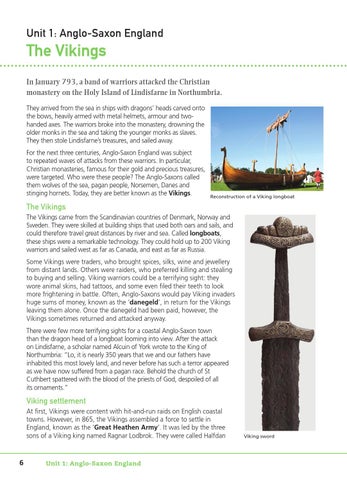
A reconstruction of a Viking longboat Reconstruction of a Viking longboat
The Vikings The Vikings came from the Scandinavian countries of Denmark, Norway and Sweden. They were skilled at building ships that used both oars and sails, and could therefore travel great distances by river and sea. Called longboats, these ships were a remarkable technology. They could hold up to 200 Viking warriors and sailed west as far as Canada, and east as far as Russia. Some Vikings were traders, who brought spices, silks, wine and jewellery from distant lands. Others were raiders, who preferred killing and stealing to buying and selling. Viking warriors could be a terrifying sight: they wore animal skins, had tattoos, and some even filed their teeth to look more frightening in battle. Often, Anglo-Saxons would pay Viking invaders huge sums of money, known as the ‘danegeld’, in return for the Vikings leaving them alone. Once the danegeld had been paid, however, the Vikings sometimes returned and attacked anyway. There were few more terrifying sights for a coastal Anglo-Saxon town than the dragon head of a longboat looming into view. After the attack on Lindisfarne, a scholar named Alcuin of York wrote to the King of Northumbria: “Lo, it is nearly 350 years that we and our fathers have inhabited this most lovely land, and never before has such a terror appeared as we have now suffered from a pagan race. Behold the church of St Cuthbert spattered with the blood of the priests of God, despoiled of all its ornaments.”
Viking settlement At first, Vikings were content with hit-and-run raids on English coastal towns. However, in 865, the Vikings assembled a force to settle in England, known as the ‘Great Heathen Army’. It was led by the three sons of a Viking king named Ragnar Lodbrok. They were called Halfdan
6
Viking sword
Unit 1: Anglo-Saxon England
95267_P002-015.indd 6
01/08/16 2:31 PM