Sailing to India
21.3.1
True or not, it was clear from Marco Polo’s stories that a great prize lay in wait for the first European merchant to establish a trading route with East Asia by sea. However, a large obstacle lay in the way: Africa. Navigation had slowly been improving during the medieval period, with the magnetic compass being used from the 13th century onwards. This, and the rediscovery of a description of world geography by the Greek astronomer Ptolemy, inspired an increased interest in sea exploration amongst Europeans. The keenest medieval explorers were the Portuguese. Throughout the 15th century, Portuguese sailors travelled further and further down the west coast of Africa. None, however, was able to round the treacherous Cape of Good Hope at the tip of the African Continent, and sail on to India. None, that was, until the Portuguese explorer Vasco da Gama, who was chosen to lead an expedition to India in 1497. On 8 July his fleet of four ships and 170 men left Lisbon. Almost one year later, he landed at Calicut in India, where they met the local king and exchanged European goods for a selection of Indian spices. After a horrendous journey home through the Indian monsoon, da Gama landed in Lisbon on 10 July 1499. Only 54 of his men had survived, but that did not matter to da Gama; he had become the first European to successfully sail to, and trade with, India. In the years that followed, Portuguese sailors established a permanent trading post in Calicut, and terrorised the Muslim merchants who had previously dominated Indian Ocean trade. A new age of trade, colonies and empire was being born in Europe.
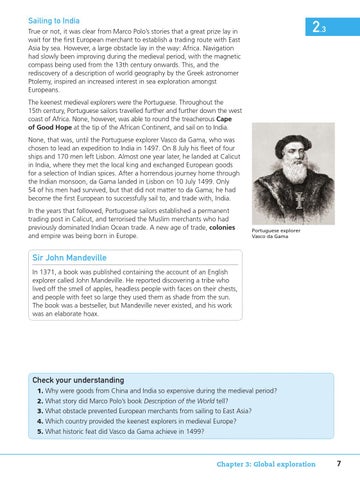
Portuguese explorer Vasco da Gama
Sir John Mandeville In 1371, a book was published containing the account of an English explorer called John Mandeville. He reported discovering a tribe who lived off the smell of apples, headless people with faces on their chests, and people with feet so large they used them as shade from the sun. The book was a bestseller, but Mandeville never existed, and his work was an elaborate hoax.
Check your understanding 1. Why were goods from China and India so expensive during the medieval period? 2. What story did Marco Polo’s book Description of the World tell? 3. What obstacle prevented European merchants from sailing to East Asia? 4. Which country provided the keenest explorers in medieval Europe? 5. What historic feat did Vasco da Gama achieve in 1499?
Chapter 3: Global exploration
95366_P002-015.indd 7
7
01/08/16 3:01 PM