Unit 2: The age of encounters
The Italian Renaissance Compared with the scholars of the Islamic world, and the scientific advances of the Song dynasty in China, Europe was not at the forefront of advancing human knowledge during the medieval period. This situation began to change during the 15th century. Starting in Italy, Europeans took a new interest in the cultural achievements of their classical forebears – the Ancient Greeks and Romans. While much classical writing had been forgotten within medieval Europe, it was kept alive by the scholars of the Islamic world and the Byzantine Empire. Due to the increased contact with the Islamic world during the Crusades, and the fall of Constantinople in 1453 (see box), classical drama, poetry, science, mythology, philosophy and political thought began to find its way back into Europe. This led to a period of extraordinary artistic and cultural flourishing in Europe known as ‘the Renaissance’, meaning ‘rebirth’ in French.
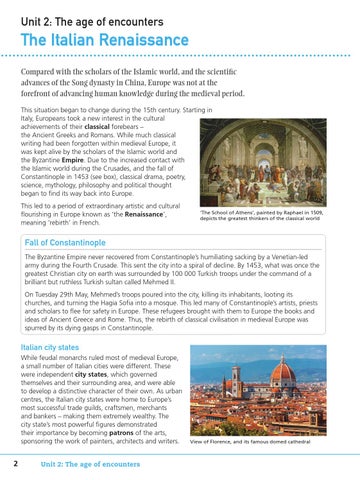
‘The School of Athens’, painted by Raphael in 1509, depicts the greatest thinkers of the classical world
Fall of Constantinople The Byzantine Empire never recovered from Constantinople’s humiliating sacking by a Venetian-led army during the Fourth Crusade. This sent the city into a spiral of decline. By 1453, what was once the greatest Christian city on earth was surrounded by 100 000 Turkish troops under the command of a brilliant but ruthless Turkish sultan called Mehmed II. On Tuesday 29th May, Mehmed’s troops poured into the city, killing its inhabitants, looting its churches, and turning the Hagia Sofia into a mosque. This led many of Constantinople’s artists, priests and scholars to flee for safety in Europe. These refugees brought with them to Europe the books and ideas of Ancient Greece and Rome. Thus, the rebirth of classical civilisation in medieval Europe was spurred by its dying gasps in Constantinople.
Italian city states While feudal monarchs ruled most of medieval Europe, a small number of Italian cities were different. These were independent city states, which governed themselves and their surrounding area, and were able to develop a distinctive character of their own. As urban centres, the Italian city states were home to Europe’s most successful trade guilds, craftsmen, merchants and bankers – making them extremely wealthy. The city state’s most powerful figures demonstrated their importance by becoming patrons of the arts, sponsoring the work of painters, architects and writers.
2
View of Florence, and its famous domed cathedral
Unit 2: The age of encounters
95366_P002-015.indd 2
01/08/16 2:59 PM