4.
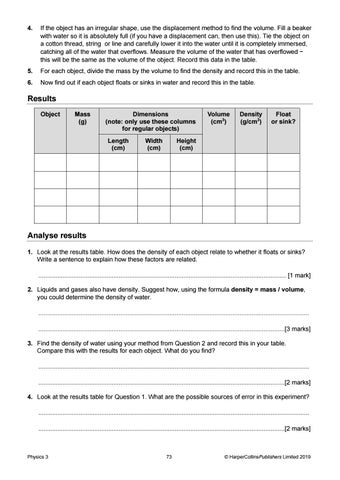
If the object has an irregular shape, use the displacement method to find the volume. Fill a beaker with water so it is absolutely full (if you have a displacement can, then use this). Tie the object on a cotton thread, string or line and carefully lower it into the water until it is completely immersed, catching all of the water that overflows. Measure the volume of the water that has overflowed − this will be the same as the volume of the object. Record this data in the table.
5.
For each object, divide the mass by the volume to find the density and record this in the table.
6.
Now find out if each object floats or sinks in water and record this in the table.
Results Object
Mass (g)
Dimensions (note: only use these columns for regular objects) Length (cm)
Width (cm)
Volume (cm3)
Density (g/cm3)
Float or sink?
Height (cm)
Analyse results 1. Look at the results table. How does the density of each object relate to whether it floats or sinks? Write a sentence to explain how these factors are related. .............................................................................................................................................. [1 mark] 2. Liquids and gases also have density. Suggest how, using the formula density = mass / volume, you could determine the density of water. ........................................................................................................................................................... .............................................................................................................................................[3 marks] 3. Find the density of water using your method from Question 2 and record this in your table. Compare this with the results for each object. What do you find? ........................................................................................................................................................... .............................................................................................................................................[2 marks] 4. Look at the results table for Question 1. What are the possible sources of error in this experiment? ........................................................................................................................................................... .............................................................................................................................................[2 marks]
Physics 3
73
Š HarperCollinsPublishers Limited 2019