Y D U T S E S A C ABOUT THE SCHOOL Field Court Junior Academy is a three-form entry junior school in Quedgeley near Gloucester. It was judged as Outstanding by Ofsted in 2014. There are 360 children in Years 3- 6, described as S.T.A.R.S. in the making: S– Self-Confident, T– Trustworthy, A– Aspirational, R– Resilient, S– Socially Minded. Field Court Junior Academy began teaching with Snap Science in September 2024. At the end of summer term 2025, we interviewed Sam Conway, Curriculum Leader and Lucy Daniels, Subject Leader for Science.
Safeguarding Policy Statement (October 2024)
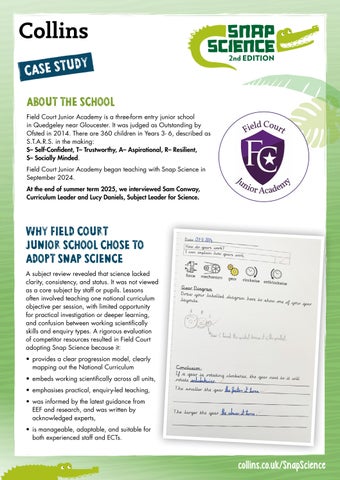
WHY FIELD COURT JUNIOR SCHOOL CHOSE TO ADOPT SNAP SCIENCE A subject review revealed that science lacked clarity, consistency, and status. It was not viewed as a core subject by staff or pupils. Lessons often involved teaching one national curriculum objective per session, with limited opportunity for practical investigation or deeper learning, and confusion between working scientifically skills and enquiry types. A rigorous evaluation of competitor resources resulted in Field Court adopting Snap Science because it: • provides a clear progression model, clearly mapping out the National Curriculum
The purpose and scope of this policy statement
Field Court Junior Academy works with children and families as part of its activities. The Academ ultimately an educational establishment but equally our mission is for all children to be ‘STARS in making’ (Self-confident, Trustworthy, Aspirational, Resilient and Socially-minded). The Academy also committed to supporting young people and families with offers of Early Help – working with partners to help children, young people and families deal with their issues as early as possible; providing information, advice and services at the right time; supporting them to resolve their concerns as soon as needs emerge. The purpose of this policy statement is: • •
to protect children and young people who receive Field Court Junior Academy’s services. to provide parents, staff and volunteers with the overarching principles that guide our approach to child protection.
This policy statement applies to anyone working on behalf of Field Court Junior Academy includin senior leaders and the board of trustees, staff, volunteers, sessional staff, agency staff and stude
Legal framework
This policy has been drawn up on the basis of legislation, policy and guidance that seeks to prote children in England. A summary of the key legislation and guidance is available from www.nspcc.org.uk/childprotection. 1
• embeds working scientifically across all units, • emphasises practical, enquiry-led teaching, • was informed by the latest guidance from EEF and research, and was written by acknowledged experts, • is manageable, adaptable, and suitable for both experienced staff and ECTs.
collins.co.uk/SnapScience
HOW FIELD COURT JUNIOR SCHOOL USE SNAP SCIENCE Snap Science is now the core of the science curriculum. All planning begins with the Snap Science materials. Modules are adapted slightly to suit local context and linked with other curriculum areas – for example, DT in Year 5 forces. “We used the staff meeting CPD resources provided, and gave teachers time to plan collaboratively in Year groups – planning from the scheme was CPD in itself.” Each lesson provides clear objectives, working scientifically skills, and a question-led approach that helps structure both teaching and reflection on learning. Teachers use and adapt the provided PowerPoints and supplement them with school-designed ‘power-up’ tasks to revisit prior learning. Assessments are tailored in-house, using checks aligned with Snap Science’s learning intentions. Working scientifically is tracked using a spreadsheet based on the Snap Science model, with a focus on identifying pupils who need support or who missed certain activities. “Before Snap Science, teachers tried to cover whole objectives in one lesson. Now, we see that some objectives need multiple lessons. The Snap Science progression document clarified this for us.”
WHAT TEACHERS AT FIELD COURT JUNIOR SAY ABOUT SNAP SCIENCE The benefits for teachers have been substantial. Confidence has increased, particularly among less experienced staff. The scheme reduces planning workload and builds subject knowledge through its structured, research-informed approach. Teachers have a clear sense of progression and know which objectives to prioritise or avoid – reducing overteaching and misconceptions. The materials are flexible enough to allow experienced staff to make adaptations while still providing strong guidance for ECTs. “Snap Science has a spiral curriculum – e.g., Year 6 light links back to Year 3 sound. It connects topics so children build knowledge and skills progressively.” Assessment is practical and manageable. Rather than relying on generic tests, staff use observation, work scrutiny, and formative endof-unit checks to determine pupil understanding. These assessments also feed directly into lesson starters and revisit content strategically. Lessons are inclusive. Snap Science avoids assumptions about home background. All children can access learning regardless of prior experience, thanks to clear modelling
collins.co.uk/SnapScience
and scaffolded vocabulary. The use of visual word maps supports all learners, especially EAL pupils, and supports the development of oracy. Oracy is embedded across Snap Science. Lessons are structured around question-led learning, and pupils are regularly asked to discuss their ideas, explain their reasoning, and reflect on what they’ve learned. Reflective tasks at the end of each lesson consolidate understanding and provide teachers with valuable formative insight. The design of Snap Science promotes sustainability. Lessons require minimal consumable resources and encourage reuse of materials. “We reuse materials, avoid single-use plastics, and compost organic matter. The scheme is practical without being wasteful.” Teachers particularly value the progressive teaching of scientific vocabulary. Snap Science defines key Tier 2 and Tier 3 words appropriately, enabling teachers to build language systematically across the key stage. Teachers have developed vocabulary aids have been developed and are displayed prominently in classrooms to support retrieval. “Staff confidence and enthusiasm have grown hugely. Science now has a buzz – teachers know they’re delivering high-quality lessons, and Ofsted confirmed this.”
collins.co.uk/SnapScience
HOW HAS SNAP SCIENCE CHANGED CHILDREN’S LEARNING OF SCIENCE? Snap Science has transformed the way science is experienced by pupils. Science is now a subject children look forward to. Lessons are filled with practical activity – from making a model of blood to filming melting ice gloves – and reallife examples that deepen understanding. Learning is secure and enjoyable. When asked what they thought of science, pupils responded immediately, ‘We love it!’ They could articulate what they had learned, describe their favourite units, and link science to other areas of the curriculum. “If I know it’s science the next day, I’m really excited to come to school because it’s science and we get to learn loads of experiments and how they work. We learn the reasons behind what is happening.” Snap Science has supported Field Court Junior Academy in raising science’s status across the school. “Science is now a core subject again.” Staff now have the tools to teach science with clarity and confidence. Children engage deeply with the subject and are excited by practical, investigative learning. The scheme’s emphasis on depth, clarity, progression, and inclusion has transformed the quality and consistency of science provision.
SNAPSHOT 1: WHO AM
Year 6, Modu le 1: Class ification of living
I?
things, Lesso n
4
Ball games
www.colli ns.co
www.collins.co.uk
© HarperCollinsPublish
.uk © Harp
erCo llinsP
ublis hers
Limit ed
2023
Scan here to find out more and sign up for a free trial.
ers Limited 2023
collins.co.uk/SnapScience