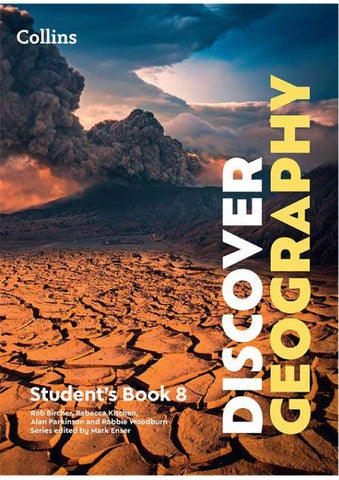
Discover Geography SB8 Sample

Page 1


Why do some volcanic eruptions cause more destruction than others?

Chapter overview

Why are you studying this?

There are around 1900 active volcanoes on Earth. Some erupt almost continuously, while others may go hundreds of years between eruptions. Volcanoes can cause great destruction and loss of life, but they can also benefit those who live nearby. This chapter will explore volcanoes in several locations and act as a reminder that humans should manage their interactions with natural processes.

Skills

In this chapter, you will learn about:

• using a range of mapping tools to investigate different types of volcanoes and their global location along plate boundaries

• the idea of risk and how to communicate this in different ways

• creating and interpreting infographics

• drawing field sketches.

Learning outcomes

By the end of this chapter, you will understand:

• that volcanoes can be classified in different ways

• why volcanoes occur where they do, and the link with tectonic plates and the boundaries between them

• the different impacts that eruptions can have on human ac tivity, both positive and negative, and how those might be measured, and mitigated

• that volcanoes can bring benefits as well as cause problems

• why people live alongside volcanoes despite the risks they pose.

What are the connections?

In Chapter 2, you will look at how the Earth is structured and learn about tectonic plates, how they move and how they are connected to volcanoes. Volcanic soils are particularly fertile: as you saw in Discover Geography 7, Chapter 5, the islands of Indonesia benefit from these. In Chapters 5 and 6, you will look at economic growth and how this is related to the physical landscape of a country.

1 Why do some volcanic eruptions cause more destruction than others?

ā–² Figure 1.1 Locations you will visit in this chapter: New Zealand, Iceland, USA, Japan, Indonesia.

Where are you going?

Although volcanic activity occurs globally, this chapter focuses on specific communities that live within the shadow of volcanoes, or which benefit from proximity to plate boundaries, for example Iceland and New Zealand. The Icelandic landscape was produced by volcanic activity, and its inhabitants enjoy accessible energy and a tourism industry which is the largest economic sector.

Why are volcanoes important?

Volcanoes are among the most dramatic landscape features. They are important for all life on Earth. Volcanic activity has shaped around 80% of the Earth’s surface and helped to produce

the air you breathe. Some countries were created entirely by volcanoes, and their inhabitants now benefit from geothermal heat close to the surface due to their location on the edge of one of the Earth’s great tectonic plates.

1 Why do some volcanic eruptions cause more destruction than others?

Discuss

1 Why are volcanoes located where they are?

2 How do volcanoes vary in their nature? Some are more dangerous than others, but how do volcanoes differ in other ways?

3 What are some of the ways that communities around the world

a are negatively affected by volcanic activity b benefit from volcanic activity?

Some notable historic eruptions are listed below.

• Mount Vesuvius: Italy, 79 CE – buried the towns of Pompeii and Herculaneum under ash

• Mount PelĆ©e: St Pierre on Martinique, 1902 – 28 000 people died in the city

• Mount St Helens: USA, 1980 – a lateral blast

• Nevado del Ruiz: 1985 – 25 000 killed by a lahar

• Mount Pinatubo: 1991 – the second-largest eruption of the 20th century

Figure 1.2 The ruins of Pompeii lie below Mount Vesuvius. Figure 1.3 The eruption of Mount St Helens, 1980.

What are volcanoes and how are they distributed?

This lesson explains what volcanoes are, and why they are found in particular locations linked to the boundaries between the world’s tectonic plates. The distribution of volcanoes is not even, and they are often found in the most densely populated parts of the world, despite the risks they pose.

What are volcanoes?

Volcanoes are openings in the Earth’s outermost layer (the crust) through which rock, possibly molten, reaches the surface. They may be single openings (vents), rows of vents or long cracks (fissures), up to several kilometres long. Eruptions occur when magma (rock at temperatures between 700 °C and 1400 °C ) comes to the surface.

The Earth’s crust is split into pieces, which may be the size of continents. These are called tectonic

plates. They are made of either dense (and thinner) oceanic crust, or less dense (and thicker) continental crust. The plates move.

Volcanoes are located along plate boundaries, where material from the mantle below can find a way to the surface, often along divergent plate boundaries.

ā–² Figure 1.4 Map showing the location of the Earth’s volcanoes.

1 Why do some volcanic eruptions cause more destruction than others?

What are mantle plumes or hot spots?

When hot material in the Earth’s mantle rises to the surface because of its low density it forms a mantle plume or hot spot. If there is a gap in

the crust or a weak point, the hot material from the mantle will push through and cause volcanic activity.

Key terms

Divergent plate boundary: Also called a constructive boundary or margin – where two plates are moving apart.

Magma: Molten rock beneath the Earth's surface.

Mantle: The layer beneath the Earth’s crust.

Mantle plume: A huge, rising column of heated rock in the upper mantle which can trigger volcanic activity on the surface.

Tectonic plates: Sections of the Earth’s crust which move slowly.

Activities

1 What is a volcano?

2 What are two differences between oceanic and continental crust?

3 Using an online map, investigate the Mid-Atlantic Ridge. This is part of the longest mountain range in the world. What countries and islands lie along the ridge?

4 What makes the location of Iceland particularly interesting?

5 Some books will use the words ā€œasthenosphereā€ and ā€œlithosphereā€ instead of crust and mantle. Find out what these words mean.

ā–² Figure 1.5 Map showing the location of the major mantle plumes.
Tectonic plates
Mantle plumes
Key
Afar
Reunion
Louisville
Easter
Tristan
Samoa
Caroline
Iceland
Hawai'i

How can volcanoes be classified? 1.2

Some volcanic eruptions only cause destruction near the volcano, while others have an impact on places far away. Some produce fast-flowing lava, while others throw ash high into the atmosphere. This lesson explores the different ways we can classify volcanoes.

What different ways can we use to classify volcanoes?

All volcanoes are unique, but they can be grouped according to:

• their form (or structure)

• the material involved in their eruptions:

• when less viscous basaltic magmas reach the surface, their dissolved gases escape easily, and lava flows smoothly – these eruptions are described as effusive

• when more viscous magmas (such as andesite) reach the surface, their dissolved gases cannot escape as easily, so pressure builds up until an explosive eruption occurs, which throws material upwards (or sideways) with great force

• the size of the eruption

• their level of activity.

What different forms can volcanoes take?

There are three main types of volcanoes, depending on their structure:

Cinder cones

These are made from loose material thrown out from a volcano, which cools down quickly. They have conical shapes and steep slopes. They may have a bowl-shaped crater where the vent is located.

Stratovolcanoes

These are made from ash and lava which have built up over lots of eruptions over a long period. They are conical in shape, but overall height and shape depends on lava viscosity.

Shield volcanoes

These are low lying and made from less viscous lava which flows quickly away from the vent. They are large, and resemble a shield placed on the ground, but can still be high if sufficient lava emerges, as with Mauna Loa, Hawai’i.

ā–² Figure 1.6 Mount Batok, Java, Indonesia – a cinder cone.
ā–² Figure 1.7 Mount Chimborazo, Ecuador – a stratovolcano.
ā–² Figure 1.8 Mauna Loa, Hawai'i – a shield volcano.

1 Why do some volcanic eruptions cause more destruction than others?

What material is involved in volcanic eruptions?

Volcanoes can be classified by the material produced in the eruption.

• Effusive eruptions involve magma reaching the surface, where it is cools and becomes lava. Viscous magma can form a dome near the vent.

• Phreatic eruptions produce tephra (ash, pumice or cinders) and often involve magma meeting water.

• Gaseous eruptions may emit sulphurous gases and steam, sometimes from beneath crater lakes.

How do we measure the size of volcanic eruptions?

Key terms

Lava: Molten rock after it has reached the Earth’s surface.

Viscosity: The thickness of lava, which determines how far it flows from the vent before cooling.

Viscous: Thick and sticky.

Eruptions are measured on an eight-point scale: the Volcanic Explosivity Index (VEI), which measures the amount of material emitted and the height any ash cloud reaches. A VEI of 6 is a significant eruption, and any that reach 8 have the potential to cause regional problems.

Active, dormant or extinct?

Volcanoes can be classified according to how recently they have erupted, and how likely they are to erupt again. Volcanoes may be:

• extinct (not expected to erupt again), e.g. the volcano on which Edinburgh Castle (Scotland) sits

• dormant (not erupted for thousands of years), e.g. Mount Fuji, Japan

• active (erupted in the last few thousand years), e.g. Mount Nyiragongo, Democratic Republic of the Congo.

Dormant volcanoes may be long-term dormant, potentially active (which means they may erupt again) or restless (which means they are showing signs of becoming active again.

Activities

1 Explain how the viscosity of the lava produced in an eruption influences the shape of the volcano that is formed.

2 Draw a sketch of a typical cinder cone and label the crater and vent. Name at least two examples along with their locations.

3 If a volcano is described as dormant, what does that mean? Is it safe to live on its slopes?

4 How does the VEI measure the size of a volcanic eruption?

5 Investigate some recent volcanic eruptions. Can you find any that are VEI 6 or over?

ā–² Table 1.1 The Volcanic Explosivity Index (VEI).

How do volcanic eruptions vary in nature?

Every volcano is unique. Although you may imagine flowing lava from a pointed mountain peak, eruptions may involve gas, lava of differing viscosities, ash and other tephra.

How do volcanic eruptions vary?

All eruptions are the result of a magma chamber beneath the surface. This magma may reach the surface before it cools, or it may cool down while still underground. The heat may interact with ice from a glacier covering the summit (for example, Nevado del Ruiz or Eyjafjallajƶkull) to produce meltwater which may flow some distance from the volcano.

The force of an eruption may be vertical (upwards) or lateral (sideways).

Volcanic eruptions involve three types of material:

• Gases – often sulphurous, and contained within the lava or beneath crater lakes.

• Lava flows – rock that has reached the surface. The speed at which it flows depends on its viscosity.

• Tephra (also called pyroclasts) – fragmented materials emitted from an explosive volcanic eruption. These vary in size from ash to large boulders.

What are the different types of lava?

The rate at which a lava flow cools produces a variety of rock types and landforms.

• Basaltic lava – generally dark, very hot and flows easily due to low viscosity.

• Pahoehoe (a Hawai’ian term – also called ropy lava) – formed when basaltic lava cools (Figure 1.9).

• Aa – a rough jagged surface formed when viscous lava cools (Figure 1.10).

• Pillow lavas – formed where lava emerges underwater and cools rapidly.

Over time, lavas break down to create mineral-rich fragments.

What are the different sizes of tephra?

Tephra can include:

• pumice – which can float on water

• fine ash

• lapilli – medium-sized fragments including pumice, which are deposited close to the vent

• volcanic bombs (or blocks) – thrown a short distance from the vent, but may roll down steep slopes.

Figure 1.9 Pahoehoe lavas at Thingvellir, Iceland.
Figure 1.10 Sharp Aa lava on the slopes of Mount Etna, Sicily, Italy.

1 Why do some volcanic eruptions cause more destruction than others?

Ash can be thrown upwards into the stratosphere (7–20 km above the Earth’s surface) where high-level winds carry it thousands of kilometres. Ash from the eruption of Mount Pinatubo in 1991 led to global cooling of 0.5 °C for at least 18 months by reflecting back the Sun’s energy. It can also pollute water supplies, damage crops and cause transport issues.

When ash is thrown out from an eruption the distance it travels depends on the wind speed and direction, the height it reaches and the size of the ash particles. Isopach maps depict lines of equal thickness (in cm or mm) of a tephra fall deposit. They are like contour lines for height, or isobars for atmospheric pressure on weather charts. The isopach map in Figure 1.11 shows deposits from an eruption in centimetres. Notice that the ash is a metre deep near the vent, and shallower with increasing distance from it.

Activities

1 Define the term tephra.

2 Place the following material sizes into the appropriate classification of tephra:

a fine material 0.05 mm in diameter

b a large piece of lava 3 m in diameter

c fine material 1.5 mm in diameter

d a sharp-edged piece of lava 6 mm in diameter.

3 Describe the effect an eruption with a large Volcanic Explosivity Index has on places a long way from the volcano

4 Look at the isopach map in Figure 1.11.

a What was the wind direction when the eruption took place?

Key term

Pyroclasts: Material thrown out by a volcano (the name means fiery broken stones).

b How far away from the vent was the furthest point that had 10 cm of ash deposited on it?

ā–² Table 1.2 A classification of tephra by size.
ā–² Figure 1.11 An isopach map of ash fall following an eruption.

Turn static files into dynamic content formats.
CreateĀ aĀ flipbook
Issuu converts static files into: digital portfolios, online yearbooks, online catalogs, digital photo albums and more. Sign up and create your flipbook.