Numbers and the number system
More and less
Solving mathematical problems
Challenge
Ordering numbers
Numbers and the number system
Solving mathematical problems
Challenge
Write an addition or subtraction calculation for each of these statements. 40 more than 6472 is 6512.
500 more than 4791 is 5291.
3000 less than 9465 is 6465.
600 less than 2351 is 1751.
70 less than 298 is 228.
0
8000 more than 1506 is 9506.
4
What patterns do you notice?
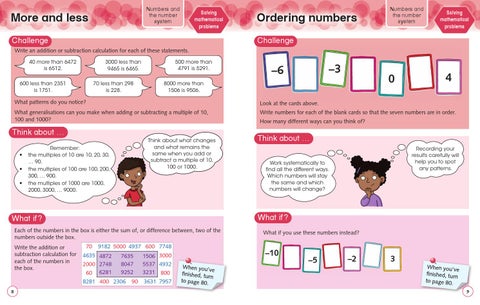
Look at the cards above.
What generalisations can you make when adding or subtracting a multiple of 10, 100 and 1000?
Write numbers for each of the blank cards so that the seven numbers are in order.
Think about … • • •
Think about what changes and what remains the same when you add or subtract a multiple of 10, 100 or 1000.
Remember: the multiples of 10 are 10, 20, 30, … 90. the multiples of 100 are 100, 200, 300, … 900. the multiples of 1000 are 1000, 2000, 3000, … 9000.
Each of the numbers in the box is either the sum of, or difference between, two of the numbers outside the box. Write the addition or subtraction calculation for each of the numbers in the box.
How many different ways can you think of?
Think about … Recording your results carefully will help you to spot any patterns.
Work systematically to find all the different ways. Which numbers will stay the same and which numbers will change?
What if ?
What if ?
70
9182 5000 4937 600 7748
4635 4872 2000 2748 60 6281
7635 8047 9252
8281 400 2306 8
–3
–6
90
1506 3000 5537 4932 3231 800 3631 7957
What if you use these numbers instead?
–10 When you’v e finished, tur n to page 80.
–5
–2
3 When you’v e finished, tur n to page 80. 9
Numbers and the number system
Nearest to 10, 100 and 1000
Solving mathematical problems
Making numbers Challenge
Challenge Ch halleng g ge
6200 6250
Deal the top four cards and place them face up on the table. Use these digit cards to make 24 different 4-digit numbers.
400
Order your numbers from smallest to largest. Then round each number to the nearest multiple of 10. 4
Which numbers round to 6250 when rounded to the nearest 10 and 6200 when rounded to the nearest 100?
7
350
2
Think about … Think carefully about the largest and smallest numbers you think will fit, and then try the numbers 1 more and 1 less to check.
Remember, your numbers must round to both the nearest 10 and 100, and in ‘the What if?’ question to both the nearest 100 and 1000.
Think about … Record your work systematically to help you find the 24 different 4-digit numbers.
What if ?
10
Solving mathematical problems
You will need: • set of 1–9 1– digit cards
Shuffle a set of 1–9 digit cards.
Investigate which numbers round to 350 when rounded to the nearest 10 and 400 when rounded to the nearest 100.
What if the numbers round to 6600 when rounded to the nearest 100?
Numbers and the number system
7000
Think about representing your ordered and rounded numbers on number lines.
What if ?
6600 When you’v e finished, tur n to page 80.
Round each of your 24 numbers to the nearest multiple of 100.
When you’v e finished, tur n to page 80. 11
Fractions of amounts Challenge halleng g
0
2 3 4 5 6 7 8 9
Choose four of the remaining digit cards to complete the fraction statement.
1
Think about … Use what you know about the multiplication and division facts for the multiplication tables up to 10 × 10 to help you.
×
What other different fraction statements can you make?
When you’ve found one fraction statement, think about how you can use it to make other statements.
Avoid making fractions with 6, 7 or 8 as the denominator (the bottom part of a fraction that shows the number of equal parts the whole is divided), e.g. 16, 17, 18.
What if you choose five of the remaining digit cards to complete this fraction statement? What if you choose five digit cards to complete this fraction statement?
12
You will need: • set of 0–9 digit cards
In each statement, you can only use each digit card once.
=
What if ?
What if you choose six digit cards to complete this fraction statement?
Solving mathematical problems
×
1
×
=
Numbers and the number system
Making decimals Challenge
Solving mathematical problems
You will need: • set of 0–9 digit cards
Shuffle a set of 0–9 digit cards. Deal the top three cards and place them face up on the table. How many different decimals can you make using these digit cards? Order your decimals from smallest to largest. Repeat twice, choosing three different cards each time.
1 58
Numbers and the number system
Think about … Record your work systematically to help you find decimals with 1 and 2 decimal places.
Think about representing your ordered decimals on number lines.
=
What if ? ×
=
When you’v e finished, tur n to page 80.
What statements can you make using the < and > signs to compare pairs of decimals?
When you’v e finished, tur n to page 80. 13