Halloween Photo Essay: City College students show school spirit [page 8]
Q. Since the economic crisis, what expenses have you had to cut back on?
02
[ page 3 ]
Weather
2 Wed 74
52°F
3 Thu 4 Fri
68 52°F 58° 47°F
5 Sat 6 Sun
61° 44°F
A Mother’s Concern: City 12 student’s son 9 3 63° being sent to 6 53°F Afghanistan Daylight standard time begins [page 6]
Los Angeles
Wednesday | November 2, 2011
The Voice of Los Angeles City College Since 1929
NEWS BRIEFS
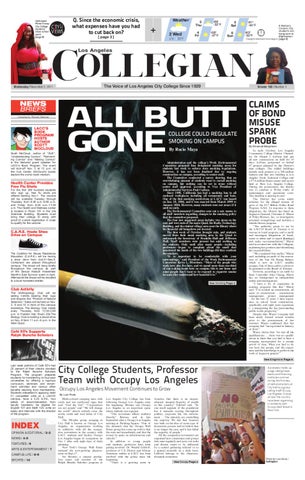
ALL BUTT GONE
Compiled by Richard Martinez
LACC’S BOOK PROGRAM HOSTS AUTHOR SCOTT MCCLOUD Scott McCloud, author of “Zot!!”, “Understanding Comics”, “Reinventing Comics” and “Making Comics” is the featured guest speaker for LACC’s Book Program. The event will kick-off Nov. 2 at 12 p.m. at the Cub Center. McCloud’s books explore the comic book medium.
Volume 165 | Number 4
COLLEGE COULD REGULATE SMOKING ON CAMPUS By Rocio Maya
Administration and the college’s Work Environmental Committee proposed four designated smoking areas for students last week to enforce state smoking regulations. However, it has not been finalized due to ongoing construction on campus, according to senior staff. The Committee conducted a survey showing that an overwhelming amount of students want to curtail smoking on campus, but nothing can be set in stone without senior staff approval, according to Vice President of Administrative Services Paul Carlson. Since 1995, California has had a smoking ban in all enclosed workplaces including all restaurants and bars. One of the first smoking restrictions at LACC was issued on Jan. 10, 1986, and it was enacted from March 1999 to January 2004. However, many students were not aware if it until recently. The Environmental Committee sent out a new memo to all staff members regarding changes in the smoking policy that the committee proposed. The four new suggested areas include: two areas on the east and west ends of the main Quad, the Radio Technology Building, and the student village area near the library where the financial aid bungalows are located. The first week of October brought rain, and students moved from their usual smoking area in the Quad to underneath the breezeway of Franklin Hall and Jefferson Hall. Staff members were present but said nothing to the students. Only until after many people—including professors—began to complain about the smell that penetrated the inside of the two buildings did they confront the smokers. “It is important to be comfortable with your surroundings,” said President of the Work Environmental Committee Kevin L. Morrissey. “Most of the people who work here also live here, and we spend more than one-third of our waking hours here on campus; this is our home and some people don’t want to be exposed to cigarette smoke because they understand how harmful it is.”
Health Center Provides Free Flu Shots
For the first 200 hundred students who sign up, free flu shots are offered starting Nov.1. The vaccine will be available Tuesday through Thursday from 8:30 a.m.-5:00 p.m. and Friday from 8:30 a.m.-11:00 a.m. The Health and Wellness center is located in Room 101 in the Life Sciences Building. Students must bring their college ID along with proof of current registration in order to qualify for the vaccine.
C.A.R.E. Hosts Shoe Drive on Campus
The Coalition for Abuse Resistance Education (C.A.R.E.) will be having a shoe drive from Oct.21-Dec.9. Containers are placed throughout campus. The shoes will hang briefly throughout the campus as part of the Sexual Assault Awareness Month’s Sole Survivor event in April. Afterwards the shoes will be donated to a local homeless shelter.
See Smoking Page 5
Club Activity
The Anthropology Club will be selling t-shirts bearing their logo and slogans like “Product of Natural Selection.” Sales will be held on Nov. 2, 9 and 16 in front of the campus bookstore. The Biology Club meets every Thursday from 12:30-2:00 p.m. in Franklin Hall, Room 224.The Biology Club is hosting a blood drive on Nov. 8 from 11 a.m.-6 p.m. in the Main Quad.
Café 50’s Supports Ralph Bunche Scholars
CLAIMS OF BOND MISUSE SPARK PROBE By Emanuel Bergmann
In early October, Los Angeles Community College District Chancellor Dr. Daniel J. LaVista had put all new construction on hold for 30 days. LaVista postponed or halted 67 projects planned by the District’s nine colleges. The stalled buildings include such projects as a $38-million fashion and fine arts building at Los Angeles Trade Technical College and a $7.4-million fitness center and sports field at West Los Angeles College. During the moratorium, the district was to conduct a 30-day study of maintenance and operations costs. This deadline is nearing its end. The District has come under criticism for the alleged misuse of parts of the $5.7 Billion Dollar Bond Program A/AA. In response to these allegations, the District has hired an Inspector General, Christine E. Marez of Policy Masters, Inc., to investigative potential wrongdoings and institute a whistle-blower program. “The authority given to me by the LACCD Board of Trustees is to oversee its bond program, and to audit and investigate allegations of fraud, waste or abuse and to report [findings] and make recommendations,” Marez said in an interview with the Collegian, explaining her position and identifying her responsibilities. “We completed four audits,” Marez said, including an audit of the renovation of the Van De Kamp Bakery, which is now an LACC satellite campus. One of these audits is about to be presented to the Board of Trustees. However, according to an audit by State Controller John Chiang, Marez has no background in independent audits and investigations. “I have a lot of experience in creating programs like this,” Marez said. “I’ve worked on construction, all areas of construction – construction management, project management – for the last 12 years. I have experience in school bond construction, specifically, and eight years experience […] interpreting the law [surrounding public works programs].” Despite that, Marez’ company had been newly formed several months prior to the procurement of her contract. Marez confirmed that her company had “incorporated in January of 2010.” Marez claims that “we met all the qualifications … there was no qualification in there that you had to have a company incorporated for a certain period of time. What you had to do was have the people, and the experience and the knowledge to perform the work of inspector general.” See Allegations Page 5
Last week patrons of Café 50’s had 20 percent of their checks donated to the Ralph Bunche Scholars Program. The program prepares students for transferring to four-year universities by offering a rigorous curriculum, seminars and enrichment activities and various other benefits resulting from membership. Students interested in applying need 21 completed units at a LACCD campus, have a 3.25 G.P.A., two letters of recommendation from faculty members, be eligible for English 101 and Math 125, write an essay and interview with the director of the program.
INDEX OPINION & EDITORIAL / 2-3 NEWS / 4-5 FEATURES / 6 ARTS & ENTERTAINMENT / 7 CAMPUS LIFE / 8-9 SPORTS / 10
City College Students, Professor Team with Occupy Los Angeles Occupy Los Angeles Movement Continues to Grow By Luis Rivas Multi-colored camping tents with crude and wet cardboard signs that read “End the Fed,” “Corporations are not people” and “We will change the world” almost entirely cover the north, south and west lawns of City Hall. The 300-plus group camping at City Hall is known as Occupy Los Angeles, an organization working in solidarity with all the occupation movements in the country with LACC students and faculty. Occupy Los Angeles began its occupation on Oct. 1 after only eight days of daily planning. New York’s Occupy Wall Street initiated the now-growing phenomenon on Sept.17. Joe Briones, a cinema production major and member of the Ralph Bunche Scholars program at
Los Angeles City College, has been following Occupy Los Angeles since the beginning. Briones sees Occupy Los Angeles as an important space where students can organize. “This movement affects students directly,” Briones said in late September after a Occupy Los Angeles meeting at Pershing Square. “One of the demands that the Occupy Wall Street group has come up with is that the wars end immediately, and that the money be spent on infrastructure and schools.” In addition to young people and students, professors have been getting involved. Dr. Wendel Eckford, professor of U.S. History and African American studies at LACC has been involved with the group since the beginning. “There is a growing sense in
America that there is an unprecedented, unequal disparity of wealth in this country,” Eckford said. “So one small segment of the population has it tentacles moving throughout politics, corporate life, the environment … The minority are controlling the majority. We feel that America was built on the idea of some type of democratic process and we believe that is no longer the case, and it has failed the majority of people.” All the occupation movements are organized into committees and groups that meet regularly and carry out tasks and discuss issues to be addressed by a central gathering referred to as a general assembly on a daily basis. Eckford belongs to the objectivesdemands committee. See Occupy Page 4
A protestor holds up a sign calling major banks and financing institutes criminal during the first day of demonstrations at City Hall by a group calling itself Occupy Los Angeles. Groups all over the country have been organizing in solidarity with Occupy Wall Street in New York.
Photo by Luis Rivas / Collegian
02
Opinion & Editorial
Wednesday November 2, 2011
Editorial
Los Angeles | COLLEGIAN
Los Angeles
Editor-in-Chief: Tanya Flowers
Resurrecting the American Dream
Managing Editor: Luis Rivas Opinions and Editorials: Hyun Chung Arts and Entertainment: Lauren Arevalo Campus Life: Jennifer Jennings Sports: Richard Martinez Distribution Manager: Erleen Barrett Advertising: Richard Martinez Marketing: Lauren Arevalo Graphic Designer: Josue Hernandez Luis Rivas Mathew Mullins Jennifer Burgos Copy Writer: Stephen Clements Reporters: Emanuel Bergmann Erleen Barrett Hyun Chung Lauren Arevalo
Masked Occupy Los Angeles demonstrator at City Hall holds up a flag with the words: “THIS IS OUR COUNTRY! WE WILL OCCUPY IT!”
Matthew Mullins Richard Martinez
Occupy Los Angeles reflects the postmodernist, non-centralized structure of the present. No one should gripe that the movement lacks focus. Many, including the Times columnist Steve Lopez, have criticized the movement for not having centralized demands. “I’m having trouble seeing how a camp-out is going to change anything.” Public protest is an American tradition, much like the dumping of British tea not that far long in the revolutionary past. The Occupy Movement is the collective way of disseminating the message: this sucks. For weeks, Occupiers have destroyed any remnants of positive
images of banks, honed by marketing and public relations departments. In case anyone like Lopez needs to be reminded of the government bailouts of banks who screwed up the entire economy, and colleges and universities suffering from budget cuts creates the perfect storm of discontent. Those who love to point and criticize Occupy Los Angeles really need a refresher of the double standard of bailouts and austerity measures. Social mobility is an American ideal; hard work and studying hard at school will help you get out of poverty is also an American dream. If the dream is false, then what’s the point of working hard?
Whether or not the opponents of the Occupy Movement care to acknowledge, the protestors are actually trying to restore democracy and fairness back to the United States. Despite Republican naysayers, the majority of Occupiers are not un-American. They are trying to restore the possibility of social mobility, an American ideal. They are trying to restore the idea that hard work will lead to success. What is the point of studying hard at LACC if you know that you’re going to end up with loans and no jobs? The real cause of ire is the double standard: corporate bailouts and forgiveness for Wall Street versus the austerity measures and budget cuts for community college students.
Instead of judging Occupy Wall Street as a corporation lacking a unified brand image, accept it for what it is: an expression of discontent, a continuity of tradition from our revolutionary past. The Occupy Movement demands the destruction of the double standard. If the government is to hand out bailouts to banks, then everyone should get a bailout, too. If the government is to practice austerity measures, then everyone must suffer, including Wall Street. The fact that the movement is spread in so many cities, such as New York, Boston, Atlanta and even overseas, is no less than amazing. Barcelona, London, and Rome are three of the cities overseas that have
Occupy Movements, according to the Los Angeles Times’ Understanding the Occupy Wall Street Movement: A primer. For some LACC students, transferring to UCLA is a dream. Unfortunately, the contagion of budget cuts has infected public universities. The movement is not a corporation. Do not expect consistent brand imaging. It is a haphazard movement at its best. Do not expect a unified logo. Expect slight differences between Occupy Los Angeles and Occupy Wall Street in New York. But the indignation of the double standard between Wall Street and Main Street is the same.
Rocio Maya Luis Rivas Byron Umana Erleen Barret Jennifer Jennings Luis Ponce Hayden Velasquez Photographers: Luis Rivas Matthew Mullins Patrick Chong Josue Hernandez Illustrators: Cesar Anzora Jose Tobar Faculty Advisor: Rhonda Guess
Occupy Wall Street
The Inner Struggle of the American Consumer By Ilse Martinez
Jacobs sneakers. How could I have my picture taken next to my carefully thought out protest sign for the world to see when I myself am a walking billboard for at least three major corporations? I was experiencing the inner moral struggle of the American consumer. The only sit in I had ever participated in was outside a sneaker store while for a new limited edition release by Nike. I love my corporations; I love my name brands but why do they treat me this way? Have I, have we, as Americans not been so good to them? How could anyone take our cries for
When I think of my mother and father working to make ends meet, it makes my heart ache. When I meet people in their 40’s with student loan debt and still struggling in the work force, I simply feel depressed at the vision of the Christmas future. For the 99 percent, the American Dream remains just that, a dream. With my protest spirit ignited, I am overcome with the need to stand up against the greed in this world. However, the feeling of hypocrisy comes over me. I feel like a Pharisee marching down to the occupation site in a pair of two-hundred dollar Marc
change seriously when we love our oppressor so much? I found a New York Times article in the Style section that not only gave me answers but was very reassuring. They were reporting on what everyone really cares about--you know, what to wear when you’re protesting, which is vital for any young adult preparing to occupy. I need to know to wear my Nike running shoes in case the cops come and I need to flee. I absolutely need to wear my Miu Miu sunglasses to protect my eyes when they mace us. And I will be sitting there for very long time, it might get chilly at night
so I will need to bring my cashmere scarf. It’s ok, it’s Savile Row, not mass-produced. I mean these are all very important tips for a first time protester. How am I supposed to know this unless a reputable and vital source for news tells me these things? After looking through the entire article, I left with this: • What you’re protesting is almost as important as what you’re wearing to the protest. • Remember the key is to appear stylish, chic, but in an effortless urban revolutionary kind of way.
• If you can’t achieve that effortless look, just lie and say you “thrifted” everything. • If you don’t know exactly what or why you are protesting, it’s ok. You’ll make friends and someone will fill you in. • Double check your protest sign for correct spelling. You don’t want to have your picture taken with a misspelled sign. Talk about embarrassing. • And lastly don’t worry about looking a little rough. It conveys struggle and makes for a great photograph.
Construction Distractions
Los Angeles
Deadline Schedule NEXT ISSUE: November 16th Editorial deadline: November 9th For all submissions including letters to the editor and publicity releases. Advertising deadline: November 9th, Send materials to Collegian office: Chemistry 207 losangeles.collegian@gmail.com
By Na Tiyana Nelson
The noise of construction fills the halls of LACC and no student walking the grounds can dispute the overall changes the campus is undergoing. Since the passing of Proposition A/ AA in 2001 and Measure J in 2008, construction began to transform all nine of LACCD’s community colleges. When you think of school, what comes to mind is a teacher educating students in a pristine, quiet classroom. Another thought that may come to mind is a clean campus where you can sit enjoy the view, study in peace and breathe in clean fresh air. However, this isn’t always the case here at LACC. The sound of drills and jackhammers drown out voices of professors, making it almost impossible for them to teach a full lesson without the interruption of clinks and clanks. This makes it almost impossible for us, the students, to learn. Dust and debris
are also another negative side effect of the never-ending construction sites on campus. Students and staff with allergies to the dust are particularly disadvantaged. I’m sure none of us, allergies or not, enjoy breathing in the polluted air. For some time now, LACC’s campus has been going through a transformation. While I’m sure that my fellow students are eager to see how beautiful the campus will become, I’m also sure they aren’t enjoying the distraction it causes while going through the much-needed metamorphosis. The noise of the construction are very disturbing and affect me, as well as my professors. This isn’t just a problem here at LACC. Many of the nine LACCD campuses face similar challenges. Last year, the construction at West Los Angeles College was a big nuisance to students, staff and faculty alike. Not only because of the noise and
dust, the construction site appropriated an area that a lot of insects called home. So naturally, when their homes were destroyed, they migrated near classrooms. Bees and mosquitos swarmed the campus daily. I’m not suggesting that construction get cancelled; I want the campus to look just as beautiful as any other. Yet, instead of the construction going on during the day, I would suggest maybe working on the campus late at night when there aren’t any students around. Maybe construction should be planned around the needs of the students, like scheduling during the summer and winter sessions—when classes haven’t been in session because of the budget cuts. The administration must make sure that the construction does not disturb any of the classes because the reason for LACC’s existence is education.
Illustration by Cesar Anzora/Collegian
The college newspaper is published as a learning experience, offered under the college journalism instructional program. The editorial and advertising materials published herein, including any opinions expressed, are the responsibility of the student newspaper staff. Under appropriate state and federal court decisions, these materials are free from prior restraint by virtue of the First Amendment to the United States Constitution. Accordingly, materials published herein, including any opinions expressed, should not be interpreted as the position of the Los Angeles Community College District, Los Angeles City College, or any officer or employee thereof. © 2003 Collegian. No material may be reprinted without the express written permission of the Collegian.
Opinion & Editorial
Los Angeles | COLLEGIAN
Wednesday November 2, 2011
03
Compiled by Lauren Arevalo and Tanya Flowers
Q. Since the economic crisis, what expenses have you had to cut back on?
Alandra Hildreta Major - Psychology, alcohol and drug studies “I’ve been cutting back on all expenses as far as transportation, as far as my rent. Just cutting back on little odd and ends. It hasn’t affected me really hard yet but I do feel crushed. So far it’s been this semester. So far everything has started to effect me this semester. I don’t know what I have to really cut back on because it’s just not coming up.”
Andrew Ramson Major - Music
Justin Pearce Major - Transfer student to UCLA, environmental science “I can’t think of anything that “This particular semester I can’t say I haven’t cut back on, I would say. I’ve personally notice any difference. Clothes—I feel like I used to shop a I’m taking only one class now, where lot more. I definitely know [I’ve cut as I’ve taken several before. I actually back on] eating out. You know, I’ve qualify for a waiver, for a fee. But, I been trying to cook at home or I find really appreciate what I get here. And anyways I can to cut back on food I have been in long lines, from waiting expenses [while] still trying to eat lines and trying to prove my eligibility healthy.” and having the right documents, that has discouraged me enough to pay the fees.”
Marcell Coleman Nei Ho Major - American sign language deaf Major - Computer Science culture studies “Colleges are charging you $36 “I haven’t cut back on anything because I haven’t had a job for a a unit and now they’re going to be while. To be honest I haven’t cut back charging you $46 [a unit] from what I on anything because … I’ve been hear next semester, which is completely homeless. I can’t take the bus because I ridiculous. Most college students, we don’t have money for the bus. I wait for work or we live with our parents. We’re friends to help me out with food. I’m already having a hard time trying to on GR [Government Relief] but that make ends meet. And not only that, but, like, you know, school is hard as only helps me out so much. it is. You can’t go out with your friends. You can’t go have fun basically because everything costs too much. Last year, I would be going out with my friends every weekend. Every other day I would be out somewhere. And now I hang out like every two weeks.”
An eye for an eye Illustration by Jose Tobar /Collegian
By Matthew Mullins Muammar Gaddhafi, a Libyan leader was captured, tortured and shot by rebels from his own country on Oct. 20. They beat him, stabbed him, and even sodomized him with a knife. A video was released showing him in absolute misery while his people cheered. They spat on him, hit him
War... What is it good for?
with their guns and dragged him through the desert, a sight antithetical to his image during his life. Libya, the country richest in oil supply on the African continent, provided Gaddhafi with the means to indulge in conspicuous consumption. About 200 billion dollars in foreign bank accounts that he stashed
were also discovered after his death. He showed no mercy to anyone who opposed him. He had no problem throwing them in prison just for opposing the dictator. His victims included pro-democracy dissidents. No matter how evil he was and even knowing that he would have imprisoned and even possibly killed
me just for being who I am, no one deserves such a horrible and unspeakably cruel death. His face of absolute horror as he was dragged bleeding across the desert will remain in my head for the rest of my life, and as a human we should never think that murder is the appropriate answer for anyone, especially without the
By Lauren Arevalo
By Christopher Jorge
Illustration by Cesar Aznora/Collegian
On the heels of Muammar Gadhafi’s death, President Obama announced on October 21st he would begin phasing out 45,000 troops from Iraq. This move has been long awaited and for many, including myself, overdue. Our involvement in Iraq has continued, despite it being hugely unpopular. Promises to end the war had been a major component of Obama’s campaign for presidency. We thought it was a war that would end with Bush’s exit. Instead, long after Obama inherited a country mired in conflict, we saw that our troops were not brought home. The war in Iraq had become Obama’s war, too. In spite of a crippling recession
and mounting economic woes, the war in Iraq continues to be waged and young are people killed in the line of duty. At the onset of the Iraq War, it was not uncommon to see yellow ribbons tied around the trunks of trees, a symbol of support for the cause. In more recent days, those ribbons are seldom found. In its place, an air of dissent has replaced a once rosy patriotism. At the age of 21, I have lived in a country involved in war nearly half of my life. However remote the Middle East seems to a majority of Americans, the narrative of the Iraq War has played out in each of our living rooms, infiltrating our homes via television sets. The financial clinch
appropriate trial. Gaddafi’s execution has been seen as victory, rather than an eye opener to how revenge feeds on the human soul causing us to become blinded by bloodlust. An eye for an eye. We need to realize that every human has a past and a present and should have a future. A proper trial for all of the
of spending billions of dollars and the siphoning of resources feels especially real. The decision to bring our troops back may not have rested so much on a shift in foreign policy as much as it is the product of a sour fiscal climate. It was a war we simply could not afford anymore. The Iraq War exiting from our lives in the very near future feels like a minor simplification is being made in the midst of many problems. This is a celebration tempered with the reality of dealing with the homecoming of thousands of soldiers and no jobs to welcome them.
people we consider to be enemies is the only appropriate and humane answer to treat people who we seem to believe are evil. Everyone has the ability to reason and think past the bloodlust. A world in which assassinations fueled by rage is tragic. We are the same deep down.
Oasis of Learning Frozen over Break
I was sitting in front of my computer checking my email for my winter registration when I was informed that the budget cuts have led to the next winter and possibly the next summer sessions being canceled. What the hell is really going on? Summer and winter classes are ideal for accelerated, compressed course format. At most, students register for only two, allowing a quicker, more intense learning experience. “[P]eople need to be able to train for new jobs and careers in today’s fast-changing economy, we’re also revitalizing America’s community colleges.” President Obama said in his State of the Union address. His promise has yet to be fulfilled at City College. With the new budget in place the challenge is overwhelming, “In fiscal year 13’ [2013] and in four years
past, we have to pay what we had incurred back in fiscal year 09’ [2009] – and that’s a 2.3 million debt,” Paul Carlson, Vice President of Administrative Services said. “Cuts and tuition hikes to the CSU and UC are bringing more students to community colleges” Dr. Jamillah Moore stated in the President’s State of the College Address. Furthermore, individuals laid off come to LACC to seek training for new careers. Last summer 2010 when classes were cancelled, Dr. Moore advised, “To our students who planned to enroll for this session, we encourage you to seek out courses at other campuses within the district.” Once known as an “urban oasis of learning,” LACC resembles more of a wasteland and students thirsty for social mobility and security through education.
04
News
Wednesday November 2, 2011
Los Angeles | COLLEGIAN
Demonstrators from the Occupy Chicago movement gather in Chicago’s financial district on the corner of Jackson Street and South La Salle Street to protest political and financial corruption.
Occupy Los Angeles Movement Continues to Grow Occupy from Page 1
Photo by Luis Rivas /Collegian
“I’ve been with the committee since its inception,” Eckford said at the end of a demands-committee at City Hall. “We came up of with a list of 49 demands-objectives. One of them is ending corporate personhood. The other one is reinstating the Glass-Steagall Act. There have been discussions about the prison industrial complex. Stopping the wars in Afghanistan and Iraq. Closing military bases overseas.” According to the first official statement by Occupy Wall Street released late September, a common cause of unity has been a general sense of disillusionment with the political process, with demonstrators alleging corruption against the government, corporations and the financial industry. “We were promised a change in this country and I haven’t seen it thus far,” said Andy Diaz, a journalism major at East Los Angeles College, during one of the general assemblies in late September in Pershing Square. “If you look at the doctrine of capitalism, it’s just ‘get wealthy by all means.’ I believe we should work collectively, for the well-being of humanity in
general.” A large number of people in the country have expressed support for Occupy Wall Street, especially among students and young people. Briones is just one of many City College students that support and volunteer at Occupy Los Angeles. Marcell Coleman, an American sign language major at LACC, stopped by at City Hall with his roommate and her two children in early October. Coleman identifies himself as a member of the 99 percent. “I’m here because I’m one of the 99 percent … I’m here to represent not only the people that were ripped off, but also represent for the LGBT community and the African-American community. Everybody from every socio-economic background, people of color and different ethnicities, gender orientation, sexual orientation—we’re all banding together. We want our voice to be heard. We want our voice to be counted,” Coleman said. According to another LACC student and comparative literature major Esther Kim, college students have a lot at stake in the occupation
movements. Kim says more students should be active in Occupy Los Angeles. “We want money back in education and not prisons and corporations. I’m hoping it will create enough attention where at least the news media people will be noticing that a lot of people out here are students and are losing their homes and maybe they’ll be focusing on helping them, because they’re so many people out here,” Kim said. Although Occupy Los Angeles posters have snuck up on the kiosks and walls of City College - including DaVinci Hall’s art gallery, the majority of LACC students may not be aware of what’s going on. “[At LACC] I don’t think the word is out yet. I’m in Dr. Eckford’s class and he mentions it but a lot of people didn’t even know about Occupy Wall Street, and I think that’s a big problem,” Kim said. Shawn Adamski, cinema production major at LACC and former ASO president, has been coming out to City Hall whenever he gets a chance. “While they [college students] might feel safe and comfortable at
Complete your dream. The Bachelor of Science in Management
The Pepperdine Advantage · Lead the way by adding the prestige of Pepperdine University to your resumé · Complete your bachelor’s degree in two years with evening and weekend classes, and earn your MBA in as little as one additional year · Transfer to Pepperdine’s Graziadio School with a minimum of 60 lower-division units · Guaranteed admission through TAG community college partnerships Learn more by attending an upcoming Information Session. Encino Campus: Wednesday, November 16 Tuesday, December 6
bschool.pepperdine.edu
Master the leader in you. Angel Stallings Account Executive, Killer Tracks Bachelor of Science in Management 2011
Encino, West LA, and Irvine Graduate Campuses
074618.14_PEPUNI_BSM_LA_City_MECH
ROUND #: MECH
college because they’re going to school,” Adamski said. “This is going to affect your job once you get out into the world and realize that the jobs and the world that they once thought they knew was waiting for them is going to be gone, and all the control and power is going to be shifted completely where they have no voice and say in what goes on in this country anymore. It’s equally as important as your education.” Toward the middle of the first week of demonstrations, several mirrored occupation efforts began springing up in different cities and states. The majority of the participants in the meeting were young people and college and university students, all sharing political and economic criticisms. However, many local officials and other community members that feel affected by the economic crisis are participating. Mario Brito is a Lincoln Heights Neighborhood Council member and an out of work labor organizer who has been coming to Occupy Los Angeles meetings since the beginning. “You have 99 percent of the
nation’s wealth in the one percent’s hands,” Brito said. “You have to deal with the fact that banks were bailed out while people are being evicted. This country, you know, if there ever was ever an American Dream, that American Dream has surely become a nightmare.” The movement’s most famous slogan is “We are the 99 percent,” a reference to the distinction that the majority of Americans are not the rich “one percent.” Occupy Los Angeles has encouraged people to attend the meetings by mainly utilizing social media sites such as Twitter, Facebook, YouTube and Tumblr. Protest signs and fliers depict the popular Twitter hashtag: #OccupyLA, #OccupyLosAngeles, #OWSLosAngeles. They are riddled in thousands of tweets, and every occupation effort has a Facebook page, where local members post events or news updates, some doing so by the hour, by the minute and featuring live video streaming. Nadir Romo, an international affairs major at the New School of Social Research in New York, has
been following Occupy Wall Street since the beginning. Romo and his friends play in a musical troupe that has been dubbed the Occupy Wall Street Marching Band. “If people think we live in a democracy, then this is an example of how we do not live in a democracy because our resources are being diverted for financial gain against the people. I think that this is a very important event—the occupation is something that, I think, will continue to grow and prosper,” Romo said. Briones argues that the economic issues enraging many Americans should also be disturbing college and university students. “You’re thousands of dollars in debt and there’s no job to pay off the debt?” Briones said. “That’s a f*#%$@ up situation. If you’re happy standing in the financial aid lines for five hours, don’t come out! If you’re happy with having to back your student loans in two years while you’re working at McDonalds, don’t come out! But if you’re unhappy with those things, come to Occupy Los Angeles.”
News
Los Angeles | COLLEGIAN
Wednesday November 2, 2011
05
Pavlik Speaks Out on Breast Cancer
Photo by Luis Rivas/Collegian April L. Pavlik leads the breast cancer awareness forum in Da Vinci Hall from the perspective of a breast cancer survivor and an assistant professor psychologist.
By Luis Rivas April L. Pavlik, assistant professor of psychology, has four small red and orange stars tattooed on her wrist, each one marking a year of being breast cancer free. There is one green star closer to the base of her palm that represents not having any genetic markers for passing on the cancer. Students and faculty gathered in Room 305 in Da Vinci Hall for a public forum on breast cancer awareness led by Pavlik. Although the audience numbered no more than 10, each person attending listened with rapt attention and asked several questions. Pavlik explained the warning signs of breast cancer and the subsequent treatment such as chemo therapy, hormonal treatment and medication. Additionally, an important factor in breast cancer patients is their mental and emotional well-being and self-image. “Your breasts are associated with your femininity and being a woman, and being able to have children,” Pavlik said. “And all of this … affects your image as well your emotionality, or your emotional state, so the treatment can cause body image issues.” Pavlik was diagnosed at 33 with breast cancer with no family history of breast cancer except for her grandmother who was diagnosed with breast cancer in the later part of her life—something that is common for
older women. Mothers, siblings and relatives diagnosed at an early age with breast cancer are important genetic markers, according to Pavlik. Pavlik had a habit of putting her hand underneath her armpit during phone conversations. Once during a phone call with her husband she noticed two small pea-size lumps near her armpit and breast area. The next day she went in to see her doctor and got a physical exam. After a mammogram and an ultrasound she was diagnosed with breast cancer in stage 1A, which means the cancer was two centimeters or smaller and had not spread outside of the breast. Christine Park, Department Director of Staff and Development, helped organize the breast cancer awareness forum. She plans on continuing more health events on campus. “We’re having a program for the entire campus for faculty and students—to build awareness for health, so this is just the beginning of it,” said Park. “We’re going to have different events or workshops throughout the year, not just breast cancer [awareness].” There are many different types of therapy available for cancer patients and survivors. What works for some may not work for others, according to Pavlik.
“I did group therapy with other breast patients,” Pavlik said. “That did not work for me. I didn’t like it. It wasn’t helpful, but then I went and saw my own therapist and did a completely different type of therapy ... I did drama therapy. And basically what it is is you kind of act out your anger and your aggression and it was amazing. It helped me a significant amount.” Most breast cancer patients experience symptoms of depression and often do not ask for help. Some of the most important things you can do to a breast cancer patient is to cook, clean, take care of their kids, pick up their mail and just be helpful, according to Pavlik. According to breastcancer.org, one in eight women will develop invasive breast cancer in her lifetime. Approximately 40,000 women in the U.S. are expected to die this year from breast cancer. However, there were 2.6 million breast cancer survivors in the U.S. this year. “It’s treatable,” Pavlik said. “The earlier you find it, the better off your chances of increased survival. That’s one thing. And the other thing is, just know your breast structure. Feel your breast, that’s it. Men can also be diagnosed [with breast cancer]. It tends to diagnose a little bit later in life for men but they still need to know, they have breast tissue just like we do.”
District Halts Construction Allegations from Page 1 Marez said that she and her team had 25 years experience “specifically in public works type construction.” One of the firms that Marez had worked for was Gateway Science & Engineering, Inc., a company that donated money to the re-election campaigns of Board member Mona Field and Board president Miguel Santiago – two of the people who decided to hire Gateway’s former employee Marez. Marez claims that she was unaware that her employer had donated money to the Board of Trustees election
funds, saying that she only learned about it much later, through news reports. “I had no idea,” Marez said. “I worked for Gateway over two years ago. ... They hired me to work with specific clients, I never actually worked for them in their offices.” Instead, Marez said, she worked with the Los Angeles Unified School District on construction projects. “My relationship with that company was that they processed my time cards … There was no real relationship, there was very little
interaction.” The Los Angeles District Attorney has opened an inquiry into the District’s hiring practices for the office of Inspector General. In a public statement dated Oct 11, 2011, Dr. LaVista said: “It’s clear that the District is coping with a lot right now. Nonetheless, I believe we are turning the proverbial corner and that we will emerge from a very difficult period all the better for having addressed the challenges we’re facing.”
By Richard Martinez conference two years ago. Members from all over the United States attended the event. Dr. Mary Callahan, vice president of academic affairs and John Freitas, president of the academic senate spoke at the opening ceremony on Friday morning welcoming Alpha Mu Gamma’s guests on behalf of the faculty at LACC. After the workshops, the group headed over to Korea town for a night full of entertainment. “Everybody enjoyed it [the dinner]. This is the 80th [anniversary], a very special occasion,” Chatel said. “I asked professor [Mickey] Hong, the Korean instructor, can we do some fabulous, festive occasion?’ So
College May Regulate Smoking Smoking from Page 1
Alpha Mu Gamma Turns 80 Alpha Mu Gamma celebrated its 80th anniversary with interpretations of foreign literature, a Chinese tea ceremony and the “Moroccan experience” among other cultural and educational experiences last week. Alpha Mu Gamma was founded by five members of the foreign language department at City College in 1931 and is the largest national foreign language society in the United States. The society has more than 346 chapters nationwide. According to the group, its primary purpose is to “honor students for outstanding achievement during their first year of foreign language study in college.” National Executive Secretary, Eiko Chatel began organizing the
Photo by Patrick Chong/Collegian
she came through. We took all [those who] attended to Koreatown and had a fabulous Korean dinner.” The dinner was soon followed by a musical performance of Korean inspired dance by UCLA faculty and student performers in full costume. City College President Jamillah Moore made an appearance halfway through dinner entertainment and gave a speech welcoming the out of state guests and congratulating Alpha Mu Gamma for its accomplishments. “People were very appreciative,” Chattel said. “[It’s] very important when you have the back up of the president and vice president.”
Although there are no penalties currently in place for smoking in non-designated areas, the possibility of fines and other reprimands by the school in conjunction with the campus Sheriff’s may be set in place in the future. As of yet there have been no reports of campus Sheriff’s taking disciplinary action against smokers. “This is so complicated,” Morrissey said. “Every time I brought the issue to shared governance council [they] said it wasn’t there purview to consider it. And it was passed right back, and this makes perfect sense because Work Environment Committee represents all constituents and we have representation from all guilds on campus including Administrative … Everyone is represented in the contract, and according to the contract we advise the president or consult directly with the president, and that is what we did … That is what we are waiting on.” Despite an increase in cigarette tax in California, smoking has remained
steady. According to the American Lung Association more than 15.2 percent of smokers are under 35 years of age. “Cigarettes don’t just contain nicotine,” said Lisa Shaw from the American Lung Association of Los Angeles. “The manufacturers put in over 4,000 chemicals, including 43 know cancer-causing chemicals and 400 other toxins, such as cyanide, arsenic, ammonia and carbon monoxide. A lot of people aren’t educated about the real damage they are doing to their body and those around them when they smoke.” A recent study by the Center for Disease Control and Prevention shows personal consumption has increased 67 percent among smokers. In 2010, there were 25.1 percent of men smokers and 17.3 percent of female smokers. The study also concluded that 28.9 percent of smokers live below the poverty line, with only 18.3 percent of smokers living above the poverty line.
“I personally don’t smoke but I see students and even teachers smoke wherever they can ... I never see no smoking sings anywhere—other than by buildings where students should know not to smoke in front of anyway,” said Alejandra Menendez, an English major. Many campuses have already placed a complete ban on smoking, such as the University of Texas, Gainesville State University and the University of Florida. Currently, there are more than 500 college campuses that have an absolute ban on smoking. However, City has not been able to implement any smoking restrictions since construction has not been finalized yet and one of the proposed smoking areas is still under construction. In California, the Los Angeles Community College District campuses have designated smoking areas. There are no campuses in the district with an absolute ban as of yet.
Complete Your Bachelor’s Degree at
Azusa Pacific University Choose from accelerated degrees online or on campus. LIBERAL STUDIES
ORGANIZATION LEADERSHIP
The B.A. in Liberal Studies (LIBS) will prepare you for a career in education. In less than two years, you could be on your way to teaching in your own classroom.
The versatile B.S. in Organizational Leadership (BSOL) makes it easy to take the next step in your career. You will learn relevant business strategies that can empower you to become an effective leader.
ABOUT THE PROGRAMS • Complete your degree in less than two years. • Choose to earn your degree online, or attend class only one night a week at a location near you. • Applicants for the Liberal Studies program must be at least 22 years old; Organizational Leadership program applicants must be at least 25.
Find out about the next Liberal Studies or Organizational Leadership program start date. Contact us today! CALL AZUSA
(626) 815-530 |
CLICK
H I G H D E S E RT
|
www.apu.edu/explore/caps INLAND EMPIRE
|
LOS ANGELES
|
M U R R I E TA
|
ORANGE COUNTY
|
SAN DIEGO
|
VENTURA COUNTY
|
ONLINE
12697
06
Features
Wednesday November 2, 2011
Los Angeles | COLLEGIAN
A MOTHER’S CONCERN English major’s son is being sent to Afghanistan as President Obama says the tide of war is receding.
“
By Matthew Mullins
Natanka Hodges clutches an 8 ½ by 11 inch photograph of her son suited up in a dark black jacket, trimmed with red piping and gold buttons. It frames a youthful face. Her son, Durey Koune Demarco is a proud member of the U.S. Marines. Natanka speaks with pride about Durey’s accomplishments. Natanka is an English major at City College and has a 20-year- old son, who completed boot camp last November. He is currently stationed in Okanawa, Japan and is waiting to be transferred to Afghanistan. Between attending college and struggling personally with her new financial challenges, Natanka worries. She worries that President Obama will not send her child home as promised. When Natanka first heard the news of her son going the Marines, she was less than thrilled. “When I found out he was being sent over I cried a lot and after I calmed down, I spoke with him,” Natanka says. “I am still proud of him and I understand that he has to do what he has to do as a man and he does take care of his mama in the process. I am proud that he didn’t let one mistake ruin his whole life.” The “mistake” Natanka recalls came during her son’s high school years. When Durey was a student at Monroin High School he planned on receiving a sports scholarship in order to attend college. Unfortunately, a poor decision led to serious consequences. He drank, became intoxicated and went into an alcoholic coma for a few hours. As a result, Durey lost his scholarship and was removed from the team. Wondering how he was going to pay for college, he secretly enlisted in the U.S. Marines. Natanka laughs recalling her surprise at the news. “He didn’t tell me until after he had already enlisted,” she says. She explains that he was making twice as much as everybody else in
his platoon. With this pay increase, John supports his mom financially by sending money home as often as possible. “He has been sending me a little bit here and there,” Natanka says. The cost of living in Japan is expensive says Natanka. Durey doesn’t have to pay rent but has long list of costly living expenses. “I thought the army would take care of him like family, that’s not the case. It’s more like any other job,” she says. Natanka is currently unemployed and living in a transitional living home. She cannot afford a house on her own and expressed how challenging it is to get by with very little help from the government. She does her best to stay positive about her situation and concentrates on her education. More than anything, Natanka wishes to be reunited with her son. She hopes that this will happen in December. Meanwhile, all signs seem to indicate that he will be all right. Durey will serve in Afghanistan along with 30,000 troops. “They are currently training him for a mission in Afghanistan. He is just waiting for his order. To be honest, he could be in Afghanistan now but I wouldn’t know because he doesn’t like to worry me. I am a worrier,” Natanka says. Mothers, families,friends and loved ones all across the country share feelings of uncertainty, often wondering when they will see their loved ones again. Obama recently declared, “The tide of war is receding.” On Oct. 20 he ordered the withdrawal of 33,000 U.S. Troops from Afghanistan and Iraq. Although Natanka is hopeful, she is not optimistic. “I’ll believe it when I see it,” she says “Obama has been saying that ever since he got into office, and my son isn’t home yet.”
I love my son with all my heart and his journey will lead him where he belongs. I will always be proud of him for his brave decisions and his dedication. Natanka Hodge, English major and Mother of L.C. Durey Masters
“
Photo by Matthew Mullins
BADALIAN’S BATTLES Professor Badalian brainstorms new ideas to help the student body achieve goals.
“
“
The adminstration says that our programs are ineffective because students are failing. What are we to do? - Prof. Raymond Badalian
By James E. Elliott III There are two distinct periods in Raymond Badalian’s teaching career at Los Angeles City College: the good old days of 1994-1998, and the heartbreaking 13 years that followed. “What I’m doing used to help 70 percent of our students,” he said. “So out of 100 students, I would make a difference in 70 lives. That was in ’94, ’95, ’96, ’97. Today, all my effort is changing 20 percent, and under, of my student’s lives.” The figures Badalian cites have credibility in a way that the percents and figures people oftentimes throw around don’t—Badalian currently teaches statistics. Initially, he came to LACC to update the math department. “I started here in 1994. When I came here there was not much technology in the math department. So, I was primarily hired for my technology based background, “Badalian said. “My work was all on using software and Mathematica and mathematical programs to do mathematics. I guess that’s what attracted them to hire me. I told them, ‘Listen, I’m [going to] come in and these antique processes you’re using to do the teaching, there’s all these computer programs that could do a much better job in helping students understand the concepts of advanced mathematics.’” Badalian’s primary focus in those early years was to make the use of mathematical software an integral part of the advanced math classroom, but that would also entail training instructors who had possibly become accustomed to their own, perhaps dated methods. “There was a lot of resistance from the more traditional faculty members,” Badalian said. “It was a
Illustration by Cesar Anzora/Collegian long fought battle. There were three to four years of constant struggle. The administration wasn’t that supportive, but they didn’t have any money to offer new training. They didn’t have the money to buy the software. We wrote a small grant to get the money to buy the software and training.” His efforts led directly to substantial progress in the LACC Math Department, and his philosophy finally took a hold in the advanced math classes. It was bolstered in part he says, by the acceptance of a few math department peers: Robert Mardirosian and Kian Kaviani. The grumblings of the “more traditional faculty members” eventually began to subside, and Badalian’s focus changed. “My interest shifted to basic mathematics,” he said. Basic mathematics focuses on addition, subtraction, multiplication and division. He was teaching advanced mathematics like calculus at that time. This change marked the point, perhaps, when he said his career began to take a demoralizing turn. “I figured, where I’m at our transfer
rate is about 10 percent, 8 percent,” Badalian said. “All this effort is going to make a difference in 10 percent of our students. What am I doing? This is not Harvey Mudd; this is not MIT. This school hired me to make a difference for the students here, not [only] the 10 percent of the students that transfer.” Badalian says 90 percent of LACC students are in remedial math classes like Mathematics 105, 112, 115, 125. He calls this “our bread and butter” and decided it was where he should focus. “I started teaching basic math to see what’s going on, and I realized it was a catastrophe—60 percent drop rate, 60 percent fail rate,” he said. “And that wasn’t just in my classes. That was across the board statewide.” Badalian says he began to do research into utilizing computer algebra systems. He says that at the basic level, the only way to learn math at a “primitive level” is by drilling. “And the traditional way of teaching doesn’t support drilling,” he said. “How many examples can you do in class? You only have one hour.
So, I figured if we could get a hold of computer software that would provide an environment for students to drill as many times as they want, then they may learn.” To facilitate the use of his drillbased methodology, Badalian applied for another grant so that math labs could be built for the students. He was awarded $300,000 from the U.S. Department of Education, Minority Science and Engineering Improvement Program. In 2000, money from the grant was dedicated to building a new facility. It would include math labs and the purchase of 50 computers, as well as a few projectors for faculty. “It made a difference, we had a 10 to 20 percent improvement rate—so it kind of worked,” Badalian said. “It propagated; more teachers started using it.” Feeling as though he had turned the tide of LACC’s Math Department woes, Badalian moved on to focus on statistics. He wrote two textbooks that integrated the subject with Microsoft Excel. He then began work on a third
textbook, which was to be a comprehensive and authoritative work. Back in 2008 however, a few years after having left basic math behind, Badalian checked in on the state of affairs. “Things were the same,” he said. “Deadly drop rates, deadly pass rates. So, I got back into it again—like an idiot, I proposed a new way of teaching basic math—do it hybrid.” The idea was to split the courses in two. One part online, and one part classroom. By doing this, Raymond could ensure his students would get at least four extra hours of instruction per week. To compensate him for extra time he spent in managing the program, he said LACC gave him three hours of release time, or pay time. However, he says he had to invest in excess of 70 hours per week handling the administrative and teaching parts of the program. There were more than 800 students involved according to Badalian. “I used to receive 900 emails a day,” he said. All of his attempts and methods seem to ultimately fail. Despite his innovative and ground-breaking ideas, Badalian says he still witnesses abysmal fail and dropout rates in math. Ultimately, it’s up to the student to learn. “Ninety percent of the students that come in don’t know how to be a college student—they have no idea,” he said. “You tell them the most primitive things and it’s news to them. ‘Oh, really, I can come to your office?’ It blows my mind away. There are statewide reforms Badalian would like to see made to the educational system, but nothing can
make a horse drink water after it has been led to a river. “The administration says that our programs are ineffective because students are failing. But what are we to do, he asked. To illustrate his point, Badalian offered an example of a student who earned 40 percent on a final exam. Fifty percent means a fail. “Forty percent means she doesn’t know anything,” Badalian said. “She sends me an email: ‘I have had a “C” in the grade all this time. Have done all the work and just from the final I have earned a “D” in the class. I am not pleased with this decision.’ What is this, a department store? You’ve bought a shirt and you’re not pleased with how it fits you, so you want to return it. You’re not pleased? Really?” The main problem that California is not addressing, according to Badalian, is that students are not held accountable. They are given financial aid—taxpayer money—but because of human and civil rights, the schools can’t force them to make the most of their time in school. “The only thing we can do is fail them, and that doesn’t affect them anymore. It’s like they’re immune,” he said. “You could bring God himself to come on Earth and start teaching these people, and it wouldn’t make a difference. I don’t care how good of a program I introduce to this college, I don’t care how many hours I work, it doesn’t matter. If these people don’t [put in the work], what difference will it make?” In spite of the challenges, Badalian is as passionate about teaching and making a difference as ever. Badalian continues to battle on.
Arts & Entertainment
Los Angeles | COLLEGIAN
City Stars
By: Jenniffer Jennings
YouTube Edition You Tube Video Fast Food Lasagna - Epic. Meal Time. “These guys make outrageous meals and they eat them. They made lasagna with cheeseburgers from different fast food restaurants and layer them. They were pretty inebriated. ”Review: 15 Big Macs, 15 Baconators, and15 Teen Burgers are the main ingredients for this lasagna. These guys really had an interesting appetite.
Wednesday November 2, 2011
07
Object of Art
Artist Spotlight
Curated Responsibly By Lauren Arevalo
By: Byron Umana
Mario Flores Sociology major Photo By Josue Hernandez/Collegian You Tube Video Jenna Marbles. “She does these comedy skits. Every Wednesday she does a new video. They’re pretty comical. She does a lot of imitations of how people act.” ”Review: In “What Nicki Minaj wants in a Man” Jenna Marbles impersonates the pop artist and all of her outrageous personalities. Her videos definitely make you laugh.”
Tyler Bennett Mechanical Engineering major
Professor Alfred Rossi (above) sits on the stage designed for Arthur Miller’s play, ‘‘All My Sons,’’ in the Camino Theatre. Quit rarely comes a teacher who identifies with students on a personal level like City’s acting Professor Alfred Rossi who considers this interaction a rewarding growth experience. Rossi, who will be directing and performing in the upcoming play “All of my Sons” as part of the third production of play writes by the late Arthur Miller, is one of the few teachers at City who values the passion of theater arts enough to personally become involved. What inspired you to pursue acting?
You Tube Video Jeannette Castro. “It’s a music video [with] one of my friends actually singing. It’s “Killing me Softly” by Lauryn Hill. She has a lot of related videos.” Review: It wasn’t a good choice of a song for her particularly, but she does have a very nice voice.
Flor Barrienton Nursing major
You Tube Video Hummas: The Rap. “I love Russian music. Today I saw a video called Hummas: The Rap. It was so hilarious. This guy [was] rapping and eating Hummas.” Review: It’s always funny when people parody rap and turn it into silly song. However, it’s kind of catchy and the rhyming isn’t so bad.
Suzanna Khorotian English major
I didn’t plan on acting. I didn’t study acting until college. I went to college (Loyal University) in Chicago and I mainly started on my own by watching TV and movies. After watching TV and movies I would start to do voices, impressions, and impersonations of signers and
“
directing career because I met so many people from other countries. Is this where you started Directing? On a professional level yes but my first experience directing was actually in college. After I left Loyal University in Chicago I went to the University of Kansa as well as the University of Minnesota, there I started to direct in student productions; which lead me to be an assistant director at the Tyrone Guthrie Theater in Minneapolis. I was actually the assistant director to the founder Tyrone Guthrie. What brought you to LACC? I had been at the University of California Davis for fourteen years as a professor and at the time was very interested in coming to a place where I can concentrate more specifically on actors. I heard
have acting professional as their goal, and that attracted me a great deal. This month you are acting and directing the play “All My Sons,” How do you feel about acting and directing a play? It is very difficult. I have to be as objective as I can be; there are times where I can be really objective because I’m not in the scene. When you’re an actor you have to be very involved with the other characters. I have to sometimes remind myself that I have to be alert and stand outside the character and proceed and see what I’m doing which becomes the challenge. I’m not intimidated given my experience but it is a challenge. What do you think this experience teaches your students? I learned a great deal when I was
Being here at LACC and having the strong reputation of the school has made me look at how I am training, directing, and teaching people.
actors. I trained myself to do their voices which I enjoyed doing. By doing these voices I was able to be on Varity shows, win awards, and do shows in nightclubs. This became my act. By the time I went to college I decided to audition. In my freshman year I was cast into various plays and two years later I obtained an opportunity to be cast into a professional show gaining a union card at the age of 20. After going to school where did your career take you? I worked in numerous places in the Midwest; I worked in Indiana, Wisconsin, and Minnesota. I was then able to go to New York, with a Job. Most people in this profession go to New York without a job, I was lucky. I was able to work in a theater studio, The Institute for Advance Studies in Theater Arts, as an assistant director. A lot of foreign directors would come in and direct foreign plays with American actors. This really helped me develop my
about the reputation of City College so one day while working in the area I came and took a look at a production, I thought the quality was terrific. The attraction came in the development of a professional acting program. How Has Life changed since being here at LACC? LACC has changed me in a couple of ways. Being in the heart of a major production center, Hollywood, there are many more oppurtunities not just for me but also people who work with me; to have their work seen and experience by people in the profession. Being here at LACC and having the strong reputation of the school has made me look at how I am training, directing, and teaching people. My teaching method has become more vocational, helping people build a career. I have found that I was helping actors build those careers in their profession because more people who come to study here
“
young and studying that when I worked with more developed and experience people. It’s kind of like tennis when you play with someone who knows the game more and is experience you learned quicker rather than someone who you better or equal to. In other words you have to work with people who are more experience so that a person can become better, greater than they would normal be; this is a great tool for our students here at LACC. Do you feel that you have achieved your goals in your career? Yes because I have had a chance to play some great parts and work with amazing people. They’re some things I say to myself I wish I could have gotten that part. There are times as an actor you don’t get the parts you want but that should never keep you from other opportunities.
Events Thursday, Nov. 3 Music Department Free Concert: Da Vinci Hall 302 | 12:10 p.m. | LACC Solo Piano Theatre Academy Performance: Camino Theatre | 3:00 p.m. and 7:15 p.m. | All My Sons Friday, Nov. 4 Music Department Evening Concert: Da Vinci Hall 302 | 7:00 p.m. | Faculty Fundraiser Recital Theatre Academy Performance: Camino Theatre | 8:00 p.m. | All My Sons Saturday, Nov. 5 Theatre Academy Performance: Camino Theatre | 2:00 p.m. and 8:00 p.m. | All My Sons Tuesday. Nov. 8 Music Department Free Concert: Da Vinci Hall 302 | 12:10 p.m. | LACC Studio Jazz Band Music Dept. Evening Free Concert: Camino Theatre | 7:00 p.m. | Solo Piano Recital Thursday, Nov. 10 Music Department Free Concert: Da Vinci Hall 302 | 12:10 p.m. | LACC Chamber Music Music Department Free Concert: Camino Theatre | 7:00 p.m. | An Evening of Chamber Music
This past summer, I took the chance to visit Art in the Streets, Jeffrey Deitch’s carefully curated exhibit at the Geffen Contemporary. The building had been filled to the brim- from every wall patrons were nearly suffocated by the immense amount of graffiti and other street art. Deitch had fashioned a mish-mash of pieces that both flowed together and opposed each other. This was the moment curating entered my conscious as its own separate art form. What exactly does a curator do? Curators manage galleries and exhibitions and determine what pieces will be shown and how they will be arranged to create a desired impact. Curators trade pieces, purchase ones they find interesting, and because of this, it is through their vision that we consume art. We visit museums or performances and expect to be changed. It is the curator’s job to bring to us a platform for us to be changed by. It can seem sometimes that what gets plucked up by curators and galleries and ushered into the world of fine art is through an arbitrary selection process. From the outside, it looks like a game for those highly trained in the evaluation of art pieces to indulge in intellectual elitism. Certain artists a given a leg up by their incorporation into this world and the value of their art increases immensely. Their market price of their work changes and this is due to favor with curators, and those who follow closely in their suit, collectors. It struck me that night as I moved pensively through Neckface’s seedy replica of a street corner amidst well-dressed crowds in downtown Los Angeles that we accept as fine art is largely due to what we are being told. The exhibition was monumental in that it ushered into the world of fine art what a majority of public officials consider criminal and punishable by law. Deitch was telling us that yes, street art is worthy of our admiration. The exhibition gave legitimacy to street art as a movement and effectively bookended its history. The responsibility to curators is undeniably elephantine. In a world where so much art exists that to plow through it would be dizzying, we need people to highlight and place into context for us what it is we should be paying attention to. Prior to Art in the Streets, what the general public usually associated with contemporary art were the colorblocked canvasses of Rothko and the heavy drippings of Pollock. Our perception of the genre has greatly increased in depth and broadened in focus. There is a word of warning, however. The suggestion that our intake of the art world shouldn’t be so limited to the scope of what were are spoon-fed by the curators of our day is an obvious one. Los Angeles has a thriving, world class art scene and I urge you to seek out its pulse. As much as we can enjoy art in retrospective, it’s another realm of enjoyment to have been part of it.
08
Campus Life
Wednesday November 2, 2011
Freebies
101
Los Angeles | COLLEGIAN
Halloween Photo Focus Clockwise from left to right: Cathy Lakatos, a Calworks Counselor, Caroline Muniak, a Theater major, Jessica Brecker, Undecided, Leslie Aguilar, Dental Technology, and David Ortiz, Computer Technology, all decided to dress up to show their Halloween spirit on Monday, Oct. 31, 2011. Photos by Matthew Mullins & Patrick Chong/Collegian
By Ginger Barrett “Occupy Protests” are spreading across the country, and around the world. If you are the 99% - you are experiencing some type of financial hardship. Resources are available to help ease the burdens. Take a look at the list below. http://www.goldoffer4u.com This site offers gift cards from major stores and restaurants like – McDonalds, Amazon, Walmart and others. This site also has gas gift cards and restaurant coupons. http://www.Absurdlycool.com This site gives away free medicine coupons. It hosts lots of free products: clothes, electronics, food and free movie tickets for the movie, “Paranormal Activity 3”. It also has a gift for you – a printable calendar. http://www.Heyitsfree.net This site has a lot of pharmaceutical products that are free. It also has household products. It is a health conscious site with free energy drinks and stuff. It also has free Hugo Boss fragrances to give away. http://www.music-oasis.com This site allows you to download for free and legally – music related items such as guitar tab, EZ Lyric which allows you to find the lyrics for any song, This site has product that will enhance your music creativity and productivity. http://www.thekidzpage.com Where was this when I was a kid. You can color a page or learn something; play with a jigsaw puzzle or clipart for fun. This is where the artist in a kid starts. I wish I had this site when I was little. http://www.freemania.net Everybody is doing it! Giveaways! Too much to write about. You gotta see this one for yourself. In times like this we need it. http://www.scrubsmag.com Where my nurses at! And for those who are interested in the world that nurses live – check out this free online magazine. Humor, quizzes stories and cartoons are here. Read about it. And of course. You wouldn’t “recognize” a nurse without a uniform. Yeah, they sell them. http://www.Freakyfreddies.com This is the spot for those who like surveys. The more surveys - the more the coupons and discounts. http://www.wiseshop.com Have a question about your lawnmower? What about the computer problem that you have? Or that musical instrument that came with no manual at the yard sell? Need some answers? Look here.
MOLE DAY GOES OFF WITH A BANG By Richard Martinez
Students in white lab coats and safety glasses set up their experiments for the 11th annual Chemistry Club Mole Day. According to chemicalformula.org ,a mole is used to calculate the quantity of chemical substances that are used and produced in a chemical reaction.The event, which took place last week between Franklin and Da Vinci Hall featured several exhibitions. From exploding foam, to carved pumpkins with dry ice,Erlenmeyer flasks with exploding foam, and race pressurepowered cars the Chemistry Club members displayed various aspects Photo by Mathew Mullins/Collegian of chemistry. Gene Fernandez (left) and chemistry professor Terry Boan (right), conduct experiments in the Quad for the 11th annual “Everything we do in this world Chemistry Club Mole Day.
Cubbington
is about chemistry,” exclaimed Ikenna Onyia, vice president of the Chemistry Club. Students attending the performance expressed a curiosity in what chemicals were being used to create those colorful and explosive reactions. Some even developed an interest in joining the club. “[I’m] curious as to what chemicals they were messing with…it looked like a fun little experiment,” said City student Ramsey Issa. The Chemistry Club meets every Wednesday from 4-5 p.m. in the Science and Technology Building room 305.
By: Cesar Anzor
“Yeah man! I gotta go check this out!”
“Down with corruption! Forgive student debts! We are the 99%!”
“End the Federal Reserve and...and... beer?”
“Wait, what were we supposed to be doing?”
Campus Life
Los Angeles | COLLEGIAN
PAH FEST
Wednesday November 2, 2011
Film Festival Comes Campus
09
Classifieds Books For Sale Accounting book, 23rd Edition $100. New and used (323) 600-5952
Participants in the mobiflicks category of PAH Festival go over hours of video that will eventually be edited down to six minute films.
Community Events Art & Design (626) 710-6424 Intutor12@yahoo.com CPR Classes for CNA & HHA (renew) (213) 908-7051 Free Legal Clinic Sat. Nov. 5, 2011, 1 p.m. – 4 p.m. Christian Legal Aid of LA St. Mary’s Center 4665 William Brook Ave. Los Angeles, CA. 90029 (323) 319-3559
Attendees at the PAH Festival film showing patiently wait for the show to begin. The films were shown at the Communications Center screening room one before an audience of over 100 people.
Tutors
Photos by Hayden Velasquez/Collegian By Hayden Velasquez The fourth year of the Project Accessible Hollywood (PAH) Festival has come to a close. The digital media festival that prides itself on capturing the creative vision of the common man ended Saturday night with a grand showcase of every contestant on the big screen at the Communications Center. The competition consisted of five categories: mobiflicks, tonepoems, digiportraits, circus vision, and cell phone art. The films were shown in a packed Communications Center auditorium seating 95 attendees. Some unfortunate viewers had to stand along the walkways due to a lack of seats. The founder of the Festival, Christopher Coppola, older brother to Nicolas Cage and nephew to Francis Ford Coppola, has traveled
around the world sharing the experience of the PAH Festival. Whether it is here in Los Angeles or in the city of Oldenburg, Germany, his desire to share the concept that people everywhere have an inner creative side begging to be released, can easily be understood after having a conversation with him. “We all have this creative spirit that we suppress, and it’s important that we tap into ... it’s a very healthy place [our creative side] and thats what I want this festival to do,” Coppola said. Before the Festival had begun, the teams taking part in the mobiflicks category had to submit their screenplay of their films to PAH. From there a panel hand-picked the top six teams and awarded them a chance to participate in the Festival.
Each team had just under four days to film and edit their piece with equipment and software that was provided by the Festival. The teams were issued the same equipment. This included a boom, microphone and small digital camera. Along with the equipment, they were also partnered with a veteran film industry advisor to help and support the teams throughout the film-making process. Once all their content was captured the teams returned to LACC to edit their piece at a make shift editing room in the Faculty and Staff Center. Teams spent many hours on the cutting room floor with some staying well past midnight getting their films in the best shape possible to win the top place. For some, sorting through over two hours worth of content into
By Ginger Barrett
Photo by: Patrick Chong/Collegian On the second floor in the Life Sciences building, the tutoring schedule, which is posted across the tutoring room, remains empty.
Learning Skills Center Offers Free Tutoring By Jennifer Jennings
Sometimes it can be hard to find a tutor in your subject, but that hassle has come to an end. The Learning Skills Center is offering free tutoring to all City College students. The Learning Skills Center is located on the second floor of the Life Sciences Building in Room 206. Tutoring is available Monday and Wednesday from 10 a.m.–3 p.m. and Tuesday and Thursday from 10 a.m.–7 p.m. Tutoring is available in several subjects, such as Accounting, English and Economics. There are only a few easy steps to take upon enrolling in the program. All students using this service are required to register, and fill out a tutor folder, which takes approximately 10 minutes. After your file is completed, you will be assigned a tutor in the subject you desire, then you set your own appointments according to your schedule.
“We have a very friendly environment,” the Center’s tutor supervisor Ms. Oni said. “Students aren’t afraid to ask questions. The one-on-one interaction is very good to help the student focus,” She calls the program The Unsung Heroes because of the programs ability to assist students in learning and mastering a wide variety of subjects. Tutoring sessions are held during regular Center hours. The service is available for each student once a week. The tutoring is private and one-on-one. Tutor availability is displayed on the hall bulletin board for students’ convenience. Joe Jimenez, a student and beneficiary of the program says, “It helped me tremendously. Other than this service there isn’t a lot of help in accounting. This is the only avenue I have.” This service is open enrollment. You can add the tutoring class
throughout the entire semester and still get credits. So if you need to maintain full-time status or eligibility for EOP&S, you can enroll in the class to meet your credit requirements. Note that although these classes offer credits, they are non-transferable. The program helps students in their basic skill needs. G.E.D classes are also offered. The other perk about this service is that the tutors are LACC students meaning you are working with people who were in your seat at one time. All student tutors must have passed their focus subject with an A. “Tutoring is a review for me,” tutor Moonis Saeed said. “Things we didn’t learn come back to us. So it’s beneficial.” For any inquiries, visit Life the Life Sciences Building Room 206 during regular hours.
a six minute film can be excruciating. For the director of Team Wetlands, her challenge came in the form of management and maintaining their original vision for the film. “Working with other people is not easy... taking control, being adamant of what you want can be difficult for me “ said director Melissa J. Lavabre. On the last saturday of October the Communications Center opened its doors to the public to screen all the finalists. Before coming within eyesight of the Center, attendees were lead to the building by giant industrial lights shining across the sky. A live jazz band entertained guest with soft-soothing tunes and freshly made popcorn. After a rough
start due to technical difficulties the first film made its way on the big screen at about 7:45 p.m. At the end of the night, after viewing the short films, the Festival ended with the announcement of its winners. The team to win the People’s Choice Award under the mobiflicks category was “A Tango for Joe “ by Team Tango. The Festival’s main winner from all categories was Team Wetlands for their film, “Into the Wetlands.” They were awarded Adobe Systems software, a check and an award certificate. All short films are available on the web at www. pahnationfest.org
Hector O. Solis I provide help with the following: Interpreter, translator, voice over, web and print media, editing, legal & medical appointment and tutoring (323) 378-0709 Certified Ministry Of Health/ Education/Community Service Loving to Learn Association 3650 S. Western Ave Los Angeles, CA 90018 (323) 735-4448 learn@lovingtolearn.org Math & physics made easy – step-by-step (626) 710-0424 KOROH@Hotmail.com
10
Sports
Wednesday November 2, 2011
Los Angeles | COLLEGIAN
SPORTS
BIN By Luis Ponce
Photo by Patrick Chong/Collegian Mario Aguiluz #11 of New Skool scores a layup over his defender Brenden Nwankwo #0 of SNL at the intramural basketball game in the Women’s Gym, on Friday, Oct. 21, 2011.
League Standings Top Scorers
1) 2) 3) 4) 5) 6) 7) 8)
Team Elite SNL TPLDU HAM Old School Snappbacc Swagg KB8 New Skool
A Fan Base with Something to Cheer About
While LACC hosts their weekly intramural sports program on Friday afternoons at the Women’s Gym, a semi-packed gym of fans cheer on their fellow student athletes to victory.
While LACC hosts their weekly intramural sports program on Friday afternoons at the Women’s Gym, a semi-packed gym of fans cheer on their fellow student athletes to victory. The intramural sport fans are perhaps nowhere near in number as the crowds at the Staples Center or the fan base that cheered on the Cubs back when they were capturing title after title back to the mid-90s. Long gone are the chants of “LETS-GO-CUBS!” and Cubby the bear is simply in hibernation waiting for the right moment to reappear. Perhaps one day the sleeping bear will awake and lead-on the cheers alongside the new fan base of the intramural sports program. For now friends, family, fellow students and significant others are the ones who make-up most of the fans at intramural basketball games. They are low in numbers, but nothing short of the common fan cheering on his or her favorite team at a sporting event. People like George Abrams, who shows up on a regular basis to support his son, Jaquan ‘Superman’ Abrams display his talent on the basketball court. Abrams feels that intramural sports are a good gateway for students to interact with something else besides Photo by Hayden Velasquez/Collegian academics. “It’s good because even though Harold Mcghee from team HAM admires his own shot attempt they don’t have an athletic program, from the three point range during a Intramural league game at the Women’s Gym. Mcghee, after four weeks of playing, is second in the they still have something for the students to do.” Abrams said. “I think league in scoring percentage with 21.6 points a game. it’s great for the students and I’m behind it 100 percent.” 1) Jermaine “ Tree “ Williams 39 ppg W4 L 0 Henry Edwards, a Criminal Justice 2) Harold Mcghee 21.6 ppg 0 4 Major who not only supports his 3) Mychal Riley 20.6 ppg 1 3 fellow students, but is also one of the 4) Maurice Hinton 19.75 ppg 1 3 many players [plays for SNL] that take 5) Henry Edwards 17.5 ppg 3 1 part in the basketball program can 3 1 CSUDHLACCSpring2011_CSUDHLACC 10/10/11 9:14 AM Page 1 4 0 4 0
easily be distinguished from everyone else inside the women’s gym, sporting his pink socks in support of October’s Breast Cancer Awareness Month. Edward feels that little by little the intramural program and its fans are picking up steam, but would really like to see it evolve into something bigger. “It’s a big step from last semester,” Edwards said. “I think we need to get a little bit more recognition, more posters out there so more people can come and support us … a little contribution goes a long way.” As the fans enjoy several basketball games throughout the afternoon, they cheer for their favorite team or player and send motivating chants to the underdog. They know that their presence in the gym is well received and acknowledge, and the players are aware that without the fan’s presence, they would not give that extra push that is needed to excel on the court. Rufus Adams, a business major, who not only coaches one of the teams, but also contributes to the program in other ways, is also grateful for the fan base that shows up week in and week out. He expressed that in order for the program to be successful there has to be a strong core of fans who support all these student athletes. Adams provides the fans, players, and staff in attendance with snacks for them to munch on; it is his way of showing just how much he appreciates their support and contribution. Whether or not the gym ever swells with spectators watching an intermural game or an intercollegiate game; one thing is for certain, the fans are there…waiting to cheer on their fellow students to victory.
I’m here for the DEGREE. and the EXPERIENCE. . A t C S U D H , t h e r e ’ s l i f e b e y o n d t h e c l a s s ro o m . Your CSU Dominguez Hills experience extends beyond the classroom walls. Here on one of the nation’s most diverse campuses, you’ll be welcomed by a vibrant campus community with countless opportunities to get involved. Meet people. And make a difference in your community.
Learn more at CSUDH.EDU/FutureStudents.
Sports Schedule BASKETBALL
GOLF
FOOTBALL
BADMINTON
SOCCER
ALL ED ELL C N CA
(310) 243-3696
•
1000 E. Victoria Street
•
Carson, CA 90747