L.A. Artists display works at Da Vinci Gallery
5
4
Collegian 8
VOTE 2012
7 Happy Halloween
Los Angeles
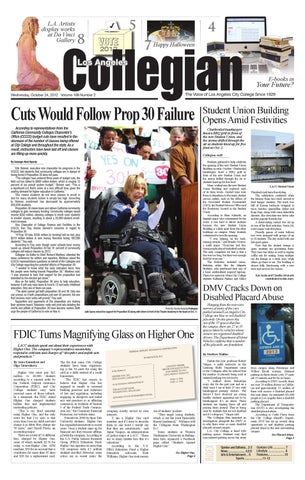
Cuts Would Follow Prop 30 Failure
According to representatives from the California Community Colleges Chancellor’s Office (CCCCO) budget cuts have resulted in the decrease of the number of classes being offered at City College and throughout the state. As a result, instructors have been laid off and classes are filling up more quickly.
Collegian staff Students gathered to help celebrate the opening of the new Student Union Building in early October. Charbroiled hamburgers lined a BBQ grill in front of the new Student Union and the aroma drifted through the air as students lined up for free food. Many walked into the new Student Union Building and explored each of its three levels. Guided tours took those in attendance to the many student service outlets, such as the offices of the Associated Student Government (ASG), the Student Services Office and the Bookstore, located in the Student Union. According to Shan Adamski, an English major who volunteered for the event, it was hard to attract students because the new Student Union Building is a little apart from the other buildings on campus. Many students volunteered to host the opening. “I was helping on the back, running errands,” said Braulio Viveros, a math major. “Everyone had fun. Some people played basketball outside. The only complaint we had is that a line was too long, but there was enough food for everyone.” The festivities included music, featuring artists like the Jalapeño Brothers, who performed their one of a kind, multicultural inspired hip-hop. There was open-mic where City College students Katherine Pipkins and Nikko
LACC Student Union
Wambach took turns free-styling. The celebration continued when the famous Kogi taco truck arrived to feed hungry students. The truck was full of Korean barbecue wrapped in tacos, burritos, quesadillas, sliders and Kogi dogs, along with some delectable desserts, like chocolate tres leche cake and the popular Sriracha bar. A donut-eating contest was set up as one of the final activities. Soma Ali, a law major, took first place. Friendly games of water balloon toss were arranged with groups of up to 10 students. The day ended with one last quick game. Now that the student lounge is open, students are gravitating there. They have bar tables as well as regular coffee sets for seating. Some students use the lounge as a study area, while others go there to eat. The building is almost fully functioning with a new store and services for visitors. Kat Ayala and Claudia Alvarado contributed to this story.
DMV Cracks Down on Disabled Placard Abuse Photo By Claudia Alvarado/Collegian
Julie Gaona voiced her support for Proposition 30 along with others in front of the Theatre Academy in the Quad on Oct. 11.
FDIC Turns Magnifying Glass on Higher One LACC students speak out about their experiences with Higher One. The company’s representatives meanwhile, respond to criticism and charges of “deceptive and unfair acts and practices.” The fee that some City College students have been experiencing is the 50 cents for using the card as a debit instead of a credit transaction. “The FDIC has reason to believe that Higher One has engaged in unsafe or unsound banking practices and violations of law and regulation, including engaging in deceptive and unfair acts and practices in or affecting commerce, in violation of Section 5 of the Federal Trade Commission Act,” the Consumer Financial Protection Act website states. Founded in 2000 by three Yale University students, Higher One has expanded nationwide in recent years. Once a student signs up for financial aid, they become affiliated with the company. According to the U.S. Public Interest Research Group (PIRG) Education Fund, Higher One operates on more than 520 campuses with 4.3 million students enrolled. However, some critics say in recent years, the
Hanging from the rear-view mirrors of many of the cars parked around Los Angeles City College are blue or red disabled placards. On any given day, out of the 55 spaces that line the campus, there are 27 to 35 spaces taken by vehicles whose owners are registered disabled drivers. The Department of Motor Vehicles confirms that a number of the placards. are fraudulent.
By Matthew Mullins
company mostly served its own interests. “I am a Higher One card member, and if I were to describe them in one word I would say that they are extortionists,” said Jaime Vasquez, an administration of justice major at LACC. “There are so many hidden fees that it’s ridiculous.” According to the U.S. PIRG Education Fund a Higher Education Advocate, Rich Williams, Higher One took money
out of students’ pockets. “They target young students, which is not the most financially literate [audience],” Williams told the Collegian from Washington D.C. Some students at Western Washington University in Bellingham have organized a Facebook page called “Students Against Higher One.” See Higher One, Page 4
Earlier this year, professor Robert Vangor, a math instructor in the Learning Skills Department came to the Collegian after he noticed that the number of placards being used at metered parking was excessive. “I walked down Heliotrope every day for the past year and on a daily basis I see at least 25 cars with handicapped parking stickers. The drivers I have observed are young healthy students appearing not to be handicapped. It’s an abuse. These students are ripping these off and passing them around. They’re being used by students that are not disabled and it’s a disgrace,” Vangor said. The Collegian then launched an investigation alongside the DMV as to why there were so many disabled placards around campus. L.A. City College is lined with parking spaces. Students may find non-metered parking across the street
INDEX
Higher One must pay $11 million to 60,000 students according to a consent order by the Federal Deposit Insurance Corporation (FDIC), and City College students may have received some of those refunds. In a statement, the FDIC stated HIgher One charged students hidden fees and implemented misleading policies. “This is my third semester using Higher One, and the only extra fee that I’ve seen is that every time I use my debit card and charge it as debit, they charge me 50 cents,” said Nayeli Flores, an accounting major. There are a total of 14 different fees, charged by Higher One, some of which include $2.50 for using a non-Higher One ATM machine, $50 for an account that is overdrawn for more than 45 days and $20 for a replacement card.
Student Union Building Opens Amid Festivities Charbroiled hamburgers lined a BBQ grill in front of the new Student Union, and the aroma drifted through the air as students lined up for free food on Oct. 2.
By Solange-Noel Nyenty
By Anna Kamalyan and Olga Tatarenkova
Your Future?
The Voice of Los Angeles City College Since 1929
Wednesday, October 24, 2012 Volume 168 Number 2
Erik Skinner, executive vice chancellor for programs in the CCCCO, told students that community colleges are in danger of losing funds if Proposition 30 does not pass. “The colleges have endured three years of budget cuts, the total cut has tallied to $809 million dollars, which is roughly 12 percent of our overall system budget,” Skinner said. “This is a significant cut, that’s come at a very difficult time, given the soaring demand for higher education in California.” This means students do not have classes to enroll in and for many students tuition is simply too high. According to Skinner, enrollment has decreased by approximately 485,000 students. Proposition 30 raises taxes and allows California community colleges to gain necessary funding. Community colleges would receive $250 million, allowing colleges to enroll more students in smaller classes, resulting in about a 20,000-student enrollment increase. Vice Chancellor of College Finance and Facilities in the CCCCO, Dan Troy, shares Skinner’s concerns in regard to Proposition 30. “If Prop 30 fails, $338 million [in funding] will be lost, plus $210 million dollars in new money, therefore losing 180,000 students,” Troy said. According to Troy, even though some schools have money saved up, should Proposition 30 fail, 91 percent of community colleges will reduce classes by 2013. Collegian Co-Editor-in-Chief Richard Martinez attended the news conference for editors and reporters. Martinez asked the CCCCO representatives questions on behalf of the Collegian and City College regarding the potential effects of Proposition 30. “I wanted to know what the early indicators were; how the people were feeling toward Proposition 30,” Martinez said. “I was shocked to hear that support for the proposition had dwindled as the election got closer.” Also on the ballot, Proposition 38 aims to help education, however it will only raise taxes to fund K-12 and early childhood education. Only one of them can pass. “The state cannot get both proposition 30 and 38. Only one can prevail, so if both propositions pull over 50 percent, the one that receives more votes will prevail,” Troy said. Supporters and opponents of the proposition are making their opinions heard. Television, radio and print ads detailing the merits and pitfalls of Proposition 30 have become routine. Both urge the people of California to vote on Nov. 6.
E-books in
from campus along Heliotrope and Willow Brook avenues. Metered parking on those streets costs 25 cents per 15 minutes and $4 for six hours. According to DMV records, there are over 24 million drivers in California and approximately 2.1 million of them will receive a disabled placard this year alone. An estimated 621,000 people in Los Angeles have a disabled parking placard. The Department of Transportation (DOT) is also investigating the disabled placard abuse. According to Cadet Flores from the City College Sheriff’s Department, DOT has set up several sting operations to end disabled parking placard abuse in the area surrounding campus. See Placard Abuse, Page 4
Opinion and Editorial... 2-3 Campus Life ............... 7 News ........................ 4,5,9 Lifestyle ..................... 8 Features.....................10 Arts & Entertainment ... 6 Sports ......................11-12
02
Opinion & Editorial
Wednesday October 24, 2012
Los Angeles | COLLEGIAN
Guest Editorial If you’ve applied for financial aid here at Los Angeles City College, the answer is yes; you’ve received one of these Higher One cards in the mail. That’s because LACC has a contract with Higher One Holdings, Inc., the bank that handles our financial aid disbursements. They are the only means to get a refund, including scholarships. There is no alternative from which to receive your money.
WARNING: Do you have one of these?
By Andrew McGivern
I
t wasn’t always this way. Just a few years back there was no “middle man,” and the Los Angeles Community College District cut checks to students. But where there’s a will to pass the buck, or make a buck, there’s a way. And so we students must adapt. We have no choice. Now, you may have heard some horror stories about Higher One. Wild accusations labeling them a scandalous company who swindle students nationwide into sinister banking relationships littered with deceptive fees, while school administrators sing their praises because they themselves receive financial kickbacks from those same fees. While the truth may lie somewhere in-between the widelyspeculated criticism and praise, it doesn’t bode well for Higher One’s reputation when the Chairman of the U.S. Senate Banking Subcommittee on Financial Institution and Consumer Protection threatens legislation against them if they don’t “change their ways.” “Higher One made 80 percent of its revenue in 2011 by,“siphoning fees from student aid disbursement cards, totaling $142.5 million,” Senator Sherrod Brown recently told reporters. “Too many students have been slammed with hidden fees and penalties that cut into their already-limited financial aid dollars,” Brown said. “It’s unconscionable that a financial institution is siphoning off students’ critical financial aid to pad their bottom line,” he added. Higher One is often criticized for manipulating students into using its products. Students can receive pitches on school letterhead, and the debit card is even created with the school or school district’s logo printed on it, all of which lends Higher One’s marketing ploys a very high level of credibility and trust, when instead students should be encouraged to shop around for far less expensive banking options. There are many egregious Higher One fees that students should be aware of, such as the
Illustration by Jose Tobar /Collegian
50-cent debit swipe fee [each time], and a $2.50 ATM withdrawal charge for non-Higher One machines, which does not include the charge you will also incur from the ATM owner. Simple cash withdrawals can often end up costing over $5.00 each time. igher One was also recently convicted for violating federal law by charging students multiple fees for overdrawing funds for a single transaction. “The company also allowed debit accounts to remain in overdrawn status for long periods as overdraft fees piled up, and engaged in other deceptive practices,” the Federal Deposit Insurance Corporation said. If this is the first time you’re hearing details of Higher One’s debit card, you’re probably feeling a bit concerned, and you wouldn’t be alone. A quick Internet search will uncover dozens of websites and Facebook pages created by students against Higher One. Fresno State University students even organize groups to speak with
H
incoming freshman and parents on dormitory move-in days to inform them of Higher One’s fee policies. Meanwhile, Higher One’s business continues to grow, and their website boasts that they provide financial services to over 1,250 campuses nationwide. That number is up from 1,200 just last month. In addition, according to DailyFinance.com, Higher One’s stock is “Poised to Pop,” earning a respected four-star rating. But wait, isn’t it possible to use Higher One without suffering all those fees? Yes, by having your money deposited into your own checking account, and disregarding the free debit card conveniently mailed to you. It’s a little more work to make this happen through the Higher One website, but well worth the effort. Is this encouraged by Higher One? No, quite understandably they are a for-profit business. However, they appear to be reaching for more than an honest buck when they conveniently mail students their school-approved
debit card, and advertise it as “faster access to refunds” among a slew of other “great benefits.” Students rightfully don’t suspect that something arriving in the name of their school might actually be targeting them, and counting on them to have their guard down. Often, students choose the faster, easier way, and who wouldn’t? Why not take the “free account” and get your money faster, and so much more? But over the course of a single semester, that lack of judgment can cost upwards of hundreds of dollars in needless fees. hy aren’t more students aware of the fee schedule and avoiding the Higher One debit card? How does a possible exploitation of students naivety and financial need exist like this? Good question. There are currently several lawsuits pending, and perhaps the legal system, along with public servants like Senator Brown and new legislation is the only way to answer that question in
W
the long run. But what else can be done in the meantime? “I think we can do a better job teaching students financial lessons in general,” said Michell Anderson, LACC Financial Aid Manager. “Encourage them to be better consumers, and to ask the question, ‘what will this cost me?’” Calvin Rankin, LACC Financial Aid supervisor believes “we can incorporate information regarding the Higher One fees into the various workshops and presentations that we host [for students].” Both are excellent suggestions that hopefully the Los Angeles Community College District will take into consideration for our sister schools as well. If you’re aware of the Higher One debit card, and the excessive fee schedule associated with their “convenient” debit card, please pass your knowledge along. Spread the word to continue to raise student awareness, help each other save a little money, and maybe we can all bring about a change for the better.
College Students Report Record High Levels of Stress, Low Esteem By Maribel Martinez College students are more stressed out than ever before — at least according to a national survey that has been conducted annually for the last 25 years. The survey includes more than 200,000 students attending nearly 300 colleges and asks them to rate how their own mental health stacks up with their classmates’ — for example, is it “above average” or in the “highest 10 percent” of your classmates? This somewhat unusual
methodology typically results in the statistical effect in which most people tend to overestimate themselves in relation to others. But the most recent results indicate that fewer and fewer freshmen feel like they are in top form in terms of coping with stress. A quarter century ago, nearly 70 percent of freshmen put themselves in the top 10 percent of mentally stable people in their class. Today only 52 percent rate themselves that highly, which is down three points from last year. Students’ self-esteem however, is still robust. A full 71 percent of freshmen put themselves in the top 10 percent in terms of academic abilities. (According to Time.com: Why Other
People’s Happy Facebook Updates Make You Sad). It is hard to know what these numbers actually mean. It is not mathematically possible for 52 percent or 71 percent of people to be in the top 10 percent of anything. And, as I explored in this post earlier today, people’s attempts to compare themselves with others are skewed in various ways. Nevertheless, the finding is in line with previous research, which found that almost half of all college students who seek counseling now have a major mental illness. That’s more than double the rate seen 10 years ago. So what’s going on? Obviously, the economy and high unemployment rate make for a scary time to be in college, potentially facing terrifying levels
of debt. This alone could account for the increase in stress. Secondly, a much more rigorous large study recently found that empathy among college students had declined 40 percent since 2000 — and since caring relationships are essential to mental (and physical) health, a decline in empathy could also produce a decline in mental health and coping. My final point brings us back to my earlier post on a Stanford study that looked at the psychological effects of comparing ourselves to others. It found that the way people tend to conceal their negative emotions while broadcasting their happy ones makes the rest of us feel somehow “less than” — as though all our friends and neighbors have
better lives than we do. Social media sites like Facebook and Twitter seem to have made these comparisons even more harmful by providing the perfect venue through which people can perpetually present a perfect version of themselves. This phenomenon, too, might tie into why the new survey, “The American Freshman: National Norms, Fall 2010,” found that students are feeling less confident about their level of emotional and mental stability. If all the students around you are desperately trying to put on a happy face — and you perceive that face as a true reflection of their inner selves, even as you work to hide your own sadness — well, it’s not surprising that so many students might be getting a bit stressed out.
Los Angeles
Collegian Co-Editors-In-Chief: Matthew Mullins Richard Martinez Copy Editor: Denise Barrett Abimael Rivera Photo Editor: Abel Zarate Jr. Kat Ayala Front Page: Olga Tatarenkova Opinion & Editorial: Naomi Johnson Campus Life: Esther Leng Arts & Entertainment: Inae Bloom Sports: Byron Umana-Bermudez Graphic Designers: Gegham Khekoyan Josue Hernandez Reporters: Amber Mason Fallynn Rian Anna Kamalyan Alvaro Mendisabal Jesa Pugh Hoon Kim Amanda Scurlock Solange-Noel Nyenty Cartavious Walker Svetlana Yurash Geoffrey Smith Carlos Minero Andrew Mcgivern Sarah Weiss Sandy Pena Maribel Martinez Michael Casey Marisela Brazfield Monica Juarez Photographers: Jorge Ponce Seung Hyun Choi Giles Spencer MultiMedia: Dave Martin David Tapia Illustrators: Jose Ramon Tobar Faculty Adviser: Rhonda Guess
JOURNALISM ASSOCIATION OF
COMMUNITY COLLEGES
ASSOCIATED COLLEGIATE PRESS Deadline Schedule NEXT ISSUE: Nov 6, 2012 Editorial deadline: Oct. 22, 2012 For all submissions including letters to the editor and publicity releases. Advertising deadline: Nov.1, 2012 Send materials to Collegian office: Chemistry 207 losangeles.collegian@gmail.com The college newspaper is published as a learning experience, offered under the college journalism instructional program. The editorial and advertising materials published herein, including any opinions expressed, are the responsibility of the student newspaper staff. Under appropriate state and federal court decisions, these materials are free from prior restraint by virtue of the First Amendment to the United States Constitution. Accordingly, materials published herein, including any opinions expressed, should not be interpreted as the position of the Los Angeles Community College District, Los Angeles City College, or any officer or employee thereof. © 2012 Collegian. No material may be reprinted without the express written permission of the Collegian.
Opinion & Editorial
Los Angeles | COLLEGIAN
Wednesday October 24, 2012
03
C TY V EWS Compiled by Solange-Noel Nyenty
Q:
What are your thoughts regarding the Higher One Debit Card students receive from the Financial Aid Office at City College?
L.G. Moseley Kinesiology “I do not like the card, because of the ATM fees. I cannot use the card anywhere else without being charged except on campus. It would be good if they create an application where you could check your balances.”
Vesser Stewart Psychology “I love it, it is fast, and it is quick. Even though I withdrew all my money out of the account, I still like the idea of the card.”
Reinventing Mid-Life
By Marisela Brazfield Changing careers after having clocked into the same type of job for about 20 years is no easy task. In fact, as I’m sitting writing this I question my sanity. A career in social services demands a 75-hour-per-week schedule with a mandatory juggling of a trillion personal life difficulties not linked with the job. Who questions if they need to go back to school and start over? I do. Working in social services not only takes a solid educational background, but patience and perseverance. As a youth social services worker, you have to love what you do. However, there comes a time when a social services worker has to think, think hard and think quickly before the “burn out” takes their soul away. I have a B.A. and M.A. in
social services and have been volunteering and working for, for-profit agencies in this field since I was a high school student. The needs of the populations a social services worker strives to fulfill are insurmountable, especially in this day in age where public programs and assistance are dwindling. In order to make up for these “budget cut” short comings a worker will begin to more or less sacrifice their own life. When “burn out” happens and takes over, the compassion that drives social services is lost. When this attribute is lost to us as a society, we all suffer. In order to avoid becoming a burden to the society I have worked so hard to improve through diligence, advocacy and quality. I have to begin a new mid-life change now. I have to utilize the skills I have shared with my clients to go forth and reinvent myself. The crux of reinvention is two-fold: 1. So that I may continue to be of service to my community. 2. So that I do not become a bitter and resentful citizen. Returning to school to work on an entirely different mid-life plan is shocking. But, it is also a much needed prescription that the proverbial Harley Davidson bike just can’t remedy anymore.
Where’s my Class, Hell... Where’s my Campus!
By Michael Casey The maze of construction on the LACC campus seems like a deliberate affront to sane members of the campus community. Beneath the simple geographic hoops one must negotiate in order to get to class, is the underlying question of priorities. I would rather learn in a shack and keep qualified teachers, than have a high-tech building with fewer qualified professors. However, despite economic hard times, those in power have committed to huge renovation projects on campus. I have heard the argument that construction contracts have already been signed, but there is a greater social contract which has been forgotten here at LACC. The real contract is with our
community. It is a contract that provides affordable education without the hassle of a construction site derailing your route to class. In return, the wider community gets the most creative and brilliant people in the creative capitol of the world. And so we circle the maze and the maze includes budget cuts. It includes city councils who blame state cuts and say it is out of their hands. The state in turn says their budget is stressed by Federal cuts. Finally, the Federal Government excuses itself because of the turbulent financial markets. We circle the maze and are told there is no alternative. Well, there is an alternative. Situations like these, where students are facing increased fees, fewer teachers and huge classes can be daunting. However, we can give substance to political struggle by supporting on-campus organizations that counter power. Whether it is the ASG, the Collegian (school newspaper), or a college club. Students need to get involved, ask the right questions and educate ourselves. We can shine the light on economic decisions that affect our future. A school is made up of students, teachers and workers. Its power resides there and not with administrators.
Earnest Williams Law “I hate it! If you Google every college that have the Higher One card, they have the same problems with it. One of the main reasons I do not like it is, because I was charged $400 get my money out.”
Miguel Garcia Theatre
Angely Castro Psychology
“I think it has some good benefits, and it helps to save time. I prefer this to the checks.”
“Concerning the higher one card I prefer it to the checks; they are really helpful as well. I once forgot my pin and I called them and they helped me easily.”
Survival of the Fittest: Harsh Reality College Degree Does Not Equal Jobs
By Monica Juarez In the past, college students could enjoy the blissful years of college by studying, partying, and having fun. Once these prospective hopefuls graduated, they found jobs, married, or bought a house. Now as a student in the 21st century, I am frustrated that I cannot graduate from college debt-free, study what I love, and
be able to find a job. So why did I work my butt off for four years? In the year 2012, hopeful freshmen enter college with the anticipation to find a job after completing their major. They major in anything from anthropology to music. When these students graduate, they discover a harsh reality: That just because you graduate from college with a degree does not guarantee you a job. Instead these students find themselves in debt hundreds to thousands of dollars and with no promised job opportunities. The reality is that being valedictorian, having a 4.0 GPA, and receiving a diploma means nothing. The job market is tough and colleges and universities need to prepare
Litter Bugs, I Dislike You! By Sandy Pena Littering, I absolutely hate it! I don’t understand why people can’t just look for the nearest trash bin or recycling center and throw their trash away. For as long as I can remember, I have walked by people, witnessed them litter and I pick up their trash. I know it seems crazy, but it’s a habit. I don’t know if people are aware of the harm that littering does to the environment, or maybe they do and are just lazy. This is my second year at LACC and I have witnessed many people attempt to throw their trash
in a bin and miss! I once told a girl that she missed the trash can and she rolled her eyes at me as she continued to walk. I stood there in disbelief and to my surprise, I still picked up her trash. Most students don’t know that the smallest piece of trash can harm an animal or sea creature. A lot of stray dogs, or any other animal for that matter, does not know the difference of “trash” and well, “not trash.” There is no way for them to know the difference other than their sense of smell. But it’s all the same to an animal, even the nastiest stench doesn’t make a difference.
students for the real world instead of toga parties and sororities. So what now? In order to survive, students must not only have the brains to get a degree but must know how to utilize it. To utilize your degree to its full potential, one needs experience and networking skills. Employers are not looking for future employees with a degree in philosophy or geography. How will this degree be beneficial to others? College students need to realize that the job market is cut-throat and that competition is fierce. So what does this mean to you? And what does this mean to me? It means that we need to major in things that will benefit ourselves and the world. The National Center
for Education Statistics shows that in the year of 2008-2009, that of the 1,601,000 bachelor degrees, 169,000 were in social sciences. Whereas, only 27,000 of them were related to science and technology. Studies show that the fastest growing and highest earning fields are in science and technology. In order to grasp this truth you need to ignore your heart and listen up. You may hate math and science, but that is where the jobs are for the future. If you decide to follow your dreams and become a painter or psychologist, you need to realize that the job market is tough. Finding a job is a fight for survival and college students need to utilize their degree and skills to their utmost potential.
So by throwing away your trash you are also helping to save an animal. How wonderful right? I live in the heart of Los Angeles, South Central to be exact. There is so much trash around my area and it grosses me out. I see people from the community that come and clean and two weeks later it’s the same mess. I always ask people, if they would rather live in an area where it’s clean and you can smell the freshness of the air, opposed to taking a stroll down a very polluted area and getting a whiff of only the nastiest smell ever? Yeah, I agree with you too. There’s a smoking area near Franklin Hall and it was my first day of college last year when I
saw a man flickering his ashes toward some plants. I can not stress how much it killed me to see him do that. People do not know how much it hurts plants, trees, or leaves to be intoxicated with such a chemical. I just wanted to throw a bunch of ash on his nice, black leather jacket and see if he liked it. You know, hypothetically speaking of course. The environment is a sacred gift and I want students to realize and understand how important it is to myself and especially mother nature. I want to be able to express how it is necessary to throw your trash away and be aware that the environment is your friend, so you should treat it like one.
Guest Opinion
Campus Police, Where’s the Justice?
By Kevin Baker As a two-time veteran of the Iraq and Afghanistan wars – both of which I oppose – I feel it is important for people to have a complete understanding of what they are getting into when signing up to become a member of the military. I am not only a veteran; I also served as an infantryman as well. I am currently a student at LACC, where a job fair was recently held. As I walked past a U.S. Army recruiting table I could not help noticing two
women getting information from the recruiters. When I saw this I had to ask the recruiters if they informed students of what it means to be in the military or if they just gave them information about the potential benefits. “I tell them my story,” replied one of the recruiters. I proceeded to tell him that instead of his story, he should inform them that according to Army Times statistics, one in every three women serving in the military are in someway sexually assaulted. What I said must have rubbed him the wrong way. He began to speak in a hostile tone. At this time he was unaware of my veteran status. I then chose to inform the recruiting officers that I too am speaking from a veteran’s perspective. I went on to say that any potential member of the military should receive accurate, honest and transparent information in regards to the job opening. This verbal altercation became more intense. The recruiters asked me what my MOS (job position in the military) was and I told them. SSG Romero then said, “You must
have placed low on the test then.” To me this implied that all combat arms service members are dumb. “I don’t think it’s fair to say that my brothers who lost their lives in a war are stupid,” I said. I also said he should apologize for making such a unprofessional comment. The encounter began to escalate as I explained to him that service members and veteran suicides are at an all-time high, in which he replied, “That explains why you’re still in a community college.” He then shifted his posture in an attempt to intimidate me and said: “Anytime anywhere guy.” I suppose this was his attempt to instigate a fight. I turned to an officer nearby to inform him that the recruiter had threatened me. Sheriff McKenzie, who was nearby told me to leave. As far as I know he and his colleagues are on campus to protect students, so why should I have to leave? “Not with me you won’t. Now go,” said Sheriff McKenzie when I asked for help with filing a formal complaint.
“Your job on campus is to insure the safety of students and if you’re not willing to do that I will lodge a formal complaint with someone who will,” I said. “I don’t want to hear it, now go!” said McKenzie. As a veteran and an infantryman, I feel insulted by this altercation in its entirety. The recruiter’s statement about my fellow service members demonstrates how he looks at lower ranking members of the military and community college students as well. I personally believe that SSG Romero’s view of students and combat veterans, along with his personal threats against me, are serious issues that need to be addressed. This incident is bigger than me. As students at LACC, everyone should be offended by his condescending reference to community colleges and their students. Although I was unsuccessful in filing a complaint, something has to be done, before someone not so understanding is put in the same situation I was.
04
News
Wednesday October 24, 2012
Los Angeles | COLLEGIAN
Higher One Defends Company Record Disabled Placard Abuse Runs Rampant From Page 1
One of the posters stated: “They did not like how I was slandering them on their Facebook page, so they blocked me. They are in control of my money, and I have no choice but to use them. How can this be legal?” In another Facebook page called “Stop Fresno State Higher One Banking,” a student posted: “Rather than keeping my money in the Higher One Account, they decided to take a very small overdraft fee out from a previous semester, then take all of my money out of the account and insist on sending it to me in check form.” If students wonder whether they are eligible for the refund, they are probably not. “The refunds went largely to people who incurred fees 1-3 years ago. Everyone who was supposed to have money, received them,” Williams said. Despite its “misleading policies,” students continue receiving Higher One debit cards in the mail. According to Williams, from 70 to 80 percent of the schools in the country work with Higher One. “Sixty-thousand out of 2 million cardholders received money, which is not that much,” Williams said. Some may wonder what will happen to those who were overcharged during the last year. Sherry McFall, a student at Ventura College filed a suit against the financial institution, and hired attorney Hassan Zavareei to represent her in court. The Collegian attempted to contact Zavareei numerous times, but he did not respond. Higher One representatives denied the claims that McFall filed. “On that particular lawsuit, we
don’t feel that the claims have any merit,” Shoba Lemoine, a Higher One’s marketing representative told the Collegian. The Collegian was assured by Higher One representatives that it has never charged students any extra fees. “There are no hidden fees when it comes to Higher One’s checking accounts,” said Lauren Perry, campus relations coordinator for Higher One. “Like with any bank, there are some services that will incur fees. What makes Higher One unique is the fact that our fee schedule first explains all the services available at no cost to the student, then addresses services with fees, the fee amount, why it’s assessed and most importantly, how to avoid it.” Lemoine says that in recent years, colleges were really attracted to Higher One because of the company’s environmentally friendly decision to go paperless. She says LACC has electronic options that help save trees, printing costs and the expense of mailing many checks. But Rich Williams sees a different reason for the attraction. According to Williams, community colleges that face tremendous budget cuts favor companies like Higher One to save money on services. Some believe the savings is happening at students’ expense. “Before schools worked with Higher One, students paid $5 a year to disperse the check. Now, with Higher One, they pay $49 a year, which is almost 10 times more,” Williams said. Higher One meanwhile defends the relationship and the services the company provides. “LACC has been working with Higher One since 2010 so it’s not new for you, it’s not the first year you guys have used it,” Lemoine
N A T I O N A L
said. “There are over 500 colleges around the country that use this service, it’s not new. It’s tried, tested and proven.” Despite the company’s prospective, many students are looking to cancel their association with Higher One and join an alternative company. “I’ve been [deducted] at least $2 each transaction I use, so that’s why I stopped using the Higher One,” said Araceli Toledo, a social work major at LACC. “I prefer using another card for it.” To avoid the 50 cent fee, Lemoine suggests students “swipe and sign.” Once you swipe your Higher One card, select the credit option to avoid the fee. The policy has became a target for criticism nationwide. Some say that’s exactly the action the FDIC called “unfair and deceptive practices.” Giving students a debit card and then charging them for using it. Some say it is unfair to provide students with a debit card and then force them to use it as a credit card. There are more ways students can learn to avoid fees, according to Lemoine. “We have a lot of tools [for] financial literacy, so we really believe that, not just students, but everybody right now can be more financially literate,” Lemoine said. “We have blogs and tips, we even have videos that show you how to avoid fees on banking accounts which I don’t know if any other bank does that.” Before students even open up an account, there’s a huge pop up window that shows every single thing that can ever be charged on the account, according to Lemoine. “This checking account is more transparent than any national that we’ve seen, and regional account,” Lemoine said
U N I V E R S I T Y
®
Los Angeles City College is not the only area affected by placard abuse; it is also heavily reported in downtown Los Angeles, Beverly Hills and several other areas according to officials at the Department of Transportation.
From Page 1 “They can be hard to spot. You don’t know if someone is disabled by looking at them, we have to run their plates and go by the registered driver description, if it doesn’t match, they pursue the problem,” Flores said. These sting operations have been happening since the middle of last semester and will continue randomly through the next few years until possible legislation change can guarantee the placards are going to people who need them. These placards are meant to ease mobility for disabled persons, but many students are finding ways to use them to circumvent what they call tedious lack of free student parking around campus. Many students complain about getting tickets and see it happen as they dash from class to their cars. They end up searching for other ways to get around receiving one, like using the disabled placards illegally. Many students are simply using their parent’s disabled placard and the car it’s registered with. One of these students said, “I put up the thing [placard] up
and that’s because of the lame job the school does with providing parking for students. I don’t want to pay $40 a week to park and go to class. I know it is wrong, but so are the prices the school gives for a parking permit. I’m just not going to pay.” Some students have started to notice the trend and are beginning to voice their thoughts on the issue. “It isn’t fair to the rest of us who are willing to play by the rules. It shows that people really don’t care about the people who actually need the spaces,” said City College student Maria Gonzalez said. According to the DMV website, one out of 10 drivers in California are legally registered disabled drivers. Students who illegally use handicapped placards may face a fine between $250 and $1,000, or six months jail time and the same fine. The court may also impose a $1,500 civil penalty. City Councilman, Dennis P. Zine has put forth a motion to try and make legislative changes in Los Angeles that would address the placards abuse. The motion states, “Disabled parking placards are issued and
regulated by the State of California and legislation would be necessary to address the rampant abuse that has been observed. Legislative changes could include actions that have been taken in other jurisdictions. The City could consider designating specific on-street parking spaces for those with disabled parking placards. The State could be asked to place the driver’s photo or other identifying information on new placards issued, and require periodic medical review to justify continued use of the disabled placard.” Los Angeles City College is not the only area affected by placard abuse; it is also heavily reported in downtown Los Angeles, Beverly Hills and several other areas according to officials at the Department of Transportation. Students who think they have witnessed handicapped placard abuse, can report the driver to the DMV by writing down the serial number on the placard and the license plate number, and filling out the form found at www.dmv. ca.gov/forms/inv172a.pdf. Zine encourages the public to contact him. He can be reached at (213) 473-7003.
© 2012 National University 11700
Brown Makes Digital Textbooks Available
10 cONVENIENT Greater Los aNGeLes LocatioNs
Transferring? BEgIN YOUR BAchELOR’S DEgREE IN hEALThcARE TODAY! National University makes obtaining a higher degree in healthcare possible with bachelor completion programs in the areas of: allied health, clinical laboratory science, healthcare administration, nursing, and public health. As a nonprofit university, we invest in our students’ success, which means we offer: • Streamlined admissions • Classes online and on campus • Flexible scheduling
• An accelerated course format • Scholarships and financial aid
Approved participant in the Cal Grant Program for current and transfer students
8 0 0 . N AT. U N I V
|
N U . e d U / h e A lT h c A r e
Governor Jerry Brown signed legislation to create a website that permits students to download digital copies of popular textbooks. SB 1052 and SB 1053 provide students with free access to 50 core textbooks for lower-division courses offered by the University of California, California State University and the California Community College system. By Alvaro Mendizabal California Senate President Darrell Steinberg (D-Sacramento) authored the bill stating, “There’s absolutely no reason a basic biology, statistics or accounting textbook, for example, should cost $200,” moments after adopting the proposals. Spokesman Mark Hedlund said the digital texts should be available
for the 2013-2014 school year through the California Digital Open Source Library. The California Open Education Resources Council will be responsible for approving books and materials developed for the California Digital Open Source Library. For those who are weary about the widening digital shift, hard copies of the texts may be purchased for $20. The new legislation is geared
towards alleviating the financial stresses of the sluggish economy while mitigating the increasing costs of tuition for students who can pay “more than $1,000 every year on their textbooks, sometimes having to choose between buying the books they need or paying for food and other living expenses,” Steinberg said. This initiative is shaping a promising future for academia, where students could afford college-level literature and instruction without diminishing the environment or overextending their monetary reserves. Only time will speak to the success of California’s digital text experiment.
News
Los Angeles | COLLEGIAN
Wednesday October 24, 2012
05
Students Give Obama a Second Look
The race for the White House is tight and students along with women may help determine who will be the next president of the United States. 2008 saw grand enthusiasm for candidate Barack Obama. In 2012, not so much. But neither Obama nor Republican challenger Mitt Romney has galvanized the vote, despite there being so much at stake. Denise Barrett
On the table are many issues that will impact students—like student loans, health care reform and the economy. There are more issues quietly looming on the horizon: minimum wage, affirmative action, gay marriage and potential military intervention in Syria. Yet absent the now dead-in-the water Occupy Wall Street movement so popular earlier in the year, there has been little to indicate that people care as we enter the final days of the campaign. Perhaps the lack of enthusiasm starts with the candidates. Comments about Obama once brimming with inspiration and hope are now tinged with sobering reality checks and public disappointments. Romney’s inability to connect to the masses and an ever-present “Romnesia,” a newly coined term to describe his continued shifts in messaging, engender a distrust even among those in his own party. Still, two weeks out from the election and just five percent of Americans remain undecided. Some LACC students prove to be equally definitive, if not enthusiastic, in their choices. Among students unofficially polled across campus, support for Obama was overwhelming. While a few declined to state, none chose Romney. Why not? “Republicans seem to be looking out for themselves,” says LACC student Gustavo Liemon. “Obama has
Illustration by Billy Monroe
done a lot of good.” “I just think he’s the better choice between him and Romney,” says Allen Sanchez, business major. “He’s doing what he can.” LACC students join others on campuses across the country in their
support for the president. But beyond campus, Romney has made strides after facing a lackluster Obama in the first debate, making up considerable ground among some undecided. A recent Gallup poll of likely voters placed Romney ahead, leading
President Obama 51 to 45 percent. A Romney win would likely mean a drastic shift. Romney wants to repeal health care reform, does not support tax hikes on the rich, opposes finance industry reform, supports further military action in the Middle East, and
NEWS BRIEFS
has no clear position on the Ledbetter Fair Pay Act which established equal pay protection for women in the workforce. If elected, most of these positions would overturn policies or actions enacted by the president in his first term.
Perhaps one reason for the Romney surge is Obama’s inability or unwillingness to explain why his policies matter, a tendency displayed in the first debate. The most infamous but least understood example is the Affordable Care Act, better known as health care reform. Designed to provide health care insurance to the nearly 50 million currently without, a large portion of whom are young adults 18-24, the policy continues to face opposition. And his passage of the Ledbetter Act could have far reaching implications for new female graduates who begin their careers making less than their male counterparts and could ultimately enter retirement facing the same dilemma. Still there are some who want him to do more. Chief among the criticisms are the slow-to-recover economy, compromises that include Wall Street bailouts and Main Street cuts to education and safety-net programs, and a staff that relies on some of the architects of the great recession. Pre-law student Christine Haskalyan agrees the president needs to do more. “I want him to put more money into public works and education like he promised. That’s the main reason I’m voting. I am a student here and financial aid is really important to me.” LACC students seem to want to give President Obama another chance, hoping he will rise to the occasion in a second term. “It’s pretty tough being president, but he’s putting up a fight,” says Sanchez. “Overall he’s been doing better... At least for me, I started school again because [there are] more benefits, more scholarships and aid. Work has been good. I was able to find work...it’s out there if you look hard enough.” “People say he hasn’t helped, but I think he has,” says Diana Nakayenga, journalism major. “I think in the next four years he’ll finish what he planned to do.”
Transfer Center Workshops Offer Preparation Students who plan to transfer to a university this fall can take advantage of a full program of workshops and consutations with visiting representatives from four-year colleges and universities. The Transfer Center is located on the first floor of the Cesar Chavez Administration Building, in Room 109. For more information call (323) 953-4000 ext. 2215 or 2216.
By Carlos Minero and Cartavious Walker
Health, Wellness Center Provides Free Services
Have your AA Degree? You Can Attend Law School.
Students can enjoy a healthier lifestyle by getting a checkup at the Student Health & Wellness Center. Free TB Testing (Monday and Tuesday only), free physicals, low cost lab tests (diabetes, pap smear, cholesterol, urinalysis, STD), and Hepatitis B Immunizations ($45 per shot, series of three required) are available. Students can get more information in the Life Science Building - Room 101 or by calling (323) 953-4000 ext. 2485.
JavaScript Training Comes to Long Beach Javascript Saturday is a one-day training seminar at the Long Beach Convention and Entertainment Center led by some of the best JavaScript experts. The seminar is aimed at individuals with varying degrees of knowledge. Tickets are $95. For more information, visit http://jssaturday. eventbrite.com.
You can attend Trinity Law School upon completion of your Associates Degree. Go straight to law school. Save time, save money, and get a great education with unlimited opportunities. Apply today FREE!*
Free tutoring will help make better use of your time and could boost you GPA. Tutoring and sessions are available Monday to Thursday from 10 a.m. to 4 p.m. in the Life Science Building, Languages Arts - Room 201. For more information call (323) 953-4000 ext. 2770.
Midnight Mission Needs Help One of the oldest continuously operating human services organizations in the L.A. region is looking for volunteers. The Midnight Mission will be serving food to the homeless at their downtown shelter on Nov. 26, from 11 a.m. to 2 p.m. Students who want to help can sign up at the Office of Student Life.
Employment Tools Made Available to Veterans Veterans discharged within the past four years, can receive monetary assistance from The Asian American Drug Abuse Program for training, transportation, clothing and job tools. An orientation is held every Tuesday at 10 a.m. at their Employment Access Unit, located at 1088 South La Brea Ave., Los Angeles, CA 90019. For more information call, (323) 295-0262.
Get Paid to Think
*Application fee waiver code: JCA213 For more information: www.tls.edu
Tutors Assist Learning Skills Department
Adept Consumer Testing, a market research facility in Los Angeles is paying students for their opinions. For more information visit, www.giveusyouropinions.com, or call (310) 279-4343 ext. 800.
06
Arts & Entertainment
Wednesday October 24, 2012
SPOT LIGHT
By Amber Mason
ART Review
MARNIE WEBER LOCAL ARTIST BRINGS MACABRE TO DA VINCI GALLERY By Sarah Weiss For those who have ever found beauty in a graveyard, enjoyed dressing up in costume, or making homemade 8 mm films: Marnie Weber is an artist who will appeal to your tastes. A local artist, Weber exhibits her work in galleries throughout the world from, Paris to Grenoble and everywhere in between. She is accomplished in film, sculpture, performance, installation, photography and music. “Spooky” and “haunting” are terms commonly used to describe Weber’s work, and she embraces those sentiments fully. Her work, “The Rescue of the Great Bunny by the Sea Witch,” can be viewed at the Da Vinci Gallery as part of the “Do Not Go Gentle” exhibition. Collegian: Your work incorporates a lot of costumes and characters—do you have a theatrical background?
Weirdly enough, I like graveyards
it to consider where your work is going to be shown. I’ve been doing this other project where I did a collage a day for a year, just a small 8x10 ‘cause it would give me a good source imagery for doing bigger works. It was really a great exercise because it’s a very freeing exercise and that’s another thing I always recommend to students
Weber: That’s what I do. I make a lot of my own costumes and I make videos and films of my narratives, and I’ve been doing that for 20 years. When I do work on paper or painted panels, I try to create a story about some of the performances or films I am currently working on so some of the characters you will see on that collage would appear in my films and performances as well. C: I read that you created your own mythology? W: Yeah, I like to consider it my own mythology. Not in a self-aggrandizing way, but in a kind of a humble way where I just make up my own stories, and then there’s built-in myths that transcend through the ages through fairy tales with certain archetypical characters and they’re iconic like the witch and scarecrows. C: When you are not working with collage you also do music and you also do performance? W: I make films and then I do the soundtracks for my films. And I do do sculpture and installation. I guess it depends on the opportunity given to me at the time. C: That’s incredible that you know all these different mediums, and we’re all students so we all try what other mediums do and balance all our different classes. How do you structure your time? W: I think it’s important to work in a lot of different mediums and especially now with the internet because if you work in painting or sculpture, most of your imagery is going to be shown flattened on the internet anyway so it’s good to work in a lot of different mediums, [and to] consider your audience even though ultimately the work has to be for yourself, but it is worth
P
A
H
Marnie Weber, an artist recently featured at MOCA, is one of seven L.A.- based artists included in Da Vinci Gallery’s current exhibition, “Do Not Go Gentle.” Weber’s acrylic and collage composition entitled, “The Rescue of the Great Bunny by the Sea Witch,” is on display in the gallery through Nov. 8.
is to set yourself a goal where you could do something once a day, like a five-minute drawing. It doesn’t have to be a lot, but it just—the subconscious will then feel like it’s got somewhere to go besides just the sleep-world because I think the subconscious moves through the day you know, kind of in a state of oblivion and then at night it gets to come alive and as artists it’s important to keep it alive during the day time. C: It sounds like you’re really well-traveled. Are there other places that you particularly draw inspiration from or places that inspire you in Los Angeles? W: Weirdly enough, I like graveyards. I think they are really
F
E
S
nice meditative calm places. I have a beautiful graveyard mausoleum in my studio. I was lucky enough to be able to perform in a mausoleum a couple of years ago and I think because you get a lot of sculptural stuff happening in a graveyard. There is also a lot of open-ended narrative where you kind of fill in the gaps [with] what could have happened to people so I get inspired by graveyards. I think they’re really beautiful; I like nature and I like faux-nature. I like to go to Stats—you know Stats the holiday store where you get decorations—yeah. I like the idea ‘cause we live in Hollywood because I love to go to all the costume shops, especially this time of year. I like fake nature; I think it’s a kind of funny sentimental thing. Yeah, fake holiday decoratings of nature: fake leaves and fake plants, fake holiday. We mark our time with like fake things, decorations, it’s a sentimentality and a longing for what is real. So in a way the fake stuff can be nurturing to you in a strange way, it really can. I think maybe ultimately it isn’t the best thing. At least it gives you a false sense of security. C: How do you think your piece falls under the “Do Not Go Gentle” moniker? W: I think there is, like, an element of surrealism and mystery to all the works in here, but there is also this interesting strength. I think it is a very well-curated show. It’s creepy, but each piece has a lot of strength too. It’s an interesting juxtaposition because normally you think of just surrealism as being weird, but each piece has a certain powerfulness to it in terms of me fitting in. When I see my work in this context, I can see the strength in the witch, whereas in my studio I didn’t really see her as such a strong figure. Now she kind of looks like, oh she’s plowing through the ocean, you know, creating this turbulent storm like maybe it’s being generated from within. I hadn’t really viewed it in that way before. So I think it’s nice when as an artist you get to see work combined with other people ‘cause then it shifts a new light on your own work.
Los Angeles | COLLEGIAN
Bold themes of fearless expression and theatricality are captured in the paintings, drawings and photography of the art department’s latest show, “Do Not Go Gentle,” an homage to a poem by Dylan Thomas. Upon entering the gallery, observers are immediately met with the looming presence of a luchador, a masked Mexican wrestler. Its menacing and aggressive stance alludes to the possibility of the graphite and charcoal sketch, crafted by Sergio Teran, lurching from its paper prison in attack. As onlookers browse the artwork, they arrive at a collection of photographs by Nadia Osline featuring drag queens clothed in flamboyant attire, adorned with wigs and ostentatious accessories. The idea of fierce personal expression seems to leap from the photographs, urging its viewers to be loud in their declaration of individuality. “Everything in the show is bold. The nakedness, the colors, luchadors and drag queens are all about being bold and being expressive, not sinking into the shadows,” said Angel Alvarado, gallery director and art major. Arriving at Kristin Calabrese’s painting, “Spaghetti,” viewers are met with the striking image of a woman draped in spaghetti noodles. The meticulous attention to detail, coupled with its bold theatrical elements, have made this painting a favorite among students. Alexandra Wiesenfeld, gallery adviser and art professor at City College, curated the show. Each work of art was selected according to the theme of theatricality and the concept of a two-dimensional surface acting as a stage. “The artists in this show continue the tradition of using the 2-D surface as a stage for emotional spectacle. At the heart of these beautifully crafted images lies the artist’s ruse that feeds on our desire to perform, to watch and be seen,” said Wiesenfeld in a press release. Students sauntered around the gallery, lingering around each piece for a few minutes as they exchanged perspectives with other viewers. Reaction to the show seemed positive. “I really think that it is refreshing to have something like this on campus, where this kind of work is being showcased. All of the work is so individual and each of the pieces represented here is something that the artist had to do with a great deal of courage,” said Courtney Salmon, cinema major. The art department’s next show will be a student photography showcase curated by Angel Alvarado and Jordan Angulo. All students are welcome to submit their photos on Nov. 7 and 8 from 12 p.m. to 5 p.m. The opening reception is scheduled for Nov. 13 from 12 p.m. to 2 p.m.
DO NOT GO GENTLE Kr is t in C a la bre s e P hung Huy nh La ur a Kr if ka N a ida Os line M a x P re s ne ill Se r g io Te r a n M a r nie We be r
Scan the QR code to be taken to a video broadcast piece on the art gallery show, “Do Not Go Gentle.”
“Spaghetti,” an oil on canvas painting by artist Kristin Calabrese is on display at Da Vinci Gallery as part of a group show of Los Angeles based artists entitled, “Do Not Go Gentle.” The show runs from Oct. 9 – Nov. 8 and gallery hours are Mon. - Thurs, noon – 3 p.m.
Trio Strikes a Chord
T Photo By Inae Bloom/Collegian
By David Stamp Bold themes of fearless expression and theatricality are captured in the paintings, drawings and photography of the art department’s latest show, “Do Not Go Gentle,” an homage to a poem by Dylan Thomas. Upon entering the gallery, observers are immediately met with the looming presence of a luchador, a masked Mexican wrestler. Its menacing and aggressive stance alludes to the possibility of the graphite and charcoal sketch, crafted by Sergio Teran, lurching from its paper prison in attack. As onlookers browse the artwork, they arrive at a collection of photographs by Nadia Osline featuring drag queens clothed in flamboyant attire, adorned with wigs and ostentatious accessories. The idea of fierce personal expression seems to leap from the photographs, urging its viewers to be loud in their declaration of individuality.
“Everything in the show is bold. The nakedness, the colors, luchadors and drag queens are all about being bold and being expressive, not sinking into the shadows,” said Angel Alvarado, gallery director and art major. Arriving at Kristin Calabrese’s painting, “Spaghetti,” viewers are met with the striking image of a woman draped in spaghetti noodles. The meticulous attention to detail, coupled with its bold theatrical elements, have made this painting a favorite among students. Alexandra Wiesenfeld, gallery adviser and art professor at City College, curated the show. Each work of art was selected according to the theme of theatricality and the concept of a two-dimensional surface acting as a stage. “The artists in this show continue the tradition of using the 2-D surface as a stage for emotional spectacle. At the heart of these beautifully crafted images lies the
artist’s ruse that feeds on our desire to perform, to watch and be seen,” said Wiesenfeld in a press release. Students sauntered around the gallery, lingering around each piece for a few minutes as they exchanged perspectives with other viewers. Reaction to the show seemed positive. “I really think that it is refreshing to have something like this on campus, where this kind of work is being showcased. All of the work is so individual and each of the pieces represented here is something that the artist had to do with a great deal of courage,” said Courtney Salmon, cinema major. The art department’s next show will be a student photography showcase curated by Angel Alvarado and Jordan Angulo. All students are welcome to submit their photos on Nov. 7 and 8 from 12 p.m. to 5 p.m. The opening reception is scheduled for Nov. 13 from 12 p.m. to 2 p.m.
From left to right: Gregory Newton, Gisle Krogseth and David Grimes perform Rondo-Rumba in front of a full house on Oct. 11 in Da Vinci Hall.
By David Stamp In a flurry of flicks and vibrating strings, Norwegian guitarist and composer Gisle Krogseth performs at the Fall 2012 concert series hosted at Da Vinci Hall. He included LACC as a part of his Southern California tour. For much of the concert, Krogseth performed solo guitar compositions. Gregory Newton, instructor at LACC, and his partner David Grimes, joined Krogseth for the final two pieces. The trio used contrapuntal techniques, repeating themes with augmented melodies and jazz inflections, which entranced onlooking students. Newton first met Krogseth in the south of England in 1982 at a summer guitar intensive. A few years ago, the two reconnected and started to tour together. Grimes and Newton have performed and toured together for more than a
decade. Each semester talented musicians are invited by City College to perform for students enrolled in Music 152: Current Musical Events, a one-credit course offered at the school and taught by faculty member Charles Suovanen. The program aims to expose students to jazz and classical along with other genres of music and is open to students and the community. Krogseth is a respected performer who has played throughout Europe and the United States. He has recorded numerous CDs, played for radio, appeared on TV and has published music. Five out of the six songs performed by Krogseth were songs that he had composed. “I did like the themes he chose, I like how he used astronomy to
write compositions,” said Jordan Brodie, a music student at LACC. In explaining the roots of a song titled, “Cygnus X-3, Opus 2b,” Krogseth briefly spoke about the intense galactic rays that radiate from Cygnus X-3, explaining that one wave of X-rays emitted from that cosmic source would wipe all life from the earth. In his composition “Three Pieces from Norwegian Mountains,” Krogseth used scales and chords that were augmented in uncommon places, melodies that pushed the listener into half-imagined remembrances and through jarring mirages. The concert series takes place every Tuesday and Thursday at noon. All performances hosted by the music department are offered free of charge.
Campus Life
Los Angeles | COLLEGIAN
Wednesday October 24, 2012
07
Police Wire
Compiled by Olga Tatarenkova Crime Date Location Summary
Medical Incident 09/10/2012 MLK Library Female having trouble breathing. Paramedics were requested and transported the female to Hollywood Presbyterian
CUBBINGTON
Illustration by Jose Tobar /Collegian
L.A. Guide Comes to City By David Stamp
Photo By Jorge Ponce/Collegian Dr. Laura Pulido came to City College to promote her new book, “A People’s Guide to Los Angeles.”
FREEBIES
Compiled by Cartevious Walker
Dr. Laura Pulido, author of “A People’s Guide to Los Angeles” was the first guest speaker in the Book Program’s series of events last Wednesday. Pulido is a professor of American Studies and Ethnicity at the University of Southern California. She says her focus is on how diverse groups encounter racial and class oppression. She has done widespread studies in the fields of environmental justice, landscape studies, and the history of the Third World. Pulido claims her book is an alternative touristic experience, not solely focused on Los Angeles mainstream appeal. She says a segment of the population is interested in knowing the history of Los Angeles. In her book, she explores 115 different places in Los Angeles in an attempt to feature sites often overlooked by tour guides and will talk about the site’s historical
significance, location, website and photos. “They are not sites mainstream tour guides include, because they really focus on power and marginalization and they offer a different reading of Los Angeles,” Pulido said. For example, she tells the history of the many citizens living in the Chavez Ravine, who were displaced so that the Dodger Stadium could be built. The students in attendance had different opinions of Pulido’s book and presentation. Camillo Gaega, liberal arts major at City said that the presentation felt, “felt kind of scattered, but he liked that the author was also addressing social issues. Pulido says her book tries to show how power is embedded in the landscape of Los Angeles, and to attempt to make sense of the process of how vacant lots become buildings. Students thought she did all that and more
in her unconventional guide to Los Angeles. “I think that to bring an author who wrote a book about Los Angeles is really amazing. It will help the students who are not from Los Angeles,” said anthropology Mondy Abulrachman. Los Angeles City College’s Book Program has been hosting these lectures for the past 11 years; bringing in authors to meet with students to discuss their published works in an effort to increase campus literacy. Now, the Book Program, under the leadership of English professor Alexandra Maeck is using themes to organize the series of lectures. This year, the theme is “L.A. Stories: A Celebration of Los Angeles.” For the spring semester Maeck would like to incorporate student work into the lectures. “By the spring we will be featuring student writers. We want to include our students on campus and their stories,” Maeck said.
Stressed out and want to relax? Head to Runyon Canyon for free daily Yoga Classes. For more information visit, http://runyoncanyon-losangeles.com/?page_id=14 Go see the Upright Citizen Brigade comedy show on Sundays for free. Get a laugh, have some fun, and go support these awesome comedians! http://losangeles.ucbtheatre.com Free STD checkup for men at AHF Men’s wellness centers at these following locations: 1300 N. Vermont Ave., Suite #407 99 N. La Cienega Blvd., Suite #200
2146 W. Adams Blvd. Van Nuys Blvd., Suite #200 For more information visit, http:// publichealth.lacounty.gov/std/ahf. htm The California Heights Methodist Church is having a free “Stroke Support” discussion in Long Beach from 10 to 11a.m. on Oct. 30. The event is open to all those who have been affected by strokes. For more information visit, http://calheightsumc.org Want your poetry heard? Want to listen to others express their feelings through spoken word? Head to
Venice at the Beyond Baroque Literary Arts Center for free on Nov. 4 for “Open Poetry Readings” 5 to 7 p.m. Sign-up at 4:45PM. Go see the space shuttle Endeavour at the California ScienCenter starting Oct 30. located at Exposition Park. 700 Exposition Park Drive between South Figueroa Street and South Vermont Avenue. Admission is free. Visit the Mount Wilson Observatory and look through their 60 inch telescope. Get an amazing view for free!! Worried about parking? Don’t stress, that’s free too!!
The Laramie Project
Medical Accident 09/10/2012 Theatre Arts Building Faculty member sat on edge of the stage and fell when he reached to pick something up Disturbance 09/12/2012 MLK Library Female escorted off campus for assaulting a staff member. Female is facing a suspension and exclusion from LACC Medical Incident 09/13/2012 Bookstore Female having trouble breathing. Paramedics were requested. Female refused transportation to a hospital Disturbance 09/17/2012 MLK (3rd Floor) Disturbance between two female students. Warned and advised. Burglary 09/19/2012 Gymnasium (Construction Site)
Unknown person made entry to the gymnasium constructions site and stole a rotating laser with a case Medical Assistance 09/19/2012 Franklin Hall (Room 224) Female passed out Disturbance 09/20/2012 Between Franklin Hall and Clausen Hall Breezeway Female student was arguing and throwing posters and leaflet material at the Free Speech area Found Property 09/21/2012 Administration Bldg Student found two twenty dollar bills in U.S. currency Marijuana 09/22/2012 Main Quad Male smoking in the smoking area with a glass pipe smoking weed in total disregard of the other students. Warned and advised. Disturbance 09/27/2012 Da Vinci Hall Disturbance (Argument) between student and faculty member. Called the Sheriff Department Medical Incident 09/28/2012 LACC Sheriff Station Staff member injury by trash can on her shin bone. Rescue was not requested
Photo By Jorge Ponce/Collegian Students during a Bible Life Club Study Group in the Chemistry building room 106. Meetings are held weekly on Wednesdays at 12pm.
‘Believers’ Congregate in New Club Their first meetings were on the stairs of campus buildings, but now members of the Life Club are spreading the word in their new home. By David Tapia
Photo By Inae Bloom/Collegian
A scene from, “The Laramie Project” depicts Reverend Phelps of the Westboro Baptist Church who picketed the funeral of Matthew Shepard on Oct. 17, 1988. Protestors carried signs with derogatory slogans like “Gods Hates Fags.” After the funeral, the church posted a “memorial” on their website which proclaimed, “Matthew Shepard has been in hell for 2102 days.” “The Laramie Project” is about the effects of prejudice in the small town of Laramie, where Shepard was murdered. The Theatre Academy chose this play to commemorate the 10th Anniversary of its creation. It has been performed all over the world. “The Laramie Project” runs through Saturday, Oct. 27 at The Camino Theatre.
Students can now join a new club that promises Bible study and fellowship. It is called the Life Club. They meet every Wednesday at 12 p.m. in the Chemistry Building, Room 106. They say they come together to explore their relationship with the Bible and each other. The club members also say they use the Bible to show them how to live. “It’s about bringing people who have an interest in studying the Bible together, so they can enjoy each other’s company, but also go deeper into the Bible than just reading the words themselves,” said Richard Lewis, faculty adviser for the LACC Life Club. The club’s goal is to promote the value of the Bible to as many City College students in other parts of the college community as possible. It took more than two years to get the club started. According to Lewis, there are many other groups on campus who offer Christian activities, so the LACC Life Club is not alone. “I really enjoy the club. I think it’s a great way to connect with other believers in the campus and I think it is a great way to increase
my faith,” said Eliane Alaniz, a club member who is majoring in film production. At a recent meeting, eight members sat down in a circle inside a classroom and talked about the Bible and their relationship with other “believers.” The club members also read phrases from the Bible and shared things about their personal lives and how they participate in their local church. Also they talked about how they study the Bible during the week. They also thanked God for the things he has given them. The meeting lasted for about an hour. “I think it is something new at L.A. City College and I hope more people join us believers,” said Beatriz Urias, an administration of justice major. Club members said that they also understand the way God communicates with people. Lewis added that the Bible can apply to daily life; he called “it an amazing source of cultural and historical information.”
08
Lifestyle
Wednesday October 24, 2012
CITY RUNWAY
Compiled by Karen Smith Photos By Seung Choi
Halloween Events
Compiled by Claudia Alvarado
West Hollywood Halloween Costume Carnaval Wednesday, Oct. 31 Halloween street party for the masses. Join the thousands of people who will be roaming Santa Monica Boulevard to showcase their eccentric and creative costumes. An honorary “Queen of the Carnaval” will be determined. Live entertainment, food vendors, contest and childrens activities will be available throughout the night. Admission is free. The Carnaval is located on Santa Monica Boulevard between La Cienega and Robertson boulevards. For more information call (323) 848-6400 or visit, www.westhollywoodhalloween.com
Alisa Shtykar Since the it is been October, wears thick sweater today. She majors graphic design on LACC. Oct 3, 2012 Earring- Universal Studio Boutique Necklace - San Francisco Market Sweater - Forever21
Haley kidd walks to library to study her major which is Nutrition. She tells that to being model for new paper is great. Oct 3, 2012 Bag - Melrose Boutique Shoes - Steve Madden
Los Angeles | COLLEGIAN
Dia de Los Muertos Saturday, Oct. 27 The Hollywood Forever Cemetery “Dia de los Muertos” (Day of the Dead) Festival will feature pre-Aztec ceremonies, the Mayan gods, calendar and rituals. The event is noon to midnight. General Admission $10, children under 8 free until 4 p.m.
Edwards West who is musician on LACC. He has lots of pride on himself and his clothes. Oct 3, 2012 Jacket - NFL Shoes - Adidas Hat - NFL
Hollywood Forever Cemetery, 6000 Santa Monica Blvd., Hollywood. For more information call (323) 469-1181 or visit, www. ladayofthedead.com Queen Mary’s Dark Harbor October 5–7, 12–14, 18–21, 25–28, 31. A monster crew will be leading this famous ship on several nights catering to this halloween tradition. Tickets cost $24–39; VIP ticket $50–$60. Guests enjoy live shows starting at 7 p.m. 1126 Queens Hwy., Long Beach. For more information call (562) 435-3511. visit, www.queenmary. com Olvera Street Dia de los Muertos October 25-November 2. A community gathering celebrating pre-Columbian rituals of the day of the dead. Festivities include childrens’ workshops, face-painting, entertainment includes strolling Mariachi bands and “Ballet Folklorico.” Community altars will be arranged beginning mid-Oct. through Nov.
2. Complimentary champurrado (mexican hot chocolate) and “pan de muertos” (bread of the dead) will be served. The event is free to the public and starts at 7 p.m. Olvera Street, Los Angeles, CA 90012 For more information go to www. olvera-street.com/html/dia_de_los_ muertos.html Los Angeles Haunted Hayride 2012: “The Congregation” October 5-7, 11-14, 18-21, 24-28, 31. In the fourth annual haunted hayride, the horrors of the forest come to life. The story of the Clifton family and that of a child found near the Old L.A. Zoo, preaching of “dark religion”. Tickets cost $28-$37, VIP $25-$49, Group/Private rates available. 4730 Crystal Springs Ave. Los Angeles, CA 90027, 310. 993.8289 For more information, email Info@ tenthirtyoneproductions.com
Peering Through the Haze
By David Stamp Students enjoy a cigarette in between classes in an area that is not designated as a smoking area
Dian Mailani Fashionable lady from Indonesia majoring music. Show us most incredible pants in the college. She said “ Everything I wear today is from Indonesia” Oct 3, 2012 Unidentified brand from Indonesia
Chuk Wuneye Abanum College computer engineer wears nice designed handmade jacket. Oct 3, 2012 Shirts - Guess Jacket - Local designer De Laurels Shoes - Andrew ST John
Smoking Areas Prove to be Social Oases
Students rush from class to class all day long; some however, take a break from their hectic schedules, waiting to inhale. Photos By Claudia Alvarado/Collegian Kalik Reyes, a business management major, enjoys a cigarette in the designated smoking area in front of the Life Science building on October 22.
By Sarah Weiss It’s 3 p.m. on a Wednesday afternoon and students David Hakopyan, Mercy Mejia, and Aider Aleksander are taking time out of the day to cool off and enjoy a cigarette before class. Of the three designated smoking areas on campus, they prefer the Quad, because of the shade and social atmosphere found there. Many say shade and seating are vital to a good smoking location. “The crappiest is by the science building,” Hakopyan said, “it’s in
the sun and it’s dirty.” There are three designated smoking areas on campus and according to the LACC website, “It is the intent of the Board of Trustees of the Los Angeles Community College District to regulate, or delegate to the College Presidents to regulate, as appropriate, the smoking of tobacco, plant or processed substance in the District’s buildings, offices, and enclosed spaces through the District.” In short: “Smoking within 20 feet of any main building entrance, exit,
Students complain that smoking restrictions on campus and the implementation of designated smoking areas have been largely ineffectual. According to the Sherriff’s office, students found smoking outside of designated smoking areas are only subject to a verbal warning. Many still choose to smoke while walking between classes, waiting in lines and when congregating in different areas on campus not designated for smoking. For students with asthma, chronic bronchitis, tobacco allergies and a myriad of other respiratory and skin diseases, this presents a hazard to their health and an obstacle to education. According to the Asthma Coalition of L.A. County, 63,000 students in the Los Angeles Unified School District (LAUSD) have asthma. Children who grew up in areas within 300 feet of a freeway or major highway are more likely to have asthma. Kathryn Herrick is a student at
City and she suffers from chronic bronchitis. She says she has had frequent confrontations with smokers on campus. ”I’m following a trail of smoke, and if I don’t stop, I’m going to be burning, it goes all the way down my throat and I start sniffling … my doctor has me on Claritin now,” Herrick said. “When I cough, I cough for two months, and I never know when it’s going to quit.” There are 4,000 chemicals in cigarettes, including formaldehyde, ammonia and hydrogen cyanide, 50 of these chemicals are known to be carcinogenic, according to the EPA. The exposure of secondhand smoke has been linked with many bad health effects, including many cancers, heart disease, sudden infant death syndrome, middle ear problems and respiratory conditions. An investigation published in the Journal of American Medical Association found that brief exposure to secondhand smoke could immediately affect the
Photos By Claudia Alvarado/Collegian A student enjoys a smoke while waiting to meet up with other friends at one of the designated smoking areas behind Camino Theatre.
or operable window is prohibited.” That rule is a familiar rattle to any student smoking on campus, but now City is increasingly more restrictive with its smoking policies, and students found smoking outside of designated areas are subject to both possible discipline from campus cadets and ridicule from non-smoking students. Hakopyan recalled a time while on his way to class, when a fellow student abruptly passed him from behind and commented, “Let me get in front of that cigarette.’” Aleksander shared a similar experience. He was sitting on a bench with his friend when a student chose to sit next to them and drew attention to their smoking by sniffing the air in disgust. Before the designated smoking areas were implemented, benches were equipped with ashtrays. Most have been removed, but there are “gray areas” where ashtrays are
located outside of smoking areas; tempting smokers to ignore the designated spaces. The new Student Union is not equipped with any smoking zones. “My professor from last semester would smoke with us on the breaks between class right by Franklin Hall, but he can’t do that anymore,” Mejia said. For student-smokers, the appeal of lighting-up on campus is not just to satisfy the desire for a cigarette; it is also an opportunity to connect with other students. The student population at City College is among one of the most ethnically diverse on the West Coast. When City College students emigrate from their countries to America, they are surprised by the demand for quarantined smoking zones. In Yerevan, Armenia where Hakopyan is from, smoking is a cultural reality. “In my hometown, it is not a
Photo By Jiles /Collegian
hearts of nonsmoker’s. After short exposures, secondhand smoke caused damage to the cells that line the heart and blood vessels. Throughout campus there are cigarette disposal receptacles located in areas not designated for smoking. Many feel this sends a mixed message to students who are told they are only to smoke in certain areas of the school. While some might find the confinement of the smoking zones a burden, many are glad for them. “[I am] glad I have a space to go [smoke] where I don’t bother people,” said Ahmen Otugen a student at City. Santa Monica College and Pierce College are already smokefree campuses. According to the University of California’s website, smoking has been barred from all five of the UC’s medical centers and there are plans to implement a smoke-free policy on all UC campuses by 2014.
problem at all,” Hakopyan said, “and then you get immigrants who come here and it’s really weird for them to be confined to these areas.” Designated smoking areas are micro-cultures on campus where students gossip, speak in their native languages, and gather to talk casually about everything or nothing at all. These areas are free of dirty looks and unsolicited remarks, but the students ask to keep the “bumming” to a minimum. “Everyone knows where the smokers are now, so it’s easy to score a cigarette,” Mejia said. Cigar smokers, cigarette smokers, they all converge at the three campus areas. When supply is short, some come looking for a handout. “I have a bum limit. I’m paying for my own addiction here, I can’t pay for anyone else’s,” Hakopyan said. Hakopyan says there is something all smokers have in common: They all take the time to just sit and relax. “Conversations just flow over cigarettes,” he said. Mejia, Aleksander and Hakopyan have different majors at LACC, but connect with one another over smoking breaks in the Quad. “We had a pretty interesting conversation the other day, it wasn’t about anything, it was about everything,” Aleksander said.
News
Los Angeles | COLLEGIAN
Administration To Take Over Collegian Advertising Students say the newspaper holds administration accountable and now they are holding the accounts. By Matthew Mullins There is a new manual that changes the way students enrolled in the journalism program learn their craft for the first time in 84 years. The Los Angeles Collegian is a student-run free press newspaper and has been produced by students and a faculty adviser since 1929. All the advertising and invoicing is done by the account reps and editors with the distant coaching of adviser Rhonda Guess. Students have collected and controlled the ad revenue and made all deposits since the Collegian began. Last week, Vice President Paul Carlson wrote adviser Rhonda Guess saying “We have a check
made payable to the Collegian for advertising. We have not deposited this check because the new procedure has not been followed. All Collegian advertising billing must take place in the Business Office. Please tell me how you have complied with the new policy.” The new policy states, “The Business Office shall be responsible for preparing, controlling, and monitoring all invoices that are generated at the College, unless it is determined by the VP of Administrative Services that another area such as the Contracting Office shall assume those responsibilities. “ After further investigation, at least two of the sister colleges are not imposing the new procedures
on their journalism departments. Professor Jean Stapleton, the chair of the journalism department at East Los Angeles College, had no knowledge of the new procedures. The staff of the student newspaper called, “The East Los Angeles Campus News” have not been asked to adhere to any new rules. “It sounds like a real problem. I have not been asked by anyone to change the way we are running,” said Stapleton, who is also the district discipline chair of journalism. The editors of the Collegian would hope to continue to remain in control of the advertising, this way when students get jobs in advertising or marketing, they know how to process an invoice and run advertising by themselves. The autonomy and practice of a student-run newspaper with an
active advertising department helps students find jobs. Richard Martinez, Co Editor-inChief has been the head of advertising in the Collegian Offices, since the Fall semester of 2011. “I feel that he [Paul Carlson] is disregarding the amount of thought and hard work I put into organizing our accounts, billing and maintaining relationships with our clients,” Martinez said. This new manual called “ Business Office Accounting Policies and Procedure Manual was created without consulting any of the journalism professors and violates Board Rules. Chapter IX of the Board Rules states “… College newspapers are free of prior restraint, and each editorial staff, in consultation with a journalism advisor, shall develop its own editorial and advertising policies.”
Culture of Competition in San Diego Bound for a leadership conference in San Diego, a small group of City College students boarded Amtrak. By Amber Mason All six students are members of the ASG Honors Club and hold leadership positions in the LACC chapter of Phi Theta Kappa, an international honors society. An additional member of the club, Yuldez Ismatullaeva and international student Marcelo Teixeira also joined the group in San Diego. The “Culture of Competition” theme fueled an engaging weekend-long discussion. Both the ethical considerations and potential benefits
of competition in academic life were heatedly discussed. Speakers including Congressman Bob Filner and Max Brascomb, advisor to “The Sun” newspaper who offered advice to those in attendance, along with their own personal experiences in the realm of competition. “Students that strive for excellence should know that the most valuable competition we can have is competition with ourselves. The internal struggle for excellence and internal sense of achievement is such a greater reward than the
external rewards and validation,” reflected Ken Woolston, Beta Pi Kappa vice president. A wide variety of individual seminars were hosted at the conference. Topics ranging from scholarship advice to effective time management provided the students with some useful information to improve their academic lives. In addition to the formal assemblies, the students had ample opportunity to fellowship with other members of the club, in addition to members of other Phi Theta Kappa chapters. The general consensus was that this was among the most memorable and enriching aspects of the trip. “The camaraderie between
the six of us has been really great. LACC and any other community college tends to be a very transitory environment so this was really one of the few experiences that I’ll always have to remember, participating with my fellow students,” said Marvin Morris, vice president of service. Honors club and Phi Theta Kappa run their meetings concurrently. Meeting locations and times are listed on the club website www.laccptk.blogspot. com. All ASG members with a 2.0 GPA are welcome to attend the meetings and those interested in joining Phi Theta Kappa and meet the 3.5 GPA requirement can submit applications to Dr. Muller in AD 205.
Wednesday October 24, 2012
09
City Clubs Rush In
Photo by Seung Choi/Collegian
College clubs lined the area in front of the new Student Union. Students surveyed a wide variety of clubs looking for new members.
By Jesa Pugh Students crowded around tables gathering information on clubs of interest, during this years Club Rush during the first week of October. Students could select from 15 different clubs. There is a club for every kind of interest you can imagine. Los Angeles City College is a very diverse community with so many different kinds of people. Club Rush demonstrated how significant and important different cultures are to City College. Many clubs celebrate their own specific heritage, such as The Armenian Club, which focuses on the history of their culture, or the Latino Club, that focuses on ethnicities including Hispanic, Puerto Ricans, Salvadorans. The Black Student Union showed enterprise, and concern for the college community. They gave out condoms and informational cards from Planned Parenthood. They used Club Rush to bring awareness of AIDS Walk L.A. They said they strive to be not only a club within their school, but a strong foundation in helping their community. If you’re looking to be more hands-on and help the less fortunate,
the Anthropology Club visits Third World countries. In 2011, they visited Cameroon in Africa. Other clubs provided resources and support, including financial advice for disabled students, like the Trio Club. They say they provide tools and guidance for anyone in need. If you are interested in spiritual advice and religious knowledge, the Bible Club and Life Club meet once a week for scripture readings and religious education. There are also alternative clubs like the Angelino Club, which embraces the culture of Los Angeles, celebrating all of the uniqueness of the city. The Dead Philosopher’s Club utilizes philosophical thought to explore the impact of societal influences on the public. “Club Rush helps students get into extracurricular activities. It gets students involved and [enables] them to go straight to the source rather than wait in line at some office,” said Vivianne Paik, a psychology major. The clubs at LACC work toward different goals and objectives. There is something for everyone. Students can learn more about all the clubs by visiting the Second floor of the Student Union Building.
Black Student Union Shows Support for AIDS Walk L.A.
Learn the worth of
prestige. Add the prestige of Pepperdine University to your resume. Complete your bachelor’s degree in two years with
Photo by Inae Bloom/ Collegian
evening and weekend classes. Then consider earning your
Thousands crossed the finish line at West Hollywood Park for AIDS Walk L.A. on Oct. 14. Event organizers raised more than $2.9 million.
MBA in as little as one additional year. You’ll be joining the ranks of alumni who believe, it was so worth
By Geoffrey Smith
it.
The Bachelor of Science in Management Encino Graduate Campus Information Session: Wed, November 7 6:30 pm bschool.pepperdine.edu
80809.04_PEPUNI_CC_Newspaper_II_Ad_Los_Angeles_City_College_01 Trim: 6.5” x 10” Color Space: BW Fonts: Zurich BT
ROUND #: 01
More than 30,000 people participated in the 28th Annual AIDS Walk Los Angeles on Oct. 14, raising more than $2.9 million according to a statement from Craig R. Miller, founder and producer of the event. The money will go to AIDS Project Los Angeles (APLA) and 29 other AIDS service organizations. APLA provides dental care, HIV prevention services, housing, medical care, and services geared
toward women and children. City College’s Black Student Union (BSU) sent a team of members to the walk. Group representatives say it was important for them to go, because of the prevalence of HIV/AIDS in the African American community. According to the Centers for Disease Control and Prevention website, “African Americans face the most severe burden of HIV of all racial/ethnic groups in the United States.” “My AIDS Walk experience
was incredible. It was rewarding to come together with all those people for one cause. It was personally fulfilling to be a part of the solution,” said City College BSU Secretary and business major Heidi Johnson. “Spending time with my BSU family, meeting new people, and having fun while making a difference was awesome.” Pasadena City College’s Black Student Alliance and California State University L.A.’s Black Student Union also took part in the walk.
10
Features
Wednesday October 24, 2012
PUBLISH or PERISH
Los Angeles | COLLEGIAN
Memoirs: Tool for Life’s Reflection
Memoir Writing Rules
from Joe Ryan
Rule #1:
Follow the demands of the genre Rule #2:
Make every word count. Rule #3:
Memoirs don’t morph. Rule #4:
Practice to make your skills stronger Photo by Inae Bloom/ Collegian
From left to right: Jonathan Shaw, Amy Fields and prof. Joe Ryan discuss a chapter from a student’s memoir in a Jefferson Hall classroom in early October.
By Olga Tatarenkova
S
ome believe memoir writing is reserved for the celebrity genre. For them, a memoirist is a retired actress sitting in a chair by the fireplace. Her right hand holds a cigarette holder while her left foot strokes a puffy cat. She stares in the window where shadows in the dark remind her about a glorious past. Slowly she starts writing. Some people believe the right to start a memoir, a story of precious and beloved self, must be earned. “But it is not how it works,” said Joe Ryan, an author of the book “Did I Really Do All That?
How to write Your Life Story for the Widest Possible Audience.” Ryan is also an instructor who teaches memoir writing at City College and he says every person has a story to tell, everyone has a life to honor. Professor Ryan began teaching a memoir class six years ago when the English Department decided to develop new courses. The class became very popular among students. The majority of them returned the next semester and some stayed in the memoir class for years. When you meet Professor Ryan, you may feel as though you have become the subject of your life’s memoir. He begins to pose
questions about your family, your hometown or your professional life. “Look, everybody has a story to tell, the main thing is let’s explore and find out what you really want to say and the only thing that you need to do is to find the proper technique,” Ryan said. “I found that students can be passionate about the story they want to tell, but they often don’t have technical tools yet to tell it in the best way.” The professor says it is important in telling the story to engage the reader. “For me, even if I tell the story to my sister, I really have to keep her excited.” Ryan says people have powerful stories to tell and often they don’t recognize this until they share them
with others. Also, in the process of reading other people’s stories, you start seeing where your life is and where it fits, according to Ryan. Ryan, who holds five degrees, says students in community college are very interesting people. He says, in an eclectic group like you would find at City College, people bring diverse and rich experiences. “This semester, I asked students in the class: “How many of you had a happy childhood?” and two people raised their hand, me and another student,” Ryan said. “Two out of 33 people in class, which means the rest had some kind of troubled childhood.” It is Thursday night in a classroom on the Second Floor of
Jefferson Hall. Students arrange their desks in a circle while an author of the memoir prepares to read. During those readings, some people use their personal laptops, others have printout and a few even read from their iPhones. Class is full, but silence falls as students prepare to share their stories. “I believe people learn who they are by the act of writing,” Ryan said. “It is a dual purpose: one is telling the story and the other is clarification of events.” Ryan says his main interest in teaching a memoir class is learning what people have lived through and how they felt about what they did. He says a memoir writer is like a psychologist, someone who must
ask tough questions. Ryan says that honesty makes it easier to discuss because people know they are not going to be judged. “People have all kind of problems: sex addiction, drug addiction,” he said. here may be a memoir in everyone, according to Ryan, but not everyone can enroll in his class. In his book “Did I Really Do All That? How to write Your Life Story for the Widest Possible Audience,” Ryan gives a road map for writing one’s life story. The book might be very useful to beginners and equally attractive to experts, who tend to spend their evenings reflecting on their glorious past.
Martinez Looks to Create a Brighter Future for Campus Although she has never been the president of a college, East Los Angeles native Renee D. Martinez is not new to the hard work, pressure, and dedication it takes to push a financially struggling college campus forward. By Fallynn Rian
Renee D. Martinez, LACC interim president
Martinez’s career has spanned more than 36 years in the Los Angeles City College District. An instructor for child development, she eventually became a dean overlooking career tech programs. After some time, Martinez landed the position as second vice president of instruction, a position which focused on career tech and community services. “In high school, my goal was to be an elementary school principal,” Martinez said. Though LACC is not an elementary school, when the LACCD chancellor approached Martinez with the opportunity to become president of LACC, she accepted. Before coming to City, Martinez was the vice president of Workforce Education and Economic Development at East Los Angeles College (ELAC). One major challenge Martinez faces as interim-president is obtaining outside funds for the school. “Our restrictions in terms of hiring people, we are limited in terms of our supply budget … my concern is especially in career
tech, that we have [enough up-todate] equipment that students are going to use when they get out in the field,” she said. A quality not hard to miss is her optimism. She seems to always see the light at the end of the tunnel. “People keep saying we do not have money, then we have to look for ways to find money, be creative,” she said. “Maybe if we are limited in monies in one area, if we work together we can mesh our monies together and get something done.” Martinez says she knows what it is like to be poor, so she understands what the students are going through. “I grew up in East Los Angeles, I know what it is like to be poor and I know what it is like to be middle income ... I know that making decisions or priorities on where you spend your money has a lot to do with how successful you are,” Martinez said. Martinez wants to have what she calls “courageous conversations” with the faculty and focus groups to work on what classes are being offered to students that help them move ahead. “We have to look at some of the things that we like to teach, but
may not necessarily be what the students need to go on and grow,” Martinez said. She also wants to keep everyone up-to-date with what is going on with the campus, good or bad. “Communication is good and sometimes it is negative, meaning that sometimes people really do not want to know, but my feeling is, if you know about something and even if you do not like it, it’s fine, you still need to know where things are,” Martinez said. City College has already left a lasting impression on Martinez. “I love that it is really diverse, it is a lot more diverse than where I came from … I learn a lot from different cultures and love having that potpourri of people,” she said. Martinez wants students to know that she does not like to make quick decisions. She wants to investigate and hear both sides. “I am dedicated to education … I think we have got to give children options. So many times students believe they cannot do stuff and they go to college and they find out that they can … that is what I want people to build on, to get students to realize that they can do a lot more than they think. That is important.”
T
FAST FACTS • Martinez was the Vice President of Workforce Education and Economic Development for East Los Angeles College. • In 2008 the LACCD passed Measure J, a bond that brought $300 million in construction dollars to LACC. • She has worked in the field of education for 36 years. • She is also Treasurer on the Board of Directors of the Beverly Hospital in Montebello.
Photo by Claudia Alvarado Collegian
Sports
Los Angeles | COLLEGIAN
Ghosts of Snyder Field
Wednesday October 24, 2012
11
Photo By Inae Bloom/Collegian
Los Angeles Junior College Varsity . From right to left; Verlin Robinson, Alex Atanasoff, Harold Shutz, Earl O’Byan and in the backfield Chet, Perry, Clide, and Nelly.
Amanda Scurlock and Olga Tatarenkova comb through archival issues of the Los Angeles Junior Collegian from 1932. Tatarenkova recently asked a Collegian editor where Snyder Field was located, and he directed her to Griffith Park. Snyder Field is the ghost of a bygone era at L.A. City College that is lost on current students.
By Amanda Scurlock
Once upon a time, long, long ago, there was a space on this campus dedicated to athleticism. A land that was haven to heroic outsiders. A place of refuge for runners, catchers, kickers and throwers. Snyder Field has been buried by the winds of time without a headstone. Its memory evades the minds of current students but haunts the hearts of alumni. Snyder Field, located where the Martin Luther King Library currently stands, was where the extinct baseball and football teams at City would compete with other schools. It was created in 1929, the year City was founded and was named after William Snyder, the first president of City. In 1946, Duke Russell was one of the many World War II veterans who were seeking an education with the help of the Servicemen’s Readjustment Act or the G.I. Bill. That year, he was a member of the Cubs baseball team. “I appreciate that LACC has a sports field after we got out of service,” he said. Many war veterans of that time would find solace by playing baseball or football and meeting fellow veterans at Snyder Field. It used to be a beautiful grass field according to Russell, a place of togetherness. Veterans fresh out of WW II found refuge on Snyder field. “It helped them rehabilitate after risking their lives,” Russell said. For years, he fought for an athletics department, but trustees ignored his pleas. Track and field was popular in the early 1950s and the Cubs track
My mom and dad came to every game,” said Councilman Parks. “When I came on field and looked up in the stands, I’d see them.
Players sit for a group photo at Snyder Field.
City opens the field for the public to enjoy. These photos were taken in 1932, when activites such as baseball, football and track and field took place at Snyder Field.
team was at the core of this action in Los Angeles. The Cubs won state championships two years in a row in 1951 and 1952. “That was quite an honor,” high jumper Hal Miller said. He reminisced on how he, Joe Tyler and Wilber Williams led the school to victory. Snyder Field was a popular meeting place along with the Student Union, which was called the “Breakaway” at the time. “I was more social than I should have been,” said Councilman Bernard Parks when referring to his years of being an offensive and defensive end at City in the early 1960s. Not only did students attend these games, but also citizens throughout the community would come out and see the Cubs play. The athletic program was a big part of the City experience. It brought together the students of diverse high schools and backgrounds, Parks told the Collegian. People that lived nearby City benefited from Snyder Field as well. It kept students out of trouble and many would use the track to exercise City demolished the field in
THE THEATRE ACADEMY presents
THE LARAMIE PROJECT
by Moisés Kaufman and members of the Tectonic Theater Project Directed by Louie Piday scenic supervisor Kevin Morrissey lighting design James Moody costume design Julius Bronola & Bridgette Wallace sound design Vern Yonemura production stage manager Alysha Bermudez
Thursday Friday Saturday Wednesday Thursday Friday Saturday
October October October October October October October
18 19 20 24 25 26 27
@ @ @ @ @ @ @
7:15 PM - Preview 8:00 PM - Open 8:00 PM 7:15 PM 3:00 PM & 7:15 PM 8:00 PM 2:00 PM & 8:00 PM
THE CAMINO THEATRE
INFORMATION AND TICKETS: 323-953-4000, ext. 2990
$12 General, $8 Students/Seniors/Veterans
2004, catching Parks by surprise. “I drove past the school and realized my landmark was missing,” he said. Other alumni strongly opposed the demolition of the athletics department. The draw of sports helped them pursue and realize long-term goals. “I probably would have never went to college without baseball,” said Phil Pote, a pitcher who played on the Cub’s baseball team in 1952 and 1953. “There are nine schools in the Community College district and City is the only one without an athletics program.” Alumni stress how nearby high schools are dependent on Cubs Athletics. Without it, students who are interested in athletics from Hollywood, Fairfax and Marshall high schools will have to travel to be on a team that is not intramural. “If [LACC] had athletics on campus, it will raise attendance and revenue” said Don Buford. After a year at City, he transferred to USC in 1957. He went on to play for the Chicago White Sox and then the Baltimore Orioles. The athletics program gave the school curriculum a level of
balance. Athletes wanted to do well academically so they could participate in sports. Many went on to become doctors, council members, lawyers, professional athletes and teachers. “Athletics brings camaraderie among students. It brings students to school,” Buford said. Alumni say that Snyder Field was a place of preparation and a place of great memories “My mom and dad came to every game,” said Councilman Parks, “when I came on field and look up in the stands, I’d see them”. Miller enjoyed the opportunity to travel. “I got a chance to see all the great athletes and compete against them,” he said. A field that had brought so much joy and inspiration to students is not even a memory to current students. Many alumni fought to revive the athletic legacy, but all failed. “The government needs to step in and find the land,” Russell said. He wants students to enjoy the benefits of intercollegiate sports. Alumni say that an athletics program would be a great learning
A runner jumps hurdles on Snyder Field in 1932.
experience. “The sports program teaches kids disciplines you cannot get out of a book,” said Parks. Despite the alumni’s fight, lessons on teamwork, composure and endurance will be taught within four walls. Students of the day know nothing about the legacy they trod upon . The only hope is that alumni pass down the rich history of the titans that call themselves City Colleges Cubs.
12
Sports
Wednesday October 24, 2012
Cookie Makes a Comeback
Photo by Seung Choi/Collegian
Team Swisher’s Bryan “Cookie” Solis breezes through the oposing team’s defense at an Intramural League basketball game on Oct. 19.
By Geoffrey Smith Bryan “Cookie” Solis arrived hours before the game to confirm his eligibility to play in the Intramural League at City. He’s ready, suited up for game time, carrying his heavy duffle. Solis graduated from Los Angeles High School a few years ago. He started all four years for the Romans. He was captain of his team, and had hoped to enroll into a university after finishing high school. “I wanted to go to a UC out of high school, but I ran into some problems,” Solis said.
Going into his senior year, Solis was involved in an armed robbery, and sent to Eastlake Central Juvenile Hall where he served a six-month sentence. “I was stuck in juvenile hall and didn’t get to take my SATs,” Solis said. He was able to walk the stage and graduate with his class, but without any SAT scores he would not have been able to meet any university’s admission standards. “It sucked, but I took it positive, I take everything positive. I see it as a learning experience. Inside I’d be doing pushups, pullups and playing pickup games to stay in shape,
because I wanted to be ready for next season,” Solis said. Fortunately for him, he was released in time to play for his fourth consecutive high school season. He was able to keep his starting position. His spot was waiting for him. “It’s in the past now. I don’t even think about it anymore. It never follows me, or comes up, and I hardly ever bring it up,” Solis said. He says his goal at the moment is to transfer to a UC, where hopes to try out for a basketball team. Basketball is definitely still fresh in his mind. He says he’s going to practice and get in shape to try out when he transfers.
Los Angeles | COLLEGIAN
“I’m a chemistry major, but my mind keeps changing every day. I want to do something in finance, where the money’s involved,” he said. The greatest question surrounding Solis is the origin of his nickname, “Cookie.” At first glance he doesn’t appear much of a cookie fanatic. At about 6’1” with a slender frame, Solis is in shape. “There’s so many rumors on how I got that nickname,” he said laughing. “Some bigger kid, both in age and size, was betting he can beat me. I said I could beat him, and he responded, ‘I’m going to eat you like a 79 cent cookie,’ people heard it and it stuck from then … and yeah, I beat him.” He’s been playing basketball since he was 5 years old. Solis says his game really stepped up after continuous play with his peers and teammates whom he played with every day. He says he learned from competition. “I played in leagues all growing up, I love playing ball so, I come out every game to win. I come for that struggle. I come to sweat. I want something to be proud of, because we don’t have a basketball team,” Cookie said on the subject of leagues. When addressing the lack of sports here at City, Solis points out how many other colleges in the district have full athletic programs, and what a shame it is that so much talent is being overlooked here. He wants sports to make a comeback. “I’m pretty sure they won’t regret it,” he said said. “I don’t really know how the money is being handled, but I would love to see a basketball program, even after I leave.” In the meantime, Cookie will have to settle for playing intramural basketball for team Swishers here at LACC. He says the league is well organized. LACC Intramural League teams Red Nation and Swishers played in Oct. In a relatively close game, the two teams played the more intense matchup of the day. By day’s end, Solis sat somberly on the steps of the Women’s Gym, looking defeated after his team suffered a loss. In the distance, a teammate shouts, “Who do we play next week?”
One Raven Inspires Flock
By Hoon Kim Seventeen years after leaving the University of Miami, Ray Lewis looks sharper than ever in his purple and black uniform. Lewis is the captain of the Baltimore Ravens defense and the heart and soul of the team. His leadership qualities are what inspired me to play football. I started playing football my freshman year in high school. During my childhood I was always either playing or watching sports. My first love was basketball, but football would turn into my passion. I decided to start playing, because I admired the ferocity and camaraderie the athletes displayed. Football taught me the value of preparation, discipline and hard work, and the concept of being a team player. I remember before my first practice I was so excited to play and ready to tackle my fellow teammates. But what I didn’t realize was you don’t get to wear pads until the middle
of summer. This taught me discipline. It is an honor to wear football pads and you had to work hard before you could actually put them on. As the summer finished I was assigned my position: middle linebacker. The position of middle linebacker is often referred as the quarterback of the defense. The middle linebacker calls the plays for the defense, identical to the way the quarterback calls for the offense. So, automatically my teammate and I were thrown into leadership roles because of our positions. Since this was my first year playing I look for an inspiration to help me lead. My offensive counterpart was a Ray Lewis fan and his presence in the locker room inspired me. We watched tapes of Lewis and the way he approached the game. The way he practiced on a Monday would translate to the field on Sundays. Football taught me responsibility at a young age. After you finish classes you have to lift weights and then practice till six or seven. You go home do your homework and go to sleep early so you’re rested to do it all over again. The blood, sweat, and tears were worth it, because of the lessons football taught me. I will never have as much fun as I did playing football in high school. The bonds you make with your teammates and your coaches will last a lifetime. Football taught me that you can never win as an individual but will prevail as a team.
2012Schedule
BASKETBALL FOOTBALL SOCCER GOLF BADMINTON SWIMMING ALL COLLEGE SPORTS
Canceled
SIDELINE PRESS
Compiled by Hoon Kim, Photos by Jorge Ponce
How do you feel about the replacement referees in the NFL?
“I feel they do whatever it takes to make the NFL better each year. I really can’t say how I feel about the NFL referees. It is what it is, I just want to watch the NFL.” Joe Emerson (Business Administration)
“I was watching the Packers game and the replacement referees are horrible. Everyone knows that they have been giving bad calls and everyone is complaining about them. In my opinion when you replace the referees, they need to be as good as the regular referees. These referees need to be top of the line.” Nikko Wambach (Undecided)
CSUDH
connects “They’re horrible, they don’t call the game fair and they don’t know what they’re doing. I heard on Sportscenter today that the referee that called the touchdown against Green Bay was in junior college as a referee and that’s ridiculous. I might not even watch the NFL anymore.” L.G. Moseley (Kinesiology)
“You know what? To be honest I can’t really say anything about it, but they’re not really calling the correct calls. It looks like a rigged game and they’re making it look obvious and the league needs to take care of it because everyone is going to keep complaining about it.” Jose Climaco (Business Administration)
CSUDH has the degree I want. And employers respect. “I feel they are screwing the integrity of the game because they don’t know what they’re doing. So the NFL needs to bring back the regular referees and give them a break.” Remiko Wright (Radiology)
CSUDH
connects
CSUDH grads get hired by the South Bay’s leading employers. More students are making CSUDH their first choice for a college degree. And for good reason. CSUDH offers quality academics, a respected degree and a practical education that prepares you to reach your goals. And succeed in your career.
Learn more at CSUDH.EDU/FutureStudents.
(310) 243-3696 • 1000 E. Victoria Street • Carson, CA 90747