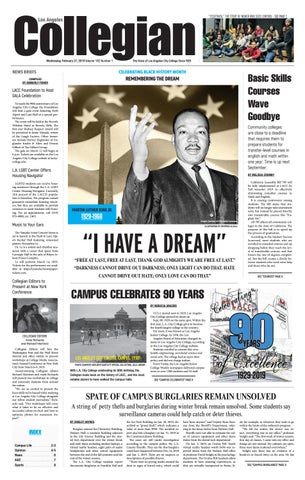
Collegian
“LYSISTRATA,” THE STORY OF WOMEN WHO SEIZE CONTROL - SEE PAGE 7
Los Angeles
The Voice of Los Angeles City College Since 1929
Wednesday, February 27, 2019 Volume 182 Number 1
NEWS BRIEFS
CELEBRATING BLACK HISTORY MONTH
Basic Skills Courses Wave Goodbye
REMEMBERING THE DREAM
COMPILED BY KIMBERLY FISHER
LACC Foundation to Host GALA Celebration To mark the 90th anniversary of Los Angeles City College the Foundation will host a gala event featuring Herb Alpert and Lani Hall in a special performance. The event will be held at the Beverly Wilshire Hotel in Beverly Hills. The first ever Rodney Respect Award will be presented to Jamie Masada, owner of the Laugh Factory. Other honorees include Harvey Englander of Englander Knabe & Allen and Dennis Gilbert of The Gilbert Group. The gala on March 12 will begin at 6 p.m. Tickets are available on the Los Angeles City College website at lacitycollege.edu.
Community colleges are close to a deadline that requires them to prepare students for transfer-level courses in english and math within one year. Time is up next September.
L.A. LGBT Center Offers Housing Navigator
BY MELISSA CRUMBY
LGBTQ students can receive housing assistance through the L.A. LGBT Center Housing Navigator. Currently, 18.6 percent of the LACCD population is homeless. The program cannot guarantee immediate housing vouchers, but they are available to provide resources to assist students with housing. For an appointment, call (323) 953-4000, ext. 2463.
MARTIN LUTHER KING JR.
1929-1968
Images Courtesy of Wikimedia Commons
Music to Your Ears
ILLUSTRATION BY BEATRICE ALCALA
The Yamaha Artist Concert Series is set to launch in the Herb & Lani Alpert Recital Hall featuring renowned pianist Alexandria Le. Dr. Le is a soloist and chamber musician with a career that spans from Carnegie Hall to the jails of Rikers Island Prison Complex. Le will perform March 14, 2019. Tickets for the performance are available at https://yamaha.brownpapertickets.com.
Collegian Editors to Present at New York Conference
“I HAVE A DREAM”
“FREE AT LAST, FREE AT LAST. THANK GOD ALMIGHTY WE ARE FREE AT LAST.” “DARKNESS CANNOT DRIVE OUT DARKNESS; ONLY LIGHT CAN DO THAT. HATE CANNOT DRIVE OUT HATE; ONLY LOVE CAN DO THAT.”
California Assembly Bill 705 will be fully implemented at LACC by Fall semester 2019 to effectively eliminating remedial courses in Math and English. It is causing controversy among students. The bill states that students will no longer take assessment tests, but instead be placed directly into transferable courses like “English 101.” AB 705 affects all community colleges in the state of California. The purpose of this bill is to speed up the process of graduation. According to the Student Success Scorecard, most students who are enrolled in remedial courses end up dropping before they reach the level of transferable courses, and that lowers the rate of degrees completed. But the bill creates a divide between students who need extra help and those who do not. SEE “COURSES” PAGE 6
CAMPUS CELEBRATES 90 YEARS BY REBECCA GRAZIER
COLLEGIAN EDITORS
Ande Richards and Richard Martinez Collegian Editors will Join the Washington Post and the Wall Street Journal and other outlets to present workshops at College Media Association’s Annual Conference in New York City from March 6-9, 2019. Award-winning Collegian editors Richard Martinez and Ande Richards will present two workshops to college and university students from around the nation. “We are so excited to present the keen skills we’ve honed while studying at Los Angeles City College alongside our fellow student journalists,” Richards said. “Our workshops will cover what it takes to be an effective and successful editor-in-chief and how to optimize photos for maximum impact.”
INDEX Campus Life Opinion News A&E Sports
2-3 4-5 6 7 8
LOS ANGELES CITY COLLEGE CAMPUS, 1930s PHOTO COURTESY ADELBERT BARTLETT SPECIAL COLLECTION, UCLA LIBRARY
With L.A. City College celebrating its 90th birthday, the Collegian looks back on the history of LACC, and the most notable alumni to have walked the campus halls.
UCLA moved west in 1929. Los Angeles City College opened its doors on Sept. 09, 1929 on the same spot. Within the first year, L.A. City College grew to become the fourth largest college in the country. For years, it was known as Los Angeles Junior College. In 1938, the Los Angeles Board of Education changed its name to Los Angeles City College, according to the Los Angeles City College website. Students enrolled in courses like civic health, engineering, secretarial science and social arts. The college had an open door policy and did not charge tuition. Every Friday, the Los Angeles Junior College Weekly newspaper delivered campus news to over 1300 students and 54 staff. SEE “CAMPUS CELEBRATES” PAGE 6
SPATE OF CAMPUS BURGLARIES REMAIN UNSOLVED A string of petty thefts and burglaries during winter break remain unsolved. Some students say surveillance cameras could help catch or deter thieves. BY CHISLEY HAYNES Burglars entered the Chemistry Building, Holmes Hall, a modular building adjacent to the Life Science Building and the dental tech department over the winter break and stole items including student laptops, a virtual reality headset, eight pairs of audio headphones and other school equipment between the end of the fall semester and the end of the winter session. The L.A. City College incident report documents burglaries in Franklin Hall and
the Sci-Tech Building on Jan. 28, 2019, described as “grand theft,” which indicates a value of more than $950. The incident report also lists a burglary on Jan. 31, 2019 in the Communications Building. The cases are still under investigation according to the campus police, the L.A. County Sheriffs. They say the first burglary could have happened between Dec.14, 2018 and Jan. 1, 2019. There are no suspects or descriptions of possible thieves. “There were no prying marks around the door or signs of forced entry, which could
have been anyone,” said Deputy Ryan Rouzan from the Sheriff ’s Department, referring to the items stolen from Holmes Hall. Sheriffs were not able to estimate the value of camera equipment and other items stolen from the dental tech department. On Jan. 2, 2019, an Oculus Rift Touch virtual reality headset worth $450 was reported stolen from the Holmes Hall office of professor David Sedghi in the psychology department. The Oculus Rift headsets allow students to have amazing experiences, as they are virtually transported to Rome, It-
aly for example, or wherever they wish to go within the limits of the software’s program. “We left for winter, the device was intact, everything was in my office,” professor Sedghi said. “The first week of winter session, first day of classes, I came into my office and things are not normal. My cabinets are open, there were items scattered everywhere.” Sedghi says there was no evidence of a break-in or forced entry in the area. He has SEE “CAMPUS BURGLARIES” PAGE 6
2
CAMPUS LIFE
Los Angeles Collegian - Wednesday, February 27, 2019
STUDENTS FIND FOOD SECURITY AT POP-UP PANTRY With just a Student I.D. card, students this semester can get access to fresh produce and other foods each Monday and Thursday at the Student Union, thanks to LACC’s Pop-Up Pantry. BY WILL PENNINGTON From around 11 a.m. to about 2 p.m., the LACC Foundation is extending the Pop-Up Pantry’s service to two days a week this semester. The hours may seem a little vague, but it is because some weeks the food goes faster than others. Produce, chips, drinks and other staples are available free of charge to any students as long as they bring their SSID card. On days with inclement weather, The PopUp Pantry moves indoors. Otherwise, it takes place just outside the Student Union. It can attract quite a crowd. According to the records kept by the foundation, more than 1,700 students visited the Pop-Up Pantry in just one week. It is easy to see why. The Pantry feels almost like one of the farmer’s markets that dot Los Angeles County, even if the options are a bit more limited. Students can peruse fruits and vegetables while volunteers and even paid interns work the various stands, helping the students get access to the food they need. “I think many students are surprised to know that we are here, even in the rain,” said Celina Navarro, a graduate intern with the Pantry. “It shows them how committed we are to helping the community.” Indeed, for many organizations on campus, helping LACC’s at-risk students is a top prior-
ity. In addition to the Pop-Up Pantry, ASG has a collection of canned foods which are available to students in need. The Pop-Up pantry is a combined effort of LACC’s foundation working with local non-profit, The Dream Center, to provide food security to a large number of students who are financially at risk. The foundation’s efforts do not stop at the pantry either. It is just one of a number of programs that have been or are being instituted by Dr. Mary Gallagher since she became president. Among the most promising is a new program that will provide safe overnight parking for students who are sleeping in their vehicles. The longer these programs exist, the more impact they will likely have as awareness increases. Already word of mouth seems to be helping tremendously. “A lot of people tell their friends, and more and more people come,” Navarro told the Collegian. “It’s kind of like a snowball effect.” Students in financial need are not the only ones who can benefit from the Pantry and other programs on campus. Volunteer and paid positions are available for interested students. To inquire further, just stop by the Pantry and ask someone working there. With City College nearly 90 years old, many are working to enact new traditions and programs to help meet the needs of students in 2019 and for years to come.
COURTESY OF CREATIVE COMMONS
KINGDOM HEARTS’ LONG-AWAITED RETURN BY DAMIEN HOSEA
PHOTOS BY WILL PENNINGTON (Top) Pop-Up Pantry workers help students find foodoutside of the Student Union on Thursday, Feb. 21, 2019. (Bottom) Celina Navarro helps students get fresh tomatoes for no cost at the Pop-Up Pantry on Thursday, Feb. 14, 2019.
Following a 13-year hiatus, Japanese videogame developer Square Enix released the highly anticipated “Kingdom Hearts III” worldwide for PlayStation 4 and Xbox One platforms to complete the popular trilogy. The development of “Kingdom Hearts III,” left many fans wondering if they’d ever see the title released in their lifetime. Square Enix ran into many hurdles when they tried to run “Kingdom Hearts III” on their now outdated Luminous Engine With Square Enix using Unreal Engine 4 in the development of “Kingdom Hearts III,” they were able to do things they weren’t able to do with the Luminous Engine such as utilize vivid colors, shadows and image rendering. Although changing the game engine did slow down the development of “Kingdom Hearts III,” it wasn’t the only hurdle. According to lead facial animator, Kayoko Yajima, “Disney wanted their characters to be showing less teeth,’ or ‘their eyelids needed to move more differently.” They wanted to preserve the soul and authenticity of the beloved characters. Kingdom Hearts is a Japanese Role-Playing game (JRPG) about a 14-year-old boy named Sora. The initial storyline focuses on the day Sora’s home, Destiny Island, was attacked by a dark entity called “The Heartless.” After Sora’s friends go missing, he is chosen by a magical weapon called a Keyblade. Together they embark on an adventure to rescue his friends and defeat the Heartless. Sora is joined by two iconic Disney characters, Donald Duck and Goofy to travel to distant worlds. In the Kingdom Hearts series, characters from Square Enix’s series Final Fantasy have crossed over into worlds made famous by Disney films. Every Kingdom Hearts game in the series contains different worlds and characters from 50 years of Disney history. In “Kingdom Hearts I and II,” Disney worlds like Pride Lands from “The Lion King” or Agrabah from “Aladdin” have been styled specifically for Kingdom Hearts. In “Kingdom Hearts III,” however, the worlds were built completely different. Square Enix used computer generated (CG) film pieces to create the exact worlds from the beloved Disney films. Before Kingdom Hearts, Buena Vista (also known as Disney Interactive Studios) was developing unprofitable educational games. Square Enix pitched an idea that was far outside of Disney’s comfort zone. The developer wanted to produce a game that didn’t just focus on one particular movie but a plethora of Disney Intellectual Properties (IPs) that would later evolve into something memorable and long-lasting. Although newcomers to the series might have a hard time understanding the storyline, Square Enix has provided a way to make “Kingdom Hearts III” more appealing to fans and non-fans alike by including a brief recap of The Kingdom Hearts Trilogy thus far. It’s been a long wait and “Kingdom Hearts III’s” story holds true to its counterparts.
(Left) In this image released by Elizabeth Preger, one of the artist’s friends is wearing an eyecatching outfit to commemorate the birth of her child. Preger’s artwork often causes a stir.
PHOTO BY WILLIAM PENNINGTON Artificial turf provides a welcome splash of green as the community garden nears completion outside the Martin Luther King Jr. Library on Thursday, February 21, 2019. The decision to replace grass in the park with artificial turf was motivated by financial as well as environmental concerns according to LACC Facilities Manager Khalil Harrington.
(Right) In this image released by Elizabeth Preger, one of her award-winning pieces appears at an art gallery in downtown L.A. Photo courtesy of Elizabeth Preger.
‘Field of Dreams’ Comes into Focus BY MYNOR PERALTA
A
fter some setbacks, the park in front of the Martin Luther King Jr. Library will be finished by the second week of March at the latest. The park will include magnolia trees, a community garden, pathways and furniture for student use. The facilities manager for Los Angeles City College, Khalil Harrington, explained the delay. “The biggest delay was the weather,” Harrington said. “From the grating and smoothing the area, the weather has been the biggest reason for the delay.” In terms of a new date for the end of the construction of the park, he said that it will be delayed for about one month, which will be the first or second week of March. However, the furniture, which includes benches and tables with umbrellas, will not be in place until a month after the opening of the park.
Harrington’s hope is that the park is a gathering area for students where they could relax and study. The students seem to agree with Harrington. “It will actually be more convenient, do some homework there,” said Eric Holloway who was sitting on a bench studying across from the Communications Building. “Another spot to chill at.” Victor Ramos checked his camera near the entrance to the Communications Building. “I think it’s a good thing, that way there is another area where people can lie down.” However, the park might not be a permanent addition to the campus. According to Harrington, there were no plans for a park to be built in the lot. As a matter of fact, for the next five years, the lot was just going to be a dirt field. It was Harrington who wanted to at least put something in place for students to enjoy and use. Harrington says other colleges like East Los Angeles College and Los Angeles Trade Tech inspired him to improve LACC.
Students like Josue Clara who was wearing a gray, New England Patriots sweater with a red beanie agrees with Harrington in this area. The student appeared to be reviewing some notes. “Makes the college more vibrant, especially with plain looking buildings around campus,” he said. One of the decisions that was made to reduce construction costs and maintenance was the installation of turf instead of real grass. Harrington noted that the cost of watering real grass was too high. Also there was not enough ground crew to be able to water and cut real grass. However students around campus think this a good choice for many reasons. “More greener and more environmentally friendly,” Ramos said. Even though there will be no real grass, there are plans to add shrubs and plants that are drought resistant around the turf and the park in general. There will also be a community garden added to the park.
VAMA FACULTY FRAMES LIFE WITH ART AT LECTURE SERIES Gritty images evoke film noir. Childhood memories of family and Siberian culture a world away emerged through art and storytelling in a recent presentation from artisteducators at L.A. City College. BY XENNIA R. HAMILTON Instructional Assistant Elizabeth Preger and professor Eugene Ahn have traveled extensively and have seen many things that inspire and influence their art in glorious ways. The two LACC staffers hosted a lecture inside CHEM 3 (Chemistry basement lecture hall) as a part of the Los Angeles City College VAMA: Artist Lecture Series on Tuesday, Feb. 12, 2019. Featured in the evening’s lecture, Preger presented art entitled: Here Are my Teeth: Black With Stars. The art piece featured still life photography that showed the beauty of the human body and nature using jet black paint in different ways. SEE “NEXT PAGE”
CAMPUS LIFE
Los Angeles Collegian - Wednesday, February 27, 2019
3
FROM “PREVIOUS PAGE”
PHOTOS BY KAITLYN KIMBLE (left) Elizabeth Preger reads a poem written to accompany her photographs during the artist lecture on Tuesday, Feb. 12, 2019. The lecture is in Chemistry 3 lecture hall in the basement of the Chemistry Building. (Right) Eugene Ahn tells students the story of how he was able to snap this image of the Golden Gate Bridge, at the artist lecture held in the chemistry building on Tuesday, Feb. 12, 2019. With extensive planning, Eugene was able to capture amazing views from the top of the bridge.
“Life moves so fast right now” -EUGENE AHN, LACC VAMA PROFESSOR
For example, one image contained a collection of seashells sitting inside a bowl upon a cherry wood table with black paint being drizzled upon them as fudge might be drizzled onto ice cream; a human arm was submerged in a white sink with jet black water. Another image contained a shirtless, Caucasian man showing the ginger beauty of his soul as natural sunlight illuminates every freckle on his chest and body. A third display of artwork was a diamond shaped black, blue and purple collage that at first glance resembles lace simply in the form of triangles. Yet on closer examination, the photo reveals a series of 45 photograms, which are cameraless techniques used to create an image. The sultry, macabre giant portrait contains double heads splitting apart in the center with sultry yet scary spider web features at the bottom that give femininity a different view. “It was me really grappling with expectations of femininity,” Preger said. Louis White, one of the many art students at the lecture, said that he is a fan of the series and the artist. “I made most of them last semester,” White said of the VAMA Lecture Series. “I made all of them last spring. And this one I’m really happy to see because it’s Elizabeth.” Preger is from Los Angeles, but her family’s Russian roots figure heavily into her art. She is known for her work on grand scales and uses audio and visuals within her
art that make you question time and space. She enrolled in courses at L.A. City College when she was a teenager and that helped her develop her craft. A lot of experimentation goes into her work. “You know, it actually started really small,” she said. “It was with Daniel Marlos, (fellow LACC professor) to be perfectly honest he was my first photo teacher.” Preger was 15 years old when she came to City College after being homeschooled for three years. “There was this alchemy and magic with photography because I started with black and white. It was a way for me to delve into my own psyche and to start to articulate my own ideas.” “It was me really grappling with expectations of femininity,” Preger said. She has also exhibited her artwork abroad in countries such as Colombia and Thailand. “That was a thrill,” Preger said. “There’s this feeling that I could’ve been myself. That I can go there and say I was an artist and ask for a show and things would happen.” In Bangkok, she drew attention to her art by simply handing out her slides or photos to different museum curators which led her to working with some of the top curators in the art world such as Mark Allen, Associate Professor of Art at Pomona College, and also Anne Ellegood, Senior Curator for the Hammer Museum, Los Angeles. Using her family’s Siberian roots and the Banyan or Siberian Bath Culture, Ms. Preger also spoke about how their memories
I grew up with all these stories and all this sort of nostalgia, but also what really for me shaped the way I dealt with it as an artist is my family had left before socialism fell apart. I only knew their memories from before socialism and the reality was that the country had really changed.
influenced her art. “I grew up with all these stories and all this sort of nostalgia, but also what really for me shaped the way I dealt with it as an artist is my family had left before socialism fell apart. I only knew their memories from before socialism and the reality was that the country had really changed.” She also goes on to say, “I just had these stories that were a time capsule. And so, the Banya work is like delving into that. In to
another time capsule that could be a space where women can get together and have a space of resistance.” Preger also offered words of encouragement to artists and students. “Reach out to faculty and staff,” Preger said. “I think there is a lot of support here and I think even if you keep moving on if you’re no longer taking classes, there is a community and there are friends I made when I was a student at LACC that I’m still friends with. I think don’t try to do it alone.” Professor Eugene Ahn also presented at the VAMA series. He is an instructor of web design for Los Angeles City College and is also a dedicated artist who exhibits art that mixes natural imagery with everyday life. Professor Ahn is a second-generation Korean whose parents immigrated here separately. “My deep background is one of understanding that my history and my identity comes from a place I have no experience,” he said. Professor Ahn’s work gives one a feeling of immersion. The images make you feel like you are a part of a story. You dive inside yourself and question logic, time and essence. “I’m really honored to share my work in this format,” Ahn said during the lecture. “The classes that I teach, I don’t get to talk about my work.” Professor Ahn’s work is a kaleidoscope of images that invoke art, nature and life. One piece of work he displayed at the lecture gave a “Sin City” vibe with dark, shadowy nights and streetlight illumination. Other examples of his work play with imagery of all-American life with depictions such as an empty, rained out, trash-filled L.A. River against an innocent blue sky, or a
white and black cat peeking through a grey wooden gate with intense yellow eyes illustrated with the sunlight. Professor Ahn also shared his ideas on how life can inspire art. “I see very little separation between art and life,” he said. “You know there’s that whole question, what are the rules of life and do you pursue a life of art or maybe a life that is more practical? And hopefully what I have to share gives people a reason to believe art and life are synonymous.” Professor Ahn’s work gives the sense that life is art and art is life and the two share a relationship. “I think the main thing that is so exciting right now and what it means to be an artist is that art is everywhere,” Ahn said. “Art isn’t something that is for the realm of the museum of the gallery, it’s part of the everyday. It’s something that everything in the world is reaching out to in order to survive and thrive in this world we live in.” In professor Ahn’s eyes, art is needed to maintain the human race. “Life moves so fast right now,” he said. “We need art actually to sustain peace and to stay sane during all these changes. It’s a lot different than 10 years ago. People have access to art to either create it or consume it more than ever before.” Professor Ahn has been published in the L.A. Weekly, the L.A. Times and other outlets. He tends to use a lot of storytelling techniques and journalism. He says art allowed him to discover people. “Language is the connector,” he said while revealing his beautiful artist’s soul. And indeed, it is. For more information about upcoming artist lectures, visit the calendar on the school’s website at lacitycollege.edu .
Black Speakers: Do Not Allow Early Discipline Problems to Brand Kids SAVING YOUNG STUDENTS FROM BEING STEREOTYPED IN SCHOOL COULD IMPROVE THEIR LIVES LATER ON. THIS WAS THE FOCUS OF TWO BLACK HISTORY MONTH SPEAKERS IN THE STUDENT UNION ON FEB. 12 AND FEB. 19, 2019. BY CHRIS ARGUETA For the month of February, the Genderversity and Multicultural Center hosted black speakers in the Student Union on the third floor for a series of talks with students about the importance of black history. They recounted the hardships of the past and the steps needed in order to improve the future. In order to succeed, students should also focus on the lifting up of their community, according to speakers. Speakers this month included Dr. Tyrone Howard, a professor in the UCLA Graduate School of Education and Information Studies, and Rahsaan Wall, an experienced voice over actor with extensive television and commercial experience. While Dr. Howard’s speech focused on
the negatives aspects of black history and the importance of education for not only African Americans, but also for minority groups across the country. Wall’s speech focused on the history of blacks beyond the transcontinental slave trade and the mentality needed to succeed in an industry which may be majority white. Dr. Howard spent some time during his speech discussing the importance of education, especially during a child’s first few years of school. It can be established early if students will be successful or not, depending on whether or not they can read by fourth grade, or if they have been suspended from school. “Black males have the lowest graduation rates of any group in our state,” Howard said. “It was black boys who were suspended in the highest rate.”
Dr. Howard examined statistics that can be indicators of who will fail later on in life based on their performance in school. It may also predict the possibility that students who were disciplined may end up in prisons. Dr. Howard encourages students who may have been suspended or punished in school to reject the stigma that others may associate with them based on their educational experience. Howard says statistics will not determine where students will end up later in life. Howard encouraged attendees “Learn to prove people wrong.” L.A. City College student Maria Velasquez attended the one-hour talk. “Even though I’m not black, I learned a lot from Dr. Howard. As a Latina student, I fear people may judge me based on what I did earlier [ in school],” Velasquez said.
Wall’s speech encouraged students to avoid being branded with any negative ideas which may be associated with their particular minority group, whether it be black, Latino or Asian students. “We need to change the perspective of our past,” Wall said. “We need to change the perspective of our present, and we need to change the perspective of our future.” Wall talked of black history before slavery even existed. He talked of how in Africa, there were monarchs and systems in place before the Europeans intervened. Wall discussed how “big-wigs” look at statistics based on children in minority groups to determine where they will build prisons. California spends $11,495 per student as opposed to $64,642 per inmate, according to statistics from the US Census Bureau.
Wall talked of his early career as a voice actor, when he believed that if he made his voice sound like a white man’s voice, he would have a better chance of getting a job. His peers encouraged him to use his own voice, because if he had to copy a white voice to get a job, they said he didn’t deserve that job. Wall ended his speech with the idea that black communities do not have to be alone in this fight to gain advantage in the country, but to join up with minority groups across the nation to rise up and prove people wrong about the negative stigmas. “I’m sick of white people thinking I’m a thug or a gangster just because I’m black,” said Michael Jacobs, an L.A. City College student. “I don’t care what they think, and I’m done being grouped. I’m gonna be my own man now.”
4
OPINION
Los Angeles Collegian - Wednesday, February 27, 2019
EDITORIAL APPROXIMATE WALL COST AND TRUMP’S COVER-UP
If I call it National Security, build the wall. People would forget all about Manafort, Mueller.
$21.6 BILLION
Mr. Trump, tear down that wall... People are stupid. BELIEVE ME!!! I am a genie, I mean genius. ILLUSTRATION BY BEATRICE ALCALA
FIGHT FOR HUMAN RIGHTS DOES NOT END AT BORDER Recent drama over President Trump’s proposed border wall and strong anti-immigrant stance causes many to ask, “What can I do to help immigrants?” Quite frankly, there is a lot you can do. In the beginning of February, Los Angeles City Council reaffirmed L.A. as a Sanctuary City. This means that Los Angeles won’t fully cooperate with U.S. Immigration and Customs Enforcement (ICE) depending on the situation.
This is great for helping immigrants live more peaceful lives. But legal declarations and state laws are not enough to combat the oppressive forces that currently haunts our government. Protest is one of the most dramatic ways to express opposition to something. It visually tells elected officials how many people are in support of immigrant rights while creating a sense of unity within the community. This strength in numbers approach
DO NOT SURRENDER YOUR HUMANITY BY DAWSON FICKUS Homelessness is a massive problem in Los Angeles and not enough is being done to fix it. I was born and raised in Fairbanks, Alaska, a small town in comparison to my new home. Because it’s below freezing there for seven months out of a year, there are very few homeless people. Moving here was a bit of a shock. I started out living in Westlake but moved into Downtown after a year. Back then, I would talk to maybe three homeless people per day and try to give each of them money. In Downtown, it’s very easy to lose count of how many times you are approached. It got to the point where I was ignoring them. I would walk by and put my head down to my phone when they would ask for money. I notice the majority of other people do the same thing. I had a friend from Alaska visit me just a few months ago. I was showing them around my neighborhood, and we were walking past a homeless person sleeping on the sidewalk. My friend rushed to the homeless person exclaiming, “Sir, are you OK? What’s wrong?” The man woke up looking as confused as I was. I ran after my friend and pulled him away as I said, “No, no, no don’t. We don’t do that here.” As soon as I said that, I realized what was happening to me. I had lost my humanity. I wouldn’t have even noticed that man sleeping on
the ground had my friend not acted. It got to the point where I was writing them off as an inconvenience, as I went on with my own life. It’s not so much that I had lost sympathy, but I was becoming so narcissistic that I could not show these human beings a little bit of courtesy. For the past few months now, I have become more and more conscious of the issue as I try to restore my humanity. When they ask for change, I’ll give it if I have it, and if not, I don’t just say “no,” I tell them that “I wish I could help right now.” It’s important to show respect and sympathy for your fellow human beings. Giving out a buck at the street corner is a short-term contribution, not a solution. Real change begins at the human level with caring, but it is carried out with legislation. In November 2016, Los Angeles voters approved Proposition HHH by a landslide. We were promised 10,000 units for the chronically homeless. Here we are over two years later with over 50,000 homeless people on the streets and in shelters every night. The city has disbursed $360 million, and we have zero units to show for it. The city is currently funding units that cost $400 to $500,000 per door. Three buildings are set to open later this year for a total of 239 units, but that is barely two percent. So, that’s the problem, what’s the solution? Write your local assembly member! Tell them to push for more units. Don’t stand for high cost and low speed. Get our fellow human beings off the streets now instead of building them luxury apartments. The gears of city government turn slowly, and in the meantime, all we can do is write and be polite
End the Stigma of Mental Illness on Campus: Mental Illness should not be Stigmatized at School BY MAX-ROSE KO Mental illness and the stigma associated with it exist at L.A. City College and among our students. We need to prioritize not only the education of students, but also their mental health and wellbeing. Students who struggle with mental illness have a difficult time managing everything. I can attest to the struggles be-
cause I battle with bipolar disorder. Stigma makes it much more difficult -- it can make a student isolate themself and feel unsafe to confide or be open about their illness. “Anxiety disorders are the most prevalent psychiatric problems among college students, with approximately 11.9 % of college students suffering from an anxiety disorder,” according to an article published in the “National Center for Biotechnology Information” by Paola Pedrelli. The article also points to depression as a very common illness among college students. When we say things like “She’s crazy,” or “Everyone has anxiety.
frightens politicians who worry over future elections. Your silence about issues such as this leads many to conclude that what is happening is not an issue for you. The same thing happened in Nazi Germany. During World War II. Many Germans opposed the Third Reich and Hitler’s plans for Germany’s future. However, many kept silent, and millions died. Don’t let history repeat itself.
You’re fine,” this discounts the experience of that student. We need to stop putting people down with our terminology, and we also need to stop using words so flippantly. No, that “crazy” day you had does not make you “bipolar.” Someone acting erratically one day does not mean they are “schizophrenic.” Mental illness is serious things and should not be trivialized or used to describe the neurotypical’s normal day. Our illnesses are not adjectives for the things that
Contact local and state politicians to demand better treatment for immigrants. Just like with protests, phone calls and emails speak volumes. Senators and state representatives can be reached by phone. Often callers will speak to an aid or intern who works for the elected official, but your opinion will make its way to the right ear. Silence and progress are not bedfellows. Concerned citizens can also volunteer for grassroots organizations like the Mex-
happen in your lives. They are real illnesses and conditions that are often trivialized or given a bad rap. We are not jokes. We need to be more compassionate in our language and behavior and more understanding. Professors especially need to provide a welcoming environment. What we can do as students to support each other is to check up on each other. We can let each other know that we’re safe to talk to, and then that can open doors for the student to be honest and accept help if it is needed.
ican-American Opportunity Foundation or Catholic Charities. These groups always need help with office work, translations, recruiting support and even legal aid. If you can afford it, donate to services that provide legal aid to immigrants like the Coalition for Humane Immigrant Rights of Los Angeles (CHIRLA). Even small donations are crucial and add up in the longrun. The future is ours to shape, proactively.
Being open in a supportive environment eases the burden of worries that we will be judged and not accepted. We can also refer our peers to mental health resources on campus. The Health and Wellness Center provides counseling, and it is located in the Student Services Building, Room 120. We should not be ashamed of being sick. We should not put up with being put down. We are strong, resilient and compassionate students. Let’s all make mental health a priority.
CAMPUS CAN FEEL MORE LIKE HOMELESS RESIDENCE THAN COLLEGE BY LIA AVETISYAN Every school’s priority should be their students’ safety, however, it seems as if this is not the case with Los Angeles City College. There are multiple unguarded entrances around the campus where the homeless enter and roam around the campus. Some are harmless, merely searching for food or shelter; on the other hand, many of them appear mentally unstable and present potential danger to the students, especially those who attend evening classes. One year ago, Franklin Hall’s basement was shut down because homeless individuals spent the night there, bringing some sort of bugs with them. This was a disturbance to both students and
professors because they had to relocate into open classrooms (which was difficult as it was the middle of the semester). Aside from disturbing classes, the homeless can physically hurt those on campus because we do not know if they are carrying weapons or not. Imagine, you are walking to your evening class, the campus is dark, and there are multiple homeless individuals sleeping on the floors of the hallways. Not only are you feeling like you are in danger, but you may take some bugs home with you after your class. I personally have witnessed a mentally unstable homeless lady on campus who gave the impression that she was on some form of a drug, yelling and talking to herself in broad daylight. The only good thing about this situation was that there were many students around me, as it was in the afternoon. However, I felt the tension in the air as students stared at her and hurried off to their classes.
On a school rating website, Niche.com, students have addressed the homeless situation. An anonymous student wrote: “You’re stalked by people on drugs…the sheriffs can be distracted on their cell phones … ” (Niche). Such comments can impact the enrollment rate at LACC because potential students will not want to attend. Los Angeles City College has multiple police cars parked around the school, yet sheriffs stay in their office and do not respond to any complaints regarding the homeless individuals on campus. If they do respond to your call, they either do not meet their promise of showing up or they show up too late to help. The sheriff ’s department needs to take this matter seriously and to take each complaint into consideration to ensure the safety of the students. In addition, there should either be guards at each entrance or secured private access entrances to the campus.
There Goes the Neighborhood BY SAMUEL SCHIFFER One of the most unique cultural crossroads in the city is located in the area surrounding Los Angeles City College. However, we could lose our status as a culturally significant neighborhood because of soaring rent and gentrification. If you walk a few blocks in any direction, you find yourself in a completely different part of the world. If you head South, across
the freeway, you find yourself in the outskirts of what I like to call “North Koreatown.” Head North a bit, and all of a sudden you’re in East Hollywood or Thai Town. Three blocks East is Virgil Avenue, home to “Sqirl,” one of the hottest restaurants in Los Angeles and the start of Silverlake, which to me looks like the most rapidly gentrifying neighborhood in all of Los Angeles. Virgil Avenue used to be home to my favorite bar in the world. A dingy, dark, low-ceilinged, karaoke dive-bar that was owned by a crotchety old Thai woman named Joanne who would “Boo” while you sang, and she would throw things at you and throw her head back in maniacal laughter. I loved
her. “Smog Cutter” was a rare jewel. Sadly, after a developer bought the building, he did not renew their lease. After a few months of not knowing what would become of the place, they were forced to shut their doors. They threw one hell of a going away party. In its 40 years of operation, it was not only always immigrant-owned, but also owned and operated exclusively by women. I’ve always thought of gentrification as consisting of three waves. The first wave is usually when the fresh-out-of-college, liberal artist crowd moves into an area because it’s cheap. Then in the second wave, they see a lack of businesses that serve their
needs, so they begin to open up shops. Usually a coffee shop, a cute little breakfast place (ahem, Sqirl), or maybe a tasteful and specific sort of clothing and homegoods store. The third wave is where the real trouble starts. Seeing the shift in demographics and the buzzy restaurants and stores, developers move in and snatch up any of the remaining real estate in the area. All of a sudden, three years have passed and the neighborhood is unrecognizable. There’s a nationally syndicated burrito restaurant and the original community has been forced to relocate. Real estate in Los Angeles is a sure thing, and if you’re a developer with business savvy, you’d be a fool not to take advantage of the opportunity. In fact, much of the area around campus is owned by The Church of Scientology, whose building looms like a spectre just a few blocks North of us. It’s doubtful they would let go of their stake in the area anytime soon. The best thing you can do to help slow gentrification is to support local businesses. Instead of going to the burrito chain, go to the mom and pop burrito store across the street. Don’t go to the chain convenience store, go to the Mexican market around the corner and support someone who is serving the needs of the community. Maybe by strengthening the presence of these sorts of businesses, we can make these neighborhoods resistant to buyouts and bullying by people who want to see them “outta there.”
LACC
TURNS
90
HAPPY BIRTHDAY CITY COLLEGE
HAVE AN OPINION, LETTER OR COMMENT? PLEASE STOP BY AND SEE US AT THE OLD CHEMISTRY BUILDING ROOM 208
OPINION
Los Angeles Collegian - Wednesday, February 27, 2019
5
Compiled by Thomas Gardner Photos by Kaitlyn Kimble
WHICH HISTORICAL FIGURES COME TO MIND WHEN YOU THINK OF BLACK HISTORY MONTH?
CIARA CANEEGA
VERENA HECHT
DEANDRE HORTON Nursing Major
Kinesiology Major
“I would say Ida B. Wells, who made a significant contribution to the field of sociology. Wells is said to be one of the founding members of the NAACP. One of Wells’ friends was lynched, and so she put forth a lot of work in effort of bringing an end to cruel and violent brutalities against African American people. In all, she was a really important figure in the world of sociology – she sought to address the major social issues that were taking place in her time.”
“I would have to say Michael Jackson, because I believe he was a major influence on pop music. I would go further and say, all of pop culture, because he transformed pop music altogether, in my opinion. His music and stage presence were incredible; to this day, so many artists have been influenced by him. In fact, I actually have a Michael Jackson Barbie at home, from when I was a kid, I do. As an artist, he was monumental. Also, Aretha Franklin comes to mind for me, because I am a big music person. Right now the cosmos is full of such influential people who are producing such great art.”
“Two people come to mind for me, I will say MLK (Martin Luther King) – he has opened lots of doors for people like myself. King stressed education, and getting to know the richness of our heritage. Also, he showed us how to fight for equal rights and equal opportunity for blacks. I have also just recently learned about Sam Cooke, the musician, who, in his time, also opened up a lot of doors, mainly by using his music as a way to build up the black community. Music was his way of participating in the political affairs of the time.”
“To me, Rosa Parks and Nelson Mandela stand out, because they really did all that they could to fight for freedom. Nelson Mandela was in South Africa, but his attitude about justice was no different from that of Rosa Parks. Both of them were jailed as a result of their determination to bring change. These two historical figures believed that black people deserved more from the society than what they were getting. Also, Mandela had to spend many years in prison because of his commitment to freeing his people.”
Psychology Major
Journalism Major
MARC LEE
Ink Style: A VISUAL REPRESENTATION OF THE WORLD AS WE KNOW IT
ILLUSTATION - BEATRICE ALCALA
Collegian Los Angeles City College Visual & Media Arts Department
855 N. Vermont Ave. Los Angeles, CA 90029
323.953.4000 ext. 2832 losangeles.collegian@gmail.com
Editor-in-Chief WILL PENNINGTON
Campus Life Editor REBECCA GRAZIER
Graphics Editor BEATRICE ALCALA
Photo Editor KAITLYN KIMBLE
CARTER WILLIAMS, XENNIA R. HAMILTON, KENNY CARRANZA, MAX ROSE KO, SAMUEL SCHIFFER, JACOB GREEN, MYNOR PERALTA, REBECCA GRAZIER, DAMIEN HOSEA
Front Page Editor CHISLEY HAYNES
Broadcast, Social Media Producer JASON PISKOPUS
Broadcast DAVE MARTIN, THEO VIDA
Opinions & Editorial Editor MARY PARONYAN
Photographers CURTIS SABIR
Advertising ABIU IZQUIERDO, ANDE RICHARDS, RICHARD MARTINEZ
Arts & Entertainment Editor LOU PRIMAVERA
Copy Editors JOHN JOHNS, KIMBERLY FISHER, CHRIS ARGUETA,
Sports Editor DAWSON FICKUS
Reporters MELISSA CRUMBY, DERRICK WADE,
Faculty Adviser RHONDA GUESS
For all submissions including letters to the editor and publicity releases, send materials to Collegian offices located in Chemistry Building, Room 207, or email: losangeles.collegian@gmail.com. To advertise in the Collegian, direct all insertion orders and questions to: pr.collegian@gmail.com. NEXT ISSUE: March 13, 2019 EDITORIAL DEADLINE: March 6, 2019
The college newspaper is published as a learning experience, offered under the college journalism instructional program. The editorial and advertising materials published herein, including any opinions expressed, are the responsibility of the student newspaper staff.
Under appropriate state and federal court decisions, these materials are free from prior restraint by virtue of the First Amendment to the United States Constitution. Accordingly, materials published herein, including any opinions expressed, should not be
Issues of our award-winning newspaper and magazine are instantly available to our readers on issuu.com/collegianwired. facebook.com/CollegianWired @CollegianWired CollegianWired.tumblr.com youtube.com/CollegianWired
interpreted as the position of the Los Angeles Community College District, Los Angeles City College, or any officer or employee thereof. Collegian ©2017. No material may be reprinted without the express written permission of the Los Angeles Collegian.
6
NEWS
Los Angeles Collegian - Wednesday, February 27, 2019
FROM “CAMPUS CELEBRATES 90” PAGE 1
FROM “CAMPUS BURGLARIES” PAGE 1
STUDENTS SUGGEST CAMERAS TO SLOW CAMPUS BURGLARIES
Los Angeles City College Administration Building circa 1920s
PHOTO COURTESY ADELBERT BARTLETT SPECIAL COLLECTION, UCLA LIBRARY
“Getting into LACC was a godsend,” Hamill told the Collegian. “It was just wonderful, and over the years I’ve tried to give back to the school as much as I can.” -MARK HAMILL ACTOR, LACC ALUMNI The Collegian staff reported on all types of issues that affected students ranging from who would become homecoming queen, to campus clubs, to theatre productions premiering at the Camino Theatre. As the community looks back on 90 years of Los Angeles City College, the Collegian will take a look at some of the famous alumni of L.A. City College to see how the past has shaped the present. Since 1929, people from near and far have been coming to Hollywood to follow their dreams. One stop along the way was L.A. City College, which has attracted many talented students over the last 90 years its doors have remained open. “We have a really unique experience here that I feel like most community colleges don’t get, we try to veer away from the stereotype that’s really prevalent in American society that community colleges are bad or aren’t as good, “said Rachel Frost, a theatre major. “Because we have small class sizes, we have teachers that care about us and work with us to get our careers out there.” An early success story for the college came to Canadian Actress Alexis Smith. She was discovered by a Warner Brothers talent scout
during a Theatre Academy production, and went on to sign a contract in 1941. Smith had a notable career on Broadway, and later went on to win a Tony Award in 1972 for her performance in “Follies.” Probably one of the most famous alumni of City College, Mark Hamill, enrolled in theatre classes in the early 1970s, and went on to star as Luke Skywalker in six “Star Wars” movies, which launched his lengthy career. The Collegian had the opportunity to sit down with Mark Hamill in December of 2015 while he was promoting “Star Wars: The Force Awakens.” In the interview, Hamill spoke extensively about his lack of money to go to a “name college,” and how attending L.A. City College shaped his career. “Getting into LACC was a godsend,” Hamill told the Collegian. “It was just wonderful and over the years I’ve tried to give back to the school as much as I can.” Universities like Yale, Juilliard and Carnegie Mellon are schools talented students dream of attending. Mark Hamill certainly could have enrolled there instead of LACC, but he just could not afford
the tuition, so he set his sights on L.A. City College. “Now the irony of course is that LACC then becomes the destination education for people that have no money but who are extraordinarily talented enough to compete with in any of the schools that I just mentioned,” Hamill said. “The alumnus is second to none and we’re all proud of that. I learned things at that school that I use throughout my career.” One student recalls an ongoing joke at the Theatre Academy about Hamill breaking his fingers during his time at LACC. “There’s like various stories, like he broke his fingers on the green room wall right there, he like hung up there and broke his fingers, and when people do that they’re like ‘ oh, you’re gonna pull a Mark Hamill’, so it’s kind of funny,” Frost said. Hamill also did the voice of “Joker in Batman: The Animated Series,” and has gone on to do many voice over roles for animated television. He received his star on the Hollywood Walk of Fame on March 8, 2018. Other alumni made the short trek from East Hollywood to stardom. It was an L.A. City College transcript
clerk who literally became the voice of God in one of his films. His name is Morgan Freeman. He came to LACC in the 1950s to take acting, voice and diction classes. Freeman later went on to win an Academy Award for Best Supporting actor in 2005 for his role in “Million Dollar Baby.” “One time I saw an interview and they asked Morgan Freeman about his voice, and he said ‘oh I got my training at L.A. City College, and I was like ‘oh that’s where I went,’ but I was kind of unaffected because I feel like we’re here to create our own path,” said Alexandra Fiallos, a theatre major. One of the most influential alumni of L.A. City College was Frank Gehry who is often called the greatest living architect in the wor ld. Unsure of what to study, Gehry ended up enrolling in courses and studied radio announcing and chemical engineering before finally settling on architecture after he decided he had a love and passion to create art. Gehry has designed famous buildings such as the Walt Disney Concert Hall, the Chiat/Day Building in Venice, and the Guggenheim Museum Bilbao, in Bilbao Spain.
FROM “BASIC SKILLS” PAGE 1
LAWMAKERS SAY AB705 WILL HELP SPEED UP GRADUATION RATE Floyd Simmons is a student and ex-marine majoring in architectural technology. He enrolled in a basic skills course, “Math 121.” “I’ve been out of school since the ‘70s. I’m into my 60’s, have been out of school for 40 years so all of this is new. As soon as I left high school, a month later I enrolled into the Marine Corps,” said Simmons. “So far, I find this class helpful. I have a thorough teacher who keeps it very simple so I can understand it. I am getting something out of this so far.” There is an abundance of students enrolled in basic skills courses this semester. According to the Los Angeles City College class schedule of Spring 2019,
some basic skills classes are full. “English 67,” English 28,” and “English 97,” show an enrollment of 15 to 49 students. Many sections of basic skills courses like “Math 110” and “Math 121” are over a quarter to half full. It appears that students still rely on these courses and find them helpful and useful. The data may suggest that the intent of AB 705 might not be so helpful for the students at Los Angeles City College whose need basic skills, which seems considerable according to spring 2019 enrollment numbers. It will be interesting to compare the enrollment statistics for this semester to fall 2019 after the final implementation of the bill next fall.
Staff members in the California Community Colleges Chancellor’s Office located in Sacramento hope this bill is going to benefit colleges around the state. Hopefully, it also benefits the students. A few colleges have already started testing out AB 705. “While it is premature to provide specific data related to AB 705 implementation across the state, a number of colleges have seen early promise as they begin to move forward at their colleges,” said Alice Perez, vice chancellor for academic affairs. “The chancellor’s office views the developmental education reform movement represented in AB 705 as a central tool in the Guided Pathways
losangeles.collegian@gmail.com
framework.” Regardless of a few colleges seeing early promises, it still doesn’t address the concern for campuses such as L.A. City College where students actually benefit from basic skills courses. Many students at LACC come from low-income areas where learning foundations are not as strong. Others students come from foreign countries or immigrant communities and may find the ESL program beneficial. When credit for basic skills courses is eliminated next fall, it could slow some students down and delay their educational plans. It is not clear yet if AB 705 will live up to its expectations.
spent a year or so taking his virtual relaity equipment on a campus tour of sorts to other departments to demonstrate how it works. “Surprisingly, a lot of other things were not taken,” he said. “I have a computer, printer and a PlayStation, but no one took anything. It seems very specific ... Someone with access to the room – access to the keys – who knows?” Other items were reported stolen around the same time from the dental tech department. Burglars stole all of the department’s digital camera equipment. Eight pairs of headphones used for podcasts, broadcasts and editing were missing from the radio booth and TV studio of the Collegian offices in journalism on the second floor. “Whether the thieves are strangers or individuals, we know they have the freedom to steal school equipment and walk out free,” said Lorrana Franca a paralegal major. On Jan. 31 or Feb 1, 2019, burglars broke into Modular 3, adjacent to the Life Science and Chemistry Buildings. Thieves may have entered through a window they forced open according to the sheriffs. They stole props and art supplies, according to VAMA chair, Laurel Paley. There have been a rash of burglaries in the Chemistry Building over the past two years. Burglars stole Desktop Macs in broad daylight in 2017, and thieves stole the paintings of art students from the L.A. City College Visual and Media Arts Department right off the walls of the Chemistry Building last year. “I think it would be worth it to repair the broken cameras and install new ones, rather than to replace everything that is taken. At least it would be easier to find out who is stealing,” said Freddy Garcia, a math major. Students seem aware of the burgalries and the lack of surveillance systems in several areas of the campus. “I don’t think the issue is finding out who did it,” said Daniel Sunun, a cinema major. “The real issue is, there is no protection. There are no cameras working … The lack of cameras is influencing some people to do it, because if no one is watching, it is going to tempt people to want to do it.”
POLICE WIRE COMPILED BY KAYLA ASHA HEWITT
CAMPUS POLICE REPORTED THE FOLLOWING INCIDENTS Jan. 28, 2019, 7:10 p.m.: There was a grand theft reported in the Science and Technology Building. Jan. 28, 2019, 9:41 p.m.: There was a grand theft reported in Franklin Hall. Jan. 31, 2019, 3:10 p.m.: There was a burglary reported in the Communications Building. Feb. 1, 2019, 11:31 a.m.: There was a bicycle theft reported in the Student Union Building.
ARTS & ENTERTAINMENT
Los Angeles Collegian - Wednesday, February 27, 2019
7
ARTIST SPOTLIGHT FEST, Bill Corso sat down to reminisce in detail about the adversity, glamour, hectic and often funny moments that took place throughout his long career in tinseltown. He spoke with the Collegian poolside at the Roosevelt Hotel in Hollywood. He is poised and relaxed speaking not only about his career but offering great advice for young people on achieving their goals.
“YOU CONTROL YOUR OWN DESTINY.” PHOTO COURTESY-CARMEN CACOPHONY Makeup artist Bill Corso waits to speak with the Collegian at the Roosevelt Hotel on Nov. 13, 2018. He has worked with director Steven Spielberg, Harrison Ford, Jim Carrey and Nicole Kidman, and he has applied cosmetics to some of the most glamorous faces in Hollywood.
Academy Award Winner Bill Corso Offers Advice
BY LOU PRIMAVERA
B
ill Corso is not only a makeup artist with an Oscar and three Emmys under his belt, he is the most sought out artist in the entertainment industry with a career that spans over three decades. His work includes over 70 films including classics such as “Indiana Jones and The Kingdom Of the Crystal Skull,” “Star wars: The Force Awakens,” “Dead Pool,” and his latest film “Destroyer,” in which he transformed Nicole Kidman into an unrecognizable gritty Los Angeles detective. Corso’s first movie assignment was “Heat” in 1985 starring Burt Reynolds. He has gone on to forge close relationships with actors such as Jim Carrey who he has worked with 11 times. He also has had a long running professional relationship with Harrison Ford having been his personal makeup artist for seven films. Similarly, Corso has worked with legendary directors such as Steven Spielberg, Tim Burton, Ron Howard, J.J. Abrams and Oliver Stone. In 2004, he won the Academy Award for Outstanding Achievement in Makeup for the film “Lemony Snickets: A Series of Unfortunate Events,” for transforming Jim Carrey into Count Olaf. Before Karyn Kasuma’s “Destroyer” made its premier at the AFI
Collegian: “Being in such a competitive industry and having such a successful career, what’s the secret to having such longevity?” Bill Corso: “Be the kind of person you want to hang out with. I always tell people that the right skillset definitely helps. It’s very important to have a great attitude. I would probably say personality and attitude is as important if not more important than having the skillset or talent.” Collegian: “There’s a lot of buzz around the latest film you worked on “Destroyer.” Bill Corso: “People really seem to like it. When you work on it it’s hard because you’re so involved in the minutiae of it and so you never really know how it’s going to be perceived. It’s always amazing to me that some movies I thought were going to be huge didn’t do well at all, and movies I didn’t think twice about wound up blowing up.” Collegian: “Nicole Kidman is nearly unrecognizable. What kind of work goes into such a dramatic transformation?” Bill Corso: “When I got the script, you get this visual in your head and it couldn’t be farther from who Nicole really is. Nicole has such a versatile resume but this movie was much different. Just sticking a wig on her wasn’t going to do it-not the way it was written. You think, what’s opposite of her? She has beautiful, flawless skin-so what if we just made her look she had bad sun damaged skin? So, you start there and that changes everything. She has perfectly groomed eyebrows, so I figured let’s get rid of that. Another thing is, Nicole looks like she never had a bad night sleep in her life, (laughs) so let’s put bags under her eyes-simple stuff. So in the movie she’s literally wearing a broken nose piece and these little eye bags. Then change her eyebrows and throw some freckled skin and add the wig.” Collegian: “Destroyer” was shot during award season last year when she was up for several nominations, how was that experience?” Bill Corso: “What was really amazing was she would come in just like a normal person. Then, she would go to work and get into this character on set and be tortured all day and we were shooting through awards season last year and she was nominated for “Big Little Lies.” So every night after a long day she would go to her trailer and get all cleaned up. About an hour later she would pop out. It took me back one day as she had on a stunning gown and was all made up. It was like I didn’t even know who this person was.” (Corso laughs) Collegian: “Sounds like a creative but exhausting process to watch. I think many people underestimate the hard work that goes into being an artist.” Bill Corso: “It’s amazing to watch. I was shooting “Blade Runner” and Ryan Gosling was up for all the “LaLa Land” awards and I remember he had the flu. Still, on a Friday night he would have to jump on a flight to be at an awards show and be back in Budapest where were shooting on Sunday. Just devastated-poor guy.” Collegian: “Since you mentioned Blade Runner, I see you have worked a lot with Harrison Ford throughout the years, as well as Jim Carrey.” Bill Corso: Yeah, there’s a couple of actors. It’s funny I never got
PREVIEW
“LYSISTRATA VS. TOXIC MASCULINITY,” OPENS ON MARCH 6, 2019 AND WILL RUN UNTIL SATURDAY, MARCH 9 AT THE L.A. CITY COLLEGE EL CAMINO THEATRE.
into the business to be that kind of makeup artist. [There are] certain types that want to be a personal makeup artist. But then certain actors will request you because they feel it’s a good match. When Harrison Ford calls you and asks, “Do you want to do Indiana Jones?” You just say yes, (laughs) because I’m not going to turn that down.” Collegian: “Not to name any names but are there any actors that were difficult to work with?” Bill Corso: “Well, I have been fortunate. Again, a lot of this has to do with your attitude. I have One sad experience, when I worked with Robin Williams on a movie, and again, I’m not a shy wallflower, I like to joke and have a good time when I work, and it’s Robin Williams! All of a sudden we start having a blast working together, I mean having the time of our lives, until I was told by his team, ‘Not to have a good time and not to rile him up because he gets going.’ They wanted to keep him more relaxed. It was hard for me at that point because I would say one thing and he would go off and he’d laugh and that would be it. So that was sad. I didn’t work with him after that. I guess his team was like, “you’re not a good match for him.” Collegian: “I remember watching the “Making of Amistad” on HBO when I was younger and you were featured on it. What was it like to work on that movie and with Steven Spielberg?” Bill Corso: “Probably one of the hardest movies I’ve ever been on. That was my first movie working for Steven. I’ve been on a bunch now. I was the main person running the set. I never worked so hard in my life. Also learning the speed he works at, which is really fast and demands perfection. I remember being out on a barge in the middle of the ocean, we were shooting the sequence where the slaves revolt on the ship and we created this fake arm that gets chopped in half. I had this arm made that was beautiful. I walked it over to Steven all proud and show it to him and he goes “It’s good. It’s supposed to be the left arm though.” (Corso laughs) Collegian: “What was your favorite movie to work on?” Bill Corso: “I’ve been fortunate and blessed to work with movies that I loved when I was a kid. And again, thanks to Harrison Ford, being on set with Steven Spielberg and George Lukas I still had to pinch myself. I remember standing there with J. J. Abrams on the set of “Star Wars” and shooting the scene when Harrison comes through the door with Chewbacca, and literally, I’m right next to the camera with J.J. and he yells “cut.” Everybody just walked off. J.J. and I just stood there and we kind of had this moment like, “Can you believe what we just saw?” So, I’ve had those moments when I stop and appreciate it. J.J. is that way also--there’s some people who get it. “ Collegian: “As glamorous as Hollywood can seem, I’m sure there are many ups and downs. Right?” Bill Corso: “I don’t have any regrets, really. A lot of the highlights of my career even my Oscar or working with a particular actor was a direct result of the lowest part of my career. One would have never happened without the other, which is fascinating to me. And again, in life if you know that your greatest hardship could begat your greatest success, then you have to think there’s a reason this happened. It goes for life as well. “ Collegian: “These days the industry is so different especially with the digital aspects and social media. What are your thoughts for artists of this generation?” Bill Corso: “Nowadays, it’s a little bit different from when I came up because you can make your own future. You can make your own movie, you can write it, you can produce it, you can put something together and pop it online, it’s amazing. I think nowadays you have more control of your destiny if you’re smart and you stick to it. You gear everything toward that goal.”
Show Still Went On, Even Without a Host BY JACOB GREEN
PHOTO BY JACOB GREEN Cast members from “Lysistrata vs. Toxic Masculinity,” the first play of the spring semester from the L.A. City College Theatre Academy, rehearse on Feb. 21, 2019. The play is a modern adaptation from the ancient Greek classic “Lysistrata,” which touches on themes such as feminism and explores the concept of the abuse of power.
‘LYSISTRATA’ PUTS FRESH TWIST ON ANCIENT TALE BY LOU PRIMAVERA “Lysistrata vs. Toxic Masculinity,” is an aggressive, innovative adaptation of “Lysistrata,” the classic Greek comedy that originated in ancient Athens in 411 B.C. It is written and directed by the playwright Christopher Fairbanks. Aristophanes originally performed the play. The premise is centered around Lysistrata and the rest of the women main objective, to end war between the Greek City states by denying sex to all of the men in the hope of bringing peace. In this adaption, Lysistrata’s excitement and hubris at her own success cause the gods to send her on a time traveling journey where she encounters historical and mythic figures.
“We took the old play and squished it, the rest of it is Lysistrata’s journey in which her perspective opens up about the challenges involved in creating peace, when so many are interested in creating war.” Fairbanks said. The adaptation is part musical and part dark comedy. It touches on themes of sexuality, inequality, femininity, and most importantly, the abuse of power. This version features multiple characters from modern day history that cross Lysistrata’s path, such as the former controversial Prime Minister of Britain, Margaret Thatcher and the famous last ruler of Egypt, Cleopatra. It also features clips of former President Dwight D. Eisenhower warning about the military industrial complex.
“The play explores toxic masculinity which can be an abuse of power, because toxic masculinity is of course, about the abuse of power, but women can do that too,” Fairbanks said. But women who want to compete say you have to play the game like us. So, the real change femininity can bring, and this comes up in the show, is changing the definition of power so it shows compassion.” Fairbanks puts a fresh twist on the adaptation of the classic masterpiece. It’s melded and crafted into a theme that portrays a strong message and entertaining tale that could relate to modern day society. Showtimes are 7 p.m. and a matinee showing on Saturday March 9, at 2 p.m. Prices are $15 for general admission and $10 for students, seniors and veterans.
This year marks the 91st annual Academy Awards, however, it is only the second in history to air without a host. Comedian and actor Kevin Hart turned down the Oscar hosting job after he faced mounting pressure for past homophobic tweets. While Hart apologized for these comments multiple times, it seems he did not think the issue was worth fighting over, and he stepped down as host of the Oscars. Following Hart’s announcement, speculation began to brew concerning whom the Academy would choose to replace the embattled comedian. In a move that stunned many, the Academy announced that this year’s awards show would go on without a host. Now with three major scandals in as many years, there is very little room for Hollywood to operate without acknowledging the blemishes that are only going to get bigger. On the heels of #OscarsSoWhite and #MeToo we have #NoHostKevinHartNoOneWantsToReplaceHost scandal. Hart remained defensive in the public spotlight following the scandal. “There is no lesson to learn…I learned the lesson 10 years ago when the stuff stopped,” Kevin Hart said recently in a Breakfast Club interview. Some in the entertainment industry rallied to Hart’s defense. TV host and LGBT activist, Ellen DeGeneres, revealed in a sit-down interview with Kevin Hart that she contacted the Academy to ask if they would still have him host the awards show. “I called the Academy on his behalf,” DeGeneres said. For years, Hollywood has operated like the neighborhood tree house, picking and choosing whom to allow in, or access to the top in exchange for favors. With such scrutiny, no one wanted to take the job, and now it feels the Academy must move into honest albeit awkward conversations that discuss culture, power and sexuality. There’s a term for that: proactive. This creates an open dialogue, which can increase steps in the right direction. Hollywood at times feels like it is 100 going on 17 with so much image insecurity. As the film industry transitions from “The Wonder Years,” to “The Real World,” mistakes happen, but what goes on behind the curtain needs to be just as transparent as the performances. There are more issues to tackle in Hollywood land, but at this rate, continue to look for the drama to play out in news and not just at the box office.
8
SPORTS
Los Angeles Collegian - Wednesday, February 27, 2019
CAMPUS SHOULD WAKE UP TO INTRAMURAL SPORTS
L
BY KENNY CARRANZA
PHOTO COURTESY OF CREATIVE COMMONS Los Angeles Dodgers’ pitcher Clayton Kershaw throws a pitch during an away game at the New York Mets on July 23, 2015. Kershaw will start on Opening Day, Thursday, March 28, 2019.
DODGERS DUST OFF DISAPPOINTING WORLD SERIES DEFEAT, JUMP INTO 2018-19 OFF-SEASON BY DAWSON FICKUS After losing the second World Series in a row, coaches, players, and fans alike were devastated. This team climbed to the pinnacle of the baseball world only to come tumbling down. Enough is enough. Now it is time for changes. The Dodgers have been busy with trades, signings and releases. The team added A.J. Pollock (free agent), Russell Martin (Toronto Blue Jays), Joe Kelly (free-agent), and two minor league players. They also lost Kyle Farmer, Matt Kemp, Manny Machado, Yasiel Puig, Alex Wood, Yasmani Grandal and two minor league players. The most notable move of the off season was the signing of free-agent A.J. Pollock on a $60 million, four-year contract with an option for an additional year. The 31-year-old outfielder is the 40th player on the 40-player roster. Pollock hit a career high 21 home runs last season with the Arizona Diamondbacks, also winning a National League Player of the Week Award as well as a National League Player of the Month Award in April 2018. The Connecticut native’s best season was in 2015 when he was named to the All-Star team and won a Rawlings National League Glove. The Dodgers traded two of their minor league players to the Toronto Blue Jays for catcher Russell Martin to replace the exit of last season’s catcher, Yasmani Grandal. This move makes a lot of sense because Grandal fell far out of favor with a lot of fans because of his poor performances in the playoffs.
In a move designed to clear payroll, the Dodgers traded Kyle Farmer, Matt Kemp, Yasiel Puig and Alex Wood to the Cincinnati Reds for Homer Bailey and two minor league players. Because of the nature of the move, Bailey was instantly released to save money. Pitcher Joe Kelly was signed to a three-year $25 million deal. For the past few seasons, the Dodgers haven’t had a proper set-up pitcher. They’ve just been throwing in one of their relievers to do the job, but they finally opened the pocket book for someone who knows how to the job. However, I was left confused by the signing because Kelly comes close to allowing one hit every inning and walks a lot of his batters, averaging 4.4 every nine innings. For a set-up man that pitches no more than two innings per game, that’s not exactly record breaking. After the loss of two outfielders, Puig and Kemp, and the sole acquisition of A.J. Pollock, the Dodgers are left short staffed on outfielders. They flirted with the idea of signing Bryce Harper, but they didn’t want to give him the 10-year contract he wants. We must hope there’s no serious injuries in any position but especially the outfield this season. Now let’s talk opening day lineup. At catcher, it’s a tossup between Austin Barnes and Russell Martin. Both have a lot to prove. Barnes is coming off a dismal offensive season and Martin is returning to the Dodgers for dirt cheap after they chose to let his contract expire in 2011. Both catchers will want to show that they can still contribute. First base will go to David Freese. Few
are more consistent than he is, a frequent nightmare for left-handed pitchers. Max Muncy will probably shadow him and fill in when needed. Muncy had an above average 2017-18 season, hitting 35 home runs as a player who began the season in the minor leagues. Second base will be handled by Chris Taylor. Third base goes to Justin Turner. He has been exceptional since he was released from the New York Mets and signed for the Dodgers in 2014. Shortstop will go to Corey Seager as soon as he gets back from injury. Until then Chris Taylor and Enrique Hernandez will fill in. The outfield will be occupied by Cody Bellinger, A.J. Pollock, Joc Pederson and Alex Verdugo. The utility player is Enrique Hernandez. The starting pitcher position is one of the deepest rotations in the league. It will be Clayton Kershaw, Walker Buehler, Rich Hill, Hyun-Jin Ryu and Kent Maeda. The reliefs are Kenley Jansen, Joe Kelly, Pedro Baez, Ross Stripling, Scott Alexander, Tony Cingrani, Julio Urias and Caleb Ferguson. Opening Day game for the Dodgers will be on Thursday, March 28, 2019 against the Arizona Diamondbacks. The current team, give or take a few players, has gotten to the World Series for the past two seasons. If anything, they’ve gone backward this off-season, leaving some to wonder, what can be expected this season? Not much, but you can hope.
Advertise in the Collegian Do you want to increase sales? Do you want to reach the student population at L.A. City College? Advertise in the Collegian! Collegian: The student voice of L.A. City College since 1929. (323) 953-4000, ext. 2832
os Angeles City College (LACC) offers students a cornucopia of activities to pursue outside of the confines of a classroom. However, one of the things our campus lacks is an awareness and promotion of intramural sports. Not every student is going to have an interest in sports, and that is completely understandable. Yet, for those students who would enjoy playing alongside their peers, the options at LACC appear to be non-existent on campus. The school promotes a wide variety of events all over campus, yet I struggled to find a single flyer or poster about our school offering intramural sports. The Major League Soccer season kicks off on March 2, and with Los Angeles Football Club a mere seven miles away from our campus (and in a beautiful, new stadium), it would make sense for LACC to promote an intramural soccer league. This is my third year attending LACC and it wasn’t until last year when I was on the second floor of the Student Union Building, that I saw that there is a soccer field on campus next to the Student Union Building and above the parking garage off Heliotrope Dr. A few weeks later, I ran into some fellow students stationed outside of the soccer field who were starting a soccer club. I signed up, and we met to play on campus a week later. The field has a great view of the city, and we spent the next two hours doing drills and playing a match. Unfortunately, we didn’t have the proper paperwork filed to be playing up there, and security guards escorted us off the field. I haven’t seen anyone playing up there since, but I hope people use the field because otherwise, it is going to waste. Three years ago, some friends of mine started what they call “Soccer Sundays.” This was a word-of-mouth type gathering. It then went on to have its own Facebook page. The idea was simple: Get the community (all ages, genders, skill sets etc.) together to have fun playing soccer. It morphed from a group of eight people, to well over 22 now. We have our own group text to get hyped on matches we’re watching live, and to survey who wants to play a pickup match regardless of the day. By actively participating in this group, I’ve experienced first-hand the importance of intramural sports. It not only promotes a healthy lifestyle, but more importantly, it fosters a sense of community. Our group started as a few buddies who went on to play with complete strangers who then became good friends. A quick Google search will uncover the contact information on campus for those thirsty for intramural sports at LACC, but it is a shame that the campus obfuscates its existence. The positive aspects of choosing to participate in intramural sports should be something I think should be rigorously promoted on campus, but that doesn’t seem to be the case — and that’s a real shame.
Lakers Free Agency Hopes Rest on Lebron James After All-Star Weekend BY MYNOR PERALTA Some of the biggest names in basketball that are available to sign include Kyrie Irving, Kemba Walker, Klay Thompson, Demarcus Cousins, Kawhi Leonard and Jimmy Butler. I did not add Kevin Durant because it seems he will most likely sign with the New York Knicks. From the lists of players that are available, there are some that have an interesting history with either the Lakers or LeBron himself. Also, some played with LeBron on his team during the All-Star game. The first player would be Kyrie Irving, who has played with LeBron on the Cleveland Cavaliers and had a messy break with that team with the request to be traded. Reports had him wanting to be the leader of his own team, and he could not do that with LeBron. This seems to have changed this year because Kyrie called LeBron to apologize for his behavior in Cleveland. This makes a reunion between LeBron and Kyrie a real possibility. There was some great chemistry between LeBron and Kyrie during the game as Kyrie threw up a lob that LeBron hammered down. The next possibility is Kawhi Leonard who demanded a trade from the San Antonio Spurs last year. He has strong connections to Los Angeles as he was born here, and he attended San Diego State University. Reports were that he wanted to be traded to either the Los Angeles Clippers or Lakers. But he seems like a long shot because the Toronto Raptors have been playing excellent ball and are one of the top teams in the Eastern Conference at the moment. The next free-agent available is Klay Thompson who has connections to the Los Angeles Lakers. His dad, Mychal Thompson, is a former NBA player who played for the Lakers and won two NBA championships with them. He is also an employee at the moment, as part of the radio broadcast team that calls the game. This is the main reason why Klay has been linked to the Lakers as a potential free agent. LeBron and the Lakers have a lot of planning to do in the upcoming months leading up to free agency. The West is stacked with multiple talented teams and LeBron cannot carry a team on his back like he did in the East. If LeBron wants to win one or two more rings, he is going to need help. The All-Star game is just the beginning of what should be a long recruitment drive for both the Lakers and LeBron. With his team winning and showing great chemistry with his other teammates, LeBron has set the right foot in the door.