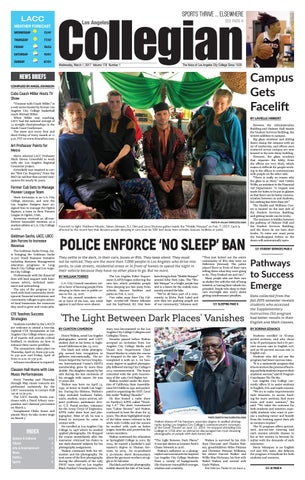
Collegian SPORTS THRIVE ... ELSEWHERE
LACC WEATHER FORECAST WEDNESDAY
72/47
THURSDAY
77/47
FRIDAY
76/53
SATURDAY
70/51
SUNDAY
67/51
NEWS BRIEFS
SEE PAGE 8
Los Angeles
Wednesday, March 1, 2017 Volume 178 Number 1
The Voice of Los Angeles City College Since 1929
ComPlieD By angel JoHnSon
Cubs Coach Miller Hosts TV Show “Timeout with Coach Miller,” is a web series hosted by former Los Angeles City College basketball coach Michael Miller. When Miller was coaching, LACC had the national average of 14 straight championships in the South Coast Conference. The show airs every first and third Friday of every month at 11 p.m. PST on www.dromebox.com.
By laVielle HiBBert
Art Professor Paints for Metro Metro selected LACC Professor Mark Steven Greenfield to work with the Los Angeles Regional Connector project. Greenfield was inspired to create “Red Car Requiem,” from the Red Car rail line that carried commuters for nearly 60 years.
Former Cub Gets to Manage Pioneer League Team Mark Kertenian is an L.A. City College alumnus, and now the Los Angeles Dodgers have assigned him to manage the Ogden Raptors, a team in their Pioneer League in Ogden, Utah. Kertenian received an all-conference honorable mention as a student athlete at L.A. City College in 2000.
Goldman Sachs, LACC, LBCC Join Forces to Increase Revenue The Goldman Sachs Group, Inc. is bringing the Goldman Sachs 10,000 Small Business Initiative including Business Management education programs to Long Beach City College and Los Angeles City College. Professionals with the financial firm will lend support with businesses advice, technical assistance and networking. The aim of the program is to work with local community development financial institutions and community colleges to give selected local businesses the resources they need to grow and create jobs.
CTE Teaches Success Strategies Students enrolled in the LACCD are welcome to attend a two-day regional CTE Symposium at Los Angeles City College where a panel of experts will provide critical feedback to students on how to enhance their career portfolio. The symposium takes place on Thursday, April 27, from 9:30 a.m. to 3:30 p.m. and Friday, April 28 from 10 a.m. to 3:30 p.m. Advance enrollment is required.
Clausen Hall Hums with Live Music Performances Every Tuesday and Thursday through May, music concerts are performed exclusively for the LACC community in Lecture Hall 140 at 12:30 p.m. The LACC Faculty Series continues with a David Arbury composition and classical percussion on March 3. Saxophonist Chika Inoue and pianist Mary Au take center stage on March 7.
INDEX Opinion & Editorial Tribute Arts & Entertainment News Politics Sports
2-3 4 5 6 7 8
Campus Gets Facelift
PHoto by WIllIaM torres/CollegIan
From left to right: Matthew Miracle, Simon Johnson, B.J. Dini and Liora Shurone gather inside the “Mobile Mosque” on Feb. 7, 2017. Each is affected by the recent ban that dictates people sleeping in cars must be 500 feet away from schools, daycare facilities or parks.
Police enForce ‘no sleeP’ BAn They settle in the dark, in their cars, buses or RVs. They keep silent. They must not be noticed. They are the more than 7,000 people in Los Angeles who drive into parks, to side streets, residential areas or in front of homes to spend the night in their vehicle because they have no other place to go. But no more. By William torreS L.A. City Council members voted in favor of banning people from sleeping in their cars in public areas on Oct. 25, 2016. Ten city council members voted in favor of the ban, one voted against it and three were absent.
The Los Angeles Police Department (LAPD) began enforcing the new law, which prohibits people from sleeping 500 feet away from schools, daycare facilities and parks on Feb. 6, 2017. Two miles away from City College, 22-year-old Simon Johnson and his boyfriend, B.J. Dini have
been living in their “Mobile Mosque” around Echo Park Lake. The “Mobile Mosque” is a bright purple bus and is a haven for the mobile community around the lake. “We’ve all been part of a community in [Echo Park Lake] and now they are pushing people out of our community,” Johnson said.
“They just kicked out the entire community of RVs that were on Belleview [Avenue]. The police placed fliers in front of their cars telling them what they were going to do. They freaked out and ran.” Many people who use their cars as shelter live with the risk of being ticketed, or having their vehicle impounded. People who sleep in their cars overnight also worry about getting misdemeanor penalties. SEE SLEEPING PAGE 6
‘the light Between dark Places’ Vanishes By Clinton Cameron Henry Walton, noted Los Angeles photographer, activist and LACC student died at his home in Inglewood California on Jan. 23, 2017. His black and white photography earned him recognition in galleries internationally. His activism helped the Service Employees International Union’s (SEIU) membership grew by more than double. His daughter stayed by his side during the last moments of his struggle with cancer. He was 77 years old. Walton was born on April 13, 1939 at home in South Los Angeles. During his lifetime, Walton’s roles included husband, father, uncle, student, union activist, adjunct professor, ambulance driver, U.S. Postal worker, volunteer for the Army Corps of Engineers, KPFK radio show host and photographer. Most of all, he was a friend to everyone he came in contact with. He enrolled at Los Angeles City College in 1958 where he studied applied photography. He dropped the course immediately after the instructor criticized his choice to use dark-skinned subjects for his photography assignment. Walton continued both his education and his photography. He took some of the first photographs during the aftermath of the 1965 SWAT team raid on Los Angeles Black Panther’s headquarters. His
story was documented in the Los Angeles City College Collegian and Collegian Times. Decades passed before Walton accepted an invitation from Los Angeles City College Media and Visual Arts Department Chair Daniel Marlos to retake the course he dropped in the late ‘50s. He completed it with an A. An honorary degree in applied photography followed during City College’s 2014 commencement. The honor coincided with the 50th Anniversary of the 1964 Civil Rights Act. Walton worked under the direction of California State Assemblyman Gil Cedillo in 1991 and participated in organizing the SEIU Local 660 strike “Rolling Thunder.” He also hosted a radio show on Pacifica’s KPFK called “Working L.A.” The show transitioned into “Labor Review” and Walton continued to host the show for 25 years. The show highlighted many of the labor issues relevant to his work with Cedillo and the unions he worked with such as better wages, benefits and protection for union members. Walton continued his education at Springfield College in 2002. By 2004, he earned a bachelor’s and master’s degree in Human Services. In 2005, he co-produced a 37-minute short documentary about the garment-workers struggle in El Salvador. His black and white photography exhibit shared the title of his book,
Between the Administration Building and Holmes Hall stands the Student Services Building, the newest addition to campus. Big glass windows and sliding doors stamp the campus with an air of modernity, and offices once scattered across campus are now housed in the new shiny building. However, the glass windows that separate the lobby from the offices are very thick, which makes it difficult for people working in the offices to communicate with people on the other side. “There is really no reason why the glass is so thick,” said Colette Willis, an assistant in the Financial Aid Department. “A request was made for holes to be put in glasses so that there can be better communication between us and students, but nothing has been done yet.” The Health and Wellness Center is located on the east side of the Student Services Building, and getting inside can be tricky. The entrance is hidden between the pathway of Holmes Hall and the Student Services Building, and the doors do not have door knobs. To enter one must press the handicapped button so the doors will automatically open. SEE STUDENT SERVICES PAGE 6
Pathways to Success Emerge Data collected from the fall 2015 semester reveals students who accessed the Supplementary Instruction (SI) program had better results in their English and Math classes. By Sorina SzakaCS
PHoto Courtesy Inae blooM/CollegIan
Walton shows off his honorary associate degree in applied photography during Los Angeles City College’s commencement ceremony at the Greek Theater on June 12, 2014. He stopped attending City College in 1958 after an instructor discouraged him from shooting photographs of people with dark-toned skin. “The Light Between Dark Places.” It was last shown at Leimert Park’s Chaos Network in 2016. Walton’s influence as a photographer and a social activist inspired Los Angeles City College Students from a variety of backgrounds. His character exemplified courage, wisdom and creativity.
Walton is survived by his children Cherysse and Charles Walton, grandchildren Miles Pittman and Christine Pittman Williams, his sisters Harriet Walker and Willie Mae Hickman, his first wife Mabel Walton and second wife Gayle Walton. SEE SPECIAL TRIBUTE ON PAGE 4.
Students enrolled in SI-supported sections, and who chose to be SI participants had a 67 percent success rate in English 028, and an 86 percent success rate in English 097. Students who did not use the program had lower success rates. “It is a nationwide program that tries to nurture the process of learning and help students improve their academic success,” said SI Program Coordinator Thi Thi Ma. Los Angeles City College currently offers SI to assist students in English, ESL and math courses. “We try to make improvements each semester, to access funding for more sections, find more room and more mentors,” Ma said. “We value the outcome for both students and mentors, especially students who want to pursue a teaching career and benefit from the training aspect their job as mentors implies.” The SI program offers specialized, one-on-one tutoring and each mentor attends classes in his or her section to become familiar with the demands of each instructor. Rocio Velasquez is an English 028 and ESL tutor, she believes the program is beneficial for both students and mentors. SEE SI PAGE 6
2
Opinion & editorial
Los Angeles Collegian — Wednesday, March 1, 2017
G.I. Bill Failed Black Veterans
Editorial
By Delton Bookman
Illustration by Jose Morales/Collegian
Media Access, Vital to Democratic Society
P
resident Trump has waged war on journalists and by default the American people. Instead of a clear view of government at work the public is systematically being subjected to a game of smoke and mirrors. Only one occupation is mentioned in the United States Bill of Rights: the press. “Congress shall make no law respecting an establishment of religion, or prohibiting the free exercise thereof; or abridging the freedom of speech, or of the press; or the right of the people peaceably to assemble, and to petition the Government for a redress of grievances.” Beginning with his early days on the campaign trail, Trump’s presidential campaign blacklisted nearly a dozen outlets and restricted the movement of journalists at conventions when they covered his speeches. He humiliated journalist Serge Kovaleski who disagreed with him about post 9/11 events. In a campaign speech to an audience in South Carolina, Trump said, “Poor guy, you oughta see this guy,” and gestured in a jerky fashion as if imitating Kovaleski’s movements. It turns out that Kovaleski has a congenital condition that affects joint movement. A statement posted on Twitter after the event and subsequent backlash read, The New York Times reporter, Serge Kovaleski, “should stop using his disability to grandstand,” the statement quoted Trump as saying.
The president of the United States doesn’t like people, particularly the press, to disagree with him so he will lash out and mock a person with a disability. Trump has battled extensively with female anchor Megyn Kelly. At the first Republican presidential debate the two had a contentious back-and-forth. In a question directed at Trump, Kelly said, “You’ve called women you don’t like fat pigs, dogs, slobs and disgusting animals.” Trump continued to criticize the Fox News host in the days after the debate, telling CNN, “There was blood coming out of her eyes, blood coming out of her wherever.” The president of the United States doesn’t like people, particularly the press, to disagree with him so he will spew hateful and misogynist rhetoric. Most recently Press Secretary Sean Spicer placed a ban on notable news organizations including CNN, the L.A. Times, The New York Times and Politico from covering a white house briefing to the press, which ultimately is a brief to the public. The job of a journalist involves gathering information from events that the public cannot attend, or does not have access to like a White House press briefing. Antagonism between a president and the press is not unprecedented, and quite natural if you consider the role of the press as the watchdog. Their role is integral and vital to the every-
day lives of citizens who depend on them to understand current events and to participate intelligently in society. It is strategic and advantageous for the president and his team to create an alternate reality. The goal is to promote a fracture between the public and the media. This opens a portal for a “Trumpian” reality not necessarily based in truth. With no watchdogs nipping at his heels the president and his advisors can rule unchecked. Journalists must continue their work on daily and investigative news stories. They must take cues from Bob Woodward and Carl Bernstein and the “Spotlight” team at the Boston Globe. Journalists must continue to question the president about his taxes, his ownership of companies put him in conflict with his role as president, and other business deals that pose problems to the national security of this nation. Journalist must continue to press Trump and his advisors about their involvement with the Russian government. Continuous pressure must be applied to his cabinet about the economy, healthcare, education and the environment. Ironically, in talking about not barring media access, Press Secretary Sean Spicer said a news conference last December that access to media is “what makes a democracy a democracy versus a dictatorship.” Journalist must up the ante on this president. They must dig deep and hold fast until truths are unearthed and the smoke vanishes.
Sixty-nine years ago, roughly 70,000 black veterans were sold off as nomads here in the United States. This act was a byproduct of Jim Crow and one of the most prosperous deals struck by Uncle Sam in U.S. History. The Servicemen’s Readjustment Act of 1944, better known as the G.I. Bill of Rights, was brought into legislation after World War II to aid returning veterans adjusting to civilian life. The bill provided college tuition, a weekly stipend and access to low-interest home loans to veterans deemed eligible. During the second world war U.S. troops were segregated. African American soldiers were often assigned to non-combat units and positions of servitude. Positions many of these veterans later found out would disqualify them from receiving equal benefits as their white counterparts, if any benefits at all. Non-white veterans who did qualify for benefits under the G.I. Bill still faced an upward battle for equality. Southern congressional leaders made certain it was local white officials who had oversight over such program and not Washington. As a result, many black veterans
‘Alternate Facts’ Undermine Hard Work of Journalists By Mynor Peralta Offering “alternate facts” undermines the hard work journalists do everyday to bring factual news to the public. If the Trump administration is able to get away with giving us their alternate version of the truth, then they will be able to influence public perceptions and this will benefit their goals, which may not necessarily be the goals of the citizens they claim to represent. Presenting accurate news and exposing false news is an important battle that journalists must wage during this administration. If this battle is lost, it could be detrimental to our country. Should the administration want the public support on a policy, all they have to do is make up stories and present them to the public as fact.
write a letter to the editor Contact the Collegian Email: losangeles.collegian@gmail.com Letters may be edited for brevity
If journalists are not able to show that these “facts” are not true, then the administration would be able to get away with anything. We already have evidence of this. When President Donald Trump was campaigning he labeled immigrants from Mexico as criminals and rapists without backing the statement up with facts. Although the media presented information that showed the statement was untrue, Trump’s supporters chose to believe what he said. Trump also presented Muslims as terrorists. It is true that there have been terrorists attacks carried out by Muslim extremists, but this cannot be used to label an entire religion. The media has pointed out how wrong these assumptions are, but still Trump supporters reject factual information. This is troubling because if there is a percentage of the population that does not believe journalists, then that section can be persuaded into believe in anything. It is a journalist’s job to be the watchdog for the people. Journalist must re-establish trust with the public.
DeVos Threatens Public Education By Jordan Rodriguez
Have an Opinion? A Story Idea?
were often denied the ability to go to school and purchase homes for their family. Roughly 70,000 black veterans were not able to attend college in 1947 due to the lack of federal funding for traditionally black colleges. Columbia professor and political scientist, Ira Katznelson visits the sad state of veteran affairs in his critically acclaimed book, “When Affirmative Action was White.” Katznelson dives further into details, explaining the forgotten truths in our history. Katznelson’s research found that, “fewer than 100 of the 67,000 mortgages insured by the G.I. Bill supported home purchases for non-whites” in New York and northern New Jersey in 1946. Relatively speaking, we are far removed from the days of Jim Crow though the effects still linger heavily in our society today. The Servicemen’s Readjustment Act of 1944 acted as a springboard for the white middle class, while many black veterans were denied their chance to achieve the American Dream. I am a black student and veteran at Los Angeles City College and I receive benefits from the G.I. Bill. I am reminded just how fortunate I am to live in current times. For those who came before me, the sacrifices of the brave women and men who served were never justly rewarded. However, this Black History Month we not only celebrate their sacrifices on the battlefield, but on the home front as well. We salute you, the 70,000 nomads in 1947 who paved the way for veterans like you and me.
Betsy DeVos, or the devil if you prefer, is the newly appointed secretary of education. She is a billionaire philanthropist from Michigan who believes that charter schools are the future educational system. D eVo s has no experience in education. The fate of education in America is left in the hands of a woman whose response when asked about having guns in schools was that they
should be there just in case of a potential grizzly bear attack. This woman is truly unfit for this position. She jeopardizes an already fragile system in order to feed the upper class who will benefit from, and who can afford charter school tuition. The elimination of public education and the reform to a voucher system will hurt lower income families and may also lead to segregation. According to the New York Times, in her hometown state of Michigan, DeVos’ charter schools perform well below the state average. She is the worst pick for a secretary of education. The end is near for government-funded schools. Get ready, because change is coming whether we like it or not.
OpiniOn & editOrial
Los Angeles Collegian — Wednesday, March 1, 2017
3
COMPILED BY Ande Richards
THE LOS ANGELES CITY COUNCIL VOTED IN FAVOR OF BANNING PEOPLE FROM SLEEPING IN THEIR CARS WHILE PARKED IN PUBLIC SPACES. THE BAN DIRECTLY TARGETS HOMELESS PEOPLE. DO YOU THINK THIS BAN MAKES LIVING IN THE CITY SAFER? ARE LOCAL AND STATE GOVERNING BODIES HANGING THEM OUT TO DRY?
SAHARA VELASQUEZ Journalism Major
MARY M. CAMPOS English Major
JOHNICKA BAILEY Journalism Major
MELISSA LUCAS Undecided Major
“Sleeping in a car is a much safer alternative as a car provides the safety and security that the streets don’t provide ... The city should focus instead on what it can do to help our homeless population. What the city is doing with this ban is basically pushing innocent people out and making them ‘figure it out.’ Homeless people are also citizens of this city. They do not deserve such treatment.”
“I feel that making it illegal for people to sleep in their cars further criminalizes homelessness and makes it harder for people to find a [safe] place to sleep. It is much safer to sleep in a locked car than to sleep outside, in a park, or in a tent on the sidewalk. I do know people who have had to sleep in their car while they were in between jobs or struggling to find an apartment.”
“At one point in time in Los Angeles all the homeless people sleeping inside of tents were only on skid-row. I would much rather see a person asleep in their vehicles than inside of a tent on the sidewalk ... There are some who go to work and school from sleeping in their cars. By banning such a thing are we saying that we would rather see them sleeping on the sidewalk?”
“The ban on people sleeping in their cars does not make Los Angeles safer ... I’ve seen police kick out homeless people from parks and streets. Where are these people suppose to go? Local government is pushing homeless people under the rug instead of helping them ... You cannot make being poor and homeless a crime.”
ink Style: A VISUAL REPRESENTATION OF THE WORLD AS WE KNOW IT
IllustratIon by george suMMers/CollegIan
IllustratIon by eDWarD loCKe/CollegIan
IllustratIon by eDWarD loCKe/CollegIan
los angeles City College Visual & Media arts department
EDITOR-IN-CHIEF Ande Richards LAYOUT EDITOR Richard Martinez
ILLUSTRATORS Luis Fernandez Hiroko Hata Jose Morales George Summers
GRAPHIC DESIGNERS Edward Locke Beatrice Alcala
REPORTERS Beatrice Anoh Delton Bookman
Collegian 855 N. Vermont ave. los angeles, Ca 90029
Clinton Cameron Rosa Cordero Dustin Gebhard LaVielle Hibbert Angel Johnson Rebecca Klinesmith Karina Lezama-Leal Eve Moreno Mynor Peralta
For all submissions including letters to the editor and publicity releases, send materials to Collegian offices located in Chemistry building, room 207, or email: losangeles.collegian@gmail.com.
323.953.4000 ext. 2832 losangeles.collegian@gmail.com
Jordan Rodriguez Barbara Solorzano Sorina Szakacs William Torres Richard Tzul
MULTIMEDIA PRODUCER Dave Martin
PHOTOGRAPHERS Cliff Cheng Curtis Sabir
ADVISER Rhonda Guess
IllustratIon by george suMMers/CollegIan
to advertise in the Collegian, direct all insertion orders and questions to: pr.collegian@gmail.com. NEXT ISSUE: March 8, 2017 EDITORIAL DEADLINE: March 5, 2017
ADVERTISING STAFF Mike Frenes
the college newspaper is published as a learning experience, offered under the college journalism instructional program. the editorial and advertising materials published herein, including any opinions expressed, are the responsibility of the student newspaper staff.
under appropriate state and federal court decisions, these materials are free from prior restraint by virtue of the First amendment to the united states Constitution. accordingly, materials published herein, including any opinions expressed, should not be
Issues of our award-winning newspaper and magazine are instantly available to our readers on issuu.com/collegianwired. facebook.com/CollegianWired @CollegianWired CollegianWired.tumblr.com youtube.com/CollegianWired
interpreted as the position of the los angeles Community College District, los angeles City College, or any officer or employee thereof. Collegian ©2017. no material may be reprinted without the express written permission of the los angeles Collegian.
4
triBUte
Los Angeles Collegian — Wednesday, March 1, 2017
HenrY WAlton a Vision in Natural light Goes dark Cherysse Walton had one request to commemorate the memory of her father Henry Walton who died during the first week of February. Her request broke from the traditional. She asked Vice-Chair of the Visual and Media Arts Department Daniel Marlos to secure a location at Los Angeles City College for his memorial. By Clinton Cameron
C
ity College photography students often praised the natural light of the entire building where the hallways and empty classrooms became a favorite for shooting assignments. Walton and his fellow classmates spent hours perfecting their printing techniques in the basement labs that take up most of the downstairs space. However, he stopped attending class due to his struggle with illness last semester. Walton’s service took place during the afternoon of Feb. 8. The room filled with more than 100 family members, friends, colleagues and fellow students arrived in small groups shortly after the doors opened. The memorial officially began nearly an hour later. Of all the labels one could assign to Walton, Angelino may be the most fitting. He was a friend to everyone he came in contact with. His involvement with union activities, photography and broadcast radio brought friends together at his memorial service who may have otherwise never met. The Walton family invitation to celebrate his life reached all the way up the political ladder to Los Angeles District 1 City Councilmember, Gil Cedillo. When KPFK extended an invitation to Cedillo to host a radio program, he declined. Instead he turned it over to Walton who worked for him at the time. He told the story in front of the crowded room. “I said, ‘Henry why don’t you do [the radio show]?’” Cedillo said. “‘You’re perfect for it,’ and so he took over that radio show and made it such a great program for working men and women to have a voice.” Walton kept his position as host of the show “Working L.A.” through its metamorphoses into “Labor Review.” He continued as a voice on KPFK for 25 years. Colette Vasquez co-hosted “Working L.A,” with Walton. She described how her friendship with him extended beyond the radio show and into her circle of immediate family and friends. “Everyone had the same experience—intimate experience with him that you did,” said Vasquez to a family member of Walton’s during the memorial. “Nobody here knows who I am but, nobody in my life doesn’t know Henry.” Some of his friendships overlapped from one activity in his life to another. Photography student Jeehyun Lee originally came in contact with Walton as his board operator at KPFK. They had no trouble becoming instant friends according to Lee. “He just opened up to me like a flower,” Lee said. “We had so much in common.” Lee soon found out they also attended the same school and took the same photography class. Lee’s friendship with Walton resulted in sharing photography tips and shooting together. Walton posed for some of Lee’s most prolific outdoor portraits. According to Lee, their friendship really grew once she discovered they would be classmates. “I walked in and there he was sitting in class, and that’s when our friendship blossomed,” Lee said. Walton’s connection to the college began in 1958. He took the now defunct V train from South Los Angeles to City College to take
PHotos Courtesy oF bob sCHMolZe, elIZabetH Preger, JeeHyun lee anD luCa luFFreDo
Top left: Henry Walton with his camera of choice, the Hasselblad. Top right: Walton in a suit and tie. Bottom left: Walton outside the Los Angeles County Museum of Art on July 23, 2016. Walton often modeled for his classmates’ assignments and personal projects. Bottom right: Henry Walton with long-time friend Cori Alegria at Los Angeles City College’s 2014 commencement ceremony. Alegria re-introduced Walton to LACC after a decades long hiatus. He eventually received an honorary degree in applied photography. classes. His first experience was short lived when he was discouraged by what he referred to as “racial insensitivity” from one of his photography instructors. A hiatus that lasted more than 50 years followed. He re-enrolled in the same class decades later when his friend, Cori Alegria introduced him to Marlos. “That’s what I do. I coordinate my people to meet,” said Alegria in a 2015 interview with the Collegian Times. Eventually, Walton passed the class with an A. Unbeknownst to Walton, Marlos petitioned the LACC Board of Trustees to recognize him with an honorary degree for his contributions in photography. “I don’t know who learned more, me or him,” said Marlos
OF ALL THE LABELS ONE COULD ASSIGN TO WALTON, ANGELINO MAY BE THE MOST FITTING. HE WAS A FRIEND TO EVERYONE HE CAME IN CONTACT WITH. HIS INVOLVEMENT WITH UNION ACTIVITIES, PHOTOGRAPHY AND BROADCAST RADIO BROUGHT FRIENDS TOGETHER AT HIS MEMORIAL SERVICE WHO MAY HAVE OTHERWISE NEVER MET. during his speech to honor Walton at his memorial. Walton’s photographs sparked interest all around the world. He claimed to have had his work sold as far away as Japan. Much of it documented the lives of everyday people in Watts and South Central L.A. during the height of the civil rights movement. “That everyday life needs to be documented because that’s the part that needs to be preserved,” said Ben Caldwell, founder of the Leimert Park based Kaos Network gallery space. “Some of those areas got paved over by the 105 freeway.” Caldwell described Walton’s work as social po-
litical art. His gallery presented the last showing of Walton’s work that ran at the gallery from August to September 2016. Walton’s Daughter Cherysse Walton delivered a heart-warming eulogy at the City College memorial. She described her father as a politically tough man. As a disabled girl, she spent her early years being carried by him during some of her most challenging moments. She said seeing adults eye-to-eye helped her confidence. “You only get one daddy, but I had a gem,” she said. “I was blessed.”
labor review Scan the QR code to listen to Henry Walton’s radio show or visit KPFK’s website: http:// archive.kpfk.org.
artS & entertainMent
Los Angeles Collegian — Wednesday, March 1, 2017
5
IllustratIon by HIroKo Hata/CollegIan PHoto Courtesy oF PHyllIs eCKler
Dance Instructor Phyllis Eckler teaches yoga, body conditioning, body sculpting and several styles of dance at LACC. Eckler stands with ballet students at Valley College they are dressed in costumes ready to perform on Dec. 8, 2016.
dAnce BeAts to its oWn rHYtHm By William torreS
D
ance offers six styles of classes this semester: ballet, jazz, modern dance, tap, Spanish flamenco and social dance. Each discipline has two levels, and students may enter the program at the level best suited to their experience. Phyllis Eckler teaches ballet, yoga, body conditioning and body sculpting this semester. She has a Master of Fine Arts in dance from the California Institute for the Arts. “We have a vibrant dance department that offers modern dance, ballet, jazz, social dance, tap and Spanish flamenco,” Eckler said. “On top of that we offer yoga classes within dance that is very popular with the students. When it comes to working your body, you have to work in variety ways to get strong, to have the form, to have the endurance and the strength.” Performance is an integral part of the dance class curriculum. “We have an open door policy and all students are encouraged
to perform,” Eckler said. “We feel that presenting yourself on stage is something you will do in life and in any job you have.” Diana Cummins has been teaching dance and yoga for more than 25 years. This semester, she is teaching modern dance and yoga at L.A. City College. Cummins has an Master of Art in dance from UCLA. She points out that students can grow with the program. “With the different levels of dance classes, students are able to take the same dance style more than once to improve on their skills,” Cummins said. Cummins also runs a dance theater company called ManGO. Her dance company is comprised of current and former City students who have studied with her. They perform in and around the Los Angeles and Long Beach area. Cummins’ dance company is a vehicle to attract students who want become professional dancers, particularly because LACC does not have a dance program. All dance classes are part of the kinesiology department.
“ALL STUDENTS ARE ENCOURAGED TO PERFORM. WE FEEL THAT PRESENTING YOURSELF ON STAGE IS SOMETHING YOU WILL DO IN LIFE AND IN ANY JOB YOU HAVE.” - PHYLLIS ECKLER, DANCE INSTRUCTOR “From my understanding, there’s never really been a push to be a stand-alone program,” Cummins said. “We are still under the umbrella of kinesiology.” Eckler says she has tried to give the department its own identity. “Several years ago, I wrote a productions course that allowed students to both choreograph, dance, and put the final work on stage,” Eckler said. “Unfortunately, that course has been archived, but it would be great to able to bring it back to complete our program. Eventually, we would love to see a ‘Dance Teaching Certificate.’” Prompted by the declining enrollment in dance classes over the
past year, Cummins and the rest of the dance faculty have been working hard to promote dance at Los Angeles City College. “The increase in publicity we are doing is a conscious effort to build our presence,” Cummins said. “Last semester, we had a happy, healthy [and] healing twoweek open-house. We offered little workshops around the Quad and in the dance studios. Eckler and Cummins say they are planning workshops and performances for this spring semester. “We are going to do more of that this semester,” Cummins said. “It’s good for that heart and soul we need that.”
Stunt Queen: Queering up Rap, Hip Hop By eVe moreno Mykki Blanco and Cakes Da Killa are two black, queer hip hop and rap artists challenging the heterosexual narrative of the industry. They draw from their experiences navigating the world as transgender and queer people. The unapologetic artists are teaming up to bring their fans a tour the queer world has never seen. The Stunt Queen Tour with Mykki Blanco and Cakes Da Killa began Feb. 10 and ends March 26. This dynamic duo is making a pit stop in Los Angeles and performing at the historic music venue, The Roxy, Sunday, March 5 in West Hollywood. Mykki Blanco was born in Orange County California, and ran away from home at 16 to explore New York, where Blanco’s cultivated their transgender identity. Blanco’s work encompasses poetry, activism, music and performance art. The transgender artist
has been releasing music since 2012 and released their first studio-produced self-titled album, “Mykki” on Sept. 12, 2016. The album’s wavy beats and queer-centered lyrics is sure to turn out the dance floor. The first track of the album “I’m in a Mood” gives listeners an insight into Blanco’s unapologetic personality. Despite the harsh realities of Blanco’s environment, the artists leads their life with love and humility. Blanco’s work is a portal to the trauma they have experienced navigating the world as a black, trans and queer artist, as well as the liberation that comes from being authentic. Cakes Da Killa, also known by Rashard Bradshaw, began rapping as a hobby in high school and has been openly gay since elementary school. The queer rapper has been established as an artist since 2011 and released three mixtapes before his first album “Hedonism,” which was released in Oct. 2016. Cakes Da Killa’s music retaliates against mainstream hip hop culture. Cakes’ lyrics are an unapologetic anthem to his sexuality. These two artists are not to be missed. Tickets for their performance on March 5 at The Roxy sell for $20. For more information, visit www.theroxy.com.
#oscarsSoWhite Has the social media campaign helped change the entertainment industry? By roSa CorDero Last year’s Academy Award nomination announcement was received with a barrage of negative press. Best actor, supporting actor, actress and supporting actress categories featured all white nominees as did many other categories. This was not the first time the Oscars shut out people of color. Immediately, social media hosted conversations with the hashtag #OscarsSoWhite. While Academy President Cheryl Boone Isaacs is right when she said on Feb. 6, 2017 that “real progress had been made,” we still have a long way to go. The truth is minorities continue to be passed over when big screen films are cast. Things have improved for many black actors and that’s definitely a wonderful start, but where is the Latino representation on the big screen and at these coveted award shows? We like seeing Sofia Vergara and Gina Rodriguez representing, but there has to be better opportunities for Latinos in Hollywood. I screen a lot of movies for edito-
rial reasons. I can vividly remember the moment I sat down to watch “Rogue One: A Star Wars Story” and saw Diego Luna lead the biggest movie franchise in the world. His accent didn’t matter because his performance was outstanding. We are not looking for handouts, nor sympathy votes from anyone as many suggest. What we are looking for is an equal opportunity to land quality roles that could potentially lead to award nominations. I have many friends who are actors and they mostly receive calls to audition for stereotypical roles. Even if they turn them down in protest, there will be another hungry Latino waiting in the wings to take it. It is not their fault; they’re just trying to make it in this industry. The only way to change this is to have more minorities get behind the cameras as directors, more writers in the writer’s rooms and to get involved as producers and executive producers. It is also as important for those who believe in these projects to go out and support the projects. If you don’t believe in it nobody will! I’m proud to see the progress that has taken place in one year’s time and I’ll be cheering for actors from diverse backgrounds because they did the best job. I am hopeful that our voices and our talent will win against prejudice and stereotypes.
IN CASE YOU MISSED IT Scan the QR code TO VISIT OUR MULTIMEDIA BLOG FEATURING COVERAGE OF OUR COMMUNITY AND BEYOND
or visit: collegianwired.tumblr.com PHoto IllustratIon by eVe Moreno/CollegIan
Iconic queer rappers Mykki Blanco and Cakes Da Killa will perform at The Roxy in West Hollywood on March 5, 2017 as part of their Stunt Queen tour. For more information, visit www.theroxy.com.
HAVE AN OPINION? A STORY IDEA?
WRITE A LETTER TO THE EDITOR! email: losangeles.collegian@gmail.com
6
neWS
Los Angeles Collegian — Wednesday, March 1, 2017
Fist Fight Breaks out in Financial aid office By BeatriCe anoH
PHoto by CurtIs sabIr/CollegIan
Protesters push back against President Donald Trump’s travel ban at Los Angeles International airport on Jan. 29, 2017. Demonstrators brought traffic to a standstill and caused many travelers to miss flights. The message of the protest reverberated with chants of, “Let them in!” and “Love, not hate, makes America great.”
Students looked on as a 20-yearold man punched a 60-year old man in the eye on Feb. 21 in front of the financial aid window inside the Student Services Building. Both men are L.A. City College students. James Hutton says the 20-yearold unnamed student punched him in the left eye after Hutton grabbed the man by his shirt. Hutton says it all started as 30 people waited in line. The younger man went from the back of the line to the front window to be helped. Some students had been waiting in the line for more than an hour, according to Hutton. “And he turned and faced the crowd and said f#*! you. I will fight anyone right here, right now.” Hutton said. “‘If you are not man enough to step up and deal with me then ‘F’ you. I do what I want.’ That was his attitude.” Hutton says he tried to alert financial aid staff behind the window. He says he asked that they call the sheriff. The financial aid
trAVel BAn cAUses cHAos For locAl trAVelers By reBeCCa klineSmitH At Los Angeles International Airport, tens of thousands of protesters gathered outside of Tom Bradley International Terminal while chanting, “the people united will never be divided” and “hey, hey, ho, ho, Donald Trump has got to go.” President Donald Trump revoked as many as 60,000 visas when he signed Executive Order 13769, titled Protecting the Nation from Foreign Terrorist Entry into the United States into law on Jan. 27, 2017. The ban bars citizens from seven Muslim majority countries from entering the United States for 90 days. The list included Iraq, Iran, Libya, Somalia, Syria and Yemen. It also suspended the U.S.’s refugee admitting program for 120 days, and indefinitely suspended Syrian refugees from resettling in the U.S. The executive order signed by the president on Jan. 27 caused chaos across the country as hundreds of thousands of people de-
scended airports protesting the controversial ban. One traveler departing the airport said he was also detained because he was born in Iran. “I think it’s awesome that people are protesting. The protest is good, but I was detained myself because I was born in Iran,” said Lima Kay. Kay was ultimately released because he holds a visa, and is a Danish citizen. Hundreds of people were detained by Customs and Border Protection Agents for more than 24 hours without adequate food or water, and were not allowed access to telephones to call their loved ones or contact legal counsel. “There are reports of a number of people who had their visas revoked, and there are reports of people who were forced to sign abandonment of their permanent resident status,” said Farnoush Farzad, an Immigration Attorney based in Los Angeles. The I-407 forms, which if
signed, mean the signatory has voluntarily abandoned their status as a lawful permanent resident of the United States, according to a lawsuit filed in a Virginia Federal Court on behalf of two Yemeni brothers with valid visas who were detained by CBP agents at Dulles International Airport. The agents involved lied to those arriving after the executive order was signed, and told them if they didn’t sign the I-407 form relinquishing their rights, they would be removed from the United States, which would bring legal consequences including a five year ban for reentry into the United States, according to an article on BusinessInsider.com. International students at Los Angeles City College were not directly impacted by the ban last month. “We only have one student from Iran, and one student from Syria, and they stayed in the United States, so they didn’t have any problems with the travel ban,” said President Renee Martinez.
Randy Anderson, dean of student services at City College said there have not been any students who have come forth seeking advice yet on the ban. Two students at Pierce College were reportedly indirectly impacted by the ban, but have not come forward to speak. There is a chance the travel ban could go to the Supreme Court, where judges could rule in President Trump’s favor, but that is highly unlikely. “I think some modified form of the ban may be possible, because from what I understand, the president has pretty broad immigration authority,” said history professor Christina Heisser. “I don’t have any particular expertise in this, though. From what I’ve heard in the news, it sounds like they botched [the] rollout of the ban and Trump’s own statements about banning Muslims may have given the courts cause to stop the ban that they would not otherwise have had.”
no sleeP BAn From PAGe 1
HOMELESS FACE FEWER OPTIONS FOR SAFE SHELTER Johnson is a former LACC student who studied dance from 20142015. He was planning to go back to school this year, but with the new law being enforced Johnson’s education might be placed on hold. “I think it’s going to be really hard being displaced and not knowing where to go,” Johnson said. “I want to go back to school again, but the biggest problem is where I’m going to stay when I start going to school.” The walls of the “Mobile Mosque” are covered with various types of Buddhist and astronomy sheets. On the table covered in a purple sheet is a healing book, an astronomy book and a yoga book. There is also a green hookah bong on top of the table, a deck of Tarot cards and burning incense that creates a smoky atmosphere. “We’ve been part of the lake for two years, we have been a meditation station, we have an occult library for people to use, and we’ve had people come inside for prayers,” Dini said. Despite the new enforcement of the ban Johnson and Dini will continue to stay in Echo Park and stand up for what they believe is unfair to the mobile community. “I’m going to see it eye to eye, and face to face you know,” Dini
said. “I’m going to invite the officer in here and I’m going to give him a Tarot card reading and I’m going to say to him this is what’s going to happen if you enforce this law. This is your destiny. This is the kind of destiny you want to be a part of.” Matthew Miracle is 51 years old and lives inside his black shuttle bus. Miracle was once part of the Echo Park Lake mobile community until the city of Los Angeles forced him out. Since the ban went into effect, Miracle has moved his black shuttle bus across the street to Out of the Closet on Sunset Boulevard. “I’ve stressed out many nights about this already,” he said. “I get stoned, but my stress still doesn’t go away.” A map provided by the city’s website shows areas of restriction, which include many streets near the LACC campus. LACC Deputy James McKain says he would not give a citation to anyone sleeping in his or her car. “Most of our students have jobs or children, if they want to take a nap in their cars during school hours it wouldn’t bother me,” McKain said. One LACC instructor knows too well how it feels to sleep in a car. In 2014, lifeguard and water safety
instructor Jonathan Galindo lived in his car for three months. “I had to sleep in my car because I didn’t know where to move in, and at the same time I was looking for a place and I didn’t have any place to go,” Galindo said. Galindo admitted to sleeping inside the LACC parking lot a few times. “In the beginning, I was actually sleeping in the parking lot of LACC when there was no one around,” Galindo said. “I just happened to sleep there for a while and then the sheriff came knocking on my window, and told me I can’t be doing this anymore. After that I just had to move to another street. They never fined me, but they said they were going to take initiative if they see me again.” Galindo said he is appalled with the city’s decision to pass such an inconsiderate law against people sleeping in their cars. “I feel the only comfortable place for a person who doesn’t have a home is in their car,” Galindo said. “Shouldn’t the city help them instead of pushing them away? Where else are they going to go?” Local groups like the Echo Park Neighborhood Council (EPNC) support vehicle dwellers who sleep in public areas.
The Collegian newspaper reached out to the EPNC board members to see what action they have taken to secure the safety of vehicle dwellers. Board Member Connie Acosta of the Planning and Land Use Committee at EPNC shared a letter they wrote to the Los Angeles City Council on Jan. 27, 2017. The letter proposed to support the creation of the “Safe Parking Program” for vehicle dwellers similar to the “Safe Parking Program” that has been in place in the city of Santa Barbara. In the letter, EPNC Chairman Tad Yenawine detailed how the program allows vehicle dwellers with overnight lodging in approved parking lots between the hours of 7 p.m. and 6 a.m., access to showers and restrooms and access to a local emergency number. “I don’t plan to park around the lake any time soon, but I think it’s f&*$ked-up because they are discriminating against a certain class of people from a public space that has always been available for people to use,” Miracle said. “Anybody should be able to use a public space to park your car. It’s totally discriminating. It’s just going after a certain segment of people that don’t have any representation.”
HAVE AN OPINION? A STORY IDEA?
staff began to help the aggressive man according to Hutton. He says the other student was frightening everyone. The suspect fled the scene, but not before onlookers in the Student Services Building tried to stop him according to McKain. Police caught up with the younger student and took him into custody. “One student struck another student in the head. That student fell on the ground, ended up with a small laceration, on his face, outside of his face,” McKain said. “Officers responded to the location, guy took off, he was found a short time later outside of Vermont across the street.” Hutton says he did not want to engage in a fistfight when he put his hand on the young man’s shirt. “I turned around, I was pissed. I put my hand on his shirt,” Hutton said. “He just pop, one hit. I had no intention of hitting him. But he closed on me.” Hutton says he will not press charges. He says he went to get x-rays the following day.
•
•
Police Wire ComPileD By riCHarD tzul •
• •
Jan. 24, 2017 at 8:30 p.m. to Jan. 25, 2017 at 5:30 a.m.: Vandalism in the facilities building. Jan. 30, 2017 from 7:30 a.m.1:20 p.m.: Hit and Run in Lot 1. Jan. 31, 2017 at 2:15 a.m.: Aggravated assault in the
• •
•
•
intersection of Lockwood and Madison. Feb. 2, 2017, 11:30 a.m.: Aggravated spousal abuse in the intersection of Westmoreland and Oakwood avenues. Feb. 3, 2017 at 5:40 p.m.: Robbery in the 4600 block of Santa Monica Boulevard. Feb. 5, 2017 at 10 p.m.: Petty theft in the 5100 block of West Sunset Boulevard. Feb. 6, 2017 at 8:30 a.m.: Theft from vehicle in the 1600 block of North Normandie Avenue. Feb. 8, 2017 at 9:10 a.m.: Aggravated assault in the 1300 block of North Vermont Avenue. Feb. 8, 2017 at 4 a.m.: Grand theft auto in the 500 block of North Oxford Avenue.
FAceliFt From PAGe 1
NEW BUILDING PRESENTS CHALLENGES FOR VISITORS Nancy Alvarado from the California Work Opportunities and Responsibility for Kids Office (CalWORKs) said their new location changed the way the staff interacts with students. “Students definitely felt the impact of the change more than we did,” Alvarado said. “The old office was much more open so we could interact with the students, but now ... we can only help them behind this glass barrier.”
Michele Mattier from the Office of Student Services (OSS) was disappointed with the move at first, but has settled into their new office. “We are settling down quite fine and students have no problem finding our office because we posted signs ... right before it even happened,” Mattier said. The new Student Services Building was finished and open for business in January 2017 following a series of delays.
stUdent sUccess From PAGe 1
STUDENTS IMPROVE GRADES WITH HELP FROM SI TUTORS “Students who take advantage of it are more likely to pass their exams, than those who don’t,” Velasquez said. “This is my second semester and I had students who passed their ESL classes and now are back for their English 28 class.” She says that the program helps students to have a better understanding of each lecture and that professors should encourage all students to use the SI program. Psychology major Cindy Cruz tutors English 28 for the SI program for the second semester in a row. “Students don’t usually feel comfortable to ask professors when they don’t understand something in class, but we are able to relate to them, because
we are students too, so it is easier for them to come to us with questions,” Cruz said. All students she mentored last semester passed classes and their grades improved compared to previous semesters. “I had a tutor last semester and my grades went up because I learned how to study properly,” said ESL student Miguel Gomez. “Now everything is easier for me, because of that I spent a few hours every week with my tutor and the result is in better grades and better learning habits and process.” Ma says that the SI program will soon extend with the help of the Physics Department, to incorporate STEM classes.
WRITE A LETTER TO THE EDITOR! email: losangeles.collegian@gmail.com
pOlitiCal perSpeCtiVeS
Los Angeles Collegian — Wednesday, March 1, 2017
los angeles Up for Grabs:
UNdErdoG VS GooN BY JAMES KNOX-DAVIES
There is an incredible opportunity for activists interested in seizing power through parliamentary politics in the 13th district Los Angeles City Council race. An unlikely aligning of factors has resulted in favorable conditions to unseat a vulnerable incumbent and create a beachhead that could p l a u s i b ly change the course of politics in Los Angeles. Challenger Sylvie Shain, is a long-time activist for renters’
rights and co-founder of the Los Angeles Tenants Union (LATU.) LATU was first created to defend her home, an artists community, which was threatened by wealthy developers. Her work led her on a road to becoming involved in local politics, where she became well known at neighborhood council meetings and city hall. Later, she was galvanized into action as an organizer for the Sanders campaign as so many were by the unprecedented achievements of a democratic socialist. The incumbent, Mitch O’Farrell, was characterized as a friend of wealthy constituents in a Los Angeles Times endorsement. His utter mediocrity as a politician made national news in 2013 when an aborted plan to destroy a local
homeless aid organization was seen as a callous attempt to make feeding the homeless illegal. His unpopularity is not merely a result of his complete disregard for the most unfortunate among us, but that he is completely devoid of a basic ability to hide his craven loyalty to power. It has been said that if all national politics is about war, all local politics is about development and O’Farrell is a friend of developers. His coalition is made up of those who build and the Business Improvement Districts - the shadowy business groups, which wield influence in how our city is built. Shain’s understanding of local politics is informed by this: The housing crisis in Los Angeles is not the result of the invisible hand, but the expression of political cap-
ital by developers who’ve become rich speculating on housing. The problem is not a shortage, but that a market for a basic human right has become monetized, and that this monetization has happened with the consent and often times the aid of the government. If Sylvie Shain is elected on her platform of popular policy to the benefit of working people, it could quite possibly turn the tide of gentrification which has made Los Angeles unfordable for all but the very wealthy. Shain’s insurgency against a lumbering Machiavellian half-wit, should at a minimum bring some pleasure to those frustrated by the constant complexity of politics. Finally, an obviously righteous underdog confronts a plainly monstrous goon of the political machine.
Measure S: Set to Ban New Housing Construction Not Good for the Homeless, Not Good for L.A.
7
trUmP’s cABinet:
The People Around the President By JoSe moraleS
REX W. TILLERSON Former Exxon Mobil C.E.O., Rex W. Tillerson was confirmed by the senate on Feb. 1 with a 56 to 43 vote to become the new secretary of state. Although Tillerson has no public office experience, he is widely recognized for having an extensive knowledge of international business. According to the Wall Street Journal, Tillerson previously made a deal with Russia for the rights to drill in a 63.7 acres of land, which are untouchable due to the sanctions placed on Russia by the U.S. Tillerson’s ties to Russian leader Vladimir Putin, along with the possible lift on Russian sanctions, have given government officials a great deal of concern.
By DaVe martin Measure S is a poorly written and dangerous initiative that blocks the building of new housing just when L.A. needs it most. The measure will harm our economy in the bargain. It is time to say no to the people who wrote this measure. It is time to fight back. Measure S spells D.A.N.G.E.R. for the chronically homeless of downtown Los Angeles. If the measure passes it would block 90 percent of the planned construction for permanent supportive housing. Measure HHH in effect becomes null and void. Let’s face it, the housing situation in downtown L.A. is not getting better. Every day more and more tents congest sidewalks leaving no space for pedestrians. As a result, there is always trash on the street and this generates another problem: rats.
BETSY DEVOS Recently confirmed as the nation’s 11th Secretary of Education, Betsy DeVos is an American businesswoman who is known for her dedication to the educational system in Michigan. DeVos’ confirmation hearing split the two parties evenly and it took Vice President Mike Pence to break the tie for a 51-50 vote to give Republicans the win. DeVos’ is highly criticized by democrats for her ideas of funneling out money from public school systems in order to pay for charter schools and vouchers. Moreover, she has also received criticism for supporting the control of education systems at the state and local level as opposed to federal oversight. Her most controversial idea is to impose religious teachings in schools, which is troubling for most Americans. DeVos is among the most controversial candidates in the Trump administration.
IllustratIon by eDWarD loCKe/CollegIan
You can see them running, especially at night, up and down the sidewalks. Many fought long and hard
last year to have measure HHH placed on the November ballot. Do not let that victory slip between our fingers.
Take action on March 7 and vote “No” measure S if you want chronic homelessness to end in Los Angeles.
ink Style: A VISUAL REPRESENTATION OF THE WORLD AS WE KNOW IT PROTEST TIPS FOR THE ACTIVIST
Elaine Chao is the new secretary of transportation. She was born in Taiwan and moved to the U.S. with her family when she was eight years old. Chao has served as the secretary of labor in the George W. Bush administration and has been involved in government functions for decades. Chao is married to Kentucky Senator Mitch McConnell. Chao was confirmed by a 93-6 senate vote which was a good sign for the Trump Administration because of his emphasis on infrastructure and redevelopment of the country. The background and experience of Chao will only help President Trump succeed in working with both sides to get things done.
By anDe riCHarDS 1.
Have a cause. This is not always necessary, but it will affect your poster design.
2.
Dress code: Goggles, backpacks and black clothing. War paint is optional.
3.
Wear comfortable shoes. They come in handy for running from the police or for an impromptu dance number.
All kidding aside, if you are moved to protest then do so. That is the legacy of our nation’s founders. Stand up for your rights, be considerate of others and be safe.
IllustratIon by Jose Morales/CollegIan
IN CASE YOU MISSED IT Scan the QR code TO VISIT OUR MULTIMEDIA BLOG FEATURING COVERAGE OF OUR COMMUNITY AND BEYOND
ELAINE L. CHAO
JEFF SESSIONS
or visit collegianwired.tumblr.com
Former Alabama Senator Jeff Sessions has been confirmed as the new attorney general by a senate vote of 52-47. Sessions has strong conservative views on immigration, same-sex marriage and civil rights. He will be in charge of directing President Trump’s “law and order” platform. Sessions argues that the separation between church and state has been taken out of context and that same-sex marriage is a threat to American culture. In addition, he believes that immigrants are committing crimes, taking jobs from Americans and sucking welfare money from the government. He also agrees that government should have mandatory penalties for drug offenses. Sessions is another controversial addition to Trump’s administration who faced large opposition.
8
SpOrtS
Los Angeles Collegian — Wednesday, March 1, 2017
WildcAts deFeAt BrAHmAs
Both the men’s and women’s basketball teams at West Los Angeles City College walk away with impressive victories over Los Angeles Pierce College after the first game of the Western State Conference south division on Feb. 15.
A By Jay yim
fter taking what seemed to be an insurmountable 53-35 lead with 15:25 remaining in the second half, the West Los Angeles College Wildcats men’s basketball team (14-11, 3-4) held off a furious second half rally by Pierce College (11-16, 2-5) to secure a 75-71 victory in the first game of the Western State Conference South Division. The visiting Brahmas cut the Wildcats lead to 7470 on a Kelton Conway layup with 19 seconds remaining. Tawuan Cargill was fouled intentionally, but missed the two freethrows. Cargill pulled down a game-high 14 rebounds, and collected his biggest rebound of the night by rebounding his own missed free-throw and was intentionally fouled again. The sophomore forward redeemed himself by making the first of the two ensuing free-throw attempts, which for all purposes sealed the Wildcat victory. Cargill finished the game with 23 points and also registered a game high six steals. Jordan Newt scored a game high 25 points for the Brahmas including 19 points during their second-half rally. In the second game of the night the West Los Angeles College women’s team (5-20, 1-6) finished off the sweep by cruising to a 57-39 victory over Pierce (2-20, 1-6). Holding a 16-9 after the first quarter, the Wildcats took control of the game outscoring the Brahmas 20-5 in the second quarter to take a 36-14 halftime lead and never looked back. They were led by guard A’ja Daniels’ 22-point, 7-rebound, 4-steal performance while her backcourt mate Kayli Schwenke added 18 points and 12 rebounds. Forward Eva Cabrera was the Brahmas lead the team with 11 points. PHoto by ClIFF CHeng/CollegIan
Left-to-right: Los Angeles Pierce College Wildcats #3, Kelton Conway and West Los Angeles College’s Brahmas #23,Tawuan Cargill in play during a game at WLAC’s campus in Culver City on Feb. 15, 2017. State budget cuts resulted in the suspension of six Los Angeles City College sports teams in 2008. The “partial suspension” has lasted for nine years.
PHoto by HeCtor loPeZ/CollegIan
Students relaxed between backstroke laps last spring when the pool chemistry was not an issue. This year, incorrect pH levels and a lack of chlorine continue to prevent students from taking classes.
Health Inspector Halts Swim Class Due to Chlorine Levels Problems with the level of chlorine in the campus swimming pool prompted an inspector from the Los Angeles County Health Department to order students out of the water and close down the facility last week. The pool opened for spring classes, but problems persist, and since the beginning of the semester classes have been canceled several times including on Feb.22. By Sorina SzakaCS Students enrolled in swimming classes this semester may be disappointed by persistent issues
that plague the swimming pool. Cold weather, the lack of a pool cover and chlorine and pH level fluctuations are still issues that have not been resolved since last
semester. Even though the campus spent $7,000 on a device called a “controller” to monitor the water, chlorine and pH levels are still a problem. It became crystal clear on Feb. 17 when a health department inspector entered the area and ordered students out of the pool during a swimming class. “The inspector came and measured the chemicals in the water and right away told us to get out of the pool,” said Sandra Moran, a student enrolled in beginner
swimming classes. “I heard from other students that classes were canceled today too, because the water is too cold.” Last semester, complaints of red eyes and itchy skin led the kinesiology department to cancel early morning swimming classes, and caused students to leave the pool. Chemical readings showed an absence of chlorine and pH levels were higher than recommended values. These factors contributed to unsafe conditions in the pool. Denis Berkshire, president of Aquatic Design Group along with kinesiology faculty helped with the design of the pool. He trained faculty and staff to be certified pool operators. “Chlorine, under the California State Health Code, needs to be at least at one part per million and no more than ten parts per million, and you calculate that knowing the volume of the pool, and how much water it contains,” Berkshire said. “The pH level should be somewhere between 7.2 and 7.8 according to the same state code. There is no state code for the alkalinity because it is not a health and safety issue.” Chlorine and pH are the “disinfection team and the first defense against germs that can make swimmers sick,” according to the Centers for Disease Control (CDC). When there is no chlorine in the water, the pH level goes high. Last semester the kinesiology department canceled more than half of the swimming classes and the only viable solution was to change the water in the pool. During the winter break, the pool was drained and then refilled in preparation for the spring semester. According to swimming instructor Jan McEveety, the problems with the pool did not end after replacing the water. The pool was closed the first weekend of the semester. “There was no chlorine in the water, pH was too high and the water was too cold.” McEveety said.
Swimming classes resumed Tuesday and Wednesday, on the second week of school, but the Wednesday afternoon class was canceled. “Apparently while we were in the viability meeting, a L.A. County Health inspector came to do a spot check on the pool during Mr. Cano’s swim class,” McEveety said. “She ordered everyone immediately out of the water for their safety. Her test showed no chlorine in the water.” Students enrolled in swimming classes either dropped after the first week of school or signed up for a different kinesiology class. “I enrolled in swimming classes for this semester as part of the general education requirements. On the first class of the semester, the water was too cold, it was raining and the class was canceled,” Kirsten Schierholt said. “I am no longer enrolled in the class, I really don’t want to get into freezing water, while it’s raining.” McEveety says she agrees with students and says that constant issues with the pool are a detriment to enrollment numbers in swimming classes. “There is no hot water in the men’s or women’s showers. The pool temperature has dropped. Students are complaining. This affects enrollment,” McEveety said. The plumbing department is in charge of pool maintenance, but they refused to talk to the Collegian. Administrators are also unwilling to answer questions about the pool. The Collegian contacted General Foreman Alex Nelson and left several voicemails. John al-Amin, vice president of administrative services, LACC President Renee Martinez, the Los Angeles County Health Department and the CDC were contacted to address questions about the new controller and the condition of the pool. Requests for information remain unanswered.
HAVE AN OPINION? A STORY IDEA? WRITE A LETTER TO THE EDITOR! email: losangeles.collegian@gmail.com
SCAN QR
CODE TO VISIT OUR MULTIMEDIA WEBSITE AND SEE OUR COVERAGE OF THE COMMUNITY AND BEYOND Or visit collegianwired.tumblr.com