CBCC Magazine - FEBRUARY 2026

Page 1


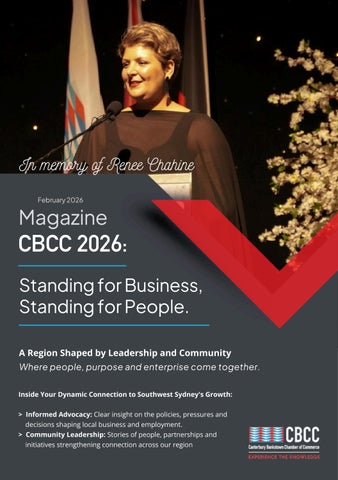
In memory of Renee Chahine

TABLE OF CONTENTS

CEO Message

We are Taxing the Attempt to Grow

Corporate Partners

Upcoming Events

In Loving Memory of Renee Chahine

New and Renewing Members

Advertise with us

Join - Membership Benefits

Contact

2026 STRATEGIC GOALS

MORE THAN A BUSINESS PLATFORM

WE ARE TAXING THE ATTEMPT TO GROW

WHY A GENERATION OF BUSINESSES — AND WORKERS — IS BEING QUIETLY SACRIFICED

Australia likes to think of itself as a nation that rewards hard work, enterprise, and aspiration. But beneath the rhetoric, we have built an economic system that does the opposite. We punish growth at the very moment it begins. We tax effort before it turns into stability. And we are doing it quietly, systematically, and without accountability. We’ve all seen the memes but what can we do about it?

This is not an ideological argument. It is a structural one.

An economy cannot be regulated into prosperity when the state no longer generates income of its own. And when the government stops earning, it starts extracting. That is the uncomfortable truth at the heart of our current economic malaise.

Over several decades, governments sold off income-generating public assets — utilities, infrastructure, ports, energy, and services that once provided stable, long-term revenue. These decisions were often framed as efficiency reforms. But the consequence was never honestly confronted: when government divests income, it must replace it.

What replaced it was not innovation. It was taxation particularly taxation on work, employment, and local enterprise.

Payroll tax is the clearest example. It has quietly become one of the most damaging taxes in our economy, not because of its headline rate, but because of when and how it applies.

This tax does not hit corporations at scale. It hits businesses at the moment they try to become something more than survival machines.

In New South Wales, payroll tax applies once a business’s wage bill exceeds $1.2 million — a threshold that has not moved since 2020. Had it kept pace with inflation, it would now sit closer to $1.5 or $1.6 million. It hasn’t. That gap is not trivial. It is deliberate in effect, if not intent.

Payroll tax hits at the worst possible moment in a business’s life cycle:

when it hires its first supervisor when it adds its first administrative support when it takes on its first apprentices when it opens its first, second site or team

This is not excess. This is not luxury. This is the transition from owner-operator to employer — from subsistence to sustainability. And that is exactly where the tax lands.

The result is predictable. Businesses don’t expand. They cap headcount. They subcontract. They do more themselves. They delay apprenticeships. They split entities. Jobs are never created and because they never exist, they never appear in government statistics.

Here is where the system becomes intellectually dishonest.

Governments increase minimum wages and superannuation — often rightly, and often necessarily. But payroll tax is levied on total wages. When wages rise, payroll tax revenue rises automatically. The threshold does not move. No legislation is required. No debate is held. No accountability is triggered. This is bracket creep but not on individuals. On employers.

The conflict is obvious, even if it goes unacknowledged: government benefits fiscally from rising wages, while offering no structural relief to help businesses absorb the cost. Consumers cannot absorb endless price increases. Businesses cannot absorb endless cost increases. Yet government revenue grows either way.

It feels like a money grab because, functionally, itissilentextraction.

This is not about big business. Large corporations can absorb payroll tax. They have scale, pricing power, legal teams, and financial buffers.

This is about local service businesses the ones that make communities function:

personal care and wellness providers

automotive repairers and service centres

air-conditioning, electrical, and mechanical installers

vehicle retailers and service yards

building material suppliers

professional advisers and small service firms

These businesses are not designed to “disrupt” markets. They exist to serve people. They operate on thin margins. They compete on reliability and price. They cannot simply pass costs on without losing customers.

For many of them, payroll tax is not an abstract policy issue. It is the reason a hire doesn’t happen. It is the reason an apprentice intake is postponed. It is the reason an owner works sick, skips super, and delays retirement indefinitely.

We sold the assets. We lost the income. And now we tax growth instead.

THE QUESTION WE KEEP AVOIDING

When businesses fail under these conditions, we tell them to be more efficient, more compliant, more resilient. But we never ask the harder question: What do we tell a generation that did everything right, and still couldn’t get ahead — because the system taxed them before they could stand?

That is not an economic failure. That is a moral one.

AFinalThought

Prosperity does not come from enforcement. It comes from confidence. From risk-taking. From people believing that effort leads somewhere. Right now, we have built a system that taxes the attempt to grow, rewards inaction, and quietly transfers pressure downward — onto businesses, workers, and communities.

That is not sustainable. And it is not inevitable.

If we want an economy that grows, we must stop punishing growth at birth.

PARTNERS

InLovingMemoryofReneeChahine Acherishedfriend,leader,andlight inourcommunity

NEW & RENEWING MEMBERS FEBRUARY

Basic Members

Turn static files into dynamic content formats.

Create a flipbook