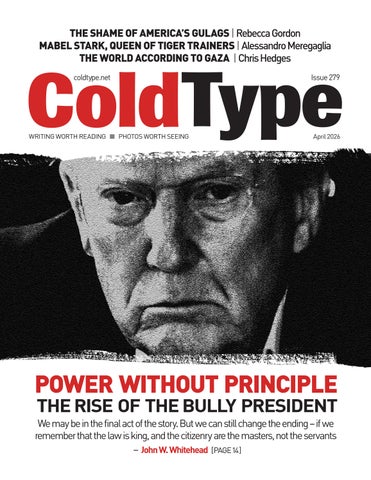
THE RISE OF THE BULLY PRESIDENT POWER WITHOUT PRINCIPLE
We may be in the final act of the story. But we can still change the ending – if we remember that the law is king, and the citizenry are the masters, not the servants
– John W. Whitehead [ PAGE 14]
INSIGHTS
5 Deader than a doornail Linda Pentz Gunter
6 Energy prices soar. So do propaganda and lies
7 Common Sense From the Internet
8 Greed at a glance Inequality.org
9 Crowds flock to statue that mocks Trump and Epstein Nick Barrickman
10 Call for new leaders as US tightens grip on Cuba Brett Wilkins
10 By the numbers Inequality.org
11 An old lesson in how
Greg Palast
13 Hurwitt’s Eye Mark
ColdType
7 Lewis Street, Georgetown, Ontario, Canada L7G 1E3
Contact: Tony Sutton editor@coldtype.net
Subscribe: For a FREE subscription e-mail editor@coldtype.net
Back Issues: www.coldtype.net/reader.html or www.issuu.com/coldtype Disclaimer:
The contents of the articles in ColdType are the sole responsibility of the author(s). ColdType is not responsible for any inaccurate or incorrect statements they may contain
INSIGHTS
DESTRUCTION: Land razed in 2017 to make way for the Hinkley Point C nuclear power plant in southern England, which is now the second most expensive building in the world
➤ LINDA PENTZ GUNTER
Deader than a doornail
If you wanted to sum up the most compelling reasons not to build new nuclear power plants, Hinkley Point C, the two-reactor project under construction in Somerset in the UK, encapsulates almost all of them.
When the UK government, still miraculously led by the clinging-byhis-fingernails beleaguered Labour prime minister, Keir Starmer, announced its Golden Age of nuclear last September, obediently gliding in Trump’s gilded wake, it claimed that the new nuclear power plants planned for Britain “will drive down household bills in the long run.”
Electricity prices from new nuclear plants will be sky high with more delays to completion while jobs don’t materialise
Nothing could be further from the truth. Far from driving down consumer costs, the Hinkley Point C project, consisting of two 1,630 MW French Evolutionary Power Reactors (EPR), could see the original
agreed strike price of $123.50 per megawatt – already considerably higher than the price Britons were paying at the time it was set in 2012 – soar even higher by the time the plant is finished, since prices are designed to increase annually in line with the Consumer Price Index.
The original estimated cost of $24 billion for the two Hinkley C EPRs has now almost tripled, having skyrocketed to almost $67 billion as announced last month, along with new delays.
In 2007, when EDF first proposed its Hinkley Point C scheme, an officer with the company predicted
Nick Chipchase / Wikimedia Commons
INSIGHTS
locals would be cooking their turkeys using electricity from Hinkley C by Christmas 2017. That’s the same year – in March – that construction eventually began.
The Hinkley C completion date has now been pushed to at least 2030, another deadline extension it probably won’t meet. If the plant does show up in 2030, it will have taken 22 years, 13 longer than planned.
That’s a long time to wait for those new jobs the UK government’s ‘Golden Age’ promised. “Working people will benefit from jobs and growth as companies in the UK and United States sign major new deals that will turbocharge the build-out of new nuclear power stations in both countries,” said that September’s announcement, embracing yet more hyperbolic rhetoric.
Several days after announcing the new cost hikes at Hinkley, news broke about similarly soaring electricity prices predicted for the Sizewell C nuclear power plant, another French twin EPR plant targeted for the steadily eroding and submerging UK Suffolk coast.
The Sizewell C project was first proposed in 2010 but there are still no shovels in the ground for the plant itself, only site preparation.
As revealed in an article in the Daily Telegraph, electricity generated from Sizewell C is likely to cost “almost double today’s prices.”
The prediction is a staggering $160 per megawatt hour, according to the government’s own new report.
Incredibly, despite the track record at Hinkley C, with identical reactor designs to Sizewell, this same government report “assumed no escalation in costs” for the Suffolk project. Such an outcome is, to put it
mildly, highly unlikely.
In an recent analysis for OilPrice.com, Leonard S. Hyman, an economist and financial analyst, and William I. Tilles, a senior industry advisor and speaker on energy and finance, predicted that “the prospects for new nuclear (both big and small) are deader than the proverbial doornail.”
They viewed the outlook for the so-called small modular reactors that the UK government is poised to green light as even bleaker. (At around 490MW the favoured design from Rolls-Royce isn’t actually that small.) Small reactors will
➤ GEORGE MONBIOT
have “projected costs that are much higher than gigawatt-scale reactors, making them even less relevant economically,” they wrote.
And yet, the Starmer and Trump governments each press on with their false and fantastical nuclear fantasy plans regardless. CT
Linda Pentz Gunter is the founder of Beyond Nuclear and serves as its international specialist. Her book, No To Nuclear. Why Nuclear Power Destroys Lives, Derails Climate Progress and Provokes War, can be pre-ordered now from Pluto Press
Energy prices soar. So do propaganda and lies
These are burning, smoking lies. As oil and gas prices soar, thanks to the US and Israel’s attack on Iran, the UK’s opponents of climate policy become even shriller. Rightwing politicians, Tufton Street junktanks and the billionaire press tell us our energy security will be enhanced and our bills will fall if we abandon net zero policies, ditch renewables and reinvest in North Sea gas. These claims are not just a little bit wrong. They are the exact opposite of the truth.
Two things have indeed happened in recent years. The price of electricity has soared, contributing greatly to the cost of living, and the proportion of the electricity we receive from renewables has simultaneously boomed: from 3 per-
cent in 2000 to 47 percent today. So, they claim, one has caused the other: more renewables means higher prices.
Not a bit of it. By far the cheapest component of our energy supply is the electricity produced by renewables, principally wind and solar.
It’s the same story worldwide. But the price of electricity does not reflect the mix of sources. It is set at almost all times by its most expensive component. And what might that be? Oh yes, fossil gas. Even before the current war, gas prices were astronomical, and had been rising in leaps and bounds. This, overwhelmingly, is the reason for our high energy bills.
Why does it happen this way? Because of a system called “mar-
INSIGHTS
ginal cost pricing”. This means that, while the majority of what comes through the wire is supplied by renewables and nuclear power, electricity is sold on the wholesale market at the price (the “marginal cost”) of the power source of last resort, which fills the last remaining gaps in supply: fossil gas.
Though the contribution of fossil fuels to our electricity supply in the UK has fallen from 73 percent in 2000 to 27 percent today, gas still sets the price to a greater extent than in almost any comparable country.
In the UK, this happens 98 percent of the time, while the EU average is 39 percent. That’s because the backup power sources in much of the EU are not gas but hydroelectricity or nuclear.
Better electricity storage would provide us with a cheaper, more secure and less volatile source of last resort. It’s one of the things the government, in the face of media fury, is developing.
Ironically, in Norway, which supplies 76 percent of our gas imports, gas sets the price only 1 percent of the time. In fact, the Norwegians scarcely use it for electricity production: hydropower provides 89 percent, wind 9 percent and fossil gas 0.9 percent. Norway’s trade in fossil fuels is like the British opium trade in the 19th century: a curse to be dumped on other countries.
These inconvenient facts caused a magnificent self-own by that gruesome junktank the Institute of Economic Affairs, which demands North Sea drilling and fracking. It claimed that, as gas here costs no more than elsewhere, “it cannot be
gas prices that are driving UK electricity prices so much higher” than in countries such as Norway. Norwegian industrial electricity, it notes, costs less than half of ours. Yup: because it scarcely uses gas. Google first, comment after.
Such idiocies abound. Recently, Claire Coutinho claimed on X that
our energy resilience depends on “maximising the North Sea.” She seems to have forgotten that, as energy secretary two years ago, she boasted “we spent over £100bn protecting the economy and households across the country” from the effects of the gas price spike caused by Russia’s invasion of Ukraine. Some resilience, that.
We’re told that if we extracted more gas at home, electricity would be cheaper. Hello, basic economics. The price of gas is set on international markets and dominated by conditions affecting the biggest suppliers, such as the US, Iran and Russia.
The UK’s remaining reserves are especially difficult and expensive to extract. The industry here depends on a very generous tax regime: most of the time, it receives more money than it returns to the Exchequer.
➤ COMMON SENSE? FROM THE INTERNET
Claire Coutinho: “Maximising the North Sea.”
INSIGHTS
Even so, it doesn’t offer this gas to UK customers at special rates. The companies sell it, as everyone else does, on the international market, at international prices. Extracting every last cubic metre from the North Sea would not shift the price by one penny.
And there’s another trifling reason why “maximising the North Sea” will have no impact. We’ve used almost all of it already.
The money from this extraction could have financed a sovereign wealth fund, like Norway’s, which would have funded social care, railways, sewerage – any of our longterm costs. Instead, thanks to Margaret Thatcher’s “liberalisation” (a fancy word for looting), private companies walked away with the profits. Another victory for neoliberalism.
The same nonsense prevailed last year when the steel industry was on the rocks. The rightwing press insisted the problem was net zero climate policies. Had journalists spoken to the industry, they would have heard a different story. Steel
is exempt from most environmental levies. Its problem is the one we all face: as UK Steel puts it, “higher UK wholesale prices are now responsible for nearly three-quarters of the price disparity between UK, French and German industrial electricity prices.”
The rest of us do pay green charges, but these account for a far smaller portion of the rise in our bills than the price of gas.
The indispensable CarbonBrief
estimates that “‘green levies’ and network charges account for just 6 percent and 20 percent of the rise in bills since before the energy crisis, respectively, against 53 percent due to wholesale prices driven by gas.”
These charges enable investment in the transition to a carbon-free grid, resulting in much lower future bills. You might have imagined that people who obsess about money and not much else could spot the difference between current and capital spending. Apparently not.
What explains this epidemic of idiocy? It’s simple. What the owners of newspapers and politicians want is what their entire class demands: a world in which resources are controlled and prices harvested by those who own them.
You can do this with fossil fuels, whose reserves are concentrated and under the exclusive control of the companies licensed to exploit them. You cannot do it with renewables, because sunshine and wind are everywhere.
Renewables are highly competitive and, for this reason, low-profit. Fossil fuels are uncompetitive and high profit. Media proprietors, like almost all billionaires and hectomillionaires, gain exceedingly by investing in them.
If it is sometimes hard to tell the difference between fossil-fuel lobbyists and the billionaire press, that’s because there isn’t one. For the sake of the ultra-rich, we are all being gaslit. CT
George Monbiot’s latest book, written with Peter Hutchinson, is Invisible Doctrine: The Secret History of Neoliberalism. His website is www.monbiot.com This article first appeared in The Guardian
Margaret Thatcher: ‘Liberated’ state resources
➤ NICK BARRICKMAN
INSIGHTS
Crowds flock to statue that mocks Trump and Epstein
On March 10, a gold spraypainted 12 -foot statue of Donald Trump and Jeffrey Epstein appeared on the National Mall in Washington, courtesy of the anonymous artist collective Secret Handshake. Titled “King of the World,” in honour of Jack Dawson’s line from James Cameron’s 1997 film Titanic, the statue has quite possibly received more interest from ordinary people than Trump’s own newly rebranded, gaudy and little-loved “Trump Kennedy Center” just over 1.5 miles away.
The piece depicts Trump and Epstein locked in the famous bow embrace from Titanic between Leonardo diCaprio and Kate Winslet. Placed on the Mall days after Trump initiated his war against the people of Iran, the image symbolises a widely held popular intuition that Trump started the conflict in an attempt to bury the Epstein scandal and his own role in it beneath a tidal wave of blood and patriotic bombast.
the point home: As with the affair between Jack and Rose, “This monument honours the bond between Donald Trump and Jeffrey Epstein, a friendship seemingly built on luxurious travel, raucous parties, and secret nude sketches.”
Crowds of tourists and DC residents have flocked to photograph themselves in front of the grotesque
Epstein over the outline of a naked woman, Trump’s looping signature positioned where pubic hair would be. An earlier work, “Best Friends Forever,” placed the pair on a park bench in matching golf gear, hands nearly touching, in a parody of sentimental friendship that the group said was meant to mark “the enduring love between billionaires and their fixers.”
The Mall’s latest addition extends the same line of attack, but on the literal front lawn of the American government.
The administration’s defense has essentially been to acknowledge that the entire political establishment is dirty, so what’s the problem? Rather than denying the statue’s message, the White House has responded with deflections, denouncing it as the product of “wealthy Democrat donors” and whining that similar monuments to Democrats who courted Epstein should also be created. As in all things, Trump speaks for the ruling class.
The statue reproduces the ship -rail scene down to the last kitsch detail – except that here Epstein, arms flung wide, takes the place of Rose (played in the film by Winslet), while Trump stands in for Jack (DiCaprio in the film), behind him, grasping his wrists and gazing lovingly over his shoulder. A plaque beneath the work drives
figurine, reacting with laughter, applause and derision. The basic sentiment expressed by the statue and its reception has been contempt for the president and the entire degenerate social layer he personifies.
Secret Handshake has repeatedly skewered Trump and Epstein in the past; this is the third major piece in their series. In January, they installed a gigantic threedimensional replica of a birthday note Trump allegedly scrawled to
Trump’s name appears repeatedly in Epstein’s flight logs and contact lists. The most recent accusations claim the Department of Justice withheld thousands of documents and victim interviews potentially connecting Trump to sexual assaults in its massive file dump in January.
Trump’s government is packed with the late financier’s acquaintances, collaborators and would-be chroniclers. Among those named in the latest document releases are former White House chief strategist Steve Bannon, who exchanged extensive emails with Epstein while working on a documentary; Elon Musk, Trump’s consigliere on mass
TITANIC EVENT: Trump and Epstein cavort in new ‘sculpture’ in Washington’s National Mall
INSIGHTS
layoffs and “efficiency” and a key player in the federal downsizing drive; Commerce Secretary Howard Lutnick; and Federal Reserve nominee Kevin Warsh, whose name appears on guest lists for an Epstein Caribbean gathering alongside fellow oligarchs and their hangers-on.
Add to this the countless billionaires, hedge-fund managers, lawyers, media executives and pseudo-intellectuals who cycled through Epstein’s Manhattan townhouse and private island, and the statue on the Mall begins to look less and less like satire.
The Trump/Epstein “Titanic” burlesque has struck a nerve because it crystalises the understanding that the war on Iran, like the war on immigrants and the war on science, is being waged by a government drawn from and answerable to a rapacious oligarchy that treats human life as disposable. CT
Nick Barrickman’s story originally appeared at the World Socialist Web Site – www.wsws.org
BY THE NUMBERS
➤ BRETT WILKINS
Call for new leaders as US tightens grip on Cuba
As Cuba works to restore electricity to millions of people plunged into darkness across the fuelstarved island, US Secretary of State Marco Rubio blamed Cuba’s
socialist government for the nation’s economic crisis – a crisis largely caused by 65 years of US economic embargo and exacerbated by President Donald Trump’s tightened fuel blockade.
“Suffice it to say that the embargo is tied to political change on the island,” Rubio told reporters at the White House. “The law is codified, but the bottom line is, their economy doesn’t work. It’s a nonfunctional economy.”
“That revolution – it’s not even a revolution, that thing they have –has survived on subsidies,” he added. “They don’t get subsidies anymore, so they’re in a lot of trouble, and the people in charge, they don’t know how to fix it, so they have to get new people in charge.”
Rubio – whose parents fled the island during the rule of pro-US dictator Fulgencio Batista – dismissed Cuba’s proposed economic reforms, including opening the country to
CUBA CRISIS: Uncollected rubbish clogs Havana streets
Jay Szarka
investment from Cubans living abroad.
INSIGHTS
“Cuba has an economy that doesn’t work in a political and governmental system that can’t fix it. So they have to change dramatically,” he said. “What they announced yesterday is not dramatic enough. It’s not going to fix it. So they’ve got some big decisions to make over there.”
Rubio added that although the Trump administration is currently focused on its war of choice in Iran – one of 10 countries attacked during the two terms of the self-proclaimed “president of peace” – the US would “be doing something with Cuba very soon.”
The US has been doing something with Cuba since the 19th century, when it invaded and seized the island from Spain. In the 20th century, it supported successive dictatorships and, after the Fidel Castro-led revolution ousted Batista, imposed an economic embargo on the island that has been perennially condemned by an overwhelming majority of United Nations member states for 33 years.
In addition to the embargo –which Cuba’s government says has cost the nation’s economy more than $200 billion in inflation-adjusted losses – the US tried to assassinate Castro many times and supported the militant Cuban exiles who launched the ill-fated Bay of Pigs invasion in 1961. Other Cuban exiles carried out numerous terror attacks targeting Cuba’s economy –and sometimes innocent civilians.
In language reminiscent of the US imperialists who conquered the island in 1898, Trump told report-
ers. “I do believe... I’ll be having the honour of taking Cuba.”
President Donald Trump’s talk of “taking Cuba” harkens back to the most aggressively imperialist period in US history.
This, after Trump said in February ahead of talks with Cuban officials that he might launch what he called a “friendly takeover” of the island. The president has also boasted about the tremendous economic suffering caused by his illegal embargo and fuel blockade, which is widely unpopular and has been called a form of “economic warfare.”
“Officials in the US must be feeling very happy by the harm caused to every Cuban family,” Cuban Deputy Foreign Minister Carlos Fernández de Cossío said.
In Havana, residents hardened by decades of privation carried on the best they could without power. Some struggled in the dark.
“The power outages are driving me crazy,” 48-year-old Dalba Obiedo told Associated Press. “Last night I fell down a 27-step staircase. Now I have to have surgery on my jaw. I fell because the lights went out.”
Cuban President Miguel DíazCanel last week acknowledged that high-level talks with US represent-
atives were under way. Recent reporting by Drop Site News cited an unnamed White House official who accused Rubio – a longtime advocate for regime change in Cuba – of trying to sabotage the talks.
Some observers believe that Trump wants Díaz-Canel to face a similar fate as Venezuelan President Nicolás Maduro – who was kidnapped in January during a US invasion and is now jailed in the United States – while others warn that the United States cannot be trusted in talks, pointing to recent accusations by Oman’s foreign minister, who said American negotiators duplicitously scuppered an Iran peace deal that “was within our reach.”
However, instead of regime change, Trump may be seeking what some observers are calling regime compliance, which is likely why he did not move to oust Maduro’s subordinates. Unlike Venezuela, Cuba has no oil, but it was once was a magnet for US investment –both legal and otherwise. CT
Brett Wilkins is a staff writer for Common Dreams –www.commondreams.org – where this article was first published
INSIGHTS
An old lesson in how to seize another nation’s
oil
In one of my most elaborate undercover operations for BBC Newsnight, I got my hands on the secret plans for the invasion. Nope, not Trump’s attack on Iran. It was 2004 when I conned the Heritage Foundation and a James Baker operative into handing over the elaborate 323-page plan to keep the oil flowing from Iraq. The plan was secretly drafted BEFORE George W. Bush invaded.
In 2004, The State Department had told me that no plan existed for handling Iraq’s oil. I didn’t buy it. If we invaded California, we’d certainly have a plan for oranges and action films.
With lots of luck, with lots of bluff and BS, I got my hands on the confidential scheme. Here it was, the smash-and-grab plan for Iraq’s oil written in secret at the direction of oil industry bigshots headed by Baker, Bush Sr’s Secretary of State who, as a lawyer, represented
Exxon and the Saudi monarchy.
At the time, when I reported it on BBC, it was a scandal. (Correction: the story was front-page news everywhere BUT the USA where it was buried.)
I’m only bringing up 20-year-old history to tell you that, while Bush’s hidden plan for the oil fields of Iraq evidenced greedy secret scheming
REMEMBER: George W. Bush re-election campaign stop in Grand Rapids, Michigan, October 2004
to grab Iraq’s oil industry, at least we could say this: EVEN GEORGE BUSH HAD A PLAN.
So no, I have not uncovered Trump’s secret plans for the invasion of Iran, or his plan to protect the world’s oil supply, BECAUSE TRUMP HAS NO PLAN. Even the Wall Street Journal, a loud booster of the attack on Iran, was shocked that our trillion-dollar defence and intelligence apparatus did not seem to know that the choke point at the Strait of Hormuz would seize the world’s economy by the throat.
In fact, before Bush invaded Iraq, he had TWO plans. One was 101 pages long drafted by neo-cons in the Defense Department (with help from the Heritage Foundation) to “privatise” (that is, seize) Iraq’s oil fields. Kudos to the Wall Street Journal for getting that document and sharing it with me.
However, oil companies were furiously opposed to seizing Iraq’s oil, so the oil men drafted a 323-page counter-plan.
And what a plan it was. The State Department and Big Oil were pushing for what they called, “an invasion disguised as a coup,” with one of Saddam Hussein’s generals taking over. The 101st Airborne would be in and out in three days.
In fact, the State Department had a secret hugger-mugger in Walnut Creek, California, where, OPEC consultant Falah Aljibury told me, he “auditioned” several of Saddam’s generals to act as replacement dictator.
Amazingly, once I got the oil industry plan, I reviewed it with Philip Carroll, the former CEO of Shell Oil USA, who had been appointed,
➤ GREG PALAST
INSIGHTS
under pressure from the oil industry, by Bush to take charge of Iraq’s oil fields. Carroll slammed the neo-con claim that “privatisation [of Iraq’s oil] is a no-brainer.” Carroll said, “it would only be thought about by someone with no brains.”
Why did Shell and Exxon NOT want Iraq’s oil fields? Because, as a Saudi official explained to me, that would kick Iraq out of OPEC and, indeed, the OPEC cartel’s power would be crushed. The Texas oil bosses knew: We don’t want Iraq’s oil, we want Iraq to stay in OPEC to LIMIT Iraq’s production and keep the price of oil at $50+ a barrel.
Oil corporations don’t want oil, they want PROFITS. Keeping most of Iraq’s oil in the ground per direction of OPEC, keeps prices high. Those oil fields today remain, technically, in the hands of Iraqis. Oil companies work by “Production Sharing Agreements” which give Big Oil the profits without the headache of ownership and keeps the OPEC cartel sitting happily on its spigots.
But Iran is different. I can’t find the secret plans for Trump’s attack on Iran because it seems there are none. It seems that “Secretary of War” Pete Hegseth and our massive intelligence agencies haven’t looked at Google Maps. I thought these guys read the Bible, in which Jesus clearly said, “It is as difficult for a rich man to get into heaven as it is to get an oil tanker through the Strait of Hormuz.” I may not have that quote exactly, but you know what I mean.
Trump is right, that the war is nearly over. Because the Ayatollahs have won. While we can revel in
Trump’s nose being rubbed in the vomit of his own self-created defeat, let us not forget that it is the people of Iran who are paying the price of Trump’s hubris, of Netanyahu’s fever dreams of Iranians rising up against their mullah masters.
The Guardian reports that, this year, Iran gunned down over 30,000 of its own citizens, unarmed, nearly ten times the number of Americans killed on September 11, 2001. Now that Trump and Hegseth have discovered the Strait of Hormuz, they must realize they are checkmated. And that they will sell out the Iranian people to the untender mercies of the religious fascists in return for some baloney deal to limit Iran’s nuclear bomb programme.
Uncovering Dubya Bush’s plan for Iraq’s oil, the auditions for a new dictator, the oil industry, Saudi and OPEC control over Iraq’s oil output made me sick at heart. But the only thing more evil than a secret
➤ HURWITT’S EYE
plan is to have no plan at all. I am sick when I hear Mr. Chickenhawk “bone spurs” draft dodger Trump tell the Iranians to rise up, unarmed, against the murdercrats.
When Trump does his TACO, as he always does, we will witness the Islamic Revolutionary Guard begin the mass arrests, whippings and executions that are all too predictable. You know and I know that Trump is going to sell them out. All because he had no plan, just a momentary rush from his testosterone and Adderall injections. An empty, bloviating sack of a man, with small hands and a small heart. CT
Greg Palast is the author of the New York Times bestsellers,Armed Madhouse, Billionaires &Ballot Bandits and the book and documentary, The Best Democracy Money Can Buy His latest film is Vigilantes Inc: America’s New Vote Suppression Hitmen
MARK HURWITT
➤ JOHN W. WHITEHEAD
Power without principle: The rise of the bully presidency
We may already be in the final act of the story. But we can still change the ending – if we remember that in America, the law is king, and the citizenry are supposed to be the masters, not the servants
“When you’re a star, they let you do it. You can do anything... Grab ‘em by the pussy. You can do anything.” – Donald J. Trump on seizing women, Access Hollywood (2005)
“I think I can do anything I want with it. Whether I free it, take it, I think I can do anything I want with it.” – Donald Trump on seizing Cuba (2026)
It’s been 20 years since Donald Trump bragged that, as a star, he could do anything – even assault women – and get away with it.
Two decades later, what once sounded like crude bravado has become a governing philosophy: might makes right, power excuses everything, and accountability is for other people – not this president.
Despite the Access Hollywood re-
cording – and everything it revealed about his character – Trump was elected to the White House twice. And ever since, he has governed exactly as he promised: as a man who believes he is unaccountable, entitled, and free to act without limits.
The same mindset that once bragged about being able to “stand in the middle of Fifth Avenue and shoot somebody, and I wouldn’t lose any voters” has now been scaled up and weaponised through the presidency.
With a core MAGA following that seems unwilling to hold him accountable for any wrongdoing, Trump has justifiably earned his nickname as “Teflon Don.”
He can be accused of sexually assaulting young girls, and he won’t lose any voters. He can, as commander-in-chief, sanction the bombing of a girls’ school in Iran – killing young girls, their mothers and
teachers – and he won’t lose any voters. He can torpedo a thriving economy, sending inflation and gas prices soaring, and he won’t lose any voters. He can dismantle a government structure that has been in place for over 200 years, and he won’t lose any voters. He can be a walking – talking – living contradiction of everything Christians claim to stand for, and he won’t lose any voters. He can send Americans servicemen and women to die in wars that the US had no business starting, and he won’t lose any voters.
This is the mindset now shaping American policy.
Trump’s acts of aggression against
other nations – Venezuela. Iran. Greenland. Canada. Now Cuba – are expansions of the same worldview, only this time backed by the full force of the US military and funded by American taxpayers.
It is the logic of the schoolyard bully: Take what you want. Dare others to stop you. Punish anyone who resists.
That same might-makes-right mindset has transformed the American presidency into something that tracks more closely with the abuses of King George III than with our revolutionary forebears who risked their
lives and fortunes to stand against tyranny.
Our Founders didn’t just fight a war – they fought a mindset. They stood against a King who thought his word was the law.
By treating the Constitution like a list of suggestions, Trump is bringing that King back to life. He’s trading our hard-won freedom for the ego of one man who thinks he is untouchable.
We are trading a republic for a playground where the bully makes the rules.
Trump wanted Venezuela’s oil, so he used the military to get it –and then bullied the country’s leaders into letting him keep it and its profits.
The tactics – swaggering, arrogant, and always prepared to browbeat and mow over anyone and anything in his way – have become all too familiar.
Trump wants a new ballroom? Tear down the old one and build another.
Trump wants to be in charge of global peace? Seize the US Institute of Peace and rename it.
Trump wants to prove his economic prowess? Levy tariffs against any nations who refuse to fall in line.
Trump wants to be seen as the one who solved Iran? Launch a preemptive war that kills civilians,
destabilises regions, and threatens the global economy – then turn to the same allies he once disparaged to bail him out.
The pattern is unmistakable: Power without restraint. Action without accountability. Force without principle.
And when the law stands in the way, it is bent – or ignored. Justice is weaponised. Congress is sidelined. The courts are defied, their rulings delayed or disregarded when inconvenient. Due process becomes conditional – a privilege for the favoured few, optional for the disfavoured.
This is not constitutional governance. This is how a bully operates: rules are for other people, constitutional prohibitions are inconveniences, and the law becomes whatever the one in power says it is.
The same egomaniacal traits are evident in how Trump treats dissent.
Criticism is not tolerated – it is punished.
Media outlets that report unfavourably are threatened with government retaliation. The FCC is weaponised to intimidate broadcasters. “Fake news” is redefined to mean anything that challenges the narrative.
Truth, in Trump’s America, is whatever serves power.
And those who challenge that power are ridiculed, demeaned, and dehumanized.
Trump insults, belittles, and mocks anyone he considers an opponent.
He calls California Governor Gavin Newsom “Newscum” and mocks him as “low IQ” for being dyslexic.
He routinely disparages women, attacking their appearance and intelligence if they dare to challenge
In a constitutional republic, no one is supposed to be above the law. A bully – an autocrat – a dictator –believes he is the law
him. He referred to New York Times correspondent Maggie Haberman as “Maggot Hagerman” and a “SLEAZEBAG writer.” He told Bloomberg reporter Catherine Lucey to be “quiet, piggy.”
This is not behaviour that should be brushed off as a personality quirk.
It is a reflection of character.
And when that character is paired with unchecked power, it becomes dangerous.
Trump’s embrace of the so-called unitary executive theory – which elevates the presidency into an allpowerful office under a distorted reading of Article II – reveals the logical endpoint of this mindset: a president who believes he can do anything, answer to no one, and operate above the law.
In a constitutional republic, no one is supposed to be above the law.
A bully – an autocrat – a dictator – believes he is the law.
One think tank has rightly concluded that the US under Trump is going through a rapid process of “autocratisation,” faster than any other dictatorship in the world.
As the Guardian reports, “the speed with which US democracy is being dismantled is unprecedented in modern history. The main factor is a ‘rapid and aggressive concentration of powers in the presidency’… Congress has been marginalised, jeopardising the ‘checks and balances’ (judicial and legislative constraints
on the executive) so crucial to US democracy. At the same time, civil rights have been rapidly declining and freedom of expression is now at its lowest level since the 1940s.”
This is what happens when a man who believes he can do anything is given the power to do almost everything.
“Peace through strength” has become the Trump administration’s rhetorical cover for preemptive violence, military incursions, and acts of aggression that bypass Congress and ignore constitutional limits.
Distractions. Deflections. Wagthe-dog theatrics. That is the spectacle.
It’s increasingly hard not to feel as if the noise on the world stage – the wars, the threats, the swagger – is a convenient distraction meant to keep us from asking the hard questions about the man who reportedly appears tens of thousands of times in the Epstein files.
Perhaps if we are distracted enough – by the brutality of war and the easy dismissal of innocent lives lost – we will fail to grapple with the deeply troubling allegations and connections raised in the Epstein files. One account alleges that Epstein introduced a 13-yearold girl to Trump, “who subsequently forced her head down to his exposed penis which she subsequently bit. In response, Trump punched her in the head and kicked her out.”
This allegation alone deserves serious scrutiny. Because if there is even a grain of truth to it, it raises profound questions about Trump’s character and fitness for public office.
This should never be a partisan issue.
It is a question of character.
And even setting aside the most disturbing allegations, the public record alone tells a troubling story: a man who has long boasted of his
treatment of women, who has admitted to infidelity and exploitation, and who has faced repeated accusations of dishonesty, fraud, and abuse of power.
Is this really the man we want as a role model for our young people?
Is this really the image of leadership we want to project to the nation – and the world?
At what point do we admit that character still matters?
Because the character on display here – cruel, arrogant, insulting, egomaniacal, and devoid of restraint – is not incidental to Trump’s presidency.
It defines it.
For too long, Trump’s supporters have excused his behaviour as a refreshing willingness to “tell it like it is.” His press secretary has described his insults as “frank” and open and honest.
But vulgarity is not honesty. Cruelty is not strength. And abuse of power is not leadership.
Americans recognise this. According to Pew Research, nearly seven in ten Americans believe Trump is attempting to expand presidential power beyond that of his predecessors – and most view that as a danger, not a virtue.
When asked to rank US presidents, Trump comes in last, with nearly half of respondents rating him as poor.
History has set a higher standard.
Abraham Lincoln, John F. Kennedy, and George Washington – they were rated as “outstanding.” Not perfect men, but men who understood that leadership requires restraint, responsibility, and a sense of duty beyond oneself.
John F. Kennedy challenged Americans to ask what they could do for their country.
Trump, by contrast, governs as if
For too long, Trump’s supporters have excused his behaviour as a refreshing willingness to “tell it like it is”
the country exists to serve him.
We should be better than this.
America deserves better than a president whose conduct is defined by insult, impulse, and intimidation.
Because in the end, this is what it comes down to: we have put a schoolyard bully on the world stage, and we are pretending it is leadership.
A man who measures strength by how much he can dominate others.
A man who confuses cruelty with leadership. A man who believes that power means never having to say no – to himself.
The bully doesn’t follow rules –he rewrites or ignores them. And like all bullies, this particular bully thrives not just on aggression, but on silence, fear, and complicity.
Bullies don’t rise to power alone.
They are enabled. Excused. Defended. Normalised. Until their behaviour becomes the standard.
That is how a nation loses its moral centre.
We are already seeing the consequences:
A government that mocks instead of leads. A presidency that intimidates instead of inspires. A political culture that rewards aggression and punishes restraint.
The bully’s code – might makes right – has replaced the Constitution’s promise of equal justice under law. But history warns us that power without restraint is just another name for a King.
This nation was born in defiance of a bully.
Two hundred and fifty years ago, a king who believed himself un-
touchable used force, intimidation, and unchecked power to bend a people to his will.
The colonists refused.
They stood their ground – not because they were the strongest, but because they believed they were right.
They understood something we seem to be forgetting: Power without principle is tyranny. And tyranny, no matter how loud or forceful, is not invincible.
The question now is whether we still believe that.
Whether we still have the courage to reject the politics of domination. Whether we are willing to demand leaders who embody something better than ego, arrogance and aggression. Whether we will continue to reward the bully – or finally refuse to be ruled by one.
Because the example we tolerate is the example we become.
And right now, the lesson we are teaching our children, our country, and the world is this: the bully wins – unless someone finally refuses to play by his rules.
We’ve seen this script before.
As I’ve warned in my books, Battlefield America: The War on the American People and in its fictional counterpart The Erik Blair Diaries, the collapse of a country starts the moment we decide that the bully is the hero.
We may already be in the final act of that story. But we can still change the ending – if we remember that in America, the law is king, and the citizenry are supposed to be the masters, not the servants. CT
John W. Whitehead is a constitutional lawyer and founder and president of the Rutherford Institute. More information at www.rutherford.org
➤ REBECCA GORDON
America’s Gulags: People die as companies profit
We
know we can dismantle the concentration camps spreading across the USA, because some of us are already doing it. It’s time for the rest of us to join in
The March 4, 2026, edition of the Arizona Daily Star put the facts succinctly: “A Haitian asylum seeker held for four months at Florence Correctional Center died Monday at a Scottsdale hospital due to complications from an infected tooth.” It seems the infection spread from his tooth to his lungs, and he developed the pneumonia that killed him.
In other words, US Immigration and Customs Enforcement (ICE) allowed a prisoner to die of a toothache. His name was Emmanuel Damas. He was 56 years old and the father of two.
And we can only expect medical treatment at ICE centres to deteriorate further. As Judd Legum at Popular Information reported in January 2026: “ICE… has not paid any third-party providers for medical care for detainees since October 3, 2025. Last week, ICE posted a notice on an obscure government website announcing it will not begin processing such claims until at least April 30, 2026. Until then, medical providers are instructed ‘to hold all claims submissions.’”
Emmanuel Damas’s unnecessary death would be outrageous enough, were it the only one of its kind. In fact, 32 people died in ICE custody during 2025, the most in two dec-
ades. Another six died in January 2026 alone, among them Geraldo Lunas Campos, a Cuban father aged 55, at Camp East Montana detention centre in El Paso, Texas.
Although ICE initially claimed Lunas Campos had attempted suicide, the American Immigration Council reports that “the El Paso County Medical Examiner ruled his death was a homicide arising from asphyxia due to neck and torso compression.” Of course, it’s pretty hard to strangle yourself to death. Witnesses, however, described his murder this way: “Mr. Lunas Campos was handcuffed, while at least five guards held him down and one guard squeezed his neck until he was unconscious.” At least one other man has died at the Camp East Montana detention centre, where tuberculosis and measles are also spreading.
Damas and Lunas Campos were among the roughly 73,000 people whom ICE currently holds in a tangle of detention camps sprawled across the country. And more centres are under construction. Many of them are former warehouses designed to function, as ICE acting director Todd Lyons put it last year, “like Amazon Prime for human beings.” (Like many Trump appointees, Lyons has not received Senate confirmation. His actual title,
according to ICE, is “Senior Official Performing the Duties of the Director of US Immigration and Customs Enforcement.”)
Taken together, this network of prisons or, more accurately, concentration camps, constitutes an American gulag. “Gulag” is not so much a word as a Russian initialism that came to stand for the Soviet Union’s concentration camp programme, originally developed under Joseph Stalin. The term stands for “Main Directorate of Correctional Labor Camps” and originally referred to the officials running the camps. Later, “gulag” came to indicate the camps themselves, which were a central instrument of Soviet political repression. Most Americans first learned about those camps through Aleksandr Solzhenitsyn’s 1973 internationally bestselling memoir, The Gulag Archipelago.
As Andrea Pitzer, author of One Long Night: A Global History of Concentration Camps, has written, such institutions are a relatively recent phenomenon. While human beings have long contrived ways to isolate groups they identify as enemies –for example, in the enclosed Jewish ghettos of medieval Europe – the modern concentration camp evolved
thanks to two key inventions: barbed wire and the machine gun. That pair of technological advances made it possible for a small number of guards to control and contain a large number of people in one place.
Concentration camps have a number of defining features:
Concentration camps exist outside regular legal structures. The people they hold are not prisoners, but detainees. So, we find people of all ages, from infants to ancients, in concentration camps. In most cases, they have not been tried or convicted of any crime. Rather, they are held because of their status, for example, as non-citizens, or in the case of Japanese-American citizens imprisoned during World War II, because of their ethnicity or national origin. This is true for the people held in ICE detention today. Their alleged offenses are against US civil, not criminal law, and their detention exists outside of any court system, including the immigration courts run by the Department of
Justice’s Executive Office for Immigration Review. Immigration judges, who are really administrative employees, can’t order anyone detained. That’s up to ICE and its umbrella agency, the Department of Homeland Security (DHS).
Concentration camp inmates are civilians, not soldiers, which places them conveniently outside the strictures of the Geneva Conventions. That’s why the US has never recognised the men it has held and, in the case of 15 prisoners, continues to hold as prisoners of war in the US prison at Guantánamo Bay, Cuba.
In the 1990s, almost a decade before the naval station at Guantánamo was first used to house detainees in the “global war on terror,” the US held immigrants there, including as many as 50,000 Haitians and Cubans. Trump’s January 29, 2025, executive order entitled “Expanding Migrant Op -
erations Center At Naval Station Guantánamo Bay To Full Capacity” directed the Defense and Homeland Security departments to prepare to hold as many as 30,000 migrant detainees there. As of July 2025, the camp held detainees from Africa, Asia, Europe, and the Caribbean.
Concentration camps are associated with authoritarian regimes. They function both as a direct form of repression and, no less importantly, as a warning to the rest of the population about what could happen to those who resist the regime. In this sense, concentration camps are very much like another tool of repression, institutionalised state torture, about which I wrote in my book Mainstreaming Torture.
Like state torture, concentration camps perform a kind of national security theatre, made all the more entrancing by its quasi-secret nature. In the case of ICE detention camps, the DHS has made a show of not permitting local officials or members of Congress to enter those
AMERICA’S SHAME: President Donald Trump (in background) enters one of the secure ‘housing units’ at the notorious Alligator Alcatraz detention centre in Florida’s Everglades on June 25, 2025
White House Photo
facilities. But such detention centres can’t fulfil their full repressive function if people don’t know anything about what goes on in them. So, we have the spectacle of a hearing in which a congresswoman asked then-DHS secretary Kristi Noem about a double amputee who “has to crawl through mold and faeces and bodily fluids just to take a shower.” Knowing that this is happening to people who have almost no recourse is intended to have a chilling effect on political action.
Concentration camps are not death camps, but people do die there. Many Americans tend to think that all German concentration camps were sites of direct extermination. In fact, the Nazis constructed six camps specifically designed for the industrialised murder of their inhabitants. But for a decade before the first death camp was even opened, prisoners had already been concentrated in thousands of “labour” camps. In fact, they were not there to be killed directly, but to be removed from society.
As the National World War II Museum in New Orleans explains, “Initially, the population of these concentration camps were not usually Jews, but Communists, socialists, Roma and Sinti, Jehovah’s witnesses, gay men, and ‘asocial’ elements (alcoholics, criminals, people with mental disabilities, the poor).” Notably, like undocumented people in the US today, these were groups who then received little sympathy from the larger German population. The conditions they encountered – lack of food and medical care, crowding, and unsanitary conditions – sickened and killed as many as a third of those who passed through them.
The Soviet gulag was not the world’s first concentration camp, although such institutions are, in fact,
It was during the occupation of the Philippines that US forces invented the form of torture we have come to call “waterboarding”
a relatively recent phenomenon. Human beings have long contrived to isolate groups they identify as enemies, as Americans at times did with enslaved Africans and the native peoples of this continent. Indeed, when the Cherokee nation was evicted from its lands under the 1830 Indian Removal Act and forced to travel the “Trail of Tears,” many of them were kept for some time in “emigration depots” in Alabama and Tennessee.
Almost everyone has heard of Nazi Germany’s camps, but the history of the modern concentration camp really began at the end of the 19th century. As Andrea Pitzer recounted in a recent interview, Americans first became aware of such camps in the 1890s, when Spain instituted a policy of reconcentración in its efforts to put down a rebellion in Cuba. As has happened in ICE detention camps today, malnourished men, women, and children were shoved into holding camps there, where crowded conditions and poor sanitation led many to sicken and die. News of the horrifying conditions in Cuba led Americans to organise material aid for those being held.
The United States then dispatched the battleship Maine to accompany the ships carrying relief supplies to Cuba. When the Maine sank in Havana harbour under murky circumstances, the US government had the pretext it needed to mount a military campaign against the remnants of Spanish colonial control in the Americas and the Pacific. That
relatively short war ended with the US in possession of most of Spain’s remaining colonies, including the island of Puerto Rico, and what would eventually become the nation of the Philippines. Almost immediately, the new American colonisers reproduced in the Philippines the kind of reconcentración camps they had supposedly gone to war to eradicate in Cuba. In another parallel with the 21st century, it was during the occupation of the Philippines that US forces invented the form of torture we have come to call “waterboarding.”
Most Americans know about President Franklin D. Roosevelt’s 1942 executive order creating 10 concentration camps to hold people of Japanese descent, about two-thirds of whom were US citizens mostly living in the western United States. Over 120,000 men, women, and children were interned for the duration of World War II. Many lost their homes, farms, businesses, and other property (often seized by their non-Japanese neighbours). A much smaller number of Italian and German nationals were also interned, as Germans had also been during World War I.
The Japanese camps were constructed by the Works Progress Administration (WPA), the same federal agency that provided mass employment for millions during the Great Depression under Roosevelt’s New Deal programme. Few Americans know that, in addition to building roads, schools, dams, and the occasional zoo, the WPA also built the barracks and strung the barbed wire that enclosed World War II internees.
ICE’s predecessor agency, the Immigration and Naturalization Service (INS), ran about 20 of those camps, primarily ones imprisoning Japanese, German, and Italian non-citizens. Three of them were built in Texas to hold people from
those countries who had been deported from Latin America. (Most of them were Japanese from Peru.) Those camps were guarded by the Border Patrol, rather than the military police. In other words, ICE and US Customs and Border Protection (CBP) have a long history of running the US version of concentration camps. They’re used to it.
It’s no exaggeration to say that ICE detention camps now threaten to become a central instrument of repression under the Trump administration. As many as 40 people have died in the camps since Trump returned to office in January 2025. And those are only the deaths that have been publicly acknowledged.
If Camp East Montana is the biggest ICE camp in the country, the most notorious may well be the Florida site in the Everglades that has come to be known as “Alligator Alcatraz.” Constructed hastily over just a week, according to Amnesty International, it “houses” people in horrific conditions:
“Inside, people are crammed into overcrowded cages around bunk beds with little room to move. Food is spoiled and maggot-infested. Mosquitoes swarm constantly, showers are scarce, and extreme heat and humidity make the centre unbearable. There appear to be almost no reliable or confidential means for detainees to communicate with their attorneys or family members.”
That description is echoed in the testimony of people held in ICE detention camps nationwide. A complete report on the conditions at all of those camps would run to hundreds of thousands of words. Indeed, it’s hard to get a handle on the full scope of ICE’s concentration camp programme, since reports on the number and size of such camps change quickly as new ones are proposed or come online. The organisation Freedom for Immigrants maintains an interactive immigration
ICE detention camps now threaten to become a central instrument of repression under the Trump administration
detention map which identifies at least 200 separate locations where immigrants (and the occasional US citizen) are detained. And the Trump administration is not done. According to the Guardian, DHS plans to spend $3.8 billion “upgrading” 24 existing warehouses to implement ICE Acting Director Todd Lyons’s dream of treating immigrants like human widgets.
And that brings us back to the point of all this. Concentration camps exist to support and expand the power of an authoritarian regime. They make everyone afraid of being treated like the current targets of the regime. Like state torture programmes, concentration camps accelerate the process of dehumanising groups of people in the public imagination. Such a process often begins by describing the target group as non-human, as “vermin” or “garbage” (as Trump has, of course, done).
Ironically, the very act of placing people in inhumane conditions can amplify the public’s perception of their inhumanity. After all, would genuine human beings submit to such treatment? Would our good nation treat genuine human beings that way? One other significant aspect of all this: the enrichment of a few corporations. President Trump’s “Big Beautiful Bill” gave ICE upwards of $45 billion to spend on those camps, which meant that there was a lot of money to be
made. Today most of them are run by two private prison companies, CoreCivic and the GEO Group. The president’s Big Beautiful Bill also allows the Department of Homeland Security to expedite that moneymaking by using the US Navy’s Supply Systems Command programme, which serves as an end-run around the usual bidding process for federal contracts.
This morning, I asked my partner whether she thought that the Trump administration could make the transition from concentration camps, where people die as a “side effect” of their internment, to actual death camps. “I think it’s possible,” she responded – and so, horribly –do I.
It’s possible, but not yet inevitable. To date, local actions have provided the most effective means of resisting the creation of the American gulag our federal government is constructing. These have included organising to oppose siting camps in specific communities, efforts to leverage local zoning laws to stop them, and attempts to generate state-level political opposition to them. (The Washington Post had an excellent roundup of recent efforts in one county in Maryland to block such a camp.)
We know what’s at stake. We know we can dismantle the American gulag, because some of us are already doing it. It’s time for the rest of us to get to work. CT
Rebecca Gordon taught for many years in the philosophy department at the University of San Francisco. Now, semi-retired from teaching, she continues to be an activist in her faculty union. She is the author of Mainstreaming Torture, and American Nuremberg: The US Officials Who Should Stand Trial for Post-9/11 War Crimes. This article first appeared at www.tomdispatch.com
➤ MÁIRTÍN Ó MUILLEOIR
From Ireland to a Texan detention centre
How an illiterate Irish immigrant inspired a New York lawyer’s journey to help ICE detainees facing deportation
When retired attorney and Vietnam veteran John J. Reilly got the call to join a group of Fordham law grads heading to the El Paso Detention Center in Texas, to aid beleaguered immigrants facing deportation, he felt he had to say yes.
“I had been volunteering up in the Bronx providing advice to immigrants who were fearful of being arrested by ICE,” he said, “and when the Dean Emeritus of Fordham Law John Feerick put out his call, I felt I couldn’t refuse.”
If you sign up, you gotta march, and as a Fordham Law Review grad, New Yorker John felt he had no option but to pack his bags for El Paso. But there was something else as well: his Irish forebears.
“My great-grandmother Mary Brennan was a refugee from the Irish Famine,” explains John, visibly choking up. “She arrived in New York just prior to the Civil War and married my great-grandfather Patrick Reilly in 1865. They had six children, three boys and three girls. One of those boys was my grandfather John Reilly who I knew and remember well.
“My great-grandfather died in 1889, at the age of just 47, and when my great-grandmother applied for
an Army pension, she signed the application with an X. She died soon afterwards, and her younger children, then orphans, were reared by a relative named Catherine Brennan whose mother had died on Christmas Day on the ship which brought her family to America. How could I refuse?”
Rather confusingly named El Paso Camp East Montana, and built on the site of a former internment camp for Japanese Americans, the privately-run, sprawling US Immigration and Customs facility, located along the Texas-Mexico border, is home to around 3,200 detainees who have been rounded up across the US
The Fordham team which included two immigration judges who had been fired by President Trump, co-ordinated with a local not-for-profit providing legal assistance to detainees. “Our job was to interview and screen 90 detainees who the local group had chosen on the basis that they seemed to have a good defence against their deportation,” explains John.
From January 3-10 the Fordham team on the El Paso detail split into pairs, with each retired attorney buddying up with a multi-lingual Fordham law student. As it turned out, ICE could only locate 45 of the
detainees the team had wanted to interview – “even though it’s a prison for goodness sake” – making them available to the lawyers in a large, gymnasium-style hall. “I have to say that for all the talk about protecting America from ‘the worst of the worst,’ the people we met were ordinary immigrants chasing the American dream,” says John.
“In fact, in all my time both volunteering with a Quakers’ relief project for immigrants in the Bronx and in El Paso, I have yet to meet a hardened criminal. Some have lived her for decades, paying taxes and rearing their families. They are hardworking people.”
For John, the entire White House assault on immigrants is ‘based on a lie.’ “No doubt there are some bad people among those being held but to get that in perspective, it’s a very small percentage of the total.”
Slammed for its harsh living conditions, the El Paso Detention Center, currently battling a measles outbreak, has seen several deaths, including a suspected homicide, and is now the focus of a contract review by the Department of Homeland Security.
“One person died the day we arrived,” recalls John. “I’m told they want to increase the detention capacity to 10,000 but they clearly can’t cope with 3,200. And among
“HOW
that number are many people who have signed up for self-deportation but still find themselves locked up months later. The only conclusion you can reach is that the operators are trying to make more money by continuing to hold them.”
John said his most troubling encounter was with a distressed father-of-two. “He was the biggest guy in the room, sitting at a table on his own and really standing out,” says John. “He was a huge, muscled black guy who had fled his native country and who had, it seemed to me, a good asylum claim. He had escaped his home country with his wife and children after his house had been blown up by gangs. They had travelled first to Chile then worked their way up to the US and to the American Heartland where he was working in a food processing plant. But one day he is stopped by state cops and as he can’t
answer their questions – he speaks no English – they arrest him and accuse him of resisting arrest which is a felony in the state. After two months in detention, he’s advised to plead guilty in order to get released, which he does but not realising that once he receives a felony conviction, he has no asylum claim. He was totally f***ed because once convicted, he was arrested by ICE and shipped down to El Paso. We explained that the solution would be for lawyers to go to back to get the conviction expunged but as we were exploring his options, this big, tough guy starts to cry. It really broke my heart.”
There was, though, some light amidst the gloom. “In this country, everyone is entitled to due process but only one-in-ten of the El Paso detainees actually has legal representation,” says John. “But on our last day, we got to go to court to represent some of those we had identified as having a strong case. The highlight was getting one woman re-
leased – it was as if she had won the lottery.”
Modest wins cheered the Fordham team. “I would like to think that I made a small difference,” adds John, “by not making it easy for this administration to simply run these ordinary people out of town.”
In a report released after the Fordham visit, Lisa Landau and Emerson Argueta of Fordham Law School’s Feerick Center for Social Justice decried conditions at Camp East Montana.
“Working people living peacefully in our communities are being ‘disappeared’ to places far from their communities,” they write. “Masked ICE agents hiding their badges are arbitrarily sweeping people off the streets – sometimes in a factory raid, but increasingly in indiscriminate ‘operations’ while people are engaging in their everyday lives: returning from work or putting their garbage out; and often – shockingly – at courthouses, where people du-
COULD I REFUSE?” John J. Reilly travelled to El Paso, Texas, to help detainees held by ICE
tifully appear for their court dates.
“What we learned (in El Paso) underscored our feeling that ... we don’t recognise our country anymore,” they declare, adding, “while emptying our towns and communities of people who have been contributing – by paying taxes, caring for children or the elderly, working in stores, on farms, in construction – we are losing on every front. We are losing our neighbours and people shouldering necessary jobs. We are losing tax dollars because we are paying a daily rate (upward of $150) for private companies to ‘house’ each deportee after having spent $1.2 billion to build the largest US detention centre ever. But the most important loss is this one: we are losing our humanity, paying to imprison people from our communities to a place where basic standards of food, medical care and sanitation are not being met and violence abounds.”
For John J. Reilly, the visit to El Paso left him moved and disturbed in equal measure. But he also returned home uplifted in the knowl-
DETAINEE HELL: The Camp East Montana migrant detention facility at El Paso, Texas, holds thousands of detainees from across the country
edge that he had repaid, in part, a debt to his Cavan forebears. “Every time I looked at someone in El Paso, I saw my great-grandmother Mary Brennan looking back,” he says. “Washed up in a foreign land, she was a terrified, desperate refugee fleeing persecution and hoping for a fresh start in this great country. You know, the descendants of this illiterate immigrant went on
to achieve the American dream. I’d like to think the Mary Brennan of the 19th Century would approve of my work for the many Mary Brennans I saw in El Paso.” CT
Máirtín Ó Muilleoir is the publisher of the Irish Echo in New York and Belfast Media Group titles in Belfast, Ireland. He is a former Lord Mayor of Belfast.
Corrie Boudreaux / El Paso
Matters
RIGHT: Olympic champion of the future?
FAR RIGHT: The signs on the slopes are in English and Gaelic
ABOVE: Family fun on the winter slopes at Glensheel
WDOUGIE WALLACE
Highland Fling!
Dougie Wallace took his camera (and his dog Flash) to Scotland’s ski areas of Glenshee, Cairngorm Mountain, Glencoe and the Nevis Range, where a thaw, a band of rain, or a gust of freezing, icy wind, can change everything
hen the snow comes, the car parks fill. Word spreads quickly: It’s a good week, a belter of snow – and by mid-morning the access roads are tight with hatchbacks, hire skis and cautious optimism. In Scotland, the difference between a strong season and a poor one can be a weather front drifting 10 miles too far north. A thaw, a gust, a band of rain, and everything changes.
The project was partly inspired by the
approach of the recent Milano-Cortina Winter Olympics in Italy, and what they might look like if staged in Scotland. But it was not about shiny podiums, more an exercise in imagining how weather, people and place, might shape a very different kind of Games.
Clear skies were rare, though, over the seven days I spent shooting in Scotland’s ski resorts. I had two clear, blue-sky days, and on the others I discovered how the cold on the mountains can be so bracing. But it
ABOVE: Under the green signage of tickets and hire, skiers assemble at Glenshee
toughens you up, although sleeping in my camper van at the base camp was challenging at times –blizzards are not conducive to deep sleep, especially as I was in my selfbuilt van, designed for life on the road for me and my dog Flash, an Irish setter-poodle, already huge and restless at 10 months old.
For the record, the ranges I visited during my Highland adventure included:
l Glenshee Snowsports Centre, Scotland’s largest ski area, spread across the wide high-level Cairnwell pass, between Deeside and Perthshire.
l Cairngorm mountain, sits above Aviemore, in the central Highlands, inside Britain’s largest national park, known for its high, exposed plateau, sudden whiteouts, and some of the coldest conditions in the UK The Cairngorm ski area sits in a sub-arctic environment where weather changes fast and visibility can disappear within minutes.
l Glencoe, in the west Highlands, set among steep volcanic terrain near Rannoch Moor, a glen of glacial origins that cuts though volcanic rocks. Known for narrow access, strong winds, and raw, exposed slopes, it is considered Scotland’s most elemental and weather-driven ski area. Often seen as Scotland’s most striking ski setting, it is raw, exposed and elemental. I’ve spent many a magical night here in my camper.
l The Nevis Range on the slopes of Aonach Mòr, near Fort William, in the west Highlands, with Ben Nevis rising nearby. The area is a challenge, being influenced by Atlantic weather systems bringing cloud, wind and rapid changes in conditions, The ski-lift gondola rises from forest to
RIGHT: First taste of snow for a tourist at the Nevis Range resort, near Fort William
TOP: Family fun at the top of one of the sledging areas
ABOVE: Youngsters head for the slopes with their skateboards
LEFT: A young visitor eyes the ski poles and dreams of future glory
ABOVE: Taking a break from the chilly weather in a cafe at Glenshee
open mountain, giving access to high, oftenharsh terrain that rises to 1,220 metres.
The Gaelic language – Gàidhlig –once flowed across much of Scotland, the everyday tongue of the Highlands and Islands before history pushed it to the margins. After Culloden the culture thinned, and the language with it, yet the words linger in place-names, in voices, in the grain of the land. Today only a small minority speak it fluently, but the language still breathes, carried in the hills, the weather, the memory of the country itself, and, of course, the signage, which reminds travellers they are moving through a land older than the motorway.
Snow tourism has grown steadily in recent years, with visitors from warmer countries such as India and China travelling north to experience snow for the first time. Resorts now also cater for organised coach
trips, families arriving for photographs, sledging and short mountain visits rather than skiing itself.
I spoke to a woman in a sari who told me she had come from Bengaluru. It was the first time she had seen snow. She was not here to ski, but to experience winter itself: Cold, unfamiliar, quietly absorbing a landscape entirely new to her.
The Winter Olympics have been and gone for another four years, but the grassroots version is gearing up. 100 metres of machine-made snow and a magic carpet can carry as much expectation as a full mountain. Meanwhile, the learning curve is steep – slush defeats confidence, a controlled slide becomes horizontal, momentum is negotiated at knee height. But the drive for personal gold continues regardless of any of life’s personal failings. CT
l See more of Dougie Wallace’s work at www.dougiewallace.com
ABOVE: Comforting sight: a toilet set among steep volcanic terrain near Rannoch Moor, Glencoe
FAR LEFT: Laminated sign at Glencoe reminds visitors to return their sledges
LEFT: At nightfall, a final memory of a great day out
➤ TONY RHODIN
It’s my house, but it’s no longer my home
A self-exiled American tells why he’s not looking forward to returning to his family’s old place in eastern Pennsylvania
Iknow it’s my house; I signed the paperwork hours after my mother died. October 1994. I gave my father a dollar and his decades of housing headaches melted away and mine began as our attorney Bill Hogan oversaw the long-planned transition of responsibility at the dining room table.
And I was foolish enough not to run out the door and back to my threebedroom apartment a mile down the street, where if anything broke, it was someone else’s problem.
So, yes, it’s my house. But watching from 10,000 miles away the barbaric cruelty of the US government across an ocean of issues – with more awfulness on the horizon –can it ever again be my home?
The oh-so-very-old place with the purple painted bricks – and so many other projects of questionable taste and ability – awaits. The drywall project along the steps to the third floor is two years in arrears, my younger brother promising to help now that his terribly busy retirement has begun. But no one –other than my wife Maggie and I –will know if it gets done or not. So, if need be, it can wait.
Itook a stroll near sunset this evening along Enmore Road as the afternoon’s dark, heavy clouds gave way and the last bit of daylight brightened
the artsy and older Sydney suburb that shares the busy main street’s name. And one thing became alarmingly clear. I don’t want to go home.
I will go home. I have to go home. Without going home, I wouldn’t see two of my kids or two grandchildren. And I need to do my tax return. So I will be boarding an airplane, and then another, for the long journey back from Australia.
Since early October, we’ve only been in our hometown of Easton, a small city in eastern Pennsylvania, for a month. This isn’t a criticism of the plucky community that has seriously straightened itself out since I first came home to a near abandoned Downtown in the late 1980s.
I want to see what’s new, and what’s different; if the new hotel is coming along next to Centre Square, where, on July 8, 1776, one of three initial public readings of the Declaration of Independence happened of midday. And I want to see what’s left a couple of blocks up of the Hotel Hampton, which was recently destroyed by fire. It’s an event that I would have written about in my old life for the local newspaper that before me employed my parents.
When we left Spain in mid November, the landlord, as he had the year before, encouraged us to consider his home our home. And the daily wanders along the Mediterranean call out to me, even though I’ve had a less scenic but equally satis-
fying three-plus-mile route for the past three months along city streets and through the campus of the University of Sydney.
It’s not as if I’ve divorced myself from the US, which I nearly called America, forgetting for a moment Bad Bunny’s Super Bowl reminder of what America really is.
I got up at four this morning and read through the Bulwarks in my email, looked to Substack for anything new from my old pal Julie Brown, then checked out the hazardous headlines in the Times. Even took a last look at the Post, with my subscription ending within hours. Bezos is a coward and journalism in this day and age – if ever – has no room for cowards. I clearly know the differences among real reporting, opinion and advocacy, but I still spend too much time with the MeidasTouch Network on YouTube.
It’s not exactly Morning in America in my news feed. Far closer to sunset, I worry from many time zones away.
My mother’s family came to Pennsylvania with William Penn. Passed-along legend says it’s my ancestor Valentine Hollingsworth’s fault that Newark (NewARK), Delaware, is pronounced as it is – his one request when the Quakers asked him for a plot of his land to build a new
meeting house.
So it’s not as if my roots don’t run deep.
My father always wanted one of his many kids to take on the huge, drafty, confounding, and alreadyold house where I grew up. I was the only one who stayed behind, so because of my parents’ gift, my three children had the same privilege of discovering the house’s many secrets and its embracing security, if not even a vague sense of serenity. Old homes are agony. Full stop.
My father, who we were supposed to help out by moving in, moved out within a year or two and married Sally Heck, happily thriving through his many last years living next door to my apartment with the gorgeous river view.
Maggie and I have overseen two new roofs, replaced most of the windows a couple of times and have gone through more than one furnace in the past 32 years. We’ve
been dedicated stewards. But now everything’s on apps and I have cameras everywhere. The snow shovelling, grass cutting and plant watering are covered when we travel. Anything I can’t do, my neighbours take care of. And city police officers stop by every now and again to make sure all is well.
So, I don’t really need to be there.
Everyone asks me when I’m going to sell, when I’m going to downsize. And Easton has an amazing stock of new, fancy, and costly apartments that would suit whatever shelter needs we might have.
The old man certainly didn’t want me to give up the house, but there’s only Maggie and me these days in the five-bedroom behemoth; the kids for years have had their own places.
My father wanted to pass on his
house because as a kid in the Depression, there was no family home for certain and certainly no old house to which to return later in life. I very much understand, being a student of that era’s remarkable and woeful history. So he left a house for us to occupy and for others in our family to return, although these days, returns are seldom and even we aren’t there that much.
I didn’t vote for Trump and it’s beyond me how anyone could, although I respect their right to do so without my interference.
When my hometown crumbled, people smarter than me put it back together. And while longtime residents would disagree, the city is better than ever.
When the police department got in serious trouble years back, it reached out to the feds for help, put its money into training and accreditation and was reinvented as a modern force for good. Imagine if ICE took such advice?
I’m enough of a Baby Boomer to have been influenced by World War II and it’s where my sense of Americanism is anchored. But, of course, the 1960s and early 1970s influenced a rethinking of everything, just not a discarding of it all. I still understand the concept of just war, we just don’t seem to fight them anymore. We were the good guys – until we weren’t.
As I write this, we’re again at war and no one can clearly state why. The inspiring words of Roosevelt and Churchill have been replaced by sophomoric tweets that say little and mean even less.
My house and my city are fixable with the right leadership and commitment. We’ve proved that. Is my country? Not yet. Not now. Not with these people.
There are so many places I’d rather be. I’ll return to my house, for I must but, at least for the moment, I won’t be going home. CT
HOME SWEET BEHEMOTH: The Rhodin family home in Easton, Pennsylvania.
The world according to Gaza
Gaza is only the start. The new world order is one where the weak are obliterated by the strong, the rule of law does not exist, genocide is an instrument of control, and barbarism is triumphant
The war on Iran and the obliteration of Gaza is the beginning. Welcome to the new world order.
The age of technologically-advanced barbarism. There are no rules for the strong, only for the weak. Oppose the strong, refuse to bow to its capricious demands and you are showered with missiles and bombs.
Hospitals, elementary schools, universities and apartment complexes are reduced to rubble. Doctors, students, journalists, poets, writers, scientists, artists and political leaders – including the heads of negotiating teams – are murdered in the tens of thousands by missiles and killer drones.
Resources – as the Venezuelans know – are openly stolen. Food, water and medicine, as in Palestine, are weaponised.
Let them eat dirt.
International bodies such as the United Nations are pantomime, useless appendages of another age. The sanctity of individual rights, open borders and international law have vanished. The most depraved leaders of human history, those who reduced cities to ashes, herded captive populations to execution sites and littered lands they occupied with
mass graves and corpses, have returned with a vengeance.
They spew the same hypermasculine tropes. They spew the same vile, racist cant. They spew the same Manichean vision of good and evil, black and white. They spew the same infantile language of total dominance and unrestrained violence.
Killer clowns. Buffoons. Idiots. They have seized the levers of power to carry out their demented and cartoonish visions as they pillage the state for their own enrichment.
“After witnessing savage mass murder over several months, with the knowledge that it was conceived, executed and endorsed by people much like themselves, who presented it as a collective necessity, legitimate and even humane, millions now feel less at home in the world,” writes Pankaj Mishra in The World After Gaza. “The shock of this renewed exposure to a peculiarly modern evil – the evil done in the pre-modern era only by psychopathic individuals and unleashed in the last century by rulers and citizens of rich and supposedly civilized societies – cannot be overstated. Nor can the moral abyss we confront.”
The subjugated are property, commodities to exploit for profit or
pleasure. The Epstein Files expose the sickness and heartlessness of the ruling class. Liberals. Conservatives. University presidents. Academics. Philanthropists. Wall Street titans. Celebrities. Democrats. Republicans.
They wallow in unbridled hedonism. They go to private schools and have private health care. They are cocooned in self-referential bubbles
by sycophants, publicists, financial advisers, lawyers, servants, chauffeurs, self-help gurus, plastic surgeons and personal trainers. They reside in heavily guarded estates and vacation on private islands. They travel on private jets and gargantuan yachts.
They exist in another reality, what the Wall Street Journal reporter Robert Frank dubs the world
of “Richistan,” a world of private Xanadus where they hold Nero-like bacchanalias, make their perfidious deals, amass their billions and cast aside those they use, including children, as if they are refuse. No one in this magic circle is accountable. No sin too depraved. They are human parasites. They disembowel the state for personal profit. They terrorise the “lesser breeds
of the earth.” They shut down the last, anaemic vestiges of our open society.
“There will be no curiosity, no enjoyment of the process of life,” as George Orwell writes in 1984. “All competing pleasures will be destroyed. But always – do not forget this, Winston – always there will be the intoxication of power, constantly increasing and constantly growing
subtler. Always, at every moment, there will be the thrill of victory, the sensation of trampling on an enemy who is helpless.
“If you want a picture of the future, imagine a boot stamping on a human face – forever.”
The law, despite a few valiant efforts by a handful of judges – who will soon be purged – is an instrument of repression. The judiciary exists to stage show trials. I spent a lot of time in the London courts covering the Dickensian farce during the persecution of Julian Assange. A Lubyanka-on-the-Thames. Our courts are no better. Our Department of Justice is a vengeance machine.
Masked, armed goons flood the streets of the United States and murder civilians, including citizens. The ruling mandarins are spending billions to convert warehouses into detention centres and concentration camps. They insist they will only house the undocumented, the criminals, but our global ruling class lies like it breathes. In their eyes, we are vermin, either blindly and unquestionably obedient or criminals. There is nothing in between.
These concentration camps, where there is no due process and people are disappeared, are designed for US And by us, I mean the citizens of this dead republic. Yet we watch, stupefied, disbelieving, passively waiting for our own enslavement.
It won’t be long.
The savagery in Iran, Lebanon and Gaza is the same savagery we face at home. Those carrying out the genocide, mass slaughter and unprovoked war on Iran are the same people dismantling our democratic institutions.
The social anthropologist Arjun Appadurai calls what is happening “a vast worldwide Malthusian cor-
How could we have elected a president (twice!) who, among other nightmares, is doing all he can to burn this planet down
rection” that is “geared to preparing the world for the winners of globalization, minus the inconvenient noise of its losers.”
Oh, the critics say, don’t be so bleak. Don’t be so negative. Where is the hope? Really, it’s not that bad. If you believe this you are part of the problem, an unwitting cog in the machinery of our rapidly consolidating fascist state.
Reality will eventually implode these “hopeful” fantasies, but by then it will be too late.
True despair is not a result of accurately reading reality. True despair comes from surrendering, either through fantasy or apathy, to malignant power. True despair is powerlessness. And resistance, meaningful resistance, even if it is almost certainly doomed, is empowerment. It confers self-worth. It confers dignity. It confers agency. It is the only action that allows us to use the word hope.
The Iranians, Lebanese and Palestinians know there is no appeasing these monsters. The global elites believe nothing. They feel nothing. They cannot be trusted. They exhibit the core traits of all psychopaths –superficial charm, grandiosity and self-importance, a need for constant stimulation, a penchant for lying, deception, manipulation and the inability to feel remorse or guilt. They disdain as weakness the virtues of empathy, honesty, compassion and self-sacrifice. They live by the creed of Me. Me. Me.
“The fact that millions of people share the same vices does not
make these vices virtues, the fact that they share so many errors does not make the errors to be truths, and the fact that millions of people share the same forms of mental pathology does not make these people sane,” Eric Fromm writes in The Sane Society.
We have witnessed evil for nearly three years in Gaza. We watch it now in Lebanon and Iran. We see this evil excused or masked by political leaders and the media.
The New York Times, in a page out of Orwell, sent an internal memo telling reporters and editors to eschew the terms “refugee camps, “occupied territory,” “ethnic cleansing” and, of course, “genocide” when writing about Gaza. Those who name and denounce this evil are smeared, blacklisted and purged from university campuses and the public sphere. They are arrested and deported. A deadening silence is descending upon us, the silence of all authoritarian states. Fail to do your duty, fail to cheerlead the war on Iran, and see your broadcasting license revoked, as the Chair of the FCC. Brendan Carr has proposed.
We have enemies. They are not in Palestine. They are not in Lebanon. They are not in Iran. They are here. Among US. They dictate our lives. They are traitors to our ideals. They are traitors to our country. They envision a world of slaves and masters. Gaza is only the start. There are no internal mechanisms for reform. We can obstruct or surrender.
Those are the only choices left. CT
Chris Hedges is a Pulitzer Prize–winning journalist who was a foreign correspondent for 15 years for the New York Times. He is the host of the Chris Hedges Report podcast at www.chrishedges.substack.com
➤ RAMZY BAROUD
The Tolstoy guide to history that Trump and Netanyahu forgot to read
What we are witnessing in Iran is not an exception to the rules of history, but to the rule itself
How do you bomb a country “without mercy” –and end up strengthening it?
When US Defense Secretary Pete Hegseth declared that Washington would show “no quarter, no mercy for our enemies,” the message was unmistakable: this was not a limited war, but an over whelming campaign meant to break Iran – militarily, politi cally, and socially.
The logic behind such a position is not new. A country under years of sanctions, strained by economic hardship, and periodically shaken by protests would, under sustained attack, fracture from within. Pressure would compound, divisions would deepen, and the political system would eventually collapse.
That was the expectation. But the result has been the opposite. Across Iran, millions have taken to the streets – not only rejecting the war, but express ing support for their country’s mili tary, political institutions, and lead ership. Instead of collapse, there has been consolidation. Instead of fragmentation, cohesion.
This is not simply a miscalculation. It is the failure of an entire way of thinking about history.
For decades, much of US and Israeli strategic thinking has relied –
implicitly or explicitly – on the assumption that political systems can be weakened and reshaped from the outside. Economic pressure, psychological operations, military escalation, and the targeting of leadership are all seen as levers that, if applied with sufficient intensity, will produce predictable outcomes.
In Iran’s case, this approach was reinforced by visible internal tensions: economic grievances, social unrest, and waves of protest that seemed to signal a society under strain.
Yet these indicators were read in isolation. They were treated as signs of imminent collapse, rather than as expressions of a complex and dynamic society. What was missing from this analysis was not data, but depth.
More than a century ago, Leo Tolstoy offered a framework that helps explain precisely this kind of failure. In War and Peace, particularly in its second epilogue, Tolstoy dismantles elite-centred explanations of history – what would later be called the ‘Great Man’ theory. He rejects the idea that leaders, gen-
REMEMBER the words: ”Kings are the slaves of history,” said Leo Tolstoy
erals, and political elites determine events, challenging instead the very foundations of how history is understood.
Tolstoy argues that history is not shaped from the top down. It is not the product of individual will imposed on passive societies. Instead, it emerges from the interaction of countless individual actions – each shaped by circumstance, culture, memory, and necessity. As he put it, “in historical events great men… are but labels… having the least possible connection with the event itself.”
What appears, in hindsight, as the decisive role of leaders is often an illusion. Tolstoy insists that those we consider powerful are, in fact, constrained by forces far greater than themselves. “Kings are the slaves of history,” he writes, describing history itself as “the unconscious, general… life of mankind,” which uses individuals as instruments rather than obeying them.
In this view, power is not located in the individual, but in the collective. Leaders do not create history; they are carried by it.
This perspective leads to what can be described as a “beehive” model of history. Society functions like a hive, where no single actor directs the whole, yet a coherent pattern emerges from the interaction of countless parts. Tolstoy himself approached this idea through a different language, arguing that to understand history, one must shift attention away from rulers and toward the countless small actions that, taken together, determine outcomes.
Modern strategic thinking struggles precisely at this point. It is highly effective at measuring what can be quantified: economic decline, protest frequency, military capabil-
What may appear as fragmentation in times of relative stability can become unity when the threat is perceived as existential
ity, political rhetoric. But it struggles to account for what cannot be easily measured – the accumulated weight of collective experience, the cultural and historical frameworks through which societies interpret events, and the ways in which populations respond not mechanically, but adaptively, to external pressure.
Iran’s national unity, in this context, is not an anomaly. It is a reflection of these deeper forces.
Iranian society has been shaped by a long history of upheaval and resistance: revolution, war, foreign intervention, and sustained economic pressure.
These experiences do not produce a simple or uniform political outlook. They generate a layered and often contradictory social reality –one in which dissent and cohesion coexist. But under conditions of external threat, these layers can align in unexpected ways.
What may appear as fragmentation in times of relative stability can become unity when the threat is perceived as existential. This is not the result of central coordination or propaganda alone, as is often suggested. It is the outcome of countless individual decisions – people reassessing priorities, recalibrating their positions, and responding to a shared sense of danger.
Tolstoy observed a similar dynamic in Russia during the 1812 invasion by Napoleon. The defeat of the French army was not simply the result of strategic brilliance or centralised command. It emerged from the cumulative effect of local
actions: peasants refusing cooperation, communities adapting to invasion, individuals making decisions that, taken together, shaped the course of the war. These actions were not coordinated in any formal sense, yet they produced a coherent outcome.
This is what Tolstoy meant when he challenged historians to look beyond rulers and to focus instead on the countless human actions that actually produce historical change.
A comparable logic can be seen in the Palestinian concept of sumud, or steadfastness. Over decades of occupation and dispossession, Palestinian resilience has not been sustained primarily by centralised structures or formal strategies, but by the people themselves – their social fabric, cultural continuity, and collective memory.
As many thinkers, from Antonio Gramsci to Ghassan Kanafani and Howard Zinn, have argued in different contexts, history is not simply imposed from above; it is constructed from below.
This does not mean that leadership, institutions, or strategy are irrelevant. It means that they are not sufficient to explain historical outcomes on their own.
The expectation that Iran would fracture under military pressure failed because it relied on the wrong unit of analysis. It treated society as a system that could be manipulated through external force, rather than as a living, adaptive organism shaped by its own internal dynamics. It interpreted internal dissent as weakness, rather than as part of a broader and more complex social process.
Most importantly, it assumed that history can be engineered.
But history is not a linear sequence of inputs and outputs. It is not a program that can be executed
according to plan. It is an emergent process, shaped by the interaction of forces that cannot be fully predicted or controlled.
In such a system, overwhelming force does not guarantee the intended outcome. In some cases, it produces the opposite effect – strengthening the very structures it was meant to weaken.
If Tolstoy were to observe the current moment, he would likely reject the dominant narratives that centre on leaders, strategies, and geopolitical calculations. He would not begin with presidents or generals. He would begin with the people –the millions whose actions, taken together, are shaping the course of events in ways that no model can fully anticipate.
The national unity visible in Iran
The ruling class will be satisfied that the masses are confused, angry and divided, and therefore more easily controlled
today is not simply a political phenomenon. It is a historical one. It reflects the deeper ‘hive-life’ of a society responding to external pressure – not as a passive object, but as an active force.
This is the lesson that remains consistently overlooked. This maxim is consistent with Gramsci’s revision of the famous Cicero’s saying, “Historia magistra vitae” (History is the teacher of life). For Gramsci, an important caveat needed to be added: History is the teacher of life, but it has no disciples.
History is not made in war rooms or think tanks. It is made in the accumulated choices of ordinary people, acting within the constraints and possibilities of their own lived realities. Power, in this sense, does not reside solely in states or leaders. It resides in the collective – distributed, dynamic, and often invisible until moments of crisis bring it into view.
What we are witnessing is not an exception to the rules of history. It is the rule itself. CT
Ramzy Baroud is a journalist, author, and the editor of the Palestine Chronicle. His latest book, co-edited with Ilan Pappé, is Our Vision for Liberation: Engaged Palestinian Leaders and Intellectuals Speak Out. His other books include My Father was a Freedom Fighter and The Last Earth
➤ MARK WALLER
Shattering the myths of Jewish-Zionist links
Israel’s perception-shaping psyops, aka hasbara, have been largely ineffective at countering transparent social media exposure of the genocide against Palestinians. Tel Aviv’s pushback is to post generative AI slop clearly designed to wrong-foot viewers as to which reels are authentic.
Fortunately, we still have the wellsourced printed word. Yakov Rabkin’s Zionism Decoded is a concise, evidence-driven demolition of one of the most pernicious conflations in political discourse – the equation of Zionism with Judaism.
Rather than offering an extended polemical argument, Rabkin, who is Professor Emeritus of History at the Université de Montréal and author of the landmark A Threat from Within: A Century of Jewish Opposition to Zionism, has assembled 101 quotes from a diverse cast of figures and allows them to speak, collectively and cumulatively, with devastating force.
The central claim – that Zionism is a modern European political ideology, not the expression or culmination of Jewish religious tradition – is not Rabkin’s own invention. It is the considered view of a remarkable range of rabbis, scholars, politicians, and intellectuals, including many devout Jews who regarded Zionism with principled horror from its very inception.
This is perhaps the book’s most important contribution. By demonstrating that Jewish opposition to
ZIONISM DECODED in 101 Quotes
By Yakov Rabkin
Published by Traction
Can $23.30
Zionism is as old as Zionism itself, Rabkin punctures the ideological chicanery by which criticism of Israeli state policy has been routinely dismissed as antisemitism.
The sections are organised thematically – Origins, Precursors, Warnings, Ideologues, Builders, Warriors, Victims, Politicians, Sup–porters, Critics – and together they build a coherent historical narrative.
The Origins section is particularly illuminating, tracing the idea of Jewish restoration to Palestine not to Jewish longing but to 17th century Protestant theology, millenarian in character and motivated by the desire to hasten the Second Coming of Christ.
Among the most striking quotes are those drawn from within the Zionist movement itself. The principal ideologue Theodor Herzl’s diary entry expressing comfort with antisemitism and recognition of its utility to the Zionist project is damning. So is David Ben-Gurion’s explicit acknowledgement that the indigenous Palestinian farming population were themselves descend-
ants of ancient Hebrew farmers.
The book’s most powerful section may be the Warnings, particularly the long tradition of Orthodox Jewish rejection of Zionism. Rabbi Haim Soloveitchik’s early observation – that Zionists needed a state not to protect Jews but to separate Jews from Torah – reads today as remarkably prescient.
The Satmar Rebbe’s insistence that Torah obligates the pursuit of peace, not conflict with nations, represents a tradition of Jewish thought almost entirely invisible in mainstream Western media coverage of Israel-Palestine.
The foreword by Ronnie Kasrils, ANC veteran and former South African Minister of Intelligence, brings an appropriate South African perspective: “Like South Africa, Palestine will be free, and international solidarity, combined with internal resistance can make it so.”
For anyone seeking to understand how a 19th century secular European nationalist movement came to present itself as the fulfilment of three millennia of Jewish spiritual longing, this book is a great starting point. Its end point is perhaps best summed up by a quote from the intrepid Israeli journalist Gideon Levy: “It is no longer possible to be a Zionist and not a fascist.” CT
Mark Waller is a UK-Finnish national who lives in Pretoria, South Africa and works as a freelance journalist, translator and editor
➤ JOHN M c EVOY
Failed UK drone project earned millions for Israeli arms firm
Elbit Systems profits from doomed drone programme which cost UK taxpayers £1.5 billion
On a summer’s day in 2018, a British army drone crashed near a school in Wales where students were taking part in a sports day.
It marked the third time that this type of drone – the Watchkeeper WK450 – had crashed, with two more having plunged into the Irish sea.
Following the incident in Wales, three more Watchkeepers crashed, twice in the US and once in Cyprus, rendering around 10 percent of the fleet unusable. Many of the drones that didn’t crash were left to gather dust in storage depots amid concerns about their reliability in poor weather conditions.
The Watchkeeper contract, valued at over £770m, had been awarded by the Ministry of Defence in 2005 to French arms firm Thales and Israel’s Elbit Systems.
Those companies created a joint venture in Leicester named UAV Tactical Systems (U-TacS) to develop and manufacture the drones.
By 2024, the Watchkeeper programme had cost the British public
over £1.5bn without delivering on its core objectives. The fleet is due to be retired in 2027 – 15 years earlier than planned.
“The general feeling of most people involved [in the programme] was that we were all nursing the Watchkeeper to a slow death,” one British official confessed in 2023.
Despite this, the Watchkeeper programme has proven to be a boon for Israel’s arms industry.
While being paid to deliver defective drones for the UK, U-TacS developed an export variant of the Watchkeeper and won a major contract to supply them to Romania.
Shipping records obtained by Declassified reveal U-TacS has sent dozens of drone components including Watchkeeper engines to Elbit in Israel over the past 18 months.
Advanced radar systems used by the Watchkeeper have also been exported to Israel by Thales in Crawley.
This information might help to explain why the value of UK arms ex-
ports to Israel skyrocketed between October and December 2024, totalling more than the 2020-23 period combined.
Under UK arms export regulations, any Watchkeeper components sent to Israel should have been reexported to Romania.
Yet they appear to have remained in Israel, with Elbit filing a “force majeure” declaration in its contract with Romania while testing the drones at a “secret airfield” in “northern Israel.”
Open-source information analysed by Declassified now indicates this airfield is located in the Golan Heights, a region of southwest Syria that has been illegally occupied by Israel since 1967.
The UK government acknowledges that Israel’s occupation of the Golan Heights is a violation of inter-
national law, suggesting the export of Watchkeepers from Britain could be unlawful.
Dania Abul Haj, a senior legal officer at the International Centre of Justice for Palestinians (ICJP), told Declassified: “Private companies have a responsibility to ensure that their products are not being used to further Israeli crimes or illegal activities, or to maintain unlawful occupations.
“Failing to adequately implement procedures to this effect may result in liability for the company’s directors both in the UK and abroad.”
A spokesperson for the Department for Business and Trade said: “We don’t comment on individual export licences.
“All licences have been assessed against our strict criteria. We keep
these under review and can suspend or revoke any licences which are no longer consistent with UK standards.”
The Watchkeeper WK450, modelled on the Hermes 450 drone which the Israelis have “battle-tested” on Palestinians, made its maiden UK flight in 2010.
It took off from Parc Aberporth, a privately-owned military testing range in Wales which receives funding from the Ministry of Defence.
Thales boasted at the time that the “success of this first flight” could be “attributed to the combined efforts of the integrated Thales UK and Ministry of Defence team.”
It wasn’t long, however, before ma-
jor problems emerged.
Between 2005 and 2015, the Watchkeeper programme “resulted in merely 146 flight hours, of which only six days on active duty, in Afghanistan,” according to The Lead.
At one point, training on the Watchkeeper was moved from Wales to RAF Akrotiri in Cyprus due to the drone’s inability to operate in poor weather conditions.
This meant that “equipment that needed maintenance was shipped back to the UK for repair just to be sent back out to Cyprus,” resulting in “hundreds of thousands in additional logistic and maintenance costs,” one British official managing the programme said in 2023.
During this time, the official said, U-TacS charged £18,000 per month “to self-organise accommodation
READY TO GO: Watchkeeper UAV operated by the UK 47 Regiment Royal Artillery readies for take off at RAF Akrotiri in Cyprus
in Cyprus for their two deployed technicians.”
They further estimated that the cost per flying hour of the Watchkeeper was around £88,400, meaning there was “no way that the Watchkeeper programme can be considered a return on investment, let alone value for money.”
Last year, the Ministry of Defence nonetheless opted to keep the Watchkeeper operational for another two years, through to 2027.
This extension is expected to cost an additional £95m, “nearly 75 percent of the budget allotted for [the Watchkeeper’s] planned replacement,” named Project Corvus.
Amidst all the problems with the Watchkeeper WK450, U-TacS developed an export variant of the drone named Watchkeeper X.
This drone was unveiled at the DSEI arms exhibition in London in 2015, with one Thales executive saying it was “based on a groundbreaking, world-leading unmanned aircraft system that was designed specifically for the requirements of the British army.”
That executive added: “We have now taken the knowledge and experience that we have gained over the history of the programme and looked at how we can make it more flexible, effective and readily available for our customers.”
Thales and Elbit thus benefitted from a major injection of British funding amid the development of Watchkeeper X, but they also received support from the UK government for exporting the drones.
In 2023, Elbit announced that it had been awarded an initial $180m purchase order to supply Watchkeeper X drones to the Romanian ministry of national defence, with the total value of the agreement potentially increasing to $410m.
Yoram Shmuely, the general manager of Elbit Systems Aerospace, declared: “We appreciate the contin-
Additional military items associated with the Watchkeeper programme have been exported to Israel from Thales in Crawley
ued support and collaboration with the Israeli and UK governments and our business partners on the Watchkeeper programme.”
The next year, Britain’s Ministry of Defence announced the government would “continue to support the export of Watchkeeper X. This will support UK industry, growth and jobs whilst also strengthening strategic defence relationship[s] with partners and allies.”
Shipping documents show how dozens of drone components have been sent from U-TacS to Elbit sites in Israel since the contract with Romania was signed.
The goods descriptions for those shipments include:
— Aircraft parts UAV — 7 x unmanned air vehicle harnesses
— UAV Flight Trials Kit
— UAV Assembly
— UAV System Parts – Pre Production
— Military Aircraft Parts
— UAV Starter Ext Harness
Some of the shipments from U-TacS to Israel specifically mention the Watchkeeper programme.
In 2025, U-TacS exported a “WK engine” and an “Engine WK 62.5 Hours Kit” to Elbit’s Advanced Technology Centre in Haifa.
Additional military items associated with the Watchkeeper programme have been exported to Israel from Thales in Crawley, the shipping documents show.
Last year, that factory sent two shipments described as “Military Aircraft Parts – I-Master” and a
third “I-Master Radars (2-off)” to Elbit in Haifa.
The I-Master radar system, which has been linked to the Watchkeeper programme since 2005, “delivers all-weather surveillance, pattern of life monitoring, change detection and wide area-coverage.”
The proliferation of these dronerelated shipments might explain why the value of UK arms exports to Israel skyrocketed in late 2024 even after the Labour government’s partial arms restrictions on Tel Aviv.
Between October and December 2024, the UK approved £127.5m worth of military equipment to Israel, totalling more than 2020-2023 combined, Campaign Against Arms Trade (CAAT) found.
The figures caused an uproar when they emerged publicly. “I have to ask the foreign secretary: how do you sleep at night?” independent MP Zahra Sultana said in parliament last May while asking for an explanation.
Then-foreign secretary David Lammy said he didn’t “recognise” the figures Sultana had quoted and suggested she was “keen on clickbait.”
The government subsequently clarified that “the vast majority of that overall value was supporting the production of items for use outside of Israel.” That included “£120m… for components to support exports of military items from Israel to a single programme for a NATO ally… for their ultimate use.”
Elbit’s contract to supply Watchkeepers to Romania, which is a member of NATO, would appear to match that description.
But in 2024, Elbit filed a declaration of “force majeure” with Romania, saying the situation in Gaza had affected its “ability to fulfil its contractual obligations.”
This suggests that drone parts
sent from Britain to Israel have not been re-exported to Romania, despite this being mandated under UK export law.
It also raises questions about whether – and how – Israel might use the parts, according to Sam Perlo-Freeman, a research coordinator at CAAT.
“There is absolutely no guarantee that equipment exported to Israel will actually be used for the Romania contract, and not for Israel’s own killer drones. The government makes no attempt to follow up how exported arms are actually used,” Perlo-Freeman told Declassified.
“The UK’s collaboration with Israel in the export of Watchkeeper X drones, including the export of crucial radar equipment for them, only strengthens the Israeli arms industry, and Elbit in particular, a company that has been instrumental in the genocide in Gaza,” he said.
He added that the “excuse” of allowing arms sales to Israel for onward export “is wearing very thin. A full two-way arms embargo is needed to end UK complicity in genocide and illegal war.”
Last year, Romanian news organisation Digi24 was invited to film the Watchkeeper X drones taking off and landing at “a secret military base in northern Israel.”
The outlet reported: “This is where the drones that the Romanian Army purchased are being tested. The aircraft are worth hundreds of millions of dollars.”
Declassified has examined the videos published by Digi24 using open-source techniques including satellite imagery and geospatial analysis. The footage strongly suggests that Elbit has been using Fiq, an airbase located in the illegally occupied Golan Heights, to test the Watchkeeper X drones.
A media report shows the drone landing at a runway, which appears to match with satellite images of Fiq
That the Watchkeeper X drones may have been tested at Fiq airbase raises serious questions about the legality of UK drone exports to Israel
airfield in occupied Golan.
Additional footage was taken by Digi24 inside Elbit’s control room, where screens showed the surveillance data hoovered up by the drone over a body of water.
That footage maps onto an anchorage at Ein Gev on the Sea of Galilee, which is only 10km west of the Fiq airstrip.
This would not be the first time that Elbit has used Fiq airbase to test its drones.
In 2017, the Swiss government admitted that defence officials had visited that airfield in 2012, 2013 and 2015 “to see flight tests of the Hermes 900 unmanned aerial vehicle.” It claimed the officials did not know the airfield was located in “occupied territory” and their visits were “contrary” to the policies of the country’s foreign ministry.
In 2008, the UK government even requested that Elbit relocate test flights for the Watchkeeper WK450 from Fiq. Britain’s Ministry of Defence said it “would consider it inappropriate to use the facilities at the Golan Heights as part of the Watchkeeper program” because “it is the long held position of the UK government that the Golan Heights is occupied territory.”
That the Watchkeeper X drones may have been tested at Fiq airbase raises serious questions about the legality of UK drone exports to Israel.
Criterion four of the Strategic Ex-
port Licensing Criteria states that the UK government must take into account “whether the recipient has in the past tried or threatened to pursue, by means of force, a claim against the territory of another country.”
It further notes that the government must judge “the likelihood that items would be used in the territory of another country other than for legitimate purposes, including national or collective self-defence.”
The information raises further concerns that U-TacS, when applying for an arms export licence, may have misinformed the UK government about the goods being diverted to an unauthorised end-use location.
Dania Abul Haj from ICJP said: “States have the obligation not to render aid or support to Israel’s illegal policies that aim to alter the physical character, demographic composition, or institutional structure of the occupied Syrian Golan Heights.
“This position was affirmed by the International Court of Justice in its advisory opinion delivered in July 2024, despite the fact that the decision concerned Palestinian occupied territory, the same legal norms apply in this case.”
Haj added that under Article 7 of the Arms Trade Treaty states must take into account whether military exports “would contribute to or undermine peace and security” or be used to “commit or facilitate a serious violation of international humanitarian law.”
U-Tacs, Elbit and Thales did not reply to requests for comment. CT
John McEvoy is Chief Reporter for Declassified UK. He is an historian and filmmaker whose work focuses on British foreign policy and Latin America. He is working on a documentary about Britain’s role in the rise of Augusto Pinochet in Argentina
Meet Mabel Stark, queen of the tiger trainers
The inspiring – and tragic – story of a woman who worked with 12 tigers in one circus cage
For the sharpest minds in show business, there’s always another hustle.
Take Joe Exotic, whose 2020 conviction for a murder-for-hire plot and violations of the Endangered Species Act hasn’t kept the eccentric tiger trainer out of the headlines.
Since beginning his 21-year sentence, the “Tiger King” star has started a cannabis brand, hawked digital art and begun work on an album tentatively titled Jungle Rhapsody: A Tiger King Experience. His most recent gambit involves selling personal phone calls from his cell – “What better Valentines gift could you ever get your loved one,” he posted on Instagram in January 2026.
But before Joe Exotic, there was Mabel Stark. Often described as America’s most famous female tiger trainer, the Tiger Queen was renowned for her pluck and charisma.
While researching Caxton Printers, the publisher of Stark’s autobiography, I came across unpublished archival material about Stark’s long career training animals. Like Joe Exotic, Stark had a knack for the spotlight. But even more impressively, she did it under the scrutiny of being a woman in a male-dominated world, while caring for her animals with love rather than fear.
STAR PERFORMER: Poster advertising Mabel Stark’s act for the Ringling Bros. and Barnum & Bailey Circus. Parkinson Library & Research Center, Circus World
Born Mary Ann Haynie in 1888 or 1889 – the exact year has always been a mystery – Stark grew up in Princeton, Kentucky. When she was eight years old, she attended her first circus, where she was awed by the performances of trained animals.
Two decades would pass before she got a chance to try her hand at animal training.
Taking a vacation in California from her job as a nurse, Stark met Al Sands, manager of the Al G. Barnes Circus. After learning of her interest in training animals, he hired her on the spot.
Stark started by riding horses and training goats. It would take several years before she started working with tigers. But once she did, her career took off.
Crowds gathered to watch the “Tiger Girl” wrestle with big cats and wow audiences by commanding a
dozen tigers at a time to follow her lead. Her wrestling act with her favourite tiger, Rajah – in which the duo would roll three or four times on the ground – became one of the best-known cat acts in the US.
She leveraged that success to join the Ringling Circus – the largest circus in the US – for twice the pay.
As her popularity grew, Stark collaborated with screenwriter Gertrude Orr to write her life’s story.
Hold That Tiger hit bookstores in 1938. Caxton Printers, a small pub-
lishing company in rural Idaho, issued the book and marketed it primarily to young readers. It proved popular, selling well enough to warrant multiple reprintings.
Known for giving a voice to firsttime writers and authors from underrepresented groups, Caxton Printers found a niche market for circus-related titles. It also published books about Stark’s first employer, Al Barnes, as well as the Ringling Brothers and renowned lion trainer Louis Roth, who also
happened to be one of Stark’s exhusbands.
Stark was acutely aware of the path she was paving.
“I deliberately chose a field in which no other woman had specialised,” she wrote in her autobiography.
The conventional wisdom at the time, she added, was that “tigers were considered too dangerous for a woman to handle.”
Stark’s willingness to defy convention mattered. As circus historian Janet M. Davis noted, “circus women’s performances celebrated female power” and represented “a startling alternative to contemporary social norms.”
In early-20th-century American life, women might not have been able to vote or to serve on juries in most states, but in the ring, they commanded the audience’s attention riding bareback on horses, displaying strength and stamina, and performing gravity-defying acrobatic feats.
Stark’s schedule was relentless. She performed almost daily with travelling circuses, and she continually refined her act. In 1938, she worked with both tigers and lions at the same time, a first for a female trainer. She made history again working with 12 tigers in one cage.
Whether it was due to the demands of her schedule or her preference for her cats, Stark’s relationships with men rarely worked out.
Over the course of her life, Stark married four times, three of which ended in divorce.
“I love these big cats as a mother loves her children,” she admitted to a friend. But “with husbands I was never happy.”
Stark, aware of other trainers’ abusive behaviour toward their tigers, took a different route.
“Kindness and patience are the
TIGER QUEEN: Mabel Stark tamed tigers – and even wrestled with them. Circus and Allied Arts Collection, Illinois State University’s Special Collections, Milner Library
FEARLESS: Mabel Stark was able to work with 12 tigers in one cage.
biggest factors in training. … Trainers who try to beat animals into submission always get into trouble,” she said.
Yet her trade was not without danger.
“An animal trainer can’t have nerves. I haven’t had any since I gave up nursing,” she said in a 1922 New York Times interview. “They may be planting violets on me tomorrow, but while I have my health and strength, I’d rather take care of 10 tigers than a sick person.”
Stark had several serious accidents. Perhaps the worst was in 1928: After a circus train arrived late, Stark started her act without realizing her tigers hadn’t been fed for 24 hours. Two famished tigers attacked Stark after she fell in mud.
“As I lay there, helpless,” she wrote, “I wondered into how many pieces I would be torn, and how long it would take for the other tigers, growling and snarling restlessly on their seats, to finish me.” She suffered multiple broken bones,
nearly lost her leg and required 300 stitches.
Another incident took place in 1950, when a tiger mauled her as she reached for its cub. Doctors initially thought they would have to amputate her arm but managed to save it.
Despite these close calls with her tigers, Stark maintained that “I am not afraid. I like the challenge of their roaring defiance.”
Stark toured with circuses until the late 1940s, when she was hired by Jungleland, a zoo located outside of Los Angeles.
Save for the three-and-a-half years she lived in Japan touring with her wild cat act, she spent the last 20 years of her career at Jungleland.
Stark never stopped drawing crowds to her show, nor did she shy away from the spotlight. She even appeared on the game show “What’s My Line?” in 1961 as a con-
testant whose profession the panel had to guess.
“Each year has left scars on my body, but it has also brought a full measure of happiness,” she recalled. Stark worked at Jungleland until she was fired in 1967 after the park’s insurance company stopped covering her. Being away from her tigers devastated her, and she died by suicide just months later on April 20, 1968, at her home in Thousand Oaks.
The concluding paragraph of Stark’s autobiography anticipates the end of her life:
“The chute door opens as I crack my whip and shout, ‘Let them come!’ Out slink the striped cats, snarling and roaring, leaping at each other or at me. It’s a matchless thrill, and life without it is not worth while to me.” CT
Alessandro Meregaglia is Associate Professor and Archivist at Boise State University. This article was originally published at www.theconversation.com
Cinema Libre Studios
“This book scrutinizes how the behaviour of many Democrats assisted Trump’s electoral triumphs. That scrutiny is important not only for clarity about the past. It also makes possible a focus on ways that such failures can be avoided in the future.”
ROAD
By NORMAN SOLOMON
sordid and tragic truth of how the Democratic Party enabled the Trump cult to seize control of the US
➤ EDWARD CURTIN
The Inner Cabinet and the Outer Media
One of the saddest realities of political life is the way people are fooled again and again by the propaganda these people and their media news feed them
“One thing was certain, that the white kitten had had nothing to do with it – it was the black kitten’s fault entirely.” – Lewis Carroll, Through the Looking-Glass
Anyone who is not sick at heart and raging over the slaughter of over 165 young Iranian girls at a school by the American-Israeli monsters waging war on Iran is depraved and evil. It sickens me to state something so obvious, but I am afraid it is true that many are not distraught by the news.
A nod to “how terrible” and on with the war is a common response for those who even know about it, not just because of moral indifference but because of the acceleration of digital news reporting that disappears today before it has become tomorrow. The young girls are forgotten with each passing day in the US and Israel – but not in Iran. For war criminals Trump and Netanyahu, the death of those children is a joy on the way to further slaughter of the innocent.
On the other hand, there are many in this functionally illiterate USA with its functionally illiterate president who have probably never heard of this war crime. And USIsraeli war crimes are so common that they come and go like ripples
on a stream, like a scroll through a ‘smart’ phone. Little penetrates the propaganda bubble, and when it does, it is quickly replaced by the illusion that once these bad guys are swept out of office these wars will end because our good guys will return in the game of musical chairs to make all copacetic. Peace will reign, as in Iraq, Libya, Syria, Ukraine, Gaza, etc.
I repeat a question that I have asked before, but to what avail I know not: Why do Americans think the United States has 750 + military bases in over 80 countries, supported by a bi-partisan consensus? The answer is blatant except for idiots and those wilfully blind, and there are plenty of both.
The United States is an imperial warfare state and these bases exist to wage wars around the world, as the US has done. End of story.
The Jeffrey Epstein Files release, aside from diverting the public’s attention from Iran, Ukraine, etc., has caused many people to contemplate
More perversely, the Epstein long-running serial is entertainment in the sense of Neil Postman’s Amusing Ourselves to Death
how certain rich and connected people conspire behind the scenes for nefarious sexual purposes but also to manipulate financial and political matters. To the most naïve, the naming of so many prominent people – university presidents, politicians, bankers, et al. – in this criminal club is very surprising.
Yet, more perversely, the Epstein long-running serial (not the reality for the victims of the sexual abuse) is entertainment in Neil Postman’s sense of Amusing Ourselves to Death, the title of his prescient 1985 book wherein he argued television had redefined the modern sense of reality, truth, and intelligence; had achieved the status of myth, “a way of thinking so deeply embedded in our consciousness that it is invisible;” that had turned everything into entertainment.
Narcoticised by their technological obsession, he argued, people were losing themselves in a fantasy world of unending diversions, as television news was becoming entertainment and all a show, the business of show business. In Postman’s words: “Americans are the best entertained and quite likely the least well-informed people in the Western World.”
Facts, data, and the delusive “news of the day” were abundant, but all in the fragmented and pseu-
do context of televised amusement.
One can only scream in accord when contemplating today’s digital internet Screen Society in which mini-televisions accompany people everywhere in the form of cell phones, keeping them constantly entertained with pointillistic nanosecond “news” catered to their personal tastes and devoid of any context.
While the inner workings of the imperial ruling class might not usually involve as much sexual abuse as the Epstein Serial, or what the journalist Pepe Escobar calls “the Epstein Syndicate,” its members have long conspired to control their wealth, power, and political domination of the masses. Waging wars, globalising their control (started greatly circa 1985), filling the coffers of the military industrial complex that they own, are prime goals. Many
of these vile creatures, of course, in their hubris, thinking they are in full control, have entered a trap of international espionage and sexual blackmail, as is evident in the Epstein case, where the presumed controllers are the controlled.
Despite their wealth and power, their little boy minds and sexual avidities have drawn them to “pleasure islands” where they have been exposed as jackasses braying their little boy innocence.
They thought Epstein and his intelligence handlers in Israel, Britain, and the US were offering them deeper access to the Syndicate’s In-
Their little boy minds and sexual avidities have drawn them to “pleasure islands” where they have been exposed as jackasses
ner Cabinet, but they failed to see the trap doors. Yet now that the Epstein “scandal” has received partial exposure, aside from the few that must be sacrificed to appease the public, most skate and profit mightily. It’s an old game of propaganda as palimpsest.
Just the other day, I had coffee with a friend whose family ties to these imperial ruling class criminals go back more than a century. We discussed his life as a dissident within his wealthy family’s connections to the CIA, the Rockefellers, Morgans, Harvard, the Kennedy assassinations, the industrial corporations essential to the warfare state and massive profits (GE., General Dynamics, Lockheed, etc.), Wall Street, the banks, corporate media, Big Tech, and on ad infinitum. Many details of a gross world of privilege,
165 children and staff were killed when a girls’ elementary school at Minab, Iran, was hit by a US-Israeli air strike on 28 February. The photo was posted on X/Twitter by Iranian Foreign Minister Abbas Araghchi
betrayal, and endless lies where all the insiders know and associate with each other despite different political parties; what, if you were a sensitive child with a conscience, would repulse you, as it did my friend.
We could call it the Old School Wasp Ruling Class except that old is new and White Anglo Saxon was never just that but connected early on to Zionism and its wealthy supporters in and out of government, here and in Israel. Endless connections that most people alive today know nothing about. The hypocrisy involved is appalling and staggering.
The moneyed elite’s hatred for ordinary people is extreme, and their use of the word “democracy” to cover their crimes is routine. Their proclivities have been inculcated in them within the unreal bubble of filthy lucre and its cultural trappings by their parents and reinforced by those toadies who kiss their asses for access to their worlds of ease and glitz. The same is true for the new billionaires who have recently joined the club and are surrounded by sycophants and tongue
The moneyed elite’s hatred for ordinary people is extreme, and their use of the word “democracy” to cover their crimes is routine
One of the saddest realities of political life is the way people are fooled again and again by the propaganda these people and their media at the entertainment circuses that they own and that pass lies for news feed them. That it is the same slop dished out endlessly from different media cooks means nothing. The conservative media simply shout for war and more war, while the liberal play both sides (anti-war and prowar) against the middle in a hypocritical manner to support the wars that the US wages endlessly. The most insidious garbage is swallowed by those who consider themselves “intellectuals” and highly educated.
When my friend mentioned one of his parents’ famous associates, Walter Lippmann, who would stay at their home when he was young, I was reminded of Edward Bernays and others who laid the foundations for today’s mind control. Lippmann, a prominent journalist termed the “Father of Modern Journalism,” and Bernays, the so-called “Father of Public Relations,” were two heavyweight insiders who, beginning in the 1920s laid the groundwork for US government and corporate propaganda today. Their work extended into the 1970s. Bernays, the paradigm for the propagandist on the inside, and Lippmann, the model for the slick journalist on the outside, each worked his side of the invisible fence.
The conscious and intelligent
manipulation of the organised habits and opinions of the masses is an important element in democratic society. Those who manipulate this unseen mechanism of society constitute an invisible government which is the true ruling power of our country. . . .
“We are governed, our minds are moulded, our tastes formed, our ideas suggested, largely by men we have never heard of. Our invisible governors are, in many cases, unaware of the identity of their fellow members in the inner cabinet.” (my emphasis)
Edward Bernays penned those words in 1928 to open his book, Propaganda. They perfectly summarise the truth of how the US is ruled.
Bernays was Sigmund Freud’s double nephew (his mother was Freud’s sister and his father was Freud’s wife’s brother).
He was born in Vienna, Austria, but his family moved to New York when he was very young. He worked as a propagandist for the US government during World War I.
He coined the term “the engineering of consent,” and for many decades worked behind the scenes for the major corporations (General Electric, the American Tobacco Company, United Fruit, etc.), politicians, and the US government to manipulate the public’s mind – e.g. convincing women to smoke by calling cigarettes “torches of [women’s] freedom” and helping the CIA in its 1954 coup in Guatemala against the democratically elected President Jacobo Árbenz, and so much more.
He was a master shadowy manipulator and anti-democrat who served the interests of the imperial ruling class and was highly respected by it for his techniques of propaganda and mind control that rendered reality “virtual” in the service of power.
Lippmann, while considered a journalist and public intellectu-
al, and who, unlike Bernays who worked almost exclusively behind the scenes as a member of the “inner cabinet,” laboured for “the inner cabinet” mostly from the outside-in through his newspaper columns. In books, which the average newspaper reader didn’t read, he advocated a similar elitist credo as Bernays, advocating that the government use symbols and movies to prevent the public from independent thought and to control them emotionally. In an early book, Drift and Mastery: An Attempt to Diagnose the Current Unrest (1914), whose words could have been written today by snide elitists, the CIA and its assets (and have in similar words), he wrote:
“The sense of conspiracy and secret scheming [among the public] which transpires is almost uncanny. ‘Big Business,’ and its ruthless tentacles, have become the material for the feverish fantasy of illiterate thousands thrown out of kilter by the rack and strain of modern life. It is possible to work yourself into a state where the world seems a conspiracy and your daily going is beset with an alert and tingling sense of labyrinthine evil. Everything askew – all the frictions of life are readily ascribed to a deliberate evil intelligence, and men like Morgan and Rockefeller take on attributes of omnipotence, that ten minutes of cold sanity would reduce to barbarous myth.”
Both Lippmann and Bernays thought of ordinary people as nasty creatures that had to be controlled through lies and deception. They were pioneers in the inside-outside technique of propaganda that has been used for a long time by the government and their media allies to confound ordinary people. By inside-outside I mean that for propaganda to be effective, those using it need to have many working secretly to develop and exercise techniques of deception like Bernays
Lippmann and Bernays thought of ordinary people as nasty creatures that had to be controlled through lies and deception
and the CIA, and public media figures like Lippmann who reinforce the lies but in a seemingly “reasonable” way from the outside. The latter group is employed at the large media com panies that are owned by the very rich outright or by massive international media monopolies. The CIA and other American intelligence agencies secretly develop propaganda techniques and have their people placed within all departments of the government (see Understanding Special Operations: 123 ff.) and throughout the mass media to work the public from the outside. Of course, as is evident from the Israeli genocide in Gaza and its joint evil war with the US against Iran, Israel and its Mossad play a large part in this as well, not only influencing Trump and the US Congress, but much of the US government and media, where they have placed many assets.
plain evil like his Israeli counterpart Netanyahu, and who on the face of it seems to contradict much of this inside-out approach to controlling the masses. Like a bull escaped from a pen, he just bellows threats and wages wars at home and abroad, seemingly not caring whether or not he convinces the population that his actions are just and in their interest.
It’s as if he is announcing to all who voted for him, that they were fools to believe for a moment that he wouldn’t start any new wars and would end America’s “endless wars,” and to those who didn’t vote for him, “Fuck you, too.”
A homely basketball analogy is apt in describing how the propaganda game is played: One successful basketball strategy known as “Inside-Out” is to have players drive to the basket to begin the game, which forces the defence to contract near the basket, which in turn opens up scoring opportunities from the outside. It is simple but effective, depending, of course, that the players can shoot and make some baskets.
Enter Trump, who seems to be and may be clinically insane or just
In the past, presidents felt compelled to try to justify through propaganda the wars and coups they waged, from Vietnam to Iraq to Libya, etc. No matter how obvious their lies, like Colin Powell holding up a little vial to show how Iraq had weapons of mass destruction (which he later said was a mistake and not a lie to cover his complicity), they told them and used all the propaganda at their disposal to make them sound true, having “journalist” friends and assets provide justifications. Trump seemingly doesn’t care.
Some say that is because he is a complete anomaly and was able to twice become president by some strange twist of fate. If that is so, it
would be the first and second time in modern history that it happened:
A man with no political experience, a comical reality-tv joke, a bombastic fat party boy with weird dyed hair who talks like a version of an East Coast Valley Girl, a womaniser, a very wealthy New York real estate wheeler and dealer, etc. gets the votes of middle Americans who are losing their farms and factory jobs and are angry at the government.
All sorts of explanations have been given for this “anomaly,” except that it was not one, except in appearance.
Before Trump was first elected in 2016, it was accepted that one could never be elected president of the US unless one checked off a list of boxes approved by the inner controllers of the Democratic and Republican parties. Independent or small party candidates like Ross Perot, Ralph Nader, Jesse Jackson were never given a real chance but were viewed as spoilers. In 2000, Trump entered the primaries seeking the Reform Party’s nomination but dropped out. He had no chance, even if he had won it, and he knew it.
The ruling class will be satisfied that the masses are confused, angry and divided, and therefore more easily controlled
Then came sixteen years of burnishing his establishment credentials. So by 2016, and then again in 2020 and 2024, he was the Republican Party’s nominee, clearly a member of the establishment’s two-party club that had (and has) a lock on the presidency. He was an insider.
So if this insider is no longer following the traditional propaganda script of inside/outside, it is highly likely that those who control the political parties for the imperial ruling class have invented a new technique of mind control to serve their purposes.
Since more and more people are starting to question the conventional propaganda as US society cracks up, a new technique must be added to the old – a turning of things inside-out and further out, so to speak. Give Trump free range to say and do the most outlandish things, the things that many have come to suspect were previously said only by the hidden manipulators like Bernays and the CIA, and one side of the western “free press/media” will rip him for his grotesquely brazen mouth and actions, while the other will praise him. The latter will claim that he has finally liberated the country, while the former will rip him as a maniac.
Both, however, owned by the same imperial ruling class that might disagree over tactics but not US long term strategy, and knowing Trump got elected because he is a political insider which they must deny, will be satisfied that the masses are confused, angry, and
divided, and therefore more easily controlled.
They call it “transparency,” and no one has to answer the question of why, under Republican and Democratic presidents, the US has 750+ military bases in over 80 countries all around the world from which they have been waging wars for many decades, some of which have recently been attacked by Iran, after the US/Israel waged the current savage war of aggression against it in a continuation of The Great Game.
Orwell called it Doublethink in Nineteen Eighty Four:
“To know and not to know, to be conscious of complete truthfulness while telling carefully constructed lies, to hold simultaneously two opinions which cancelled out, knowing them to be contradictory and believing in both of them, to use logic against logic, to repudiate morality while laying claim to it, to believe that democracy was impossible and that the Party was the guardian of democracy, to forget whatever it was necessary to forget, then to draw it back into memory again at the moment when it was needed, and then promptly to forget it again: and above all, to apply the same process to the process itself – that was the ultimate subtlety: consciously to induce unconsciousness, and then, once again, to become unconscious of the act of hypnosis you had just performed. Even to understand the word ‘doublethink’ involved the use of doublethink.”
Yes, we are through the lookingglass, but even Alice finally woke up before it was too late. CT
Edward Curtin is a sociologist, researcher, poet, essayist, journalist, and novelist.. His latest book is At The Lost And Found: Personal & Political Dispatches of Resistance and Hope (Clarity Press).
LAST
WORDS
| CAITLIN JOHNSTONE
Israel is forcing the world to care about US-Israeli warmongering
Westerners are about to start paying a lot more attention to the war in Iran as USIsraeli escalations point to a coming energy crisis set to impact the whole world.
Israel has bombed the world’s largest natural gas field in southwestern Iran, reportedly in coordination with the United States. Now a major red line for Tehran has been crossed, retaliatory strikes have begun pummelling the energy infrastructure of US allies in the region, with Qatar reporting that its primary gas facility has sustained “significant damage” from an attack after Iran issued evacuation warnings for energy facilities in Qatar, Saudi Arabia and the UAE.
Fuel prices are already surging. If middle eastern energy infrastructure starts taking extensive damage on top of the Iranian blockade on the Strait of Hormuz, this war could end up affecting virtually every corner of human civilisation in one way or another.
Westerners are largely apathetic about US military explosives landing on populations on other continents. But once it starts having a direct impact on their bank accounts, you can expect them to get a lot more interested in US foreign policy.
This war has been a bit odd for me because, as an anti-imperialist peacemonger I’m not yet entirely sure what my role is in my commentary here.
Normally, I’d be begging westerners to care about another horrific act by the US war machine, but as things stand it looks like westerners are going to be forced to care about this one whether they want to or not.
Normally, I’d be writing furiously about how people should not support this war, but the war has exceptionally low public support already.
Normally, I’d be trying to help everyone open their eyes and recognise the US warmongers for the psychopaths that they are, but the Trumpanyahu administration is openly waging an unprovoked war of aggression while thumping its chest and boasting about how it’s showing the Iranians “no quarter, no mercy” and saying it can kill whoever it wants with impunity.
Normally, I’d be writing about how the mass media are churning out war propaganda to manufacture
consent for more US military butchery, but the mass media keep putting out stories about how the US government is lying about a war that should never have happened while Trump administration figures have public tantrums about how the media isn’t churning out war propaganda for them.
President Trump is on social media babbling about how news outlets “should be brought up on Charges for TREASON” for not reporting on an embarrassing story about a US aircraft carrier fire the way he wants, while Secretary of War Pete Hegseth gave one of his fire-and-brimstone podium sermons bitching about how “an actual patriotic press” would be framing this war in a more positive light.
Do you see what I mean? What am I supposed to do with this? Where does that leave dissident fringesters like myself? All I can do is clear my throat and sheepishly go, “Uh, yeah, I uh … agree with CNN.”
With Ukraine the mass media fell all over themselves to hide the west’s role in provoking the conflict, framing Putin as an evil maniacal Hitler figure who spontaneously flipped out and invaded a country on Russia’s border because he hates freedom. With Gaza the western press gave non-stop narrative cover to Israel’s genocidal atrocities, constantly dragging public attention into an endless conversation about antisemitism and Jewish feelings whenever opposition to the slaughter got too hot.
That’s not happening with Iran. It’s the first US war I’ve seen where a big chunk of the imperial power structure refuses to get on board. The media’s not playing along, US allies are telling Trump to get stuffed when he asks for military assistance with the Strait of Hormuz, and the public’s not buying the lies.
This is a frightening time to be alive – but you can’t say we’re in a period of stasis. Things are moving. They might get a whole lot worse. They might get a whole lot better. They might get a whole lot worse and then get a whole lot better. But it seems a safe bet that the situation won’t remain the same. CT
Caitlin Johnstone is an Australian independent journalist. This article was first published at her web site, www.caitlinjohnstone.com.au