Содержание
STANISLAV
UDK 004.8
Bukhtueva Irina bachelor’s degree, Lomonosov Moscow State University Russian Federation, Moscow
AI-ENABLED SALES FORECASTING: TECHNIQUES AND BEST PRACTICES FOR IMPROVED ACCURACY
Abstract:Thearticleexaminessalesforecastingmethodologiesutilizingartificial intelligence (AI). Various AI techniques, such as machine learning, deep learning, and natural language processing, are analyzed. Their effectiveness in refining sales forecasts is assessed. A comparison of these advanced methods with traditional approaches is conducted to identify complex patterns and respond to changing market dynamics. Sales forecasting with AI is studied using examples from companies like Accenture, Boston Consulting Group, and Deloitte. It is emphasized that overcoming existing challenges in AI implementation is linked to the development of technologies suchasblockchainandexplainableAI.Theresearchunderscoresthesignificant impact of AI in the field of sales forecasting.
Keywords: Artificial Intelligence, sales forecasting, machine learning, deep learning, natural language processing, model transparency, data integrity
INTRODUCTION
In today's competitive business environment, accurate sales forecasting is important for effective decision-making and strategic planning. Traditional sales forecasting methods, which often rely on historical data and statistical techniques, face significant limitations in their ability to handle large volumes of data, capture complex patterns, and adapt to rapidly changing market conditions.
Artificial Intelligence (AI)-enabled sales forecasting leverages advanced algorithms and machine learning (ML) techniques to analyze vast amounts of data, identify hidden patterns, and generate precise predictions. These AI techniques surpass traditional methods in their ability to process diverse data sources, including customer behavior, market trends, and economic indicators, thereby providing a more holistic and dynamic approach to forecasting.
The primary objective of this article is to explore the various AI techniques employed in sales forecasting, evaluate their effectiveness, and outline best practices for their implementation.
MAIN PART. OVERVIEW OF SALES FORECASTING
Sales forecasting is an essential component of business strategy, enabling companies to efficiently allocate resources and make informed decisions. Traditional forecasting methods have been the backbone of this process for decades. These techniques primarily include qualitative approaches, such as expert judgment and the Delphi method, and quantitative techniques, such as time series analysis and causal models.
Qualitative approaches rely heavily on the intuition and experience of specialists. The Delphi method, for instance, involves gathering and synthesizing the opinions of multiple experts to reach a consensus forecast. While these approaches can beusefulinscenarioswherehistoricaldataissparseornon-existent,theyareinherently subjective and can be influenced by individual biases.
Quantitative techniques, in contrast, use mathematical models to analyze historical sales data and identify trends and patterns. Time series analysis, including methods like moving averages and exponential smoothing, extrapolates past sales trends into the future. Causal models, such as regression analysis, attempt to establish relationships between sales and various independent variables, including economic indicators, marketing efforts, and seasonal effects [1]. These methods are generally more objective than qualitative techniques and can handle large datasets more effectively.
These traditional forecasting approaches are not without their challenges and limitations. One significant drawback is their reliance on historical data, which may not always be a reliable predictor of future sales, especially in rapidly changing markets. Traditional methods often struggle to capture the complexities and nuances of modern market dynamics, such as sudden shifts in consumer preferences, emerging technologies, and global economic fluctuations.
Another challenge is the limited ability of conventional methods to integrate and process diverse data sources. In today's data-rich environment, sales forecasts can benefit from analyzing various types ofinformation, including social media trends, customer feedback, and macroeconomic indicators. Traditional models, with their relatively simplistic frameworks, often lack the capacity to synthesize these diverse datasets effectively.
Conventional techniques can be time-consuming and labor-intensive. The need for continuous manual adjustments and updates to the models can be a significant drain on resources. This inefficiency is further exacerbated when dealing with highdimensional data, where traditional methods may become impractical or infeasible.
The accuracy of traditional sales forecasts can be compromised by unforeseen external factors, such as economic downturns, natural disasters, or geopolitical events. These factors are difficult to predict and incorporate into conventional forecasting models, leading to potential discrepancies between forecasted and actual sales.
The emergence of AI-enabled techniques offers promising solutions to these challenges, providing more accurate and adaptable forecasting capabilities that can better meet the needs of today's dynamic business environment.
AI TECHNIQUES IN SALES FORECASTING
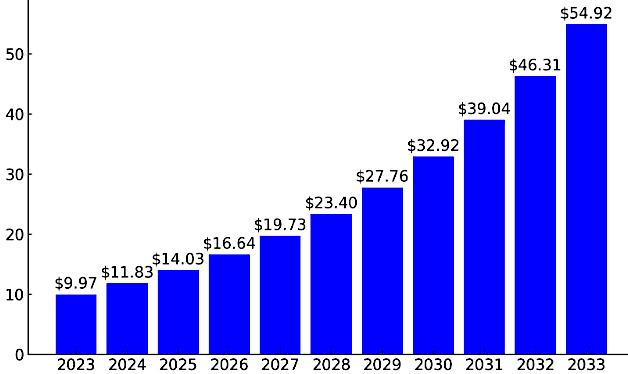
The global market size for AI in retail was valued at 9,97 billion dollars in 2023, grew to 11,83 billion dollars in 2024, and is projected to reach approximately 54,92 billion dollars by 2033, with an average annual growth rate of 18,6% from 2024 to 2033 (fig.1).
Figure 1. Global AI market in retail, billon dollars [2]
The field of sales forecasting has been revolutionized by AI, which introduces sophisticated algorithms capable of analyzing vast amounts of data, uncovering hidden patterns,andmakinghighlyaccuratepredictions. TheseAItechniquesleveragevarious branches of ML, deep learning (DL), and natural language processing (NLP) to enhance the precision and reliability of sales forecasts (table 1).
Table 1. AI techniques in sales forecasting [3, 4]
AI technique
Supervisedlearning
Description Applications in sales forecasting
Machine learning
Algorithms trained on labeled datatopredictoutcomes
Unsupervisedlearning Itidentifypatternsindatawithout labeledoutcomes
Reinforcementlearning Algorithms that learn optimal actionsthroughtrialanderror
Neuralnetworks
Convolutional neural networks(CNN)
Recurrent neural networks (RNN)
Sentimentanalysis
Textmining
Deep learning
Computational models inspired bythehumanbrain
Neural networks particularly effectiveinprocessingvisualdata
Itspecializedforsequentialdata
Natural language processing
Technique to analyze opinions andemotionsintextdata
Extracting useful information fromtext
Predicting sales trends based onhistoricaldata
Segmenting customers based onpurchasingbehavior
Optimizingpricingstrategies
Recognizingcomplexpatterns insalesdata
Analyzing visual trends and productimages
Forecastingsalesbyanalyzing timeseriesdata
Gauging customer sentiment fromsocialmediaandreviews
Analyzingmarkettrendsfrom newsarticlesandreports
From the author's perspective, the incorporation of AI techniques in sales forecasting offers a multifaceted approach that markedly improves the precision of predictions. Each technique provides unique benefits, ranging from the utilization of historical data and the segmentation of customer groups to the optimization of strategic decisions and the analysis of market sentiment. This extensive application of AI methodologies not only mitigates the shortcomings of conventional forecasting approaches but also endows businesses with powerful tools to effectively manage the intricacies of contemporary markets.
MODEL SELECTION AND EVALUATION
The process of model selection entails considering various criteria to identify the most suitable algorithm for a given forecasting task. This careful evaluation ensures
the chosen model aligns with the specific data characteristics and business requirements, maximizing forecasting accuracy and efficiency.
•The nature of the data: different models are optimal for specific types of data. For instance, time series models such as RNN are ideally suited for sequential data, whereas CNNs are more appropriate for visual data analysis.
•The complexity of the model: simpler models, such as linear regression, may be preferred for their interpretability and ease of implementation. In contrast, more complex models, such as DL networks, may offer superior accuracy at the expense of increased computational resources and complexity.
•Scalability is essential indynamic businessenvironments, wherethe model must accommodate growing datasets and evolving market conditions.
•The ease of integration with existing systems and the availability of computational resources must be considered, as models requiring extensive computational power may not be feasible for all organizations.
•The ability to interpret model outputs is crucial for practical decision-making. Although black-box models, such as deep neural networks, can provide high accuracy, their lack of interpretability can be a disadvantage in situations where understanding the decision-making process is critical.
The performance evaluation of forecasting models necessitates the use of various metrics. Common evaluation metrics include Mean Absolute Error (MAE), Mean Squared Error (MSE), Root Mean Squared Error (RMSE). These metrics provide insights into the average magnitude of errors in the predictions, with lower values indicatingsuperior modelperformance To enhance the robustness andgeneralizability of forecasting models, cross-validation is employed [5]. Cross-validation involves partitioning the dataset into multiple subsets, training the model on some subsets while validating it on the remaining ones. This process is repeated multiple times to ensure consistent model performance across different data partitions.
Bycarefullyconsideringcriteriaformodelselection,employingrobustevaluation metrics, and utilizing cross-validation and model tuning techniques, businesses can
leverage AI to significantly enhance their sales forecasting capabilities and make more informed strategic decisions.
CASE STUDIES OF SUCCESSFUL AI-ENABLED SALES FORECASTING
The implementation of AI-enabled sales forecasting techniques has demonstrated substantial benefits across various industries. By leveraging advanced algorithms and ML models, organizations have achieved remarkable improvements in accuracy and efficiency.
Accenture, a global professional services company, has developed predictive modelsthatanalyzehistoricalsalesdata,customerinteractions,andmarkettrends.This approach allows thecompanyto provideits clients withhighly accuratesales forecasts, enabling more informed decisions and strategic planning. Accenture's AI-powered model predicts the likelihood of success in any deal at any stage of the sales cycle. The forecasts are based on past similar deals that were either successful or unsuccessful. The AI model achieves 97% accuracy and delivers predictions in less than three seconds [6].
Accenture'sfirst-quarterfiscalyear2024performanceshowcasedstrongbookings of 18,4billion dollars and a 12% increase, emphasizing the robustness of theirstrategic priorities.Thisreflectsthecompany’scapabilitytoleverageadvancedanalyticsandAI to drive business performance across various sectors [7].
Boston Consulting Group (BCG) has integrated AI-driven sales forecasting into its consulting practices to offer clients enhanced predictive insights. BCG utilizes sophisticated ML models to process large datasets, including historical sales figures, economic indicators, and consumer behavior patterns. These models enable BCG to provide precise sales forecasts that help clients anticipate market shifts and adjust their strategies accordingly. One of the company's projects involves developing an integrated suite of analytics, marketing, and sales capabilities to attract customers in a more targeted, personalized manner based on data. Over 15 months, a client in the biopharmaceuticalsectorincreasedtheirannualsalesby45million dollars anddoubled their sales conversion rate [8]. In 2023, BCG's revenue reached 12,3 dollars billion, a
5% increase from the previous period. Consulting clients on AI has been a primary focus for BCG since 2015 [9].
Deloitte, one of the Big Four accounting firms, has adopted AI-powered sales forecasting to enhance its advisory services. Utilizing advanced DL techniques and natural language processing, Deloitte has developed sophisticated models that analyze large volumes of structured and unstructured data. These models enable clients to predict future sales trends more accurately, accounting for various market dynamics andconsumersentiment.DeloitteleveragestheSAP®BusinessTechnologyPlatform, which integrates analytics, database management, and intelligent technologies, further strengthening its forecasting capabilities and providing valuablebusiness insights [10].
To elevate its expertise in AI, Deloitte is training over 120,000 professionals through the Deloitte AI Academy™ and investing over 2 billion dollars in global technology learning and development initiatives. These efforts aim to enhance skills in AI and other areas, ensuring that the workforce is well-equipped to leverage cuttingedge technologies.
CHALLENGES AND FUTURE DIRECTIONS
Despite the significant advancements in AI-enabled sales forecasting, several challenges persist that need to be addressed to fully harness the potential of these technologies (table 2).
Table 2. Challenges in AI-enabled sales forecasting [11, 12]
Challenge Description
Data quality and diversity
Model complexity andinterpretability
Data privacy and security
Stakeholdertrust
Reliance on high-quality, comprehensive datasets from disparate sourcesandvaryingquality
Advanced models often function as black boxes, making their decisionmakingprocessesdifficulttounderstand
Concerns regarding compliance with data protection regulations such as GDPRandCCPA
Difficultyingainingtrustduetothelack oftransparencyinAImodels
Potential solutions
Implementing robust data cleaning and integration processes
Developing hybrid models that balance accuracy with interpretability
Utilizing privacy-preserving techniques and secure data handlingprotocols
AdvancingexplainableAI(XAI) techniques to provide clear and understandablemodeloutputs
From the author's perspective, overcoming these challenges is crucial for the successful deployment of AI-enabled sales forecasting. Future advancements in this area should explore several promising directions to address these obstacles and further improve forecasting capabilities.
One innovative approach is the incorporation of blockchain technology, which canenhancedatasecurityandtransparencybyensuringthatthedatausedinforecasting is tamper-proof and traceable [13]. This integration can mitigate some privacy and security issues associated with large-scale data usage. The creation of hybrid models that merge the strengths of different AI techniques can achieve a balance between accuracyandinterpretability.Forexample,combining MLwithrule-basedsystemscan yield more reliable forecasts while maintaining transparency and comprehensibility in the decision-making process.
Continuous advancements in natural language processing (NLP) can also significantly enhance sales forecasting capabilities. By better understanding and analyzing textual data from social media, customer reviews, and market reports, NLP canprovidedeeperinsightsintomarketsentimentandemergingtrends,leadingtomore accurate and timely forecasts. The ongoing development of explainable AI (XAI) techniques aimsto make AI models more transparent andinterpretable,providing clear explanations for their predictions. This development will help build trust among stakeholders and facilitate the adoption of AI technologies in sales forecasting.
CONCLUSION
By leveraging advanced ML algorithms, deep learning models, and natural language processing techniques, businesses can examine extensive datasets, uncover intricate patterns, and generate accurate forecasts that exceed the capabilities of traditional methods. The integration of various data sources, including customer behavior, market trends, and economic indicators, into AI models enables a more comprehensive and dynamic forecasting process. Evidence from industry leaders such as Accenture, BCG, and Deloitte highlight the considerable benefits of AI-driven sales forecasting, such as improved decision-making, efficient resource allocation, and strategic insight. AI-enabled sales forecasting holds significant potential to transform
business strategies, providing a robust framework for addressing the complexities of contemporary markets.
REFERENCES
1. Shiman X. U. Comparison of Sales Prediction in Conventional Insights and Machine Learning Perspective // Psychology. 2023.Т. 13. №. 3. С. 146-154.
2. Artificial Intelligence in retail market size and growth / Precedence Research // URL: https://www.precedenceresearch.com/artificial-intelligence-inretail-market (date of application: 15.05.2024)
3. Gupta A., Agarwal P. Enhancing Sales Forecasting Accuracy through Integrated Enterprise Resource Planning and Customer Relationship Management using Artificial Intelligence // 2024 3rd International Conference on Artificial Intelligence for Internet of Things (AIIoT). – IEEE,2024. С. 1-6.
4. Ogarkov A. Application of big data analytics to improve business customer service // Innovacionnaya nauka.2024. №7-1. P. 61-65.
5. Sharma K. K., Tomar M., Tadimarri A. AI-driven marketing: Transforming sales processes for success in the digital age // Journal of Knowledge Learning and Science Technology ISSN: 2959-6386 (online). 2023. Т.2.№2.С. 250260.
6. Converting sales opportunities into customers / Accenture // URL: https://www.accenture.com/us-en/case-studies/about/empowering-enterpriseinsights(date of application: 22.05.2024)
7. Q1 FY24 Performance/ Accenture // URL: https://newsroom.accenture.com/content/1QFY24Earnings/1qfy24earningsinfographic.pdf (date of application: 24.05.2024)
8. DigitalSales/BCG//URL: https://www.bcg.com/capabilities/marketingsales/digital-sales (date of application: 01.06.2024)
9. BCG delivers 20th consecutive year of growth / BCG // URL: https://www.bcg.com/press/15april2024-bcg-delivers-20th-consecutive-year-growth (date of application: 03.06.2024)
10. DeloitteExpandsSAP®businesstechnologyplatformwithgenerativeAI to deliver services and solutions focused on outcomes and client value / Deloitte // URL: https://www.deloitte.com/global/en/about/press-room/deloitte-expands-sapbusiness-technology-platform-with-generative-ai.html (date of application: 05.06.2024)
11. Allioui H. et al. Unleashing the potential of AI: Investigating cutting-edge technologies that are transforming businesses // International Journal of Computer Engineering and Data Science (IJCEDS). 2023. Т.3. № 2. С. 1-12.
12. Bobunov A. Development of test automation methodologies in the financial sector: a comparative analysis of approaches in the USA, Europe, and Asia // Cold Science. 2024. № 2/2024. P. 61-70.
13. Stepanov M. The application of machine learning for optimizing maintenance processes and energy management of electric drives // Cold Science. 2024. №2/2024. P. 22-30.
стандарты, кибербезопасность,
кадров.
Volkov Dmitry bachelor’s degree, Far Eastern Federal University Russian Federation, Vladivostok
INFORMATION SECURITY: INTERNATIONAL STANDARDS AND MODERN CHALLENGES
Abstract: The article analyzes international standards and modern challenges in the field of information security. It examines key aspects of the development and implementation of IS standards, innovative approaches to information protection, and the role of education and training in ensuring information security. Particular attention is paid to current threats and data protection strategies.
Keywords: Information security, international standards, cybersecurity, blockchain, artificial intelligence, training.
для атак на центральную
Certified Information Systems Security
1.
трансформации
практика. 2020.№ 10(190). С. 138-142.
2. Хаджаев С.И. У.Актуальностьпроблемы
1. № 4. С.212-217.
3. Исрафилов А. Современные вызовы в области
научн. журн.2024. 2(119).
4. Яковишин
avlodlari. 2023. Т.
5.
2023. С. 156-162.
применения ИИ для повышения
эффективности, внедрение инновационных технологий в различных отраслях, перспективы их развития, а также проблемы и вызовы, связанные с внедрением. Особое внимание уделено персонализации предложений и улучшению производительности с помощью ИИ.
Ключевые слова: Инновационные технологии, искусственный интеллект, бизнес, корпоративная эффективность,персонализация, производительность.
Kuznetsova Elena bachelor’s degree, individual researcher
INNOVATIVE TECHNOLOGIES AND ARTIFICIAL INTELLIGENCE IN BUSINESS
Abstract: The article analyzes innovative technologies and artificial intelligence (AI) in business. It examines ways AI is used to improve corporate efficiency, the implementation of innovative technologies in various industries, their development prospects, and the associated problems and challenges. Particular attention is given to the personalization of offers and productivity improvement through AI.
Keywords: Innovative technologies, artificial intelligence, business, corporate efficiency, personalization, productivity.
предлагаярешения,которыеулучшаютпроизводительностьи
2. Бойко С. В. Использование
персонализации
// Universum: экономика и юриспруденция.2024.№ 3(113).
3. Березовская Н. О. Анализ рынка краткосрочной
недвижимости: влияние экономических факторов и внедрение инновационных технологий // Вестник науки. 2024.№ 4(73).
4. Малыхин Н. И. Оптимизация производительности с помощью Hibernate Cache: стратегии, преимущества и проблемы // Актуальные исследования. 2021.№ 31(58). doi: 10.5281/zenodo.11193274.
5. НамиотД.Е.,ИльюшинЕ.А.,ЧижовИ.В.Искусственныйинтеллект и кибербезопасность // International Journal of Open Information Technologies. 2022. Т. 10. № 9. С. 135-147.
UDK 004.6:338
Bushuev Stanislav specialist’s degree, South-Russian State University of Economics and Service Russian Federation, Shakhty
ECONOMIC ASPECTS OF BIG DATA: ANALYSIS OF DATA PRIVACY PROTECTION METHODS
Abstract: The article examines the economic aspects of Big Data, with a particular focus ondataprivacy protectionmethods. Theeconomicbenefits and market trends driven by the use of Big Data are analyzed. The privacy challenges associated with Big Data are identified. Encryption, data anonymization, access control, data masking, differential privacy, and blockchain technology are considered as effective data privacy protection methods. The economic implications of implementing robust data privacy measures are analyzed, emphasizing the importance of maintaining consumer trust and compliance with privacy regulations.
Keywords: Big Data, data privacy, encryption, data anonymization, access control, differential privacy, blockchain technology.
INTRODUCTION
Big Data has profoundly impacted the contemporary economic landscape, reshapingbusinessoperationsandorganizationalstrategies.Thistermencompassesthe extensive datasets generated from diverse sources, including social media platforms, financial transactions, and Internet of Things (IoT) devices. Through advanced analytics, it can reveal significant patterns, trends, and correlations, thus driving innovations and improving decision-making processes across various industries. Despite the economic benefits, the use of Big Data raises serious concerns about privacy. Such information often contains personal data, which, if inadequately protected, can lead to significant financial losses, legal consequences, and a decline in consumer trust.
This article aims to investigate the economic aspects of Big Data with a particular focus on data privacy protection methods. It will analyze the economic benefits and
market trends driven by Big Data, identify the privacy challenges inherent in its use, and examine various techniques employed to protect sensitive information.
MAIN PART. ECONOMIC ASPECTS OF BIG DATA
Big Data analytics represents a transformative force in contemporary economic systems, offering substantial benefits across various sectors. The capacity to process and analyze extensive datasets enables businesses to derive valuable insights, optimize operations, and foster innovation.
•Big Data enables organizations to make more informed decisions by analyzing vast amounts of data to identify trends and patterns.
•Businesses can streamline operations and reduce costs through data-driven process optimizations.
•Data insights drive innovation, leading to the development of new products and services tailored to market needs.
•Predictive analytics helps in identifying potential risks and implementing strategies to mitigate them.
•Companies can better understand customer behavior and preferences, allowing for more targeted marketing and improved customer satisfaction.
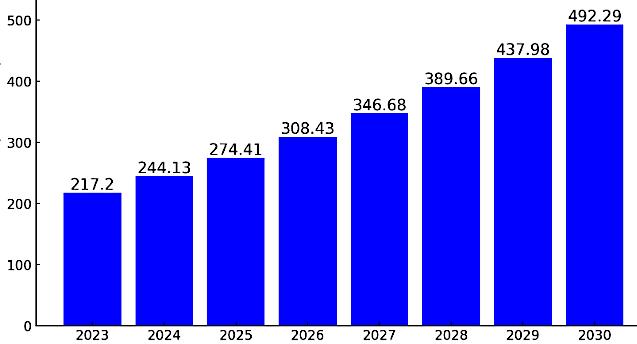
The economic benefits of Big Data are underscored by notable market growth and investment trends observed in recent years. The Big Data market size in 2023 was estimated at USD 217.2 billion (fig. 1).
This growth is fueled by substantial investments from both public and private sectors, emphasizing the strategic importance of Big Data in driving economic
Figure 1. Projected Big Data market size from 2023 to 2030, billion dollars [1]
progress. The impact of Big Data analytics extends across various industries, each harnessing its potential to address unique challenges and opportunities [2]. In the healthcare sector, Big Data enables precision medicine by analyzing patient data to tailortreatmentsandimproveoutcomes.FinancialinstitutionsutilizeBigDatatodetect fraud, assess risk, and streamline operations, thereby enhancing financial stability and security [3]. In the retail industry, Big Data analytics facilitates personalized customer experiences,inventorymanagement,andsupplychainoptimization. Thetransportation and logistics sector benefits from Big Data through route optimization, predictive maintenance, and enhanced operational efficiency.
The significant benefits of Big Data analytics, coupled with robust market growth and targeted investments, underscore its pivotal role in modern economies. Across diverse industries, Big Data continues to drive innovation, improve efficiency, and create new economic opportunities, solidifying its position as a critical asset in the digital age.
PRIVACY ISSUES IN BIG DATA
Data privacy is the protection of personal information from unauthorized access and misuse. As organizations increasingly utilize large datasets for analytics and decision-making, the likelihood of privacy breaches escalates [4]. Understanding the various data protection issues is important for developing effective risk mitigation strategies. These challenges can be categorized into several key areas, as illustrated in table 1.
Table 1. Types of data privacy issues [5]
Type of issue Description
Databreaches Unauthorized access to sensitive information, leadingtoexposure.
Datamisuse Inappropriate use of informationbeyondagreed purposes, violating user consent.
Re-identification risks
Potential to re-identify individuals from anonymized datasets through advanced techniques.
Hacking, insider threats Financial loss, reputationaldamage
Data selling, unauthorizedsharing Legal consequences, lossofconsumertrust
Data matching, linkageattacks
Privacyinvasion,legal issues
Insufficient anonymization Poor anonymization processes that fail to adequately protect individualidentities. Weak pseudonymization, poortechniques
Inadequate securitymeasures
Regulatory noncompliance
Weak security protocols thatlead to vulnerabilities indataprotection.
Failure to adhere to data protection laws and regulations, leading to legalpenalties.
Outdated software, lackofencryption
Increased risk of reidentification
Data theft, unauthorizedaccess
Ignoring GDPR, CCPAviolations Hefty fines, operational disruptions
The regulatory landscape for data privacy in the USA is characterized by a complex mix of federal and state laws designed to protect personal information and ensure organizational adherence to specific data protection standards. One of the most significant pieces of legislation in this regard is the California Consumer Privacy Act (CCPA), which came into effect on January 1, 2020. The CCPA grants California residents several rights regarding their personal data, including the right to know what personal data is being collected about them, how it is used, and to whom it is disclosed. Additionally, it includes the right to delete their personal data held by a business, subject to certain exceptions, the right to opt-out of the sale of their personal data to third parties, and the right to receive equal service and pricing even if they exercise their privacy rights.
In addition to the CCPA, other federal laws contribute to the data privacy regulatory framework in the USA These include the Health Insurance Portability and Accountability Act (HIPAA), which protects medical information by establishing nationalstandardsforelectronichealthcaretransactionsanddataprivacy.TheGrammLeach-Bliley Act (GLBA) requires financial institutions to explain their informationsharing practices to their customers and to safeguard sensitive data. The Children's Online Privacy Protection Act (COPPA) imposes certain requirements on operators of websites or online services directed at children under 13 years of age, and on operators of other websites or online services that have actual knowledge that they are collecting personal information from a child under 13 years of age [6].
Compliance with these regulations is important for organizations to avoid legal repercussions and maintain consumer trust. Non-compliance can result in substantial fines, legal action, and damage to an organization's reputation. Therefore, businesses must stay informed about the evolving regulatory landscape and ensure their data protection practices meet or exceed the required standards.
METHODS OF DATA PRIVACY PROTECTION
Effective data privacy protection involves a combination of technical measures, organizational policies, and compliance with regulatory frameworks.
Encryption is one of the fundamental techniques used to protect data privacy. It involves converting plain text data into an unreadable format using cryptographic algorithms, which can only be deciphered by authorized parties possessing the decryption key. There are two primary types of encryptions: symmetric, where the same key is used for both encryption and decryption, and asymmetric, which uses a pair of public and private keys. Encryption is widely used to secure data in transit and at rest, ensuring that even if the data is intercepted or accessed without authorization, it remains unintelligible and secure.
Data anonymization refers to the process of modifying data in such a way that the individuals whom the data describe remain anonymous. This involves removing or altering personally identifiable information such as names, addresses, and social security numbers. Techniques for data anonymization include data masking, generalization, and k-anonymity. By anonymizing data, organizations can share and analyze datasets without compromising individual privacy, reducing the risk of reidentification and ensuring compliance with privacy regulations.
Access controls are important for limiting data access to authorized individuals only. This method includes the implementation of authentication and authorization mechanisms to verify the identity of users and control their access to sensitive data. Authentication processes can involve passwords, biometrics, and multi-factor authentication, while authorization determines the level of access granted to authenticated users. Role-based access control (RBAC) is a widely used model that
assignspermissionsbasedontheuser’srolewithintheorganization,ensuringthatusers can only access data necessary for their specific job functions.
Data masking involves the obfuscation of specific data within a database to prevent unauthorized access while maintaining the usability of the data for testing or analysis purposes. This technique replaces actual data with fictional data that retains the same structure and format, ensuring that sensitive information is not exposed. Data maskingisparticularlyusefulinnon-productionenvironments,suchasduringsoftware development andtesting,wheretheuseofreal datacould lead to privacyviolations [7].
Differential privacy is an advanced technique designed to provide strong privacy guarantees when analyzing large datasets. It works by introducing controlled random noise to the data or the results of queries, thereby preventing the identification of individualdataentries. Thedegreeofnoiseaddediscalibratedtoensurethat theoverall statistical properties of the dataset remain useful while protecting individual privacy. Differential privacy is particularly valuable in scenarios where datasets are shared or published for research and analysis purposes, as it allows for meaningful insights without compromising privacy.
Blockchain technology offers a decentralized approach to data privacy protection. It uses cryptographic techniques to secure data across a distributed ledger, ensuring that all transactions are transparent, tamper-proof, and verifiable. Each block in the blockchain contains a cryptographic hash of the previous block, a timestamp, and transaction data, making it extremely difficult for malicious actors to alter information without detection [8]. Blockchain can enhance data privacy by providing secure and transparent mechanisms for data sharing, authentication, and audit trails, particularly in sectors such as finance, healthcare, and supply chain management.
Regular audits and monitoring are essential for maintaining data privacy. Audits involve systematic examinations of data practices and compliance with privacy policies and regulations. This process helps identify vulnerabilities, ensure adherence to best practices, and mitigate risks associated with data handling. Continuous monitoring involves real-time surveillance of data access and usage patterns to detect and respond to suspicious activities promptly. Implementing automated monitoring
tools and conducting regular security assessments are critical components of an effective data privacy protection strategy.
Different methods of data privacy protection offer varying levels of security, applicability, and costs associated with their implementation. Organizations must carefully evaluate these factors to choose the most suitable methods for their specific needs (table 2).
Table 2. Comparative analysis of data privacy methods [9]
Method
Encryption Protects data at rest andintransit
Data anonymization Allows data sharing without compromising privacy
Accesscontrols Limitsdataexposure to authorized personnel
Datamasking Protectsdatainnonproduction environments
Key management challenges,performance overhead
Vulnerable to reidentification techniques
Requires diligent management and updates
Does not protect productiondata
Differential privacy Strong privacy guarantees Complextoimplement, may reduce data accuracy
Blockchain technology Ensures data integrity, transparent andtamper-proof
Resource-intensive, not suitable for all applications
High implementation and maintenancecosts
Reduces regulatory risks, significantinitialsetupcosts
Moderate implementation andmanagementcosts
Lower costs, primarily benefits development and testing
Significant investment, protectsagainstbreachcosts
High initial setup and operational costs, reduces verificationcosts
Regular audits andmonitoring Proactive threat identification Continuous effort and investment Preventscostlybreachesand complianceviolations
According to the author, data privacy protection in the realm of Big Data is important, as the consequences of failing to safeguard sensitive information can be severe and far-reaching. Inadequate data privacy measures can lead to significant financial losses, legal penalties, and long-term damage to an organization's reputation. The erosion of consumer trust resulting from data breaches can negatively impact customer retention and brand loyalty, further affecting the economic stability of the organization.
ECONOMIC IMPLICATIONS OF DATA PRIVACY PROTECTION
Investing in data privacy protection can yield significant economic benefits by mitigating risks and enhancing consumer trust. Google has successfully implemented various data privacy protection methods, including encryption, data anonymization, and differential privacy. Encryption is used extensively to protect data both at rest and intransit, ensuringthatsensitive informationremains securefrom unauthorized access. Google employs Advanced Encryption Standard (AES) with 256-bit keys for its services,providingahighlevelofsecurity.Googleusesdataanonymizationtechniques to ensure that personal data cannot be linked back to individual users [10]. This is particularly evident in Google’s use of differential privacy in its data collection processes, where noise is added to datasets to prevent re-identification of users. These measures have not only safeguarded user data but also enhanced Google’s reputation as a trusted service provider, thereby maintaining consumer trust and compliance with regulatory standards.
Apple is another company that has effectively implemented comprehensive data privacy protection measures. Apple’s approach includes end-to-end encryption for services like iMessage and FaceTime, which ensures that only the communicating users can access the content of their messages. Apple uses secure enclave technology toprotectbiometricdata,suchasfingerprintsand facial recognitioninformation,stored on its devices [11]. This technology isolates sensitive data from the main operating system, providing an additional layer of security. Apple also employs stringent data anonymization practices, ensuring that user data collected for analytics is de-identified and cannotbetracedbacktoindividualusers.Theseprivacymeasureshavecontributed significantlytoApple’sbrandimage as acompanycommittedtouserprivacy,thereby fostering customer loyalty and enhancing market competitiveness.
T-Mobile, one of the largest telecommunications companies in the USA, experienced two significant data breaches in 2023, leading to substantial economic and reputational consequences. The most recent breach, affecting 836 customers, involved unauthorized access to sensitive information, including full names, contact details, account numbers, associated phone numbers, T-Mobile account PINs, social security
numbers, government IDs, and dates of birth. Upon discovering the breach, T-Mobile reset the affected account PINs and offered two years of free identity protection services through TransUnion’s myTrueIdentity.
This breach followed an earlier incident in January 2023, which compromised the data of approximately 37 million customers. Hackers exploited vulnerabilities in one of T-Mobile’s API interfaces,which had been accessible without proper authorization since2022.Theexposeddataincludednames,homeaddresses,emails,phonenumbers, dates of birth, T-Mobile account numbers, and service plan details for both postpaid and prepaid customers. The cumulative impact of these breaches underscores the critical need for robust data privacy measures.
The economic implications for T-Mobile have been significant. The company has faced direct costs related to breach notification, customer support, and free identity protection services. T-Mobile’s reputation hassuffered,potentially affecting customer retention and acquisition. Historically, T-Mobile has been subject to multiple breaches since 2015, resulting in financial penalties and settlements. The company paid a $25 million fine to the FCC and agreed to a $500 million settlement for a class-action lawsuit. T-Mobile incurred further costs by paying $270,000 to hackers to prevent the publication of stolen data, though a subsequent $200,000 ransom payment attempt failed, as the hackers continued to leak and sell the data [12].
These incidents highlight the severe economic risks associated with inadequate dataprivacyprotections.Beyondimmediatefinanciallosses,breachescanleadtolongterm reputational damage and erosion of consumer trust, significantly impacting a company's market position and financial stability. Investing in comprehensive data privacy measures is crucial for mitigating such risks and ensuring sustainable business operations in the era of Big Data.
CONCLUSION
The analysis of economic aspects related to Big Data highlights the complex balance between leveraging its potential and ensuring privacy. The proliferation of Big Data has revolutionized various industries, providing information that drives innovation, optimizes operations, and enhances decision-making processes. Effective
protection methods are necessary not only for regulatory compliance but also for maintaining consumer trust and preventing substantial financial and reputational losses. The implementation of advanced techniques such as encryption, data anonymization, differential privacy, and blockchain technology, combined with stringent organizational policies and continuous monitoring, can mitigate the risks associated with data breaches and misuse.
REFERENCES
1. Big Data Market: Global Industry Analysis and Forecast (2024-2030) / Maximize Market Research // URL: https://www.maximizemarketresearch.com/market-report/global-big-datamarket/66349/ (date of application: 15.06.2024)
2. Ajala O. A. et al. Reviewing advancements in privacy-enhancing technologies for big data analytics in an era of increased surveillance //World Journal of Advanced Engineering Technology and Sciences. 2024. Т. 11. №. 1. С. 294-300.
3. Bobunov A. Approaches to monitoring and logging in automated testing of financial applications // Sciences of Europe. 2024. # 142. P. 62-66.
4. FarayolaO.A.,OlorunfemiO.L.,ShoetanP.O.Dataprivacy and security init:areview oftechniques andchallenges//ComputerScience&IT Research Journal. 2024. Т. 5.№. 3. С. 606-615.
5. Nayak B. S., Walton N. The future of platforms, big data and new forms ofcapitalaccumulation//InformationTechnology &People.2024. Т.37.№.2.С.662676.
6. Ehimuan B. et al. Global data privacy laws: A critical review of technology's impact on user rights //World Journal of Advanced Research and Reviews. 2024. Т. 21. №. 2. С. 1058-1070.
7. Pshychenko D. The impact of digital transformation on the economic efficiency of enterprises // Cold Science.2024. № 6. P. 82-91.
8. Guo S. et al. Blockchain-assisted privacy-preserving data computing architecture for Web3 // IEEE Communications Magazine. 2023. Т. 61. №. 8. С. 2834.
9. Udeh C. A. et al. Big data analytics: a review of its transformative role in modern business intelligence // Computer Science & IT Research Journal. 2024. Т. 5. №. 1. С. 219-236.
10. Default encryption at rest / Google // URL: https://cloud.google.com/docs/security/encryption/defaultencryption#:~:text=Encryption%20at%20rest%20is%20encryption,encryption%20co nsistently%20across%20Google%20Cloud (date of application: 15.06.2024)
11. Privacy / Apple // URL: https://www.apple.com/privacy/features/ (date of application: 20.06.2024)
12. T-Mobile Consumer Sample / T-Mobile // URL: https://www.documentcloud.org/documents/23793945-t-mobile-consumer-samplefebruary-march-data-breach/ (date of application: 25.06.2024)
использованию
инновационным технологиям,
интеллект, дляповышениябезопасностиданных.Примерыуспешноговнедренияцифровых технологий и рекомендации
Ключевые слова: Цифровая трансформация, здравоохранение, кибербезопасность,электронныемедицинскиезаписи,блокчейн,искусственный интеллект.
Andreev Ivan graduate student, Lomonosov Moscow State University Russian Federation, Moscow
EFFECTIVE STRATEGIES FOR DIGITAL TRANSFORMATION AND CYBERSECURITY IN HEALTHCARE
Abstract: The article examines strategies for digital transformation and cybersecurity in healthcare. It focuses on the use of electronic medical records, telemedicine,and innovativetechnologiessuchasblockchainand artificialintelligence to enhance data security. Examples of successful digital technology implementations and recommendations for their use are discussed to improve the quality of medical services and information protection.
Keywords: Digital transformation, healthcare, cybersecurity, electronic medical records, blockchain, artificial intelligence.
1.
2.
// Наукосфера.2024. № 5(1). С. 54-59.
3. Прончев Г. Б. О проблемах информационной безопасности использования информационно-коммуникационных технологий и искусственного интеллекта в цифровом здравоохранении // Социальногуманитарные знания. 2022.№ 2. С. 100-107.
4. Яковишин А. Д. Влияние международного законодательства
5. Ибрагимова З. М., Батчаева З. Б., Ткаченко А. Л. Информационная безопасность как элемент экономической
Дона. 2022.№ 11(95). С. 26-33.
6. Грепан В. Н. Методы обеспечения приватности
мессенджерахспомощьюблокчейн-технологий//Холоднаянаука.2024.№6.С. 4-14.
7. Коробкова О. К. Информационная
здравоохранения в условиях цифровой экономики: проблемные вопросы // Экономика и предпринимательство.2020.№ 8. С. 1110-1113.
аспекты и регулирование цифровых
финансовые услуги,
оптимизация, блокчейн,искусственный интеллект,
Andreev Ivan graduate student, Lomonosov Moscow State University Russian Federation, Moscow
DIGITALIZATION AND ITS IMPACT ON FINANCIAL SERVICES AND TAX OPTIMIZATION
Abstract: The article examines the impact of digitalization on financial services and tax optimization. It describes key aspects of using digital technologies such as blockchain and artificialintelligencetoimprove the efficiency and security of financial operations. Examples of successful digital solutions implementation are provided, and the legal aspects and regulation of digital financial services are discussed.
Keywords: Digitalization, financial services, tax optimization, blockchain, artificial intelligence, cybersecurity.
1. Захаров
2. Котенко И. В., Левшун Д. А. Методы
системных
методов машинного обучения //Искусственный интеллект
2023. № 3. С.3.
3. Грепан В. Н. Анализ