The Line
Issue 11 | Summer 2021
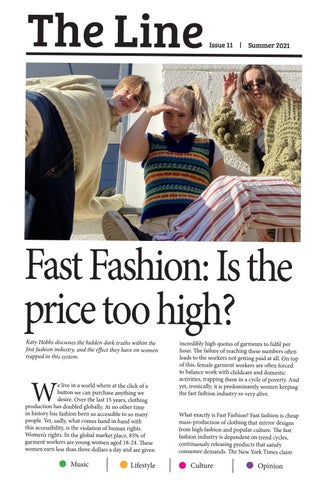
Fast Fashion: Is the price too high? Katy Hobbs discusses the hidden dark truths within the fast fashion industry, and the effect they have on women trapped in this system.
W
e live in a world where at the click of a button we can purchase anything we desire. Over the last 15 years, clothing production has doubled globally. At no other time in history has fashion been so accessible to so many people. Yet, sadly, what comes hand in hand with this accessibility, is the violation of human rights. Women’s rights. In the global market place, 85% of garment workers are young women aged 18-24. These women earn less than three dollars a day and are given
Music
Lifestyle
incredibly high quotas of garments to fulfil per hour. The failure of reaching these numbers often leads to the workers not getting paid at all. On top of this, female garment workers are often forced to balance work with childcare and domestic activities, trapping them in a cycle of poverty. And yet, ironically, it is predominantly women keeping the fast fashion industry so very alive.
What exactly is Fast Fashion? Fast fashion is cheap mass-production of clothing that mirror designs from high fashion and popular culture. The fast fashion industry is dependent on trend cycles, continuously releasing products that satisfy consumer demands. The New York Times claim
Culture
Opinion
2
The Line | Summer 2021
that fast fashion ‘follows in the footsteps of the culture of materialism and disposability.’ People’s need for the latest trends is what’s fuelling the industry’s exploitative machine. This has serious implications for the women making their clothes as well as resulting in severe environmental consequences. Fast fashion brands are complicit in maintaining gender-based harassment that the industry was built on. In Cambodia, it has been reported that 68% of women garment workers said they were made to feel unsafe
or uncomfortable at work. In Bangladesh, it has been reported that over 60% of female garment workers have identified feeling threatened and intimidated with violence at work. In Vietnam 34% of women garment workers have experienced physical harassment, including touching, hitting and kissing. Not only do the majority of these females feel vulnerable in the workplace, they’re also prone to violence on their commute to and from work. Due to bias within the media, we’re not often made aware of the women constantly protesting in India, Ghana and Bangladesh amongst many more
The brain gives rise to all our mental processes: our emotions, thoughts, decisions and sensations.
countries. These women are fighting for safer working conditions and their rights to higher wages. Nazma Akter, executive director of the Awaj Foundation in Bangladesh states that ‘Retailers colonize us due to cheap labour, exploit our youth, and disrespect the dignity of workers, especially women and girls […] It was countries that used to colonise us, now it’s large corporations.’ She highlights the fact that the fast fashion industry was built on the exploitation of indigenous women and their labour, with the majority of workers being South-East Asian. The consumption of products from these brands reinforces not only the gender gap, but also highlights the reality of racism. This must stop, and it is our job as educated young consumers to do something about it. On 24 April 2013, an eightstorey commercial building called the Rana Plaza collapsed. 1,134 peopled were killed and nearly 3000 were injured. This building contained products of many well-known brands, including Primark and Matalan, outlets that many of us shop at regularly. The owners of the Rana Plaza ignored warnings to avoid using the building after cracks had appeared a few days before. Garment workers were forced to return the following day, and on this day the building collapsed. This incident is considered the deadliest garment factory disaster in history, and yet even after atastrophic incidents like the Rana Plaza, women in fashion’s supply chain are still overworked, underpaid and abused. Due to the lack of public awareness surrounding this
The Line
|
Summer 2021
and a lack of regulations put in place by the government, many brands are able to keep this exploitation hidden, and out of public consciousness. However, there has recently been a surge in global fashion movements, with campaigns such as #WearYourValues and #WhoMadeMyClothes raising awareness on the women behind our clothes and their poor treatment. These campaigns are demanding accountability from large fast fashion companies, companies that we all shop from daily. Many women are also forced to physically carry the burden of fast fashion. Due to the industry’s vast disposability and turnover rates, the Global North’s waste crisis has developed a second-hand clothing supply chain that millions of people in Ghana, the second largest importer in the world,
3
now has to rely upon. Women head porters (Kayayei) in Kantamanto, Ghana, carry bales of this clothing at a minimum weight of 120 pounds. These women are paid between $0.30 - $1.00 per every potentially back breaking trip. Their wages are so low that these women can barely survive off them, and yet because of how heavy these bales are, they’re constantly putting their lives at risk, all a product of the fast fashion industry. What can we do to help? There are a number of ways in which we can help stop this deadly system, even simple things like sharing knowledge on this matter. Supporting sustainable and ethical brands, brands that do not exploit their workers and instead take care of them, for example: Levis,
The idea of being out of control is simply a terrifying concept for us.
Boden, Pact, Ralph Lauren and many more. Another way in which we can make a significant difference is by shopping for second-hand clothing. Not only does this help fast fashion workers, but it also helps the environment hugely, and it is easy to find a far larger range of diverse, quirky clothing! So next time we see fast fashion brands advertising their products on social media, or sending marketing emails about ‘women’s empowerment’ let us remember that they are the very culprits of the ongoing exploitation that’s destroying so many women.
4
The Line | Summer 2021
The Revival of Musical Subcultures in the 21st Century In this article Daisy Colliss Quinton explore the cultural evolution of subcultures in the 21st century, through the original movements and their later revivals.
S
ubcultures have been a community of likeminded people, both musically and politically, and have been on the decline in the 2000s. But there has been a revival of awareness of these communities, through the reinvention of the classic genres. Subcultures revolve around a collective aesthetic, music and artistic style - often iconic and recognizable. For example: the 1950s style of the Rockabillies, or the Victorian-esque fashion of the goths, or the vibrantyet-aggressive style of punks
and rockers. The recreation of music genres by merging existing styles together, along with the controversy surrounding artists, has led to recognition of these hidden cultures in the news. Punk appeared out of the garage rock and mod bands of the 1960s and the political and financial insecurities of the 1970s, being recognised as a subculture in the mid1970s. The punk movement rejected ideals of social norms and mainstream music- creating a new aggressive style of music
The punk movement rejected ideals of social norms and mainstream music
as well as a fashion and art style of anti-establishment and non-conformity. The style of punk music, often called punk-rock, typically incorporated vocals, electric bass, electric guitar and drums- using mantras to reinforce the political ideology of antiestablishment to the listener. The Sex Pistols and the Ramones (to name a few) defined the genre of punk. John Lydon (lead vocalist of Sex Pistols and Public Image Limited) referred to Sex Pistols as “the last rock and roll band”. Often
5
The Line | Summer 2021
outspoken against the genre of rock, Lydon illustrates the individuality of punk by redefining music in the 1970s, separating itself from the other heavy genres. Despite being dormant since the 90s, punk has been making a comeback in mainstream music, through the revival of pop punk. The icons of pop punk, such as Blink 182 and Bad Religion have been influencing a new style of pop punk, with the resurgence of this genre through rappers, alternative musicians and rockers. Machine Gun Kelly is playing a key role in reviving this genre, with frequent collaborations with the pop punk icon Travis Barker and the alternative singer Yungblud. This new style appears as a bridge between the emo rap of the 2000s with the pop punk styles of the 90s, with the album “Tickets to My Downfall’ illustrating this. Moreover, All Time Low’s single “Monsters” debuted in the Billboard Hot 100, further adding to pop punk’s appearance in main stream media. The comeback of punk, through pop-punk has also created renewed interest in the punk subculture, replacing the DIY style of clothing in the 70s with the band shirts style of punk rock and pop punk. The new demographic of ‘punks’ have a wider awareness and appreciation for other music, causing the emergence of subcultures. Over the years, many subcultures have been reinvented, introducing new fans into the subcultures. Nu-metal was invented in the 90s and early 2000s, with Limp Bizkit pioneering the early nu-metal genre on their album “Significant Other” (released in 1999)-
creating the initial hype for the genre; and bands like Linkin Park following closely behind. The new style of music incorporated the dirty vocals of heavy metal, with the clean vocals of rock (and even pop), creating a genrebending blend of passion. The initial introduction of nu-metal invoked an era of young fans, discontent with the mundane rules plaguing the time, using the sound as an outlet for their anger; eventually fizzling out in the 2000s. Despite this, a restoration of the genre has occurred in the last five years, incorporating the abuse people suffer in their lives and the dissatisfaction with political leaders. In addition, the availability of music on the internet has created more support for the genre. During the past few years, nu-metal has introduced the styles of hip-hop, rap and post-hardcore into the style, adding to more genredefying music. Bands such as Falling in Reverse have been praised for redefining the genre by incorporating different styles of songs into their album repertoire, creating a diverse media of interest. With the increase in the metal subculture’s inclusion of nu-metal, a new way of viewing the world appears, as the new style incorporates the the outsider attitude, creating an inclusive environment. The news has played a part in the visibility of subcultures, with metal music often being targeted as the music of the devil. The Satanic Panic in the 1980s caused the belief that bands, for example Black Sabbath and Iron Maiden, recorded messages to the devil on the backwards play of the records. This publicity
The new style of music, incorporated the dirty vocals of heavy metal, with the clean vocals of rock
increased the disapproval of metal music in the mainstream; contrastingly this media attention also brought new audiences to the metal community as a form of rebellion. Similarly, the bad reputation of black metal, due to the Norwegian arson attacks on Christian churches in the 1990s, created a lasting stigma around black metal. Within the last two months metal has yet again been brought to the forefront of the mainstream news due to the sexual abuse and misconduct allegations against Marilyn Manson, from his exgirlfriends and musical counterparts, shining the light once again on the negative influences of certain icons in the metal and horror rock subcultures. By negatively reinforcing these subcultures stereotyping occurs, causing people to distance themselves from these cultures; whilst the raised awareness of their existence brings the subcultures to the light, capturing new audiences.
Music subcultures have been through a revitalisation in the 21st century
Music subcultures have been through a revitalisation in the 21st century. The Coronavirus pandemic has caused many people to look for a sense of community, which can be found within these musical cultures; and the political issues present in the 21st century have brought the spirt of punk into many people’s lives. Despite the influx of support for subcultures, they still remain in the shadows, surfacing in the mainstream media though pop icons and controversial news coverage.
6
The Line | Summer 2021
Does Religion Rule the World?
Ruari Kirkham considers the increasingly commonplace ways in which government and religion can influence each other.
R
eligion has been declining in influence over the past 100 years but is still very important for certain groups of people. Within countries where religion remains common, there are certain laws put in place and actions undertaken by the governments of countries that have either a more religious motive or have been acted upon due to pressure from religious groups. This article aims to examine the negative effects of governments involving themselves and being influenced by religion and the dangers it poses to both the people of the country and those religious groups themselves. Poland is an outlier in Europe, as it is one of the most religious countries in the world. On average, roughly 35% of the population of most European countries identified as religious, whilst statistics from 2015 show that roughly 94% of Polish citizens identify as religious, with 86% of those being Roman Catholics. Poland is also one of the strictest countries in Europe regarding the laws surrounding abortion, with a recent addition to their laws as of the 27th of January 2021 stating that abortion is only legal in the case that pregnancy is a result of a
criminal act or is a danger to the mother’s life (these two categories account for roughly 2% of all abortions in Poland). The Law and Justice party of Poland, who govern the country, are heavily influenced by the Bishops and Catholic Church, causing the promotion of more Catholic ideologies as well as the desire potentially to make the law even stricter. The laws surrounding abortion remain a controversial topic in Polish politics, with Roman Catholicism often influencing social and political views, with many people within Poland hoping for a change to the law. On 30 of April 2021, the country of Israel witnessed one of its greatest tragedies on Mount Meron at the Lag B’Omer Festival. The festival, in which roughly 1000 people attempted to walk down a narrow hallway all at once, resulted in the deaths of 45 people and over 100 people injured, some of whom were children. This event, whilst tragic, is under investigation in the hopes that such a disaster will not happen again. One such line of inquiry involves the fact that the site of the festival had been established as hazardous years ago, and that the police and government had been reluctant to attempt to reduce the sizes of the crowd so as not to upset the
On average, roughly 35% of the population of most European countries identified as
religious
ultra-Orthodox politicians and rabbis, who hold great influence within Israel. The validity of this claim is yet to be proven, but should it be the truth, this tragedy would represent the dangers of a government that must worry more about upsetting religious leaders than the wellbeing of its people. However, whilst both the Polish and Israeli governments may be overly influenced by religion, the extreme persecution of religious bodies is also a very prominent issue, particularly in China. Since 1949 China has been governed by the Chinese
The Line
|
7
Summer 2021
Communist Party, and the country has always been moderately anti-religious, seeing it as a rival force to the government; however, in recent years the persecution of religious groups has increased dramatically, in particular the Uighur population of the Xinjiang Province in the Northwest of China. The Uighurs are mostly Muslim, make up less than half of the population of Xinjiang (though still roughly 12million people) and do not see themselves as part of China. There has been conflict in the region since the 1990s, with violence occasionally being used, such as in 2009, when 200 people lost their lives, yet now the persecution of the Uighurs
is more extreme than ever. China has been accused of using the Uighurs as forced labour in “re-education camps”, which function more like high-security prisons, and the forced sterilisation of women to control the Uighur population. China denies these claims as “completely fabricated” and “baseless”, yet people who have managed to escape the camps report that mental, physical and sexual torture occurs in these prisons. These claims, regardless of validity, showcase an extreme prejudice of state persecution to a religious group who solely want independence, highlighting the necessity to separate religion from politics.
It is clear that a balance between religion and government in necessary, now more than ever.
Having studied these examples, it is clear that a balance between religion and government is necessary, now more than ever. Throughout history, religion and government have been in a perpetual balancing act of power, with Henry VIII breaking away from the Catholic Church to obtain a divorce being another particularly good example. However, in this modern age, the stakes are much higher, and as such, the maintenance of balance between politics and religion is even more crucial, meaning the need for a secular government is only greater than before.
8
The Line | Summer 2021
Why Is It Important That Cotton Is Fair Trade for Humans and Their Rights? Lily Todeschini explores the importance of fair trade cotton and why it is essential that we make sure all cotton farms are fair trade.
A
s many as 100 million households are directly engaged in cotton production in around 85 countries. The importance of fair-trade cotton farming in 2021 is crucial for the human race for a number of reasons: for the protection of human rights for all labourers, preventing child labour and ensuring women workers get equal pay. Fair-trade works with small scale cotton farmers around Asia and Africa. The organisation works on bringing together farmers and businesses and making them stronger as a
group. Fair trade currently works with almost 45,576 cotton farmers in some of the most deprived regions in the world. It is essential for the health and well being of the workers on cotton farms that fairtrade protects their rights as human beings. Currently 152 million children worldwide are still in child labour. Of this, around 70 percent are working in agriculture, which equates to around 98 million children, including children working on cotton farms. Working on a cotton
It is essential for the health and well being of the workers on cotton farms that fair trade protects their rights as human beings
farm is often exploitative and hazardous and can also be violent. Children working on the farms often are abused as they are deemed as an easy target. Working on a cotton farm is intensive and manual, and often involves 8-10 hour long days. This leaves little time for important aspects of childhood like a good education. Children as young as five years old can be involved in the industry, working with harmful pesticides and most of the time working barefoot. The toxic fumes and gasses are often cancerous. Often the workers cannot afford to get their illness treated or the medicine isn’t accessible to them. Fair-trade ensures that child safety is one of their priorities for those reasons. They have banned children under the age of 18 working on cotton farms unless the work doesn’t interfere with important factors that are beneficial for childhood, like education. In those countries where women are involved in cotton planting and harvesting, the excessive use of pesticides is a big risk, as it has been shown to cause reproductive problems.
The Line
|
9
Summer 2021
Fair-trade cotton is evolving in safe and sustainable ways
This is just one of the many problems that women face while being part of a maledominated organisation. In the past 15 years fair-trade has tried to act upon the gender pay gap within the industry. Although this isn’t something that they have been able to enforce in all of the farms and organisations it is a start to help women who aren’t getting paid and treated fairly. This is an issue for women across the world, it is not just noticeable in the cotton trade. Annually in 2020 women’s earnings were only 82.3% of men’s and unfortunately the gap is even larger for women of colour. This is a massive issue in the cotton industry. Women are also extremely discriminated against and sexual assault also has been depressingly common. This is something that fair-trade is trying hard to prevent. To protect the women working on the cotton farms fair trade have placed rules and regulations to protect them. It has been noticed that women do not perform in high up positions
in the cotton trade. The lack of access to a good level of education among African and Asian women could be an explanatory factor for the absence of women in higher skilled jobs. This is something that Fair trade are trying to control. They are trying to make education more accessible for women in less developed countries but also a better level of education for everyone who cannot access it currently. How is fair trade making things better? Fair-trade cotton was introduced to highlight the farmers who are often neglected from a long line of unfair and unreliable trade. This has given farmers from low-income countries the chance to have a stable cash-flow through things like the Fair-trade Minimum Price. This allows owners of the farm to pay their workers fairly and to keep the working environment safe for everyone. The organisation helps businesses to source Fair-trade cotton with an understanding of exactly
where the cotton comes from. Fair-trade have focused on the working conditions, living wages and workers’ rights in the industry. Fairtrade has allowed small farmers to expand and profit in a safe way without disadvantaging their workers through under-paying. Fair-trade cotton is evolving in safe and sustainable ways, which allows the industry to continue whilst making sure these groups aren’t being discriminated against though their pay, gender or age. Fair-trade not only in the cotton industry but other huge worldwide industries too, needs to continue if we want to see women, children and all workers in the cotton industry benefit and change the way the cotton industry is run.
10
The Line | Summer 2021
Literature and the Social Tightrope of ‘Cancel Culture’ Tegan Saunders explores the relationship between cancel culture and literature, posing the question, ‘Can we separate art from the artist?’
C
ancel culture. Whether you believe it’s censorship or a way of enacting social justice, it is fair to say in recent times the world has been reviewing and revising public figures, literature and social media posts, questioning their views from a modern perspective. This has been an effective way of bringing to the attention of the masses societal injustices and holding people accountable for inappropriate actions. A few months ago, Dr. Seuss
books sparked an outcry amongst some readers due to their stereotypical illustrations of ethnic groups. Regardless of whether Dr. Seuss books should be ‘cancelled’ or not, cancel culture is causing people to examine authors and their texts. In some cases, this prompts the question of whether they should even be read. This poses the further question: can we separate the artist from their art? To be brutally honest, whether an author is alive or
whether an author is alive or not makes an impact on how one interprets their work
not makes an impact on how one interprets their work. The historical gap between the artist and us, perhaps allows readers to view their work in a more separate way. To use the phrase “dead men tell no tales”, apart from the literal novels, their personal lives will always be historically obscured in one way or another. Therefore, readers can separate the artist from the work as we will only ever have biographical sections about their life. Above all, if an artist has died then you can view their work as a product of its time. If Ezra Pound had a Fascist Twitter account, then it would make reading ‘The Cantos’ quite uncomfortable. Without meaning to fly too close to moral relativism, a reader can separate the artist from the art if they’re dead by the fact that you can see their work as a reflection of the views at the time. However, a line should be drawn where we cannot separate the artist from the art when their potentially offensive views are visible within the work itself. For example, if Nabokov was an undisputed paedophile, audiences would undoubtably respond to ‘Lolita’ in a more disturbed and concerned way. Arguably, a bridge is built
The Line
|
11
Summer 2021
when the views of the author match the comments stated in the text. It makes the work appear like a direct window of their arguably problematic opinions. Therefore, it is significantly harder to view the artist as separate from the art. But what’s the alternative? Let’s say we cannot divorce the art from the artist. Do we simply stop reading work from ‘disreputable’ authors? At the risk of seeming a pessimist, most people have said or done awful things at some point in their life. Some people are just bad people, in the same way a few are good. If we take the stance that we should only read the works of morally ‘good’ artists, whose actions are exclusively exemplary, there really would not be a whole lot of choice. Charles Dickens tried to have his wife Sectioned; Enid Blyton was a racist; Byron had an affair with his stepsister… The list goes on. As readers, do we really have another option but to separate the art from the artist?
“Those who cannot remember the past are condemned to repeat it”. One of George Santanaya’s most haunting quotes. Literature is a huge component of the culture we have today. It is a product of where we have been and where we are going. Negating works of literature and even art more generally, is a dangerous thing. To curate culture would mean to risk eliminating the ‘ugly bits’ of our history and in turn, repeat them. The danger of ‘cancelling’ anything is to
We must find a way to seperate art from the artists if their opinions are ‘offensive’, or we may lose sight of our past and future.
forget that it existed, and not view our culture as something that is changing and growing. We must find a way to separate art from the artists if their opinions are ‘offensive’, or we may lose sight of our past and future. The question of whether we can view art and the artist as two separate entities is not a new idea. The question has been discussed endlessly by many. In recent times acknowledging that cancel culture has a place in the public arena of opinion, has added a level of immediacy and currency to the question. As with many things, there is no definite answer. We should try to view the artist and art as two separate things unless their polemic ideas are clearly manifested within the text itself. It is also worth keeping in mind, just because something has been ‘cancelled’ does not mean you cannot still watch, listen to or read it. As a society we need to see art as separate from its creator, viewing their work as relative to the context.
12
The Line | Summer 2021
The Curse of the Ninth Symphony
Tom Orton asks whether there is any truth behind the legend that the ninth musical step is one too far.
S
uperstition persists even today in modern industrial societies, governing the best part of many people’s actions. Whether it be a mere belief in ‘beginners’ luck’ or a conviction that breaking a mirror is a sure way to doom yourself for seven years, it is more than likely that superstition has had an impact on your very being. Superstition follows us everywhere. We shamelessly cross our fingers in need of some luck, refrain from opening umbrellas indoors and constantly associate good fortune with horseshoes. Yet the sheer certainty many have in these beliefs seems to be grounded by an immense lack of evidence. The idea of
superstition is believed to be something solely embraced by the small-minded and the foolish, yet the ‘curse of the ninth’ is something that appeared to control the lives of many greats that we all know today.
The idea of superstition Ludwig Van Beethoven, is believed to famous German composer be somethng and pianist, still remains solely one of the most admired embraced by musicians in the history of Western music. Arguably the the smallmost influential composer mnded and ever, his works seemed to the foolish
bridge the gap between the Classical and Romantic eras. The impeccable innovation in symphonic structure and expression he showed most evidently in his ‘Eroica’ (No.3) and ‘Choral’ (No.9) symphonies paved the way
for programmatic music. Beethoven was among the many composers who believed in the fatal curse of the ninth, along with many others: Franz Peter Schubert; Gustav Mahler; and Ralph Vaughan Williams, an English composer who strove to mark a decisive break in British music from its German-dominated style of the 19th century. When considering some of the greatest musical minds in history, who would have thought that they would have been stopped in their tracks by superstitious tittle-tattle? Superstition is not only prevalent in the lives of many ordinary people, but is also a notion that plagues the life of classical music, in the form of the curse of the ninth
13
The Line | Summer 2021
symphony. In essence, the curse of the ninth is a belief that the ninth symphony is destined to be the composer’s last, usually as a result of death. An attempt to write a tenth symphony is seen as a challenge to Fate. On the surface, despite sounding immensely peculiar, this theory/ superstition does appear to be based on factual evidence: Beethoven, Schubert, Dvorak and Vaughan Williams all died after completing their ninth symphonies; Anton Bruckner died with his ninth entirely unfinished and Mahler contracted pneumonia while writing his tenth, so the truth or coincidence behind this superstition is evident. If we delve into the background of this rather unsettling belief, we can find that it has been derived from Gustav Mahler’s naivety. Mahler was one of the first composers to believe in this superstition surrounding ninth symphonies and became almost obsessed with this idea, after witnessing the downfall of Beethoven and Bruckner before him. Mahler’s obsession became impractical when he
decided he would gamble with fate after constructing a cunning plan in order to defeat and outwit the curse. After completing his eighth symphony, Mahler constructed a piece of music (‘Das lied von der erde’) that was, in essence, a symphony yet refused to call itself so. He finished composing this ‘symphony’, and immediately started upon his tenth, in the great belief he had ‘beaten’ the curse. During the writing of this tenth and final symphony, Mahler contracted a fatal form of pneumonia and died aged 51, leaving his last symphony incomplete and thus proving the superstition correct. In an essay about Mahler, Schoenberg wrote, “It seems that the ninth is the limit. He who wants to go beyond it must pass away. It seems that something might be imparted to us in the tenth which we ought not yet to know, for which we are not ready. Those who have written a ninth have stood too close to the hereafter.” Upon deeper inspection, one can begin to unpick the problematic nature of this superstition and the evidence
one can begin to unpick the problematic nature of this superstition and the evidence that appears to support the theory
that appears to support the theory. From Mahler’s point of view, the only victim of the curse of the ninth of whom he was actually aware was the famous Ludwig van Beethoven; even Bruckner fails to qualify. Bruckner, a composer closely linked with Mahler, died before completing his (unfinished) ninth symphony, making his total of symphonies eight, thus making his inclusion in this list problematic. Interestingly, Bruckner had superstitions about his ninth symphony too, not solely because of the number, but because it could be seen in the same key as Beethoven’s ninth. Schubert’s inclusion in this list is another one that is awkward: Mahler would not have even considered Schubert to have written nine symphonies as only two were established as symphonic works after his death. The curse of the ninth, despite sounding like a great story and idea that has influenced Classical composers and musicians to this day, can only make sense if you focus on a rather small number of 19th century composers. If you take a look out of the extreme tunnel vision a focus on this superstition can give you, you will find the fifteen symphonies written by Shostakovich and the ensuing twelve written by Heitor Villa Lobos. When considering some of the greatest minds in history and their inability to continue with their music, it is possible to see the true extent and amount of control that we, as humans, place on superstition.
14
The Line | Summer 2021
The Expression of Oppression In this article Millie Knight explores the art of expression in the Black Lives Matter movement, and how the issues faced have led to the emergence of influential and dynamic content which contain strong threads of African-American culture. violently oppressive world is a powerful statement.
B
lack Lives Matter has arrived at the forefront of our political awareness and has had an incredible impact on our culture. The oral tradition rooted in African-American heritage has meant this issue has given birth to immensely powerful content in the world of both literature and music. From poetry in 1926 to rap in 2019, black issues have influenced writing throughout modern culture. Although the Black Lives Matter movement itself started in 2013 with the shooting of Trayvon Martin and saw its resurgence in 2020 at the death of George Floyd, there have been voices addressing these issues for centuries. The Harlem Renaissance in
the 1920s and 1930s saw the revival of African- American culture in outlets such as music, dance, art, fashion, literature, theatre and politics. Langston Hughes wrote at the height of this, and his poem “I, too” asserts that the black community are just as American as their white counterparts, and that their strength and beauty will not go unnoticed much longer.
From poetry There is a sense of in 1926 perseverance in Hughes’ to rap in poem, one that suggests that although facing the injustices 2019, black issues have of racism and segregation, this is a community which influenced will maintain an energetic and writing beautiful cultural tradition, throughout which through time will compel the white population modern to appreciate its contribution culture. to the American society. This sense of gentleness against a
This calm yet assertive tone is not one unique to Hughes – or, indeed, poetry - as we see other African-American artists tackle these issues without hostility. The 1960s were a time of vast political and cultural changes, with multiple black artists such as Aretha Franklin dominating the music scene with genres of Soul and Gospel. Amid the Civil Rights movement in America, Sam Cooke released his 1964 song, “A Change is Gonna Come.” Despite having faced violence himself - such as being kicked out of a Holiday Inn for the colour of his skin just one year before his song lacks aggression. Whilst he does give an insight into the hardships that his community must endure, there is a sentiment of hope threaded throughout the song, with an emphasis on the change that he is sure will come. Although 40 years later than Hughes, and a song rather than poetry, these parallels of suffering are both confronted with optimism. The late 1970s saw the birth
The Line
|
15
Summer 2021
‘I, too, sing America. I am the darker brother. They send me to eat in the kitchen When company comes, But I laugh, And eat well, And grow strong. Tomorrow, I’ll be at the table When company comes. Nobody’ll dare Say to me, ‘Eat in the kitchen,’ Then. Besides, They’ll see how beautiful I am And be ashamed— I, too, am America.’ Langston Hughes, 1926 of Hip Hop, and also a shift in the prevailing tone that was being spread. Hip Hop addresses both racial attitudes but also socioeconomic challenges that have hardened the lives of many black people, and a sense of more powerful resistance began. Rapper Royce da 5’9 sees Hip Hop as “The voice that America couldn’t control ... it was that voice of the streets, and they didn’t know what the next line was gonna be and that scared them.” which highlights the resistive elements of the genre. Public Enemy released their song, “Fight the Power” which contained both obvious messages, such as “I’m Black and I’m Proud” amongst other, less direct statements. In 1964 Malcolm X argued
that “Today it’s time to stop singing and start swinging,” inciting a violent response to suppression. Public Enemy, with the line “Swinging While I’m Singing” imply they can retain the hopeful message and optimism we see in previous songs and literature, whilst also being prepared to “fight the power” for equality. The anger displayed in the Hip Hop genre carried through to the rap songs of 2020, a year not only characterised by the pandemic but by the worldwide fight against systemic racism and police brutality. In his song Superheroes, Stormzy directly tackles the issue of young, black men dying due to their skin colour, a concept horrifically familiar to us all. And yet, the song ends with
The late 1970s saw the birth of Hip Hop, and also a shift in the prevailing tone that was being spread.
‘I’m Black and I’m Proud’
a hopeful message that “I will win someday,” once again reminding us all that equality will prevail. Enzo Silon Surin asks in 2020, “Is there a place where black men can go to be beautiful?” in his poem ‘When Night Fills with Premature Exits,’ and the formidable answer from generations of black artists before is ‘Yes’. Despite the genres changing and developing, the message remains clear, simple and compelling – equality can and will be reached. The oral tradition rooted in the culture of AfricanAmericans has nursed the anger and hardship faced into something beautiful, a powerful and assertive beckoning for change.
‘I was born by the river, in a little tent Oh, and just like the river I’ve been running ever since It’s been too hard living But I’m afraid to die ‘Cause I don’t know what’s up there Beyond the sky I go to the movie And I go downtown Somebody keep telling me Don’t hang around Then I go to my brother And I say, brother, help me please But he winds up, knockin’ me Back down on my knees It’s been a long A long time coming But I know a change gonna come Oh, yes it will.’ Sam Cooke, 1964
16
The Line | Summer 2021
‘Young black king, don’t die on me You’re my brother, you’re my keeper I need you to keep an eye on me And no more fighting on the streets Walking ‘round with all this pride on me... …Live and you learn, they’ll always hate me for my tone For the shade of my skin And not the courage of my bones... …Believe me now, I will win some day.’ Stormzy, 2020
‘Listen if you’re missing y’all Swinging while I’m singing Giving whatcha getting Knowing what I know While the Black bands sweating And the rhythm rhymes rolling Got to give us what we want Gotta give us what we need Our freedom of speech is freedom or death We got to fight the powers that be ... ...‘Cause I’m Black and I’m proud I’m ready and hyped plus I’m amped Most of my heroes don’t appear on no stamps Sample a look back you look and find Nothing but rednecks for 400 years if you check.’ Public Enemy, 1989