








Adam Ha milton

















































































































Adam Ha milton

Why Did Jesus Have to Die? by Adam Hamilton



Journey through one of Christianity’s most profound questions with renowned author Adam Hamilton. This theologically rich study explores the meaning of Jesus’s crucifixion, examining salvation, atonement, and the transformative power of Christ’s sacrifice. Perfect for groups seeking deeper understanding of the heart of Christian faith.




In addition to the book, other study components include a Leader Guide, DVD, and Sermon and Worship Download.








Preview the first session on Amplify Media on HERE.

The Last Supper by Will Willimon






Join beloved preacher and scholar Will Willimon for an intimate examination of Jesus’s final meal with his disciples. This character-driven study brings the upper room to life, exploring themes of betrayal, forgiveness, servanthood, and holy communion that resonate throughout the Lenten season.











In addition to the book, other study components include a Leader Guide and DVD.





Preview the first session on Amplify Media on HERE.







An Unlikely Advent by Rachel Billups




Experience the biblical journey leading to Easter through fresh eyes. Rachel Billups guides readers through the unexpected paths and unlikely people God used to bring about redemption. A compelling study that reveals how God works through the ordinary to accomplish the extraordinary.














In addition to the book, other study components include a Leader Guide and DVD.










Preview the first session on Amplify Media on HERE.












Adam Hamilton
Category Why Did Jesus Have to Die? by
by William H. Willimon

Rachel Billups

Theological Focus
Structure & Approach


Atonement theory and crucifixion meaning; challenges transactional views; explores the cross as transformative rather than explainable




Thematic exploration of crucifixion metaphors (ransom, sacrifice, reconciliation, victory); theological analysis


Table fellowship and mealtime parables as windows into the Last Supper; hospitality and kingdom values






Key Themes Transformation vs. transaction, living Word, multiple metaphors, mystery




Six-week journey following Jesus to Jerusalem through meal-based parables; narrative exploration




Best For Theological depth and complexity; questioning traditional explanations; pastoral/worship integration



Witness-centered Easter story; resurrection as ongoing invitation; God's work in the margins




Character-driven journey through Easter story focusing on overlooked witnesses and moments

Mercy, invitation, radical hospitality, kingdom surprises, preparation for Holy Week






Devotion, opposition, freedom, courage, companionship, alliances, unexpected moments



Storytelling approach; connecting parables to Holy Week; traditional journey structure


Fresh perspectives; character identification; seeing the unexpected





Practical Application




How the cross transforms who we are and how we live




Study Components Book, Leader Guide, DVD, Sermon and Worship Download






Key Insight The cross may not be a transaction to explain but a word to transform

Connecting ancient table stories to contemporary Christian life through discussion questions

Book, Leader Guide, DVD




Table stories illuminate the deeper meaning of Jesus' final meal and sacrifice





Heightened awareness of God's unexpected work in everyday life and margins



Book, Leader Guide, DVD


Resurrection is not just a past event but an ongoing invitation





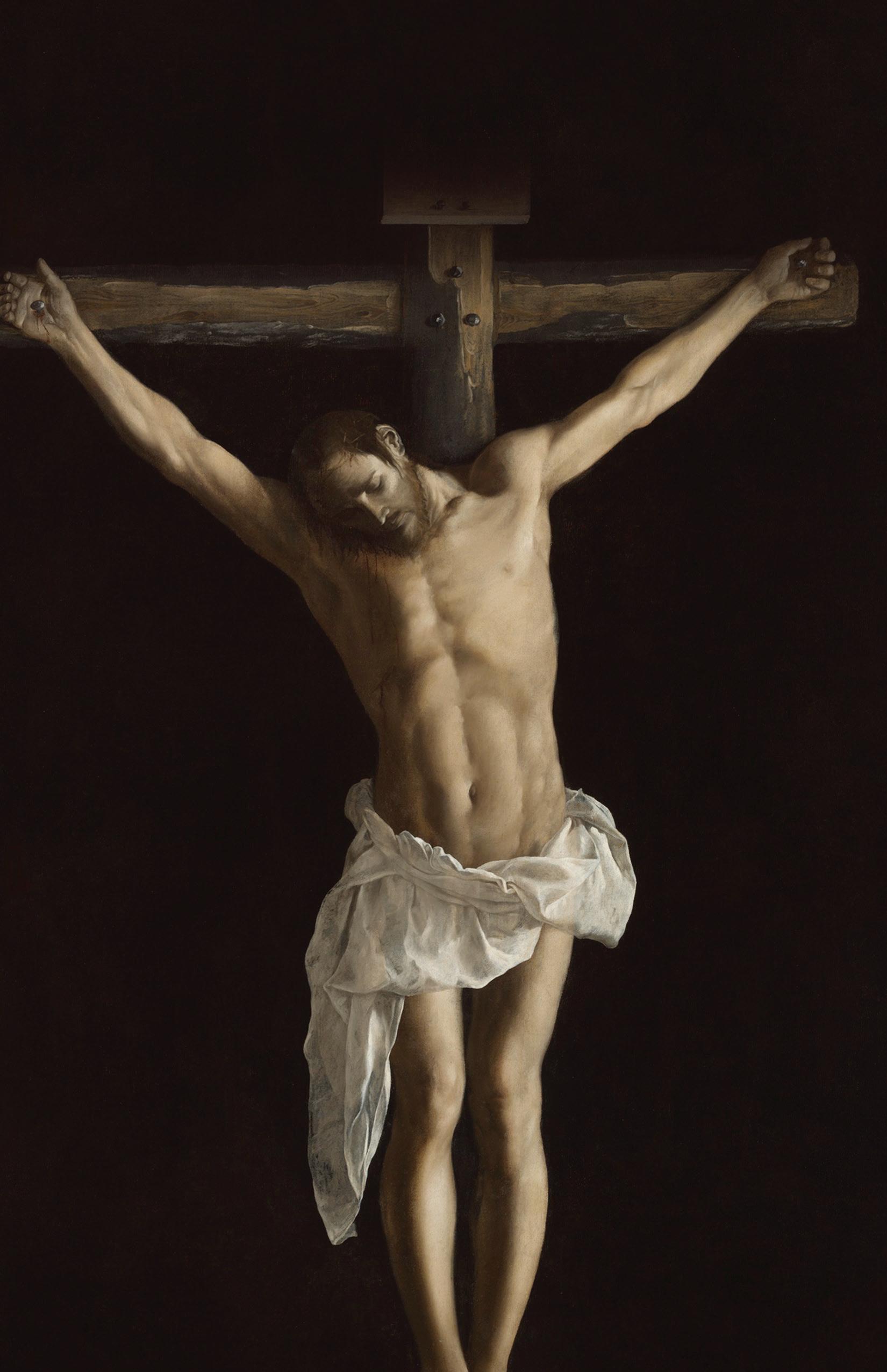

THE MEANING OF THE CRUCIFIXION

Hamilton breathes life and curiosity into a question that is both common and central to the faith of Christians. Through the heart language of hymns and voices of history and tradition, he unwraps the living truth of the cross that stands as our saving grace.
–Laura Merrill, Bishop, Arkansas, Oklahoma, and Oklahoma Indian Missionary Conferences of The United Methodist Church
In the rich tradition of preacher-theologian, Hamilton does not shy away from the complexity of atonement theology. He brings the atonement back into the middle of human life so that the earthly Jesus connects with people in their present reality. He reminds us that the cross is not a symbol of condemnation, but of grace. In a time when many wrestle with images of a wrathful God or punitive justice, Hamilton re-centers the conversation on the self-giving love of Christ, “while we were yet sinners Christ died for us” (Romans 5:8). I commend Why Did Jesus Have to Die? to all who seek to understand the mystery of the cross and the hope it offers to a broken world.
–Robin Dease, Bishop, North and South Georgia Conferences of The United Methodist Church
If you have ever felt that the meaning and power of Jesus’ death on the cross was something you almost understood, Adam Hamilton is here to help. This is one of Adam’s best books. He offers a logical understanding of Jesus’ death on the cross that is clear, biblical, and insightful. This book helps us understand God’s love in a fresh way.
–Tom Berlin, Bishop, Florida Conference of The United Methodist Church
Who knew that atonement theory discussions could be both stimulating and personally challenging? Many today are asking, Why did Jesus have to die? Do typical understandings of Jesus’ death shortchange God into someone who demands recompense? In a rare feat Pastor Adam Hamilton jettisons corrupted approaches to the death of Jesus, explains the theories, shows the importance of a multiphasic approach to the death of Jesus, and then explains how each can help us to follow Jesus today. Even more, Hamilton avoids forcing readers to choose their favorite atonement theory. And even more, Hamilton accomplishes the redemption of the moral influence theory in a way that reshapes all atonement theories.
–Scot McKnight, author and theologian


At the heart of the Christian faith is Jesus. Born around 5 BC and crucified around AD 28,1 the New Testament Gospels tell his story. Matthew and Luke begin with stories surrounding his birth. Luke includes a story from when he was twelve. But the focus of the Gospels is on what he said and did during the three years of his public ministry, from his baptism to his crucifixion and resurrection.
Matthew’s Gospel summarized his ministry by saying that he “traveled among all the cities and villages, teaching in their synagogues, announcing the good news of the kingdom and healing every disease and every sickness” (Matthew 9:35). But while the Gospels tell us about Jesus’ words and deeds across the course of his life, they are each driving toward Christ’s arrest, trial, crucifixion, death, and resurrection.
Matthew devotes 30 percent of his Gospel to the final days of Jesus’ life. For Mark, it is 40 percent. In Luke 9:51 we read, “As the time approached for him to be taken up to heaven, Jesus resolutely set out for Jerusalem” (NIV). Sixty-two percent of Luke’s Gospel tells of Jesus’ journey to Jerusalem to be crucified and the events after that. And 47 percent of John’s Gospel is focused on the events of the final week of Jesus’ life.
The Gospel writers saw the Crucifixion (and the subsequent Resurrection) as the climax of God’s work in the life of Christ. You cannot understand Jesus without understanding his crucifixion.
The Crucifixion was at the center of the preaching of the apostles as well. Paul wrote to the church at Corinth, “I decided to know nothing among you except Jesus Christ, and him crucified” (1 Corinthians 2:2 NRSV). To the Galatians he wrote, “May I never boast of anything except the cross of our Lord Jesus Christ” (Galatians 6:14 NRSV). In 1 Peter we read, “He carried in his own body on the cross the sins we committed. . . . By his wounds you were healed” (1 Peter 2:24). The writer of Hebrews notes, “We have been made holy by God’s will through the offering of Jesus Christ’s body once for all” (Hebrews 10:10).
Yet despite the centrality of Christ’s crucifixion to Christian faith, the New Testament is surprisingly vague on precisely how Jesus’ death saves or why, exactly, Jesus had to die. Jesus regularly predicted his own death, and while at times he gave hints as to why he had to die, he never fully explains it. His disciples were consistently confused by Jesus’ words about his impending death. Before his conversion Saul/Paul found the idea of a crucified messiah absurd. The New Testament authors, writing after Christ’s death and resurrection, offer at least ten different metaphors to describe the meaning of his crucifixion, but these only offer glimpses as to how it accomplishes its saving work.
As a pastor, I’ve often heard people express their questions about the logic of the cross. They believe in it, but they don’t
fully understand it. This is why the atonement, the work of Jesus on the cross to reconcile and restore humanity to God, is often described as a mystery. We are moved by his death. We know it was for us. We accept, to the degree that we understand them, its benefits. But in some sense, its logic remains beyond our grasp.
Not only do Christians often fail to understand the logic of the cross, they also often fail to see the expansiveness of Christ’s saving work. Many focus on one dimension of this atoning work, usually forgiveness. Forgiveness is utterly important. But there is far more that Christ’s death is effecting than our forgiveness.
My hope in writing this book is to help readers make sense of the Crucifixion so that we might hear God speak to us through it, and that we might say, with the apostle Paul, “I have been crucified with Christ and I no longer live, but Christ lives in me. And the life that I now live in my body, I live by faith, indeed, by the faithfulness of God’s Son, who loved me and gave himself for me” (Galatians 2:20).
Adam Hamilton
Before we delve into the meaning of the Crucifixion, it seems important to consider what led up to it—the reasons, from a strictly historical standpoint, that Jesus was sentenced and put to death, as well as what actually happened in his crucifixion.
Beginning as early as Mark chapter 2, opposition to Jesus began to develop. When Jesus forgave a man’s sins, Mark records, “Some legal experts were sitting there, muttering among themselves, ‘Why does he speak this way? He’s insulting God. Only the one God can forgive sins’” (Mark 2:6-7). Shortly after this, Mark notes that the Pharisees questioned why Jesus ate with sinners and tax collectors (Mark 2:16). A few verses later, Mark records that the religious leaders were troubled that Jesus did not require his disciples to fast (Mark 2:18). Then Jesus plucked grain to eat on the Sabbath, and they accused him of violating the Sabbath laws (Mark 2:24). And just a few verses later, as Jesus healed a man on the Sabbath, Mark notes, “At
that, the Pharisees got together with the supporters of Herod to plan how to destroy Jesus” (Mark 3:6).
From the perspective of those religious leaders who called for his crucifixion, Jesus was put to death because he contradicted their interpretations of Scripture, he didn’t follow their rules, they were jealous of his popularity, and he challenged their authority. Some claimed he had demons, or was empowered by demons (John 10:20; Matthew 9:34). In addition, Jesus’ fate was sealed as he came to Jerusalem for Passover and drove out the merchants and moneychangers from the Temple courts, then called out the religious leaders for their hypocrisy. Ultimately, the religious leaders found him guilty of blasphemy for claiming to be the Messiah and took him to the Roman governor, demanding his crucifixion.
From the perspective of the Romans, who sentenced him to death, Jesus was guilty of leading an insurrection, though he was unlike any rebel they had seen before. He entered Jerusalem six days before his crucifixion to throngs waving branches in the air and shouting, “Deliver us now!” Judea was a powder keg with zealots and their supporters who hoped to overthrow Roman rule. Anyone claiming to be the long-awaited Messiah would be seen as a challenge to the emperor’s authority; the authority of his puppet king, Herod Antipas in the Galilee; and his governor in Judea, Pontius Pilate.
When persons were crucified, their crimes were listed on a sign above their heads. All four Gospels note that the sign above Jesus’ head read, “The king of the Jews,” though John expands the sign to read, “Jesus the Nazarene, the king of the Jews” (John 19:19). John also tells us that the Jewish leaders
objected to this sign. They wanted it to read, “This man said, ‘I am the king of the Jews’” (John 19:21) but Pilate refused to change the charge.
Neither the religious leaders nor the Roman governing apparatus believed they were putting Jesus to death for any saving purpose. Both were ridding themselves of a problem. But Jesus and all who followed him saw God using this miscarriage of justice for the purposes we will explore throughout the pages of this book. In God’s way of bringing good from the evil humans sometimes commit, I’m reminded of the words of the patriarch Joseph to his brothers after they had sold him into slavery, “You planned something bad for me, but God produced something good from it, in order to save the lives of many people” (Genesis 50:20).
Before leaving our introduction to Christ’s death, a brief summary of what happened at Christ’s crucifixion may also be helpful. I’ll draw upon the chronology found in Matthew, Mark, and Luke’s Gospels; John’s chronology differs in some details.
It was a Thursday evening, the start of the Jewish Passover, when Jesus sat with his disciples for the traditional meal celebrating the night when God rescued Israel from slavery in Egypt. The Passover is typically joyful, but on this occasion Jesus’ mood was somber. At the meal Jesus predicted that one of his disciples would betray him. He then took a piece of the unleavened bread and said, “This is my body.” He then took one of the four cups1 of wine used in the Passover and said, “This is my blood of the covenant, which is poured out for many” (Mark 14:22-24).
During the meal, Judas Iscariot left to meet with the Temple guard, having already agreed to betray Jesus into their hands for thirty pieces of silver. Following the meal, Jesus led his disciples to a place on the Mount of Olives called Gethsemane (the word means “oil press”). There, “He began to feel despair and was anxious” (Mark 14:33). He asked his disciples to wait and pray while he went a bit farther ahead to pray. Then he “threw himself on the ground and prayed that, if it were possible, the hour might pass from him. He said, ‘Abba, Father, for you all things are possible; remove this cup from me; yet, not what I want, but what you want’” (Mark 14:35-36 NRSV).
A few moments later Judas Iscariot led a mob sent from the religious leaders to arrest him. In the darkness, Judas identified Jesus with a kiss, whereupon Jesus was seized. His disciples fled as Jesus was bound and led away to the home of the high priest, where members of the Jewish ruling council had gathered. Trying an accused by night was highly irregular, but this was done to avoid the crowds of Jesus’ followers.
Witnesses were brought to testify to anything Jesus might have said or done that was considered criminal. When none could agree, the high priest finally asked Jesus, “Are you the Christ?” to which Jesus replied, “I am.” And with that, the high priest and religious leaders agreed, “He deserves to die.”
At sunrise he was taken to the Roman governor, Pontius Pilate. Pilate heard the accusations against Jesus, and asked him, “Are you the king of the Jews?” Jesus gave a cryptic response, saying “That’s what you say” (Matthew 27:11). Ultimately, Pilate asked the crowd, “What should I do with the one you call king of the Jews?” They shouted back, “Crucify him!” I
suspect many of these were merchants who had been deprived of income when Jesus cast them out of the Temple. Others were lay supporters of the Jewish religious leadership. “Wishing to satisfy the crowd,” Pilate sent Jesus off to be beaten, then crucified.2
He was led to a place called Golgotha (Calvaria in Latin)— it means “the place of the skull.” There, about 9 a.m., they stripped him naked, stretched him out upon the cross and affixed him to it with spikes. The cross was hoisted in the air. Two violent outlaws3 were crucified with him, one on his right, the other on his left. For the next six hours, Jesus would hang, slowly dying.
Crucifixion is one of the most painful forms of death ever invented. It was intended to prolong the victim’s suffering, thus serving as a deterrent for others who might be tempted to commit crimes punished in this way, violent crimes and rebellion among others. Multiple theories have been suggested for the physiological cause of death by crucifixion, and these vary from dehydration and blood loss to asphyxiation, respiratory failure, and many more. We don’t know conclusively the precise cause of death by crucifixion, only that it was commonly used by the Romans of Jesus’ day as a means of torturing people to death.4
By 3 p.m., Jesus breathed his last. Shortly after, when Pilate found out that Jesus had died, he allowed two men, Joseph of Arimathea and Nicodemus, to remove Jesus from the cross in order to bury him before the Sabbath began at sunset. They hastily prepared his body for burial, likely with women assisting, and they placed him into the tomb Joseph had constructed for
his own burial. They rolled a large stone in front of the tomb. And that, the Romans, Jewish leadership, and Jesus’ own followers believed, was the end of his story. But that was most definitely not the end of Jesus’ story.
Thirty-six hours after his burial,5 the stone in front of the tomb was forced aside, Jesus was resurrected, and he stepped out and soon appeared to Mary Magdalene and then to the other disciples. He would appear to them on multiple occasions over the next forty days. It was only in the aftermath of his resurrection that his followers began to understand that Jesus’ death had saving significance—that it was intended by God to speak, to heal, to offer forgiveness, to bring reconciliation, to initiate a new covenant, to be a sign of divine love, and so much more.
In the following pages, we’ll seek to understand what the disciples, and generations of Christians after them, came to understand about why Jesus died and the saving significance of his death. As we do, we’ll explore ideas that came to be known as “theories of the atonement.” I’ve used the metaphor of a puzzle to think about the meaning of the death of Jesus, with each atonement theory being like a piece of the puzzle. All of the puzzle pieces, together, help us see the meaning of the Crucifixion.
As I’ll argue throughout the book, I believe Jesus’ death on the cross should first be understood as God’s Word to humanity. Jesus incarnates God’s Word, revealing God’s heart and character, God’s action on our behalf to reconcile and heal us, God’s word about the human condition, and God’s word concerning God’s will for our lives. Our task is to hear this
word, to receive it, and to allow it to have its intended effect on our lives, and through us, on the world.
Some might suggest that this approach is a merely subjective approach to atonement and crucifixion. I disagree. That claim fails to understand the power of God’s word and how God works in our world. Throughout Scripture God acts by speaking. Creation occurs by God’s word: “God said, ‘Let there be light.’ And so light appeared. God saw how good the light was” (Genesis 1:3-4). God speaks and a stuttering sheepherder named Moses becomes the great deliverer. God speaks and the childless Abraham and Sarah conceive a child. God speaks through prophets and kingdoms rise and fall. Paul, as well as the writer of Hebrews, describes God’s word as a sword. But most importantly for our purposes, in his epic prologue, John describes Jesus himself as God’s Word.
In the light of this, we can see (or hear) that the various New Testament metaphors used to describe Christ’s death, and the resulting theories of the atonement, are not mechanisms for our salvation, but God’s Word speaking powerfully through the suffering, death, and resurrection of Jesus.
With this in mind, let’s begin.
In the beginning was the Word and the Word was with God and the Word was God . . .
The Word became flesh and made his home among us.
(John 1:1, 14)
In the same way that everyone dies in Adam, so also everyone will be given life in Christ. . . .
The first human, Adam, became a living person, and the last Adam became a spirit that gives life.
(1 Corinthians 15:22, 45)
I have often been asked, not only by skeptics but also by devout Christians, “Why did Jesus have to die?” Sometimes these are people new to the faith. But more often, they are devout Christians who have spent a great deal of time thinking about this question. Some ask, “Did God need for Jesus to suffer and die in order to forgive our sins?” Or they may ask, “How exactly does the death of Jesus so long ago absolve me of my sins today?” Sometimes they simply say, “I’m embarrassed to admit it, but the atonement just makes no sense to me.” As one man told me, “I believe Jesus died for me. I feel bad that he did. I love him for it. I just don’t fully understand it.” Or as one woman told me, “The atonement is one of those ideas that you can’t think about too long or it just gets confusing!”
If you have ever felt that way, you are in good company. Lutheran theologian Robert Jenson once wrote, “The history of theology has been rich in theories of atonement, and explanations of this reconciliation [of God and humanity that Jesus made possible], none of which has been fully persuasive or has in fact persuaded the church as a whole.”1 Evangelical theologians James K. Beilby and Paul R. Eddy note, “Particularly among evangelical theologians today, the question of how best to conceive of the atonement remains an important and contested issue.”2
In his book Mere Christianity, C. S. Lewis said it this way, The central Christian belief is that Christ’s death has somehow put us right with God and given us a
fresh start. Theories as to how it did this are another matter. A good many different theories have been held as to how it works; what all Christians are agreed on is that it does work.3
The Gospels note that Jesus repeatedly told his disciples that he would be put to death. He described the significance of his impending death in several ways, but he never explained precisely how his death would bring forgiveness, ransom the world from sin, glorify his Father, or draw all people to him. In fact, when he told his disciples that he had to suffer and die at the hands of the religious leaders, they at first did not believe him, and when he persisted, they did not understand it.
In Mark 8, Jesus, just after he affirmed that he was, in fact, the king the Jewish people had been waiting for, said to his disciples, “’The Human One [Son of Man] must suffer many things and be rejected by the elders, chief priests, and the legal experts, and be killed, and then, after three days, rise from the dead.’ He said this plainly” (Mark 8:31-32). But consider Peter’s response to Jesus’ prediction: “Peter took hold of Jesus and, scolding him, began to correct him.” This did not go very well for Peter, as Jesus famously responded, “Get behind me, Satan. You are not thinking God’s thoughts but human thoughts” (Mark 8:32b-33).
In Mark 9:30-31, Jesus again predicted his death to his disciples. And Mark records, “They didn’t understand this kind of talk, and they were afraid to ask him” (Mark 9:32). Again and again, Jesus foretold his death. And again and again, the disciples failed to understand why Jesus had to die to accomplish God’s mission.
The night of his arrest, while he was praying in Gethsemane, Jesus pleaded with God, saying, “Abba, Father, for you all things are possible. Take this cup of suffering away from me. However— not what I want but what you want” (Mark 14:36). At least for a moment, Jesus, too, seemed to wonder if there wasn’t another way forward aside from his impending crucifixion.
On that first Easter, the resurrected Jesus appeared as a stranger to two downcast disciples on the road to Emmaus. They did not believe the report that Jesus had been raised from the dead. Walking in their grief, deeply saddened by Jesus’ death, the “stranger” asked Cleopas and his friend, “‘Wasn’t it necessary for the Christ to suffer these things and then enter into his glory?’ Then he interpreted for them the things written about himself in all the scriptures, starting with Moses and going through all the Prophets” (Luke 24:26-27). After this, as they broke bread together, their eyes were opened and they saw the stranger was Jesus. In reading this story, how I wish Luke had recorded what Jesus said to these disciples about why it was necessary for him to die.
By the way, the idea that the Messiah had to be crucified made no sense to an ambitious young Pharisee named Saul of Tarsus. When he heard Jesus’ followers teaching that their candidate for king had been crucified, he thought it was blasphemous. He responded by pursuing a mission to harass and arrest these followers of Jesus, even giving approval for the stoning death of one of them. Only after an encounter with the risen Christ did he come to believe. After his conversion, he appears to have spent years working out his theology of the Crucifixion4—we’ll explore his thoughts in subsequent chapters.
It has been noted that the creeds of the first five hundred years of the Christian faith, including the Apostles’ Creed, the Nicene Creed, the Athanasian Creed, and the Chalcedonian Creed, tell us that Jesus was “crucified, dead and buried,”5 that “for our sake he was crucified,”6 that “for us and for our salvation” [Jesus] was born,7 and that he “suffered for our salvation,”8 yet none of them tell us how the death of Christ saves us, only that it does. They do not endorse any one “theory of the atonement” while at the same time making it clear that Christ died for us.
As an aside, atonement is an English word with an interesting history. It seems to have been created by William Tyndale (1494–1536), though influenced by John Wycliffe (1324–1384) when he translated the New Testament into English from Greek, and the Old Testament into English from Hebrew and Aramaic—it signified what was necessary to be reconciled or made at one with God, hence at-one-ment.
Today there is a variety of theories of the atonement— theories as to how Christ’s death makes us at one with God. Various Christians tend to emphasize one or the other of ten theories, sometimes more. Most recognize that no one theory is adequate to completely convey the significance of Jesus’ death. Each theory is a puzzle piece that requires other pieces in order to offer a clear picture.
With this as a backdrop, we’re ready to consider the saving significance of Jesus’ crucifixion. In each chapter we’ll consider different answers to the question of how Jesus’ death atones or saves. But I’d like to begin with a foundational theory of the atonement—a way of looking at the Crucifixion that, I believe,
helps resolve the questions raised by the other theories of the atonement and allows each to speak to us today.
I’d like to propose that we start building our understanding of Christ’s atoning work with the majestic Prologue of the Gospel of John, John 1:1-18. John’s Gospel begins,
In the beginning was the Word and the Word was with God and the Word was God.
The Word was with God in the beginning. Everything came into being through the Word, and without the Word nothing came into being. What came into being through the Word was life, and the life was the light for all people.
The light shines in the darkness, and the darkness doesn’t extinguish the light. . . .
The Word became flesh and made his home among us.
We have seen his glory, glory like that of a father’s only son, full of grace and truth.
(John 1:1-5, 14)
John speaks of Jesus as “the Word” that became flesh. The Greek word for “Word” here is Logos, which means not simply word, but message, speech, logic, reason, and more. I read John’s Prologue to say that God’s desire to speak to us, to reveal himself and his will for humanity, led to the Incarnation. God’s message, speech, word, logic, reason, and will took on flesh and “made his home among us” in and through Jesus.
Everything that Jesus says and does is God’s Word to humanity, and that Word reaches its climax in Jesus’ death on the cross, with the Resurrection serving as the dénouement— the final resolution or afterword. This Word on the cross is written in the suffering and death of God’s Son.
If we begin by seeing the Crucifixion and the atonement through the lens of John’s prologue, then we can recognize that Jesus’ death is not primarily a transaction, mechanism, or formula—it is not a divine quid pro quo where one thing automatically results in another (Jesus’ death procures our forgiveness, for instance). Instead, the Crucifixion is first and foremost a Word or message from God. This Word has the power to save, to deliver, to rescue, to redeem, to forgive, to heal, to inspire, and to love. It is intended to move us, to change us, to open our eyes and our hearts, to transform us, and to heal us and the world. We might call this the Logos theory of the atonement or simply refer to the Crucifixion as God’s Word.
When we understand this, our question changes from “How does the Crucifixion work?” to “What is God seeking to say to us through the Crucifixion?” Paul notes, “The message of the cross is foolishness to those who are being destroyed. But it is the power of God for those of us who are being saved” (1 Corinthians 1:18, emphasis added). It is the message of the cross—God’s Word to us through the cross—that has the power to save. Each of the various metaphors used in the New Testament, and each of the different popular atonement theories in the church, are ways the disciples, and believers ever since, have heard God speaking through the cross. Each captures a different dimension of this Word. The focus is not understanding a mechanism, but rather
hearing and accepting God’s Word of redemption, forgiveness, and love.
In Scripture the “word of God” was never merely a book, a written document, or a story. In Genesis 1, God spoke and the cosmos was created. In Exodus, God spoke and the Israelites were liberated from captivity. The word of God gave direction to God’s people, and it was the basis of God’s covenant with them. It gave them hope and offered them power. It convicted them and moved them to repentance. We read repeatedly how the “word of God,” or the “word of the Lord,” came to the prophets, seizing them with a message that was like a fire pent up in their bones (Jeremiah 20:9).
In the Gospels, Jesus both preaches the word of God, and as we’ve seen, is the Word of God. In Acts, the word of God is the good news of Jesus that transforms the lives of those who believe it. For Paul the word gives life, is meant to live in us, is the message of Christ he preaches, and is so powerful he likens it to a sword that comes from the Spirit (Ephesians 6:17). This idea is also picked up by the writer of Hebrews: “God’s word is living, active, and sharper than any two-edged sword. It penetrates to the point that it separates the soul from the spirit and the joints from the marrow” (Hebrews 4:12).
Jesus embodies God’s Word. His life is the visible Word of God. You’ve undoubtedly heard that “a picture is worth a thousand words” and that “actions speak louder than words.” I think of some of the most influential photographs in history and how a picture can change hearts and even the course of history.
I think of the well-known photo of Peter, a slave who escaped his master’s estate in March of 1863. He fled to a
Union camp in Baton Rouge. The record of his story is written on the back of the original photograph taken at the Union encampment:
“Ten days from to-day I left the plantation, run away from massa.” “What made you run away, Peter; was your master ugly—did he whip you?” With a

peculiar shrug of his shoulders, and raising his eyes toward the ceiling he shouted, “Lor God Almighty Massa! look here”—and suiting the action to the word, he pulled down the pile of dirty rags that half concealed his back, and which was once a shirt, and exhibited his mutilated sable form to the crowd of officers and others present in the office.9
The wounds on this man’s body spoke louder than any written account could capture. The camp doctor, seeing his back, asked for a photographer to capture Peter’s suffering. It became a portrait of the evils of slavery.
President Lincoln issued the Emancipation Proclamation on January 1 of 1863. But some in the North felt emancipating slaves was not their concern. Why not simply let the South keep their slaves? This photograph, published and widely disseminated by abolitionists that year, moved people. It led many in the North to a deep resolve that the war must continue until all 3.5 million slaves in the South were free. This image changed the course of a nation and played a key part in liberating millions of people.
That is a powerful example of the impact of a portrait of unjust suffering. In the case of Jesus, we see, or better hear, by Christ’s suffering, death, and resurrection, God’s redemptive, reconciling, healing, transforming Word; we hear God’s judgment on sin, God’s mercy for sinners, God’s love for humanity, and God’s will for our lives.
When we understand the Crucifixion through the lens of John’s Prologue, again, our first question isn’t “How does the Crucifixion work?” but “What is God trying to say to us through it?” Understood this way, we can appreciate why there are a
Lift High the Cross
ten or more different metaphors used in the New Testament to describe the meaning of the cross.
I recently spoke to a friend, Julián Zugazagoitia, the director of the Nelson-Atkins Museum of Art, one of Kansas City’s treasures with more than forty thousand works in its collection. He spoke of how each work of art speaks differently to different people, and that he himself will return to his favorite pieces and see, or hear, something different each time. That’s precisely my experience of the cross.
The early church did not simply hear one word as they contemplated the meaning of the cross. It spoke to them in a multitude of ways. For some, its primary message was human sin and God’s forgiveness. For some, its primary message was evil and God’s defeat of it. For some, it was primarily a portrait of the love of God and our need for it. Some saw in it the sacrifices of the Old Testament. Others saw Christ identifying with our pain. Still others saw in the drama of the cross a reversal of the story of Adam and Eve, and a new defining story for humankind. Some saw the wonder and glory of a God who suffers in order to save his people. These are just a few of the suggestions we find in the New Testament for the Word of God in the crucifixion of Jesus.
In order to fully understand the cross, you need to see all of these. Some describe this as taking a kaleidoscopic view of the Crucifixion—each turn of the kaleidoscope brings a different, beautiful picture. Others speak of the Crucifixion as a puzzle, as I have suggested, with different pieces, all of which make up the whole. Still others use the metaphor of a tile mosaic, or a stained glass window—each piece is only a part of the whole,
and only when taken together do we begin to fully comprehend the power of the cross of Christ.
This view of the Crucifixion as God’s Word is key to understanding all of the other theories of the atonement we’ll explore in subsequent chapters. In the final paragraphs of this chapter, I’d like to briefly mention one of those theories, what is sometimes called the recapitulation theory of the atonement.
Both the apostle Paul and the Gospel writer John saw in Christ’s crucifixion a return to the garden of Eden. They saw Jesus’ death as a reversal of humanity’s original story. In the Bible’s opening story, God created the first human and placed him in paradise. Here’s how Genesis describes the scene,
The Lord God planted a garden in Eden in the east and put there the human he had formed. In the fertile land, the Lord God grew every beautiful tree with edible fruit, and also he grew the tree of life in the middle of the garden and the tree of the knowledge of good and evil. . . . The Lord God took the human and settled him in the garden of Eden to farm it and to take care of it. The Lord God commanded the human, “Eat your fill from all of the garden’s trees; but don’t eat from the tree of the knowledge of good and evil, because on the day you eat from it, you will die!”
(Genesis 2:8-9, 15-17)
By verse 18 in Genesis 2, God sees that “It’s not good that the human is alone. I will make him a helper that is perfect for him.” God then creates the new (and improved!) model of
the man, the woman, to be his companion. Soon they discover a talking, walking snake who comes to tempt them to do the one thing God told them not to do: to eat the fruit that God forbade them to eat. And you know the rest of the story. They soon plucked the fruit and ate it. In their disobedience, their innocence was lost, they were filled with guilt and shame, and they hid from God.
God did not kill them for their disobedience. But he did expel them from paradise, or better, they expelled themselves by their actions. God, in his mercy, provided clothing for them to wear. And he told them that life would, henceforth, be harder for them. Sin and suffering, pain and death had entered the world.
Some read these stories as literal history. Some read them as archetypal stories. Either way, the point of the story was not to tell us about people who lived long, long ago in a place far, far away. The point of the story is to tell us about ourselves. We have all heard the whisper of temptation. We have all turned from God’s will and way. We have known shame and guilt and alienation from God. We have ruined paradise. Adam and Eve are archetypal humans. Their story is humanity’s story—our defining story.
But the apostle Paul recognized that in Jesus, there is a new defining story. He spoke of Jesus in connection to Adam. Listen to Paul’s words to the Romans,
Death ruled from Adam until Moses, even over those who didn’t sin in the same way Adam did—Adam was a type of the one who was coming. But the free gift of Christ isn’t like Adam’s failure. If many people died through what one person did wrong,
God’s grace is multiplied even more for many people with the gift—of the one person Jesus Christ—that comes through grace.
(Romans 5:14-15)
In Jesus, Adam’s story is reversed. Jesus becomes a second Adam, a second archetype or pattern that we may follow. This idea that Jesus came to reverse course for the human race, to give us a new defining story, a new Adam to follow, is called the recapitulation theory of the atonement. In Latin the word for “head” is caput. To decapitate is to remove the head. Recapitulation, and its short form, recap, is usually defined as summarizing or restating something, but it is literally to re-head something. Recapitulation, as an atonement theory, means to restate our story as humans, only now with a new head of the human race, no longer Adam, but Jesus. Again, he offers us a new defining story.
John’s Gospel picks up this theme. He intentionally started his Gospel with the same opening words that we find in Genesis, “In the beginning . . .” The Synoptic Gospels, Matthew, Mark and Luke, pick up this idea as they describe how, before he begins his ministry, Jesus is tempted, just as Adam and Eve were. He’s even tempted by food as they were. Jesus resisted the temptation. Adam and Eve succumbed to it. In Luke 22:42 (see also similar statements in Mark 14:36 and Matthew 26:39), Jesus prays in Gethsemane on the night he would be arrested, “Not my will, but thy will be done.” This is the opposite of how Adam and Eve lived in Eden. If their actions were a prayer, it would have been, “Not thy will, but my will be done.”
In Genesis, Adam and Eve ate the forbidden fruit in a garden. John intentionally records that “There was a garden in the place where Jesus was crucified” (John 19:41) Jesus is reversing the story of Adam and Eve. He suffers and dies and is buried in the garden. He is resurrected in the garden, and Mary Magdalene, when she first sees him, thinks he’s the gardener. Adam’s sin led to death. Jesus’ suffering ends with his resurrection, conquering death. Adam’s story is reversed by Jesus. Humanity has a new beginning, and we have a new archetype, a new defining story.
In 1 Corinthians 15 we hear Paul describe Jesus as a second Adam: “In the same way that everyone dies in Adam, so also everyone will be given life in Christ. . . . The first human, Adam, became a living person, and the last Adam became a spirit that gives life” (1 Corinthians 15:22, 45). Jesus has suffered death on behalf of Adam’s descendants, bearing the curse from their disobedience, and setting humanity on a new trajectory.
Each of the four Gospels, and the Acts of the Apostles, mention Jesus sending his disciples out to continue the work he began. We are, in the words of the prayer he taught his disciples, not only to pray, but to work to see God’s kingdom come and God’s will be done on earth as it is in heaven. The restoration of Eden began with Jesus, and as his followers, we continue that work.
This is but one of many theories of the atonement. And I’ve shared only my interpretation of this theory. As we’ve noted, the seeds of it are clearly found in the New Testament. It was this understanding of the significance of Jesus’ death that seized the heart of one of the second century’s greatest theologians, Irenaeus of Lyons, who is often credited with championing the
recapitulation theory. It does not represent a mechanism so much as a story, a divine drama in which Jesus is coming to set humanity on a new course, and his death is pivotal in that. Jesus suffers and dies to change our story, and to change the course of human history.
The Bible begins in a garden where Adam and Eve pluck the forbidden fruit from the tree of the knowledge of good and evil and paradise is lost. The Bible ends in Revelation 22 in a garden representing paradise restored. In it is the tree of life, with its leaves for the “healing of the nations” (v. 2). In between these two is Jesus, who resisted temptation, who came as a second Adam, to suffer and die on behalf of humanity, and to call us to a new defining story. He commissions his disciples, and us, to

Stained-glass window from the Church of the Resurrection
Lift High the Cross
continue to live his gospel, and to not merely pray, but also to work to see God’s kingdom come and God’s will to be done, on earth as it is in heaven.
At the Church of the Resurrection, where I serve as senior pastor, we have a large stained glass window—one hundred feet wide by thirty-five feet tall. It captures this idea of recapitulation (and other theories of the atonement). The window is bordered by two trees. On the left is Eden and the tree of the knowledge of good and evil with Adam and Eve plucking the forbidden fruit, essentially living the prayer “Not thy will, but my will be done” On the right is the tree of life from Revelation 22, representing the restored paradise. Between the two is Jesus crucified and resurrected. It is a divine drama in which Christ

suffers and dies for us, then conquers death. He resets our story. And in the window the resurrected Christ stands with his hands pointing each direction, to the tree of the knowledge of good and evil and the tree of life, as if to say, “Which path will you choose?”
I’d ask you that question. In this powerful redeeming and atoning story, which path will you take? Will you follow the first Adam or the second? Will you pray with Adam, “Not thy will, but my will be done”? Or will you pray with Jesus, “Not my will, but thy will be done”?
That leads me to the title of this chapter. I’ve chosen Christian hymns about the Crucifixion as the titles for each chapter in this book. “Lift High the Cross” was written in 1887 and revised several times since. It draws upon the imagery of signs or standards carried into battle behind which the warriors from a nation or tribe marched into war.
But Christ has sought to transform and heal this world—to save us from our “warring madness” by offering us a different way. The sign Christians follow is not a national flag, but a cross. We serve a crucified king. And the weapon in our effort to heal the world is his love. Which is why the hymn’s refrain cries out, “Lift high the cross, the love of Christ proclaim, till all the world adore his sacred name.”
In the crucifixion of Jesus, God has spoken to us deep, profound truths about who he is and who he calls us to be. Through Christ and his crucifixion, the restoration of Eden has begun. We become a part of that restoration, that recapitulation, as we “lift high the cross.”

When the time came, Jesus took his place at the table, and the apostles joined him. He said to them, “I have earnestly desired to eat this Passover with you before I suffer. I tell you, I won’t eat it until it is fulfilled in God’s kingdom.” After taking a cup and giving thanks, he said, “Take this and share it among yourselves. I tell you that from now on I won’t drink from the fruit of the vine until God’s kingdom has come.” After taking the bread and giving thanks, he broke it and gave it to them, saying, “This is my body, which is given for you. Do this in remembrance of me.” In the same way, he took the cup after the meal and said, “This cup is the new covenant by my blood, which is poured out for you.
“But look! My betrayer is with me; his hand is on this table.”
Luke 22:14-21
View a complimentary session of Will Willimon’s The Last Supper

Scan the QR code below or visit https://bit.ly/thelastsupper _session1.

Introduction: Palm Sunday, The Journey to the Table . . . . . . ix
Palm Sunday as enacted parable.
Matthew 21:1-11; Luke 19:28-44
Chapter 1 . Sowing, Seeking, Finding
The Forgiving Master. Luke 7:43
The Sower. Luke 8:5-15
The Grain of Wheat. John 13:14
The Good Samaritan. Luke 10:25-37
Chapter 2 . Open Invitation .
The Great Banquet. Luke 14:16-24
Chapter 3 . Feasting with the Found
The Searching Shepherd. Luke 15:3-7
The Seeking Woman. Luke 15:8-10
The Celebrating Father. Luke 15:11-32
Chapter 4 . Crumbs from the Table
Lazarus and the Rich Man. Luke 16:19-21
Lunch at the House of Zacchaeus. Luke 19:1-10
Chapter 5 . Refusing the Host
The Minas. Luke 19:11-27
The Wicked Tenants. Luke 20:9-19
Chapter 6 . The Host Who Becomes the Meal
The Last Supper. Luke 22:9-21
The Supper at Emmaus. Luke 24:3-25
Notes
1
19
Sure, Jesus’s teaching, healing, and preaching drew crowds in the Galilean outback. But how will Jesus fare in Jerusalem, the capital city?
On Palm Sunday he barges right into town uninvited, unwanted even, parading in public, up front in his intentions to claim the city as his own (Matthew 21:1-11; Luke 19:28-44). We shouldn’t be surprised by his politics. Never did Jesus begin a parable, “A personal relationship with me is like . . .” It was always, “The kingdom of heaven is similar to . . . ” “God’s kingdom,” politics Jesus-style, is the theme of most of his parables.
Conquering your precious heart or solving your personal problems are too small a goal for Jesus’s royal aspirations. As John puts it, “God so loved the world that he gave his only Son . . .” (John 3:16). The world, the whole world, more than your heart or even your zip code. On Palm Sunday Jesus mixes religion with
politics, takes it to the streets, in a public dispute with Caesar over who’s in charge.
At last. “Hosanna! Hail, king! ” (Luke 19:28-40).
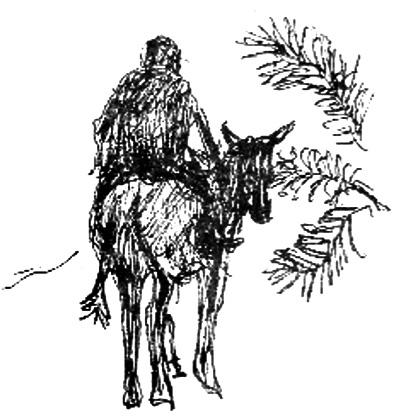
But who thinks “king” when you see this itinerant country rabbi astride a borrowed donkey, his motley crew tagging along behind him on Palm Sunday?
Looking back on this scene, Matthew remembered an ironic promise by the prophet Zechariah:
Rejoice greatly, Daughter Zion.
Sing aloud, Daughter Jerusalem. Look, your king will come to you.
He is righteous and victorious.
He is humble and riding on an ass, on a colt, the offspring of a donkey.
(Zechariah 9:9; Matthew 21:4-5)
A king, “victorious” as well as “humble,” a triumphal royal entry on a wobbling, skinny donkey? Parabolic paradox, oxymoron, joke, and riddle, not spoken but enacted on Palm Sunday.
Along the road and at the table Jesus told so many riddles; he now dramatically becomes the greatest conundrum of all. Look! There’s your king, righteous, victorious . . . riding on an ass, a rented one at that.
We want Jesus to get off that ridiculously modest donkey and swagger right up to the palace, plop down on the imperial throne, seize a royal scepter, and begin to issue executive decrees for the liberation of Judea.
Instead, Jesus goes to the temple, heals some sick people, then turns over the tables, causing chaos, provoking indignant uproar among the temple-going righteous, accusing us of having made the holy place “a hideout for crooks.” Just about the meanest thing anybody has ever said about us clergy (Luke 19:46).
“My kingdom is not from here,” Jesus told Pilate at the trial. Here, where all monarchs prop up their power with an army, here, where political strong-arming is the only way to get any good done, where people are admired, not for their love and mercy, but for their ability to coerce, enforce, build walls, make threats, and anybody who sheds an empathetic tear is dismissed as a wimp. Here.
Then there, at week’s end, at the table, in his last meal before execution, all Jesus did was to host a modest meal during which he offered a cup of wine, “This cup is the new covenant by my blood, which is poured out for you” (Luke 22:20).
This, God’s promised salvation?
King on a donkey. An adoring crowd turns into a murderous mob, a preacher who lives and dies what he says, God nailed to a cross, a mighty Savior who shares his last meal with sinful betrayers who are also his best friends?
We wanted him to unfurl a battle flag, storm Jerusalem, and set up a new messianic King of David government. Instead, he gave us a simple supper of bread and wine with a bunch of disappointing, simpleton disciples.
But I get ahead of myself.
As we stumble after him on the road to that last fateful meal, Jesus tells stories, riddles. During the forty-day trek from Ash Wednesday to Maundy Thursday, story after story, Jesus reveals
where he is taking us, unveiling, preparing us for the table in the upper room when he will solve the riddles and show and tell all.
“Who are you?” we wondered. “Where are we headed?” Jesus answered, but indirectly, with pithy little stories that teased, cajoled, upset, made us smile, befuddled, disoriented, or sometimes smacked us up beside the head. “A farmer scattered seed . . . ” “Hear the one about the shepherd who lost a sheep?” “Two people went to the temple to pray . . .”
The gospel is truth we can’t tell ourselves. Nobody is born knowing the good news, nor has anybody ever drifted toward the conviction that a man—tortured to death by a consortium of religious and governmental leaders, hosting his disappointing disciples for a final Maundy Thursday meal, hanging from a cross in agony on Good Friday, forgiving those who nailed him there— is the whole truth about God.
Want to get close to Jesus? You’ll have to sit for story time with him.
Matthew and Mark say Jesus said nothing except in parables (Matthew 13:34; Mark 4:34). Over half of everything Luke quotes from Jesus is in parables or, as we’ll name some of them, riddles.
Humanity’s oldest riddle is from Sumer, six thousand years ago: “What building do you enter blind and exit sighted?”
Answer: “A school.”
These days we prefer truth handed to us on a platter, three obvious points, six knock-down principles for a stress-free life, four takeaways, three irrefutable reasons to get out of bed in the morning, five doctrines you must believe if you are to be a Christian. Biblical fundamentals.
Sorry, that’s not Jesus’s way. If his good news could be encapsulated in easy-to-remember general principles, he would have. Instead, he told stories as a sly stratagem to make his story yours.
“Jesus came into Galilee announcing God’s good news, saying, ‘Now is the time! Here comes God’s kingdom! Change your hearts and lives, and trust this good news!’ ” (Mark 1:14-15).
“Tell us, what’s it like when God’s kingdom comes, God’s will is done on earth as it is in heaven?”
Jesus responds, “Try this. Somebody lies wounded, dying in a ditch in need of saving . . . it can be compared to an invitation to a great feast . . . a woman lost a coin and . . .” Working from everyday experiences of a world we know, Jesus . . . reveals a world we can’t know (i.e., the kingdom of God or, as Matthew describes it, “kingdom of heaven”) without listening to his story.
A warning before you get too far down the road with these riddles: God’s realm is so different from our kingdoms that when Jesus is revealing, sometimes it feels like he’s concealing.
As Jesus told Pontius Pilate on that bleak Friday, “My kingdom isn’t from here” (John 18:36), so it’s bound to sound strange when you first hear of it. Still, you can trust Jesus: he’s telling you this story because he wants to open your eyes so that you can see the good news for yourself.
A parable is a GPS taking you to a new world that’s God’s rather than the fake world in which we bedded down.1
Want to join Jesus at his table? All you’ve got to do is “Listen!” (Matthew 15:10).
Sure, Jesus wants to connect with us, but he refuses to put his truth on the bottom shelf. Good news: Your misunderstanding
and incomprehension won’t stop him from talking. When you respond to some of his more opaque stories with, “I’m sorry, I don’t get it,” what does he say? “Try this: The realm of God could be compared to a father who had two sons, both pains in the neck, though in different ways . . .”
Better than understanding Jesus is to be at table with Jesus. Rather than boasting, “I got it!” it’s better to be able to say, at a parable’s end, “Jesus just got me.”
Maybe you come to church seeking confirmation for what you already know, and then Jesus throws a curveball of a parable and you find yourself dislocated, subverted, pushed on stage as a character in Jesus’s drama of salvation, made citizen of a kingdom not from here. On the basis of nothing but a story.
If you journey with Jesus as he heads toward his last meal you’ll have to put up with his riddles.
What kind of Son of God, Prince of Peace, Savior of the World would end up at supper, the night before his death, with a cluster of losers, promising them a place at the table in his coming kingdom?
This book is your answer.
Will Willimon
Heard the one about the dinner party messed up by Jesus? Simon the Pharisee—a pious, biblically knowledgeable religious leader—invited Jesus to dinner (Luke 7:36). In the Gospels, Pharisees like Simon are depicted as religious experts who can’t stand Jesus; yet they persist in inviting him into their homes for supper! Maybe they hope to trick this rural rabbi into saying something stupid that can be used against him with the Romans. Yet in every case, Jesus turns the tables on his pharisaical critics with parables.
Let’s make that evening at Simon’s a fancy dinner party, sophisticated, expensive, and snobby. A blessing is offered. (Our custom of saying grace before meals comes from the Jews for
whom, once the food is blessed, every meal is sacred.) Scarcely has the Mogen David been poured and the brisket unveiled than a “woman of the city” barges in mid-soiree. She falls all over Jesus, anointing and massaging his feet with sweet ointment, letting her hair down and causing an uproar by bathing Jesus’s “feet with her tears.” (Yes, “letting down her hair” meant the same thing then as now.) Assorted “well, I never” and “outrageous” among the horrified guests.
“When the Pharisee who had invited Jesus saw what was happening, he said to himself [smirking, loud enough for everybody at the table to hear], if this man were a prophet, he would know what kind of woman is touching him. He would know that she is a sinner” (Luke 7:39).
Some prophet, this Jesus, allowing this sinful woman to make such a scene, and at the table too. We aren’t told the “sin” of this woman who “is touching him” (Greek: haupto, “touch,” also “caress,” “fondle”). Luke just says that she’s a “woman of the city,” leaving the rest to your prurient imagination.
Showing not the slightest interest in the shamelessly intruding woman’s alleged sinfulness, Jesus smacks his religiously offended host with a riddle: “Someone owed a loan shark a hundred bucks [back in those days a dollar was worth something] and another guy owed fifty. The predatory lender forgave both debts! Now think hard Mr. Religious-know-it-all, which debtor would be the more grateful?” (Luke 7:42).
“I suppose, I guess you could say, probably, the one who was most forgiven?” (Luke 7:43) replies the embarrassed host, muttering, Whose bright idea was it to invite this pushy preacher to dinner?
Jesus turned to Simon, “Do do you see this woman?” Jesus asks. Of course not. Women were invisible at such occasions, particularly a “woman of the city.” Jesus contrasts her ardor, kissing, anointing, weeping, and affectionate haupto with the dispassionate, dignified, detached, virtue signaling, but now humiliated, Pharisee.
As Jesus puts the screws to Simon, all the guests show sympathy for the plight of their host: “Who is this person that even forgives sins?” (Luke 7:49). Another dinner party ruined by Jesus and his riddles.
Leaving the Pharisee’s stuffy table a shambles, Jesus and his merry band hit the road. Along the way, his stories continue. The word parable comes from the Greek, meaning “throw out,” “toss.” Why pitch these curve-ball riddles toward us? To reveal the “mysteries of God’s kingdom” (Luke 8:9-10).
But God’s realm isn’t that easy to see. Maybe it’s a mystery because the only kingdoms we know are the USA, UAR, UK, Tesla, Walmart, or Costco. Undeterred by our incomprehension, Jesus keeps pitching parables:
He spoke to them in a parable: “A farmer went out to scatter his seed. As he was scattering it, some fell on the path where it was crushed, and the birds in the sky came and ate it. Other seed fell on rock. As it grew, it dried up because it had no moisture. Other seed fell among thorny plants. The thorns choked the young plants. Still other seed landed on good soil. When it grew, it produced one hundred times more grain than was scattered.”
As he said this, he called out, “Everyone who has ears should pay attention.”
(Luke 8:4-8)
Though we’re all ears, we’re grateful when, “His disciples asked him what this parable meant” (Luke 8:9).
Let’s see if we’ve gotten your drift, Jesus: “The seed is God’s word” and the parable describes what becomes of God’s word once it’s broadcast. Couple of questions: Why would any sane sower cast seed on a road? For that matter, who sows seed “on the rock” or “among thorny plants”? Seed so sloppily sown is of course “choked by the concerns, riches, and pleasures of life” (Luke 8:14).
Concern for friends and family, the achievement of a comfortable, secure income, enjoyment of leisure and recreation. Are these not good things? What chokes the seed is not evil, bad, sinful things, but “concerns, riches, and pleasures of life.” Ironic, huh?
Even though I’m no great shakes as a gardener, seems to me that a great deal of good seed is being wasted here.
A farmer carefully removed all rocks and weeds from the soil, turned up the earth six inches deep, spaced neat furrows a foot apart, carefully covering each seed with a half inch of dirt? No! To hell with the asphalt, rocks, and weeds. Just sling that seed!
With such sloppy sowing, are you surprised there is farming failure? Most of this parable reports in detail the disappointing outcome.
Can you guess why the Sower is most preachers’ favorite parable?
In five decades of ministry, nobody has said, “I’m not listening to your sermon because I don’t believe there is a God.” No. The forces that defeated my listeners are not their intellectual reservations about God but rather choking on assorted “concerns, riches, and pleasures of life.”
“What’s your greatest challenge in youth ministry?” I asked a youth pastor. He leaned under his desk and pulled out a soccer ball. “It’s this. Our parents would rather their children learn soccer than Jesus.”
I averaged preaching fifty sermons a year. Yet when asked, my listeners could remember no more than two or three. If “God’s word” is “the seed” that’s broadcast, a lot of seed is being wasted. At least when I’m slinging the seed from my pulpit.
What’s the major reason given for leaving the pastoral ministry? A counselor of pastors replied, “It’s the drip, drip of a gradually draining church. The daily, weekly, relentless meager results. Unremitting failure wears ’em down.”
“She could’a been an attorney. Got a full scholarship to law school. Brilliant. Now she’s stuck at a little country church, attendance, grand total of thirty,” said her disappointed father. “Damn, what a waste.”
Or . . . is it an amazing harvest? The curious thing is that Jesus doesn’t characterize this as a farming disaster. The Sower has a surprise ending. “Still other seed landed on good soil. When it grew, it produced one hundred times more grain than was scattered.” Jesus focuses us on the seed that succeeded rather than the seed that failed to germinate. While most of the scattered seed was wasted, more grain was produced, a hundred times more, than was lost in the reckless sowing. It’s a miracle.
The Sower just loves to sow, slinging seed with abandon, casting good seed into seemingly hopeless contexts, undeterred by the prospect of farming failure, focusing upon the seed that bears fruit rather than the seed that fails.
Therein is our hope.
He had flunked out of college. Then the drugs and the DUI. Two weeks jail time. “So sad,” said everybody at church. “After all his parents did for him, look how low he has sunk.”
But nobody’s story is over until Jesus says it’s over. He will have the last word; loves to make surprise endings. I’ll never forget the Sunday when the young man showed up, looking a bit sheepish, yes, but also bright and hopeful about a new beginning. For the first time in a long time he looked great. New job. Life going well. Volunteered to help in the food pantry next week.
Back in the congregation every Sunday thereafter.
Thank the Lord his story didn’t end as we feared. What happened? He explained it to me one morning over coffee: “I was at this rock concert. Wasn’t thinking about God. Trying hard not to think about anything. And in one of the songs, I heard the word, ‘Why?’ That’s all. Kept ringing in my ears. ‘Why?’
“Well, on the way home that night my girlfriend asked, out of nowhere, ‘Why do you keep hurting yourself when God has given you so much?’ I began to weep. Couldn’t stop. Well, one thing led to another and, long story short, I’m back. Born again and all that.”
Sure, a lot of good seed goes to waste. But Jesus won’t let Almighty Death have the last word. Just one little seed, one word slung from the hand of the Sower, and there’s miraculous harvest.
In the Gospel of John, speaking of his impending death, Jesus told sorrowing disciples a riddle: “I assure you that unless a grain of wheat falls into the earth and dies, it can only be a single seed. But if it dies, it bears much fruit” (John 12:24). Jesus, the “seed” cast down into death on a cross on Friday, a life wasted. Surprise! Unexpected, abundant harvest by Sunday.
I asked a teacher of elementary school teachers what’s the most important characteristic for educators. She replied, “A good teacher must be in love with sowing the seed but doesn’t need to be around for the harvest.”
I ran right back to my class at Duke Divinity School and told that to my seminarians. Sling that seed with abandon, confident that the harvest is God’s business. (Fun fact: seminary comes from the Latin, “seedbed,” a school where seeds are slung that might bear fruit in future ministry.)
“Sadly, my daughter, who grew up in this church, loved the youth group and all that. But when she went off to college, she left the faith. Says she doesn’t believe all this stuff and she’s not a Christian.”
“Not a Christian, yet,” I corrected. “You tell her to be careful. Take care what she reads, to whom she listens, where she walks. There’s a reckless Sower out there, eagerly slinging seed her way. None of us is safe from the seed taking root in the heart and . . .”
No corner of the earth is dismissed as unfertile ground, and nothing shall defeat so generously scattered secrets determined to go public. Though the word germinates in the hearts of only a few, from those in whom it takes root, it bears abundant harvest. Nine-out-of-ten average Americans may listen, shrug their shoulders and hear nothing. But the Sower, who with such delight wildly, recklessly, graciously slings the seed, marvels at the harvest, otherwise known as your church, your life.
Only a small portion of the whole town will be gathered at your church this coming Sunday. Jesus’s riddle suggests that it’s a wonder that anybody is there, considering all of Satan’s
distractions, the “concerns, riches, and pleasures of life” that make hearing the word so hard for so many.
Jesus’s truth is not to be safely tucked away in our hearts for safekeeping. It’s to be broadcast into all the world. We’re not to judge the potential receptivity of the soil unto which the seed is slung. Working with the Sower, our job is simply to join in Christ’s exuberant slinging of seed, not to be discouraged when his peculiar kingdom truth fails to take root or folks just don’t get Jesus’s jokes. Go ahead, assistant sower, sling that seed.
Only twelve sat at table with Jesus at the Last Supper. Yet look at the harvest.
“Turning to the disciples, he said privately, ‘Happy are the eyes that see what you see. I assure you that many prophets and kings wanted to see what you see and hear what you hear, but they didn’t” (Luke 10:23-24). We, his miraculous harvest, we happy few listening to Jesus’s riddles, and in hearing him, see him more clearly, love him more dearly, so that we can follow more nearly.
Then Luke plays one of Jesus’s greatest hits (Luke 10:25-37).
Mr. Me-Love-Bible-Better-Than-You swaggers up and asks a question meant to stump the Rabbi. (The Common English Bible version calls him a “legal expert” but, due to some negative experiences I’ve had with attorneys, I prefer the traditional “lawyer.” That offends the jurists among you? Sue me.)
“Teacher,” he said, “what must I do to gain eternal life?” (Luke 10:25).
Good one. Even though a recent Pew poll says that most Americans believe in some vague, heavenly future after death, a much smaller proportion believe that this “Teacher” who
taught through riddles is the whole truth about God. Keep the conversation ethereal, spiritual, and fuzzily focused on the distant future.
Jesus, no fan of “legal experts” brushes him off with, “All of us Jews already know the answer: You must love the Lord your God with all your heart, with all your being, with all your strength, and with all your mind, and love your neighbor as yourself ” (Luke 10:27; Deuteronomy 6:5; Leviticus 19:18).
“Do this and you will live” (Luke 10:28).
Undeterred, the expert who “wanted to prove that he was right” asked, “Yeah, yeah, but who is this ‘neighbor’ that I’m to love as much as I love me?” Jesus is backed into a corner where he’ll be forced to distinguish between those who are worthy of neighborliness and those who are not. Where to draw the line? The deserving poor from the undeserving? Even Jews with whom we have doctrinal disagreements? Maybe. Roman occupation forces. Never! Those lousy, unfaithful, mixed-race Samaritans? Not a chance. Come on Jesus, show us your list of approved neighbors so we can have a debate over who’s worthy to be my neighbor.
And Jesus answers with (what else?) a story:
A man went down from Jerusalem to Jericho. He encountered thieves, who stripped him naked, beat him up, and left him near death. Now it just so happened that a priest was also going down the same road. When he saw the injured man, he crossed over to the other side of the road and went on his way. Likewise, a Levite came by that spot, saw the injured man, and crossed over to the other side of the road and went on his way.
A Samaritan, who was on a journey, came to where the man was. But when he saw him, he was moved with compassion. The Samaritan went to him and bandaged his wounds, tending them with oil and wine. Then he placed the wounded man on his own donkey, took him to an inn, and took care of him. The next day, he took two full days’ worth of wages and gave them to the innkeeper. He said, “Take care of him, and when I return, I will pay you back for any additional costs.” What do you think? Which one of these three was a neighbor to the man who encountered thieves?
(Luke 10:30-36)
Wait a minute! I asked, “To whom ought I be neighborly?”
Jesus turns the tables on the lawyer, flipping the question into, “Which of these three was a neighbor to the man dying in the ditch?”
“I suppose, I guess, perhaps it’s the . . . Samaritan,” mumbles the lawyer.
“Can’t heeear you,” joshes Jesus.
The neighbor is the lousy, despisedly rich, unfaithful, halfbreed . . . merciful . . . Samaritan. Not, to whom should I be a neighbor but who among the unlikely and despised has been a neighbor to me?
“But when he saw him, he was moved with compassion.” The despised Samaritan was neighbor to the one in need, even though he didn’t even know him and had nothing in common with him.
“Then don’t stand around idly shooting the theological breeze, go and do likewise,” says Jesus.2
(Would Jesus say to religious expert me, “All this writing and reading! Who needs another book on the Last Supper? Go! Do! ”)
This exchange began with the lawyer’s question, “What should I do to gain eternal life?” Jesus’s response suggests that “eternal life” isn’t something we win someday after we die; it is life available here, now, whenever we obey Jesus’s command to “go” and “do.”
In my part of the world, ask folks, “Who’s a Christian?” and they will likely respond, “A Christian is somebody who has accepted Jesus Christ as their personal Savior so that when they die they get to go to heaven.”
Hear any of that in Luke 10?
What impresses me this time through this beloved (shocking?) parable is not just that the Samaritan stopped and cared, heck, I would have done that. It was the way he cared: extravagance and recklessness akin to a careless Sower slinging seed. Most of the verses in the parable are consumed with the Samaritan’s effusive, costly, merciful actions.
The Samaritan took time for the man in the ditch. A risk, since the same brigands who beat the man within an inch of his life could also be waiting to mug the victim’s savior. Ripping up his expensive suit and bandaging the man’s “wounds, tending them with oil and wine,” then placing the wounded man on the leather seats of his Jag, carrying him to an inn for long-term care, then taking two full days’ worth of wages and giving it all to the innkeeper saying, “Take care of him, and when I return, I will pay you back for any additional costs.”
This isn’t a story about pausing to allow a victim to use your cell phone to call the highway patrol; it’s a story about otherwise good people passing by and a bad Samaritan being actively,
systemically, resourcefully, extravagantly merciful to a man in a ditch who was as good as dead.
Know anybody who extravagantly, wastefully, recklessly risked being a victim, mercifully giving away everything he had, even his own life, for a bunch of good-as-dead, down-in-the-ditch strangers?
Even from the cross on which we hung him, refusing his salvation, entrance into his kingdom, he looked down upon us, the dying, saying, “Father, forgive.” Extravagantly merciful, even to his last breath (Luke 23:34). Jesus, good neighbor of all good neighbors.
Don’t soften the shock, the outrage, that the unexpected (maybe even unwanted) hero of the story is a Samaritan. As John’s Gospel explains, “Jews don’t mess with Samaritans,” or words to that effect (see John 4:9). Once, when Jesus’s critics cursed him, they said, “You are a Samaritan and have a demon” (John 8:48).
The good neighbor to the man dying in the ditch is ______?
A religious terrorist? A neo-Nazi? The rich guy who lives next door who posted an offensive yard sign and voted differently from you in the last election? Feel free to fill in the blank with your despised Samaritan.
When Augustine preached this story, he said the Samaritan is Jesus, our unexpected, though true neighbor who reached out in mercy, bandaged our wounds, even made our wounds his own. It’s more than an example story that exhorts us to better human behavior; it’s a story about the saving work of the Christ.
Julian of Norwich interpreted the victim, dying in the ditch from his wounds, then resurrected out of the ditch by divine
mercy, as Christ, the only one who ever found a way out of the grave, the pioneer who goes ahead of us from death to life (Hebrews 12:1-3).
Many people my age say, “I don’t want to be a burden to my family” or “I don’t want to be dependent on the charity of others in my old age.” We thereby show that we have been baptized into the American myth of self-sufficiency and independence. We fear being so in need that we’ll need a neighbor.
Martin Luther King Jr. (who preached more sermons from Jesus’s parables than any other genre of scripture) stressed the ethical imperative in the story. In one sermon King said that the lawyer and the Levite reminded him of most white preachers who are “more cautious than courageous” in their reluctance “to speak up for those in need.” In a couple of sermons King asserted that the Black church had been sent down the dangerous Jericho road to rescue the sick-unto-death white church from its racist sins, to bind up its self-inflicted wounds and restore it to health.
King had the gall to tell an African American congregation that, in spite of all the wounds they had suffered from white supremacy sin, they were called by Jesus to be saviors of those who despised them.
“What must I do to earn my eternal life?” asks the lawyer. I’m a fairly well-fixed person of means. I want to be a good citizen. An afternoon a week tutoring disadvantaged youth? Ten percent off the top for charity? A pint of blood a month to the Red Cross? To whom must I be a neighbor in order to win myself a place in God’s eternal kingdom?
At the story’s ending, Jesus has turned the tables on his questioner. Not, to whom must I be a neighbor? But rather, “Who has recklessly, extravagantly been a neighbor to me?”
Maybe I’m more the good-as-dead, helpless, needy guy down in the ditch than I like to admit, in need of some Samaritan who doesn’t mind getting down and dirty with the likes of me.
“What was your biggest challenge in AA?” I asked a recovering alcoholic.
He replied, “Having to admit that I couldn’t save myself without help from somebody I can’t stand.”
Mother Mary had sung a song of mercy before Jesus’s birth:
He shows mercy to everyone, . . .
He has shown strength with his arm.
He has scattered those with arrogant thoughts and proud inclinations.
He has pulled the powerful down from their thrones and lifted up the lowly.
He has filled the hungry with good things and sent the rich away empty-handed.
He has come to the aid of his servant Israel, remembering his mercy, just as he promised to our ancestors, to Abraham and to Abraham’s descendants forever.
(Luke 1:50-55)
Not much mercifulness out there at the moment. Ours shall not be known as the Age of Mercy. I listen to the news every day, waiting for our current leaders to use the five-letter word Jesus loved; they don’t.
Just heard a podcaster rant that all of America’s problems are due to “the sin of empathy.” Empathetic thinking (which he said particularly afflicts women) leads government decision makers to make excuses for the irresponsibility of others, to rescue people from their own mistakes through empathetic social programs, and coddles people who ought to be punished rather than pitied.
Thank God the man never mentioned the one who, in his last meal, responded to our hunger with “This is my body, my blood, given [mercifully] for you.”
Amid the famine of mercy, what a grand opportunity for Christians to rediscover the oddness of the King on a donkey who preached, “Happy are people who show mercy, because they will receive mercy” (Matthew 5:7).
Scripture has little to say about humanity’s search for God; from start to finish the Bible is a long story of God’s unrelenting, resourceful, determined search for us. We are not able to initiate or to sustain conversation with God; everything about our relationship with God begins and continues with God in Christ slinging seed our way, stooping down to bind up our wounds, with God’s merciful resolve to be for us and for us to be with God.
The Samaritan not only stopped on his journey but also risked reaching out to the one in need in the ditch. That’s good news: your relationship with God is at God’s initiative. In Jesus Christ, God has mercifully taken responsibility for your connection with God.
It’s all well and good that you are reading a book on the Last Supper. I hope that in reading you’ll find yourself drawn closer to Christ.
Just remember that your reading this book was Christ’s idea before it was yours. If you feel Jesus speaking to you from the words on this page, it’s his revelation, his gift, grace, rather than your personal achievement. He doesn’t wait for us to come to him; he makes the first move to us.
God’s kingdom comes to us, not we to the Kingdom. The Kingdom’s outbreak among us is God’s doing, not the result of our good work, sincere believing, social activism, or reading books about the Kingdom.
You can rest secure in that. We don’t have to climb up to God; in Jesus Christ, God descends, condescends to us. If we’re to be rescued, saved, plucked out of whatever ditch we’re in, it will be at the Lord’s initiative:
Rescue comes from the Lord!
May your blessing be on your people!
(Psalm 3:8)
So when Jesus says “Go and do likewise,” maybe he’s saying “This is who I am and what I’m up to. Now that you know that, why don’t you join with me in my work in my world?” Go and do as Jesus goes and does.
“Go and do likewise” suggests that this parable has missional intent. God has elected the church to embody God’s gracious intentions beyond the bounds of the church. We can’t be faithful just hanging around the church; we’ve got to be out and about on the road. We are missionaries of a merciful Christ, looking for those who need mercy in the worst sort of way.
Others may be enemies of our country, or adversaries of the American way; God is not their enemy. Others may be undocumented to be citizens of the USA, but all are naturalized citizens of God’s kingdom. If the church condemns the lifestyle of a group of people, the sinfulness of another culture, or the foreign policy of some hostile nation, we are under divine compulsion to make clear that God has elected them to be our sisters and brothers by electing all for God’s salvation (1 Timothy 1:3-4). Mercy trumps condemnation when the church turns from talking about Jesus to talk with fellow sinners about sin in the name of a Savior who saves only sinners. How? Through the missionary endeavor of sinners partnering with God’s merciful saving of fellow sinners.
As Mary Gauthier puts it in “Mercy Now,” we find ourselves loving institutions—church and country—that have fallen into destructive patterns, yet recognizing that condemnation isn’t the final word. Her song gives voice to the broader truth that “every single one of us could use some mercy now”—a mercy that doesn’t calculate worthiness or wait for reform before extending itself. 3
“Sure, we ought to love everybody, and though I don’t want to see us turn anybody away from our church, I just don’t think it’s biblical to affirm people with those lifestyles. Love the sinner; hate the sin. Right? There are churches that don’t see anything wrong with LGBTQ identities; let those congregations help them.”
Countered a fellow church member, “My point was not that we ought to try to be a good neighbor to help them, but rather, maybe they could help us to be a more faithful church. We need them to be our good neighbors more then they need us.”
Having grown up in South Carolina, during the days of legally enforced racial segregation, I’m grateful that, in my youth, a number of courageous, caring, reckless Black Christians were merciful good Samaritans to me. Witnessing to me, correcting me, telling the truth to me even when I didn’t want to hear it so that I was saved, lifted out of the ditch of white racism where I lay dying, even though I didn’t even know I was sick.
After an evening at table at Martha and Mary’s place, Jesus and his comrades resume their journey (Luke 10:38-42). And we all know where that walk will end, and how we shall repay the Sower, the Samaritan for such extravagant, reckless, risky mercy.
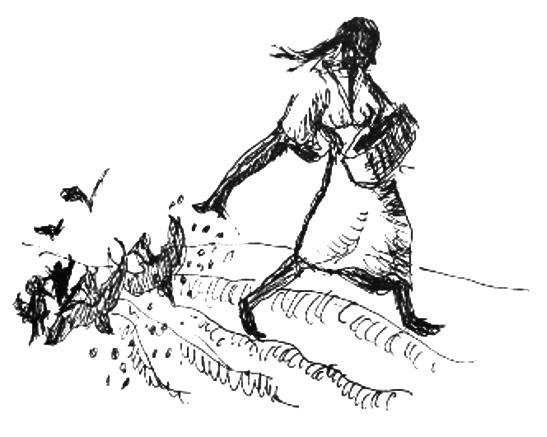


1. Unlikely Offering: Mary of Bethany

Scan the QR code below or visit https://bit.ly/anunlikelylent.

I love to sing. Although I am not particularly gifted in vocal performance, I make an enthusiastic choir member. There’s something about lifting my voice with others, blending in harmonies, and feeling the music resonate deep in my soul. So when I was asked to participate in an ecumenical Easter cantata, I readily agreed. The local Church of God would be hosting this grand event, and my future mother-in-law happened to be the choir director. I wanted to be part of something meaningful, something that told the greatest story ever known in a way that reached people beyond mere words.
The choir practiced for months. But more than music, there was a theatrical aspect to the cantata. Many local craftsmen and craftswomen created a realistic tomb, a Roman road, and even a rugged wooden cross. Long before the days of Amazon and mass production, costumes were lovingly handmade. My boyfriend at the time reveled in his role as a Roman soldier. His older brother was portraying Jesus, and they both took their roles seriously. There was a moment in the play when the Roman soldier was supposed to strike Jesus before leading him to the cross. “I want you to hit me with force,” his older brother insisted. You can imagine my boyfriend was happy to comply.
That moment disturbed me. Even though it was just a reenactment, it felt raw, too real. Why is it that we fixate so much on the brutality of the Crucifixion? Why do we linger in the suffering, almost relishing the gruesomeness of the punishment? We speak of the pain, the nails, the crown of thorns. We hear of the Roman soldiers and the key players, folks like Pontius Pilate, Peter, and Judas. But what about everyone else? The ones watching, grieving, wondering? What about those who don’t hold the central roles but whose stories still matter?
The story of Easter is rightfully centered on the crucifixion and resurrection of Jesus. But the Resurrection was not witnessed in isolation; it unfolded before a crowd. In that crowd were women and men who slipped through the margins of our Bibles, people who stood in the shadows but whose presence still shaped the moment. Might their stories have something to teach us today? There was the servant girl who confronted Peter. Or the story of Simon of Cyrene who was just minding his own business when he was compelled to carry Jesus’s cross. May we find in them an invitation to a different kind of Lenten journey—a journey that explores freedom, courage, and connection through the lives of these unlikely characters. As we embark on this forty-day journey, may we discover a new dimension of God’s pervading love and a fresh resurrection experience for our own lives.
In chapter 1 we begin in Bethany at the home of Jesus’s closest friends. Mary of Bethany’s story is one of extravagant devotion and an excessive offering. In a society where women were often relegated to the sidelines, Mary steps forward with a bold and lavish act of divine adoration. She anoints Jesus’s feet with a costly perfume, an act that demonstrates her deep love for Jesus while foreshadowing his impending death and burial. This act raises the
question: are we prepared to defy the norms of the day and offer Jesus our unlikely offerings?
As we continue our journey, in chapter 2 we encounter the servant girl whose words present Peter with an unlikely opposition. Peter follows Jesus at a notable distance after his arrest. It is not a high priest or a Roman official who first calls him out but a servant girl, a young woman, nameless and seemingly insignificant. She sees Peter and boldly claims, “You were with him.” Peter, caught off guard, denies it. And so begins his unraveling. But what if the servant girl is not just an accuser? What if she is a mirror? What if she forces Peter, and by extension you and me, to look deeper, to confront what is stirring inside? Sometimes the challenges that unsettle us are the very ones that transform us. This girl, often overlooked in the narrative, becomes the catalyst for Peter’s internal reckoning, and in her we find an invitation to examine our own experiences of opposition.
In chapter 3 we find Barabbas. Barabbas’s release represents an unlikely freedom. He is the man chosen by the crowd to be released instead of Jesus. Barabbas is often painted as a villain, a man unworthy of mercy. But what if we’ve misunderstood his story? What if his release, as unfair as it seemed, reflects the irresistible grace of God? Might there be places in our own lives where we still cling to the shame we’ve experienced in our lives? Are there parts of our story that still need to experience the scandalous, unearned, and unfair love of God? Barabbas reminds us that God’s grace often defies our logic, extending freedom to those we deem undeserving, just as it does to us.
In chapter 4 we walk alongside Simon of Cyrene, who reminds us of the importance of an unlikely companionship. He did not wake up that day expecting to carry a cross. He was
an outsider just passing by and was pulled into the unfolding drama of redemption. Compelled to carry Jesus’s cross, he became part of the story. This reminds us that even Jesus did not walk the road to the cross alone. He needed human help. Why do we resist help when we need it most? Why do we act as if faith is a solo journey when the very heart of the gospel is community? What if we embraced an interdependent faith, one where we bear one another’s burdens? Simon’s story calls us to rethink how we respond when we are pulled into the suffering of others. Will we resist, or will we step into the role God places before us?
Among the most powerful figures at the cross are the women who remained by Jesus’s side, exhibiting in chapter 5 an unlikely courage. The women at the cross stayed when others fled. These women did not turn away from the suffering. They remained, watching, witnessing, and grieving. Their presence was an act of profound bravery. What does it mean to show up and stand by someone when the world falls apart? What are the possibilities of presence in the face of fear? Who are we being called to stand beside today? These women teach us that courage is not always loud or forceful; sometimes, it is simply the act of staying, bearing witness, and refusing to abandon those in need.
And finally in chapter 6, we come to Joseph of Arimathea and Nicodemus, two men who demonstrate an unlikely alliance. These were men of power and privilege, yet they risked everything to care for Jesus’s body. They stepped forward when it mattered most, using their influence to ensure Jesus was entombed with dignity. Their actions challenge us to rethink power, to reconsider how we use our resources for God’s kingdom. Where is God calling us to be unlikely allies? Who needs us to step forward, to offer our time, influence, or resources in a way that furthers
love and justice? Their willingness to show up when others had abandoned Jesus reminds us that faithfulness often requires us to step beyond our comfort zones and align ourselves with God’s purposes, even when it carries a cost.
This is an unlikely Lent, a season not just of giving up, but of stepping into the unfolding story of Easter—a practice in seeing what has been overlooked; an experience of meeting Jesus, not just in the grand moments, but in the in-between: in the silence, in the side characters, and in the questions.
And as we journey with these unlikely men and women, as we step into their stories, we may just discover that the Resurrection is not just a past event. The Resurrection is an invitation into something new; something unexpected; something unlikely. With each chapter you will experience personal reflection, biblical content as well as an invitation into a Lenten practice. I encourage you to participate in the weekly practices, either individually, in small group, or within worship.
So come, let us take this journey together. Let us be open to surprise. Let us embrace the discomfort of new perspectives, the beauty of hidden moments, the power of presence, of grace, and of connection. Let us walk through this season with eyes wide open, ready to see where God is moving, even in the margins. Since the cross is not the end of the story, let us embrace every unlikely moment along the way.
Mary took a pound of costly perfume made of pure nard, anointed Jesus’s feet, and wiped them with her hair. The house was filled with the fragrance of the perfume.
John 12:3
Together we are stepping into the season of the traditional church calendar known as Lent. Lent is a season I have grown to love and appreciate for its fresh invitation to life and its reflection on suffering and death. It’s a forty-day journey when many people will choose to engage in particular spiritual practices. Some may choose to give up habits that seem to distract or block our connection to God. Still others will embrace practices that are centering and life-giving to ourselves and those around us.
Whether we are laying down distractions or picking up new possibilities, these forty days invite us to reengage with Jesus’s life, death on the cross, and ultimately the resurrection of Easter. Lent is essentially a season of preparation and together we are exploring women and men, characters in the Gospel accounts, who participate in the events leading up to Jesus’s crucifixion; but these very real humans seldom take center stage. They do not make their way into our Palm Sunday cantata, or an Easter play complete with costume-covered Roman soldiers. The story of Easter is generally focused on the crucifixion and resurrection of Jesus with a few key players. Peter, John, Mary Magdalene, just to name a few, are the focus of many messages and Bible studies. But I am curious: what else was happening around that earthshattering event and whom did it involve? Perhaps women and men who seemed to slip through the margins of our Bibles? Might a curious exploration of their stories have something to teach us today? Could we together experience God once again in the unlikely? Today we begin around the table.
Have you ever found yourself in a situation where you just wanted to do something to help? Perhaps you experienced a neighbor, a coworker, or a friend who lost someone they love and you wanted to do something, anything, to demonstrate your care and mindfulness. Maybe you decided to send a text. Some who enjoy talking may make a phone call. And if you are so inclined, you might even decide to bring food, have a meal delivered, or bake a fresh loaf of bread as a sign of your compassion. These acts of love and compassion are never about the casserole. A food offering
is our excuse to connect human to human. Food is a tangible sign of love declaring I see you, I love you, and I am here to help.
Louise Butts always made the most delicious food. She was my mom’s friend. And now that I think about it, I realize she was my mom’s best friend. Kids do not expect their parents to have best friends and certainly they were not the paint-your-nails-ona-Friday-night besties. My mom, Linda, and Louise were not even let’s-go-on-a-girl-trip buds. They were the kind of best friends who knew the struggles within your family, your parenting woes, and your money shortages. They were committed to walking out life’s journey together.
While I was growing up, Louise and my mom took turns picking up Louise’s daughter, Caressa, and me from track practice. I secretly loved when Louise picked us up because it usually meant I would spend a few extra minutes at her house for what I affectionately called “first dinner.” Louise’s idea of an after-school snack was a delicious soup, homemade bread, and a decadent dessert. Would we be having her gooey cinnamon-soaked monkey bread? She had perfected the art of making chocolate no-bake cookies. Louise’s no-bakes were my absolute favorite. There was something about the way she laid out the bowls, the spoons, even the butter for our bread. Each gesture seemed chock-full of love. I remember dreaming that someday I would be that kind of momma when I grew into adulthood. News flash, I am not that kind of momma; ain’t nobody got time to be that kind of momma. But I must tell you that when my mom’s cancer journey brought her home with hospice, this same woman showed up with pots of food and pies in hand.
Determined to die at home, my mom wanted to be surrounded by friends, family, and the land that she loved. There’s something
centering about belonging to the land. Even though she said she wasn’t going to plant a garden that year, she did. Of course it was smaller, but she grew the fruits and vegetables she loved: string beans, ripe red strawberries, mouthwatering sweet potatoes, and zucchini as big as your arm! My mom and dad had worked our family farm for over forty years, and just driving onto the property after numerous hospital stays seemed to relax my mom. She seemed as if she could breathe again. As she rested in her hospice bed, her smile indicated that being home felt just right. She went home to be on the farm, to be surrounded by family and friends. And I was not sure she would get what she wanted: to be surrounded by the people she loved. But people just kept coming: church people, family people, and friend people. Louise came every day with chicken and noodles, mashed potatoes, her homemade spaghetti, fresh-baked bread and pies. Oh my goodness the pies. There was nearly a pie for every member of my family: cherry pies, coconut cream pies, apple pies, pumpkin pies, and pecan pies. So many pies! We had to insist that everyone who visited my mom eat a piece of pie. My dad, brother, sister, and I could not consume the carbs fast enough. The pies were broken and shared with everyone who stopped by to chat, to sing, to pray, to cry, to grieve, and to celebrate. Food was the offering. It was a little over the top, it was extravagant, and it made the human connection so rich.
Perhaps you, too, have experienced food offerings. Maybe when one of your loved ones walked through the valley of the shadow of death, someone brought food. Or possibly when there’s been much to celebrate, a person or group of people came with an offering. It’s the casserole that shows up when a child is born, the cinnamon rolls shared among teachers on the last day
of school, your best friend who invites you to dinner when you receive a promotion, and even the zucchini bread shared by a neighbor just because they baked an extra loaf. But food offerings are never really about the menu items. Food offerings are always about our deeply human connection, and it’s been that way for a long, long time. Beyond the twelve disciples, Mary, Martha, and Lazarus were Jesus’s closest best friends. It was unclear as to why this trio held such a tender place in Jesus’s heart, but it’s not hard to imagine that Jesus enjoyed numerous nights in their home, and more meals around their table than they could count. Jesus gathered with his best friends for a meal in the Gospel of John to celebrate, because as we all know, tomorrow is not promised.
In John’s Gospel Jesus has just raised Lazarus from the dead. And Lazarus had been dead for a while. So dead that the sisters were worried that when those milling about helped open his grave, Lazarus was going to smell terribly bad. Initially his body had been prepped, anointed, and wrapped for the long slumber and yet Jesus’s “Lazarus, come out” called him back to life on this side of heaven. Of course that’s a colossal reason to celebrate, but not too much too fast because Jesus already knew he was in trouble. Jesus once again created a disturbance among the naysayers, so much so that they were ready to eradicate him and his traveling ministry. Jesus took a risk coming to Bethany to heal his friend, and now he’s together with them once again in that same small town. There was an urgency as John wrote about this gathering. I encourage you to read the Gospel of John 11 and 12 together. When you do read those chapters, you will pick up on a tension
in the text that seems so thick you can nearly taste it. We are no strangers to tension. I imagine most have experienced tension around tables. At that family gathering where your uncle goes into a political tirade, you experience tension. The wayward cousin decides to show up at the last minute to everyone’s surprise, and suddenly there is tension. The work party where someone did not realize a coworker has been let go for not-great reasons, and they inquire, “Where’s Sam?”—you’ve got tension! The air is thick, the conversation minimal, and those in the room don’t know exactly what to do or say. It’s this kind of tension that I imagine the disciples were experiencing around Lazarus, Martha, and Mary’s dinner table:
Six days before the Passover Jesus came to Bethany, the home of Lazarus, whom he had raised from the dead. There they gave a dinner for him. Martha served, and Lazarus was one of those reclining with him. Mary took a pound of costly perfume made of pure nard, anointed Jesus’s feet, and wiped them with her hair. The house was filled with the fragrance of the perfume.
John 12:1-3
John situated the reader at the table, preparing for the defining meal of the Jewish faith known as the Passover. The Passover was less than a week away and like a master storyteller John’s just building the tension. Imagine the scene with me: Jesus and the disciples are reclining at the home of Lazarus, and Martha was serving. Again, not a surprise: according to the writer of Luke, Martha was in the habit of doing such things:
Now as they went on their way, he [Jesus] entered a certain village where a woman named Martha welcomed him. She had
a sister named Mary, who sat at Jesus’s feet and listened to what he was saying.
Luke 10:38-39
Martha was not particularly happy with her younger sister, Mary, for not aiding in the preparations. Is this the same Mary and Martha story with a different twist? Is the writer of the Gospel of John attempting to give us a different angle? It’s not exactly clear. But what is clear is that Mary decided to offer Jesus an extravagant gift. Mary, sitting at Jesus’s feet as was her habit is our sign that Mary, too, was a disciple and a student of Jesus. But on this occasion Mary was not merely listening. She had brought with her a gift and an intention to share it. As Jesus was speaking, she gently lifted a pound of costly nard perfume out of her bag and anointed Jesus’s feet with that oil. The word for anointed, ēleipsen, is the same word used when talking about preparing a body for burial. Mary anointed Jesus’s feet and then wiped those same feet with her hair. Her action certainly did not dissipate the tension. These actions added to it. Here’s a woman, a follower and friend of Jesus who touched Jesus’s feet, letting down her hair. There was an intimacy to her actions. Mary did not seem to act in desperation, but rather shamelessly poured out an extravagant offering onto Jesus. I wonder, did the disciples look away, did her actions leave them speechless? There were no immediate protests as Mary focused on washing her friend’s feet.
But why would Mary do such a thing? Was this a sign that she was just so grateful for Jesus’s healing her brother? Did she not know what else to do? Jesus will later say she bought the perfume. But how did she buy this perfume and with what? Were Mary and her sister, Martha, independently wealthy? Did Mary own
some sort of small business? Could this nard have been part of her inheritance? Was this woman literally pouring her dowry over Jesus’s feet as a sign of her unrivaled commitment to Jesus and his ministry? Burn the ships, pour out your most prized possession, Mary! Mary seemed to be with Jesus no matter what. She seemed to be giving Jesus her all.
Sometimes this is when I wish I could be a participant around that table. While Mary anointed Jesus’s feet, did the men nervously laugh, did they groan in protest, did some even applaud Mary? We don’t know. Perhaps everyone around the room was merely stunned. There’s also this assumption that Jesus was always traveling with a posse. Was it merely the twelve or were there more? Were men and women seated together? Were there children to witness this exchange?
I feel compelled to give Judas a bit of credit. While the room full of dinner guests were watching this alternative ritual in shock and horror, Judas asked perhaps what others were wondering:
“Why was this perfume not sold for three hundred denarii and the money given to the poor?”
John 12:5
The author of John added a little commentary, stating that Judas did not actually care about the poor and used to steal money from the common purse. Really? That conclusion seems a bit suspect because wouldn’t the disciples just deem Judas irresponsible and keep the purse themselves? Or at the very least, I imagine the disciples asking Jesus to rebuke Judas for his robbing them all. Maybe the author added this bit of commentary because he needed to suggest a reason that Judas would later betray Jesus.
Since it was nearly unthinkable, he needed to justify Judas’s later behavior.
Sometimes we have relationships, friendships, partnerships that go south and it’s only in hindsight we realize that something underneath the surface was going on. At times we attempt to justify why we did not see the infringement in the moment: the affair, the embezzlement, the betrayal, and so we say things like, he or she was always shady, but that was not really the case. Humans can be really human, meaning that sometimes people get caught up in making bad choices. And sometimes people, particularly us religious types, attempt to portray ourselves beyond our human condition. We say things to ourselves like, I would never do that; I would never say that; there is just no way I could get caught up in something so suspect. But I’ve been around long enough to realize we all are capable of making less than great choices for ourselves and others.
Yes, Judas was only human after all. But Jesus was not having it with Judas that day:
“Leave her alone. She bought it so that she might keep it for the day of my burial. You always have the poor with you, but you do not always have me.”
John 12:7-8
Jesus responded to his anointer’s critics tagging an Old Testament scripture, Deuteronomy 15:11, “Since there will never cease to be some in need on the earth, I therefore command you, ‘Open your hand to the poor and needy neighbor in your land.’”
I’ve experienced too many people in ministry use John 12:78, as justification for not caring for the poor. They place words, these words, in Jesus’s mouth as a mere mandate to ignore the
vulnerable among us with sometimes political implications. But the hearers in the room would have heard the depth of this scripture. The Old Testament was always encouraging (dare I say challenging) the faithful to care for the foreigner, the widow, and the orphan among us. Jesus had a deep passion for caring for the vulnerable. Judas could have been portraying some kind of false piety, and maybe Jesus called him out for his future mishaps. Or maybe Judas was merely the target because Jesus understood the discomfort of the witnesses in the room. Even I struggle to imagine Jesus this vulnerable: a Jesus who needed to be prepared for burial. Mary’s gift to Jesus eased the tension in his body as he made his way toward Jerusalem. A needy Jesus does not seem to align with the Jesus of the Gospel of John. And no matter the interpretation of this exchange between Judas and Jesus, Jesus was opening the door for there to be more ways than one to offer love, to bless others, to honor the divine.
I am always surprised by Jesus’s treatment of women throughout the Gospels. Jesus’s interactions with women were revolutionary and deeply personal. Take John 4, for example, where Jesus met the Samaritan woman at the well. Not only did he break cultural and gender norms by speaking to this woman, but he invited her into a deep theological conversation about worship and the living water that Jesus could provide. This was unheard of in the first century. Rabbis did not engage with women like this, much less Samaritan women. Yet Jesus did not just talk to her; he saw her, valued her, and gave her the dignity of understanding. And her response? She ran back to her village, becoming one of
the first true evangelists, sharing the good news of Jesus with her people.
Another surprise encounter was with the woman caught in adultery in John 8. This Gospel of John story was loaded with possibilities for entrapment from the beginning. The religious leaders brought a woman to Jesus, hoping to pin him down in some theological or legal mistake. But Jesus, in his brilliance, refused to play their game and instead turned the spotlight on the accusers, confronting their own sinfulness. And then when the crowd dispersed, Jesus did not shame the woman. Jesus did not condemn her, but instead extended a pathway of grace, saying, “Go now and leave your life of sin.” Jesus offered her a future, a second chance, a path to freedom. Again, we see Jesus lifting a woman out of shame and offering her dignity and grace.
So now here’s Mary of Bethany, anointing Jesus with expensive perfume and the criticism is on! The disciples, especially Judas, were ready to write her off for her extravagance. But Jesus protected her, even praised her, saying, “Leave her alone.” Her offering, misunderstood by others, was honored by Jesus. There are other accounts in the Gospel of this type of anointing.
Jesus sat in Bethany at the house of Simon, but this time the woman was unnamed:
While he was at Bethany in the house of Simon the leper, as he sat at the table, a woman came with an alabaster jar of very costly ointment of nard, and she broke open the jar and poured the ointment on his head.
Mark 14:3
Or even in Luke’s Gospel, there is a different Simon, a different location, and most likely a very different woman.
One of the Pharisees asked Jesus to eat with him, and when he went into the Pharisee’s house he reclined to dine. And a woman in the city who was a sinner, having learned that he was eating in the Pharisee’s house, brought an alabaster jar of ointment. She stood behind him at his feet, weeping, and began to bathe his feet with her tears and to dry them with her hair, kissing his feet and anointing them with the ointment.
Luke 7:36-38
The similarities are obvious: there’s the anointing, the hair, the offering poured out over Jesus. But the differences are also glaring: the names, the locations, the vocations of these women. And yet in every account, Jesus defended the women, when the men folk around were so quick to dismiss the actions of these women. Grace was always on the menu when Jesus interacted with women. John’s Gospel seemed to kind of smoosh these stories of the women together with Mary representing them all in a profound and prophetic way.
Who is this Mary of Bethany anyway? For years scholars have chastised the storytellers of the early churches for their tendency to meld all of its female identities together: the good, the bad, and the in-between. And although I do not like to assume that everyone who touched Jesus’s feet had some kind of scandalous past, there is helpful insight in the theory that purports that these women were all indeed one disciple.
Last spring I found myself listening to Diana Butler Bass at a gathering of leaders and innovators with the Texas Methodist Foundation talk about scholarship surrounding Mary and Martha and early manuscripts that did not include Martha within the stories. Butler Bass referenced the scholarship of Elizabeth Schrader Polczer and her Resurrecting Mary the Tower, where she
questions whether or not the Mary of Bethany was in fact Mary Madgalene prior to scribes shifting the name Mary to Martha. In an interview with Peter Enns, Polczer explained, “One in five Greek manuscripts has a problem around Martha, and one in three old Latin manuscripts has a problem around Martha. So, it’s really happening throughout the entire textual transmission.”1
I was fascinated. What if this textual problem was created to downplay Mary’s role in Jesus’s life? Maybe Mary was not one of the Twelve, but nonetheless, she was one who understood Jesus’s power and purpose far better than the men witnessing her actions. This feet-anointing Mary emerged as a passionate follower of Jesus, preparing his body for his ultimate death and burial. And isn’t that just like history? Time and time again, we see how powerful women, devoted disciples, and fierce followers of Jesus get pushed to the margins. We take their names and shift them, adjust their stories, and rewrite their contributions. But what if Mary was more than just a background character? What if she was the disciple who saw Jesus with more clarity than anyone else? While Peter was busy denying, and Thomas was caught in doubt, Mary was right there—fully present, fully aware, and fully engaged in the deep mystery of Christ’s purpose. She was not waiting for permission to believe. Mary simply knew.
Imagine the radical implications of this theory: a woman, often overlooked, was the one preparing Jesus for the greatest moment in history. She did not wield power the way the world expects. Mary did not have a title or a position among the Twelve, but her actions declared a devotion that was tangible and real. Maybe we’ve missed something by pushing Mary’s story aside. Maybe, in recovering her rightful place, we see a clearer picture of what true discipleship looks like. True discipleship with Mary
looked like deep devotion, bold action, and an unwavering love for Jesus that refuses to be erased. She poured herself out in that offering.
The offering was spikenard imported most likely from a region in what is now India. It’s an expensive offering valued at three hundred denarii. A denarius was a common worker’s daily wage. We are talking minimum wage, but still worth an entire year’s salary. That’s a lot of money for a traveling group of people living off the generosity of others. So it’s no wonder Judas protested! And then there was the smell! Pure nard imported from the mountains of India, was purposed to be used sparingly to mask the odors of everyday life. What happens when a person takes an entire pound of pure nard and pours it out on Jesus’s feet? It starts to spill into the rug, splashing on the linens covering the table. The aroma filled the nostrils of everyone in the room. The scent would have been overwhelming.
I’ll never forget smelling that anointing oil. I was standing on the slippery floor of a YMCA in Greenville, Ohio. Its pool was our strategy for baptizing people by immersion. Tom had already been baptized as a baby, but sometimes it is difficult for people to understand United Methodist theology surrounding baptism. Yes, United Methodist clergy baptize babies but we do not baptize infants to secure their eternal salvation. It’s not about that, but clergy also do not rebaptize people because we firmly believe that God is the actor in baptism. And what God did once, God does not need to do again. Tom was adamant, however. He wanted to publicly declare his faith through baptism, and did I mention I
was a provisional elder in The United Methodist Church at the time and not yet ordained? I had a deep ethical vein and would not allow myself to do something I was not permitted to do. But Tom persisted. “Rachel, can’t you do something?” he asked emphatically. I thought about his request for quite some time. “Well, Tom, perhaps I could anoint you with oil as a sign of the work you’ve felt God doing in your life.” I’m not sure to this day why I decided to use oil. Truth be told I haven’t used anointing oil for anything but prayers of healing since Tom’s anointing. So I traveled to a local pottery shop and purchased a jar that looked somewhat old and rugged and then purchased the biggest batch of anointing oil I could find. The oil was scented with Rose of Sharon. I now recognize that I could have merely used some olive oil and supplemented with a few tiny jars of the scented stuff, but I didn’t.
The day came for Tom’s anointing, and there were other people prepared for immersion baptism. Men, women, and teens were waiting to be immersed that day, but we started with Tom’s public declaration of faith. He looked at me, grinning from ear to ear. And I asked, “Why are you here today, Tom?” There were nearly fifty people gathered to hear Tom’s poolside testimony. I cannot recall exactly what he said, but he wanted people to know he was committed to following Jesus. I prayed over him and poured the oil over his head, probably an entire cup of anointing oil with a smell that was so strong it made my eyes water. The Rose of Sharon was strong! And there was no way Tom was ever getting that smell out of the clothes he was wearing. In the holiness of the moment, everyone gathered, encircled Tom, and placed hands on him to pray. With each touch, oil was exchanged, and no one was getting out of that YMCA without the fragrance of the anointing
oil on their person. We cheered Tom on for stepping into this new season of faith. Tom was beaming and my integrity was left intact. Several months later, after I left that church to serve at a new congregation, I received the call that Tom had died suddenly of a massive heart attack at the age of forty-six.
I still have that jar and although it no longer holds oil, to this day it smells unmistakably like Rose of Sharon. Every time I hold the jar I think of Tom and feel immensely grateful that we were able to use an unlikely offering to create memorable space for him to publicly declare his faith. And every time I read of a story of anointing in the Bible, I can’t help thinking of Tom’s commitment to following Jesus. So I wonder, what about you? Maybe you’ve never experienced an anointing in church? Maybe you can’t even imagine the overwhelming aroma, but each one of us has gifts to offer Jesus and one another.
I am a sucker for internet videos that catch people in a random act of kindness. You scroll to a video where a woman in the checkout line pays for someone’s groceries, a man buys an extra sandwich for a hungry traveler, a stranger on the street asks a passerby for extra change to pay for parking and his need is met.
Usually, the requests are minimal. The ask is simple and easy, and yet many times people are in too big of a hurry to meet the needs presented by the person filming. I can’t be too harsh. Maybe they do not meet the request because they do not have the extra cash. Or perhaps those who pass by are already behind schedule. I certainly can think of numerous times that I’ve just ignored someone or something around me because I had people
to see and places to be. I did not have time to be inconvenienced by people.
But then someone does give the extra couple of bucks, pays the parking, buys the cup of coffee, and suddenly the receiver becomes the giver. They hand the person $1,000 cash. Usually this is when the woman or man is brought to tears. They begin sharing a piece of their story: there are bills to pay, mouths to feed, a car that just broke down, and an uncertainty on how to arrive at any solution. Sometimes the story goes deeper, however; the internet does its thing and before we know it a total stranger has a new car, medical debt that has been paid, and a refurbished apartment is in the works. It’s extravagant, it’s over the top, it’s for one person, and the extravagant generosity is beautiful. In a world where scarcity seems to be the name of the game, abundance feels like a healing balm. Perhaps that was Jesus’s point: this unlikely offering was over the top; a demonstration of the grace God was pouring over all of creation. What I love most about the character of God is that God chose not to do this work alone, but rather, now we have the opportunity to experience God’s abundance on earth as it is in heaven. We can offer God and others over-the-top generosity.
I am struck by how Mary offered her very best to Jesus, an unlikely gift of costly perfume that completely filled the room with the fragrance of her love and devotion. It was not practical, it was not expected, but oh my, the offering was beautiful. And it makes me wonder: what does that look like among us now? What is your unlikely offering? Maybe you don’t have the mad skill of making pies to share with your dying best friend, but what about using your creativity, your expertise, or your passions in unexpected ways to bless the world?
Imagine a graphic designer offering free branding to a struggling small business, or a retired teacher tutoring kids in their neighborhood who can’t afford extra help. Maybe you’re a barber who could spend an afternoon cutting hair for people experiencing homelessness, or a photographer capturing portraits for foster families who might not have the means to have professional photos taken. What about someone who has a knack for listening, really listening, offering their time to sit with someone who feels invisible? I am in awe of the care and calling team at New Albany United Methodist Church: twenty laypersons who give of their time to visit and listen to the most vulnerable adults among us. Many times, these adults lack mobility; they cannot attend church, but these persons bring the church to them. And they pour out words of love and grace over those who are homebound. These acts may seem small, but they reflect a love that’s both surprising and potentially transformative.
The beauty of an unlikely offering is that it catches the world off guard. It does not follow the rules of efficiency or practicality; rather, an unlikely offering comes from within. Think of the nurse who stays late to comfort a patient who is struggling to make sense of this new health crisis, the mechanic who volunteers to fix cars for single parents, or the gardener who grows fresh vegetables to share with the local food pantry. These gifts may not come with fanfare, but they carry the intoxicating fragrance of God’s love into spaces so desperately in need.
I invite you to offer Jesus and the world your very best. Your unlikely offering does not have to be perfect. Perhaps your pies are not Instagram worthy. The offering does not have to make sense to everyone else. Like Mary of Bethany, your offering just has to come from a willing heart. So as we step together into the season
of Lent, let’s explore what our own unlikely offerings might be. What do you have in your hands, your home, your heart, that can be poured out as a gift? When we offer what we have, albeit unlikely, unexpected, and perhaps a little over the top, the aroma will be remarkable. It will catch the world off guard and the one for whom it’s intended will be blessed.
During this season of Lent, consider making space for an offering: a gift of love, devotion, or generosity that may seem unusual or unexpected but speaks deeply to Jesus. In this practice I invite both individuals and church groups to explore what you can pour out in faith. One possibility for engaging in this practice is through personal reflection and journaling. Set aside time each day this week to meditate on the question: what is my unlikely offering? Write about your skills, resources, or acts of love that may seem small or unconventional, but you could use to bless others. Perhaps it’s an act of generosity that doesn’t make sense to everyone but speaks volumes in the kingdom of God.
Church groups could create spaces for people to offer and receive prayer and anointing, either in a dedicated worship service or through interactive prayer stations where individuals can anoint one another. These moments of anointing can serve as a time of surrender, inviting participants to ask, Lord, what is mine to pour out? What do I have in my hands, my heart, my life that you can use to love God and others?
Another way to practice offerings is through acts of service. Individuals or groups can commit to giving their time and presence in unexpected ways, such as visiting someone who
is lonely, providing a meal for a struggling family, or offering encouragement to those in need. Churches might organize a “generosity challenge,” where people intentionally find creative ways to give, whether through financial gifts, time, or even simple gestures of kindness.
No offering is too small, and no act of love goes unnoticed in the kingdom of God. Whether as an individual or a community, take time this Lent to listen for God’s call. Step into acts of unexpected generosity, and allow your offering, whatever it may be, to reflect God’s love in the world.
God of abundance and grace, thank you for receiving our unlikely offerings, poured out in love. Teach us to give boldly, even when our gifts seem extravagant or misunderstood. Help us to recognize your presence in every act of generosity and every aroma of devotion. May our offerings fill the world with the fragrance of your love. Amen.

























Copyright © 2025 All rights reserved. No part of this work may be reproduced or transmitted in any form or by any means, electronic or mechanical, including photocopying and recording, or by any information storage or retrieval system, except as may be expressly permitted by the 1976 Copyright Act, the 1998 Digital Millennium Copyright Act, or in writing from the publisher. Requests for permission can be addressed to Rights and Permissions, e United Methodist Publishing House, 810 12th Avenue South, Nashville, TN 37203-4704 or e-mailed to permissions@abingdonpress.com.
800.672-1789 | Cokesbury.com/lent-studies