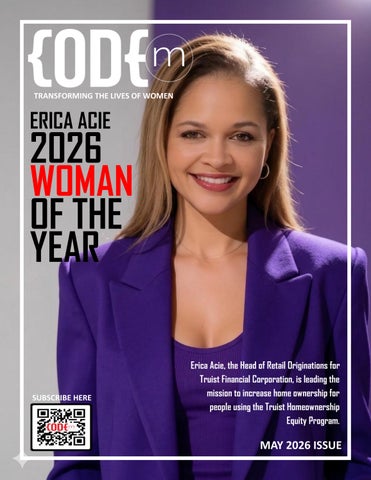
TRANSFORMING THE LIVES OF WOMEN
![]()

TRANSFORMING THE LIVES OF WOMEN

SUBSCRIBE HERE

Erica Acie, the Head of Retail Originations for Truist Financial Corporation, is leading the mission to increase home ownership for people using the Truist Homeownership Equity Program.
MAY 2026


May calls us to pause and recognize a foundation we often stand on but don’t always acknowledge enough the strength, love, and influence of women, especially mothers.
Before we became who we are, someone nurtured us. Someone sacrificed, poured into us, protected us, and believed in us sometimes before we even believed in ourselves. Whether it was a mother, grandmother, aunt, or a woman who stepped in when she didn’t have to, their impact is woven into our journey.
Mother’s Day is more than a celebration it’s a reminder.
A reminder that strength doesn’t always look loud. Sometimes it looks like consistency. Like patience. Like showing up day after day, even when it’s hard. Women, and especially mothers, carry a unique resilience the ability to nurture while enduring, to give while still holding everything together.
As men, it’s important that we not only appreciate that love Honor is not just something we say it’s something we show. speak, how we listen, and how we lead. It’s in how we uplift rather than overlook, and how we carry forward the lessons we were given.
In my own life, I’ve come to understand that growth is not just about personal success who helped shape that success. The journey to becoming a better man is deeply connected to the examples, sacrifices, and love we’ve received along the way. That same understanding is part of what fuels Code M Magazine that not only uplifts Black and Brown men, but encourages us to live with awareness, gratitude, and purpose. My hope is that the words and images in this issue inspire deeper appreciation, stronger connections, and a renewed commitment to lead with respect and intention.


58 COPING WITH MOTHER’S DAY BLUES
Women are struggling with the ability to keep up with the expectations of what a mother has become in modern society.
ERICA ACIE, THE 2026 WOMAN OF THE YEAR
Erica Acie, the Head of Retail Originations for
Truist Financial Corporation, is leading the mission to increase home ownership for millions using the Truist Homeownership Equity Program.
18 MOVERS AND SHAKERS
Get to know people who are making a difference in their careers and changing the world!
21 WOMAN CODES
Quotes by women. .
22
In a world caught up with distractions and drama, the confluence of arts, advocacy, and entertainment as a means to re-engage humanity on deeper, more meaningful levels is imperative.
32 NAVIGATING THE NEW WORLD OF NON-PROFIT IN 2026
Iris Ivana Grant discusses the importance of ecosystem building in nonprofit work, navigating funding challenges for minority organizations, and the impact of AI on social initiatives. She shares her expertise on strategic philanthropy, leadership, and the necessity of change in a rapidly evolving landscape.
36 CREATING HOMES WHERE YOU WORK
Ashani O’mard shares insights on community development, affordable housing, and the importance of strategic initiatives in Atlanta's housing market. Discover how innovative approaches and collaborative efforts are shaping the future of housing affordability and community resilience.
40 CODE M BEAUTY
Amazing women are refining what it means to be sexy.
52 CHAOS AT THE 2026 WHITEHOUSE CORRESPONDENT’S DINNER
Madison Maynard shares her first-person experience of the traumatic night at the 2026 White House Correspondents'


CODE M CELEBRATES 10 ACHIEVERS WHO ARE MAKING A DIFFERENCE

Dinner, including security lapses, the chaos of the shooting, and her reflections on safety and journalism.
Tackling the blatent racism, sexism and misogyny of Black women in America has become a full-time job for those who deal with it on a regular basis creating another level of stress they must deal with.
Four jazz vocalists join forces to bring their unique talents together to create one voice that blends their sounds to inspire, teach and educate through incredible songs that soothe the soul and calm the mind.
76
There is nothing more attractive than a Black man dressed in all black who exihbits all the confidence in the world.
ADVERTISE WITH CODE M
Blacks influence the latest trends of popular culture, fashion, and music more than any demographic. Reach them when you advertise with CODE M Magazine. With over 1.4 million viewers monthly, we have your audience.


PUBLISHER
Bilal S. Akram
PRESIDENT
Brad J. Bowling
SENIOR ADVISOR
Alexandria Johnson Boone
MANAGING EDITOR
David Christel
CHIEF OF STAFF
Anita G. Butler
PAGE EDITORS
Laron Harlem-Fashion Editor
Paris Lampkins-Movers & Shakers Editor
Valerie Starks-Hutton-Beauty Editor
GRAPHIC DESIGN
Stiff Arm Media
MEDIA COORDINATOR
Carole Anthony
EXECUTIVE ASSISTANT
To the PUBLISHER
Ladonna “Lala” Dicks
EXECUTIVE CONSULTANT
Adrianne M. Sims
ENGINEER RADIO/PODCAST
Chris Westbrooks
SOCIAL MEDIA
Stiff Arm Media
IT CONSULTANT
Anthony Jones
Digital Jetstream, LLC
CONTRIBUTING WRITERS
David Christel
Leslie Logan
Brad J. Bowling
Bilal S. Akram
Laron Harlem
Bolling Smith
Monique Wingard
Raland Hatchett
Akil Marshall
Dr. Tim Goler
STAFF
Sylven Lamar
Franklin Solomon


To submit
or to inquire about advertising please contact us at
info@codemediagroupllc.com


Kassidy Cameron is a media professional and recent graduate of NYU Tisch School of the Arts, where she earned her degree in Film and Television with a minor in Producing. Her academic experience combined creative storytelling with hands-on production work. This shaped her ability to develop compelling, purpose-driven content across multiple platforms.
Kassidy currently serves as a Sports Marketing Coordinator at NBC Sports, contributing to some of the network's most high-profile broadcasts, including Sunday Night Football, the Olympics, and the Kentucky
Get to know people who are making a difference in their careers and changing the world!
by Paris Lampkins
Derby. In this role, she supports teams in developing and executing marketing campaigns that engage broad audiences and elevate the storytelling behind major sporting events. Her work often involves coordinating creative assets, supporting strategic initiatives, and ensuring that each campaign reflects the energy, emotion, and cultural significance of the sports moments it represents.
Raised in Cleveland, Ohio, Kassidy developed a deep appreciation for the unifying power of sports and the ways they bring communities together. This early connection continues to influence her professional goals and creative vision. She is particularly passionate about amplifying stories that highlight how athletes, teams, and organizations use their platforms to inspire change, foster inclusion, and spark meaningful conversations.

Cydney Granger is a third-year law student at Case Western Reserve University School of Law, graduating in May. She is one of only twelve distinguished Stephanie Tubbs Jones Scholars and an active member of the Black Law Students Association (BLSA).
A proud cum laude graduate of Ohio University, Cydney earned her degree in Business Pre-Law and Marketing in 2023. During her undergraduate years, she made a lasting impact as President of the Ohio University chapter of Alpha Kappa Alpha Sorority, Inc. and as President of the Black Student Cultural Programming Board one of the university’s leading organizations responsible for producing some of its most celebrated and enduring campus events.
As a law school student, Cydney was published for her contribution to the American Bar Association’s Election Litigation Resource page. She also served as a Certified Legal Intern in the Environmental Law Clinic, where she represented clients pro bono and assisted in drafting a moratorium on pyrolysis.
Cydney is emerging as a dynamic and impactful voice in the next generation of legal professionals. She has already secured

a full-time Associate position practicing corporate law with a firm in Cleveland.
Born and raised in the heart of Cleveland, Ohio, I grew up surrounded by the bustling energy of urban life and the quiet charm of the Midwest. From a young age, I developed a curiosity about the world around me and finding my role in it. This curiosity began with a B.S. in biology from the University of Charleston (WV) and led me to pursue a Masters in chemistry at Delaware State University.
I am currently immersed in exploring the intricacies of molecular compounds and soft materials. My studies not only fuel my passion for scientific discovery but also align with my growing interest in environmental science. I am currently working on a hydrophilic medium that can remediate heavy metals and toxins from water. Some hobbies of mine include coaching Women’s lacrosse, shopping, and enjoying the outdoors. I am looking forward to where my studies will take me as a Delaware Space Grant Fellow this upcoming year.
After graduating from Shaker Heights high school in Cleveland, Ohio, Aryanna’s academic career continued at the University of Charleston (WV). Here, she participated as a division II women’s lacrosse player, while serving as president of Chi Beta scientific society and volunteering at CAMC hospital. Aryanna completed her degree in 2019 with a bachelors of science in Biology. At this time, she is preparing to graduate with her Masters degree in Chemistry from Delaware State University. An historically black

college and university founded in Dover , Delaware. During her time at Del State, Aryanna has been an Agilent Technologies scholar, NASA Delaware Space Grant Fellow, Lab instructor and Lab Manager in the Delaware State Water Quality Lab.


Compiled by Bilal S. Akram
“Every great dream begins with a dreamer. Always remember, you have within you the strength, the patience, and the passion to reach for the stars to change the world.” – Harriet Tubman
You don’t have to think about doing the right thing. If you’re for the right thing, then you do it without thinking.”
- Maya Angelou
“Love makes your soul crawl out from its hiding place.”
– Zora Neale Hurston
“I had to make my own living and my own opportunity. But I made it.” - Madam C.J. Walker
“The success of every woman should be the inspiration to another. We should raise each other up.” - Serena Williams
“I thrive on obstacles. If I’m told it can’t be done, then I push harder.” - Issa Rae
“Dreams are lovely, but they are just dreams. Fleeting, ephemeral, pretty. But dreams do not come true just because you dream them. It’s hard work that makes things happen. It’s hard work that creates change.” - Shonda Rhimes
“I knew my life would be a fight, and I realized this: I had it in me.” - Viola Davis
“The only person who can stop you from reaching your goals is you.” - Jackie Joyner-Kersee
“My mother did not raise me to ask for permission to lead.” – Ayanna Pressley
Proverbs 31:25 She is clothed with strength and dignity; she can laugh at the days to come.

In a world caught up with distractions and drama, the confluence of arts, advocacy, and entertainment as a means to re-engage humanity on deeper, more meaningful levels is imperative.

Written by DAVID CHRISTEL
David has been ghostwriting books for well-known people since 1995. He is also the author of Married Men Coming Out: The Ultimate Guide to Becoming the Man You Were Born to Be.
The intersection of arts, advocacy, and entertainment is not what one would necessarily call a fit, but for Cheryl Berry Neal, it makes all the sense in the world.
“How do I get people to understand that the arts, advocacy, and entertainment are intrinsically interconnected? For me, it’s about enabling and elevating all our voices to be heard and understood in all three arenas.”
Cheryl whose expertise is in arts & cultural leadership, advocacy & civil engagement, and entertainment & production has a compelling byline: “art awakens, advocacy empowers, entertainment inspires.” She’s here to connect all three, to bridge the worlds of entertainment, philanthropy, and social change.
That’s a tall order, one in which discipline and dedication are key, along with a constant attunement to what’s occurring in the world and how it impacts every facet of one’s life. Cheryl has also found that what’s required is a commitment to continued learning and the drive to expand oneself in our ever-changing, frenetic, and highly distracted world.

“I believe it’s important to continue to have outlets where people can learn. With everything I’m involved in, I want people to question, to research, to discover new perspectives, and to find ways in which they can become part of something larger than themselves.”
That idea was prevalent in Cheryl’s family, where she is the seventh of eight kids. As she puts it, “I grew up in a very lively home; full all the time with friends and family, where we always played music, watched movies, and created things.” She credits her early home life with instilling in her a nascent desire to get involved, to let her natural curiosity drive her to learn more, and subsequently, to support others in being more than they perceive themselves and life to be.
Importantly, Cheryl’s parents were significant mentors for her. “My father was a businessman, and my mother was the Executive Director of the YMCA.” Her parents married young and immediately started a family. Her mom didn’t finish high school, but went on to attain her GED, then a bachelor’s degree, and then a master’s. She began working as a secretary for the YMCA and eventually became the ED, the first Black woman to hold that position.

“My mom did all that plus raised eight children and she did it effortlessly.” With a household of highly talented achievers, Cheryl began creating what would become a roadmap for herself, something she could impart to her own daughter, as well as anyone she interacts with.
“I watch people, their behaviors, and the things they’re involved with, and I’m always supporting them in reaching higher, to be and do better.” Cheryl encourages people of all ages to explore and research because they may find a rabbit hole that turns into treasure and that opens doors to a world of possibilities. “I want to listen to what everyone else is saying and then figure out where and how I can meet them to get things done. I want to work with the bigger picture.”
That bigger picture involves knowing one’s history, of their family, their community and culture, and the world at large.
“It’s not about me, it’s not about you, it’s about the community, the country. It’s knowing whose shoulders you stand on.”
Cheryl strives to bring everyone together. She doesn’t care about your status: she views everyone at the same level, a level in which they can learn and be inspired, in which they can make deeper connections. That’s a significant aspect of creating roadmaps for ourselves and future generations it’s a different facet of legacy building.
Having followed the roadmaps of others and built upon them, Cheryl is sharing what she’s learned by putting everything on the table. “We truly are living in a matrix, and to see it, you have to take a step back, look at the entire picture, figure out where things are going, and where the holes are. From
there, you can begin formulating a strategy and what your next moves are, and where and how to adapt or shift directions.”
This is where the arts, advocacy, and entertainment come into play. As the founder and CEO of B The Now, Inc. and Nealie House Productions, Cheryl “identifies growth opportunities, builds strategic roadmaps, and curates cultural experiences that spark genuine engagement and action.” She’s focused on “building community, legacy preservation, and elevating diverse voices through compelling storytelling and strong partnerships.”
Awakening, Empowering, and Inspiring are the bedrock of Cheryl’s work, a powerful combination that informs individually and collectively, shapes culture, and creates the space and heart for deeper, more meaningful lives of purpose and value. ●


Kimberly Kline Dickens is a highly respected real estate attorney and community leader with over 20 years of experience serving the Atlanta area. As the founder of Kim Kline Law, she has built a reputation grounded in integrity, excellence, and results.

Her practice focuses on commercial and residential real estate, estate planning and probate, and corporate law, where she has successfully guided individuals, families, and businesses through complex legal matters. Kimberly has represented over 200 lenders nationwide, reflecting both her expertise and the trust placed in her counsel.
Kimberly has also demonstrated leadership within her profession, serving on the Board of the Georgia Real Estate Closing Attorneys Association (GRECAA). Passionate about giving back, she established a legal internship program that has mentored high school and college students many of whom have gone on to become practicing attorneys in their communities.
She founded her firm on the principle that clients should be treated like family, creating a personalized, results-driven approach that fosters lasting relationships and peace of mind.
Driven by purpose, Kimberly is committed to using her legal knowledge to uplift others and strengthen her community. As she often says, "Success is not measured by what you close, but by the doors you open for others."
CODE M was born to showcase and highlight Black people who are making a difference for their businesses, community, and their families. We are proud to celebrate these women this month and we encourage you to do the same thing.


Carole Hopson is a Boeing 737 Captain for United Airlines, based in Newark, NJ.
After a remarkable 20-year career as a journalist and executive, she followed her dream to become a pilot and share her passion with others as a flight instructor, while raising her family.
Walking away from executive-level positions, she went to flight school with gusto and completed flight training at the peak of her corporate accomplishments.
True to her roots as a writer, Carole published her debut novel: A Pair of Wings, based on the life story of pioneer aviatrix Bessie Coleman, the first American to earn a French civilian pilot’s license.
Carole also heads the Jet Black Foundation, dedicated to sending 100 Black women to flight school by the year 2035.
Dr. Ryland Gore is a board-certified, fellowship-trained surgeon specializing in breast surgical oncology and practices exclusively at Dream Breast Care Center in Atlanta, Georgia, located in the heart of Buckhead, and serving the entire metropolitan Atlanta area.
In addition to her passion for women’s health and breast care, and devotion to her patients, Dr. Gore brings a wealth of knowledge and breast health and cancer care experience to the medical landscape. She has been voted numerous times as one of Atlanta’s top doctors (Atlanta magazine) and as an Influential Atlantan in Medicine (Modern Luxury Atlanta magazine). She was also named a Top Doctor in 2024 from Memphis magazine. Dr. Gore is a highly sought-after speaker, medical contributor, consultant, and lecturer on breast cancer, breast health, breast cancer disparities, and surgical disparities, and other women’s health topics.
Her expertise has opened so many doors and has allowed her to be featured in or contribute to print, radio, and TV media.


Nina Simone Meyers is a seasoned growth equity investor and strategic leader dedicated to advancing economic opportunities for visionary founders, capital providers and stewards of capital.
As of 2025, Nina has succeeded her late father as CEO and Lead Lobbyist of The Meyers Group. Under her leadership, Nina has expanded the breadth of the firm’s offering to include strategic advisory, leveraging her successful tenure as the Lead Growth Equity Investor of Goldman Sachs’ One Million Black Women Initiative. During her tenure at Goldman Sachs, she played a pivotal role in the firm’s One Million Black Women initiative, a $10 billion commitment aimed at closing opportunity gaps for Black women through investments in key sectors such as affordable housing, education, job creation, and access to capital. Having deployed nearly $100mm in her seat, she has led and overseen the execution of transactions across healthcare, education, and financial health. Nina’s investments will impact an estimated 80,000+ Black women.


LaShelle Franklin is a dynamic leader, attorney, and changemaker dedicated to expanding opportunities for the next generation. A Cleveland, Ohio native and graduate of the Cleveland School of the Arts, she brings a deep commitment to community and excellence to her work.
She is the Founder and Chief Executive Officer of the Williams-Franklin Foundation (WFF), a national nonprofit supporting students at Historically Black Colleges and Universities (HBCUs) through scholarships, mentorship, and career development. Since co-founding WFF in 2014 with her husband, Dwight, the organization has raised nearly $1 million to support HBCU scholars nationwide.
A proud graduate of Howard University, LaShelle has built a distinguished legal career across government, private practice, and nonprofit sectors in Maryland and Washington, D.C., litigating complex family law cases and advocating for underserved communities.
Now leading WFF full-time, she drives strategic growth, cultivates partnerships, and advances initiatives that promote educational equity and economic mobility.
Charmaine Brown is a powerhouse strategist, executive coach, speaker, and entrepreneur who has spent nearly three decades helping leaders and organizations turn vision into action and complexity into results. Known for her sharp business insight, dynamic presence, and ability to move people from ideas to execution, Charmaine has built a career at the intersection of leadership, strategy, and transformation.
She is the Founder and President of Connexions Consulting, Inc., a woman-owned management consulting firm based in Michigan that partners with corporations, nonprofits, foundations, and public sector organizations seeking stronger leadership, sharper strategy, and measurable performance. Charmaine helps organizations align purpose with execution through strategic planning, organizational development, leadership effectiveness, and sustainable growth.
Before launching Connexions Consulting in 2015, Charmaine held senior corporate leadership roles, including serving as Head of Diversity & Inclusion.


Whenever actress, comedienne and Screen Actors Guild award nominee Cocoa Brown takes the stage, the world stands still! Brown is undeniably one of the most talented comics and performers of this generation. The Newport News, Virginia native, born Farah Brown, assails her craft with such passion and soul-searching veracity, when she claims a stage, the ensuing act is nothing short of a force of nature.
This tour de force audaciously draws from painful reminiscences and hardknock lessons, bravely weaving humorous tales that uplift, upend and upgrade everything you thought you knew about comedy. What is it that drives the comic who female fans nationwide have nicknamed "The Truth?" It’s the sheer will of a woman who survived the worst life had to offer and is still standing. Being appropriately dubbed as a "comedy machine gun" by America's Got Talent judge Sharon Osbourne, she has received numerous awards including the DC Comedian of the Year after only a short time of stand-up and was handpicked by the family of Moms Mabley to receive the 2018 Moms Mabley Legacy Award.


Tiffany L. Hollinger is the founder of Astraea Development, a Clevelandbased real estate firm dedicated to purposeful revitalization, workforce housing, and community-centered growth. With more than a decade of experience in real estate investment, property management, and residential redevelopment, Hollinger brings a disciplined, impact-driven approach to projects that align financial sustainability with neighborhood transformation.
Through Astraea, her focus is on strategic reinvestment in emerging corridors and proximity-to-opportunity locations, creating housing that supports the city’s workforce while contributing to long-term economic stability and community vitality.
Her flagship Commercial Real Estate venture, Project Fifteen Hundred (1500 E. 105th Street), represents the firm’s vision in action. The project involves the adaptive reuse of a historic fourstory building into five premium residential units designed for medical and academic professionals working near Cleveland’s major healthcare and education institutions.
Dr. Shiricka Fair is a visionary mental health strategist, educator, and Licensed Marriage and Family Therapist (LMFT) whose influence spans industries, communities, and continents. With over two decades of cross-sector leadership across academia, nonprofit systems, clinical practice, and global partnerships, she is redefining how mental wellness, health equity, and workforce development intersect in today’s world.
As Senior Director of Provisions Wellness Solutions, Dr. Fair leads transformative initiatives in executive coaching, leadership development, and culturally responsive program design. Her work equips organizations to prioritize mental wellness as a strategic advantage- strengthening leadership, enhancing performance, and cultivating healthier workplace cultures.
A dynamic community leader, Dr. Fair has created and hosted impactful initiatives such as Beyond The Jersey, focused on suicide prevention and athlete mental wellness, and Barbershop Talks.


Commissioner Dr. LaDena Bolton widely known throughout the community as Dr. B is a dynamic leader, accomplished chemist, and lifelong advocate for equity, safety, and opportunity in DeKalb County. Elected to represent Super District 7 in December 2024, she brings a bold, compassionate, and collaborative approach to governance, grounded in her deep roots in the community where she was raised, is raising her family, and continues to serve. Under her leadership, District 7 has been proudly branded as the district of bee pollinators a symbol of collective purpose, productivity, and care. Just as pollinators sustain ecosystems, Dr. B’s mission is to cultivate a community where every resident is valued, and every family is healthy, safe, and thriving.
She chairs the Employee Relations & Public Safety Committee, championing constituent services, crisis response, and interdepartmental coordination. Her district motto “Growing Businesses. Empowering Families.” guides her work to uplift legacy neighborhoods, support small businesses, and expand equitable access to resources.


Iris Ivana Grant discusses the importance of ecosystem building in nonprofit work, navigating funding challenges for minority organizations, and the impact of AI on social initiatives. She shares her expertise on strategic philanthropy, leadership, and the necessity of change in a rapidly evolving landscape.
By Bolling Smith
IIt’s no secret that the world of non-profit funding has changed. And depending on your mission, your sources of funding might be severely impacted. With the cancellation of DEI and the current political climate, organizations are tasked with having to reinvent themselves or risk closing due to a lack of funds.
Iris Grant, the founder and CEO of the Genési Group Incorporated, advises businesses and non-profits on strategic philanthropy, community engagement, and brand awareness. Her role is to amplify their goals and execute the proper strategies so that they realize their true potential.
“What we’ve noticed is that some of the funding that minority organizations used to get is now being flagged, so it has become harder and harder to identify grant opportunities as we go on,” Grant said.
She defines “flagged” as the federal government is watching organizations that still use DEI as a mission to advance their agenda. So, whether it’s gender based or based on any idea of DEI, those organizations might not be able to attract the same monies they once did in years past.
“We’re even seeing the foundations that typically give out funding to smaller organizations reducing where money goes due to the fact that the federal government has changed its position on what’s important to support,” Grant explained.
She recommends several things for any organization that might be caught in the spaces between their old mission and any new mission they hope to support. Grant’s recommendations:
Scrub the website – This means remove any mention of anything that might suggest the support of one group or another. Take out any wording that defines your organization as supporting DEI, working with disabilities, or being based on gender equality.
Iris Grant works with non-profits to maximize their potential.
Redefine your mission – You don’t have to change what you do as an organization; you must advance your mission to include everyone.
Grow and Learn – Just like people, organizations need to evolve and grow their brand to adjust to the conditions of


the time they operate in.
Grant gives an example of major corporations that refused to adjust to the changing times. “Blockbuster was ahead of the game but died because they refused to pivot and see the market change.” Grant continued, “Netflix gets the importance of adjusting to the market and staying ahead of the market trends, so they’ve grown with the market instead of dying due to market changes.”
too late.
Grant is also enthusiastic about helping people who might want to start a non-profit but don’t understand what’s needed to do so. Her organization is a guide for anyone who might want to start their own organization.
“I love seeing people take their pain and turn it into a purpose. Or they might see a need in society and want to do something about it,” Grant said.
“Across the board we are seeing a need for any organization, whether it be for-profit or non-profit to make tough decisions about who they want to be going forward,” Grant said.
Any organization that’s struggling with the concept of change might already be experiencing pain from the struggle of either getting less funding for the same project they did last year, or they might see no funding from places that they used to be able to count on year after year for funding.
“Across the board, we’re seeing a need for any organization, whether it be for-profit or non-profit, to make tough decisions about who they want to be going forward,” Grant said.
Genési Group works with companies from ten million to one hundred million in revenue and consults all their clients on seeing the change in market trends and adjusting to them before it’s
With so many changes happening in 2026, Grant and her team have prepared all her clients on the importance of learning how to become informed with decisions and stay in that space.
She teaches her clients the power of continuous evolution, meaning that if you, as a company, are staying the same, you are dying a slow business death, but you just don’t realize it. There are so many examples of this everywhere. Boston Market, Sears, and Friday’s restaurants are just a few of the examples of companies that refused to evolve and ended up paying the price for staying the same.

Grants’ expertise has made her and her team sought after by industries desperately seeking help to stay relevant. Her passion is helping; her purpose is to help companies get out of their own way so they can survive anything they may face.
Those are amazing attributes to have, and anyone with a business should listen to what she has to say. Very powerful from one amazing person.
Those are amazing attributes to have, and anyone with a business should listen to what she has to say. Very powerful from one amazing person. ●
Grant speaking at a non-profit conference.


Ashani O’mard shares insights on community development, affordable housing, and the importance of strategic initiatives in Atlanta's housing market. Discover how innovative approaches and collaborative efforts are shaping the future of housing affordability and community resilience.
By Bolling Smith
Real estate has always been the foundation of any community. Affordable housing means families and communities have the ability to thrive because of their ability to support the family unit. Today, Gen Z families are struggling to hold on to the idea of being able to create the existence that Gen X and other generations found.
Ashani O’Mard understands that and works with local Atlanta communities to regain their potential by financing the homes that bring communities together. A 20+ year veteran in community development, O’Mard is a nationally respected affordable housing leader who blends a deep commitment to expanding
pathways to prosperity with a track record of delivering results on a scale.
She currently serves as President of the Atlanta Neighborhood Development Partnership (ANDP), where she helps shape long -term strategy, strengthen organizational and financial capacity, and advance ANDP’s mission to create and preserve affordable housing across metro Atlanta.
In her role as President, O’Mard partners closely with the ANDP’s CEO and Board of Directors to guide enterprise-wide strategy, oversee cross-functional leadership, and position ANDP for sustained impact and growth. She plays a central role in capital strategy and external engagement, cultivating partnerships across the public, private, and philanthropic sectors to support mission-driven investment and systems-level change.

“We have an affordability crisis right now where people are being forced to live in other places than where they work. This means that entire communities are changing due to the housing shortage,” O’Mard said.
When she says housing shortage, she is discussing the problems in certain communities where incomes have not kept up with prices. She also describes the lack of quality housing in places where people can afford to live.
The problem started during the mortgage meltdown of 2008 to 2012, when mortgage lending changed. Those changes have caused a reduction in the number of people who can afford a home, and also in the number of new homes that
Mard served as ANDP’s Senior Vice President of Strategic Housing Investments, supporting multifamily housing development, portfolio performance, and cross-departmental initiatives that strengthened the organization’s effectiveness and sustainability.


have been built. O’Mard and her organization are changing to buy funding projects where people need help the most.
“We offer financial support to those who want to build or buy single-family homes where they work and live. This provides urban communities the opportunity to elevate their communities because of the quality of housing choices they have,” O’Mard explained.
That support can come to investors who want to build in the area, and it can come to individuals who are looking to finance the American dream of owning a home.
O’Mard and the Atlanta mayor’s office have an ambitious goal to
est rates, it might be the right time for anyone who wants to buy a home to get one.
O’Mard’s organization will help anyone who wants to purchase a home by providing education and guidance to understand the process. They also offer programs for those who need assistance to understand their credit score, borrowing ability, and banking education.
“We understand that buying a home is a process, which is why we offer financial classes to those who might need help first before they can begin the process of looking for a home,” O’Mard said.
“We offer financial support to those who want to build or buy single family homes where they work and live. This provides urban communities the opportunity to elevate their communities because of the quality of housing choices they have,” O’Mard said.
preserve or create 20,000 homes in the areas of Atlanta where housing is needed the most. It allows those communities to thrive because of the quality of housing choices that exist, and it allows those communities to maintain the feeling of closeness that all communities seek.
In 2026, there is predicted to be a slight uptick in how many people can acquire a mortgage and a new home. Prices are starting to come down somewhat, and with the slight reduction in inter-
She estimates that the time it takes for someone to begin the process of looking for a home to the end of the process could be anywhere from twelve to eighteen months, depending on what they need or where they start their journey.
Anyone living in the Atlanta area wanting to enter into the program has the ability to do so by going to the organization’s website and signing up for a conversation.

There is no clear-cut path to finding the American dream of homeownership. Ashani and her team are doing everything they can in their power to help anyone who wants it. Good work from a good person indeed. ●


Philly Weeden is an Author, Former Professional Football Player, Public Speaker, Playwright, Humanitarian, Screen Writer and Gym Owner.
From being married, divorced, and a father at a young age, Philly was inspired to write his first book in 2011; "REALationship Breakdown Philly Style: Based on Real Life Experiences" which pre- sold 1,500 copies in the first month! As an avid believer in God, he knows that all things are possible and realized that helping others through his words he was able to find healing in himself.2012 Nominated for The Entrepreneur of the Year at the Ohio Mix tape Awards and won Hip-Hop Play Producer/ Playwright.
• He received the "Young Black Business Association Entrepreneur of the Year"
With Partnerships, countless accomplishments & recognitions, 2 books, 13 stage plays, and a movie, Philly Weeden is the epitome of what faith, hard work and dedication resembles. By continuing to walk in his purpose he is destined to be a devoted leader in not just Northeast Ohio but globally.
To read more and to contact Philly Weeden visit his IG page. https://www.instagram.com/ phillyweeden? igsh=MWFvM29vcG8ydmIwdQ==


Erica Acie, the Head of Retail Originations for Truist Financial Corporation, is leading the mission to increase home ownership for millions using the Truist Homeownership Equity Program.

Written

FFor many Americans, homeownership remains one of the most powerful pathways to long-term wealth, stability, and opportunity. Yet in today’s market, defined by affordability pressures, elevated interest rates, and constrained housing supply, the dream feels increasingly out of reach for individuals and families across generations. Addressing that reality requires more than financial products; it requires leadership with purpose, discipline, and a deep commitment to community impact.
Few leaders embody that responsibility more fully than Erica Acie, Head of Real Estate Lending Retail Originations at Truist Financial Corporation.
As a senior executive, Acie leads with a clear mandate: align
across Truist’s footprint focus not only on originations, but on education, long-term preparedness, and trusted relationships ensuring clients are equipped to make informed financial decisions well before they step into the market.
“It is incredibly important to me that our organization is structured with the right talent and shared purpose,” Acie said.
“That’s how we best serve our clients and the communities that trust us.”
The modern housing market presents undeniable challenges. Since the pandemic, U.S. home prices have increased by approximately 60%, driven largely by a housing shortage estimated at 4.7 million homes. As of April 2026, mortgage rates for a 30-year fixed loan hover around 6.30–6.33%, remaining elevated relative to recent years despite modest weekly declines.
“Supporting women and emerging leaders is one of my greatest motivations,
” she said.
“When people are empowered with knowledge, confidence, and opportunity, entire communities benefit.”
strategy, talent, and community engagement to expand access to sustainable homeownership. Under her leadership, teams

Acie does not shy away from these realities. Instead, she and her leadership team have built programs designed to meet clients where they are educating them on credit readiness, saving strategies, available assistance programs, and longterm financial planning. Through Truist’s Homeownership Equity Program, business development leaders, loan officers, nonprofit partners, and community leaders collaborate to drive measurable impact at the local level.
This work reflects Acie’s belief that leadership is not about proximity to decisions, but responsibility for outcomes.
Raised in Columbus, Ohio, Erica Acie built her career across the real estate lending ecosystem, holding leadership roles with several major lenders and developing strong operational depth, including experience with a BPO model supporting offshore staff augmentation. Having lived and worked in five states, she brings a broad, national perspective to her leadership. Acie holds both a B.A. and an MBA from Ashford University with a focus on organizational leadership and has earned multiple certifications in Six Sigma and operational excellence. In addition to her corporate leadership, she serves on the executive board of the Atlanta Neighborhood Develop-


Acie has a passion for speaking power into women in America and spends her free-time working to help those who desire a better outcome.


ment Partnership (ANDP) and is an active member of World50, Women Empowering Women (WEW), and ALICE reflecting her commitment to civic engagement, inclusive growth, and leadership at scale. Her professional journey marked by disciplined execution, adaptability, and values‑based leadership mirrors the organization she represents and its commitment to helping clients and communities thrive.
Truist operates across seventeen states, offering mortgage origination services in forty-seven states nationwide. Its purposedriven approach to governance and client advocacy has positioned the company as a recognized leader in financial services and as a place where leaders like Acie can fully align passion with profession.
“I am deeply proud of the teams I work alongside every day,” Acie shared. “Their commitment, compassion, and discipline are what make this mission real.”
Beyond the enterprise, Acie is a visible and respected voice in the community. She is an advocate for financial education, frequently speaking at colleges and community events to demystify the homebuying process and encourage early financial preparation. Through partnerships with organizations such as the American Mortgage Bankers Association, her teams help deliver accessible education on homeownership strategies and long-term wealth building.
A motivational speaker, mentor, and author of We Got This – A Guide to Securing Your Greatest Future, Acie is particularly passionate about advancing women and young leaders.
“Supporting women and emerging leaders is one of my greatest motivations,” she said. “When people are empowered with knowledge, confidence, and opportunity, entire communities benefit.”
Her widely shared advice “marry the house, date the rate” captures her practical approach: focus on long-term stability while understanding that financial conditions evolve over time. It is guidance grounded in experience and delivered with empathy, reinforcing her belief that informed clients build stronger futures.


For Acie, leadership is inseparable from service. Living with intention has allowed her to give back, uplift others, and lead at scale made possible by an organization that prioritizes doing right by people.
Acie's commitment to leadership is rooted in a profound belief that professional success is inseparable from personal growth. For her, leadership isn't just about managing outcomes; it's about creating an environment where others feel empowered to realize their highest potential.
Her mission is deeply personal, forged through a journey that was rarely linear and often challenging. She remains acutely aware that her achievements are not hers alone, frequently acknowledging that she stands on the shoulders of the many mentors and advocates who paved the way before her.
Reflecting on the pivotal moments that shaped her, Acie recognizes that her life could have followed several different trajectories. It was the combination of unwavering faith, intentional mentorship, and the power of prayer that allowed her to navigate away from more difficult paths and break long-standing generational chains.
This transformative experience shifting from a predetermined course to one of purpose became the catalyst for her book, *We Got This*. Through her writing, she shares the mindset and resilience required to change one's narrative, offering a roadmap for others to lead with authenticity and courage.
Central to Acie's philosophy is the understanding that excellence looks different for everyone. She recognizes that people come from diverse walks of life and carry vastly different belief systems; because of this, she makes it a priority to meet people exactly where they are.
Rather than demanding others conform to a singular mold, she seeks to understand the unique perspectives and histories that each individual brings to the table. This inclusivity is not just a leadership tactic, but a core value that ensures every person she encounters feels seen, heard, and valued for their intrinsic worth.
This deep sense of empathy was born out of growing up in difficult conditions that could have easily fostered bitterness. In-

stead of holding a grudge, Erica chose to transform her past into a masterclass in human psychology. She learned a vital lesson early on: most conflict and negativity are simply a projection of a person's own fears rather than a reflection of one's true value. By decoupling her self-worth from the projections of others,
CODE M Magazine recognizes Erica Acie not only for her professional accomplishments, but for the disciplined, peoplecentered leadership she brings to everything she does. As the 2026 Woman of the Year, she represents what is possible when executive excellence, community stewardship, and purposedriven leadership converge. ●


Madison Maynard shares her first-person experience of the traumatic night at the 2026 White House Correspondents' Dinner, including security lapses, the chaos of the shooting, and her reflections on safety and journalism.

Written by Madison M. Maynard

I wrote an article for this very publication on how School Shootings Shaped Generation Z. Though I haven’t experienced the trauma of a school shooting, I just experienced my first, and hopefully only, shooting somewhere I never imagined it would happen… at the White House Correspondents’ Dinner.
I was selected by the journalism professors at Howard University’s Cathy Hughes School of Communications to be honored with a White House Correspondents’ Association (WHCA) scholarship, along with two other classmates of mine. Receiving this honor was truly the biggest blessing of my academic career thus far. As a little girl who was always passionate about politics and social justice, I realized around high school that I wanted to be a political commentator. After watching shows like The View and political debates on CNN, I knew that was the path I wanted. Later, I began to admire reporters such as April Ryan and Abby Phillip. I realized I wanted to follow in their footsteps, report on national politics, and ultimately become a White House Correspondent.
I showed my friends in high school videos of reporters challenging various administrations in the White House Press Briefing Room and told them that’s what I wanted to do. To be recognized on a national level for my work in political reporting at Howard University, and to be seen as someone entering the professional world of political journalism, still feels surreal.
On April 24th, 2026, I met scholars from 15 other colleges and universities. Everyone was excited about the weekend ahead. For many of us, it was the most exciting weekend of our journalism careers so far. We spent time introducing ourselves, discussing career goals, what we hoped to gain from the weekend, and expressing gratitude for being in the space together.
We began with a private meeting with members of the White House Communications Team. We toured the White House Press Briefing Room, officially the James S. Brady Press Briefing Room, and later attended a scholarship luncheon with members of the WHCA. I ended the day on an all-time high, calling family and friends to share my experience and telling them how excited I was for the next day’s White House Correspondents’ Dinner.
On April 25th, 2026, I woke up like any other day, but with even more excitement for the evening ahead. When I got ready, I made sure everything was perfect, to the point that my fellow scholars and classmates from Howard were waiting outside the Uber for almost ten minutes. I definitely felt bad about that. Once we left, the energy in the Uber was electric. We were all
Maynard is a junior at Howard University studying journalism.

eager to step into a space we had long dreamed of attending. We documented everything, taking selfies in the car to capture the start of the night. When we arrived, we immediately took pictures on the infamous red carpet. I was still taking it in, realizing I was actually there.
As the night continued, we attended the reception prior to the dinner, where I connected with scholars from other universities. I also met some of my idols, including Jonathan Capehart of MS NOW, Lester Holt of NBC News, and April Ryan, the longest-serving Black White House Correspondent and one of my biggest inspirations. I was able to tell her that in person.
The other scholars and I then walked into the ballroom where the dinner was held, and my mind was blown. “I’m so happy to be here,” I told them. The room was filled with hundreds of tables and chairs, and I knew it would be filled with some of the most respected journalists in the industry. I saw this as my moment to shine and make connections.
By the time the dinner was about to begin, the room was so packed I was dodging feet left and right. I wasn’t successful, and a taller man accidentally stepped on my big toe. He was apologetic, but it still caught me off guard.


When we sat down at our tables, we were excited, but also curious about how the night would unfold, especially with President Trump attending for the first time and members of his administration also present. WHCA President Weijia Jiang delivered introductory remarks after the President and First Lady entered, and then dinner began with salads.
We were mainly discussing the people we were seeing in real time, pointing out individuals we had only ever seen from afar. For a while, the atmosphere was light, until people suddenly rushed through the ballroom doors, screaming, “Duck! Drop to the floor!”
I immediately dropped and crawled under the table. Once all of us were under, we heard distant gunshots. Our table was near the stage, and we then heard what I assumed was the Secret Service saying, “Affirmed, shots fired.”
My first reaction was confusion. I didn’t understand what was happening or why people were running in every direction. Once I heard “Drop to the floor,” panic set in. When I heard the gunshots confirmed by the Secret Service, I began to pray, for myself and for everyone in the room.
Then panic returned. My phone was still on the table. I worried I wouldn’t be able to contact my family if something happened. I worried they would hear the news before I could tell them I was safe. Then I prayed again. It became a cycle; prayer, panic, prayer, panic.
Eventually, I began to hear normal voices again; chattering, movement. Other scholars started getting up. I remember asking, “Where are you going?” and someone responded, “People are up, you can come out.” I said, “I’m not getting out until I know it’s safe.”
About five minutes later, I came up and immediately reached for my phone. I was relieved I didn’t have messages from family or

friends asking if I was okay yet. I quickly texted everyone to let them know I was safe before the news broke. Then I received calls from my parents. I explained what happened, but I quickly realized I barely understood it myself. There had been no official explanation yet, so we relied on the news to find out more.
Eventually, someone announced the dinner would resume shortly. Some people reacted with excitement, but many of us were confused. Why continue a dinner when there had just been an active shooting scare? We also still didn’t know the status of the gunman. Was he detained? Was the threat over?
The uncertainty was unsettling. Deep down, I was also relieved we hadn’t reached the scholarship recognition portion of the evening. I had looked forward to that moment for years. We waited for nearly an hour, told dinner would resume soon, but nothing was served.
During that time, I started documenting everything on my phone like everyone else. I took videos and photos of the aftermath. Then WHCA President Weijia Jiang returned to announce the dinner would not resume and that, due to law enforcement guidance, we should evacuate immediately.
There was both relief and disappointment. I had hoped for my moment to shine, but it was taken by a violent disruption no one could have anticipated. The sadness stayed with me on the way home. As I reflected more, I began to fully understand what had just happened. I had been inside a shooting involving the President of the United States and members of his administration. It was a historic and surreal moment.
When I checked social media, it was everywhere. When I turned on the news, it was on every channel. And I was there. I was in the room. Even now, it still feels unreal.
Shortly after, I posted the videos I took to my Instagram. As a student journalist, I realized I needed to document and process what had happened, and also recognize its significance in real time.
Unfortunately, this feels like a preview of my life as a journalist, especially in today’s political climate, and a very unforgettable way to begin my journey in this profession. ●
Maynard with other scholarship winners on the night of the correspondents dinner.


Women are struggling with the ability to keep up with the expectations of what a mother has become in modern society.

Written by LATOYA SMITH
LaToya is the founder of Eros Heart Coaching, where she creates inclusive, transformative spaces that guide individuals and couples toward deeper self-awareness, passion, and authentic connection. Driven by a profound belief in the power of self-discovery, she helps people ignite their truest desires unlocking lasting joy, pleasure, and overall wellness.


Mother’s Day originated officially in 1914 when President Woodrow Wilson signed a proclamation declaring the second Sunday in May as a National holiday. The holiday was spearheaded by Anna Jarvis who created the day in 19051908 to honor her late mother Ann Reeves Jarvis, who was a community activist. It was intended as a day for personal gratitude and to honor the sacrifices of mothers.
The month of May is a full month of many celebrations: graduations, prom, Memorial Day, and Mother’s Day. When Mother’s Day comes around, for some, it can be a fun-filled day of love, laughter, joy, and celebration of moms or mother figures. And for others, it can be quite sad, depressing, and triggering. What makes Mother’s Day so interesting, especially after surveying many mothers, is the wide range of emotions the day evokes. One mother, Sophia, when asked, “What is Mother’s Day like for you?” she replied, “I have mixed emotions from love, joy, grief, and sadness, all the way to gratitude and the tiredness that comes from constantly thinking about the needs of others.” She continued, “Over the years, my Mother’s Day budget was huge because I had so many gifts to purchase for my mother, grandmother(s), mother‑in‑love, Godmothers, and other mother figures. Then that budget got smaller because those people were no longer physically present.” She explained that this shift made the sadness of the holiday feel heavier and more present in her life.
Sophia went on to say, “I was grateful for the love and admiration my family showered on me, but my sadness didn’t always allow me to recognize or enjoy it. Sometimes, as mothers or mother figures, the weight of the world can feel so heavy. As nurturers, mothers often desire time alone respite, space, and quiet. It takes a lot of energy to hold space, nurture, and care for children, parents, and sometimes ill partners. And at times, the best gift is simply time back to ourselves for rest and self‑care. That time can be used to do whatever moms want to do guilt‑free.”
During the interview, Sophia became emotional, sharing her vulnerability in how she has been able to process her grief. She also opened up further, explaining that
when her mother transitioned some years ago, she sought grief counseling and experienced hypnotherapy guided relaxation and focused‑attention subconscious work to support her healing journey.
As you think about Mother’s Day for you, how do you celebrate it with your mother or the mother figure(s) in your life? What feelings or emotions come up during this month? Grief is interesting and tricky, and you never know when it will appear. Here are some ways to celebrate your mother, partner, mother figure, sibling, aunt, godmother, or grandmother this coming Mother’s Day.
Movement:
Sometimes, when grief begins to enter your body or headspace, consider moving your body and incorporating the breath along the way. Here are some examples:
Meditation & Breathwork Grounding practices help calm overwhelming emotions and bring present during grief spikes.
Gentle movement Walking, stretching, yoga, or swimming can release emotional tension and support emotional processing.
Reiki or energy healing Many find comfort in modalities that soothe the energetic body and create a sense of peace (this aligns beautifully with your own Reiki practice).
Somatic grounding Focusing on sensations, textures, or breath to anchor the body when grief feels destabilizing.
Ritual & Remembering:
Create a ritual that will help you to define your renewed spirit and connection with your beloved mother as you acknowledge the absence of her physical presence.
Black mothers are often misunderstood by society.


Lighting a white candle in her honor on Mother’s Day.
Visiting a meaningful place you shared or that she loved.Cooking her favorite meal or engaging in an activity se enjoyed.Creating a memory box with photos, letters, or keepsakes.
Writing a letter to her expressing what you miss, what you’re learning, or what you wish you could say.
Surrounding Support:
Support groups Being with others who have lost their mothers can be deeply validating.
Therapy or grief counseling Especially helpful when emotions feel overwhelming or complicated.
Faith-based support Pastoral counseling or spiritual community can offer comfort.
Family time Sharing memories, laughter, and tears with others who loved her.
Meet Where I am:
Naming and validating emotions Recognizing sadness, anger, guilt, relief, shame, or numbness as normal.
Understanding grief as non-linear Grief comes in waves, especially around Mother’s Day.
Allowing mixed emotions Many feel both longing and gratitude, sorrow and love.
Self-compassion practices Speaking to oneself with gentleness during painful moments.
Protect Yourself:
Setting boundaries around celebrations or social media.
Planning the day intentionally choosing solitude, connection, or distraction.
Creating a “grief plan” identifying what you need, who you can call, and what practices soothe you.
Allowing yourself to skip the holiday entirely if needed.
Communicate to family and friends what support is needed.
Be mindful of the memories that may pop up on your phone.
Still honor your boundaries and your peace.
Do what comes naturally.
If you have a beloved, spend your time celebrating that person, honoring those caretakers.
Write a letter to your inner child for healing purposes.
For some of you, ignoring your feelings of grief is something that you just do. It’s a macho thing, LOL! You want to be able to show your mom, mother figure, or beloved a great time. Well, this day can also blow your budget and be the busiest Sunday for all the restaurants in town. Here are some things you can do that may be cost-effective, creative, and thought-provoking, which would be memorable for mom.

Mother’s Day is a special day to show love to a mother or mother figure, to let her know how much you love and appreciate her. On this Mother’s Day, if you are feeling blue, do something different with the recommendations shared in this article and be gentle with yourself. ●


Tackling the blatent racism, sexism and misogyny of Black women in America has become a full-time job for those who deal with it on a regular basis creating another level of stress they must deal with.

Written by


AAfrican American women confront many of the same obstacles and challenges faced by Black males. However, there are both nuanced and significant differences in the way racism and other societal challenges manifest for Black women as opposed to their Black male cohorts. Moreover, the racism confronting Black women is also tainted by the same sexism, i.e., viewing women as inferior, and even outright misogyny (hatred of women, confronting women of every race and ethnicity in our society).
This combination of racism and misogyny faced by Black women is underpinned by hundreds of years of violence and sexual assault faced by enslaved African American women. That barbaric history, paired with modern-day racism, sexism, and overt misogyny, creates a gestalt of hatred greater than the sum of its individual components. As such, African American women confront a form of racism that is distinct and different from that directed at Black men and sexism and misogyny are even more intense than that faced by White women.
The name for this unique intersection of sexism, misogyny, and racism faced by Black women is “misogynoir.” The term, which merges “misogyny” and “noir,” the French word for Black, was coined by Black feminist, activist, and author Moya Bailey.
Whatever it is called, Black women in America confront challenges originating from multiple fronts, including: 1) minimization within their own political and social justice movements; 2) workplace discrimination; 3) domestic violence; and 4) increased health risks.
1.) Minimization within political and social justice movements: Black women are often excluded from leadership in their own political and social justice movements, despite being a key demographic and the grassroots organizers for many of them. This is especially true in civil rights and feminist movements. The American Psychological Association, when studying this phenomenon, identified several key reasons for this unfortunate disparity.
The first and most notable is what they call “Intersectional Invisibility.” Effectively, Black women are perceived as less representative of "Black people" than Black men in civil rights causes and as less representative of "women" than White women in feminist movements. The net result is that the specific needs of Black women have been, and are today, often ignored by both broader movements.
Another factor in the exclusion of Black women from leadership in these organizations appears to be tied to historical stereotypes. Specifically, stereotypes that characterize ambition in Black women as being "too much" or "too overbearing." In its worst mani-


festation, it can lead to being labeled an “angry Black woman” when the same ambition in any other demographic, male or female, would be admired and rewarded.
2) Workplace discrimination: Black men have historically faced the highest unemployment rates in the country, an average 7.1% for 2025, according to the Economic Policy Institute. Black women, according to the same source, despite a dramatic increase in unemployment from 5.3% in January of 2025 to 6.7% by year’s end, still maintained a lower unemployment rate than Black men. However, despite African American women faring better in terms of sheer numbers relative to Black men in the American job market, they still face unique challenges in the workplace.
Specifically, Black women confront even greater wage disparities in the workplace than White women experience relative to White non-Hispanic men. Based on data from the Center for American Progress, Black women earn only 63-66 cents per dollar compared to White men. White women earn about 7983 cents on the dollar compared to their male cohorts.
According to the Institute for Women’s Policy Research, working Black women, who represent the primary or only breadwinners in 81% of Black households, are also often forced to choose between paid work and unpaid caregiving roles. This difficult choice is compounded by the absence of affordable childcare, workplace restrictions, and higher poverty rates for Black women.
3) Domestic violence: Compared to White women, Black women suffer higher rates of domestic partner violence, rape, and homicide. According to a CDC study, 53% of Black women in the United States have reported stalking, physical or sexual violence by an intimate partner. That compares to a national average among all women of 47.3%. The same study also confirmed that Black women are more than twice as likely to be murdered by a domestic partner than White women.
Describing Black women as historically “more likely to be harmed than heard,” Nat Fields, the CEO of the Urban Resource Institute, the country’s largest domestic violence shelter service, discusses the historical and societal causes that contribute to expanded violence against African American women. In his words, “We cannot separate domestic violence from issues like housing, economic inequality, and racial bias.”
Black women lead the demographic when if comes to income in America.

One interesting fact is that Black women are statistically more likely to report intimate partner violence to the police than White women. However, these incidents may still be underreported since many African American women must overcome fears of racism, law enforcement overreaction, or police brutality toward themselves and Black men before deciding to report domestic violence.
4) Increased health risks: PubMed Central, a government website, reports that African American women, due to experiencing both racism and sexism and multiple socioeconomic factors, report dramatically higher levels of chronic stress compared to other demographic groups. This stress is tied to higher cortisol levels, which are in turn associated with obesity, hypertension, and heart disease. The article goes on to report that 59% of Black women over the age of twenty are living with some form of cardiovascular disease.
PubMed Central also outlines the significant maternal mortality risk facing Black women. African American women in the US are two to three times more likely to die from pregnancy-related causes than White females. Rather than just socioeconomic factors, the researchers cite systemic inequities, healthcare provider bias, and chronic stress as the major contributors to the increased maternal mortality risks. They also speculated that over 80% of these deaths among pregnant African American women could be preventable were it not for these disparities.
While the archetype of the “strong Black woman” is historically accurate and a central tenet of African American culture, the article discusses it as being idealistic for Black women to believe they must "always" live up to that standard. Trying to do so can lead to unrealistic expectations and often cause Black women to neglect self-care to the detriment of their physical and mental health.


In Politics & Social Justice: A recent report by the Center for American Women and Politics reveals the strides African American women continue to make in politics. As of 2025, a record high percentage of Black women, 5.4%, are represented in state legislatures nationwide. There are currently 31 Black women serving in Congress, including two in the U.S. Senate. Moreover, of America’s 100 most populous cities, eight are led by Black women mayors. In addition, several Black women lead prominent civil rights and feminist organizations, including Karen Boykin-Towns, Vice Chair of the NAACP's Board of Directors; Opal Tometi, Co‑founder of Black Lives Matter, and Christian F. Nunes, who recently served as the President of the National Organization for Women.
In the Workplace & Entrepreneurship: The same CAWP data confirms that Black women have higher labor force participation than any other major female demographic, with 63.2% of Black women in the labor force compared to 61.3% for Hispanic, 59.9% for Asian, and 57.6% for White women. In addition, Black women are confronting inequities in the traditional workplace by starting their own businesses. In the five years between 2019 and 2024, Black women-owned businesses grew by more than 51%. That growth rate was more than 10% higher than for other women-owned businesses. In addition, supplemental data from Fast Company shows Black women entrepreneurship surging by another 13% between

2025 and 2026.
Against Domestic Violence: While this problem may seem endemic and intractable, as relates to Black women, several programs and organizations are springing up to specifically combat it. These include Ujima, the National Center on Violence Against Women in the Black Community; the National Organization of Sisters of Color Ending Sexual Assault; the National Black Women's Justice Institute, and several other national, state, and local organizations.
There are also programs and services available through the Federal government. The Office on Violence Against Women's Culturally Specific Services Program provides funds and services to racial and ethnic minorities affected by domestic violence, and the Violence Against Women Act's Housing Protections Program offers federal protections to help domestic violence survivors avoid homelessness.
In Healthcare: While strides in healthcare for Black women have admittedly been too slow, there appear to be positive signs on the horizon. A report by the American Cancer Society touts the expanded participation of Black women in the healthcare industry. African American women now represent more than 13% of the health care workforce.
The report also discusses multiple new targeted research and legislative initiatives directed specifically at Black women’s healthcare, including $16 billion in Federal funds specifically directed at reducing maternal mortality in Black women. In addition, community activist organizations such as the Black Women's Health Imperative and other grassroots movements have sprung up recently to advocate for Black women's health.
In conclusion, African American women have survived slavery, Jim Crow segregation, disenfranchisement, poverty, illegal medical procedures disguised as research, institutionalized and overt racism, sexism, and blatant misogyny, but the keyword has always been that they “survived” whatever was thrown at them. Not only have they survived, but they have also overcome, thrived, and grown to become the smart, strong, proud Black beautiful women they were always destined to become. ●
Black women are some of the most educated people in America.


Four jazz vocalists join forces to bring their unique talents to inspire, teach and educate through incredible
By Leslie

talents together to create one voice that blends their sounds songs that soothe the soul and calm the mind.
Logan


With so much going on in society today, there are very few places the mind can go to get complete calm. Today’s entertainment seems to use overthe-top themes in order to draw an audience. So, it’s almost impossible to find something that can be rewarding, entertaining, and calming at the same time.
Well, look no further because The Sistering has accomplished the very thing that every soul needs. Created by Lenora Helm, Nnenna Freelon, Kate McCarry, and Lois Deloatch, the four women have joined forces in a jazz group that blends amazing storytelling with beautiful compositions.
The Sistering captures the pure magic that unfolds when four accomplished jazz artists come together to uplift and inspire one another on and off stage. This in-the-making collection features eleven powerful compositions: two penned by each artist, two cowritten, and one imaginative reworking of a beloved jazz standard.
Though still in progress, the music already reveals a beautifully interconnected journey through themes of family, love, loss, and badassery rendering the project both as a memoir and a cultural mirror.
Infused with soul, folk, funk, and spoken word, The Sistering ventures across wide musical terrain, with improvisation at its heart. Song titles like “Combat Boots and Glass Slippers” by Lenora, “Circle” by Kate, “Follow the Stream” by Lois, and “A Brother Just Like You” by Nnenna hint at the emotional depth and narrative spirit behind the music.
As it continues to take shape, the project stands as a vibrant testament to the power of creative alliance and it needs the support of those who love (and will come to love) the group and their music to be fully realized.
“Because we all live in the same zip code, we have known each other for years. So, we were all together one day and we organically decided that we should come together, form one group, and blends our talents,” Deloatch said.
That blend of talent has created the group, The Sistering. The meaning behind the name carries a double meaning. It’s first meaning obviously defines the four ladies’ choice to collaborate. The second meaning makes the name behind the group that much more special.

“I come from a construction family, and I hear that term being used all the time in my house,” Freelon said.
“Sistering in construction means the joining of two beams that work together to balance the load of a structure, so it kind of worked for us, too.”
And it works perfectly. When you first hear the ladies’ merged talents blended together, you are immediately reminded of another era of music music from a time when it was not about dancing or noise. The music went deeper. Their music harkens back to a time when music told stories and made you feel something. It’s up to you what you feel, but The Sistering songs purposefully slow your mind down to the point where you actually listen to the words.
For those old enough to understand, the music begins to feed your soul. For many people, the music will resonate at a level where they didn’t know their souls needed to hear it. There is something calming and nurturing that comes when listening to The Sistering.
“The Sistering is an interplay of ‘me’ and ‘we.’ We each composed two individual songs for the project and co wrote is broken as we explore themes of family, love, and loss, McCarry said.
“We didn


decided to work together.” Helm, explained. “We knew together that we could create something wonderful and honor the decades of music we all have performed over time.”
The ladies’ music reminds you of going to visit grandma and sitting on the porch and hearing about the history of the family and the times when life was simple. At the same time, you get the feeling of sitting in a smoke-filled jazz club, dimly lit with one candle on the table, while sitting next to your favorite person and having the experience of a lifetime.
The joining of forces is so special all women should feel proud of what The Sistering means.
“Us coming together is applicable to all people. It’s not just a feminine thing, it’s a human thing,” Freelon said.
The women understand the power that comes from combining their talents into one unique voice. It symbolizes what everyone needs right now.

The ladies would like to make a documentary of their journey together due to the significance of what they’ve been able to accomplish. For music lovers, you’ll not have to wait for that, you can enjoy their music as you seek them out online, and eventually, when they come to a venue near you. A special group for a needed time in music. ●
Find out more at: https://sisteringproject.com/home


There is nothing more attractive than a Black man dressed in all black who exihbits all the confidence in the world.
Written by LARON HARLEM

A wardrobe shopper, stylist, and accessories designer who specializes in dapper looks that truly appeal to the most discerning eye. mailto: styledbydecar-lo@gmail.com, https:// www.styledbydecarlo.com/
A black leather jacket instantly says cool no matter how hot it is outside.


Simple often speaks volumes in fashion. This black shirt can be worn with a sports jacket or by itself. Either way, the man wearing it looks good both ways.


A little bit of color, along with an incredible Black man sets the tone for any meeting he attends.


Less is more when it comes to wearing the color black. Well, the zipper adds some appeal too.


