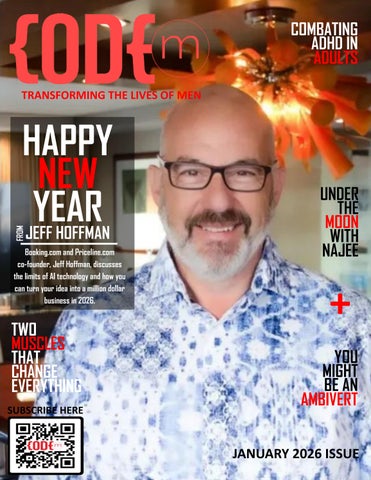
THE COVER Hoffman, discusses the limits of AI technology and how you can turn your idea into a million dollar business in 2026.
HAPPY NEW YEAR FROM JEFF HOFFMAN Booking.com and Priceline.com co-founder, Jeff
Taylor Aulston left a lucrative job to return home to lead his former high school St. Augustine High School, located in New Orleans, where he leads some of the most gifted and talented young Black men in the country.
20 YOU MIGHT BE AN AMBIVERT
THE FOG BLACK MEN INHERITED
Black men in America are retreating from connection, social media and relationships creating a mental health crisis that could last for generations.
14 MOVERS AND SHAKERS
Get to know people who are making a difference in their careers and changing the world!
17 MAN
18
An ambivert is a person with a balanced personality that includes both introverted and extroverted traits. They are comfortable in social situations but also value time alone for reflection, adapting their behavior to their environment and needs. This flexibility allows them to thrive in both social settings and quiet, solitary activities.
32 THE 2025 CODE M MAN OF THE YEAR
The 2025 Man of the Year photo gallery captures the incredible event to salute Attorney Ben Crump for his efforts and accomplishments throughout his career.
41 CODE M BEAUTY
Amazing women are refining what it means to be sexy.
52 COMBATING ADHD IN ADULTS
Shama Akram helps adults and children better understand how to thrive through their diagnosis of ADHD (Attention-deficit/ hyperactivity disorder) so they can enjoy life that those around them.
58 TWO MUSCLES THAT CAN CHANGE EVERYTHING
The beautiful truth is this: improvement never expires. The body never stops
listening to the choices you make. And your wellness journey begins the moment two powerful muscles come together your brain and your heart
64 ALPHAS JOINTLY CELEBRATE 119 YEARS TOGETHER
The Northeast Ohio Alphas come together to celebrate the fraternity’s 119 year history of serving the community proudly by doing manly deeds. .
70 UNDER THE MOON WITH NAJEE
Najee blurs the lines with his latest project, Under the Moon, Over the Rise by combining great jazz and other genre’s of music. His efforts have created an amazing collection of songs that stand on their own in one powerful CD.
74 THE DIVINE 9
Aulston Taylor left a lucrative job to return home to lead St. Augustine High School, his former high school located in New Orleans, where he leads some of the most gifted and talented young Black men in the country.
Get to know people who are making a difference in their organizations and in their careers
76 BLACK POWERS COLOR
The color black has always been the driving force in fashion. Used the right way, the color black delivers every time.
PUBLISHER
Bilal S. Akram
PRESIDENT
Brad J. Bowling
SENIOR ADVISOR
Alexandria Johnson Boone
MANAGING EDITOR
David Christel
CHIEF OF STAFF
Anita G. Butler
PAGE EDITORS
Laron Harlem-Fashion Editor
Paris Lampkins-Movers & Shakers Editor
Valerie Starks-Hutton-Beauty Editor
GRAPHIC DESIGN
Stiff Arm Media
MEDIA COORDINATOR
Carole Anthony
EXECUTIVE ASSISTANT
To the PUBLISHER
Ladonna “Lala” Dicks
EXECUTIVE CONSULTANT
Adrianne M. Sim
To submit comments,
ENGINEER RADIO/PODCAST
Chris Westbrooks
SOCIAL MEDIA
Stiff Arm Media
IT CONSULTANT
Anthony Jones
Digital Jetstream, LLC
CONTRIBUTING WRITERS
David Christel
Leslie Logan
Brad J. Bowling
Bilal S. Akram
Laron Harlem
Bolling Smith
Monique Wingard
Raland Hatchett
Akil Marshall
Dr. Tim Goler
STAFF
Sylven Lamar
Franklin Solomon
or to inquire about advertising please contact us at
info@codemediagroupllc.com
SHAKERS
CJ AND KOLLIN MATTHEWS
CJ Matthews, a high school senior preparing to begin his college football career, has spent the past 13 years building a platform rooted in generosity.
Long before Friday Night Lights or recruitment milestones, CJ created The Giving Bowl, a youth-led service movement that mobilizes student athletes to support families facing hardship. It has become a signature example of how sports can be a vehicle for empathy, action, and community change.
Get to know people who are making a difference in their careers and changing the world!
by Paris Lampkins
Now, as CJ prepares to transition into collegiate athletics, he is taking that mission with him proving that young men can lead on the field while shaping culture off of it.
Following in that same spirit is his 9-year-old brother, Kollin, who is already developing as a multi-sport athlete in football and wrestling and as a young community leader.
Kollin launched his own initiative, Giving Little Soles, where he teams up with his friend Divine Lee a 9-year-old baseball phenom and son of hip-hop legend Murphy Lee to provide shoes to underserved youth who want to play sports but lack access. Together, they help children step into opportunity with dignity and confidence.
KATHY VOGEL
Kathy Vogel is a veteran radio personality with more than three decades behind the microphone, connecting with listeners across Northeast Ohio. Her warm style and authentic storytelling have made her a trusted voice at stations including WONE-FM, Q-104 Cleveland, Rock 107 Canton, and Mix 94.1 Canton. Beyond the airwaves, Kathy has built a thriving career as a professional voiceover artist, voicing national brands from Dunkin’ to Harley Davidson.
In 2024, Kathy expanded her creative reach with the release of her debut book, Through the Storm: Hearing God’s Voice Through Life’s Tempests, which quickly became a top-selling title on Amazon.
The book is both a memoir and a message of hope, chronicling her experience surviving Hurricane Helene and the deeper spiritual storms of life. Kathy’s story resonates with readers of all ages, offering encouragement to trust God’s leading no matter the season.
She is also the founder of Enduring Olive, a lifestyle platform dedicated to inspiring women over 40 to live boldly and with purpose. Whether on air, in print, or online, Kathy’s mission
DR. DARLENE ALLMON AND SON, DR. RICHARD JOHNSON
Mother and Son are now both doctors
There are now two doctors in the Allmon household. In 2024, Darlene Allmon earned her Doctor of Human Services degree from Capella University.
Also, Dr. Allmon's son, Richard Johnson, earned his Doctor of Physical Therapy degree from Howard University. Both from Cleveland, Dr. Darlene Allmon is an active member of Alpha Kappa Alpha Sorority, Inc., Lambda Phi Omega Chapter.
Dr. Richard Johnson is a member of Phi Beta Sigma Fraternity, Inc., Gamma Alpha Sigma Alumni Chapter of Phi Beta Sigma fraternity, and also passed his National Physical Therapy Examination prior to accepting a fellowship position as an athletic trainer with the National Football League's Minnesota Vikings.
remains the same: to share stories that uplift, empower, and remind others that no storm lasts forever.
MAN CODES: POSITIVE MOTIVATION
Compiled by Bilal S. Akram
"Life is like riding a bicycle. To keep your balance, you must keep moving." - Albert Einstein
“Black excellence is a form of resistance.” – Unknown
“Positivity is a superpower.” - Ryan Brewlow
“Keep Going. Your hardest times often lead to the greatest moments of your life. Keep going. Tough situations build strong people in the end.” - Roy T. Bennett
“The only thing standing between you and your goal is the bullshit story you keep telling yourself as to why you can't achieve it.” - Jordan Belfort
"No person is born great; great people become great when others are sleeping." - African Proverb
“Enjoy yourself. Do something positive. Project some love. Make
someone happy. Laugh a little bit. Appreciate the moment. And do your work.” - Naval Ravikant
“I’m a movement by myself, but I’m a force when we’re together.” – Ne-Yo
“When we are fulfilled, we radiate energy toward others. When we are empty, we pull energy from others. Fill yourself up and let it pour over.” - Cory Muscara
"You are never too old to set another goal or to dream a new dream." –
C.S. Lewis
"If I cannot do great things, I can do small things in a great way." - Dr. Martin Luther King, Jr.
Proverbs 17:22 - A merry heart [a]does good, like medicine, but a broken spirit dries the bones. (NKJV)
Ne Yo
THE PURSUIT OF GIVING
Aulston Taylor left a lucrative job to return home to lead St. Augustine High School, his former high school located in New Orleans, where he leads some of the most gifted and talented young Black men in the country.
By Leslie Logan
For Blacks, making it professionally is the ultimate goal. If you come from humble beginnings, making it also means moving from a bad environment to a better place. But what if financial success doesn’t equal personal pride?
For Aulston Taylor, success meant going back home to run the very school that gave him his education, and ultimately his financial success.
Taylor graduated from St. Augustine High School, located in New Orleans, Louisiana. After college, Aulston landed an rousing position in media sales and quickly rose the corporate ladder to become one of the rising star executives in the media sales industry.
His education did exactly what it was supposed to do. It has given Taylor a chance to earn a high income, travel the world,
and meet some of the most interesting people on the planet.
However, when he returned home on a visit to New Orleans and to the school that created his status, something pulled at him. He saw a school that looked nearly the same as it did when he was a student. The school needed a facelift, physical repairs and in search of a expanded pool of donors to sustain its place in history.
St. Augustine High School was founded in 1951 by the Society of St. Joseph of the Sacred Heart (The Josephite Fathers and Brothers) through the Youth Progress Program of the Archdiocese of New Orleans.
During the 1950s and 1960s, St. Augustine witnessed breakthrough success with its students, and alumni accomplishing many “firsts” for African Americans in the state, region, and nation. Momentum grew as the school positioned itself as a Christ-
Aulston and some of the students of St. Augustine High School .
centered institution of academic, athletic and music excellence while battling the remnants of segregation.
In 1967, St. Augustine won a legal battle, which led to the desegregation of Louisiana high school sports as well as the school’s admittance into the Louisiana High School Athletic Association. The same year, the school’s legendary Marching 100 became the first African American marching band to participate in the Rex Parade during Mardi Gras. Within this period, St. Augustine presented its first graduating class in 1955, and early alumni began to blaze trails in collegiate atmospheres where African Americans were once excluded.
Today, while St. Augustine welcomes students of all races, it remains the leading secondary school for Black males in Louisiana and is nationally recognized in educational circles for outstanding success in preparing its students for higher education and leadership.
Taylor, a product of the school, made the calculated decision to leave his corporate job, taking an 82 percent pay cut to return home to join the staff in 2019 and lead the school where he once attended.
“I knew that something greater needed to be done,” Taylor said. “There was no way I could come home, enjoy homecoming in 2018, leave, and allow the place I love to continue to look the way it did if it was going to continue to be a pillar in the community of New Orleans, and produce the quality of graduates we all expected to see.”
And produce St. Augustine does. To date, the school has produced notable civic leaders, countless athletes who have reached the professional ranks, medical leaders that impact groundbreaking research and some of the world’s top musicians, including Jon Batiste, the award-winning musician and composer.
When Taylor took the position, he first began by positioning the school as an irreplaceable global leader for the growth of young men. .
“The city of New Orleans knows St. Augustine, but the world doesn’t,” Taylor explained. “Given my experience as a sales executive, I knew our first order of business was to tell our story in meaningful ways beyond the city limits of New Orleans. My background was perfect for the role that needed to be leveraged to galvanize our alumni, re-engage foundations, friends of the school and corporations.”
Aulston and his wife, Sevetri Wilson Taylor are expecting their first child in January 2026.
Taylor went to work and created a winning formula that promoted the school to the right benefactors, while demanding excellence from administration, staff, students and parents.
In four years, Taylor was able to raise over twenty million dollars for improvements to the school’s physical plant and expand the school’s endowment from 3.6 million a year to its current invested amount of 9.8 million.
For Taylor, the thought of giving up status and above average compensation to return home to elevate the school gave him the deeper sense of purpose that his media sales roles couldn’t match.
“I enjoyed my time and work in New York City, but I always knew God had something greater in store for me. What I gave up in pay, returned to me in mission-driven work for young men at a place I call home,” Taylor said.
Taylor is an example of living in your purpose. He is also an example of betting on yourself. His mission to give back has given him way more than he could ever have imagined.
St. Augustine remains one of the top high schools in the country for young Black men seeking a training ground for leadership. Taylor is proof that giving back should be the pursuit for everyone. ●
YOU MIGHT BE AN AMBIVERT
An ambivert is a person with a balanced personality that includes both introverted and extroverted traits. They are comfortable in social situations but also value time alone for reflection, adapting their behavior to their environment and needs. This flexibility allows them to thrive in both social settings and quiet, solitary activities.
Written by DAVID CHRISTEL
The world has changed dramatically over the hundreds of thousands of years humans have inhabited planet Earth. Yet, for all our advancements in every field imaginable, humans still exhibit four distinct personality traits. We’re all familiar with two of the types, introverts and extroverts, which were introduced by Swiss psychiatrist Carl Jung in 1921. What we’re less familiar with are the omniverts and ambiverts.
Extroverts which means “turned outward” are highly outgoing, engaging, and socially confident people. It’s estimated that they are from 11–29 percent of the population. They like attention, action, and being in the thick of social interactions and activities.
Introverts meaning “turned inward” are just the opposite, tending to be quiet, retiring, contemplative, and prefer not to be so socially engaged. They’d rather be left alone and like spending large amounts of time by themselves. It’s estimated they make up from 15–43 percent of the population.
Omniverts meaning “all” are both extrovert and introvert, just not at the same time. A person is distinctly one or the other and can turn on a dime to be the other type depending on the situation. They also tend to be an extreme of both types. This group is much harder to discern, so no statistics are available as to how much of the population could be omniverts.
Ambiverts meaning “both” are a balanced blend of extrovert and introvert and effortlessly maneuver between the two in social situations of all kinds. They enjoy times of either quiet contemplation or heightened social activity. It’s estimated that they make up 38 percent of the population, making them the largest group.
But Barry Smith, emeritus professor at the University of Maryland and the Head of the Human Psychophysiology Laboratories, suggests that ambiverts actually make up about 68 percent of the US population. That’s a huge percentage, so let’s take a look at what exactly that means.
Psychologist Dr. Darrielle Allen states, “An ambivert is someone who balances traits of both introversion and extroversion. They’re flexible, adapting their behavior to the demands of the situation. They might thrive in a lively social setting but also enjoy quiet moments alone to recharge. Ambiverts are comfortable in both environments ”
So, ambiverts are fluid in that they can, like a chameleon, move with ease between being an extrovert
Ambiverts exist somewhere in between introverts and extroverts.
and an introvert in just about any situation and environment. But this isn’t a case of black and white. Ambiverts aren’t 50/50 of either of the personality types. They modulate themselves according to their mood, activity, energy level, circumstances, and what’s going on around them.
Because of their fluidity, ambiverts can be further described as subtypes: outgoing and reserved. Again, ambiverts regulate themselves according to their needs and the needs of the moment. They’ll thrive in social situations and, to recharge their batteries, will spend a little quiet time away from others. Conversely, they may prefer to spend more time in solitude and reflection, yet still enjoy social interactions.
Neutral is often a term used to describe ambiverts, as they tend to listen first, then respond. Often, their response may sound non-committal as all options sound good to them. That can cause some people to perceive an ambivert as indecisive, ineffectual, and even weak.
Sometimes, if an ambivert feels action has stalled and a conversation isn’t getting started, the extrovert in them will step in to get things activated. Dr. Allen says, “Ambiverts know when to talk and when to listen. They can be equally at ease listening quietly and contributing actively to conversations. That can make them skilled conversationalists.”
Without the dramatic personality shift that omniverts are known for, ambiverts have a more seamless changeover between types. For those trying to determine if they or someone else is an omnivert or ambivert, this can be confusing. Omniverts aren’t subtle when being either an extrovert or an introvert. They tend toward exaggerated behavior, swinging toward the extremes of either type and they can do this at the drop of a hat. In that, omniverts are
often reactive to situations rather than responsive.
On the other hand, ambiverts are more considerate and thoughtful. They prefer balanced conversations and like coming to resolutions collaboratively. Omniverts will either dominate the conversation or be completely withdrawn, depending on their energy and mood.
Another important trait of ambiverts is their adaptability. They can comfortably work either alone or in a group with equal engagement, focus, and energy. The other term that fits ambiverts is “balance.” Ambiverts tend to be more even-keeled, but can turn it on when needed (the extrovert), as well as retreat for a while to renew themselves (the introvert). Whatever the situation, ambiverts are comfortable with the situation at hand.
Interestingly, ambiverts haven’t become a part of our everyday lexicon. The term was first introduced in 1923 by psychologist Edmund Smith Conklin, but then it quietly disappeared, possibly because the term describes a “normal” personality type as opposed to what has been considered the more extreme extrovert and introvert types. Then, decades later, British psychologist Hans Jürgen
Eysenck popularized the term, which is now used extensively for business and marketing purposes.
Though a large contingent of the American population fits into the ambivert category, as with all things, there are gray areas and areas of overlap. No one is 100 percent one type or another. What’s important to understand is that personality is not set in stone and that no matter which personality type a person might be, there is always the possibility of changing to another type or becoming more fluid between the types.
One could compare it to whether people are left-brain (analytical, logical, orderly) or right-brain (creative, emotive, intuitive). No one is strictly one or the other, though they may primarily be left or right-brained and prefer one to the other. The Encyclopedia Britannica states:
“The idea that there are right-brained and left-brained people is a myth. Although we all obviously have different personalities and talents, there’s no reason to believe these differences can be explained by the dominance of one half of the brain over the other half. Recent research using brain imaging technology hasn’t found any evidence of right or left dominance.
Math, for example, requires logical thought and, thus, is generally said to reside in the left brain, far away from all those artsy right-brain abilities. But mathematics is a profoundly creative endeavor in addition to being a logical one. So, would a gifted mathematician be a right-brained person or a left-brained person? Likewise, artistic creativity isn’t just unbridled emotion. Many of the greatest works of art are products of rigorous, precise thought.”
So, being an ambivert is a great position to be in. Imagine a world of only extroverts and introverts. There would be a lot of tension, friction, and divisiveness as the two confronted each other. Ambiverts bring much-needed balance and neutrality to the sphere of human endeavors, and their fluidity and adaptability are extremely valuable in addressing life’s challenges.
Wherever you fall on the spectrum of personality types, honor who you are and capitalize on the positive aspects of your type. Then allow yourself to explore and become even more expansive. Let the world be your oyster and you the pearl! ●
Most people are ambiverts where they enjoy the company of others, however also enjoy alone time.
THE FOG BLACK MEN INHERITED
Black men in America are retreating from connection, social media and relationships creating a mental health crisis that could last for generations.
Written by TIMOTHY D. GOLER, Ph.D.
Dr. Timothy D. Goler is Associate Professor of Sociology and Urban Affairs at Norfolk State University and Director of Research at the university’s Center for African American Public Policy. He is a co-founder of PolicyBridge and author of the forthcoming book, Liberated Mind: Black Mental Health as a Path to Freedom.
AAcross the United States, many Black men describe a quiet but persistent mental heaviness. It doesn’t always present as panic or despair. More often, it appears as hesitation, second-guessing, and a low-grade uncertainty that hums beneath daily life. Researchers studying chronic stress and racialized pressure have noted that this internal strain often accumulates subtly, shaping cognition and self-perception over time rather than erupting in obvious crisis.
Some scholars describe this condition as inherited rather than chosen.
That distinction matters.
Generations of Black men have come of age within social environments shaped by imposed identities, distorted narratives, and expectations formed under pressure rather than freedom. Scholars across sociology, psychology, and Black studies have long documented how miseducation, surveillance, and systemic misrecognition influence how people learn to see themselves. These influences are rarely transmitted explicitly. They are passed down through tone, posture, institutional encounters, and the quiet lessons of adaptation.
Long before a child can name these forces, they begin shaping internal orientation.
W.E.B. Du Bois provided one of the earliest frameworks for understanding this process. In his seminal work, The Souls of Black Folk, Du Bois described the veil, a structural condition that distorted how Black Americans were seen by the wider society and how they were compelled to view themselves through that external gaze. The veil was not psychological alone. It was social, political, and economic. It filtered perception and constrained recognition.
What many observers note today is not the disappearance of the veil, but its internal residue.
Where earlier generations faced external barriers to recognition, contemporary conditions have increasingly shifted inward. After decades of exposure to racial scrutiny, economic instability, and cultural distortion, the struggle is often no longer only about how Black men are seen, but how clearly they are able to see themselves.
Psychologists studying racial stress describe this as internalized vigilance, a constant mental monitoring that taxes attention, confidence, and decision-making. Thus, the demoralizing formation of cognitive burden is taking a debilitating physical, mental, and emotional toll on Black men today.
Data supports this shift. According to the American Psychological
Association, Black men report higher levels of chronic stress exposure than their white counterparts, with disparities that persist across income and education levels. The Centers for Disease Control and Prevention has also documented elevated rates of hypertension, sleep disruption, and stressrelated illness among Black men, conditions commonly linked to prolonged exposure to stress.
The result is not a lack of intelligence or discipline. It is a cognitive burden.
Yet this condition is not static.
Across Black communities, there are growing signs of intentional recalibration. Some Black men are stepping back from constant stimulation and reaction-driven environments to examine which beliefs feel inherited rather than chosen. Others are turning to study, reflection, spiritual practice, or disciplined solitude as a way to reestablish internal clarity. Men are:
• Intentionally limiting social media and news consumption, stepping away from constant commentary and outrage cycles, and choosing quieter routines.
• Returning to reading and study, whether history, philosophy, or spiritual texts. Others are carving out time for
prayer, meditation, journaling, or long walks without headphones.
• Choosing smaller, private conversations instead of public debate, spaces where they can think out loud without performing or posturing.
Deliberately, men are logging off, not posting every thought, reducing the noise, and creating space to examine what they believe and why. That might look like early mornings without a phone, disciplined solitude, study groups, or a spiritual practice that happens quietly, without an audience.
Importantly, these efforts are often taking place outside performative spaces, such as social media, public forums, or highly politicized conversations, in settings where honesty is not penalized, and vulnerability is not mistaken for weakness.
This movement is not retreat; it is alignment with values, priorities, and a sense of self that feels chosen rather than inherited.
Clarity tends to emerge not through confrontation, but through discernment. Researchers studying self-regulation note that mental steadiness often begins with small acts of boundary setting, deliberate choices that reduce cognitive overload and emotional reactivity. This can look like choosing when not to respond to messages or provocation, naming pressure instead of internalizing it, or recognizing that not every request, conflict, or crisis deserves immediate attention.
Over time, these decisions rebuild cognitive authority, the capacity to govern one’s own attention, judgment, and inner direction reality rather than having it shaped by constant pressure and external demand. Where cognitive burden fragments attention and keeps the mind in a reactive state, cognitive authority restores the ability to decide what matters, when to engage, and when to step back.
For many Black men, whose mental bandwidth is often consumed by surveillance, expectation, and social threat, reclaiming cognitive authority is not abstract. It is the difference between living reactively and living deliberately.
A man who sees himself clearly becomes less susceptible to manipulation. He no longer moves primarily from fear or approval. That grounding reshapes how he shows up as a son, father, partner, educator, or mentor. It slows reaction, sharpens judgment, and restores trust in personal perception.
When this shift occurs at scale, families feel it. Communities feel it. Conversations change. Emotional temperature lowers. Conflict becomes less combustible, not because structural problems vanish, but because individuals are no longer approaching them from confusion.
Sociologists note that collective clarity often precedes collective action. Before institutions change, people must first regain confidence in their own interpretation of reality. In this sense, clarity is not optimism or illusion. It is orientation. It is the ability to see oneself without distortion and to trust that vision.
The fog many Black men carry was inherited through history and circumstance. It was passed down through distortion, pressure, and repeated interruption of the self. But the work of clearing it has always been personal, deliberate, and ongoing.
Over time, these practices restore cognitive authority. They return a man’s ability to govern his own attention, intention, judgment, and inner direction. What emerges is not something new, but something long obscured clarity, strength, and inner authority. Not lost, only buried beneath sustained cognitive burden and constant external demand.
When a man learns to see himself without distortion, something fundamental shifts. He becomes difficult to mislead because he recognizes false urgency. Difficult to erase because he knows his place in the world. Difficult to render invisible because he is no longer looking away from himself.
This is not withdrawal from life. It is the recovery of authorship. And once a man takes that back, both the world and his own reflection must reckon with him. ●
Black men often will not share their frustrations with others for a fear that it will be used against them.
Cleveland City Council President, Blaine Griffin, provides Attorney Ben Crump with proclimations from the City of Cleveland, Ohio.
The CODE M Magazine team takes a picture with Attorney Ben Crump.
2025 CODE M MAN OF THE YEAR
The 2025 Man of the Year photo gallery captures the incredible event to salute Attorney Ben Crump for his efforts and accomplishments throughout his career.
Attorney Ben Crump and CODE M Magazine, Brad Bowling, during the fireside chat.
The 2025 Man of the Year celebration is an annual celebration where CODE Media Group honors the man that has excelled in the area of advancing the agenda for mankind. With CODE M Magazine serving as the only magazine for Black and brown people, it is important to celebrate those who, otherwise, would not get the recognition they deserve.
For 2025 the CODE M Man of the year was Ben Crump. Known at Black America’s attorney general Crump has done an incredible job criss-crossing the country fighting for the rights of those who have been wronged.
Crump and his team’s relentless pursuit of justice has made him a household name, and has won a tremendous amount of cases by pressing the issue of legal equality.
His efforts have has never been more important than in 2025 where Blacks are watching their history be erased, their way of life be attacked, and their options become reduced.
“I follow the teachings of Supreme Court Justice Thurgood Marshall where he picked cases that set the tone for who we are as a people,” Crump said.
“It is never wrong for us to expect equal treatment and equal rights.’
The night was lead by Fox News 8’s Jennifer Jordan as the master of ceremony. Jordan introduced CODE M’s Founder and CEO, Bilal S. Akram, who underscored the importance of why this occasion is so important for the country and the recipient of the award.
Also in attendance we Reverend Otis Moss II, Dr. George Fraser and Dr. Willie Jolley who all gave excellent speeches to a sold out audience.
Crump delivered an emotional key note speech that left the audience motivated and excited for what lies ahead for 2026.
The night ended with a fireside chat conducted by CODE M President, Brad Bowling, who interviewed Crump about his latest accomplishments and goals for the future.
CODE Media Group will continue to celebrate the outstanding achievements of incredible people in May 2026 at it salutes the 2026 Woman of they Year. ●
Attorney Ben Crump pictured with the cover of the 2025 Man of the Year Magazine.
The 2025 Man of the Year Celebration was attended by a sold-out crowd of over 250 people.
Pictured from left to right: CODE M President, Brad Bowling, Reverend Dr. Otis Moss, Jr., Dr. George Frasier, Attorney Ben Crump, Founder and CEO Bilal S. Akram (Holding the MOTY Plaque), and Dr. Willie Jolley.
Attorney Ben Crump pictured with several past covers of CODE M Magazine. Crump delivered the keynote speech of the evening.
Pictured from left to right: CODE M President, Brad Bowling, Attorney Ben Crump and Founder and CEO, Bilal S. Akram as the three prepare for the presentation of the Man of the Year Award presentation.
BEAUTY
CHARCEE N. STARKS
Charcee N. Starks is a transformational leadership coach known for her depth, discernment, and the way she helps people return to the truth of who they are. Her work is rooted in Identity Alchemy her methodology supports individuals through the reconstruction of self, those pivotal seasons where clarity, courage, and emotional honesty become non-negotiable. Her philosophy is shaped by years of teaching, mentoring, coaching high-level leaders, and studying the inner architecture of human behavior.
Charcee brings a presence that is both steady and intuitive, a blend of masculine structure and feminine attunement. She often describes her work as guiding clients through the liminal space between “The House” the familiar place of who you are now and “The Woods”, the space where you can finally breathe, reflect, and meet yourself without performance or pressure, and step toward who you are becoming.
In the ever-changing world of technology, those who want to lead the next trend in business need to understand what the market wants. But before they can sell to the market, they need to sell to Jeff Hoffman. Hoffman travels the globe and listens to pitch after pitch, waiting to discuss the next best thing.
Hoffman is the perfect person to pitch because he created the next best thing several times.
Jeff is chairman of the board for the Global Entrepreneurship Network, where he focuses on providing strategic input and communicating GEN's vision while serving as the organization's chief evangelist.
Hoffman is a successful entrepreneur, proven CEO, worldwide motivational speaker, bestselling author, Hollywood film producer, producer of a Grammywinning jazz album, and executive producer of an Emmy Award-winning television show. In his career, he has been the founder of multiple startups, been the CEO of both public and private companies, and he has served as a senior executive in many capacities. Jeff has been part of several well-known successful startups, including Priceline.com/Booking.com, uBid.com, and more.
Hoffman serves on the boards of companies in the US, Europe, the Middle East, South America, Africa, and Asia. He supports entrepreneurs and small businesses on a worldwide basis. He is the Chairman of the Global Entrepreneurship Network, which works with entrepreneurs in 180 countries, as well as being a founding board member of The Unreasonable Group, whose startup companies have operations in 185 countries and have raised over $4 billion in funding. He supports the White House, the State Department, the United Nations, and similar organizations internationally on economic growth initiatives and entrepreneurship programs.
Jeff is a frequent keynote speaker, having been invited to speak in over sixty countries. He covers the topics of innovation, entrepreneurship, and business leadership, and is the author of the book SCALE, a how-to guide for growing your business. Hoffman also teach-
Jeff Hoffman travels the world helping those who are most in need.
es innovation workshops to major corporations on a regular basis.
He is a featured business expert seen on Fox News, Fox Business, CNN, CNN International, Bloomberg News, CNBC, ABC, and NPR, and in publications including Forbes, Time, Fast Company, the Wall Street Journal, and more.
Today, Hoffman listens to over 1,000 pitches for the next big thing. The rumor is that the AI industry will create many more millionaires than in the dot.com era. “I tend to think otherwise,” Hoffman said. “I think there will be a course correction, and the AI movement will not be as rewarding as we think it will be.”
He feels that with the human element stripped from the business model, people will begin to yearn for some level of human interaction, therefore limiting the success of the AI business model.
“It’s much more a focus on who, not what,” Hoffman explained. “I’m interested in innovators and passionate leaders, and service-oriented leaders. So, we’re interested in finding people who we believe will be world changers in the areas that they want to be in.”
Hoffman understands that the next Steve Jobs might walk into his office one day, present a great idea, and because his financials are not in order, he walks out without ever being given a chance to attempt his idea.
Hoffman also understands that not everyone has a great idea; however, he goes beyond the business plan and will work with outstanding people.
“Most investors spend a ton of time reading spreadsheets; we, on the other hand, spend a ton of time reading people. I am looking for enthusiastic people whom I can build a business around,” Hoffman said.
Hoffman might be onto something because there appears to be a growing resistance to EV vehicles. Once sold as the next great wave of technology people want, EV automobiles were touted as the only option for people by 2030. EV markets are crashing, and EV sales are almost dead compared to the same time four years ago.
The trend of looking for talent using AI seems to be meeting resistance as well. Employers are working to choose between an ever-growing number of applicants. Some positions can see over six hundred people apply for one job. AI is the only way to thumb through that many applications at one time.
Hoffman consults others creating startups and owning a business.
Hoffman says the problem with using AI is that you miss the human element.
“One day, I put a business plan on the table and told my entire team to take a minute and look at the plan,” Hoffman said. “ They stared at it for a while, and no one knew what to do next. They all looked at me and said, ‘It’s not doing anything.’”
Hoffman wanted to make the point that a business plan, alone, is no good. He’s looking for the right person who can execute a plan. He’ll often take the person and throw away the plan. He feels like people
Jeff also warns people about duplication in ideas. He used to see the same idea once in a while. Today, Hoffman feels like he is seeing the same idea over and over again.
“I get the same idea all the time. Six hundred people pitch me the same idea, when it used to be thirty people would pitch me an idea. And they’re all trying to take the human element out of their solution. At some point, soci-
“I get the same idea all the time. Six hundred people pitch me the same idea, when it used to be thirty people would pitch me an idea. And they all are trying to take the human element out of their solution. At some point society is going to push back and want to talk to a real person,” Hoffman said.
will always come up with ideas; however, the idea they present at the time they meet him might not be the right plan. But that doesn’t mean they’re not good people to work with.
“I come across people all the time with bad ideas, but they’re good people. If we see someone we think is a superstar, we’ll often not move forward with their idea, but we’ll move forward with them,” Hoffman said.
ety is going to push back and want to talk to a real person,” Hoffman said.
He suggested that anyone who’s looking to create the next great thing remember to solve a problem. He likes to invest in businesses that advance humanity. He says
that AI can only do so much without the involvement of a real person.
In 2026, Hoffman is going to continue to travel the world with his organization and do the hard work of helping villagers build communities and work with those who come to him with a great idea. He selects a very few people a year to finance. He would love to increase that.
Jeff has struck a goal with his ideas, which have made him a billionaire. He’s on a mission to find the next solution that will aid in making the world a better place, and the person who brings it to a wealthy person. His presence is a masterclass for anyone lucky enough to spend some time with him.
Life is good when you can change the world one idea at a time, and Jeff Hoffman is here for all of it. ●
To learn more about Jeff Hoffman, visit: https://www.jeffhoffman.com/
Hoffman hears over 1,000 business pitches a year.
COMBATING ADHD IN ADULTS
Shama Akram helps adults and children better understand how to thrive through their diagnosis of ADHD (Attention-deficit/ hyperactivity disorder) so they can enjoy life that those around them.
Written by BRAD BOWLING
Brad Bowling is the President of CODE Media Group, LLC. Bowling has his BA in mass media communication and an MBA in marketing. He contributes articles to the magazine continuing his love for writing.
Life can be unbearable. With so many factors contributing to the condition, many people lose themselves in the ever-complicated existence of trying to navigate life, not totally understanding what triggers their condition, and what is simply an outside irritant.
Shama Akram has seemed to crack the code on dealing with ADHD by helping her clients better understand their own relationship with their condition and how to better deal with the internal battle that comes with the diagnosis.
Akram, who lives in Great Britain, is a consultant who works with children and adults around the world. Her clients range from twelve to 80 years of age. She works with professionals to help them perform better at work, and she also works with those who just want a better, more peaceful life.
“I battled through life myself until I discovered early in my forties that I had ADHD,” Akram said. “It was only after I realized what was going on that I became a champion for developing the coping mechanisms needed to thrive with ADHD.”
Akram defines coping mechanisms as having her clients define which areas of ADHD afflict them, then have them work to better understand what triggers their condition. Once they are aware of those things, they then develop ways to reduce the occurrences of their issues, thus reducing the daily stress they live with by having ADHD.
• Hyperactivity/Restlessness: Fidgeting, feeling internally restless, excessive talking, difficulty sitting still, constant need for activity.
• Impulsivity: Interrupting others, blurting things out, impatience, acting without thinking, and trouble waiting for turns.
• Emotional Dysregulation: Mood swings, low frustration tolerance, hot temper, high sensitivity.
How it Appears in Adults
• Symptoms become more pronounced as life demands in-
crease.
• Hyperactivity may decrease but manifest as internal restlessness.
• Difficulty with executive functions (planning, prioritizing) significantly impacts daily life, work, and relationships.
• Often co-occurs with anxiety, depression, or sleep disorders, complicating diagnosis.
For those with ADHD, they may not know they suffer from one or all the areas that it can impact in their life. Akram helps them break down their habits so she can identify which ones impact them. They then work on a plan to manage how ADHD impacts them in a negative way. Once they have a game plan, the people she consults begin to better see the roadblocks in front of them, thus creating a better outcome when they see stress coming.
“Life for people who struggle with ADHD can get to be so bad that sometimes they cannot function in a work environment, they struggle in their relationships, and they find it hard to even get along with others socially,” Akram said.
Akram, herself, knew that something had to be done for herself when she finally realized she had ADHD.
“My husband will tell you that it was tough to me with me before I understood that I have ADHD,” Akram said. “He wouldn’t understand why I was so emotional, and we would argue about everything. Little did I know at the time that I was suffering from emotional dysregulation.”
Shama Akram helps people all over the world deal with adult
Akram also suffered from:
• Time blindness – Difficulty perceiving and managing the passage of time, leading to chronic lateness, missed deadlines, and trouble with planning, commonly linked to ADHD but also seen in autism, depression, or brain injury.
• Pathological Demand Avoidance (PDA) – A behavioral profile, often linked to autism, characterized by an extreme resistance to everyday demands and requests, driven by anxiety and a need for control, not willful defiance.
• Justice sensitivity – A strong awareness of unfairness, leading to intense emotional, cognitive, and behavioral reactions to perceived injustices, common in ADHD and autism but present in many. It involves feeling wronged deeply, ruminating on them, and feeling compelled to fix them. Types include victim sensitivity (experiencing injustice), perpetrator sensitivity (guilt for causing harm), observer sensitivity (noticing injustice towards others), and beneficiary sensitivity (discomfort from unfair advantage).
Akram warns that for those with ADHD, once they throw in aging, menopause, and medication, the outcome can be very bad for those who don’t seek an understanding of how to cope with having the condition.
She also says that for those who seek counseling and treatment, their lives can improve. Akram has seen dozens of people who thrive in life once they better understand what’s going on. After they realize they have ADHD, they begin to resolve the conflict
within themselves much better, thus creating a better life for themselves.
“Life is not supposed to be a mental prison where you can’t understand why everything triggers you. I once thought to myself, ‘If I’d known I had ADHD, I wouldn’t have had kids.’ However, now that I understand what’s happening, I’m a different person,” Akram explained.
She uses the same philosophy as she coaches her patients. Because she’s living it, she finds the place where her patients can go to heal, forgive themselves, and then begin a new way of interacting with the world around them.
Her success stories include people who struggle in college, but after getting help from her, they’ve gone on to graduate from law school. She has also helped children learn how to reduce their stress levels so they can co-exist with their siblings and parents. Akram understands how cruel the world can be and works hard to prepare those who seek her for treatment to do so with as little medication as possible.
“Personally, for me, I didn’t want to experience the side effects of medication,” Akram said. “Medication can alter your mood, change your DNA, and for some people, increase their burden of having ADHD.”
Akram includes exercise and meaningful rest as healthy options for those who work with her. She herself exercises three times a week and gets as much passive rest and active rest as possible.
Akram defines active rest as developing good sleeping habits. Rest can do wonders for recovery and to maintain peace. She defines passive rest as having the ability not to suffer from the conditions associated with having ADHD.
Akram believes that getting rest from the stress of having ADHD increases her patients’ happiness, reduces their frustration with the things they are trying to accomplish, and helps them better deal with any future issues they may face.
She doesn’t have all the answers for those dealing with adults or adolescents with ADHD; however, she does have a game plan for those she helps. She knows that understanding their condition is half the battle; they’ll figure the rest out as they work together to thrive in life.
Akram has the right attitude, and she’s helping those who seek her out to do the same thing. ●
https://www.facebook.com/p/Syrenity-Coaching-
Barbara Arnold Massey
Shama Akram was diagnosed with ADHD in her early 40’s and developed a program to help others.
TWO MUSCLES THAT CHANGE EVERYTHING
The beautiful truth is this: improvement never expires. The body never stops listening to the choices you make. And your wellness journey begins the moment two powerful muscles come together — your brain and your heart.
Written by BRYAN AKIL MARSHALL
Bryan Akil Marshall is widely recognized as the Godfather of Strength and Conditioning in the NBA and was the first Black man to host an exercise show on American television. He is the author of 22 books, including How Bryan Akil Marshall Became the GODFATHER of Strength and Conditioning in the NBA. He can be reached at Fitt4Success@gmail.com.
There comes a moment in life especially when you reach ages 50, 60, 70, and 80 when something inside begins calling you toward better health, better movement, and better self-care. It doesn’t matter who you are or what you’ve been through; the body sends messages. Maybe it’s stiffness in the morning. Maybe it’s slower steps than you used to take. Maybe it’s the realization that you want more energy, more freedom, and more strength to enjoy your life fully. That inner voice is the beginning of Awakening God Science, the understanding that you can still improve, still grow, and still transform your body at any age.
That
same decision-making
It
hasn’t retired.
and respect. Wellness is not external it’s already within us.
The body responds to movement. The mind responds to intention. When both are engaged, we actively participate in our health rather than passively decline. This internal design is our innate God Science.
Before any physical muscle in your body gets stronger, it starts with the brain, the muscle of decision. Think about all the major decisions you’ve made throughout your life: raising a family, building a career, overcoming daily challenges, pushing through hardship, making sacrifices, learning new
ability is still inside you today. It hasn
’t weakened.
It
hasn’t faded.
When it comes to wellness and strength after fifty, the very first step is simply that mental choice: the choice to begin. One clear thought “I will get better starting today” opens the door to transformation.
Awakening God Science is a wellness philosophy shaped by the understanding that the human body contains its own wisdom, intelligence, and healing capacity. It’s the recognition that our joints, muscles, heart, lungs, mind, and spirit were created to move, adapt, and renew themselves when treated with care, consistency,
skills, loving others, and navigating this world with courage. Those decisions took strength. They took clarity. They took wisdom. And whether you realize it or not, they took the powerful participation of your brain in deciding the direc-
tion your life would take.
That same decision-making ability is still inside you today. It hasn’t weakened. It hasn’t faded. It hasn’t retired. When it comes to wellness and strength after fifty, the very first step is simply that mental choice: the choice to begin. One clear thought “I will get better starting today” opens the door to transformation.
But a decision alone is not enough. The brain chooses, but the heart commits. The heart is the muscle that gives consistency, determination, and the ability to stick with something long enough to see results. The heart is where you find your grit. It’s where you find your steadiness. It’s where you find the courage to show up on days when you’re tired, on days when you’re not motivated, and on days when old habits whisper, “Just skip it.”
Every great achievement in your life requires your heart to stay in the fight. Wellness is no different. The heart gives you the will to continue when progress is slow. It gives you the energy to keep moving when doubt tries to interrupt you. And it gives you the
emotional fire that says, “I’m doing this for me. I’m doing this because I matter.” When your heart is involved, you become unstoppable.
This is why I call ages 50, 60, 70, and 80 the ZIP Code of Betterment. This is the age range where the body needs the most attention but it’s also the age range where improvements can be the most dramatic. Many people believe decline is automatic after fifty. But decline is not the truth. Disuse is the truth.
When the body isn’t moved, it stiffens. When muscles aren’t challenged, they weaken. When joints aren’t activated, they tighten. But every one of those changes can be reversed. At these ages, the body is extremely responsive. Small efforts create big results.
• Consistency creates breakthroughs.
• Movement creates youthfulness.
• And strength creates independence.
One of the most important principles of Awakening God Science is understanding that the body is never in neutral. There is no “holding steady.” Every day you’re alive, you’re either getting better or getting worse. That is the biological reality. The body keeps a score of your decisions. Your muscles keep score. Your joints keep score. Your energy level keeps score. And the beautiful thing is that you get to decide which direction you move in. The choice is never taken away from you.
Movement is the medicine of life. You don’t have to run marathons or lift heavy weights. You don’t need perfect routines or long hours in the gym. What you need is the willingness to move your body daily in a way that honors your age, supports your joints, and builds your strength. Ten minutes of walking counts. Gentle stretching counts. Chair exercises count. Wall push-ups count. Slow squats count. Breathing exercises count. Simple calisthenics count.
Every movement no matter how small tells the body, “Wake up. We’re getting better!” And the body responds faithfully. ●
A good exercise plan will for good blood flow after the age of 50.
ALPHAS JOINTLY CELEBRATE
The Northeast Ohio Alphas come together to celebrate the fraternity’s 119 year history of serving the community proudly by doing manly deeds.
by Dr. K.D. Hale
On December 6, 2025, members of Alpha Phi Alpha Fraternity, Inc.,
from Cleveland’s graduate chapter, Delta Alpha Lambda, Akron’s graduate chapter, Eta Tau Lambda, and local undergraduate chapters based at Cleveland State University, Kent State University, the University of Akron, and Youngstown State University jointly celebrated their national fraternity’s 119th Founders Day Anniversary at Pin-
Photographer: Glenn E. Thorntron
CELEBRATE 119 YEARS
stripes in Beachwood, Ohio.
Established at Cornell University, in Ithaca, New York, on Dec. 4, 1906, Alpha Phi Alpha Fraternity, Inc., is the nation’s first and oldest Black-Greek intercollegiate organization committed to brotherhood, scholarship, and service. The fraternity was founded by seven African-American college men, known as the fraternity’s “Seven Jewels”, in an era when racism excluded Blacks from many professional, civic, and social organizations.
“Brotherhood in Action, 119 Acts, 7 Pillars, One Brotherhood” was the theme of the 2025 celebration. 200 Alpha members from throughout Northeast Ohio were present at this year’s annual event, which emphasized not only reflection and celebration, but also a “call to action.”
Akron graduate chapter fraternity member, Eufrancia Lash, proclaimed, “Alpha is at its best when we stand as one.” Cleveland graduate chapter president, Christopher
Murray remarked, “This joint celebration is about strengthening connections across cities and is an opportunity to reflect on where we have been and what we have to do in the days ahead.”
The program was uniquely designed to educate, commemorate, celebrate, and facilitate enhanced brotherhood, inspire an elevation of service, and more.
Program co-chair and Cleveland graduate chapter member, pastchapter president and Chaplain, Samuel Dickerson, guided the members in a holistic wellness activity emphasizing eight transformational values and themes, including presence, honor, courage, compassion, wisdom, joy, legacy, and renewal.
Reaction to the Founders Day experience from members in attendance, across age and background, was positive.
Born in Greenville, Mississippi, Michael King, who became a fraternity member through the Cleveland graduate chapter in 1996 and is a retired attorney and journalist, said, “The Founders Day program was great! It promoted history and brotherhood, contained levity, and inspired retrospection and forward-thinking.”
King, who attended undergraduate school at the University of Kansas, reflected on what inspired him to want to become a member of the fraternity. “As I think about it, one of the reasons that I wanted to become an Alpha member is that growing up into adulthood, as I looked around, the special men who were having a positive impact in the community were Alpha men. I remember reading about a man going around the country fighting to improve the educational opportunities for Black people. His name was Thurgood Marshall, and I learned that he was an Alpha man. That type of leadership and action inspired me to become an Alpha man as well,” added King.
Throughout the half-day event, members reflected upon themes denoted as Pillars of Action, ranging from, medical awareness and health, civic engagement and voter education, financial literacy and support, education and youth service, community enrichment and neighborhood services, financial literacy, supporting the fraternity’s
National Programs, and brotherhood and internal acts, which should guide the fraternity’s membership moving forward.
Fraternity member Darrell McNair, of Cleveland’s graduate chapter, emphasized that “Our 7 Pillars are not extract. They are active. They are the blueprint of our legacy and heartbeat of our future.”
Members in attendance seemed genuinely moved by the Founders Day program’s content and call to action.
Alpha member Akil Hameed, who became a fraternity member at the Beta Nu Chapter in 1999 while a student at Florida Agricultural and Mechanical University (FAMU) in Tallahassee, Florida, acknowledged being moved by the Founders Day experience.
“Attending today reminded me of why I committed my life
Top Photo: Darrell McNair and Eric Fisher.
Bottom Photo: Micheal Hairston, Founders Day presenter.
to service to the fraternity. I was encouraged by the thoughtful program that pierced my heart to assess where I am today, and to do an inventory of my responsibilities of an Alpha Man so that I can recommit to the broader mission of the fraternity,” reflected Hameed. “I look forward to advancing our mission and impacting not only the local communities, but impacting the communities throughout the nation, and America as a whole,” note Hameed.
In addition to emphasizing the fraternity’s impact on society, core elements of the program focused on members taking care of one
must create a brotherhood that is felt, not just spoken. We must make space for connections and build bridges to brotherhood and mentorship between older and younger Brothers,” added Hairston.
Event co-chair Samuel Dickerson noted, “Over the course of the fraternity’s 119 years of existence, Alphas have always been present, but throughout time, some of us, within our Greek-letter organizations, have lost our way.
This program was designed to remind us that the skills and strengths of all of our Brothers are needed, and that though our chain may consist of many links, no link is greater than the other. We must collectively recommit to serving all and having noted Dickerson.
As was begun by their seven founding members in 1906, s Alpha Phi Alpha Fraternity, Inc. members seem ready and willing to continue their commitment to, and demonstration of servant leadership to the betterment of our communities, nation and world. ●
plus-year member of Alpha Phi Alpha Fraternity, Inc.)
Najee
UNDER THE MOON WITH NAJEE
Najee blurs the lines with his latest project, Under the Moon, Over the Sky by combining great jazz and other genre’s of music. His efforts have created an amazing collection of songs that stand on their own in one powerful CD.
By Bolling Smith
There is no doubt that music has changed. Gone is the creation of timeless classics that resonate forever. The music today comes and goes without much thought. Music used to define the era people lived in. Now it represents a throw-away society where nothing is longterm, and mood music is no longer.
However, every now and then, an artist will bring something original and bold. A record that not only defines the time, it takes over the room and helps to drive emotion and behavior.
Najee’s latest project, Under the Moon, Over the Sky, is a blend of R&B, international themes, and jazz. Each track feels like it belongs as the lead song to its own project.
“Because this is my first independent project, I was able to create the record I wanted,” Najee said. “When you put up your own financing, you can do what you want.”
Under the Moon, Over the Sky represents the latest trend in music where artists use their own money, produce themselves, and market their work on their own platforms.
With the internet and social media, record companies have lost all leverage when it comes to controlling the business of music. Najee saw the opportunity to control the process from open to close and decided to go for it.
“We started right before the pandemic and took our time and cre-
ated the kind of songs we wanted to hear,” Najee explained. “I was able to collaborate with some wonderful people on this project, and it came out in each song.”
Najee was born in the Lower West Side of Manhattan in New York City and lived his teenage years in Queens, New York. His father died at a young age, and Najee and his siblings were raised by his mother, Mary Richards. His mother was an important figure and supporter throughout his life and musical career.
Najee’s musical pursuits began in grade school at age eight, where he began playing the clarinet, but he had a deep desire to play saxophone. He was influenced at this age by
listening to his mother’s recordings of Miles Davis and other American jazz artists.
A pivotal moment in his life came when he made the decision to become a professional jazz musician. In high school, Najee began to study jazz as a student at the Jazzmobile program (co-founded by Dr. Billy Taylor) where he honed his skills on tenor saxophone and flute under the direction of Jimmy Heath, Frank Foster, and Ernie Wilkins. At age sixteen, Najee studied flute at the Manhattan School of Music Preparatory Division, where he took lessons with Harold Jones, flautist from the New York Philharmonic Orchestra.
Najee draws his inspiration from saxophonists John Coltrane, Charlie Parker, Yusef Lateef, Joe Henderson, Grover Washington Jr., and Ronnie Laws, as well as flautists Hubert Laws and James Galway. Najee began his career as a teenager performing in local bands in the New York City area. After high school, Najee’s first world tour was with a band from New York City called Area Code.
After his studies at the New England Conservatory, Najee returned to New York City in the early 1980s. In 1983, he and his brother Fareed toured with Chaka Khan for the Ain’t Nobody Tour. In 1986, he released his debut album, entitled Najee’s Theme (EMI/Capitol). The album earned Najee a Grammy Award nomination for Best Jazz Album. In 1987 Najee accepted an opportunity to open on the Tasty Love tour with R&B singer Freddie Jackson.
In 1988 Najee’s second album, Day by Day, was released and certified gold. Day by Day was produced by several producers, including Barry Eastmond (Freddie Jackson, Aretha Franklin, Anita Baker, and Billy Ocean). In 1990, Tokyo Blue was released. This album was produced by Najee’s brother, Fareed, and is one of his
most successful recordings to date. Day by Day and Tokyo Blue led to Najee winning two Soul Train Awards for Best Jazz Artist in 1991 and 1993.
Najee learned to perfect both the saxophone and flute and even plays the piano.
“When I was coming up, the saxophone was not used on records, so I learned how to play the piano so I could get gigs. Those skills allowed me to play in R&B groups, as well as play the jazz I wanted to play,” Najee said.
And he did play. When Najee first started out, his band was hired by the US military and traveled the world to play behind Miss Black America. That tour gave him the exposure to then tour with other musicians.
Najee worked with Chaka Khan, with whom he toured. He spent three years on tour with Prince and played with Regina Belle on many occasions.
Najee’s latest project is significant because it is so much larger than jazz. It sounds the way music is supposed to be created with feeling, emotion, and great composition. In a world where everything is hurry up and revenue-driven, Under the Moon, Over the Rise reminds the listener of what taking your time sounds like.
Najee plans to travel around the world in 2026 as he supports his first independent CD. You are in for a treat if you can find a way to listen to him live. Najee is saving music, one note at a time. ●
For more information, visit: https://www.najeeofficial.com/
DIVINE 9 THE
LEON WILSON
Leon Wilson, a native of Detroit MI, is a Fall 2002 initiate of Kappa Alpha Psi Fraternity, Inc. has served as the Chief of Digital Innovation & Chief Information Officer at the Cleveland Foundation in Cleveland OH for the past decade.
Leon is a technology thought leader in the philanthropic and non-profit sector serving on many national boards including the National Council of Nonprofit in D.C. Since serving at the Cleveland Foundation, Leon has led the Foundation’s strategic funding efforts in technology and innova-
Get to know people who are making a difference in their organizations and in their careers.
By Bilal S. Akram
tion, directing over $12M towards “building a stronger, more equitable and inclusive digital community”. Leon also collaborates the City of Clevland, Cuyahoga County, and the State of Ohio on broadband and digital inclusion efforts.
Leon has more than 20 years of senior level technology experience on technology strategic planning initiatives and investments that positively impact communities. He holds a B.S. in Computer Science from Michigan State University, a M.S. in Software Engineering from University of St. Thomas in St. Paul MN, and PhD graduate work in Computer Science from Wayne State University.
DARRYL SAMS
Darryl Sams is currently an MS2 at the Perelman School of Medicine at the University of Pennsylvania. He was born and raised in Saint Louis, MO, to Darryl and Wanda Sams; his father served as a CW5 in the United States Army and his mother, with her engineering degree, has worked as a project manager for a few major corporations (Anheuser Busch, Express Scripts, Ameren).
Upon graduating from one of the top high schools in Saint Louis, he decided to attend Morehouse College to obtain a major in Biology and minor in Sociology. A college that his father, uncle, and older cousin also attended. While he pursued Morehouse as a legacy, he appreciated entering an institution that knew my worth and potential before even setting foot on those hallowed grounds. During his time there, he participated as community service chair of a student organization, and as the President for the Health Profession Society. His proudest accomplishment was being one of the Valedictorians of his 2023 graduating class. He spent his first year of post grad working as a cancer research specialist in an immunology lab at Penn.
He has participated in service events across Philadelphia, including working with local barbershops and supporting his fraternity,
TYLER P. FIELDS
Tyler P. Fields is an accomplished scholar and emerging leader in the intersecting fields of communication, philosophy, and law. A graduate of the University Honors Programat the University of Cincinnati, Tyler graduated in May 2025 with a Bachelor of Arts degree, double majoring in Philosophy and Communications completing his undergraduate studies in just three years. He graduated with a 3.96 GPA.
This fall, Tyler has been pursuing a master’s degree in political science at the University of Cincinnati, with plans to attend Law School immediately upon completion of his graduate studies.
In addition to his academic and leadership responsibilities, Tyler works full -time at the University of Cincinnati as a Grad Assistant in the Office of Student Conduct and Community Standards.
He also volunteers in his spare time at the Clifton Area Neighborhood School, mentoring and supporting underprivileged youth in the local community.
Tyler’s growing legal résumé includes internships with the Franklin County Municipal Court under Judge Jarred B. Skinner, and with both the Hamilton County Court of Appeals and Hamilton County Municipal Court under Judge Tyrone K. Yates.
the Philadelphia Alumni Chapter of Kappa Alpha Psi Fraternity, Incorporated. One of his goals in medical school is to learn to provide personalized preventative care and to work to eradicate health disparities in underserved communities.
FASHION
BLACK POWERS COLOR
The color black has always been the driving force in fashion. Used the right way, the color black delivers every time.
Written by LARON HARLEM
A wardrobe shopper, stylist, and accessories designer who specializes in dapper looks that truly appeal to the most discerning eye. mailto: styledbydecar-lo@gmail.com, https:// www.styledbydecarlo.com/
Black shines through as it sets the tone for the entire outfit bringing art and fashion together without pause.
leather increases the dominance in who wears it by setting the tone for the evening, and the person wearing it.
Black
Less is more. At the same time, less can be less. Those two can only be true if the color black is used to define the outfit. Who needs a shirt when the pants are black leather.
Cool cannot be denied to the person who accentuates their look with Black. The
is black, yes, however the scarf completes the look and defines his attitude.