TRANSFORMING THE LIVES OF MEN

HAVING PURPOSE BEYOND RETIREMENT
![]()

TRANSFORMING THE LIVES OF MEN

HAVING PURPOSE BEYOND RETIREMENT
HOW SCHOOL SHOOTINGS HAVE SHAPED GEN Z

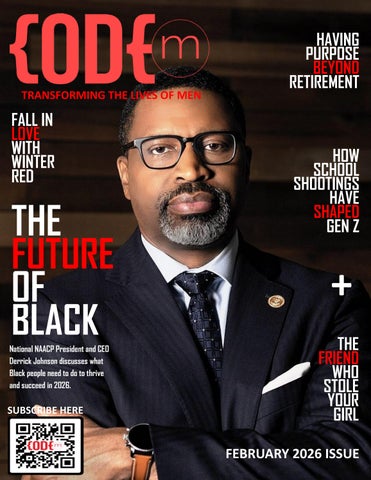
National NAACP President and CEO Derrick Johnson discusses what Black people need to do to thrive and succeed in 2026. THE FRIEND WHO STOLE YOUR GIRL
SUBSCRIBE HERE + FEBRUARY 2026 ISSUE FALL IN LOVE WITH WINTER RED


February invites us to reflect on two powerful forces: love and legacy.
As we honor Black History Month, we are reminded that our history is rooted in love love for family, love for community, love for freedom, and love strong enough to endure oppression while still believing in a better tomorrow. Our ancestors loved us so much that they fought, sacrificed, and dreamed beyond their own lifetimes so we could stand where we are today.
That kind of love is disciplined. It’s intentional. It Valentine’s Day often focuses on romantic love, but this month I want to challenge us to think deeper. Do you love yourself enough to protect your mental health? Do you love your purpose enough to stay committed when the process gets uncomfortable? Do you love your brothers enough to hold them accountable and lift them when they stumble?

For me, love showed up during moments when I had to rebuild. Love looked like self-honesty. Love looked like growth. Love looked like choosing purpose over pride. And love ultimately looked like creating Code M Magazine a space designed to affirm Black and Brown men, tell our stories with dignity, and remind us that we matter.
Love is not just what you feel. It’s what you invest in. It’s how you show up. It’s how you honor those who came before you and how you prepare the way for those coming after you.
This month, I encourage you to love boldly yourself, your people, and your potential. Let Black history remind you of your resilience, and let love guide how you move forward.
My hope is that the words and photos in this publication continue to inspire, heal, and change lives for the better.
Lead with love.
Build with purpose.


America is at it once again: trying to revise and erase Black history in order to support a white nationalist agenda and hide what’s considered emotionally uncomfortable.
THE FUTURE OF BLACK National NAACP, President and CEO, Derrick Johnson
discusses what Blacks need to do in order to thrive and succeed in 2026.
18 MOVERS AND SHAKERS
Get to know people who are making a difference in their careers and changing the world!
21 MAN CODES
Thoughts on life.
24 HOW SCHOOL SHOOTINGS HAVE SHAPED GEN Z
The kids of Generation Z, born between
1997 and 2012, have become known as the lockdown generation due to the non-stop threat of gun violence they faced in schools across America. The trauma of constantly worrying about being gunned down had had a real impact their adult lives.
37 CODE M BEAUTY
Amazing women are refining what it means to be sexy.
48 TIME FOR A COMMUNICATION REBOOT
At its foundation, communication focuses on conveying messages to generate meaning within and across various contexts. It’s complicated and it all seems to be going downhill.
32 THE 2025 CODE M MAN OF THE YEAR
The 2025 Man of the Year photo gallery captures the incredible event to salute Attorney Ben Crump for his efforts and accomplishments throughout his career.
52 THE FRIEND WHO STOLE YOUR GIRL
There is no greater betrayal than a close friend who does the unthinkable and works to steal the woman you fell in love with.
56 INACTIVE POTENTIAL IS KILLING YOU
"Inactive potential" in people generally refers to a state of sedentary behavior or untapped, dormant capabilities both physical and cognitive that, if engaged, could significantly improve health and well -being. This term covers both the physical


Bivian “Sonny” Lee III decided to make his life about saving other lives. That decision has led to raising over 700 boys to outstanding men who s uccessfully contribute to society, ending a cycle of fatherless homes.
risks of a sedentary lifestyle (sometimes called "sitting disease") and the untapped potential of brain and behavioral abilities
Get to know people who are making a difference in their organizations and in their careers
Known as one of Hollywood’s first Black costumers, Harold Crawford paved the way for a generation of talents to live their dreams and pursue their goals, making Crawford a living legend.
Winter can be cold. Heat things up with a splash of red in your wardrobe that keeps things fun and fashionable.
Blacks influence the latest trends of popular culture, fashion, and music more than any demographic. Reach them when you advertise with CODE M Magazine. With over 1.4 million viewers monthly, we have your audience.
Call 440-796-5763 to request a rate kit.


PUBLISHER
Bilal S. Akram
PRESIDENT
Brad J. Bowling
SENIOR ADVISOR
Alexandria Johnson Boone
MANAGING EDITOR
David Christel
CHIEF OF STAFF
Anita G. Butler
PAGE EDITORS
Laron Harlem-Fashion Editor
Paris Lampkins-Movers & Shakers Editor
Valerie Starks-Hutton-Beauty Editor
GRAPHIC DESIGN
Stiff Arm Media
MEDIA COORDINATOR
Carole Anthony
EXECUTIVE ASSISTANT
To the PUBLISHER
Ladonna “Lala” Dicks
EXECUTIVE CONSULTANT
Adrianne M. Sim
To submit comments,
ENGINEER RADIO/PODCAST
Chris Westbrooks
SOCIAL MEDIA
Stiff Arm Media
IT CONSULTANT
Anthony Jones
Digital Jetstream, LLC
CONTRIBUTING WRITERS
David Christel
Leslie Logan
Brad J. Bowling
Bilal S. Akram
Laron Harlem
Bolling Smith
Monique Wingard
Raland Hatchett
Akil Marshall
Dr. Tim Goler
STAFF
Sylven Lamar
Franklin Solomon


or to inquire about advertising please contact us at
info@codemediagroupllc.com


Kemp, married to his incredible wife, Stacy, and blessed with a family of six children, is a dedicated family man and community leader. He serves as the Executive Director of Love Akron and is the pastor of Street Light Church. Additionally, Boyd emphasizes mentorship and community engagement as the Head Football Coach at Garfield High School.
Boyd is an alumnus of The University of Akron, where he earned his bachelor's degree in 2004. Building on this foundation, he pursued further academic excellence by obtaining a Master of Organizational
Get to know people who are making a difference in their careers and changing the world! by Paris Lampkins
Management with a concentration in Business Leadership from Ashford University. Additionally, he is a certified instructor of Teen, Youth and Adult Mental Health First Aid, helping raise awareness of mental health challenges while reducing the stigma associated with mental health disorders.
In his commitment to community service, Boyd serves as the Chair of the Akron Citizens' Police Oversight Board and is a member of other local boards including Leadership Akron, Summit County Children Services, Chapel Hill Christian School, First Tee, and is Co-Chair of County of Summit ADM Boards Change Direction. He is also an active member of the Phi Beta Sigma fraternity and 100 Black Men.

As a wardrobe and wedding problem-solver, Anne Hydock has a passion for fashion and is an Independent Style Consultant for J.Hilburn Menswear. She loves helping men of all sizes and shapes save time, money and get the proper fit.
She is a member of the Cleveland Metropolitan Bar Association and Preferred Vendor of several country clubs and wedding venues in Cleveland.
Hydock is an award-winning sales and marketing professional with an extensive background with C-Suite, sales and marketing executives in commercial real estate, multimedia, trade shows and the fashion industry.
She provides concierge service making office and house calls and has clients across the country. Fittings take about 1-2 hours. Her shortest client is 5’4”, tallest is 6’9 and heaviest is 360 lbs.
J.Hilburn specializes in 11 custom and casual wear categories with fabrics from the most well-respected mills in Italy ~ and without the traditional markups. Low overhead and no brickand-mortars equal SAVINGS!
Fit is 100 guaranteed. Great Referral Program.

Winter Event Sale is up to 50% off through Feb. 28. Contact Anne for a complimentary consultation or a personal or virtual fitting at 440-263-3454 or anne.hydock@jhilburnpartner.com.
Jamar Williams is a Grant Manager for the Northern Ohio Recovery Association, a role he has held since June 2, 2021. In this position, he manages grants awarded by federal, state, and local governments and contributes to the development and writing of grant proposals.
He is also a proud member of Alpha Phi Alpha Fraternity, Incorporated, the first historically Black Greek-letter fraternity.
In addition to his professional work, Jamar is the owner of ProMartial Arts Lyndhurst, located in Lyndhurst, Ohio, which he opened on August 27, 2016.
The studio specializes in Korean martial arts, with a focus on Tae Kwon Do, Tang Soo Do, and Hapkido, emphasizing character development and lifelong personal growth.
ProMartial Arts Lyndhurst serves students of all ages, from 3 years old to senior citizens. The studio’s Chief Instructor, Deborah White, has a 3rddegree black belt and has been with the school since its opening.
Under Jamar’s leadership, the program prioritizes discipline, confidence, and self-respect.
We also teach a Bullying and Predator Awareness Program that teaches youth how to de-escalate bullying situations and defend themselves when


“Persistence is the only real magic I know.” - Idris Elba
“Better to die fighting for freedom then be a prisoner all the days of your life.” - Bob Marley
“Difficult and meaningful will always bring more satisfaction than easy and meaningless.” Maxime Lagacé
“Freedom is not something that anybody can be given. Freedom is something people take, and people are as free as they want to be” - James Baldwin
“I believe that if life gives you lemons, you should make lemonade and try to find somebody whose life has given them vodka and have a party.” – Ron White
“Let us put our minds together and see what life we can make for our children.” – Sitting Bull

Compiled by Bilal S. Akram
“You’ll never change your life until you change something you do daily.” - John C. Maxwell
“You cannot be afraid to disappoint people. You have to live the life you want to live.” - David Goggins
“I don’t like country music, but I don’t mean to denigrate those who do. And for those who like country music, denigrate means to ‘put down.’” – Bob Newhart
“What an old man sees from the ground, a boy cannot see even if he stands on top of the mountain.” – African quote
“Sometimes you have to lose all you have to find out who you truly are.” - Roy T. Bennett
Jeremiah 29:11 11 For I know the plans I have for you,” declares the Lord, “plans to prosper you and not to harm you, plans to give you hope and a future. (NIV)

In the Black community, the problem of Black boys not having men in their lives creates severe problems as they become adults. Statistics for positive outcomes within this demographic plague the community as a whole. Bivian “Sonny” Lee III turned the problem into a solution when he started the Son of a Saint program.
Established in 2011 by Lee, the organization's inception is a testament to the resilience of the human spirit. Rooted in a deep commitment to changing lives, Son of a Saint has become a driving force in providing mentorship and opportunities to young boys who have lost their fathers.
Since the organization's inception in early 2011, Lee has grown Son of a Saint to now serve over 700 boys with an annual budget of more than $6 million. Over its fourteen years of existence, Son of a Saint has raised more than $50 million to support its mission
and its young men.
“We wanted to create something that would last forever,” Lee said. “The impact we’re having on these young men has led to a generational change for them, and their future families and kids.”
Lee learned what it takes to be a man from his father. Bivian Lee, Jr., was an NFL defensive back for the New Orleans Saints from 1971 to 1975. Tragically, in 1984, Bivian died at the young age of 36 after suffering a heart attack. He left behind a wife, a five-year-old daughter, Tamica, and a threeyear-old son, Bivian “Sonny” Lee, III.
In turn, Lee, then twenty-nine, founded Son of a Saint on January 1, 2011, in honor of his late father and single mother. Inspired by this journey, Lee decided to create a support system for young boys in New Orleans who had lost their

fathers due to various circumstances.
The program has gained national recognition for the work it’s do-
need to feel whole and supported.”
Beyond mentors, the organization also has ambassadors. These are people who support the organization in various ways, whether that’s mental, physical, or financial support. The list of ambassadors reads like a who’s who in the community and around the country.
“We have been so blessed to have the kind of support we have,” Lee said. “I think people see the difference we’re making for the young men who attend the program, and they want to be part of the amazing transition that these men accomplish.”
The program has graduated so many young men who have gone on to do incredible things; there are too many to name. Lee is particularly proud of one of his most recent graduates, who is attending West Point.
The program will often have field trips for the boys so they can get a chance to travel and see other places. Those experiences create the kind of culture that all young men need in order to see for themselves what can happen if they try.
February is typically called Black History Month. With the impact that Bivian “Sonny” Lee III is having on so many young men, it could be called Black Future Month, too. ●


The kids of Generation Z, born between 1997 and 2012, have become known as the lockdown generation due to the non-stop threat of gun violence they faced in schools across America. The trauma of constantly worrying about being gunned down had had a real impact their adult lives.

Written by Madison M. Maynard


On December 13, 2025, Brown University faced an unimaginable tragedy while students were studying for final exams. A gunman entered the Barus and Holley Building, which houses Brown’s School of Engineering, and shot eleven students, killing two of them. The following day, families and friends of the Sandy Hook Elementary School mass shooting victims were grieving, 13 years after the horrific event, which killed 27 people, most of whom were six- and seven-year-old students.
The young child victims of Sandy Hook would have been collegeaged students today, around the same age as Ella Cook and MukhammadAziz Umurzokov, the students who were killed in the Brown shooting. Generation Z, those born between 1997 and 2012, has continuously faced the threat of school and mass shootings, something they’ve dealt with their entire lives.
From the Columbine High School shooting in 1999 to the Virginia Tech University shooting in 2007, to the Marjory Stoneman Douglas High School shooting in 2018, to the Robb Elementary School shooting in 2022, school shootings have sadly become a normal part of our reality, with Gen Z, also known as the lockdown generation, being the first to experience active shooter drills in schools.
The reality is that school shootings are happening more frequently and have drastically increased from before the COVID-19 pandemic to the present. In 2019, the year before the pandemic, there were 52 school shootings. Of course, in 2020, the country was in quarantine for most of the year; however, there were still 22 school shootings. The number then spiked in 2021, with 74 school shootings. The year with the most school shootings was 2024, with 83. In 2025, as of December 13, there have been 75 school shootings.
Due to mass school shootings happening so often, many members of Gen Z are survivors of multiple school shootings. Two survivors of the Brown University shooting spoke out publicly about surviving multiple mass shootings while still students.
In 2018, Zoe Weissman was just 12 years old, attending West Glades Middle School in Parkland, Florida, right across the street from Marjory Stoneman Douglas, when the high school experienced a mass shooting that took the lives of 17 and injured 18. Even though she wasn’t inside the high school during the shooting, she witnessed a great deal from the outside. In an interview with The Cut, she described what she saw that day, which ultimately led her to develop PTSD.
Weissman said to Andrea González-Ramirez, a senior writer for
Generation Z has experienced more gun violence than any other generation.

The Cut: “I was outside with my friends working on a project for a class. When the shooting started, we were out of our teacher’s view, so she wasn’t able to get us into her classroom before she had to close the doors. The class had about 35 students, and in the heat of things, she didn’t realize that a few of us were missing. The lockdown procedures were very unclear. We didn’t hear any alerts or any screaming.
We only realized something was happening when we saw the first responders and then heard a few pops About a minute after that, we heard a lot of pops in a row, followed by people screaming. I now assume there must have been a bunch of kids hopping the fence onto my school’s campus to get away. Once we heard that, we went to our classroom door, which was closed. I started screaming. Thankfully, a security guard heard us and let us in.”
Amidst the pain and trauma that impacted Weissman, she became a gun control activist, and when she was in high school, she became the president of Parkland’s March for Our Lives chapter.
The emotion she experienced after surviving her second school shooting was primarily anger, as she never thought this would happen to her again. However, she hopes that at least something impactful can come out of her journey, and she is also hopeful that more people will pay attention to the issue of gun violence in America. She believes that people seeing a survivor of two school shootings could have more empathy for the tragedy.
In 2019, Mia Tretta was a freshman at Saugus High School in Santa Clarita, California, when she and four other students were shot by a fellow classmate. Two were killed before the gunman turned the gun on himself.
Tretta was hospitalized and survived the shooting. She later became a gun reform advocate and joined the team at Eve-


rytown for Gun Safety, a nonprofit organization that advocates gun control legislation to pass in all fifty states. Her work in gun reform did not stop once she arrived as a student at Brown University; she was the school’s chapter president of Students Demand Action, a youth organization under Everytown.
She once again faced a shooting at her school, this time at Brown University. She never thought she’d experience this again. Tretta told The Washington Post that “I found a place where I finally started to feel comfortable.” That is no longer the case for her.
Now, she is witnessing her fellow classmates go through the same thing she experienced years prior. The impact of her first school shooting is still powerful, and now that she has experienced it a second time, she can help her classmates through the grief. It’s something she wishes she didn’t have to do.
There was a different fear for Tretta with the shooting at Brown University. When she was shot by her classmate at Saugus High School, law enforcement quickly identified the shooter. This time, she was on lockdown for hours, and they didn’t find the shooter until days later, when he was discovered dead.
Mass school shootings in our country have impacted so many members of Generation Z. There are many who haven’t experienced a school shooting but have a constant fear that it could happen to them. Elijah Williams, a student at Howard University in Washington, DC, and a graduate of Fuquay-Varina High School in North Carolina, expressed that the recent shooting at Brown had a huge impact on him.
“It really opened my eyes that it can really happen anywhere, at any time,” Williams said. “The semester was almost over; stu-

dents were getting out for the holidays. It sets in a new fear that it doesn’t have to be daylight, the middle of the semester, or earlier in the semester. It can really happen at any time, at any place.”
The unfortunate reality is that younger Americans have become desensitized to school shootings. This is true for Williams, as he expressed: “Whenever I hear about another shooting, especially another school shooting, it honestly gets to the point where it makes me feel really sad, but I can’t let it consume me because it’s become so frequent, especially as of late. I hate to say this, but it’s just another day in the news…it happens so often that it loses impact.”
This is true for so many Americans, particularly the lockdown generation. School shootings shouldn’t be normal; they shouldn’t be just another day in the news, but that is what they’ve become based on how frequently the tragedy occurs.
The physical and mental health of many young Americans is affected by mass school shootings. For survivors and the families and friends of the victims, this has consumed many aspects of their lives. It might feel incredibly hopeless for those who see the lack of effort in gun reform legislation from their lawmakers. Even with the rise in school shootings in the last few years, major gun control legislation has not been implemented on a national level by either the Democratic or Republican Parties.
However, if you are passionate about this topic, get involved in advocacy, reach out to local-, state-, and national-level politicians to express your concerns and explain how you want to see policy change, and consider a future in politics to ensure that you are working toward real solutions.
If you are interested in advocacy work, there are many organizations working to fight for gun control legislation, such as Everytown for Gun Safety, with Students Demand Action and Moms Demand Action under the organization’s network. There is also March for Our Lives, an organization led by young people and founded by the survivors of the Marjory Stoneman Douglas shooting.
Your impact could save the lives of many Americans; your participation in different parts of our democracy could eventually lead to substantial policy change. The eventual results of major gun reform legislation will move Generation Z away from the identity, the Lockdown Generation. ●
The trauma of being hunted has created a class of citizens who value gun control.


America revise support hide
America is at it once again: trying to revise and erase Black history in order to support a white nationalist agenda and hide what’s considered emotionally uncomfortable.

Written by DAVID CHRISTEL


At last count, 44 states have started debating whether to introduce bills that would limit what schools can teach about race and American history Critical Race Theory (CRT) is the thing intimidating these states the most.
What the states are pushing to enact includes actions seen in years past, as well as components of Project 2025, the Trump administration’s vision for creating a Christian-nationalist blueprint to remake the federal government. What’s happened so far includes:
• DEI programs have been attacked across the country and forced to be dropped by many organizations, schools, and agencies
• All the military’s diversity programs have been shut down
• National museums are being reviewed and funds cut if they display and document US history that makes “America look bad” and makes white people uncomfortable
• $3.4 billion in federal grants have been cut or frozen for HBCUs, and public health research that affects Blacks and Black entrepreneurs
• Cultural centers at Predominantly White Institutions (PWIs) have been shuttered
• Black history information has been expunged from national websites ranging from the Dept. of Defense to the National Park Service
• Critical Race Theory has been demonized
• 591 books by Black authors have been banned from Pentagonrun schools and libraries.
What’s happening now is that Black history and culture is being lumped in with being “woke” and characterized as being divisive and anti-American. Some are calling Black activists “terrorists” in order to intimidate and clamp down on those supporting Black autonomy, equality, and equity. There are even Christian congregations stating they’ll not tithe to their church if the money goes toward paying Black reparations.
Sadly, none of this is new, as we’ve been through similar circumstances since the early days of our country, through Reconstruction, and the Civil Rights Movement. Maya Wiley, President and CEO of the Leadership Conference on Civil and Human Rights, said, “When datasets or historical materials disappear, it becomes harder to see and fix racial disparities and every time, they were justified with new language and new fears. The terms change. The strategy doesn’t.”
That strategy is focused on one thing: ensuring that the status quo of white dominance, hierarchy, status, and privilege remain fixed in

place with legislation, Supreme Court rulings, and presidential policy directives. “These steps are veiled attempts to rewrite and distort the narrative by removing any mention of the racist actions, words, and deeds that have shaped American history,” said Karsonya “Kaye” Whitehead, president of the Association for the Study of African American Life and History (ASALH). “This regime is actively seeking to erase the lived experiences of Black people.”
What many see is the “sanitizing” of American history so that the skeletons in our national closet remain hidden from view and eventually forgotten. Like any family dynamic, the purpose is to present a front that only emphasizes “the good,” not “the bad and the ugly.” It’s all about image: the projection of a mythical narrative of wholesomeness, goodness, and virtuousness. This denial of lived experience has extraordinary negative implications economically, politically, educationally, health-wise, and culturally for the Black community.
There is no denying that African Americans have contributed significantly to the America we know today. The book Black Firsts: 500 Years of Trailblazing Achievement and Ground-Breaking Events, by Dr. Jessie Carney Smith, states on the back cover that the book “…is a testimony to the rich but often overlooked history of Black life in America and throughout the world. This vital collection includes thousands of personal success stories that still resonate today. It recognizes and honors both renowned and lesserknown, barrier-breaking trailblazers in all fields arts, entertainment, business, civil rights, education, government, invention, journalism, religion, science, sports, music, and more.”
The book is a much-needed chronicle reminding everyone that the Black experience is inextricably interwoven with the entirety of American experience something that can’t be diminished, whitewashed, or eradicated. African Americans are integral to American progress, innovation, and evolution.
The erasure actions and measures being undertaken by the current administration and various groups, agencies, and organizations are receiving backlash from multiple avenues that include lawsuits, demonstrations, and counterpolitical and judicial measures. Additionally, other steps are being taken:
• the archiving of all Black content on the internet,

• preservation of historical artifacts and sites, museums, and contributions,
• the restoration of digital and physical content that was removed, and
• ensuring that vital educational initiatives, programs, and cultural events remain active.
Then there’s the matter of the Black community as a whole and how they factor into American demographics. The World Data website reports that
“The Black population in the United States has reached a historic milestone in 2025, with the latest US Census Bureau estimates revealing that 51.63 million people now identify as Black alone or in combination with another race, representing 15.2% of the total American population of 340.1 million. The Black community remains the second-largest racial group in America, trailing only the White population, and continues to play a pivotal role in shaping the nation’s cultural landscape, political dynamics, economic development, and social fabric. Understanding the demographic composition, geographic distribution, socioeconomic characteristics, and evolving identity patterns within the Black population becomes essential for policymakers, researchers, business leaders, educators, and community organizations seeking to address disparities and opportunities affecting this vital segment of American society.”
The importance of actively addressing and confronting erasure cannot be understated. The Black community is a sizeable voting block that could dramatically impact future outcomes at all levels of society. Unfortunately, not all within the Black community are in alignment with overall Black needs, civil rights, and protections.
Onyx Impact a nonprofit research, education, and digital innovation hub dedicated to building healthier, safer, and more just digital spaces for Black communities has reported that there is a system at work promoting Black disinformation. They’ve found that Black far-right activists are spreading the majority of disinformation within Black communities and engaging with the highest number of misleading narratives.
Mis- and disinformation are now commonplace in our country and considered a principal marketing tool. With the advent of technology, the dissemination of information is done on a vast scale that’s difficult to track in terms of veracity. Anyone can say anything,
Blacks are beginning to celebrate Black History their own way.

whether truthful, a lie, or a mashup of both. Who to trust and how to determine what’s real has become severely compromised.
Onyx Impact and other truth seekers are doing their best to identify and resource as many Black trusted messengers and media as possible, expose and discredit key bad actors in the primary Black disinformation networks, and aggressively counter revisionist history, civic disengagement, and disinformation narratives.
It’s a herculean task, and thankfully, there are other groups, initiatives, and projects providing resources such as The 10 Steps campaign, a nationwide mobilization project geared toward protecting democracy and giving citizens the courage and resources to resist false narratives and build stronger, more cohesive communities.
The opposite of erase is create: to enliven, to make real, to sustain. Stacey Abrams said, “We will all, at some point, encounter hurdles to gaining access and entry, moving up and conquering self-doubt; but on the other side is the capacity to own opportunity and tell our own story.” Let the story of African Americans ring true throughout the ages! ●


Danita Miller is an Army veteran, devoted parent of two, and a woman who embraces life with heart and creativity. By day, she works in Human Resources at the VA, supporting those who've served, and by passion, she's an abstract artist who finds beauty in expression without limits. Danita is passionate, grounded, and joy-driven someone who loves to sing at the top of her lungs, dance whenever the moment calls for it, and laugh often. This season of her life is all about authenticity, love in its many forms, and having fun while honoring every part of the journey that brought her here.


National NAACP President and CEO Derrick Johnson discusses what Black people need to do to thrive and succeed in 2026.


Written by BRAD BOWLING
Brad Bowling is the President of CODE Media Group, LLC. Bowling has his BA in mass media communication and an MBA in marketing. He contributes articles to the magazine continuing his love for writing.

For Blacks in America, 2026 will be an interesting year. In 2025, it was clear that Blacks were on their own. With that in mind, how Blacks respond might decide the future of the race for the next 30 years to come. If Derrick Johnson has anything to do with it, the future is now, and everyone can be a key player.
Derrick Johnson is the President and CEO of the National Association for the Advancement of Colored People (NAACP). His tenure as president started in 2017, but his passion for civil rights started much earlier.
Johnson was born in Detroit. He attended Tougaloo College, then studied law at the South Texas College of Law, where he was awarded his Juris Doctor.
He previously served as president of the NAACP's Mississippi state chapter and vice chairman of its board of directors. Johnson is the founder of the Mississippi nonprofit group One Voice Inc., which aims to improve the quality of life for African Americans through public engagement.
A lover of history, Johnson discovered at an early age that engagement was in his blood. He loved reading about those who paved the way before him, and he wanted to do the same.
“I got engaged as a student on the campus. When I went to school in Mississippi in the 1990s, many of the people that I read about, I ended up meeting,” Johnson said.
Johnson attended a meeting to discuss the counties’ options to battle a consent order that dealt with the 1954 decision on Brown vs. Board of Education. The local school district was still out of compliance with a law that was passed almost 35 years prior. Johnson noticed that the people who originally worked on that case were still in the room.
“I started to hear and see people that I read about when I was a student, and I realized, ‘wait, the people I read about in textbooks are still here fighting for equality.’ I was hooked,” Johnson said.
That meeting would spark a mission for Johnson to graduate from law school and dedicate his life to serving the purpose of impacting the lives of those around him. Johnson became an organizer in his community and worked at various non-profits.
He became the state president for the NAACP. From there,


Johnson continued in various capacities for the organization until he was asked to lead the national organization in 2017. At the NAACP, Johnson works closely with the national staff, including Wisdom Cole, the National Director of the NAACP Youth & College Division for the Association. Johnson and the organization have taken on some of the community’s top priorities since he became president.
On June 18, 2020, in Trump v. NAACP, the Supreme Court of the United States blocked the Trump administration's effort to rescind the Deferred Action for Child Arrivals program for young immigrants in "Donald J. Trump, President of the United States, et al., Petitioners v. National Association for the Advancement of Colored People, et al." The Supreme Court ruled in favor of the NAACP in a 5-to-4 decision. President Trump later wrote in a tweet that this was a "shotgun blasts into the face of people that are proud to call themselves Republicans or Conservatives."
GQ Magazine reported that under Derrick Johnson's leadership, the NAACP had landed a huge win against the Trump administration, with Johnson noting, "It's a huge victory for us."
Johnson further stated that the NAACP’s decision to defend DACA came in part because of the organization's traditional role of being a voice for Black communities, which often included immigrants.
Facebook: Stop Hate for Profit campaign
In the summer of 2020, the NAACP launched the Stop Hate for Profit campaign, targeting Facebook and its founder, Mark Zuckerberg, for refusing to take down hate speech on the platform. In a live interview on MSNBC's Morning Joe, Johnson called Facebook "one of the biggest threats to democracy". It was later revealed that the Duke and Duchess of Sussex, Prince Harry and Meghan Markle, were working with the NAACP in this campaign. Johnson praised the couple for embodying “the kind of leadership that meets the moment."

In an interview with Forbes, Johnson called on brands to boycott the platform, emphasizing his concerns about Facebook’s failure to regulate misinformation on its platform.
CBS Studios partnership
On July 15, 2020, the NAACP and Johnson announced a multi -year deal with CBS Television Studios. Variety announced that the deal would involve developing and producing scripted, unscripted, and documentary projects, with a particular focus on diverse and Black artists. The deal would not be restricted to CBS-owned platforms, and the NAACP was permitted to supply content for third-party platforms.
"In this moment of national awakening, the time has never been better to further tell stories of the African American experience,” said Johnson. "Programming and content have the power to shape perspectives and drive conversations around critical issues. This partnership with CBS allows us to bring compelling and important content to a broad audi-

Johnson speaking at various functions about the importance of Black unity.


Going into 2026, Johnson reminds Blacks to be mindful of the misinformation that exists on social media, and for everyone to draw their own conclusions when it comes to understanding what is important.
It was recently discovered that during the 2020 election, a fake video surfaced suggesting that Black women would not support the Kamala Harris presidential campaign. The reel gained traction and went viral. The reality was that the video was created by someone in the Soviet Union and spread around the internet as if it were created by a Black person.
Johnson warns Blacks that those kinds of things could create a division among Blacks if they are not careful where they obtain their information.
“We must be careful not to repeat misinformation that has been planted on social media platforms. These things start to get reported as news because we begin to empower one set of individuals and dis-empower ourselves.” Johnson continued, “I have heard more from people in interviews talk about the nature of Black males in their political leanings than I have heard from actual Black males.”
Johnson refers to his time spent at his barber, where the nonsensical talk that he hears online does not exist when he is around real people. Johnson felt like the 2020 election was filled with scores and scores of political dis-information so the Black vote would get suppressed and so Blacks would not come out to vote.
With the mid-elections coming in 2026, Blacks cannot afford to listen to any rhetoric that might be spread online. Johnson wants Blacks to do their due diligence and find out for themselves what is true and not true.
And he is not wrong. 2025 was hard on Black businesses and nonprofits. Some businesses have been shuttered while others are changing how they classify themselves in order to attract donors

and sponsors. An estimated 300,000 Black women were impacted by the change of a diversity standard in corporate America.
With 2026 off to a fast start, Blacks will have to be more vigilant than ever if they are going to thrive under the current administration.
The 2026 Black Agenda focuses on counteracting economic regression, defending civil rights, and restructuring educational and technological systems. Key priorities include reversing high Black unemployment rates, protecting the 14th Amendment, and promoting educational equity through increased Black educator representation. The agenda also emphasizes combating algorithmic bias in technology and addressing environmental racism.
Key Focus Areas for 2026:
Economic Justice: The Joint Center for Political and Economic Studies highlights a "Black Recession" in 2026, with Black unemployment increasing to 7.5%, necessitating a push against policies deemed harmful to Black workers.
Civil Rights & Protection: Black Agenda Report emphasizes defending the 14th Amendment against challenges to birthright citizenship and civil rights.
Education Reform: The African American Leadership Forum pushes for more Black educators, community governance, and targeted, measurable goals for student wellness and history.
Technology & Accountability: Color of Change aims to address bias in AI, facial recognition, and digital access.
Global Solidarity: Continued advocacy against foreign policy actions affecting Black and marginalized communities globally.
The agenda emphasizes unity, urging the pooling of resources and intelligence to fight for policy changes.
The future of Black is simple; everyone will need to come together, help each other, and fight for the things that impact the community. No one is coming to help, so look at your neighbor, roll up your sleeves, and get to work. ●
Johnson is critical of how social media is used to divide the Black community.


At its
foundation, communication
focuses on conveying messages to generate meaning within and across various contexts. It’s complicated and it all seems to be going downhill.

Written by DAVID CHRISTEL
David has been ghostwriting books for well-known people since 1995. He is also the author of Married Men Coming Out: The Ultimate Guide to Becoming the Man You Were Born to Be.
The English language has between 470,000 to 1 million words, yet the average extent of vocabulary people use on a daily basis is only about 13,000.
• Only 5% of the words people use during the day are unique words, with all others being repeated.
• The average person uses between 2.67% and 3.35% of their vocabulary every day.
• Every year that passes, the average person speaks 300 words less per day (this is thought to be due to a rise in digital communication).
Additionally, recent research found that 45% of adults prefer communication through online tools, 30% prefer email, 12% prefer face-to-face, and only 6% prefer phone calls. Technology is a primary factor prompting people to become more interested in quick sound bites that don’t require emotional in-
volvement, demand very little intellectual stimulation, and can be accomplished in a short time and with very little energy expenditure.
Now let’s combine those stats with another aspect of communication: reading.
• 21% of adults in the US read below a 5th-grade level.
• 19% of high school graduates in the US can’t read.
• 45 million adults in the US are functionally illiterate.
• 50% of adults in the US can’t read a book written at an eighth-grade level.
What all this means is that our communication skills are on a downward slope. Our ability to express our innermost thoughts and feelings coherently and with meaning is shrinking. Our ability to convey complicated, context-rich ideas and concepts is diminishing. What this also means is that our IQs are also waning.

A University of Michigan study called Monitoring the Future and the Programme for International Student Assessment (PISA) data show “a sharp decline in cognitive skills, particularly among younger generations. Teens and young adults are struggling with basic cognitive tasks like maintaining focus and processing information.” The Financial Times has reported that young people are spending less time reading and more time scrolling through digital screens a key driver behind the decline in cognitive abilities.
“Studies suggest that excessive screen time, particularly on social media, can negatively impact both verbal and cognitive skills. Prolonged exposure to screens makes it harder to concentrate and retain information, which may explain why many young adults are struggling with cognitive tasks.

The connection between technology and cognitive decline is not limited to attention span issues. Research has shown that the digital age may be rewiring the brain in ways that make it more difficult to perform tasks that require deep thinking and sustained focus. … With the ease of access to information online, many individuals may find it less necessary to engage in deep thinking, instead relying on quick, surface-level insights.”
The word that comes to mind to describe our current state of communication is “fatuous.” We appear to have become hooked on meaningless attention grabbers and call it entertainment, politics, and news. We’re also readily substituting words with any of the available 3,953 emojis. Additionally, words are being shortened for purposes of input speed, emotional shorthand, or avoidance, and trendiness.
We’ve become a nation that, on one side of the swinging pendulum’s arc, is the creation of noise, and the other side is all about vacuous chit-chat. The noise side produces everything that’s communication bling, pretentious bluster, glib pomposity, and manipulative spin without any real substance (and oftentimes short on factual reality).
The chit-chat side is equally without substance and relies on quick text bursts, emojis, and gifs that are supposed to convey emotional range. On the surface, they convey an idea more than a fully felt emotion. What’s missing is the allimportant nuance, inflection, emphasis, and depth. Chit chat isn’t about sustaining conversations, but about quick bursts of emotional info bytes. They are also a shortcut used to avoid dealing with one’s emotions.
Bringing this back to our IQs, research shows that adults are now struggling with basic math and reasoning tasks. The upshot is that our reliance on our digital devices and AI apps is making intellectual tasks harder to comprehend and engage with. What we’re experiencing is cognitive entropy, wherein our verbal reasoning and problem-solving skills are decreasing at an alarming rate.
This trend has reintroduced an old term: brain rot. And just like a dystopian novel, we’re letting ourselves devolve while AI evolves. Our naïve belief is that AI is helping make life
Effective communication is the key to a more connected, vibrant society.


easier and increasing our productivity, which will give us more time to pursue our interests, such as scrolling on our phones:
• The average US screen time has reached 7 hours and 2 minutes daily.
• 41% of teenagers spend over 8 hours on screens each day.
• The average person spends 2 hours and 21 minutes daily on social media.
• The average Gen Zer spends around 9 hours per day on screens.
What this is all leading to is the understanding that all the time we’re spending on our phones is time missed connecting with other human beings via phone and video calls or, better yet, face-toface interactions. We’re replacing the real world with a digitized, disconnected world where we ironically believe clicking on “like,” using emojis and gifs, posting quick “comments,” and posting inane videos for our followers equate with “connection.”
This false sense of connection is creating some serious drawbacks: communication misunderstandings, a decline in empathy and consideration, loneliness and separation, physical withdrawal from social relations, difficulty in expressing oneself, conflict avoidance, increased anxiety and depression, weakened family and community bonds, loss of shared experiences, generational disconnection, difficulty in collaborating with others, an inability to work in team situations, and a disregard and lack of respect for leadership, authority, and elder life experiences and wisdom. The outcome is a lack of fulfillment in one’s life and an inadequate ability to socialize in environments.
For many people, their attachment to their devices has become a bona fide addiction. Researchers have found that therapeutic treatment for addiction to our devices is more difficult to deal with than an addiction to heroin.
There really seems to be only one solution to this: get off one’s devices and start talking with others. As uncomfortable as that may be, it’s always the first step that’s the most difficult simply because we have to allow ourselves to be vulnerable, set aside our fears, and just go with the flow. That sounds trite, but it really is that simple.
The old adage of when you fall off a horse, dust yourself off, and get back on the horse is apt. Social interactions can be messy, complicated, confusing, hurtful, and offensive and they can be just the opposite, leading to fulfilling and rewarding relationships and life experiences.
Speech pathologists suggest taking communication workshops, role-playing and practicing communication, reading and listening to podcasts about communication, and seeking feedback from others about how you’re communicating. They also advise to “learn to listen and listen to learn” as a way to remain present and attentive in conversations.
The outcome will be a life that’s far richer, engaging, and connected. It’s time for a communication reboot and the results will be worth it! As Paul J. Meyer has said, “Communication the human connection is the key to personal and career success.” personal and career success.” ●

Human connection has never been more needed than now.


There is no greater betrayal than a close friend who does the unthinkable and works to steal the woman you fell in love with.
A COLUMN WRITTEN BY CHATGPT

Written by CY BORG
Cy Borg is an artificial intelligence writer. Using Open A.I., Cy responds to various prompts with fully-qualified answers using the internet and technology.


There are certain events in life that one never forgets the first kiss, the first car, the first heartbreak. And then, there is the friend who stole your girl. That unforgettable betrayal by the person you trusted the most. It’s like being blindsided by a friendly bear hug that ends with you getting thrown into a pit of molten lava. Not only does it hurt, but it also makes you reconsider your entire social circle, your taste in friends, and possibly your taste in women (although, let’s be honest, that’s probably the last thing to blame).
Let’s take a moment to meet this treacherous character The Friend. He was the guy you could always count on, the one you shared inside jokes with, and the guy who, in the early days of your friendship, swore he would never even think about dating your girlfriend. “Bro code,” he said. It was almost too perfect: the camaraderie, the trust, the mutual respect. Until, of course, the day came when he decided to test the limits of the “bro code.”
It all started innocently enough, with a casual hangout, perhaps watching the game, eating pizza, or playing video games nothing out of the ordinary. But then, without warning, he started looking at her differently. You know that look, don’t you? The kind of look
ie has a hole in the sleeve what was once comfortable and safe now feels questionable.
The slow burn of betrayal began with innocent texts. “Hey, how’s your day going?” “What’s up?” “I just wanted to let you know I think you’re really cool.” Friendly, right? Absolutely. But if you’ve seen any romantic drama ever made, you know exactly where this is headed: the slow descent into treachery.
Before long, The Friend was giving your girlfriend all the attention you’d been neglecting. It was like watching a magician perform a trick ”and for my next act, I will make your girlfriend fall for me, while you’re busy not texting her back.” There was a dramatic increase in the amount of heart -eye emojis. And suddenly, you were the third wheel in your own relationship.
Naturally, your first reaction was denial. “Nah, this is just a phase. He’s just being a good friend,” you thought, while internally screaming for help. But before you could say “bro code,” there they were, locking eyes and laughing at something you definitely didn’t find funny. At that moment, you knew. You knew, as you sat there pretending to enjoy your pizza, that you were not the only one invested in this relationship.
s like realizing your favorite hood-

And then it happened. The “confession.” Not from her, mind you. She was busy trying to pretend like everything was fine. But The Friend, oh, he couldn't keep it in any longer. One night, under the guise of “bro-to-bro honesty,” he casually mentioned that he'd been “feeling something” for your girl. Oh, really? How convenient. It was like watching a car crash in slow motion, only you were in the car and there was no way to hit the brakes.
So, what did you do? You confronted them. Of course, that didn’t go well. They both claimed it was “nothing personal” and “just chemistry.” Right. Because nothing says “we value our friendship” like ruining it over some unexplainable attraction.
And so, The Friend became your ex-friend. Your ex-girlfriend stayed your ex-girlfriend (for the most part). And you, the innocent bystander, learned a valuable lesson in one simple fact: Never trust a friend who suddenly becomes way too interested in your girlfriend. Because one day, he’ll steal her, and you’ll be left with nothing but broken friendships and a questionable amount of pizza grease on your shirt. ●
Having a good friend cheat with your girlfriend can be devastating.


"Inactive potential" in people generally refers to a state of sedentary behavior or untapped, dormant capabilities—both physical and cognitive—that, if engaged, could significantly improve health and well-being. This term covers both the physical risks of a sedentary lifestyle (sometimes called "sitting disease") and the untapped potential of brain and behavioral abilities.

Written by BRAD BOWLING


We live in a time where life has never been more convenient. Almost everything has been simplified to the point where effort is an afterthought. But what if advancements in technology are leading to a sedentary lifestyle that’s literally killing us?
Inactive potential is a reference to those who struggle to be motivated to do anything. Because of life’s conveniences, they don’t have to exert any energy to do anything. This mentality also leads to a lack of desire or motivation to thrive, work, and accomplish anything of meaning.
Because people are spending more time doing sedentary activities, they are becoming numb to effort. During our leisure time, we are often sitting while using a computer or other device, watching TV, or playing video games. Many of our jobs have become more sedentary, with long days sitting at a desk or while commuting. And the way most of us get around involves sitting: in cars, on buses, and on trains.
This lifestyle is creating unhealthy conditions in people that used to only be seen in older people. Today, children are developing illnesses and conditions that used to be reserved for aging seniors.
When you have an inactive lifestyle:
• You may have poorer blood circulation
• Your body may experience more inflammation
• You may develop a hormonal imbalance
What are the health risks of an inactive lifestyle?
Having an inactive lifestyle can increase your risk of developing chronic (long-term) diseases. This is sometimes referred to as "sitting disease." By not getting regular exercise, you raise your risk of:
• Obesity
• Heart diseases, including coronary artery disease and heart attack
• High blood pressure
• High cholesterol
• Stroke
• Metabolic syndrome
• Type 2 diabetes
• Certain cancers, including colon, breast, and uterine cancers
• Osteoporosis and damaging falls
• Increased feelings of depression and anxiety

You burn fewer calories. This makes you more likely to gain
You may lose muscle strength and endurance because you
Your bones may get weaker and lose some mineral content
Your metabolism may be affected, and your body may have
Having a sedentary lifestyle can also raise your risk of premature death. And the more sedentary you are, the higher your health risks are.
Physical inactivity is a growing concern and a threat to global health, with rates rising by about five percent between 2010 and 2022. This is more common in women than men and among older adults.
Lack of physical activity is linked to poor health, including metabolic syndromes, muscle weakness, and weaker bones. It also affects the brain, with studies finding that increased sitting time is associated with thinning of the medial temporal lobe, which is critical for memory. Just ten days of physical inactivity can lead to insulin resistance and brain changes associated with Alzheimer's disease.
A bidirectional relationship exists where poor mental health can lead to inactivity, and inactivity can, in turn, lead to further deterioration of mental and physical health.
So, anyone struggling with inactivity is also at risk of developing
Laziness has created a class of people who are not motivated to do anything meaningful.


health conditions that exacerbate mental and physical issues, creating a vicious cycle. The desire to become more active can be frustrating for those who have mental struggles as well.
Creating a whole new process to get moving is possible.
There are some ways you can be active around your house:
• Housework, gardening, and yard work are all physical work. To increase the intensity, you could try doing them at a more vigorous pace.
• Keep moving while you watch TV. Lift hand weights, do some gentle yoga stretches, or pedal an exercise bike.
• Work out at home with a workout video (on your TV or on the internet).
• Go for a walk in your neighborhood. It can be more fun if you walk your dog, walk your kids to school, or walk with a friend.
• Stand up when talking on the phone.
Get some exercise equipment for your home. Treadmills and elliptical trainers are great, but not everyone has the money or space for one. Less expensive equipment, such as yoga balls, exercise mats, stretch bands, and hand weights, can help you get a workout at home, too.
Creating small wins turns into larger wins, which trains your brain to want more success. That success becomes contagious as you begin to feel better and think better thoughts. There is nothing like putting a solid 30 to 40 minutes into some type of physical activity to jumpstart a change in lifestyle.
The mental aspect of getting going can be tremendous for those who live alone or have fallen into a pattern of lack of movement.

There are groups you can join to stimulate activity by doing them together, which reduces the inability to not want to try.
You can begin small and come up with a daily process of progressing slowly until your mind and body begin to crave activity. Over time, increase the activity so you don’t cause harm to yourself or create a medical emergency that stunts your mental and physical health.
Most of us sit when we are working, often in front of a computer. It can be challenging to fit physical activity into your busy workday, but here are some tips to help you get moving:
• Get up from your chair and move around at least once an hour
• Park at the back of the parking lot
• Stand when you’re talking on the phone or during a video conference
• Find out whether your company can get you a stand-up or treadmill desk
• Take the stairs instead of the elevator
• Use your break or part of your lunchtime to walk around the building
• Stand up and walk to a colleague's office instead of sending an email
• Have "walking" or standing meetings with co-workers instead of sitting in a conference room
If you are what is called “lazy by nature,” start with reading a book on healthy activities and work to develop a plan for yourself. It’s never too late to start, and once you start, don’t stop until you have reached a level you’re proud of and get the results you desire.
There are devices you can buy that aid in the fun factor of beginning an activity routine. Smart watches, watches that track health, and apps can all be used to maintain a history of your goals. They also help in adding to the fun by recording your steps, and as you hit the set goal, you will desire to increase those goals as you advance.
The human body was not meant to sit and live a sedentary life. It was meant to hunt and gather. Honor your body and yourself by moving and grooving until you’re back in action. 2026 is off to a fast start, and so should you. ●


People are taking another look at retirement and deciding that they still have much to offer themselves, and those around them.

Written by NEAL HODGES
For much of American culture, relevance is measured by age. Careers are expected to taper. Work is framed as something that ends. Identity narrows, and purpose is treated as a chapter already written. Aging, in this model, is synonymous with decline.
But what if relevance were measured differently?
Across creative, professional, and health-related fields, a more accurate metric is increasingly difficult to ignore: engagement. Sustained participation, curiosity, discipline, and purpose not chronology are emerging as stronger indicators of contribution, vitality, and well-being. When viewed through this lens, many long-held assumptions about aging begin to fracture.
The late actor Bill Cobbs offers a compelling case study not through speeches or manifestos, but through lived practice
Engagement as Evidence, Not Anecdote
Cobbs, whose career spanned decades and genres, continued working professionally well into his eighties. His relevance was not preserved through nostalgia or symbolic appearances, but through daily discipline: preparation, curiosity, collaboration, and a consistent commitment to craft.
Those who collaborated closely with him over extended periods of travel and production observed a man equally capable of professional rigor and personal vulnerability.


These sustained professional relationships revealed something that aligns closely with a growing body of research: productive engagement particularly creative engagement supports not only longevity, but quality of life.
This is not a celebrity profile. It’s a case study in measurement.
Research from institutions such as the National Institute on Aging and the Harvard Study of Adult Development consistently identifies continued cognitive engagement, social connection, and a sense of purpose as among the strongest predictors of mental health and longevity. Paid employment is only one pathway but meaningful work matters.
Across aging, labor, and public-health studies, several findings recur:
• Adults who remain cognitively and socially engaged experience slower rates of cognitive decline
• Sustained purpose is associated with lower rates of depression and anxiety
• Identity continuity being more than “retired” correlates with improved overall health outcomes
Cobbs embodied these findings long before they were fashionable to cite.
In 2020, at age eighty-six, Cobbs achieved something that quietly disrupted prevailing assumptions about aging in the creative workforce: he won his first and only Emmy Award.
The honor came for a guest supporting role on Dino Dana, a Canadian children’s television series. It was not a lifetime-

achievement award. The work was physically demanding. It was neither ceremonial nor honorary. It was recognition for current performance, judged on merit, alongside performers decades younger.
A year earlier, he had been awarded Best Director by the NAACP Hollywood Chapter for The Meeting, a stage work imagining a conversation between Martin Luther King, Jr. and Malcolm X.
That distinction matters.
From a data perspective, Cobbs’ Emmy win reinforces research showing that peak contribution does not carry a fixed expiration date particularly in fields that value interpretation, emotional intelligence, and storytelling. From a human perspective, it underscores how continued opportunity not nostalgia fuels engagement, confidence, and mental vitality in later life.
Notably, Cobbs spoke little about the award itself. He spoke about the work.
Cobbs was not alone.
On December 31, 2025, millions watched Diana Ross approaching eighty-two headline Dick Clark’s New Year’s Eve Rockin’ Eve. There were no caveats, no softened framing. She was not introduced as “still impressive for her age.” She was presented as what she remains: a headliner.
That moment carried cultural and economic weight.
Entertainment is one of the few industries where retirement is increasingly optional, and where experience, recognition, and longevity are demonstrating measurable market value Studies by Nielsen and AARP consistently show that audiences over fifty represent one of the most powerful and under-targeted consumer segments in media and advertising.
In this context, seasoned talent signals:
• Trust
• Legacy
• Emotional credibility
Ross, at eighty-one, is not an outlier. She is part of a visible pattern.
Retirement can be fun when placing your time in the right places.


Importantly, this shift is not gender exclusive.
At eighty-five, singer Candi Staton released Back to My Roots, an album later nominated for a 2026 Grammy Award. Her continued output reflects what gerontologists and labor economists describe as late-life creative resurgence a phenomenon particularly significant for women, and especially Black women, whose careers have historically been interrupted, undervalued, or prematurely curtailed.
Research on aging and creativity consistently finds that:
• Emotional depth often increases with age
• Narrative control improves with lived experience
• Late-career creative work is frequently more intentional, not less ambitious
What figures such as Cobbs, Ross, and Staton share is not genre or medium, but continued authorship of self.
Cobbs rarely granted media interviews and never framed work in terms of fame. He spoke about it as responsibility craft, preparation, and respect.
Even in later years, he approached each role, regardless of scale, with seriousness. During one of his final performances in the movie Caroltyn, filmed in Atlanta in 2021 and released the following year, he memorized lines meticulously, asked detailed questions, learned modern technology, and sought a full understanding of the story being told.
This discipline aligns with research showing that learning new material and maintaining routine challenges the brain in ways that support cognitive health. There was no nostalgia loop, no fixation on the past. Cobbs lived in the present tense.
The irony is that while entertainment increasingly demonstrates the value of older talent, many industries continue to force disengagement at arbitrary ages. Labor-force data show that adults over sixty-five who wish to work often face structural exclusion, despite evidence that mixed-age teams outperform agesegregated ones in decision-making and problem-solving.
Entertainment’s evolving model suggests a broader recalibration:
• Value contribution, not chronology
• Measure relevance by engagement, not age
• Understand longevity as an asset, not a liability
When applied consistently, this metric reframes aging across sectors not as decline, but as evolution.
One of the least discussed aspects of aging particularly among men is identity loss. Traditional retirement can sever individuals from roles that once anchored purpose and usefulness, increasing risk for isolation, depression, and disengagement.
Cobbs resisted that rupture.
His work provided rhythm, structure, and community. More importantly, it provided meaning. Mental-health research consistently identifies purpose not productivity alone as the protective factor.
Those close to Cobbs observed that sustained engagement did not preserve youth; it preserved clarity. Relevance was not chased. It was maintained through curiosity.
Cobbs, who died on June 25, 2024, days after his ninetieth birthday, was not an anomaly. He was an example of what becomes possible when relevance is measured accurately.

The data is clear. Human evidence is clearer.
Aging does not require disengagement from purpose. It demands refinement.
Cobbs never stopped working not out of fear of aging, but because he understood something culture is still learning: Staying engaged is not about refusing to grow old it’s about refusing to disappear! ●


Madison Moore is a proud resident of Cleveland, Ohio, shaped by a community that has taught her the power of service, resilience, and showing up fully for others. Now a Juris Doctor candidate at Southern University Law Center, she channels those values into her work as a rising legal advocate committed to equity, innovation, and expanding access to justice. At Southern University Law Center, she serves as a Junior Editor for the Journal of Race, Gender, and Poverty and is a Certified Student Attorney in the Technology and Entrepreneurship Clinic through the United States Patent and Trademark Office, where
Get to know people who are making a difference in their organizations and in their careers.
By Bilal S. Akram
she assists clients on their business matters.
Madison’s professional journey spans athletics, higher education, healthcare, and public service. As an intern with Louisiana State University Athletics, she supports student‑athletes navigating the fast‑changing world of name, image, and likeness (NIL). Her earlier roles include contributing to institutional policy research at Cuyahoga Community College, strengthening ethics and compliance initiatives at The MetroHealth System, and supporting community outreach in the Office of Congresswoman Emilia Sykes.
Madison earned her B.S. in Kinesiology with a minor in Nonprofit Leadership and Social Innovation from the University of Maryland where she was initiated into Alpha Kappa Alpha Sorority, Incorporated.
DJ McEwen is a graduate of Howard University, where he earned a degree in Finance, and is originally from Columbia, Maryland. Grounded in faith, DJ is a firm believer in Jesus Christ and lives as a man of God, allowing his spiritual foundation to guide his leadership, discipline, and purpose-driven approach to life.
He is a proud member of Alpha Phi Alpha Fraternity, Incorporated, Beta Chapter. Through Alpha Phi Alpha, DJ upholds the fraternity's longstanding commitment to leadership, scholarship, service, and the betterment of his surrounding communities.
Entrepreneurship sits at the center of DJ's professional journey. He is the CEO and founder of DJS (Don't Just Settle), a clothing brand designed to promote elevated standards, confidence, and continuous personal growth. The brand reflects DJ's belief that success begins with mindset and intentional action.
Beyond fashion, DJ is expanding his business portfolio into real estate through the establishment of an LLC focused on wholesaling, flipping properties, and long-term ownership. This venture aligns with his vision for strategic investment, generational wealth, and sustainable financial impact.
DJ's mission is to build purpose-driven businesses that inspire
Alexis Walter is a community focused professional and emerging leader with a passion for service, people, and impact. She is a proud graduate of Central State University, the only public HBCU in the state of Ohio, where she developed a strong appreciation for leadership, collaboration, and giving back to her community.
Currently, Alexis works in Human Resources at First Financial Bank, where she supports employees and organizational initiatives with care, professionalism, and a people first mindset. She is known for her thoughtful approach, strong work ethic, and ability to connect with others in meaningful ways.
Alexis is a Fall 2025 initiate of Alpha Kappa Alpha Sorority, Incorporated, and is honored to continue the organization's legacy of service, sisterhood, and excellence. Her commitment to community engagement aligns closely with the sorority's mission, and she actively seeks opportunities to uplift, mentor, and support those around her.
Driven, intentional, and deeply rooted in community, Alexis is recognized as an up and coming leader who leads with integrity, purpose, and heart.


generation of talents to live their dreams and pursue their goals, making Crawford a living legend.
By Lesie Logan
The ability to speak to the people who paved the way for Blacks to succeed today has become rare. The youth of today will never really understand the effort it takes to be the first in an era where Blacks had to fight to get any opportunity to succeed.
For Harold Crawford, the desire to become one of Hollywood’s first Black costume designers meant that he would spend a lot of time alone.
“When you were tasked to do anything as I did, it meant that I was alone a lot because there weren’t many people who looked like me who were doing what I was doing. I was always the only Black in the room,” Crawford said.
In 1968, Crawford filled out an application to work at a movie studio as a costume designer. The goal of the program, spearheaded by the
NAACP, was to get more Blacks behind the camera in Hollywood.
Crawford always had a flair for fashion, and he expressed his passion by dressing some of Hollywood’s biggest stars of that era. He has worked on more than one hundred movies and TV shows in his 50-year career. He has worked at major Hollywood studios like 20th Century Fox Studios, Paramount Studios, Warner Bros Studios, and Universal Studios, where he would stay for seven years as a costumer.
“I have worked with so many wonderful people during my time, some of whom are friends today,” Crawford said.

One of his clients became his mentor and personally chose Crawford to dress him for the rest of his career. That was Robert Guillaume, who starred as Benson on the ABC TV show Benson. Guillaume also voiced the mandrill Rafiki in The Lion King and played Isaac Jaffe in Aaron Sorkin's dramedy Sports Night.
“Robert took me under his wing and kept me with him throughout his career,” Crawford said. “I remember when he became the first Black person to play Phantom of the Opera. He asked me to costume his wardrobe for that play. I was honored and humbled that we were making history together.”
And history they made. Guillame was the first to play the lead in the play Phantom of the Opera, and Crawford was the first costumer to dress the lead. Both men worked together to create a magical run of excellence that Crawford continued on every set where he worked.
Crawford’s success allowed him to choose what movies and TV shows he worked on. He eventually moved to Cleveland, Ohio, after he got married and decided to move to be closer to family.
While living in Cleveland, Crawford saw an opportunity to work at Karamu House, the oldest Black theater in the country, where he dressed those who performed at the theater for four more years.
“The Karamu House gave me an opportunity to reinvent myself,” Crawford said. “I had no idea that so many wonderful people got their start at Karamu. It was an honor to work there and continue to have successes.”
This April, Crawford is expected to be inducted into the Hollywood Designers Hall of Fame, where he will be honored for his over fifty years of dedication and being a leader in fashion for movies and television.
He recently started a nonprofit, The Harold Crawford Foundation, designed to give back and encourage those who want to follow him to manifest their own dreams of one day creating and designing clothes for people.
Crawford is a living legend, and we honor him during Black History Month. ●


Winter can be cold. Heat things up with a splash of red in your wardrobe that keeps things fun and fashionable.
Written by LARON HARLEM

A wardrobe shopper, stylist, and accessories designer who specializes in dapper looks that truly appeal to the most discerning eye. mailto: styledbydecar-lo@gmail.com, https:// www.styledbydecarlo.com/

Bradley Candie at his best. photo by D LYFE PHOTO styled by STYLED BY DECARLO


