Missouri’s Cattlemen Foundation www.mocattlemenfoundation.org
2026 MCA Officers
Anita Vanderwert, President 573-808-3000 • 620 State Route P, Fayette, MO 65248
Deb Thummel, President-Elect 660-541-2606 • 12601 Hwy. 46, Sheridan, MO 64486
Alex Haun, Vice President 816-345-0005 • 1031 SW 600 Rd., Holden, MO 64040
Vance Keaton, Treasurer 417-825-4853 • 5863 W. State Hwy 76, Anderson, MO 64831
Chris Cloud, Secretary 417-358-8459 • 7825 CL 173, Carthage MO 64836
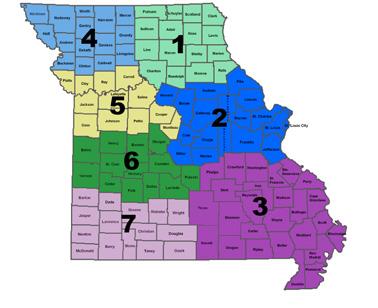
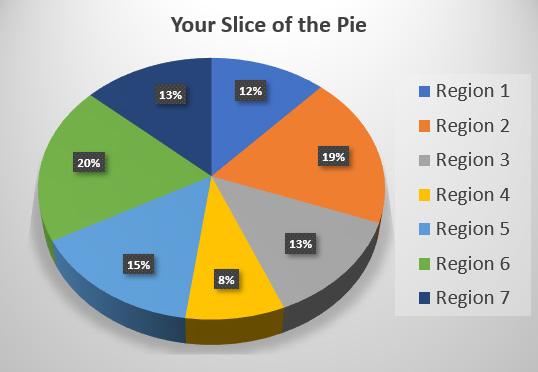
2026 MCA Regional Vice Presidents
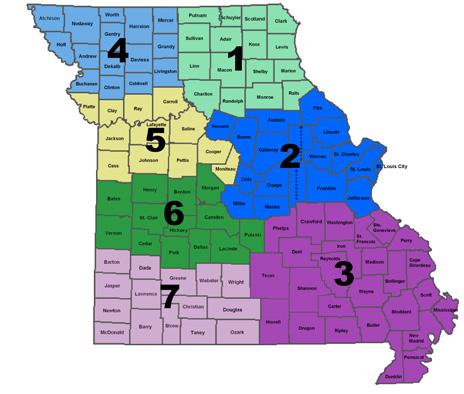
Region 1: Ethan McNeill, 325 McMurry St. Paris, MO 65275 636-544-9943
Region 2: Blake McDonald, 250 Clonts Rd. Sullivan, MO 63080 • 573-205-7914
Region 3: Danny Ross, 5514 Gaston Rd Eunice, MO 65468 • 417-932-4964
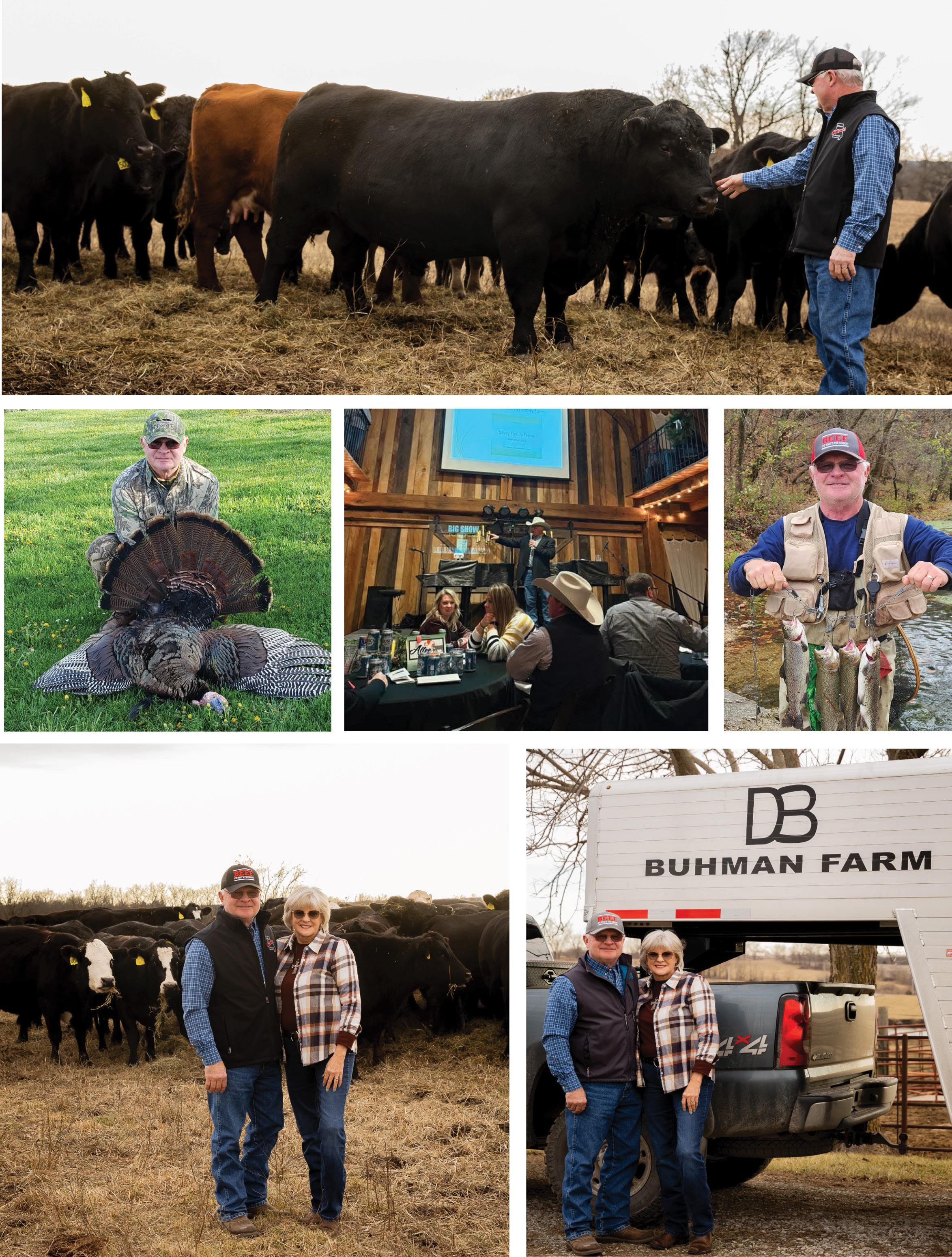
Region 4: Dale Buhman, 3751 SW Taylor Rd. Clarksdale, MO 64430 • 816-244-9249
Region 5: David Wolfe, 7761 Mount Vernon Rd Pilot Grove, MO 65276 • 660-834-3232
Region 6: Warren Love, 8381 NE Hwy ZZ Osceola, MO 64776 • 417-830-1950
Region 7: Nathan Isakson, 20706 Lawerence 2022 Everton, MO 65646 • 573-578-2518
MCA Regional Grazing Coordinators
Region 2 - Doug Mertens 573-489-5261 doug@mocattle.com
Region 3 - Kenneth Ball 417-818-6400 kenneth@mocattle.com
Region 4 - Micah Hans 636-201-6846 micah@mocattle.com
2026 NCBA CattleCon
CattleCon 2026 Heads to the Heart of Nashville from February 3rd - 5th. At CattleCon, you’ll discover a unique and comprehensive experience that brings together education, networking, business opportunities, advocacy and fun for the whole family, all under one roof. Registration for CattleCon26 is now open!
Cowboys at the Capitol
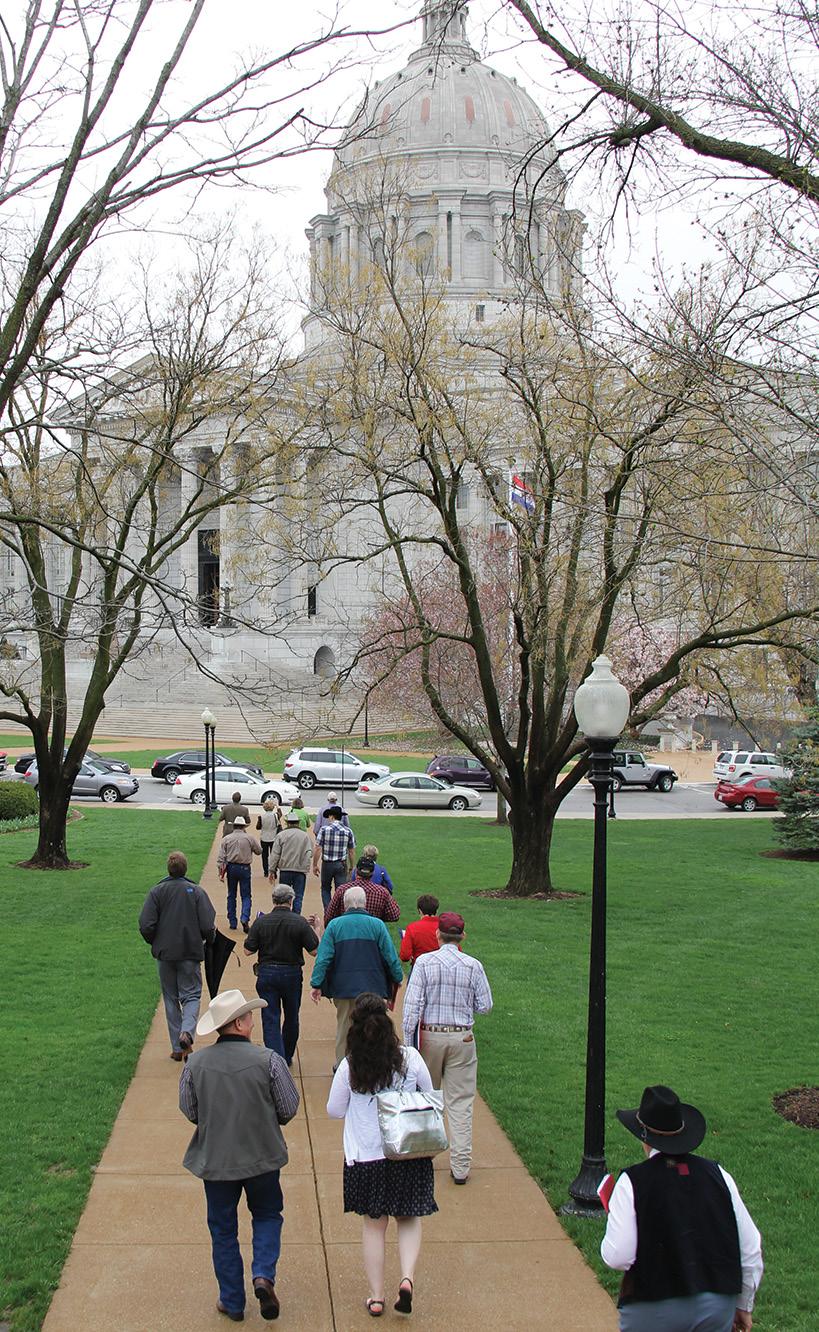
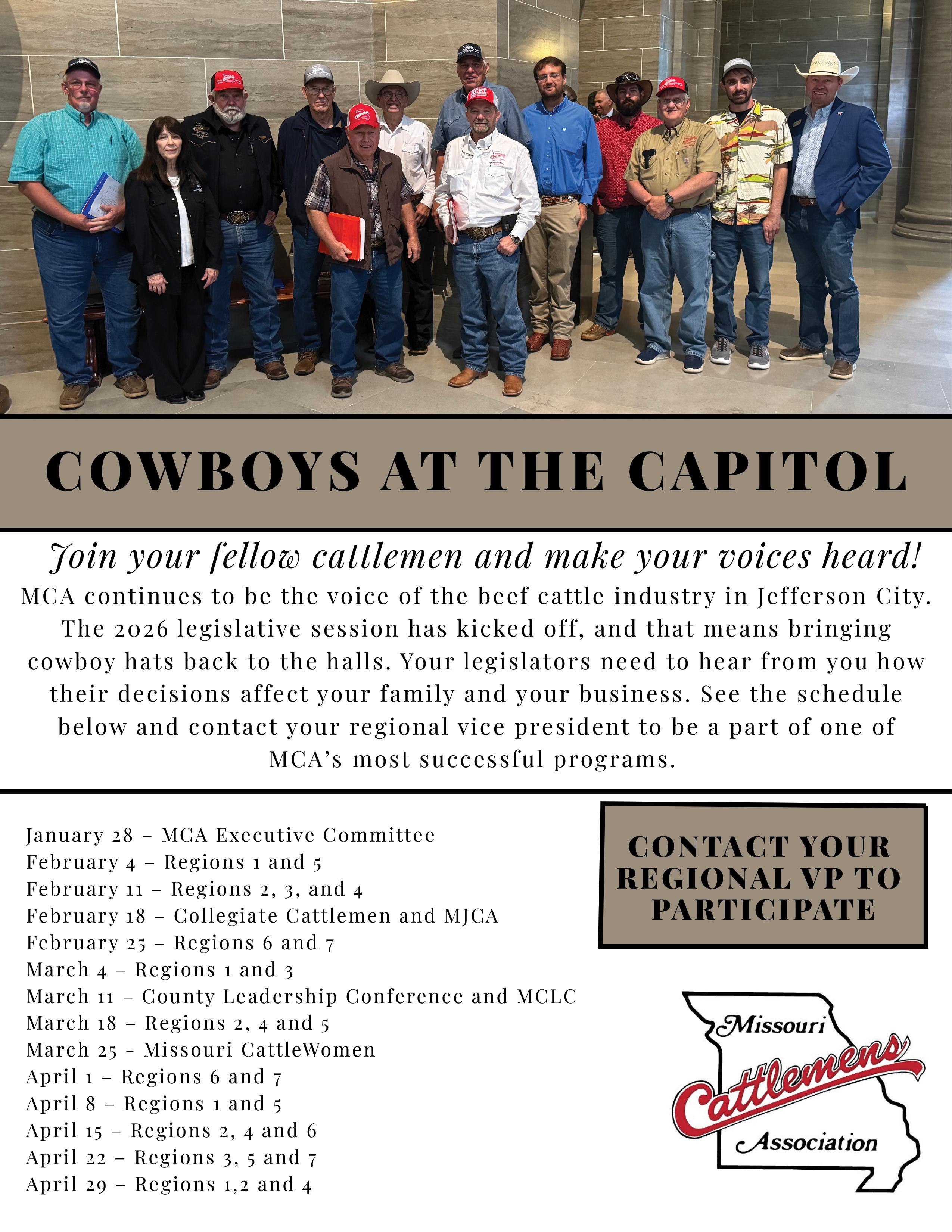
The 2026 legislative session is off to a great start with Cowboys at the Capitol meeting in Jefferson City every Wednesday. We are proud of the grassroots efforts that are reinforced through this weekly activity and see the role it plays in developing relationships with legislators. The weekly schedule for Cowboys at the Capitol—including when your region or group attends—is on page 91.
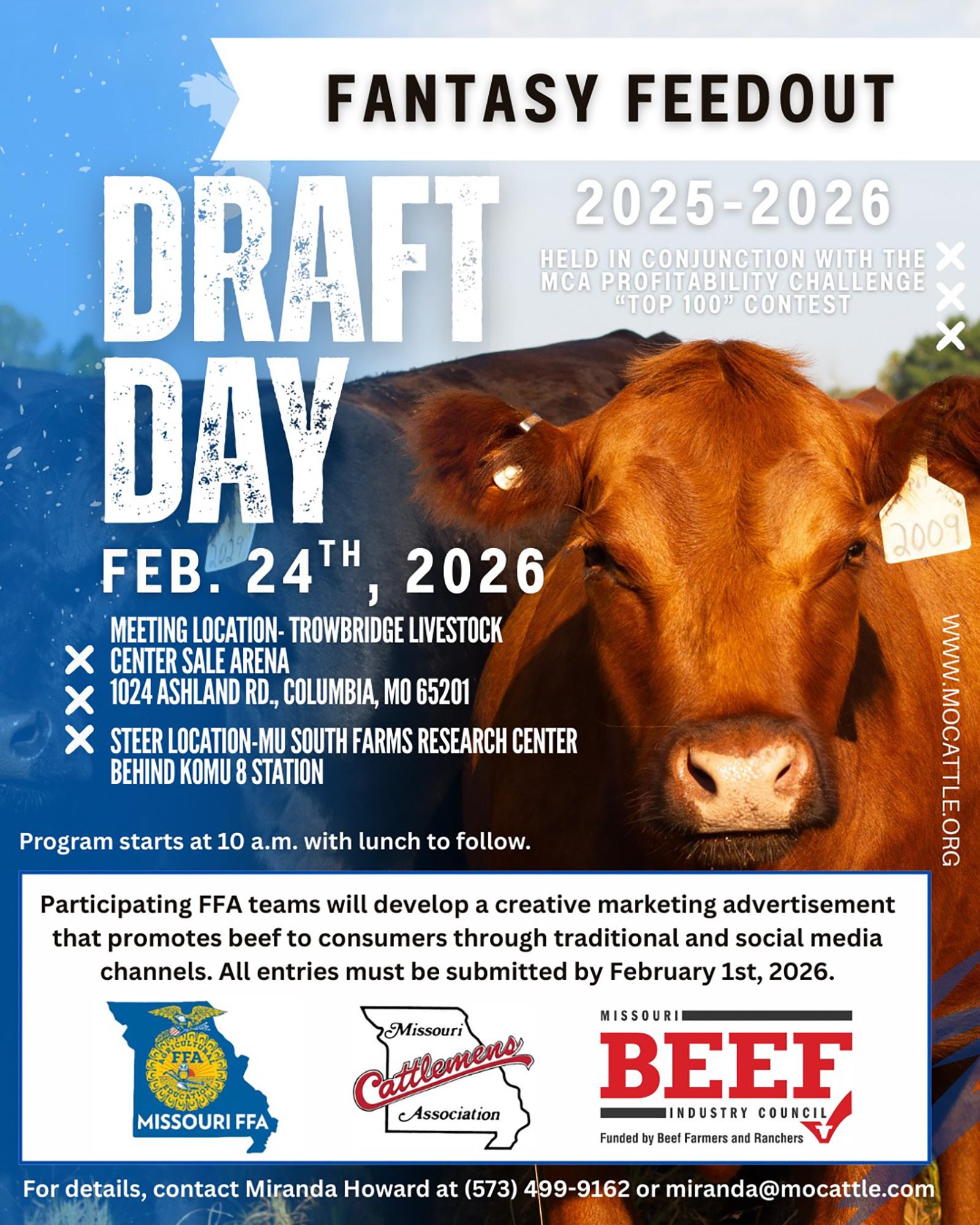
FFA Fantasy Feedout
FFA Fantasy Feedout Draft Day will occur on Tuesday, February 24th, 2026, with the program beginning at 10 a.m. and lunch to follow. The program will take place at Trowbridge Livestock Center Sale Arena in Columbia, Mo. If you or your chapter would like to participate in the 2026-2027 FFA Fantasy Feedout, please visit mocattle. com for more info or see PAGE 66.
Show-Me-Select Heifer Replacement Program
We are partnering with Show-Me-Select again this year for an exclusive new member promotion drawing. All new Missouri Cattlemen’s Association member will be entered to win in a drawing for a $2,000 credit to a ShowMe-Select Replacement Heifer sale. To be considered a new member, you must not have been an MCA member within the last 12 months. Credit must be redeemed in the same calendar year at any of the spring or fall sales. Learn more on PAGE 89.
Brian Schaufler, Schaufler Cattle Company, Holden, MO
Ronald Smith, Summersville, MO
John Hendrickson, Hendrickson Trust / Nile Valley Shorthorn, Sedalia, MO
Gabe DeShon, Gabe DeShon Farms, Clarksdale, MO
Erin Hornbrook, Sancoxie, MO
Cole Martin, Anderson, MO
Cam & Kaitlin McCurdy, Fairview, MO
Robert & Jennifer Taylor, Granby, MO
Larry Jones, Neosho, MO
Katherine Whitney, Carrolton, MO
Clinton Whitney, Carrolton, MO
Jared Embree, Moberly, MO
Christy Akers, WC Aker Farms, Windsor, MO
Harper Fricke, Mayview, MO
Chris Mershon, Mershon Cattle, Blue Springs, MO
James Holman, Macon, MO
Michael Burnett, Lincoln, MO
Jason & Heather McCoy, MWG Livestock, Archie, MO
Meah McCoy, MWG Livestock, Archie, MO
Kevin Hall, 6H Ranch, Rogersville, MO
Steve Hays, Ozarks Double L Ranch, Willow Springs, MO
John Martin, Columbia, MO
Adam Martin, Columbia, MO
Grant Coomer, Whitewater, MO
Joe Fredrick, Hermann, MO
Hayden Warner, Lady H Livestock, Buffalo, MO
Greg West, Premier Farm Realty, Springfield, MO
Claire Salmon, Salmon Cattle, Lowry City, MO
President’s Perspective with Anita Vanderwert
Great Convention
What a convention! Educational sessions and informative hallway discussions are always a highlight. Convention is a great time to learn from industry leaders and each other alike.
It is truly an honor to serve as your new president of the Missouri Cattlemen’s Association. I step into this role with gratitude for those who came before me and with genuine excitement for the year ahead. Missouri cattle producers are strong, resilient and deeply invested in the future of agriculture and that spirit drives our work.
This coming year, our focus will be clear: protecting property rights, strengthening the voice of cattle producers at the Capitol and ensuring sound commonsense policy for Missouri agriculture. We will not be put out of business by over-reaching legislation. We were able to celebrate a few big wins last year. Getting rid of capital gains tax in Missouri as well as a water preservation bill that helps keep our water in our state.
No doubt we will again be spending as much or more time fighting misaligned bills that are counterproductive to agriculture as we do try to pass bills empowered by our policy handbook.
Grassroots policy is most effective when it is powered by engaged members and that is exactly what we do - an informed, united presence working directly with
President
lawmakers in Jefferson City. There is no substitute for showing up. That’s why I invite each of you to join us every Wednesday at 9:00 a.m. at the Rotunda during a legislative session. Whether it’s your first visit or your fiftieth, your presence matters. Conversations held face-to-face help shape decisions that impact our farms, families and future generations. Although we highlight different regions to attend every week, feel free to show up whenever you are available. Grab a friend and join us. See schedule on page 91.
I also want to extend a big thank you to all those around our state who make county meetings happen, organize banquets, cookouts and help raise funds for our Foundation. These events celebrate leadership, education and the next generation of Missouri agriculture, and they remain vital to our association’s strength.
I hope to see many of you in the coming months at spring scholarship banquets and county meetings. MCA has a talented staff and your officer team is committed to serving you. Let us know how we can help.
Together, we will work hard, stay engaged and continue moving Missouri cattle producers forward. I look forward to standing beside you - in the Rotunda, across the state and throughout this exciting year ahead.
CattleWomen’s Corner with Jennifer Poor
Calving Season is Under Way
Convention is behind us and I hope everyone who went had a great time. MCW had a great meeting and voted in our new(ish) slate of officers:
Past President: Marsha Corbin
President: Jenny Poor
President Elect: Mandy Weigand
Vice President: Carolyn Dieckman
Treasurer: Mary Kay Lyle
Secretary: Terry Bettels
I am excited to work with these ladies again this year. My hope is for MCW to look deeper into our bylaws and update them where they may no longer be relevant.
If you are interested in helping out, please reach out to me or anyone on the board. We can always use the extra set of “eyes”. I also hope that we can build up our membership and encourage others to become more involved with our association. Like MCA, we are a grassroots organization and it takes members like you to get our voices heard. During our annual meeting we also voted in bylaws to change to further define what a cattlewoman member is.
This year the Convention Committee outdid themselves on coming up with educational series that might be some of the best yet. I truly appreciate a forwardthinking committee who appreciates the value of educating producers. Convention is a time to learn, a time to meet up with old friends and a time to see all the new upcoming resources the vendors have to offer producers. One of the main components of being a successful beef producer is educating yourself and convention is an excellent opportunity to do so. If you didn’t make it this year, I encourage you to go next year!
This year we welcomed our very first Missouri Beef Ambassador, Claire Walker from Chillicothe. I know she will do an amazing job promoting beef and ag to the community. Her love for our industry is undeniable. Keep your eyes open to see the great things that Claire will be doing. Congratulations Claire!
It’s February and for some of us it’s “go time” aka: calving season. In the past, I had a love hate relationship with our February calving season. Between weaning and calving some days I didn’t know if I was coming
or going. The days seemed short and the hours long. However with each passing year, I grow more and more excited for calving. I wonder what this year’s calf crop is going to look like. Are the calves going to be healthy? Are the mommas going to need help? What are the market prices going to be like? The questions are endless. However, each year I pray that the weather is mild and that the momma’s have easy, unassisted births during the early hours of the morning, giving the new calf the whole day to find their legs, warm up, and get that first drink of colostrum. Regardless of the outcome, I know it’s God’s plan and I just have to have faith in that.
This year the Cattlewomen have some fun activities planned. One in particular is our event at the historic Blackwater Depot in Blackwater, MO, on March 21st.
We are so blessed to have MBIC to partner with us again this year to bring you this event. At the time of writing this article, the specific schedule has yet to be determined. However, rest assured our past MCW president, Marsha Corbin, will have an amazing day planned. I encourage you to add this to your calendar and make plans to attend. Bring some friends with you and make it a “Girls Trip”.
One of my favorite things about using beef in soups is the versatility of the cuts. This month’s recipe calls for stew meat, but if you don’t have any in your freezer, another cut could be used in a pinch. You can substitute ground beef, meaty soup bones, cut up a roast, etc. If you are feeling extra adventurous, you could sneak in chunked up beef tongue. I’ve never tried that, but that’s not to say I won’t. Have fun with it!
Lazy Day Beef & Vegetable Soup
A lazy day needn’t mean time off from a healthy meal. Beef up your zinc levels for a healthy immune system with this smart-but-satisfying soup of Stew Meat, chickpeas, veggies and pasta.
Ingredients:
2-1/2 pounds beef Stew Meat, cut into 3/4-inch pieces
2 cans (14 to 14-1/2 ounces each) reducedsodium beef broth
1 can (15 ounces) chickpeas, rinsed, drained
1 can (14-1/2 ounces) no-salt added diced tomatoes, undrained
Cooking:
1 cup water
1 teaspoon dried Italian seasoning
1/2 teaspoon salt
1/2 teaspoon pepper
2 cups frozen mixed vegetables
1 cup uncooked ditalini or other small pasta
Shredded Romano cheese (optional)
Combine beef, broth, chickpeas, tomatoes, water, Italian seasoning, salt and pepper in 4-1/2 to 5-1/2-quart slow cooker; toss to coat well. Cover and cook on HIGH 5 hours or on LOW 8 hours. (No stirring is necessary during cooking.)
Cook’s Tip: For early eaters use no-added salt chickpeas/garbanzo beans rinsed and drained. Stir in mixed vegetables and pasta. Continue cooking, covered, 1 hour or until beef and pasta are tender. Season with salt and pepper, as desired. Stir well before serving. Serve with cheese, if desired.
Cook’s Tip: For early eaters (6-7m) certain pasta can be hard to pick up prior to baby having the pincer grasp. Pieces of pasta about the size of an adult pinky finger are preferable early on in self-feeding. These include rigatoni, penne, cavatappi.
If you have questions about starting solid foods, consult your physician or health care provider.
Alternate Cooking Method:
This recipe can be made in a 6-quart electric pressure cooker. Use 1 cup elbow noodles for ditalini. Place beef, broth, chickpeas, tomatoes, water, Italian seasoning, salt and pepper in pressure cooker. Close and lock pressure cooker lid. Use beef, stew or high-pressure setting on pressure cooker; program 25 minutes on pressure cooker timer. Use quick-release feature to release pressure; carefully remove lid. Add vegetables and pasta; close and lock pressure cooker, set timer for additional 5 minutes. When complete, use quick-release feature to release pressure; carefully remove lid. Garnish with cheese, if desired. (This recipe variation was tested in an electric pressure cooker at high altitude. Cooking at an altitude of less than 3000 feet may require slightly less cooking time. Refer to the manufacturer’s instructions.)
Straight Talk
with Mike Deering
It’s Not Just Land
It’s blood, sweat and tears. It’s the tough conversations around the kitchen table. It’s the family name. It’s your legacy. It is so much more than the deed, but that’s where it starts. That’s where the line needs drawn. Protecting the deed to your property starts with fully understanding just how vulnerable it truly is. Just ask landowners in northern Missouri who have already been in the courtroom for condemnation proceedings.
Eminent domain is being used as a weapon by outof-state, for-profit, private corporations because they couldn’t get permission the honest way. This tactic is straight out of the swamp playbook. Big money plus government muscle means you lose your land.
Eminent domain was never intended to be a shortcut for corporations who can’t get a “yes” at the kitchen table. It was meant for true public necessity. It was never meant once for out-of-state interests and corporate boardrooms that think Missouri farms are just lines on a map. If the Grain Belt Express and others cannot build their green energy boondoggle without threatening landowners, then it doesn’t deserve to be built on the backs of Missouri farm and ranch families.
This association has spent well over a decade fighting against the use of eminent domain for private, for-profit companies trying to take private land for private gain because we believe your land is your castle. That land means a whole hell of a lot more to you than dollars and cents. It’s not just land. Your deed shouldn’t come with
Executive Vice President
an asterisk that says, “unless a corporation wants to take it by force.”
This association has been relentless in our pursuit of reforming eminent domain laws in this state. In 2022, we worked alongside elected leaders, Missouri Farm Bureau and others to pass HB 2005, which was signed into law by Governor Mike Parson. The legislation provides greater protection for farm and ranch families, tightens the use of eminent domain and ensures the interests of Missouri landowners are considered and balanced with any public benefit. The provisions in HB 2005 were undoubtedly a huge win for Missouri landowners, but it was a starting point and by no means the grand finale. More work needs to be done. It must be done. We are committed to finishing this fight.
That’s why we are once again saddled up with Missouri Farm Bureau in our fight to protect private property rights. We will be pushing the “Landowner Fairness Act” this session. Stay tuned for more information about the specifics of this legislation. It’s time to put basic guardrails in place when it comes to the condemnation of private land. Protect the farm. Protect the deed. Stop eminent domain abuse. Attend Cowboy’s at the Capitol (schedule on page 91) on Wednesdays of legislative session. Speak up and join the fight.
Observations from the Field
with Micah Hans, Region Four Grazing Coordinator
Meet Micah Hans
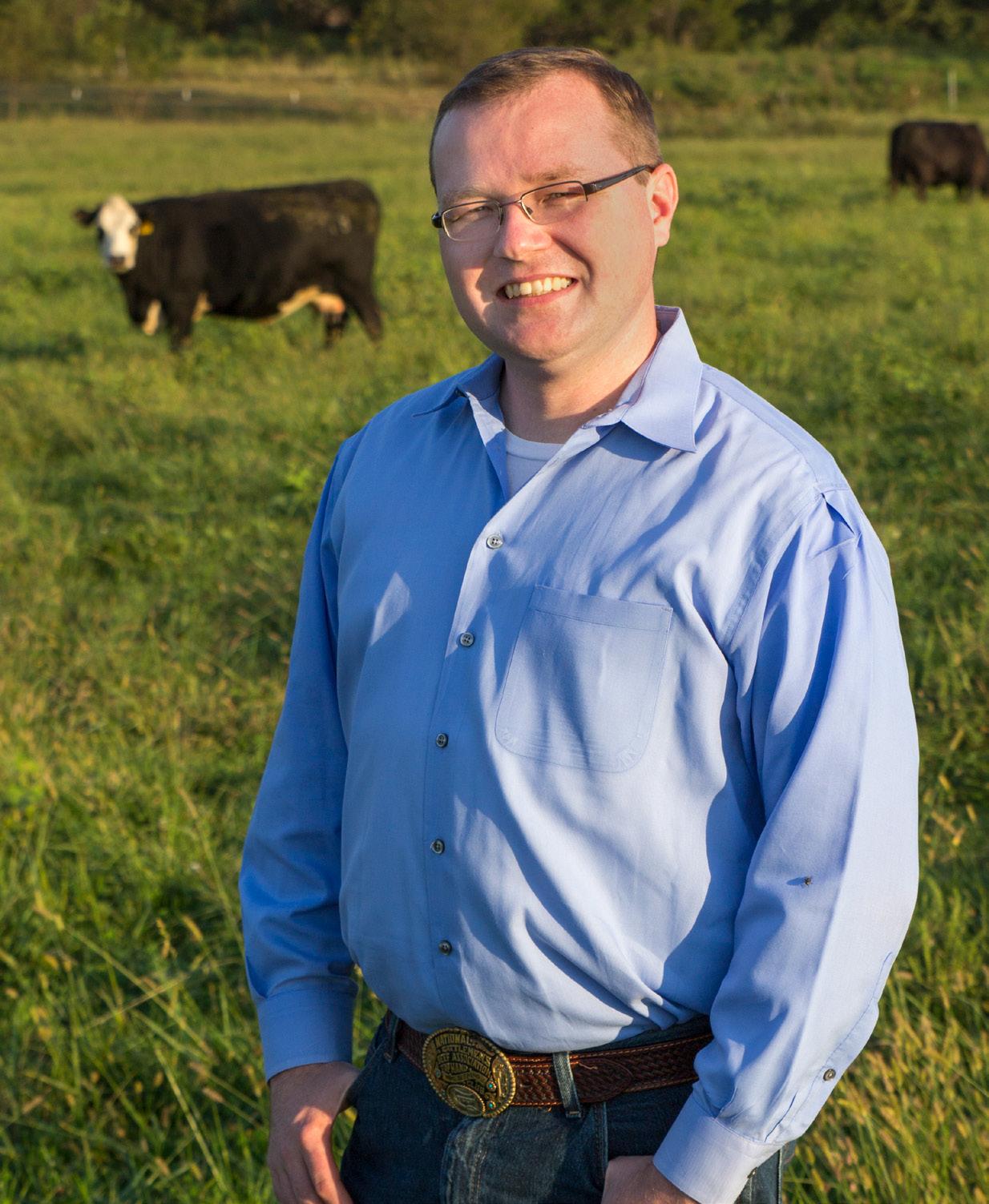
Good grazing management isn’t something learned from a book alone - it’s built through experience, asking questions, trying new ideas and learning from other producers. Those principles have guided me throughout my life and are what I bring to my role as Region 4 Grazing Coordinator for the Missouri Cattlemen’s Association.
My name is Micah Hans and I’m excited to serve cattle producers across our region while supporting grazing practices that are practical, profitable and sustainable.
I was raised on a cattle and row crop farm in Jonesburg, Missouri, where I learned early on that good grazing management comes from hands-on experience and a willingness to learn. Those early lessons shaped my appreciation for grazing systems that make better use of forage while also taking care of the land for the long term.
I’ve been married to my wife, Rachel, for 20 years, and together we are raising two children who keep us busy and grounded in agriculture and community. Our son, Dallas, is a junior in high school and currently serves as Vice President of the Montgomery County R2 FFA Chapter. Our daughter, Mylee, is in the eighth grade and is part of the local Kountry Kids 4-H Club. Both kids show steers each year at the Montgomery County Fair. Being a husband and dad has reinforced how important it is to make management decisions today that protect our farms and ranches for the next generation.
As Region 4 Grazing Coordinator, my goal is to be visible, approachable and helpful. I plan to attend local cattlemen’s meetings, field days, pasture walks and grazing events throughout the region. I also want to spend time visiting one-on-one with producers to talk through grazing goals, challenges and opportunities on their operations. A key part of those conversations
will be helping producers better understand and utilize available USDA and NRCS programs that can assist with fencing, water development, pasture improvements and conservation practices.
I believe strongly in producer-to-producer learning and open conversations about what works and what doesn’t work. Every operation is different, and there’s value in sharing experiences and ideas. I look forward to listening, learning, and working alongside producers to strengthen grazing systems across Region 4.
If you see me at a meeting or field day, please stop and visit. I’d also welcome the opportunity to meet with you directly and discuss grazing opportunities on your operation!
For help with management of native grass, or for help identifying plants or weeds (feel free to text pictures) contact Missouri Cattleman’s Association Grazing Coordinators:
Region 2 • NE MO
Doug Mertens
Doug@mocattle.com
573-489-5261
Region 3 • SW MO
Kenneth Ball
Kenneth@mocattle.com
417-818-6400
Region 4 • SE MO
Micah Hans
Micah@mocattle.com
636-201-6846
Regional Range Report
Region 4 has Been Busy
Cattlemen in MCA Region 4 have experienced an unusually mild fall and early winter-at least until recently, as winter appears ready to remind us of who’s in charge. After weeks of spring-like conditions, forecasts are now calling for an Arctic blast pushing north from the South, a sharp turn from the weather we’ve grown accustomed to.
The December Cattle on Feed (COF) report showed total cattle numbers down 2%, feedlot placements down 11%, and marketings down 12%. The report also noted “limited to no significant heifer retention.” This historic supply-demand imbalance continues to be reflected in prices at local sale barns, which have been absolutely smokin’ hot with record-breaking prices. A post shared yesterday from a northern Missouri auction barn reported a load of 905-pound steers bringing $3.75 per pound-the sixth-highest price ever recorded for 9-weight steers sold at a United States auction barn. The same sale also reported 895 lbs. at $376.35, 893 lbs. at $378.75, and 891 lbs. at $379.00. These strong prices are not isolated to one barn; sale barns across the region are seeing similar trends. With robust domestic beef demand and these price levels, it certainly appears 2026 is shaping up to be another profitable year for cattlemen.
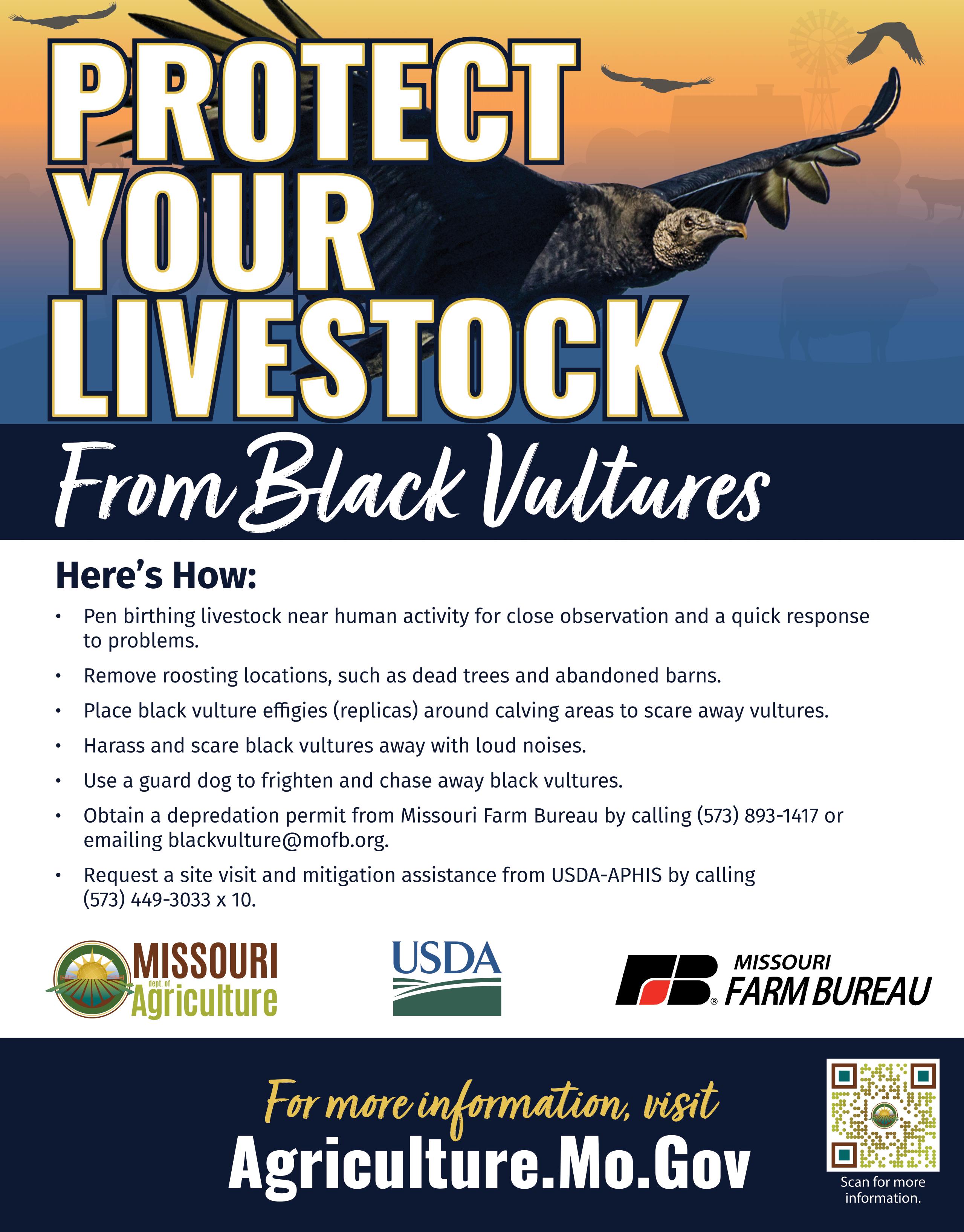
The six affiliates in MCA Region 4 have been extremely busy this fall promoting beef, MCA and the cattle industry. In September, I-35 Cattlemen hosted their first annual golf tournament, featuring beef prizes for hole contests and a prime rib dinner at the nineteenth hole. Also in September, Gentry/Worth sponsored a BBQ contest in King City. November brought an educational meeting hosted by I-35 Cattlemen on black vultures, along with a presentation from the Clinton County 4-H judging team sharing their experience competing in Scotland. That same month, our newest affiliate, Livingston County, hosted an event featuring presentations from Merck Animal Health and the
Region 1
Region 2
Region 3
by Dale Buhman, Region 4
Chillicothe FFA Ag Issues Team.
A special congratulations goes out to the Livingston County Cattlemen’s Association, which held its inaugural membership meeting in August. Their strong early success in membership recruitment is a testament to the dedication and leadership of their officer team and sets the stage for becoming one of the top affiliates in the state.
December was just as busy. Worth/Gentry Cattlemen hosted their annual Testicle Festival in Stanberry, while Nodaway County Cattlemen held a “Pasture to Plate, Chef’s Pairing” event in Maryville. This unique experience featured a five-course meal, with beef highlighted in every course except dessert, each paired with a craft drink selected by the chef. It was a great event and one I look forward to attending again next year. Just before the holidays, Andrew/Buchanan County Cattlemen hosted an informative meeting covering New World Screwworm, Theileria and virtual fencing technologies.
As you can see, Region 4 has had a very active fall, and all affiliates have annual meetings and fundraisers scheduled for the first quarter of 2026. Be sure to mark your calendars; you won’t want to miss the fellowship, fun and excitement.
•I-35 Cattlemen’s Night at the Pearl – January 31st
• Nodaway County Cattlemen’s Round Up –January 31st
• Livingston County Cattlemen’s Ball – February 28th
• Andrew/ Buchanan County Cattleman’s: Cattlemen’s Roundup - March 14th
• Gentry/Worth County Cattlemen’s Annual Banquet –March 21st
• Harrison County Cattlemen’s Annual Banquet –March 14th
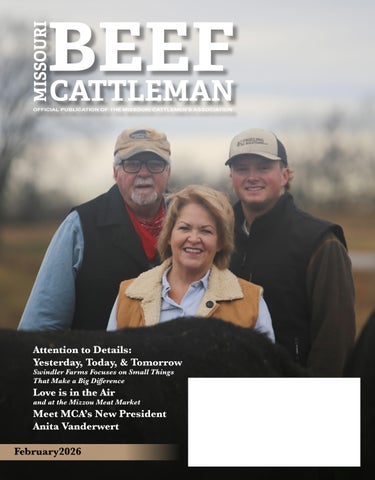
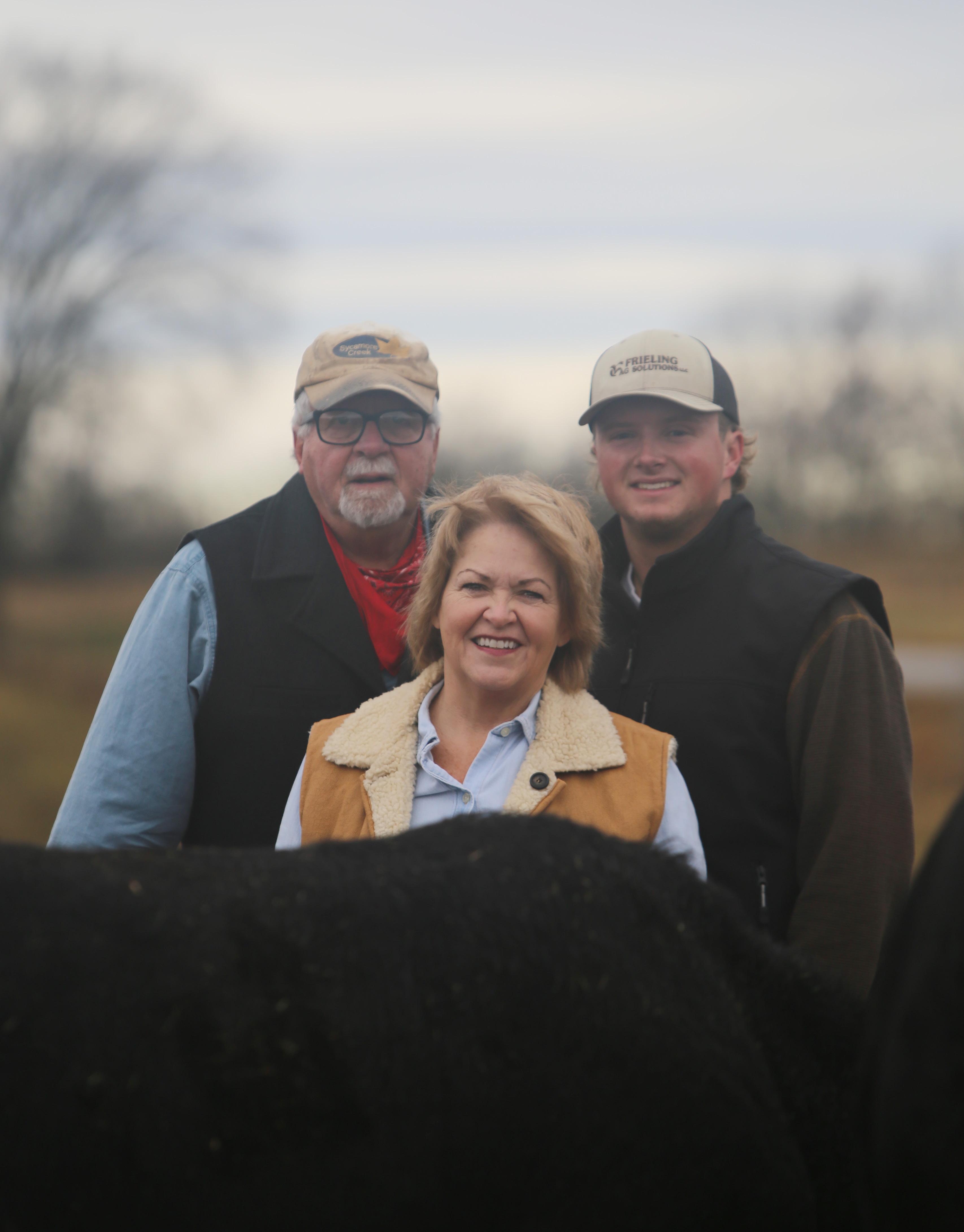
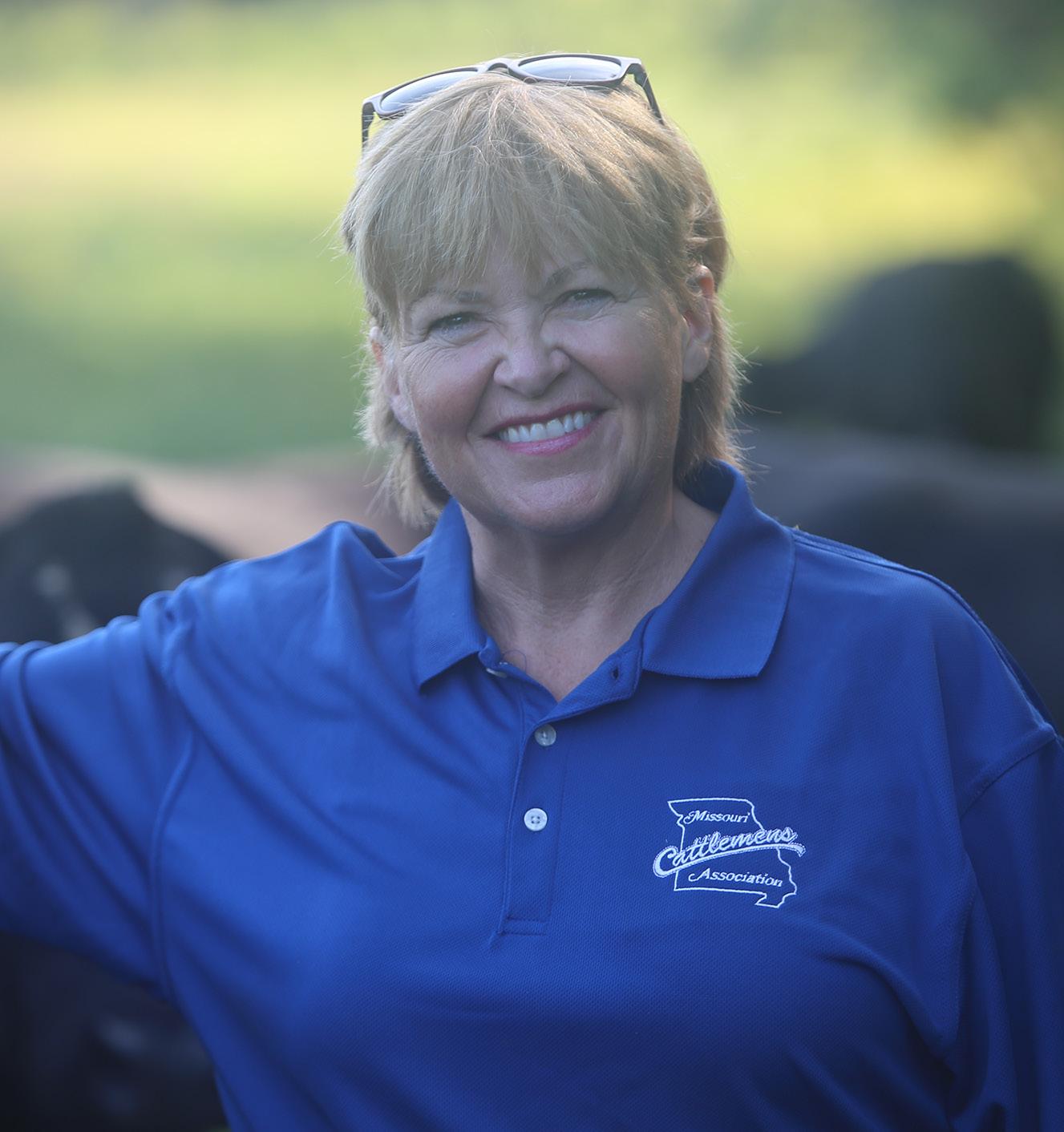
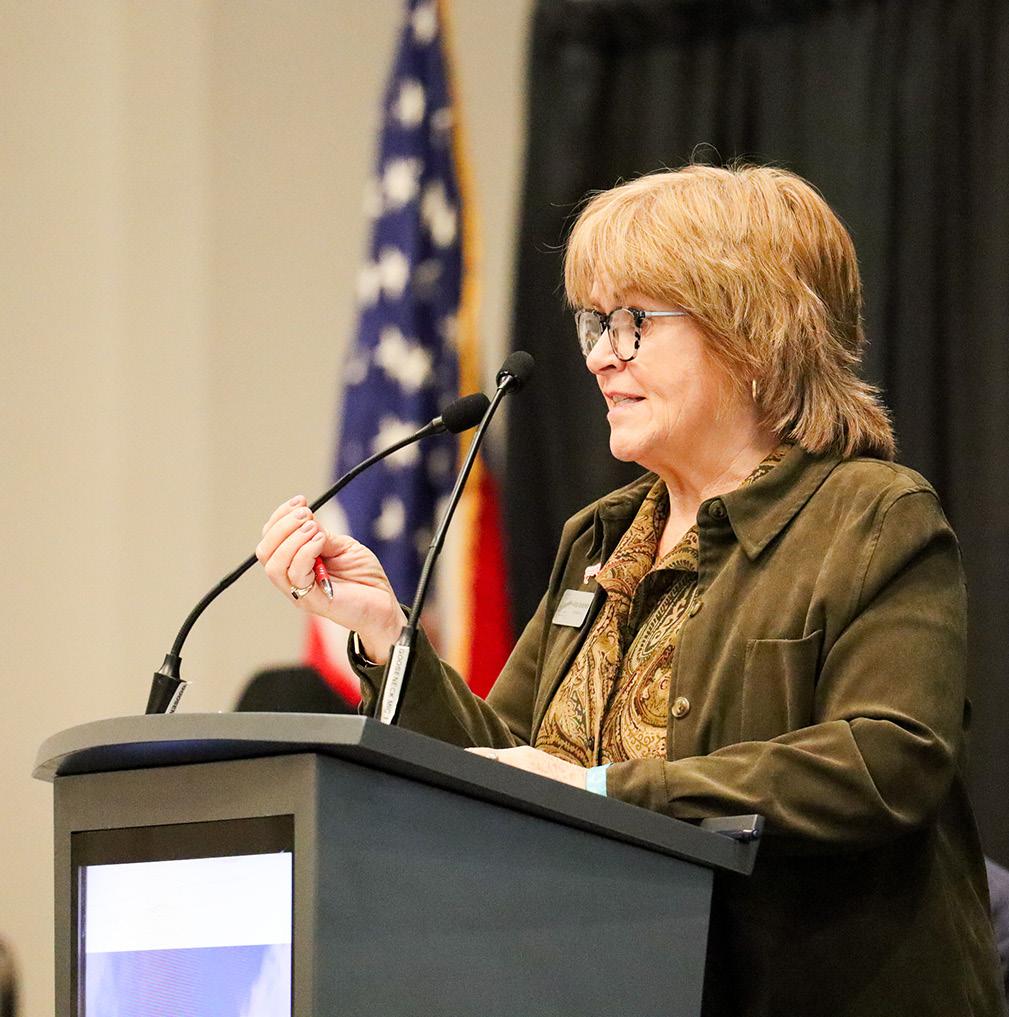
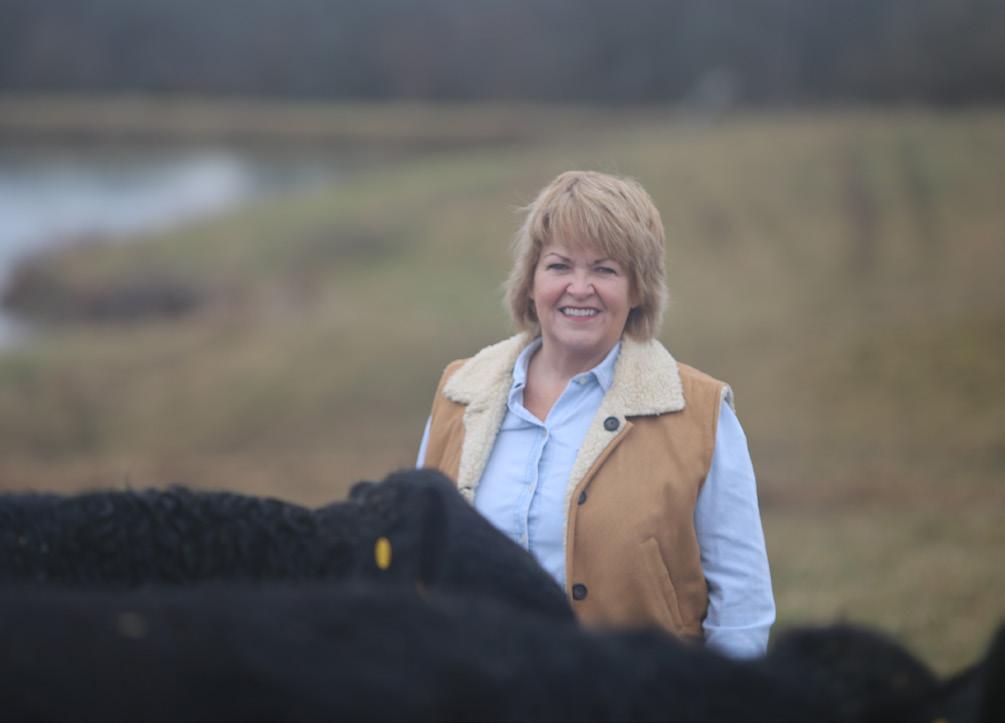
Anita Vanderwert is the new president of the Missouri Cattlemen’s Association. Some people come to the cattle business. Others are born into it, raised in barns and pastures where the work shapes who they become. Anita Vanderwert’s story is one of the latter. Cattle have been part of her life from the beginning, not as a choice she made later, but as the foundation that shaped everything that followed.
That understanding started when she was young, following her dad through barns and show rings, watching cattle evaluated, moved, and cared for with intention. When her family moved from Iowa to Lee’s Summit so her father, Ron (Jim) Geddes, could manage the J.C. Penney Angus Farm, Anita was handed a front row seat to some of the best cattle and cattlemen in the country. Her father judged shows across North America and worked with elite breeders in multiple breeds. She was there, listening, learning, and absorbing lessons most people don’t get until much later, if at all.
Those early years weren’t about titles or accomplishments. They were about repetition and responsibility. Seeing what holds up over time. Understanding why good cattle families matter. Learning that cutting corners always shows up somewhere down the line. As the youngest of four, Anita learned by watching and doing, guided by parents who believed in hard work.
As she grew older, opportunities followed. Through the Missouri Cattlemen’s Association, she began stepping into leadership roles that pushed her beyond the farm gate. Being named Missouri Beef Queen gave her the chance to travel the state and speak on behalf of producers, an experience that sharpened her confidence and taught her how to listen as much as talk. In the show ring, she found another proving ground, earning top showmanship honors at the first MCA Junior Show and building relationships that would stay with her throughout her career. Her leadership continued when she served as president of the American International Junior Charolais Association, expanding her influence and commitment to youth development within the beef industry.
FFA expanded her world even further. Competing on a livestock judging team that traveled to Scotland and across Europe, Anita saw firsthand that while production systems differ, the heart of agriculture looks the same everywhere. Good stockmen care deeply. They adapt. They take pride in doing things right. That perspective never left her.
At the University of Missouri, Anita’s education moved beyond cattle alone. She gained an understanding of policy, economics, and communication, tools that would shape the professional path ahead. Over time, that path took her into breed associations, national marketing efforts, animal health, and agricultural media. She’s worked with the American International Charolais Association, an agricultural advertising agency in Chicago on the Case IH account, the National Cattlemen’s Beef Association in Denver, a St. Louis marketing agency managing the Merck Animal Health account, and Brownfield Ag News. Today, she brings that experience to Missouri ALOT, helping develop the next generation of agricultural leaders. Through it all, her focus stayed consistent: helping producers connect with information that mattered.
Collaborating • Connecting
Travel remained a constant thread. Studying agriculture in more than 30 countries reinforced what she already believed, that stewardship, resilience, and respect for livestock are universal values. The scale may change. The language may change. The responsibility does not.
Beyond her professional roles, Anita has demonstrated a steady commitment to agricultural leadership and service. She’s served on the board of the National Association of Farm Broadcasters, as president of the Agricultural Alumni Association at Mizzou, and is a current trustee for CAFNR. She also serves on the Youth in Ag committee for the Missouri State Fair and the Missouri Wine & Grape marketing committee.
Family has always anchored Anita’s work. Her husband, Wayne, holds a PhD in Animal Science and built a career supporting producers through extension work and national breed associations, including the North American Limousin Foundation and the American Gelbvieh Association. Together, they raised their son, Ethan, with the same expectations they lived by. His leadership roles as past president of the Missouri 4-H Council and past member of the Missouri Junior Cattlemen’s Board reflect those values, as does his next step into medical school at the University of Missouri this summer. Their expertise and service have strengthened not only the industry but also the foundation of the ranching life the couple shares.
Today, those decades of experience come together at Sycamore Creek SimAngus Ranch. What started as a cow calf operation has evolved into a seedstock program focused on cattle that work in real world conditions: efficient, maternal, and structurally sound. They moved their operation from Monroe to Howard County, and today they focus on fescue tough genetics that produce calves capable of performing well from birth to harvest. The bulls and bred heifers they market are built for longevity, not trends, and that philosophy resonates with commercial cattlemen who value function over flash. Every animal on the ranch reflects the decades of accumulated knowledge between them.
Their ranch is more than a business. It’s a continuation of a legacy. The values Anita learned growing up are the same ones she works to pass down: to her family, to her customers, and to the next generation of young cattle producers watching from the sidelines just as she once did.
“As I step into this year as president of the Missouri Cattlemen’s Association, I’m excited about what’s ahead,” Anita says.
Anita’s involvement with the Missouri Cattlemen’s Association has followed her through every stage of life, from the junior show ring to boardrooms and committees. In 2026, she’ll take on one of her most meaningful roles yet, serving as President of the Missouri Cattlemen’s Association. It’s a role she approaches the same way she’s approached everything else, with respect for those who came before her and a clear focus on what producers need moving forward.
In an industry shaped by generations, Anita Vanderwert’s story isn’t about a single title or achievement. It’s about consistency. About showing up. About carrying lessons learned in a barn years ago and applying them, every day, to the future of Missouri’s cattle industry.
“As I step into this year as president of the Missouri Cattlemen’s Association, I’m excited about what’s ahead,” Anita said. “This organization has been part of my life for a long time, and I don’t take this role lightly. Missouri producers are facing a lot of challenges, but we also have incredible opportunities. I’m looking forward to working alongside our members, our board, and our partners to see where this year takes us and how we can continue moving the industry forward together.”
Red Angus Association of America Names Luke Bolin Director of Communications
Source: RAAA
DENVER— The Red Angus Association of America has named Luke Bolin as its new director of communications, bringing extensive experience in agricultural communications, creative services and team leadership to RAAA’s staff.
In this role, Bolin will lead RAAA’s communications strategy across print, digital and social platforms, working closely with staff, leadership and members to strengthen the Association’s brand presence and enhance member engagement. He will oversee content development, design, messaging and marketing support for key programs and initiatives that advance Red Angus cattle and Red Angus-influenced genetics in the beef industry.
“Luke brings tremendous experience in communications and graphic design that will complement the ongoing efforts of the RAAA communications team,” said Greg Ruehle, RAAA executive vice president. “I look forward to seeing his leadership reflected in a refreshed visual identity that further increases Red Angus visibility and acceptance across the beef industry.”
Bolin resides in Arkansas and is a graduate of the University of Arkansas, where he developed the foundation for his career in agricultural communications and creative services. Before joining RAAA, he spent more than 10 years in a leadership role with Sullivan Supply, where he significantly grew the communications department and helped elevate the organization’s visual and digital presence. His background includes graphic and brand design, content development and building communication strategies that resonate across diverse audiences.
“Luke is a talented, visionary and creative professional who comes to us with years of industry experience,” said Halla Ramsey, RAAA executive director of operations. “We are excited to leverage his graphic design expertise to elevate the Red Angus breed and his leadership skills to guide our communications team into new areas of growth and impact. The Association’s strategic plan will serve as his compass as he brings fresh perspective, innovation and momentum to RAAA.”
Throughout his career, Bolin has worked within the livestock and agriculture sectors, combining creative talent with practical industry knowledge. His experience building and managing high-performing creative
Luke Bolin joins the Red Angus Association of America as director of communications, leading the Association’s print, digital and brand efforts.
teams, developing integrated campaigns and supporting producer-focused organizations positions him well to serve RAAA’s membership and stakeholders.
“I’m excited to step into the role of director of communications for the Red Angus Association of America at such a great time for the breed and the organization,” Bolin said. “Red Angus has an incredible story to tell, and I’m grateful for the opportunity to help share it through clear, consistent and thoughtful communication. I look forward to working closely with our members and team to build a communications program that strengthens connections, encourages engagement and supports the long-term success of Red Angus.”
As director of communications, Bolin will support RAAA’s ongoing efforts to provide strong, consistent messaging around its value-added programs, breed improvement tools and member services, while showcasing the strengths of Red Angus cattle throughout the beef supply chain.
For more information about RAAA or marketing programs for Red Angus-influenced cattle, visit RedAngus.org.
The Red Angus Association of America serves the beef industry by enhancing and promoting the measurable advantages of Red Angus and Red Angus-influenced cattle. RAAA provides commercial producers with objectively described cattle by implementing new technologies and using scientifically sound principles that quantify traits of economic importance to beef producers in all segments of the beef industry. For more information, visit www.RedAngus.org.
Missouri Red Angus Breeders
Ken & Brenda Keesaman
816-675-2503 • C: 816-390-4988
Kody Keesaman 816-724-1432
Kolten Keesaman 816-808-2846
3803 SW Rogers Rd. • Osborn, MO 64474
Ken@kkfarmsredangus.com www.kkfarmsredangus.com
Kunkel 417-455-3597 kunkelfarms@netins.net
Harris 417-389-2987 Jacob Dunn 417-434-0335
COUNTY NEWS
See What’s Happening in Your County
Bates County Cattlemen
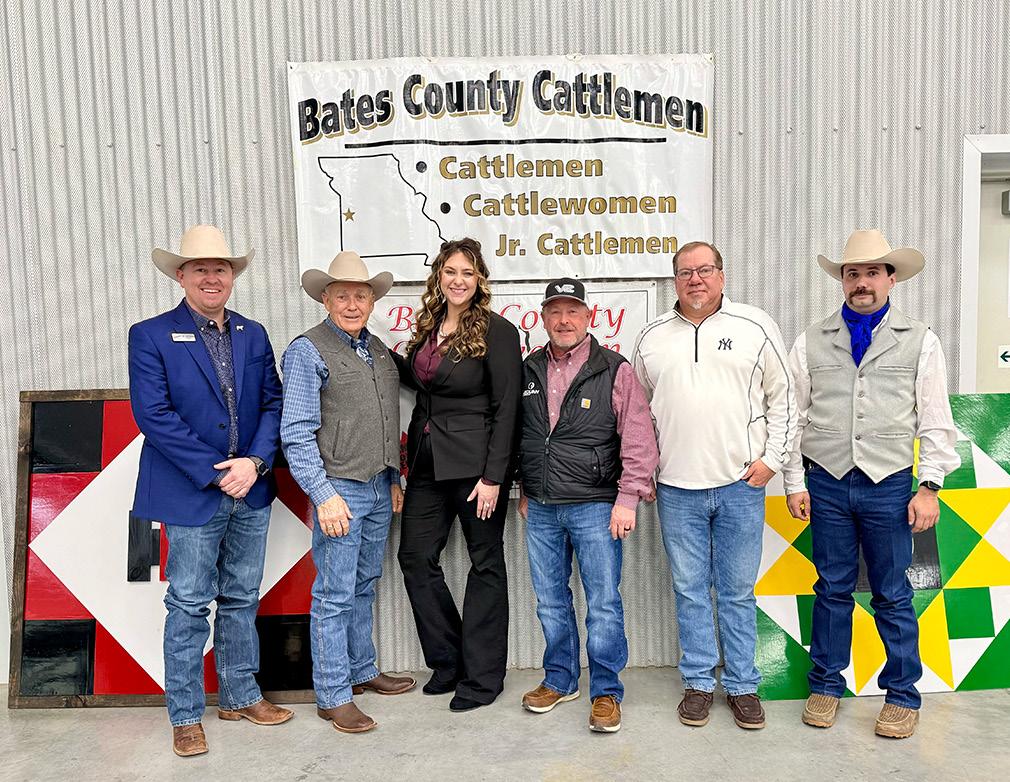
The Bates County Cattlemen held their annual prime rib dinner, Saturday, January 10th at the Adrian Optimist Club.
Region 6 Vice President, Warren Love, updated the attendees on what was happening in the region and what is on the radar for 2026. He then introduced, special guest, MCA President Jeff Reed. Jeff spoke on current affairs at the national level and how it impacts the Missouri beef industry. He reminded everyone of the upcoming state convention at Margaritaville at the Lake of the Ozarks and discussed the need for the upcoming increase of membership dues. Eminent Domain, Department of Agriculture grants, Alpha Gal, capital gains and feral hogs were also topics he touched on.
The Cattlemen awarded scholarships to both Hallie Harkrader and Natalie Nitchals this year.
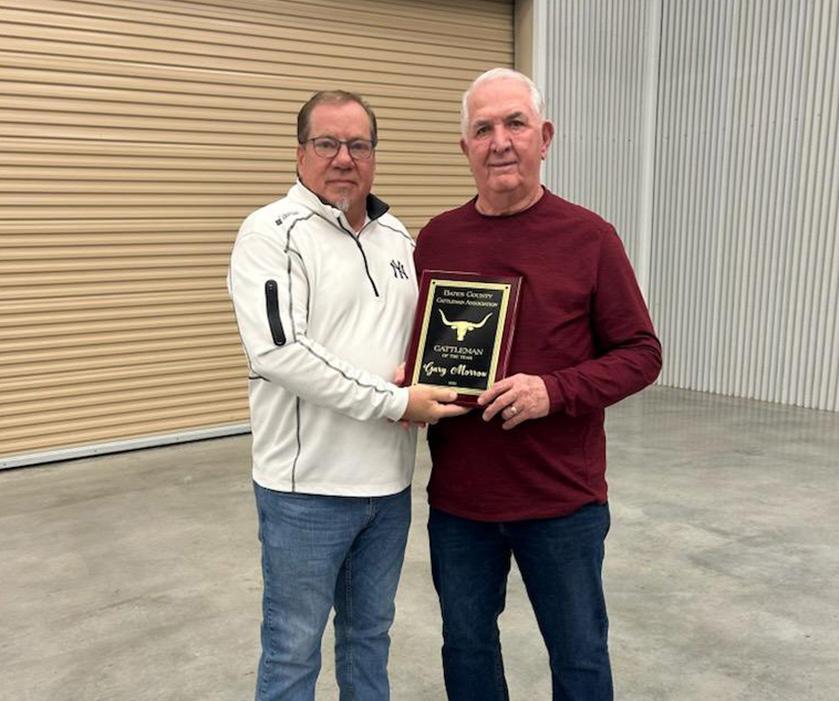
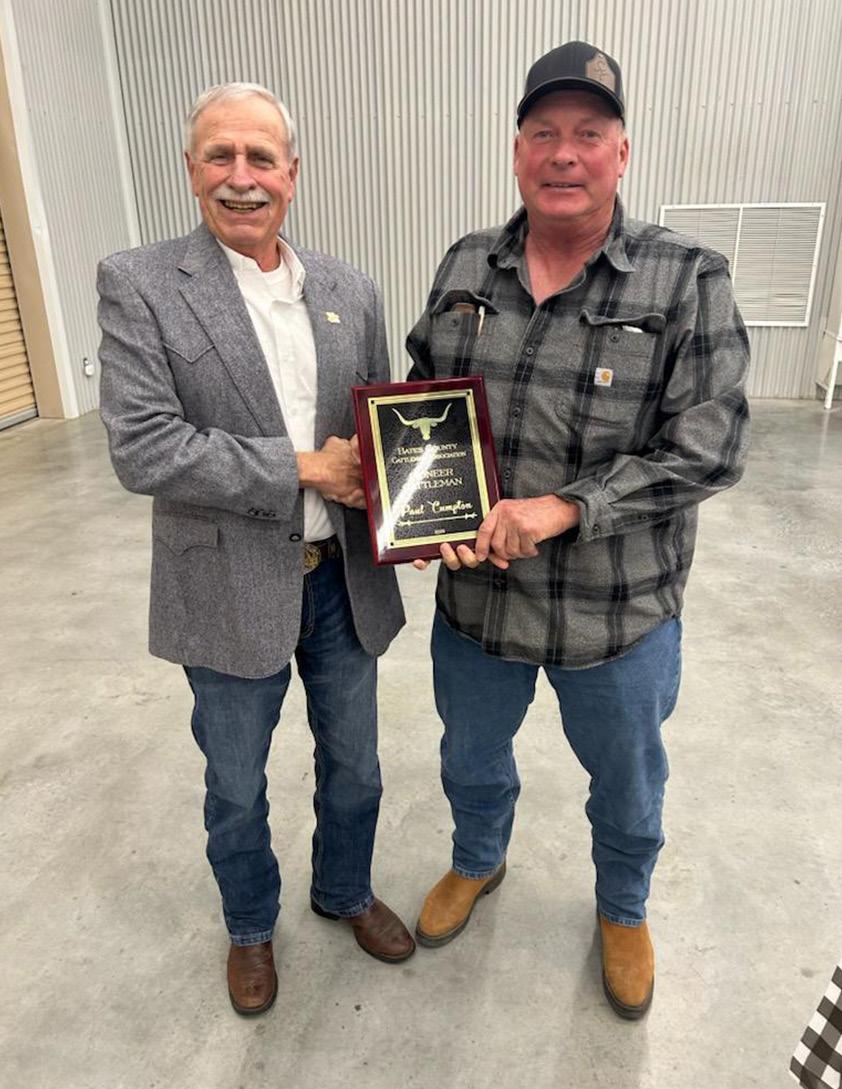
The Cattleman of the year was awarded to Gary Marrow and the Pioneer Cattleman was awarded to Paul Cumpton.
The Ballard, Drexel and Miami FFAs worked on several projects that were auctioned off after dinner and awards were presented. They were: IH barn quilt, John Deere barn quilt, black cow planters (2), red cow planters (2), porch swing, set of Adirondack style chairs with table, wine rack and glasses, horseshoe coat tree and (2) saddle/quilt racks.
L-R Jeff Reed, Warren Love, Annette Jenkins, Brad Jennings, John Lindsay, David Warfield Jr.
John Lindsay & Gary Marrow
Lonny Duckworth & Paul Cumpton
Southwest Missouri Cattlemen
In light of the nonsense going on across the nation, I’ve been avoiding the news. Rest assured, I’m not going to make you relive what you’ve seen by detailing riots across the country. I will confess to being a proud American and rancher in a state that’s known to be a GOP stronghold with steadfast support of agriculture and the contribution we make to a broad range of important economic and environmental initiatives that helps feed, sustain and strengthen our communities & beyond.
I did turn on the news yesterday long enough to watch President Trump and Secretary of Agriculture, Brooke Rollins, announce the passage of the Whole Milk for Healthy Kids Act, which is effective immediately. If you missed it, here’s an abbreviated recap of the press release:
“Thanks to President Trump’s leadership, whole milk is back – and it’s the right move for kids, for parents, and for America’s dairy farmers,” said Secretary Brooke Rollins. “This bipartisan solution to school meals alongside the newly released Dietary Guidelines for Americans reinforces what families already know: nutrient dense foods like whole milk are an important part of a healthy diet.”
Secretary Rollins emphasized that restoring whole milk in schools supports both children’s nutrition and the producers who sustain rural jobs and communities. She also highlighted the Trump Administration’s broader work to rebuild the farm economy through fair trade, lower costs, reliable financing, and strong markets, all while working to make groceries more affordable for families.(USDA.gov)
This Act is a portion of the broader initiative to amend the Dietary Guidelines for Americans, update the food pyramid, and improve the health of the American population. So, you may ask, how does that affect you and me? By updating the standards, beef is identified as an integral part of a healthy, nutritious diet, rather than a villain that should be replaced by a lab grown, processed substance, intended to taste like beef.
According to Dr. Ben Carson and Dr. Mehmet Oz, “This pivot also supports the abundant healthy food being supplied by America’s incredible farmers and ranchers. By making milk, raising cattle and growing wholesome fruits, vegetables and grains, they hold the key to solving our national health crises.” If those comments don’t make you stand a little taller, I’m unsure what will!
Speaking of politics, our January 6th Cattlemen’s meeting included a Capitol update by Brian Worthington, Agriculture Advisor to Rep. Eric Bulison. Brian spoke about a couple items that really caught my attention: First, the ability to purchase high-end proteins like steak with a pre-tax HSA account, to encourage healthy eating. Second, easing USDA regulations on direct-to-consumer inspections at custom meat processing facilities. Although I’m not certain, I believe he was referring to the H.R. 4700, PRIME Act, introduced July 23rd, 2025, which lists Mr. Burlison as a co-sponsor and currently remains with the House Committee on Agriculture. I found this summary online, at Congress.Gov: This bill exempts from federal inspection requirements animals and meats that are slaughtered and prepared at custom slaughter facilities for distribution within the state. Under the current law, a custom slaughter exemption applies if the meat is slaughtered exclusively for personal, household, guest, or employee uses.
I would also like to point out that if you go to the website, enter a quick search for H.R. 4700, you’ll see a link titled, “Contact Your Member”, which will allow you to give feedback on the bill.
Our Keynote Speakers this month were Dr. Chuck Dake, and Dr. Briana Isakson, from Dake Veterinary Clinic. Dr. Dake spoke about the importance of a bull breeding exam, and in particular, testing for trichomoniasis (trich). He covered the importance of testing, testing method, what a positive test result means for the bull and cow herd, up to and including quarantine of the entire herd. Dr. Dake answered several questions regarding the disease and highlighted the risks that arise when there is no governmental requirement to notify neighboring property owners.
Dr. Dake then spoke about the Asian Longhorned tick, and the disease it carries, bovine theileriosis. He gave our group an overview of the signs and symptoms, as well as the dismally high death rates associated with it. This is an emerging threat in Missouri so it’s important we learn to identify the tick, symptoms, treatments, and preventative measures.
Our next SMCA meeting will be Feb. 3rd at 7 p.m. in the Southwest Research Center. We hope to see you there!
Danise Cummings Secretary, Southwest Missouri Cattlemen’s Association Co-Owner, Show-Me Prime Angus Ranch LLC
Missouri Angus Breeders
9770 W. State Hwy 266 • Springfield, MO 65802 Jim 417.827.0623 Joann 417.827.2756 clearwaterangus.com Bulls & Females | Quality Angus Beef
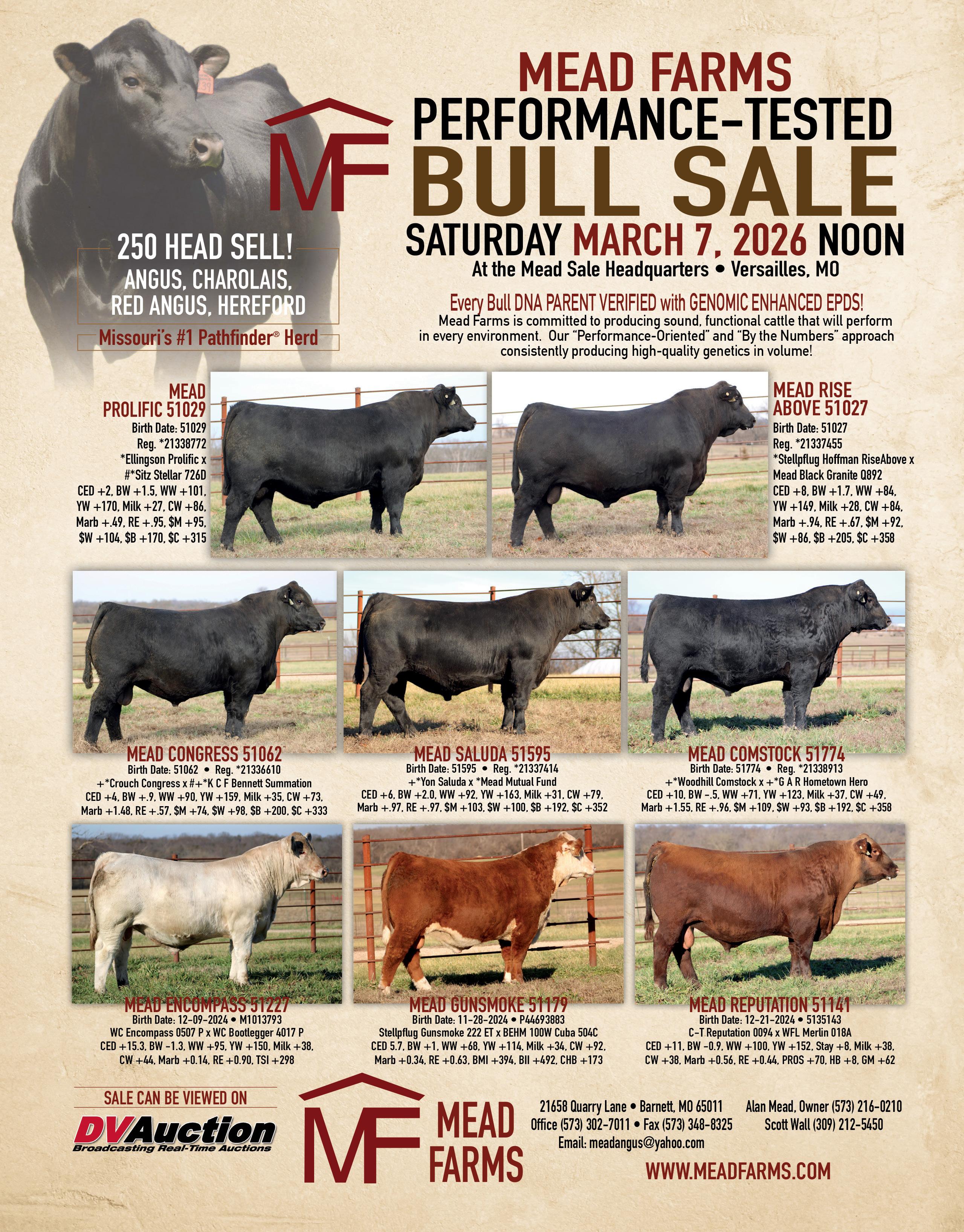
meadangus@yahoo.com
www.meadfarms.com
Marilynn Jane Howard
Marilynn Jane (Quigley) Howard, 70 of rural Monticello, Missouri passed away Wednesday, December 3rd, 2025 at her home.
She was born November 21st, 1955, to George Arthur Quigley and Ruth Ilene (McCoy) Quigley in Denver, Colorado.
She graduated Canton R-V High School in 1973. Marilynn had a knack for remembering numbers, normally a registration or tag number of cow to an ear notch of sow. She loved all of her kids and grandchildren dearly. She was a devoted Mother, Cow Grandma and Nana. Out of the many things in life, no matter the profession that Marilynn had, she was always described as one of the hardest workers that anyone had known. Marilynn met her life partner in Terry Little, they loved going to Las Vegas and Montana when the cattle allowed them to go. She enjoyed the Missouri State Fair, spending time with family and loved ones, and taking time out of her days to watch soap operas and rodeos. She is already missed greatly by those who knew and loved her.
She is survived by her partner in life, Terry Little of the home, her children, Bethany Warner of Holden, MO; Cecile (Adam) Wade of Warrensburg, MO; and
Charles Howard (Jessica) of Monticello, MO; stepchildren Michael (Tammy) Little of St Charles, MO; Melissa (Gary) Penn of Quincy, IL; and Amanda Little Corpus Christi, TX; 14 grandchildren, and 2 greatgrandchildren. A sister Sharon Lambert of Lorraine, IL, and a brother Mike (Brenda) Quigley of Canton, MO, several nieces, nephews, and friends.
She was proceeded in death by both parents, brothers Bob Ferguson, Larry and George “Gorg” Quigley, sister-in-law Judy Ferguson, and brother-in-law Keith Lambert
Funeral services were held Saturday, December 6, 2025 at Arnold’s Funeral Home in Canton, Missouri with Rev. Rusty Schultz officiating. Burial was in Forest Grove Cemetery at Canton.
Memorials may be made to the family to help with final expenses.
Pallbearers: Adam Wade, Gary Penn, Michael Little, Jason Legg, Cole Turpin and Bobbie Ferguson. Honorary Pallbearers: Grandsons, Carson Howard, Jayden Howard, Tristen Howard, Jace Little, Brock Penn and Maxx Hansen.
Queens of the Herd
Gelbvieh Continues to Wear the Crown of Maternal Excellence.
Source:
AGA,
By: Megan Underwood
Spring bull sale season has arrived and sale catalogs continue to fill the mailbox daily. As you flip through each new catalog that arrives in your mailbox, you will see everyone’s favorite sayings in their footnotes, “She’s the front pasture kind” or “She’s destined for the donor pen.” While these sayings ring true, shouldn’t beef producers raise every female with the goal to make it to the front pasture or donor pen?
While not every female can make it to the donor pen, every replacement female can make it to the pasture whether it’s the front pasture or the back pasture, every
female needs to be producing to her maximum ability. The Gelbvieh female does just that. Whatever pasture she calls home, in any environment or zip code, she continues to excel in maternal ability, and the data continues to prove it.
The United States Meat Animal Research Center (USMARC) located in Clay Center, Nebraska, is the home of the historic Germplasm Evaluation Project that has contributed data to the beef industry for more than 50 years. This project is designed to compare genetic change across beef breeds and their crosses, which allows producers to make the best genetic selection decisions in crossbreeding systems. The research goals are to identify complimentary breed utilization for traits that impact producer efficiency and cater to consumer preference, sustainability, and marketability.
SOAP WEED GELBVIEH
Dedicated to continuing the positive traits of disposition, calving ease, milk, and growth since 1978. Polled, Purebred and Fullblood Red Bulls for Sale • Available Late Fall Select Group of Red Females • Some Pairs Barb, Butch & Heather 317 State Rd B LaShell Phillipsburg, MO 417-345-6396 or 417-872-6414 65722
USMARC Progress Report No. 22 data shows Gelbvieh females have the smallest mature cow size of the four major continental breeds. The Gelbvieh breed was the only breed in the study to reduce mature cow size – at
an average of 1,382 pounds Gelbvieh-sired females had the lowest five-year-old cow weight. This reduced mature cow-size allows for puberty to be reached at an earlier age, which leads to calving earlier in the season and producing a heavier calf at a younger age.
Gelbvieh females are the smallest mature cows however, their decreased size does not negatively influence their maternal influence, it continues to improve their efficiency and makes them the picture of sustainability. Growth in your calf crop begins with the Gelbvieh female and the latest USMARC research proves this fact even more.
USMARC just released new research regarding breedspecific heterosis for growth and carcass traits in 18 United States cattle breeds, and Gelbvieh-sired females were the only Bos taurus females with a maternal weaning weight advantage. The data revealed that Gelbvieh-influenced females had a maternal weaning weight advantage of 22.7 pounds. This increase in weaning weight is thought to be the result of maternal milking ability in Gelbvieh females as Gelbvieh is in the top two breeds for average maternal milk.
In today’s market, the increased 22.7 pounds of weaning weight has a significant impact on the beef producer’s bottom line. At a market price of $4.50 per pound on five-weight steers with a 22.7 pound weaning weight advantage, the Gelbvieh influence would equate to an additional $102.15 revenue per head. On a group of 100 steers,
Gelbvieh-influenced females would generate $10,215 in additional calf crop revenue. Gelbvieh-influenced cowherds generate more pay weight which is more profit for the producer. Gelbvieh genetics grow more than just weaning weights, they grow your profitability.
The USMARC research projects continue to prove that Gelbvieh females are the queens of the herd and wear the crown of maternal excellence with honor. Gelbvieh females have the genetic capability to be the next donor dam and front pasture cow, but they really deserve to be the foundation females of the entire United States cowherd as Gelbvieh is the maternal breed of choice.
AGA Elects Board of Directors
Source: American Gelbvieh Association
LINCOLN, Neb. – Members of the American Gelbvieh Association (AGA) elected five candidates to the board of directors at the AGA Annual Meeting held December 5th, 2025, during the 55th Annual AGA National Convention in Nashville, Tennessee.
Newly elected board members are Dalton Bennett, Red House, Virginia; Gary Carlisle, Redmont, Utah; and Josh Phillips, Lathrop, Missouri. Re-elected to serve a second term were David Larson, Clearbrook, Minnesota, and Brent Overmiller, Smith Center, Kansas.
The AGA board of directors also elected individuals to serve in leadership positions on the executive committee for 2026. Dan Warner, Arapahoe, Nebraska, was reelected president. Stuart Jarvis, Phillipsburg, Kansas, was re-elected vice president. Brent Overmiller was re-elected secretary. Gregg Hartman, Pueblo, Colorado, was elected treasurer.
Other members of the board include Greg “Bubba” Anderson, Marion, North Carolina; Zack Butler, Milton, Tennessee; Troy Forbes, De Smet, South Dakota; William McIntosh, Georgetown, Kentucky; John Shearer, Canton, Kansas; Mark Stock, Waukon, Iowa; and Justin Taubenheim, Amherst, Nebraska.
Retiring members of the 2025 AGA board of directors were Mark Covington, Montrose, Colorado; Tom Vehige, Billings, Missouri; and Cory Voss, Bruning, Nebraska.
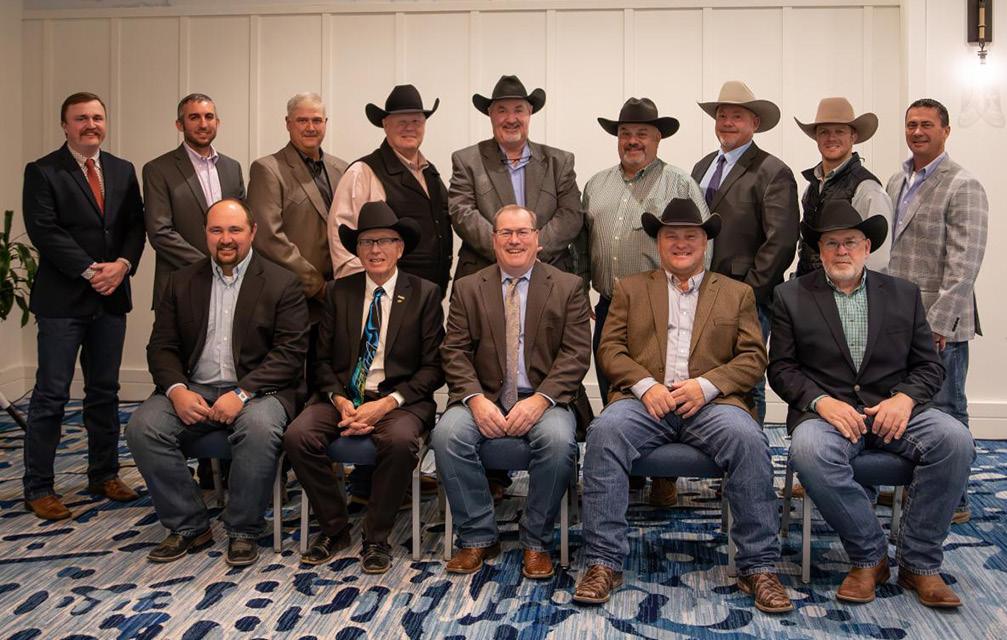
Pictured is the 2025-26 AGA Board of Directors. Back row (l to r): David Larson, Clearbrook, Minn.; Zack Butler, Milton, Tenn.; Mark Stock, Waukon, Iowa; John Shearer, Canton, Kan.; Troy Forbes, De Smet, S.D.; Greg “Bubba” Anderson, Marion, N.C.; Gary Carlisle, Redmond, Utah; Justin Taubenheim, Amherst, Neb.; and Josh Phillips, Lathrop, Mo. Front Row (l to r): Brent Overmiller, Smith Center, Kan.; Gregg Hartman, Pueblo, Colo.; Harold Bertz, AGA executive director; Dan Warner, Arapahoe, Neb.; and Stuart Jarvis, Phillipsburg, Kan. Not pictured: Dalton Bennett, Red House, Va., and William McIntosh, Georgetown, Ky.
• Genomic EPDS/ Sire Verified & Ultrasound Data
• Blacks & Reds
• Several DNA tested Homozygous Black/Homozygous Polled
• Low Birth Weights/High Growth/ Packed with Meat & Muscle
Select Group of Open Purebred Gelbvieh & Balancer Heifers
• Open Heifers will be Pelvic Measured & Reproductive Scored
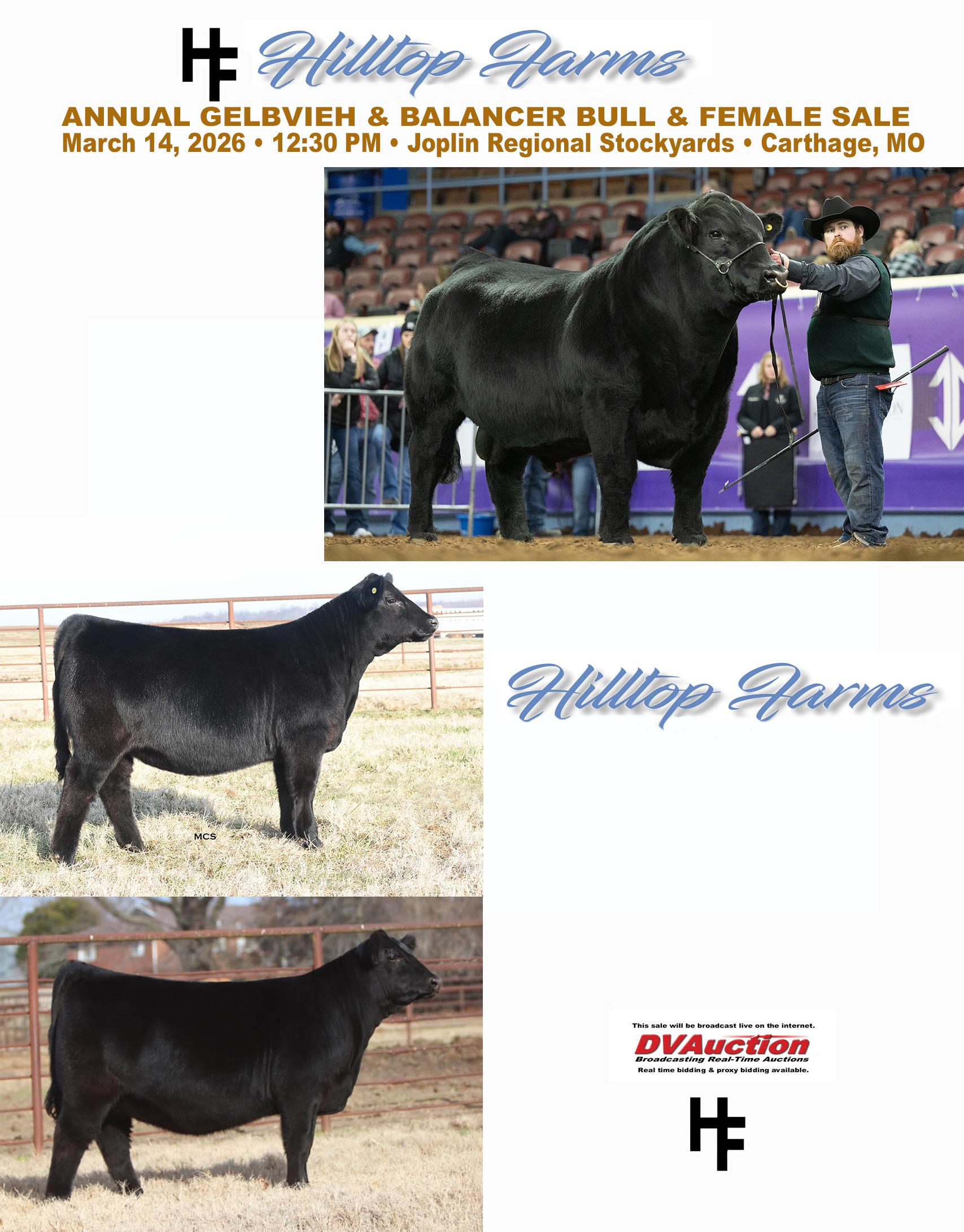
2023 Cattlemen’s Congress National Champion Gelbvieh Bull HTFG HILLTOPS HAWKEYE H064 (Reg# AMGV1489488) Semen Available
October Pork Exports Largest Since March; Encouraging Rebound for Beef
Source: USMEF
U.S. pork exports continued to build momentum in October, led by a record performance in leading market Mexico, according to data released by USDA and compiled by the U.S. Meat Export Federation (USMEF). While beef exports remained lower year-overyear, shipments rebounded to some degree in October, posting the largest totals since June.
Record-large shipments to Mexico fuel strong October pork exports
Pork exports totaled 264,657 metric tons (mt) in October, up 5% from a year ago, valued at $762.1 million (up 7%). Both volume and value were the largest since March, led by substantial growth in Mexico and year-over-year increases to Central America, Canada, Japan, South Korea and the Philippines. In addition to Mexico, October shipments were also record-large to Honduras and Guatemala.
January-October pork exports reached 2.43 million mt, just 2% below the record pace of 2024. Export value was also down 2% to $6.93 billion. The year-over-year difference is mostly due to a 20% decline in exports to China (which are mainly variety meats), where U.S. pork is subject to burdensome retaliatory duties.
Bright spots for October beef exports include Japan, Taiwan, Caribbean, Colombia
Beef exports totaled 93,448 mt in October, down 11% year-over-year but the largest since June and 16% above the low volume posted in September. Export value was also the highest since June at $759.5 million, down 12% from a year ago but 15% above September. October beef exports increased year-over-year to Japan, Taiwan, Canada, the ASEAN region and the Dominican Republic, while also jumping sharply to Colombia. But these gains were more than offset by lack of access to
China, which has reduced exports to minimal volumes for the past several months. For markets other than China, October beef exports were up 5% year-over-year in volume and up 7% in value.
January-October beef exports totaled 949,471 mt, down 11% from the 2024 pace, while value was down 10% to $7.79 billion. When excluding China from these results, exports were down 3% in volume and just 1% in value compared to the first 10 months of 2024.
“The latest export data confirm what I consistently hear from customers across the world and from our international staff – that global demand for U.S. red meat remains robust, despite tight supplies and formidable market access barriers,” said USMEF President and CEO Dan Halstrom. “Obviously, regaining access for U.S. beef in China is our most urgent priority, as industry losses from this lockout are enormous. But we are also hopeful that ongoing trade negotiations will remove barriers in other destinations where consumers have a growing appetite for highquality red meat.”
October lamb exports trend lower Exports of U.S. lamb muscle cuts totaled 161 mt in October, down 12% year-over-year, while value fell 6% to $971,000. October shipments declined to the Caribbean but increased to Mexico and Central America. January-October exports were still up 40% year-overyear in volume (2,340 mt) and 27% higher in value ($12.65 million), led by growth in Mexico, Canada, the Bahamas, Trinidad and Tobago, Costa Rica and Panama.
A detailed summary of the January-October export results for U.S. pork, beef and lamb, including marketspecific highlights, is available from the USMEF website.
USMEF Elects New Officers, Examines Trade Opportunities and USMCA Review
Source: USMEF
The U.S. Meat Export Federation (USMEF) concluded its Strategic Planning Conference last fall with election of its new officers. Chairing USMEF for the 2025-26 term is Jay Theiler (pronounced TYLER), executive vice president of corporate affairs for Agri Beef Company, based in Boise, Idaho.
Theiler recalled his early days with Agri Beef, when the company came to realize that it could not maximize the value of each head of livestock processed by selling product only in the Pacific Northwest, or even in the entire United States.
“To get maximum value, we had to go to the international markets and include them in our sales,” Theiler said. “I did a lot of overseas trips in the early 2000s and many subsequent trips that laid the foundation for our success. When we traveled to Japan, Korea, China, Taiwan and Southeast Asia, we would meet with USMEF staff, who would paint a landscape
of the distributors in the market and help us set up appointments and meetings. USMEF was really an integral part of our company story and our brand story. And I tell you this today because it may serve as an inspiration for others on how to grow your business and how USMEF can help.”
Looking forward, Theiler said differentiating the quality of U.S. red meat is essential to continued expansion of the global customer base.
“The world doesn’t just buy U.S. meat because it’s available – they buy it because it’s exceptional,” he said. “Our U.S. red meat brand means something – it is the gold standard for quality, taste, safety, sustainability and reliability. Our beef, pork and lamb is sought out as incomes around the world grow. But we can’t take this for granted and we must continue to invest in international marketing, especially as our global competitors increase their quality and aim to compete with us.”
Continued on page 52
While emphasizing the need to diversify export destinations, Theiler also noted the importance of defending hard-earned market share with established trading partners.
“We cannot take our long-standing partners for granted,” Theiler said. “Markets like Japan, South Korea, Taiwan and Mexico are vital and have been reliable trading partners for decades. We must continue to protect and strengthen those relationships, and we must keep earning their confidence and trust.”
Theiler succeeds Steve Hanson, a rancher and cattle feeder from southwestern Nebraska, as USMEF chair.
The USMEF chair-elect for the coming year is Dave Bruntz, who raises corn and soybeans and feeds cattle in southeastern Nebraska. Bruntz is a past president of the Nebraska Corn Board and Nebraska Cattlemen. The USMEF vice chair is Darin Parker, director of Salt Lake City-based exporter/distributor PMI Foods. The newest USMEF officer is Secretary-Treasurer Ross Havens, a cattle producer who serves as marketing coordinator for Nichols Farms in Bridgewater, Iowa.
Friday’s closing business session at the USMEF conference also included a staff panel discussion of opportunities that could emerge as a result of reciprocal
trade agreements and frameworks announced by the Trump administration. The session focused mainly on two critical regions ‒ Europe and Southeast Asia (ASEAN). USMEF Vice President of Economic Analysis Erin Borror moderated the panel, which included Jihae Yang, vice president of Asia Pacific, Director of Export and Technical Services Courtney Heller and Jim Remcheck, director of export services.
Borror kicked off the discussion by sharing USMEF estimates of substantial additional export opportunities in the European Union (EU), the United Kingdom (UK) and several ASEAN countries if trade barriers ‒ tariff and non-tariff ‒ are addressed. From there, Borror and the panelists walked the audience through an array of trade barriers that continue to prevent the red meat industry from reaching its trade potential in specific markets within those regions.
“In the EU, we’re still working on all of the trade issues that fall outside of the hormone ban that really shut things down back in 1989,” said Heller. “As we began working with the Trump administration, we detailed all the extra requirements that need removed to ease the process inside the packing plant, through labeling and putting product in containers to ship to the EU. And this is product that is raised specifically for the EU or
Continued on page 54
the UK. It’s highly specialized and costs at least $100 extra per head, or if we’re talking about pork, about $60 more. So it’s very difficult to send it anywhere else and get the same return on that investment.”
In the ASEAN region, U.S. beef faces tariff disadvantages because Australia and New Zealand, along with some other suppliers, have free trade agreements throughout the region. The U.S. also faces a host of non-tariff barriers.
“We have to chip away and tackle some of these technical market access barriers to trade that are really hindering our opportunities,” said Remcheck. “The single greatest barrier we face is the facility-by-facility approval and registration process. That’s sort of an overarching, cross-cutting issue that we see throughout the region, and the primary thing keeping us from reaching our market potential.”
Yang agreed that protectionism is a serious problem in the ASEAN, and shared an example of how import permit processes can be abused to help protect local producers. Yang also highlighted two other aspects that hinder market development efforts in the region ‒ cold chain infrastructure and limited financial capacities of importers.
Yang also detailed U.S. red meat opportunities and several promotional initiatives that are contributing to the industry’s market development progress in the ASEAN region.
“You may remember that we had only two people on staff 25 years ago, and now we have 12 people in the region. That demonstrates how much we are penetrating into the market and developing our own programs to address market needs. Our strategy is supply chain development, not just in the foodservice sector, but also including distributors, retailers and further processors. The demand is there and our staff is there, working to build close working relationships with key trade partners.
Thursday’s general session focused on the upcoming review of the U.S.-Mexico-Canada Agreement (USMCA) and the importance of preserving duty-free access for U.S. pork, beef and lamb entering Mexico and Canada.
Kenneth Smith Ramos, a former lead negotiator for the Mexican government who was deeply involved in the negotiation and ratification of USMCA, detailed the mutual benefits USMCA has delivered for the agricultural sectors in both the United States and Mexico. The agreement has enhanced food security in both countries and bolstered the profitability of many agricultural sectors through free trade.
Smith, who is now a partner in the regulatory and trade consulting firm AGON, outlined the possible outcomes of the USMCA review, ranging from a very limited review to the threat of “rupture” if the agreement is reopened and the United States threatens to withdraw. He anticipates something in between, with portions of USMCA – some of which may be contentious – opened up for renegotiation.
“We see a complex USMCA review, but we do not see a scenario where there is an imminent collapse of the agreement,” he explained. “There will be turbulence, but we do not see the plane crashing.”
Smith added that it is critical for the U.S., Mexican and Canadian agricultural sectors to remain vigilant in explaining the benefits of USMCA and the importance of maintaining it as a trilateral pact.
John Masswohl, a veteran of many agricultural trade negotiations during his long career with the Canadian Cattle Association, struck similar themes as he analyzed USMCA from Canada’s perspective. He stressed the efficiencies that duty-free movement of meat and livestock between the U.S. and Canada have fostered and the importance of maintaining this environment.
“You have to ask yourself, if those [Canadian] cattle weren’t coming into the U.S., what would the reality be?” Masswohl explained. “Would there really be a need for two major packing plants in the Pacific Northwest? Would there be a need for a packing plant in Utah? In some of these areas, some years, up to 30% of the kill is Canadian cattle. If they don’t have those facilities, are livestock producers prepared to ship their animals many
Meyers Truck Service
Masswohl also questioned whether the U.S. truly has an agricultural trade deficit with Canada, citing per-capita consumption figures. He noted that (based on 2023 data) the average Canadian consumes more than $700 per year in U.S. agricultural goods, while Americans average only $118 in consumption of Canadian ag products.
“That tells me the Canadian market is pretty open, and that Canadians like American agricultural products,” he said. “If you scratch into what we are buying, we’re purchasing a lot of high-value U.S. items.”
Thursday’s program also included the presentation of USMEF’s Michael J. Mansfield Award to Ted McKinney, former USDA under secretary for trade and foreign agricultural affairs. Dr. Dermot Hayes, who recently retired as an Iowa State University professor and continues to serve as a consulting economist for the pork industry, received the USMEF Distinguished Service Award. More details on these awards and the honorees are available here.
The next meeting of USMEF members will be at the organization’s Spring Conference in Oklahoma City, May 20-22.
NCBA Pushes to Reduce Frivolous Environmental Litigation in House Hearing
Source: NCBA
WASHINGTON (December 10, 2025) – Today, the House Natural Resources Subcommittee on Oversight and Investigations held a hearing on the Abuse of the Equal Access to Justice Act (EAJA). Todd Wilkinson, South Dakota cattle producer and National Cattlemen’s Beef Association (NCBA) past president, testified on the rampant EAJA abuse by environmental groups that have become repeat litigants as soon as Congress discontinued reporting requirements in 1995.
“EAJA was created with the best intentions, to allow Americans to challenge government actions without facing crushing legal costs. Unfortunately, like so many well-intentioned programs, it became vulnerable to abuse when oversight faded. Today, EAJA allows payments not only to parties who prevail in court but also to those who settle or enter consent decrees. This allows radical environmental groups to collect EAJA fees while forcing agencies to change policy through settlements,” Wilkinson said. “Too often, these lawsuits
are filed with the sole purpose of coercing federal agencies into settlements that drive policy changes. That’s not responsible governance – that’s forced manipulation. Congress needs to reform EAJA to stop this rampant abuse for financial and political gain by improving reporting requirements, establishing financial limitations on tax-exempt organizations, and capping the legal fees paid to these groups under EAJA.”
Background In 2013, the U.S. Chamber of Commerce found that 71 sue-and-settle cases resulted in more than 100 new regulations and more than $100 million in new annual compliance costs for federal agencies. Since that time, costs have continued to stack up, straining already tight budgets and greatly reducing government efficiency. EAJA has the right level of financial limits for individuals and businesses, and these limits should be amended to include non-profits. Groups whose sole mission is to sue the federal government should not be able to continue coming back to EAJA to fund their political efforts.
FCS Financial Announces Leadership Transition - Billy Weiland Named SVP
Source: FCS Financial
FCS Financial is pleased to announce the selection of Billy Weiland as Senior Vice President, Managing Director of Agribusiness Lending. Weiland will succeed Kevin Gabbert, who is retiring on January 31st, 2026, after a distinguished career spanning over 40 years with the cooperative.
This transition marks a significant milestone for FCS Financial. Kevin Gabbert has been a respected leader within the organization and the industry, dedicating four decades to serving member-owners and strengthening rural communities. His tenure leaves behind a legacy of integrity, expertise and deep commitment to agriculture.
“We want to thank Kevin for his incredible dedication and over 40 years of service,” said Rob Guinn, Chief Executive Officer. “His leadership has been instrumental in our success, and we wish him the very best in his well-deserved retirement.”
As FCS Financial looks to the future, the appointment of Billy Weiland represents a continued commitment to strengthening the leadership team to better serve the
marketplace. Weiland received his bachelor’s degree in business management from McPherson College and brings 25 years of experience in financial services and agribusiness lending.
“I am honored to step into this role and build upon the strong foundation Kevin has established,” said Weiland. “I look forward to leading our talented team and growing the business line to support the agriculture economy in Missouri and beyond.”
The FCS Financial Agribusiness Lending team serves a variety of agribusinesses headquartered in Missouri with operations throughout the Midwest. This includes businesses that provide products and services directly to farmers and ranchers, as well as those involved in processing and marketing agricultural products. This leadership update reflects FCS Financial’s vision to support agriculture and rural America by ensuring its team remains staffed with knowledgeable, dedicated experts.
If you would like to learn more about the financial solutions that FCS Financial can provide for you, visit the FCS Financial website at myfcsfinancial.com.
A Year of Putting Missouri Farmers First
Source: By Ronnie Russell, State Executive Director, USDA Farm Service Agency – Missouri
Since January 20, 2025, President Donald J. Trump has been working around the clock to put American Farmers First after inheriting one of the toughest farm economies our country has faced in decades. Here in Missouri, farmers and ranchers know the challenges firsthand – rising input costs, volatile markets, extreme weather, and years of policies that prioritize bureaucracy over producers.
This year, President Trump and U.S. Secretary of Agriculture Brooke L. Rollins have worked at record speed to deliver real relief and long-term reforms, working hand-in-hand with the Farm Service Agency to ensure these resources are reaching our farmers and rural communities right here at home.
Trump Administration has delivered more than $30 billion in ad hoc assistance to farmers nationwide since January 2025.
Contact: Mike Williams Higginsville, MO 816-797-5450 mwauctions@ctcis.net
Land Equipment and Livestock
Here in Missouri, this includes $380.6 million through the Emergency Commodity Assistance Program (ECAP), $167.4 million in disaster relief through the Supplemental Disaster Relief Program (SDRP), and $16.3 million in assistance for specialty crop and livestock producers. These programs are helping farmers recover from weather disasters, inflation, and market losses that have been left unaddressed for years.
Just as important, the Trump Administration strengthened the farm safety net through legislation in the One Big Beautiful Bill Act. For the first time in more than a decade, statutory reference prices for major commodities were raised by 10–21 percent, and more than 30 million new base acres were added to Agriculture Risk Coverage (ARC) and Price Loss Coverage (PLC) programs beginning in 2026. Crop
Ronnie Russell, State Executive Director, USDA Farm Service Agency – Missouri
insurance was also made more affordable, saving farmers over $400 million annually, with expanded support for beginning farmers and ranchers, a critical investment in the future of agriculture.
USDA is also working to lower farmers’ costs by restoring competition and cutting red tape. New actions with the Department of Justice are targeting price fixing and anti-competitive behavior in key input markets like seed, fertilizer, and equipment. Partnerships with the Department of Labor (DOL) and Department of Homeland Security (DHS) have also led to significant reforms to the H-2A program. An Interim Final Rule published by DOL in October reformed the H-2A Adverse Effect Wage Rate (AEWR)—providing over $2 billion in annual savings for farmers—and a Final Rule published by DHS reduced the time it takes to navigate the H-2A application process by allowing concurrent filing. These reforms help make the H-2A program more affordable and accessible, ensuring producers have access to the labor they need at a more affordable cost.
USDA has been prioritizing the purchase of healthy, U.S.-grown commodities with the intent to purchase up to $970 million in this year alone, under Section 32 of the Agriculture Act of 1935. These purchases support farmers while supplying food banks, schools, and nutrition programs – strengthening agriculture and food security in communities all across Missouri.
One of the most significant actions of this year was the announcement of $12 billion in Farmer Bridge Payments – designed to help farmers weather ongoing market disruptions, elevated production costs, and continued volatility while longer-term reforms take hold. This bridge assistance reflects President Trump’s commitment to ensuring farmers are not left behind as the farm economy recovers.
These payments are intended to provide stability and certainty for producers as USDA continues to deliver disaster assistance and implement the improvements made under the One Big Beautiful Bill Act. While SDRP signups are ongoing, USDA is ensuring farmers
have access to immediate relief today while positioning them for expanded market opportunities ahead.
Under President Trump’s leadership, we are rebuilding American agriculture to be stronger, more competitive, and more resilient. The Trump Administration is expanding global market access for American agriculture. New trade deals and frameworks with more than 15 countries are opening doors for U.S. beef, grains, dairy, specialty crops, and biofuel exports. These wins matter here in Missouri, where exports support farm income, rural jobs, and long-term economic growth.
At the Farm Service Agency, our mission is simple, but bold: serve farmers, not bureaucracy. The Trump Administration’s Farmers First agenda is delivering real results: relief today, stronger safety nets tomorrow, and expanded markets for the future – but this is just the beginning.
Every day, the Farm Service Agency will continue to fight for Missouri farmers and ranchers to ensure they have the tools, freedom, and opportunity to succeed for generations to come.
Ronald Russell State Executive Director Missouri Farm Service Agency
Missouri Dairy Growth Council Announces Management Partnership, New Website
Source: Missouri Dairy Growth Council
(Jefferson City, MO.) - The Missouri Dairy Growth Council (MDGC) announced today that Missouri Dairy has been selected as the council’s management organization. Additionally, Alfred Brandt has been tapped to serve as the Executive Director of the Missouri Dairy Growth Council.
MDGC is comprised of a broad group of stakeholders from across Missouri’s agricultural community. A strong dairy industry benefits all involved — from producers and agribusinesses to local communities — by creating jobs, supporting infrastructure and driving long-term economic growth.
Brandt brings decades of dairy experience to the organization, having spent his career working directly with dairy producers, industry organizations and agricultural leaders. His deep understanding of dairy operations, policy and producer needs positions MDGC for continued success as it works to grow and strengthen the state’s dairy industry.
“We are excited for the new direction of MDGC and the clarity, leadership and momentum this collaboration has brought to dairy economic development in Missouri,” says Brandt. “The new structure and website provides MDGC the tools to support our existing dairies, while looking for new opportunities to grow the sector.”
Callaway Livestock Center, Inc.
Every Monday:
Slaughter Cattle 12:00 p.m.
Selling All Classes of Cattle 12:30 p.m.
1st Thursday Nite of Each Month: 6:00 p.m. Bred Cows and Breeding Bull Sale
Jack Harrison 573-999-7197 (owner)
John P Harrison 573-220-1482
Claude Niemeyer .............. 573-470-1017
Roger Temmen 573-680-4538
Justin Oberling 217-440-7724
Glenn Stegman ................. 573-619-8495
The new website, GrowMODairy.Org, showcases the benefits of Missouri dairy production with the goal of attracting new dairies and supporting existing dairies.
“Missouri offers a compelling combination of natural resources, economic advantages and processing infrastructure, making it a smart choice for dairy producers,” says Matt Amick, director of market development for Missouri Soybeans and MDGC board chairman. “For dairy producers looking to relocate or expand, Missouri has affordability, abundant feedstuffs and a supportive agricultural environment.”
The website provides deeper insights into Missouri’s dairy advantage. The site provides information on economic and industry development; government and regulatory agency contacts; technical assistance; and input procurement and processing.
For more information about the Missouri Dairy Growth Council and its initiatives, visit www.growmodairy.org.
About the Missouri Dairy Growth Council
The Missouri Dairy Growth Council (MDGC) is dedicated to strengthening and expanding Missouri’s dairy industry by serving as a central hub for producers, partners, and stakeholders. The Council promotes and supports dairy business growth across the state through strategic partnerships, research initiatives, resource connections, and recruitment efforts that help dairy operations thrive. Missouri’s competitive advantages — including affordable land, abundant natural resources, a supportive agricultural environment, strong processing access, and favorable market conditions — create a foundation for long-term success in dairy production and investment. For more information, visit growmodairy.org.
Alfred Brandt
National Survey Looks at Beef Producers’ Bull-Buying Decisions
Source: College of Agriculture, Food and Natural Resources
COLUMBIA, MO. – A new national survey aims to better understand how beef producers make bull-buying decisions and how extension programs can better support those producers.
The survey is being conducted by eBEEF, a nationwide network of extension specialists in beef cattle genetics, including University of Missouri Extension’s Jamie Courter. The survey focuses on bull and semen selection practices, breeding goals and the challenges producers face when making genetic decisions.
This survey is designed specifically for beef producers who make genetic selection decisions on their operations. Results will guide extension education, training and research related to beef genetics, Courter said.
“The best way to understand the needs of the beef industry is to hear from them directly,” he said. “Better understanding the needs and ideas of Missouri beef producers and those across the U.S. will help all extension professionals better serve the industry. It will drive research projects and extension materials for the foreseeable future, until it’s time to ask these same questions again.”
Producers who complete the survey and provide an email address may enter a drawing for one of five $100 gift cards sponsored by the Beef Improvement Federation.
“Your voice matters,” Courter said. “By participating, you’re helping ensure that beef genetics research and extension efforts stay relevant, practical and producerdriven.”
Complete the survey at https://muext.us/eBeefSurvey.
For more information, contact Courter at jcourter@ missouri.edu.
Livestock
and Forage Event is March 3
Source: University of Missouri Extension
OZARK, Mo. – University of Missouri Extension offers the annual Christian County Livestock and Forage Conference 6-8:45 p.m. Tuesday, March 3, in Ozark. The free event will be held at the Agriculture Building at Ozarks Technical Community College’s Richmond Valley campus.
MU Extension agronomist Tim Schnakenberg said MU Extension specialists will offer updates to help producers grow better forages for healthier herds and bigger profits.
Speakers include agronomist Josh Dunn who will talk about soil fertility in southern Missouri. He will give practical insights into ways to boost forage quality and yield. Agricultural business specialist Jake Hefley will offer business updates and livestock specialist Ian McGregor will share ways producers can improve cattle performance on endophyte-infected pastures.
Lynn Morris of the Christian County Commission will give remarks during the dinner served by Meat Hooks of Clever.
Schnakenberg said there is no charge for the meal or event, but registration is required. Register at https:// pears.io/events/mu/3894. For more information, call 417-581-3558.
Supporters for the evening’s event and meal include Bank of Billings, Christian County Farm Bureau, Christian County Soil & Water Conservation District, Earlybird Feed & Fertilizer and Southern Bank.
Pearls of Production Returns February 28 in Columbia
Source: University of Missouri Extension
COLUMBIA, MO. – The 2026 Pearls of Production Conference is set for Saturday, Feb. 28th, at the University of Missouri Beef Research and Teaching Farm in Columbia.
This in-person gathering promises a full day of hands-on learning, idea exchange and inspiration, says Heather Conrow, MU Extension livestock and poultry specialist.
The conference begins with an 8:30 a.m. breakfast featuring Carey Portell, who has inspired thousands to change their perspectives by sharing her recovery journey after surviving an accident involving a drunk driver.
Session topics include:
• Tips for a Successful Calving Season
• Genetics for a Better Cow
• Small Ruminant Neonatal Care
• Lunch and Learn: Show Me the Money
• Save the Cuss Words: You Got This! 2.0
• Technology Showcase: Virtual Fencing and Drones
Parents attending the conference can enroll children ages 5-12 in “Future Pearls of Production,” held in partnership with Mizzou Block and Bridle. For $5, children can enjoy their own mini agriculture adventure while their parents attend sessions. The full cost for adult participants is $20. Find details and registration at https://muext.us/POPFeb2026.
“We’ve done it again with an excellent lineup of speakers and topics on a variety of livestock species,” Conrow said. “During Pearls of Production, we don’t just talk shop. We build skills, swap stories and celebrate those who keep agriculture thriving. It’s hands-on, highenergy and full of pearls of wisdom!”
MU Extension’s Pearls of Production aims to bring in unique and new talent to the industry at large, she said. “Empowering participants isn’t just about education. It’s about cultivating confidence, leadership and a legacy of resilience.”
For questions, contact Heather Conrow at hconrow@ missouri.edu or 660-248-2272.
Pearls of Production is made possible through partnerships with USDA National Institute of Food and Agriculture; Missouri AgrAbility; Missouri Beginning Farmers and Ranchers; MFA Rural Mental Health Awareness; University of Missouri Extension and others. All are committed to advancing production agriculture, supporting community resilience and nurturing the next generation of farm and livestock professionals.
Scott Cape, Owner of Jim’s Motors in Cuba, Missouri. All I
Commodity Trades Welcome
MU Extension Livestock and Forage Event set for February 19 in Forsyth
Source: University of Missouri Extension
FORSYTH, Mo. — University of Missouri Extension will host the 2026 Taney County Livestock and Forage Conference 5:30-8:30 p.m. Thursday, Feb. 19, at Forsyth High School, 178 Panther Road, Forsyth.
The free conference is designed to provide livestock producers with timely, practical information on herd management, forage systems and market conditions as they plan for the year ahead, said Jake Hefley, MU Extension agricultural business specialist.
The program will include:
• Black vultures. Chez Kleeman, USDA Animal and Plant Health Inspection Service.
• Pasture renovation. Tim Schnakenberg, MU Extension field specialist in agronomy.
• 2026 cattle market outlook. Jake Hefley, MU Extension field specialist in agricultural business.
• Selecting and developing the right replacement heifers for your herd. Elizabeth Picking, MU Extension field specialist in livestock.
“This conference focuses on several timely topics that are important to livestock producers in Taney County,” said Hefley.
Registration is free. A meal will be provided.
Register at https://pears.io/events/mu/2336. For more information, contact Hefley at 417-546-4431 or jhefley@ missouri.edu.
ORYS 07 RED ANGUS
Service age bulls, bred cows, cow/calf pairs, show prospect heifers available. 417-652-3425 417-839-7205 www.oryscircle7.com
Registration Open for February 18-19 Grain Marketing Workshop
Source: University of Missouri Extension
COLUMBIA, MO. – University of Missouri Extension, with support by Missouri Corn Producers and their checkoff, is offering corn and soybean producers a opportunity to strengthen their marketing skills through the “Basics of Grain Marketing Workshop,” set for Feb. 18th and 19th at the Boone County Electric Cooperative in Columbia.
This two-day workshop is designed for growers who want to build a more confident, disciplined and informed approach to grain marketing, said Ben Brown, a specialist with MU Extension’s Food and Agricultural Policy Research Institute. Brown will be the primary instructor for the workshop.
Participants will learn the essential components of a successful marketing plan, including basis, market carry, margins and cash market dynamics, which Brown says are “core concepts that help producers navigate volatile markets and protect farm income.”
“Understanding how and when to market grain is one of the most effective ways producers can manage risk,” he said. “In years when margins are tight, even small improvements in marketing decisions can make a meaningful difference to a farm’s bottom line.”
Brown said attendees will explore a wide range of marketing and risk-management tools, including forward contracts, futures, hedge-to-arrive contracts, basis contracts and deferred pricing.
The program also covers hedging fundamentals, storage considerations and the role of crop insurance in marketing decisions. Instruction is paired with handson exercises, farmer-to-farmer discussions and panels featuring industry professionals.
For many producers, improving marketing knowledge is one of the most accessible ways to mitigate price swings and stabilize revenue, Brown said. Missouri farmer Mark Ellison agrees. “You can’t control the weather or the markets, but you can control how prepared you are,” Ellison said. “Workshops like this help farmers make decisions with confidence instead of reacting out of fear. That’s worth a lot when every penny counts.”
Registration is limited to 50 participants. Those who attend will also receive access to quarterly follow-up Zoom sessions throughout the year to reinforce key concepts and support ongoing decision-making.
Register at https://muext.us/GrainMarketBasics.
For more information, contact Brown at bpbrown@ missouri.edu or 660-492-7574.
Missouri Hwy. 58 • 45 Miles SE of Kansas City, MO
Scout Early and Often for Corn Leafhopper in 2026
Source: University of Missouri Extension
COLUMBIA, Mo. – University of Missouri Extension in-field research in 2025 cornfields showed less damage from corn leafhopper than in 2024.
MU Extension state crops and forage entomologist Ivair Valmorbida is happy about that, but he is unsure why this happened. “It is possible that corn leafhoppers arrived later in the season compared to 2024, as they do not truly overwinter in Missouri,” Valmorbida says.
The invasive pest first appeared in Missouri corn crops in 2024, carrying corn stunt disease, which causes drastic yield losses. Its travels are aided by wind from the south after events like hurricanes.
In 2024, it was confirmed in the Missouri counties of Gentry, Knox, Boone, Pike, Lincoln, Warren, Gasconade, Osage, Morgan, Bates, Laclede, Barton, Lawrence and Christian. In 2025, corn stunt was confirmed in Morgan County.
Although they only reproduce on corn, they can feed on other grass species such as gamagrass and Johnsongrass, says Valmorbida. They also have been found on alfalfa, triticale and other winter annual weeds, although there is no evidence that these plants serve as feeding hosts for corn leafhoppers.
The 1/8-inch pale yellow insect can be distinguished from the aster leafhopper by two distinct dark spots with white halos between its eyes. It sucks plant juices from the phloem of corn plants. While feeding, the pest secretes a honeydew-like substance that favors black, sooty mold. Adults are usually found within the corn whorl and on the underside of corn leaves.
Corn stunt symptoms appear one to eight weeks after inoculation. The range and severity of corn stunt symptoms can vary, and they are influenced by the growth stage when infection occurred, the amount of inoculum present, the corn variety, and environmental and weather factors.
Leafhopper 2. Photo courtesy of Lennis Rodrigues.
Leafhopper 1. Photo by Lucas Bonuma Severo.
Most common symptoms include yellow streaks on the base of infected leaves and yellowing or reddening of leaf tips. Other symptoms can include shortened internodes, small ears, deformed kernels and poor grain filling. Corn stunt can also cause wilting and plant death, leading to significant yield losses.
Management is complex, and once plants are infected, damage is irreversible, says Valmorbida. The earlier the infection, the greater the damage.
He recommends that growers scout fields often, using yellow stick traps and by visually inspecting corn plants. Consider insecticidal seed treatments that can provide control of corn leafhoppers up to the V3 growth stage, and foliar insecticide applications if corn leafhoppers are present before the R1 growth stage. Plant early to reduce risk of infestations on young corn.
For information on leaf hopper, see the MU Extension publication “Biology and Management of Corn Leafhopper” at https://extension.missouri.edu/ publications/g7109.
You also may contact your area MU Extension agronomist or email Valmorbida at ivairvalmorbida@ missouri.edu.
Cowboys at the Capitol on
Wednesdays
Capitol Update with Nancy Giddens & Shannon Cooper
Our 2025 Legislators of the Year
Every legislative session has its noise. Press conferences, partisan flare-ups, and long nights when the process feels heavier than progress. But every once in a while, a session also delivers something far more important to Missouri agriculture: real results. That’s why the Missouri Cattlemen’s Association is proud to name Senator Curtis Trent and Representative Cameron Parker as our 2025 Legislators of the Year.
From our seats in the Capitol, working day in and day out on behalf of cattle producers, we see very clearly who is willing to listen, who asks the hard questions, and who is willing to do the work when it counts. This year, Senator Trent and Representative Parker stood out— not because they chased headlines, but because they delivered policy that strengthens rural Missouri for the long haul.
Senator Curtis Trent earned this recognition for his leadership on the capital gains bill, an issue that may sound abstract but is deeply personal for farm and ranch families. For cattle producers, capital gains policy affects succession planning, land transfers, and whether the next generation can afford to stay on the ranch. Senator Trent understood that this wasn’t about tax theory— it was about keeping operations intact and keeping Missouri land in production.
Throughout the process, Senator Trent was engaged, informed, and accessible. He took the time to understand how capital gains impact family-owned operations differently than large corporations. He asked thoughtful questions, worked across the aisle, and never lost sight of the goal: giving Missouri producers a fair shot at passing on what they’ve built. His work on this bill provided certainty and relief for families who have invested decades into their land and livestock.
Representative Cameron Parker is being honored for her leadership on the water bill, an issue that is foundational to every cattle operation in the state. Water is not optional in agriculture—it is infrastructure. Whether it’s livestock access, drought resilience, or long-term conservation, water policy directly affects animal health and operational viability.
Representative Parker approached the issue with both urgency and respect for the land. She listened closely to producers and local stakeholders, recognizing that good water policy must balance stewardship with practicality. Her work ensured that producers are not burdened by one-size-fits-all mandates, while still protecting Missouri’s most valuable natural resource. The result was legislation that reflects how agriculture actually works on the ground.
What ties Senator Trent and Representative Parker together is not just the bills they championed, but how they approached their work. They treated agriculture as a partner, not an afterthought. They respected rural voices and backed that respect up with action.
On behalf of Missouri’s cattle producers, these awards are our way of saying thank you. Thank you for listening. Thank you for leading. And thank you for helping ensure that Missouri agriculture remains strong, competitive, and family-driven for generations to come.
Our greatest thanks, Nancy and Cooper
Nancy Giddens & Shannon Cooper
Feb. 7
Feb. 14
Feb. 21
SALE CALENDAR
Loonan Stock Farm 51st Annual Production Sale, Corning, IA
J&N Black Hereford 42nd Production Sale, Leavenworth, KS
Byergo Angus Sale, Savannah, MO
Feb. 21 Missouri Angus Breeders Futurity Sale, Columbia, MO
Feb. 27 Jamison Hereford & Friends Production Sale, Quinter, KS
Feb. 28 Post Rock Cattle Company Annual Bull and Female Sale, Barnard, KS
Feb. 28 Seedstock Plus North Missouri Bull Sale, Kingsville, MO
March 2 Buck Ridge Cattle Co. Sale, Seymour, MO
March 6 SIU Carbondale Bull Test Sale, Carbondale, MO
March 6 Express Ranches Spring Bull Sale, Yukon, OK
March 7 Mead Farms Spring Sale, Versailles, MO
March 7 Seedstock Plus Arkansas Bull Sale, Hope, AR
March 7 Missouri Select Genetics Sale, Keytesville, MO
March 7 Moriondo Bulls Sale, Mount Vernon, MO
March 7 Gibbs Farms Spring Sale, Ranburne, AL
March 8 Flickerwood Angus Sale, Jackson MO
March 10 Galaxy Beef Sale, Macon, MO
March 12 Henke Farms Sale, Salisbury, MO
March 12-13 Miller Cattle Co. Bull & Heifer Sale, Online
March 13 Wall Street Cattle Co. Bull & Female Sale, Lebanon, MO
March 14 Sampson Cattle Co. 10th Annual Bull Sale, Kirksville, MO
March 14 Wright Charolais Bull Sale, Kearney, MO
March 14 Seedstock Plus Red Reward Bull & Female Sale, Osceola, MO
March 14 Hilltop Farms Gelbvieh & Balancer Bull & Female Sale, Carthage, MO
March 15 April Valley Farms Sale, Leavenworth, KS
March 15 Briarwood Angus Farms Spring Sale, Butler, MO
March 16 Hinkle’s Prime Cut Angus Sale, Nevada, MO
March 20 Bradshaw Ranch Bull Sale, Palmyra, MO
March 20 Marshall & Fenner Angus Sale, Boonville, MO
March 21 Falling Timber Farm Sale, Marthasville, MO
March 21 Brinkley Angus Ranch Sale, Green City, MO
March 21 Ertel Cattle Co. Annual Production Sale, Kirksville, MO
March 21 Mississippi Valley Angus Sale, Cuba, MO
March 21 Wild Indian Acres Annual Spring Bull Sale, Carthage, MO
March 21 Northeast Arkansas Angus Assn. Bull & Female Sale, Cord, Ark
March 23 Oleen Brothers Production Sale, Dwight, KS
March 27 Barrett Cattle & Mill Brae Ranch Annual Bull Sale, Maple Hill, KS
March 28 Worthington Angus Sale, Dadeville, MO
March 28 8 Story Farms 4th Annual Production Sale, Gallatin, MO
March 28 Seedstock Plus South Missouri Bull & Female Sale, JRS - Carthage, MO
March 28 3C Cattle Co Sale, Carrollton, MO
March 28 Sandhill Farms Annual Production Sale, Haviland, KS
April 2 T Bar S Females for the Future Sale, Online
April 2 Hunter Angus Show Heifer Sale, Fair Grove, MO
April 3 Meyer Cattle Co. Sale Bowling Green, MO
April 4 Four State Angus Association Sale Springfield, MO
April 4
April 4
April 4
April 6
Gardiner Angus Ranch Spring Production Sale, Ashland, KS
Peterson Farms Bull Sale, Mountain Grove, MO
Gilbert Cattle Co Sale, Oldfield, MO
Brockmere Sale, New Cambria, MO
April 11 Fink Beef Genetics Sale, Randolph, KS
April 14 Sydenstricker Influence Sale, New Cambria, MO
April 18
WMC Cattle Co. The Complete Dispersal Sale, Wasola, MO
April 25 Heart of the Ozarks Angus Sale, West Plains, MO
April 25 Cow Camp Ranch Turn Out Sale, Lost Springs, KS
MBC Classified
The MBC Classified column appears monthly. Classified advertising is only 50¢ per word. Send your check with your ad to Missouri Beef Cattleman, P.O. Box 480977, Kansas City, MO 64148. Deadline 15th of month before an issue.
“REESE” DISC MOWERS, CADDY V-RAKES, “REESE” TUBE-LINE BALE WRAPPER, AITCHISON DRILLS, SELF-UNLOADING HAY TRAILERS, HEAVY DUTY BALE AND MINERAL FEEDERS, FEED BUNKS, BALE SPIKES, CONTINUOUS FENCING, COMPLETE CORRAL SYSTEMS, INSTALLATION AVAILABLE: Tigerco Distributing Co. 660-645-2212, 800-432-4020 or www.tigercoinc.com.
BLACK SIMMENTAL BULLS SINCE 1993: Calving Ease, Attractive, Athletic, Sound Footed and Docile. We Deliver. Mike Williams, Higginsville, 816-797-5450
SYCAMORE CREEK SIMANGUS BULLS & BRED HEIFERS FOR SALE. Great EPDs. Wayne and Anita Vanderwert -15 minutes from Columbia. 573-808-3000 or 303-506-3508
HORNED HEREFORD BULLS. Large frame, add weaning weight and good disposition. 10 miles south of Warrensburg. ET Herefords. David Bernt 660-238-2395. Tim Bernt 816-517-4102.
SIM-ANGUS BULLS - Top EPD’s for Calving Ease and Growth. Lynn Snow Call Matt McQuitty 660-924-8037.