Saving Cainhoy
For more than 50 years, ill-planned development has had devastating consequences for historic communities on the South Carolina coast. The recent “fast-tracking” of development on the Cainhoy peninsula is completely counter to the legacy of historic preservation that distinguishes Charleston. Numerous African-American communities comprised of descendants of slaves from the area’s plantations, as well as descendants of the Anglicans, Huguenots and Congregationalists who settled there in the 17th and 18th centuries, are standing in opposition to the development of the Harry F. Guggenheim family lands. Churches, cemeteries, local businesses, gathering places and historic roadways and footpaths are at risk of being reduced to descriptive subdivision names and street signs. If plans by the developers–facilitated by the City of Charleston–are realized, a living culture may become a mere footnote to history.
A
lthough the Cainhoy peninsula once seemed a world apart from the Charleston peninsula, it was never as isolated as the more remote barrier and sea islands of the South Carolina coast. Rural Cainhoy developed an economy and culture closely intertwined with that of the thriving port city to the south. White entrepreneurs and planters populated the peninsula alongside enslaved West Africans and free black landowners and artisans. Bound by the Cooper and Wando rivers and associated tributaries, Cainhoy became an early thoroughfare between inland enterprises and plantations, and the Port of Charleston. The Dover and Calais Ferry, Clement’s Ferry Road, Meeting Creek and Fogartie’s Landing are just a few of the site names that evoke the network of trade and travel that crisscrossed the historic peninsula. While the legacy of slavery, Reconstruction and Jim Crow kept the black and white communities relatively separate for more than two-anda-half centuries, a great deal of commerce and interdependency connected the two. According to historian Suzannah Smith Miles and others, the Cainhoy peninsula was a melting pot. St. Thomas Parish of Cainhoy notes in its 1728 Annals a population of 565 whites, 950 negroes, 60 Indian slaves and 20 free negroes. A surprising number of freemen owned property early on, including John Primus, who purchased 100 acres on the peninsula in 1712 and for whom the Jack Primus community is named. Likewise, the blended name of St. Thomas and St. Denis Church reflects the melding of the Anglican and Huguenot communities at Cainhoy, just as the Congregational Meeting House became Presbyterian and ultimately evolved into a Methodist church. Today, the Cainhoy Presbyterian/ Methodist Cemetery and Old Ruins Corporation cares for the old meeting house ruins and graveyard, which includes both white and black burial sites.
Dana Beach
A Grave Threat
The Other Historic Peninsula
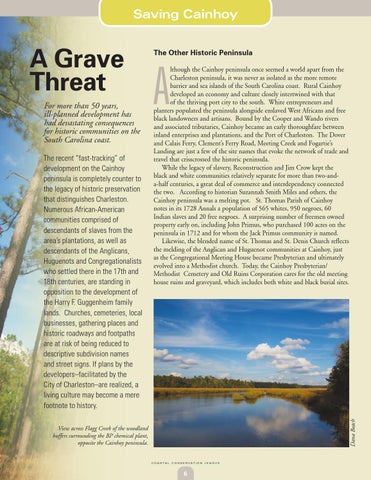
View across Flagg Creek of the woodland buffers surrounding the BP chemical plant, opposite the Cainhoy peninsula.
C OA S TA L C O N S E RVAT I O N L E AG U E
6