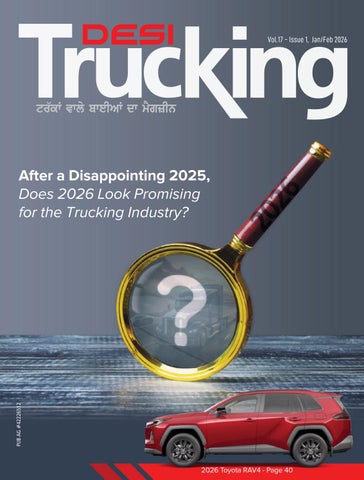
Desi Trucking - January February 2026 (National Edition)

Page 1


After a Disappointing 2025, Does 2026 Look Promising for the Trucking Industry?

STEERING INTO 2026—INNOVATION, COMMUNITY, AND SAFETY

Welcome to the Jan/Feb 2026 issue of Desi Trucking Magazine. As we turn the calendar, our industry stands at a fascinating crossroads. The year 2026 is set to be a "turning point" for Canadian trucking, defined by a shift from survival to strategic growth.

The Road Ahead in 2026

This year, we are seeing the "AI Revolution" move from the office to the cab. With the recent launch of the Automated Commercial Motor Vehicle Pilot, expect to see more autonomous and electric-assist technologies on our highways. Sustainability is no longer just a buzzword; with hydrogenpowered Class 8 trucks now making regular runs through the Lower Mainland, the "Green Imperative" is officially here. For owner-operators, 2026 is about efficiency— using technology to combat rising costs while navigating a stabilizing freight market.

A Landmark Partnership: BCTA & APNA

We are also thrilled to highlight a major milestone for our community. The BC Trucking Association (BCTA) has

officially endorsed the 2026 APNA Truck Show, taking place this June in Abbotsford. This partnership signals a powerful bridge between industry leadership and the South Asian trucking community. The show will feature BCTA-led seminars on safety and business strategy, making it an essential stop for anyone looking to scale their operations this year.

Winter Readiness: Safety First

As we navigate these first few months of the year, winter remains our most formidable opponent. Preparation is your best insurance:

• The "Three-Point" Rule: Always maintain three points of contact when entering or exiting to avoid icy falls.

• Air Tank Discipline: Drain your air tanks daily to prevent moisture from freezing your brakes.

• Space and Pace: In 2026’s unpredictable weather, double your following distance. No load is worth more than your life.

Let’s make 2026 a year of pride, precision, and safety. See you on the road!

2026 v~l vDdy kdm—nvInqw, BweIcwrw Aqy sur~iKAw

DeSI Trucking Magazine dy jnvrI/ PrvrI 2026 AMk iv~c quhwfw suAwgq hY[ ijvyN hI AsIN nvyN swl dy kYlMfr dy pMny plt rhy hW, swfI ieMfstrI ie~k idlcsp moV 'qy KVHI hY[ swl 2026 kYnyfIAn tRikMg leI ie~k "nvW moV" swbq hox vwlw hY, ij~Qy hux isr& guzwrw krn dI bjwey rxnIqk ivkws 'qy iDAwn id~qw jw irhw hY[

2026 iv~c Biv~K dI rwh

ies swl, AsIN "AI kRWqI" ƒ dPqrW qoN inkl ky tRkW dy kYibnW q~k phuMcdy dyK rhy hW[ Awtomyitf kmrSIAl motr vhIkl pwielt dy hwlIAw lWc dy nwl, swfy hweIvyA 'qy hor Awtonoms Aqy ielYkitRk-shwieqw vwlIAW qknIkW dyKx dI aumId r~Ko[ siQrqw (Sustainability) hux isrP ie~k Sbd nhIN rih geI; loAr mynlYNf iv~c hweIfRojn nwl c~lx vwly klws 8 tRkW dy inXmq gyiVAW nwl, "gRIn ieMpYryitv" AiDkwrq qOr 'qy SurU ho cu~kw hY[ Enr-AwprytrW leI, 2026 dw swl vDdIAW lwgqW dw mukwblw krn leI qknwlojI dI vrqoN krky kuSlqw vDwaux dw swl hY[

ie~k ieiqhwsk sWJ: BCTA Aqy APNA swƒ Awpxy BweIcwry leI ie~k v~fI auplbDI sWJI kridAW bhuq KuSI ho rhI hY[

BC tRikMg AYsosIeySn (BCTA) ny AiDkwrq qOr 'qy ies jUn iv~c AYbtsPorf iv~c hox vwly 2026 APNA tRk SoA dI hmwieq (Endorse) kIqI hY[ ieh sWJ ieMfstrI dI lIfriSp Aqy d~KxI eySIAweI tRikMg BweIcwry ivckwr ie~k mzbUq pul dw kMm krygI[ ies SoA iv~c BCTA v~loN sur~iKAw Aqy vpwrk rxnIqI 'qy sYmInwr krvwey jwxgy, jo Awpxy kwrobwr ƒ vDwaux dI ie~Cw r~Kx vwly hr ivAkqI leI bhuq zrUrI hn[

srdIAW dI iqAwrI: sur~iKAw sB qoN pihlW swl dy ieh pihly kuJ mhIny swfy leI sB qoN v~fI cuxOqI hn[ srdIAW iv~c quhwfI iqAwrI hI quhwfw sB qoN v~fw bImw hY:

• "QRI-puAwieMt" inXm: tRk iv~c cVHdy jW auqrdy smyN hmySw iqMn puAwieMtW dw sMprk bxw ky r~Ko qW jo br& 'qy iPslx qoN bicAw jw sky[

• eyAr tYNkW dI sMBwl: bRykW iv~c nmI ƒ jMmx qoN rokx leI rozwnw Awpxy eyAr tYNk KwlI kro[

• dUrI Aqy r&qwr: 2026 dy AxpCwqy mOsm iv~c, AglI g~fI qoN AwpxI dUrI du~gxI r~Ko[ koeI vI lof quhwfI jwn qoN kImqI nhIN hY[

AwE 2026 ƒ mwx, Su~Dqw Aqy sur~iKAw dw swl bxweIey[ sVkW 'qy imldy hW!

Editor-In-Chief

Advertising & Sales Jag Dhatt

Art Director Ranjit Singh

IT Manager Ranjit Singh Bhamra

Cover Design Ranj Bhamra

Cover Photo Credit Anadolu Agency / Contributor

Contributing Writers Jag Dhatt; Michael Howe; Pash Brar; Ray Gompf; Jimmy Gill; Staff Reporters

Translator

Tirath S. Khabra; Jesse Khabra

jag@jgkmedia.ca

Jag Dhatt

inrwSwjnk 2025 qoN bwAd, kI 2026 tr~ikMg audXog leI

jdoN ik 2025 tr~ikMg audXog leI QoVHw inrwSwjnk swl sI, pr ieh XkInn pihlw nhIN sI – isr& sB qoN hwlIAw pihlw[ audXog ny COVID qoN bwAd muSkl simAW dw swhmxw kIqw hY, Aqy pUrI qrHW bhwl hoxw G~t kihx leI cuxOqIpUrn irhw hY[ hwlWik 2025 dI AwKrI iqmwhI iv~c suDwr dy Aswr idKweI id~qy, ies leI ijvyN hI 2026 SurU huMdw hY, audXog dy siQr hox dI sMBwvnw hY[ ieh vI sMBv hY ik audXog isr& nvIN sDwrxqw nwl AnukUl ho irhw hY Aqy keI idRStIkox qoN, ies qoN hI ku`J suDwr dI Aws jnm lYNdI hY[ tr~ikMg audXog leI cuxOqIAW ik~Qy rhIAW hn? s`c pu~Co qW, ieh hr kony ‘c Aqy aus qoN vI bwhr rhIAW hn[ splweI cyn ‘c rukwvtW, iPaUl Aqy purizAW dI mihMgweI, vwqwvrxI inXm, lybr sImwvW, koivf nwl sMbMiDq pRBwv, tYirP, BwVy dIAW drW Aqy Awm rwjnIiqk AsiQrqw ny sB iml ky jW Awpxy-Awpxy Awp iv~c tr~ikMg audXog ƒ cuxOqI id~qI hY[ iPr vI, hux 2026 hY Aqy audXog iqAwr hY auh krn leI jo ies ny sB qoN vDIAw kIqw hY –Afwpt hoxw Aqy hOslw r~Kxw[

ie~k Kyqr jo lgwqwr cuxOqI bxI rhygw, auh hY fRweIvrW dI Gwt[ sImq qnKwhW Aqy kMm krn dIAW SrqW sMBlxXog nw hox kwrn, ieh siQqI hor vI burI ho skdI hY[ dUjI lybr sMbMDI cuxOqI hY trnEvr, Aqy iesdw au~cw rihxw audwsIn hY[ cwhy

2026 iv~c audXog swry p~KoN ikvyN vI krdw hovy, ieh lgwqwr sm~isAw Awaux vwly swlW ‘c vI Awpxw pRBwv idKweygI[

mihMgweI Aqy BwVy dIAW drW 2026 iv~c vI ie~k cuxOqI bxI rihxgIAW[ qyl, bImw, murMmq, swzo-swmwn lwgqW ƒ dyKdy hoey, BwVy dIAW drW ƒ qbdIl krn dI loV hovygI, nhIN qW ieh lwgqW boJ bx jwxgIAW[ bySk, v~fy kYrIAr, ijnHW dI mwrkIt phuMc v~fI hY, ieh cuxOqIAW k`uJ h~d q~k lMmy smyN dy Tyky Aqy mwqrw dIAW nYgosIeySnW rwhIN Gtw skdy hn, pr Coty kYrIAr ies qrIky nwl ieMny sPl nhIN ho skdy[

cMgI g~l ieh hY ik 2026 iv~c tr~klof BwVy dy ryt k`uJ v~Dx dI aumId hY[ ieh audXog dy ies p~K ƒ siQr krn iv~c mdd krygw[ ieh dyKxw idlcsp hovygw ik drW inXmW vwly mwhOl ƒ ikvyN pRBwivq krdIAW hn[ nvyN hYvI-ifaUtI tylpweIp iemISn stYNfrf (EPA) vrgy inXmW, nwl hI sUbweI pRogrwm, kYrIArW ƒ G~t iemISn vwly, zIro-ieimSn tr~kW Aqy keI QwvW qy ibjlIkrn jW hor ivklpI swzo-swmwn v~l D~k rhy hn[ izAwdwqr mwmilAW ‘c, v~D srkwrI inXmW dw nqIjw izAwdw lwgqW vjoN in`kldw hY, G~to-G~t QoVy smyN leI qW[ ies leI, BwvyN ik BwVy dIAW drW vDx, bhuq swrI nvIN inXmwvlI drW iv~c vwDy ƒ Gtw skdI hY[

tr~ikMg audXog bhuq h~d q~k au~qr AmrIkw dI smUihk ArQivvsQw dI ishq 'qy inrBr krdw hY[ 2026 leI, ArQivvsQw leI AinSicqqw hI nW hY[ ku~l imlw ky AwriQk mwhOl, ijs iv~c mihMgweI Aqy vpwirk nIqIAW Swml hn, tr~ikMg dy idRStIkox ƒ Awkwr dyx iv~c mu`FlI BUimkw inBwauxgy[ tYir& nIqIAW, Kws krky auh jo stIl Aqy AYlmInIAm ƒ pRBwivq krdIAW hn, swzo-swmwn dI splweI Aqy PRyt mwrkItW ƒ pRBwivq krn dI aumId hY, ijs nwl tr~ikMg sYktr iv~c ivSwl punrjIvn iv~c dyrI ho skdI hY[ hor AwriQk cuxOqIAW vwpr skdIAW hn jy globl sMGrS AmrIkw Aqy kYnyfw leI mslw bx jwvy Aqy ies g~l iv~c koeI S~k nhIN ik ijvyN ijvyN AsIN 2026 iv~c pRvyS krdy hW, ku~J hOt spOt vI hn[ mUl svwl v~l vwps AwauNdy hW: inrwSwjnk 2025 qoN bwAd, kI 2026 tr~ikMg audXog leI PwiedymMd swl l~gdw hY? sDwrx jvwb hY nhIN Aqy Swied[ jwrI cuxOqIAW dy nwl sMBl ky aumId r~Kxw, ieh d~sx dw sB qoN vDIAw qrIkw hY ik audXog 2026 iv~c kI aumId kr skdw hY[ siQr hox Aqy muV suDwr dy pihlU hn, pr hux vI inXmk AsiQrqwvW Aqy AwriQk dbwA hn, ijnHW ƒ ie~k v~D qr`kI Aqy siQr Biv~K hwsl krn qoN pihlW sMBwlxw peygw[

PERFECTED FOR THE ROAD AHEAD.

The pinnacle of Kenworth’s engineering: the T680, a masterpiece of aerodynamics designed for long-haul efficiency. This tractor combines a high-perfomance PACCAR powertrain with durable, easy-to-maintain components for unparalleled uptime. Enhanced with cutting-edge technology, it offers a driving experience that’s both intuitive and safe, reducing driver fatigue. The cabin, akin to the luxury found in top-tier automobiles, elevates comfort to new heights. Welcome to the next level of trucking with the Kenworth T680.

After a Disappointing 2025, Does 2026 Look Promising for the Trucking Industry?

While 2025 was a bit of a disappointing year for the trucking industry, it certainly wasn’t the first – just the most recent. The industry has faced difficult times ever since COVID, and fully rebounding has been challenging to say the least. The last quarter of 2025 showed signs of improvement though, so as 2026 begins there is cautious optimism that the industry may be stabilizing. It’s also possible that the industry is just adapting to the new normal, and in many ways, that itself brings some cautious optimism.

Where have the challenges been for the trucking industry? Honestly, they have been around every corner and then some. Supply chain disruptions, fuel and parts inflation, environmental regulations, labor constraints, COVID related effects, tariffs, freight rates, and general political uncertainty have all proven to be dynamic forces that together or individually have challenged the trucking industry. Yet, it’s 2026 now and the industry is ready to do what it does best – adapt and persevere.

One area of continued challenge will the driver shortage. With retention pay and working conditions unlikely to improve, this situation could become even worse. The other workforce related

challenge is turnover, and that is expected to remain high. Regardless of how the industry fares as a whole in 2026, this persistent problem will take its toll for years to come.

Inflation and freight rates will also continue to be a challenge in 2026. Fuel, insurance, maintenance, equipment costs will need freight rates to keep pace, or these costs will take a toll. Of course, larger carriers with a larger market reach can mitigate some of these challenges through long term contracts and quantity negotiations, but smaller carriers may not be as successful with that approach.

On a positive note, spot rates for truckload freight are expected to increase some in 2026. This should help stabilize that aspect of the industry. It will be interesting to see how rates react to the regulatory environment though. Regulations such as the new heavy-duty tailpipe emissions standards (EPA), as well as state programs are pushing carriers toward lower emissions, zero-emission trucks, and in many places electrification or other alternative fuels. In most cases, increased regulations result in increased costs, at least in the short term. So, even if freight rates increase, too many new regulations could mitigate the rate

increases.

The trucking industry is highly reliant on the health of the overall North American economy. For 2026, uncertainty seems to be the name of the game for the economy. The overall economic environment, including inflation and trade policies, will play a crucial role in shaping the trucking outlook. Tariff policies, particularly those affecting steel and aluminum, are expected to impact equipment supply and freight markets, potentially delaying broader recovery in the trucking sector. Other economic challenges could come about if global conflict becomes an issue for the US and Canada, and there are certainly some hot spots as we enter 2026.

Back to the original question: After a disappointing 2025, does 2026 look promising for the trucking industry? The simple answer is no and maybe. Cautious optimism with ongoing challenges is a great way to describe what the industry should expect in 2026. There are signs of stabilization and even recovery, there are still regulatory uncertainties and economic pressures left to navigate before a more positive and sustainable future can be achieved.

MICHAEL HOWE

Awpxy tr~k leI shI

krnw

tr~k bImw quhwfy tr~ikMg kwrobwr dw qIjw sB qoN v~fw Krc hY, sB qoN pihlW qnKwhW, iPr qyl ^rc[ quhwƒ ieh XkInI bxwaux dI loV hY ik qusIN bhuq izAwdw Bugqwn qW nhIN kr rhy[

ie~k vDIAw kMm krn vwlw irSqw bImw bRokr nwl bxwE[ bImw bRokr ie~k nwzuk siQqI iv~c huMdy hn ikauNik auh quhwfy leI kMm krdy hn qW ik quhwƒ sB qoN vDIAw auqpwd imly, jdoN ik aunHW nUM bImw kMpnI v~loN qnKwh imldI hY, jo Awi^rkwr quhwfy tr~k jW tr~kW dw bImw krdI hY[ jy qusIN 1 qoN 9 tr~k clwauNdy ho, qW qusIN bImw kMpnI dIAW drW 'qy inrBr ho, pr jy

quhwfy PlIt iv~c 10 jW aus qoN v~D tr`k hox, qW kMpnI nwl vDIAw kImqW lYx dI g`l bx skdI hY Aqy quhwfw bRokr quhwfy leI vDIAw kImqW lYx leI bImw kMpnI nwl g`l krygw[ Awpxy bImw bRokr nwl hr swl g~lbwq krnI Aqy Awpxy rytW qy k`uJ sur~iKAw b`jt bcwauxw ie~k cMgI Awdq hY[

ies g~l dI pRvwh kIqy ibnW ik quhwfy PlIt iv~c 1 qoN 9 vwhn hn jW ds qoN v~D, qusIN Ajy vI Awpxy bImw kYrIAr nwl swlwnw pYsy dy Brn leI zuMmyvwr huMdy ho[ ieh pYsy kMpnI leI aunHW dI Awmdwn dw bhuq v~fw ih`sw huMdy hn ijs ‘coN auh

jI ryA gON&, sI fI

KricAW dw Bugqwn krdy hn jo qusIN aus iv~qI swl iv~c dwier kr skdy ho, aus iv~qI swl dy AMq iv~c, bImw kYrIAr mnI pUl ƒ KwlI krdw hY, mOjUdw dwAivAW qoN Anumwnq Bugqwn ƒ ie~k pwsy r~Kdw hY iPr bwkI munwPw bx jWdw hY ijs qoN bImw kMpnI Bugqwn krdI hY, tYks, lwBAMS Aqy kwrjkwrI bons[

jy qusIN ie~k v~fy bImw kYrIAr ho, qW qusIN svY-bImq hox dI cox kr skdy ho jy qusIN sUbweI srkwr nwl s~q AMkI jmHW rkm r~Kdy ho, iPr iksy vI dwivAW dy nukswnW ƒ Awpxy bImy dy pYsy qoN J~l lYNdy ho jo quhwƒ Awpxy dwivAW dy irkwrf dy

ADwr 'qy Bugqwn krn leI brkrwr r~Kxw pYNdw hY[ k`uJ v~fy kYrIArW ny ie~k gru~p bxwieAw hY qW jo auh srkwr dy sMsQw duAwrw loVINdy Dn dy pul ƒ vDw skx, jo ies qrHW dIAW siQqIAW ƒ sMBwldI hY qW ik svY-bImq kMpnIAW ƒ kwƒnI BwrI dwivAW qoN bcwieAw jw sky[

pihlW ie~k imlIAn fwlr quhwƒ BwrI dwivAW qoN bcwauNdw sI, pr hux d~s imlIAn fwlr vI isr& mwmUlI jhI hI ho skdw hY, ies leI s~cmu~c, izAwdwqr kMpnIAW, hwlWik auh svY-bImw dw lwB lYx dI smr~Qw r~KdIAW hn, ies dI cox nhIN krdIAW[

AmrIkw iv~c G~to-G~t ie~k kMpnI hY ijhVI kYrIAr dy zrIey bImw krvwauNdI

imldI, nwl hI bImw kMpnI hr swl ies pUl ƒ KwlI nhIN krdI[

pr swfy vrgy Awm sDwrn lokW leI, swƒ bImw kMpnIAW dy bxwey inXmW dy Anuswr Kyfxw pYNdw hY[ ijvyN v~fIAW kMpnIAW hor tr~ikMg kMpnIAW nwl smJOqy kr skdIAW hn Aqy krdIAW vI hn, qW jo auh Awpxy iv`qI pUl ƒ vDw skx, jo ik bImw kMpnI duAwrw swlwnw KwlI nhIN huMdw, ies qrHW auh ssqy bImy dw AwnMd lY skdy hn[ iPr vI, swfy Coty kwrobwrI lokW ƒ hr swl bImw kMpnIAW dy pYsy dy pUl ƒ Brnw pYNdw hY[

ies leI XkInI bxwE ik qusIN Awpxy bImw bRokr nwl g~l kro qW jo auh quhwƒ sB qoN vDIAw dr l~Bx iv~c mdd kr

jy qusIN swvDwnI nwl irkwrf r~Kdy ho jo quhwƒ krnw cwhIdw hY, qW auh irkwrf quhwƒ irkwrfW dI kImq nwloN vDyry pYsy dI bcq kr skdy hn[ ieh irkwrf inXmq qOr 'qy ivcwry jWdy hn Aqy inXmq qOr 'qy soDy jWdy hn, ^wskr jy quhwfw bRokr quhwfy v~l iDAwn ‘c r~Kdw hY qy b`cq krn dy qrIky quhwnUM d`sdw hY[

Coty tr~ikMg kwrobwrW iv~c mwlkW dy kMm ieMny v~K-v~K huMdy hn ik aunHW kol fRweIv krn leI smW hI nhIN huMdw[ auQy aus murMmq krn vwlw kMm, sur~iKAw mYnyjr dI BUimkw, ihaUmn irsors dw kMm, ivkrI dw kMm, jo ieh suinSicq krdw hY ik lofW dy ivckwr koeI KwlIpn nw hovy Aqy mwlk dy mn iv~c stor kIqy hoey rolofYks dI sMBwl vwlw swrw kMMm aus nUM

Getting the Right Insurance for Your Truck

Truck insurance is the third largest line item on your trucking business spreadsheet, following wages and fuel. You need to make certain you don’t pay too much while ensuring you have the right coverage.

Establish a good working relationship with an insurance broker. Insurance brokers are in a precarious position in that they work for you to get you the best product possible while being paid by the insurance carrier that ultimately insures your truck or trucks. If you operate one to nine trucks, you’re at the mercy of the insurance carrier’s rates; but, if you have 10 or more vehicles in your fleet, there’s room for negotiation with the carrier and your insurance broker will take the

lead. Having an annual conversation with your insurance broker about your rates and saving some of that insurance budget item line.

Regardless of whether you have 1 to 9 vehicles in your fleet or over ten, you will still be responsible for filling up the pool of money annually with your insurance carrier. That’s the big pool of money from which they pay out the claims. At the end of the fiscal year, the insurance carrier empties the money pool, sets aside the projected pay outs from existing claims and the remainder becomes profit from which the insurance company pays taxes, dividends and executive bonuses.

If you are a large carrier, you can opt to be self-insured by making a

seven-figure deposit with the provincial government, and then absorbing any claim losses from a self-administered pool of money you must maintain for paying out claims based on your record of claims. Some large carriers have formed a group to be able to increase the pool of money required by the government organization that takes care of such situations to protect the self-insured companies from legal catastrophic claims.

It used to be a million dollars protected you from catastrophic claims, but now, ten million could be a mere drop in the bucket. So truly, most companies even with the capacity to enjoy self-insurance don’t.

There’s at least one company

in the United States that has insurance through a carrier but have a ten-milliondollar deductible. That is simply so they are essentially self-insured with protection from catastrophic court awarded claims. Believe me, this carrier has its own big pool of money set aside for claims to which shareholders, executives, get no return, plus the insurance carrier doesn’t empty annually.

But for us peasants, we must play by the rules made by insurance carriers. While large companies can, and do, enter into agreements with other similar trucking companies to increase their ability to increase their catastrophic pool which isn’t emptied annually by the insurance carrier, so they can enjoy cheaper insurance. Again, we small business peasants have to refill the insurance companies’ money pool annually.

So, ensure you talk with your insurance broker so that broker can help you find the best possible rate you can get. Make absolutely certain that you have sufficient liability insurance to protect you from a catastrophic court award. In today’s world, five-milliondollar coverage is not too much. This is moneys that will be paid out in case you cause someone to be maimed.

Make sure that during your conversation, you go through every detail of your coverage. There will be your truck, your trailer, and yes, you’re responsible for the load while it’s in your control. Then, there’s insurance you may want to have that will protect you from injury, whether it be short term disability or long term.

If you keep meticulous records –which you should – those records could wind up saving you more money than

the cost of the records. These records get discussed regularly and amended regularly, especially if your broker brings to you attention ways to save.

Small trucking businesses far too often have ownership that is so multitasked and has no time to drive. There’s that maintenance hat, there’s that safety manager’s hat, there’s that Human Resources hat, there’s the sales hat ensuring there is no gap between loads, and there’s maintenance of that Rolodex stored in the owner’s mind. Make sure you, as the small business owner of a trucking company, stay ahead of all the new rules and regulations and requirements as they apply to your trucking company. Whether you have a one to nine truck company or you are in the big leagues, your business relationships and your record keeping are critical.

that keep trailers rolling, all on hand. If your trailer is down we have 30,000 sq feet of all makes trailer, truck out exactly what you need. Fast. Daily delivery and pickup at our 3 GTA locations plus we ship nationwide. Skip the search. Call Glasvan.

Fraudulent Truck Driver’s Licenses

As many of us have seen in the media, there have been multiple accidents involving truckers who are illegal aliens and have improper licenses in the US. Innocent people have been killed by incompetent ill-trained illegal people who were given commercial driver’s licenses by improper authorities. There are loopholes and criminals are helping these illegal immigrants obtain illegal licenses, and trucking companies are hiring them and clearly paying them under the table. These people have no regard to the law and to the safety of others. These cases have mostly been in the USA and made prominent by ICE. New Zealand recently revoked commercial driver’s licenses of 459 Indian born truckers which were obtained using fraudulent documents. On December 3, 2025, an illegal immigrant trucker killed a newlywed couple in Oregon when he jackknifed the semi he was driving. He had a fraudulent California license. How are they getting fraudulent documents?

In Canada, we are seeing more overpass hits, so I wonder if the truckers too are being poorly trained or something is amiss. While Canada does have better measures for controlling illegal immigrants, do we have a better way of training our commercial truck driver’s as well? To teach trucking, a person must first have their class 5 license, then obtain their class 1 license and have a minimum of 3 years safe driving. Then they are in position to begin the journey to teach someone to obtain their commercial class 1 license. They must do an instructor course and go through a criminal and

medical test, a driving test and entrance quiz. The road to teaching takes years, but the people already teaching prior to MELT program requirements, did not have these stringent details and just continue teaching. This is where I think some issues can arise. The ones who just got accepted because they were doing the job already, may lack what the new instructors have.

I was on a walk and almost got hit on the sidewalk by a driving school car making an illegal left turn over doublesided lines. I confronted the instructor who said they were only not allowed to pass on a double solid. I explained they cannot make a left turn ever on a double solid line. The instructor told me I was wrong! I did tell the poor girl who was learning to please not break the law and learn from someone else so she can stay safe and legal. I found it unbelievable that a so-called driving school was teaching someone how to drive improperly. If this is happening with Class 5, then it must be happening with Class 1 as well.

I know many of the truck accident cases in the US being publicized are emphasizing the illegal status as well as lack of English. Some of the truckers being charged are not proficient in English to even understand their charges at trial. This shows there was obvious rule breaking activity to give the trucking license to the individual. How did they write the tests or understand the classroom instruction? Lacking comprehension is a major issue. Perhaps they did not understand the safety components but probably paid someone

to issue the license.

If used incorrectly, a semi-truck is a large weapon on the road. No one should get behind the wheel of a semi without understanding the full operation and safety rules. Having a commercial license is a good way to provide for a family, but only if you make it home safely. The most famous truck accident in Canada was the 2018 bus accident involving the Humboldt Broncos Hockey Team that killed 16 and injured 13. The truck driver was a legal permanent resident immigrant, but his permanent resident status has been revoked, and some of the families of those who lost a loved one on that bus want him deported. He went through a stop sign, causing the accident. This rookie driver was criminally charged where he pleaded guilty. Although this tragedy had some mitigating circumstances, the driver did take responsibility for his actions; however, the company he worked for was barely touched at all by authorities.

I don’t think any person intends to hurt or kill anyone when he or she sets out for work, but some do. Is it due to lack of language, knowledge and rules? Trucking can be rewarding, but if you want to get your class 1 license, take the time to research a proper driving school with a good record. Governments must put in more regulations on who issues the licenses. The schools, and those who issue, must be more heavily regulated to protect all of us on the roads. There are big holes in the system that is allowing this, and they must be exposed to protect all of us on the roads. Until then, I know more accidents will unfortunately occur.

PASH BRAR

DoKwDVI vwly tr~k

frweIvr lwiesYNs

ijvyN ik swfy iv~coN bhuiqAW ny mIfey ‘c vyiKAw hY, tr~k fRweIvrW nwl juVy bhuq hwdsy hoey hn, jo ApRwiDk gYrkwƒnI ivdySI fRweIvr sn Aqy AmrIkw ‘c shI qOr qy lwiesYNsSudw nhIN hn[ byksUr lokW ƒ AXog, mwVI isKlweI pRwpq gYr-kwƒnI lokW duAwrw mwirAw igAw hY ijnHW ƒ Axauicq AiDkwrIAW duAwrw vpwrk fRweIvr lwiesYNs id~qy gey sn[ ie~Qy kmIAW hn Aqy AprwDI ienHW gYrkwƒnI pRvwsIAW ƒ gYrkwƒnI lwiesYNs pRwpq krn iv~c shwieqw kr rhy hn Aqy tr~ikMg kMpnIAW aunHW ƒ kMMm 'qy r`K rhIAW hn Aqy sp~St qOr 'qy aunHW ƒ tybl dy Q`ilEN Bugqwn kr rhIAW hn[ ienHW lokW ƒ kwƒn Aqy dUijAW dI sur~iKAw dI koeI prvwh nhIN hY[ ieh kys izAwdwqr AmrIkw iv~c hoey hn Aqy ICE duAwrw aujwgr kIqy gey hn[ hwlWik inaUzIlYNf ny hwl hI iv~c 459 BwrqI jMmpl lokW dy tr~kW dy vpwrk fRweIvr lwiesYNs r~d kr id~qy hn jo DoKwDVI vwly dsqwvyzW dI vrqoN krky pRwpq kIqy gey sn[ 3 dsMbr, 2025 Oregon ‘c ie~k gYr-kwƒnI pRvwsI tr~k frweIvr ny ie~k nv-ivAwhy joVy dI aus smyN h~iqAw kr id~qI jdoN ausny Awpxw sYmI jYk nweIP kr id~qw ijs ƒ auh clw irhw sI[ ausdy kol iek DoKyDVI

vwlw kYlI&ornIAw dw lwiesYNs sI[ auh ieh DoKyDVI vwly dsqwvyz ikvyN qy ik`QoN pRwpq kr rhy hn?

knyfw iv~c AsIN izAwdw EvrpwsW nwl hox vwLIAW t`krW nUM vyK rhy hW, ies leI mYƒ hYrwnI hY ik tr~k clwk vI shI qrIky nwl tRyn nhIN kIqy jw rhy jW ku`J qW ikqy qW glq hY[ jdoN ik kYnyfw iv~c gYrkwƒnI iemIgRYNtW ƒ kMtrol krn leI cMgy aupwA hn, kI swƒ Awpxy vpwrk tr~k fRweIvrW ƒ tRyn krn dw koeI vDIAw qrIkw hY? tr~ikMg isKwaux leI, iksy ivAkqI kol pihlW Awpxw klws 5 lwiesYNs hoxw cwhIdw hY, iPr auh klws 1 lwiesYNs pRwpq kry Aqy G~to-G~t 3 swl sur~iKAq fRweIivMg dw qjrbw hovy, iPr auh iksy ƒ vpwrk klws 1 lwiesYNs pRwpq krn isKwaux dI Xwqrw SurU krn leI iqAwr huMdw hY[ auhnW ƒ iek ieMstrktr kors krnw pYNdw hY, mYfIkl tYst, frweIivMg tYst Aqy mu`FlI fRweIivMg pRIiKAw ‘coN lMGxw pYNdw hY[ isKwaux dw rsqw swlW lMbw huMdw hY, pr ijhVy lok MELT pRogRwm dIAW loVW qoN pihlW isKw rhy sn, auhnW kol ieh koeI vI XogqwvW nw hox dy bwvjUd vI anHW ny tr`k fRweIvr dI tRyinMg dyxI jwrI r`KI[ mYN socdI hW ik ie~Qy ku`J sm~isAwvW

KVIAW ho skdIAW hn[ ijhVy lok isrP ies leI mnzUrSudw ho gey ikauNik auh pihlW hI ieh kMm kr rhy sn, auhnW kol nvyN ieMstRktrW vrgIAW guxv~qvW nhIN ho skdIAW[

mYN sVk ‘qy sYr kr rhI sI Aqy lgBg ie~k fRweIivMg skUl dI kwr ny mYƒ tRYiPk dy kwƒn ƒ qoV ky fbl sweIf lweInW au~qy glq qrHW lYPt trn krdy hoey sVk 'qy mYnUM lgBg t`kr mwr hI id~qI sI[ mYN ieMstRktr dw swhmxw kIqw ijs ny ikhw ik auh isrP fbl swilf lweIn ‘qy kyvl pws hI nhIN kr skdy[ mYN smJwieAw ik auh fbl swilf lweIn au~qy kdy vI lYPt trn nhIN kr skdy[ ieMstRktr ny mYƒ glq ikhw! mYN aus bycwrI kuVI ƒ, jo is`K rhI sI, d~isAw ik ikrpw krky kwƒn nw qoVo Aqy iksy hor qoN is~Ko qW jo auh sur~iKAq Aqy kwƒnI qrIky nwL aus nUM fRweIivMg isKw sky[ mYƒ ieh AsMBv l~igAw ik ie~k AKOqI fRweIivMg skUl iksy ƒ glq qrIky nwl g~fI clwauxI isKw irhw sI[ jy ieh Class 5 nwl ho irhw hY, qW ieh Class 1 nwl vI jrUr hI huMdw hovygw[

mYN jwxdI hW ik AmrIkw iv~c keI

pYS brwV

tr~k hwdisAW dy kys ijhVy mShUr ho rhy hn, auh nw isr& gYrkwƒnI siQqI ƒ aujwgr kr rhy hn blik AMgryzI BwSw dy igAwn dI kmI ƒ vI idKw rhy hn[ k`uJ tr~k cwlk ijnHW 'qy mwmly drj hoey hn, auh Awpxy doSW jW mwmly dI sMvDwink kwrvweI ƒ smJx leI AMgryzI iv~c mwihr nhIN hn[ ies qoN sw& pqw l~gdw hY ik kOmWqrI lwiesYNs dyx leI spSt rUp iv~c inXmW dI aulMGxw vwlIAW gYrkwƒnI srgrmIAW hoeIAW hn[ auh tYst iks qrHW ilKy jW klws iv~c d~sIAW geIAW hwlqW ƒ ikvyN smJy? smJx dI kmI ie~k v~fI sm~isAw hY[ Swied auh sur~iKAw dy ih~isAW ƒ nhIN smJdy pr sMBv hY ik iksy ƒ pYsy lYy ky lwiesYNs idvwaux dI kwrvweI nUM zrUr smJdy hn[

jy glq qrIky nwl vriqAw jwvy, qW ie~k sYmI tr~k sVk 'qy ie~k v~fw hiQAwr bx jWdw hY[ iksy ƒ vI sYmI dy ip~Cy bYTx

qoN pihlW pUry EprySn Aqy sur~iKAw inXmW dI smJ hoxI cwhIdI hY[ ie~k vpwrk lwiesYNs hoxw pirvwr dy leI iek cMgw rwh ho skdw hY, pr kyvl qd hI jy qusIN Gr sur~iKAq qrIky nwl phuMco[ kYnyfw iv~c sB qoN pRis~D tr~k hwdsw 2018 dw b`s hwdsw sI, ijs ‘c Humboldt Broncos dI hwkI tIm Swml sI, ijs ‘c 16 lok mwry gey Aqy 13 z^mI hoey[ tr~k fRweIvr ie~k kwƒnI sQweI invwsI iemIgRYNt sI, pr aus dI sQweI invwsI hwlq r~d kr id~qI geI hY, Aqy aus b`s 'c Awpxy ipAwirAW nUM guAwx vwly k`uJ pirvwr cwhuMdy hn ik aus nUM ifport kIqw jwvy[ aus v`loN stwp sweIn ƒ nzrAMdwz krn krnw ies hwdsy dw kwrn bixAw Aqy auh ie~k nvW fRweIvr sI[ aus 'qy ApRwiDk muk~dmw drj kIqw igAw Aqy ausny ies hwdsy leI pUrw zuMmyvwr hox dw Awpxw doS svIkwr kIqw[ mYN nhIN socdI ik jdoN koeI vI ienswn

iksy vI idn jdoN kMm leI jw irhw huMdw hY qW, auhnW iv~coN iksy dw vI iksy ƒ mwrn dw koeI ierwdw nhIN huMdw, pr iPr vI ieh iBAMkr hwdsw vwpr igAw[ kI ieh BwSw, igAwn Aqy inXmW dI Gwt kwrn sI? tr~ikMg dw ik`qw lwBdwiek ho skdw hY, pr jy qusIN Awpxw klws 1 lwiesYNs pRwpq krnw cwhuMdy ho, qW ie~k cMgy irkwrf vwly shI fRweIivMg skUl l`Bx dI koiSS jrUr kro[ srkwrW ƒ ieh inrDwrq krnw cwhIdw hY ik lwiesYNs kOx jwrI krdw hY[ skUlW ‘qy Aqy jo vI fRweIvr lwiesYNs jwrI krdy hn, auhnW ƒ sVkW 'qy swfI sur~iKAw leI hor kVweI nwl inXMqirq kIqw jwxw cwhIdw hY[ ies isstm iv~c v~fIAW KwmIAW hn jo ies dI AwigAw dy rhIAW hn Aqy auhnW ƒ sVkW 'qy swfI sur~iKAw leI pRkwiSq kIqw jwxw cwhIdw hY[ aus smyN q~k, mYƒ pqw hY ik APsos nwl, hor hwdsy vwprngy[

Transport Canada Issues Stern Warning After Air India Pilot Arrested in Vancouver

Transport Canada has issued a formal warning to Air India, stating the airline could face a suspension of its flight authorizations following the arrest of a pilot suspected of being under the influence of alcohol just moments before a scheduled departure.

The incident occurred on December 23, 2025, at Vancouver International Airport (YVR). The pilot was preparing to operate Flight AI186, a long-haul service destined for Delhi via Vienna, when airport staff raised concerns regarding his fitness for duty. According to reports from the Richmond Royal Canadian Mounted Police (RCMP), the pilot was removed from the cockpit of the Boeing 777 after failing two consecutive breathalyzer tests.

Serious Regulatory Breaches

In a letter addressed to the airline, Transport Canada labeled the event a "serious matter." Canadian aviation regulations are among the strictest in the

world, maintaining a "bottle-to-throttle" rule that prohibits crew members from consuming alcohol within 12 hours of reporting for duty or performing tasks while impaired.

The regulator has demanded that Air India conduct a comprehensive internal investigation under its Safety Management System. The airline has been given a deadline of January 26, 2026, to submit a detailed report on corrective actions taken to prevent such a lapse from recurring.

"Non-compliance with these regulations may result in the suspension or cancellation of a Canadian Aviation Document," Transport Canada stated, signaling that Air India’s very right to operate in Canadian airspace is at risk.

Airline and Passenger Impact

The arrest led to significant disruption for the nearly 300 passengers on board. Flight AI186 was delayed for over seven

hours while the airline scrambled to roster an alternate pilot. The flight eventually departed safely later that evening.

Air India, currently owned by the Tata Group, responded with a statement emphasizing its zero-tolerance policy toward such violations. The airline confirmed that the pilot has been grounded and taken off flying duties pending the results of a high-level inquiry. "Any confirmed violation will attract strict disciplinary action in line with company policy," a spokesperson said.

This incident adds to a string of recent safety and regulatory challenges for the carrier, which has been under intense global scrutiny following previous safety lapses. As the investigation continues, the RCMP has stated that no further details regarding the pilot’s identity or specific blood-alcohol levels will be released at this time.

This is more than fleet fuel savings.

It's over 300 nationwide stations.

Itʼs smart, secure tools.

Itʼs exclusive offers.

Itʼs complete fleet fuel management.

Ford Pulls the Plug on All-Electric F-150 Lightning

In a seismic shift for the American automotive landscape, Ford Motor Company officially announced this month that it has ended production of the all-electric F-150 Lightning. The move marks a definitive end to the first chapter of Ford’s electric truck ambitions, as the company pivots away from pure batteryelectric power for its flagship pickup in favor of a hybrid-focused future.

The road to the Lightning’s retirement began in earnest in late 2024. In November of that year, Ford initiated what was intended to be a seven-week production halt at its Rouge Electric Vehicle Center. At the time, the company cited "slower-than-expected demand" and the need to optimize profitability.

However, a series of external shocks throughout 2025 accelerated the truck's demise. A major fire at a critical aluminum supplier, Novelis, forced Ford to prioritize its limited materials for more profitable gas and hybrid F-150 models. By the time the supply chain began to recover in December 2025, Ford executives confirmed that the assembly lines for the current Lightning would not

restart.

Why the Lightning Struck Out

While the Lightning was initially met with massive fanfare and a $40,000 starting price, the business case eventually eroded. Key factors in the cancellation include:

• Financial Losses: Ford’s "Model e" EV division reportedly faced billions in losses, with some estimates suggesting the company lost tens of thousands of dollars on every electric truck sold.

• Regulatory Shifts: The rolling back of federal EV tax credits and the loosening of emissions standards reduced the financial incentives for Ford to maintain an unprofitable EV line.

• Consumer Friction: Real-world challenges, particularly regarding towing range and cold-weather performance, led to a cooling of consumer enthusiasm.

What Comes Next?

While the current all-electric Lightning is "dead," the nameplate is expected to return in a radically different form. Ford has announced it will shift

toward Extended-Range Electric Vehicle (EREV) technology.

Unlike a pure EV, the next-generation Lightning will feature an onboard gasoline engine that acts strictly as a generator to charge the battery while driving. This "series hybrid" setup aims to deliver the instant torque of an electric motor while offering a range of over 700 miles, effectively eliminating range anxiety for truck owners who tow heavy loads.

The workers at the Rouge facility have largely been redeployed to support the production of gas-powered and hybrid trucks, which continue to see record demand. Ford’s new "Universal EV Platform" for smaller, more affordable electric vehicles is still in development, with a mid-size electric pickup expected to debut in 2027.

For now, the era of the full-size, battery-only Ford truck has come to a close, replaced by a strategy that bets on the internal combustion engine to save the electric dream.

Porf

AmrIkI Awtomoitv Kyqr iv~c ie~k v~fI qbdIlI kridAW, Porf motr kMpnI ny ies mhIny AiDkwrq qOr 'qy AYlwn kIqw hY ik ausny AwpxI Awl-ielYkitRk AY~P150 lweItinMg (F-150 iLghtinng) dw auqpwdn bMd kr id~qw hY[ ieh kdm Porf dy ielYkitRk tr~kW dy pihly AiDAwey dy AMq ƒ drswauNdw hY, ikauNik kMpnI hux Awpxy PlYgiSp ipkA~p leI pUrI qrHW bYtrI-ielYkitRk pwvr dI bjwey hweIibRf mwflW 'qy iDAwn kyNdirq kr rhI hY[

"Axim~Qy smyN" dI rok hux p~kI hoeI lweItinMg dy auqpwdn ƒ rokx dw islislw 2024 dy AKIr iv~c SurU hoieAw sI[ nvMbr 2024 iv~c, Porf ny Awpxy rUj ielYkitRk vhIkl sYNtr (Rouge Electirc Veihcle Center) iv~c s~q h&iqAW leI auqpwdn rokx dw PYslw kIqw sI[ aus smyN kMpnI ny "aumId qoN G~t mMg" Aqy munw&y ƒ vDwaux dI loV dw hvwlw id~qw sI[

hwlWik, 2025 dy dOrwn keI bwhrI

kwrnW ny ies tr~k dy AMq ƒ qyz kr id~qw[ ie~k pRmu~K AYlUmInIAm splwier, novyils (Noveils), iv~c A~g l~gx kwrn Porf ƒ Awpxy sImq swmwn dI vrqoN isrP v~D munw&y vwly gYs Aqy hweIibRf AY~P150 mwflW leI krnI peI[ dsMbr 2025 q~k, jdoN splweI cyn iv~c suDwr hoxw SurU hoieAw, Porf dy AiDkwrIAW ny puStI kIqI ik mOjUdw lweItinMg dIAW AsYNblI lweInW ƒ dubwrw cwlU nhIN kIqw jwvygw[

lweItinMg dy AsPl hox dy kwrn hwlWik lweItinMg ƒ SurU iv~c bhuq auqSwh Aqy 40,000 fwlr dI SurUAwqI kImq nwl lWc kIqw igAw sI, pr smyN dy nwl iesdw vpwrk p~K kmzor huMdw igAw[ ies dy bMd hox dy mu~K kwrn hn:

• iv~qI nukswn: irportW Anuswr Porf dy "mwfl eI" (Model e) ifvIzn ƒ ArbW dw nukswn hoieAw[ ku~J AMdwizAW muqwbk, kMpnI ƒ vycy gey hr ielYkitRk tr~k 'qy hzwrW fwlr dw Gwtw pY irhw sI[

• KpqkwrW dIAW cuxOqIAW: Kws krky BwrI smwn iK~cx (toiwng) vyly

ryNj dI kmI Aqy TMFy mOsm iv~c bYtrI dI kwrguzwrI Gtx kwrn gwhkW dw auqSwh G~t igAw[

A~gy kI hovygw?

BwvyN mOjUdw ielYkitRk lweItinMg bMd ho geI hY, pr ieh nwm ie~k v~Kry rUp iv~c vwps Awaux dI aumId hY[ Porf ny AYlwn kIqw hY ik auh hux AYkstYNff-ryNj ielYkitRk vhIkl (EREV) qknwlojI v~l vDygI[ ie~k Su~D EV dy ault, AglI pIVHI dI lweItinMg iv~c ie~k Cotw gYsolIn ieMjx hovygw jo isrP bYtrI ƒ cwrj krn leI jnrytr vjoN kMm krygw[ ies nwl tr~k dI ryNj 700 mIl qoN v~D hox dI aumId hY, jo ryNj dI icMqw ƒ Kqm kr dyvygI[

iPlhwl, Porf dy Pu~l-sweIz isrP bYtrI vwly tr~kW dw dOr Kqm ho igAw hY, Aqy kMpnI hux AijhI rxnIqI 'qy c~l rhI hY ij~Qy hweIibRf qknwlojI rwhIN ielYkitRk supny ƒ bcwaux dI koiSS kIqI jw rhI hY[

Chacha’s House

I am the president of the Surrey Hospice Society and needed to make arrangements for a staff and volunteer holiday party. Without much money, as many charity organizations are struggling, I made one phone call. I knew the trucking industry wouldn’t let me down and they did not. A truck and trailer dealership, Gillz, offered to pay! They knew the owner of new restaurant Chacha’s House, who agreed to host us without hesitation.

Chacha’s House used to be a Greek

restaurant who was there at least 30 years. I missed Greek lunch Fridays for a long time, so I was curious to see the renovations. It was very different! A new bar was built, the bathrooms were moved and it had been completely gutted. It’s so nice inside and sparkles on the outside.

We had a group of 18 excited volunteers. These dear people work with the terminally ill and are a treasured resource to the hospice team. I knew I had to do a nice party and it sure was. Everyone was surprised with the large

table set up for us. A board member brought Purdy’s chocolates for the volunteers, and I made my famous almond roca and boxed it up for everyone to take home.

We were allowed to order anything we wanted instead of a set menu, and we all ordered different dishes. We ordered goat, there was butter chicken, gol gappas, chili fish, curry fish, Manchurian, and paneer. We shared around and had naan bread, rice and rumali roti. The food was amazing. I also had a cumin spiced drink I was hesitant on, but the waitress reassured me it was good, and it was.

Our table had a great time, and it was a great night for fun and team building. I get to go again with the staff party and so does our volunteer coordinator. We both can’t wait. We didn’t try any dessert. One of the volunteers’ husbands works in HR in the bakery on Annacis Island that supplies Costco. They supplied us with a donated delicious tuxedo cake. Most of us enjoyed the cake with some tasty chai tea.

It is difficult to be head of charity that is an essential service in the city when there isn’t much money. When I took over, I told everyone; if we do good, the community will help us. With our holiday party, that help is starting to happen. We may not have much, but thanks to Gillz Truck and Trailer and Chacha’s House, I now have some volunteers who loved the restaurant and will go back to eat there again. They are inspired to keep doing the good work they are already doing because they are deeply appreciated. It’s not easy to help the terminally ill but feel rest assured that these volunteers are there to help if you or your family in Surrey is ever in need. I’m going again to Chacha’s House for the staff lunch and will skip breakfast so I can enjoy myself fully. Thank you to the trucking community and to Chacha’s House for having our back.

Peterbilt Pacific Unveils New Full-Service Truck Dealership in Kelowna

KELOWNA, BC — The commercial transportation industry in the Okanagan Valley received a significant boost last fall with the opening of the new Peterbilt Pacific full-service dealership in Kelowna. This state-of-the-art facility, officially converting the former TRP Parts store at 2659 Norris Rd into a complete hub, now stands as the company’s 10th full-service location across British Columbia.

The expanded Kelowna branch now serves as a one-stop destination for trucking operators. Moving beyond its original focus on parts, the dealership offers comprehensive heavy-duty truck sales, featuring the latest Peterbilt models, as well as a selection of quality used commercial vehicles. Crucially, the

location has significantly enhanced its service capabilities.

The service department is equipped to handle everything from routine preventative maintenance to complex powertrain repairs. A key feature is the expanded parts inventory, which stocks not only genuine Peterbilt components but also all makes parts through the TRP brand, ensuring operators of diverse fleets can find the essential components they need quickly. This comprehensive parts and service offering is designed to reduce vehicle downtime, which is critical for businesses operating in the busy regional haul and long-haul sectors.

Peterbilt Pacific President, Jim Schroeder, expressed pride in the new

facility. "This expansion into a fullfledged Parts, Service, and Truck Sales Dealership is a direct response to the increasing demand and growth we've seen in the Okanagan," said Schroeder. "Our mission is to provide unparalleled support to our customers, and by offering sales, all makes parts, and full mechanical service right here in Kelowna, we are solidifying our commitment to keep the trucks—and the economy—moving."

Strategically located just off the Okanagan Highway, the new dealership is poised to become an essential maintenance and support point for the thousands of commercial vehicles traversing the province, signaling a major investment in the region's economic backbone.

pUrI-syvw tr~k fIlriSp dw audGwtn kIqw

Ekwnwgn vYlI iv~c vpwrk AwvwjweI audXog ƒ ipCly pqJV iv~c kylonw iv~c nvIN pItriblt pYsIiPk Pu~l-srivs fIlriSp dy Ku~lx nwl ie~k mh~qvpUrn hulwrw imilAw[ ieh Aiq-AwDuink shUlq, jo ik 2659 nOirs rof 'qy siQq swbkw tIAwrpI pwrts stor ƒ AiDkwrq qOr 'qy ie~k sMpUrn h~b iv~c bdldI hY, hux ibRitS kolMbIAw iv~c kMpnI dy 10vyN Pu~l-srivs sQwn vjoN KVHI hY[

ivsiqRq kylonw SwKw hux tr~ikMg AwprytrW leI ie~k-stwp mMizl vjoN kMm krdI hY[ purizAW 'qy Awpxy mUl Poks qoN pry vDdy hoey, fIlriSp ivAwpk hYvIifaUtI tr~k ivkrI dI pySkS krdI hY, ijs iv~c nvInqm pItriblt mwflW dy nwl-nwl guxv~qw vwly vrqy gey vpwrk vwhnW dI cox Swml hY[ mh~qvpUrn qOr 'qy, sQwn ny AwpxIAW syvw smr~QwvW ƒ kw&I vDw id~qw hY[

syvw ivBwg inXmq rokQwm r~K-rKwA qoN lY ky guMJldwr pwvrtRyn murMmq q~k hr cIz ƒ sMBwlx leI iqAwr hY[ ie~k mu~K

ivSySqw ivsiqRq purizAW dI vsqU sUcI hY, jo nw isr& AslI pItriblt purizAW dw stwk krdI hY blik swry tIAwrpI bRWf rwhIN purizAW ƒ vI bxwauNdI hY, ieh XkInI bxwauNdI hY ik iviBMn PlItW dy sMcwlk aunHW zrUrI purizAW ƒ jldI l~B

skx ijnHW dI aunHW ƒ loV hY[ ieh ivAwpk purzy Aqy syvw pySkS vwhn fwaUntweIm ƒ Gtwaux leI iqAwr kIqI geI hY, jo ik ivAsq KyqrI FoAw-FuAweI Aqy lMbI dUrI dy KyqrW iv~c kMm krn vwly kwrobwrW leI mh~qvpUrn hY[

pItriblt pYsIiPk dy pRDwn, ijm SRofr ny nvIN shUlq 'qy mwx pRgt kIqw[ "ie~k pUrI qrHW nwl purzy, syvw Aqy tr~k ivkrI fIlriSp iv~c ieh ivsQwr Ekwnwgn iv~c vDdI mMg Aqy vwDy dw is~Dw jvwb hY," SRofr ny ikhw[ "swfw imSn swfy gwhkW ƒ

byimswl shwieqw pRdwn krnw hY, Aqy ie~Qy kylonw iv~c ivkrI, swry purzy bxwaux vwly Aqy pUrI mkYnIkl syvw dI pySkS krky, AsIN tr~kW - Aqy AwriQkqw ƒ - cldw r~Kx leI AwpxI vcnb~Dqw ƒ mzbUq kr rhy hW["

rxnIqk qOr 'qy Ekwnwgn hweIvyA dy iblkul nyVy siQq, nvIN fIlriSp sUby iv~c lMGx vwly hzwrW vpwrk vwhnW leI ie~k zrUrI r~K-rKwA Aqy shwieqw ibMdU bxn leI iqAwr hY, jo ik Kyqr dI AwriQk rIVH dI h~fI iv~c ie~k v~fy invyS dw sMkyq hY[ jYg F`t

Navigating the Fog: Market Uncertainty Lingers in North American Trucking for 2026

As the North American trucking industry rolls into 2026, the "cautious optimism" that defined much of 2025 is being tested by a stubborn fog of market uncertainty. While the extreme volatility of the postpandemic years has faded, carriers and shippers alike are finding that the "new

normal" is anything but predictable. Heading into 2026, the industry faces a complex landscape where capacity rebalancing, aggressive trade policies, and looming regulatory shifts create a market that is technically recovering but remains psychologically fragile.

The "Lumpy" Demand Cycle

One of the primary drivers of uncertainty is the distortion of traditional freight cycles. In 2025, many shippers engaged in massive "pull-forwards"— importing goods months early to beat anticipated tariff hikes. As we enter 2026, the industry is dealing with the

"payback" period of that activity.

Instead of the steady, seasonal volume increases typically seen in Q1 and Q2, the market is facing an "air pocket" of soft demand. Retailers who front-loaded their inventory in late 2025 now have high stock levels, leading to a temporary lull in replenishment orders. For carriers, this makes lane planning nearly impossible, as the usual "peak seasons" have become lumpy and unreliable.

Trade Policy and the Tariff Tangle

Geopolitical factors, particularly trade tensions and the implementation of Section 232 tariffs, are weighing heavily on the 2026 outlook. These policies have a dual impact: they increase the cost of the trucks themselves and dampen the volume of the goods being hauled.

New tariffs on foreign-sourced components have driven the price of Class 8 tractors to record highs. Consequently, many mid-sized fleets are delaying their equipment replacement cycles, opting to repair aging trucks rather than invest in new ones. This "wait-and-see" approach creates a ripple effect: it keeps less efficient trucks on the road longer, increasing maintenance costs and making it difficult for OEMs (Original Equipment Manufacturers) to forecast production needs for the second half of 2026.

The Great Capacity Correction

The industry is currently in the midst of a painful but necessary capacity shakeout. After years of oversupply, 2026 is seeing an uptick in carrier exits, particularly among smaller owner-operators who can no longer survive on recessionary-level spot rates.

The Federal Motor Carrier Safety Administration (FMCSA)

has tightened enforcement on nondomiciled Commercial Driver’s Licenses (CDLs) and Englishlanguage proficiency. Analysts estimate that this could remove up to 190,000 drivers from the North American market by the end of 2026. While this contraction should theoretically push freight rates up, the timing is the wildcard. If capacity exits faster than demand recovers, we could see sudden, localized "rate spikes" that disrupt shipper budgets; if demand remains flat, the industry remains stuck in a low-margin grind.

Regulatory and Tech Hurdles

Finally, the "EPA 2027" cliff is casting a shadow over 2026. With strict new nitrogen oxide (NOx) emission standards set for 2027, the industry is debating whether to engage in a massive "pre-buy" in late 2026.

A carrier must decide in early 2026 whether to buy a large fleet of current-model trucks to avoid the more expensive, complex 2027 engines. However, with interest rates still fluctuating and freight volumes "anemic," committing millions in capital is a massive gamble. This creates a "stutter" in the market where some fleets are buying aggressively while others are paralyzed by the lack of clear economic signals.

Final Thoughts

In 2026, the trucking industry isn't necessarily in a crisis, but it is in a state of sustained hesitation. The recovery is unfolding gradually rather than abruptly, leaving logistics leaders to manage a market where "busy" doesn't always mean "profitable." Success in this environment will require a shift from aggressive growth to extreme operational flexibility, as the only thing certain about the 2026 market is its lack of clarity.

Bringing the Industry Together: BC Trucking Association Endorses APNA Truck Show

(Surrey, BC)- The APNA Truck Show is excited to announce that the British Columbia Trucking Association (BCTA), the leading voice for commercial road transportation in the province, has officially endorsed the 2026 APNA Truck Show. The endorsement marks a significant milestone for the event, highlighting its growing influence as a hub for connection, innovation, education, and industry leadership within Western Canada’s trucking community.

The APNA Truck Show will be held at the Tradex Centre on June 13-14, 2026, and is expected to attract thousands of attendees, including professional drivers, fleet managers, suppliers, and industry leaders. The show will showcase the latest advancements in trucking technology, safety innovations, educational seminars, career opportunities, and networking possibilities.

“We are so pleased to have the support of the BC Trucking Association,” said Tony Arora, Senior Manager at the APNA Truck Show. “BCTA’s endorsement reinforces the importance of events like ours, where the industry can unite to celebrate the strength and diversity of trucking.”

APNA organizers believe that BCTA’s involvement will add significant value for attendees, particularly for those seeking practical insights, reliable information, and opportunities to connect with industry experts.

BCTA President and CEO Dave Earle expressed his support for the event: “The APNA Truck Show has become a signature event that truly celebrates the heart of our industry— the people and the

innovation that propel British Columbia forward. We are pleased to endorse this year’s show and support an event that brings our trucking community together while showcasing industry excellence.”

As part of their involvement, BCTA will host a series of live Q&A sessions with industry experts, giving attendees direct access to representatives from Commercial Vehicle Safety and Enforcement (CVSE), the Ministry of Transportation and Transit, WorkSafeBC, ICBC, and more. These sessions will offer a unique opportunity for drivers, carriers, and industry stakeholders to ask questions and better understand the regulations and programs that shape commercial transportation in B.C.

“With BCTA participating in this year’s event, we can offer even more opportunities for carriers and drivers to learn, connect, and grow,” added Jag Dhatt, Manager at the APNA Truck Show. “We are excited to welcome them and to work together in supporting the

industry we all care so deeply about.”

Attendees will be able to reserve tickets online at APNATruckShow.com, where they can also find full event details, schedules, and exhibitor information.

About the APNA Truck Show

The APNA Truck Show is one of Western Canada’s largest gatherings of national and international truck brands, cutting-edge technologies, and valuable career opportunities—all under one roof. The Show serves as a powerful platform for industry professionals to connect, explore innovations, and help shape the future of commercial transportation. Visit APNATruckShow.com to learn more.

About the BC Trucking Association

The BC Trucking Association is a member-based, non-partisan, non-profit motor carrier association dedicated to serving the interests of its members in British Columbia’s trucking industry. With a commitment to promoting safety, efficiency, and sustainability, BCTA strives to be a driving force for positive change in the province’s commercial road transportation sector. To learn more, visit BCTrucking.com.

Media Inquiries:

Jag Dhatt

APNA Truck Show (604) 767-4433

Jag@jgkmedia.ca

Dave Earle

BC Trucking Association 604-888-5319 Communciations@BCTrucking.com

ieMfstrI ƒ ie`k ju`t krnw: BC tr~ikMg

AYsosIeySn ny APNA tr~k SoA dI

hmwieq kIqI

(srI, BC) - APNA tr~k SoA bhuq KuSI nwl ieh AYlwn krdw hY ik ibRitS kolMbIAw tr~ikMg AYsosIeySn (BCTA), jo pRWq iv~c vpwrk sVk trWsport dI pRmu~K Awvwz hY, ny 2026 APNA tr~k SoA dw AiDkwrk qOr 'qy smrQn kIqw hY[ ieh smrQn ies smwroh leI ie~k mh~qvpUrn mIl p`Qr dI inSwndyhI krdw hY, jo vYstrn kYnyfw dI tr~ikMg kimaUintI iv~c kunYkSn, nvInqw, is~iKAw Aqy audXog AgvweI dy kyNdr vjoN iesdI v~D rhI pRBwvSIlqw ƒ drswauNdw hY[

APNA tr~k SoA 13-14 jUn, 2026 ƒ tRyfYks sYNtr ivKy AwXoijq kIqw jwvygw, ies v`loN pRoPYSnl frweIvrW, PlIt mYnyjrW, splwierW Aqy audXog dy nyqwvW smyq hzwrW drSkW ƒ AwkriSq krn dI aumId hY. SoA tr~ikMg qknwlojI, sur~iKAw nvInqwvW, ividAk sYmInwrW, krIAr dy mOikAW Aqy nY~tvrikMg dIAW sMBwvnwvW iv~c nvInqm qr~kI ƒ pRdriSq krygw[

APNA tr~ikMg SoA dy sInIAr mYnyjr tonI AroVw ny ikhw, "AsIN bI sI tr~ikMg AYsosIeySn dw smrQn pRwpq krky bhuq KuS hW[" " BCTA dw smrQn swfy vrgy smwgmW dI mh~qqw ƒ hor mzbUq krdw hY, ij~Qy audXog tr~ikMg dI qwkq Aqy iviBMnqw dw jSn mnwaux leI iekju~t ho skdw hY["

APNA pRbMDkW dw mMnxw hY ik BCTA dI SmUlIAq hwzrIn leI mh~qvpUrx mu~l joVn dw kMm krygI, ^wskr aunHW leI jo ivhwrk sUJ, BrosymMd jwxkwrI Aqy audXog dy mwhrW nwl juVn dy mOikAW dI Bwl kr rhy hn[

BCTA dy pRDwn Aqy CEO fyv Arl ny ies smwgm leI Awpxw smrQn zwhr kIqw: " APNA tr~k SoA ie~k isgnycr eIvYNt bx igAw hY jo s~cmu~c swfy audXog nwl juVy lokW Aqy nvInqw jo ibRitS kolMbIAw ƒ A~gy vDwauNdI hY, dy Swndwr rUh qy idl dw jSn mnwauNdw hY[ AsIN ies swl dy SoA dw smrQn krn Aqy ie~k ievYNt dw smrQn krn iv~c KuS hW jo audXog dI au~qmqw dw pRdrSn krdy hoey swfy tr~ikMg kimaUintI ƒ iekju~t krdw hY["

aunHW dI SmUlIAq dy ih~sy vjoN, BCTA audXog mwhrW nwl lweIv svwl - jvwb sYSnW dI ie~k lVI dI myzbwnI krygw, ijs iv~c sRoqy vpwrk vwhn sur~iKAw Aqy lwgU krn (CVSE), AwvwjweI Aqy AwvwjweI mMqrwlw, Worksafe BC, ICBC Aqy hor bhuq swry numwieMidAW nwl is~DI g`lbwq kr skxgy[ ieh sYSn frweIvrW, kYrIArW Aqy audXog dy ih~sydwrW ƒ pRSn pu~Cx Aqy inXmW Aqy pRogrwmW ƒ ibhqr FMg nwl smJx dw ie~k ivl~Kx mOkw pRdwn krngy jo bI. sI. ‘c vpwrk AwvwjweI ƒ Awkwr idMdy hn[

APNA tr~k SoA dy mYnyjr jYg F`t ny ikhw, "ies swl dy smwgm iv~c BCTA dy ih~sw lYx dy nwl, AsIN kYrIArW Aqy fRweIvrW ƒ is~Kx, juVn Aqy vDx dy hor vI mOky pRdwn kr skdy hW[ AsIN aunHW dw svwgq krn Aqy aus audXog dw smrQn krn leI iml ky kMm krn leI auqSwihq hW ijs dI AsIN swry idloN pRvwh krdy hW["

hwzrIn APNATruckShow.com 'qy itktW Onilne irzrv kr skxgy, ij~Qy auh pUry ievYNt vyrvy, kwrjkRm Aqy pRdrSk jwxkwrI vI pRwpq kr skdy hn[

APNA tr~k SoA bwry

APNA tr~k SoA p~CmI kYnyfw dy rwStrI Aqy AMqrrwStrI tr~k bRWfW, Aiq-AwDuink qknwlojIAW, Aqy kYrIAr dy kImqI mOikAW dy sB qoN v~fy iek~TW iv~coN ie~k hY - ieh sB ku`J ie~k C~q dy hyTW hn[ SoA audXog dy pySyvrW leI juVn, nvInqwvW dI pVcol krn Aqy vpwrk AwvwjweI dy Biv~K ƒ Awkwr dyx iv~c shwieqw krn leI ie~k SkqISwlI plytPwrm vjoN kMm krdw hY[ hor jwxkwrI leI APNATruckShow. com ‘qy jwE[

bI.sI. tr~ikMg AYsosIeySn bwry

bI.sI. tr~ikMg AYsosIeySn ie~k mYNbrADwirq, gYr-p~KpwqI, gYr-munwPw, motr kYrIAr AYsosIeySn hY jo ibRitS kolMbIAw dy tr~ikMg audXog iv~c Awpxy mYNbrW dy ih~qW dI syvw krn leI smRipq hY[ sur~iKAw, kuSlqw Aqy siQrqw ƒ auqSwhq krn dI vcnb~Dqw dy nwl, BCTA sUby dy vpwrk sVk AwvwjweI dy Kyqr iv~c skwrwqmk qbdIlI leI ie~k cwlk SkqI bxn dI koiSS krdw hY[ hor jwxn leI, BCTrucikng.com 'qy jwE[

mIfIAw pu`Cig`C krn leI:

Jag Dhatt

APNA Truck Show (604) 767-4433

Jag@jgkmedia.ca

Dave Earle

BC Trucking Association 604-888-5319

Communciations@BCTrucking.com

How Trucks and Personal Motor Vehicles Need to Share the Road

Of the hundreds of thousands of trips collectively done on Canadian roads, the overwhelming number are completely safe; primarily because most people, be they commercial drivers or by private motorists, follow the rules or at least blend in well with the majority.

Yes, both groups have their fair share of impatient members and rule breakers but certainly they don’t represent anywhere close to a majority. We are, however, looking much terribly worse in recent years.

For example, just a few years ago, there were about 3,500 wrecks per year involving big trucks in all of Canada, with a mere 2% the fault of the truck driver. The other 98% were clearly the fault of the non-commercial driver. Truck drivers are the most highly skilled and safest drivers on the road. Today, the numbers are harder to evaluate but in Ontario, on roads patrolled by the Ontario Provincial Police, there are nearly 36,000 wrecks involving big trucks and that coveted 2% fault rate has gone by the wayside.

Humboldt was the first wreck that determined there was a real gap in the skill level of older truckers and the new crop of replacements coming into the industry leave a lot to be desired with training to any sort of skill level. Of course, governments that had abandoned much of the training and testing of new commercial drivers were all trying to cover their inadequacies and came up with Minimum Entry Level Training

as if minimum was going to solve the problem. Naturally, MELT has been a dismal failure. In fact, it’s exacerbated an already precarious position, welcoming truck driver training schools to abuse the system in search of a quick dollar and with no responsibility to the unskilled, illtrained now driving large trucks to wreak havoc on the roads.

The industry itself recognizing “it ain’t working” has a much better solution to the training problem and the greed inspired truck driving schools that were training to test, not to provide knowledge, to wit the birth of truck driving as a red seal skilled trained trade and the creation of the Professional Truck Training Alliance of Canada.

PTTAC has a massive challenge ahead, because it has to have five provinces agree to its proposals and then it will be adopted as the way trucking companies will hire drivers through training schools that will be adhering to the program without deviation. Training, however, is but the first step, to lifelong skill development throughout one’s career. The training for drivers must be assumed by the industry, and testing should never be third party where, as has proven in Ontario, there is room for corruption and kickbacks. That’s not just an assumption, but people have been arrested, tried and convicted of such crimes recently. There must be a way for provinces to cooperate when a person or group has been removed from the training business only to move jurisdictions and operate as before convictions.

Fortunately for PTTAC, Alberta has agreed to go the Red Seal Skilled Trade route. Ontario, Manitoba, Saskatchewan, and British Columbia are working within the decision-making process. It could happen fairly quickly, now.

The trucking industry has recognized the training failures and is undertaking major changes to make their part of the equation much safer. The other part of the road safety equation, the personal driver, will be tackled through better enforcement, and insurance punishment as a resulting ramification of stiff enforcement.

The best advice for both groups in the interim is to follow all the rules of the road. Remember, speed limits are upper limits for when conditions are ideal. Conditions are rarely ideal, especially in winter. Never, ever use cruise control during rain or when roads are snow or ice covered. During inclement weather, if you can turn the settings off for as many options as possible and drive manually without the benefit of the onboard computers, you should do it.

Most importantly, remember what a safety margin is and maintain a good safety margin. When you find yourself getting surrounded by a platoon of traffic, just back out of it and when you find yourself alone on the road with a platoon a half mile ahead and a platoon a half mile behind, work at keeping the place but don’t worry about the lone wolf that moves from the rearward platoon to the forward platoon, maintain your place.

G. RAY GOMPF, CD

tR~kW Aqy in~jI g`fIAW ƒ sVk ikvyN sWJI krnI cwhIdI hY

jI ryA gON&, sI fI

kYnyfw ‘c hzwrW g`fIAW v`loN sVkW ‘qy kIqy jwx vwlw sPr izAwdwqr pUrI qrHW sur~iKAq huMdw hY, mu~K qOr 'qy ies leI ik izAwdwqr lok, cwhy auh pRoPYSnl fRweIvr hox jW in~jI g`fIAW clwaux vwly fRweIvr, inXmW dI pwlxw krdy hn[ hW, dohW smUhW iv~c AiDkqr lok keI vwrI inXm qoVn vwly vI hn pr XkInn auh bhumq dw pRqIiniDq nhIN krdy[ iPr vI AsIN hwlI hwlqW nwloN bhuq ^rwb idKweI dy rhy hW[ audwhrn vjoN, isrP ku~J swl pihlW, kYnyfw ‘c v~fIAW tr~kW nwl juVy swlwnw lgBg 3,500 hwdsy ho rhy sn, ijs iv~c isrP 2% tr~k fRweIvr dI glqI sI[ bwkI 98% sp~St qOr 'qy nw-vpwrk fRweIvr dI glqI sI[ tr~k fRweIvr sVk 'qy sB qoN hunrmMd Aqy sB qoN sur~iKAq fRweIvr hn[ A~jkl, nMbrW dw mulWkx krnw QoVHw AOKw hY pr EntwrIE 'c, puils v`loN pYtrol kIqIAW jwx vwlIAW sVkW 'qy, lgBg 36,000 v~fy hwdsy ho rhy hn Aqy ijs 2% dI zuMmyvwrI dI g~l sI auh ip~Cy rih jWdI hY[

hMbolt pihlw hwdsw sI ijs ny drswieAw ik hMFy hoey purwxy tr~k cwlkW Aqy nvyN Aw rhy fRweIvrW dI kuSlqw ‘c bhuq v~fw &rk hY Aqy nvyN Awey cwlkW ƒ id`qI jwx vwlI iksy vI iksm dI tRyinMg ‘c bhuq ku`J G~t isKwieAw jWdw hY[ bySk auh srkwrW jo nvyN vpwrk fRweIvrW dI tRyinMg Aqy tYsitMg cY`k krnI C~f cu~kIAW sn, auh swry Awpxy GwtW ƒ Fkx dI koiSS kr rhIAW sn Aqy G~to-G~t AYNtrI lYvl tRyinMg (MELT) ilAweI ijvyN g~l G~toG~t tryinMg nwl isrP siQqI TIk ho jwvy[ inSicq qOr 'qy, MELT bhuq Pyl rhI hY, hkIkq iv~c ies ny pihlW hI nwjuk siQqI ƒ hor vDw id~qw hY, tr~k cwlkW

dI tryinMg dyx vwly skUlW ƒ isstm dw durpXog krn dI AwigAw idMdw hY kyvl jldI kmweI krn leI Aqy hux srkwrI izMmyvwrI qoN ibnW, G~t kuSl Aqy G`t tryNf fRweIvr v~fy tr~kW nUM clw ky sVkW 'qy qbwhI mcw rhy hn[

audXog Awp hI ieh mMn irhw hY ik “ieh TIk nhIN c~l irhw” Aqy ies ƒ isKlweI mu~dy dw byhqr h~l imilAw hY Aqy lwlc v~loN pRBwivq tr~k clwaux vwly skUl jo is~Kx dI bjwey tYst leI iqAwr kr rhy sn, iesdw nqIjw tr~k clwaux ƒ ie~k rYf sIl mwihr qrIky nwl is~Ky jwx vwly vpwr dy qOr qy jnm lYxw Aqy kYnyfw dy pRoPYSnl tr~k tRyinMg AlwieMs dw isrjx[

PTTAC dy swhmxy v~fI cuxOqI hY, ikauNik iesƒ AwpxIAW isPwrSW 'qy pMj pRWqW dw smrQn lYxw peygw Aqy iPr ieh ies qrIky vjoN ApxwieAw jwvygw ijsdy zrIey tr~k kMpnIAW fRweIvrW ƒ tRyinMg skUlW dy rwhIN ruzgwr pRdwn krngIAW jo pRogrwm dw pwlx ibnW koeI fMg pey hovygI[ isKlweI hwlWik isrP pihlw kdm hY, jo ik iksy dy pUry kYrIAr dy dOrwn jIvn Br dI hunr ivkws vjoN hY[ fRweIvrW dI isKlweI dw zuMmyvwr audXog ƒ hoxw cwhIdw hY, Aqy tYsitMg kdy vI qIjI p~KI nhIN hoxI cwhIdI, ij~Qy, ENtwrIE ‘c swbq hoieAw hY, iBRStwcwr Aqy irAwieqW dy mOky hn[ ieh isrP Dwrxw nhIN, pr hwl hI iv~c lok jylH gey, muk~dmw clwieAw igAw Aqy Aijhy ApRwDW leI doSI Tihrwey gey[ PTTAC leI KuSiksmqI nwl, Albrtw ny rY~f sIl siklf tRyf rUt Apxwaux 'qy sihmqI id~qI hY[ ENtwrIE, mYnItobw, sskYcvn Aqy ibRitS kolMbIAw PYslw krn

dI pRikirAw iv~c kMm kr rhy hn[ hux ieh kwPI jldI ho skdw hY[

tr~ikMg audXog ny tryinMg iv~c nwkwmIAW ƒ pihcwixAw hY Aqy AwpxI ih~syvwrI ƒ bhuq ijAwdw sur~iKAq bxwaux leI v~fy bdlwv kr rhy hn[ sVk sur~iKAw dy hor ih~sy, jwxI ik in~jI g`fIAW dy fRweIvrW ƒ vDIAw pwilsI lwgU krn Aqy bImw szw dy zrIey inpitAw jwvygw, jo ik s^q lwgUkrn dw pirxwm hovygw[

dohW gru~pW leI sB qoN vDIAw slwh ieh hY ik sVk dy swry inXmW dI pwlxw kro[ Xwd r~Ko, rPqwr dIAW sImwvW aunHW hwlwqW leI v~D qoN v~D sImw hn jdoN siQqIAW AwdrS huMdIAW hn[ hwlwq Aksr AwdrS nhIN huMdy, ^ws krky srdIAW dI ru`q ’c[ brswq, jW jdoN sVkW br& nwl F`kIAW hox jW phwVI ielwkw hovy qW kdy vI kRUz kMtrol nw vrqo[ bury mOsm dy dOrwn jy qusIN ijMny izAwdw PIcrW dy sYitMgs ƒ bMd kr sko Aqy ibnW kMipaUtrW dI mdd dy Kud Awp fRweIivMg kr sko, qW ieh bhuq sur`iKAq ho skdw ho[

sB qoN mu~K g~l, Xwd r~Ko ik sur~iKAq Pwslw kI huMdw hY Aqy ie~k cMgw sur~iKAq Pwslw brkrwr r~Ko[ jdoN qusIN Awpxy Awp ƒ tRYiPk dy ie~k gru~p ‘c PisAw hoieAw mihsUs kro, qW aus ‘coN bwhr in`klx dI koiSS kro Aqy jdoN qusIN sVk 'qy iek`ly hovoN qy A~gy qy ip~Cy bwkI tRYiPk iksy A~DI mIl dUr hovy, qW AwpxI jgHw bxweI r~Ko, pltUn ‘c jwx vwly isr& iek`ly fRweIvr vwry icMqw nw kro, AwpxI QW ‘qy bxy rho[

Koch Trucking Modernizes Fleet with Landmark 185-Unit Volvo

VNL Order

In a major move to solidify its position as a leader in driver comfort and operational efficiency, Koch Trucking has announced a massive order of 185 all-new Volvo VNL 860 long-haul tractors. This significant investment underscores the company's commitment to maintaining one of the youngest and most technologically advanced fleets in the North American transportation industry.

A Strategy of Constant Renewal

Founded in 1976, the family-owned Koch Trucking has long adhered to a rigorous fleet modernization strategy. Currently, the company operates an asset-based fleet of over 800 tractors, with a strict policy that every vehicle remains three years old or newer. By integrating these 185 new Volvo units, Koch continues to phase out older models to ensure maximum uptime and reliability for its customers.

While the fleet includes a variety of premium brands—including Kenworth, Freightliner, and International—this latest acquisition signals a deepening partnership with Volvo Trucks North America.

Why the Volvo VNL 860?

The decision to go with the flagship VNL 860 was driven by a three-pronged focus on fuel economy, driver retention, and safety.

• Fuel Efficiency Gains: The redesigned VNL series, launched in 2024, features a wedge-shaped cab and advanced aerodynamics developed in tandem with Volvo’s "SuperTruck 2" program. Combined with the I-Shift automated transmission and I-See predictive cruise control, the new models are expected to deliver up to a 10% improvement in fuel efficiency compared to previous generations.

• A "Home Away from Home": For Koch, the driver experience is paramount. The VNL 860 is renowned for its 77-inch sleeper cab, which offers a premium living environment. "Investing in equipment that enhances driver comfort isn't just operationally smart, it's foundational to who we are," said Jeff Koch, Chief Operating Officer of Koch Companies. The trucks feature improved acoustic insulation to reduce road noise and integrated workstations for life on the road.

• Sustainability through Idle Reduction: A key selling point for Koch was the truck's ability to maintain cab climate control without idling the engine. This "no-idle" capability significantly reduces fuel waste and engine wear while allowing drivers to rest in a temperature-controlled environment.

Safety as a Standard

Safety remains a core pillar for both organizations. The new VNL 860s come equipped with Volvo Active Driver Assist Plus, which includes active lane centering and emergency braking. The high-strength steel cab and North American industry-first sidecurtain airbags provide an extra layer of protection for the professional drivers who represent the Koch brand across thousands of miles.

As the first of these 185 units begin to hit the road this month, Koch Trucking is positioning itself for a highly efficient 2026, proving that in the competitive world of logistics, the best way to move forward is by investing in the people behind the wheel and the technology under the hood.

koc tr~ikMg ny 185 nvyN volvo

VNL tr~kW nwl Awpxy byVy dw

kIqw AwDuinkIkrn

frweIvrW dI shUlq Aqy kMm dI kuSlqw ƒ vDwaux leI ie~k v~fw kdm cu~kidAW, koc tr~ikMg ny 185 iblkul nvyN volvo VNL 860 lONg-hwl trYktrW dw Awrfr dyx dw AYlwn kIqw hY[ ieh invyS au~qrI AmrIkw dI tRWsportySn ieMfstrI iv~c sB qoN AwDuink Aqy nvIN tYknwlojI vwly tr~k r~Kx dI kMpnI dI vcnb~Dqw ƒ drswauNdw hY[

lgwqwr nvInIkrn dI rxnIqI

1976 iv~c sQwipq, pirvwrk mlkIAq vwlI koc tr~ikMg ny hmySw Awpxy byVy (fleet) ƒ nvW r~Kx dI nIqI ApxweI hY[ vrqmwn iv~c, kMpnI kol 800 qoN v~D trYktrW dw byVw hY[ kMpnI dI s^q nIqI hY ik hr vwhn iqMn swl jW aus qoN G~t purwxw hoxw cwhIdw hY[ ienHW 185 nvyN volvo XUintW ƒ Swml krky, koc purwxy mwflW ƒ htw irhw hY qW jo gwhkW ƒ BrosymMd syvwvW id~qIAW jw skx[

hwlWik kMpnI kol kynvrQ (Kenworth), PrytlweInr (Frieghtilner)

Aqy ieMtrnYSnl (Internaitonal) vrgy hor pRImIAm bRWf vI hn, pr ieh qwzw KrId volvo tr~ks nOrQ AmrIkw nwl aunHW dI fUMGI sWJ dw sMkyq hY[

volvo VNL 860 ƒ hI ikauN cuixAw?

VNL 860 ƒ cuxn dw mu~K kwrn qyl dI bcq, frweIvrW dw Awrwm Aqy sur~iKAw hY:

• qyl dI bcq: 2024 iv~c lWc kIqy gey nvyN VNL sIrIz dw ifzweIn hvw dy dbwA ƒ Gtwaux leI bhuq vDIAw bxwieAw igAw hY[ I-Sihft tRWsimSn Aqy

I-See pRYifkitv krUz kMtrol dy nwl, ieh nvyN mwfl ipCly mwflW dy mukwbly 10% q~k ibhqr mweIlyj dyx dI aumId r~Kdy hn[

• "Gr vrgw Awrwm": koc tr~ikMg leI frweIvr dw AnuBv sB qoN mh~qvpUrn hY[ VNL 860 Awpxy 77-ieMc dy slIpr kYb leI jwixAw jWdw hY, jo ik bhuq Awrwmdwiek hY[ koc kMpnI dy

sI.E.E. jYP koc ny ikhw, "Aijhy swzoswmwn iv~c invyS krnw jo frweIvr dy Awrwm ƒ vDwauNdw hY, swfI buinAwd hY["

• no-AweIfl shUlq: ie~k Kws ivSySqw ieh hY ik ieh tr~k ieMjx c~lx qoN ibnW vI kYibn dy qwpmwn ƒ kMtrol iv~c r~K skdy hn[ ies nwl qyl dI bcq huMdI hY Aqy frweIvr SWqI nwl Awrwm kr skdy hn[

sur~iKAw sB qoN pihlW sur~iKAw dy ilhwz nwl, ieh nvyN tr~k volvo AYkitv frweIvr Aisst pl~s nwl lYs hn, ijs iv~c AYmrjYNsI bRyikMg Aqy lyn kMtrol vrgIAW shUlqW hn[ ies qoN ielwvw, hweI-strYNQ stIl kYb Aqy sweIf-krtn eyArbYgs frweIvrW dI sur~iKAw ƒ XkInI bxwauNdy hn[

ijvyN hI ieh 185 tr~k sVkW 'qy auqrngy, koc tr~ikMg 2026 q~k lOijsitks dI dunIAw iv~c ie~k nvW mukwm hwsl krn leI iqAwr hovygI[

2026 Toyota RAV4

The Canadian-Built Electric Standard

The sun was low over the vineyards of Niagara-on-the-Lake (NOTL), casting a golden hue over the polished sheet metal of the all-new 2026 Toyota RAV4. It was a welcome change from the storms from the day before, thankfully. The new RAV4 isn’t just a new model year; it’s a revolution. We were privileged to be among the first in the world to experience the vehicle during a test drive that spanned the historic, scenic routes of the Golden Horseshoe, from the quiet elegance of NOTL to the industrial heartland of Woodstock—the very town where this vehicle is built by Toyota Motor Manufacturing Canada (TMMC).

The long-rumoured generational shift is here, and it is profound. For 2026, the RAV4 abandons the idea that an internal combustion or pure EV are the best options; and they should know this as Toyota has been the industry leader in hybrid technology. For 2026, every model in the lineup—from the capable LE to the sporty GR-SPORT—

is now battery assisted in some form. The decision for this move is more than strategic; it’s a confident statement of Toyota’s future, and the drive confirmed that the world’s best-selling SUV is now even better.

The Electric Heart: Performance and Peace

The transition to a battery assisted platform is the defining feature of the 2026 RAV4, and it is executed with confidence that the manufacturer is built upon. Toyota leveraged years of hybridization experience and its new generation of battery technology to achieve what seemed impossible only a few years ago: uncompromised electrically assisted driving with increased overall range.

Thanks to better sound insulation and joint adhesives, the quiet ride through the historic town of Niagara-on-the-Lake was instantly noticeable. Without the low thrum of a gasoline engine when in

hybrid or EV mode, the gentle sounds of the environment—the pitter patter of the rain, the rustling of the leaves, the gentle lapping of Lake Ontario—enriched the cabin, enhancing the sense of calm and connectivity.

But the real surprise came when we merged onto the 401 for the eastward journey toward Woodstock. Pressing on the accelerator didn’t yield the frantic noise of a downshift; instead, there was gentle surge of power, without the overbearing sound of a struggling engine. The electrically assisted engine combined with an all-wheel-drive system delivers instantaneous torque that plants you firmly in your seat. With an estimated 0-100 km/h time dipping into the low five-second range for the top trims, this RAV4 moves with an authority its predecessors could only dream of. I remember driving the RAV4 Prime, which I thought had a lot of torque; the 2026 has even more. Power outputs will vary from roughly 230

JAG DHATT

horsepower in the hybrid option up to 320 for the PHEV. Power output for the GR model wasn’t available at the time of our drive experience.

Underpinning this performance is Toyota’s next-generation battery architecture, which is nothing short of revolutionary. While the current models are impressive, the 2026 RAV4 trims adopt an evolution of the company's "Performance" battery strategy. This results in an estimated Canadian range exceeding 800 kilometres on a single charge for high-spec models. And for those purchasing the PHEV, electric only range increases from 68 km to an impressive 84 km. A few years ago, one of my colleagues had written that the sweet spot for a PHEV should be about 100 km, and the RAV4 is ever so close to that mark.

Just as impressive is the charging profile. The 2026 RAV4 can use DC fast-charging to go from 10% - 80% in less than 30 minutes. This charging capability fundamentally changes the ownership proposition for someone with a PHEV, making city travel and recharging as simple as a quick coffee break in a service centre when wanting to use only EV driving. The electric powertrain, built around highly efficient Silicon Carbide (SiC) power semiconductors, maximizes every watt, ensuring that the RAV4’s legendary efficiency translates into an even better battery assisted driving experience.

A Digital Cockpit: Technology That Anticipates

The interior redesign matches the powertrain's leap forward. The dash is dominated by a sweeping, integrated digital landscape, anchored by a massive

12.3-inch customizable digital gauge cluster and a seamlessly integrated 10.5inch Toyota Multimedia Touchscreen.

The technology isn't just about size; it's about intelligence. The upgraded Intelligent Voice Assistant integrates deep learning to handle complex, natural language commands, from "Set the navigation to the Toyota plant in Woodstock" to "Warm my seat to 24 degrees and call Home."

The 2026 RAV4 debuts the next version of Toyota Safety Sense (let’s call it TSS 4.0), which moves beyond defensive features into true automated support. Our vehicle demonstrated accurate capabilities on the 401: under geo-fenced highway conditions, the system can allow for sustained, handsfree driving, monitoring driver attention and executing seamless lane changes

with a simple tap of the turn signal stalk. An augmented reality Head-Up Display projects navigation cues directly onto the road ahead—an arrow seemingly painted on the asphalt shows exactly where to exit for Woodstock. This technology is intuitive, calming, and fundamentally changes the driver-vehicle relationship, making long drives less fatiguing.

Beyond driver assistance, the RAV4 will feature Vehicle-to-Everything (V2X) communication hardware, futureproofing the vehicle for integration into smart city infrastructure. This technology will allow the car to communicate with traffic signals, emergency services, and other V2X-equipped vehicles, enhancing safety and maximizing efficiency in urban environments. Toyota was thinking future when it began developing the V2X technology.

Made in Canada: The Pride of Woodstock

The destination of our drive was perhaps the most crucial part of the story: Toyota Motor Manufacturing

Canada (TMMC) in Woodstock, Ontario. The RAV4 is a global icon, but for North America, it is proudly a Canadian product.

The importance of this designation cannot be overstated. TMMC has been a cornerstone of the Canadian automotive industry for decades, and the Woodstock plant specifically has been the home of RAV4 production for almost 15 years. This facility is renowned across the Toyota world, having earned numerous J.D. Power Plant Quality Awards, reflecting the dedication and skill of the Canadian workforce.

Senior Toyota Motor North America management spoke to TMMC's reputation, noting that building the RAV4—a "more upscale, more complex, higher content vehicle"—fits well with the plant's "well-earned reputation for quality." This legacy of precision is what enables the complex shift to a solely electrically assisted architecture for the RAV4.

Driving the new battery assisted RAV4 into Woodstock feels like a symbolic homecoming. It represents billions in investment and thousands of stable, high-quality Canadian jobs in the heart of Ontario. Scott MacKenzie, Director of Corporate and External Affairs at Toyota Canada, emphasizes the logistical advantage of this manufacturing strategy: "Reducing powertrain variations helps us be more efficient. So, in the plant we can save space, we can make processes to be more dedicated." This focus on streamlined, dedicated processes is key to ramping up high-quality production.

The RAV4 is not just a car imported for consumption; it is an economic driver, supported by both federal and provincial commitments to ensure Canada remains a leader in the next generation of automotive manufacturing, especially with so much changing within the industry.

When you purchase the 2026 RAV4, you are not just buying world-class engineering; you are supporting a legacy of Canadian quality and precision. Knowing that every panel, every wire harness, and every critical assembly was touched by a TMMC team member instils a deep sense of confidence and pride. The quality, durability, and reliability (QDR) that Toyota is famous for is, quite literally, Made in Canada.

Final Thoughts. This is a New Benchmark

The 2026 Toyota RAV4 is a masterful reinvention. It takes the beloved formula of the segment leader—dependability, practicality, and space—and infuses it with a level of electrically assisted performance and futuristic technology that sets a new benchmark. From the serene, long-range drive through Niagara to the proud arrival at its Canadian home in Woodstock, the new RAV4 proves that the future of the compact SUV is silent, smart, and proudly Canadian.

The 2026 Toyota RAV4 is expected to be in dealerships in Spring 2026. Four trims – Core, Sport, Outdoor Adventure and the first-ever GR SPORT will ensure there’s a RAV4 to fulfill every buyer’s needs.

Vueroid S1 4K Infinite: A New Benchmark for Clarity and Reliability

The dashcam market is often a race to see who can pack the flashiest features into a plastic shell, but the Vueroid S1 4K Infinite takes a different approach. Released as a flagship contender for late 2025, the S1 Infinite focuses on the "Holy Trinity" of dashcam performance: high-end optics, intelligent power management, and software that actually works when you need it.

Installation: Built for the "HardwireFirst" User

While the S1 comes with a standard cigarette lighter adapter, it is truly designed to be hardwired. The kit includes a robust hardwiring cable and a removable GPS mount that makes the initial physical setup seamless.

For the DIY crowd, the installation is straightforward. The front unit is

compact enough to hide behind most rearview mirrors, while the rear camera utilizes a "one-foot tail" design. This small but brilliant engineering choice allows you to tuck the main connector into the headliner or trim rather than having a bulky plug dangling right at the glass. If you prefer an even simpler power solution, Vueroid offers an OBD2 power cable, which provides 24/7 parking mode power without the need to poke around your fuse box—a major plus for EV and Hybrid owners wary of traditional wiring.

Major Features: AI and the "Starvis 2" Edge

The standout feature of the S1 Infinite is the inclusion of Sony STARVIS 2 sensors for both the front and rear cameras. While many "4K" cameras use older sensors and upscale the image, the S1 delivers native 4K (3840 x 2160) at

the front and QHD (2560 x 1440) at the rear.

Beyond the raw specs, the S1 introduces several "Infinite" AI-driven features:

• AI License Plate Restoration: A post-processing tool within the app that helps sharpen blurry plates from recorded footage.

• Geofencing (Auto REC Off Zone): This is a game-changer for battery health. You can program the camera to automatically disable parking mode when you are at home in your secure garage, then have it reactivate the moment you park in public.

• Fast Boot Technology: The S1 is remarkably quick, beginning recording in roughly one second after ignition.

Performance vs. The Competition

In the premium 4K segment, the Vueroid S1 Infinite faces stiff competition from established titans like Thinkware and Viofo. Here is how it stacks up:

Feature

Video Quality

Night Vision

Parking Power

Unique Tech

Vueroid S1 4K Infinite

4K 60fps (Front) / 2K (Rear)

Starvis 2 + Sight Matrix

Ultra-Low (<1mA)

Thinkware U3000 Viofo A329S

4K 30fps (Front) / 2K (Rear)

4K 60fps (Front) / 2K (Rear)

Starvis 2 + Built-in Radar Starvis 2 + CPL Filter

High Efficiency (Radarbased)

Export to Sheets

While the Viofo A329S is often praised for its versatility (like recording to an external SSD), and the Thinkware U3000 is the king of radar-based parking detection, the Vueroid S1 carves its own niche with the industry's lowest standby power draw. At less than 1mA in extreme low-power mode, it is significantly less taxing on your car battery than its rivals, making it the most reliable "set it and forget it" option for long-term parking.

Performance: Action Cam Quality on the Road

In real-world testing, the video

Standard Low-Power

quality is exceptional. During the day, the 151° wide-field of view captures multiple lanes without the "fish-eye" distortion common in cheaper lenses. Vueroid includes a Circular Polarizing Filter (CPL)in the box, which is essential for cutting through windshield glare.

Night performance is where the STARVIS 2 sensor earns its keep. Vueroid’s "Sight Matrix" tuning balances the blinding glare of oncoming LED headlights against the dark details of the road. Even in unlit areas, noise levels are kept impressively low. For those who want the absolute best plate

clarity, switching the camera to 30fps unlocks an "Infinite Plate Capture" mode that further optimizes shutter speeds.

Final Verdict

The Vueroid S1 4K Infinite isn't just another camera; it feels like a professional-grade security tool. While the Thinkware U3000 might be better for those who want cloud-connected radar alerts, and the Viofo appeals to those who want massive storage, the Vueroid is the winner for users who prioritize battery longevity and sheer image clarity.

own the day

Introducing the all-new Volvo VNR

The new Volvo VNR promises to redefine your expectations for productivity, safety, and maneuverability. Boasting up to 7.5% improved fuel efficiency compared to our legacy model. A new era is arriving for Class 8 local and regional haul. Learn more at volvotrucks.ca

Volvo Trucks. Driving Progress

Turn static files into dynamic content formats.

Create a flipbook