UNPACKING “PARTNERSHIP” IN INTERNATIONAL DEVELOPMENT: A REFLECTION ON COADY INSTITUTE’S ENGAGE INITIATIVE
“ONE OF THE FANTASTIC THINGS ABOUT THE ENGAGE INITIATIVE IS HOW IT CREATED A SPACE FOR TRUST, GROWTH, AND THE ABILITY TO LEARN WITH FLEXIBILITY AMONG PARTNERS ACROSS THE WORLD.”
– remark by an Engage partner at a reflection session
At a time when international development is at a crossroads amid budget cuts and political turmoil, the remark above prompts us to reflect on what makes partnerships sustainable in this context.
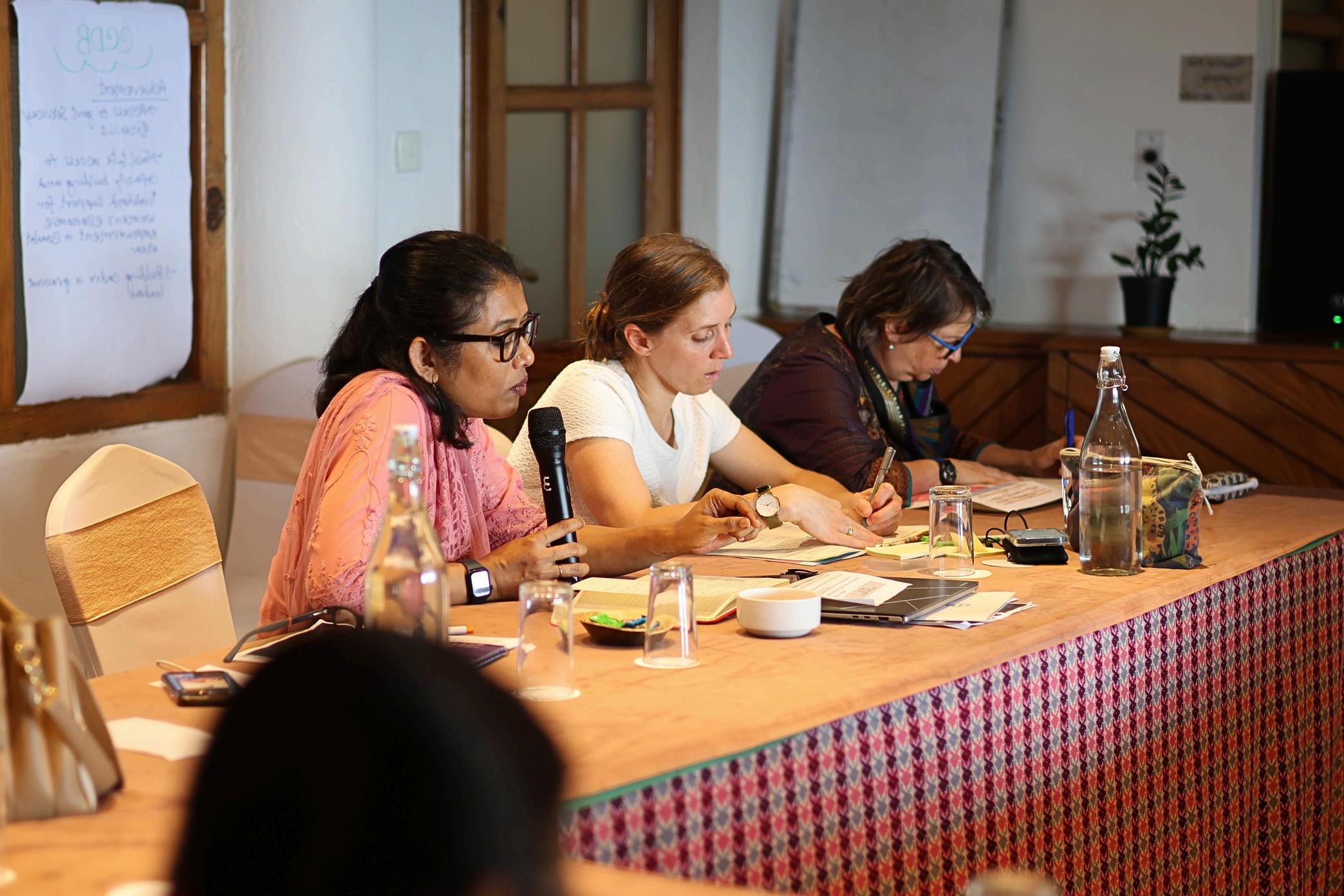
International development, or global development, is criticized for upholding neo-colonial traits and for acting as a messiah to aid the Global South. However, when Engage initiative partners met to reflect on the partnership model, they unanimously reported that this initiative, in some ways, differs from other development initiatives they are involved in because it champions community-led actions. This approach, in a way, challenged the practice of top-down direction and promoted activities and actions that followed a predominantly bottom-up approach The question that arises here is: what factors contribute to the perception that the initiative model is innovative, even though, at first glance, it may look like any other initiative in the international development space? To answer this question, I will reflect on a few discussions and events that brought together all partners of the Engage initiative, gathering their opinions, reflections, and nuanced observations over the course of one year to contextualize the discussion
1 Note for the reader: the word project, both in meaning and in practice, is colonial We need to practice, as an organization, practitioners, educators, and individuals, to stop referring to projects and start using terms like initiative, collaboration, and others that are anti-colonial Hence, in this reflection, I actively replaced the word project' with 'initiative'
ENGAGE: WOMEN’S EMPOWERMENT & ACTIVE CITIZENSHIP
Engage is a 6 5-year initiative co-designed by the Coady Institute and five partner organizations in Bangladesh (CCDB), Ethiopia (WISE), Haiti (CLE), India (SEWA), and Tanzania (TGNP). The initiative primarily supports the leadership development of women in the informal sector, enabling them to tackle key issues such as the future of work, community governance, increased participation in entrepreneurship, and the reduction of urban and rural poverty through economic empowerment in their communities The initiative faced setbacks and delays as it launched during the COVID-19 pandemic. However, these pandemic-induced obstacles allowed partners to share alternative ideas and activities that could help mobilize movement in their communities Significant shifts during the pandemic created space for co-learning across the partnership that may not have happened if each organization had been focused on implementation in its own country space for learning, appreciation, and support for each other to foster the relationship When courses, workshops, and training were impossible to conduct in person, activities shifted online, where partners supported, nurtured, and promoted cofacilitation, ensuring equal partnership and learning opportunities Partners collaborated with the community to engage in deeper discussions on ways to bring systemic change by strengthening women’s leadership capacity.
ENGAGE PARTNERSHIP MODEL
International development fundamentally involves two sides: the local and the global two components that make it both compelling and questionable A standard critique of international development practice is that the Global North imposes and rehearses colonial and imperial practices, posing as partners or change-making catalysts. Or is it a result of its ongoing misconduct, finally seeking to amend its influence? In the global development context, when Western partners act as saviours by directing aid contributions, they often simultaneously withdraw funds, causing donors and catalysts to exit abruptly. Experts in the international development sector and critics view decolonial practices as a mere checkbox exercise
The Engage initiative typifies a typical international development initiative funded by Global Affairs Canada that brings together six partners from six different countries The Coady Institute at St Francis Xavier University serves as the initiative’s convenor, aligning closely with the standard international development framework. Like other initiatives, it pursues specific outputs and outcomes to meet its goals Yet, across its partners, the Engage initiative is regarded as something distinctive as it is a learning platform for all partners, leaving an imprint by fostering equitable partnerships across the Global South and North
Engage partners are challenging the traditional narrative by asserting that Engage has established an equal contribution platform, promotes collaborative decision-making, ensures fair resource distribution, encourages co-facilitation and co-creation of knowledge, and advocates for gender-inclusive practices The accumulated notes from the partners' reflections reveal a clear picture of the Engage initiative: this initiative's model is bold and meaningful, as it genuinely practices active engagement and naturally embodies decolonial praxis through its activities and operations
“WE TAILOR-MADE ACTIVITIES SPECIFICALLY FOR TGNP STAFF ON ASSET-BASED COMMUNITY DEVELOPMENT. WE DEVELOPED A MANUAL AND TRANSLATED IT INTO SWAHILI TO SUPPORT TOT TRAINING FOR TRAINERS ACROSS DIFFERENT GROUPS WITHIN THE KNOWLEDGE CENTER. IT ENABLED THEM (TOTS) TO TRAIN OTHERS AND HELPED THEM IDENTIFY TYPES OF ECONOMIC ACTIVITIES FROM THE COMMUNITY MEMBERS.”
–
TGNP Engage initiative manager
The TGNP initiative manager emphasized that tailored capacity development activities were essential for ensuring an equitable and inclusive partnership. It was a practical example of how the social and economic development concerns of the community and staff in Tanzania come from the ground and are incorporated into practice Another reflection emphasized the partnership between the organizations involved in the Engage project. The SEWA’s Engage initiative manager said, “Engage brought exposure to learning from the partner organizations, for example, from the TGNP, from whom we got to know more about Gender-responsive budgeting.”
On the other hand, the CCDB initiative manager reflected on how capacity development activities are tailored to partners’ requirements. The CCDB initiative manager shared that the organization was seeking to learn more about qualitative research. Upon sharing this in a management meeting, it was picked up and later developed into a workshop that eventually benefited all partner organizations and involved their own research staff.
Co-facilitation of a course also made its mark by challenging topdown directives while working with communities and by challenging the Western gaze on international development practice. The Engage partnership model stands out from other international development initiatives due to its flexibility in implementation, which creates space for learning and unlearning, and its transparency in finance, activities, and planning, as well as the trust partners have in each other. All partners unanimously agreed that any gatekeeper organization does not control knowledge generation and production, provided it focuses on community-led development.
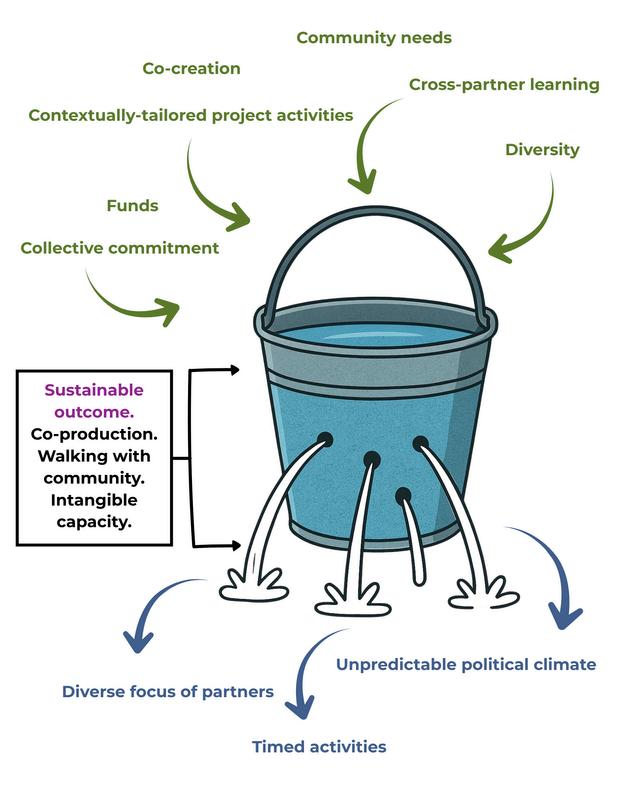
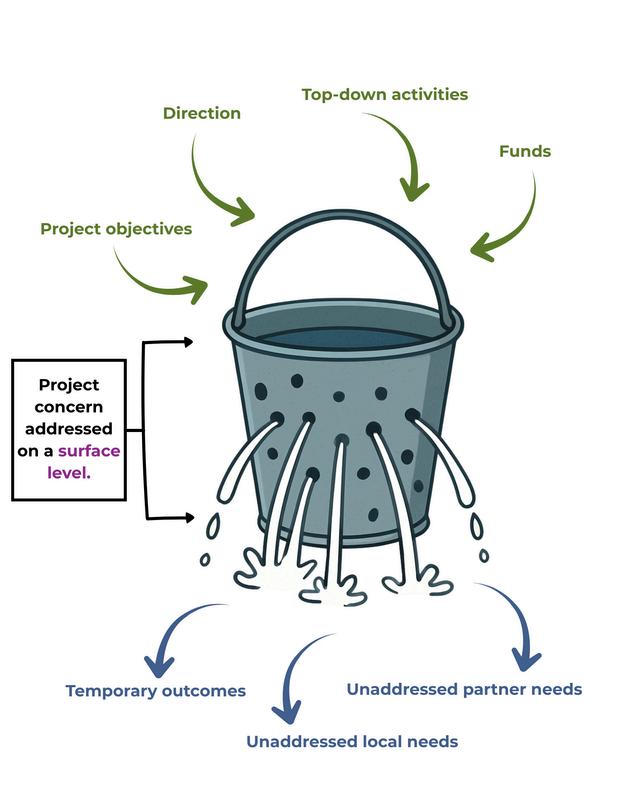
To understand how Engage Partnership is unique and stands out from other programs, this reflection piece uses a comparative leaky bucket tool. For context, the Leaky Bucket is an educational tool used globally. It usually visualizes the assets that stay in a bucket as positives going into the bucket as resources (illustration: water filling a bucket), and the negatives as challenges, depicted as holes draining it. Within the Engage initiative, the tool has been adapted to facilitate conversations amongst partners on the initiative's impact, including its benefits, challenges, and the resulting energy level of the organization. Below is an illustration comparing leaky buckets: one based on the general international development model and the other on the Engage Initiative model, which highlights the key features that set it apart from a contemporary development initiative.
THE ENERGY LEVELS IN BOTH MODELS ARE COMPARED. THE ‘ENGAGE’ MODEL RETAINS SIGNIFICANTLY MORE ENERGY COMPARED TO THE TRADITIONAL MODEL.
In contrast, a typical international development initiative usually focuses on resources such as funds, top-down activities, direction, and predetermined initiative tasks (Figure 2)
The negatives that drain energy are also different in the two contexts.
The illustrations show a side-byside depiction of why Engage partners believe it is a sustainable partnership between the Global North and the South. The Engage model highlights several key positive sources that fill the bucket, including funds, collective commitments, contextualized initiative activities, co-creation, cross-partner learning, community needs, diversity, and co-facilitation (Figure 1).
Figure 1: Engage Leaky Bucket
Figure 2: Traditional Development Leaky Bucket
In Engage, partners addressed a range of challenges, including timed activities, an unpredictable, critical political climate, and diverse partner focuses (Figure 1). Conversely, in a general initiative, energydraining sources were identified as a lack of understanding of local needs, insufficient knowledge of partners' needs, and focusing on temporary outcomes (Figure 2) As a result, the energy levels in both models are compared; the Engage model retains significantly more energy, which benefits sustainable international development, compared to the general initiative model, which bears the burden of demonstrating predetermined results. The balance between positives and negatives shows Engage partners that the outcomes are sustainable, as they observe intangible growth in communities. This realization creates space for co-production, walking alongside communities, while a general initiative model only sustains the set of initiative outcomes. Partners can also reflect on their own organizational health beyond the activities accomplished
In international development practices, it is high time to adopt approaches that promote the natural upward growth of community initiatives, with a shared understanding of community-led movements and social change. Engage initiative partners admire the work model for creating space and being mindful of the importance of working alongside the community. The partnership model became sustainable because it accompanies community-led efforts and workers by moving away from a top-down approach to development and adhering to the principles of collective action.