NOVEMEBR 1 –7, 2025. Volume No. 23
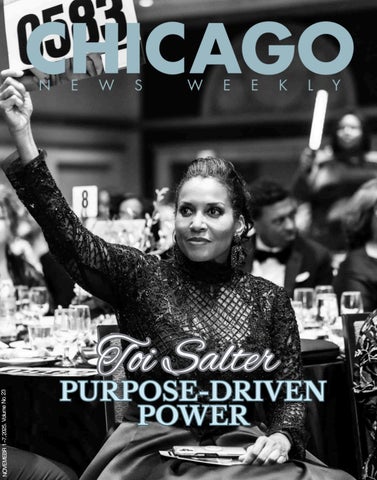
Toi Salter
PURPOSE-DRIVEN PURPOSE-DRIVEN POWER POWER
2 NOV 1 --- NOV 7, 2025
E-NOTES Publisher Cheryl Mainor Norman
Editor-In-Chief
Kai El Zabar
Chief Content Officier Laura Miller Malachi Webster Editorial Assistant Creative Direction Executive Producer Sales Manager Sales Manager Copy Editor Staff Writers19 24
CNW Studio, LLC Laura Miller Kevin Ross Michael Toliver Max Blaisdell Mila K. Marshall PhD. Candi McCrary Neffer Kerr Cabryl Breotti CL. Blackburn Dr. Sanja Rickette Stinson David Seaton
Columnists Intern & Illustrator
Cover Photography
Elijah Lee Erika Bracey
Chicago News Weekly, LLC 700 N Sacramento Blvd Suite 320 Chicago, IL 60612 (312) 877-5151 Volume 3 No. 21 October 15, 2025 Chicago News Weekly is Published on Thursday www.cnwmedia.com advertising@cnwmedia.co m editorial@cnwmedia.com
CHECK OUT LAST WEEK’S ISSUE AT WWW.CNWMEDIA.COM/E-EDITIONS
The Motherboard Connections Kai El Zabar As we look around and examine our current sociopolitical environment, we are more aware than ever of the value and importance of connection. We may also recognize why being connected with others beyond our immediate family is significant. Let’s begin with childhood—surrounded by family, neighbors, and friends. We grow up with them as constant fixtures in our lives, engaging with them across many aspects of daily living. In the kind of neighborhood I grew up in, where most were homeowners, people made it their business to know one another. They often established friendships and depended on each other for all sorts of things—from carpooling the kids to school to chaperoning them on park or school outings. Sometimes, if our parents were away for the evening, we ate dinner at each other’s homes. We shared neighborhood events, community rules, and codes of conduct. Even our visiting relatives became part of that extended network. Then there were our parents’ friends, and our own—from school, church, or camp— each forming relationships that took on lives of their own. When we lived at 544 Camden Ave., a cul-de-sac lined with homes in an open semi-circle, all the neighbors looked out for one another. It was like a huge family —connected in a positive, functional way that helped the community thrive cohesively. I had grown up with most of the kids since kindergarten, so when we moved at the end of my sixth-grade year, I was devastated—even though my neighborhood friends weren’t my classmates. We moved into our new home at 1236 Paddock Hills, off Paddock Road, across the street from a golf course. That new environment offered me fresh adventures and helped shape my view of the world through a romantic lens. I was entering seventh grade, and life had changed just like that. Our elementary schools went from kindergarten through sixth grade, and our high school began at seventh and went through twelfth. re skin. Our immersion into the Paddock Hills neighborhood was different—it bordered a busy road and faced a golf course, which became a creative inspiration for me. I often took long walks there and wrote poetry. Avon Fields Golf Course became a favorite walking spot and one of my fondest memories shared with friends. I didn’t play golf, though my father and godfather did. As an older child in this new neighborhood, I became the local babysitter and soon knew most of the parents—and they knew mine.
Many of our relationships can be fleeting or never deepen beyond a superficial level, yet even these small connections can grow into something more essential. My reputation as a responsible sitter, for instance, led to a summer position as a live-in Au Pair—though I wasn’t from abroad. I lived with a family around the corner whose parents worked and traveled throughout the summer. I had my own room and built a meaningful relationship with their three children. I still communicate with them today. Connections are exactly what they sound like. How often have you said to someone, “I can put you in touch with a friend who can help with that”? Or asked, “Do you know anyone at Disney in Orlando who can assist me with a job opportunity?” Such exchanges happen because of the connections we make over the years. I’ve since met people through countless avenues— conventions, conferences, shared interests, classes, sporting events, anniversaries, the gym, doctor’s offices, condo associations, and organizations like sororities and fraternities. From each encounter, we have the opportunity to form momentary or lasting bonds. For example, if you cook a large meal for four neighbors once a week, you’ll have four nights off in return. As you grow to trust one another, you can add new members or take on new shared tasks. During COVID, my floor would meet in the hallway—masked, seated at a safe distance, with wine placed in the center. We’d sit back and talk. It was a much-needed gesture to maintain our human connection. Actions speak louder than words. Working closely with neighbors to ensure everyone’s well-being can be a powerful way to build a sense of belonging where you live. Not everyone will be open to joining such a network, but as you connect with those who appreciate the value of this “motherboard,” you’ll find that others are just as eager as you are to create meaningful, lasting connections. NOV 1 --- NOV 7, 2025 3
NATIONAL NEWS Your Choices About Healthcare, Immigration, and Governance Are About to Be Made for You—Unless Malachi Webster - Staff Writer Congress Acts The American political system is in genuine crisis, and it's directly affecting your wallet, your family's healthcare, and your city's future. Here's what you actually need to understand. Why? Exit polling shows that 1. The Government Shutdown Is Without those subsidies? According voters' primary concern wasn't the Longest in American History to KFF, a nonpartisan research abstract political ideology. It was —and It's Getting Worse organization, average premiums the economy. More than half of would increase 114% across the New York City voters said rising As of November 4th, the federal country. cost of living was their top government entered its 36th day concern. In California, nearly of shutdown, breaking the In concrete terms: if you're 60 years half of voters identified "the previous record set during old, earning $80,000 a year, and economy" as their main issue. Trump's first term. For context: currently paying $439 monthly for These aren't people responding this means that roughly 800,000 insurance, you're looking at $1,059 to partisan messaging. These are federal employees are working monthly starting in 2026 if subsidies people struggling with their rent, without pay, Social Security expire. That's more than 15% of their groceries, their ability to services are understaffed, crucial income. The question before maintain their standard of living. data collection has stopped, and Congress is whether to extend the food assistance payments for 42 subsidies. Republicans have made it Meanwhile, Treasury data million Americans have been clear they won't. Your healthcare shows that while stock markets threatened. decisions for 2026 might depend hit record highs and GDP on what Congress decides in the growth remains solid on paper, Transportation Secretary Sean next few weeks. wage growth hasn't kept up with Duffy warned that air traffic inflation. For most Americans, controller shortages could force 3. Immigration Enforcement the economy doesn't feel good. the closure of "certain areas of Has Become Indiscriminate It doesn't matter if economists airspace" and promised that you'll and Increasingly Violent say it's "fundamentally sound." If "see flight delays" and "mass you're a Chicagoan working two “The raid at Rayito de Sol on cancellations." This isn't theoretical. jobs and still worried about your November 5th was dramatic, but it's If you fly out of O'Hare, this is lease, the economy feels broken. one data point in a much larger affecting you. The shutdown's The election results suggest that enforcement campaign. Operation leverage in negotiations is literally voters are holding the current Midway Blitz has resulted in more the threat of making your ability administration responsible for than 3,000 arrests in Chicago since to travel impossible. that feeling. September. These aren't all at the border. They're happening in What's the fight about? Democrats 5. Your Choices About neighborhoods, at schools, at want the extended enhanced Healthcare, Immigration, and community centers. subsidies for Affordable Care Act Governance Are About to Be insurance to continue. “The Supreme Court, in an Made for You—Unless Republicans want those subsidies emergency ruling this year, allowed Congress Acts to expire. The White House has immigration enforcement stops indicated it's willing to let this based on "race or ethnicity, All of this connects. The continue indefinitely. Chicago command of English, location, and government shutdown is residents should understand that type of job." That's a constitutional directly linked to whether this isn't a Washington problem violation being endorsed by the health insurance subsidies that will resolve itself. This is highest court in the nation. It means continue. Immigration affecting hospital funding, food law enforcement can pull over enforcement determines who safety inspections, and basic people based on appearance. It gets deported and who stays. infrastructure maintenance right means your neighbors are living in The economy's direction will be now. fear. It means that if you look like shaped by policy decisions you might be undocumented— being made in Congress right 2. Health Insurance Premiums which is often code for looking now. Are Doubling—and Congress Latino—you're potentially subject to Might Let It Happen arrest. Chicago has tried to position What's critical for Chicagoans to itself as a sanctuary city, but understand is that none of this Open enrollment started sanctuary status means nothing is predetermined. Congress November 1st. If you're looking at against federal enforcement with could extend the subsidies and Affordable Care Act plans on helicopter raids and tactical units. end the shutdown. Congress healthcare.gov, you'll see This is the national enforcement could mandate that premiums that may have reality right now. It's coming to immigration enforcement can't doubled or even tripled from neighborhoods in your city. rely on racial profiling. 2025. This isn't insurance Congress could implement companies being greedy; it's what different economic policies. 4. The Economy Is Stalling, and happens when federal subsidies The reason these decisions Voters Just Sent Trump a Message expire. haven't happened isn't because About It the options don't exist. It's For the past few years, Congress because political actors have On Election Day 2025, Democrats maintained "enhanced" premium chosen the confrontation subsidies that made insurance swept major off-year elections. They instead. won governor's races in two states. affordable. These subsidies mean They won in New York City. They that around 22 million Americans That choice—that specific —including self-employed won in California. In a year when political choice—is what's the incumbent president's party people, small business employees, affecting your health insurance, usually gets punished, they gained and freelancers—could actually your neighbors' security, and afford to buy coverage. ground. your city's ability to function. The government works for you. Theoretically. The question is whether you're going to hold it accountable for the choices it's 4 NOV 1 --- NOV 7, 2025 making on your behalf.
CITY NEWS Armed Officers in the Pre-K: ICE's Rayito de Sol Operation Malachi Webster - Staff writer At 7 a.m. on Wednesday, November 5th, the walls between childhood and citizenship collapsed at Rayito de Sol Spanish Immersion Early Learning Center on Chicago's North Side. Video footage shows the moment clearly enough, though clarity offers no comfort: federal agents in tactical gear, faces masked, entering a daycare during drop-off. A woman in a pre-K classroom, fleeing, screaming in Spanish: "I have papers." The physical struggle. The forcible removal. Children watching. Teachers watching. Parents arriving to drop off their infants into what was supposed to be a sanctuary, instead witnessing something that belongs to another kind of nation. The woman was Diana Santillana, according to parents who knew her. From Medellín, Colombia. A teacher who had been working with children in that classroom. The daycare had recently assured parents that all their educators were legally permitted to work.
That assurance, clearly, meant nothing against the machinery of enforcement.The daycare had recently assured parents that all their educators were legally permitted to work. That assurance, clearly, meant nothing against the machinery of enforcement. This wasn't a violation of policy. It was the policy. What happened at Rayito de Sol wasn't an isolated incident. It was part of Operation Midway Blitz, a federal immigration enforcement initiative that has resulted in more than 3,000 arrests in the Chicago area since early September. We're talking about agents rappelling from Black Hawk helicopters in the middle of the night. We're talking about overwhelming force deployed in recreational areas. We're talking about tear gas launched at protesters. This is what aggressive immigration enforcement looks like in practice—not abstract policy but concrete raids on the fabric of ordinary life.
The problem is that this version collides with what dozens of witnesses— parents, teachers, aldermen—saw and documented. They recognized agents entering the building without showing a warrant. They looked at agents walking through classrooms with weapons in a building full of four-montholds and toddlers.
They watched a woman claiming to have documentation being ignored, pursued, and physically restrained. They observed not a dangerous criminal being apprehended but a preschool teacher being removed from her workplace in front of terrified children. "Alderman Matt Martin, representing the 47th Ward, was direct: "You had agents with guns who were walking around the facility with teachers inside, with children inside, and so we are of course demanding that she be released immediately." What made Wednesday remarkable wasn't the enforcement action itself—Chicago had already become accustomed to them. What made it remarkable was the targeting of a sanctuary. Daycares aren't usually considered high-value targets in immigration enforcement campaigns. But under the current operational tempo, there apparently are no sanctuary spaces left. No places where the rules of enforcement don't apply. Not schools. Not places of worship. Not daycares where the most vulnerable members of society are being educated. The cascading trauma is worth noting. Parents raced from their jobs. The facility closed for the day. Children were exposed to violence—yes, state violence counts— during what was supposed to be the ordinary, safe beginning of their day. Teachers questioned whether their coworkers were secure. The entire infrastructure of trust that makes early childhood education possible shattered in minutes. And then there's the question nobody wants to ask directly: What message does this send about who belongs? A woman with documentation. A teacher with a job. A person embedded in a community. Removed from that community in front of children. The signal isn't subtle. It's not about who's legal or illegal. It's about who can be removed, at any moment, regardless of status. It's about establishing a hierarchy of security and belonging, with some people permanently vulnerable. Chicago has a particular history with sanctuary. The city took the stance, at least rhetorically, that immigration authorities shouldn't rely on local police cooperation. That there were limits. That certain rights applied to certain places. But rhetorical sanctuary means nothing against the force of federal enforcement. It means nothing when agents decide that a daycare isn't protected space. What happened at Rayito de Sol wasn't an exception to how we're operating. It was the operating system made visible. It's what it looks like when enforcement becomes the organizing principle, when enforcement reaches into spaces we assumed were outside its scope, when enforcement prioritizes demonstrating power over protecting vulnerability. The daycare will reopen. Teachers will return. Parents will drop off their children again, though with a different kind of fear now—the knowledge that no space is guaranteed to be safe. Some people will argue that this is necessary. That enforcement has to show it operates everywhere. That nobody is exempt. They would be right. And that's precisely the problem.
NOV 1 --- NOV 7, 2025 5
CITY NEWS Chicago Theological Seminary and Chicago History Museum Present Jackson Oral History Project Pop-Up Exhibition CNW Staff Report Chicago Theological Seminary (CTS), in collaboration with the Chicago History Museum, is honored to present the Jackson Oral History Project Pop-Up Panel Exhibition, a traveling educational and cultural initiative that highlights a pivotal chapter in Chicago’s civil rights history. The exhibition explores the work and influence of Rev. Jesse Jackson and the Chicago Breadbasket Movement, foregrounding the voices and lived experiences of individuals who helped shape a transformative moment in the ongoing fight for racial and economic justice. The exhibition features nine largescale interpretive banners, each displaying historical photographs, contextual narrative, and excerpts from oral history interviews. Central to the project are three newly recorded oral histories, captured specifically to expand the public record and enrich understanding of the Chicago Breadbasket era. The included interviews offer firsthand accounts from individuals who organized, strategized, and mobilized alongside Rev. Jackson, helping to build the infrastructure of a movement grounded in faith, dignity, and collective action.
6 NOV 1 --- NOV 7, 2025
“No great movement occurs without a cadre of competent, faithful individuals who share the leader’s passion and commitments,” said Rev. Dr. Brian E. Smith, who helped guide the development of the project and its oral history recordings. “Following the illustrious career of Rev. Jesse Jackson, we have carefully cultivated relationships with some of the early pioneers of the Chicago Civil Rights Movement. The Jackson Oral History Project is made possible through the generous support of the Donnelly Foundation, whose contribution ensured the preservation, interpretation, and public sharing of these vital histories.
COVER STORY
Toi Salter
TRANSFORMATIVE & OBEDIENT BY LAURA MILLER - MANAGING EDITOR PHOTO CREDIT: ERIKA BRACEY 7 NOV 1 --- NOV 7, 2025
COVER STORY
The Purpose-Driven Power of Toi Salter From a Hyde Park salon to the high-stakes world of finance, Toi Salter has spent her life blending faith, focus, and fierce determination. Now, as a record-breaking fundraiser and mentor to the next generation, she’s proving that obedience isn’t submission—it’s strategy.
“Obedience doesn’t limit you — it liberates you.” There’s a quiet command in the way Toi Salter moves through the world — one built not on ego, but on purpose. For decades, she’s balanced entrepreneurship, mentorship, and philanthropy with a grace that feels effortless but is anything but. Her story reads like divine choreography — every twist, every risk, every reinvention guided by faith and conviction. “I’ve always known God had His hand on my life,” she says softly, her tone both calm and absolute. “I didn’t always know what the next step looked like, but I knew I wasn’t walking it alone. Every time I thought something was ending, it was really just God moving me into position.” That quiet certainty has carried her from her grandmother’s beauty salon to boardrooms where millions of dollars move through her stewardship — and to grand ballrooms where she’s raised millions more for education and equity. Her life, at its core, is not about chasing success; it’s about obeying purpose.
The Foundation: Faith, Family, and First Dreams Salter's foundation was built at home — in the industrious hum of a family of entrepreneurs who made things happen long before "self-made" became a slogan. Her mother, Jacqueline Walker, was a successful entrepreneur, but Salter gravitated towards her grandmother. Her grandmother ran a beauty business from her basement, a one-woman force of confidence and craftsmanship. "She had long nails and such pride in her work," Salter recalls. "I used to sit there and just watch her — how she handled her customers, how they lit up around her. She made people feel beautiful and important. I knew I wanted that same feeling — that ability to create something that brought people joy." After college, when Salter's father offered to buy her a car, she surprised him. With her counter request, “Don’t get me a car, get me a salon.” she recalls. "A car could take me from point A to B," she laughs, "but that salon could take me for life." With that single decision, she changed her trajectory. In 1983, Salter opened her nail salon in Hyde Park — one of the first of its kind in the city. It was an instant success, but more than that, it was a gathering place. "You'd be amazed at who came through those doors," she says. "Writers, stylists, radio hosts — the energy was electric. We talked about everything from business to love to what was going on in the city that week. It wasn't just a salon — it was connection. It was community." If social media is about creating engagement, Salter was doing it long before hashtags and timelines. "We were our own network," she says. "You could feel it. People left there believing in something — in themselves, in possibility." Even then, Salter's instincts were teaching her how connection, purpose, and commerce work together. She just didn't have the language for it yet.
The Pivot: Faith and Financial Vision After several years of success, Salter began to feel a restlessness she couldn't ignore. "It's not that I didn't love what I was doing," she says. "It's that I started hearing that whisper again — that inner voice saying, 'You've done this part. Now let's move on.'" So Salter did. She sold her business, went back to school, and decided to start again — from scratch. Salter's uncle, the late Roger Salter, an entrepreneur and mentor, helped point the way. "He showed me his February check — seven figures," she says, eyes widening even now at the memory. "I said, 'Okay, I understand what obedience looks like in motion.'"
8 NOV 1 --- NOV 7, 2025
Photo Credit : Jason McCoy Photography
But this was never about chasing wealth. It was about stewardship — understanding how money works, and how it could serve others when managed with care. "I saw how many professional athletes were making millions and losing it all," she says. "Not because they weren't smart, but because they didn't have guidance. I thought, if I could just be that steady voice — the one that says, 'Let's plan before we spend, let's build before we buy' — maybe I could help change that story."
through the United Negro College Fund (UNCF) and the Chicago Urban League. Salter’s leadership with UNCF Chicago is now the stuff of legend. In 2019, she raised $1.1 million for the organization. Then came 2020 — a year without a gala due to COVID — yet through a few phone calls to her clients who had always given, she helped raise $1.7 million. There was no event to attend, no ballroom to gather in — just the genuine desire to contribute and make a difference.
Today, as CEO and founder of Salter Financial Management LLC, Salter manages and oversees the financial and business affairs of professional athletes and media personalities. Her approach is part mentorship, part management, and part ministry.
“People told me it couldn’t be done,” she says. “But when you lead with faith, you don’t ask ‘if’ — you ask ‘how.’ We adjusted, we called, we prayed — and people gave. Because giving feels good when it’s connected to purpose.”
"Entrepreneurship has never felt hard," she says. "When you're walking in passion, you're being carried. I've learned that when you work in your purpose, the work itself becomes the reward."
Altogether, her efforts brought in nearly $3 million for UNCF. Then, in 2024, the Chicago Urban League called. Their annual Golden Fellowship Dinner — the organization’s largest fundraising event — needed a chair. The goal: $3 million.
Salter pauses, then adds with a laugh, "That doesn't mean it's easy. But it's grace-filled. There's a difference."
They said, 'Toi, can you do it?'" she recalls, smiling. Thought to herself, this is light work, 'and rose to the occasion.
The Art of Purposeful Giving
By the end of the night, they had raised $4.3 million — a record-breaking total.
If entrepreneurship was instinct, philanthropy was destiny.Over the years, Salter has helped raise more than $12 million for organizations that empower youth and strengthen communities — especially -
COVER STORY "I didn't go looking for that role," she says, shaking her head. "It found me. And when God sends something your way, you don't negotiate — you obey." This year, Salter's back — serving again as Honorary Chair alongside Charles Smith, helping the Urban League aim for another $3 million. Salter's philosophy of giving has little to do with transactions and everything to do with transformation. "People think fundraising is about asking for money," she says. "It's not. It's about telling a story that moves the heart. If you can remind people that their giving changes lives — not in theory, but in real time — they'll give every time." Salter leans forward slightly as if letting you in on a truth. "You have to connect the mission to emotion. When I talk about UNCF, I talk about the students — the faces, the families. When I talk about the Urban League, I talk about opportunity. Because we're not raising money, we're raising possibility." Salter's voice softens. "And you can't ask people to give to something you don't believe in yourself. That's why I show up, why I write checks too, why I pick up the phone and call people I know could be doing more. It's not pressure — it's partnership. We're in this together." Salter pauses, smiling. "Sometimes I'll call and say, 'I know you said you were going to give 10, but what about 25?' And then we both laugh, and they do it anyway. Because when it's for the right cause, people rise to it." She sits back. "That's how I know God is in it. When you can make people feel seen and inspired — that's ministry. Whether it's through faith or finance, I just want to be in service to something bigger than me." Faith, Purpose, and Reinvention Salter doesn't chase change; she obeys it. "God wants me to stretch," she says. "To come out of my comfort zone so He can show up and show out in my life. My job is to be obedient." When she says "obedient," it doesn't sound submissive — it sounds strong. It's a word she's reclaimed as strategy. "I've learned that obedience doesn't limit you," she says. "It liberates you. It teaches you to trust the timing, even when you can't trace it." Right now, that obedience looks like balance. "The chapter I'm in?" she smiles. "Transformative and obedient."
“We’re not raising money. We’re raising possibility.”
“Think like a child, but have grownfolk execution.”
Salter laughs softly. "I take naps unapologetically. I say no as a sport. I've learned to shut down the noise — and it's all right." There's a gentle humor in her delivery, the ease of a woman who's spent decades proving herself and now refuses to hurry. "I used to think stillness was unproductive," she says. "Now I understand — stillness is strategy."
Legacy and Light When asked what she hopes young women take from her story, Salter answers without hesitation. "Think like a child," she says, "but have grown-folk execution. Children believe everything is possible. Grown people know how to make it happen. You need both." Then she pauses — the kind of pause that carries weight. "There's nothing new under the sun," she adds. "You don't have to reinvent the wheel — just put your spin on it. That's what makes it yours." Her spin, of course, has always been grace, grit, and giving. From her grandmother's basement to the grandest ballrooms in Chicago, Salter has lived a life guided by faith and fueled by purpose. She's built not just wealth, but wisdom — not just success, but significance. "When you move in purpose," she says, "you move differently. You don't panic when doors close, because you understand closed doors are just redirections. You trust that what's meant for you will find you — and that you'll be ready when it does." Salter smiles, that calm confidence radiating through the room. "I've learned that passion without obedience is noise. But when you pair the two?" She leans back, letting the thought hang. "That's power. That's peace."
NOV 1 --- NOV 7, 2025
9
a.i The Answer Is
CNW STAFF REPORT Today we are witnessing some of the most unexpected behavioral choices by our federal government in recent memory—actions that often challenge the sacred codes of conduct that underpin our democratic way of life. Many of these “codes” are interconnected, referring broadly to how we define and regulate behavior. Yet each carries a distinct shade of meaning and applies in different contexts. The CNW editorial team thought it might be useful to revisit these terms— protocol, rules, law, decorum, etiquette, and manners—as they shape not only governance but also our everyday experiences.
Understanding the Codes Protocol is the most formal and rigid of the group. It refers to a system of rules or accepted procedures governing official ceremonies, international relations, or specific scientific or technical practices. It dictates procedures in government, diplomacy, medicine, or technology—setting the highest-level standards for an event or process. Rules are explicit, mandatory guidelines for conduct or procedure in a specific activity or domain. They are the most general and basic form of regulation. Protocols and laws are specialized types of rules, which are usually written down and carry penalties if broken.
Law represents the most enforceable set of rules. It is the system a country or community uses to regulate the actions of its members, typically enforced by penalties. Breaking a law carries legal consequences—unlike breaking a rule of decorum or etiquette.
A Spectrum of Behavior These terms form a kind of hierarchy —from the most formal and mandatory to the most personal and voluntary:
At the top are law and protocol, which define mandatory systems of behavior, Decorum means behavior that reflects such as traffic laws or diplomatic good taste and propriety. It focuses on procedures. Beneath them are rules, the what’s appropriate in a given setting— explicit guidelines that govern organized such as maintaining respect and order systems. Decorum and etiquette shape in a courtroom. Decorum often reflects social expectations, setting standards for the spirit of protocol, emphasizing appropriateness and politeness. And at what’s fitting rather than what’s legally the most personal level are manners, the required. small daily gestures that put those expectations into practice. Etiquette refers to the customary code of polite behavior in society or within a In essence, your manners reflect your respect for etiquette and decorum, which particular profession or group. It is less formal than protocol but more detailed in turn are shaped by broader systems of rules, protocols, and laws. than decorum. Etiquette consists of broad, often unwritten social Each of these words has a long history expectations, and manners are the and specific setting—whether a business individual actions that demonstrate meeting, a courtroom, a wedding, or a them. dinner party. Think of Robert’s Rules of Manners are the daily expressions of Order or Miss Manners as modern politeness and respect—saying “please” guides to these timeless principles. and “thank you,” chewing with your mouth closed, or holding the door for someone. They are the most personal We’ll leave the rest to you. and practical form of social behavior, learned to make interactions pleasant and respectful.
Eli's collaboration with Malachi’s Webster’s Armed Officers in the Pre-K: ICE's Rayito de Sol Operation Story on page 5.
NOV 1 --- NOV 7, 2025 11
The Power of the Pause - Part 1
EMPOWERMENT
Dr. Sanja Rickette Stinson - Columnist After retiring from more than three decades as a founding nonprofit CEO—building a mission from the ground up, shaping and uplifting countless lives, advocating for the overlooked, and carrying the weight of service with unwavering commitment—you’d think the next chapter would glide in with ease and predictability. But as we navigate the final months of 2025, the transition is often anything but simple. In fact, it can be unsettling… even a little scary. Life after leadership can be surprisingly jarring. Suddenly, the rhythm changes. The phone quiets. The calendar clears.And you find yourself standing in a new kind of silence, the kind that makes you wonder, “Who am I now?” That’s when you realize something profound: leadership doesn’t end with retirement—you simply shift where it lives. Because people may retire, but purpose never does. Even with a legacy full of impact behind you, you still need to pause intentionally —to breathe, to regroup, to listen for the next divine assignment. Retirement doesn’t mean releasing purpose; it means reimagining it.And sometimes that reimagining comes wrapped in the unexpected. Jobs change. Relationships shift. Plans stall. Dreams get rearranged like furniture in a room that suddenly doesn’t feel like home anymore. But here is the good news: disruption isn’t your enemy. Sometimes it’s your divine invitation. This season is calling us to engage three powerful moves—Pause, Pivot, and Shift. These aren’t just motivational words; they’re spiritual strategies that ground us while propelling us into whatever God is unfolding next. Today, we begin with Part 1 of this three-part series: The Pause. Pause:The Sacred Selah Before the Next Chapter Know this: a pause is not quitting, it’s not weakness, it’s not resignation.Apause— pure and simple—is wisdom.And yet, pausing is one of the hardest things for leaders, caregivers, visionaries, and world-shifters to do. Why? Because we have been conditioned to believe movement equals progress
12 NOV 1 --- NOV 7, 2025
Productivity equals purpose. If we’re not working, strategizing, or solving… we fearwe are falling behind. (Selah here indicates a pause for reflective purposes) But pausing is its own kind of progress. Apause disrupts autopilot. It creates sacred space for clarity. It gives your spirit room to exhale. It allows God’s voice to rise above the noise of deadlines, expectations, and the constant pressure to perform or “figure it out.” The truth is, it takes more faith to pause than it does to push. Even Scripture reminds us that every major transition began with stillness. Moses encountered God while standing still before a burning bush. Elijah heard the divine whisper only after the brook dried up and everything familiar stopped flowing. Jesus prepared for His public ministry during forty days of solitude in the wilderness. In each story, transformation was preceded by a pause. The assignment didn’t come during the hustle it came during the hush. So, if you find yourself in a season where things have slowed, shifted, or stopped altogether, don’t panic. Pay attention. Sometimes the pause you didn’t choose becomes the pathwayyou didn’t know you needed. Whythe Pause Matters (Especially Now) As we approach the final months of 2025, many people feel the pressure to sprint to the finish line close the gaps, fix the delays, rescue abandoned goals, or accomplish something that “proves” the yearwasn’t wasted. But what if the victory in this season isn’t found in more doing but in quiet becoming? The pause is where we reconnect with our soul. The pause is where we confront what we’ve ignored. The pause is where we admit the truth we’ve run from. And the pause is where we let God restore what life has depleted. Pausing also helps us recognize subtle shifts—those internal nudges that tell us: “This chapter is ending, or something new is beginning.When we rush, we miss the signals.When we pause, we receive the instructions.
Three Questions to GuideYourPause As you enteryour own sacred pause, here are three questions that help reveal what God may be speaking, shifting, or aligning in your life: 1.What is God trying to show me right now? 2.What have I been too busy to notice? 3.Where am I out of alignment—emotionally, spiritually, or physically? These questions aren’t about judgment; they’re about clarity.And clarity is the foundation for every pivot and every shift that will follow. So, if this year has felt unfamiliar… unsettling… or uncertain, breathe. You are not falling behind—you’re being prepared.You’re not losing purpose—you’re learning it on a deeper level. The pause is not the end of your story. It is the page-turn. So, as we close out 2025, give yourself permission to embrace the pause fully, intentionally, and without guilt. Because when you honor the pause, you prepare your spirit for the pivot… and you make room for the shift. Part 2—The Pivot—is coming next.
AROUND TOWN CNW Chi-Lights! At the Pigmented Black Fine Art Faire ~ October 30th at Zhou B. Arts Center
NOV 1 --- NOV 7, 2025 13
HEALTHY LIVING
Finding Balance After 40: Why Fitness Is About More Than Just Cardio or Weights Laura Miller - Managing Editor Lifting weights or using resistance bands helps preserve lean muscle, maintain bone density, and support posture and balance—all crucial for aging well. For women in particular, it can offset the effects of declining It was meant as helpful advice, and it echoed something I’d heard floating around in fitness estrogen, which otherwise accelerate bone loss and muscle breakdown. circles. But it also made me pause. But men benefit, too. As Was that really true—and was it a womentestosterone levels dip with age, only rule? As it turns out, there’s some truth strength training stimulates the behind the statement, but also a fair bit of body to produce more of its misunderstanding. remaining anabolic hormones, As it turns out, there’s some truth behind helping maintain vitality, mood, and the statement, but also a fair bit of energy. misunderstanding. The reality is that both The Cortisol Conversation women and men benefit from rebalancing their fitness approach after 40—just not by Cortisol—often called the “stress abandoning one form of exercise in favor of hormone”—is part of what the other. people mean when they warn How Our Bodies Change in Our 40s and that too much cardio can Beyond backfire. Cortisol naturally rises during exercise, but long, intense By our 40s, the human body begins to shift in sessions (especially those lasting more than 45 to 60 minutes) can ways that affect how we respond to exercise. keep it elevated longer. Chronic Hormone levels—estrogen, progesterone, elevation may contribute to and testosterone—start to decline. Metabolism slows, and muscle mass naturally fatigue, slower recovery, and increased abdominal fat. decreases, a process called sarcopenia. For women, perimenopause and menopause add However, as researchers in an extra layer of complexity: changes in Frontiers in Physiology note, estrogen can influence how the body stores cortisol responses depend more fat, manages recovery, and regulates mood. on intensity and recovery than on These changes don’t mean our best fitness the type of exercise itself: years are behind us. In fact, research “Cortisol levels increase during consistently shows that staying active is one of acute exercise in an intensitythe strongest predictors of longevity and dependent manner” (Tarantino et independence. But how we move—and how al., 2022). we recover—becomes more important than Strength training tends to ever. produce shorter cortisol spikes followed by increases in muscleWhy Strength Training Deserves More building hormones such as Attention growth hormone and One part of that common advice was right: strength training is vital after 40 According to testosterone. Strength training tends to the *American Heart Association (AHA), produce shorter cortisol spikes “Stronger muscles lead to a boost in your metabolic rate, which means you’ll burn more followed by increases in musclebuilding hormones such as calories even when your body is at rest” growth hormone and (American Heart Association, 2023a). testosterone. That’s one reason it The AHA recommends resistance training at can help regulate—rather than least twice a week for adults (American Heart disrupt—the body’s hormonal Association, 2023b). balance as we age. Not long ago, someone told me, “Once you’re over 40, you should focus more on weight training—especially for women. Cardio just raises cortisol.”
14 NOV 1 --- NOV 7, 2025
Why Cardio Still Matters Cardio is beneficial, with the AHA recommending at least 150 minutes of moderate aerobic activity weekly for adults. It strengthens the heart, improves blood pressure and sugar control, reduces anxiety, and supports brain health. After 40, the focus shifts to how cardio is performed; low-impact activities like brisk walking, swimming, or cycling are better for joints. Incorporating shorter, high-intensity intervals once or twice weekly can enhance endurance and metabolism without straining recovery. Finding the Right Balance A balanced routine for those over 40 includes 2-4 days of strength training with compound movements, 2-3 days of moderate cardio, and 1-2 sessions of flexibility or mobility work, like yoga or stretching. The American College of Sports Medicine recommends combining strength, aerobic, balance, and mobility training for health maintenance. Also, prioritize sleep, nutrition, and stress management.
SPORTS
Chicago's Teams Are Doing What Politicians Couldn't MALACHI WEBSTER - Staff Writer Chicago needed something to believe in again. Not the kind of empty cheerleading that mayors hand out before ribbon cuttings, but something raw—the kind of catharsis that comes when your team walks onto the field at Soldier Field or takes the court at United Center and reminds you that the city you live in still knows how to aspire. For the past several years, Chicago had been wrestling with itself. Political upheaval, cultural fracture lines, the general sense that something essential had come loose. You could feel it in the neighborhoods, in the bars, in the way people talked about their own city with something between resignation and anger. Crime dominated conversations. Economic uncertainty stalked every coffee shop discussion about the future. The municipal machinery groaned under pressure, and the energy that once defined this city—that thick, confident Midwestern grit mixed with big-shouldered ambition—had started to feel like a relic. Then came the sports narrative.
The Bears' 2024-2025 season community report tells part of the story that the stat sheets miss. More than 230 community appearances. Over 470 volunteer hours. Players who didn't just show up for obligatory charity photos but showed up repeatedly. Hospital rooms visited. Kids reached through youth programs—not in the fancy neighborhoods, but in North Lawndale, where community meant something tangible. When the Bears collected 24,000 coats in their annual drive, that wasn't nostalgia. That was a team remembering that the city had been there for them during lean years. DeMar DeRozan and the Chicago Bulls told a different kind of story—one about patience and philosophical conviction. In a league obsessed with novelty, the Bulls made a counterintuitive choice: they believed in their foundation more than in the lottery of free agency. While other franchises chased flashy names, Chicago doubled down on development. Coby White, the 25-year-old North Carolina product, became the nucleus. ESPN didn't just casually rank him ahead of both DeRozan and Zach LaVine for the 2025-26 season; that ranking was a validation of the Bulls' entire strategic pivot. The organization had been willing to look foolish in the short term to build something durable.
The Chicago Bears, fresh off a chaotic 2024 season that exposed every fault line in their organization, executed what amounted to organizational triage. Out went the old regime's tactical incompetence. In came Ben Johnson, the architect of the Detroit Lions' explosive offense, a man so respected that when the Bears turned to him, it felt less like hiring a coach and more like calling in a specialist who actually knew how to fix what was broken. More crucially, they surrounded their franchise quarterback, Caleb Williams, with genuine support. An AllPro left guard in Joe Thuney. An offensive line that didn't collapse like a house of cards. Suddenly, a rookie who looked overwhelmed last season had a fighting chance. The Johnson didn't come in with empty promises. Instead, he demonstrated something Chicago had been starved for: competence. Deliberate, methodical competence. During training camp, he pushed Williams hard—the kind of challenge that separates good coaches from great ones. "He's a sponge right now," Johnson said, and you could feel the difference in how he talked about the quarterback. Not coddling. Not making excuses. But genuine belief coupled with high standards.
Bulls' community initiatives mirrored the Bears' approach but with their own flavor. Four focus areas—education, community investment, health and wellness, and access to opportunities— that added up to something more than marketing speak. When Ayo Dosunmu hosted his third annual Block Party for Chicago youth, that wasn't obligation.
What both teams understood, perhaps more clearly than the political leaders who had failed the city recently, was that hope isn't manufactured. It's built incrementally, through consistent action. Through showing up. Through believing that people matter and that excellence requires investment. The significance isn't that the Bears might make the playoffs or that the Bulls might develop into a contender. The significance is that in a city that had been told its best days were behind it—that its institutions were broken, that its future was uncertain—two of its most visible organizations demonstrated that renewal was still possible. That you could look honestly at what was broken, bring in capable people, invest in the fundamentals, and create something worth paying attention to again. Caleb Williams throwing touchdowns at Soldier Field in front of 60,000 people carrying hope again.
Coby White orchestrating an offense in a resurgent Bulls franchise. These aren't small things. They're oxygen for a city that had been holding its breath. The political upheaval that ravaged Chicago for years created a void— not just in governance but in collective identity. What the Bears and Bulls are offering is a reminder that identity can be rebuilt. That a city doesn't have to accept the narrative that it's in decline. That excellence, when applied consistently and with genuine belief in the community, becomes contagious. For the first time in years, Chicago had something other than grievance and complaint to rally around. It had the possibility of Tuesday night basketball in a resurgent franchise. It had the genuine momentum of a quarterback and a coaching staff that looked prepared to compete. It had players who understood that their most important work happened in the community, not just on the field or court. That's how cities heal. NOV 1 --- NOV 7, 2025 15
ARTS & CULTURE
Choreographer Chanel DaSilva Brings Love Story to Chicago Stage Brooklyn-born artist premieres "Wabash & You" with Joffrey Ballet while championing diversity in dance Kai El Zabar
When Chanel DaSilva's new ballet premieres at Chicago's Harris Theater this week, audiences will witness more than just an elegant love story set against the backdrop of downtown Chicago. They'll see the work of an artist who has dedicated her career to transforming the dance world from the inside out. DaSilva, a Brooklyn-born dancer, choreographer, and social justice advocate, describes herself as an "artivist"—someone who uses art as activism. Her latest work, "Wabash & You," debuts Thursday, November 6, as part of the Joffrey Ballet's two-part program "Matters of the Heart," running through November 9.
Around age 30, after establishing herself as a performer, DaSilva decided to expand her impact beyond the stage. She cofounded Move NYC, a social justice nonprofit dedicated to creating greater diversity and equity in the dance profession. Together with partner Nigel Campbell, she examined the systemic barriers that keep Black and brown dancers, particularly women, from accessing elite training and professional opportunities. "We peeled back that onion and realized that it takes access and opportunity at a very key and pivotal age, usually in your teenage years, to get you in the rooms you need to be in," DaSilva explains.
From Dancer to Change-maker
Breaking Down Barriers
DaSilva's journey in dance began at age three when she pointed to a picture and told her grandmother she wanted to do that. Enrolled at the Bernice Johnson Cultural Arts Center in Queens, she immediately fell in love with West African, tap, jazz, and modern dance. By 16, she had the confidence to audition for Juilliard, despite her mother's skeptical question about whether she was "really good." DaSilva's answer was simple: yes, she was. She earned a scholarship and never looked back.
The obstacles, DaSilva discovered, are deeply entrenched. The most significant barrier is financial. In ballet and other dance disciplines, aspiring dancers typically need to either pay their way into prestigious programs or receive scholarships. However, the scholarship system itself perpetuates inequality. Because men are scarce in dance, scholarships tend to go to Black and brown male dancers, while girls—who are in abundance— often miss out, regardless of their talent.
But success in the dance world revealed a troubling pattern. DaSilva found herself repeatedly being the only brown face in the room. "I asked myself, Why is that?" she recalls.
DaSilva recalls auditioning for programs as a teenager and qualifying, only to face program fees of $3,000 or more. "I was informed that I qualified, 'but the fee is $3,000' to which my single mother mom without hesitation simply told me, 'I got a mortgage to pay, babe. I can't afford to send you,'" she remembers.
Around age 30, after establishing herself as a performer, DaSilva decided to expand her impact beyond the stage. She co-founded Move NYC, a social justice nonprofit dedicated to creating greater diversity and equity in the dance profession. 16 NOV 1 --- NOV 7, 2025
Without financial support or mentorship, many talented young dancers give up on their dreams and pivot to other careers.
DaSilva considers herself lucky. She received a few scholarships and found herself in the right place at the right time. Her acceptance to Juilliard opened doors that might otherwise have remained closed. But she's determined to ensure other young women of color don't have to rely on luck.
Chanel DaSilva
Move NYC provides mentorship, professional development, and dance training entirely tuition-free. The programming connects young people with opportunities and professionals who can guide their advancement, creating pathways that bypass traditional financial barriers. Leadership and Representation As DaSilva transitioned into choreography and direction, she encountered another gap: the scarcity of Black and brown women in leadership positions within the dance field. To address this, she created Catapult, a platform specifically designed to help women connect, cultivate their skills, and advance into—and remain in—leadership roles. "Now that I'm a choreographer and director, I'm sitting in leadership roles often, and again, there's not a lot of brown and Black women in leadership positions in the dance field," she notes. DaSilva didn't initially envision herself as a choreographer. As a Juilliard freshman, she dropped her composition class, surprising her instructors who told her she was "a fabulous choreographer." She resumed her studies and developed her craft, though it wasn't until after her performing career matured that she realized she had more to say through choreography. "My choreography usually feels like a journal entry of all the things that I'm hearing and experiencing in my life and in the world around me," she explains. "Rather than pouring that out on Instagram or Facebook in the comment section, instead I pour it into my work." The Language of Dance As a choreographer, DaSilva is an intentional storyteller who blends multiple dance languages—ballet, modern, West African, jazz, and hip-hop. She combines the virtuosity and seemingly impossible athleticism of these forms with simple, everyday gestures: a touch of the face, a hand to the heart, a racing heartbeat. "I blend dance languages that already exist," she says, "combining that with simple gestures that I do every day, so that when an audience member comes to see it, the story is clear and it's also relatable."
ARTS & CULTURE Choreographer Chanel DaSilva Brings Love Story to Chicago Stage CON’TD
Kai El Zabar - Editor-in-Chief "Wabash & You" exemplifies this philosophy. Inspired by Wabash Avenue and performed in collaboration with the band The Main Squeeze—who perform live onstage with the dancers—the ballet tells the story of a brief but unforgettable romance in downtown Chicago. The set design features scenes from downtown under the El train, capturing the city's distinctive urban landscape. DaSilva's connection to Chicago is deeply personal, a romance with the city that she has parlayed into artistic expression. Her work shares the bill with another piece by choreographer Annabelle Lopez Ochoa about Frida Kahlo, creating an evening united by the theme "Matters of the Heart." A Message of Love and Support DaSilva hopes audiences will take away three things from "Wabash & You."
SSCAC Sells Art to Build New Building Wanda Wright - Contributing Writer
Her broader mission extends beyond any single performance. Through her choreography, her nonprofit work, and her leadership platforms, DaSilva is working to ensure that the dance world becomes more representative of the diverse communities that make up American society. She's chipping away at longstanding barriers, changing who appears onstage, what stories get told, and who leads the field. For young dancers of color who dream of careers in ballet and contemporary dance, DaSilva represents both inspiration and tangible support. She's proof that barriers can be overcome, but she's also creating systems to ensure that future generations won't face the same obstacles she did—or at least won't have to overcome them alone or through luck. As the curtain rises on "Wabash & You" this week, audiences will witness not just a love story set in Chicago, but the culmination of one artist's determination to use her platform for change, one performance, one mentee, and one leadership position at a time.
"Number one, come to have a fun evening of enjoyment," she says. "Number two, I'd love the audience to walk "Wabash & You" and "Broken away knowing that love can Wings" perform November 6-9 at find you at any time, and the Harris Theater for Music and know that if that love doesn't Dance in Chicago. last, that doesn't make it any less valuable. Number three, Check out CNW Network’s please continue to support The Terran Lamp Show the arts because the arts are what keeps us human and afloat as a society." Around age 30, after establishing herself as a performer, DaSilva decided to expand her impact beyond the stage. She co-founded Move NYC, a social justice nonprofit dedicated to creating greater diversity and equity in the dance profession.
ART FOR SALE
Electricity danced as it traveled at the speed of light zapping through the cavernous space of Haven sparked by the soul of Margaret Taylor Burroughs Goss- Founder of the 85-yearold South Side Community Arts Center (SSCAC) fundraising campaign. The Village glowed in anticipation and celebration of its new facility scheduled for completion in 2027.
Factually- artists came to Chicago from everywhereone of their first public offerings became the famous Lake Meadows 35th Street Art Fair. The Federal Art Project (FAP), part of the WPA, was established in 1935 and attracted notable artists like Eldzier Cortor and Gordon Parks.
Patrons across the diaspora packed the venue to standing room only. Music pulsed while guests eagerly buzzed beneath a canopy of dazzling lights, haute vibes and ART FOR SALE! Tables laden with irresistible cuisine from local gourmet restaurants lining expansive walls sent guests in full pursuit of tasty delights and laughter as they rushed to bid, nosh, view and settle in place before a live auction. Heartfelt action and sincere love for cultural treasures bore witness to the tangible impact of donations, support and kindled dreams as it realized hopes.
The WPA operated in Chicago from 1935 to 1943, employing millions for public and cultural projects, with Eleanor Roosevelt's support. It aimed to make art accessible during the Great Depression and promoted Black artists at the SSCAC. The Evening Auction, opened by Twyler Jenkins and Executive Director Monique Brinkman-Hill, honored contributors like Pemon Rami, Masequa Myers, and Dr. Bob Starks. A lively bidding war, led by auctioneer Candace Hunter, featured prominent Candace Hunter (CHLEE) attendees, including Bishop journaled heartwarming stories Dr. Horace E. Smith and of local African American MBDC CEO Debra Johnson. Artists history which created a Donate at sscartcenter.org to palpable spirit of pride and help SSCAC bring more unity. color to your world!
NOV 1 --- NOV 7, 2025 17
FOOD & WINE It’s football season — time to have the folks over for game day viewing! If you’re planning to host a Super Bowl watch party, start practicing now with a few game-day recipes. That way, when the big day arrives, your dish will be perfect. The tailgate tots can be tricky — it’s tailgate food, after all. To pull it off, your dish needs to be fun, creative, and easy to eat while watching the game. Messy is not acceptable.
Game Day Snacks Mari Evans - Staff Writer
It’s football season — time to have the folks over for game day viewing! If you’re planning to host a Super Bowl watch party, start practicing now with a few gameday recipes. That way, when the big day arrives, your dish will be perfect. The tailgate tots can be tricky — it’s tailgate food, after all. To pull it off, your dish needs to be fun, creative, and easy to eat while watching the game. Messy is not acceptable. Tailgate tots are attractive, easy to prepare, delicious, and crowd-pleasing. They’re also simple to serve. Whether you’re tailgating all day or parked on the couch for kickoff, these tots are the perfect packable snack to keep you satisfied as the game rages on. Here’s how we do it: layer tater tots, bacon, chopped chives, sour cream, and a homemade cheddar cheese sauce in mason jars to create these layered dreams. You can go with frozen tater tots as presented here, or if you really want to go over the top, make your own air fryer tater tots instead. Ingredients 1 (32-oz.) package tater tots 8 slices bacon, chopped 1/4 cup freshly chopped chives
A fan favorite is loaded potato skins — and this is your chance to get creative. Go beyond our combo and make it your own. Try Buffalo sauce, blue cheese crumbles, or ranch dressing. Chili and cheese are another classic pairing that never disappoints. We layered our tailgate tots in mason jars for the most adorable presentation, but you don’t have to. If you do, we recommend using wide-mouth jars so it’s easy to reach the bottom of your stack. Alternatively, you can layer your tots in small bowls. While presentation counts, use whatever container makes it easiest to layer and devour these tots. Let’s Get Started Preparation
1 container sour cream
Step 1: Heat grill to medium.
2 Tbsp. butter
Step 2: Spray two disposable pie plates with cooking spray and spread tater tots in a single layer in each. Grill for about 20 minutes, stirring regularly. Set aside.
2 Tbsp. all-purpose flour 1 cup whole milk 1 2/3 cups sharp cheddar cheese 1/4 tsp. chili powder
Step 3: Meanwhile, fry the bacon in a sauté pan over medium heat, then place on a paper towel-lined plate to drain excess grease. Step 4: Make the cheese sauce: In a deep sauté pan over medium heat, melt the butter. Sprinkle in flour, whisking to combine into a slurry. Gradually pour in the milk, whisking continuously, to form a thin sauce. Slowly stir in cheddar cheese and chili powder until fully combined. Remove sauce from heat. Step 5: Layer tater tots into small bowls or wide-mouth mason jars. Top with cheese sauce, bacon, sour cream, and chives. Repeat layers until you’ve reached the top of the container. Serve immediately — and enjoy your winning game-day snack!
18 NOV 1 --- NOV 7, 2025
FASHION
Inspiration Behind Fashion Mare Evans - Staff Writer Listen—be liquid and flow—because fashion consciousness is like the ocean. The creatures that inhabit that vast body of water are much like people. We live above ground, breathe air, eat food, drink water, and wear clothes. So, where does the inspiration for style really come from once we factor in the environment? We know that designers must work according to the seasons—that only makes sense. The fabrics, colors, and shapes are inspired first by those elements. That’s established. After that, culture, gender, religion, profession, and lifestyle all come into play. Today, the world of fashion is international, and inspiration comes from everywhere. Top designers are in tune and draw ideas from all of these factors. It’s no secret that fashion scouts look to the streets, where personal style carries serious credibility. As a young adult, I remember Japanese photographers coming to our (the Black) community, taking photos at gatherings where we wore African-inspired regalia. The next year—or even the next season— we’d see those same styles replicated in their retail shops. Trust me on this. We are naturally creative in all that we do, and fashion is no exception. If you’re old enough to remember these next two things, just nod your head as you read. Brothers used to cut their T-shirts to midriff length in the summer because it was too hot. Soon after, the fashion industry began manufacturing midriff Tshirts tailored to brothers. The sisters, meanwhile, wore their gym shoes with the heels pressed down for comfort. The industry noticed—and created mule-style gym shoes, which remain popular today. The people serve as fashion muses, and the world’s top designers continue to be inspired by their creativity and sense of style Take a look at the muses here from the streets of Africa. If you ever doubted our connection, just note their brand of cool which is ours. Check out some of the 2025 muses.
NOV 1 --- NOV 7, 2025 19
20 NOV 1 --- NOV 7, 2025