
May 7, 2026 Edition

Page 1


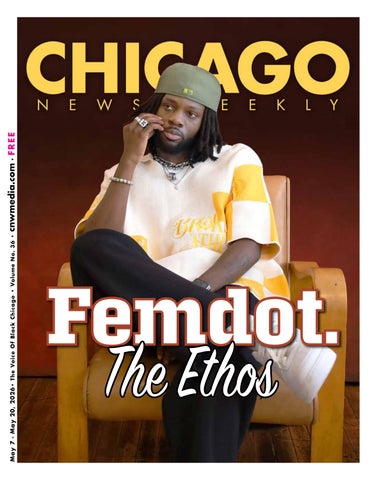
Femdot. The Ethos

Publisher

Cheryl Mainor Norman

Editor-In-Chief

Kai EL’ Zabar

Chief Content Officer & Managing Editor

Laura Miller

Editorial Assistant

Malachi Webster

Creative Direction

CNW Studio, LLC

Art Director

Paul Mainor

Copy Editor

Max Blaisdell

Staff Writers

Zada Johnson, PhD.

Candi McCrary

Mila Marshall. PhD.

Cabryl Breotti

C.L. Blackburn

Columnists

Ryan Willis

Dr. Sanja Rickette Stinson

Intern & Illustrator

Elijah Lee

Cover Photography

Sterling Hightower

Chicago News Weekly

700 N Sacramento Blvd Suite 320 Chicago, IL 60612 (312) 877-5151

Volume No. 36 May 7 - May 20, 2026

Chicago News Weekly

is Published on Thursday a product of CNW Network

www.cnwmedia.com advertising@cnwmedia.com editorial@cnwmedia.com

Your Word is a Promise… A Promise is a Commitment

Understand the power of our words when spoken with intentionality.

It’s a real thing! Let me be clear: saying you will do something is giving your word. It creates expectations. Whether you agree to meet someone, accept an invitation, promise to pick up the children, commit to visiting the sick, or agree to make a donation—all these fall under the category of a promise made. When you make a promise, it is, in fact, a commitment. Note that you will be judged by your words. This is not new; we know it to be true. Yet, for as long as human beings have communicated, we have been making promises—and we either keep them or we don’t. It is telling that we identify those who keep their word as people of integrity and hold them in high regard. Conversely, those who fail to keep their promises are often viewed as unreliable or, at best, people who cannot be taken seriously.

We tend to make these judgments as if there are no exceptions, but life happens. It is important to consider the context and an individual’s track record before drawing a conclusion. If someone with a history of dependability misses a commitment, it usually triggers concern rather than judgment. We assume an emergency occurred—a lost phone, an accident, or a family crisis. Such instances are understandable. On the flip side, an individual who habit-

ually fails to follow through naturally lands on the side of being undependable. I would argue that most people make “empty” promises without an intentional desire to lie. They might say, “I’ll see

On Personal Integrity and Healing

Those who practice lying, however, do not deserve to be taken seriously. Too many people fail to recognize how

you at the meeting,” and fully mean it in the moment, but fail to follow through because they didn’t put it on their calendar. In those cases, if the person is generally held in high regard, we assume something unavoidable prevented them from attending.

powerful words are, using them casually or recklessly. This creates expectations that are never fulfilled, leaving behind a trail of disappointment and distrust. On a deeper level, there are promises we may have made to ourselves that we don’t re-

member because they have slipped unconsciousness into our subconscious. A disappointing love connection that failed to deliver upon the promise of eternal love which delivered a broken heart instead, may have been the impetus to a promise ‘to never trust love again.’ It becomes a repressed trauma and instinctually drives behavior that you repeat whenever the familiarity of the past trauma arises. Such declarations ground themselves in our psyche, and as subsequent relationships fail, we may wonder if we are simply fulfilling a promise made out of past hurt. Through reflection or therapy, we may realize we are beholden to a promise we no longer wish to keep. You can perform a ritual to request release from that bond. In doing so, you clear outmoded patterns and return to a clean slate. We must remember that our word is sacred—be conscious of every promise you make, both to others and to yourself. If you believe in God and His Word, seek the Biblical texts that will lead you to the freedom necessary to move forward on your path. You may ask God to release you from any promises made to yourself or others—past, present, or future—that are holding you back. Ask that love, light, and healing be ever present in your life. Finally, continue to trust in God as you travel your life journey.

Kai EL’ Zabar Editor-in-Chief
Photo: Dot Ward

Thousands Fill the Streets for May Day Chicago’s Biggest in Years

Daley Plaza, Chicagoans march on labor, immigration, and inequality as city marks 140 years since the strikes that sparked a movement.

It started as a gathering and became something larger. By 1 p.m. on Friday, May 1, several separate morning protests had converged into a sea of homemade signs and rippling banners at Union Park, 1501 W. Randolph St. What followed was one of the most heavily attended May Day demonstrations Chicago has seen in recent memory — thousands strong, stretching from the

Near West Side all the way to Daley Plaza downtown, where marchers finally arrived just after 4 p.m.

The timing carried particular weight this year. May Day 2026 marked the 140th anniversary of the labor uprising that began right here in Chicago and gave birth to International Workers’ Day as it is observed around the world. On May 1, 1886, tens of thousands of Chicago workers walked off the job and took to the streets demanding an eight-hour workday — the largest such demonstration in the country. Days later, on May 4, a bomb thrown at police during a rally at Haymarket Square set off one of the most consequential events in American labor history. In the years that followed, the international labor movement designated May 1 as International Workers’ Day in honor of those who had fought and died in Chicago that week.

To mark the 140th anniversary, city officials and labor leaders gathered Friday morning at the Haymarket Memorial, 151 N. Des Plaines Ave., to unveil a new plaque. Mayor Brandon Johnson, Illinois Secretary of State Alexi Giannoulias, and UAW President Shawn Fain were among those present for the dedication.

“This clash gave birth to the International Workers’ Day we observe today,” said Rabbi Daniel Kirzane of KAM Isaiah Israel in Hyde Park, who addressed the noon interfaith service at Union Park. “And inspired labor activists to redouble their efforts to protect the lives and livelihoods of everyday people.”

(Source: WTTW Chicago — news. wttw.com)

The march itself stepped off shortly before 2:30 p.m., moving along Washington, Racine, Jackson, Halsted, and Washington streets before reaching Daley Plaza. The crowd carried flags and signs on a wide range of grievances — ICE’s targeting of Chicago neighborhoods, wealth inequality, workers’ rights, and calls for justice for Silverio Villegas González, who was shot and killed by a federal immigration enforcement officer in suburban Franklin Park in September 2025. Mayor Johnson joined marchers

near Union Park and helped lead the procession downtown.

The rally’s demands were organized under the national “Workers Over Billionaires” banner — a coalition of hundreds of groups across the country calling for a day of economic blackout: no work, no school, no shopping. At its core, the Chicago event reflected a city grappling with the compounding pressures of the Trump administration’s immigration enforcement, widening economic inequality, and a labor movement that organizers say is more energized than it has been in a generation.

“You have to look at the actions that the Trump administration has taken over the last year and the impact on working people to understand where this urgency comes from,” said Sharmili Majmudar of Chicago-based nonprofit Women Employed, who took the day off to join the march. (Source: Block Club Chicago — blockclubchicago.org)

The Chicago Teachers Union was among the primary organizers, and the question of CPS participation generated its own drama in the days leading up to May 1. The CTU lobbied new CPS CEO Macquline King to close schools for the day, arguing the “day of action” was included in the union’s contract. King declined, opting to keep schools open while allowing teachers to request time off and principals to organize supervised field trips. The district ultimately approved approximately 40 field trips for around 2,200 students, deploying more than 2,600 substitute teachers across 76 schools.

CTU President Stacy Davis Gates made a brief appearance at the rally. So did Mayor Johnson, who addressed the crowd before the march. “Today you’re making history — part of the next generation of voices and leaders who will continue on the legacy of protecting and building our democracy,” Johnson said. (Source: ABC7 Chicago — abc7chicago.com)

For many older Chicagoans who turned out Friday, the march was a return to something familiar. Queen Weiner, a retired CTU member, said she came to fight back against billionaires who she believes have “annihilated” the working class. Seeing the number of young people and students present gave her hope. “The fight never stops,” she said. (Source: WTTW Chicago — news.wttw.com)

Bears Stadium Bill Hits a Wall — and a New Deadline

Senate back at drawing board as homeowner tax relief called ‘negligible’; amusement tax emerges as Bears’ top sticking point.

SPRINGFIELD, IL —

The Chicago Bears’ stadium saga took another complicated turn this week as Illinois Senate leaders pushed back on the “megaprojects” bill passed by the House, with a new analysis finding that the property tax relief promised to homeowners under the legislation would be negligible — sending lawmakers back to the drawing board with just weeks left in the spring session.

The Illinois House passed the sweeping 377-page bill on April 22 by a 78-32 vote. The measure would allow largescale developers to negotiate Payments in Lieu of Taxes (PILOT) with local taxing bodies, effectively freezing property assessments for 25 to 35 years. For the Bears, the deal is a prerequisite to committing to a new domed stadium at the

former Arlington International Racecourse site in Arlington Heights.

But the Senate is not ready to simply take the House bill and run with it. State

Sen. Bill Cunningham (D-Chicago), the chamber’s lead negotiator, said Monday that lawmakers agree on embedding property tax relief but want it to be more meaningful. “We want to see if there is a way to make it more significant,” Cunningham said en route to Springfield, adding that he remains optimistic a deal can be reached within weeks. The Senate’s deadline is May 31, when the spring session closes.

A new wrinkle emerged this week: a 9% amusement tax buried in the House bill has become the Bears’ primary sticking point. Gov. JB Pritzker acknowledged the team’s objections, saying they “really don’t want to see that happen on top of all the other taxes imposed here.” Pritzker, who has made keeping the Bears in Illinois a top priority, has urged the Senate to move quickly, saying there is a “need for speed” and calling for “expeditious” action. He

added, however, that the bill was drafted without full coordination with his office, Senate leaders, or even the Bears — a notable admission.

Complications are piling up on multiple fronts. Late additions to the House legislation include tax incentives for the redevelopment of underused railyards — a provision that could open the door to a new White Sox stadium at the South Loop Amtrak yard — further tangling the negotiations. Progressive Democrats remain wary of any measure that hands tax breaks

to a franchise valued at nearly $9 billion while residents face rising costs. Chicago Democrats are equally reluctant to help the Bears leave Soldier Field, a venue city taxpayers are still paying off.

The Bears, for their part, have remained deliberately vague. Their public statement called the House vote “progress” but said “additional amendments are necessary to make the Arlington Heights site feasible.”

The team is set to update the NFL’s stadium committee this week on the status of their search — a meeting that adds real pressure on Springfield to show movement. Indiana, which has already approved a separate incentive package for the franchise, remains a viable alternative.

“A megaprojects bill is not just for the Bears,” Cunningham said. “We are hoping that it triggers other development projects.” Whether the Senate can thread that needle — satisfying the Bears, placating Chicago Democrats, winning over progressives, and delivering meaningful homeowner relief — before May 31 remains very much an open question.

Chicagoland Teens Drive Change SafeLIGHT Foundation Honors 2026 Ambassadors

CHICAGO — In a powerful stand against one of the leading causes of death for young people in the United States, 17 local students were recently honored for their commitment to road safety. The The program arrives at a critical time. Citing research from the Centers for Disease Control and Prevention (CDC), which identifies motor vehicle crashes as a primary threat to teen safety, these students chose to turn statistics into action. By accepting the mantle of leadership, the ambassadors worked to bridge the gap between risk and responsibility.

Impact Through Education

Throughout the academic year, the 17 ambassadors engaged their peers through high-impact

social media campaigns and town hall-style meetings held at schools across the region. Their mission was clear: educate young drivers on the life-saving importance of safe behavior behind the wheel.

To date, the SafeLIGHT Foundation’s reach has been significant:

- $138,000 in total scholar-

ships awarded to date.

- Over 50 teens empowered through the program.

- Partnerships with 21 Chicagoland area high schools.

The Class of 2026

The most recent cohort represented a diverse cross-section of nine area institutions, including Southland College

Prep, Whitney Young, Mother McAuley, Marist, Brother Rice, Morgan Park, Lyons Township, and the Illinois Mathematics & Science Academy.

In recognition of their advocacy and successful completion of the program, each student received a $2,500 college scholarship. these

awards were made possible through the support of program sponsors Donate Life Illinois and Gift of Hope, along with the Illinois Secretary of State’s Office, which remains a staunch advocate for teen driver safety.

A Legacy of Safety

The SafeLIGHT Foundation is a nonprofit organization dedicated to reducing preventable road tragedies. As the 2025-26 class concludes their term, the foundation is already looking toward the future.

Applications for the upcoming program year are now open. Interested students who wish to make a difference in their communities can find eligibility requirements and application details at safelightfoundation.com.

Femdot. The Ethos

In Chicago, where sound has always been tied to identity, lineage and resistance, Femdot, born Femi Adigun, exists in a space that refuses to be reduced to any one lane. He is as comfortable in front of a classroom at DePaul University as he is in the middle of a packed room, where fans jump, collide and lose themselves in the moment. He jokes that he is too old for the mosh pit now, but the fact that it exists at his shows anyway says plenty about how people experience his music and curated events.

What stands out in person is not the scale of what he has built, but the way he carries it. He is kind, measured and present, the type of presence that does not compete for attention, but still holds it. It would be easy to misread if you did not know what sits behind it: the rooms, the crowds, the work, the way people respond when the music starts. When I ask how he defines himself, whether he sees himself as a rapper, a lyricist, an artist or something else entirely, he does not treat “rapper” like a limitation.

“No one calls a poet a dirty word. No one calls a novelist a dirty word. I’m a writer and it’s just that my medium is rapping. I’m very much a rapper… I’m a writer first, and my medium is rap.”

In Chicago, that matters. It places him in conversation with artists who approach rap as something to be studied, built upon and taken seriously. The comparison to someone like Lupe Fiasco is not about sounding alike. It is about approach, about intellectualizing the art form while still being able to move a room.

The Foundation

Early in the conversation, before we get into the full weight of the music, I tell him directly that he comes from what feels like a superhero family. The

more we talk, the more that framing holds. Femi Adigun grew up in a Black, first-generation American Nigerian household where excellence was visible, layered and expected in different forms. Discipline was present, but so was range.

Music did not arrive later. It was already there. He recorded his first song at 6 years old, a Family Focus track called “What You Wanna Be,” and by grammar school he was passing out mixtapes and recording at home.

His brother, Kola Adigun, became the first blueprint, not just introducing him to rap, but shaping how he listened to it and studied it. Kola stepped away from rapping at the end of high school to focus on school, but the relationship to music never left. In adulthood, he returned to the craft through songwriting, landing credits connected to major artists and records, including work tied to Eminem, G Herbo, Offset, Rubi Rose, Honey Dijon, Bree Runway, Flo Milli, Maiya The Don and Mello Buckzz.

“My brother’s always gonna be my favorite rapper. He also introduced me to all of the rap that I enjoy… I’m really just a combination of my siblings… it was kind of like passing the torch, although I was mad young.”

That “combination of my siblings” line is one of the most important things he says about himself. Femi does not position his story as self-made in the empty, mythological sense. He understands himself as a product of proximity, family, study and inheritance.

That level of excellence was not limited to music. His sister, Seun Adigun, is a two-time Olympian and a doctor, the first African athlete to compete in both the Summer and Winter Olympics. In the transcript, the family résumé starts to sound almost unreal: two-time Olympian, five degrees, doctor, history-maker, sister. His second brother, Tunde Adigun, is an actor, comedian, and entertainer in his own right.

“It’s four of us and… everyone else is competing for second place… she’s gotta win… we’re all competing for second place for real.”

That environment shapes expectation, but it also

shapes perspective. When I ask about the pressures associated with being first generation American, he does not romanticize it. He talks about discipline, survival and the way practicality can sometimes limit dreaming. But he also makes clear that his parents left room for creativity.

“Especially being of Nigerian descent, there’s a lot of discipline that shows up… when people come here from different countries, a lot of times survival is the only mindset… but my parents, they were open as long as we were doing what we needed to do. They let a lot of our hobbies continue.”

The conversation then turns toward the perceived divide between first-generation African kids and African American-born Black communities, a question rooted in how people experience Chicago and how Blackness gets understood, separated, flattened or expanded depending on where you stand.

“I’ve only ever been raised to see Black as the umbrella that we all fit under… growing up in Black American culture fully and interacting with Jamaicans, Haitians, Belizeans… everybody has a variation of this thing that ties into each other… I understand how rare it is to be able to exist as who you are. So it’s also allowed me to be able to see Blackness as a larger identity and understand the variations, but what it is as a whole for real.”

It is a nuanced answer to a real tension, and it explains a lot about how he moves. There is no denial of difference, but there is also no distance in how he defines belonging.

The Mind

When we shift into process, the tone changes. Less about origin, more about how he thinks in real time. Femi is a thinker, and that is not always a peaceful thing. In the second conversation, I bring up “Overthinker” on his latest EP, Less Talk More Haze because the title alone suggests something is happening beneath the surface. He describes pacing at home, trying to plan everything, imagining every possible outcome, until he had to interrupt himself. “If you could just imagine my anxiety or my overthinking in physical form, I’m just walking in circles… and I just stopped and I thought, bro, just make something.”

That is the part that sticks: “Just make something.” Sometimes the

planning becomes the thing blocking the work. That tension is all over his creative process: intentional, but not paralyzed; thoughtful, but not frozen.

When I ask why he raps and why he chooses the lane he does, the answer is practical and self-aware. He knows what feels natural and what does not.

“My music just reflects who I am… I have moments where I’ll pop it, that’s cool, but that’s just not sustainable for me. It feels unnatural… Let me go find some chamomile tea. Let me process. Let me get back in my head a little bit.”

There is humor in it, but there is clarity too. He can access that braggadocious mode, but it is not where he lives. The center of his work is reflection, documentation, observation and feeling.

“As I grew older, it went from me just enjoying words… to it being journal entries, to then being like, oh, I’m supposed to be a documentarian… giving you insight to how people are thinking or to what’s going on… presenting you with the idea of what humanity looks like.”

Even the way he talks about his earliest connection to music reflects that attention. When I ask about the first rap record that changed his life, he does not hesitate: Jay-Z’s “Dead Presidents II.” He remembers seeing the video in his brother’s room, the static on the screen, his brothers glued to the TV and, later, Kola burning him a copy of Reasonable Doubt. That is not casual listening. That is imprinting.

The Work

As his career develops, the work shifts from trying to translate himself clearly to trusting himself fully. When I ask if he makes music for himself or for people to hear him, he gives an answer that sounds like someone who has learned how unpredictable audience response can be.

“When I was younger, I was making music that I felt was good and that would convey my points across for other people to understand… but now I make music that I like… I prepare the food and they either eat it or they don’t. That’s it.”

He continues with the lesson that experience taught him: people often do not know what they want until they hear it in the right context.

“People don’t know what they want, and the only thing they want is authenticity, so I’m just gonna make music that feels good to me.”

The same philosophy shows up in how he thinks about projects, especially EPs. He calls them time capsules, smaller bodies of work meant to capture a moment, a feeling or a “small pocket” of a larger idea. His day-to-day life shows up because he makes music for the places where he actually listens to music: the shower, the house, while cleaning, inside ordinary motion.

He does not talk about projects like product drops. He talks about them like containers, small enough to hold a feeling, but large enough to point toward a bigger idea.

The City

What becomes clear as the conversation moves forward is that his work does not stop at the music. It extends into how he understands Chicago itself, not just as a place, but as a system. The same way he approaches rap as something to be studied, he applies that thinking to the city, to how it is built and who it serves.

When we start talking about his work at DePaul University, it shifts the conversation completely. He is not just teaching music. He is teaching how to read a city through it.

“I’m teaching a course called Chicago Culture Through Hip Hop. It pretty much uses hip hop as an anthropological lens into the way the city is developed. So I have first-year students, and they have to learn about Chicago, and they learn through the lens of what I teach them, which is strictly Chicago hip hop albums.”

He is not using hip hop as decoration for a syllabus. The albums

are the texts. They are the way into neighborhood history, political decisions, displacement, violence, resistance and memory.

“Hip hop is a narrative-based art form, and it’s a Black art. When you have a city that’s segregated like Chicago by blocks, each block has a different narrative, and if people are rapping about it, you get an actual insight into what’s going on. If we’re talking about school closings, redlining, food deserts, then you take that and you see why somebody from this neighborhood is rapping the way they are. There’s a direct connection to how the policy of Chicago has affected the people who live in these communities.”

And when the conversation turns to drill, he places it inside the same framework.

“Drill is a very, very good indicator of Chicago policy… people don’t connect those dots and then they just want to blame… whether you agree with the content or not doesn’t mean that it’s not a reflection of what’s going on.”

That is the difference between consuming a genre and understanding what created it.

The Ecosystem

When we get into “You Had to Be There,” it is easy to focus on the turnout, the energy and the fact that people showed up the way they did. But what stood out to me was not only the room. It was what happened after. He shouted out every DJ, every contributor, Ramova, the people who helped make the experience work. I tell him directly that this is not always how people move, especially in entertainment, where credit can be treated like currency people are afraid to spend.

His response is immediate.

“Because they’re good at it… This is an ecosystem we’re building, right? You’re supposed to follow the DJs in Chicago. That’s what you do. Follow the DJs. That doesn’t take anything away from me.”

When I ask why he decided to create the event, he makes it clear that the intention was bigger than one night. Chicago DJs are doing important work. Chicago artists are doing important work. But, as he sees it, those worlds do not always cross over. His goal was to activate an independent Chicago venue, show proof of concept and use what he has built to put his friends in position.

That is curation. That is strategy. That is someone using what they have built to make room for other people.

The next “You Had to Be There” continues that thinking. In the second conversation, he explains that the June 6 event is back at Ramova, still rooted in DJs and performance, but this time curated with an all-women lineup. That continuation matters because it shows the first event was not a fluke. It was proof of concept. Now the concept is expanding.

The Ethos

Toward the end of the second conversation, I shift the question. Less about what he has done, more about what he believes. I ask him to imagine that he is shouting into the void, except this time it is not a void. Everyone is listening. Everyone has his ear. What is the thing he wants people to know? He pauses. Then answers.

“Two things. All this shit is made up. And every path is different. I think we’re always trying to follow these rules and learn this way or this is the way to get there, and it’s like, no the fuck, no it’s not actually. None of that is. There’s COVER STORY, Continued on page 11 u

17,000 Jobs Gone Overnight

How

Spirit Airlines Ran Out of Sky

From a trucking spinoff to America’s scrappiest budget airline — and how a decade of debt, a blocked merger, a war, and a failed bailout brought it all down.

At 3 a.m. on Saturday, May 2, 2026, a dispatcher in Spirit Airlines’ Orlando operations center sent a message to one of the carrier’s final pilots through the cockpit alert system.

“GODSPEED MY FRIEND,” it read, according to CNBC. Minutes later, Spirit Airlines — the bright-yellow budget carrier that once flew more than 44 million passengers a year — ceased to exist.

By sunrise, check-in desks across the country sat empty, departure boards showed wallto-wall cancellations, and according to CNN, approximately 17,000 workers were out of a job — most of them notified by media reports before hearing a word from their employer.

Spirit’s collapse did not happen in a single night. It was the end of a years-long unraveling shaped by a broken business model, a contested government decision, a global fuel crisis, and a bailout that fell apart in a creditor standoff.

Built

for

the budget traveler

According to NBC News, Spirit traces its roots to a Michigan trucking company from the 1960s, rebranding as an airline in 1992. The pivot that defined it came in 2007, when it adopted an ultra-low-cost carrier model — rock-bottom base fares, with charges for everything else: carry-on bags, seat selection, even printing a boarding pass at the airport. For millions of budget-conscious travelers, it was the airline that made flying financially possible.

At its peak, Spirit flew more than 44 million passengers a year. According to CBS News, by 2024 it had lost more than $2.5 billion since the start of 2020. As legacy carriers launched their own “basic economy” fares and loyalty programs poached Spirit’s price-sensitive customers, the model began to crack. By 2022 and 2023, Spirit was a company in search of a lifeline.

The merger that might have saved

it

Two airlines came knocking. Frontier proposed a merger in 2022. Then JetBlue arrived with a hostile $3.8 billion tender offer, go-

ing directly to Spirit’s shareholders over the board’s objections. The shareholders accepted — even though, as The Hill reported, Spirit’s board had warned the deal faced near-certain regulatory challenge.

They were right. The Biden administration’s Department of Justice sued to block the merger under the Clayton Act, arguing that absorbing Spirit — the most aggressive ultra-low-cost carrier in America — into the mid-tier JetBlue would eliminate the competitive force keeping fares low on hundreds of routes. According to Fox Business, then-Attorney General Merrick Garland stated the merger “would have caused tens of millions of travelers to face higher fares and fewer choices.” A federal judge agreed in January 2024. JetBlue walked away.

Within months, according to NBC News, Spirit filed for Chapter 11 — the first major U.S. airline to do so since 2011.

Whether the DOJ made the right call is now fiercely debated. Transportation Secretary Sean Duffy has been blunt: “The Joe BidenPete Buttigieg administration and DOJ tanked that deal,” he said on ABC’s “This Week,” as reported by Fox News. Defenders counter that Spirit’s problems ran deeper, and that JetBlue had internally projected raising fares 24–40% on former Spirit routes post-merger — hardly a win for the budget travelers the DOJ was trying to protect.

A year and a half of last chances

Spirit’s court-approved reorganization plan in early 2025 bought time but not a turnaround. Then in February 2025, the Iran War began. U.S. and Israeli strikes on Iran triggered closure of the Strait of Hormuz — through which, according to TIME, roughly 20% of the world’s oil flows. Jet fuel prices spiked. According to Yahoo Finance, the crisis threatened to push Spirit’s already-negative 2026 operating margin from negative 7% to negative 20%.

Spirit filed for bankruptcy a second time in August 2025. Talks about a merger with Frontier collapsed in December. By April 2026, the Trump administration stepped in with a proposed $500 million rescue package that would have given the federal government a 90% ownership stake in the airline, according to CBS News. It was an extraordinary intervention — and it failed.

Why the bailout died

The core dispute was simple: who gets paid first.

According to Semafor, Citadel — the firm led by Ken Griffin — Ares Management Corp., and distressed-debt specialist Cyrus

Capital were among Spirit’s most senior creditors. Under normal bankruptcy proceedings, they would be first in line to recover from Spirit’s liquidated assets. The government’s deal would have jumped them in that line, handing priority to the federal government and potentially wiping out their recovery entirely. They are distressed debt specialists — firms that buy the debt of struggling companies precisely because they expect to recover more than they paid through bankruptcy. Subordinating their claims to the government was not a trade they were willing to make. According to CBS News, Spirit had $250 million in cash — but creditors held a lien on it. The airline was sitting on money it could not legally spend. Citadel submitted a counterproposal that the government rejected. The government’s terms were rejected by creditors. Neither side moved. “You can’t breathe life into a corpse,” Transportation Secretary Duffy said Saturday morning, according to CNN. Spirit’s final flight — NK1833, Detroit to Dallas Fort Worth — touched down just after midnight. At 3 a.m., it was over.

What comes next

According to CNBC, United, Southwest, JetBlue, Delta, American, and Frontier all capped emergency fares at roughly $200 for stranded Spirit passengers. United rebooked 14,000 customers in the first twelve hours; Southwest took in more than 20,000. Analysts warn, however, that with Spirit gone, fares on the budget routes it dominated — particularly in Florida, the Caribbean, and Latin America — are likely to rise. The political blame has already been assigned in both directions. The honest accounting is that it was all of it at once: a model under pressure, a regulatory decision that remains genuinely contested, a geopolitical shock no airline could fully absorb, and a creditor standoff that no one blinked on. What is not in dispute is the human toll. As the Air Line Pilots Association stated, and CNBC reported: “The pain of this decision will not be felt in boardrooms. It will be felt by pilots, flight attendants, mechanics, dispatchers, and ground crews, and by the families and communities that depend on them.”

The Hidden AI Divide Nobody Is Talking About

I’ve been using ChatGPT (Artificial Intelligence) almost since it’s inception. And what I know is Artificial Intelligence is no longer something reserved for Silicon Valley, technology companies, or science fiction movies. It is already shaping the way businesses hire, how organizations communicate, how grants are written, how customer service operates, and even how decisions are made behind the scenes.

But while many conversations around AI focus on innovation and opportunity, there is another conversation quietly unfolding that deserves our attention. That is not everyone is entering the AI era from the same starting point. And that may become one of

the greatest divides of our generation.

In this business article, I want to explore just a bit the hidden AI divide nobody is talking about and why this conversation matters right now. As Artificial Intelligence rapidly becomes part of everyday business operations, many organizations, entrepreneurs, nonprofits, and communities are quietly being separated into two groups those learning how to adapt and those at risk of being left behind

The real AI divide is not simply about who has the newest technology. It is about who understands how to use it, who has access to learning it, and who may unintentionally be left behind while the world rapidly moves forward.

Small businesses are trying to figure out how to compete with larger companies already using AI-powered systems. Nonprofits are navigating tighter budgets while being expected to do more with less. Mature adults and seniors are often told AI is “too technical,” even though many have decades of leadership, wisdom, and life experience that technology itself cannot replace.

Meanwhile, many communities are still struggling with digital access, training opportunities, and the confidence needed to engage with tools they barely understand. In my opinion, that should concern all of us.

Because AI is quickly becoming the new digital literacy weather we want to accept it or not

Years ago, people who did not learn email or basic computer skills found themselves disconnected from opportunities. Today, we are standing at a similar crossroads with Artificial Intelligence. The difference is that this transition is happening much faster.

The challenge is not simply teaching people how to use AI tools. The deeper challenge is helping people understand how to use them responsibly, ethically, and without losing the human element that matters most.

AI can help draft content, organize information, analyze patterns, and automate tasks. But it cannot replace compassion, emotional intelligence, discernment, lived experience, creativity, human connection, or the grace-filled wisdom that comes through the Holy Spirit.Those qualities still belong to us.

That is why this conversation matters so deeply for women, faith leaders, nonprofits, entrepreneurs, educators, and underserved communities. If we fail to intentionally include people in this shift,

the technology gap may quietly become an economic and social gap as well.

And perhaps the greatest irony of all is this: Some of the people who believe they are “behind” may actually possess the very skills AI can never duplicate wisdom, resilience, adaptability, empathy, and the ability to lead through uncertainty.

The future should not belong only to those with the fastest software.

I believe and content that the future should not only belong to those with the fastest software, it should also belong to those who know how to lead with humanity.

As AI continues to reshape the future of business and everyday life, my passion in this next chapter as an AI Certified Strategist is helping individuals, nonprofits, and small businesses navigate technology with confidence, clarity, and a human-centered approach ensuring people are not left behind while innovation moves forward.

Because in the end, the greatest competitive advantage may not be artificial intelligence at all. It may be human intelligence used wisely. And maybe the question is no longer whether AI is coming.

The real question is: Who are we helping prepare for it?

In the coming weeks, I look forward to sharing more conversations around Artificial Intelligence, human-centered leadership, and how individuals, nonprofits, and small businesses can prepare for the future without losing the human touch that matters most.

If this conversation sparked your curiosity about AI, leadership, or the future of human-centered technology, perhaps it’s time we start learning together.

Black Micro-Schools Deserve Recognition

NABML Creates National Standards and Resources

Black families are the fastest-growing demographic in alternative education. Discover how the National Association of Black Micro School Leaders is providing educators with resources, training, and certification to launch thriving microschools.

Public school advocates and politicians typically spearhead the attack on microschools, focusing on their perceived “lack of oversight and public accountability.” Yet Black families are the fastest-growing demographic in alternative education. This shift is driven by the recognition that traditional public education cannot change quickly enough to serve its children’s needs. The Nation-

u Cover Story Continued from page 8

no, no. I have to constantly remind myself that. I think my career is an example of that. We’re worried about the parking spot, not the vehicle. You have an assigned parking spot, but there’s no telling if you’re gonna take 94, you’re gonna take Lake Shore, you’re gonna be in a rental car, you’re gonna be in your whip, you’re gonna be on a bike.

al Association of Black Micro-School Leaders is an organization working to counter this narrative and fill a critical gap. Nicole Stewart, the founder, told The Carolinian that “Black families are the fastest-growing group in alternative education, but Black microschool founders have had no national home, no unified voice, no shared resources, and no collective power.”

Nicole Stewart, a former educator with nearly 20 years of experience in public education, retired to start her education consulting company and later opened her own school. That experience led her to discover microschools. Stewart advocates for a balance between joy and rigor in education, designing learning experiences that honor identity, strength, and purpose. She understands that microschools can be tailored to address the specific needs of the families and communities they serve.

The oversight criticism is legitimate. This concern is precisely why NABML is establishing the national benchmark for community-led education. NAB-

ML’s certification is that seal of approval, signaling to families, funders, and policymakers that a school is not merely functioning but is outstanding. Additionally, the organization emphasizes the importance of legal structures, fiscal stewardship frameworks, and community involvement as foundational to sustainability and accountability.

NABML realizes this vision via four main support systems:

Community Design Day: NABML facilitates a process in which the neighborhood tells us what its children deserve.

You get to explore new learning approaches and define educational priorities for your community. A community task force is then formed to implement these ideas, and NABML supports you along the way. This creates a space where you can be a part of the process as a founding member of a microschool.

Founders Launch Lab: This professional development experience equips Black microschool founders and educational leaders with the training, operational, and strategic skills to launch and sustain

thriving schools. Participants gain the business acumen and pedagogical frameworks necessary to navigate the transition from traditional educator roles to entrepreneurial school leaders.

Membership (The Vault): Members gain instant, 24/7 access to proprietary legal templates, student handbook builders, fiscal stewardship frameworks, and zoning blueprints designed specifically for the microschool model. They also join a curated community of mission-aligned founders through monthly “Brilliance Circles” and a private digital forum. Membership unlocks the NABML Fund, a curated capital pool designed specifically for the network, removing a major barrier to school launch and sustainability.

Certification: This is the seal of approval that tells families, funders, and policymakers that your school isn’t just operating; it is also excelling. NABML is currently developing the national benchmark for community-led education, making sure that certified schools meet rigorous standards for student outcomes, community engagement, and fiscal responsibility.

Whether you’re a parent seeking educational alternatives, an educator ready to launch a microschool, or a policymaker committed to expanding equitable education options, NABML invites you to be part of this transformation.

Ready to start or support a microschool? Visit https://nabml.org/ to learn more, access resources, or join the Founders Launch Lab.

Want to invest in Black educational futures? Make a donation at https://secure.qgiv.com/for/naobml/ to support founders in building schools that serve their communities.

Every microschool launched is a community transformed. Every founder supported is a generation of Black children empowered to thrive.

There’s no telling how you’re gonna get there, but you have an assigned parking spot. So your path may look different, but you’re gonna get to where you need to go, whatever that is, and it may not be what you think it is. But everyone’s path is different, and all of this shit is made up. The beauty of that is because all this shit’s made up, you can make up some shit too.”

It does not land like advice. It lands like clarity. Like someone who has already wrestled with the pressure of trying to follow a map that did not quite exist for him.

And when you look back at everything else, the family, the heritage, the records, the classroom, the packed rooms, the DJs, the city, it fits. Nothing about Femi Adigun feels acciden -

tal. The quiet does not mean small. The humility does not mean uncertainty. The kindness does not mean lack of force.

He is not just making music. He is building around it. Bar by bar. If you’re not locked into Femdot, be sure to follow and support him on all platforms right now, but start with the music.

Dawn Montgomery Culture Critic NNPA NEWSWIRE

Michael Review: The Man in the Mirror

Like most Michael Jackson fans, I waited with bated breath for the most anticipated film of the year. This isn’t just a movie; it’s a cinematic portrayal of the life and legacy of the most influential artist the world has ever known. ‘MICHAEL’ doesn’t try to be a Wikipedia entry; instead, it focuses on the man behind the music, tracing his journey from the discovery of his preternatural talent in the Jackson 5 to the visionary whose creative ambition fueled a relentless pursuit to become the greatest entertainer on earth.

Rather than trying to capture every second of his existence, director Antoine Fuqua chose a specific lens: Michael’s life offstage, particularly the antagonistic relationship between him and his father, Joseph Jackson. We also get a glimpse of his mother, Katherine—portrayed here as “demure” but revealed as a formidable force when pushed to protect her son.

The Art of the Snapshot

There’s a disgruntled 1% complaining that because the film focuses on a specific segment of his life, “it’s not a story.” Don’t believe that. Honestly, Michael is such a fascinating character that you could make a standalone film about the creation of each iconic hit. Imagine a movie just on Off the Wall—a story of beauty and pain, capturing the minutiae of Michael breaking free from Joe Jackson’s “crypto-grip” on his creativity. What those without a creative bent don’t realize is that art evolves from experience. Artists create perspectives that surface from the “underbelly” of life—the good, the bad, and the ugly. This film captures the torment and fear Michael endured under his father’s physical and psychological abuse, which,

ironically, birthed the strength and determination he used to express himself. We see how Joe’s intention to oppress his son backfired, instead forging a fiercely independent creative thinker.

The film is an entertaining ride through the height of his career, prioritizing the spectacle of the music over a deep psychological

dive. That said, the performances are what truly fuel the engine: Colman Domingo (Joe Jackson): He is terrifying. He captures the cool, cold, calculating side of a man who wanted to escape the steel mills of Gary, Indiana, by any means necessary. Domingo plays him with a “steel fist” subtlety—the way his cheekbones drop or the way

he slowly walks toward his sons is chilling. The film misses Joe’s own thwarted musical dreams as a member of The Falcons, giving context (though not an excuse) for why he pushed his sons so relentlessly.

Jaafar Jackson (Michael Jackson): To say he “channels” his uncle is an understatement. For those who never saw MJ live,

Jaafar’s portrayal is so perfect I dare say Michael himself would have been happy with it. His body language shifts instantly when Joe enters the room; he embodies that singular, forced existence where Michael, a unique thinker who felt alienated from his brothers and the world, found solace only with animals.

Nia Long (Katherine Jackson): She provides the heart, standing as the quiet bulwark against Joe’s intensity.

The Numbers and the Void

The musical sequences are topnotch biopic filmmaking. The sound design, the editing, and the recreation of iconic videos are electrifying. Watching this in a theater felt like an existential moment—the crowd was cheering and singing along as if they were at a live concert. It’s rare for a movie to elicit that kind of visceral reaction. However, the film isn’t without its flaws. The most glaring omission is the relationship between Michael and his brothers. The film largely ignores any meaningful interaction between them, leaving the audience to assume they had no bond at all, which feels like a missed opportunity for a story about a family band especially since Joe Jackson states the importance of family repeatedly thtoughout the film

Final Word

The film deliberately spans from 1966 to 1984, with a brief epilogue in 1988. Ultimately, the story is about emancipation. It’s the arc of a man breaking away from the mental and physical hold of his father to claim his own throne. Whether you’re a lifelong Moonwalker or a casual observer, the sheer talent of Jaafar Jackson and Colman Domingo makes this a ride worth taking.

Alvin Ailey Reborn 10.0

A Masterclass in Spirit and Motion

Friday night’s opening performance of Alvin Ailey American Dance Theater had my heart racing, with the rest of me close behind. Sitting in the historic Auditorium Theatre, I had a full view of the stage, feeling “up close and personal” with every movement.

I could almost feel the pulse of the dancers’ bodies as they sailed through the air like masters of “dynamic soaring,” using invisible currents to travel across the stage with breathtaking grace. The only “wind” beneath them was the beat of their own hearts and the music that lifted their spirits, giving flight to their arms like the wings of birds. Their leg extensions seemed to elongate the very notes of the score, enhancing their immense artistic talent.

Truth be told, I was mesmerized—simultaneously moved to tears, amused, and completely immersed in the magical spell of a new romance with the Ailey company.

The Alvin Ailey legacy was on full display as the company returned to its Chicago home on April 24th, marking its 57th engagement on this landmark stage. Across the weekend, Ailey offered two distinct programs, blending fresh

premieres with the company’s signature closing work, Revelations.

The performance also carried a deep local connection. Among the company’s 32 dancers are several artists with ties to Chicago and the broader region: Solomon Dumas and Isaiah Day (Chicago), Donnie Duncan Jr. (Carrier Mills, IL), Renaldo Maurice (Gary, IN) and Sarah Daley-Perdomo (South Elgin, IL)

In a recent “Conversations with Kai” podcast interview with Artistic Director Alicia Graf Mack and principal dancer Isaiah Day, the themes of movement, memory, and spirit took center stage— reminding us why AILEY remains one of the most celebrated dance companies in the world.

This return marked a new chapter under the leadership of Alicia Graf Mack.

A renowned dancer and educator, Graf Mack’s history with the company began under Judith Jamison and continued under Robert Battle. While she never danced under Alvin Ailey’s direct instruction, she is undeniably the rightful heir to his guidance. Her vision honors the tradition that has made Ailey a cultural force for generations while introducing a “bodacious,” experimental thrust that feels vital and

new. Entering the Auditorium’s grand hall felt like a prelude to a magical escape. The excitement was off the charts, with Chicago VIPs mingling with a spectrum of generations—from young pre-teens to grandparents eager to impart a piece of greatness to the leaders of tomorrow.

The Performance: From Intimacy to Power

From the moment the dancers stepped onto the stage, the energy in the theater shifted. The space took on the aura of the backdrop for each piece, whisking the audience away to another world. The two-hour performance moved from sexy and intimate to athletic and bold; from introspective and reflective to reverent and spiritual.

What stood out most was the dancers’ ownership of the space. The presentation was never “flat”—it represented life itself, with an ebb and flow of energy that ranged from high-octane power to soft, sweet vulnerability.

The program opened with Embrace, a contemporary piece that explored the yin and yang of human connection through popular songs by Stevie Wonder, Kate Bush, Ed Sheeran, Des’ree, and Pink. The communication was clear,

clean, and deeply familiar.

A Case of You followed as one of the most mesmerizing pieces of the evening. This duet moved me to tears, portraying a realm of emotion so deep it felt private. The dancers performed as if the audience wasn’t there; we were merely voyeurs in awe of their love.

Revelations closed the night with the company’s 1960 signature work. It was the moment I had awaited for months. Drawing from African American social and religious traditions, it is a visceral connection to faith and survival.

I initially went in wanting to see a “new” perspective on Revelations, but I quickly realized: it is perfect as it is. Each artistic director who has danced it knows this, and so the work continues to live and breathe through the dancers’ commitment.

By the end of the night, there were so many standing ovations—17? 27?—that I lost count. If you missed this Chicago engagement, check their schedule and get on a plane. It is, quite simply, “otherworldly.”

Opening Night Cast

BLINK OF AN EYE–Sarah Daley-Perdomo, Jacquelin Harris, Miranda Quinn, Constance Stamatiou, Shawn Cusseaux, James Gilmer, Xavier Mack, Christopher Taylor

A CASE OF YOU–Samantha Figgins, Isaiah Day

EMBRACE–Patrick Coker, Caroline T. Dartey, Solomon Dumas, Ashley Kaylynn Green, Jacquelin Harris, Xavier Mack, Jesse Obremski, Miranda Quinn, Constance Stamatiou, Christopher R. Wilson

REVELATIONS–PILGRIM OF SORROW >I Been ‘Buked -The Company;Didn’t My Lord Deliver Daniel-De’Anthony Vaughan, Miranda Quinn, Corrin Rachelle Mitchell; Fix Me, Jesus-Sarah Daley-Perdomo, Christopher R. Wilson; TAKE ME TO THE WATER, Processional/Honor, Honor-Shawn Cusseaux, Ashley Kaylynn Green, Sebastian Garcia, Isaiah Day; Wade in the WaterSamantha Figgins, Renaldo Maurice, Constance Stamatiou; I Wanna Be Ready- Yannick Lebrun; MOVE, MEMBERS, MOVE>. Sinner Man-Christopher Taylor, Isaiah Day, Patrick Coker; The Day is Past and Gone-The Company; You May Run On-The Company; Rocka My Soul in the Bosom of Abraham-The Company

When love changes the seating chart

The older we get, the less accidental friendship becomes. It takes planning, patience, history and a kind of emotional endurance people rarely name out loud. By adulthood, the people who still know us are not just people we enjoy. They are witnesses. They remember who we were before the title, the house, the child, the grief, the comeback or the ring.

That is why the social shifts that come with love can feel more complicated than people admit.

When someone enters a serious relationship, the language around them changes. “I” becomes “we.” Weekends become coordinated. Holidays become negotiations. Friendships that once had their own rhythm begin to move around a new center of gravity. None of this is wrong. Love is supposed to change a life. But sometimes, without anyone saying it plainly, love also changes the seating chart.

Suddenly, the friend you used to meet alone now arrives as a pair. The dinner that once held a certain kind of honesty has another set of ears at the table. The group that built its trust over years is expected to stretch, warmly and without complaint, around someone new. Everyone is supposed to be happy, and often they are. But happiness does not erase the adjustment.

Adult friendship is already under pressure. The Survey Center on American Life found that Americans report having fewer close friends than they once did, and nearly half said they lost touch with at least a few friends during the pandemic. Pew Research Center has also found that fewer single adults are actively looking for romantic relationships or dates than they were just a few years ago.

Maybe those numbers are not saying people have stopped believing in love. Maybe they are saying adults are more protective of the relationships that still feel safe.

We know how to talk about boundaries inside romantic relationships. We talk about communication, privacy, family interference and what each partner owes the other. But we talk less about the boundaries around the couple. What happens to the friendships that existed before the relationship? What happens to the rooms where someone was known as a full person before they became one-half of a pair?

This is not about disliking someone’s spouse or refusing to celebrate love. It is about acknowledging that friendship has its own architecture. There are shared stories, old jokes, unspoken agreements and private histories that cannot be instantly extended to a new person simply because someone else has chosen them.

Still, many adults struggle to admit that without sounding immature or resistant to change. So they adjust quietly. They stop saying certain things. They shorten

the story. They become more careful at the table. They accept that some friendships now come with an audience. Love can expand a person’s life. It can also narrow their availability. Nine years ago, research tied to Oxford anthropologist Robin Dunbar has suggested that falling in love can cost people two close friends, on average, because romantic relationships absorb time and emotional attention that once went elsewhere. That does not make partnership the enemy of friendship. Not entirely at least.

There is a difference between introducing your partner into your life and assuming every part of your life should immediately become theirs too. A spouse or serious partner may become part of the wider circle over time. They may become beloved. They may become family in the truest sense. But that kind of belonging cannot be declared on someone else’s behalf. It has to form through presence, respect and patience.

The healthiest couples understand this. They do not treat every social space as a shared asset. They know a partner can be honored without being centered. They know love does not require carrying someone into every room.

Because in the end, the issue is not whether love changes things. Of course it does. The issue is whether it changes everything without asking.

Images of Mothers and their Children across Chicagoland

Mothers are our first introduction to life. They are our fountains of sustenance. They are our nurturers, our first love, and our first teachers. They teach us how to be loved, and they teach us to love.

They teach us how to love ourselves so that we can love others and be loved in return. They teach us how to be love

and how to reciprocate that which is directed toward us. They teach us the meaning of unconditional love. They teach us how to forgive and how to ask for forgiveness. They teach us how to befriend.

They teach us how to give, how to serve, how to share, and how to receive. They teach us how to prepare and make meals out of little to nourish our minds, bod -

ies, and souls for the spirit. They teach us how to flow and how to let go. They teach us how to pray.

They inform us of our inner and outer worlds and show us how to navigate through both. They teach us to embrace all of ourselves—the good and the bad. They teach us to love all people, but to recognize who they are; they teach us discernment. They

teach us that to love is to not know hate. Thou shalt not hate. They teach us that we are human and that humans are made in the image of our Creator, from whom much is given and from whom much is received. They teach us to be secure and confident in ourselves. They teach us how to go when we must. They teach us how to be leaders and how to lead. They teach us

how to follow, which teaches us to be humble and enables us to express humility. More importantly, they teach us to be love, and all the rest will come.

All praises to the Most High God who created Mother, and to Mother, who is love!

Happy Mother’s Day to all mothers!

The Met 2026 A Masterpiece in Fundraising

The long-awaited 2026 Met Gala, the premier charity event and fundraiser for the Metropolitan Museum of Art’s Costume Institute, has officially come and gone. Traditionally timed to mark the opening of the department’s spring fashion exhibition, the gala is known for raising eight-figure sums. While 2025 set a staggering record with a $31 million gross—the highest in the event’s 77-year history—this year’s gala, held on Monday, May 4, shattered that milestone.

Leading the charge were Jeff Bezos and Lauren Sánchez Bezos, who served as lead sponsors and primary donors. Their reported $10 million contribution helped propel the evening to a record-breaking $42 million total for the Costume Institute. Other major sponsors included:

Corporate Giants: Colgate, eBay, Eli Lilly and Company, Saint Laurent, and Condé Nast.

Tech Titans: Amazon, Meta, OpenAI, Snapchat, and Shopify all purchased tables, ensuring the evening was a resounding financial success.

The evening’s triumph bore the distinct fingerprints of its star-studded Co-Chairs: Beyoncé, Nicole Kidman, Venus Williams, and Anna Wintour. They were supported by a dynamic Host Committee led by Zoë Kravitz, featuring Sabrina Carpenter, Doja Cat, A’ja Wilson, Misty Copeland, and Aimee Mullins.

Each year, the Metropolitan Museum of Art’s Costume Institute builds anticipation by announcing the following year’s theme well in advance. Last year, they unveiled the Spring 2026 exhibition: “Costume Art.”

This exhibition serves as the grand opening for the Met’s new, nearly 12,000-square-foot Condé M. Nast Galleries. The collection explores depictions of the dressed body by pairing garments with art objects spanning 5,000 years of history—a fascinating concept that bridges the gap between fashion and fine art.

As expected, guests arrived “fashioned-up” as living works of art. While some interpretations were more successful than others, the sheer creativity ensured the evening never lost its legendary allure.

Pull that Pork A Pulled Pork Recipe

Football season is over, but playing football on Sundays is still on. It’s time to get your food menu game up. In thinking about a recipe for game time at home, you want something that is easy to serve, stays warm throughout the game, and satisfies a crowd. A Slow Cooker Pulled Pork is a classic choice because it requires minimal prep and lets you focus on the game. That’s the plan. Game on.

Slow Cooker Pulled Pork Sandwiches

This recipe yields about 8–10 servings and takes roughly 15 minutes of active prep time.

FUN FACT: Football is called a “pigskin” because early, mid-19th-century footballs were fashioned from inflated pig bladders covered in leather, not because they were made of pig hide. While the nickname persisted, modern foot-

balls are constructed from cowhide, often with a pebbled texture for grip, and utilize rubber

Ingredients

Meat: 4–5 lb pork shoulder (pork butt).

Rub: 2 tbsp brown sugar, 1 tbsp paprika, 1 tsp garlic powder, 1 tsp onion powder, 1 tsp salt, and ½ tsp black pepper.

Liquid: 1 cup beef broth or a neutral cola (the acidity helps tenderize the meat).

The Rest: 1 bottle (18 oz) of your favorite BBQ sauce and a pack of brioche buns or slider rolls.

Instructions

Season the Meat: In a small bowl, mix the dry rub ingredients. Pat the pork dry and rub the spice mixture over all sides of the meat.

Slow Cook: Place the pork in the slow cooker and pour the liquid (broth or cola) around the sides— don’t pour it directly over the spices. Cover and cook on Low for 8 hours (or High for 4–5 hours) until the pork is fork-tender.

Shred: Remove the pork from the slow cooker and transfer it to a large bowl or cutting board. Use two forks to shred the meat, removing any large pieces of fat.

Sauce it Up: Drain the liquid from the slow cooker. Return the shredded pork to the pot and stir in the BBQ sauce.

Serve: Set the slow cooker to the “Warm” setting. Serve the pork on buns with optional toppings like coleslaw, pickles, or sliced jalapeños. Why This Works for Game Day

Hands-Off: Once it’s in the pot, you’re done until it’s time to shred.

Self-Service: Guests can build their own sandwiches or sliders whenever they get hungry.

Versatile: If someone doesn’t want a sandwich, the pork works great over nachos or in tacos.

Pro Tip: For a better texture, lightly toast the buns with a bit of butter in a pan before serving to prevent them from getting soggy.

ARTISTS LIVE: avery r young and the creation of safronia

Artists Live is a series of intimate dialogues with artists across disciplines focusing on their lifelong development and work. This evening will feature acclaimed multidisciplinary artist avery r young in conversation with Sylvia Ewing and LaRob K Rafael. Together, we will explore avery r young’s artistic journey, including his evolution as an artist and the creation of his recent opera, safronia, which was presented at the Lyric Opera of Chicago. This intimate gathering offers insight into his creative process and perspectives as an artist, writer, and educator.

Audience members are encouraged to participate in the discussion, bringing questions and reflections to foster lively, meaningful dialogue among artists and attendees.

Monday, May 11, 2026 • 6pm Logan Center for the Arts

Performance Penthouse

915 E 60th Street, Chicago

FREE – RSVP encouraged, not required

Turn static files into dynamic content formats.
Create a flipbook
May 7, 2026 Edition by cnwmedia.com - Issuu