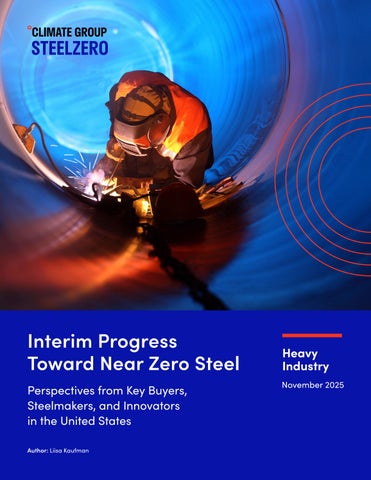
Interim Progress Toward Near Zero Steel
Perspectives from Key Buyers, Steelmakers, and Innovators in the United States
Author: Liisa Kaufman
November 2025
About SteelZero & Climate Group
SteelZero is a global initiative that brings together leading organizations to speed up the transition to a net-zero steel industry. Our growing group of over 40 businesses globally are creating a market for net-zero steel by making a public commitment to use 50% low emission steel by 2030, which sets a clear pathway to 100% net-zero steel by 2050, at the latest. Our members include well-known businesses such as Volvo Cars, Ørsted, and Maersk.
For more than two decades, Climate Group has been driving climate action. Fast.
Our goal is a world of net-zero carbon emissions by 2050, with greater prosperity for all.
We focus on systems with the highest emissions and where our networks have the greatest opportunity to drive change. We have built coalitions of over 600 ambitious companies through initiatives focused on energy, transport, and the decarbonization of heavy industry (steel and concrete). We hold our members to account, turning commitments into action.
We are the organizers of Climate Week NYC and are the secretariat of the Under2 Coalition, the largest global network of states, regions, provinces and other subnational governments committed to achieving net-zero emissions by 2050.

Project Overview
There is an urgent need to explore mechanisms and structures to scale up lower emission steel1 and ensure progress2 continues in the United States. With the current political landscape and ongoing volatility in the sector, sustained momentum and near-term solutions can act as a guardrail to successfully scale clean steel. 3 We embarked on this year-long project to assess the current landscape and ways in which the market can make progress, today.
With this mandate, we examined how to most effectively accelerate the production and procurement of lower emission steel in the US, while also ensuring meaningful progress is made by 2030. This sets a clear pathway toward net-zero emissions by 2050. We focused on scaling market demand for lower emission steel, fostering buyer confidence, and addressing systemic barriers through innovative market mechanisms
We interviewed over 20 buyers, steelmakers, suppliers and innovators, and hosted two inperson workshops to further discuss and validate ideas on how to scale up clean steel in the US market. Based on these discussions, we have identified and begun to explore what buyers want from steelmakers, as well as key opportunities and addressable obstacles that could facilitate momentum and offtake agreements for clean steel.
1 Lower Emission Steel is described as the greenhouse gas (GHG) emissions intensity threshold of ≤2000 to ≤350 kgCO2e/ ton of crude steel dependent on 0-100% scrap share of metallic inputs. For further details, please refer to the SteelZero framework
2 For the purpose of this project, we define “progress” as increased availability and/or offtake of lower emission steel by 2030 (aligning with ResponsibleSteel’s Decarbonization Progress Level 2, or better) to drive said product availability in the market.
3 For this report, “clean steel” is used as an umbrella term in reference to any steel that is progressively decarbonized, targeting near zero emissions by 2050.

What Buyers Need
Through our interviews and workshops, we uncovered a range of perspectives from buyers that reveal both enthusiasm and hesitation around clean steel adoption. The following section outlines the most pressing needs and insights shared by buyers across sectors. 4
Please note that where an overlap between buyer and steelmaker needs occurred, we indicated this with an asterisk (*).
1. Certainty and market stability*
a. Across the board, buyers emphasized the importance of certainty of supply, pricing, and the ability to meet their sustainability goals. In a landscape marked by looming tariffs, shifting domestic production priorities, and policy volatility, clean steel often becomes a secondary consideration, especially for smaller companies with limited procurement flexibility.
b. To create a sustainable market with increasing demand for clean steel, buyers need indication from steelmakers on how they’re proceeding with their climate transition plans and when progressively decarbonized products will come online. This would allow buyers to advance their procurement plans for clean steel.
2. Domestic sourcing preference
a. There is a growing preference for sourcing steel domestically, driven by a desire to reduce emissions, improve supply chain resilience, and respond to policy incentives. Tariffs and rising costs of international procurement have further accelerated this trend.
b. Buyers view domestic sourcing as a way to reduce exposure to geopolitical risks. However, they also noted that domestic suppliers must continue to demonstrate clear and steady progress toward net-zero production to remain competitive with the global market and to instill buyer confidence.
4 Respondents included buyers from the following sectors: real estate, logistics, equipment manufacturing, automotive, data processing, construction, and power generation.
3. Innovative contracting mechanisms*
a. Leading buyers expressed interest in creative contracting approaches that reduce risk and incentivize clean steel adoption. These include:
i. Triparty agreements involving buyers, steelmakers, and equipment manufacturers.
ii. Sunset clauses that phase out non-renewable energy use over time.
iii. Consortium purchasing agreements that allow multiple buyers to pool demand and share risk.
b. This openness to innovation reflects continued optimism and long-term investment in clean steel, even amid short-term market challenges.
4. Data transparency and product comparability
a. Buyers consistently cited the inability to compare steel products based on emissions performance. This hinders informed decision making and slows adoption of cleaner alternatives.
i. It was discussed that site level data might provide a clearer, more transparent framework than Environmental Product Declarations (EPDs), though we found an initial unwillingness from steelmakers to share this data.
b. Buyers want visibility into a steelmaker’s year-on-year progress toward net-zero, including emissions intensity, technology investments, and renewable energy integration. This would aid procurement decisions.
i. There was explicit interest in steelmakers who are investing in next-generation technologies.
c. There is a need for clearer justification of price premiums based on emissions reduction achieved. Without this, buyers struggle to make the case internally for higher-cost clean steel.
d. Supplier data inconsistencies are a concern for most of the buyers interviewed. This is a foundational misalignment between buyers and steelmakers.
i. For buyers with less resources for sustainability, the inability to define what is “clean” was a core hurdle to integrating sustainability factors into procurement decisions.

What Steelmakers Need
While buyers are signaling demand for cleaner steel, steelmakers voiced their own set of challenges in responding to this shift. Understanding these supply-side needs is essential to design effective market mechanisms and foster collaboration across the value chain.
1. Clear market signals and standardization*
a. Steelmakers emphasized the need for a consistent, buyer-driven definition of “clean steel.” Without a shared standard, producers struggle to align product development and certification efforts with market expectations. A harmonized definition would reduce confusion, streamline data requests, and support comparability across suppliers.
2. Access to clean electricity and power
a. This is a foundational requirement for producing clean steel. Steelmakers noted that without this, even the most advanced technologies cannot deliver on decarbonization goals.
b. The proliferation of data centers and their strong capital capacity for clean energy contracts was noted as a risk for steelmakers’ access to clean energy. There is, however, an opportunity surrounding the integration of clean energy use for steelmakers into hyperscalers’ contracts with utilities.


3. Increased internal resources
a. Many steelmakers operate with small teams responsible for aggregating, validating, and reporting sustainability data. This work is time-intensive and often under-resourced, making it difficult to meet growing buyer demands for transparency.
b. Steelmakers highlighted the importance of buyers sharing the context for requesting emissions data and the need for streamlined tools and frameworks to reduce the burden and improve accuracy.
4. Deep supply chain engagement
a. Steelmakers noted that meaningful decarbonization requires active engagement across the supply chain. However, upstream supplier knowledge gaps, especially surrounding upstream Scope 1 and 2 emissions (contributing to the steelmakers’ Scope 3 emissions) often result in reliance on industry averages, which can misrepresent actual performance.
b. There is a need for targeted education for steelmakers and their entire upstream supply chain to improve data quality, support emissions tracking, and align with buyer expectations.

Recommendations
The insights from both buyers and steelmakers point to several actionable opportunities. Our recommendations aim to address the most critical barriers: procurement risk, data transparency, and clean energy access, while also leveraging existing momentum in the market. SteelZero and Climate Group are actively developing several of these initiatives and seeking partnerships and funding to accelerate implementation. These recommendations are designed to be scalable and responsive to the evolving needs of both buyers and steelmakers.
De-risk procurement and build buyer confidence to address uncertainty, ensure progressively decarbonized products will be available, and enable scalable demand for clean steel:
• Develop triparty agreements between buyers (e.g. hyperscalers), equipment manufacturers, and steelmakers to facilitate long-term procurement of domestic clean steel.
• Further explore consortium purchasing models that allow multiple buyers to pool demand and share risk, particularly for smaller companies.
• Introduce contract mechanisms such as sunset clauses for non-renewable energy use and first-access rights to future cleaner steel products.
• Support buyers in setting interim targets and GHG intensity baselines to send clearer demand signals to suppliers.
Improve data transparency and product comparability to overcome misalignment and enable informed procurement decisions:
• Develop a streamlined, universal, more transparent reporting framework: A “simpler” reporting tool which would allow for and require yearly updates (thus moving away from reliance on often outdated, legacy data), would address the issue of steelmakers’ need to create bespoke certificates for various sectors (PCFs vs. EPDs), and clearly showcase year on year progress.
• Launch a Clean Steel Calculator: A public-use tool to help buyers compare products based on emissions intensity, scrap share, and other key metrics. This tool will also serve as an educational resource for broader audiences.

• Publish the ‘Data Request Reporting Form’ (developed by SteelZero) for wider market use: A standardized B2B template used to collect consistent, comparable data from steelmakers, including site-level emissions and decarbonization progress. This will include a proforma supply chain engagement template to help buyers engage suppliers and align sustainability priorities across the value chain, while also indicating to steelmakers why and how the data will be used.
• Integrate forecasting models to support buyers in evaluating future emissions performance and procurement decisions.
• Advance Scope 1–3 emissions reporting by supporting steelmakers and suppliers with tools and guidance to improve data quality and granularity.
Enable access to clean energy for steelmakers to support supply-side readiness and scale production of clean steel:
• Aggregate demand for clean energy across steelmakers to improve purchasing power and attract utility engagement.
• Engage directly with utilities in key regions to advocate for industrial decarbonization and prioritize clean energy access for steel production.
• Explore integration opportunities with large buyers who already source clean energy contracts to secure clean energy for steelmakers, leveraging shared infrastructure and investment.
Lastly, an overarching conclusion was the continued need to foster understanding and alignment surrounding the importance of decarbonizing both primary and secondary steel production. Many buyers view secondary steel (recycled content) as the most accessible path to decarbonization. Though it may be more relevant and applicable for use in some sectors and steel products, for consumer sectors and applications where steel needs to be produced with higher grade virgin materials (such as in an integrated mill), it is critical to incentivize the decarbonization of primary production and ironmaking.
• Raise awareness of the need for a dual decarbonization approach, underlining that all steel production needs to follow its own progressive pathway to near zero emission.
Taken together, these recommendations form a strategic roadmap for accelerating clean steel adoption in the US. They are designed to be practical, scalable, and responsive to the needs of both buyers and producers. As the steel industry navigates a complex and evolving landscape, these actions can help anchor progress.
Conclusion
This project underscores a critical inflection point for the US steel industry: the need to scale clean steel is no longer a distant ambition, it is an immediate imperative.
Through extensive stakeholder engagement, we identified clear signals from both buyers and steelmakers that certainty, transparency, and creative collaboration are essential to unlocking progress. Yet systemic barriers, particularly around data misalignment, procurement risk, and clean energy access, continue to stall momentum.
We believe SteelZero can act as a vital catalyst in this landscape. By convening demandside actors and aligning them around a unified commitment to net-zero steel by 2050, we help bridge the gap between ambition and action. Our tools are designed to simplify procurement, foster trust, and drive accountability. Moreover, SteelZero’s engagement with key stakeholders (e.g. buyers, steelmakers, policymakers, subnational and national governments, industry associations) positions us uniquely to not only further develop, but to also aid in the implementation of these recommendations.
In a volatile policy and market environment, we believe our recommendations, in tandem with the tools and framework provided by SteelZero, can provide the structure, credibility, and collaborative platform needed to accelerate decarbonization. These could act as strategic levers to ensure the US steel industry remains innovative, competitive, resilient, and aligned with global climate goals.

Appendix
Beyond the core findings, stakeholders raised several additional considerations that, while not central to this project’s scope, offer valuable context and potential areas for future exploration:
• Buyers are often sent marketing materials on “clean products” which require further verification of emissions performance.
• A hurdle for many was a lack of direct relationship with steelmakers and instead working through Tier 1 suppliers. Often Tier 1 suppliers have different priorities than the end consumer.
• Long-term contracts are harder and harder to justify, as most companies are largely focused on meeting their quarterly earnings. Yet, long-term agreements (5-7 years) allow innovators and steelmakers the stability needed to invest and scale.
• Different sectors are at different stages of maturity, with notable progress in the clean energy generation sector. Buyers noted that mission alignment across suppliers helped drive coordination in asking for clean steel.
• Even the most sophisticated players struggle to integrate emissions targets in their procurement requirements. There are several exemplars that include SteelZero-type targets, but more actors should set a GHG intensity baseline and future timebound ambitions to send a demand signal.
• Innovators noted the difficulty in setting an agreed-upon premium along the supply chain that would enable stable, consistent income to scale up their technology.
• Steelmakers and innovators are thinking twice about investing in scaling up clean technology in the US due to access to clean electricity and the political climate.
• A mechanism for testing and approval of materials (i.e. safety criteria are met) that is streamlined (i.e. lives with the steelmakers or crowdfunded by all OEMs, versus each OEM taking this on).
• Some buyers conduct internal quarterly reviews on how they are stacking up against their sustainability goals.
• Price is still the biggest procurement decision for many.
To learn more about SteelZero and the work we are leading, please reach out to Liisa Kaufman, lkaufman@climategroup.org
The Climate Change Organisation (Climate Group) with Company Registration Number: 4964424 and Charity Registration Number: 1102909
The Climate Group, Inc. is a U.S. registered 501(c)3 with EIN 43-2073566.
M/s TCCO India Projects Private Limited with Corporate Identity Number U74999DL2018PTC334187 Stichting Climate Group Europe, with Chamber of Commerce KVK number 87378426