Explore and download more ebooks or textbooks at ebookball.com
Hands On Machine Learning With Scikit Learn and TensorFlow Techniques and Tools to Build Learning Machines 3rd Edition by OReilly Media ISBN 9781098122461 1098122461
Evolutionary Computation Machine Learning and Data Mining in Bioinformatics 2009th Edition by Clara Pizzuti, Marylyn Ritchie, Mario Giacobini ISBN 3642011837 9783642011832
Hands On Machine Learning with Scikit Learn and TensorFlow Concepts Tools and Techniques to Build Intelligent Systems 1st Edition by Aurelien Geron ISBN 1491962291 9781491962299
Designations used by companies to distinguish their products are often claimed as trademarks or registered trademarks.In all instances in which Morgan Kaufmann Publishers is aware ofa claim,the product names appear in initial capital or all capital letters.Readers,however,should contact the appropriate companies for more complete information regarding trademarks and registration.
No part ofthis publication may be reproduced,stored in a retrieval system,or transmitted in any form or by any means—electronic,mechanical,photocopying,scanning,or otherwise— without prior written permission ofthe publisher.
Permissions may be sought directly from Elsevier’s Science & Technology Rights Department in Oxford,UK:phone:(+44) 1865 843830,fax:(+44) 1865 853333,e-mail: permissions@elsevier.com.uk.You may also complete your request on-line via the Elsevier homepage (http://elsevier.com) by selecting “Customer Support”and then “Obtaining Permissions.”
Library ofCongress Cataloging-in-Publication Data
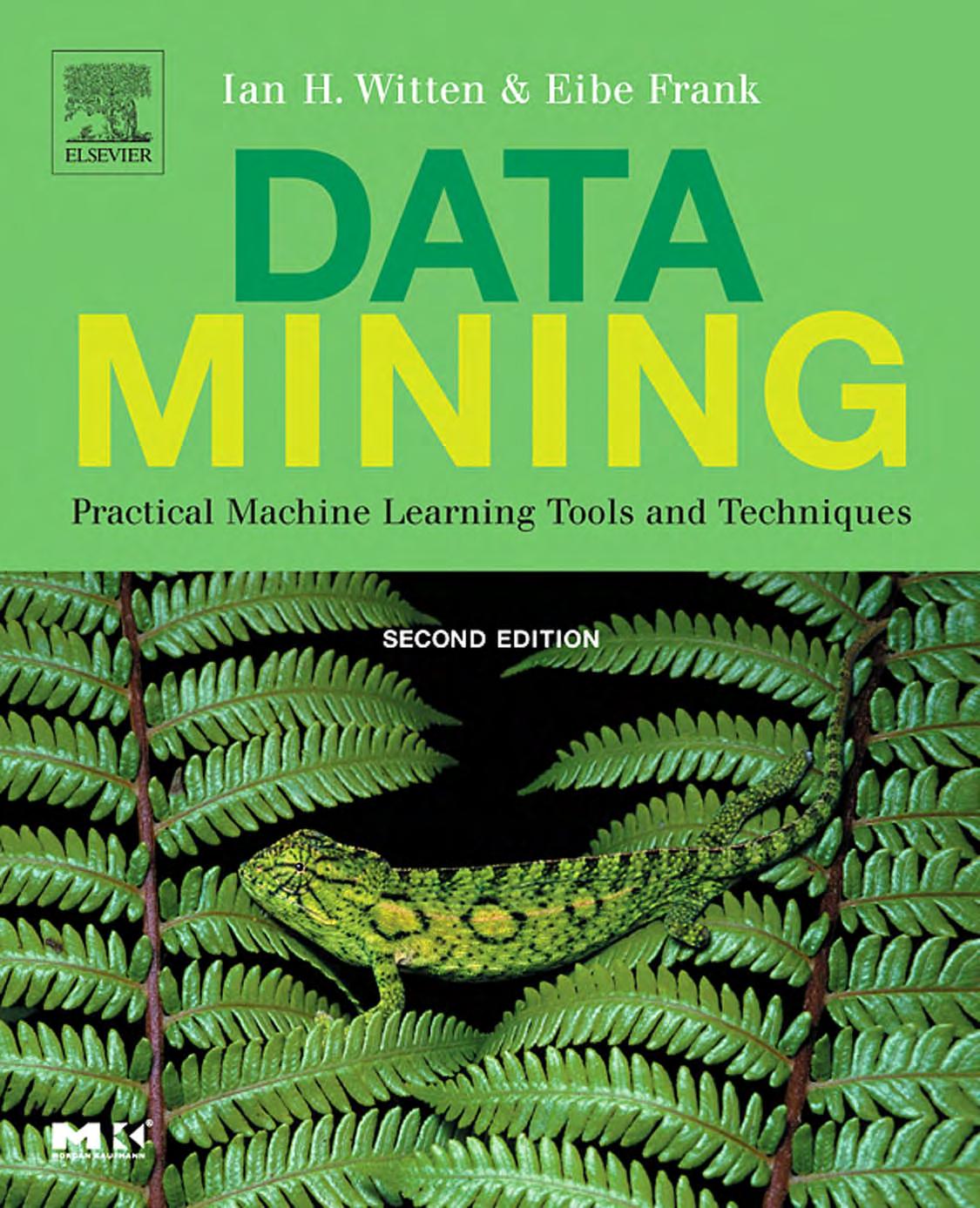
Witten,I.H.(Ian H.)
Data mining :practical machine learning tools and techniques / Ian H.Witten,Eibe Frank.– 2nd ed. p.cm.– (Morgan Kaufmann series in data management systems) Includes bibliographical references and index.
ISBN:0-12-088407-0
1.Data mining.I.Frank,Eibe.II.Title.III.Series.
QA76.9.D343W58 2005 006.3–dc222005043385
For information on all Morgan Kaufmann publications, visit our Web site at www.mkp.com or www.books.elsevier.com
Printed in the United States ofAmerica 050607080954321
Working together to grow libraries in developing countries www.elsevier.com | www.bookaid.org | www.sabre.org
This book presents this new discipline in a very accessible form:as a text both to train the next generation ofpractitioners and researchers and to inform lifelong learners like myself.Witten and Frank have a passion for simple and elegant solutions.They approach each topic with this mindset,grounding all concepts in concrete examples,and urging the reader to consider the simple techniques first,and then progress to the more sophisticated ones ifthe simple ones prove inadequate.
Ifyou are interested in databases,and have not been following the machine learning field,this book is a great way to catch up on this exciting progress.If you have data that you want to analyze and understand,this book and the associated Weka toolkit are an excellent way to start.
1.4Machine learning and statistics29
1.5Generalization as search30
Enumerating the concept space31 Bias32
1.6Data mining and ethics35
1.7Further reading37
2 Input: Concepts, instances, and attributes41
2.1What’s a concept?42
2.2What’s in an example?45
2.3What’s in an attribute?49
2.4Preparing the input52
Gathering the data together52
ARFF format53
Sparse data55
Attribute types56
Missing values58
Inaccurate values59
Getting to know your data60
2.5Further reading60
3 Output: Knowledge representation61
3.1Decision tables62
3.2Decision trees62
3.3Classification rules65
3.4Association rules69
3.5Rules with exceptions70
3.6Rules involving relations73
3.7Trees for numeric prediction76
3.8Instance-based representation76
3.9Clusters81
3.10Further reading82
CONTENTS
5 Credibility:
Evaluating what’s been learned143
5.1Training and testing144
5.2Predicting performance146
5.3Cross-validation149
5.4Other estimates151
Leave-one-out151
The bootstrap152
5.5Comparing data mining methods153
5.6Predicting probabilities157
Quadratic loss function158
Informational loss function159
Discussion160
5.7Counting the cost161
Cost-sensitive classification164
Cost-sensitive learning165
Lift charts166
ROC curves168
Recall–precision curves171
Discussion172
Cost curves173
5.8Evaluating numeric prediction176
5.9The minimum description length principle179
5.10Applying the MDL principle to clustering183
5.11Further reading184
6 Implementations: Real machine learning schemes187
6.1Decision trees189
Numeric attributes189
Missing values191
Pruning192
Estimating error rates193
Complexity ofdecision tree induction196
From trees to rules198
C4.5: Choices and options198
Discussion199
6.2Classification rules200
Criteria for choosing tests200
Missing values,numeric attributes201
Specific algorithms278
Data structures for fast learning280
Discussion283
7 Transformations: Engineering the input and output285
7.1Attribute selection288
Scheme-independent selection290
Searching the attribute space292
Scheme-specific selection294
7.2Discretizing numeric attributes296
Unsupervised discretization297
Entropy-based discretization298
Other discretization methods302
Entropy-based versus error-based discretization302
Converting discrete to numeric attributes304
7.3Some useful transformations305
Principal components analysis306
Random projections309
Text to attribute vectors309
Time series311
7.4Automatic data cleansing312
Improving decision trees312
Robust regression313
Detecting anomalies314
7.5Combining multiple models315
Bagging316
Bagging with costs319
Randomization320
Boosting321
Additive regression325
Additive logistic regression327
Option trees328
Logistic model trees331
Stacking332
Error-correcting output codes334
7.6Using unlabeled data337
Clustering for classification337
Co-training339
EM and co-training340
7.7Further reading341
8 Moving on: Extensions and applications345
8.1Learning from massive datasets346
8.2Incorporating domain knowledge349
8.3Text and Web mining351
8.4Adversarial situations356
8.5Ubiquitous data mining358
8.6Further reading361
Part IIThe Weka machine learning workbench363
9 Introduction to Weka365
9.1What’s in Weka?366
9.2How do you use it?367
9.3What else can you do?368
9.4How do you get it?368
10
The Explorer369
10.1Getting started369 Preparing the data370
Loading the data into the Explorer370 Building a decision tree373 Examining the output373 Doing it again377 Working with models377 When things go wrong378
10.2Exploring the Explorer380 Loading and filtering files380 Training and testing learning schemes384 Do it yourself: The User Classifier388 Using a metalearner389
Clustering and association rules391 Attribute selection392 Visualization393
15.1An example classifier471 buildClassifier()472 makeTree()472 computeInfoGain()480 classifyInstance()480 main()481
15.2Conventions for implementing classifiers483
List of Figures
Figure 1.1Rules for the contact lens data.13
Figure 1.2Decision tree for the contact lens data.14
Figure 1.3Decision trees for the labor negotiations data.19
Figure 2.1A family tree and two ways ofexpressing the sister-of relation.46
Figure 2.2ARFF file for the weather data.54
Figure 3.1Constructing a decision tree interactively:(a) creating a rectangular test involving petallength and petalwidth and (b) the resulting (unfinished) decision tree.64
Figure 3.2Decision tree for a simple disjunction.66
Figure 3.3The exclusive-or problem.67
Figure 3.4Decision tree with a replicated subtree.68
Figure 3.5Rules for the Iris data.72
Figure 3.6The shapes problem.73
Figure 3.7Models for the CPU performance data:(a) linear regression, (b) regression tree,and (c) model tree.77
Figure 3.8Different ways ofpartitioning the instance space.79
Figure 4.3Expanded tree stumps for the weather data.100
Figure 4.4Decision tree for the weather data.101
Figure 4.5Tree stump for the ID code attribute.103
Figure 4.6Covering algorithm:(a) covering the instances and (b) the decision tree for the same problem.106
Figure 4.7The instance space during operation ofa covering algorithm.108
Figure 4.8Pseudocode for a basic rule learner.111
Figure 4.9Logistic regression:(a) the logit transform and (b) an example logistic regression function.122
Figure 4.10The perceptron:(a) learning rule and (b) representation as a neural network.125
Figure 4.11The Winnow algorithm:(a) the unbalanced version and (b) the balanced version.127
Figure 4.12A kD-tree for four training instances:(a) the tree and (b) instances and splits.130
Figure 4.13Using a kD-tree to find the nearest neighbor ofthe star.131
Figure 4.14Ball tree for 16 training instances:(a) instances and balls and (b) the tree.134
Figure 4.15Ruling out an entire ball (gray) based on a target point (star) and its current nearest neighbor.135
Figure 4.16A ball tree:(a) two cluster centers and their dividing line and (b) the corresponding tree.140
Figure 5.1A hypothetical lift chart.168
Figure 5.2A sample ROC curve.169
Figure 5.3ROC curves for two learning methods.170
Figure 5.4Effects ofvarying the probability threshold:(a) the error curve and (b) the cost curve.174
Figure 6.1Example ofsubtree raising,where node C is “raised”to subsume node B.194
Figure 6.2Pruning the labor negotiations decision tree.196
Figure 6.3Algorithm for forming rules by incremental reduced-error pruning.205
Figure 6.4RIPPER:(a) algorithm for rule learning and (b) meaning of symbols.206
Figure 6.5Algorithm for expanding examples into a partial tree.208
Figure 6.6Example ofbuilding a partial tree.209
Figure 6.7Rules with exceptions for the iris data.211
Figure 6.8A maximum margin hyperplane.216
Figure 6.9Support vector regression:(a) e = 1,(b) e = 2,and (c) e = 0.5.221
Figure 6.10Example datasets and corresponding perceptrons.225
Figure 6.11Step versus sigmoid:(a) step function and (b) sigmoid function.228
Figure 6.12Gradient descent using the error function x2 + 1.229
Figure 6.13Multilayer perceptron with a hidden layer.231
Figure 6.14A boundary between two rectangular classes.240
Figure 6.15Pseudocode for model tree induction.248
Figure 6.16Model tree for a dataset with nominal attributes.250
Figure 6.17Clustering the weather data.256
Figure 10.13Working on the segmentation data with the User Classifier: (a) the data visualizer and (b) the tree visualizer.390
Figure 10.14Configuring a metalearner for boosting decision stumps.391
Figure 10.15Output from the Apriori program for association rules.392
Figure 10.16Visualizing the Iris dataset.394
Figure 10.17Using Weka’s metalearner for discretization:(a) configuring FilteredClassifier,and (b) the menu offilters.402
Figure 10.18Visualizing a Bayesian network for the weather data (nominal version):(a) default output,(b) a version with the maximum number ofparents set to 3 in the search algorithm,and (c) probability distribution table for the windy node in (b).406
Figure 10.19Changing the parameters for J4.8.407
Figure 10.20Using Weka’s neural-network graphical user interface.411
Figure 10.21Attribute selection:specifying an evaluator and a search method.420
Figure 11.1The Knowledge Flow interface.428
Figure 11.2Configuring a data source:(a) the right-click menu and (b) the file browser obtained from the Configure menu item.429
Figure 11.3Operations on the Knowledge Flow components.432
Figure 11.4A Knowledge Flow that operates incrementally:(a) the configuration and (b) the strip chart output.434
Figure 12.1An experiment:(a) setting it up,(b) the results file,and (c) a spreadsheet with the results.438
Figure 12.2Statistical test results for the experiment in Figure 12.1.440
Figure 12.3Setting up an experiment in advanced mode.442
Figure 12.4Rows and columns ofFigure 12.2:(a) row field,(b) column field,(c) result ofswapping the row and column selections, and (d) substituting Run for Dataset as rows.444
Figure 13.1Using Javadoc:(a) the front page and (b) the weka.core package.452
Figure 13.2 DecisionStump: A class ofthe weka.classifiers.trees package.454
Figure 14.1Source code for the message classifier.463
Figure 15.1Source code for the ID3 decision tree learner.473
List of Tables
Table 1.1The contact lens data.6
Table 1.2The weather data.11
Table 1.3Weather data with some numeric attributes.12
Table 1.4The iris data.15
Table 1.5The CPU performance data.16
Table 1.6The labor negotiations data.18
Table 1.7The soybean data.21
Table 2.1Iris data as a clustering problem.44
Table 2.2Weather data with a numeric class.44
Table 2.3Family tree represented as a table.47
Table 2.4The sister-ofrelation represented in a table.47
Table 2.5Another relation represented as a table.49
Table 3.1A new iris flower.70
Table 3.2Training data for the shapes problem.74
Table 4.1Evaluating the attributes in the weather data.85
Table 4.2The weather data with counts and probabilities.89
Table 4.3A new day.89
Table 4.4The numeric weather data with summary statistics.93
Table 4.5Another new day.94
Table 4.6The weather data with identification codes.103
Table 4.7Gain ratio calculations for the tree stumps ofFigure 4.2.104
Table 4.8Part ofthe contact lens data for which astigmatism = yes.109
Table 4.9Part ofthe contact lens data for which astigmatism = yes and tear production rate = normal.110
Table 4.10Item sets for the weather data with coverage 2 or greater.114
Table 4.11Association rules for the weather data.116
Table 5.1Confidence limits for the normal distribution.148
Table 5.2Confidence limits for Student’s distribution with 9 degrees offreedom.155
Table 5.4Different outcomes ofa three-class prediction:(a) actual and (b) expected.163
Table 5.5Default cost matrixes:(a) a two-class case and (b) a three-class case.164
Table 5.6Data for a lift chart.167
Table 5.7Different measures used to evaluate the false positive versus the false negative tradeoff.172
Table 5.8Performance measures for numeric prediction.178
Table 5.9Performance measures for four numeric prediction models.179
Table 6.1Linear models in the model tree.250
Table 7.1Transforming a multiclass problem into a two-class one: (a) standard method and (b) error-correcting code.335
Table 10.1Unsupervised attribute filters.396
Table 10.2Unsupervised instance filters.400
Table 10.3Supervised attribute filters.402
Table 10.4Supervised instance filters.402
Table 10.5Classifier algorithms in Weka.404
Table 10.6Metalearning algorithms in Weka.415
Table 10.7Clustering algorithms.419
Table 10.8Association-rule learners.419
Table 10.9Attribute evaluation methods for attribute selection.421
Table 10.10Search methods for attribute selection.421
Table 11.1Visualization and evaluation components.430
Table 13.1Generic options for learning schemes in Weka.457
Table 13.2Scheme-specific options for the J4.8 decision tree learner.458
Table 15.1Simple learning schemes in Weka.472
alchemy.Instead,there is an identifiable body ofsimple and practical techniques that can often extract useful information from raw data.This book describes these techniques and shows how they work.
We interpret machine learning as the acquisition ofstructural descriptions from examples.The kind ofdescriptions found can be used for prediction, explanation,and understanding.Some data mining applications focus on prediction:forecasting what will happen in new situations from data that describe what happened in the past,often by guessing the classification ofnew examples. But we are equally—perhaps more—interested in applications in which the result of“learning”is an actual description ofa structure that can be used to classify examples.This structural description supports explanation,understanding,and prediction.In our experience,insights gained by the applications’ users are ofmost interest in the majority ofpractical data mining applications; indeed,this is one ofmachine learning’s major advantages over classical statistical modeling.
The book explains a variety ofmachine learning methods.Some are pedagogically motivated:simple schemes designed to explain clearly how the basic ideas work.Others are practical:real systems used in applications today.Many are contemporary and have been developed only in the last few years.
A comprehensive software resource,written in the Java language,has been created to illustrate the ideas in the book.Called the Waikato Environment for Knowledge Analysis,or Weka1 for short,it is available as source code on the World Wide Web at http://www.cs.waikato.ac.nz/ml/weka. It is a full,industrialstrength implementation ofessentially all the techniques covered in this book. It includes illustrative code and working implementations ofmachine learning methods.It offers clean,spare implementations ofthe simplest techniques, designed to aid understanding ofthe mechanisms involved.It also provides a workbench that includes full,working,state-of-the-art implementations of many popular learning schemes that can be used for practical data mining or for research.Finally,it contains a framework,in the form ofa Java class library, that supports applications that use embedded machine learning and even the implementation ofnew learning schemes.
The objective ofthis book is to introduce the tools and techniques for machine learning that are used in data mining.After reading it,you will understand what these techniques are and appreciate their strengths and applicability.Ifyou wish to experiment with your own data,you will be able to do this easily with the Weka software.
1 Found only on the islands ofNew Zealand,the weka (pronounced to rhyme with Mecca) is a flightless bird with an inquisitive nature.
The book spans the gulfbetween the intensely practical approach taken by trade books that provide case studies on data mining and the more theoretical, principle-driven exposition found in current textbooks on machine learning. (A briefdescription ofthese books appears in the Further reading section at the end ofChapter 1.) This gulfis rather wide.To apply machine learning techniques productively,you need to understand something about how they work; this is not a technology that you can apply blindly and expect to get good results. Different problems yield to different techniques,but it is rarely obvious which techniques are suitable for a given situation:you need to know something about the range ofpossible solutions.We cover an extremely wide range oftechniques. We can do this because,unlike many trade books,this volume does not promote any particular commercial software or approach.We include a large number of examples,but they use illustrative datasets that are small enough to allow you to follow what is going on.Real datasets are far too large to show this (and in any case are usually company confidential).Our datasets are chosen not to illustrate actual large-scale practical problems but to help you understand what the different techniques do,how they work,and what their range ofapplication is.
The book is aimed at the technically aware general reader interested in the principles and ideas underlying the current practice ofdata mining.It will also be ofinterest to information professionals who need to become acquainted with this new technology and to all those who wish to gain a detailed technical understanding ofwhat machine learning involves.It is written for an eclectic audience ofinformation systems practitioners,programmers,consultants, developers,information technology managers,specification writers,patent examiners,and curious laypeople—as well as students and professors—who need an easy-to-read book with lots ofillustrations that describes what the major machine learning techniques are,what they do,how they are used,and how they work.It is practically oriented,with a strong “how to”flavor,and includes algorithms,code,and implementations.All those involved in practical data mining will benefit directly from the techniques described.The book is aimed at people who want to cut through to the reality that underlies the hype about machine learning and who seek a practical,nonacademic,unpretentious approach.We have avoided requiring any specific theoretical or mathematical knowledge except in some sections marked by a light gray bar in the margin. These contain optional material,often for the more technical or theoretically inclined reader,and may be skipped without loss ofcontinuity.
The book is organized in layers that make the ideas accessible to readers who are interested in grasping the basics and to those who would like more depth of treatment,along with full details on the techniques covered.We believe that consumers ofmachine learning need to have some idea ofhow the algorithms they use work.It is often observed that data models are only as good as the person
object-oriented languages because programs written in Java can be run on almost any computer without having to be recompiled,having to undergo complicated installation procedures,or—worst ofall—having to change the code. A Java program is compiled into byte-code that can be executed on any computer equipped with an appropriate interpreter.This interpreter is called the Java virtual machine. Java virtual machines—and,for that matter,Java compilers—are freely available for all important platforms.
Like all widely used programming languages,Java has received its share of criticism.Although this is not the place to elaborate on such issues,in several cases the critics are clearly right.However,ofall currently available programming languages that are widely supported,standardized,and extensively documented,Java seems to be the best choice for the purpose ofthis book.Its main disadvantage is speed ofexecution—or lack ofit.Executing a Java program is several times slower than running a corresponding program written in C language because the virtual machine has to translate the byte-code into machine code before it can be executed.In our experience the difference is a factor of three to five ifthe virtual machine uses a just-in-time compiler.Instead oftranslating each byte-code individually,a just-in-time compiler translates whole chunks ofbyte-code into machine code,thereby achieving significant speedup. However,ifthis is still to slow for your application,there are compilers that translate Java programs directly into machine code,bypassing the byte-code step.This code cannot be executed on other platforms,thereby sacrificing one ofJava’s most important advantages.
Updated and revised content
We finished writing the first edition ofthis book in 1999 and now,in April 2005, are just polishing this second edition.The areas ofdata mining and machine learning have matured in the intervening years.Although the core ofmaterial in this edition remains the same,we have made the most ofour opportunity to update it to reflect the changes that have taken place over 5 years.There have been errors to fix,errors that we had accumulated in our publicly available errata file.Surprisingly few were found,and we hope there are even fewer in this second edition.(The errata for the second edition may be found through the book’s home page at http://www.cs.waikato.ac.nz/ml/weka/book.html.) We have thoroughly edited the material and brought it up to date,and we practically doubled the number ofreferences.The most enjoyable part has been adding new material.Here are the highlights.
Bowing to popular demand,we have added comprehensive information on neural networks:the perceptron and closely related Winnow algorithm in Section 4.6 and the multilayer perceptron and backpropagation algorithm
in Section 6.3.We have included more recent material on implementing nonlinear decision boundaries using both the kernel perceptron and radial basis function networks.There is a new section on Bayesian networks,again in response to readers’requests,with a description ofhow to learn classifiers based on these networks and how to implement them efficiently using all-dimensions trees.
The Weka machine learning workbench that accompanies the book,a widely used and popular feature ofthe first edition,has acquired a radical new look in the form ofan interactive interface—or rather,three separate interactive interfaces—that make it far easier to use.The primary one is the Explorer,which gives access to all ofWeka’s facilities using menu selection and form filling.The others are the Knowledge Flow interface,which allows you to design configurations for streamed data processing,and the Experimenter,with which you set up automated experiments that run selected machine learning algorithms with different parameter settings on a corpus ofdatasets,collect performance statistics,and perform significance tests on the results.These interfaces lower the bar for becoming a practicing data miner,and we include a full description ofhow to use them.However,the book continues to stand alone,independent ofWeka, and to underline this we have moved all material on the workbench into a separate Part II at the end ofthe book.
In addition to becoming far easier to use,Weka has grown over the last 5 years and matured enormously in its data mining capabilities.It now includes an unparalleled range ofmachine learning algorithms and related techniques. The growth has been partly stimulated by recent developments in the field and partly led by Weka users and driven by demand.This puts us in a position in which we know a great deal about what actual users ofdata mining want,and we have capitalized on this experience when deciding what to include in this new edition.
The earlier chapters,containing more general and foundational material, have suffered relatively little change.We have added more examples offielded applications to Chapter 1,a new subsection on sparse data and a little on string attributes and date attributes to Chapter 2,and a description ofinteractive decision tree construction,a useful and revealing technique to help you grapple with your data using manually built decision trees,to Chapter 3.
In addition to introducing linear decision boundaries for classification,the infrastructure for neural networks,Chapter 4 includes new material on multinomial Bayes models for document classification and on logistic regression.The last 5 years have seen great interest in data mining for text,and this is reflected in our introduction to string attributes in Chapter 2,multinomial Bayes for document classification in Chapter 4,and text transformations in Chapter 7. Chapter 4 includes a great deal ofnew material on efficient data structures for searching the instance space: kD-trees and the recently invented ball trees.These
are used to find nearest neighbors efficiently and to accelerate distance-based clustering.
Chapter 5 describes the principles ofstatistical evaluation ofmachine learning,which have not changed.The main addition,apart from a note on the Kappa statistic for measuring the success ofa predictor,is a more detailed treatment ofcost-sensitive learning.We describe how to use a classifier,built without taking costs into consideration,to make predictions that are sensitive to cost; alternatively,we explain how to take costs into account during the training process to build a cost-sensitive model.We also cover the popular new technique ofcost curves.
There are several additions to Chapter 6,apart from the previously mentioned material on neural networks and Bayesian network classifiers.More details—gory details—are given ofthe heuristics used in the successful RIPPER rule learner.We describe how to use model trees to generate rules for numeric prediction.We show how to apply locally weighted regression to classification problems.Finally,we describe the X-means clustering algorithm,which is a big improvement on traditional k-means.
Chapter 7 on engineering the input and output has changed most,because this is where recent developments in practical machine learning have been concentrated.We describe new attribute selection schemes such as race search and the use ofsupport vector machines and new methods for combining models such as additive regression,additive logistic regression,logistic model trees,and option trees.We give a full account ofLogitBoost (which was mentioned in the first edition but not described).There is a new section on useful transformations,including principal components analysis and transformations for text mining and time series.We also cover recent developments in using unlabeled data to improve classification,including the co-training and co-EM methods.
The final chapter ofPart I on new directions and different perspectives has been reworked to keep up with the times and now includes contemporary challenges such as adversarial learning and ubiquitous data mining.
Acknowledgments
Writing the acknowledgments is always the nicest part! A lot ofpeople have helped us,and we relish this opportunity to thank them.This book has arisen out ofthe machine learning research project in the Computer Science Department at the University ofWaikato,New Zealand.We have received generous encouragement and assistance from the academic staffmembers on that project: John Cleary,Sally Jo Cunningham,Matt Humphrey,Lyn Hunt,Bob McQueen, Lloyd Smith,and Tony Smith.Special thanks go to Mark Hall,Bernhard Pfahringer,and above all GeoffHolmes,the project leader and source ofinspi-
ration.All who have worked on the machine learning project here have contributed to our thinking:we would particularly like to mention Steve Garner, Stuart Inglis,and Craig Nevill-Manning for helping us to get the project offthe ground in the beginning when success was less certain and things were more difficult.
The Weka system that illustrates the ideas in this book forms a crucial component ofit.It was conceived by the authors and designed and implemented by Eibe Frank,along with Len Trigg and Mark Hall.Many people in the machine learning laboratory at Waikato made significant contributions.Since the first edition ofthe book the Weka team has expanded considerably:so many people have contributed that it is impossible to acknowledge everyone properly.We are grateful to Remco Bouckaert for his implementation ofBayesian networks,Dale Fletcher for many database-related aspects,AshrafKibriya and Richard Kirkby for contributions far too numerous to list,Niels Landwehr for logistic model trees,Abdelaziz Mahoui for the implementation ofK*,Stefan Mutter for association rule mining,Gabi Schmidberger and Malcolm Ware for numerous miscellaneous contributions,Tony Voyle for least-median-of-squares regression, Yong Wang for Pace regression and the implementation ofM5¢,and Xin Xu for JRip,logistic regression,and many other contributions.Our sincere thanks go to all these people for their dedicated work and to the many contributors to Weka from outside our group at Waikato.
Tucked away as we are in a remote (but very pretty) corner ofthe Southern Hemisphere,we greatly appreciate the visitors to our department who play a crucial role in acting as sounding boards and helping us to develop our thinking.We would like to mention in particular Rob Holte,Carl Gutwin,and Russell Beale,each ofwhom visited us for several months;David Aha,who although he only came for a few days did so at an early and fragile stage ofthe project and performed a great service by his enthusiasm and encouragement; and Kai Ming Ting,who worked with us for 2 years on many ofthe topics described in Chapter 7 and helped to bring us into the mainstream ofmachine learning.
Students at Waikato have played a significant role in the development ofthe project.Jamie Littin worked on ripple-down rules and relational learning.Brent Martin explored instance-based learning and nested instance-based representations.Murray Fife slaved over relational learning,and Nadeeka Madapathage investigated the use offunctional languages for expressing machine learning algorithms.Other graduate students have influenced us in numerous ways,particularly Gordon Paynter,YingYing Wen,and Zane Bray,who have worked with us on text mining.Colleagues Steve Jones and Malika Mahoui have also made far-reaching contributions to these and other machine learning projects.More recently we have learned much from our many visiting students from Freiburg, including Peter Reutemann and Nils Weidmann.
Ian Witten would like to acknowledge the formative role ofhis former students at Calgary,particularly Brent Krawchuk,Dave Maulsby,Thong Phan,and Tanja Mitrovic,all ofwhom helped him develop his early ideas in machine learning,as did faculty members Bruce MacDonald,Brian Gaines,and David Hill at Calgary and John Andreae at the University ofCanterbury.
Eibe Frank is indebted to his former supervisor at the University of Karlsruhe,Klaus-Peter Huber (now with SAS Institute),who infected him with the fascination ofmachines that learn.On his travels Eibe has benefited from interactions with Peter Turney,Joel Martin,and Berry de Bruijn in Canada and with Luc de Raedt,Christoph Helma,Kristian Kersting,Stefan Kramer,Ulrich Rückert,and Ashwin Srinivasan in Germany.
Diane Cerra and Asma Stephan ofMorgan Kaufmann have worked hard to shape this book,and Lisa Royse,our production editor,has made the process go smoothly.Bronwyn Webster has provided excellent support at the Waikato end.
We gratefully acknowledge the unsung efforts ofthe anonymous reviewers, one ofwhom in particular made a great number ofpertinent and constructive comments that helped us to improve this book significantly.In addition,we would like to thank the librarians ofthe Repository ofMachine Learning Databases at the University ofCalifornia,Irvine,whose carefully collected datasets have been invaluable in our research.
Our research has been funded by the New Zealand Foundation for Research, Science and Technology and the Royal Society ofNew Zealand Marsden Fund. The Department ofComputer Science at the University ofWaikato has generously supported us in all sorts ofways,and we owe a particular debt of gratitude to Mark Apperley for his enlightened leadership and warm encouragement.Part ofthe first edition was written while both authors were visiting the University ofCalgary,Canada,and the support ofthe Computer Science department there is gratefully acknowledged—as well as the positive and helpful attitude ofthe long-suffering students in the machine learning course on whom we experimented.
In producing the second edition Ian was generously supported by Canada’s Informatics Circle ofResearch Excellence and by the University ofLethbridge in southern Alberta,which gave him what all authors yearn for—a quiet space in pleasant and convivial surroundings in which to work.
Last,and most ofall,we are grateful to our families and partners.Pam,Anna, and Nikki were all too well aware ofthe implications ofhaving an author in the house (“not again!”) but let Ian go ahead and write the book anyway.Julie was always supportive,even when Eibe had to burn the midnight oil in the machine learning lab,and Immo and Ollig provided exciting diversions.Between us we hail from Canada,England,Germany,Ireland,and Samoa:New Zealand has brought us together and provided an ideal,even idyllic,place to do this work.
1
What’s It All About?
Human in vitro fertilization involves collecting several eggs from a woman’s ovaries,which,after fertilization with partner or donor sperm,produce several embryos.Some ofthese are selected and transferred to the woman’s uterus.The problem is to select the “best”embryos to use—the ones that are most likely to survive.Selection is based on around 60 recorded features ofthe embryos— characterizing their morphology,oocyte,follicle,and the sperm sample.The number offeatures is sufficiently large that it is difficult for an embryologist to assess them all simultaneously and correlate historical data with the crucial outcome ofwhether that embryo did or did not result in a live child.In a research project in England,machine learning is being investigated as a technique for making the selection,using as training data historical records of embryos and their outcome.
Every year,dairy farmers in New Zealand have to make a tough business decision:which cows to retain in their herd and which to sell offto an abattoir.Typically,one-fifth ofthe cows in a dairy herd are culled each year near the end of the milking season as feed reserves dwindle.Each cow’s breeding and milk pro-
duction history influences this decision.Other factors include age (a cow is nearing the end ofits productive life at 8 years),health problems,history ofdifficult calving,undesirable temperament traits (kicking or jumping fences),and not being in calffor the following season.About 700 attributes for each of several million cows have been recorded over the years.Machine learning is being investigated as a way ofascertaining what factors are taken into account by successful farmers—not to automate the decision but to propagate their skills and experience to others.
Life and death.From Europe to the antipodes.Family and business.Machine learning is a burgeoning new technology for mining knowledge from data,a technology that a lot ofpeople are starting to take seriously.
1.1Data mining and machine learning
We are overwhelmed with data.The amount ofdata in the world,in our lives, seems to go on and on increasing—and there’s no end in sight.Omnipresent personal computers make it too easy to save things that previously we would have trashed.Inexpensive multigigabyte disks make it too easy to postpone decisions about what to do with all this stuff—we simply buy another disk and keep it all.Ubiquitous electronics record our decisions,our choices in the supermarket,our financial habits,our comings and goings.We swipe our way through the world,every swipe a record in a database.The World Wide Web overwhelms us with information;meanwhile,every choice we make is recorded.And all these are just personal choices:they have countless counterparts in the world ofcommerce and industry.We would all testify to the growing gap between the generation ofdata and our understanding ofit.As the volume ofdata increases, inexorably,the proportion ofit that people understand decreases,alarmingly. Lying hidden in all this data is information,potentially useful information,that is rarely made explicit or taken advantage of.
This book is about looking for patterns in data.There is nothing new about this.People have been seeking patterns in data since human life began.Hunters seek patterns in animal migration behavior,farmers seek patterns in crop growth,politicians seek patterns in voter opinion,and lovers seek patterns in their partners’responses.A scientist’s job (like a baby’s) is to make sense ofdata, to discover the patterns that govern how the physical world works and encapsulate them in theories that can be used for predicting what will happen in new situations.The entrepreneur’s job is to identify opportunities,that is,patterns in behavior that can be turned into a profitable business,and exploit them.
In data mining, the data is stored electronically and the search is automated— or at least augmented—by computer.Even this is not particularly new.Economists,statisticians,forecasters,and communication engineers have long worked
with the idea that patterns in data can be sought automatically,identified, validated,and used for prediction.What is new is the staggering increase in opportunities for finding patterns in data.The unbridled growth ofdatabases in recent years,databases on such everyday activities as customer choices,brings data mining to the forefront ofnew business technologies.It has been estimated that the amount ofdata stored in the world’s databases doubles every 20 months,and although it would surely be difficult to justify this figure in any quantitative sense,we can all relate to the pace ofgrowth qualitatively.As the flood ofdata swells and machines that can undertake the searching become commonplace,the opportunities for data mining increase.As the world grows in complexity,overwhelming us with the data it generates,data mining becomes our only hope for elucidating the patterns that underlie it.Intelligently analyzed data is a valuable resource.It can lead to new insights and,in commercial settings,to competitive advantages.
Data mining is about solving problems by analyzing data already present in databases.Suppose,to take a well-worn example,the problem is fickle customer loyalty in a highly competitive marketplace.A database ofcustomer choices, along with customer profiles,holds the key to this problem.Patterns of behavior offormer customers can be analyzed to identify distinguishing characteristics ofthose likely to switch products and those likely to remain loyal.Once such characteristics are found,they can be put to work to identify present customers who are likely to jump ship.This group can be targeted for special treatment,treatment too costly to apply to the customer base as a whole.More positively,the same techniques can be used to identify customers who might be attracted to another service the enterprise provides,one they are not presently enjoying,to target them for special offers that promote this service.In today’s highly competitive,customer-centered,service-oriented economy,data is the raw material that fuels business growth—ifonly it can be mined.
Data mining is defined as the process ofdiscovering patterns in data.The process must be automatic or (more usually) semiautomatic.The patterns discovered must be meaningful in that they lead to some advantage,usually an economic advantage.The data is invariably present in substantial quantities.
How are the patterns expressed? Useful patterns allow us to make nontrivial predictions on new data.There are two extremes for the expression ofa pattern: as a black box whose innards are effectively incomprehensible and as a transparent box whose construction reveals the structure ofthe pattern.Both,we are assuming,make good predictions.The difference is whether or not the patterns that are mined are represented in terms ofa structure that can be examined, reasoned about,and used to inform future decisions.Such patterns we call structural because they capture the decision structure in an explicit way.In other words,they help to explain something about the data.
Now,finally,we can say what this book is about.It is about techniques for finding and describing structural patterns in data.Most ofthe techniques that we cover have developed within a field known as machine learning. But first let us look at what structural patterns are.
Describing structural patterns
What is meant by structural patterns? How do you describe them? And what form does the input take? We will answer these questions by way ofillustration rather than by attempting formal,and ultimately sterile,definitions.There will be plenty ofexamples later in this chapter,but let’s examine one right now to get a feeling for what we’re talking about.
Look at the contact lens data in Table 1.1.This gives the conditions under which an optician might want to prescribe soft contact lenses,hard contact lenses,or no contact lenses at all;we will say more about what the individual
features mean later.Each line ofthe table is one ofthe examples.Part ofa structural description ofthis information might be as follows:
If tear production rate = reduced then recommendation = none Otherwise, if age = young and astigmatic = no then recommendation = soft
Structural descriptions need not necessarily be couched as rules such as these. Decision trees,which specify the sequences ofdecisions that need to be made and the resulting recommendation,are another popular means ofexpression. This example is a very simplistic one.First,all combinations ofpossible values are represented in the table.There are 24 rows,representing three possible values ofage and two values each for spectacle prescription,astigmatism, and tear production rate (3 ¥ 2 ¥ 2 ¥ 2 = 24).The rules do not really generalize from the data;they merely summarize it.In most learning situations,the set ofexamples given as input is far from complete,and part ofthe job is to generalize to other,new examples.You can imagine omitting some ofthe rows in the table for which tear production rate is reduced and still coming up with the rule
If tear production rate = reduced then recommendation = none which would generalize to the missing rows and fill them in correctly.Second, values are specified for all the features in all the examples.Real-life datasets invariably contain examples in which the values ofsome features,for some reason or other,are unknown—for example,measurements were not taken or were lost.Third,the preceding rules classify the examples correctly,whereas often,because oferrors or noise in the data,misclassifications occur even on the data that is used to train the classifier.
Machine learning
Now that we have some idea about the inputs and outputs,let’s turn to machine learning.What is learning,anyway? What is machine learning? These are philosophic questions,and we will not be much concerned with philosophy in this book;our emphasis is firmly on the practical.However,it is worth spending a few moments at the outset on fundamental issues,just to see how tricky they are,before rolling up our sleeves and looking at machine learning in practice. Our dictionary defines “to learn”as follows:
To get knowledge ofby study,experience,or being taught;
To become aware by information or from observation;
To commit to memory;
To be informed of,ascertain;
To receive instruction.
computers.To decide whether something has actually learned,you need to see whether it intended to or whether there was any purpose involved.That makes the concept moot when applied to machines because whether artifacts can behave purposefully is unclear.Philosophic discussions ofwhat is really meant by “learning,”like discussions ofwhat is really meant by “intention”or “purpose,”are fraught with difficulty.Even courts oflaw find intention hard to grapple with.
Data mining
Fortunately,the kind oflearning techniques explained in this book do not present these conceptual problems—they are called machine learning without really presupposing any particular philosophic stance about what learning actually is.Data mining is a practical topic and involves learning in a practical,not a theoretical,sense.We are interested in techniques for finding and describing structural patterns in data as a tool for helping to explain that data and make predictions from it.The data will take the form ofa set ofexamples—examples ofcustomers who have switched loyalties,for instance,or situations in which certain kinds ofcontact lenses can be prescribed.The output takes the form of predictions about new examples—a prediction ofwhether a particular customer will switch or a prediction ofwhat kind oflens will be prescribed under given circumstances.But because this book is about finding and describing patterns in data,the output may also include an actual description ofa structure that can be used to classify unknown examples to explain the decision.As well as performance,it is helpful to supply an explicit representation ofthe knowledge that is acquired.In essence,this reflects both definitions oflearning considered previously:the acquisition ofknowledge and the ability to use it.
Many learning techniques look for structural descriptions ofwhat is learned, descriptions that can become fairly complex and are typically expressed as sets ofrules such as the ones described previously or the decision trees described later in this chapter.Because they can be understood by people,these descriptions serve to explain what has been learned and explain the basis for new predictions.Experience shows that in many applications ofmachine learning to data mining,the explicit knowledge structures that are acquired,the structural descriptions,are at least as important,and often very much more important, than the ability to perform well on new examples.People frequently use data mining to gain knowledge,not just predictions.Gaining knowledge from data certainly sounds like a good idea ifyou can do it.To find out how,read on!
1.2Simple examples: The weather problem and others
We use a lot ofexamples in this book,which seems particularly appropriate considering that the book is all about learning from examples! There are several