The Role of Technology in Civil Engineering, Construction, and Architecture
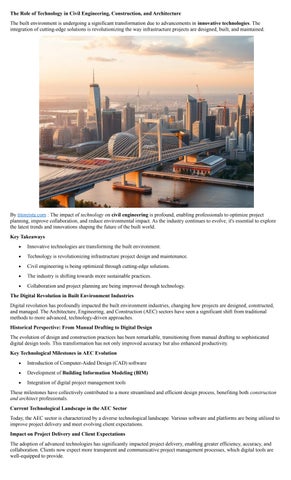
The built environment is undergoing a significant transformation due to advancements in innovative technologies. The integration of cutting-edge solutions is revolutionizing the way infrastructure projects are designed, built, and maintained.

By titoreista.com : The impact of technology on civil engineering is profound, enabling professionals to optimize project planning, improve collaboration, and reduce environmental impact. As the industry continues to evolve, it's essential to explore the latest trends and innovations shaping the future of the built world.
Key Takeaways
Innovative technologies are transforming the built environment.
Technology is revolutionizing infrastructure project design and maintenance.
Civil engineering is being optimized through cutting-edge solutions.
The industry is shifting towards more sustainable practices.
Collaboration and project planning are being improved through technology.
The Digital Revolution in Built Environment Industries
Digital revolution has profoundly impacted the built environment industries, changing how projects are designed, constructed, and managed. The Architecture, Engineering, and Construction (AEC) sectors have seen a significant shift from traditional methods to more advanced, technology-driven approaches.
Historical Perspective: From Manual Drafting to Digital Design
The evolution of design and construction practices has been remarkable, transitioning from manual drafting to sophisticated digital design tools. This transformation has not only improved accuracy but also enhanced productivity.
Key Technological Milestones in AEC Evolution
Introduction of Computer-Aided Design (CAD) software
Development of Building Information Modeling (BIM)
Integration of digital project management tools
These milestones have collectively contributed to a more streamlined and efficient design process, benefiting both construction and architect professionals.
Current Technological Landscape in the AEC Sector
Today, the AEC sector is characterized by a diverse technological landscape. Various software and platforms are being utilized to improve project delivery and meet evolving client expectations.
Impact on Project Delivery and Client Expectations
The adoption of advanced technologies has significantly impacted project delivery, enabling greater efficiency, accuracy, and collaboration. Clients now expect more transparent and communicative project management processes, which digital tools are well-equipped to provide.

The integration of technologies like BIM has been particularly transformative, allowing for more detailed and data-rich project models that enhance collaboration across different stakeholders.
Building Information Modeling (BIM): Transforming Project Delivery
BIM technology is at the forefront of innovation in the built environment, offering a digital representation of a project's physical and functional characteristics. This advanced approach to project delivery is transforming the Architecture, Engineering, and Construction (AEC) industries by enhancing collaboration, reducing errors, and improving project visualization.
Core Principles and Benefits of BIM Implementation
The core principle of BIM lies in its ability to create a comprehensive digital model that encompasses all aspects of a project. This includes not only the physical attributes but also the functional characteristics, such as energy consumption and structural integrity. The benefits of implementing BIM are multifaceted:
Improved Collaboration: BIM facilitates better communication among stakeholders by providing a shared platform for data exchange.
Enhanced Accuracy: By reducing reliance on manual drafting, BIM minimizes errors and discrepancies in project documentation.
Better Project Visualization: The 3D modeling capabilities of BIM allow for a more intuitive understanding of complex project elements.
Dimensional Capabilities: From 3D to 7D Modeling
BIM's dimensional capabilities range from 3D modeling, which provides a visual representation of the project, to more advanced dimensions such as:
1. 4D Modeling: Integrating time-related data to simulate construction sequences.
2. 5D Modeling: Incorporating cost information to enable more accurate budgeting.
3. 6D Modeling: Focusing on sustainability and energy analysis.
4. 7D Modeling: Managing the facility's lifecycle, including maintenance and operations.

Collaborative Workflows and Information Sharing
A key aspect of BIM is its ability to facilitate collaborative workflows and information sharing among project stakeholders. By using a common data environment, teams can work together more effectively, reducing the risk of data loss or miscommunication.
Case Studies: Successful BIM Applications in Major US Projects
Several major projects in the US have successfully utilized BIM, demonstrating its potential to transform project delivery. Examples include:
The renovation of the US Capitol Visitor Center, which used BIM to manage complex phasing and logistics.
The construction of the One World Trade Center, where BIM played a crucial role in coordinating the efforts of multiple stakeholders.
These case studies highlight the versatility and benefits of BIM in large-scale projects, showcasing its ability to improve project outcomes through enhanced collaboration and data-driven decision-making.
Advanced Structural Analysis Software and Simulation Tools
Modern structural design relies heavily on sophisticated simulation tools to ensure safety and efficiency. The integration of advanced structural analysis software has transformed the way engineers approach complex projects, enabling them to simulate various scenarios and optimize their designs accordingly.
Finite Element Analysis in Modern Structural Design
Finite Element Analysis (FEA) is a cornerstone of modern structural engineering. It allows engineers to break down complex structures into smaller, manageable elements, analyzing each component's behavior under different loads. This method provides detailed insights into structural integrity, helping engineers identify potential weaknesses and make informed design decisions.
Computational Fluid Dynamics for Environmental Analysis
Computational Fluid Dynamics (CFD) is another critical tool in structural analysis, used to simulate the behavior of fluids and gases around structures. CFD helps engineers understand environmental impacts, such as wind patterns and water flow, on their designs. This information is crucial for optimizing structural performance and ensuring durability.
Seismic and Wind Load Simulations for Resilient Structures
Seismic and wind load simulations are essential for designing structures that can withstand extreme weather events. By using advanced simulation tools, engineers can model how different loads affect their designs, making adjustments to enhance resilience. This proactive approach helps minimize potential damage and ensures the safety of occupants.
Predictive Modeling for Extreme Weather Events
Predictive modeling takes structural analysis a step further by forecasting the impact of extreme weather events on structures. By analyzing historical data and simulating various scenarios, engineers can predict potential risks and develop strategies to mitigate them. As "The future of structural engineering lies in our ability to predict and prepare for the unpredictable." - a quote that resonates with the current advancements in the field.
In conclusion, advanced structural analysis software and simulation tools are revolutionizing the field of structural engineering. By leveraging FEA, CFD, and predictive modeling, engineers can create safer, more resilient structures that stand the test of time.
Technology Civil Engineering to Construction and Architect Integration
Technological advancements are bridging the gap between civil engineering, construction, and architecture, enhancing collaboration and project outcomes. The integration of technology across these disciplines is crucial for improving project delivery times, reducing costs, and increasing overall quality.
Breaking Down Traditional Silos Between Disciplines
Traditionally, civil engineering, construction, and architecture have operated in silos, with limited communication and collaboration between them. However, technological integration is changing this landscape by introducing unified platforms that facilitate data sharing and coordination.
Unified Digital Platforms for Project Lifecycle Management
Unified digital platforms are revolutionizing project lifecycle management by providing a single source of truth for all project stakeholders. These platforms enable real-time data sharing, collaboration, and decision-making, ensuring that projects stay on track and within budget.
Real-time Collaboration Tools and Their Implementation
Real-time collaboration tools are a key component of unified digital platforms, allowing teams to work together more effectively. These tools include features such as live commenting, @mentions, and instant file sharing, which enhance communication and reduce misunderstandings.
Interoperability Challenges and Solutions
Despite the benefits of unified digital platforms, interoperability challenges remain a significant hurdle. Different software and systems often have difficulty communicating with each other, leading to data loss and inconsistencies. To address this, the industry is moving towards the development of standardized data formats and interfaces that enable seamless integration between different systems.
By adopting these solutions, the AEC industries can overcome the challenges associated with technological integration and reap the benefits of improved collaboration, reduced project timelines, and enhanced project outcomes.
Sustainable Design Practices Through Technological Innovation
Sustainable design practices are being redefined through cutting-edge technological innovations. The architectural, engineering, and construction (AEC) industries are leveraging these advancements to create more environmentally friendly and efficient buildings.
Energy Modeling and Performance Simulation
Energy modeling and performance simulation play a crucial role in sustainable design. By using advanced software, architects and engineers can analyze a building's energy consumption and optimize its performance. This process helps in achieving netzero energy buildings that produce as much energy as they consume.
Net-Zero Building Design Technologies
Net-zero building design technologies involve a range of tools and strategies. These include advanced insulation materials, energy-efficient HVAC systems, and renewable energy sources like solar and wind power. Building information modeling (BIM) is also utilized to simulate and analyze building performance, ensuring that designs meet net-zero energy goals.
Material Selection and Life Cycle Assessment Tools
The selection of materials is critical in sustainable design. Life cycle assessment (LCA) tools help architects and engineers evaluate the environmental impacts of different materials throughout their entire life cycle. This enables informed decisions that reduce a project's overall environmental footprint.
Green Building Certification Support Systems
Green building certification systems like LEED, WELL, and Living Building Challenge provide frameworks for achieving sustainability. Digital tools support these certifications by streamlining the documentation and verification processes.
LEED, WELL, and Living Building Challenge Digital Tools
Various digital tools are available to support LEED, WELL, and Living Building Challenge certifications. These tools help project teams track their progress, manage documentation, and ensure compliance with certification requirements, making the process more efficient and less prone to errors.
Automation and Robotics in Construction
The construction industry is on the cusp of a revolution with automation and robotics. As the sector continues to evolve, the integration of these technologies is improving efficiency, reducing waste, and enhancing safety.
Prefabrication and Modular Construction Technologies
Prefabrication and modular construction are at the forefront of this revolution. By manufacturing building components off-site, construction companies can significantly reduce waste and improve quality control. Digital fabrication methods play a crucial role in this process, enabling the production of complex components with high precision.
Digital Fabrication Methods and Quality Control
Digital fabrication involves the use of computer-controlled machines to manufacture building parts. This not only enhances precision but also allows for real-time quality control, ensuring that components meet the required standards.
On-site Construction Robots and Autonomous Equipment
The deployment of on-site construction robots and autonomous equipment is another significant trend. These machines can perform tasks ranging from bricklaying to excavation, improving productivity and reducing the risk of accidents. Construction management tools are essential for coordinating these robots and ensuring they integrate seamlessly into existing workflows.
3D Printing Applications in Building Construction
3D printing is also making waves in the construction industry. This technology allows for the rapid creation of complex structures, reducing construction time and costs. Large-scale 3D printing projects have demonstrated the potential of this technology, from residential homes to commercial buildings.
Case Studies: Large-Scale 3D Printed Structures
Several notable projects have showcased the capabilities of 3D printing in construction. For instance, "As '3D printing is revolutionizing the construction industry by enabling the rapid production of complex structures with reduced waste.'
," highlights a leading industry expert. These case studies demonstrate the potential for 3D printing to transform construction practices.
Infrastructure Development Solutions for Smart Cities
Infrastructure development is a critical component in the creation of smart, sustainable cities. As urban populations grow, cities face increasing challenges in managing resources, reducing environmental impact, and improving the quality of life for their citizens. Advanced infrastructure solutions are essential to address these challenges.
Digital Twins for Infrastructure Management
One of the key technologies driving infrastructure development is the concept of digital twins. A digital twin is a virtual replica of a physical infrastructure asset, such as a bridge, road, or building. This technology allows for real-time monitoring, predictive maintenance, and optimized asset management.
Predictive Maintenance and Asset Management
Predictive maintenance enabled by digital twins can significantly reduce maintenance costs and extend the lifespan of infrastructure assets. By analyzing data from sensors and IoT devices, cities can anticipate potential failures and schedule maintenance proactively.
IoT and Sensor Networks for Real-time Monitoring
The Internet of Things (IoT) and sensor networks play a crucial role in infrastructure development for smart cities. These technologies enable real-time monitoring of infrastructure assets, allowing for immediate response to changes or issues. For example, sensors can monitor traffic flow, water quality, or energy usage, providing valuable data for city planners and managers.
Resilient Infrastructure Design Through Technology
Technology is also enhancing the resilience of infrastructure in smart cities. Advanced simulation and modeling tools allow engineers to design infrastructure that can withstand extreme weather events and other challenges. By leveraging these technologies, cities can create infrastructure that is not only efficient but also resilient and sustainable. By integrating these infrastructure development solutions, cities can move towards a more sustainable, efficient, and livable future. The use of digital twins, IoT, and advanced design technologies will be pivotal in creating the smart cities of tomorrow.
Construction Management Tools and Project Delivery Systems
Modern construction management is leveraging cutting-edge tools to enhance project delivery and collaboration. The industry is witnessing a significant shift towards digital solutions that streamline processes, improve accuracy, and reduce costs.
Cloud-Based Project Management Platforms
Cloud-based project management platforms have become essential in modern construction management. These platforms enable real-time collaboration, document sharing, and project monitoring from anywhere in the world. Procore and PlanGrid are examples of popular cloud-based solutions that have transformed how construction projects are managed.
Integration with Financial and Resource Planning Systems
One of the key benefits of cloud-based project management platforms is their ability to integrate with financial and resource planning systems. This integration allows for more accurate project forecasting and better resource allocation. For instance, integrating project management with financial systems can help track expenses in real-time, enabling project managers to make informed decisions.
Feature Procore PlanGrid
Real-time Collaboration
Document Management
Integration with Financial
Systems
Yes Yes
Yes Yes
Yes Limited
Mobile Applications for Field Operations and Documentation
Mobile applications are being increasingly used for field operations and documentation, improving data accuracy and reducing paperwork. These applications enable field personnel to report progress, document issues, and communicate with the project team in real-time. "The use of mobile apps has significantly reduced our paperwork and improved our data accuracy," says a project manager at a leading construction firm.
Data Analytics for Project Performance Optimization
Data analytics is playing a crucial role in optimizing project performance. By analyzing data from various sources, construction managers can identify trends, predict potential issues, and make data-driven decisions. Machine learning applications are being explored for predictive analytics, enabling proactive measures to be taken to prevent delays and cost overruns.
Machine Learning Applications in Construction Management
Machine learning algorithms can analyze historical project data to predict future outcomes. This capability allows construction managers to anticipate and mitigate risks more effectively. For example, machine learning can help predict the likelihood of project delays based on historical data, enabling proactive measures to be taken.
"The integration of machine learning in construction management is revolutionizing how we predict and manage project risks."
— Expert in Construction Technology
By embracing these advanced construction management tools and project delivery systems, the construction industry can achieve greater efficiency, reduce costs, and improve project outcomes.
Urban Planning Innovations and Computational Design
Computational design is changing the landscape of urban planning, enabling more efficient and sustainable city development. This transformation is driven by various technological innovations that are reshaping how cities are designed, managed, and experienced.
Parametric Design and Generative Architecture
Parametric design and generative architecture are at the forefront of urban planning innovations. These technologies allow for the creation of complex urban forms that are optimized for various parameters such as energy efficiency, traffic flow, and green spaces. By using algorithms and data, urban planners can generate multiple design scenarios, analyzing and selecting the most effective solutions.
Benefits of Parametric Design:
Enhanced design flexibility
Improved sustainability
Optimized urban forms
GIS and Spatial Analysis for Urban Development
Geographic Information Systems (GIS) and spatial analysis play a crucial role in urban development. These tools enable urban planners to analyze spatial data, understand urban dynamics, and make informed decisions. GIS technology is used for mapping urban areas, tracking changes over time, and planning infrastructure projects.
Climate-Responsive Urban Planning Tools
Climate-responsive urban planning tools are being developed to help cities adapt to climate change. These tools use data and simulations to predict the impacts of climate change on urban areas and design resilient urban environments. For instance, urban heat island mitigation strategies can be developed using thermal imaging and GIS data.
Tool Function Benefit
GIS Spatial analysis
Climate Modeling Predict climate impacts
Informed decision-making
Resilient urban design
Virtual and Augmented Reality in Urban Planning
Virtual and augmented reality (VR/AR) technologies are being increasingly used in urban planning to engage the public and stakeholders. These immersive technologies allow for the visualization of urban projects, facilitating better understanding and feedback.
Public Engagement Through Immersive Technologies
Immersive technologies enhance public engagement by providing interactive and immersive experiences. Citizens can explore proposed urban developments in a virtual environment, offering valuable insights and feedback.
"The use of VR in urban planning has revolutionized how we engage with the public. It's no longer just about presenting plans on paper; it's about immersing people in the future of their city." - Urban Planning Expert
Shaping the Future: Emerging Technologies and Industry Transformation
The AEC industries are on the cusp of a significant transformation driven by emerging technologies. As technology civil engineering continues to evolve, we can expect innovative solutions to emerge, further transforming the industry.
Technologies such as artificial intelligence, machine learning, and the Internet of Things (IoT) are poised to revolutionize the sector. These advancements will enable more efficient project delivery, improved collaboration, and enhanced sustainability in construction and infrastructure development.
The integration of technology civil engineering with emerging technologies will drive the development of smart infrastructure, resilient buildings, and more efficient construction processes. As the industry continues to adapt to these changes, professionals must stay informed and embrace new technologies to remain competitive.
By leveraging these emerging technologies, the AEC industries can look forward to a future characterized by increased efficiency, sustainability, and innovation, ultimately shaping the built environment of tomorrow.