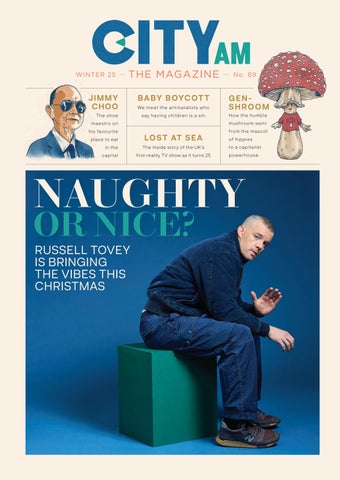
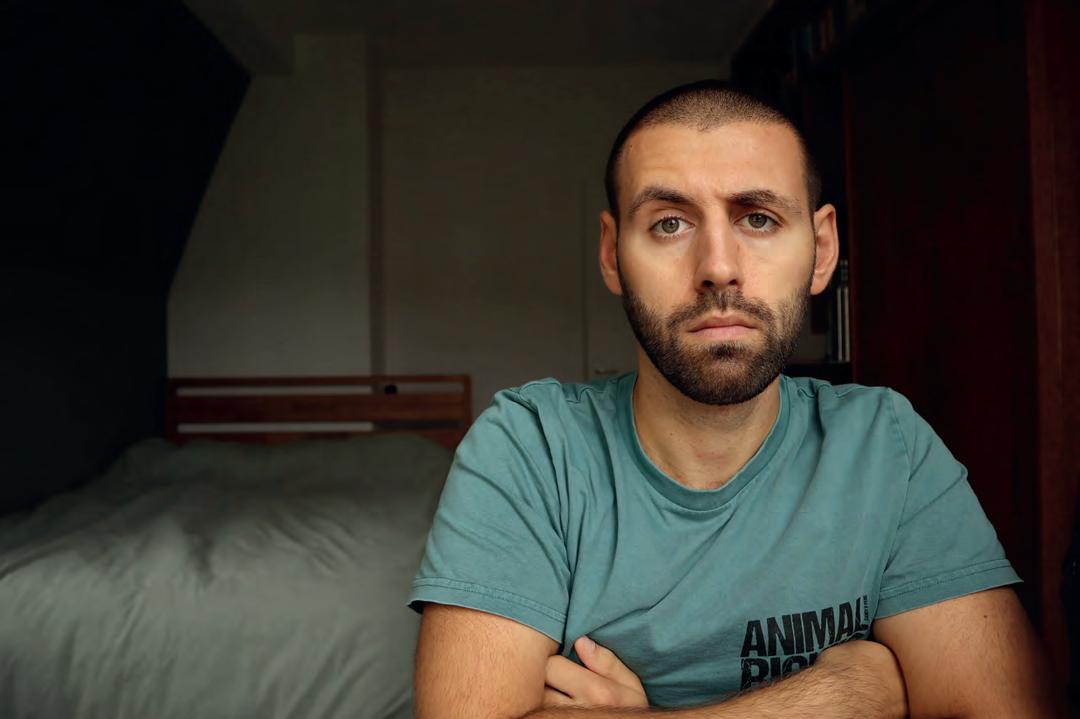
We meet the antinatalists who say having children is a sin
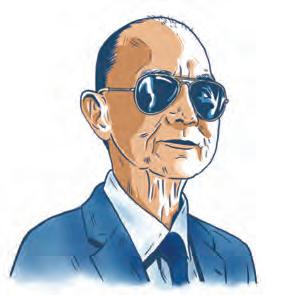
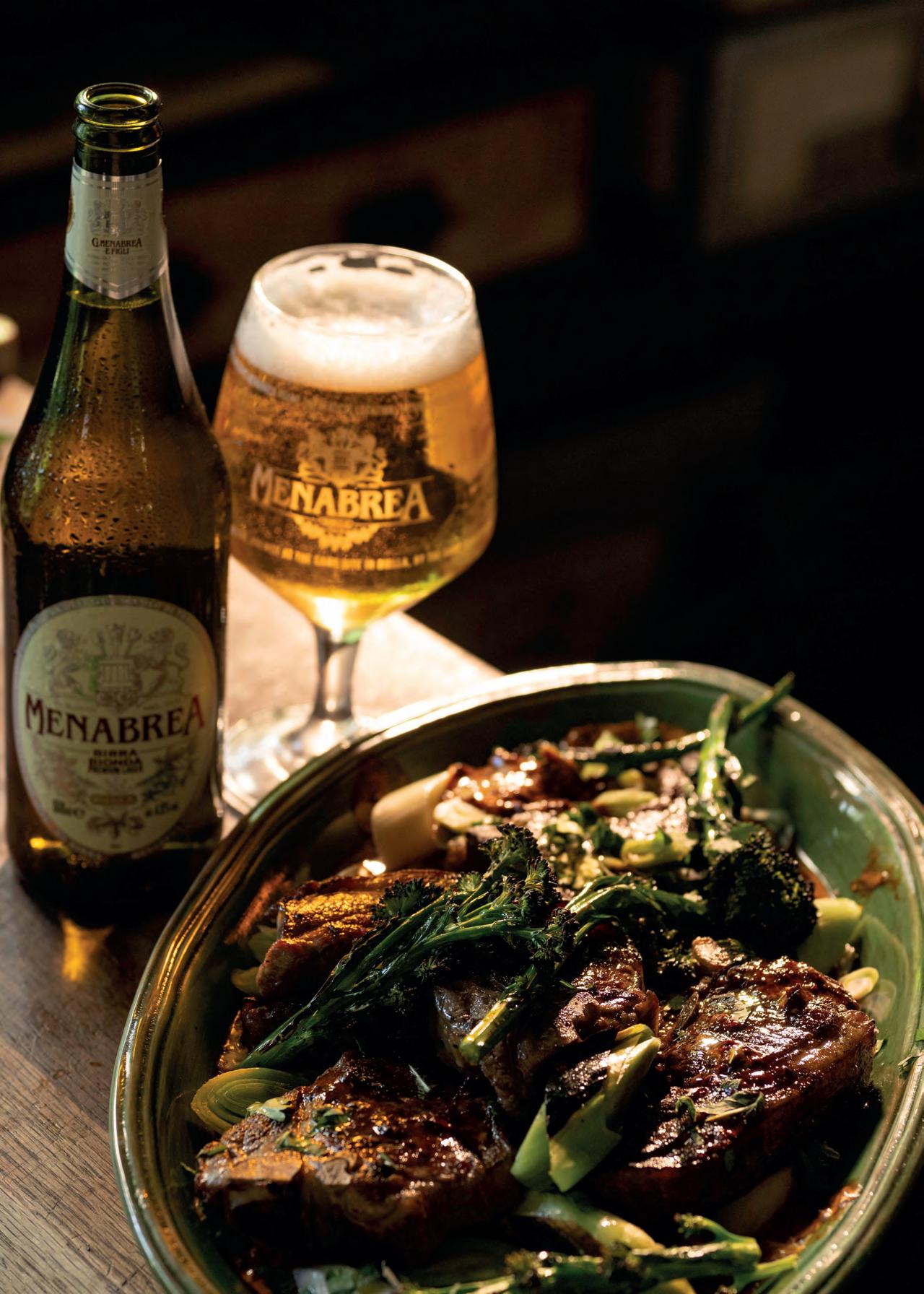
How the humble mushroom went from the mascot of hippies to a capitalist powerhouse The shoe maestro on his favourite place to eat in the capital
LOST AT SEA
The inside story of the UK’s first reality TV show as it turns 25
NAUGHTY OR NICE?
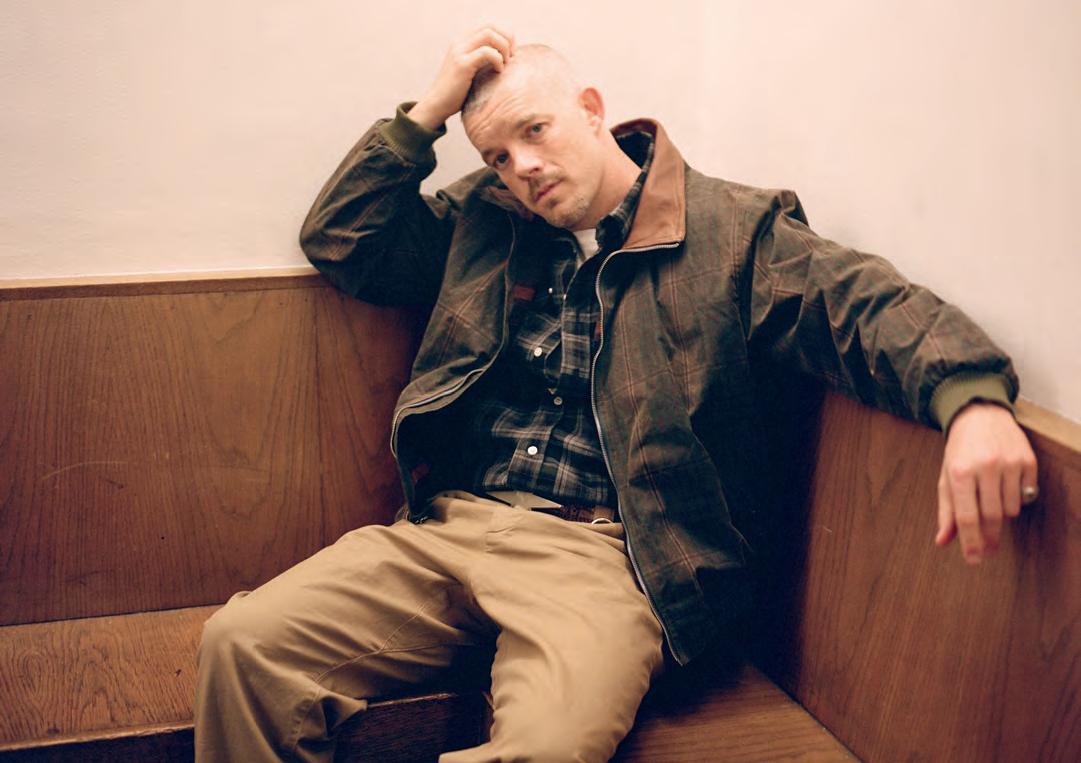
RUSSELL TOVEY IS BRINGING THE VIBES THIS CHRISTMAS
EDITOR’S LETTER INSIDE THIS ISSUE
It is customary for an editor’s letter to provide a pithy summary of a magazine’s theme, some overarching thesis that ties together its contents with a neat little bow. This is usually done in hindsight: all great features, after all, comment on some aspect of the human condition, exploring something broad and accessible – love, nostalgia, fear –through the prism of something narrow and new.
But I look at our roster of features in this issue and I’m pleased to say I can’t find any obvious thread to string them all together. On P30 we send new writer Cosmic Thapa to meet a group of antinatalists who believe having children is impossible to justify, given the state of the world. On P34 we look back on the original series of Castaway as it turns 25. That this rather quaint, earnest protoreality TV show would help form the basis of the savage, often toxic brand of television that still rules the airwaves today seems faintly ridiculous, although perhaps its return would be the perfect antidote to life in 2025.
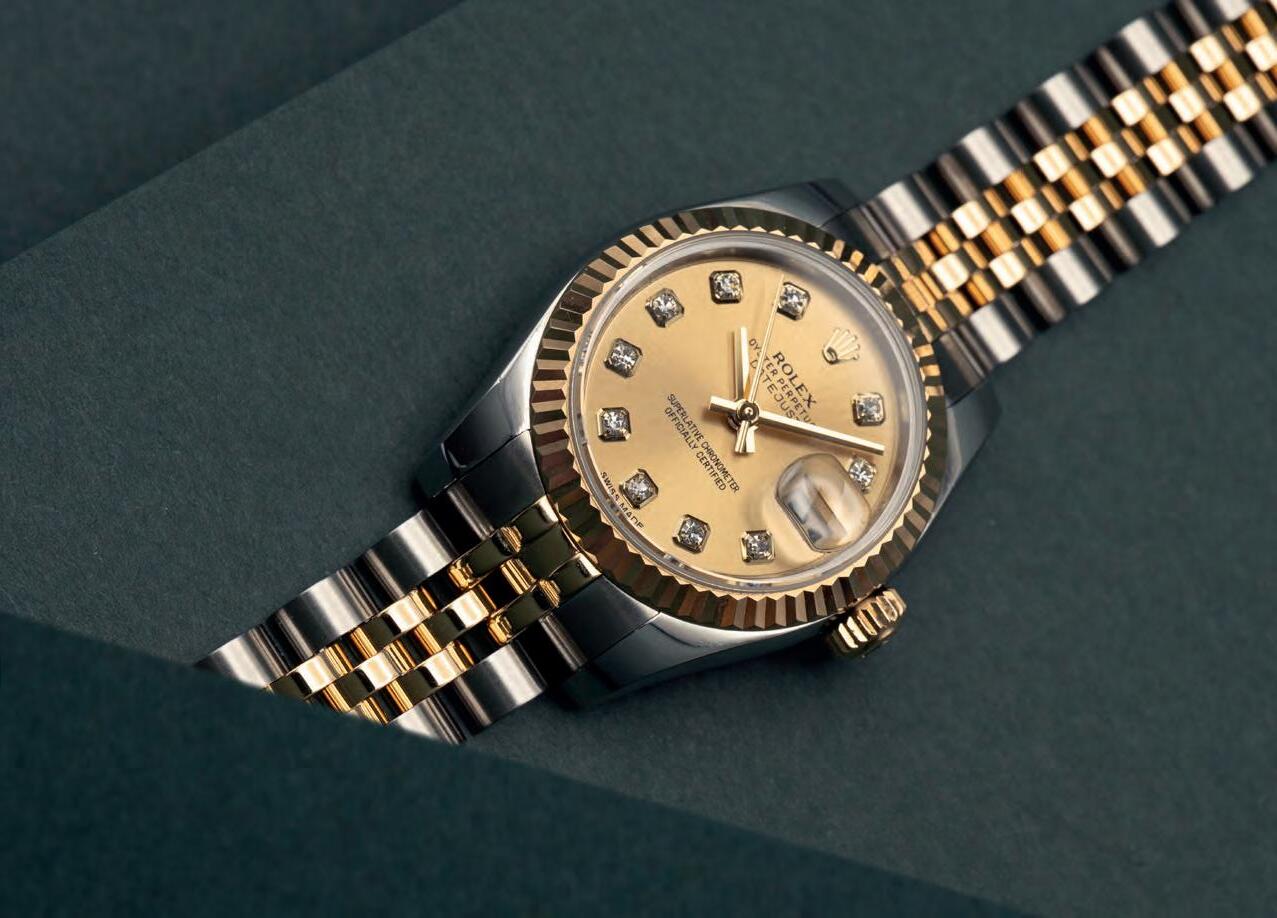
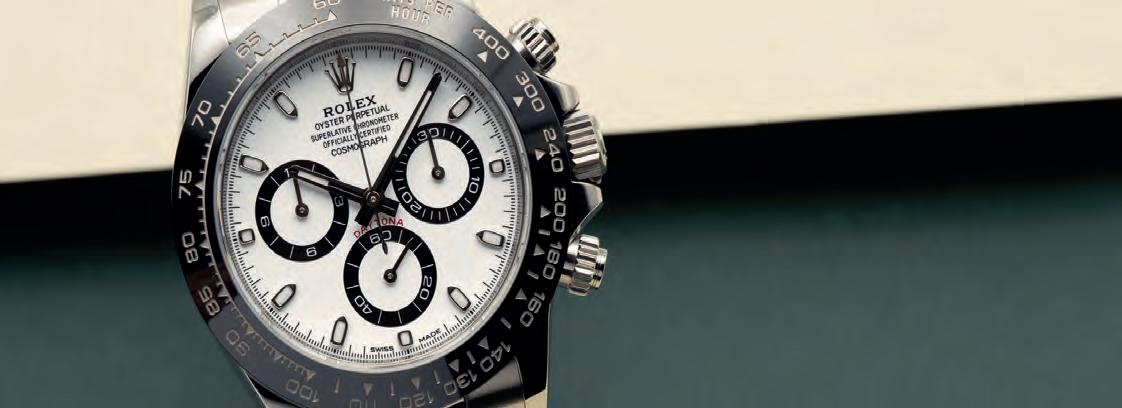
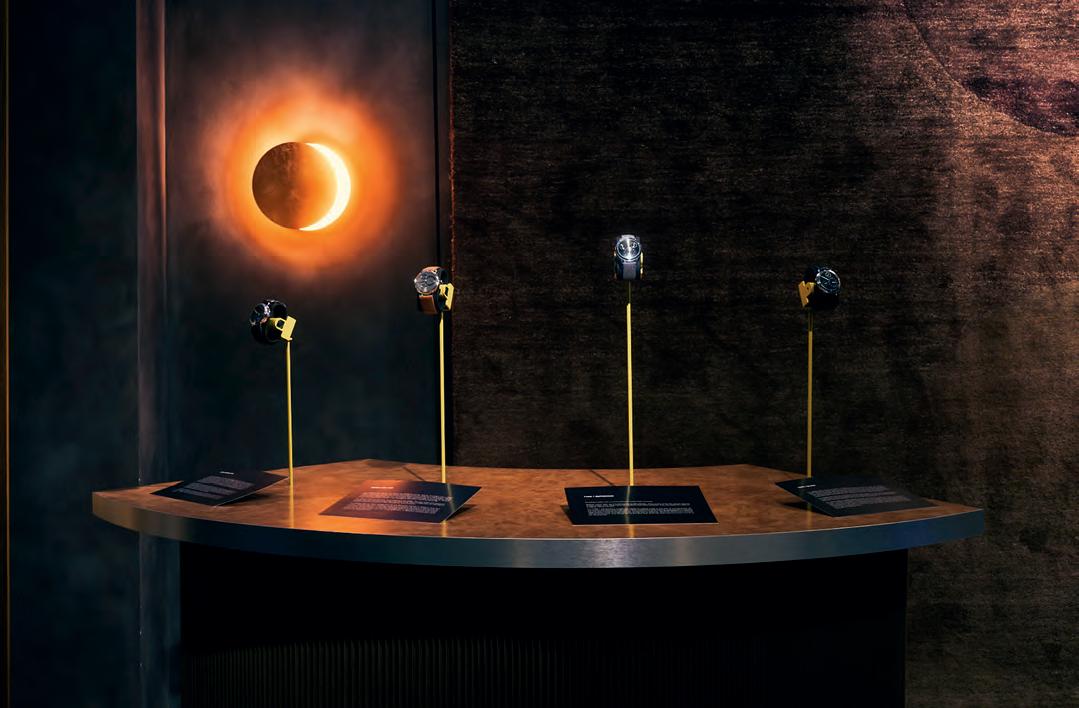
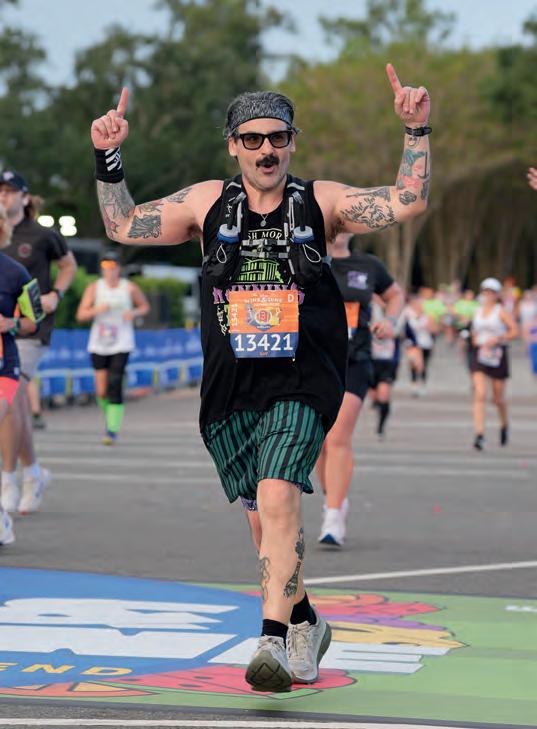
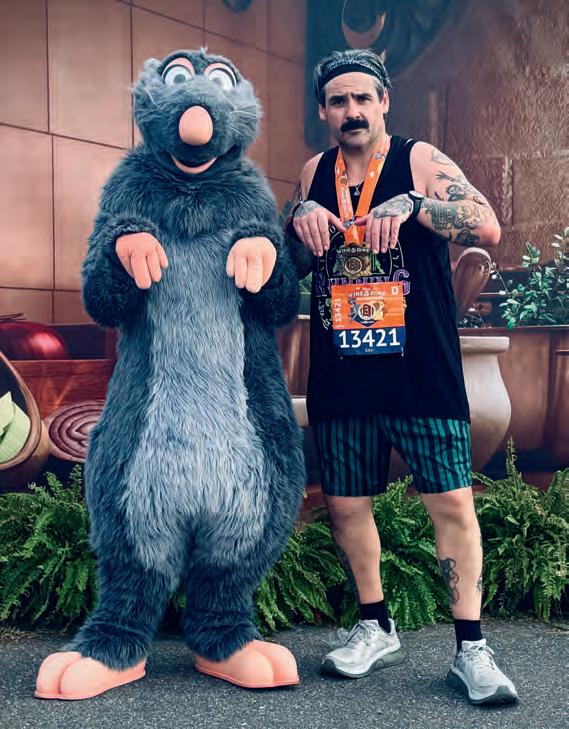
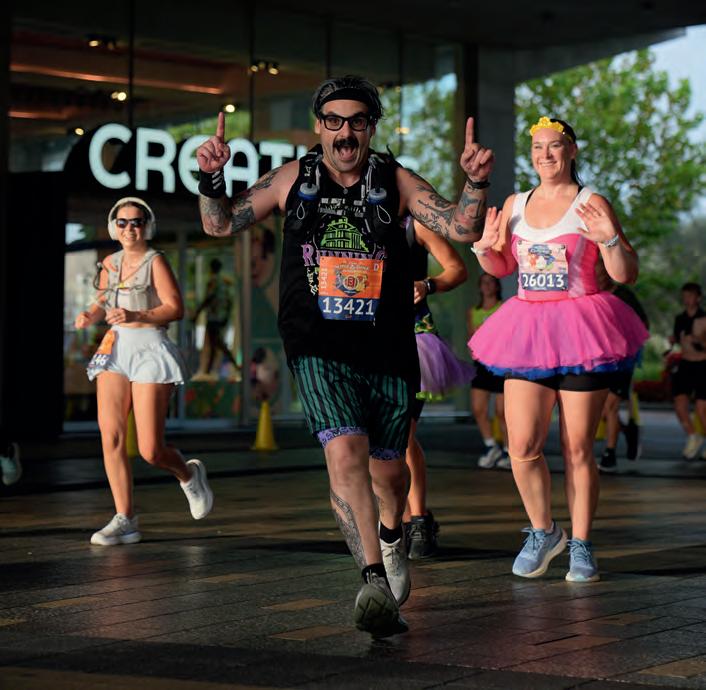
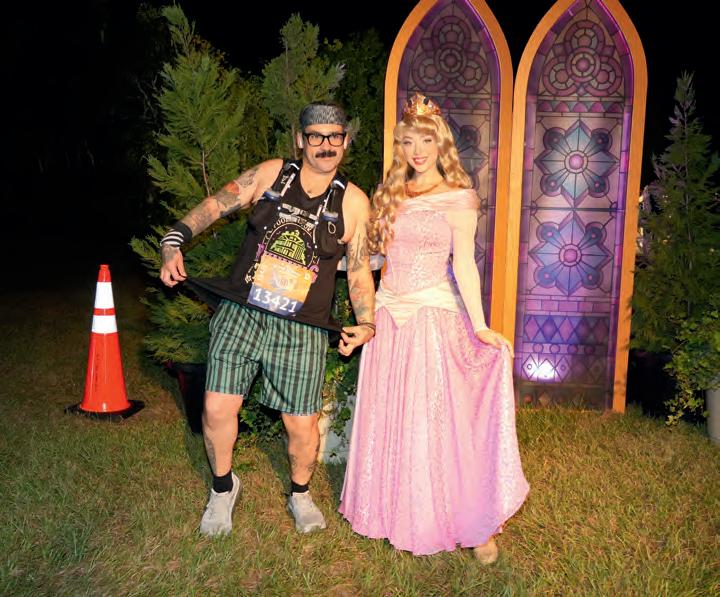
Elsewhere we chart one man’s quest to read 100 books in 100 weeks; we send podcaster, streamer and all-round top bloke Gav Murphy to run a half marathon amid the costumed denizens of Disney World Florida; we tour the new wave of clubhouses where watch nerds gather to discuss cogs and dials.
It’s all wonderfully disparate, because the theme of this issue is the same as the theme of the previous 88 issues: great journalism that explores the strange alchemy of time and place that is the world, today. Merry Christmas!
– STEVE DINNEEN
FEATURES REGULARS
14. FUSION FOOD
Top chef Rafael Cagali talks us through his inimitable spin on Brazilian-Italian dining
26: ERIC ROTH
The screenwriter behind cinematic hits including Dune and Forrest Gump on his debut West End play
38: 100 BOOKS IN 100 WEEKS
What happens to your brain when you swap a screen for a paperback? We took two years to find out
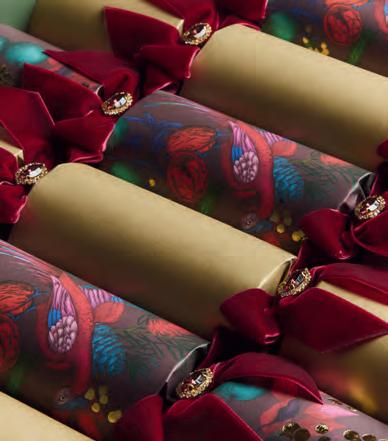
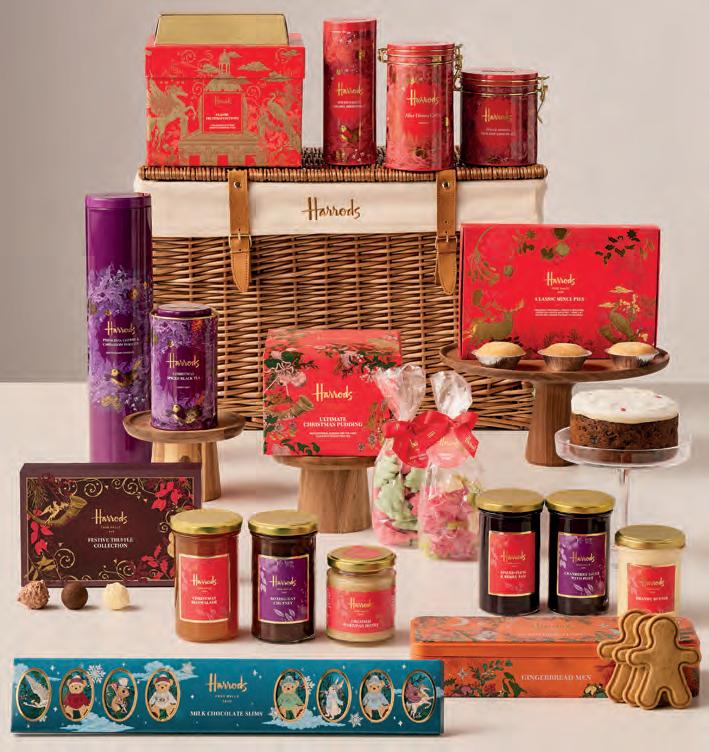
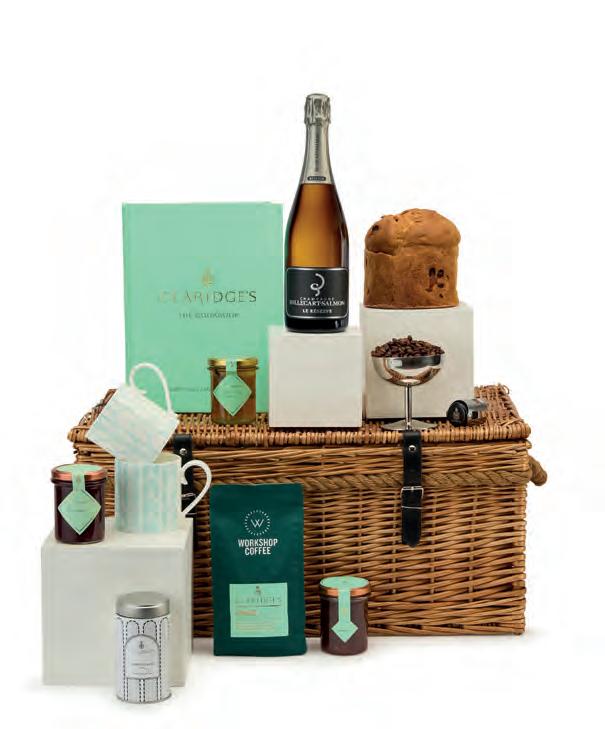
54: THE GIFT GUIDE
Whoever you’re shopping for, we have something perfect, from fashion to tech, homeware to hampers
18: CHEF’S TABLE
Shoe designer Jimmy Choo takes a seat in his own personal private dining room at Med Salleh
42: WATCHES
All the latest must-have timepieces, from rock dials to the Gen Z collectors changing the game
76: THE DISNEY MARATHON
What’s it like weaving between Mickey and Ratatouille as you run the world’s strangest race?
84: MOTORING
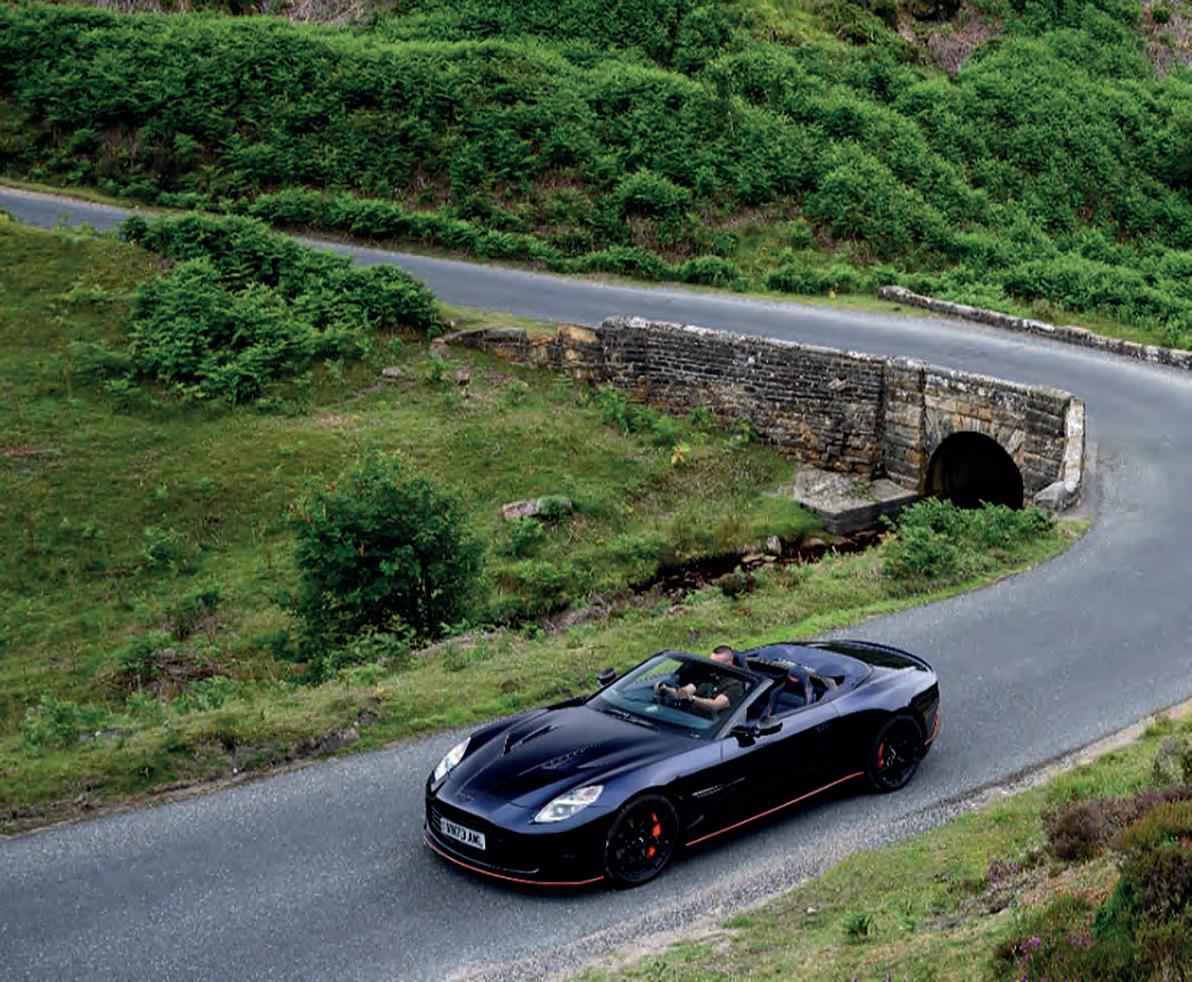
We drive the new Aston Martin Vanquish Volante to a wedding in Wales – big mistake!
60. 14.
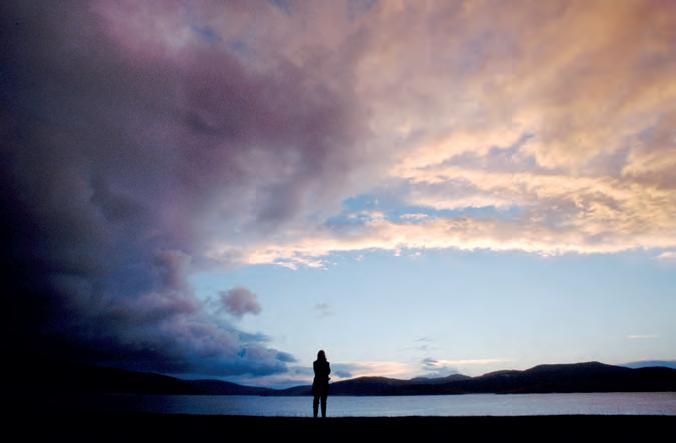
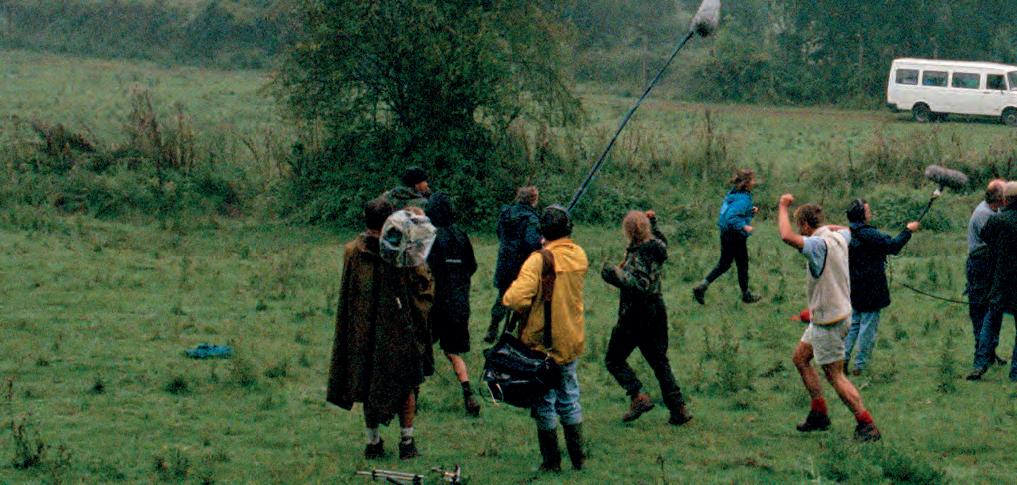
Above: A contestant on Castaway 2000 on the island. We speak to cast and crew in a retrospective on P34
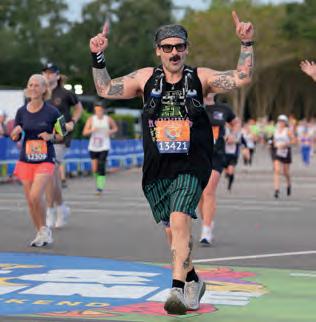
Below from left: The lobster at Rafael Cagali’s new restaurant Mare; Gav Murphy running in the Florida heat
34.
CONTRIBUTORS
ANNA MOLONEY is books editor of this magazine. On P88 she asks what makes the perfect Christmas bestseller – and wonders why they’re all so crap
SIMON HUNT is City Editor at City AM. On P38 he talks about his quest to read 100 books in 100 weeks. Can demolishing this many words re-wire a screen-addled brain?
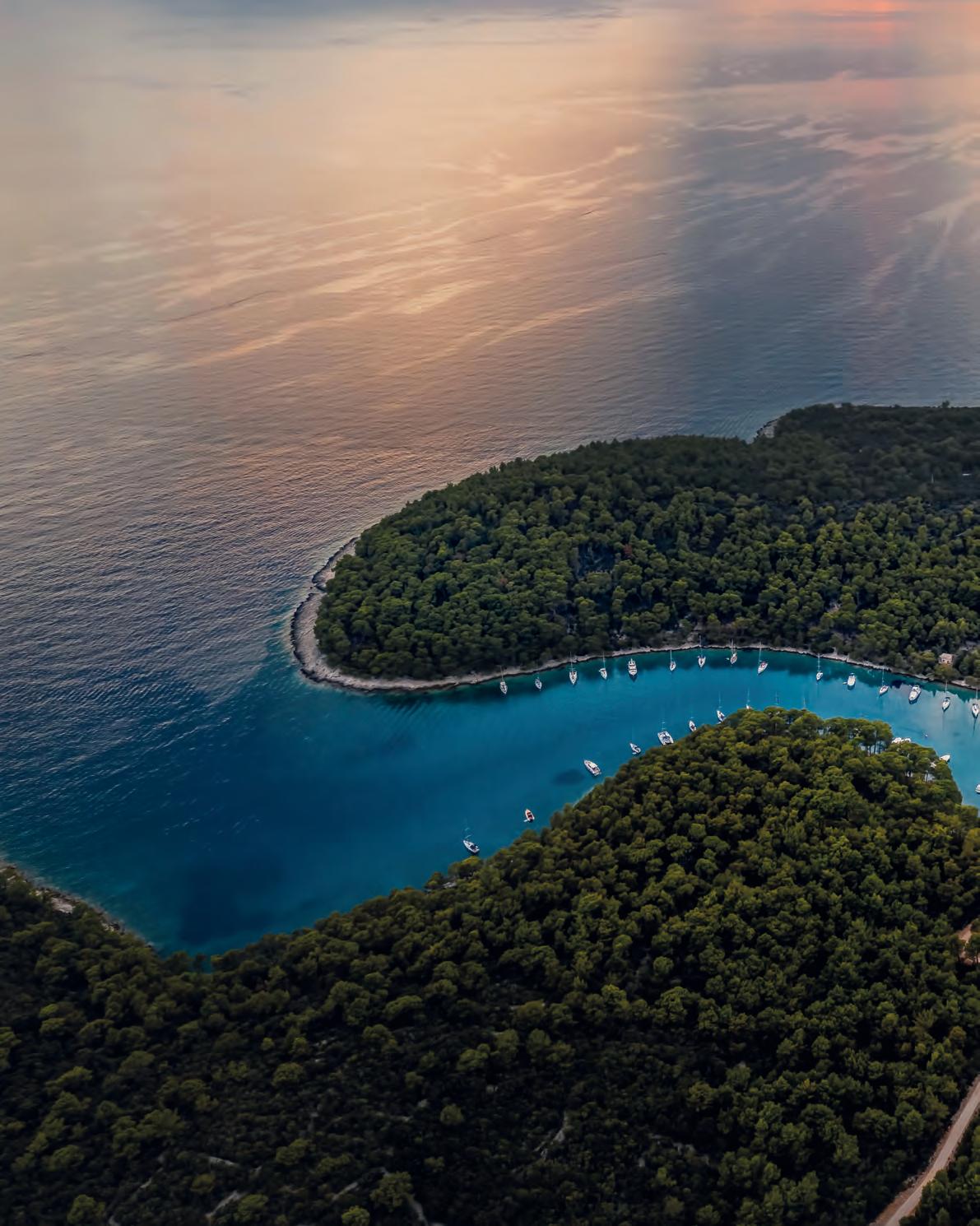
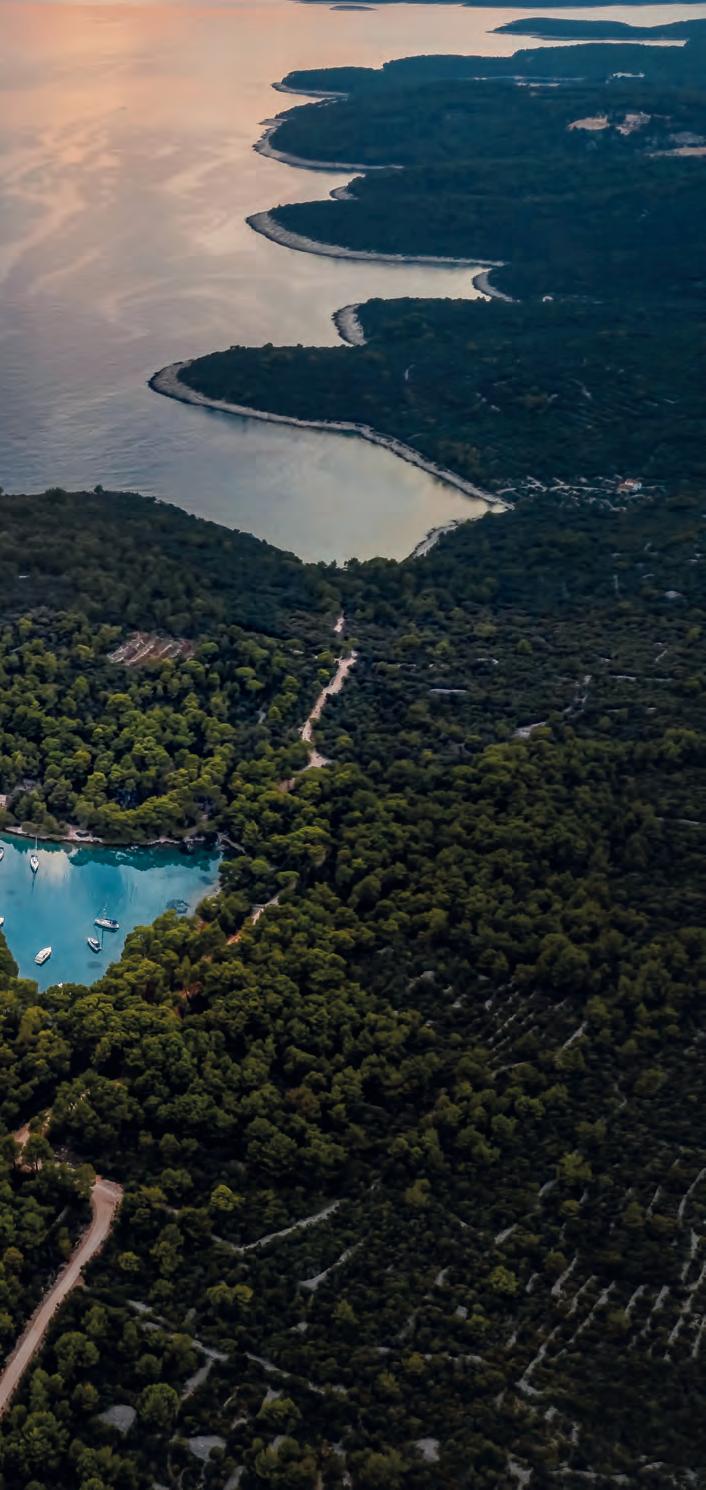
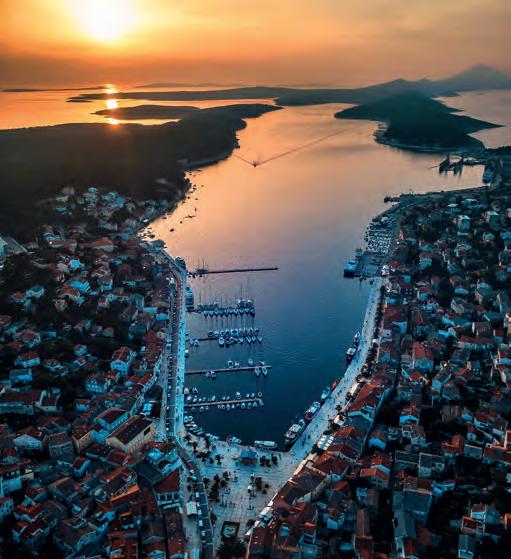
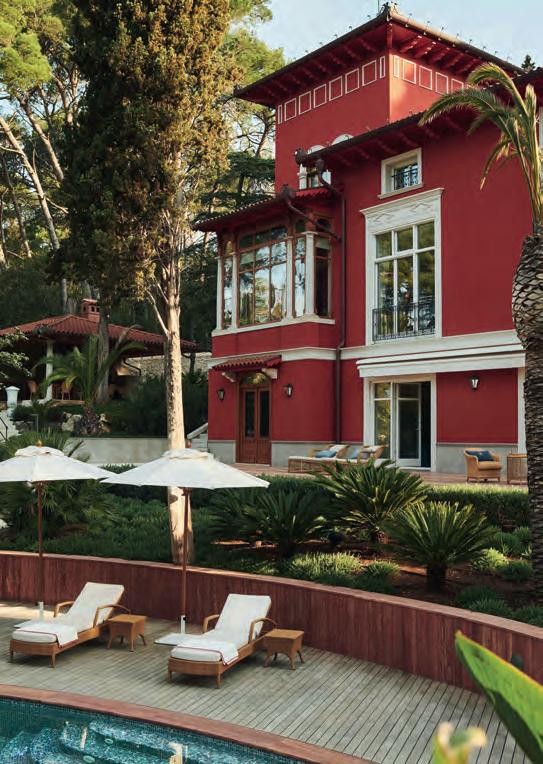
ADAM HAY-NICHOLLS is City AM The Magazine’s motoring editor. On P80 he visits a tiny Croatian island bringing a new kind of quiet luxury to Europe
CARYS SHARKEY is a senior editor at City AM. On P14 she interviews two Michelin star chef Rafael Cagali about his inimitable style of ItalianBrazilian cooking
COSMIC THAPA is a freelance features writer. On P30 she dives into the strange world of antinatalists, who think having children is morally wrong
SAM KESSLER is the editor of Oracle Time and an expert on all things horology. On P44 he speaks to the new generation of watch collectors and influencers
For a digital version of City AM – The Magazine go to cityam.com/the-magazine
EDITORIAL TEAM:
Steve Dinneen Editor-in-Chief Adam Bloodworth Deputy Editor Billy Breton Creative Director Chris Stopien Deputy Creative Director Andy Blackmore Picture Editor Adam Hay-Nicholls Motoring Editor Tom Matuszewski Illustrator Anna Moloney Books Editor
COMMERCIAL TEAM:
Harry Owen Chief Executive Officer Graeme Pretty Agency Sales Director Nzima Ndangana Luxury & Direct Sales Director
For sales enquiries contact commercial@cityam.com. City AM The Magazine is published by City AM, 107 Cheapside, EC2V 6DN.
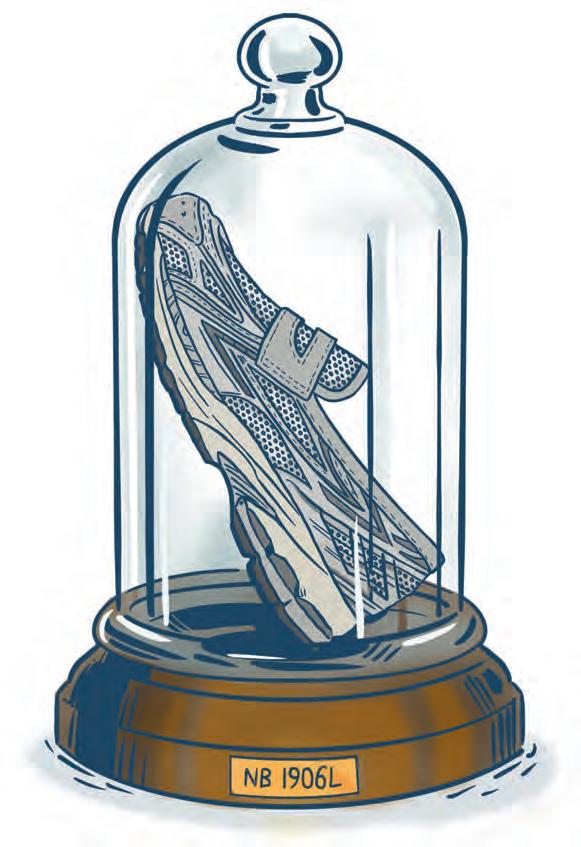
THE UGLY SHOE THAT DEFINED 2025
The New Balance 1906L –affectionately known as the ‘snoafer’ – is an affront to the eyes. So why has it come to represent the sartorial choices of a generation? ANNA RAHMANAN slips on a pair and finds out
What does it say about society today that the shoe that most succinctly and perfectly typifies it also happens to be its ugliest? I am talking, of course, about the New Balance snoafer.
Officially called the 1906L, it boasts the silhouette of a penny loafer and the comfort of a sneaker, though it doesn’t fully belong to either camp. First debuting at Junya Watanabe’s Paris Fashion Week show in 2024, the snoafer quickly caught everyone’s attention. It didn’t have the sleek glamour of a stiletto or the flash of a maximalist sneaker, but it had something else: an unapologetic practicality wrapped in a self-aware awkwardness.
Social media quickly latched on, with some users poking fun at its dorky aesthetics while others praised its practical, hybrid nature. In TikTok “fit check” videos, you’ll see them worn with oversized trousers and chunky knit sweaters one day, then with cropped skirts and sharp blazers the next.
What’s perhaps most interesting isn’t the snoafer itself but what it says about the world in which we live. In an age of fading dress codes and an obsession with quiet luxury and comfort (Covid restrictions ushered in an era of athleisure that still influences fashion and culture today), the 1906L feels like the ideal shoe for an era with an identity - crisis. It seems to ask: Who are we, really? Or, perhaps: Who do we want to be?
The 1906L represents “anti-perfectionist fashion,” according to Peter Martinez, co-founder of the Leather Skin Shop. “It’s deliberately awkward, comfortable and refuses traditional categorisation,” he says. “Most importantly, it says you are dressing for your real life, not an idealised version of it. The 1906L offers a compromise: it is professional enough for most office environments but comfortable enough for someone who’s been wearing slippers for two years. It represents the post-pandemic workplace reality where formality feels performative rather than professional.”
Stylist Julie Matos agrees: “The 1906L hits that post-pandemic sweet spot: structured enough for a meeting, comfortable enough to wear from the subway to a client dinner. The hybrid lifestyle so many of us are living now demands versatility, and this shoe delivers.”
The athleisure fits that dominated runways after stay-at-home orders came from a similar mindset. At first, this hybrid style seemed unsure of its place in
the fashion world but, on closer inspection, it was redefining the rules of what you can wear.
The snoafer does the same. Perhaps most illustrative of the shoe’s uncanny reflection of the here and now is who is wearing it. According to both Martinez and Matos, the core audience spans Millennials and Gen Z, but for different reasons.
“The ultimate dad shoe has now become a Gen Z favourite, with younger wearers drawn to its rulebreaking aesthetic and comfort-first philosophy,” says Martinez. Creative professionals have also adopted it in droves, folks whose careers demand adaptability and elasticity.
The 1906L, after all, isn’t about picking a lane but dismantling the system all together. It’s a polished yet laid-back shoe. In a culture obsessed with categorising, it’s a rare product that refuses to be boxed in – a fact that paradoxically turns it into a statement: the whole point of today’s fashion is that we don’t have to choose between versions of ourselves anymore.
l Anna Rahmanan is a culture writer based in New York
THE RISE OF MUSHROOMCORE
A fungal frenzy has taken the humble mushroom from hippy hallucinogenic to high street hero. DAVID HILLIER asks why we’ve all gone mad for mushrooms
After counting five different items in a Brighton homeware shop emblazoned with mushrooms, the case was clear: the humble fungus has risen from the mascot of underground hippy culture to a grandma-friendly motif, hewn into everything from tea towels to tiles.
It’s not just cutesy seaside emporiums: “Mushroomcore” is a sartorial expression. Bella Hadid, Fiorucci and Hollister all tout funghi in their collections. Scour the high street and you’ll find mushrooms sprouting on everything from £10 Primark disco balls to £725 Nicholas Pourfard lamps.
“A few years ago, if you saw a mushroom on someone’s tee, you’d assume they were into tripping, alternative medicine or folkloric culture,” says Ella Glover, a journalist who covers drugs and culture.
“The mushroom was a signifier that you were different. Now it’s just mainstream.”
Research into magic mushrooms (and their psychoactive compound, psilocybin) as treatment for a range of health conditions has thrust mycelium onto our screens and timelines. The therapeutic potential of psychedelics and the vast, interconnected mycelial world and its role in the global ecosystem has been explored in a range of culture-changing books, from Michael Pollan’s 2018 effort How To Change Your Mind, later adapted into a Netflix series, and the 2019 documentary Fantastic Fungi. These helped to underline how fascinating and vital mushrooms really are, connecting plants and trees, decomposing organic matter and recycling nutrients like carbon and nitrogen back into the soil.
And then there’s Joe Rogan – arguably the world’s most famous podcaster – who has been open about using magic mushrooms. “Mushrooms, alongside other natural drugs like cannabis, are less stigmatised in fitness communities, and I genuinely think it’s the Rogan effect,” says Glover.
Tottenham-based Fat Fox Mushrooms is a mushroom-based workshop and grow kit company, formed by Lex Truax and co-founder Ben Blackwell. When I called she was “neck-deep in mycelium,” responding to huge Londoner demand. For the first couple of years, if she were at a market, people would ask about ‘special mushrooms’ with a nudge and a wink, but Lex Truax says they “get much less of that now.” Half the people who attend her workshops are taking Lion’s Mane supplements. “Two or three years ago, most people hadn’t even heard of that.”
Fancy fungi are available everywhere from Holland
& Barrett to high-end gyms like Sloane Square’s Vita Boutique, which serves mushroom matchas and coffees alongside your standard Green Goddess smoothie. Fallow on Haymarket is renowned for serving homegrown lion’s mane and ‘hen of the wood’ burgers.
One thing you might be seeing less of is the fly agaric mushroom, the famous red one with white spots popular from folklore, which can be neurotoxic, leading to dizziness and vomiting. “It was the only mushroom emoji for a long time,” says Truax. “But things have changed.”
Despite the lack of scientific evidence, the functional mushroom market is predicted to grow from around £795m in 2023 to £1.68bn internationally by 2030. Mushrooms are being marketed for every modern ailment, from anxiety to ADHD, and legal fungal-based remedies now come in the form of drops, teas and capsules. With the mycelial revolution in full bloom, expect to see it everywhere as you start your Christmas shopping. I’ve just found some sewn onto John Lewis babygrows, for goodness sake.
Gifts for smiles.
HOW CHISWICK BECAME ‘LITTLE NASHVILLE’
The leafy West London neighbourhood seems a million miles from the honky tonk bars of the American South. But somehow it’s becoming a Mecca for country music fans. ANNA MOLONEY asks why
Holler and swaller,” yells a man in a flannel shirt to a sea of cowboy hats, beneath which a merry crowd of shoe-tapping line dancers raise their glasses and whoop wildly in obedience to the call. The holler and swaller is a common toast in places like Nashville, designed to get locals drinking fast in country bars. Except we’re not in Nashville – not even close – we’re in Chiswick: the newest frontier of the Wild West.
From the outside, Lil’ Nashville is unassuming. A red brick, semi-industrial block set just back from the high street; leafy London locals off to the nearby Gail’s could breeze by it entirely none the wiser that London’s premier honky tonk venue lies beyond. Luckily, on my way to the Big Nash Bash, the venue’s fortnightly knees-up, a few stray stetsons sidling down a nondescript alleyway marked the way. Scurrying after them, my own *slightly* less authentic diamantefringed hat in hand, I find myself in the heart of one of the UK’s fastest growing cultural scenes.
The rise of country music in Britain has experienced a long, steady plod, but in the last two years things have exploded. In 2024, country was the fastestgrowing music genre on our shores, propelled to success by breakaway hits such as Shaboozey’s A Bar Song (Tipsy) and Dasha’s Austin. But pop hits aren’t the whole story, with the genre as a whole doubling its share of the singles market to 3.3 per cent – its highest stake this century, according to the British Phonographic Industry. Country artists who have played the UK, including those for the Grand Ole Opry’s historic international debut at the Royal Albert Hall this summer, have remarked on Brits’ love for the music itself, often knowing a whole album, unlike Americans who tend to listen to the hits.
And things are only on their way up, with London’s country fever now so intense that even Big Nashville is paying attention.
Indeed, when I speak to Helen Wood, the owner of Lil’ Nashville, she’s fresh back from the States where she’s been meeting country record labels interested in sending their artists to play Chiswick, of all places. She says it’s fast becoming London’s informal country hub. Wood, who does not have a background in music but realised a lifelong dream when she opened the bar with her husband Rob this February, says the response has been quite astonishing, admitting the location was almost completely accidental. “It’s quite surreal to put a honky tonk in Chiswick, but it was really easy for us to commute to,” she says matter of factly.
A 42-year-old northerner, Wood has been a country fan since she was a child and it’s her own memorabilia – Shania Twain records, old concert tickets – that cover the walls of Lil’ Nashville in a nostalgic collage that tells
the story of her love affair with the genre. There’s a lot of Americana too, which Wood admits made her a little worried given recent events, but she hopes it’s the southern hospitality, not politics, that shines through. Wood was intentional in making the space feel like a genuine honky tonk, rather than a Wild West-themed bar. She was strict: not a single wagon wheel or saloon door was allowed and, I admit, my diamante cowboy hat felt a little out of place with the more earthy country tones embraced by the regulars. Country music is a humble genre, Wood says, with jeans and T-shirts the dress code.
Khayla Jordan, who heads up line dancing group The Country Roses, said she’d seen such high demand for her classes she had to add an intermediate level. She notes that Londoners – quick on their feet – are uniquely good at picking up the steps: “Londoners use a lot of footwork just getting round the city,” she reasons. Indeed, the next 45 minutes are almost as chaotic as a Clapham commute, as too many people than should be on a dancefloor knee slap, grape vine and foot scuff in near-enough unison. It was the most endorphins my friends and I had experienced since Just Dance 4 came out, which is fitting, in a way. Country music, after all, is about nostalgia – for the past, for family, for an imagined home in West Virginia, or perhaps for Chiswick.
l Anna Moloney is a features-writer for City AM
F-WORD SAY THE NEVER
Brazilian chef Rafael Cagali has been sweeping aside expectations with his playful mixing of cuisines. Just don’t call it ‘fusion’, he tells CARYS SHARKEY
What I know and love about Brazilian food comes from two places. Hungover lunches in Southwark at small cafes with beautifully beige arrays of ‘salgados’. For a couple of quid you can fill up on coxinha (dough stuffed with shredded meat which is then shaped into a teardrop and deep fried), or pastel (blistered semicircles of molten meat and cheese). But long before I spent my weekends burning fingers on puffed-up snacks, I ate chewy pão de queijo (cheese bread) and sat over bubbling pots of feijoada (an inky stew of pork and beans) at my friend’s house after school, after which we’d down cans of guaraná soda in front of the TV.
So it’s fair to say that trying Rafael Cagali’s food came as something of a re-education – just don’t call his cooking Brazilian.
Cagali was born in São Paulo to a Brazilian-Italian
family and spent his early years in his mother and aunt’s ‘por quilo’ restaurant. This is a staple of Brazilian dining, where you select dishes from an almost-endless buffet and then pay for the weight of the plate. Genius. After studying economics in Brazil, Cagali moved to London to learn English, only to fall in love with cooking after working part-time in kitchens to fund his course. What followed was a culinary grand tour including stints on Lake Garda and the Basque Country, culminating with a job under Quique Dacosta at his triple-Michelin starred restaurant in Dénia, a small port city jutting into the Mediterranean.
Cagali moved back to England in 2012 and landed a role at Heston Blumenthal’s The Fat Duck in Bray, where he met a business and life partner in Charlie Lee. A period working with L’Enclume’s Simon Rogan was followed by the opportunity to go it alone. And in 2019 Cagali opened Da Terra.
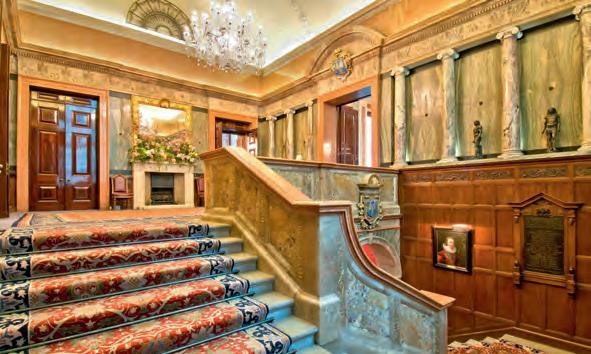
Da Terra, nestled inside the heavy walls of Bethnal Green’s Baroque Town Hall, won a Michelin star
within months of opening, before adding a second in 2021. It consistently ranks as one of the best restaurants in the UK, and has received a fat docket of rave reviews, not least from this magazine’s editor.
But the softly-spoken Cagali wears his accolades lightly. Nicknamed ‘turtle’ when young on account of his “chubby cheeks”, Cagali spends much of his time dodging the F-word: fusion food. The term, which lived and died in the 90s, is an attempt to capture the multiplicity of culture and experience in a binary – for Da Terra, that was Italian-Brazilian.
When I speak to Cagali, his reluctance to tether his cooking to a single, pithy epithet is clear. He tells me that any description of his food should be taken “with a big pinch of salt”.
“My background is very international. I was born and raised in Brazil, but Brazil is also a country with so much multicultural influence.”
And this resounds in the food at Da Terra, which lilts in and out of familiarity. A snack of cassava and octopus is like eating Scampi Fries on the Med (the
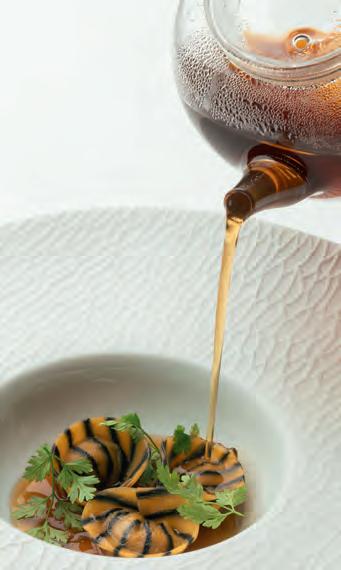
platonic ideal of snacking). Fleshy red mullet sits in an ajo blanco, the Andalusian cold almond soup. Then comes a quail dish that effortlessly elides a continent, from England’s grasslands to Bologna’s towers. It’s not until the moqueca, an impossibly refined take on a Brazilian fish stew and staple at Da Terra, that Brazil really enters the mind. His home country bleeds into Cagali’s signature dessert too: the Romeo and Juliet, which arrives like an Elizabethan ruff of aerated goat’s cheese and guava, a distinctly Brazilian cousin to manchego and membrillo.
Eating at Da Terra, I was reminded of Jeremy Chan saying the best compliment he ever received about his two-Michelin starred Ikoyi is “there are no reference points”. Like Chan, Cagali’s food refuses to adhere to expectations, cannot be neatly categorised or mapped with crude border lines.
“I don’t want to be the guy who is representing Brazil,” he says. “I don’t wanna be the guy who is like, ‘Oh, you want to taste Brazilian, you go to Rafael’.”
A big part of what makes Cagali’s food so special is a
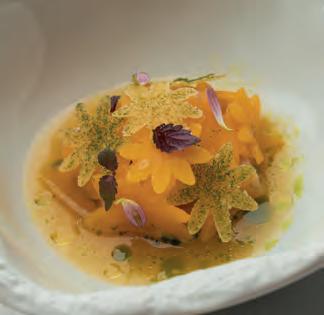
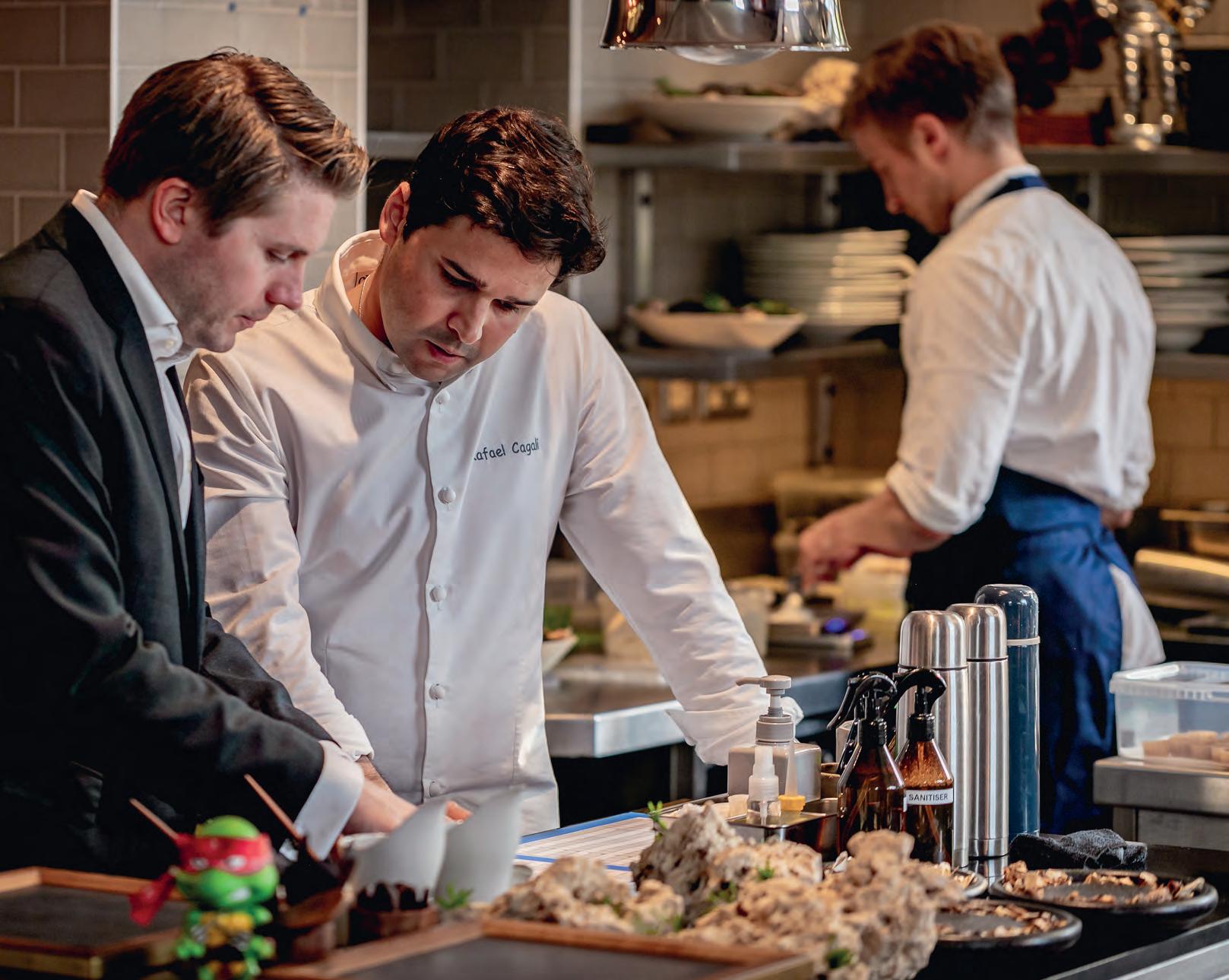
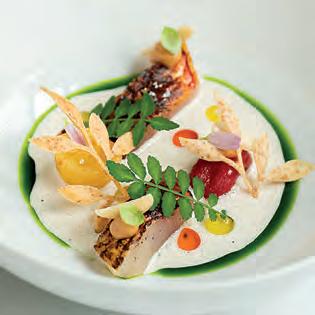
Above: Chef Rafael Cagali and general manager Charlie Lee at the pass in Bethnal Green’s twoMichelin-starred Da Terra; Below left: Hamachi with fermented manioc juice, pumpkin and jackfruit; Below right: Aged red mullet in ajo blanco with tomatoes, basil and toasted almonds
deft hand for fun, even at the highest echelons of fine-dining. This is nowhere more apparent than in Cagali’s latest venture Maré, which opened in Hove earlier this year. His first restaurant outside of London, Cagali says Maré came about “at the right time, in the right place”.
The less formal little cousin to Da Terra, Maré’s menu sings with Cagali’s genre-defying cooking, echoing the double-Michelin star restaurant’s greatest hits.
Cagali and head chef Ewan Waller say they want to create a space that complements the “quirky, independent” spirit of Brighton and Hove. And above all, to cook food worth travelling for.
“That’s one of the ideas as well, bringing more customers down here,” says Cagali. “You want to also help the community, you want to add to the food scene. I think that’s the staple. We want longevity. We want to have the people talk about it. It’s important that the locals enjoy it too, because they’re the ones that are going to keep coming back.”
The ‘BYOT’ (build your own tacos) is a standout piece of cooking combined with some theatre. The constituent parts: a
tangle of braised lamb shoulder and a deep, velvety mole are brought to the table for diners to heap into tacos made from cassava flour. That playful nod to Brazil is surpassed only by the ‘surf and turf’. Picanha steak, a cut synonymous with churrasco, or Brazilian BBQ, is here served butter-tender under its hood of fat and eaten alongside lobster rice studded with gems of ox tongue.
Towards the end of our conversation, Cagali grapples for a while with what Brazilian food actually is. He points to the country’s vast size, its relative youth as a state, the influence of other cultures, from West Africa to Japan, and the imperative of ingredients. All of this leads him to conclude that Brazilian cooking boils down to “adapting to where you are, and then adding to the food scene”.
Leaving Hove on a slate-grey day where the sky becomes indistinguishable from the expanse of the English Channel, it strikes me that here, thousands of miles away from the kaleidoscopic tropics of Brazil or the thick hustle of São Paulo, that Cagali is the epitome of a Brazilian cook. Just don’t tell him I said so.
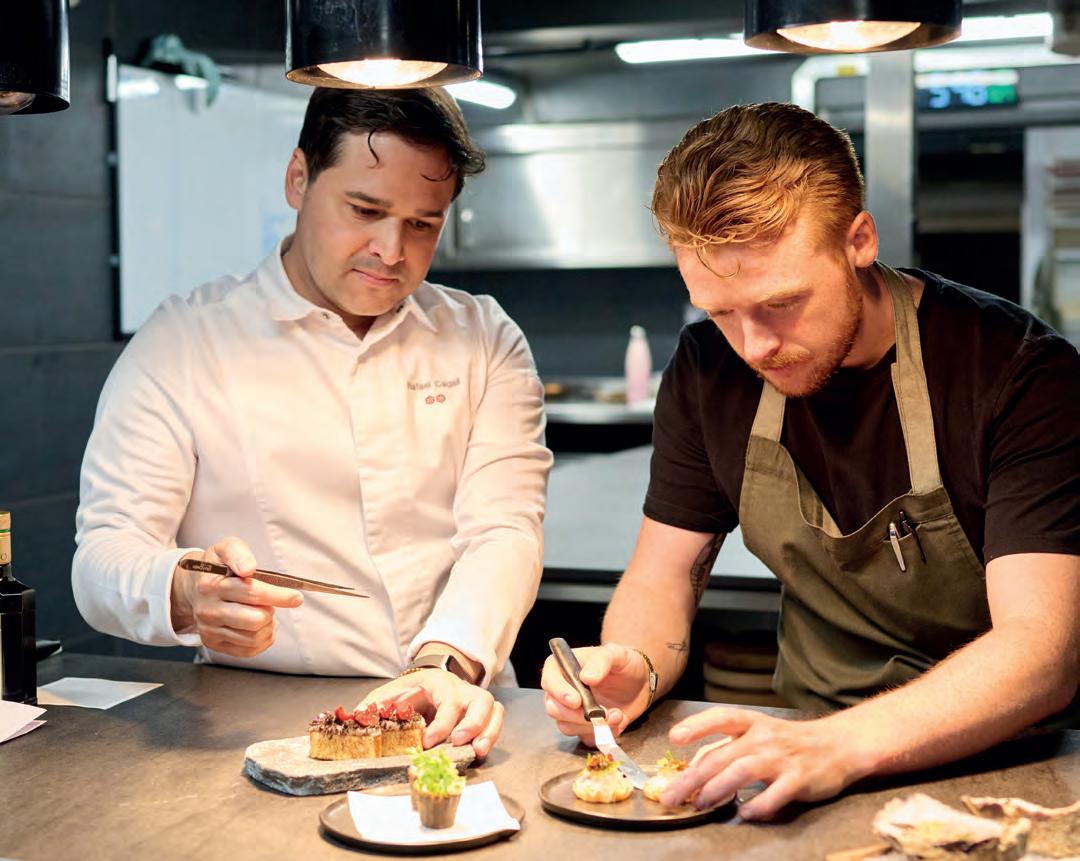
This image: Maré head chef Ewan Waller plates a selection of snacks; Below: Da Terra’s signature dish of quail tortellini in brodo
CHEF’S TABLE
Shoe designer JIMMY CHOO interviews his old friends
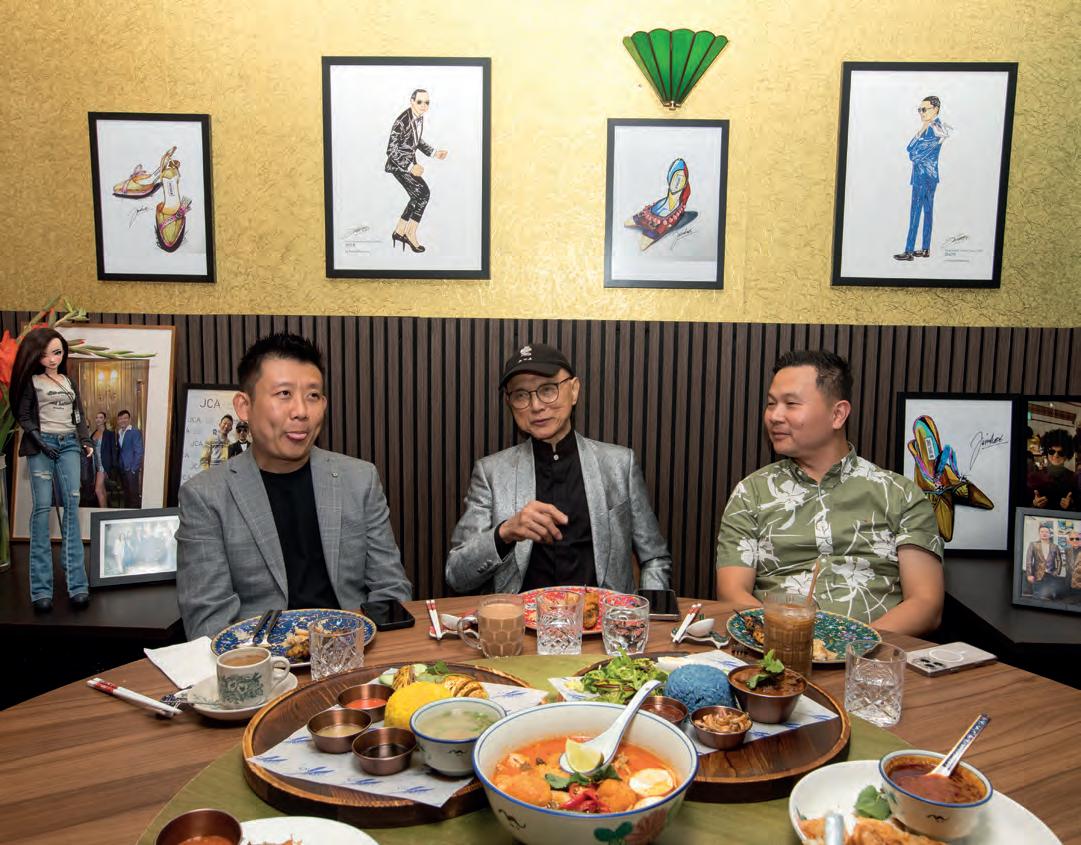
MED PANG and KOI LEE at their Med Salleh restaurant in Queensway, in the Jimmy Choo private dining room, no less
THE MEAL:
NASI LEMAK
COCONUT RICE
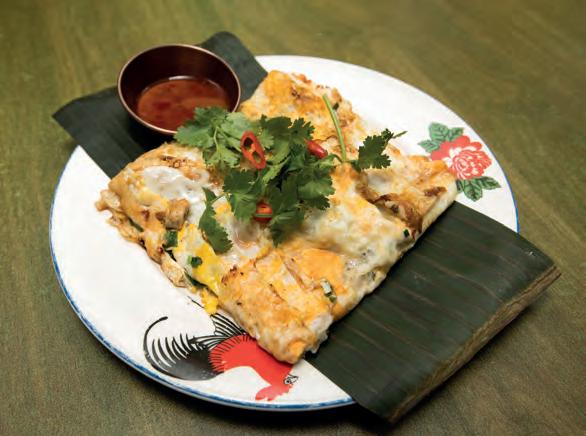
OYSTER PANCAKE
CURRY LAKSA NOODLES
JIMMY CHOO: Last night was a good party…
MED PANG: Yeah, we went clubbing! Did we leave Park Chinois about two in the morning?
JC: Yes! When I go partying I get so hungry, you’ve got to fill your tummy first, so I’m glad we had dinner here before we went out. It was a great night. We had guests from Canada, China, Hong Kong. We were out so late.
MP: It reminds me of the birthday parties we’ve thrown for you here, Jimmy. Where we dance to disco, especially the song you love, Saturday Night Fever. One year we all wore wigs!
JC: I’m still young, I don’t feel old. It all depends how you look at yourself. Age is just a number, it’s nothing special. Plus, I just love it here.
I remember three years ago coming to say hello when you opened the restaurant as I live nearby. We hadn’t seen each other in 20 years, but I reminded you that we’d met all those years ago. You’re always so kind to me, and it’s nice to have a Malaysian community in London.
MP: Yes – I didn’t remember us meeting! But I’m glad you reminded me, look at us now, we’re great friends.
JC: I come for breakfast, lunch and dinner and eat in my ‘Jimmy Choo Dining Room’! We worked together to make this room look great: my original sketches, the colouring. All the images have their own stories. It feels like home to me.
When I arrive from the airport I come here, leave my luggage, and have
breakfast. I can just tell how much you care. Some restaurants charge a million pounds for food, but it doesn’t matter if you can’t feel heart and soul in the cooking. You have to put everything into cooking: your feelings, your taste, your manners…
MP: Now you’re our supporter, our ambassador, everyone who comes here asks for Jimmy Choo! And you always have the same dish: soup with chicken, vegetables, steamed egg, noodles, a little bit of spice. We look after you whenever you’re in town.
JC: I return the favour when you go to Malaysia. My driver is waiting for you when you land! But I want people to know that in London at Med Salleh, the ‘Jimmy Choo’ room is for everyone. If someone else books it I will go and sit in the main restaurant.
MP: I’m actually going back to Malaysia for the first time in five years this
winter. I don’t go back so often these days, and I’m very excited and grateful to you for your driver! It’s also kind that you take pictures with guests here, and let them sit in your private room to enjoy the shoe illustrations on the walls.
JC: It’s so intimate. When I’m at home in Kuala Lumpur I invite 500 people to my birthday but in London I have 30 here. We dress up, do cool hairstyles. It’s good to have lots but then you can’t talk to each other. It’s a different feeling here.
KOI LEE: It’s fun throwing events like that. In Med Salleh it’s family, it doesn’t matter if you’re Chinese, Malay, Indian or British. We love hot and spicy food. And our Malaysian food is inspired from different cultures: Malay, Indian, all mixed together. The food is inspired from our childhood memories: chicken my grandmother made, and our very simple fried rice dishes with
I’m still young, I don’t feel old. It all depends how you look at yourself. Age is just a number, it’s nothing special
prawn, chicken and vegetables are my favourites.
JC: When I first came to England 40 years ago I remember someone gave me pie and mash and I said ‘I cannot eat this, I want egg fried rice every day!’ But now I’m used to it. It takes some time to understand, but I love fish and chips now.
KL: We’re particularly proud of our Nasi Lemak, the Malaysian national dish with coconut rice. The blue colour comes from pea flower, dyed with natural ingredients. Presentation is really important to us so we can promote Malaysian food. People like to share the blue rice on Instagram.
JC: If you go to a Michelin star restaurant, you don’t pay for the food, it’s the art and design. It’s like designing shoes, with food you also have to come up with ideas. Next time I design a new pair of shoes I’ll bring you
Opposite page: One of the Malaysian classics at Med Salleh; Chef patron Koi Lee, Jimmy Choo and Med Salleh founder Med Pang in the Jimmy Choo room; Pictures by Gretel Ensignia
two along to help me!
KL: Yes of course, we’re creatives too. We’re cooking food but we still see ourselves as creatives. We love visiting other restaurants to learn and bring ideas back here.
MP: We need more Malaysian restaurants in London but it’s getting better. Anyway Jimmy, do you remember when you first took us to a fashion party? At Claridge’s in Mayfair? It was so fancy!
JC: Yes, you were my celebrity guests!
MP: We posed for press photos and you introduced us to a lot of people. It was my first experience with hundreds of cameras flashing, so now I know why Jimmy always has sunglasses. I felt like I was a star.
JC: Hahaha. Those events can be fun, but real friends like you, I can feel in my heart. It feels very nice to bring my friends to Claridge’s. They wear my shoes! You wore them out last night to the club.
MP: That was a rare occasion. My wife wears the shoes and she feels amazing, but she only wears them inside the house. She values them too much to get them dirty!
JC: Even after 40 years in the industry, I
still love shoemaking. My father was a shoe designer, so craftsmanship is what I know.
The main things are that they have to be comfortable, you have to understand the shape of the foot, and they have to be balanced to the foot. When you create something, you have to feel it inside your heart.
It’s the same with writing, food or shoes. It’s also important to me to train the next generation through my fashion foundation college, and to realise that not everyone has money: sometimes people say they love me but they can’t afford my shoes, so I design a shoe for her. You have to care for people.
KL: Yes, and it’s also important to promote young people in the restaurant. We give them apprenticeships, train them so the food has the Med Salleh taste after they’ve worked closely with our chefs. Some of the young people who train here might go back to Malaysia to open their restaurants.
JC: That’s amazing. I can go to Paris, Italy or New York for work, but wherever I go I want to return here. I even have the business card for Med Salleh in my phone case so if I lose it on a plane, they bring it back here. Sometimes I also stay here in a room upstairs. I stayed last night, after our big night out. I said I would come down for breakfast early but I came down at ten o’clock! It was a late night!
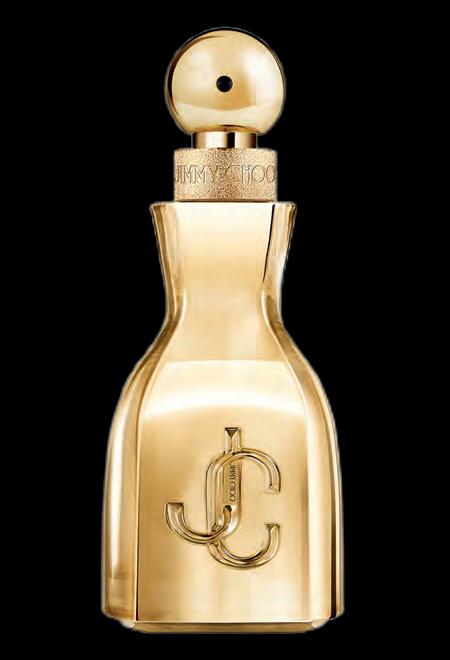
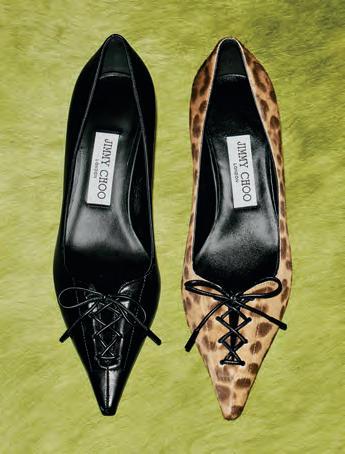
Above from left: Jimmy in the Jimmy Choo room at Med Salleh; The I Want Choo fragrance; Classic Jimmy Choo shoes; A dish at Med Salleh
WHY ARE ALL THE BURGERS SLUTTY?
We call them dirty, filthy, nasty, sloppy. Is it time we started treating our food with a little more respect?
FOOD FOR THOUGHT
RALPH JONES
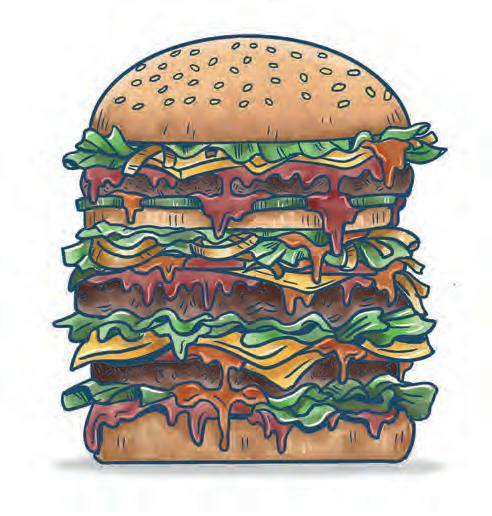
Fifteen years ago, we didn’t seem to think of our food as leading a life of sexual promiscuity. Today, casting your eye over a burger menu can feel like you’re browsing Pornhub. It all seems to have started in the mid-2000s, when foodies began calling anyone who served an egg on top of something an “egg slut”. In 2011, chef Alvin Cailan turned this jovial term into a food truck specialising in egg sandwiches.
This was the opening of Pandora’s box, so to speak. Since Eggslut, it has become commonplace to call food – often but not exclusively burgers – by the filthiest names imaginable. ‘Dirty Bitch’. ‘Dirty Motherclucker’. ‘Salty Bitch’. ‘The Slut’. Meat Liquor, which began operating in 2008, describes its ‘Dirty Chicken’ burger as “juicy, crispy and unapologetically thicc”. Slutty Vegan, which opened in Atlanta in 2018 to much hype, serves burgers with names like ‘Fussy Hussy’. There’s a British chain called Slutty Buns that delivers sloppy burgers across the land. In 2020, the actor and comedian Jack Whitehall helped launch a pop-up called Foodslut. “We love slutty food,” declared the website. There is a Burgerslut in Salford. None of them wanted to speak to me for this column.
It is perhaps no coincidence that this type of language is applied to a food that is extremely male-coded. “The burger stands as supremely masculine,” says Emily Contois, the author of Diners, Dudes and Diets: How Gender and Power Collide in Food Media and Culture. (You could quibble that steak is even more stereotypically male, but, by virtue of being cheaper, burgers are a more dominant cultural force.)
Google ‘man food’ and you are assaulted by photos of massive burgers; google ‘woman food’ and the first photo is a lady eating a salad. In the UK there are twice as many female vegans as male vegans. When marketing red meat, advertisers know their demographic is more likely to be male.
But is calling food items ‘sluts’ a misogynistic and macho throwback, or a fun – even feminist – addition to our culinary lexicon? When food is described as slutty it tends to mean it’s extremely indulgent – succumb to it and you may as well be succumbing to a sexual urge. A slutty burger would never be a petite, low-calorie option, rather something enormous and dripping with fat.
There’s certainly an argument that this is problematic. In the book The Sexual Politics of Meat, Carol Adams argues that the patriarchy treats both women and animals as flesh to be consumed. Is it a coincidence that slutty burgers have risen alongside the proliferation of widely available hardcore pornography? Probably not.
Or maybe we’re overthinking it. “I never felt ostracised at Eggslut,” says Contois. In our digital culture, she suggests, ‘slut’ has a range of definitions that can be inclusive or funny.
“I don’t know that I’d ever call a friend a slut,” Contois says, “but women younger than me definitely do.” I tell Contois that I can’t imagine a range of slutty yoghurts, given that the food is targeted so directly at women. “I don’t know,” she says. “These higher-fat ones are coming back. I can actually see the slut concept working really well with Greek yoghurt now.”
You heard it here first. We can’t close Pandora’s box, so to speak, but perhaps we can shake some more out of it.
Brace yourself for a range of Slut Yoghurts, coming to a supermarket near you.
l Ralph is a freelance writer and stand-up comedian
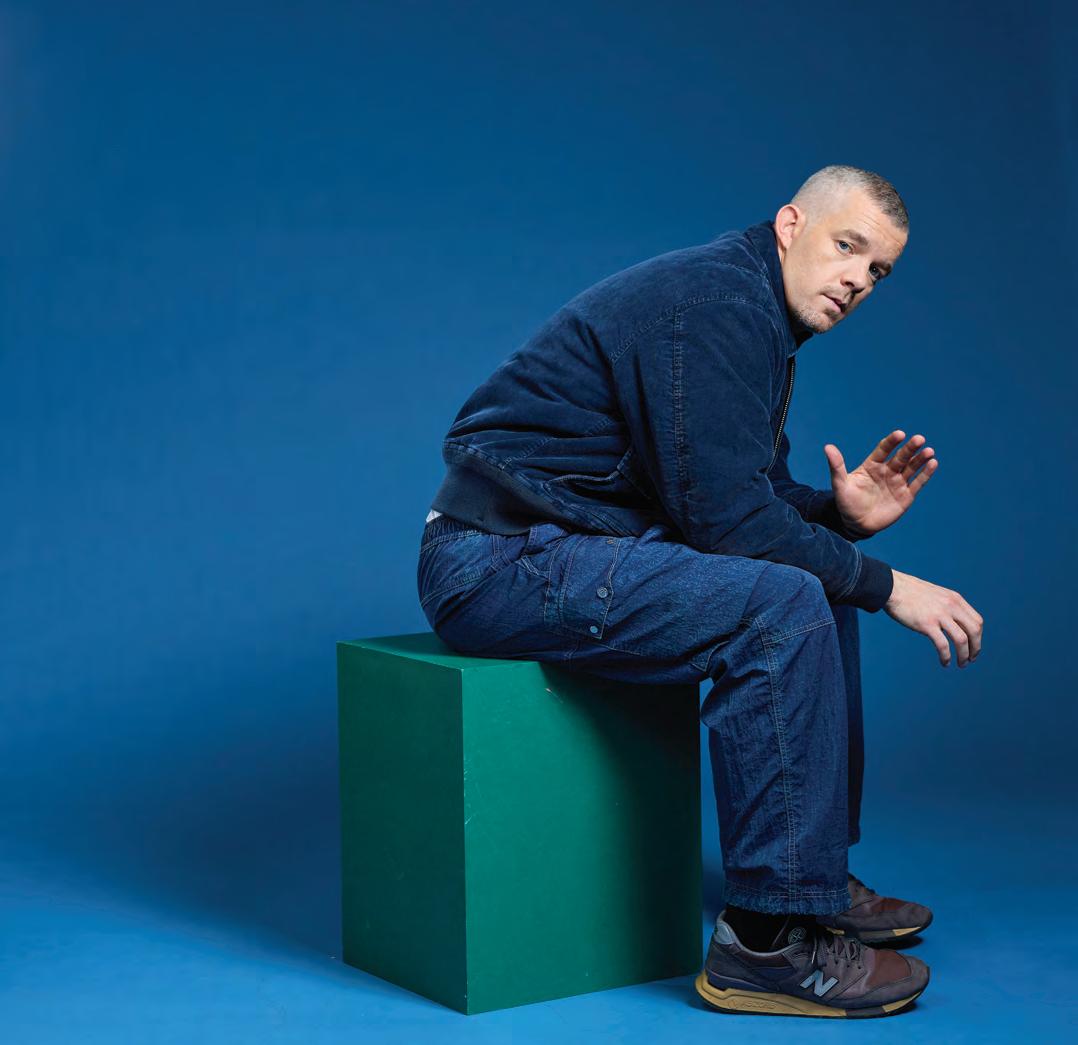
BEING RUSSELL
TOVEY
In The History Boys and Being Human, Russell Tovey captured hearts. Here he tells ADAM BLOODWORTH that when he works, it needs to matter
There are lots of lovely things you could say about Russell Tovey, but perhaps the most striking is how relatable he seems. Not that it always comes across in his roles: in his breakthrough as Rudge in Alan Bennett’s The History Boys, he showed a bluntness and confidence beyond his years; then came the guardedly complex Kevin from Looking, followed by a plethora of sci-fi roles (three with Russell T Davies), including his beguiling career high as werewolf George Sands in Being Human. So it’s testament to Tovey that, despite how established he has become, his cheeky-chappy, guy-next-door friendliness precedes his work.
I get a dose of it when we meet in an Old Street cafe near his apartment. When I arrive, Tovey has already ordered two smoothies, one with kale and the other fruit; I pick the kale. “Oooooh, look at you,” he says flirtatiously as he slides it across the table. It feels like meeting an old friend rather than a storied star of stage and screen.
Despite being built like the kind of man who knows his way around a kale smoothie, Tovey says he loves the local boozers, pointing to The Eagle around the corner, which he explains is featured in the nursery rhyme Pop Goes the Weasel, before singing me the tune. “Up and down the City road, in and out The Eagle, that’s the way the money goes, pop goes the weasel!” He clicks his fingers to illustrate cash disappearing on pints. “Pop. Gone. You just think, wow! The rhyme that we all know.
It came from that pub! There’s history on the doorstep here, everywhere you go.”
He goes on to say that a quirk of east London life is that he’s stopped by fans far more often when he wears light blue. “I’m like, what the fuck’s different today? I wonder why people are looking at me and I’m wearing fucking blue again.” Then a dose of that cheeky-chappy energy: “So if I’m having a bad day, I’ll put blue on, ‘cause I’d like an ego boost!”
Born in Billericay, Essex, in 1981 to parents Carole and George, his brother Daniel now runs the family coach company based out of Romford. He jokingly put paid to the idea of a career in transport in 2013, saying: “I’m not going to do my bus licence so you can ring me up at 4am because someone’s broken down.” Aged 12, Tovey was scouted by a talent agent and cast in adverts. After pursuing acting at local clubs, he eschewed a formal drama school education to enrol in a performing arts course at Barking College.
He lives with his dog Rusty, who is celebrating his 13th birthday the day we meet. He’s partially blind and completely deaf: “I was gonna bring him but I thought he should chill on his birthday. I take him everywhere, I’m probably not allowed to – I just sort of crowbar him into situations. He’s old but doing very well. He’s a scorpio, he’s very resilient.”
Talk about his personal life and most things are delivered with a shade of farce – and that big, warm, sharky grin. When he talks about his work he dials it down a bit. We’re meeting to discuss buzzy indie film Plainclothes as well as new Disney drama The War
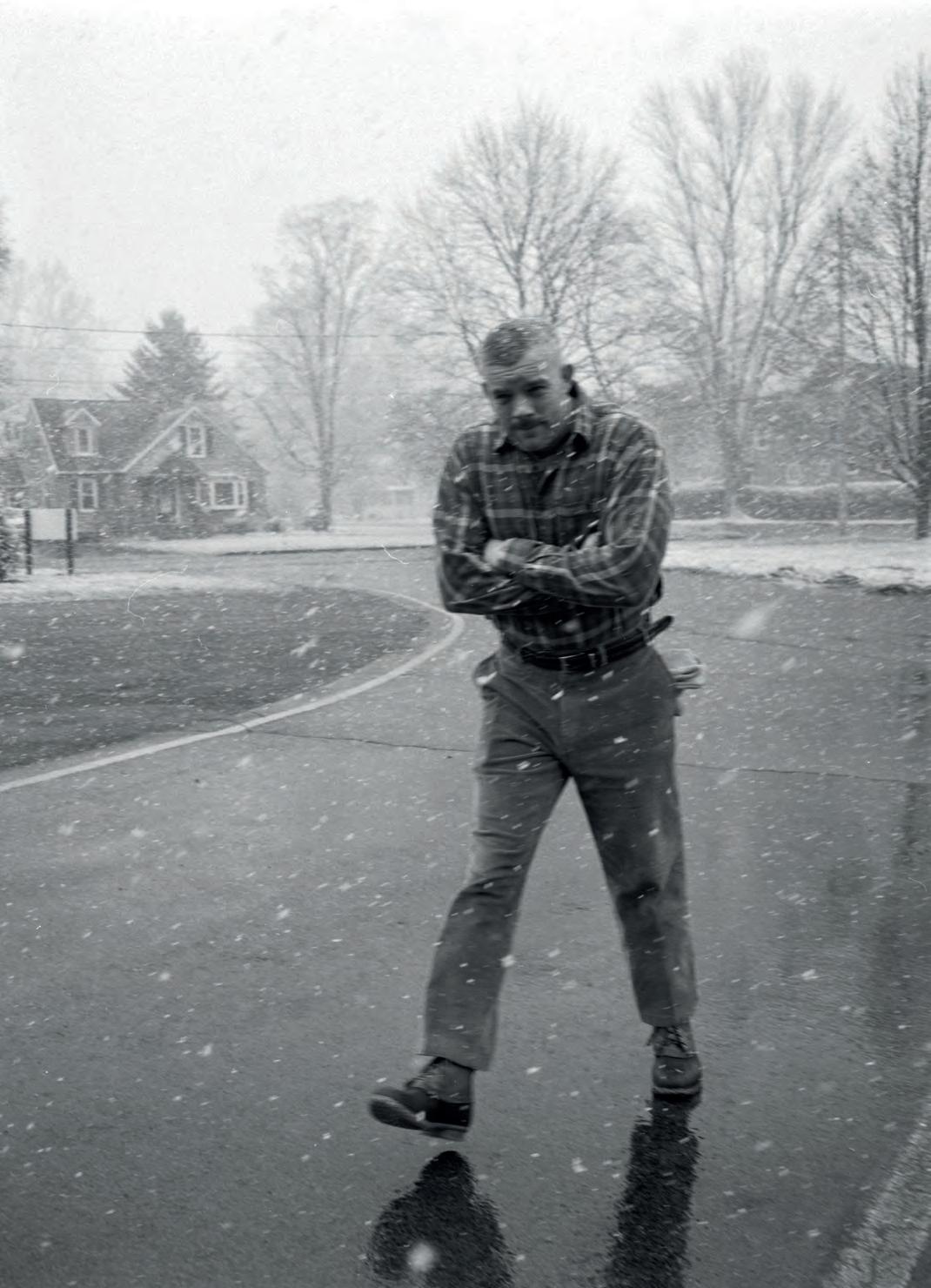
Russell Tovey in New York during the shoot for new indie drama Plainclothes. The actor speaks exclusively to City AM The Magazine
Between the Land and the Sea, both out this Christmas. The former is a beautifully shot rumination on the cruising scene in New York in 1997, the latter a big budget family drama by Russell T Davies, showcasing the Doctor Who showrunner’s talent for smushing together worthwhile drama with stonkingly entertaining telly. In The War Between the Land and the Sea Tovey plays Barclay, an ordinary Londoner propelled into a diplomatic position to help save Earth from destruction. The story follows an alien race that lives under the sea and wages war with humans over plastic pollution. If it sounds on the nose, it’s actually deeply human and terrifically bingeable. “I watched it,” says Tovey. “If I’m in it and I can watch it, that’s a good barometer test for me.” It’s the third time he’s worked with Russell T Davies, following Doctor Who and Years & Years. Davies admires how well Tovey can juxtapose comedy with emotion, which is the compliment to end all compliments for Tovey, given his teenage inspiration was Robin Williams. “I crack the joke to break the pain,” he says. “I deflect into that. Russell writes characters where even at their most scared, they find humour.” More than once during our conversation Tovey uses the word angry when relating to the show’s climate change narrative. He wants viewers “to be angry and do something. That’s what good drama does. To realise we can – and we have to. We learned about Mr Bates and the Post Office scandal through drama. Isn’t that amazing? Is it actually making a difference? Yes, because of that drama we now understand it.”
lll
The History Boys – the tale of a group of bright but troublesome boys at a 1980s grammar school – broke his career back in 2006, starring alongside James Corden and Dominic West. He says he’d love to work on another project with Alan Bennett, the author of the play the film was based on who turned 90 recently, and Nicholas Hytner, the director of the film and subsequent National Theatre play, in which Tovey also starred. Talking Heads, Bennett’s series of dramatic monologues, could have been that opportunity, given it was revived in 2020, but Martin Freeman “brilliantly” played the only role he could realistically have been cast for. Tovey would have loved to do it but “I can’t begrudge him for that.” Is there any way to tell people you’d really like to work with them? “It’s difficult. You’d hope they would know that you want to do it. When I like someone’s work I say to them I’d love to work with you, just put it out there.”
He’s perhaps most known for 2009’s Being Human, BBC Three’s biggest hit at the time, as well as the dystopian 2019 family drama Years & Years. He speaks particularly proudly of Looking, the HBO show that broke him in America back in 2014, following the lives of a group of gay men in San Francisco. More recently, his
lead role in 2022’s American Horror Story – taking the AIDS pandemic as its backdrop – further established him Stateside, though people close to Tovey say there’s still work to do in entrenching his career over there. As for how he chooses his roles, he says: “I just find a character and go, ‘I’m desperate to play that.’” He had avoided queer work until 2014 out of an “anxiety about making sure I could get straight roles”, he told IN Magazine in 2018, so Looking felt like a watershed moment. “I remember going, ‘This is a big deal’. The parts I’ve played that have been queer have changed my life. I’ve grown myself but also my career has enhanced every time I’ve taken on these roles.”
In Plainclothes, Tovey plays Andrew, a closeted man in his mid-forties. Married with two children, he spends his free time cruising public toilets. There he finds Lucas, played by Tom Blyth, a closeted police officer sent on sting operations to catch men like Andrew. It’s an intergenerational story and for Tovey, playing the older man of the two was a big deal. “The 90s was a big decade for me: growing up, working out who I was. To go back to that period and play someone who is the age I am now was really interesting.”
Writer-director Carmen Emmi’s film is so slow and methodical that it feels almost hypnotic. It examines the point between fear and eroticism, and it’s a
sadly contemporary tale: this year 200 men have been arrested for cruising in New York’s Penn Station, with a significant proportion of them sent to Immigration and Customs Enforcement (ICE) custody. At the heart of the movie is an attempt to destigmatise cruising. As a whole, the piece is a testament to the power of TV to educate. “Isn’t it great that there are so many stories that not everybody knows about,” says Tovey. “That’s the generosity of art, there are still so many things to be mined. So many areas of humanity to be explored.” He likens it to a scene in which a female character has her period in Michaela Coel’s I May Destroy You, which became a
I’m not allowed on the apps. I got kicked off! So it’s IRL dating for me, every time. I take it slow. That’s so much more exciting
real pandemic-era telly talking point.
“Isn’t it fascinating that this is still so radical, shocking, and unseen? You think, wow, we’ve got so far to go.”
Stylistically Plainclothes fascinated Tovey because it gave him the rare opportunity to experiment with silence and stillness.
“Most often it’s ‘pick up the pace guys, we need this scene done quick,’” he says.
“There were moments just to stare at each other, take each other in and be soft, which they’re denied everywhere else in their lives. That’s one of the most beautiful things people are receiving from this film, just those moments of quiet.”
He says he relishes the opportunity to try new things on set, and describes himself as “very malleable... I don’t come onto a set fully formed with exactly what I’m going to do.”
I ask how he feels about being a pin-up. There are stories about Tovey logging onto Grindr and half of London rushing to Old Street to message him. Tovey laughs and says that exercise got him kicked off the platform because Grindr assumed he was a fraud pretending to be Russell Tovey. “I did try that for a bit but the universe wouldn’t allow it. It’s IRL for me, every time. It’s so much more exciting.”
And with that he slurps the dregs of his smoothie, flashes me one last cheeky grin, and disappears into the night, off to celebrate with Rusty and, perhaps, make a few quid disappear over at The Eagle.
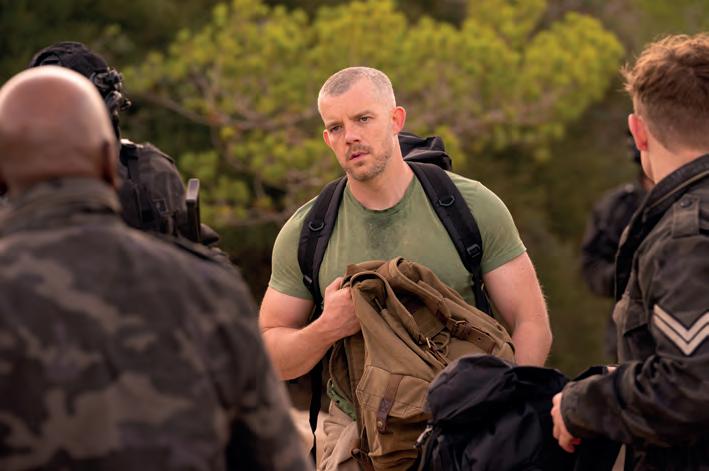
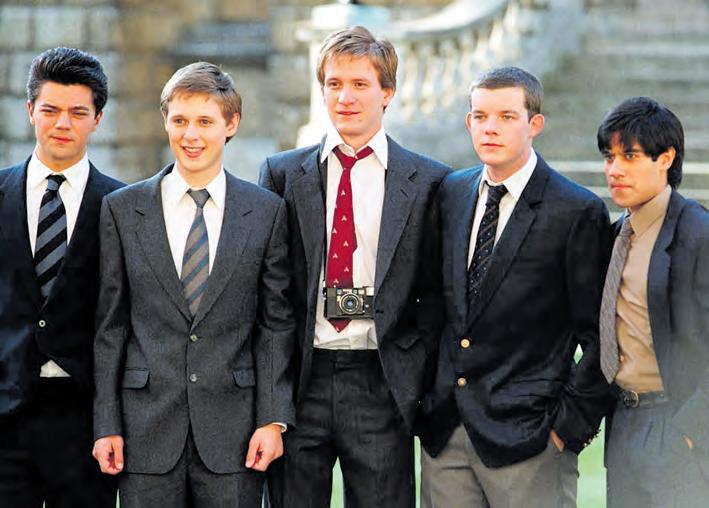
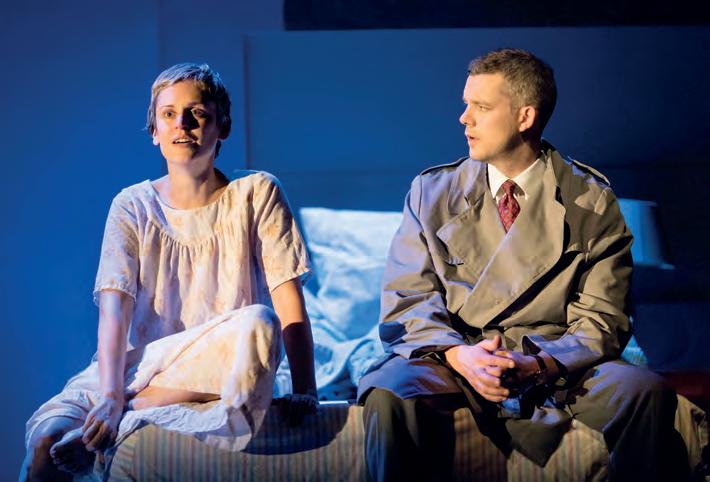
Opposite from top: Tovey in The War Between the Land and the Sea; In The History Boys; Starring opposite Denise Gough in Angels in America
This page: The actor poses for photographer Spencer Phipps
IN SEARCH OF THE PERFECT WORDS
Eric Roth is one of Hollywood’s most prolific screenwriters, penning Forrest Gump, A Star Is Born and Denis Villeneuve’s Dune. He talks to ADAM BLOODWORTH about longevity, staying young and making his playwriting debut aged 80
When Forrest Gump comes on, I just stop,” says the screenwriter Eric Roth. “I watch the rest of the damn movie.” And it’s a rare occurrence that the scriptwriter of Dune, The Star Is Born and The Curious Case of Benjamin Button will “just stop” what he is doing. His routine is sacred and doesn’t allow much room for spontaneity. He wakes early in the morning and writes until one o’clock in the afternoon, then again at night. “If I’m on deadline I’ll work in the middle of the night,” says Roth. “I’m very disciplined about it.”
The screenwriter of more than 30 feature films is one of Hollywood’s most prolific scribes. He has written famous lines for some of the 20th century’s most iconic actors, from Robert Redford to Paul Newman. But when Roth turned 80 this year, he needed a new challenge. This month, he makes his playwriting debut at the Harold Pinter Theatre in London with his adaptation of the classic Western movie High Noon. “I’m really pretty good as a screenwriter,” he says from his LA office, a characteristically writerly sort of room with books piled halfway to the ceiling. “I’ve written a lot of movies, won an Oscar… but that’s no longer enough: I’ve reached an age and thought, ‘I’ve gotta try something else, see if I can do it’.”
Roth says that “a little fear of changing genres” delayed him diversifying sooner. High Noon is an Oscar-winning 1952 movie starring Grace Kelly and Gary Cooper as a newlywed couple embarking on their life together when Cooper’s character, Will Kane, becomes embroiled in a face-off with a murderous gang. “I’d never written a play, it was a great discovery. It’s been one of the more joyful experiences of my life,” says Roth, who bought rights to the screenplay, and says the collaborative way theatre companies work has made him feel “like I’m 22 again.”
“As I get towards the end of this thing – I won’t say life, maybe this career – it’s a great way to explore a whole different world and feel the same way I did for my first movie, 60 years ago. The uninhibited quality of pure creativity and feeling everybody working together. But I don’t want to gush too much – it sounds silly…”
It’s vanishingly rare to see a Western on stage, although musical versions of the genre have become box office gold, in particular the Young Vic’s radical 2023 adaptation of Oklahoma!, which was critically acclaimed for its stripped-back staging and feminist approach. That interested Roth: “Will Kane is a complicated man, it’s a beautiful love story with music and dancing – plus there’s a gun fight that will be harrowing, I hope! The piece, to me, is about courage. How do we stand up for our principles even if
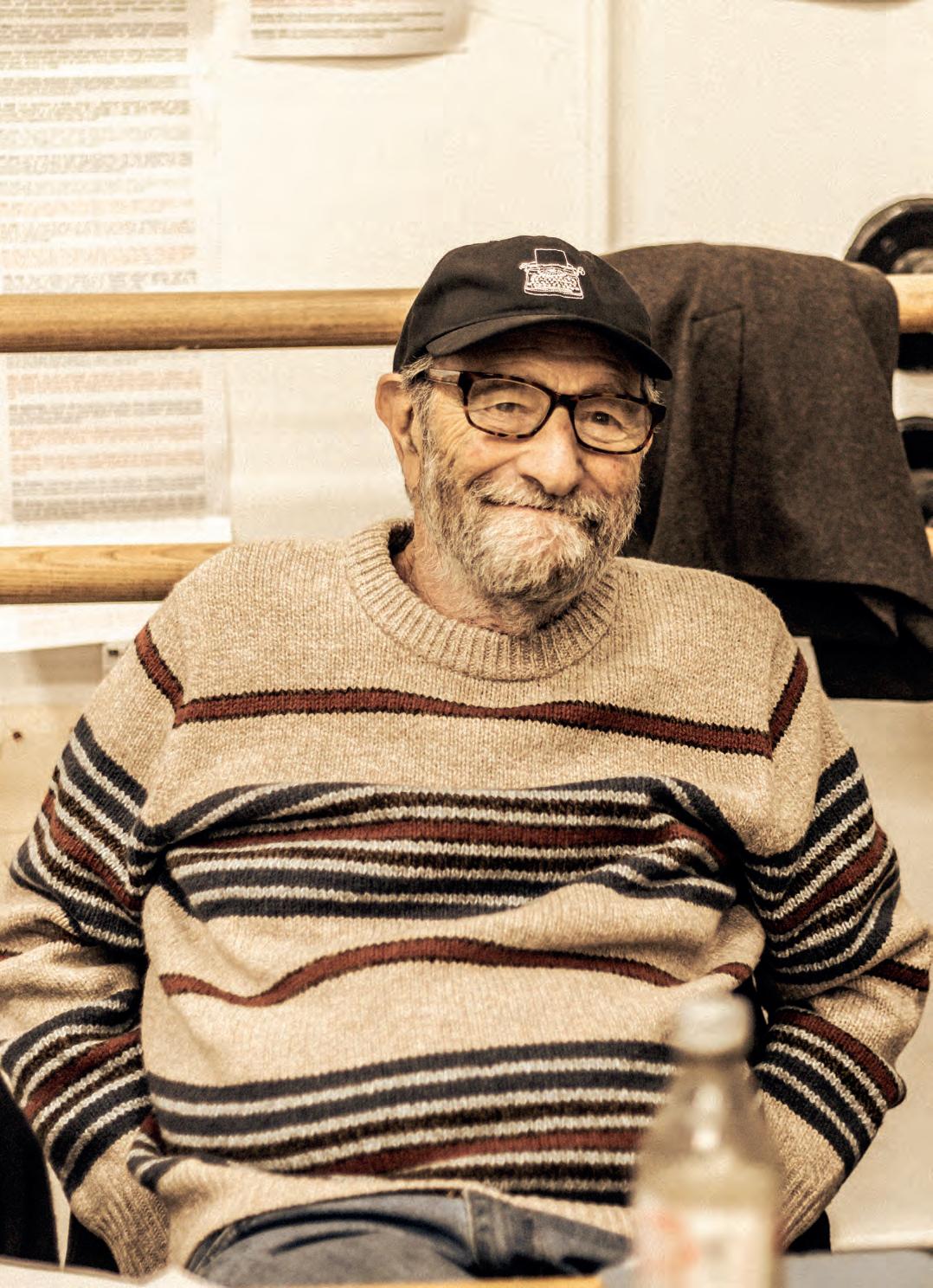
Opposite: Eric Roth at rehearsals for his debut West End play, High Noon, an adaptation of the 1952 movie starring Grace Kelly and Gary Cooper
everybody abandons us and we have to do things alone?”
One challenge for Roth has been realising that subtlety doesn’t work on stage. In movies, close-ups of faces and hands can reveal emotion, but that won’t fly if you’re sitting at the back of a 1,000 seater Edwardian auditorium like the Harold Pinter. Roth, who was born in Brooklyn in 1945 and now lives in Los Angeles, learned this during recent workshops with High Noon director Thea Sharrock, the Olivier Award-winner behind Equus and After the Dance. “I’d written ‘he shuffles his feet’’” remembers Roth, “and the director said ‘I’d like someone from the balcony to see him. He’s going to have to do a jig!’” Roth is notorious for his extra long screenplays, which frankly had become a bit of a problem. He told Deadline in 2024 that he had developed a reputation “not for unproduceable, but for slow, long scripts, which can be dangerous.” So it must have been a joy to work on Killers of the Flower Moon, which runs at nearly three-and-a-half hours with plenty of dense, character-driven dialogue. It won Roth Variety’s Creative Impact in Screenwriting Award. But that movie was the exception rather than the rule. “I used to get away with it. You can’t anymore. That was the frustrated novelist in me, I guess.”
Despite his strict routine of sitting down at a given hour, doing the actual writing is something Roth has less control over. “The idea of just sitting and writing – it’s more of an abstraction,” he says. “The words come out, and hopefully they come out in the right way.” He sometimes doesn’t even remember writing the scripts, rather certain scenes “reveal themselves on the screen”. He studied English at University of
California, Santa Barbara, as well as Columbia University, where he graduated with a bachelor’s degree. He studied for a masters at the UCLA School of Theater, Film and Television, and won his first plaudit for writing, the Samuel Goldwyn Writing Award, in 1970. It was the same year his first script was released in film form for the movie To Catch a Pebble, a love story set in Israel. His breakthrough followed four years later with The Nickel Ride, a crime thriller which premiered at the Cannes Film Festival in 1974; it was nominated for the Palme d’Or, the festival’s highest honour. But he didn’t receive popular acclaim until the 1990s, when Forrest Gump won him the Best Adapted Screenplay Oscar.
Roth doesn’t drink – he says he never liked the taste – but in his formative years he’d be stimulated by “a marijuana lunch.” Drugs are famously hard to write about – the screenwriter falls silent for a moment when I ask if anyone’s ever
nailed the sensation of being high. “It always comes out in some corny way,” he says. “It doesn’t reflect what you’re feeling, or seeing. Maybe Tho Wolfe’s non-fiction book The Electric Kool-Aid Acid Test. I’d have to think. I’m sure there are a couple good ones.”
He’s debating whether to write a novella about a long Hollywood life, but is wary of doing a cradle to grave sort of thing. “Maybe I’ll get to it, maybe I won’t, we’ll see.”
The only thing that seems to vex him is writing, and the pursuit of the perfect semantic flow. He says “the only thing I do know” is how to string a sentence together. “I appreciate the use of words so much, one word having to follow another, picking the right words. The great writers all pick the best words to sound the right way, and it’s always a struggle.”
l High Noon opens at The Harold Pinter Theatre on 17 December; go to haroldpintertheatre.co.uk
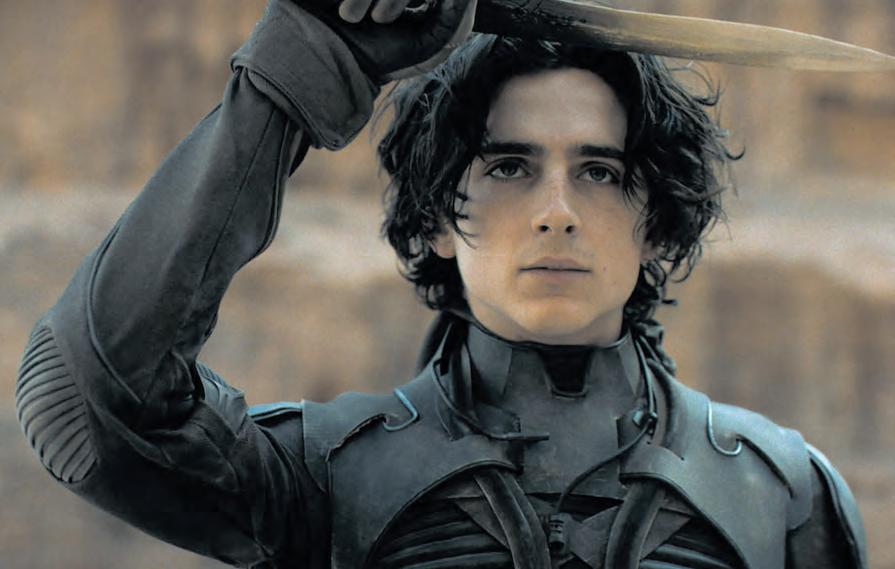
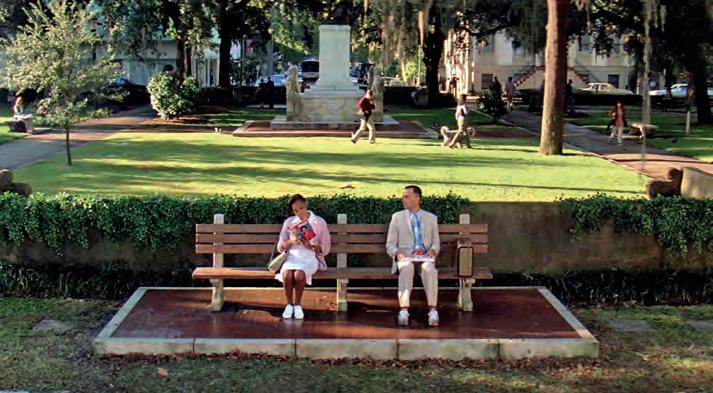
Left: Timothee Chalamet in Denis Villeneuve’s adaptation of Dune; Below: The iconic bench from which Forrest Gump delivers his story in the Oscar-winning movie
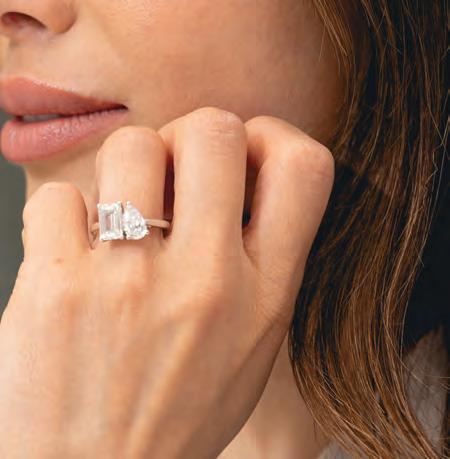
At Platform Jewellers, family and craftsmanship come first. Discover stunning engagement rings and diamond jewellery, made to celebrate love from our family to yours.
OUR OFFERING GET IN TOUCH
For more information or a free consultation, get in touch using the below or scan the QR code.
+44 (0) 20 7430 9691 hello@platformjewellers.com
www.platformjewellers.com
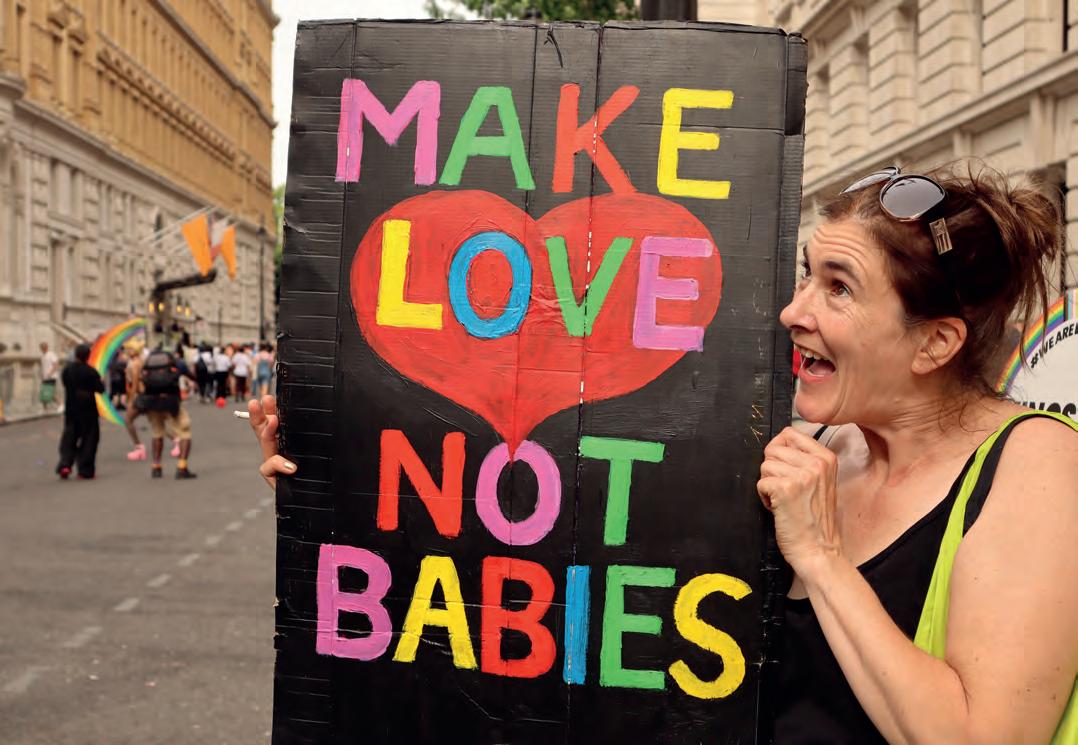
From top: Lawrence Anton is a committed antinatalist who has had a vasectomy to make sure he remains childless; A woman at a pride march is pictured with an antinatalist slogan
BABY DOOMERS
An increasingly vocal group says having children is at best selfish and at worst a moral crime. COSMIC THAPA meets the antinatalists
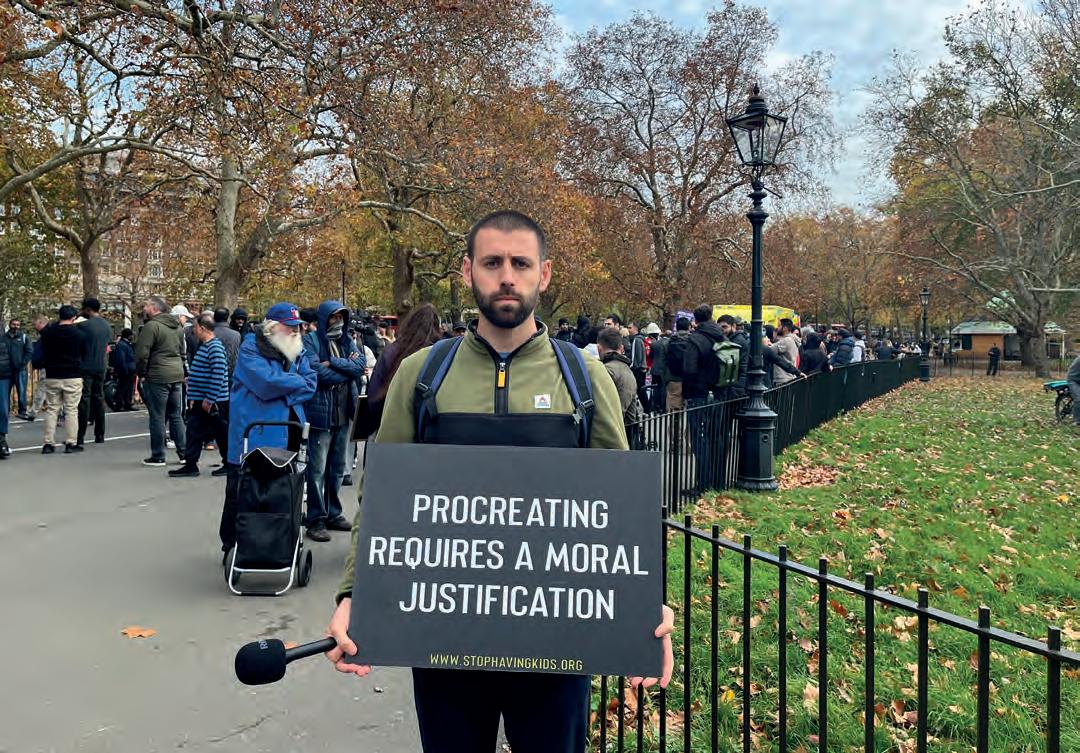
When we arrive at Speakers’ Corner, an ambulance is parked on the pavement, its blue lights flashing over the crowd as police patrol the perimeter. Preachers balance on step stools waving holy books above their heads, livestreaming their sermons while someone dressed as Superman flies past on roller skates. Next to them, a vegan activist is locked in a screaming match with a man in a leather jacket, jabbing fingers at each other beneath the twinkling lights of Winter Wonderland. Lawrence Anton and his friend Alexi Smith quietly set up a camera among the thicket of tripods and ring lights.
While the crowd clamours for attention, Lawrence keeps to himself, easy to miss in his muted layers. He holds up a placard in front of the camera reading, Procreation Requires Moral Justification, standing serious and unflinching even as a man beside him uses a streetlamp as a makeshift stripper pole.
It’s not long before people slow down their pace, watching Lawrence with curiosity. A man who has been observing them for a few minutes marches over to Alexi, pokes his shoulder and tells him to “die”, scrunching his face into a scowl. Alexi keeps his composure, explaining his point of view in the soothing tone you might use to calm a toddler mid-tantrum. Slowly, a wave of realisation sweeps across the man’s face, smoothing down the folds of his frown. “Oh,” he says, stepping back. “Never mind, I get your point.”
Another man waded into the argument but left laughing at a joke Lawrence made, nudging me as he walked off: “He’s hard to argue with, isn’t he?”
Lawrence, like thousands of others, describes himself as an antinatalist, a philosophy arguing that procreation is cruel and unethical because existence guarantees suffering. Putting his money where his mouth is, at 23 he laid on a surgical table and made a life-changing decision. The air smelt faintly of disinfectant as he stared up at the fluorescent lights above. Nervous laughter broke the stillness of the room as the doctor inserted a needle and made the first incision. “It felt like someone was just fiddling down there. I didn’t realise it had already happened until the doctor said, ‘Mate, I’ve just taken this out of
you’,” Lawrence recalls. “It looked like a piece of cooked spaghetti. I really wish I didn’t see that.”
As I quietly rethink my dinner plans, Lawrence tells me that his vasectomy was one of the best decisions he’s ever made. “Once we exist, we can have dementia, cancer, be bereaved, lonely, depressed, and cause unintended harm to others. It’s better not to create someone so they’re not vulnerable to any of it.”
Antinatalism’s early ideas can be traced back to Schopenhauer, with strands going back as far as ancient Greece and India. South African philosopher David Benatar, one of the ideology’s key figures, puts it bluntly in his 2006 book, Better Never to Have Been: “[Parents] play Russian roulette with a fully loaded gun... aimed at… their future offspring.”
The movement, unsurprisingly, found a home online. On Reddit’s r/antinatalism forum, 233,000 members discuss its ethics and share personal stories. Lawrence documents his own journey on YouTube, posting educational videos for more than 7,000 subscribers. In these, he discusses the consent of birth, the environmental impact of human life, and the harm we inflict on other people and animals.
Lawrence and I meet in the inauspicious surrounds of Pret in Marble Arch. I can’t help but notice the irony as I weave through a sea of buggies and toddlers darting between tables. “It started when I became vegan, and I realised my views can be completely wrong,” Lawrence says, taking a bite of a vegan croissant. I peek down guiltily at the ham and cheese toastie in my bag; that’s two meals ruined.
Sterilisation isn’t a requirement for antinatalists, but it’s a choice some make. Across the pond in Canada, antinatalist Julia Brown (not her real name), chose to remove her fallopian tubes when she was 34. I reached her through a comment she posted on a video discussing antinatalism; she was eager to share her experience, agreeing to a video call on the condition she would remain anonymous.
“The surgery was simple. It was the recovery that was the worst part,” she says. “I was extremely nauseous and sick. It hurt to do anything.” Despite the pain, Julia says it was worth it in the end.
Unlike Lawrence, who managed to book his
procedure through the NHS within a month, Julia was rejected three times by doctors, who were under the impression she would change her mind. “If you don’t have children and you’re unmarried, they won’t consider you, especially if you’re a woman,” she says.
“We’re just baby machines to them,” she says. “But I always knew I didn’t want children. The more I looked at the suffering around the world – war, death, colonisation – the more I realised antinatalism was the way to go.”
Though the movement is controversial, scepticism around parenthood is hardly fringe. Many are questioning whether they really want children and birth rates in developed countries continue to fall. In the UK they dropped to a record low in 2025, and a YouGov report earlier this year found almost 30 per cent of 18-40-year-olds without children say they definitely don’t want them in the future. While financial pressures topped the list of reasons, the second most common factor was the state of the world. This trend applies globally: a UN report found that a fifth of people over 50 have chosen not to have as many children as they would otherwise have liked due to fears for the future of the world, including climate change, wars and pandemics.
During my nightly doom-scroll, I stumbled across one of these people: Jannah Santana. Although she doesn’t describe herself as an antinatalist, she relates to some of their views. “The world is f*****d: hunger, poverty, everything going on in Palestine, bloody genital mutilation…” she says. “I love children and that’s why I would never want to bring them into this place just to leave them to deal with the consequences.”
Jannah, 31, describes herself as a life coach, posting advice videos on TikTok including a fiery rant against men who tell women they should have children. “I get a lot of comments from people online saying I’m too young to know and that I’ll change my mind,” she tells me on a video call, her voice tightening with frustration. “And then when they find out I’m 31, they tell me I’m damaged goods and too late to have kids anyway.”
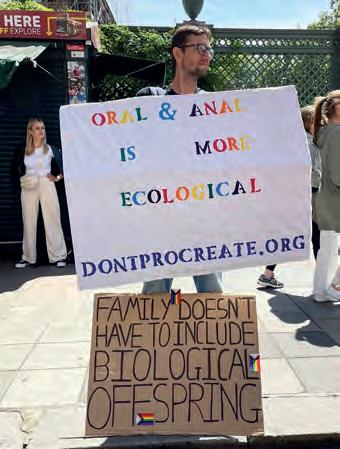
Lawrence is no stranger to hostility, either. “People get pissed off and ask me why I haven’t killed myself,” he says. “All antinatalists are saying is that it’s not okay to create new life. But when you’re here, you can do as you wish and make the most of it.” Lawrence often campaigns alongside other antinatalists around London, their placards bearing slogans including: “Make Love Not Babies”, “The Only Perversion is
Reproduction” and, my personal favourite, “Oral & Anal is More Ecological”. This is how I ended up at Speakers’ Corner, where he arrived alongside his friend Alexi Smith, 31, the latter lugging three tightly packed equipment bags. Alexi volunteers to help Lawrence film some of his content, having met him online after stumbling upon his YouTube channel.
Originally from Nicaragua, Alexi was adopted at 19 months old, alongside his sister Tania, by his British mother Jenny Smith. Both born into extreme poverty in the early 1990s, Tania had been hospitalised seven times due to malnutrition before she was even a year old. “It’s really weird but I never really gave adoption much thought before I became an antinatalist. Unlike my mum and sister, who feel very strongly for it,” Alexi says. “Since becoming one, it’s given me more of a relationship and a peace with it that I never had before. There’s a lot of kids out here who need love and care,” he says. Alexi tells me his beliefs have caused difficulties in romantic relationships. “When I first met my now ex-girlfriend, I wasn’t an antinatalist. I sort of had these thoughts in the back of my mind, but I didn’t know it was a thing,” he says. After researching the philosophy, Alexi decided to tell her. “It caused huge problems. She definitely wanted children. She came from a big Irish family, and it was really important for her,” he says. “It’s crucial next time for me to tell them upfront, before we get hurt.”
The movement has recently found itself dragged into headlines for the wrong reasons: the bombing of a Florida IVF clinic earlier this year, carried out by 25-year-old
Edward Bartkus, has led to accusations the fringe philosophy is dangerous. In a manifesto on his now-deleted website, Bartkus said he planned to attack an IVF clinic because he didn’t consent to exist. He described himself as a pro-mortalist, a more radical offshoot of antinatalism that argues it is better for existing beings to die. Bartkus died at the scene and four others were injured.
His website also mentioned the subreddit r/efilism, which had 12,000 members before it was banned after the bombing. A play on the word “life” spelt backwards, the term was coined by a YouTuber known as ‘Inmendham’ to emphasise that all suffering, not just human, is “the greatest problem in the universe”. Some users migrated to the r/antinatalism subreddit, while one user created r/efilism2.
The Florida bombing is one of countless examples of fringe philosophies spreading online before violently entering the public arena, of how isolated people can fall into extremist interpretations of otherwise non-violent ideologies. Jack Jiang, an anthropologist and PhD researcher at the New School for Social Research, says digital spaces have played a major role in amplifying antinatalism. “By nature, online communities get into feedback loops, so niche philosophical movements grow out of that condition. There can be something conspiratorial about it,” he says.
“Antinatalism absolutely does not encourage extremists,” says Lawrence. Just like being pro-choice or anti-communist, someone could adopt [any view] and rationalise it in their head to enact violence… If someone bombs a fertility clinic, they’re very likely mentally unwell.”
Alexi stresses that while some within the community can express negativity or take the idea to extremes, this does not undermine the philosophy’s fundamental message – to prevent suffering and pain. “It was a terrible thing that happened. Thank goodness no innocent people were killed,” he says. “Hurting others and causing harm to yourself is not in line with the true philosophy behind antinatalism. It’s all based on compassion.”
By the time we leave Speakers’ Corner, the air has turned sharp and cold. “I know most people here are set in their beliefs, just like me, or here to watch the spectacle,” Lawrence says, as we make our way out of the gates. “I’m not expecting everyone to agree. I just hope at least one open-minded person sees my videos… or at least leaves thinking more consciously about their choices.”
Opposite page from top: Lawrence Anton argues his antinatalist case at Hyde Park’s Speakers’ Corner; A man confronts Lawrence during his appeal; Inset below: Nimrod Harean, an antinatalist from Israel, makes a colourful case for alternative methods of gratification
A VISION OF THE FUTURE
Twenty five years ago, reality TV as we know it was invented on a Scottish island. ADAM BLOODWORTH travels back to the millennium. Pictures by SIMON ROBERTS
It was a sunny autumn day in 1998 when TV producer Chris Kelly arrived at the BBC Television Centre armed with an idea. He had a meeting booked with Peter Salmon, co-founder of Sport Relief and the Controller of BBC1. “As the new millennium beckoned, we discussed what we’d do differently if we had the chance to start all over again,” Kelly tells me. The conversation went well: just over 12 months later, they were filming a show that birthed a new era of reality TV.
“I hate the phrase ‘reality television’, but I’ll use it,” says Kelly, speaking on the 25th anniversary of Castaway 2000, the controversial, once-in-a-lifetime reality show that inspired the likes of Big Brother and I’m A Celebrity.
The BBC show, which stranded 36 strangers on a remote island in the Outer Hebrides and made them fend for themselves, was the first of its kind. In the 1990s, the en vogue style of reality TV
had been fly-on-the-wall documentaries following cabin crews around airports and learner drivers with their longsuffering instructors. Taking a different tack, Castaway 2000 was the first to show ordinary people doing extraordinary things. Big Brother put a load of
It’s hard to imagine how people were feeling at the turn of the millennium. They wondered if they were living the right way
strangers in a house together and waited to see what happened, but this Hebridean show – launched three months earlier – thought dumping strangers on a remote island would be the better gambit. It wouldn’t be long before celebrities would go into the jungle, waved off by Ant and Dec. But first, there was Castaway 2000.
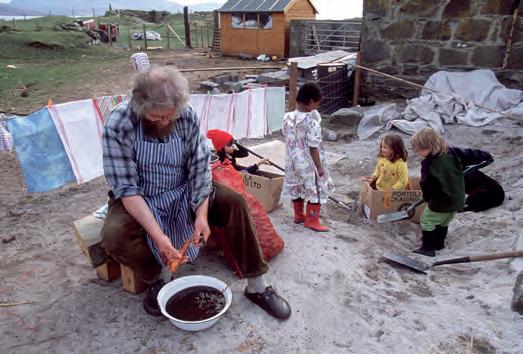
The show was astonishing in its scope. The castaways spent an entire year living on the Scottish island of Taransay. There was no technology, except for one CD player, and visitors were banned. The idea was that the castaways lived selfsufficiently, killing their own livestock and growing their own vegetables. One participant, Tanya, was tasked with filming, so TV crews didn’t ruin the experiment, although additional footage was shot by a production team who visited sporadically.
There were explosive bust-ups, which became some of the biggest tabloid stories of 2000. In 2010, one of the
castaways, Ron Copsey, wrote a piece for the Guardian entitled “How Castaway ruined my life.” Another contestant was Ben Fogle, who had formerly served as photo editor for Tatler.
I was fascinated that these people had upended their lives for an entire year, but also that the show has been largely forgotten. So I got in touch with a number of the old castaways, producer Chris Kelly, the psychologist who supported the islanders, the man who wrote the official book and the guy who photographed the show, many of whom are still working in the TV industry.
Their accounts differ dramatically. While some describe a fairly harmonious experience, others say the castaways were at each others’ throats. One thing for certain is that Chris Kelly and coproducers Jeremy Mills and Colin Cameron knew this would make unrivalled TV. “We came away from that meeting giddy with excitement,” says Kelly. “Part of us thought, ‘Shit, we’re gonna have to make this now’. You’ve gotta be careful what you wish for sometimes. If you say you’ll put a man on the moon, you’ve got to do it. And if you say we’re going to create a microcosm of society for a year…”
What’s interesting isn’t so much the brawls – they’re easy to manufacture and totally inevitable – but how earnest the project seemed. “I don’t think anyone now would do something that had the purest intentions of social experiment,” says Kelly.
Watching old clips of the show on YouTube, I believe him. The show featured scrappy, handheld camerawork, and spent long periods of time with people performing fairly ordinary tasks, going about their lives on the island. It would be a hard sell to commissioners today. More
intriguing is what the programme says about the way people envisioned their 21st century lives. “It’s hard to imagine how people were feeling at the turn of the millennium, but there was a lot of retrospection about whether we were living the right way,” remembers Kelly. Cynthia McVey, the psychologist who worked with the contestants, agrees that the scope of the show feels even more impressive with the passing of time. “When I look back, it was extraordinary,”
she says. “Sometimes I think people have forgotten how extraordinary this community of people turned out to be.” Castaway 2000 launched in the same year as two similar ‘fish-out-of-water’ shows. Survivor and Big Brother UK both premiered in 2000, and according to Dr Rebecca Trelease, reality television lecturer at AUT University, Big Brother’s funding and Channel 4 timeslot “could be attributed to the success of Castaway 2000.” She believes it’s a similar story for
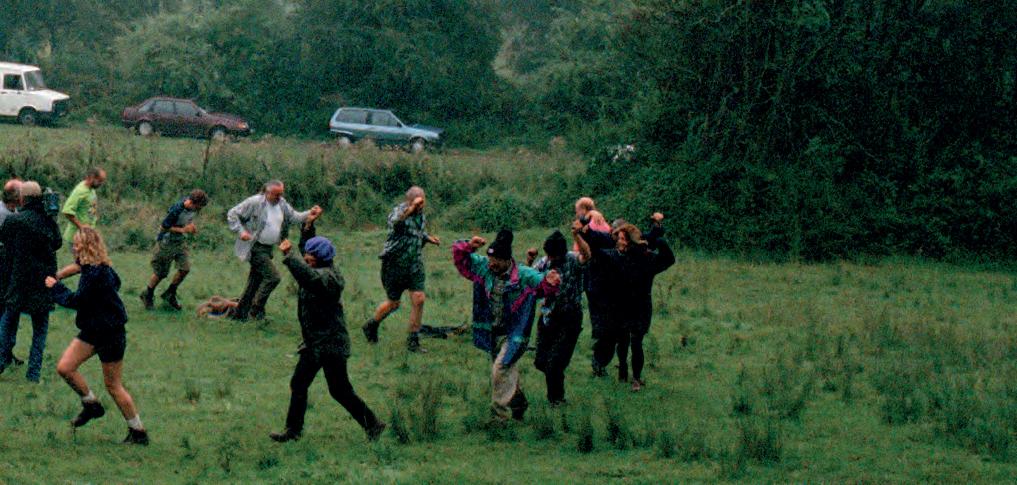
Top: The castaways engage in a pagan-esque dance
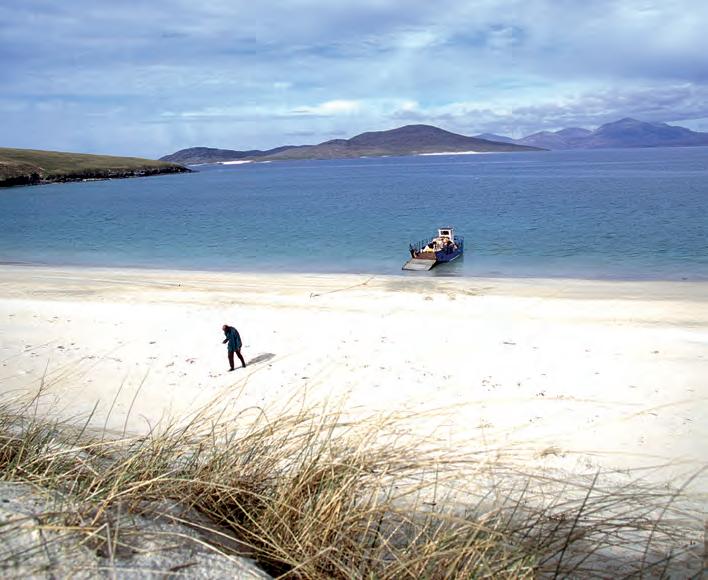
Above: The remote isle of Taransay was the perfect wilderness on which to maroon the castaways
Survivor, which launched on a primetime slot on CBS in America. Castaway 2000 was also the first show to adopt the diary room format, before Channel 4 made it famous. “There was a movement, clearly,” agrees Kelly. “People were looking to make observational documentaries on people’s lives. ‘Let’s put people in a different situation,’ was very much new-millennial thinking in TV. That went down the road that ended up saying, ‘Let’s create a scripted reality world’, which led to Essex and Chelsea, and these other shows.”
But on Castaway 2000, there was no winner, no tasks or challenges, no kangaroo testicle eating, no audience voteoffs and no prize money. No crowds of screaming fans stood outside waving placards. All that noise would distract from the more fascinating but far slower
work of watching a new population come together over 12 months. The backdrop was the beautiful island of Taransay, three kilometres across the water from the Isle of Harris, famous as the home of Harris Tweed. Taransay is just under 15 kilometres squared, easy enough to get around on foot, and during filming the island was home to 700 sheep, many of which became lamb rump cooked over flame. The combined result of overgrazing and the harsh climate means there is just one tree.
During his visits, photographer Simon Roberts describes the rain coming down sideways “like javelins” and McVey remembers the wild weather leaving her stranded on Taransay long after her work was done. “You get cut off,” she shudders. “Once I was stuck out there for three or four days.” These days, the island is
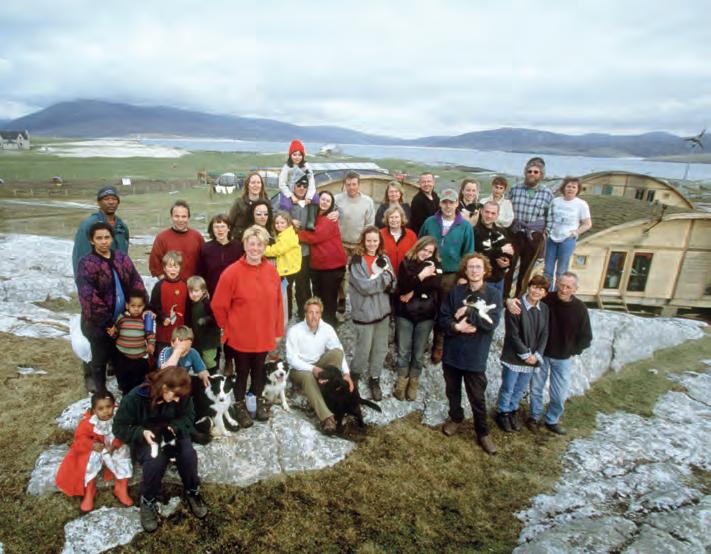
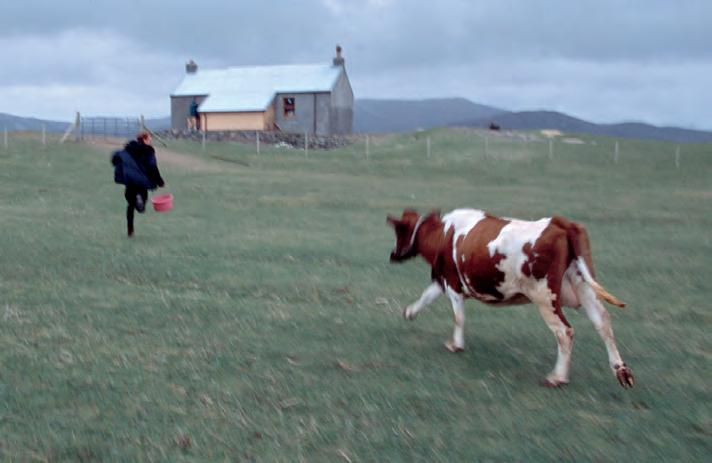
Left: Most of the castaways posing for their picture on the island of Taransay in the Outer Hebrides; Below left: Islander Ron Copsey being chased by a cow. He was in charge of 40 chickens, three cockerels and four Bantam hens but that didn’t prepare him for the bovine threat
privately owned by Adam and Cathra Kelliher and is uninhabited, although they welcome guests to visit on day-boats from Harris. “The majority of British visitors know the show,” says Adam Kelliher. “Many are keen to see the sites immortalised on film.” They may be disappointed if they’re hoping to swat up on attractions though: all that remains is one “crumbling hydro system and the grave of a dog that died while they were on the island.” But the landscape, carved out of one of the oldest rocks in the world called Lewisian Gneiss and dating back three billion years, cannot be blown away by the relentless gale force winds. “There is a timeless quality to the place,” says Kelliher. “People may pass through, but the eternal island always remains.”
Even more fascinating is that the castaways enjoyed island life so much that they began to “resent the presence of a crew,” remembers psychologist McVey. “Towards the end they almost took possession of the island, even though the BBC was paying for what they were doing.” While at first the plan was that the show would air either late in 2000 or early in 2001, BBC tested some footage earlier in 2000 which was a huge ratings hit, pulling in nine million viewers, so Kelly and his team had to change tack. A dozen 50-minute episodes aired in 2000, with four in January, another quintet in April and the final four in September. Then a Big Brother-esque series of live daily broadcasts began in December. Roberts, who spent eight weeks on the island photographing the castaways, thinks that producers intruded on their lives too much which ultimately detracted from the experiment. “Perhaps if they had been allowed to be isolated for the year with remote cameras and confessional boxes, the potential for a more interesting television experiment could have been given a chance,” he says.
Kelly denies that producers did anything “at all” to provoke the much-publicised fights to score higher ratings, recalling that “a lot of the drama was circumstantial.” On the contrary, he says, it was the BBC who requested they capture the bust-ups. “There was still a kind of demand led by the audience, but from the BBC as well, a little bit. You know, ‘Have you got any more of them arguing?’ There were times when I felt, ‘Enough with the arguing! They’re actually getting on now.’”
There were disputes about working hours, about castaways having lie-ins while others were up milking cows, and access to contraband provided by illegal visitors from off-island. As Kelliher puts it: “A lot went on that wasn’t broadcast!” The relentless 100mph winds went on for weeks and meant you couldn’t stand up if you went outside, no doubt further quickening tempers. “People were falling out over whether they should have a drink or a fag,” says Kelly. “It made for some very entertaining viewing.”
All of the castaways I spoke to remembered their experience fondly. “I dream of Taransay still,” says Padraig, who was 27 and working in IT sales when he arrived on the island. One of his favourite memories was successfully hunting a deer. “That was thrilling. The island itself is magnificent, and the pure freedom of it is the kind of thing people dream of.”
Jodene was 11 at the time and is also grateful for the formative experience. “If it wasn’t for Castaway 2000, I wouldn’t be who I am today,” she says. “At 11-years-old I knew I was part of something that was socially important.”
Most believe the format will never return. Fragmented audiences watching clips on social media have democratised broadcast content, so much so that “the
audience doesn’t need TV professionals, frankly, to deliver them the content they want to find,” says Kelly. McVey thinks the idea wouldn’t appeal to Gen Z, who see reality TV stars from Love Island and would expect a similar experience. She says it would be “difficult to find youngsters who would not see it as a way to become a reality television star. Back then, I would say the majority were there genuinely out of interest.” That’s crucially where it differed from Big Brother, which Kelly describes as “a form
I don’t feel guilty that we unleashed the beast. Nor do I feel like we should take any credit. We were just following everyone else
of tabloid show. I’m not knocking that very successful format... But ours wasn’t. Ours was more organic.”
But there is a trend for slower television, for shows that respond to the idea that so many of us struggle to focus on anything for longer than a few seconds. There is also a movement to get us away from phones and screens, which is proving commercially successful for travel companies touting ‘off-grid’ experiences in huts in the woods, disconnected from the internet. If people are willing to pay exorbitant sums to live like medieval forest-dwellers by holidaying with companies like Unplugged, then I have hope for another show as ambitious as Castaway 2000.
It certainly chimed with the contestants, many of whom are still close. Almost half of the original castaways met on Taransay this past August for a reunion, with 15 of them spending a full weekend together reminiscing. “We were very nostalgic,” says Padraig. “And very happy to be there and together in a group again.”
“I don’t feel guilty that we unleashed the beast,” says Kelly, who is humble about what his show achieved: “Nor do I feel like we should be taking any credit. We were just following the stream like everyone else.”
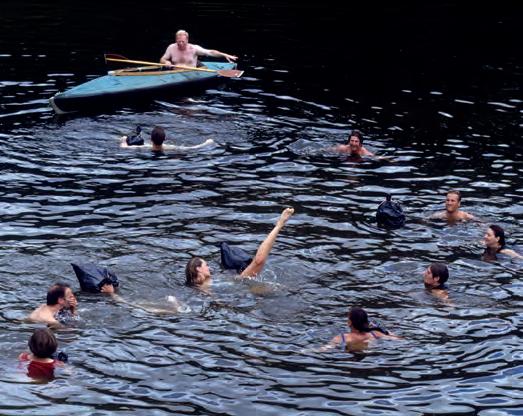
Clockwise from top left: Peter Jowers preparing food; Islander Philiy Page; a large group including Ben Fogle wild swimming. Photographer Simon Roberts visited the island four times during the year 2000
I READ 100 BOOKS IN 100 WEEKS
In an age of doom-scrolling and distractions, SIMON HUNT undertook a book-reading odyssey, learning something about himself as well as the world in which we live
As I write this, I am in the final days of the longest reading marathon of my life. In January last year, I set a challenge to read 52 books in as many weeks. Having (just) completed my goal, I set another to read 48 this year, to finish at 100 (journalists like round numbers).
Never have I read so much in such a short time. I’ve hardly set a world record, but this was about my limit while maintaining a normal life and having a job. There was no careful formula for what I chose to read. My guiding light was whatever caught my eye on a periodic wander around Charing Cross Foyles, though that did bias me towards recent releases.
I scoffed when the columnist Janan Ganesh last year insisted against reading contemporary books. Nonsense,
I thought. The reason to read is to learn about the world; as books get older, their value surely diminishes.
A year on, my defiance has waned. Plenty of new books are compelling – but plenty more aren’t. I was surprised by how many modern works focus on the same narrow subject matter, even while the variety of options has never been wider.
I was also surprised at the saminess of many contemporary works of non-fiction. It’s practically a sin, for instance, for a non-fiction writer not to pay homage to Daniel Kahneman’s Thinking Fast and Slow by the middle of their third chapter. And after reading a dozen of them, I refuse to pick up another book on AI: no one has anything new to say.
Newer books strike me as a little less polished – the writing is more clunky and wordy and the incidence of typos is higher. That is partly a result of the
economics of modern publishing, in which as few as a thousand sales can propel an author to a best-seller list, depending on the category.
The older books I read were generally far better at holding my attention – the rhythm, register and vocabulary were all richer and more idiosyncratic. Writers of past eras seem more worldly; they had a firmer grasp of where their subject matter sat within space and time. By contrast, modern US writers in particular exhibit the thinnest grasp of anything that takes place outside of their own country.
To disabuse readers of any early conclusions, I’m not about to declare my foray into books a colossal waste of time. Anything but. Yes, the drearier titles were a drag to wade through but, above all, I rediscovered a love of reading.
Not since university had I picked up so many books – and back then, I rarely read them cover-to-cover. Like most humanities graduates, I completed my degree with a feeling of book fatigue, and went a year or two afterwards reading barely anything.
The first challenge I faced was learning how to read again. I was shocked by how hard I found it just sitting with a book on my lap. Hours of scrolling during the pandemic had done things to my brain. The urge to reach for my phone after a page and a half was startling. I realise I do not struggle alone: I’ve stopped gasping when friends say they’ve read nothing in months, nor when they share their iPhone screen time stats.
Two years on, I can comfortably get through 10 or 15 pages before my mind seeks a diversion. Better still, the endless dopamine spurts from smartphone notifications have dulled – more often than not, they have become an annoyance.
The Times columnist James Marriott is perhaps the best-known chronicler of the dangers of smartphone addiction. He suggests we could be living past the
Top, from left: Some of the books in Simon’s challenge, including Catastrophe Ethics by Travis Rieder; Careless People by Sarah Wynn-Williams; The Everything War by Dana Mattioli; Code Dependent by Madhumita Murgia; Age of the City by Ian Goldin and Tom Lee-Devlin; Above: Empire of AI by Karen Hao
peak of literacy rates – and he is in no doubt about the culprit.
I’m less convinced smartphones are to blame. The late American writer Neil Postman’s 1985 book Amusing Ourselves to Death (my 88th read), in which he fears the television is turning us all into simpletons, shows moral panic over technological advances is nothing new.
I don’t think smartphone use necessarily corrodes the mind – but choosing not to spend hours using one requires serious willpower, like never skipping gym days until those abs are rock solid. If anything, my foray into books has made me more keen on opening magazine and news apps and less keen on ones that blast me with ‘content creator’ posts and AI-slop. Like hitting the gym, hitting the tome each day delivers tangible improvements over time. I am convinced I am a better person through my reading habits. I sense a renewed intellectual curiosity. I understand the world better. My grasp of the cultural and economic forces shaping it is more acute. I know when to be intrigued and when to smell a rat. My writing is smoother, more succinct. I am a sharper editor. I am also more introspective – and perhaps more pompous.
I am also a more discerning reader, now. A well-crafted book is, to me, like a
vintage sauvignon to a sommelier. But it takes many mouthfuls of cheap plonk to tell the good stuff from the bad – which is why I don’t regret reading the books I didn’t enjoy. A few cases in point: Tom Chatfield’s Wise Animals, which chronicles human evolution, was needlessly verbose; Travis Rieder’s Catastrophe Ethics, a book about forming ethical rules in times of crisis, was catastrophically bad at coming up with any; Ian Goldin and Tom Lee-Devlin’s Age of the City, an analysis of the importance of urban centres, was just a long list of pedestrian observations.
But the books that may soon find
The books that may soon find themselves in my high street Oxfam were dwarfed by the numbers that will stay on the shelf
themselves in my high street Oxfam were dwarfed by the numbers that will stay on the shelf. Those include Careless People by Sarah Wynn-Williams; Dana Mattioli’s The Everything War; Madoff, the Final Word by Richard Behar, The Everything Blueprint by James Ashton and, most bizarrely, a 1970s book on the history of WH Smith (who knew 500 pages on a stationery shop could be a page-turner?). What united all of them was a deep, forensic knowledge of the subject, whether from personal experience or serious research.
With 100 books down, what now? I will slow the pace next year, allowing time for other things and other people. After a two-year reading obsession, I need a new hobby. but my penchant for a good book is here to stay.
Instead of Foyles I plan a foray into the nicher corners of the book world, to seek out old favourites and rediscover forgotten gems. So far I’ve largely steered clear of fiction – why spend ten hours on a book when you can watch the film adaptation in two, my utilitarian mind barks – but that is a personal shortcoming I want to confront.
A part of me wants to write something of my own – but I’m more aware than ever of what a bad book looks like, and the effort required to make a good one. Maybe one day.
From left: Two more from Simon’s pile: Amusing Ourselves to Death by Neil Postman; Madoff, the Final Word by Richard Behar
Fishmongers’ Hall is one of the oldest Livery Companies of the City of London, one of the ‘Great Twelve. For 750 years it has stood on the banks of the River Thames bosting a Banqueting Hall, that space lends itself to cabaret conferences, seated dinners, and standing receptions.
A conference at Fishmongers’ Hall is more than a meeting of minds, it’s a moment of influence. In a setting that has hosted visionaries and decision makers for centuries, ideas are elevated, conversations flow, and connections take shape. With seamless service, historic grandeur, and modern event capabilities, your next industry defining gathering starts here.
Sitting adjacent to London Bridge, with superb transport connections via train, bus, river and City airport.
Contact the team for more details
VenueHire@FishmongersHall.org.uk
Conference
WATCHES
Morning coffee you can set your watch by: the new Arc II D’Arc Roast is a love-letter to caffeine by Danish design maestros Arcanaut
COFFEE O’CLOCK
Denmark is serious about its coffee: four of the first seven World Barista Champions were Danish, a winning streak unbeaten in nearly two decades.
Danish watch brand Arcanaut celebrates this national obsession in its new Arc II D’Arc Roast, which features a dial literally
made from coffee. The material is crafted from finely ground beans moulded under high pressure, resulting in a richly textured surface that will be familiar to any home baristas.
Bronze-toned hands with ‘cream’ LumiCast tips evoke the warmth of hygge, while on the reverse you will find a
luminous caseback featuring a grinning coffee cup mascot called Joe.
Limited to 33 pieces, the D’Arc Roast is a love letter to caffeine and Danish design, created for collectors with a taste for the unconventional.
l The D’Arc Roast is available to order now for £4,000 from arcanaut.watch
ROCK STARS
Hardstone dials have been the defining watch trend of 2025. SAM KESSLER picks three of his favourites
CHRISTOPHER WARD SEALANDER ROCKS
Let’s start with one of the more accessible, mainstream stone dials around from British stalwart Christopher Ward. The Sealander collection as a whole is billed as the brand’s ‘everyman’ watch, based on the OG Rolex Explorer and built as a beater. This latest quartet takes that blueprint and narrows the broad appeal considerably with four eye-catching stone dials.
You have the requisite malachite and tiger’s eye, of course, with their green and brown striations respectively. But stepping out of the hardstone box, CW have also opted for turquoise, which taps into the dual trend of stones and bright blues, and grained, purple charoite. The brown and green are the safer options, but when it sets you back under £800 (on leather), it might well be worth trying out something a bit more… unusual. If you’ve been circling stone dialled watches, this is a good chance to get stuck in.
Every year Rolex launches a new stone dial but this year they’ve been relatively quiet about it – which is a bit of a shame because it’s one of the most interesting for years. Perhaps it’s just the shadow of the Land-Dweller looming large. Either way, the new tiger iron dial is one of the coolest
the marque has ever made.
Only found in Western Australia, Tiger Iron is a combination of different stones (specifically tiger’s eye, red jasper and silvery hematite) that results in incredible, fiery striations of orange, brown and dark grey. Here Rolex has paired it with yellow or rose gold, as is their wont for these additions (though I’d love one in steel for once) and a black/grey take on the collection’s famous 24-hour GMT bezel. Backed by Rolex’s typically superlative watchmaking, if you can get your hands on one of these ferrous felines, grab it.
£41,500 (yellow gold), £43,300 (rose gold)
PIAGET WARHOL COLLAGE
Stone dials may be in vogue now but Piaget’s had its hand in the trend since the days of legendary pop artist Andy Warhol. So, when they officially named their archival, step-sided dress piece the Warhol Watch, the writing was on the stone-clad wall. Even by their elegant standards, however, the new Collage is an absolute stunner.
The artistically-inclined may recognise the shape on the dial as referencing Warhol’s own collages of Mick Jagger and Lenin, amongst others. It’s there, but it’s not as on-the-nose as other art-based editions you might have seen.
More importantly, the dial is made from wafer-thin shards of four different stones: black onyx base with yellow Namibian serpentine, pink opal and green
chrysoprase. It’s incredibly well done and a fantastic combination of metiers d’art and pop art colours, wrapped in the watch world’s obsession with hardstone dials. What’s not to love?
£67,500, Piaget.com
Clockwise from this picture: The Rolex GMT-Master II Iron Tiger; The Piaget Warhol Collage; The Christopher Ward Sealander Rocks in malachite
ON THE PULSE
There’s a new generation of watch collectors, with exquisite taste and a worryingly small number of years between them. SAM KESSLER meets the hip young gunslingers of horology
Go to most watch collector hangouts and you’ll be faced with a gang of 50-something-year-old men who love nothing more than to obsess over rare references. I know that because I’m one of them. Well, I’m slightly younger, but you get my point. As far as most people are concerned, that’s what a watch collector is. But head onto social media and you’ll find a very different story.
It doesn’t matter your social media of choice – Instagram, TikTok, Facebook should it still be a thing – you’ll see influencers bucking the trend of what it means to be a watch collector, proving that fine timepieces don’t need to be as stuffy as they sometimes sound.
I spoke to three annoyingly goodlooking watch influencers to get their views on watches, their collections and the stories that spurred them into the horological sphere.
ANDREA CASALEGNO @iamcasa
We like to think of London as a pretty mature market for watch collecting, but compared to the Italians, we’re still taking baby steps. Ever wondered how the Rolex hype started? Ask them. But for watch comms entrepreneur Andrea Casalegno – better known by his Instagram handle @iamcasa – watch collecting started as just one part of an outfit.
“Trying to differentiate myself from the crowd,” reminisces the suave Italian, “quickly made me look at vintage clothing, vintage photos and, of course, vintage watches. They made me feel different, more interesting than the rest of the people who only cared about price tags. From there I started buying some really cheap vintage watches and social media did the rest: I saw a Mercator from Vacheron Constantin on Instagram and realized that there was much more than a Submariner in the world.”
Fortunately for Andrea, he wasn’t the only person in his family who saw more to life than Rolex and he has some serious horology in the not-quiteproverbial attic.
“A huge part of my collecting journey was fuelled by the fact that I found vintage watches in my grandmother’s house, one of which was an Omega De Ville with floral dial, which needed restoration. That was a turning point. Then, after some conversation, they told me about the Speedmaster.
“I was 15, rich in enthusiasm but not in money, but a Speedy became a dream. I was astonished by its purity, its strong
and reliable look, its story… Eventually I bought a super simple and classic one, the Speedmaster Professional Moonwatch from 2007, used, for €1,900, which I still own and wear today.”
It’s a relatively accessible success story, but a success story all the same. What’s more fascinating, however, is that watches in Andrea’s life seem to be a generational success story, too.
“My grandfather was a simple man from a small town in the south of Italy, a town of 2,000 people, far from everything and almost forgotten.
“In the 1950s he left for South America to change his life. Years later he made it: he made enough money to come back and start building houses and much more in his town, and, before leaving, he bought himself something as a reminder – a yellow gold Longines Conquest, which I also still wear today.”
With such a love of vintage – and such a wealth of horological history to draw from – it’s no surprise that Andrea has a halcyon era of watchmaking to look back on. Or more accurately, two:
“I’d say either the 1920-30s or the 60-70s: there was creativity and the courage to expresss it, with many less numbers involved, way less attention to Ebitda and more burning passion…”
Despite being only 27 years old, Andrea has an incredibly mature collection, ranging from wonderful, eclectic vintage pieces from Tissot Antimagnetiques and his Longines Conquest, to more serious archival stuff. But even so, if he could do it all again, he says he’d make sure he had a much
stronger collection.
“The one piece of advice I’d give my younger self is ‘borrow money, sell your stupid stuff and buy more and more and more’, so I’d be 27 today with €1m collection, not to make money, but to save it. If you like something and you feel it’s rising in price, buy it now, because in five years you’ll have to buy it for the new price.”
COURTNEY BACHRACH @tinywristcheck
Some people are bitten by the collector bug when they get their first proper paycheck; others when a watch is handed down from a relative recently deceased. Courtney Bachrach, however, was born into it.
“My father, who passed last year, was a collector, so watches have been woven into family lore and some of my happiest memories. One of my earliest memories is visiting vintage dealers with him in London and by high school, I’d unintentionally built a collection.
“My taste leaned toward black diamond TechnoMarines, so my dad would give me a Tank or Pasha when he’d grown bored of it. Around then, I learned the basics of complications from
Sol Meller at Feldmar in Los Angeles; he was much more patient than my dad.”
So even before Courtney turned 20, watches were a big part of her life. They were evocative, intriguing and a bit of a family pursuit. But once she graduated past TechnoMarines, it turns out that Courtney – whether intentionally or otherwise – had curated that most ephemeral of traits: good taste. I wonder if one watch in her collection stands out?
“The Rolex Daytona 116505 in Everose with an ivory dial, a 21st birthday gift. I’m fairly certain I’d unintentionally asked for the Daytona of the moment. At the time, I was working at a talent agency in Los Angeles and exclusively wore oversized men’s watches, mostly passed-down 1990s Cartier pieces that I paired with different colored rare-skin straps from Jacques at Progressive Shoe Repair, the legendary Beverly Hills shop.
“It’s a reminder of that era in my life –that watch was the first time I understood the hunt that came with collecting.” Funnily enough, it’s not the only
Clockwise from left: Watch influencer Andrea Casalgeno showing his sartorial side; An armful of asymmetrical Exaequo watches; Courtney’s 21st Birthday Rolex Daytona 116505; Inset opposite page: Nothing says summer in Italy like a bright, bold Hublot; Inset Below: Courtney ‘borrowing’ a Rolex Yellow Gold LeMans at legendary collector event Rolliefest
moment in Courtney’s life signified by a Rolex. To celebrate her birth, her father bought her mother a 1986 DateJust. On presenting it to his proud wife, he dropped the precious timepiece, almost bludgeoning his newborn in the process. “Naturally, his matching Day-Date President was waiting back at his office,” says Courtney.
With all that in mind, it’s not hard to see why Courtney still considers Rolex the hottest brand in the world.
“Rolex just has this cultural gravity and brand identity that no one else can touch. Seeing an actor or athlete become a Rolex ambassador has meaning , even the most cynical collectors can’t deny that the ‘Reach for the Crown’ shorts [a documentary series featuring Rolex partners] makes everyone feel warm and fuzzy.”
Not that she’s only about the latest Crown drop, of course. When asked whether she prefers something shiny and new or with a little bit of life behind it, her answer is emphatic: “Vintage, always. I need something that not everyone else has seen. I want something with a story. I don’t see a friend wearing a new Panthere or new Royal Oak and expect them to have a lot to say about it.”
Fortunately for Courtney – and anyone with a passing interest in archival watchmaking – it’s now easier than ever to educate yourself about older references. As she says:
“Access has changed everything. The internet and social media gives younger collectors the knowledge that used to require years of relationships with dealers, retailers and auction houses. That democratisation has produced a wave of collectors who are incredibly well-informed and much more opinionated about what constitutes value. My father loved watches, but if he forgot a reference number or saw something new to him, he couldn’t exactly pull it up with price history on Wrist Check.”
But it’s not all about access: it’s what you do with it that counts. If you really want to know your uncommon pieces from your holy grails, Courtney’s advice is to ask. “Collectors love to talk about what’s on their wrist. I’d tell my younger self not to confuse access with understanding.”
Opposite page, clockwise from top: Italian weirdness with Exaequo’s Dali-esque melting watch; Horological madness with grail-level pieces from MB&F and Richard Mille; A rare 1968 Bulgari Serpenti Tubogas by Jaeger-LeCoultre on Courtney’s wishlist; Ramsey showing the merits of Citizen’s worryingly accessible Tsuyosa; A punchy specs-driven dive watch in Ramsey’s TAG Heuer Aquaracer; Bucking the trend with an 1840s Cartier bracelet watch and 1970s Piaget at Rolliefest; Inset below: WatchTok star Ramsey Zahlan’s face has launched a thousand budding collections
RAMSEY ZAHLAN @ramseywatchtok
As one of the few, big Tiktok watch guys that doesn’t live or die on cringey Rolex negotiations, Ramsey Zahlan is the jumping off point for many a future watch collector. That means an emphasis not on the super rare, auction-headlining stuff, but a more monetarily restrained, accessible philosophy. In fact, it was cool, accessible watches that gave Ramsey the taste for watches.
“Whenever I went shopping with my parents they’d get me a Fossil watch. They were always affordable and I loved the random designs. When I was younger they looked super elegant and clean, and I was obsessed from that point.”
From there he started noticing his grandfather’s Rolex – something most of us can identify with. The watch in question was a 16013 DateJust with a Tiffany stamp, the kind of watch to get students of the Crown’s archives hot and bothered.
“It was on his wrist for decades and he wore it every day. When he passed, it came to me and honestly, it’s something I don’t really wear because it’s incredibly valuable – in sentimentality as much as money.”
In fact, unlike many influencers who love to show off their wrist candy, Ramsey keeps a lot of his upper-echelon pieces out of sight (almost like he’s visited Central London recently). It
makes sense, then, why his first proper watch purchase for himself had an accessible, distinctly American bent.
“It was a Hamilton Khaki King with an automatic movement and steel bracelet. I was learning all about watches at the time and I thought it was so cool to have a brand that used to be made in America, and it was super affordable for what it was. I loved it… until it got stolen from my parents’ car.”
In fact, for the majority of Ramsey’s collecting journey, value-for-money was at the forefront. It makes sense; when you don’t have a six-figure income, you want to make sure you’re spending wisely. But what that means, exactly, has changed for him in recent years.
“When I was younger I used to be obsessed with specs. Automatic movement, solid links, sapphire crystal, I had a checklist to decide whether a watch was good or not. Now the number one thing for me is design. The specs are still important of course but now it’s less of an academic thing. It’s about what speaks to me.”
So, what speaks to him?
“The best I can think of is a watch I ordered three days ago, the Timex and Noah collab. It’s actually kind of overpriced for the specs, but I loved the design. It reminded me of some vintage Pateks (as much as a Timex can) – but more importantly, it had Noah on the dial, which is my newborn son’s name.”
Of course, Ramsey still has an eye for the bigger brands – and there’s no surprise Rolex is still at the top of the pile. “Rolex is still the king but Cartier is super hot right now, partly due to social media, partly because that kind of old money aesthetic is coming back. I’ve been wanting the Santos Dumont in black lacquer since it came out.”
It’s a pricey proposition, coming in at £7,200, but Ramsey’s no longer the kid that bought a Fossil watch every weekend. With age comes experience and with experience…
“…comes confidence. Most collectors starting out go for hype and impulse buys, what’s hot whether or not it’s for them. You see queues for microbrands just because they’re cool at the time. Then you start to realise what you like, what you want on your wrist, and that it’s worth waiting for the right watch to come along.”
WORKS IN THE
Delve deeper into your horological obsession at a Bucherer Masterworks showcase, where time is appreciated, not just measured
Should haute horology be on your Christmas wish list this year, consider stopping by the breathtaking Masterworks showcase at the Bucherer store at Royal Opera House. Here you will find a watch-lover’s paradise – part clubhouse, part museum – where you’re encouraged to engage with watchmakers and watchmaking alike.
“Whether you are a seasoned connoisseur or discovering fine watchmaking for the first time, you are invited to explore, experience, and talk with our experts – or simply share your passion with fellow enthusiasts,” says Olivier Gantenbein, global associate director haute horlogerie at Bucherer. “Here, a large table serves as an inviting focal point, designed to instigate conversation, connection and discovery. It also provides the perfect setting for gatherings and events, such as intimate dinners.”
Masterworks regularly collaborates with top watchmakers to create editions available only at Bucherer, often produced in limited numbers. These “Bucherer Exclusives” are often included in the Masterworks showcase. Those with an eye for a limited edition timepiece can see collaborations with brands including H. Moser & Cie., Girard-Perregaux, Ulysse Nardin and L’Epée. “No matter which brand or model we choose to include within our Masterworks
portfolio, it must possess that certain something – a distinctive quality that resonates with us and inspires genuine excitement in our clients,” says Gantenbein.
Even if you’re not planning to stay in London over the festive period, you could still plan a horological excursion, with Masterworks outposts to be found in Geneva, Lucerne, Zurich, Berlin, Frankfurt, New York and Las Vegas, each showcasing watches that reflect the spirit of the location as well as the interests of their clients.
“The space allows us to present our carefully curated pieces in the environment they truly deserve and to create the right ambience around them,” says Gantenbein. “Our objective is to slow down the retail experience and invite visitors into a space where time is appreciated, not just measured.”
SPACE OUT
Traditional retail stores are out –
LAURA MCCREDDIE-DOAK on the rise of the watch-lovers’ clubhouse
Just past De Beers on London’s Old Bond Street lies an anonymous-looking door. Look through to the lobby beyond it and you’d be forgiven for thinking it was an office block where boring admin-y things happen. In fact, if you take the lift up, the doors open to reveal a calm, cream space. To your right is a beautifully appointed roof terrace, to your left a stocked bar, invitingly plush sofas, art work on the walls and sculptures throughout.
Welcome to Club 1755, Vacheron Constantin’s experiential space where lovers of horology, art and craftsmanship can wallow in the world of this historied Maison.
“The inspiration for Club 1755 stemmed from a desire to create a more intimate and engaging experience for our Vacheron Constantin clients,” explains Charlotte Tanneur-Teissier, UK brand director for the maison. “We recognised that the traditional retail environment, while still important, wasn’t always conducive to fostering the kind of deep connection we wanted to build with our community.
“Our initial purpose was to establish a space where collectors and enthusiasts could come together, share their passion for horology, and immerse themselves in the world of Vacheron Constantin in a more relaxed and personalised setting. We wanted to move beyond the transactional and create a true community.”
Vacheron Constantin isn’t alone in wanting to offer customers something different from the traditional purely transactional retail experience. Clubhouses, studios – call them what you will – have been popping up in every major city from Manchester to Melbourne, giving watch lovers the chance to learn, discover and maybe even enjoy a beverage while they contemplate their next purchase.
“Once you’re inside, you can treat it like a record store, but for watches,” says Andrew McUtchen,
founder of Time+Tide, which started out life in Australia in 2014 as a digital platform for watch news and reviews, and subsequently branched out into “bricks and mortar” with its Time+Tide Studio. The first opened in Melbourne in 2023, then London and New York followed in 2024 and 2025 respectively, with a vibe that is more hipster loft than cream serenity.
“You come in to see what’s new, what’s rare, what’s trending and you talk to pretty hardcore watch enthusiasts who will meet you on that level, from complete newbie to actual watchmaker. You might come for an event or a brand showcase, but most people just drop by to browse, have a chat, or even film some content for their socials. We’re not pushing product, we’re curating experiences and helping you discover watches you might never have found otherwise.”
In the watch world, as in the wider culture in 2025, “curating experiences” has become the norm. Passive observation is out: active participation is now the way people want to engage. Customers don’t want to stand on the other side of a counter being talked at by an authorised dealer, they want to know more about the ways in which these watches were created, be introduced to a world that goes beyond gears and wheels.
“The rise of this kind of space reflects a shift in clients’ perception of how they wish to connect with brands, moving from transactional to a more personal and experiential approach,” says Daniel Compton, general manager for Audemars Piguet UK, which has branded “Houses” all over the world from London to Macau. “They have become a platform for brands to create and offer a fully personalised experience to their customers, based on their personal interests. For instance, our AP House in Manchester is a place where we connect with guests through a cultural lens, be it music – with a wide selection of vinyl to play in our dedicated room – or art, as we exhibit a
Clockwise from top: The Subdial Clubhouse is a place for watch collectors to gather; The cool, dim lights of the Subdial Clubhouse (images by Clemency Cartwright of Coolhaus Interiors); Art displayed at the Vacheron Constantin clubhouse
rotating display of artworks, curated by our own art commission programme, Audemars Piguet Contemporary.”
From a customer perspective, this more holistic approach to retail is working and not just in the primary market but also the secondary one, where trust is paramount. “I came across [pre-owned trading platform] Subdial through watch forums while I was consolidating part of my collection,” says watch collector Jack N.
“I met the team during a drop-off and have since purchased several pieces through them. What differentiates the Clubhouse experience is the combination of trust, transparency, and access. You are able to meet the team in person, inspect a watch, and know they have in-house watchmakers who can provide movement photos, or timegrapher reports. When collecting vintage, ‘buy the seller’ is a mantra for a reason, and Subdial really embodies that reassurance.”
For Subdial co-founder Christy Davis, the Clubhouse was a natural step in the business’ growth, following its success as a purely online concern.
“It’s less about buying or selling a specific watch, and more about building long-term relationships with people so they want to do their trading with Subdial. Someone might be viewing a watch, but they could also just be stopping by to have a coffee and chat watches,” he says. “Ultimately it comes down to trust – this starts with the very
tight physical and digital security controls that make the space feel really safe, and runs through to the human relationship that we try to build with each customer. We like chatting watches as much as our customers do! The Subdial Clubhouse allows us to build relationships that feel real.”
It’s that word – “real” – that goes to the heart of this scene. Millennials and Gen Z crave authenticity. It drives their purchasing decisions, fosters their loyalty to brands and translates as prioritising real-world interactions and genuine connection. Which brings us back to these clubhouses and studios. “People want connection, not just product. But they get a premium space, too,” explains McUtchen. “They want to feel part of something, to learn, to share their passion, while still feeling like they’re in a
Collecting is about more than just watches. When you buy a watch, you unearth all sorts of histories
special, eminently liveable space.”
In a world where interactions are increasingly digital, this return to something resembling the salons of the 19th century – intimate, creative spaces where like-minded people gathered to exchange views – feels like a positive change. As Davis says, “What non-watch people don’t realise is that collecting is about more than just watches. When you go through the process of buying a watch, you unearth all sorts of histories and you meet people. It’s a sort of digital antidote, where you can get hands-on with tangible things and form friendships around a shared passion.”
For those who despair that life is increasingly viewed through a black mirror where opinions are either black or white, the rise of the interactive watch space must seem refreshingly positive.
Above: The stnning Audermars Piguet maison in Macau; Below: Time+Tide in London, a cool new hangout for watch nerds
SARTORIA DEI DUCHI: REDEFINING LUXURY
Meet the fashion house bringing Italian craftsmanship to modern London professionals
In an era of relentless visual and cultural noises, true luxury has learned to whisper. Few maisons understand this better than Sartoria Dei Duchi, the Italian tailoring house whose philosophy is rooted in quiet luxury and unwavering, 100 per cent Italian craftsmanship. As London professionals rediscover the power of subtlety over spectacle, Sartoria Dei Duchi is emerging as a name synonymous with refined confidence and enduring style.
Founded in the artisanal heart of Abruzzo, the atelier carries forward a lineage of craftsmanship once reserved for noble Italian families, the “Duchi” who inspired its name. Today, the brand has found its natural audience among those who work hard, lead with intention, and appreciate garments built with the same precision they bring to the boardroom.
What sets Sartoria Dei Duchi apart is not just its aesthetic, but its uncompromising devotion to Italian workmanship. Every element – from cutting to canvassing to the final pressing – is performed by artisans in Italy who view tailoring not as production, but as mastery. The brand refuses shortcuts. There is no outsourcing, no machine-driven shaping, no dilution of tradition. A Sartoria Dei Duchi piece is pure Italian savoir-faire, constructed exactly as it would have been generations ago, but designed for the rhythms of modern life.
This devotion naturally aligns with the ethos of quiet luxury, a movement celebrated not through logos or volume, but through cut, texture and permanence. The Sartoria Dei Duchi signature is instantly recognizable to those who know: soft-structured shoulders, elegant lines, hand-stitched details visible only upon close inspection, and fabrics sourced from most esteemed mills in the world. Nothing shouts. Everything speaks.
For London professionals who spend their days in high-pressure environments and their evenings unwinding in curated spaces, this subtlety is a welcome shift. Sartoria Dei Duchi pieces are built to empower without overwhelming, to elevate without announcing. A jacket hangs with effortless structure. A blazer moves with its owner, not against them. A coat softens the harshness of winter commutes while maintaining boardroom authority. This is luxury engineered not to impress others, but to feel right for the wearer alone.
The brand’s bespoke and made-to-measure experiences embody this philosophy of personal luxury. Clients are invited into a quiet creative ritual, choosing from meticulously curated Italian fabrics, hand-finished linings, thoughtful stitch variations, and silhouettes shaped to their lifestyle. It’s a process that feels more like collaboration than consumption, a moment of pause and intention in a city defined by pace. What resonates most with London’s stylish professionals is that Sartoria Dei Duchi refuses the ephemerality of trend cycles. While fast fashion moves at breakneck speed, the atelier remains grounded in
durability, repairability, and timeless tailoring. Each garment is designed to transcend seasons, blending Italian heritage with contemporary ease. It’s an investment not just in clothing, but in continuity.
As workplaces evolve and personal style becomes a key facet of modern identity, the brand’s arrival in London feels particularly timely. Tailoring is no longer just formalwear—it’s a tool for expression, presence, and quiet distinction. And in a city where influence often arrives dressed in understatement, Sartoria Dei Duchi has found an audience that instinctively understands its message.
Yet beyond its craftsmanship and design language, the brand offers something rarer: a reminder that luxury does not have to be loud to be powerful. That true elegance is felt, not shown. That quality still matters, perhaps now more than ever.
Sartoria Dei Duchi invites Londoners to step into a world where tailoring is slow, intentional, and deeply personal. Where Italian artisanship is not a marketing phrase but a lived reality.
l For more information go to sartoriadeiduchi.com
GIFTS
GADGETS | P57
From turntables to games consoles, make a geek’s day this Christmas
HOMEWARE | P60
Amazing kitchenware and modernist lamps to improve any room
FASHION | P66
We pick out the top bags, accessories and an obligatory pair of socks
BRØD & TAYLOR SOURDOUGH HOME
£135, BRODANDTAYLOR.UK
Take your home baking to the next level with this ingenious device that eliminates the stress of sourdough starter care. The
sleek device regulates the temperature you choose for your precious ‘mother’, regardless of environmental factors. The Sourdough Home opens like a fridge and has a removable shelf inside to store multiple jars. Regardless of whether it’s hot or cold outside, set the temperature to
suit your schedule, and it gently heats or cools your starter, giving it a stable environment. Consistency is key to successful sourdough, so whether you’re new to home baking or looking for a more reliable routine, the Sourdough Home was made for you.
PEEKABOO HIGH JEWELLERY EARRINGS
£18,900, BUCHERER.COM
Peekaboo by Bucherer Fine Jewellery is the epitome of joie de vivre and lends an air of radiance to any look with an array of fresh pastel colours. Created with the free spirit in mind, the collection features artistic designs to emphasise the wearer’s light-hearted, effortless sense of style. It features 18K rose gold, five tourmalines, eight topaz, 72 diamonds and three beryls.
DIAMOND LADIES’ TENNIS BRACELET
£11,500, PLATFORMJEWELLERS.COM
A ladies’ diamond tennis bracelet is a timeless gift, elegant, wearable every day and perfect for marking milestones. Made from high-quality diamonds, a secure clasp and a classic design. it adds effortless sparkle and style to any jewellery collection.
ELSA PERETTI CUFF AT TIFFANY
£1,625, TIFFANY.CO.UK
Inspired by childhood visits to a Capuchin crypt in Rome and her passion for the organic architecture of Antoni Gaudí, Elsa Peretti first designed the Bone cuff in 1970. Head over to Royal Exchange to see Tiffany’s amazing pieces in person –Christmas shopping done properly!
ROLEX DATEJUST, £4,995, TROTTERSJEWELLERS.COM
Discover timeless luxury with this Rolex Datejust 26mm in Steel & Gold, featuring a stunning Champagne Diamond Dial. A true icon of refinement and craftsmanship, designed to elevate your style for any occasion. Own a piece of enduring elegance and make a statement that lasts.
Vinyl has been back for some time and if you’re shopping for a real enthusiast, you can’t go wrong with this stunning turntable. With its clear acrylic plinth and platter, the AT-LPA2 manages to be a statement piece that also blends seamlessly into its surroundings. The materials have a sonic as well as an aesthetic justification – the material density creates a cleaner soundstage, allowing the music to do the talking. Just mind-blowing.
MOTOROLA RAZR ULTRA 2025 FROM £600, MOTOROLA.COM
Had you told us a couple of years ago that a flip phone would be on our Christmas wish list, we’d have told you to get back to 2005. But Motorola’s super-cute new Razr Ultra is a welcome breath of fresh air in a phone industry that has too long been obsessed with black rectangles. Featuring a foldable screen on one side and a half-size screen on the other, it’s genuinely useful for taking pictures and making calls, as well as fitting easily into your pocket. Confirming its cooler-than-thou credentials, Motorola has even teamed up with Pantone to create a version in official colour of the year, Mocha Mousse.
IPHONE 17 PRO FROM £1,099, APPLE.COM/UK
You can’t talk about the year’s most desirable phones without a mention of the incredible new iPhone 17 Pro, which takes the formula perfected by Apple over the last five years and absolutely perfects it. Switching from a titanium frame to a unibody aluminium chassis, it now comes in a mad Cosmic Orange. The back of the phone has been reconfigured, with the raised camera ‘plateau’ now taking up most of the top third of the device (with the lenses peeking out even further) and a glass panel in a slightly brighter orange lying flush with the aluminium below. It is neither thinner nor lighter than its predecessor but it is certainly cooler. It feels almost… playful, which is not a word you’d usually associate with the iPhone Pro range. If Father Christmas brings us one this year, we’ll be very pleased indeed.
LEICA Q3 MONOCHROM
£5,800, LEICA-CAMERA.COM
A century ago, Leica defied convention and transformed the field of photography with the first mass-produced 35mm camera. Since then, we have struggled to repeat the feel, splendour, range and subtlety of simple analogue 35mm Black and White film. That changed with the launch of the Leica Q3 Monochrom, a camera that distils photography to its purest form, capturing only brightness data with its dedicated black-and-white sensor. Its 60 MP monochrome sensor with Triple Resolution Technology delivers remarkable sharpness, impressive dynamic range and exceptional tonal depth. It really is a masterpiece of technology, design and aesthetics.
NINTENDO SWITCH 2
£404.95, JOHNLEWIS.COM
While Sony and Microsoft continue to battle over resolution and ray tracing, Nintendo drops yet another weird and wonderful console in the Switch 2. With a new Mario Kart and the best Donkey Kong ever, there’s already a pair of game of the year contenders to pick up.
ONEPLUS WATCH 3
£319, ONEPLUS.COM
This OnePlus Watch 3 adopts more of a classic watchface aesthetic than the ubiquitous Apple Watch, although it is still stuffed with a tonne of intimidatingly high-level tech add-ons. Expect comprehensive health tracking, dual-band GPS, a sapphire-crystal display and up to five days of battery life.
THE FOLIO SOCIETY BOOKS FOLIOSOCIETY.COM
If in doubt, one can never go wrong with a book for Christmas, especially not one from The Folio Society. The publisher is known for celebrating classic and zeitgeisty literature with modern, luxury-bound editions, some of which sell out in minutes. The Christmas collection includes the first illustrated edition of Hamnet, made with hand-carved prints and released just ahead of its film adaptation, along with a deluxe edition of Tomorrow and Tomorrow and Tomorrow.
KD28 LAMP BY JOE COLOMBO, £181, KARTELL.COM
This lamp’s first iteration came in 1967. While new models retain the innovative spirit of the original, it has been adapted for modern use, both technologically and in sustainability terms. Comprising recycled materials and emitting warm light, the KD28 remains a timeless masterpiece of design.
LE CREUSET CHRISTMAS ROUND
CASSEROLE DISH, £355, LECREUSET.CO.UK
A gold star knob and tree designs elevate this classic Le Creuset casserole dish to give it fabulous festive credentials. It is part of a limited-edition seasonal set by the French kitchenware company that also includes mugs, table accessories, bowls and pleasingly ruby-red cake stands. A surefire hit.
CLEMENT KNIVES, FROM £216, CLEMENTKNIVES.COM
Clement Knives are Japanesestyle blades, hand-forged in the Scottish Highlands from entirely recycled materials. Blacksmith Tim Westley collects commercial waste that has washed up on beaches before melting it down for his kaleidoscopic handles. The blades are forged out of nitrous oxide canisters (which you will have seen peppering the streets come Sunday morning). This ingenious recycling has garnered a cult following, from home cooks to top London chefs. A one-man show, Tim’s knives are beautifully crafted, and completely unique - a perfect blend of artistry, sustainability and razor-sharp performance for any serious kitchen enthusiast.
12 DAYS... FROM FORTNUM & MASON
£250, FORTNUMANDMASON.COM
When it comes to the classics, Fortnum’s knows best, and of this year’s collection, the Twelve Days of Christmas Hamper speaks to us particularly strongly. It is a thorough celebration of the season of Christmas, and includes spreads, biscuits, chocolates, one of Fortnum’s Christmas puddings and a couple of bottles of fine wine, including the store’s own branded champagne. Each of the wicker baskets are carefully woven by hand.
HARRODS ULTIMATE CHRISTMAS HAMPER
£5,500, HARRODS.COM
Harrods hampers feature fine wines and spirits, and the finest artisanal products showcasing exceptional craftsmanship. Their hampers “go beyond seasonal indulgence” by focusing on the highest quality products. This year’s curation features the brand’s mince pies, gingerbread men, smoked salmon, hams, artisanal cheeses and some rare wine and spirits. Gift Cards are available by email at corporate.service@harrods.com and harrodscorporateservice.com.
CLARIDGE’S BROOK HAMPER
£345, SHOP.CLARIDGES.CO.UK
For the Art Deco lover in your life, there is obviously no better than a Christmas hamper from Claridge’s. This one includes a bottle of fizz, the hotel’s own brand ceramic mugs, one of their rather fanciful champagne stoppers and a range of artisanal food to boot, including Italian-made panettone, vanilla honey and marmalade. Everything arrives in a gorgeous Claridge’s hamper.
SYLVA ORCHARD, £40, SYLVALABS.COM
City AM was the first publication in the world to try this new alcohol-free spirit when it came to market at the end of last year. Ten years ago Ben Branson birthed the low-and-no scene as we know it today when he founded boozefree spirits range Seedlip, but this new product goes strides further in terms of flavour. Inspired by his childhood memories of fruit orchards, it has tasting notes of red cherries, stewed plums, and apple.
ATKINSONS AMBRE ROYAL
£230 FOR 100ML, ATKINSONS1799.COM
Ambre Royal is inspired by the titular Ambre Chinois, one of the first Eastern fragrances to be introduced to the west in the 1920s. This hand-decorated bottle holds a floral bouquet featuring ylang-ylang and magnolia, with deeper amber notes and sensual woods.
CAROLINA HERRERA LA BOMBA
£126 FOR 80ML, CAROLINAHERRERA.COM
This gorgeous butterfly carries in her wings the sort of scent that’s the perfect precursor for a glamorous night out. It’s sweet, fruity and floral, with exotic notes including pitaya, cherry, and vanilla. Vegan and refillable, this might be effeminate but it isn’t soft: here’s a bouquet that makes a bold statement.
MOSCHINO: TOY BOY 2
£91 FOR 100ML, MOSCHINOBEAUTY.COM
Most perfumes take themselves terribly seriously, so it is refreshing to see Moschino’s playful, flirtatious offering contained in a bottle shaped like one of the brand’s iconic teddy bears. It’s a woody, spicy fragrance with amber notes “designed for the authentic, passionate, intriguing and iconic man.”
ARIANA GRANDE ELPHABA ENCHANTED
£54 FOR 100ML, ULTA.COM
Wicked is all the rage again this Christmas . Expect green apple and “emerald cocoa” on the nose, building an amber, woody palette. Ariana Grande’s website describes it as a “tribute to the forest, where Elphaba’s most important moments take place.”
JO MALONE LONDON CYPRESS & GRAPEVINE
£164 FOR 100ML, JOMALONE.CO.UK
You may have noticed Tom Hardy rocking this in the Jo Malone London promotional material and it’s certainly a fragrance fit for the A-List. A fresh and woody scent for men, this is sure to go down a treat on Christmas morning. You can pick up a bottle at the stylish store at The Royal Exchange.
EXPENSIVE
£36 FOR 50ML
This provocatively titled fragrance helps you smell “as expensive as you feel”, with bergamot, lemon, pink pepper, saffron, vanilla, sandalwood and musk on the nose. Interior designer Sydney Dumler is behind the launch, which she hopes captures the same quiet luxury as her wellness spaces.
BLACK MOONLIGHT
£270 FOR 50ML, XERJOFF.COM
Simon Le Bon and Duran Duran have collaborated with luxury perfume house Xerjoff to create a fragrance epitomising the timeless energy and spirit of the iconic band. Black Moonlight explores the band’s darker side, and is an “homage to the eerie and mysterious”.
FIGUE ÉROTIQUE
£ 193 FOR 30ML, TOMFORDBEAUTY.CO.UK
This is brand new from Tom Ford for Christmas 2025. When he’s not helping Adele make her feature film debut, Ford has a singular talent for making fabulous fragrances. This fig-scented offering is both fresh and sweet, with notes of bergamot, pink pepper, mandarin, fig, ylang ylang, licorice and brown sugar.
CARL FRIEDRIK PALISSY WEEKEND BAG
£795, CARLFRIEDRIK.COM
Carl Friedrik crafts some of our favourite leatherware, with a selection of amazing bags that will have you covered for any occasion. Each of its heritage bags is handmade by a team of artisans in Italy, ensuring every piece is a masterclass in craftsmanship. This weekend bag is a sturdy grained leather creation that will get you where you need to go in style. With a 30L capacity and five pockets (including a 15” laptop storage area), it’s the perfect companion for a long weekend.
TUMI BENIN LAPTOP CARRIER
£290, UK.TUMI.COM
There’s a reason Tumi is synonymous with style and efficiency and this laptop bag will see you breeze through airport security. The range is available to explore at The Royal Exchange in the Square Mile.
ASPINAL CONNAUGHT FLIGHT BAG
£650, ASPINALOFLONDON.COM
Quality never goes out of style and this from Aspinal of London just oozes timelessness. Handcrafted from full-grain leather, it features a zipped pocket, a spacious interior and Aspinal’s Feather Monogram lining. Available at The Royal Exchange.
THE LONDON SOCK EXCHANGE SOCKS, FROM £12, THELONDONSOCKEXCHANGE.NET
Socks may be obligatory but that doesn’t mean they have to be boring. The London Sock Exchange is offering a series of collections that are sure to appeal to your sartorially-conscious loved ones, with ranges including ‘golf’, ‘travel’ and ‘culture’ so you can pick the details and colours that best reflect the personality of whoever is on Santa’s list. Our favourites are these Tabasco-inspired hot sauce socks for your fiery friends.
SARTORIA DEI DUCHI TAILORING SILK TIE £180 AND POCKET SQUARE £70, SARTORIADEIDUCHI.COM
Elevate holiday gifting with Sartoria Dei Duchi’s hand-finished Italian silk tie. Rich in texture and refinement, it’s a timeless gesture of quiet luxury. Perfect for the gentleman who appreciates impeccable craftsmanship. Likewise their silk pocket square offers a whisper of Italian elegance; hand-rolled and beautifully refined, it brings discreet flair to any tailored ensemble.
TOAST COSY WOOL SCARF
£75, TOA.ST
This micro cable striped wool scarf is made from lambs’ wool and is guaranteed to keep your loved ones snug through the cold months. It’s made by Robert Mackie, a Scottish knitwear manufacturer established in 1845, so you can be sure it has form for keeping people warm. An excellent stocking filler.
GUINNESS SHIRT, £60, ART-OF.COM
Trendy sports-fashion label ART OF returns with another limited edition collection of Guinness merch, fusing football heritage with the big G. “It’s a tribute to both beer and the beautiful game,” says the label. You’d better snap this up quicker than you can down a pint, though, as last year’s range sold out sharpish.
LIGHT! LET THERE BE
Unwrap confidence this Christmas with Buff’s LED Mask, the ultimate skin ritual for the special gent in your life
BUFF LED MASK, £179.99, SKINBUFF.CO.UK/PRODUCTS/LED-MASK
This Christmas, skip the socks and slippers and give the gift of skin radiance with the Buff LED Face Mask. This sleek, science-backed skincare essential is improving complexions across the UK and has been designed for effortless use and maximum results, making it the ultimate skincare essential for active men.
The festive season is a time for joy, but it can take a toll on your skin as the cold weather, late nights and holiday stress all show on your face. The Buff LED Mask brings professional-grade light therapy home helping skin recover, refresh and rejuvenate.
Buff’s mission is to get as many men as possible taking care of their skin. The LED face mask uses 122 medical-grade LEDs which in turn create targeted light wavelengths to address key skin concerns such as fighting blemishes with blue light, boost collagen production with red light, aiding in reducing inflammation with near infrared light, and promoting a brighter and more radiant complexion with yellow light.
Red light therapy penetrates the skin’s layers to stimulate collagen production, which helps in reducing fine lines, wrinkles, and overall skin ageing. This results in firmer, more youthful-looking skin over time.
In addition to this, red light therapy can help improve skin texture and tone by promoting healing, reducing inflammation, and increasing blood circulation. It’s especially useful for people dealing with blemish prone skin, redness, or irritation, providing a calming effect.
Just ten minutes a day is all it takes to achieve visible results - no appointments needed, just effortless skincare from the comfort of your home.
Beautifully designed and easy to use, this isn’t just a gadget - it’s a self-care ritual. Whether it’s a quiet morning before the festivities or a post-party reset, the Buff LED Mask turns skincare into a moment of calm, even well into the new year.
Praised for its sleek fit and high-performance results, the Buff LED Mask is fast becoming a must-have for anyone serious about skincare. From tackling blemishes to boosting luminosity, it’s the perfect way to step into 2026 with confidence.
TRAVEL
CONTROL CRUISE
This jaunt down the Peruvian Amazon is the trip you have to book for 2026 (even if you don’t like cruises)
Abercrombie & Kent has been delivering unrivalled travel experiences ever since company founder Geoffrey Kent, a close friend of King Charles, founded the company way back in 1962. They were one of the first to offer luxury safari
experiences in an age when going animal-spotting in Africa was still radical. These days, it’s harder to impress, but A&K always raises the bar. Above is a rendering of its new Pure Amazon river cruise boat that offers three or four-night voyages along the Amazon from Iquitos to Nauta in Paddington Bear’s deepest, darkest Peru. There are just 12 rooms on this state-of-the-art ship and a maximum of
22 guests, so service is personal, and it goes unsaid that chefs and mixologists bring a new level of luxury to the world of riverboat cruising, using the finest local ingredients – you really haven’t seen anything like this before.
Experiences include land- and waterbased journeys into the biosphere, getting up close to the area’s incredible wildlife. It’d be a royal shame not to. l For information go to abercrombiekent.com
Change HOPE begins with
The Hope Treatment Center in Thailand specializes in affordable and effective substance misuse recovery programs. Our life-changing approach combines a range of therapies including, CBT, addiction counselling, trauma therapy, and relapse prevention. Our inspiring facility is situated on the coast amongst serene beaches and colorful Buddhist temples. Our guests enjoy comfortable and well-appointed accommodation, massage, Thai boxing, Yoga, Tai Chi, meditation, healthy Thai cuisine, and the opportunity to explore local islands and culture.
Other benefits include:
l Individual Counselling
l Daily Therapeutic Groups
l Psychological Recovery Tools
l Recovery-Program
l Relapse-Prevention
l Mindfulness Coaching
l Morning Meditation Groups
l Aftercare Groups & Support
l Muay Thai Boxing Training
l Fitness & Yoga
l Traditional Thai Massage
l Fun Weekend Excursions
MAD WORLD
Playful is the new trend for luxury hotels – out with the beige and in with bright colours! ADAM BLOODWORTH checks into Mad Swans, the UK’s most provocative new countryside hotel
Ilove nothing more than a staycation in the British countryside – but let’s be honest, the hotels can feel samey-samey. Everything on the menu is locally sourced, croquet sets adorn the manicured lawns and Farrow & Ball’s Forest Green slathers the walls.
So for my latest countryside escapade I opted for something different – Mad Swans, a new Center Parcs-style resort near Bath, which is completely batty. The website encourages visitors to blast music from their golf buggies, which come with speakers and beer fridges. Everything is painted in primary colours, and marketing material shows people in hysterics rather than pouting and looking cool. It feels like Mad Swans is doing something few other UK hotels are doing: asking guests to have fun.
We live in an age where luxury hotels are designed to be as vague as possible with their design choices, so as to not put
anyone off. That way they welcome the widest remit, from the Middle East to the Deep South of America.
Not so at Mad Swans, which in fairness isn’t just about getting pissed on a golf course: it has padel, pickleball, crazy golf, a driving range serving beer and pizza, guest cabins, a late-night hangout with darts and shuffleboard and what is branded the UK’s only 12-hole golf course. It has royally hacked off locals. They remember Mad Swans as The Blacknest Golf and Country Club, a conventional sort of place that opened in 1994 but shuttered last year. The former club lounge has been turned into the whimsically-themed Potting Shed, a restaurant decorated with all the colours of the rainbow. Waiters recall the stained carpets and staid atmosphere of the Blacknest, and are constantly confronted by confused locals who walk in and wonder why their comfy old club is now an eccentric adult playspace.
We turned the music up loud and darted around the golf course, drinking strong rum cocktails and ice cold beers between shots
It’s not only the vibe that infuriates former members, but the new 12-hole course, which is admittedly not really ‘a thing’ but is arguably more accessible to newbies than a traditional 18-hole (but presumably less accessible than the more common nine hole course – it’s best not to think too hard about it).
“We learned that golf began as a 12-hole sport,” says Joel Cadbury – yes, that Cadbury – founder of Mad Swans. “We then learned that Jack Nicklaus, the greatest golfer ever, said golf should go back to being a 12 hole sport, and Tiger Woods came out four years ago and said it should go back to being 12 hole.” Fact check: golf began with a varying number of holes, depending on the land available, but Nicklaus and Woods’ backing is impressive nonetheless.
I check in one graphite grey November afternoon, ditch my bags and head straight for the driving range, which – shock horror – isn’t like any other driving range. Noughties indie blasts from speakers, and beers and pizza are served to comfy sofas for those who’d rather test their liver than their swing. Everything is neon green. This is a little bit about golf and a lot about the sesh. It is also useful for newbies: I had played golf once before and spent two hours not hitting the ball, so I had a place to practice my swing and dance to some banging indie tunes.
Then we went on safari. Dumping our clubs on a golf buggy decorated in neon green camouflage, my friend wacked some Busta Rhymes on the soundsystem. We played some golf and went joyriding, the playlist veering from Dean Martin to 50 Cent and The Maccabees. We drank strong rum cocktails and tinnies of independent British pale ales and, in between haring around, thwacked a ball or two.
Mad Swans currently has eight bedrooms in two cabins in configurations of four, but has big plans for expansion. Monochrome fixtures and fittings break from the primary colours of the restaurant and lobby, a small acknowledgement, perhaps, that we are
Clockwise from main: Drinking is encouraged on the golf course; The cabins at Mad Swans, where dogs are welcome; The padel and pickleball facilities
adults after all. Outside you can see a newly installed lake, although landscaping is ongoing and new cabins were being built during my stay. There are other ways Mad Swans lives up to its name. Cadbury scrunches up his face and waves his arms about in excitement when describing the surprise that greets corporate groups at breakfast. Instead of the usual pastries, the chef makes one giant croissant a metre-and-ahalf long that up to 12 guests can tear apart. “The whole spirit of the meeting is lifted,” says Cadbury, who wears a purple scarf in what appears to be the exact same shade as the famous chocolate company’s branding. Is it tonally matched? “No,” says the entrepreneur in a break from the chat about giant croissants. “It’s give or take.” I didn’t get to try the croissant but the rest of the food, from Michelin starred chef
The pastry chef makes one croissant nearly two metres long for meetings so corporate groups can get in on the fun
Ollie Dabbous, is very good. Don’t miss the hay smoked whole chicken.
Mad Swans plays into a wider trend across the country. The new Treehouse Hotel in Manchester has decked out its rooms like actual treehouses; bird boxes adorn the walls and welcome notes thank guests for “climbing up” to their rooms. It feels a bit like what happened in the 1990s and 2000s in Las Vegas, when a new breed of hotels opened as theme parks where you could ride a gondola, gawp at the Eiffel Tower or watch a volcano erupt. The trouble is, families don’t end up gambling much, so most of those have now closed.
Will Cadbury’s new sweet treat go down well? Wispa it, but I reckon he’s onto something.
l Go to madswans.com; cabins cost from £195 per night; golf is from £30 for a 12-hole round
Left: The Hangout bar and indoor games area, with pizza, cocktails, darts and shuffleboard
Below from left: The new driving range, where food and drink is served; The bespoke golf carts
HAPPIEST RACE ON EARTH?
Welcome to the world’s strangest race: what happened when themepark lover GAV MURPHY signed up for a Disney World half marathon
I’m sweating in more places than I thought possible. I can feel warm, salty beads slither their way from the back of my head to the top of my arse. I’ve been running on a closed Florida highway for four miles since 5am and I’m ready to lie in the middle of the road and hope for a truck to end me when a lady wearing a full chef’s outfit overtakes me. “This is a real cake!” she yells, gesturing to the two-tier birthday cake she’s cradling as she dashes by. “I made it last night before I went to bed!” I shoot her a forced smile as she leaves me in her floury dust. This isn’t even the first tray of baked goods that has passed me over the last couple of hours because this is no ordinary race – I’ve been running a half marathon around, through and on the highways adjacent to Disney World in Florida.
Disney began hosting running events in 1994 and these races have become an obsession for the hundreds of thousands who flock to the parks multiple times a year for themed running events. Disneygoers call these events “runcations”. I’ve been running since 2020 and, annoyingly, everything you’ve heard from bouncy influencers and PE teachers about running being good for your body and mental health is true, which is why you’ll find me plodding around Victoria Park two or three times a week banging out below average 5ks and uploading sweaty selfies to Strava.
The idea of planning an entire holiday around a run sounded like a laugh and as a card-carrying lover of theme parks, I managed to get a spot in the runDisney Wine & Dine Half Marathon Weekend. I signed up to the race months ago with a plan to become a different, healthier person. Those aspirations didn’t quite transpire but unfortunately the flights were non-refundable so here I am, more than 4,000 miles from my bed trailing a woman running with a cake bigger than my head. It wasn’t always like this – just days before I had been sipping ice cold beer watching another breathtaking Florida sunset. Let me take you back to those beautiful days and talk you through my journey as a Disney athlete.
FOUR DAYS UNTIL RACE DAY
I touched down in Florida four days before my run. I wasn’t sure if this was enough time to acclimatise; Usain Bolt took 12 days to get used to London before winning all them medals so I was a bit behind. I doubt he exclusively drank Miller Lite prior to running either but then I don’t think first place was ever on the cards for me. Luckily, in the runDisney events, everyone gets the same medal and they’re all sort of gold.
I’d finished three half marathons prior to my Disney trip and while each of them felt like a huge pain in the arse, I fancied doing more. I wanted to make a trip of this one and, while I do love the beautiful chaos of Disney World and Universal Studios, I also wanted to switch off. This is impossible at the parks’ own hotels, which are understandably full of children screaming after their day at the Happiest Place on Earth. A buddy of mine recommended a place called Kissimmee, which is far enough away from the parks that the screams are but distant echoes and close enough that there’s still plenty going on. Coincidentally, the only thing I knew about Kissimmee before heading there is that it’s home to Olympic Gold medal sprinter, Justin Gatlin. If the dewy, dreamy suburbs of Kissimmee are good enough for an Olympic champ, then there was hope for me.
I typed “things athletes can do before a race” into the Experience Kissimmee website’s search bar and while there were understandably very few hits, I did manage to pack my week full of what I
would say is a pre-race itinerary perfect for a champion.
THREE DAYS UNTIL RACE DAY
For my athlete village, I checked into a frankly stunning rental home in the Spectrum Resort, which is home to hundreds of perfect, serene houses that line pristine estates. Think top of the line Airbnb with the amenities of a five star hotel. This is one of the best places I’ve stayed in Florida and is top of my list for my next theme park trip. I spent many evenings watching men whacking balls down a pure, green golf course, and while I couldn’t risk injury by joining them, witnessing them from afar with a lager in my hand was good enough for me. What was even better than the accommodation was Kissimmee Old Town. It’s a kitschy, vintage town that feels like Margate crossed with a California boardwalk. Old Town boasts a collection of little fairgrounds, karaoke
bars and – the absolute highlight for any athlete soon to be undertaking a race he is ill-prepared for – a shop that sells moonshine. One of Maw’s Mountain Moonshine’s drinks was called White Lightning, which sounded fast, so I enjoyed several of those while visualising my race.
TWO DAYS UNTIL RACE DAY
Athletes need fuel. I read that somewhere. Athletes also need inspiration but I didn’t read that anywhere. Where can a man go to both be inspired and fill himself with carbs? How about a medieval themed restaurant where knighted lads pretend to beat the shit out of each other while you stuff your face! I told every knight that would listen at Medieval Times that I was, like them, about to embark on an adventure for glory. The bewildered and patient swordsmiths had very few words of encouragement for me but having lined my tank with all the potatoes I could handle I left feeling more prepared for my half marathon than ever. Which is to say, still not very prepared.
ONE DAYS UNTIL RACE DAY
As I lifted my arms in celebration, I caught a wave from the big man himself, Mickey Mouse
I thought it would be a good idea to get a spa day in as part of my training. A bit of research revealed an enchanting spa close to my Kissimmee headquarters. It boasted hot tubs and a private sauna for total muscle preparation, so I knew it was a good one. The spa I booked also happened to have unlimited beer and the baths are filled with hot hops. My Beer Spa says soaking in the ingredients used to make beer results in “maximum mental and physical relaxation” and I, for one, believe them. To keep the mix of relaxation and booze going, I also checked into the St Somewhere Spa in the Margaritaville Resort for a pre-race massage and stretch session. Let me tell you: green tea, panpipes and lavender smoothies are all well and good but you haven’t lived until you’ve had a full body rub-down administered between sips of deadly-strong frozen margaritas. With my muscles relaxed and stinking of an old man’s boozer, I headed to pick up my race bib and to schmooze with the other Disney sweat enthusiasts at something called the ‘runDisney Expo’. This is essentially a huge convention centre filled with merch stalls and running paraphernalia and a man dressed like the dragon from Mulan. Luckily, I’m not an easy mark so I only came away with a runDisney themed mug, waterproof jacket, reflective running top, special edition trainers and a souvenir photo of me and the little dragon fella. I spied a wall featuring the half marathon route and pushed through the crowd to get my first look at the soon to be conquered map. As I approached, I heard a fellow contender whisper to his wife, “That’s… a lot of highway”. He
Opposite page: Bombing around an empty Epcot park; This page from top: Princess Aurora was up bright and early to cheer on her subjects; The Magic Kingdom’s spire inspiring us from afar
wasn’t wrong. While the 5k and 10k races mostly see you running around the Epcot park (the secret best park in all of Disney), to make up the required 13.1 miles of a half marathon, a large portion takes place on the neighbouring motorways. These would thankfully be closed to traffic but still, it didn’t sound that enticing.
I was ready for my final pre-run meal and while most people tend to stock up on pasta, I ventured to Kissimmee’s Sunset Walk, which feels like a sparklier version of the Old Town. The choice of food on offer is daunting but I spied four magic words on the side of a building: “All You Can Eat” at KPOT Korean BBQ & Hot Pot. As something of a connoisseur of hot pot, I was excited by the prospect of getting my own personal broth pot to cook up some weird concoction like Ratatouille piloting his human meat puppet. I was not disappointed.
With a belly full of Korean-spiced meat, I laid out my running gear and attempted to get some sleep before my ludicrously early call time. Tomorrow was the Big Day.
RACE DAY
Because the runs take place in and beside the parks, they need to be done and dusted early so regular Disneygoers’ plans aren’t ruined by sweaty little cardio gremlins. This is why these events open from 3am and kick off at 5am. This actually kind of helps pasty Welshmen like myself with regards to the heat but I don’t think a 2am alarm before a 13.1 mile run is good for anyone, pasty or otherwise.
It feels odd to be heading to Disney World so early but luckily I had the company of almost 14,000 other runners. I’ve done half marathons in Wales and in England before and felt a similar level of nerves before them but being in a different country adds a whole other aura of anxiety.
Are their bananas full of chemicals outlawed in the UK? Will there be anyone there from St John’s Ambulance to put me in the recovery position?
I was, quite frankly, bricking it. I’d necked four cups of tea and thrown down two Campfire S’more flavoured energy gels when the pop from a firework signalled it was my turn to go to the start line. Starting a race alongside thousands of excited Disney fans in various colourful costumes was a brilliant, surreal experience. The effort involved from the participants and the organisers is breathtaking and a sense of zen-like happiness overwhelmed me. This was quickly dispelled by a sharp,
aggressive rumble in my belly. Perhaps I shouldn’t have knocked back so many of those gels... I knew there were toilets on the route but I hadn’t memorised their locations. I hoped they weren’t far. One of the great things about runDisney events is that they pepper the course with costumed characters, some that are rarely seen out in the parks. I’d decided that I wasn’t going to stop for photos but the first character I happened upon had almost no queue so I decided – in the name of serious journalism –that this piece would be better for having a photo of me with a Disney Princess. If the prospect of soiling myself in public was making me anxious, that worry increased exponentially when I was in the presence of royalty. Soon after
my encounter with the monarchy, I spied a row of empty port-a-loos. Drama averted.
The first five miles flew by like a dream. I weaved in and out of the Disney parks, passing my favourite rides, treading empty streets usually bustling with tourists. Getting to run around Disney World when it’s empty almost feels illegal and I would recommend any hardcore Disney nut sign up immediately for a chance to experience your beloved park like never before.
The final miles on the outstretched Florida highways weren’t quite as exciting but in my darkest times, there was always someone running near me in a bonkers costume to cheer me up. It’s also one of the only races I’ve done where I struck up full conversations with strangers running next to me, which I would usually hate. But runDisney feels like you’re running in the middle of a strange, ridiculous and overwhelmingly welcoming community.
I passed the giant Epcot ball in the final stretches of the run and stopped for one last photo. Looking at it now, I look like a shell of a man but somehow I still have a smile on my face. My legs felt like they were no longer attached to my body as I approached the finishing line but that didn’t matter because, as I lifted my arms in celebration, I caught a wave from the big man himself, Mickey Mouse, who’d presumably taken time out of his busy schedule to congratulate me on a race well run. Even better, moments after I dragged myself over the line I spotted the lady from earlier handing out slices of her cake to everyone. I swallowed that baked dream whole and stepped up to receive my gold medal.
CROATIA, WITHOUT THE SELFIES
The
small island of Lošinj is doing things differently.
ADAM HAY-NICHOLLS finds the Hotel Alhambra is rather more ‘Succession’ than ‘Kardashian’
Towards the northern end of Croatia’s coast, where the Kvarner Gulf melts into ribbons of silver and turquoise, lies an island that seems to breathe so much more deeply than the overrun hotspots of Dalmatia to the south. The 28-square-mile paradise of Lošinj – pronounced Low-sheen – has quietly positioned itself as the Adriatic’s answer to Capri and St Tropez, but with a fraction of the crowds. As one of my pals succinctly put it on our trip, it’s more Succession than Kardashian.
Famed since the 19th century for its curative microclimate, when Viennese physicians would prescribe their patients a couple of lungs-full of Lošinj to combat respiratory ailments, the spas here still use local herbs and medicinal plants, of which there are more than 200, while the hiking and cycling trails wind through pine forests and wildflower meadows scented with sage and myrtle.
It’s not the easiest place to get to, which weeds out the hoi polloi. The island can be reached via a threehour drive from Pula Airport to the north and a short car ferry ride. Should you wish to be more cinematic about it, why not charter a yacht?
Once the preserve of the Austro-Hungarian elite who came here to convalesce in the island’s clean air, Lošinj has re-emerged as a modern wellness and luxury destination that combines spa culture, sailing and sublime cuisine, with none of the hustle, bustle or incessant Instagramming that afflicts some of Croatia’s other high-end destinations (I’m looking at you, Hvar and Rovinj). In Lošinj, you’ll likely find the pebble beach and the pool completely to yourself, and guests have the good grace to put their phones away.
The focal point of this revival is the terracottacoloured Boutique Hotel Alhambra, a five-star supervilla on Čikat Bay, which blends Belle Époque charm with bang up to date facilities. Built in 1912 and meticulously restored by Lošinj Hotels & Villas, the Alhambra feels like a small-scale grande dame, peering across the bay and nestled among some stunning villas also owned by the group and let to deep-pocketed families and those who desire the utmost privacy.
The Cube Spa Alhambra is what draws many guests here. Therapists use local olive oil, sea salt and essential oils distilled from the island’s sage, lavender and laurel. There are Finnish and bio saunas, a steam room and a vitality pool all within the spa’s calming cocoon, and there’s a heated seawater pool that opens directly onto the bay.
With 36 regular rooms and 15 suites, the Alhambra is all about understated grandeur. The polished parquet floors gleam beneath high ceilings; Murano chandeliers shimmer like constellations. The colour palette of soft ivory, olive and coral is borrowed from the landscape. Guest rooms open onto balconies that hover above the bay; an opportune spot for a stiff sundowner and a drag on something Cuban (although that probably defeats the purpose of coming for the restorative air). Sailboats drift lazily out to sea and the bells toll at the nearby church of the Annunciation of the Blessed Virgin Mary.
Keen to get out on the high seas myself, albeit on gentle waves and under a cerulean sky, I hiked down to the old town of Mali Lošinj with the rest of my gang to charter a traditional vessel for a few hours. Centuries ago, this was a boatbuilding hub. The town’s baroque church, sun-faded pastel shopfronts, harbour-front cafes and red-tiled rooftops receded into the background as the crystalline water rippled by. Rounding the cape, the Aleppo pine forests thickened and the Addio statue greeted us upon our return.
The sea air tends to inspire an appetite and there are several options in Čikat Bay where one can hop from teak deck to table without even having to put your shoes back on. For meat, a rustic konoba (traditional tavern) called Diana Steakhouse cooks ribeyes and t-bones seared to perfection on a traditional Asado grille, paired with wild asparagus and served with a spanking Baranyan red from the Croatian uplands, all at an extremely reasonable price. For seafood, Laterna is an oyster shell’s throw from the Annunziata church on a craggy headland.
My thirst barely sated, I later joined the Alhambra’s wine director Flip Veselovac and my fellow guest Matthew Jukes, a noted wine writer and bon vivant, for a Croatian wine tasting. It took place in one of the villas next to the main hotel, the ones reserved for those with the deepest pockets. Known as the Captain’s Villa Rouge, it is painted in a deep red and filled with Murano crystal and works by notable Croatian artists.
Shuttered neoclassical Hapsburg villas serve as a buffer between the Alhambra and the Hotel Bellevue, which shares the same owner but has a more minimalist vibe to complement its modern architecture. It’s managed by Gianluca Cugnetto, who couldn’t be a more charming and entertaining host. He
knows London and the TV comedy Ted Lasso like the back of his hand having been married to our very own treasure of stage and screen Hannah Waddingham. The Bellevue’s Matsunoki restaurant is highly rated, combining Japanese cooking with Croatian ingredients. I’d been dying to try it, but on my visit a summit of dignitaries from Budapest meant it had become a Hungarian restaurant for the night. The Bellevue’s other fine dining restaurant, Bava Innovation, changes its culinary theme each year. In 2025 it’s been Greek and helmed by Thanos Feskos, formerly executive chef of the two-star Athens restaurant Delta and head chef of Copenhagen’s three-star Geranium.
Our most decadent meal, though, came
For perhaps the first time, I didn’t check out of my luxury hotel with a hangover, instead feeling refreshed
courtesy of the Alhambra’s own Michelinstarred restaurant, which is named after the building’s architect Alfred Keller. Decadent, yes, yet mindful of one’s health and wellbeing; our menu of rich bouillabaisse, foie gras, duck leg, scallops and turbot Rossini was twinned with some of Jukes’ very own cordialities, which he and his team mix in a railway arch in Battersea and which has built a cult following. These extremely quaffable non-alcoholic drinks, available carbonated in a can or as concentrate you can dilute to taste, use apple cider vinegar to give them complex tasting notes and all the bite you get from wine minus the buzz. Jukes’ sparkling and still whites, roses and reds were a refreshing accompaniment to chef Michael Gollenz’s elevated French gastronomy and infinitely more sophisticated than any of the dealcoholised plonks I’ve tried and quickly spitooned in the past.
Given Lošinj has been serving up ‘the cure’ for 140-odd years, it’s apt that – for perhaps for the first time – I didn’t check out of my luxury hotel with a hangover. Instead, I left with the smug glow of self-righteous hydration and a brace of lungs cleaner than those I arrived with. l 2026 room rates at the Boutique Hotel Alhambra and the Hotel Bellevue start at £380 and £220 per night, respectively. For more information visit losinj-hotels.com. To order Jukes cordialities, visit jukescordialities.com
From top left: An aerial view of the Lošinj harbour; The boutique hotels and villas here are a world away from the built-up resorts that dominate the mainland
Welcome to Drapers’ Hall, Truly one of the most magnificent venues in London
Drapers’ Hall boasts magnificent interiors creating a stunning backdrop to every occasion.
Our exquisite in-house catering, and the service provided by our experienced and dedicated team, will ensure that your event is perfect in every way.
Our great Livery Hall, reception rooms and tranquil outdoor spaces make Drapers’ Hall a very special place for weddings, banquets, private dinners, cocktail parties and corporate events.
Or almost anything else you might have in mind.
The venue can hold up to 700 guests for a standing reception, 276 for a seated dinner, and 300 for theatre-style presentations or concerts.
For event enquiries please contact the Events Team on 020 7448 1324 or by email events@thedrapers.co.uk
There are certain faux pas that wedding guests must avoid at all costs. Wearing a white dress, for example. Forgetting to silence your phone during the speeches. Revealing what really happened on the stag do. You can add to this rocking up to the ceremony with the roof down in an Aston Martin Vanquish Volante.
The nuptials in question took place in North Wales, a region blessed with some of Britain’s best driving roads. So having a new drop-top supercar booked for the same weekend seemed like a remarkable stroke of luck. And so it proved, until my partner and I arrived late at the stately home, with all eyes on us rather than the bride’s Bentley. Still, it could have been worse: at least the Vanquish wasn’t white. Whether you’re photobombing a wedding or just rumbling down the high street, an Aston Martin will turn heads.
Unlike a Ferrari or Lamborghini, though, nobody questions your virility or tries to goad you into a race. Perhaps it’s the association with James Bond, or just patriotic pride, but most people treat the Vanquish with the deference this automotive blue-blood surely deserves.
Powered by an 835hp twin-turbo V12 that drives its rear wheels via a paddleshift auto gearbox, the Vanquish assumes the role as Aston Martin’s flagship front-engined grand tourer. At £345,000 in open-air Volante guise, its only true rival at this rarefied altitude is the £366,500 Ferrari 12Cilindri Spider. Alternatively, you could save nearly six figures and spend £259,500 on a Bentley Continental GTC Speed. How’s that for consumer advice?
Don’t be too hasty, though, because the Vanquish Volante offers a unique blend of 98 RON hedonism: one that mixes old-school glamour with outrageously modern performance. It’s a potent
cocktail that will leave you both shaken and stirred (OK, that’s enough Bond references).
Like a DB12 after several months on a diet of raw eggs and bench presses, the latest Vanquish had the ‘brute in a suit’ aesthetic well and truly nailed. As a Volante – Aston Martin’s name for open-air GT cars since 1965 – it’s even more arresting. To create space for the V12, there is 80mm more metal between the windscreen pillar and front wheelarch than in a (V8-powered) DB12. Its most distinctive detail is the floating ‘shield’ panel between the tail lamps, which can be painted a contrasting colour or left as naked carbon fibre.
The Volante’s multi-layered fabric roof looks elegant, disappears beneath the rear deck in 16 seconds, and is claimed to offer ‘a level of thermal insulation directly comparable to the Vanquish coupe’. The downside is that it eats into
THE PRINCE OF WALES
The glamorous, V12-powered Aston Martin Vanquish Volante is the ultimate way to make an entrance at a Welsh wedding, says TIM PITT
luggage capacity, shrinking the boot to a measly 187 litres when stowed. Using every crevice of available space, my partner and I squeezed in a carry-on flight case, my suit bag and no less than six pairs of shoes for our weekend in Wales. Lift the carbon fibre bonnet and you realise why nearly five metres of car only accommodates two people, and offers less space for your shopping than a Volkswagen Up. The huge 5.2-litre V12 is mounted well back almost behind the front axle, helping achieve near-perfect 49:51 front:rear weight distribution. The Volante’s suspension is also tweaked to account for being 95kg heavier than the Vanquish coupe.
Aston Martin quotes a dry weight of 1,869kg, which adds up to north of two tonnes by the time you add fuel, engine oil, coolant and hydraulic fluid, let alone a driver, one passenger and a surplus of shoes. Still, when you have this much torque – 738lb ft, developed between
2,500rpm and 5,000rpm – coupled with a ‘boost reserve’ function to help the turbos react almost instantly, any sense of inertia is swiftly obliterated. The Vanquish hurls itself to 62mph in 3.4 seconds and won’t stop accelerating until you reach 214mph. At that speed, we could drive from London to North Wales in, oooh… just over an hour.
Sadly, having to navigate the M25, M40 and M6 means we need to allow a little longer. It has also just started raining, so I set off in Wet mode, which limits torque to around 300lb ft, with the roof up, heated seats on and demister blasting. Forget any notions of glamorous grand tours along the French Riviera; welcome to a real-world British road test. With double-glazed windows, noisecancelling tyre technology and a V12 that is barely ticking over in eighth gear at the legal limit, the Vanquish dispatches motorway miles in calm, long-legged comfort. Its cabin feels snug and
beautifully appointed, and there is a welcome array of ‘proper’ buttons to complement the 10.25-inch driver display and matching 10.25-inch central touchscreen.
Speaking of screens, Aston Martin is the world’s first automotive brand to introduce Apple CarPlay Ultra. The new software allows you to access many of the car’s functions – such as changing radio stations or switching off lane-keep assist – via the familiar iPhone interface. It generally works well, although Apple’s simple graphics look a tad ‘ordinary’ in a car of this calibre. We also lost signal a couple of times in the wilds of Wales, which showed the limitations of relying on a 4G or 5G signal. Don’t have an iPhone? You can connect wirelessly via Android Auto, albeit without the added level of integration.
Close to Gaydon on the M40, another new Vanquish flashes past on the opposite carriageway. Apart from here, perhaps, in
close proximity to Aston Martin’s HQ, these cars will remain a rare sight; no more than 1,000 will be sold worldwide each year, made up of both coupe and convertible versions. Around two thirds are expected to feature some level of personalisation from Aston Martin’s bespoke ‘Q’ division, too – potentially pushing the ticket price above £400,000. After stopping for a coffee just beyond Birmingham, we finally spear off the M6 towards Whitchurch, then across the border into Wales. The rain has subsided now and the roads are suddenly more interesting, so I retract the Volante’s roof and switch from easygoing GT mode into Sport. A long straight opens up ahead… Holy moly! The wake-up call is like downing another double espresso.
There’s something about V12s that makes them feel greater than the sum of their (many) parts. From vintage RollsRoyces, Maybachs and Cadillacs to the post-war Colombo and Bizzarrini V12s made famous by Ferrari and Lamborghini, these engines have long been synonymous with power and speed. All three generations of Vanquish launched since 2001 have featured a V12, but this will likely be the last. With new petrol engines being outlawed in the UK from 2035, it must speak now or forever hold its peace. Still, this V12 has no intention of bowing out quietly. Flatten your right foot and its potent rumble swells to a searing crescendo, syncopated by explosive thuds from the quad tailpipes
– and all amplified by the absence of a roof. With all 835 horses unleashed at 6,500rpm, Aston Martin’s turbocharged engine has a very different personality to the Ferrari 12Cilindri’s naturally aspirated V12, which musters 830hp at a frenetic 9,250rpm. On the road, however, both cars feel equally exciting.
Crossing the Denbigh Moors, we skirt around the ‘Evo Triangle’ (a cluster of roads famously used to test performance cars by Evo magazine, but now monitored by average speed cameras) and head westwards towards Snowdonia. On meandering hedge-lined lanes, there is no escaping the width of the Aston’s haunches, and I involuntarily hold my breath every time we meet a kamikaze Amazon delivery van. Here, you could make swifter progress in a well-driven hot hatchback.
On hedge-lined lanes I involuntarily hold my breath every time we meet a kamikaze Amazon delivery van
Thankfully, as the daylight seeps away and the air skimming our heads starts to chill, the home run to the hotel is on fast and flowing A-roads: the kind of terrain where the Vanquish comes into its own. Its demeanour is burly and aggressive, like an over-engined muscle car, but there’s a real deftness to its damping and steering response. It feels like an Aston Martin Vantage turned up to 11 – or perhaps 12 – and that’s very much a good thing.
A key contributor to the Vanquish’s fluent, controlled cadence is its electronic differential, which assists turn-in and helps keep the car stable while changing trajectory. The result is a lovely sense of throttle-adjustable balance that encourages you to hook up the power mid-corner and exit with a smidge of sideways attitude. There’s no discernible flex from the bonded aluminium chassis, either. How can a car with 835hp coursing through its rear tyres feel so approachable?
Our Airbnb cottage is located down a rutted track that even Aston Martin’s DBX SUV would struggle to negotiate, so we park at the end of the lane and complete the final 100 metres on foot. I take a lingering look back at the Vanquish, then listen to its titanium exhausts cool and contract as I walk away. Tomorrow will be filled to bursting with friends, food, drinking and ill-advised dad dancing. But I’m already looking forward to the long drive home.
The Aston Martin Vanquish Volante opens up on a stretch of Welsh country road
Final units available
● Located in the heart of Stockport’s historic Old Town
● Prices from just £175,000
● 1 and 2-bedroom apartments available
● Experienced developer
● Reserve today with just £3,000 (20% on exchange and balance on completion in QTR4 2026)
Following the sell-out success of our previous Stockport sites in the Underbanks, we are thrilled to announce our next, highly-anticipated, Stockport investment opportunity.
Overbank is in a prime location in the heart of the Old Town where demand from young professionals for residential property is high.
Less than a minute to the main shopping district and a short walk to the train station with frequent services to Manchester & London. There is also a brand-new Transport Interchange and a new Metrolink line proposal to further connect Stockport with the rest of Greater Manchester. All in, around £2 billion is being spent on investment and regeneration across the town.
THE XMAS PUZZLE
What makes a Christmas number one in the literary world? ANNA MOLONEY finds a fraught, frenzied market
What makes a number one Christmas book?
The formula for the last 20 years has been remarkably consistent: five Guinness World Records books, four Jamie Oliver cookbooks, three David Walliams children’s books and a partridg—no: a smattering of autobiography (Michelle Obama and Alex Ferguson). Adult fiction as a whole has only managed to muster mass appeal twice (Richard Osmon, 2020 and Dan Brown, 2009) while a murder-mysterythemed puzzle book – that’s right – took
the top spot in 2023, presumably reflecting some sort of national yearning to solve things. Alas.
So, what could take the crown this year? Richard Osmon’s cosy crime fivequel The Impossible Fortune, bolstered by the recent Thursday Murder Club Netflix adaptation, is one contender, though it will have to compete with Lee Child’s Jack Reacher thirtyquel Exit Strategy, currently topping the fiction hardback chart. Phillip Pullman’s return to the Book of Dust trilogy could be a nostalgia hit, while Jeremy Clarkson’s fifth Diddly Squat diary and Gareth Southgate’s Lessons in Leadership lead the way in terms of dad-buy celebrity fodder. And, of course, a
Guinness win can never be discounted. But there’s another contender this year, in a category almost entirely of its own invention. The Boy, The Mole, The Fox and The Horse, written and illustrated by former Spectator cartoonist Charlie Mackesy. You may remember it from Instagram, where shots of its one-page wisdoms became gospel in lockdown Britain following its 2019 release. Set in a bucolic woodland full of sage animals, it consists of stylised line-sketches accompanied by two-to-four-line exchanges between said boy, mole, fox and horse. One image – “What’s the bravest thing you’ve ever said?” asked the boy. “Help,” said the horse – went particularly viral. We must remember the age: pans were being banged for the NHS and Captain Tom was still doing laps of his garden.
It went on to be the bestselling book of 2020 and was named the biggest-selling adult hardback of all time in the UK the following year. No surprise that its sequel, Always Remember: The Boy, The Mole, The Fox, The Horse and The Storm – take a breath – released this autumn, has been quick to reach the top of the Sunday Times bestseller list.
A book that seeks little more than to celebrate kindness and friendship, it would take a particular degree of hard-hearted mean-spiritedness to decry its success. Allow me to rise to the occasion (perhaps I have been empowered by The Horse: “Being honest is always interesting,” he tells The Fox). The problem with this book is not that it promotes kindness but that it does so with an unwavering sincerity unbecoming of our proud, sarcastic nation. Consider this extract, another favourite of the Instagram quote brigade: “What do you want to be when you grow up?” asked the mole. “Kind,” said the boy. Right, so the boy’s a loser, then. I for one don’t know any little boy who would choose being kind over some sort of transport operator and arguably, that’s because this book isn’t really for children at all.
Dr Ann Alston, a specialist in children’s literature at the University of the West of England, says she doesn’t think it’s a children’s book, rather one for adults that plays on our nostalgia for children’s literature. “It’s set in this idyllic world,” she says, referencing the soft, pastoral watercolours, free from any intrusion of modern technology. “The appeal of children’s literature in lots of ways goes back to the appeal of the Romantics, for a time when things were better… It’s fantasy, but I think it’s adult fantasy.” Its style has been compared to AA Milne, but I would argue the comparison makes Winnie the Pooh, lazy and honeyaddicted, look positively edgy. The most Mackesy can offer in the way of personality is a mole that likes cake, a conceit that delivers punchlines similar in sharpness to Prosecco Mum kitchen signs.
In 2025, deemed by some as the dawn of a post-literate society, this is where we are: a more sanitised Winnie the Pooh marketed for millennial adults. Oh, bother.
IS FLESH A RISKY PUNT ON MASCULINITY?
Flesh is a book that talks a lot about the physical body, you will not be surprised to hear. Writer David Szalay, asked to sum up the crux of the novel in six words, chose “being a body in the world”. For some, used to the perception of literary fiction as most concerned with the emotional world, this focus on the physical, and on masculinity, makes Flesh an unlikely Booker win.
A rags-to-riches-to-rags story about a working class Hungarian immigrant who moves to London, Flesh starts with the physical experience of masturbation and ends with that of crying; on the surface, that is the rather crude progression of the male experience Szalay presents. But Flesh, critics have delighted to inform us, is a novel that relies on “white space”.
“I don’t think I’ve read a novel that uses the white space on the page so well. It’s as if the author… is inviting the reader to fill the space, to observe – almost to create – the character with him… Every word matters; the spaces between the words matter,” enthuses head judge Roddy Doyle.
White space is one of those terms loved by smug literary sorts, but it is well used to describe Flesh, whose characters are infused with a sort of blankness. Istvan, the protagonist, is a man of especially few words. He uses the response “OK” some 500 times in the novel, and more often than not, when asked for his opinion, says: “I don’t know”. The book’s German title, Was nicht gesagt werden kann, literally translates to ‘What cannot be said’.
Written in the third person, this is a novel that paints masculinity from the outside-in, showing us the struggle to express, rather than the expression itself. There’s been a lot of critical ink spilled on the “risky” nature of Flesh: its “unliterary” title and its unfashionable use of masculinity as a theme. Those assessments are a little overblown. Flesh, to me, sounds exactly the sort of name of a potential Booker winner. As for celebrating men, 20 male Booker Prize-winning authors in the last 30 years (and eight in the last 10 alone) is not bad going.
A NOMINATION FOR ST JANE AUSTEN
Patriotism has become a fraught subject in England. Who of our heroes, which of our conquests, should we really be proud of? Reams can be written on the subject but there is one figure who I think we should pretty much make our national saint: Jane Austen.
On a recent trip to Winchester, the city where Jane Austen spent her last weeks and is buried at Winchester Cathedral, I was disappointed to find only a few nods to Her Majesty. A former student at a prestigious boys’ school in the area, situated just opposite the house in which Jane Austen spent her last weeks on this earth, told me the writer was not mentioned at all in his schooling, which in my view is an utter scandal.
That has since been partially rectified, with a statue of Jane unveiled by the Cathedral this autumn in honour of the 250th anniversary of her birth, along with a number of other festivities to mark her semiquincentennial.
To personally mark the occasion, I opted to read some of the writer’s ‘juvenilia’. A prolific writer from as young as 11, three of Austen’s childhood notebooks have survived her, containing early short works from verses to dramatic sketches, almost all in which her characteristic wit can already be discovered. The British Library describes the texts as “sociable”, referring to their purpose to be read by her circle of family and friends or, as they put it, to “show off”. The notebooks heavily worn, it seems Miss Austen would have been pleased with their response.
One work amongst these which in particular shows the early budding of Austen’s playfulness is indeed a patriotic one: The History of England, a rundown of all the Kings and Queens of England from Henry IV to Charles I, written when Austen was just 15 and with the rather important caveat, “by a partial, prejudiced and ignorant historian”.
It is a fabulous history and only leaves us wondering what she would make of Charles III, with whom she now shares a banknote.
PARTING SHOT...
Each issue we ask a photographer to talk about their favourite frame. This edition BEN ASHTON
SANTA MONICA WEST COASTER
This photo is a mid-action shot of riders on the Santa Monica West Coaster on the Santa Monica Pier in Los Angeles. They are having the time of their life, approaching the peak of the ride.
It was taken on a bright summer day where the breeze was blowing softly and
the laughter of families filled the air.
This was my third attempt to get the shot. I wanted to get a summertime shot of the roller coaster mid rise, against the sunny blue backdrop – I knew that the candy coloured amusement ride against the blue sky would look fantastic but on my first two visits it was overcast and grey.
I live in Australia so I don’t have easy access to the pier – it was a last minute decision to visit before flying home and I’m so glad I did! The people with their hands in the air were the icing on the cake. Looking at this photo reminds me exactly how it felt to be there in that moment. l Ben lives in Brisbane; @studioburnett
Sit back and relax while you enjoy a live, one on one demonstration of the revolutionary Quooker on your smart TV or computer. See it in action as one of our expert team show you how this revolutionary boiling water tap could help save you time, energy and money whilst making everyday tasks easier and the kitchen safer for the whole family.
Want to know how it works? How easy is the installation? Or like to know more about specific benefits? Just ask. We’ll tailor the session to what matters most to you.
So why not join us live from our Customer Experience Centre, at a time of your choice and experience the innovative Quooker for yourself.