CI NC Y’S
Toughest
Cops
PETER BRONSON DIVES INTO THE HISTORY OF THE CITY’S LAW ENFORCEMENT
L
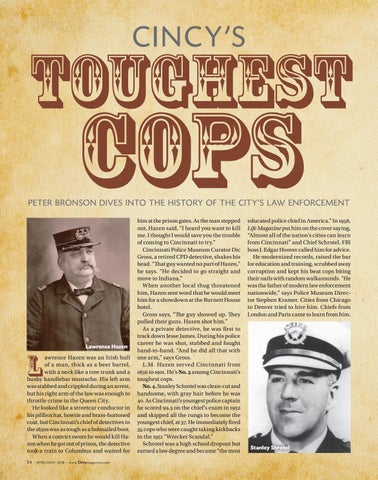
Lawrence Hazen
awrence Hazen was an Irish bull of a man, thick as a beer barrel, with a neck like a tree trunk and a bushy handlebar mustache. His left arm was stabbed and crippled during an arrest, but his right arm of the law was enough to throttle crime in the Queen City. He looked like a streetcar conductor in his pillbox hat, bowtie and brass-buttoned coat, but Cincinnati’s chief of detectives in the 1850s was as tough as a hobnailed boot. When a convict swore he would kill Hazen when he got out of prison, the detective took a train to Columbus and waited for 54
A P R I L /M AY 2 0 1 8 : : w w w.
maga zine.com
him at the prison gates. As the man stepped out, Hazen said, “I heard you want to kill me. I thought I would save you the trouble of coming to Cincinnati to try.” Cincinnati Police Museum Curator Dic Gross, a retired CPD detective, shakes his head. “That guy wanted no part of Hazen,” he says. “He decided to go straight and move to Indiana.” When another local thug threatened him, Hazen sent word that he would meet him for a showdown at the Burnett House hotel. Gross says, “The guy showed up. They pulled their guns. Hazen shot him.” As a private detective, he was first to track down Jesse James. During his police career he was shot, stabbed and fought hand-to-hand. “And he did all that with one arm,” says Gross. L.M. Hazen served Cincinnati from 1856 to 1901. He’s No. 5 among Cincinnati’s toughest cops. No. 4. Stanley Schrotel was clean-cut and handsome, with gray hair before he was 40. As Cincinnati’s youngest police captain he scored 99.3 on the chief’s exam in 1952 and skipped all the rungs to become the youngest chief, at 37. He immediately fired 35 cops who were caught taking kickbacks in the 1951 “Wrecker Scandal.” Schrotel was a high school dropout but earned a law degree and became “the most
educated police chief in America.” In 1958, Life Magazine put him on the cover saying, “Almost all of the nation’s cities can learn from Cincinnati” and Chief Schrotel. FBI boss J. Edgar Hoover called him for advice. He modernized records, raised the bar for education and training, scrubbed away corruption and kept his beat cops biting their nails with random walkarounds. “He was the father of modern law enforcement nationwide,” says Police Museum Director Stephen Kramer. Cities from Chicago to Denver tried to hire him. Chiefs from London and Paris came to learn from him.
Stanley Shrotel
He retired from the Police Division in 1966 to be head of security for Kroger. His honesty and courage made policing a profession. No. 3. John Poppe earned America’s highest award for bravery at the Battle of Milk Creek in northwest Colorado in 1879, just three years after Little Bighorn. Attacked by hundreds of Utes, Sgt. Poppe’s Fifth Cavalry patrol circled its wagons and held out for a week. Poppe earned the Medal of Honor for “Gallantry in Action.” Five years later, the horse soldier with a “giant, rugged frame and enormous strength” showed that medal to the Cincinnati Police and asked for a job. He was hired. Stabbed and shot at many times, he became a “model patrolman” and rose to chief of detectives. He showed gallantry in action again on Jan. 30, 1909, as his morning streetcar ride suddenly lurched into a heart-stopping emergency. On a steep hill down Clifton Avenue, the trolley’s ice-jammed brakes failed and it hurtled out of control. Lt. Poppe fought his way through panicked passengers to the front of the car, where he grabbed a handbrake to help the motorman. The trolley flew off its tracks on a curve and shot toward a 150-foot drop to the city below. It snapped an iron trolley pole like a toothpick and finally stopped in mud, two feet from the fatal drop. Many of the 20 passengers were injured, but only the motorman was killed. Poppe, found lying in blood-stained snow, told rescuers, “I think I’m pretty badly done for. The motorman is hurt worse. Look after him.” With crushed ribs, a punctured lung and a mangled leg, he was given no chance to live. As he prepared to die, he wanted the police to know: “Tell the boys down there I was right in front, and I want them to know I was trying to do my duty.” Prayers and cards flooded in and Lt. Poppe survived. A special city ordinance for his heroism allowed him to return to active police duty on an artificial leg until 1913. No. 2. When the mob infested Newport, Cincinnati stayed as clean as Kansas. One of the reasons was the dapper detective Robert “Machine Gun” Meldon. As a young bailiff in 1930, he tackled a burglar who tried to leap from a courthouse window, then rescued two boys and a girl from drowning in the Ohio River. “Saves Four Lives in One Week,” the headline said.
John Poppe A 1949 Picture of the Year from the Cincinnati Post showed Meldon straddling a curb in trench coat and fedora, blasting his Thompson submachine gun into a basement through clouds of gun smoke.
Robert “Machine Gun” Meldon
“These are photos of the SWAT team sent to Sixth and John Street where a suspect was in an old coal cellar, shooting up at the police,” he wrote years later. Meldon and his partner Det. Bill Wood believed the .45 cal. “Tommy Gun,” invented by Brig. Gen. John T. Thompson of Newport, Ky., was very effective for removing barricaded gunmen, dead or alive. He was in more than a dozen gun battles: three killed, six wounded. In 1957, police were tipped that burglars were going to rob a safe at a Beechmont Avenue Thriftway. Meldon and his crew smuggled weapons into the supermarket in fruit crates and set up an ambush. As the “yeggmen” (safecrackers) arrived, w w w.
m a g a z i n e . c o m : : A P R I L /M AY 2 0 1 8
55
Meldon cut the Thompson loose, riddling one burglar with more than 20 bullets. Another burglar shot back and was machine-gunned. A third was captured alive, huddled behind a bullet-holed meat counter. When a mobster threatened to get even by killing Meldon, the detective made a date to meet him on a street corner in mob-city Newport with his Thompson. The hitman did not show up. Headlines called “Machine Gun” Meldon the “Mob Menace” when he retired in 1963. The wise guys agreed and left Cincinnati alone. No. 1. If Superman pretended to be a polite patrolman instead of a mild-mannered reporter, he could be William C. Boers. Born in Cincinnati in 1872, Boers grew up as a strongman and trapeze artist in the Boers Brothers Circus Act. Looking for a more death-defying challenge, he joined the Baltimore and Ohio Railroad Police and singlehandedly, while unarmed, arrested a trio of armed bank robbers in downtown Cincinnati. The mayor hired him on the spot as a Cincinnati policeman in 1896. On July 6, 1900, he stepped into the path of a runaway mule, wrestled it to the ground and saved three boys in the mule cart. In 1903 he ran with a ladder to the Millcreek Distilling Co. fire and rescued a man from the third floor. Two months later he grabbed a team of runaway horses and pulled them down on himself to save a crowd of shoppers. Still recovering from his injuries a few weeks later, he ran in front of a streetcar
William C. Boers and saved a 4-year-old girl. A year later he jumped out of a moving streetcar on Gest Street and ran alongside
The Murder Case The Greater Cincinnati Police Museum at 308 Reading Road downtown has blackjacks, machine guns, nightsticks, dozens of detectives’ snub-nosed revolvers, ancient radios and callboxes and an amazing archive of records and photos. One of the most interesting exhibits might be called “The Murder Case.” Over 50 years, celebrated defense attorney William “Foss” Hopkins handled hundreds of sensational murder trials—and collected key pieces of evidence along the way. Only half of the murder weapons he collected are guns. The rest testify to the ingenuity of human hate: a hammer, a jagged broken coke bottle, jackknives, weights for drowning, a small bottle of phenobarbital, even a stone axe that could have been used when Cain killed Abel. The police museum is open Tuesdays, Thursdays and Saturdays from 10 to 4. Parking and admission are free. Donations welcome. 56
A P R I L /M AY 2 0 1 8 : : w w w.
maga zine.com
to pull a 3-year-old girl from its path. Both were run over but Boers shielded the girl, and neither was seriously hurt. He was cut while breaking up a knife fight, saved a woman from the second floor of a burning building and wrestled a gun away from a man he arrested for domestic violence. On April 16, 1917, he was off duty but responded to a domestic incident on Fourth Street, where he was shot and killed by a wife-beating husband. His last words to his wife were: “Ma, I tried it once too often. This time they got me.” Kramer says, “Boers was absolutely fearless. Undoubtedly the toughest guy to ever wear a badge for the Cincinnati Police.” That badge, No. 394, is on the wall at the Cincinnati Police Museum, near a medal that shows Boers diving under a streetcar. His picture hangs among 100 officers killed in the line of duty while serving the City of Cincinnati. n