P 22 - Now marking its 70th anniversary, the RoSPA Health and Safety Awards has a long history of recognising organisations that lead the way in health and safety.

![]()


P 22 - Now marking its 70th anniversary, the RoSPA Health and Safety Awards has a long history of recognising organisations that lead the way in health and safety.


Gocator® 2D cameras combine high-speed imaging and deep edge AI (deep learning-powered intelligence executed on-device), in one compact, IP67-rated package—built on the NVIDIA Jetson Orin NX and powered by onboard GoPxL IIoT vision software. These cameras capture, inspect, and output results at up to 84 fps—no PC, no cloud, no middleware—just powerful inspection performance, straight from the camera.

End Users and Manufacturers of consumer and industrial products who need a reliable, flexible, and easy-to-maintain vision system that can scale with their needs.
System Integrators and Control Engineers who need fast deployment, zero-PC architectures, and easy scaling across cells.
Gocator 3D Sensor Users who need to add 2D cosmetic and label checks inside the same 3D/GoPxL ecosystem.


Rapid Deployment
High-quality results delivered on-camera with none of the complexity of PC-based vision.

Edge AI Performance
On-camera training and inference for anomaly detection, image classification, and OCR.

Unified Capability
One UI, one job file, shared workflows—no middleware, no integration overhead.

Automation-Ready I/O
Native EtherNet/IP, PROFINET, Modbus TCP, and MQTT for seamless factory integration.

High-Speed Imaging 5MP/12MP global shutter sensors delivering up to 84 FPS for real-time inspection at line speed.

GoPxL Onboard (v1.4)
No-code inspection pipelines, accelerated AI tools, custom HMIs with GoHMI, and full browserbased configuration— running directly on the device.


Rugged Industrial Architecture
IP67-rated, fanless, vibration-resistant design with sealed M12 connectors.

Open & Scalable
No subscriptions, complete protocol support, flexible extension through scripts and the Python GDK, and fast redeployment across new lines or sites.


Editor
Oliver Batt oliver@cimltd.co.uk
Publication Manager
James Burke jb@mepca.com 01795 509105
Head of Brand Development
Jim Bearden jim@mepca.com 01795 509105
Design & Production
Grant Waters grant@cimltd.co.uk
James Taylor james@cimltd.co.uk
Administration Manager
Natalie Woollin admin@cimltd.co.uk 01795 509103
Credit Facilities Manager
Gwen Lee creditcontrol@cimltd.co.uk 01795 509103
Head of Digital
Xhulio Bishtaja digital@cimltd.co.uk
Marketing Manager
Lucas Payne lucas@cimltd.co.uk
Director
Tom Woollin tom@cimltd.co.uk
Managing Director
John Denning
© 2026 Cogent Multimedia Limited, 1st Floor, Saphir House, 5 Jubilee Way, Faversham, Kent, ME13 8GD. No part of this magazine may be reproduced or stored in a retrieval system or transmitted in any form – electronic, mechanical or physical – without express prior permission and written consent of the publisher. Contributions are invited and when not accepted will be returned only if accompanied by a fully stamped and addressed envelope. Manuscripts should be typewritten. No responsibility can be taken for drawings, photographs or literary contributions during transmission or in the editor’s hands. In the absence of an agreement the copyright of all contributions, literary, photographic or artistic, belongs to Cogent Multimedia Limited. The publisher accepts no responsibility in respect of advertisements appearing in the magazine and the opinions expressed do not necessarily represent the views of the publisher. The publisher cannot accept liability for any loss arising from the late appearance or nonpublication of any advertisement.

Welcome to the April issue of MEPCA magazine.

Over the first quarter of 2026, a delicate optimism had started to build within the manufacturing sector, with businesses poising to invest in growth. But the sector now finds itself faced with another geopolitical crisis. The war in Iran has raised oil prices, resulting in the sharpest rise in inflation since Black Wednesday in 1992. Exactly how this will impact the sector will become clearer in the coming months, but that delicate optimism will surely have dissipated.
Amidst this uncertainty, the April issue focuses on an industry constant: Health & Safety. In this focus, we look at the latest solutions in occupational health and risk management and the strategies for protecting manufacturing and engineering’s most vital resource: its people. Leading this section is MSA Safety, bringing us the latest in connected gas detection systems. Also in this section, we bring you an exclusive Q&A with Pulsar Instruments on the invisible threat to health – noise exposure.
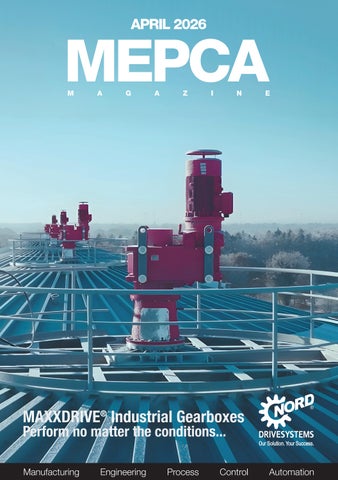
On the cover this month is NORD DRIVESYSTEMS, with an encoder-less innovation for improving the efficiency and performance of drive technology (page 14-15).
Turn to page 12 to learn why our April Manufacturing Champion swapped medicine for machinery. Elsewhere in this issue, our events section shows that there is still plenty to look forward to this year.
Oliver Batt, Editor
To subscribe to MEPCA visit our website www.mepca.com or scan the QR code.


RS Group, a high-service global product and service solutions provider for industrial customers, has today announced its acquisition of BPX Group, a specialist distributor of industrial automation and control products. The deal will see BPX become part of the RS Group.
As a result of this acquisition, BPX is now part of a global organisation with circa 8,500 employees, serving millions of customers every day. The deal is designed to support the RS Group strategy to deepen its technical capabilities. BPX brings specialist automation and control (A&C) knowledge, serving industrial customers, high service intensity, combined with strong supplier relationships.
Raj Patel, Managing Director, RS UK & Ireland, said: “We are delighted to welcome BPX Group into the RS family. This acquisition will strengthen our product technical capabilities in the A&C category and help to accelerate our growth plans within the UK & Ireland markets.
“Through the technical expertise and specialist knowledge of BPX, combined with the scale, knowledge and reach of RS Group, we will find new opportunities to win in the markets in which we operate, and continue to grow our businesses together.”

Guy Collins, Director from BPX Group, said: “This is an exciting step for BPX Group which will take the business to the next level. BPX is a complementary business to RS in the UK & Ireland, both are high-service level distributors of automation and control products with an overlap of product range and a customer-centric focus, but each serving the market in different ways.”
rsgroup.com
Leading packaging machinery manufacturer, ULMA Packaging UK, will make its debut appearance at MedTech Innovation Expo Ireland, as it expands its focus on Ireland’s growing medical device manufacturing sector.
Taking place at Dexcom Stadium, Galway, the exhibition brings together manufacturers, technology providers, and supply chain specialists serving one of Europe’s most significant MedTech hubs. ULMA will exhibit on stand 6.
The event marks ULMA’s first appearance at the show and reflects a focus on the Irish market following the appointment of Rob McKenna as regional sales manager for Ireland. With demand for advanced packaging solutions in the medical sector increasing, ULMA will showcase technologies designed to meet stringent requirements for product protection, traceability and hygiene.
Rob McKenna will be joined by Alastair Cook, product manager for thermoforming and traysealing, with both available to discuss applications and packaging formats suited to medical device production environments.
ULMA’s presence will focus on thermoforming and flow-wrap solutions, technologies widely adopted across medical manufacturing for their reliability, flexibility and ability to deliver consistent pack quality. Automation will also form a key part of the company’s messaging,

demonstrating how integrated systems can reduce human intervention during packaging processes while supporting product safety and regulatory compliance.
Although full machinery cannot be installed at the tabletop space, ULMA will present real packaging samples to demonstrate achievable pack designs and highlight how its solutions support the precise handling and protection required for medical applications. ulmapackaging.co.uk
On 1 January 2026, Nikola Matic took up the newly created position of Head of Sales at stabau GmbH. In his new role, he is responsible for sales in Germany and abroad and is driving forward the strategic expansion of national and international sales activities. As a member of the HUBTEX Group, stabau will primarily rely on the various HUBTEX branches internationally.
Matic has many years of sales experience in the industrial sector. His previous responsibilities included establishing structured sales processes and further developing international market activities. “stabau stands for technically sophisticated solutions and a strong customer focus. Together with the team and the entire group, I would like to further develop the sales structures and strengthen international growth in a targeted manner,” says Nikola Matic.
HUBTEX also emphasises the importance of the new appointment: ‘With Nikola Matic, we are strengthening stabau’s sales and group-wide integration in international business,’ says Hans-Joachim Finger, Managing Director of the HUBTEX Group.

Since its foundation in 1974, stabau GmbH, formerly Schulte-Henke GmbH, has stood for the highest quality and innovation in the development, manufacture and sale of attachments, stationary equipment and telescopic forks for intralogistics under the product name stabau. stabau.com
Companies House, the government body that maintains the register of companies and incorporates all forms of companies in the United Kingdom, has disciplined more than 100 staff over the past three years, according to new data.
The findings were revealed via the Freedom of Information Act (FOI), and analysed by the Parliament Street think tank, observing the number of disciplinary actions taken against staff as well as the number of employees sent on compliance and ethics training each year, for the past three years.
In total, disciplinary action was taken against 132 staff over the period, with Companies House attributing these to breaches of internal policies, including attendance management, grievance, performance, disciplinary and probation.
The news comes following a major tech glitch on the UK’s official corporate register permitted people to access other companies’ details by pressing the back key on the site’s dashboard.
The department also outlined that 12,684 training courses on compliance and ethics were completed by Companies House employees and contractors over the three-year period, as part of mandatory annual learning.
Within the training, staff were expected to complete

modules on Counter Fraud, Bribery and Corruption, Security and Data Protection, Government Security Classification Policy, Health and Safety, and Civil Service Expectations.
A Companies House spokesperson said: “As a modern Civil Service employer with approximately 2,400 staff we have robust procedures in place to address misconduct or poor performance.”
Raj Abrol, CEO of AI firm Galytix added, “AI adoption will fix many of these problems, allowing organisations to reduce risk and automate complex tasks to reduce human error.” galytix.com
In a sector operating under sustained pressure, wellbeing is a strategic advantage says Chris Newson, Director, Health, Safety & Environment at Make UK.
In a world where the UK domestic political agenda is dominated on a daily basis by what seems an endless stream of crises, policymakers appear to have forgotten the adage, “It’s the economy, stupid”. And if there is one ticking timebomb that is acting as an anchor on economic growth, it is the rising tide of ill health and absence due to stress, depression and anxiety.
In this context, workplace wellbeing is becoming a critical enabler of organisational performance. Robust wellbeing systems support not only the attraction and retention of talent, but also engagement, productivity, and long-term workforce sustainability.
Manufacturing remains one of the most critical pillars of the UK economy. It supports millions of jobs, anchors regional economies, drives exports, and underpins national productivity and innovation.
Yet, the sector is operating in an environment of sustained pressure. Businesses face ongoing cost challenges, economic uncertainty and political instability, alongside geopolitical tensions and global trade volatility that continue to reshape markets and supply chains.
New research – commissioned by Make UK and conducted anonymously and independently with senior decision makers and shopfloor employees across the manufacturing sector – reveals a sector that has built strong foundations but now needs to deliver tangible results. In particular, there is a clear, almost shocking divergence between the attention given to physical issues and risks compared to wellbeing related issues.
Most striking among the findings, is a clear perception gap between leaders and the shopfloor. Manufacturers have activity in place – policies, procedures, risk assessments and training – but these are not consistently understood or experienced. Wellbeing policies exist, but many employees do not know what they include. Risk assessments are carried out, but not everyone sees the implementation. Training is common for physical health, but less so for psychological health. The result is a system that looks robust on paper but doesn’t always translate into clarity or confidence on the ground.
The human impact is real. Many employees report mixed or worsening wellbeing, and they are clear about the consequences: lower morale, reduced productivity and increased absence. Crucially, they believe that better wellbeing support would improve their performance and attendance.

Companies should ensure wellbeing is felt as a business priority and that employees are aware of what support is available. Policies must be communicated consistently, be visible and felt on the ground, not hidden away in documents. And, wellbeing must be given the same priority and, treated with the same rigour as, physical safety with consistent training on promoting mental health.
The Make UK research shows a sector that has already done much of the hard work. The findings offer a powerful mandate for action. Wellbeing is not a “nice to have” or an add on; it is a strategic advantage.
makeuk.org
The outlook for UK automation & robotics in 2026 has a renewed confidence and forward momentum, says Oliver Selby, BARA Chairperson & Head of Sales at FANUC UK.
As Chairman of the British Automation & Robotics Association, I have the privilege of engaging closely with system integrators, manufacturers, technology developers, and end users across the UK. Entering 2026, one message stands out clearly: despite global uncertainty, UK industry is showing renewed confidence. Automation and robotics are now recognised not as optional improvements but as essential tools for competitiveness, resilience and sustainable growth.
Conversations with BARA members reveal a notable rise in optimism shaping investment planning for the next two years. System integrators report stronger pipelines, while end users particularly in food and beverage, life sciences, logistics, and advanced manufacturing are accelerating from pilots toward full scale deployment. Labour shortages, rising costs and sustainability commitments continue to drive automation forward.
A significant cultural shift is underway: businesses are no longer debating whether to automate but how quickly solutions can be deployed and scaled. Flexible automation cells and data driven production systems are enabling even smaller manufacturers to modernise efficiently.
A key development this year will be the launch of the government’s new robot adoption hubs, led by the Department for Science, Innovation and Technology. These hubs will play a vital role in reducing the traditional barriers to automation, especially for SMEs. By offering demonstrators, expert guidance and hands‑on training, they give businesses a low‑risk environment to explore solutions and understand their benefits.
From BARA’s perspective, the hubs are as much about capability building as they are about technology. They will help demystify robotics, address skills gaps, and connect end users with trusted integrators and solution providers. As they mature, these hubs will strengthen regional productivity and create a nationally coordinated foundation for long‑term innovation.

The UK is also seeing a rise in startups bringing advanced AI‑enabled technologies to the automation market. Innovations in vision systems, autonomous robotics, predictive maintenance and optimisation software are adding agility and creative problem‑solving to the ecosystem. Many of these businesses are partnering with established integrators, combining innovation with robust delivery capability.
AI is making robots more accessible easier to program, more adaptable, and more suitable for non‑specialist users. Rather than replacing established players, these startups are enriching the sector and reinforcing the UK’s global competitiveness.
With rising industrial confidence, targeted government support, and a vibrant AI‑driven startup community, the UK automation and robotics sector is well positioned for sustained growth throughout 2026. At BARA, we are proud to support this progress.
automate-uk.com/our-associations/bara/
We’re delighted to introduce our April Manufacturing Champion: Olivia Lane, Mechatronics Engineering Apprentice at Amazon and regional winner of the Make UK Engineering Apprentice Rising Star Award. Here, Olivia discusses her career shift from medicine to machinery, engineering’s lack of visibility, and provides advice for those considering apprenticeships.
Engineering was a subject that kept cropping up throughout my school journey, however, I was so set on a dream to pursue medicine at this time that it was always pushed to the back of my mind. After A-levels and being unsuccessful in 2 application cycles for Med school, I decided to take a gap year and worked as a warehouse operative for Amazon. Through various job roles at one of our distribution sites I was able to see Engineering in the real world. I was able to see for myself exactly what engineering is in a mechanical, electrical and robotic context. I progressed at Amazon to become a department team lead and my favourite/most interesting days were when the machinery broke down and the engineers rushed in. At this point I knew medicine was not my true calling, fixing machinery was.
WHAT COULD THE UK DO BETTER TO ENCOURAGE WOMEN AND OTHER UNDERREPRESENTED DEMOGRAPHICS TO PURSUE STEM SUBJECTS AND ENGINEERING CAREERS?
Personally, I believe a key issue in UK education is that many students (especially women and underrepresented groups) are not exposed to what engineering actually looks like in the real world until much later, if at all. This lack of visibility can prevent people from considering STEM pathways early enough. In schools, engineering is often taught in a very theoretical way compared to more visible careers like medicine. Integrating hands on projects, workplace visits and partnerships with companies such as Amazon would allow students to see mechanical, electrical and robotic systems in action.
WHAT ADVICE DO YOU HAVE FOR ANYONE CONSIDERING AN APPRENTICESHIP AS A WAY OF BEGINNING OR FURTHERING THEIR CAREERS?
Apprenticeships are an excellent option for anyone considering starting or developing their career and they are often misunderstood. One of the biggest misconceptions

is that apprenticeships are only for people who struggled academically or are better with practical subjects. But in reality, they are a credible and competitive pathway that can be just as academic. Another major benefit is the hands-on experience gained from day one. Apprentices work in real environments, solving real problems and developing practical skills that employers value highly. In contrast, many university graduates finish their degrees with strong theoretical knowledge but limited work experience. This can make it difficult to secure graduate roles that often require prior experience. Apprenticeships are also a great option for those who may not be completely certain about their career path. Because you are gaining experience while working you can explore a field and decide if it truly suits you, without committing to years of study and significant debt. This makes it a relatively low risk way to test and build a career.

SCAN CODE to register.


Routeco Live brings together the biggest names in industrial manufacturing for a day of expert talks, real-world insights and hands-on demonstrations. Elland


As industry demands ever higher performance and energy efficiency, NORD DRIVESYSTEMS’ answer is Current Field Control (CFC) open-loop injection control. This enables synchronous motor control without need of an encoder. Read on to learn the key advantages of this approach, and how the technology works in practice.

In modern automation, precision and efficiency are no longer optional; they are fundamental expectations.
As industries push for higher performance with lower energy consumption and reduced system complexity, drive technology must evolve to keep pace. NORD DRIVESYSTEMS has stepped confidently up to meet these demands with its permanent magnet synchronous motors (PMSMs).
These so-called NORD IE5+ PMSMs bridge both the demand requirements of dynamic high performance and lower energy consumption.
Traditionally, dynamic applications using PMSMs rely on encoders to provide rotor position feedback. While effective, encoders add cost, complexity and installation effort. They also introduce potential failure points in harsh environments. Current Field Control (CFC) open-loop injection control sidesteps these limitations entirely.
NORD’s CFC open-loop injection control is an innovative method that enables powerful, dynamic control of PMSMs
without the need for an encoder.
This development marks a significant shift in how synchronous motors can be deployed, especially in applications where rapid load changes, high dynamics and cost efficiency are essential. By eliminating the encoder while maintaining high performance, NORD offers a compelling solution for industries seeking both simplicity and capability.
The method uses intelligent algorithms to determine the motor’s magnetic field orientation without physical feedback hardware. The result is precise, stable and highly dynamic motor control, even under demanding conditions.
One of the most immediate benefits is the elimination of the encoder itself. No encoder means lower hardware costs, fewer components to install and reduced wiring complexity. Moreover, the control method is inherently energy efficient, particularly in partial load conditions where many industrial systems operate most of the time.
Because the system can still deliver high dynamic performance without an encoder, motors can be more compact, reducing both footprint and cost.
2. Faster, simpler commissioning
Commissioning encoders can be time consuming and error prone. With CFC open-loop injection control there is no encoder commissioning required at all; the system is designed for plug and play readiness, allowing integrators to get machines running quickly. Intelligent control logic automatically adapts to the motor, reducing setup time and minimising the need for specialised expertise.
3. High dynamics and overload capacity
Despite operating without feedback hardware, the system delivers impressive performance. Motors can start with 150% overload, providing strong torque for demanding start-ups. Shorter ramp times enable more dynamic acceleration, which are ideal for applications with frequent speed changes. The method maintains stability even under fluctuating loads, ensuring smooth operation.
4. A sustainable drive solution
Sustainability is increasingly central to industrial decision making. CFC open-loop injection control supports this shift by enabling more compact, lightweight drive systems, which reduce energy consumption and lower material usage due to the absence of encoders.
The result is a solution that aligns with both economic and environmental goals.
5. Ideal for dynamic, high change applications
Industries such as conveyor technology, packaging, and production often experience rapid load variations and frequent start stop cycles. CFC open-loop injection control is particularly well suited for these environments, offering the responsiveness and reliability needed to maintain throughput and efficiency.
CFC open-loop injection control is compatible with all NORD permanent magnet synchronous motors. Currently, it is available as standard on NORDAC latest generation frequency inverters. This ensures long term scalability and flexibility for users who want to standardise on a single control approach.
The updated NORDAC LINK is engineered for seamless integration: Ethernet comes pre-installed, simplifying network connectivity; support for industrial safety protocols PROFIsafe and FSoE ensures safe, reliable communication in safety critical environments; and built in safety functions—including STO, SS1 t, and SLS—enhance operational protection without requiring additional hardware.
The inclusion of the CFC open-loop injection method makes the NORDAC LINK even more versatile, enabling

encoderless control of high efficiency synchronous motors in dynamic applications.
Together with the motor mountable NORDAC ON, the NORDAC LINK forms part of a modular drive ecosystem that gives users greater freedom in designing flexible, scalable drive architectures.
NORD’s LogiDrive system integrates motor, gear unit, and drive electronics into a compact, low maintenance package ideal for logistics environments such as airports, warehouses, and parcel distribution centres. There are two variants:
• LogiDrive Advance combines the NORDAC LINK with an IE5+ synchronous motor and delivers exceptional energy efficiency across wide speed and load range, making it ideal for facilities prioritising long term energy savings
• LogiDrive Basic Pairs the NORDAC ON with an IE3 asynchronous motor, offering a cost effective, compact solution with high power density, which is well suited for standard conveyor applications.
NORD backs its technology with real world data through its NORD ECO consultation service, which analyses actual system consumption to identify optimisation opportunities.
• The largest recorded saving so far is 1,165 kWh per year
• This equates to powering a single person household for six months
• It also represents a reduction of approximately 466 kg of CO₂
These numbers demonstrate that energy efficiency isn’t just a marketing claim; it’s a tangible outcome. For more information, visit NORD’s website.
nord.com/en/


Sponsored By

As industrial sites become ever more connected through digitisation, gas detection systems have likewise evolved to support them. Here, MSA Safety explains how connected gas detection systems can transform health and safety management through shared alerts.

In recent years, innovation in gas detection technology has accelerated. Advances in connectivity and digital integration are enabling safety systems to do more than simply detect hazards. Connected devices can now share information, provide real-time visibility of conditions and support faster, more coordinated responses when incidents occur.
This shift towards connected safety solutions is helping organisations move beyond isolated monitoring and towards more integrated approaches to risk management.
One example of this evolution is the growing use of connected gas detection systems such as MSA Safety’s ALTAIR io™ 4 Connected Gas Detector, which integrates with the MSA Grid platform. Equipped with built-in CAT-M LTE cellular connectivity, the ALTAIR io™ 4 can transmit data directly to the cloud, allowing safety teams to monitor alerts, device activity and safety data in real time. Through the Grid platform, connected devices can also share alarm notifications through features such as the
Shared Alerts System. Rather than limiting alarms to the individual worker carrying the device, Shared Alerts allows notifications to be distributed to nearby colleagues. If a detector such as the ALTAIR io™ 4 triggers an alarm, workers nearby can receive an alert directly on their own device.
In many traditional gas detection systems, alarms are largely localised. When a device detects dangerous gas levels, the alert is typically limited to the individual wearing the detector, meaning others nearby may not be aware of the situation unless informed separately.
By sharing notifications across connected detectors, workers can be informed immediately when a colleague nearby experiences a potential safety issue, enabling faster awareness and response.
When organisations upgrade from non-connected gas detection systems to connected solutions such as ALTAIR

io™ 4 detectors connected to MSA Grid, devices can communicate through the platform and share alerts across the workforce.
The system can be configured in different ways depending on the operational environment. Alerts can be proximity-based, meaning workers within a defined distance receive a notification when an alarm is triggered. Alternatively, alerts can be assigned using location or organisational labels so that workers operating in the same building, floor, department or operational zone receive the alert.
This flexibility allows safety teams to configure alert distribution in ways that reflect how their facilities operate.
Workers can receive notifications relating to several different types of alarms:
Gas alarm – occurs when a device such as the ALTAIR io™ 4 detects dangerously high levels of gas, including substances such as hydrogen sulphide (H₂S) or carbon monoxide (CO), or when a worker reaches an exposure limit. Through the Grid platform, these alerts can be shared with nearby workers so they are aware of the hazard and can take appropriate action.
Motion alarm – may activate if a worker remains motionless for an extended period, indicating a potential emergency such as a collapse or medical incident. Shared alerts mean colleagues nearby can receive a notification quickly and investigate the situation.
Worker emergency alarm – can be triggered manually if a worker needs assistance. Once activated, the alarm can be communicated through connected detectors, helping make sure that support can reach the worker as quickly as possible.
The ability to share alerts through connected gas detection systems offers several advantages in workplace safety management.
One key benefit is improved situational awareness.
When alerts generated by devices such as the ALTAIR io™ 4 are shared across connected detectors through the Grid platform, workers nearby gain immediate visibility of potential hazards.
Faster communication can also support more effective emergency responses. Rather than relying on manual communication processes, alerts can be distributed automatically, allowing workers to take action without delay. In situations where gas exposure or worker distress is involved, this speed can be critical.
For safety managers, the combination of connected detectors and the Grid platform also provides greater oversight of site activity. Real-time alarm data can help safety teams understand what is happening across a facility and coordinate responses when needed.
As digital technologies continue to reshape industrial workplaces, connected safety solutions are becoming an important part of modern risk management strategies.
Systems that link devices such as the ALTAIR io™ 4 with cloud platforms like MSA Grid demonstrate how gas detection technology is evolving beyond standalone monitoring tools. By enabling devices, workers and safety managers to share information more effectively, these systems help organisations respond more quickly to potential hazards.
Shared alerts are one example of how connectivity can strengthen existing safety practices. By ensuring critical information reaches workers when needed, connected gas detection solutions can help organisations build a more aware, responsive and collaborative safety culture.
To learn more about how connected technologies can support worker safety, visit MSA Safety’s Connected Worker ecosystem page.
gb.msasafety.com/connected-work
How can organisations manage gas detection more efficiently, economically and safely across multiple sites? One answer lies in connected working. This approach links portable gas detectors, workers and managers through wireless connectivity to a cloud-based software platform for improved visibility and streamlined processes.
To maximise the potential benefits of connected safety, MSA Safety shares five key capabilities to look for in a connected safety system.
A connected gas detection system should be easy to deploy without requiring extensive additional infrastructure. Systems that work straight out of the box can save both time and expense during implementation. It is also important to consider future flexibility. As technologies and safety requirements evolve, organisations may need to scale or adapt their systems. Devices that support over-the-air (OTA) software updates allow new features or improvements to be deployed remotely, helping to avoid downtime and eliminating the need to return detectors to suppliers for updates.
Traditional paper or spreadsheet-based processes for issuing and returning detectors can be time-consuming and prone to errors. A connected system can simplify this process through digital assignment.
For example, workers may be able to assign a detector to themselves using an RFID tag or similar method. At the end of the shift, placing the device back into its dock automatically returns it to the fleet. This approach links collected data to individual users, improving accountability while also simplifying inventory and device management.
Maintaining compliance with testing and calibration requirements is essential for reliable gas detection. A connected system can help by automatically preventing the assignment of devices that are not compliant. Some docking stations can also check detectors for compliance and perform bump testing or calibration when required. In addition, devices with built-in indicator lights can clearly signal compliant, non-compliant or alarm conditions, providing workers with a quick visual reference.

Access to accurate information is vital for effective safety management. Connected systems can automatically record and store data from gas detectors, making it available to safety managers in real time.
This information may include testing and calibration records, compliance status, maintenance history and details of device usage. Data such as locations, gas levels, alarms and incidents can also be monitored remotely. For organisations operating across multiple sites, the ability to view and map this information centrally can significantly improve oversight and response times.
Beyond data collection, connected systems can help turn information into practical insight. Real-time data can support faster decisions during incidents, enabling managers to assess situations quickly and guide workers on evacuation or other protective actions.
Over time, access to reliable safety data can also support continuous improvement. Insights from incident reports, audits and equipment performance can help organisations refine procedures, optimise maintenance schedules and help make sure gas detection equipment remains in optimal condition.
gb.msasafety.com/connected-work

Designed as the ultimate sampling tool, the ALTAIR io 6 is built with durability in mind, features an integrated pump, and comes with cellular connectivity right out-of-the-box.
As health and safety expectations continue to evolve across sectors, organisations are increasingly seeking credible ways to demonstrate their commitment to protecting their workforce and wider communities. The RoSPA Health and Safety Awards remains one of the most established and globally respected indicators of excellence.
Now marking its 70th anniversary, the RoSPA Health and Safety Awards, sponsored by NEBOSH, has a long history of recognising organisations that lead the way in health and safety. Over seven decades, it has grown into one of the world’s largest and most influential safety award programmes, welcoming entries from more than 50 countries and reflecting a truly global community of practice.
For many organisations, participation in the RoSPA Awards provides an opportunity to benchmark their approach. A RoSPA accolade is not simply a reflection of outcomes; the scheme evaluates an organisation’s management systems, long-term strategies and the extent to which health and safety is embedded at every level.
As a result, earning an award is often seen as a marker of leadership, signalling effective risk management and a culture that prioritises the wellbeing of employees, contractors and the public. This external validation can be a valuable asset.
While the awards recognise organisational achievement, they also shine a spotlight on the individuals and teams who drive safety forward. For many entrants, the recognition offers an opportunity to celebrate the dedication of staff, reinforce shared values and highlight the impact of collaborative working. As employee engagement becomes increasingly critical to maintaining robust safety cultures, the ability to showcase success plays a meaningful role in morale and retention.
RoSPA is widely recognised as a trusted voice in safety, and association with the organisation carries substantial reputational weight.
Participation can also contribute to wider corporate responsibilities. As environmental, social and governance (ESG) expectations grow, organisations are under pressure to provide clear evidence of their commitment to social

value and community wellbeing. Demonstrating strong health and safety performance is a significant part of that story.
The Awards programme is not just about recognition. RoSPA has a long history of influencing standards, policy and public understanding of safety, and the awards community plays a part in that wider mission. Many organisations choose to go on to collaborate with the charity through research, campaigns or sector-wide initiatives, extending their impact beyond their immediate operations.
Such partnerships reflect a shared commitment to improving safety outcomes across industries and throughout society – a reminder that health and wellbeing extend far beyond compliance.
More information about the RoSPA Health and Safety Awards is available at:
rospa.com/awards.

Here, global electronic components distributor DigiKey highlights the dangers of electrostatic discharge and explains why ground references are critical to workplace safety.
Electricity makes our modern world run. But it can also be dangerous, especially in the workplace. For instance, the United Kingdom’s Health and Safety Executive (HSE), a government agency, receives around 1,000 work accident reports each year involving electric shock or burns, about 30 of which are fatal. Additionally, the U.S. Occupational Safety and Health Administration (OSHA) includes electrocutions as part of the construction industry’s “Fatal Four”1, accounting for 71 deaths in 2017 alone.
When high voltages and electrical currents are transmitted into factories, commercial vehicles, airplanes, medical equipment, servers and other high-power applications, electrostatic discharge (ESD) can result in bodily harm, equipment damage or even death.
Lightning strikes and man-made power surges are two types of ESD. However, when a system involves high voltage and/or high current along with a lot of copper circuitry, electromagnetic interference (EMI) and radiofrequency interreference (RFI) also can cause problems, interfering with the proper functioning of equipment. For example, if there are motors running in a conveyor system near busbars, EMI and RFI could affect the performance and accuracy of nearby sensors.
A ground reference, such as Molex Grounding Jumpers, draws potentially damaging excess power and references it to the ground. This can protect workers from electrocution and equipment from damage, and it also ensures performance by absorbing EMI and RFI.
1. UL-rated: the Molex Grounding Jumpers available through DigiKey are all UL-rated and therefore deliver guaranteed quality. Thoroughly tested according to Underwriter Laboratories’ stringent standards, the grounding jumpers meet the requirements to earn the official UL rating.
2. Flexible: Molex Grounding Jumpers are bendable and twistable, making them easier to fit in available spaces as opposed to rigid copper that needs to be custom designed.
3. Cost Effective: because they are offered as standard products and often need no or little customisation, Molex Grounding Jumpers are more economical than custommade rigid copper.

Getting power from point A to point B is crucial in today’s electrically run world, and Molex Grounding Jumpers can contribute to power delivery systems by functioning as flexible busbars. Furthermore, when Molex Coeur HighCurrent Interconnects (also available through DigiKey) are integrated with the grounding jumpers, customers have a complete busbar solution with a low-profile, easy-to-mate connector.
With quick availability through DigiKey, Molex Grounding Jumpers and Coeur High-Power Interconnect System provide a complete solution for safety and power delivery needs. For custom inquiries, visit DigiKey’s website for more information.
bit.ly/4rquUBo
1. osha.gov/data/commonstats


Across manufacturing sites, the critical flow of people and goods intersect at high speeds. From production floors to loading bays, these varied environments pose numerous hazards for workers. With that, comes the demand for a consistent safety system that enhances site safety and productivity.
When safety is positioned strategically, it can ensure operational quality. With a responsible safety culture defined across the site, risks are identified proactively, allowing for safe and seamless workflows.
Modern manufacturing environments are complex ecosystems. Inside, workers interact daily with production, complex machinery and automated processes. These zones are often well maintained, but risks can remain for people and equipment, particularly during maintenance or cleaning routines. Unexpected start up or uncontrolled access to danger zones due to human error cause potential for serious incidents.
Proven, effective safety approaches play an essential role in mitigating such human error. They are no longer optional.
According to HSE guidance on machinery safety, implementing interlocked guards (such as mechanical trapped key systems) that comply with BS EN ISO 14119 can ensure that machines cannot start before the guard is closed. They can also prevent machines being opened whilst still moving, which is essential in preventing injury during routine intervention, cleaning and maintenance.
Trapped key interlocking solutions therefore actively work to mitigate human error to enforce safe, consistent sequences of operation. By mechanically controlling access to hazardous areas, they reduce the risk of harm at every stage of operations, where people and manufacturing equipment interact. Beyond safety, these systems support operational efficiency by enabling faster, safer maintenance and reducing downtime. Their scalable design ensures compliance with safety standards, while delivering longterm cost and reputational optimisation.
The risk profile transitions as operations shift away from machinery and towards loading bays. Logistics operations are fast-paced and operate under significant time pressure. With site personnel, lorry drivers and vehicles all speedily operating in proximity, scope for accidental drive-aways and near misses can loom, especially if safety processes are not correctly followed.
This is why a consistent safety system across facilities is

crucial. Trapped key interlocking solutions like the Salvo Loading Bay Safety System Solution continue the proven principles of TKI, forcing workers to follow a safe sequence of loading or unloading procedures, which means that trailers can only move when it is safe to do so.
Safety is too often considered an obligation, discussed in line with compliance or a site checklist. However, a seamless safety culture recognises the need for consistency and reliability across the site. Robust safety solutions like trapped key interlocking, can be applied across manufacturing sites and facilities of all sizes, as well as loading bays and warehouses, creating clarity and enforcing routine safe behaviour.
Ultimately, a robust safety culture not only reinforces people’s protection, but shows a genuine commitment to efficiency and growth as an organisation.
sentricsafetygroup.com

The Sentric Safety Group unites the world’s leading safety brands to create the long-term protection of people, productivity, and business reputation


Gas monitoring is crucial for any industry utilising gases in its processes. Megan Hine, a Gas Safety expert at Draeger Safety UK, gives five top tips for gas safety in manufacturing facilities.
Gases play a crucial role across many manufacturing and industrial environments, supporting processes such as refrigeration, fermentation, sterilisation and product packaging. However, the potential for leaks, as well as accumulation and exposure hazards, mean that effective gas monitoring isn’t simply good practice; it is fundamental to protecting people, property and operations.
1. Be alert to ‘workarounds’ in your organisation. Sometimes people can be complacent about gas safety and take matters into their own hands. For example, in a food processing factory where carbon dioxide and nitrogen are used in the packaging process (both gases pose serious risks at certain concentrations), simply opening a door to ventilate the area and prevent gases building up is not an adequate safety solution, nor is it an alternative to the installation of a fixed gas detection system.
2. Keep it simple, particularly for smaller industrial settings. A well-chosen gas detection system supported by expert advice from a knowledgeable provider is often more than enough for lower-complexity environments.
3. Work with the company supplying the gas detection system to minimise touchpoints so that the diagnostic information and configuration of the transmitter can be read directly from a controller. This allows for a single touchpoint, which is easy to access and can be linked to an alarm which sounds if there is a leak to enable swift evacuation of the building.
4. Ask the prospective supplier what experience they have in your industry, and make sure that they can handle the full range of gas safety issues in your business. Additionally, ensure the company has strong engineering, installation, service and maintenance capabilities to support you through the process and look after your system longerterm.
5. Consider the total cost of ownership of gas detection and monitoring devices. Quality can vary, and it’s important to ask, for example, how long consumable parts such as sensors or batteries should last. There can be significant differences in the lifespan of such parts, and the

frequency with which they may need to be replaced can make the difference between good and poor value in the long term.
Gas detection of airborne hazards is an issue that is attracting growing focus, not least with the increased use of new and more environmentally sustainable practices and materials.
Obtaining good advice from trusted partners is an effective way for health and safety professionals to efficiently address gas safety concerns, from the small and simple to the sophisticated and bespoke, ensuring peace of mind for all concerned.
bit.ly/4rIFLXk

Dräger Fixed Gas Detection – A total solution, no matter the size
Whether for a compact laboratory or a sprawling oil refinery, Dräger’s fixed gas detection solutions are designed to safeguard every environment. Our holistic approach begins with expert consultation and project management, followed by tailored engineering, seamless installation and commissioning. With a team of over 70 engineers across the UK, we also ensure ongoing support for reliable, long-term safety. To learn more or arrange a consultation, please scan the QR code or visit www.draeger.com
Shawcity Limited has expanded its partnership with global safety manufacturer MSA Safety through a new channel agreement to supply the Bacharach range of gas and refrigerant leak detection products in the UK.
The new agreement builds on Shawcity’s major channel partnership with MSA Safety announced in January 2026, further strengthening the company’s fixed gas detection portfolio while enabling expansion into the growing HVAC-R sector. By incorporating Bacharach leak detection technologies, Shawcity will be able to provide customers with an even broader range of specialist monitoring solutions.
Founded in 1976, Shawcity is recognised as one of the UK’s leading providers of workplace gas detection systems. The company has built its reputation on technical expertise, impartial advice and strong partnerships with global manufacturers. Its portfolio already includes technologies from industry leaders such as Analox, Crowcon Detection Instruments, GDS Technologies, Ion Science, Sensitron and Uniphos Envirotronic.
The addition of Bacharach solutions reflects the brand’s long-standing heritage in gas measurement and leak detection. Established in Pittsburgh in 1909, Bacharach developed a reputation for precision instrumentation and advanced gas monitoring technologies across industrial and commercial sectors. The company became part of MSA Safety in 2021, bringing over a century of expertise into MSA’s global safety portfolio.
Neil O’Regan, Managing Director at Shawcity, said the expanded partnership aligns closely with the company’s values and long-term strategy.
“With a long history of innovation and developing patented detection technologies, MSA Safety is regarded as a global leader in the development and manufacture of advanced safety products, technologies and solutions,” he said.
“Their commitment to innovation, listening to customers and responding to customer needs aligns strongly with Shawcity’s values, and we are delighted to introduce their Bacharach solutions to our fixed gas detection offering.”
MSA Safety also highlighted the importance of the partnership for expanding access to its technologies in the UK market.
Bryan Redmond, Regional Sales Manager at MSA Safety, said:
“We welcome the opportunity to grow our partnership with Shawcity through the addition of our Bacharach portfolio. Shawcity’s well-established presence and highly


regarded reputation in the detection industry provide a strong foundation for bringing our innovative technologies to more customers in the UK.”
Shawcity’s in-house Fixed Gas Detection team provides a complete service across the UK, including site surveys, system design, installation, commissioning, handover and ongoing maintenance. With the addition of refrigerant leak detection solutions, the company can now support a wider range of environments, including industrial chilling plants, transport refrigeration systems, supermarkets, grocery storage facilities, cold rooms and walk-in freezers.
The expanded partnership further reinforces Shawcity’s commitment to delivering comprehensive detection solutions while helping organisations maintain safe, compliant and efficient operations.
For more information on MSA’s Bacharach products available through Shawcity, visit: bit.ly/46LMVCN
Work with Ideal Power from the start of your project to get the right PSU first time.
Our expert-led support, bespoke products, and flexible call-off service help you avoid delays, reduce risk, and stay in control. Visit our Website


TSI Incorporated introduces the OmniWear Noise™ Dosimeter. This ultra-lightweight (36g) bodily worn exposure monitor helps safety professionals assess workplace noise with precision. Capable of measuring all workplace noise parameters simultaneously, the device provides an unobtrusive solution for noise assessment.
According to the World Health Organisation, occupational noise exposure contributes to approximately 16% of hearing loss globally. Monitoring remains essential to understanding exposure levels and risks to employees. Wearable dosimeters assist in analysing an individual’s dynamic exposure throughout a working day.
Featuring one-button operation and an all-weather IP65 rating, the OmniWear Noise™ Dosimeter enables rapid deployment across various workplaces. TSI designed the dosimeter for simplicity, allowing users who may not have experience with noise dosimeters to operate the device and report data easily.
The dosimeter offers a maximum 16-hour run time, making it ideal for complete shift exposure measurements. This feature helps employers monitor the exact level of noise experienced by wearers. Additionally, the device supports specific task measurements to help define working areas or identify employees who may require hearing support.
As exposure limits rely on an eight-hour working day average, the dosimeter calculates and displays this average via an accompanying app. This function assists employers in quantifying noise levels
for compliance purposes. Available on both Apple and Android devices, the app controls and monitors up to 20 devices simultaneously via Bluetooth. By offering real-time data collection and post-run reporting, the solution helps employers track periods of excessive exposure and act to minimise risk to wearers.


Ketan Mehta, Vice President of Global Sales & Marketing at TSI Incorporated, said: “The OmniWear Noise™ Dosimeter supports health and safety practitioners new to noise dosimetry by combining intuitive use with accurate noise measurement. The light and robust design helps minimise body burden for the wearer. When used in conjunction with our control and monitoring app, the dosimeter enables you to capture the important noise data you need.”
Paired with a CEL-120 calibrator that offers one-touch automatic calibration, the OmniWear Noise™ Dosimeter supports convenient and accurate field use.
Around the globe, TSI provides a comprehensive range of data-driven solutions, from workflow management to measurement instrumentation.
For more information about OmniWear Noise™ please visit:
tsi.com/OmniWear

Improve workplace safety with a personal noise dosimeter that anyone can use.
The TSI OmniWear Noise™ Personal Dosimeter is designed to bring professional-grade noise monitoring to a wider range of industries and users.

▪ Lightweight, rugged design
▪ Intuitive mobile app
▪ Multi-device monitoring
▪ Seamless data reporting is
For more information on the TSI OmniWear Noise™ Dosimeter please visit: tsi.com/omniwear


Quentin Wylie, Robotics and Automation Consultant, Schneider Electric reveals how collaborative machines featuring next-generation automation can work closely alongside humans, to deliver safety alongside added value.
With more people working alongside automation technology, machine builders can stand out from the competition with safe, reliable and supported cobots (collaborative robots) in a crowded marketplace.
Cobots are designed to work seamlessly alongside human operators in collaborative applications. They also present an opportunity for Original Equipment Manufacturers (OEMs) to develop innovative solutions without the bulky safety systems associated with traditional robotics, such as cages and barriers.
By including cobots with sophisticated sensors and built-in safety features, OEMs can deliver machines that prioritise both productivity and worker safety, simplifying compliance for safety managers.
Cobots represent a huge opportunity for machine builders to meet the need for next-generation industrial automation. By offering the cobot hardware, software and support, a machine builder can develop long-term relationships with end users, becoming part of their ecosystem. Under this approach, all parties work towards a shared goal of optimised operations.
Removing safety barriers while bringing operators and machines together into a shared space removes obstacles for workers and enables more flexible and productive operations.
Traditional robotics are structured rigidly, requiring extensive stoppages and updating code for modifications. However, a more dynamic approach is emerging with many cobot applications, founded on the underlying principle of enhancing processes through immediate interaction and adaptability.
For example, operators can now take a hands-on role with some cobots, directly guiding or ‘teaching’ them how to perform tasks within the span of a short break, without extensive coding. The cobot can then pick up the repetitive tasks, while workers oversee quality. This approach allows for continuous adjustments, such as introducing different

materials, modifying processes, or swiftly navigating unforeseen challenges.
The advantage of this flexibility is that it is achieved without compromising safety, updating safety systems, or applying for new safety certifications.
Pairing human skills with robots, results in a powerful combination of knowledge and adaptability with precision, strength and repeatability. It also improves reliability as the downtime associated with safety procedures is also reduced. Human intervention with traditional robot solutions requires an important yet slow safety process, but cobot intervention is a much simpler task, and one that can be undertaken safety without slowing production.
Another benefit of cobots is that they support scalability for growing businesses. This comes from a combination of adaptability and the space saved by the in-built safety systems, which eliminate the screens needed to separate workers from traditional robots. Bringing the operator and asset closer together enables OEMs to look beyond the norm and provide innovative solutions with safety at the forefront, that are also adaptable for multiple applications. By using a dedicated technology partner, OEMs and end users can extend the value of any cobot deployment, proactively solving safety challenges as businesses scale.
se.com

Nicolas Van der veken, Product Manager at Donaldson, a global leader in technologyled filtration products and solutions, says that dust control requires a systematic approach to production air quality that considers both exposure and emissions.
To achieve effective dust control filter efficiency is often the focus. However, two other key factors – exposure and emissions – can be overlooked, which can mean that dust control performance is not being fully optimised.
A qualified industrial hygienist can audit a facility to evaluate air quality and determine average or peak concentrations of contaminants. Hooding can be an effective means of reducing exposure to dust, and an audit can identify a facility’s dust sources to verify if ventilation hooding currently in use is appropriate. This is often when new dust generation points and the need to add controls, such as additional hood locations, are identified.
Once exposure areas have been addressed, the next step is to review appropriate dust collection technology. A dust collector should deliver consistent and predictable performance that effectively removes contaminants, while maintaining a consistent air volume at a predictable energy cost.
When assessing the appropriate dust collector, it is also important to carefully analyse the type of filter and its efficiency. A filter in a regenerative dust collector is often pulse-cleaned under heavy loads. It must handle new dust entering the collector, in addition to all the dust accumulated on it over time. Evaluating a dust collector in terms of what it achieves at its stable set point, and using exposure and emissions testing, will give a better indication of the ventilation system’s performance.
Outlet emissions are what ultimately passes through the dust collector. It is therefore important to know the quality of the filtered air being emitted back into the building or exhausting outside. This requires systematic testing to monitor air quality. For some facilities, industry-relevant regulations mandate continuous emissions monitoring. Other local and international standards may also apply, dictating the need for a variety of test methods to determine emissions or exposure limits.
Once ventilation needs and emissions limits are understood, a qualified industrial ventilation designer can design a dust collection system. They will identify what the dust load demands may produce in terms of energy and cleaning consumption, and how to achieve emissions goals in both a cost and energy efficient way.
Effective dust management can help prevent airborne

particle contamination during manufacturing, support product quality consistency, and reduce production interruptions from contamination problems. Dust filtration can also help protect equipment, as well as contribute towards prolonging machinery life and overall system performance. Additionally, extended filter longevity can minimise operational downtime, while reduced air consumption can support lower long-term operational and energy costs. Taking into consideration dust collection in terms of exposure, efficiency and emissions will support the optimisation of dust control performance throughout the production process1
donaldson.com
1. This information is provided for general guidance only and should not be considered legal, regulatory, or technical advice.


Across industrial sites, businesses are embracing new workplace safety technologies, yet many still rely on traditional painted and printed safety signage. Automated projected signage helps transform workplace safety, says Projected Image.

More businesses are exploring automated projected safety signage as a more effective way to improve workplace safety.
That’s according to Projected Image, leading UK suppliers of LED gobo projectors and experts in projected safety signage for businesses in warehousing, automotive, food and beverage, and more.
By combining powerful LED gobo projectors with motion or light sensors, projected signage helps improve safety for workplaces.
“Traditional painted and printed safety signs can easily be ignored or missed, especially in busy environments where they become faded or viewed so often that workers become subconsciously ‘blind’ to them. However, by automating signage – and using projections, which are bright, clear and difficult to ignore – workplaces are transforming safety and making facilities more efficient” says Ian Spoors, Projected Image’s Managing Director.
Projected signs are especially impactful in areas where traditional floor or wall signage is likely to become worn, obscured or ignored. Projected signage remains clear even in low light, on wet surfaces or where layouts frequently change. Projected signage is more likely to be adhered to as it’s only visible when needed.
“Automated projected signage consists of a gobo projector shining a bright safety message when triggered
by a sensor, such as when an approaching forklift is detected. By only projecting safety messages when needed, automated projected signage systems improve sign visibility, reduce sign blindness and help teams respond to potential risks in real time, creating a safer workplace!” adds Ian.
Projected Image have implemented projected signage for a wide range of businesses, including Coca-Cola, Mercedes-Benz and Dunbia, among others.
“We recently delivered an automated system for a leading renewable energy manufacturer. The system warns pedestrians of forklifts when approaching roller doors, shining brighter and clearer safety messages, which significantly improved their health and safety measures” says Ian.
Projected Image is the only business in the UK who supply both powerful, IP-rated LED projectors and the bespoke gobos which go in them. Its durable LED projectors offer up to 50,000 hours of lamp life.
“Automated projected signage isn’t just a visual upgrade for businesses – it’s a smarter way to communicate safety messages. By combining bright, clear signs with automation, businesses can manage workplace risks in a way that traditional signage simply can’t” concludes Ian.
projectedimage.com
Using LED gobo projectors, projected signage is a durable, adaptable and cost-effective alternative to traditional warehouse safety signage.
Why choose Projected Image?
27 years of experience in the projection industry, we’re experts.
From initial enquiries to manufacturing your signage, it’s all in-house.
Site visits to assess your needs for projected safety signage.
Our easy-install solution runs off a 230v standard 3-pin plug, with no extra electrical requirements. Choose the experts, choose Projected Image.


The NORD CFC open-loop injection function offers powerful synchronous motor (PMSM) control without the need for any feedback.
► The injection method provides performance comparable to closed loop controls with encoder
► Reduced costs on installation and components - no encoder, cable or connection required


Systems with IE3 and IE5+ motors
► IE3 ASM technology with optimised winding to provide constant torque to 50 or 87Hz
► IE5+ PMSM with constant torque over entire speed range to standstill - Highest efficiency
► 200% overload capacity for dynamic performance
► Open and closed loop operation
Integrated PLC
► Monitor inputs, evaluate drive operating conditions, execute preprogrammed logic and control functionality in real-time
► POSICON motion control
Multi-protocol Ethernet interface
► Parameter selectable
► PROFINET
► EtherCAT
► EtherNet/IP Onboard Safety
► PROFIsafe
► FSoE


NORDCON Software
Download from our website Free of charge
► PLC programming
► Inverter parameterisation


► Diagnostic tools including real-time oscilloscope
At The Health & Safety Event, NEC Birmingham, 28th – 30th April, health & safety leaders and facilities management professionals can discover approaches designed to reduce exposure to work at height and promote consistent working practices with JLG Power Towers.
At stand 3/F60 and 3/E66, visitors can learn more about practical approaches and modern low-level access equipment designed to assist organisations in meeting their work at height policies and procedures.
At The Health & Safety Event, visitors will be among the first to view new and innovative material handling accessories for the Power Tower and Power Tower Duo models, platforms which can reach up to 5.0m working height. The new board and pipe carrier accessories have been developed to encourage more guided handling and positioning of plasterboard, pipework and similar materials at height.
A new anti-climb guard option can complement the new accessories. This cage-like structure can be added to the Power Tower Duo platform with the board carrier option. It adds an extra solution for helping to manage safe systems of work as its designed to discourage unauthorised access to the platform and to support the containment of items or tools.
Equipment fitted with the new accessory can still pass through most standard doorways, due to the board tray’s foldaway design. It is ideal for maintenance and construction fit-out tasks.
JLG Power Towers will also highlight its compact solutions for confined space working. The Nano 30CS and Power Tower CS are push around low-level access platforms designed to support stable working at height in tight or awkward areas. With working heights up to 4.95 m for the Nano 30CS and 5.0 m for the Power Tower CS, a lightweight design, slim footprint, and 360° manoeuvrability, they are easy to position and is designed to allow operatives to work comfortably through ceiling tiles as small as 60 x 60 cm.
Featuring fully guarded, robust non-slip platforms, selflocking front wheels and simple push-button elevation, they are designed to provide a reliable, controlled solution

that helps reduce risk and is designed to discourage teams from using improvised and, in some cases, unsafe methods when working above ceiling height.
As well as learning about JLG Power Towers at the event, visitors to the JLG Industries stand can also discover more about LiftPod, the world’s first Quick Fold Lift.
LiftPod is a portable access solution designed with aesthetics and ergonomics in mind to support lowlevel working for soft facilities maintenance. Suitable for hospitality, healthcare and data centre applications, to name but a few, it is designed with safety and comfort in mind. With intuitive use, it is intended to help reduce manual handling strain, reduce ergonomic pressures, and promote consistent, safe access routines across everyday operations.
Further information on the Power Towers range can be found at: powertowers.com
Turn energy costs into actionable insight.
Gain clear visibility of where, when and how energy is being used, so inefficiencies can be identified and addressed with confidence.
Build a data-driven case for efficiency improvements.
Establish accurate energy baselines to justify investment, validate change and support funding or grant applications.


Reduce waste without disrupting operations.
Monitor energy consumption non-intrusively across processes and infrastructure, without interfering with production or uptime.
Move to evidence-based decisions and control.
Replace guesswork with reliable data that supports smarter operational decisions and longterm efficiency planning.


Earlier this year, market compliance practice Knox Thomas released its PUWER Assessment App, a simple yet effective tool for handling the PUWER assessment process. Learn here the origins of the tool, and why Knox Thomas has made it freely available to download.

Whether you have one machine or many, PUWER (the Provision and Use of Work Equipment Regulations 1998) assessments present multiple pathways to a headache. There’s the obvious technical challenge of taking an abstract piece of legislation and turning that into real, actionable, checks. But on top of that, the moment you step onto the workshop floor you begin to produce large volumes of data that needs to be held together in a way that makes sense two weeks later when you’re back at your desk.
In the latter half of 2025, Knox Thomas developed a simple app to help our consultants meet these challenges, and to ensure that their time and energy is being spent on noticing the hazards that need to be noticed, and making the decisions that require their expertise instead of wrangling paper, a clunky spreadsheet and a series of disconnected photographs.
The app is simple; little more than a database back end and a basic form-filling interface, but, despite its simplicity, it has proven to be a powerful asset for us. And if it has proven useful for us, we suspect that it might prove useful to others as well.
For some time now, our PUWER checklist has been freely available to download from the Knox Thomas website, and so the clear next step was to give away our app as an intuitive way to work through the checklist and to help

others keep track of their PUWER information.
And so, in January this year, we released our app, making it available, for free, for anyone to download and use so long as they can bear the cost of seeing our logo on startup.
Since we released the app, we’ve had many people react with surprise: “Is it really free? why is it free? Did you know you could make it not free?”
The reality is that we have no interest in becoming software providers, nor do we want to spend time and energy chasing a mythic passive money machine. Such an approach would require us to find ways to lock users into our own software ecosystem, as well as guarantee 100% uptime. That’s not what we want to do.
Instead, we want to offer a simple tool that may make the process of PUWER assessment easier for people to do by themselves, helping them to make their workplaces safer in a material way.
The value we hope to add is in the quality of our advice and not in the simple tools we use. The fruit we look for is the fruit of more people getting to go home safely after a day’s work.
As with every industry, our industry flourishes when cheerful and generous competition is the norm. Hopefully our app is a step in that direction.
knoxthomas.co.uk


When it comes to head protection, Olympic athletes do not take chances – they wear the latest in high-spec protective equipment. Here, Chris Ellerby of KOROYD looks at how action sports and materials science are coming together to move head protection technology forward.

There are many MEPCA readers I am sure who followed the exploits of the athletes at the winter Olympics. To do the things they do, at the speeds and the heights that they do it, takes not only incredible bravery but also a faith that, should things go wrong, their safety equipment – primarily their helmets –will protect them.
If Olympic athletes recognise that they need high-spec protective equipment, why then do people working in industry still tolerate head protection, hard hats, that have changed little since they were introduced in 1919?
The question as to why hard hats used in industry were so outdated was one that bugged Ryan Barnes. He founded STUDSON in the USA in 2020 to bring more innovative head protection to the industrial market. STUDSON set out to develop better PPE for the ‘industrial athlete’ (as it termed them). Looking back to his previous experience in action sports, Ryan knew there were
technical developments that could be brought across into industrial products.
To be fair, Ryan Barnes’ assertion that the hard hat had not changed much since 1919 had a little creative licence about it. Industrial helmets had widely adopted Expanded Polystyrene (EPS) material, which did provide the wearer with more advanced protection. However, there was much more advanced technology on the market than just EPS, and it was those materials that Barnes wanted to explore.
One such material was KOROYD, an impact protection material that had been introduced into a series of award-winning ski and cycle helmets. KOROYD’s impact protection technology is a series of thermally welded copolymer tubes designed to crumple instantly on impact, efficiently absorbing force while remaining lightweight and highly breathable.

Each tube in a KOROYD panel is extruded as a duallayer polycarbonate tube with a wall thickness of just <0.06mm. The interior tube is slightly thicker and provides structure, while the outer layer is much thinner and melts at a slightly lower temperature. Those tubes are then bundled together; hot air is passed through the network, and that outer layer fuses together to form a unified structure. Creating the ‘honeycomb’ in this fashion retains each tube’s geometric structure, which is critical to the material’s energy absorption properties.
KOROYD head protection technology is extruded as long tubes and formed as giant blocks. From there, it can be sliced as needed depending on the application and thermoformed into complex shapes.
Firstly, laboratory tests have found that when an impact occurs its material compresses up to 73 per cent vs foam materials such as EPS, which, when tested in the same way, only compress up to 56 per cent. The KOROYD material is more efficient at absorbing the energy of an impact.
Secondly, KOROYD provides a visual end of life indicator to easily demonstrate if products are safe, or unsafe, for use. When an impact occurs, the welded tubes deform into a distinct compressed pattern which is clearly visible on inspection. This indicates that the helmet has been compromised and needs to be replaced. EPS and other foams give no such visual indication.
Thirdly, KOROYD’s mechanical properties are constant for temperatures ranging from -5°F to +122°F (-20 to +50°C). By comparison, foams like EPS perform inconsistently at extreme temperatures, either softening or hardening. Plus, in relation to temperature, the tubular geometry

has secondary benefits as channels between tubes allow air to flow, which improves cooling and reduces sweat accumulation, a major comfort factor for workers in hot climates. KOROYD’s tubular structure is 95 per cent air; it allows humid air to dissipate and be displaced by cooler air. This can reduce the temperature inside a helmet by up to 4.5C or 80F.
On the practical front, one other factor is the material’s ability to enable more compact, lower profile and lighter weight helmet designs. This provides a reduction in ride height and results in a sleeker, more practical helmet. In addition, KOROYD’s welded tubes crumple instantly and consistently on impact, absorbing force in a controlled manner, minimising energy transferred to the wearer’s head. Traditional energy absorbers act like a spring (elastic), storing the energy from an impact and releasing it over a micro-moment of time.
There is something satisfying about the idea that technology first developed for use by elite athletes now protects people in industry. Historically, sports equipment has driven advancements in protective design because performance and comfort are highly valued by athletes and general consumers. Those same priorities are vital for PPE where compliance and wearability determine not only whether the product works but vitally if it remains in place.
With materials such as KOROYD already being incorporated into PPE for industrial use, there’s no reason why the helmets that workers are using across the UK shouldn’t perform as well, in every aspect, as their action sport counterparts. With the STUDSON SHK-1 soon to achieve European Certification, such equipment will shortly be available to UK businesses.
koroyd.com
In this exclusive Q&A, Joshua Flynn, Technical Sales Manager at Pulsar Instruments, supplier of noise measurement solutions, shares his insights on managing noise on retrofitted sites, the latest hearing protection trends, and more.
Noise exposure is an invisible threat to employee safety. Not only is noise-induced hearing loss irreversible, it has a wider negative impact on employees, causing stress and affecting wellbeing, and increasing the risk of workplace accidents. Founded in 1969 and based in North Yorkshire, Pulsar Instruments has been helping businesses protect their employees from hearing damage for over 50 years. Here, Pulsar Instruments’ Technical Sales Manager, Joshua Flynn answers our questions.
IN ADDITION TO ITS RANGE OF NOISE MEASUREMENT PRODUCTS, HOW ELSE DOES PULSAR INSTRUMENTS SUPPORT MANUFACTURERS IN PROTECTING EMPLOYEES’ HEARING?
At Pulsar Instruments, we focus on helping organisations manage noise risks effectively in their day-to-day operations. We provide guidance, practical training resources and technical support so safety professionals can use their equipment with confidence. Our team also works closely with customers to understand their application and recommend the right instruments. We also support longterm confidence through our extended 7-year warranty and calibration service. In addition to measurement products, solutions such as our SafeEar noise-activated warning signs help raise awareness of high noise levels and encourage workers to wear hearing protection when needed.
When retrofitting older sites, it’s important to consider noise early rather than treating it as an afterthought. New machinery can change the overall noise profile of a workplace, sometimes increasing levels or introducing different noise characteristics. A good starting point is to carry out noise measurements before installation and repeat them once the equipment is operational. This helps safety teams understand how exposure levels have changed. Where higher noise levels are identified, organisations may need to introduce hearing protection

zones. Noise-activated warning signs, like the SafeEar, can help clearly highlight these areas and prompt workers to wear hearing protection when noise levels rise.
One of the biggest developments we’re seeing is the increasing use of personal noise exposure monitoring. Wearable noise dosimeters allow organisations to understand how individual workers are exposed to noise throughout their shift, rather than relying solely on area measurements. This provides a much clearer picture of real exposure levels, particularly in dynamic environments such as manufacturing and construction. Alongside this, there is growing demand for software that makes it easier to review, store and report noise data. Together, these tools are helping safety teams move towards more continuous, data-driven approaches to managing noise and protecting workers’ hearing.
For guidance on measuring noise levels and choosing suitable hearing protection, visit the Pulsar Instruments website.
pulsarinstruments.com

In today’s manufacturing environments, particles and fumes are more than a cleaning concern. They are a critical health, safety and compliance issue that must be managed through considered engineering controls rather than reactive housekeeping.
Where powders, fine particulates or process dust are generated, airborne contamination can quickly become a risk. Prolonged exposure may affect operator wellbeing, while settled particles can accumulate on surfaces, equipment and structural elements. In certain conditions, this build-up can increase the likelihood of fire or explosion. At the same time, uncontrolled dust and fumes can compromise product quality, reduce visibility and contribute to unnecessary maintenance.
Effective extraction addresses these risks at source.
At Summit Dynamic Solutions, our extraction systems are delivered in partnership with APS UK Ltd, combining specialist extraction expertise with detailed knowledge of industrial material handling and process integration. This ensures that dust and fume control is not treated as an isolated system, but as a fully engineered component of the wider operation.
Each solution begins with a thorough site survey and assessment of the process. Capture points are designed to be positioned close to where particles are generated, whether at transfer stations, mixing points, loading areas or mechanical processing equipment. Airflow requirements are calculated to suit the application, with ducting layouts and fan configurations designed to maintain consistent extraction performance. Filtration technology is selected based on particle characteristics and volume, ensuring efficient containment of fine and hazardous dust.
Compliance is central to the design philosophy. Systems are specified to support COSHH and DSEAR requirements, helping manufacturers manage workplace exposure and combustible dust risks. Where zoned environments are identified, ATEX compliant options can be incorporated to provide additional protection. By controlling dust accumulation and airborne particulates, businesses reduce the risk of incidents while demonstrating a proactive approach to regulatory responsibility.
Operational benefits naturally follow. Cleaner air supports improved working conditions and visibility. Reduced dust build-up minimises cleaning time and helps protect machinery from premature wear. By preventing contamination and maintaining a controlled environment, manufacturers can sustain consistent production standards and reduce unplanned downtime.

Importantly, long-term reliability is considered from the outset. Service access is built into the system design, allowing straightforward filter changes and routine maintenance without major disruption. From concept and design through to installation, commissioning and aftercare, a structured project approach ensures the extraction solution performs as intended over time. In an increasingly regulated industrial landscape, engineered Local Exhaust Ventilation is not optional. It is a fundamental element of responsible, resilient manufacturing. By removing particles and fumes at source and designing systems around both safety and operational demands, Summit Dynamic Solutions helps organisations create cleaner, safer and more efficient production environments.
summitdynamicsolutions.co.uk


Often seen as trivial, a damaged pallet can be a warning sign of wider operational risks. Here, Chris Coote, Director of Product at Dexory, highlights why pallet build compliance is a health and safety priority.
In many warehouses, pallet damage is treated as routine. A cracked slat, loose shrink wrap, a leaning stack of cartons – these appear manageable.
But damaged pallets are rarely isolated. They are early indicators of wider operational risk affecting safety, product integrity, compliance and cost control.
A pallet is more than a transport base; it is a structural foundation. When that foundation weakens, multiple risks increase at once. Unstable loads can lead to falling goods, forklift handling difficulties, racking impact, and potential injury.
In high-bay warehouses, the risk is amplified. Stock stored 10 metres or more above ground can conceal pallet defects that are difficult to identify from floor level. Subtle load lean, compromised shrink wrap, or cracked bases may go unnoticed until a shift or collapse occurs.
Unstable pallets increase the likelihood of near misses and falling stock incidents, while weakened pallets can also place additional stress on racking systems, raising compliance concerns during audits and inspections.
Pallet damage is not just an operational inconvenience. It is a risk management issue.
Most facilities rely on scheduled visual inspections and supervisor walk-throughs to identify damaged pallets. These checks are important but periodic, and visibility is limited in dense storage environments.
In large distribution centres with thousands of pallet positions, maintaining consistent oversight becomes challenging. Issues can develop between inspection cycles, and manual processes struggle to scale as warehouse complexity grows.
This creates a visibility gap, particularly at height, where instability can accumulate unnoticed.
When a load collapses or shifts, the immediate concern is often product damage. However, the wider impact is frequently greater. Investigations consume management time as teams determine whether the cause was handling, racking failure, pallet quality, or load instability.

Stock may be quarantined while checks take place, leaving pick locations empty and creating nil picks. What begins as a safety or damage issue quickly becomes a customer service issue, affecting product availability, order fulfilment and ultimately customer trust.
Repeated incidents also create operational distraction. Productivity slows as focus shifts from throughput to investigation. Over time, minor instabilities compound into recurring write-offs, increased investigation workload and growing reporting requirements.
Modern warehouses are larger, faster and more regulated than ever, making reactive responses to visible incidents insufficient.
Health and safety resilience depends on early detection, particularly in high-bay storage where risks are harder to see. Knowing where stock is stored is only part of the equation. Ensuring it remains safe and structurally sound is what protects people, performance and compliance.
dexory.com


After replacing accounting software and spreadsheets with a modern system, Vanquish Hardware Protection saw a massive revenue boost in a single year without scaling headcount.
Vanquish Hardware Protection is a UK-based manufacturer of intumescent fire protection products, specialising in protective fire door hardware.
In the early days, Vanquish utilised Sage 50 in combination with spreadsheets for its production, stock and order management: a makeshift production system that worked reasonably well with a low order volume, but as volume increased, it became a clear bottleneck.
Vanquish didn’t start the search for a new production system with a detailed ERP shortlist. Instead, an email from independent manufacturing and ERP consultancy, Smart Manufacture, introduced the team to the SME-oriented manufacturing system MRPeasy.
“The alternatives still looked complicated, like Sage all over again,” Mike says. “MRPeasy does what it says on the tin – it’s simple and intuitive.”
Vanquish started implementing MRPeasy around October 2024. Rather than overwhelming staff with a rapid, all-at-once rollout, the team’s priority was making day-to-day work easier first.
“Within just a few months, Vanquish was online with MRPeasy and putting orders through the new system,” Mike says.
The impact was felt quickly, especially on the shop floor. “People aren’t second-guessing the data anymore. Our shop floor staff have direct access to info that’s relevant to them, through tablets and workstation computers. It has stopped people running around trying to source information.”
One of the most immediate improvements came from live inventory tracking. With MRPeasy, stock levels are always accurate and shared across the organisation in realtime. Vanquish’s previous worry of double booking or using the wrong materials is a thing of the past.
Order handling, which once required constant workarounds and duplicated data entry, is now also much more straightforward. “We can load orders and book materials in seconds or use a customer-issued part number

with zero workarounds,” says Mike.
With clearer scheduling and fewer production errors, Vanquish’s delivery performance improved dramatically. “Our OTIF is now constantly above 99%,” Mike says. “It’s never been better!”
The results speak for themselves. Mike Sutcliffe sums up his experience: “In the first year after going live, we grew in revenue by 25% while adding just one or two new employees. There’s no way we could have done that without MRPeasy. Certainly not without bringing in a lot more people. So, my advice is to just go for it! There’s nothing that would hold me back from going ahead with this system as an SME.”
mrpeasy.com

After many successful years exhibiting at the event, Hoffmann Group is proud to announce its participation once more in MACH 2026.

Following significant investment in a new facility with a dedicated innovation centre in late 2025, Hoffman has expanded its presence at the event with a large, interactive stand to demonstrate its ongoing commitment to innovation and enhancing productivity in manufacturing solutions.
At the characteristically orange Stand 6-139, visitors can explore Hoffmann Group’s comprehensive range of workplace solutions and services, including:
Cutting Tools: its specialists will provide expert guidance on tool selection to boost performance, extend tool lifespan and reduce operational costs. Drawing on years of personal experience in the workshop with an excellent knowledge of its catalogue, attendees are invited to challenge its application technicians with any query.
Inventory Management Solutions: attendees will experience an interactive area showcasing a sample of Hoffmann’s range of inventory management systems. Its IM team will showcase systems for optimising stock levels, streamlining workflows and improving inventory efficiency.
Hoffmann Connected Tooling (HCT): visit dedicated HCT zone to discover bluetooth-enabled tools and live demonstrations of digitised workflows that enhance productivity and minimise errors.
Workstations & Storage Solutions: attendees can explore ergonomic and modular solutions designed for 5S workplace organisation, improving efficiency in manufacturing processes. Hoffman’s specialists will be on

hand to discuss practical 5S implementation tailored for individual shop floors.
PPE and Workwear: Hoffmann’s PPE display features workwear from brands GARANT and HOLEX. Attendees will receive expert advice regarding health and safety, learn about workwear personalisation, spill station solutions and schedule site surveys with its NEBOSH-certified specialists.
“We are excited to showcase our innovative solutions at MACH 2026, where visitors can see first-hand how Hoffmann Group is driving progress in manufacturing,” said Peter Borrowdale, Sales Director at Hoffmann Group UK. “This year’s stand reflects our continued investment in supporting the industry by simplifying procurement and increasing productivity in manufacturing.”
With over 100 years of expertise, Hoffmann Group provides integrated solutions to enhance productivity, safety and quality in manufacturing environments. From cutting-edge tooling to tailored services, it offers end-to-end support for businesses across the manufacturing sector.
Visit Hoffmann Group at Stand 6-139 for live demonstrations, personalised consultations, and expert advice on cutting tools, inventory management, 5S methodology, health and safety and connected tooling solutions.
hoffmann-group.com/GB/en/


For OEMs regulating the flow of gas, liquid, or vapour, customised flow solutions offer efficient flow control, simplified integration and long-term performance, but their effective design and implementation is complex and multidisciplinary, requiring forethought, as specialist low-flow solutions provider Bronkhorst explains here.
Developing a customised flow solution begins with a thorough understanding of the system’s functional and technical requirements. This includes identifying whether the gas, liquid, or vapour control application fits the required functionalities, specifications, cost factors and logistical constraints. Taking a holistic view from the outset helps ensure the final design is both practical and well aligned with the OEM’s operational goals.
Working closely with technical experts throughout the process strengthens the outcome. Collaboration enables OEM engineers to combine their system knowledge with specialist insight into flow measurement and control technologies. This joint effort ensures solutions integrate naturally into equipment architectures and support longterm performance.
A key aim of any customised flow design is to simplify integration. Compact assemblies, combined functionality and plug and play configurations help reduce engineering workload, shorten development cycles and minimise overall cost of ownership. Rather than adapting machines to standard components, modular and application specific designs allow OEMs to incorporate flow control more efficiently.
Modularity plays an important role in achieving this. By combining valves, filters, flow meters, pressure control and other functions on customised manifold blocks, engineers can create solutions that fit the unique footprint and operational needs of each machine. This ensures reliable performance while keeping the design as streamlined as possible.
Throughout development, it is essential to respect the confidential nature of OEM applications. Many industries rely on discreet integration, from analytical equipment and burner control to additive dosing, coating systems and process humidification. Protecting intellectual property is therefore a fundamental aspect of customised solution design.
Thorough testing under real operating conditions confirms that the tailored solution performs as intended. In one example, a laser system manufacturer asked Bronkhorst to provide a more robust alternative to its analogue flow meters. Iterative engineering and validation

led to a compact, durable instrument that met all specifications and could be produced reliably at scale. Successful customised flow solutions draw on multidisciplinary expertise; from engineering and applications knowledge to awareness of market developments. Combining these perspectives helps ensure solutions remain innovative, reliable and ready for future demands.
Bronkhorst.com

Unlock reliable, compact, and fully tailored flow solutions for your OEM equipment. Bronkhorst combines decades of expertise with a collaborative approach to deliver exactly what your process needs.
Your benefits:
100% customised solutions, co-created with you
Compact, robust, and reliable integration
Cost-saving, plug & perform solutions
Modular, innovative designs 45+ years of expertise
Circular connectors are a favoured solution for transmitting power and data in numerous applications. But due their versatility, selecting the right circular connector can be daunting. Here Binder helps to navigate selection of the ideal connector.
Among the many types of electrical connectors, circular connectors stand out by delivering secure connections with protection against moisture and dust. Different types of circular connectors serve distinct purposes. It is essential to choose a connector suited the intended application.
Panel-Mount Connectors are ideal for permanent installations and designed for mounting onto the housing of machinery, control panels, and equipment enclosures.
Field-Wireable Connectors are ideal for maintenanceintensive environments, enabling re-wiring in the field without specialised tools, and are ideal for industrial automation
Overmoulded Cable Connectors are suitable for heavyduty industrial applications, offering superior strain relief and excellent protection.
Two to four contacts suit simple applications for power transmission or basic signal flow, such as in lighting, sensors, or low-power motor control. However, they can still transmit high data volumes via Ethernet protocols.
Five to 12 contacts are common in industrial environments for power and data, such as in automation systems, sensors, or industrial machinery and provide more flexibility for signal and power segregation.
Connectors with more contacts are used in complex systems like communication networks or multichannel data acquisition. They enable transmission of a large volume of data and power through a single interface, supporting advanced control, monitoring, and communication protocols.
Female connectors protect the internal contacts, reducing the risk of accidental contact in high-voltage systems or areas where connectors might be touched.
Conversely, male connectors typically have exposed pins, which can allow for easier contact during mating and are often used in stationary or fixed components such as control panels not exposed to damage from frequent handling.

Threaded locking, such as M12, M8, M16 and M9, are suited to applications subjected to constant vibrations, e.g. industrial automation, transportation and machinery. Bayonet locking, such as the binder NCC, provide a quick-connect mechanism that is ideal for applications where quick or frequent connections are required.
Push-pull locking is ideal for applications requiring frequent connections or quick installation in tight spaces.
Snap-in locking is lightweight and compact and are ideal for tight spaces and are widely used in medical devices and test & measurement.
The current rating specifies the maximum current that can safely pass through the connector. This can be influenced by various factors, including contact material, thermal management, contact resistance, the number of contacts, and environmental conditions.
The rated voltage indicates the maximum voltage that a connector can safely withstand and is critical in
determining the electrical insulation and breakdown voltage the connector can handle without failure.
For extreme conditions, such as high temperatures or heavy vibrations, ensure that the connector has an appropriate IP rating and environmental sealing features. If electromagnetic interference is a concern, opt for shielded connectors to protect from electromagnetic disturbances.
The correct wire size prevents issues such as overheating, voltage drops, and other inefficiencies. Larger diameter wires can carry more current for power connections. Smaller diameter wires are suited for lower currents or signal transmission.
Solder provides a durable and reliable electrical bond, but is labour-intensive and requires specialised tools.
For applications requiring frequent disconnections, Screw clamp facilitates straightforward installation and removal, making it ideal.
Crimping is widely employed in mass production due to its efficiency and cost-effectiveness.
IDC (Insulation Displacement Connector) enables rapid and efficient assembly without the need to strip the wire insulation.


Wire Clamp provides a vibration-resistant connection, enables tool-free installation and is ideal for applications requiring reliability and ease of use.
Stainless steel housing is used for heavy-duty applications, offering excellent strength and resistance to corrosion. Alternatively, plastics such as Polyamide are lightweight and durable, making them ideal for standard applications. Metals such as brass and diecast zinc for enhanced robustness and durability, particularly in industrial settings. For further infromation on circular connector selection, visit Binder’s website. binder-connector.com/uk/


LED Analysers from Micro-Epsilon are being used as part of end-of-line test equipment to measure the colour and intensity of red and green status LEDs for charging stations designed for aircraft cabin applications.

Loll Feinmechanik GmbH, a company that develops sockets and USB chargers for aircraft cabins, is using the colourCONTROL MFA-14 multi-point colour measurement system from Micro-Epsilon to measure the colour and intensity directly on the LED display and reliably detects deviations within defined tolerances. This means that even the smallest colour differences can be reliably detected, which can be noticeable in an aircraft cabin environment across entire rows of seats.
The individual colour quality of an LED and its colour temperature are often determined by its ‘bin’. When combining multiple LEDs together, the difference in colour temperature can be quite apparent if LEDs are used from different ‘bins’ and so there is a need to inspect and check that the illumination and colour temperatures are equal.
In the application, the LED status display is objectively checked so that displays appear identical in each unit. MFS fibre optic receiver sensors from Micro-Epsilon are used to check up to 14 LEDs simultaneously and precisely, directly on the status display. Information is directly transmitted from the measured object to the MFA controller via the individual MFS sensors, which are interchangeable and can be universally coupled. Every LED can be reliably evaluated and documented, even in changing designs and confined installation spaces. Units outside the defined tolerances are sorted out, while tested products with consistent colour quality are released.
The LED Analyser records relevant measurands such as colour values in common colour spaces (e.g. XYZ, xyY, Luv, uvL and RGB), the dominant wavelength (λDuomo) for the clear assessment of the main emission content, as well as the colour temperature (CCT). The colourCONTROL MFA-14 is suitable for automated test sequences in series production and evaluates LED displays objectively with reproducible results. This replaces or safeguards the visual inspection and the LED quality can be documented in a standardised manner.
The colourCONTROL MFA series of multi-point colour detection systems is available in either 7, 14, 21 or 28 channel configurations (each with a uniform installation size) to monitor up to 28 LED test objects simultaneously. The MFA-14 offers high data processing/sampling speeds (up to 80 Hz), high repeatability (xy < ± 0.000025) and a wide dynamic range (1 to 50,000 lux).
The freely available sensorTOOL software from MicroEpsilon is used for parameter set up of the LED Analyser, as well as to read out and record the measured values for all measuring points synchronously. The integrated RS422 interface allows easy connectivity with other process control units. USB and RS232 interfaces are also provided.
For more information on the LED Analyser, please visit Micro-Epsilon’s website.
bit.ly/4cU635q


A new architectural model has led to a fundamental shift in how machine vision systems are designed and implemented. In this article, LMI Technologies, developer of smart 3D technologies, describes how smart inspection platforms are reshaping machine vision system design.
Traditional vision systems are built from a familiar stack of components: cameras capture images, PCs perform analysis, and software connects the solution to factory automation.
While this approach offers flexibility, it demands careful integration. This often leads to operational complexity and higher costs. As manufacturing evolves toward more automated, data-driven operations, a different architectural model is emerging.
Smart vision platforms, such as LMI Technologies’ GoPxL, exemplify this shift. Instead of relying on external computing systems for analysis and decision logic, modern platforms integrate acquisition, measurement, processing and communication within a unified environment on industrial imaging hardware.
The result is an architecture that places intelligence precisely where the data is created.
In traditional machine vision deployments, the sensor or camera primarily serves as a data source, with external systems handling most of the inspection logic.
Platform-based vision environments invert this model.
Within GoPxL, the entire inspection workflow is configured within a single web-based software environment that runs on-device. Rules-based algorithms and AI-enabled capabilities operate together as a unified processing pipeline.
This platform-centred approach allows engineers to design and refine vision workflows within one interface while sending results directly to PLCs and factory systems using industrial protocols such as EtherNet/IP, PROFINET and Modbus.
By consolidating these functions, the overall system architecture becomes simpler and more cohesive.
A typical inspection task may involve verifying geometry, detecting surface defects, reading part markings and measuring dimensional features. Historically, these requirements demanded separate software environments and tools.

Recent GoPxL platform updates have introduced support for industrial 2D imaging with the release of the new Gocator 2D Smart Camera. Engineers can now access these combined 2D/3D inspection capabilities and build inspection pipelines using the same common tools and logic.
Workflows can therefore be designed around application requirements, not the limitations of individual imaging technologies.
Traditional PC-based deployments often require duplicating computing resources at every inspection station.
Because inspection logic runs directly on-device with GoPxL, LMI’s Gocator 2D and 3D hardware systems can be replicated easily across production lines while maintaining consistent workflows.
Processing can remain local for single-sensor or camera deployments, or expand across multiple sensors/cameras across a production site, as inspection demands increase.
In this new architecture, the edge device no longer merely captures images; it increasingly runs the inspection system itself, bringing intelligence closer to the production process and enabling manufacturers to expand the use of machine vision inspection systems across the factory floor.
lmi3d.com


This April, Routeco Live 2026 will take to the road to bring the latest in Mechatronics, cyber resiliency and the future of UK automation to four iconic locations. Read on for details of how this unique event brings new technologies, expertise and practical guidance to the control and automation community.

The UK’s manufacturing sector continues to change and evolve at pace. Robots are becoming standard rather than specialist. Cyber threats to industrial infrastructure are growing more sophisticated. And the engineers tasked with designing, building and protecting these systems need access to real expertise, real hardware and real answers.
That’s exactly what Routeco Live 2026 is built for.
Taking to the road across four locations: Leeds, Manchester, Yeovil and Northampton, the event brings together the technologies and specialists that matter most to the control and automation community. This year, two areas are generating particular interest: Mechatronics, dedicated to robotics, motion and vision, and sessions focused on cyber resilience, featuring Rockwell Automation’s practical guidance on securing industrial environments.
Industrial cybersecurity is no longer just an IT concern. For

many UK manufacturers, it’s a legal liability, and the clock is ticking.
The EU’s NIS2 directive has brought director-level accountability into sharp focus. While NIS2 doesn’t yet legally bind UK businesses post-Brexit, the UK’s own Cyber Security Resilience Bill is widely expected to draw heavily from it. Businesses turning over more than €10 million can face fines of up to 2% of global turnover for insufficient cybersecurity, and directors can be held personally liable, with potential criminal sanctions.
For UK manufacturers operating COMAH-registered sites – and there are over 1,200 of them, covering distilleries, chemical works and facilities storing hazardous materials –there is an additional layer of obligation. Under the OG86 standard, enforced by the Health and Safety Executive (HSE), industrial automation and control systems at these sites must meet specific cybersecurity requirements. The HSE has the authority to shut operations down for noncompliance.
The challenge most organisations face is that they haven’t yet joined the dots. Engineers understand the

control systems, but may not be aware of the director-level liability above them. Chief Information Security Officers understand compliance frameworks, but often don’t know which PLCs are running on site. Routeco Live is a rare opportunity to bring those two worlds into the same conversation.
At the event, Routeco will present practical guidance built around three stages: visibility, measurement and management, which will cover auditing control systems using tools that document due diligence to satisfy regulators, and how to maintain that position through ongoing re-auditing as systems, patches and machines change over time.
The Mechatronics area at Routeco Live will be a working demonstration space.
Visitors will see robotic cells operating live, with pickand-place demos using grippers from SMC and Schmalz, including interchangeable head systems that show in practice how flexible a single robotic cell can be. Schmalz will also be showcasing their exoskeleton; wearable technology that provides targeted support for the lower back during lifting and repetitive manual handling tasks, helping businesses protect their workforce while maintaining productivity. Cognex vision systems will be running with multiple camera configurations, showing how automated visual inspection works in real conditions and how quickly it can be set up.
One of the clearest differentiators on show will be unified robot control through Rockwell Automation PLCs, putting motion, control and robot operation into a single architecture, reducing complexity and making systems easier to commission and scale. Emulate 3D digital twin technology will also be running alongside the physical hardware, illustrating how upfront simulation can
dramatically reduce commissioning time and allowing significant design work to happen before any hardware is purchased.
The business case for automation is increasingly straightforward. Rising employment costs and persistent labour shortages are pushing more UK manufacturers –including SMEs – to look seriously at automation for the first time. End-of-line palletising and automated visual inspection are among the highest-value starting points: machine vision doesn’t stop, doesn’t get distracted and doesn’t miss defects.
With over 25 manufacturers in attendance, the show floor covers robotics, mechatronics, panel technology, cybersecurity, digital transformation, industrial software and more. Four dedicated Routeco demonstration areas cover mechatronics, services, assemblies and software. Eight private one-to-one rooms are available throughout the day for focused, confidential conversations with Routeco specialists and supply partners.
Topics available to book include modernisation strategies, digital twin applications, product roadmaps, shared SI success, remote access, services, panel visualisation and safety legislation, giving attendees the opportunity to go deeper on the subjects most relevant to their businesses, with the right people in the room.
Free parking, breakfast, lunch and refreshments are provided. And for every attendee, Routeco will make a £5 donation to nominated local charities.
There are very few events that offer this level of access to technology, expertise and insight in a single day. Spaces are limited across all four locations – register now to secure a place.
uk.routeco.com
In the high-stakes world of UK manufacturing, the margin for error is shrinking while the demand for throughput climbs. For the MEPCA readership—those at the coalface of process control and automation—the challenge is often balancing high-tech digital systems with the indispensable need for human dexterity and visual verification.
Vision Engineering has spent decades defining the ergonomic benchmark, but with the launch of the third generation of its flagship Mantis ergonomic stereo microscope, it has moved the goalposts. This isn’t just a microscope; it is a critical productivity tool designed for the modern factory floor.
The hallmark of Mantis has always been its “eyepiece-less” design. By removing the physical constraints of traditional oculars, Mantis allows operators a degree of head freedom that virtually eliminates the neck fatigue and eye strain associated with long shifts. In an era where operator retention and workplace wellbeing are paramount, this ergonomic advantage translates directly into sustained accuracy and reduced scrap rates.
However, Mantis delivers more than just comfort. The introduction of Mantis PIXO bridges the gap between purely optical inspection and digital documentation. It features a high-quality built-in camera that allows for seamless image capture and video recording, essential for the traceability and “First Article Inspection” (FAI) protocols that MEPCA readers manage daily.
What makes Mantis particularly relevant to the automation sector is its versatility. Whether inspecting complex PCBAs, fine-tuning medical device components, or deburring aerospace parts, the system offers:
• 3D Macro Imaging: true optical stereo allows for natural depth perception, making hand-eye coordination tasks significantly faster accurately than with 2D digital screens.
• Dynamic Lighting: five-way LED illumination allows users to synchronise lighting to the specific texture and geometry of the component, highlighting defects that shadow-heavy systems might miss.
• A “Plug-and-Play” Workflow: designed to fit into existing production lines without complex recalibration.
For British manufacturers, Mantis 3rd Gen represents a unique blend of heritage and innovation. It acknowledges

that while we strive for full automation, the human eye remains the ultimate arbiter of quality. By upgrading to the latest generation, facilities aren’t just buying a microscope— they are optimising their most valuable asset: their people.
To arrange a technical comparison of the Mantis PIXO versus the ERGO model for a specific production line requirement, contact Vision Engineering. Mantis will also be available to demo at the upcoming MACH show on the Vision Engineering stand at 19-630.
visioneng.com/mantis

Fatigue is the enemy of throughput. When your operators strain to see, quality slips and production slows.
Mantis 3rd Gen isn’t just a microscope—it’s a productivity powerhouse. Its patented “eyepiece-less” design delivers stunning 3D optics with the freedom of head movement, eliminating the neck strain and eye fatigue that plague traditional inspection.
Mantis PIXO:
9 Faster Inspection: High-fidelity 3D imaging for instant defect recognition.
9 Precision Rework: Unrivalled hand-eye coordination for assembly and soldering.
9 Maximum Comfort: Keep your team focused, accurate, and productive all shift long.
9 Digital Ready: Capture, report, and share high quality images instantly.
In an era where industrialised digitalisation projects are frequently delayed by integration complexity, Brainboxes demonstrates how AI-ready documentation can reduce development timelines from weeks to minutes.
In a recent product demonstration, Luke Walsh, Managing Director of Brainboxes, showcased the company’s revamped open-source C# .NET API and online documentation. Clearly structured and machine-readable documentation allowed AI coding assistants to interpret it, generate application architecture, and deploy a functional industrial monitoring solution in approximately 15 minutes.
The demonstration featured the BB-400 industrial edge controller and an ED-582 remote I/O module with an RTD temperature sensor. The BB-400 was connected via digital I/O to a push button, LED indicator, and proximity sensor, while the ED-582 captured temperature readings. Using Visual Studio Code and an AI assistant, Walsh provided a text prompt outlining IP addresses, I/O mappings, functional requirements, and a link to Brainboxes’ .NET API documentation. He also specified resilience requirements, ensuring the system could tolerate devices moving online and offline to reflect real-world plant-floor conditions.
The AI agent read the documentation and planned the project structure from a single prompt. The prompt enabled the AI to build a web-based dashboard with a live temperature gauge, digital I/O button control, event counter, and historical temperature graphing. The AI assistant then deployed the finished application directly to the BB-400 over SSH, without requiring any manual coding.
For system integrators and OEM engineers, this represents a shift in early-stage development. Rather than spending days writing integration code, teams can quickly produce a working proof-of-concept to validate ideas, engage stakeholders and clarify requirements. The result is not production-ready software, but it does accelerate the most time-consuming part of the process in getting something functional up and running.
The BB-400’s Linux foundation and open-source tooling run on industry-standard technologies. This allows AI agents to already understand the deployment environment without proprietary training. Equally important is the structure of the Brainboxes documentation itself. It includes comprehensive API references, logical organisation, example code, and it is publicly accessible.
Walsh notes that AI-generated output may deliver “80%


of the journey” to a finished application. The remaining 20%, including cybersecurity hardening, validation, optimisation and compliance, still demands engineering expertise. However, by accelerating the starting point, organisations can allocate more resources to higher- value tasks.
Machine-readable documentation proves to be a decisive and competitive advantage. As AI coding assistants become embedded in engineering workflows, vendors that design platforms for humans and machine consumption will enable faster integration. This will ultimately shorten the overall development cycle and lower the barriers to industrial IoT adoption.
The real challenge for the industry is no longer the arrival of AI in industrial software development, but ensuring that platforms, APIs and documentation are built to support this new reality.
brainboxes.com

Reliably welded junctions are a crucial element of thermocouple assembly, as UKbased manufacturer of temperature sensors Labfacility explains here.
In temperature measurement, accuracy often comes down to the smallest details. One of the most critical elements in a thermocouple assembly is the quality of the welded junction. If the junction is inconsistent or poorly formed, the resulting temperature readings can be unreliable. For sensor manufacturers, laboratories and engineering teams working with thermocouples, having a dependable welding solution is therefore essential.
Solutions like the L60 Thermocouple & Fine Wire Welder have been developed specifically to simplify and improve this process. Designed as a compact and straightforward instrument, it enables users to produce consistent thermocouple junctions quickly and efficiently. By precisely fusing the ends of thermocouple wires, the welder forms a robust junction that is essential for accurate temperature measurement across industrial, laboratory and research environments.
One of the key advantages of the L60 is its ease of use. Unlike more complex welding systems, it requires very little specialist training. Most operators can produce high-quality welds with only a small amount of practice, making it ideal for both experienced sensor manufacturers and teams working in development or prototype environments.
The instrument has been engineered to provide flexibility across a wide range of applications. It can weld wires up to 1.1 mm in diameter and offers adjustable energy output up to 60 Joules, allowing users to fine-tune the welding process depending on the wire type and junction required. An optional argon gas shield facility is also included, although many users find that excellent welds can be achieved without it.
Another benefit is the comprehensive accessory kit supplied with the welder. Items such as wire-holding pliers, safety glasses, carbon electrodes, an argon hose, and a footswitch are included as standard, allowing operators to start working immediately without needing additional equipment.
Ultimately, the value of a thermocouple welder lies in its ability to produce reliable, repeatable junctions. Consistency in the welding process directly translates into improved sensor performance and confidence in temperature readings. By combining precision control, ease of operation and a robust design, the L60 Thermocouple Welder provides a practical and efficient solution for organisations involved in thermocouple production and testing.


Labfacility is a UK-based manufacturer of temperature sensors, thermocouple connectors and temperature instrumentation, trading since 1971 and accredited to ISO 9001.
The L60 Thermocouple Welder can be bought direct from Labfacility or through its global distribution partners, including Digikey and Farnell, both of whom stock the L60 welder plus a wide range of thermocouples, RTDs, connectors and cables for fast delivery worldwide.
labfacility.com

Titan Enterprises outlines six practical steps to minimise the engineering challenges of integrating flow sensor technology into existing systems.
Integrating flow sensors is rarely plug-and-play. Most difficulties arise not from the sensor itself, but from how it interfaces with the process, control architecture and long-term operating environment. A disciplined, engineering-led approach, supported by early specialist involvement, reduces cost, commissioning time and operational risk.
Integration should begin with a clear understanding of why the measurement is needed. Is it for real-time monitoring, totalising for reporting or billing, or closedloop process control? Is it permanent, or only required for commissioning or diagnostics?
Over-specification adds unnecessary complexity and cost. In some cases, a simple flow sensor feeding an existing processor can replace a costly flow switch. Likewise, dispensing or batching applications may only require volume-based measurement with on/off control rather than continuous closed-loop flow control. For temporary measurements, clamp-on ultrasonic meters or timed collection methods can provide sufficient data without modifying pipework.
Sensors are often treated as an afterthought, leading to redesigns when space, straight pipe lengths or access prove inadequate. Early engagement with a sensor specialist clarifies installation constraints and technology limitations, particularly in established systems. Suppliers can advise on whether one sensor can serve multiple loops, provide CAD models to support accurate installation design, and ensure devices arrive preconfigured and correctly wired. Clear installation guidance and defined ongoing support are equally important.
Initial purchase price rarely reflects true cost. Low-cost mechanical meters may appear attractive but can introduce wear, contamination sensitivity and frequent recalibration requirements. Non-intrusive technologies such as ultrasonic flowmeters eliminate moving parts and pressure loss, reducing maintenance and downtime. Selection should reflect service life, accessibility and process criticality, not simply capital cost.

Meters are often specified for nominal conditions, yet problems frequently occur during start-up, shutdown or cleaning cycles. Engineers must consider flow range, pressure, temperature and transient conditions such as pulsation, entrained air and cleaning-in-place procedures. Compatibility with existing PLCs, SCADA systems and legacy instrumentation is equally critical.
All wetted components must suit the process fluid across its full operating life. Hydraulic shock, over-range events and future process changes should also be considered. Building in appropriate margins at the sensor stage is far simpler than modifying pipework or controls later.
No single flow technology suits every application. Selection should balance accuracy, integration complexity and cost. Regardless of technology, correct installation – including adequate straight lengths, system flushing and controlled commissioning – prevents many avoidable faults. Reliable flow measurement depends not on advanced analytics alone, but on a correctly specified, well-integrated sensor supported by realistic lifecycle planning and experienced technical guidance.
flowmeters.co.uk

In the following case study, material handling equipment supplier ProSpare demonstrates how the installation of BFM® fitting snap-in connectors between the weigh head and mobile mixer simplified maintenance.
BakeAway has been manufacturing high-quality dough for over 15 years. The site runs 24/7 and utilises 10,000 tonnes of flour each year.
As part of the production process, flour is dropped from weigh heads into mobile mixers across four different lines, through fabric connecting sleeves.
Each sleeve is approximately two metres long and was ordered from the OEM. The sleeves required replacing every six months, creating an unnecessary recurring cost. Often, lead times were long and delays were common.
The sleeves were attached to the equipment using jubilee clips. Due to the requirement of tools, when lines were disconnected for the weekly clean, the hygiene team relied on the engineering team to remove the sleeves. Moreover, it would take around 20 minutes to disconnect each sleeve.
The engineering team leader was looking for a more efficient solution. In particular, a sleeve/connector that would last longer to help mitigate some of the supply chain issues they were facing.
The BFM® fitting system combines a unique snap-in, bluebanded flexible connector with specially formed steel spigots. Connectors are designed to standard diameters and lengths in a comprehensive range of sizes.
BakeAway selected one of the lines for a trial run with a mixer that allowed them to use a BFM® lipped spigot via a quick-release clamp, without the need for welding. Spigots were installed with a Ø300 mm x 1850 mm long Seeflex connector. Four stainless steel support rings were specified to keep the connector “open” when vacuum was experienced during loading, helping ensure unimpeded product flow.
Furthermore, jubilee clips are not required for BFM® fitting flexible connectors. For the staff at BakeAway, this means the hygiene team can now disconnect the connectors themselves when cleaning the lines, instead of the engineering team, as tools are no longer required. Additionally, the fabric sleeves took 20 minutes to remove. With BFM® fitting, the connector can be snapped out of the bottom spigot in just five seconds. Over the course of the year, this has saved the Engineering team

over 16 hours, and it could be +60 hours once all lines are converted.
Furthermore, whilst the fabric sleeves required replacing every six months, BFM® fitting has been in operation for over a year and is still performing well. In this application, BFM® fitting has achieved payback in under 7 months.
“BFM® fitting is fantastic, it’s so easy to use! It has even improved the extraction system on the mixer, which is a massive bonus. The whole team is really happy with how it is performing and keep asking me when the other lines will be converted.” – Engineering Team Leader, BakeAway.
For more information, contact ProSpare Ltd, UK distributor for BFM® fitting:
prospare.co.uk


Ahead of exhibiting at MACH 2026 this April, Laser Lines, provider of 3D printing and other advanced manufacturing services, introduces FixtureMate, an intuitive solution for creating jigs and fixtures. But what exactly is FixtureMate and how does it work?

In fast moving manufacturing environments, the ability to create reliable jigs and fixtures quickly can make the difference between meeting production deadlines and missing them. Traditionally, designing fixtures requires experienced CAD users and can take hours or even days to complete. FixtureMate changes that.
FixtureMate is an intuitive web-based software solution that automates fixture design, making it accessible to anyone regardless of CAD expertise. It enables users to produce custom 3D printed fixtures in as little as 20 minutes allowing for faster workflows and freeing up engineering teams for higher value tasks.
FixtureMate uses a step-by-step interface that guides users through the process without the need for advanced design knowledge. Users start by importing a CAD model of the part on which they want to work. The software then automatically generates the geometry required, including creating a negative that perfectly matches the part’s

shape. This ensures an accurate secure fit while avoiding undercuts and other typical design challenges.
The software includes a library of industry standard components such as clamps and baseplates so users can build a complete fixture without designing every element from scratch. These components integrate seamlessly with the generated fixture body, reducing setup time and ensuring compatibility with standard workshop layouts.
FixtureMate’s output is specifically optimised for additive manufacturing. Once the design is complete, users simply export print ready files which can be produced on a wide range of 3D printing platforms. Exported files use intelligent support structures and efficient material strategies ensuring strong fixtures that use only the material required.
With traditional methods, fixture design can take two to four hours or longer – even for experienced CAD engineers.

FixtureMate helps eliminate production bottlenecks, reducing fixture design to minutes delivering production ready fixtures fast, with an 80 per cent reduction on traditional workflows.
FixtureMate brings modern digital automation to fixture creation, simplifying complex workflows and making custom tooling more accessible than ever. It’s perfect for industries including automotive, aerospace, rail, tooling and general manufacturing. Typical applications include:
• Assembly fixtures
• Welding fixtures
• Machining jigs
• Inspection gauges and Go/No Go tools
• Handling and transport trays
These applications benefit from the precision, speed and repeatability that FixtureMate provides.
Adopting new technology is easiest when a team receives hands on guidance from experts. With FixtureMate, many organisations discover they can streamline fixture design dramatically, but the fastest way to realise its benefits is through dedicated training and live demonstrations.
Even though FixtureMate is simple to use, there is real value in seeing an expert demonstrate the full workflow in the context of a specific workflow environment and the intended parts. A live demo helps engineering teams:
• Understand best practice for preparing parts and choosing baseplates


• Learn how to adjust offsets for tight secure fits
• Explore how to integrate clamps and standard components quickly
• Gain confidence in producing inspection gauges or machining fixtures
• See how FixtureMate can eliminate bottlenecks reducing fixture creation from days to under an hour By experiencing the workflow step-by-step, teams quickly recognise how FixtureMate can speed up production, support quality control tasks and free up skilled engineers from repetitive fixture design.
Laser Lines will deliver the FixtureMate demo during MACH at the stand 17-428, so engineers and operators can see the software in action using real world parts and scenarios. Whether the requirement is for assembly fixtures, inspection jigs or CNC work, Laser Lines’ team will demonstrate how to generate them quickly and accurately.
Laser Lines was founded in 1975 and has grown to become one of the UK’s leading suppliers of 3D printers, additive manufacturing systems, laser processing solutions, laser photonics products and associated accessories. Its experienced and enthusiastic support team offers an end-to-end service which includes training, installation, maintenance and repair services for all of its products. Laser Lines also have a sub-contract facility for 3D printing and additive manufacturing requirements.
laserlines.co.uk
Three significant acquisitions over the past fifteen years by Sumitomo Drive Technologies mean customers can now access specialist expertise for all aspects of motion control in one place, whatever their requirements.
Part of Sumitomo Heavy Industries (SHI), Sumitomo Drive Technologies provides gears, motors and variable frequency drives from industry heavyweights including Sumitomo Cyclo Drive, Hansen Industrial Transmission, Lafert Group and Invertek Drives.
The origins of the company grew from the original inventor of cycloidal gear technology 100 years ago. This spirit of innovation continues to drive the company today, as Nigel Evans, Marketing Communications Manager for Sumitomo Drive Technologies EMEIA, comments: “Cycloidal gear technology reliably delivers high torque capacity, low backlash and smooth, quiet operation. Adding industrial gearboxes from Hansen Industrial, highperformance and customised electric motors from Lafert Group, and variable frequency drives built using the very latest technologies from Invertek Drives means our product portfolio now covers every aspect of industrial power transmission.”
Gear systems translate power into usable torque. Precision motors enable smooth, controlled, repeatable movement.
Variable speed drives regulate motor behaviour
based on real operating demand, and integrated drive solutions allow machine builders to simplify system design, improve reliability and maximise both performance and energy efficiency.
Each brand offers a range of general-purpose products, as well as models which have been developed for specific
applications. For example, Invertek Drives provides dedicated VFDs with functionality designed for industries including elevator control, HVAC, pumps, cranes and hoists.
“We work hard to continuously develop the technologies we offer; however, it’s not just our products which make a difference to our customers – it’s our people,” Nigel states.
“Each of our individual brands has its own team of experts, many of whom have worked at their respective companies for a substantial amount of time.”
All collaborative projects begin by clearly establishing what the customer needs and wants to achieve. The Sumitomo Drive Technologies team then works together to identify the best combination of gears, motors and drives for each and every unique installation.
“This approach means that our customers aren’t buying generic off-the-shelf products,” continues Nigel. “They are benefiting from specialist solutions tailored to meet their exact requirements so they can be confident that they are procuring products which are proven to work together to meet their objectives and deliver tangible ROI.”

Find out more about the products and services offered by Sumitomo Drive Technologies EMEIA on its website.
emeia.sumitomodrive.com/en-gb

Problems with electric vehicle (EV) chargers often stem from power architecture decisions made at the low-voltage stage. Power conversion product specialist Ideal Power explains why internal DC/DC design determines reliability.
The EV charger internal power supply determines whether a charger operates reliably under realworld conditions. Electric vehicle chargers rarely fail because engineers misjudge the high-power stage; more often, failure begins when the low-voltage architecture is treated as secondary.
Inside every EV charger, the EV charger internal power supply controls stability. It governs communication integrity, protection logic and overall system safety. When this stage is under-specified, chargers overheat, reset under load, fail EMC testing or behave unpredictably in the field.
For that reason, reliable EV charging starts with disciplined power architecture, and that discipline must include the DC/DC stage.
EV charging systems operate across three structural layers. On-board chargers sit inside the vehicle and convert AC to DC within strict thermal and space limits. Offboard chargers relocate high-power conversion into the cabinet. Supporting infrastructure manages grid interface, protection and communication.
In rapid DC chargers, engineering attention focuses on kilowatt ratings, switching devices and thermal control. These stages carry charging current. They dominate efficiency discussions.
Yet behind the high-power stage sits the low-voltage architecture that maintains control. In practice, this layer determines whether the charger behaves consistently under stress.
The internal DC/ DC stage generates regulated rails such as 5 V, 12 V or 24 V. These rails power microcontrollers, communication modules, HMIs, relays, contactors, cooling systems and safety circuits. They do not deliver charging current. Instead, they ensure predictable operation.
When this stage destabilises under thermal rise or electrical noise, control

integrity declines. As a result, the system becomes unstable even if the high-power stage continues to function.
Understanding AC and DC in EV charging begins with a simple distinction. The grid supplies alternating current. EV batteries store direct current. Every charger must bridge that gap. Consequently, architecture choices shape longterm reliability.
In DC chargers, grid AC converts into high-voltage DC inside the cabinet. This creates a DC bus that feeds downstream stages before power reaches the battery. In AC wallboxes, the vehicle performs the main AC/DC conversion through its onboard charger. Even so, the charge point still contains internal conversion stages for control electronics.

Where AC/DC conversion occurs within the charger, the front end rectifies mains AC into controlled DC. It usually includes Power Factor Correction to manage harmonics. From this DC bus, downstream DC/DC stages step voltage down into tightly regulated lowvoltage rails.
These rails, typically 5 V, 12 V or 24 V, support controllers, communication modules, displays,
cooling systems and protection relays. Therefore, their stability directly affects regulation accuracy, noise behaviour and long-term reliability.
When these rails drift or fluctuate, the effect is immediate. Controllers reset, communication drops and charging sessions terminate unexpectedly. In high-power environments with thermal and EMC pressure, disciplined DC regulation becomes essential.
High-power EV chargers operate in demanding electrical conditions. Sustained duty cycles generate heat inside compact enclosures. Without proper derating in the DC/ DC stage, capacitor ageing accelerates. Ripple increases, voltage regulation begins to drift and, under transient load, resets occur.
At the same time, the front-end AC/DC stage generates high-frequency switching noise. If isolation and ripple suppression in the DC/DC layer are weak, that noise reaches logic rails and communication circuits.
As a result, design teams see predictable outcomes. EMC tests fail. Conducted emissions exceed limits. CAN or Ethernet links destabilise. Protection circuits trigger unexpectedly. Prototype revisions follow.
These issues rarely originate in the high-power stage. Instead, they stem from weak low-voltage stability.
EV charging systems connect directly to the low-voltage distribution network. Therefore, harmonic distortion and voltage stability extend beyond the enclosure.
A 2025 peer-reviewed study in Energies examined gridconnected EV charging stations. It showed that harmonic distortion can fall significantly through optimisation of transformers, filters and capacitor banks. In simulation, voltage total harmonic distortion dropped to 0.05 percent. Grid current THD fell to 0.88 percent after mitigation techniques were applied.
The message is direct. Charger performance depends on system-level power architecture. Within that structure, the EV charger internal power supply plays a defining role. Stability must be engineered at every stage. Inside the charger, that responsibility rests with the DC/DC layer.
A properly specified DC/DC converter does more than reduce voltage. It stabilises the control layer across DC bus variation and maintains regulation accuracy at elevated temperatures. In addition, effective ripple suppression and proper isolation protect sensitive electronics from switching noise.
As a result, it prevents transient disturbances from reaching control circuitry.
When DC/DC selection is weak, instability follows. Control boards reset. Communication drops out. Nuisance trips increase. Service returns rise. Although these problems appear at system level, the root cause often lies in the lowvoltage stage.

Mechanical layout and charging capacity often dominate early discussions. Meanwhile, low-voltage architecture is defined later. That sequence creates avoidable risk.
The DC/DC stage should be specified during concept development alongside the AC/DC architecture. Engineers must assess DC bus input range, isolation level, output tolerance, transient load demand, ambient temperature and EMC constraints from the outset.
By selecting a high-reliability DC/DC converter early, PCB rework reduces. Filtering simplifies. Thermal margins stay intact before compliance testing begins.
If you are integrating control electronics within an EV charger, the DC/DC stage is a design-critical decision. In practice, long-term stability depends on how the EV charger internal power supply is defined at concept stage.
Wide bandgap devices such as GaN and SiC switch faster and operate with lower losses than traditional silicon components. As a result, EV charging systems achieve higher efficiency, reduced heat and increased power density.
These benefits matter most in high-power AC/DC and isolated DC/DC stages. Higher switching frequencies shrink magnetics and filtering components. Lower losses reduce thermal pressure inside compact cabinets.
Where wide bandgap devices support the charger’s conversion architecture, they improve efficiency margins and long-term stability. In lower-power auxiliary rails, silicon solutions may still suit the application.
Thermal stress, harmonic distortion, EMC failure and field instability often trace back to decisions made in the lowvoltage stage.
High-power conversion attracts attention, yet internal DC/DC architecture ultimately determines whether the charger behaves consistently in real operating conditions. Reliable EV charging does not begin at the connector. It begins with a correctly specified EV charger internal power supply defined early in the design process.
idealpower.co.uk
CHEMUK returns to the NEC Birmingham on 20 and 21 May 2026 with its most ambitious conference programme yet: over 50 hours of free-to-attend content across five stages, running through the heart of the event floor. Discover here why this year’s conference cannot be ignored.
For process and plant engineers, production teams and compliance professionals, CHEMUK offers a concentrated opportunity to benchmark technologies, understand new regulations and explore practical routes to safer, smarter and cleaner operations.
At the core of the programme are two daily miniconferences hosted by IChemE. Each two-hour session will explore the skills, technologies and system-level changes needed to deliver modern process safety, digitalisation and decarbonisation, with a strong emphasis on real plant experience and implementation. These sessions will be followed by IChemE keynotes, bringing together high-level thinking on net zero and process safety with practical case studies and early career perspectives.
Flow and reaction engineering themes are strongly represented. Asynt return with a new talk, “Exploring batch and flow photochemistry for reaction scalability”, showing how continuous and photochemical methods can unlock safer, more efficient scale-up pathways. Endress+Hauser will present a case study on “Raman spectroscopy to improve process understanding and control of multi-phase slurry polymerization”, demonstrating how in-line optical analysis can turn a complex, opaque slurry polymerisation into a controllable, data-driven process. Basetwo AI will show how “hybrid mechanistic–ML digital twins” can improve critical quality attribute control in reactive distillation, cutting cycle times and reducing batch failures through soft sensing and real-time prediction.
Environmental and regulatory themes provide another strong strand of content. PFAS management and destruction will be a prominent topic, with Puragen outlining their “Search, Capture & Destroy” granular activated carbon process, and Chemviron presenting thermal destruction of PFAS-laden activated carbon with greater than 99.99 % removal demonstrated. In the regulatory stream, Staphyt Regulatory will explore new REACH polymer registration requirements and grouping strategies, while UL Solutions will examine the growing use of group-based regulations and what this means for supply chains. Enviresearch and Ricardo (now part of WSP) will tackle biocidal registration and post-transition poison centre notifications respectively, giving attendees practical


guidance on staying compliant in a rapidly shifting landscape.
Flagship panel debates will again anchor the programme. The UK REACH panel returns on Day 1 with a refreshed line up drawn from government, industry, trade bodies, NGOs and legal experts to discuss “what’s in the mix for ’26”. Day 2 will see the “Big educational debate” hosted by Dr Suze Kundu, asking how the UK can underpin its future chemistry and chemical industries talent base.
Further content is being confirmed almost weekly, with more details, including timings and additional sessions, being released through spring at:
chemicalukexpo.com

Registration has opened for The PPMA Show® 2026, the UK’s leading event for processing and packaging machinery, which will return to the NEC, Birmingham, from 22–24 September 2026.
The three-day show is expected to attract thousands of manufacturing professionals looking to explore the latest advances in processing, packaging and automation technologies. With more than 350 exhibitors representing over 1,500 brands, the event will provide a comprehensive showcase of the machinery, systems and solutions answering today’s challenges, while shaping tomorrow’s possibilities.
Visitors will have the opportunity to see the latest equipment operating in real-world conditions through a series of live demonstrations. All while gaining firsthand insight into new product launches and emerging technologies designed to improve efficiency, productivity and operational performance.
In addition to the technology on display, the show offers a valuable platform for industry networking, bringing together manufacturers, suppliers and specialists from across the processing and packaging sectors.
Scott McKenna, Chief Operating Officer, said the event continues to play an important role in connecting the industry with the technologies and expertise needed to address modern manufacturing challenges.
“The PPMA Show has established itself as the UK’s leading event for processing and packaging machinery, and we’re looking forward to welcoming the industry back to the NEC in 2026,” he said.
“With hundreds of exhibitors and a wide range of technologies on display, the show offers visitors the opportunity to explore new solutions, meet leading suppliers and gain practical insight into innovations that can help strengthen and future-proof their operations.”
Explore a comprehensive showcase of the latest processing and packaging machinery, robotics, automation and vision systems. With hundreds of leading suppliers under one roof, visitors can compare technologies designed to enhance efficiency, productivity and operational performance.
Experience the newest machinery first-hand with live demonstrations taking place throughout the show. Visitors will also have the chance to see new product launches

and emerging technologies that are transforming modern production lines.
The event provides valuable opportunities to meet suppliers, technical experts and industry influencers. Helping visitors gain insights, share ideas and identify practical solutions to real manufacturing challenges.
The PPMA Show® attracts professionals from across a wide range of sectors, including food and beverage, pharmaceuticals, household and industrial chemicals, pet food, FMCG manufacturing, engineering and contract packing. Attendees typically include production managers, engineers, operations directors and procurement specialists looking for the latest technologies to support their operations.
With new technology launches, live equipment demonstrations and extensive networking opportunities, The PPMA Show® 2026 is set to be a key event for professionals across the manufacturing sector.
To register now, visit the website below.
ppmashow.co.uk


22-24 September 2026, NEC Birmingham


From 3–5 February 2026, Southern Manufacturing & Electronics 2026 returned to Farnborough International Exhibition & Conference Centre for its best-attended edition in its 29-year history. The show welcomed 10,722 attendees and 571 exhibitors, representing a 5.6 per cent year-on-year increase in attendance.
Southern Manufacturing & Electronics 2026 opened with a pre-recorded address from Chris McDonald, Minister for Industry in the Department for Energy Security and Net Zero and the Department for Business and Trade. He underlined the importance of manufacturing and engineering to the UK economy and highlighted the role of innovation in driving future growth.
This set the tone for an event focused on practical insight and future investment, with visitors able to engage directly with exhibitors and compare options across a wide range of technologies and services. First-time exhibitor MPE Electronics showcased its high-reliability contract electronics manufacturing services, spanning PCB assembly and full box build. Newbury Electronics drew strong interest by demonstrating its fully in-house, end-toend electronics manufacturing capability.
Major brands including Sony, Panasonic, Matsuura and Mazak added to the scale and profile of the event.
Attendees emphasised the value of face-to-face engagement. “I’ve had some really good conversations, I managed to get what I needed by speaking directly with suppliers and seeing their capabilities,” said Andre Oliveira of McLaren Automotive. “Events are important, because there’s sometimes a gap in know-how when it comes to properly transferring knowledge and information.”
The seminar programme attracted strong attendance, with a full schedule of free-to-attend, CPD-accredited sessions delivered across two theatres. Topics included digital transformation, supply chain resilience, sustainability, process optimisation and advanced manufacturing, with a strong emphasis on real-world implementation. Among the speakers was Stephen Phipson, CEO of Make UK, who outlined the current manufacturing landscape. Visitors also heard from speakers representing Siemens, Rolls-Royce, Renishaw, Airbus, Sourceability and a range of technical specialists and solution providers.
Sponsors CDT / TTL / Siemens, The Electronics Group and Syn-Star were all represented on the floor, highlighting applied technologies that support manufacturers across the production lifecycle.
The Global Electronics Association hosted two skills

competitions: the IPC Hand Soldering Competition, judged to IPC-A-610 Class 3, and the first European Cable & Wire Harness Competition, assessed to IPC/WHMA-A-620. Justyna Mikolajczyk, Production Technician at Zettlex/ Novanta, won the IPC Hand Soldering Competition with 882 out of 887 points, claiming the UK Champion 2026 title and a place at the World Championships at Electronica in Munich in November. Adam Fidura, Electronics Expert & Systems Test at Oxford Instruments Plasma Technology, won the Cable & Wire Harness Competition with 405 out of 500 points.
Southern Manufacturing & Electronics is returning 2-4 February 2027, at Farnborough International Exhibition Centre. Register interest or book a stand today by visiting the exhibition’s website.
southern-manufacturing-electronics.com