THE LEADING PROFESSIONAL JOURNAL FOR HOTELIERS
26
EX ED CLU SI W On IT at es IO V ch t E 20 o N
JANUARY 2026
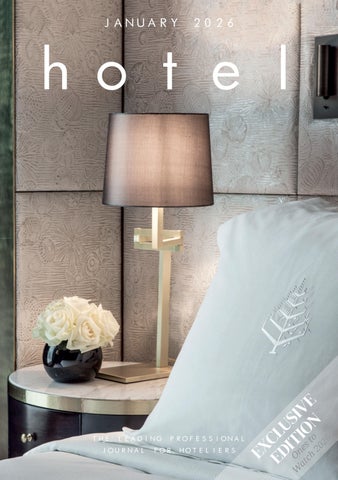
Image courtesy of Four Seasons Hotel London at Tower Bridge
Application
Deadline
16th January
2026
www.hotelmagazineawards.co.uk
Find Your One-Stop Shop for Hotel Room Products at
www.outofeden.co.uk
EDITOR’S NOTE
JANUARY 2026
H
appy New Year! Welcome to our first, and one of our most anticipated, issues of 2026… January’s exclusive edition. A new year always brings with it a sense of possibility, but this January feels especially energising for the hospitality sector. After years of rapid change, accelerated innovation and extraordinary resilience, we’re entering a moment where creativity, guest experience and operational excellence are joining in exciting new ways. It’s this momentum that has shaped our exclusive edition: a 26-page Ones to Watch feature spotlighting the venues, leaders and rising talents set to redefine the year ahead. This extended showcase is more than just a hot list, it’s a forwardlooking snapshot of the people and places demonstrating fresh thinking and a refusal to settle for the ordinary. From pioneering brands to inspiring young leaders and visionary independents, our selection reflects the diversity and dynamism of the hospitality world today. You’ll also discover several standout new hotel openings across the UK, each with their own perspective on what the future of hospitality and modern guest experience looks like. Alongside this special feature, we turn our attention to one of the most powerful differentiators in the guest journey: food and drink. This month’s focus is a deep dive into the experiential side of F&B - from immersive dining concepts and hyper-local tasting menus to collaborations that push creative boundaries. Hotels are no longer just places to stay; they are becoming culinary destinations in their own right, competing with the most innovative restaurants and bars. We explore what’s driving this shift and how operators are standing out in an increasingly competitive landscape. And of course, you’ll still find all the regular features our readers rely on. Our Hotel of the Month celebrates London Hilton Park Lane. The UKHospitality column returns with interesting insights. Our Housekeeping focus continues to spotlight the teams and techniques at the heart of everyday excellence, while Industry News brings essential updates from across the sector. This edition also includes expert commentary, thought leadership and promotional features from leading hospitality brands, offering inspiration and practical tools for the year ahead. Here’s to a year of ambition, innovation and unforgettable hospitality.
JADE EVANS, EDITOR
© 2026 Cogent Multimedia Limited, 1st Floor, Saphir House, 5 Jubilee Way, Faversham, Kent, ME13 8GD. No part of this magazine may be reproduced or stored in a retrieval system or transmitted in any form – electronic, mechanical or physical – without express prior permission and written consent of the publisher. Contributions are invited and when not accepted will be returned only if accompanied by a fully stamped and addressed envelope. Manuscripts should be type written. No responsibility can be taken for drawings, photographs or literary contributions during transmission or in the editor’s hands. In the absence of an agreement the copyright of all contributions, literary, photographic or artistic, belongs to Cogent Multimedia Limited. The publisher accepts no responsibility in respect of advertisements appearing in the magazine and the opinions expressed do not necessarily represent the views of the Publisher. The Publisher cannot accept liability for any loss arising from the late appearance or non publication of any advertisement.
8
www.thehotelmagazine.co.uk
CONTENTS
12 INDUSTRY NEWS
Wondering what’s currently happening within the hotel sector? We reveal all as we share insights into some of the latest news.
22
29
15 HOTEL MAGAZINE AWARDS
As the 2026 event grows closer, we are excited to reveal our hosts for the evening, along with further partners.
27 ONES TO WATCH
In this special edition, we highlight some of the biggest names in the industry set to make big moves in 2026 and beyond.
62 HOTEL OF THE MONTH
34
London Hilton on Park Lane features as our Hotel of the Month this January as we reveal the key elements that make the venue stand out in the competitive capital.
65 FOOD & DRINK
With help of industry experts, we explore the rise of unique dining experiences and how they contribute to the wider guest experience.
90 INTERVIEW
66
74
EDITOR-IN-CHIEF
ADMINISTRATION MANAGER
HEAD OF BUSINESS DEVELOPMENT
DESIGN AND PRODUCTION
Jade Evans jevans@thehotelmagazine.co.uk
Jazmine Davis jazmine@thehotelmagazine.co.uk Tel: 01795 509 105
ACCOUNT MANAGER
Natalie Woollin admin@cimltd.co.uk
Grant Waters grant@cimltd.co.uk
James Taylor james@cimltd.co.uk
Harrison Hume hh@cimltd.co.uk Tel: 01795 509 105
HEAD OF DIGITAL
MARKETING MANAGER
SOCIAL MEDIA MANAGER
Lucas Payne lucas@cimltd.co.uk
Xhulio Bishtaja digital@cimltd.co.uk
In an interview with Will Bishop, VP Commercial Operations at Aimbridge EMEA, we hear his perspective on how hotels can achieve commercial success in a rapidly changing landscape.
CREDIT FACILITIES MANAGER Gwen Lee creditcontrol@cimltd.co.uk Tel: 01795 509 103
DIRECTOR
Declan Wale declan@thehotelmagazine.co.uk Tel: 01795 509 112 Tom Woollin tom@cimltd.co.uk
MANAGING DIRECTOR John Denning
Lily Lawson socials@cimltd.co.uk
www.thehotelmagazine.co.uk
9
BRING ICONIC SNACKS TO YOUR HOTEL BAR Enhance your hotel bar snack range with Pringles and Cheez-It Cheez-It reached £12.2m value sales after just 31 weeks, showing its broad appeal in the UK market1 Cheez-It has already attracted 2.5 million shoppers and achieved 23.7% loyalty in the UK2 Pringles is growing 15% year on year, outperforming the crisp category3 Pringles’ stackable format takes up 41% less space than the average crisps packet
Foo
KEL26463 HotelMagazine_July_DPS_AW_BM.indd 1
Elevate your hotel bar with eye-catching POS VISIBILITY CREATES VALUE
70% OF SNACKING PURCHASES ARE BOUGHT ON
IMPULSE4
ORDER FREE POS HERE © 2025 Kellanova. 1 Circana I Total GB I Value Sales I Data since launch to 8th Feb 25. 2 Kantar Worldpanel I Take Home Panel I Data 24we to 29th Dec 24. 3 Circana SalesOut | Crisps | Foodservice | Value Sales|52we 17th Jan 25. 40g Pringles growing at +15% YoY in Foodservice versus total crisps at +2.1%. 4 Lumina Intelligence Convenience Tracking Programme; 52 WE 8th Dec 24.
30/05/2025 09:12
INDUSTRY UPDATE
Leading London CEOs Sleepout and Unite Against Homelessness
F
lemings Mayfair’s Managing Director Henrik Muehle, once again, joined one hundred other London’s business leaders for his fifth CEO Sleepout UK, spending the night outdoors with only a sleeping bag for warmth. The annual CEO Sleepout London event highlights the realities of homelessness while raising vital funds for charities tackling poverty and housing insecurity across the capital. Since first participating in 2021, Mr. Muehle’s fifth Sleepout has singlehandedly contributed to raising more than £120,000 in total, surpassing the ambitious target he set for 2025. This year alone, the Flemings team raised £40,000. All funds support Charity Begins at Home (CBAH), a grassroots, donation-funded organisation providing warm meals, clothing, and essential items to people experiencing homelessness. Mr. Muehle also serves as a trustee of the charity. Reflecting on the experience, Henrik said: “Each year, the Sleepout is a humbling reminder of the hardship so many people face. One cold night outside doesn’t compare to the daily reality of homelessness, but it reinforces why this work matters. Reaching the £120,000 milestone is incredibly meaningful, but the true reward is helping create real change for those who need it most.” Flemings Mayfair continues its local impact through ongoing community initiatives. Every Wednesday, the hotel’s chefs prepare more than 60 fresh meals for families in need as part of a Charity Begins At Home-led charity bike project, contributing to more than 14,000 meals donated across the past four and a half years.
Since its launch, CEO Sleepout UK has raised more than £6 million to support people in need across the country.
Hyatt Regency London Olympia set to open in Spring 2026
W
est London’s newest regeneration project, Olympia, will welcome a brandnew hotel, Hyatt Regency London Olympia, in spring 2026. Situated within Emberton House, which was previously home to one of Europe’s largest five-storey car parks, the five-star hotel celebrates its heritage through key design details with the exterior of the property still in keeping with the typical multi-storey feel. With 204 keys, the hotel will be made up of both guestrooms and suites, with a lead in rate of £299. Designed for both comfort and ease, the hotel provides a peaceful escape from the hustle and bustle of the city whilst being perfectly positioned to enjoy everything it has to offer. Alongside the accommodation, Hyatt Regency London Olympia will be home to two food and beverage outlets including Lounge Café and Bar, located in the hotel’s lobby and offering light bites, coffee and cocktails, and Hotel Market, a grab & go style offering situated at the hotel’s entrance. Hotel guests will also have exclusive priority access to the adjacent Pillar Hall, a building which will comprise a beautiful ground floor restaurant together with
12 www.thehotelmagazine.co.uk
a basement speakeasy bar and a spectacular first floor events venue. As part of the wider £1.3 billion Olympia regeneration scheme, the destination is set to welcome a range of new cultural venues, including 30 new restaurants, bars and eateries; a purpose-built live music and events venue, the British Airways ARC; a world-class theatre, the British Airways Theatre; a senior school; a 1Rebel gym; 550,000sq ft of state-of-the-art offices; another hotel; and enhanced event facilities at ICC Olympia.
Does your hotel have TVs? You probably need an AVLA licence. The AVLA licence allows you to offer legally TV channels featuring content from our extensive repertoire. Stay compliant. Support the creative community.
Get your AVLA licence now at
www.avla.uk
HOTEL MAGAZINE AWARDS
www.hotelmagazineawards.co.uk
15
HOTEL MAGAZINE AWARDS
THE FINAL COUNTDOWN As the big day grows ever closer, we share some final details on the upcoming Hotel Magazine Awards 2026.
O
n 20 April 2026, the hospitality world will converge on one of London’s most iconic venues, the InterContinental London Park Lane, for the annual Hotel Magazine Awards (HMAs). Organised by Hotel Magazine, the HMAs are a celebration of innovation, service, and leadership in the hotel industry. With applications for the Hotel Magazine Awards closing on 16 January 2026, the time is now for hotels and individuals to showcase their excellence. Whether you’re a spa venue crafting unrivalled tranquillity, a tech-savvy property pioneering smart guest experiences, or a leader celebrated for uplifting your team, there’s a category designed to spotlight your strengths.
16
www.hotelmagazineawards.co.uk
This year’s edition promises to be bigger and bolder. With ten award categories, including long-standing favourites like Hotel of the Year, Hotelier of the Year, Environment Award, and Unsung Hero, the HMAs spotlight the full spectrum of talent across the sector. Notably, 2026 introduces three brand-new categories: Technology Award, Hotel Bar of the Year, and Hotel Restaurant of the Year, reflecting the growing importance of innovation and food and beverage excellence in modern hospitality. For those of you attending the Hotel Magazine Awards 2026, you will be greeted in a vibrant welcome area to set the tone for an unforgettable evening. We will proudly boast an array of pop-up bars which will line the space,
HOTEL MAGAZINE AWARDS
“The Hotel Magazine Awards 2026 aim to celebrate the very best in hotel leadership.” each serving drinks crafted specially for the occasion. Alongside these, a selection of canapés will circulate the room, providing ample chance to mingle and unwind ahead of the gala dinner and awards ceremony. The event will also see two well-recognised faces from the industry, Peter Hancock and Hamish Kilburn, helping to ramp up the excitement as our hosts for the evening. Unlimited complimentary drinks will be flowing all evening alongside the three-course meal, prepared by the esteemed Theo Randall, offering plenty to talk about. The HMAs, once again, promise to serve as a significant opportunity for the hospitality community to elevate and celebrate achievements across every facet of the industry. From outstanding sustainability efforts and marketing ingenuity to leadership qualities, inclusive culture, and technological innovation, these categories reflect the values shaping tomorrow’s hospitality landscape. The Hotel Magazine Awards 2026 aim to celebrate the very best in hotel leadership. As the hospitality industry
continues to evolve post-pandemic, the HMAs offer a powerful platform to honour those setting new standards. For those looking to apply, attend, or sponsor, full details are available at the official site: hotelmagazineawards.co.uk
Award Categories
The Environment Award Marketing Innovation Award Best Spa and Wellness Venue Hotel of the Year Hotel Bar of the Year Hotelier of the Year Hotel Restaurant of the Year Equity, Diversity & Inclusion Award Unsung Hero Award Technology Award
www.hotelmagazineawards.co.uk
17
HOTEL MAGAZINE AWARDS
CENTRE STAGE Hotel Magazine is delighted to announce Peter Hancock as the Master of Ceremonies for the 2026 Hotel Magazine Awards. A muchloved figure in British hospitality, Peter brings with him nearly five decades of industry experience and ahead of the 2026 ceremony, we sat down with Peter to learn more about his remarkable journey, his passion for celebrating the industry’s unsung heroes, and what guests can expect when he takes to the stage. Tell us about yourself and your journey within the hospitality industry
My first full-time role was behind the bar at Pontins Holiday Camp in Bracklesham Bay in 1977. Admittedly, that predates many of your readers, but rest assured, we behaved very much like young people do today. From there, I moved into a waiting position at a nearby hotel and country club, where a mix of good fortune and swift progression led to my first general manager role at just 21. My next GM position was at a larger hotel on Hayling Island, followed by a couple of years running a charming, upmarket countryside restaurant. A brief foray into wine sales introduced me to the owners of Johansens Guides, where I spent 12 years - starting as a regional inspector and later becoming Group Publishing Director. In 2000, Pride of Britain Hotels advertised for a new Chief Executive to succeed Michael Yeo. I took on the role and spent the next 21 years helping to develop and, I hope, enhance the collection and the support offered to its members. Throughout my career I was often invited to host or speak at events, so when I retired in 2021, I simply leaned into that experience. These days I enjoy what I jokingly call the “rent-a-gob” lifestyle - with the added pleasure of an ambassadorial role for James Hallam Insurance, which keeps me close to the hotel world I love.
What drew you to wanting to host the Hotel Magazine Awards?
I’m an avid enthusiast of events like the HMAs, those that champion the work of unsung heroes; so when I met Jade Evans as a fellow judge for the Independent Hotel Show awards and she mentioned the opportunity, it was a nobrainer for me. All that the Hotel Magazine Awards stand for align perfectly with what I love to do and celebrate.
What excites you the most about hosting the event?
Events that celebrate excellence are always a joy, but those
18
www.hotelmagazineawards.co.uk
within hospitality are especially meaningful. I often know people in the room, and I have deep respect for those who consistently deliver exceptional service in our industry. Hotel Magazine is highly regarded across the sector, so these awards carry significant prestige.
What can guests expect from your style as a host?
My goal is simple: start on time, finish on time, give every winner their moment in the spotlight, and share a few laughs along the way.
The Hotel Magazine awards are built around celebrating excellence and innovation, how important are events like this to the industry? There’s nothing quite as motivating as recognition from your peers. Awards such as these elevate standards, boost morale, and remind people why their work matters. Truly, what more could we ask for?
HOTEL MAGAZINE AWARDS
BEHIND THE CURTAIN We are turning up the energy for this year’s HMAs and leading the charge backstage is none other than Hamish Kilburn. We caught up with him to find out how he plans on using his deep sector knowledge and undeniable main-character energy, to ensure the backstage experience is as compelling as the awards themselves. As the Backstage Host for the 2026 Hotel Magazine Awards, what are you most looking forward to uncovering or highlighting during the event?
Is it too much to say that this role was made for me? I can’t wait to capture what happens just outside of the stage lights and camera frame. For me, that’s the good stuff where the truth – and often the comedy – lives. My entire mission is simple: embrace the chaos, chase the unexpected and catch the moments that are far too good to script.
You’ve built a strong reputation through Kilburn Communications and your work in hospitality media – what unique energy or perspective are you planning to bring to the evening’s backstage coverage?
I thought my reputation peaked as the man who has spent years doing handstands in hotels for a living. No, seriously, I’ve built my career on capturing the moments this industry really want to remember – and sometimes the ones they didn’t realise were happening. People trust me to get it right, to keep it real and to make it fun – I don’t take that lightly. Don’t let the word ‘backstage’ fool you, though. I’m not approaching this like a typical behind-the-scenes role. I want to give it main character energy – a genuine backstage pass – VIP if you like – where the audience sees what I see: the heart, the humour and the humanity of the people fuelling the hospitality industry.
Your industry knowledge spans design, hospitality trends and brand strategy. How do you see this experience elevating the on-site interviews and the stories you plan to draw out of finalists and winners? I guess after editing magazines and hosting podcasts
for the last decade or so, I understand the things these finalists lose sleep over, and I think I can press all the right intellectual buttons – gently, of course, yet with intent. I want the backstage chats to move fast, land deep and feel like a one-off moment captured in time.
The awards naturally create an atmosphere of excitement and pressure - how do you plan to capture those authentic, behind-the-curtain moments that audiences don’t normally get to see? These awards are a celebration of community as much as of talent – and you can really feel that spirit in the room, which may or may not be related to the plethora of drinks sponsors! So, I’ll be drawn to the people who radiate energy. My goal is to capture fleeting gestures that make the extraordinary feel human. www.hotelmagazineawards.co.uk
19
HOTEL MAGAZINE AWARDS
COMPANY PROFILE Sponsoring the Environment Award at the 2026 Hotel Magazine Awards is La Bottega Collective – a newly formed brand re-defining luxury amenities in hotels. We spoke with Tommaso Pacini, CEO and Founder of the La Bottega Collective, who revealed how the partnership aligns with the collective’s message and what it means to be a part of such a poignant event.
Can you tell us about the story behind your brand and what sets it apart in the hospitality industry?
La Bottega Collective was born from a passion for craftsmanship, creativity, and collaboration. We partner with some of the world’s most distinguished brands, and hoteliers to transform everyday moments into meaningful guest experiences. What sets us apart is our belief that guest experiences are more than products, they’re expressions of a hotel’s story, values, and identity. Each product is created with artistry, sustainability, and storytelling at its core, redefining how guests connect with luxury and design.
What inspired your decision to sponsor the 2026 Hotel Magazine Awards, and how does this align with your brand’s values and vision?
Sponsoring the 2026 Hotel Magazine Awards is an extension of our commitment to celebrating innovation and excellence within hospitality. At La Bottega Collective,
20 www.hotelmagazineawards.co.uk
we share a deep respect for creativity, design, and the stories that shape guest experiences. The Awards represent a community of forward-thinking brands and hoteliers who continue to inspire us - aligning perfectly with our vision to elevate hospitality through collaboration, craftsmanship and experiences.
What does being part of such a prestigious event mean to your team, and how do you see it impacting your presence in the industry? Being part of this event is both an honour and an opportunity to celebrate the spirit that drives our industry. For La Bottega Collective, it’s a moment to connect with like-minded creators and partners who share our dedication to excellence and storytelling. It also reinforces our role as a creative partner to the world’s leading hotels, strengthening our presence and continuing our mission to craft experiences that are as meaningful as they are memorable. labottegacollective.com
HOTEL MAGAZINE AWARDS
COMPANY PROFILE Schweppes have an exciting presence at the 2026 Hotel Magazine Awards as they are the official Mixer Sponsor for the evening and will be showcasing a unique branded lounge at the venue. We spoke with Shaun Bragg of Coca-Cola Europacific Partners as he explains what it means to be a part of the esteemed event. Can you tell us about the story behind Schweppes and what sets it apart in the hospitality industry?
As the original mixer, no other brand has the heritage in innovation with the product trinity of carbonation, balance and flavour like Schweppes. In 1783, Schweppes set the standard for what a good mixer should be. Today, the product you find behind the bar has evolved, but it’s still a bartender’s trusted companion that comes from 240 years of heritage. The product is perfectly balanced, the flavours across the range enhance bartending and the carbonation is robust. It’s the backbone of a lively, refreshing and effervescent drink. Each SKU is balanced to enjoy just as it is or mixed as you wish, allowing the full flavour of Schweppes to elevate the profile of any spirit with harmony, character and carbonation. Schweppes’ range provides the foundation for a full spectrum of flavour exploration, with our highball drink strategy empowering our customers to explore unique serves with the confidence that only over 240 years of carbonating experience can bring.
What inspired your decision to sponsor the 2026 Hotel Magazine Awards, and how does this align with your brand’s values and vision?
At Schweppes, we’ve always believed in the power of refinement, heritage, and hospitality. Sponsoring the 2026 HMAs was a natural extension of our commitment to celebrating excellence in the hospitality industry - a sector that shares our passion for elevating everyday experiences into something truly memorable. This partnership also aligns with our brand’s vision of being present in the most inspiring and premium hospitality environments. We see the HMAs not just as a celebration, but as a community of excellence where Schweppes belongs, bringing effervescence to every moment.
What does being part of such a prestigious event mean to your team, and how do you see it impacting your presence in the industry? Being part of the 2026 Hotel Magazine Awards is a proud moment for the Schweppes team. It’s more than just a
sponsorship, it’s a celebration of the shared values between our brand and the hospitality industry: quality, elegance, and the pursuit of excellence. For our team, this event is a chance to connect with the people who shape the guest experience at the highest level. It’s incredibly rewarding to see Schweppes featured in environments where attention to detail and premium service are paramount, because that’s exactly what we stand for. We see this partnership as a powerful way to reinforce our presence in the luxury hospitality space. It allows us to showcase Schweppes not just as a mixer, but as an essential part of the elevated drinking experience. Whether it’s a classic gin and tonic or a bespoke cocktail, Schweppes brings balance, refinement, and a touch of heritage to every glass. schweppes.eu www.hotelmagazineawards.co.uk
21
In the Hot Seat
TRACY LOWY Tracy created the Living Rooms concept in the 1990’s and has since opened a variety of properties in London’s thriving neighbourhoods along with the celebrated Laslett Hotel. 22 www.thehotelmagazine.co.uk
INTERVIEW
A
s the driving force behind Living Rooms and the acclaimed Notting Hill hotel The Laslett, Tracy Lowy has built a career on understanding not just how people travel, but how they want to live when they’re away from home. Her deeprooted connection to hospitality began early. “Having grown up in the hotel business, I became fascinated by how people really want to live when they’re away from home,” she reflected. By the 1990s, she sensed London was ready for a new kind of hospitality experience - “somewhere that offered the comfort, ease and individuality of a home, paired with the service and refinement of a five-star hotel.” That vision shaped the first Living Rooms property in 1999 and continues to inform the brand’s approach today. The Laslett, perhaps her most celebrated project, is a testament to this philosophy. Its identity is rooted firmly in the character of Notting Hill. “The vision was to capture the cultural heritage of Notting Hill… a place shaped by the neighbourhood’s history, culture and spirit,” she said. Even its name pays homage to community pioneers: Rhaune Laslett, a founder of the Notting Hill Carnival, and Russell Henderson, the Carnival musician whose legacy lives on in the hotel’s Henderson Bar. Set within five Victorian Grade II listed buildings, the property combines elegant heritage with contemporary creativity. Tracy credits the longstanding collaboration with designer Tom Bartlett of Waldo Works for achieving this balance: “The five Victorian Grade II listed buildings gave us a wonderful backdrop, and we layered in modern creativity to bring it to life. Our longterm collaboration with Tom Bartlett… was key.” Art, culture and design collaborations have been central to The Laslett’s identity. One of the most meaningful, Tracy noted, was with the late Barry Kamen: “He had that rare ability to capture the energy of London through art, fashion, and youth culture, and bringing his work into The Laslett gave the hotel a distinct creative heartbeat.” Every guest room features an original Kamen piece, a lasting
tribute to his influence. The hotel’s creative family extends further, to Bartlett, to antique curator Jerome Dodd of Les Couilles du Chien, and to artist Harland Miller, whose unmistakable Penguin Classics piece, I AM THE ONE I’VE BEEN WAITING FOR, dominates the reception. “His work is being celebrated in a recently opened Design Museum exhibition,” Tracy added with pride. At the core of all these ventures is Living Rooms, her London-based collection of design-led hotel apartments. The concept grew from a simple but powerful ambition: “to create places that feel lived in and personal.” Comfort, privacy and individuality are the hallmarks, with each property expressing its own character. “The aim has always been the same: to make guests feel instantly at ease, as if they have arrived somewhere familiar.” As hospitality evolves, Tracy sees guests increasingly seeking authenticity, comfort and a strong sense of place. “They value good design, but they also want comfort and ease. Technology helps behind the scenes, but the human touch matters most,” she explained. That philosophy has resulted in remarkable loyalty: “Many of our guests feel so at home in our properties they end up staying for years!” Asked what advice she offers to those building a career in hospitality, Tracy emphasised curiosity and empathy. “Stay curious, work hard and stay close to the guest experience… hospitality is built on people skills.” As for what lies ahead, Living Rooms will continue to grow organically rather than through aggressive expansion. “What’s next is always evolving… We are actively exploring ways to expand our apartment collection, particularly in Notting Hill, where the neighbourhood continues to inspire us.” With a philosophy anchored in personality, place and genuine human connection, Tracy’s Living Rooms and The Laslett remain defining examples of how hospitality can feel both stylish and sincerely warm - homes not just for nights away, but for life’s many ways of living. www.thehotelmagazine.co.uk
23
MARKETING
SUSTAINABLE GROWTH Using AI authentically and building a brighter future
F
or many, the past few years haven’t just been challenging—they’ve been exhausting. The kind of tired that comes from constantly firefighting, from watching margins shrink whilst workload grows, from losing sleep over staffing rotas and supplier invoices. Some of you reading this will have felt the weight of responsibility for your team, your guests, your livelihood. Maybe you’ve questioned decisions, doubted yourself, wondered if it would ever feel manageable again? But you kept going. That resilience is the foundation of what comes next. Because you deserve better than just surviving. You deserve to feel excited about your business again, to have space to breathe, to remember why you fell
24 www.thehotelmagazine.co.uk
in love with hospitality in the first place. And that future is within reach.
Where your guests are looking
Your potential guests are searching differently now. They’re having conversations with AI, asking “Where should I stay for a peaceful coastal break?” or “Find me a boutique hotel with great local food.” These natural, exploratory conversations favour businesses with rich, authentic content and strong digital foundations. When your website tells compelling stories and showcases genuine experiences, you become visible in entirely new ways. AI-powered search rewards hotels that
MARKETING
truly communicate what makes them special. This shift levels the playing field—you’re competing on authenticity and story, not just marketing budget. And that’s where independent hotels have always excelled.
sustainability flows from your values rather than being a marketing add-on, it becomes part of why guests choose you.
Human-first in a digital world
Understanding what needs to change and making it happen are different things, especially when you’re already stretched thin. The right marketing partner transforms this journey. Not another vendor promising quick fixes, but a trusted advisor who genuinely understands your world and has the expertise to navigate this evolving landscape alongside you. They help you prioritise and focus on what will actually move the needle, becoming an extension of your team invested in your success.
Technology should enhance the human experience, never replace it. Your website isn’t just a transactional tick-box, it’s often a guest’s first emotional connection to your property. A human-first website speaks to the person browsing at midnight, dreaming of their next escape. It shows them the experience of staying with you: morning light streaming through your breakfast room, the local artisan whose work hangs in your corridors, the team member who knows every hidden gem. When your digital presence reflects the warmth guests will experience in person, you build trust before they arrive. And trust converts to direct bookings.
Selling experiences, not just stays
Travellers choosing independent hotels seek experiences they can’t find anywhere else. When you shift from selling rooms to selling experiences, everything changes. Your autumn package becomes about crisp woodland walks, evenings by the fire, and waking to misty mornings that feel a world away from the everyday. This drives sustainable growth by commanding better rates and creating guests who return year after year, who become advocates for your hotel. It’s about attracting the right guests who value what you do and contribute to the atmosphere that makes your hotel special.
Where hospitality shines
At the heart of every memorable stay is a team that genuinely cares. Leading hotels build purpose-driven cultures where team members feel valued and connected to something meaningful. When your people feel proud of where they work, it radiates through every guest interaction. Equally vital is embedding meaningful sustainability throughout your operations. Today’s conscious travellers want to support businesses that align with their values. This might start with local suppliers, reducing plastics, or community initiatives. What matters is authenticity. When
Getting there
The future you’re building
The brighter future ahead isn’t about completely reinventing yourself. It’s about thoughtfully embracing changes that amplify your strengths whilst staying true to your core values. The landscape is shifting quickly. The hotels that understand this and take action now will capture bookings and secure their place in tomorrow’s market. With the right strategies, tools, and support, you can become more visible, efficient, and profitable. Because that’s what this is really about: creating breathing room to enjoy what you’ve built. Having energy to connect with guests instead of drowning in admin. Watching your team grow. Running a business that contributes positively to your community. Going home feeling accomplished rather than drained. That’s the brighter future. Not just better numbers, but better quality of life for everyone involved. More time for the good stuff. More moments that remind you why you started this journey. The tools exist. The knowledge is available. The guests are searching for exactly what you offer. All that’s left is to take the first step for things to be different, better. Let’s talk about how the right strategy and support can transform your hotel’s future with sustainable growth. Call 01803 872999 or email hello@clock-work.co.uk
www.thehotelmagazine.co.uk
25
ONES TO WATCH - VENUES
www.thehotelmagazine.co.uk
27
ONES TO WATCH - VENUES
DAKOTA HOTELS Dakota Hotels is known for its refined design, guest-centric innovation, and people-first culture. Blending atmospheric style with smart technology and thoughtful service, Dakota offers a blueprint for boutique hospitality’s future - elevated, intuitive, and unmistakably human. With the most recent launch from Dakota Hotels in Newcastle in early 2025, we expect an exciting year ahead for the brand.
A
s the UK hospitality sector continues to evolve at pace, Dakota Hotels is carving out a reputation as one of the industry’s most dynamic brands to watch. With bold development plans and a people-first culture, the group is positioning itself at the forefront of modern luxury hospitality. A major focus for 2026 is the launch of Dakota Manchester Airport, the group’s seventh property and its second in the Greater Manchester region. Set to open in Summer 2026, the project marks an ambitious reimagining of what an airport hotel can be. “Dakota Manchester Airport will transform expectations of airport accommodation, becoming the most luxurious airport hotel in the UK,” the Dakota team explained. “As ‘the destination before the destination’, we’re ready to set a new benchmark within the industry and redefine airport hospitality.” This elevated approach aligns with Dakota’s strategy of pairing refined design and service excellence with thoughtful innovation - an ethos the brand believes is essential in a rapidly shifting travel landscape. Dakota’s rise in profile is underpinned by a remarkable year of accolades across the group. Their recognition is no coincidence; it stems from a deep-rooted belief in cultivating exceptional hospitality talent. “At Dakota, people are our passion; our team, and their dedication to our guests and enthusiasm for the industry, are undeniably why we are appearing in this list,” the team shared. In the past year alone, Dakota has been listed once again in The Sunday Times Best Places to Work, receiving a Highly Commended mention in the 16–34 Spotlight Award, and has continued its multi-year streak in The Caterer’s Top 15 Best Places to Work in Hospitality. Individual achievements have also been celebrated, including Operations Director Matt Townley receiving the Institute of Hospitality Chief Executive’s Award, Head Chef Ben Thomson winning an Acorn Award, and Dakota Newcastle
28 www.thehotelmagazine.co.uk
taking home four accolades at the NEHAs. “We know that investing in our people, and nurturing them with the tools to flourish – through training, progression, and internal support – has been invaluable to Dakota’s success.” Dakota’s ambitions stretch beyond its own portfolio. The group is committed to elevating the industry as a whole through community engagement, education, and the championing of hospitality as a meaningful, long-term career. “The Dakota team are all champions of hospitality, and we’re passionate about shaping the future of the industry,” they emphasised. “We do this by supporting people and community, working closely with schools, colleges, and charities, with the aim of providing experience, mentorship, and career opportunities.” At the heart of this mission is Dakota’s desire to spotlight the breadth of talent within the sector and to model how hotels can strike the balance between exceptional guest experiences and positive industry influence. “Dakota wants to show that hospitality is a rewarding career with progression and development, and highlight the amount of exceptional talent within the workforce. We aim to set an example for how hotels can combine superb guest experience whilst driving industry change.”
ONES TO WATCH - VENUES
THE HARI The Hari Hotel, London exemplifies the future of hospitality through contemporary elegance, unique approaches to sustainability and incredible community spirit. Celebrated in our Ones to Watch feature, we explore how the venue plans on setting a bold standard for tomorrow’s boutique hotels.
A
s London’s boutique luxury landscape continues to evolve, The Hari stands out not for following the latest hospitality trends, but for refining a distinctive identity built on character, culture and community. For The Hari, 2026 is less about reinvention and more about deepening what already defines the brand. “Rather than chasing trends, 2026 will see The Hari lean even further into what makes us, us: character, community, and quietly brilliant service,” Francesco Sardelli, General Manager at The Hari explained. A major focus is the continued evolution of the hotel’s cultural programming, which has become a calling card for the property. “We’re expanding our partnerships with London creatives and launching new art collaborations that bring fresh perspectives to our spaces,” Francesco added. Building on the success of The Hari Art Prize, which champions emerging artists, 2026 also marks the first full year of the Mini Maestro Art Prize, a competition unveiled in 2025 to spotlight young talent from local schools. “We believe creativity begins at a young age and they deserve a platform to share their ingenuity.” Sustainability remains a central pillar, but in a way that complements, rather than competes with, the luxury experience. “This remains discreet, behind the scenes, and meaningful in impact,” Francesco noted. Every initiative is designed to protect both the neighbourhood and the environment while preserving the polished warmth that defines the guest experience. The Hari’s Ones to Watch recognition is no surprise when looking at the past year’s achievements. The hotel continued to strengthen its signature style of personalised luxury, shaped by its independent, family-owned status. “We’ve cultivated a warm, community-driven atmosphere where staff take genuine care to learn guest preferences, remember names, and personalise every detail,” they reflect. From bespoke cocktails at The Hari Bar to thoughtful in-room touches, this human-first approach remains a central part of the brand’s DNA. The hotel also deepened its cultural and social engagement. “In 2025, we further expanded our cultural impact through the fourth edition of The Hari Art Prize,
awarding £14,000 to emerging artists, and by launching the Mini Maestro Art Prize to support young local talent.” Community initiatives, ranging from partnerships with the Kensington & Chelsea Foundation to fundraising for Macmillan, underscore the brand’s commitment to inclusion, education and local support. Perhaps most notably, The Hari proved that meaningful sustainability is possible in dense urban environments. “This leadership earned us recognition as the 7th most sustainable hotel in the world in the Tripadvisor Travellers’ Choice Awards 2024, alongside operating at 100% renewable electricity, retaining EarthCheck Silver Accreditation for 2025 and achieving a Level 3 Sustainability rating from Booking.com,” Francesco shared. The year’s biggest lesson? “Luxury is at its most meaningful when it is both personal and conscious.” The Hari sees its role in the wider hospitality landscape as one that blends connection with creativity and their approach is rooted in authenticity. “Our team leads this evolution by embodying a style of hospitality that is both polished and human. They are empowered to be themselves, to build relationships, and to create moments that feel sincere, not scripted.” With the broader industry leaning into experiential luxury, The Hari intends not just to follow the trend, but to define it. “If the industry is moving toward experience-led luxury with personality, then The Hari intends to be at the front of that movement.” www.thehotelmagazine.co.uk
29
ONES TO WATCH - VENUES
THE PENINSULA LONDON In the ever-evolving world of London luxury, The Peninsula London’s Managing Director, Rolf Buehlmann, reveals how the hotel is shaping not just guest experiences, but the future of London’s luxury landscape as One to Watch.
A
sked about the developments shaping 2026, Rolf said, “We are very grateful to be recognised as one of the ‘2026 Ones to Watch,’ especially in light of the ever-growing new entrants into London’s luxury hotel landscape, which is of course rapidly changing.” He highlighted the hotel’s focus on community: “We are very humbled to continue to evolve as a place where the wider community comes together. Our Grand Opening celebration in June 2024 has already become the stuff of legends, and our annual Festive Tree Lighting ceremony, complete with food stalls in the courtyard, a gospel choir, snow, and Father Christmas, is quickly establishing itself as a cherished tradition. These community events, alongside an expanding calendar of cultural activations, speak to our ambition to be a welcoming hub where neighbours, partners, guests, and locals feel a sense of place and belonging.” Rolf stressed that enduring values define luxury: “Ultimately what sets a fine hotel apart has not really changed: it is the connections we make with our guests, whether they are international travellers or local residents, and the culture within that fosters this service excellence and team cohesion. “In short, I believe we can be quietly confident in our wonderful and very generous product here at The Peninsula London, which allows us to focus more deeply on the human dimension - our teams and the connections they make. It is that combination of luxury product plus human authenticity that will define the next decade in hospitality.” Reflecting on achievements over the past year, he noted several milestones. “A wonderful milestone was our debut at Goodwood Revival, where we brought the Peninsula experience off-property for the first time. Hosting the World’s 50 Best Opening Banquet was another highlight, welcoming 250 global industry leaders for dinner by Brooklands by Claude Bosi, showcasing our culinary voice
30 www.thehotelmagazine.co.uk
on an international stage.” Food and beverage innovation continues to set the hotel apart: “Our concepts like Soleil by Claude, The Noodle Bar, our vintage Austin 7 coffee truck, as well as our increasingly popular Crepe and Ice Cream trolleys outside Peninsula Boutique and Café, remain key differentiators.” Talent development and sustainability are also priorities - through the hotel’s partnership with Regent’s University, The Peninsula London nurture future hospitality leaders. Rolf explained, “We are proud to have achieved both BREEAM ‘Excellent’ and EarthCheck certifications, affirming sustainability as a core pillar of our operations.” Looking ahead, he sees The Peninsula London shaping the wider hospitality landscape: “As London evolves as a leading global destination, luxury hotels act as lighthouses for the visitor economy, setting standards in service, design, and experience. Hospitality is still a deeply peopledriven industry, where meaningful moments come from real interaction. Our team is our greatest strength, delivering high-touch, emotionally resonant service that helps define the future of hospitality and how London presents itself.” By combining world-class product, authentic human connection, and cultural engagement, The Peninsula London is proving that luxury hotels can thrive as both a destination for guests and a vibrant hub for the city.
ONES TO WATCH - VENUES
CAMERON HOUSE RESORT With Cameron House Resort marked as One to Watch, Managing Director, Will Oakley, reveals how he is shaping a gentler, more soulful vision of Scottish luxury for 2026 and beyond.
A
s Cameron House looks toward 2026, Will Oakley, Managing Director at Cameron House Resort, says the team is focusing on a more grounded and soulful approach to luxury - one that mirrors what modern travellers seek from
Scotland. “We’re looking at Cameron House through a slightly different lens,” he explained, “one that pays even closer attention to how people actually want to experience Scotland today.” Rather than expanding through volume or spectacle, the resort is sharpening its commitment to personalised, quietly curated experiences. Guests can expect stays that unfold in ways that feel effortless and organic. “We’re refining the Cameron House experience so it feels quietly curated…with thoughtful touches that reflect what someone truly comes here for,” Will said. Whether that means a pre-dawn dip in Loch Lomond, a woodland walk where the water appears unexpectedly, or a fireside tasting, the aim is for “experiences to gently take shape around each of our guests.” Cameron House will expand its signature suites, enhance intimate spaces across the estate, and deepen the connection between guests and the landscape. “Luxury in Scotland now comes with an expectation of responsibility,” Will noted, pointing to strengthened sustainability efforts, tighter local sourcing, and wellbeing rituals tied to the land. “In short,” he said, “2026 is about depth, not noise. More soul, more sensitivity, and a richer connection to the place we’re so proud to call home.” The resort’s recent accolades have underscored its upward trajectory: being named 5th Best Resort in Europe by Condé Nast Traveller readers and winning Best Hotel Experience at the Scottish Thistle Awards. “These were moments that genuinely resonated with the team,” Will reflected. “One reflects the wider world’s view of Scotland as a luxury destination; the other comes from our own hospitality community.” Key refinements across the property have played a major
role. Refreshed rooms and suites, elevated experiences at Cameron Spa, and the opening of LOMA - where Michelinstarred chef Graeme Cheevers reimagines contemporary Scottish cuisine - have all advanced Cameron House’s vision. But Will emphasised the biggest lesson from the past year has been the power of attentiveness. “If this past year has taught us anything, it’s that the details matter… the feeling that someone has taken a moment to think about what might make a guest’s day at Cameron House a little better.” The resort’s philosophy of continuous, thoughtful evolution, rather than sweeping reinvention, has proved central to its success. “Guest feedback has helped shape countless small refinements, and team insights have sparked ideas that might never have surfaced in a boardroom,” he added. As the hospitality industry gravitates toward automation, Cameron House is leaning into warmth, intuition, and authentic Scottish character. “Scottish hospitality has always famously had its own character; generous, warm, and quietly confident,” said Will. “While the global industry moves towards automation and uniformity, we’re determined to hold onto the human instincts that make a stay memorable.” For Will, the team is the soul of the estate. He describes their dedication as “not only admirable, but fundamental to who we are.” www.thehotelmagazine.co.uk
31
ONES TO WATCH - VENUES
New Opening
SIX SENSES LONDON Opening soon within the revitalised Whiteley, Six Senses London is set to redefine urban hospitality. General Manager, Nick Yarnell, shares how the brand’s first UK hotel aims to bring a gentler rhythm to the city.
A
s Six Senses prepares to open its first urban property in the UK, General Manager Nick Yarnell is shaping a hotel designed to shift the tempo of city living. Set within the revitalised Whiteley in Bayswater, Six Senses London promises an experience that balances calm and vibrancy - an antidote to the traditional pace of the capital. “Some arrive looking for quiet, others want to tap into the energy outside our doors,” Nick said. “We’ve created a place that supports both.” That duality runs through every aspect of the property. Wellness, a core pillar of the Six Senses brand, is elevated through London’s first in-hotel magnesium pool, a suite of recovery therapies and a 2,300-square-metre spa. Sustainability is treated with equal seriousness: the hotel will work with local ecologists, operate under a plastic-free philosophy, and source over 80 percent of its plant-forward menu from local suppliers. Partnerships with neighbouring communities at The Whiteley have shaped a series of curated experiences, including a modern-day apothecary inspired by traditional European herbalism. The hotel’s culinary direction will mirror this spirit of place. Whiteley’s Kitchen, Bar and Café -named after the building’s original founder, William Whiteley, embraces his rebellious streak through “maverick British cuisine.” Under Chef Eliano Crespi, the restaurant will champion seasonal, locally sourced produce, offering bold, relaxed dining intended to feel deeply rooted in West London. A major evolution for the brand is the debut of Six Senses Place, its first private members’ club. Conceived as a hub for creativity, wellbeing and purpose-driven community, it reflects a broader shift in guest expectations. “People want community as well as comfort,” Nick noted. Today’s travellers also seek experiences that support long-term wellbeing, from flotation and cryotherapy to personalised programmes. This ethos informs the hotel’s design, service and technology choices. Rooms will avoid gadget overload in favour of simplicity and timelessness, while the service culture will emphasise warmth, effortlessness and natural interaction. Architectural collaborations with Foster + Partners,
34 www.thehotelmagazine.co.uk
AvroKO and EPR Architects ensure the heritage building has retained its character while meeting standards of responsible luxury. Sustainability is not an add-on but a lifestyle expectation for many guests, Nick said, and the hotel is built to answer that demand. Six Senses London’s approach reflects Nick’s wider hopes for the UK hospitality landscape. “We want to bring a different rhythm - warm, kind and easy to be in,” he said. His team has spent considerable time understanding the local neighbourhood to create experiences that feel authentic, thoughtful and unhurried. Community impact will be embedded into operations through a Sustainability Fund that directs 0.5 percent of gross revenue into local initiatives, supported by on-site Earth Lab programmes. If Nick had to choose one thing that excites him most, it’s the atmosphere the hotel creates. “There’s a calm that settles quite naturally, but the building also has a brightness and lift to it,” he reflected. For him, that emotional resonance - not any single feature - is what will define Six Senses London as one to watch.
ONES TO WATCH - VENUES
New Opening
THE NEWMAN As Fitzrovia prepares to welcome The Newman in 2026, General Manager Oliver Milne-Watson shares how the independent hotel aims to redefine the “Londoner’s London,” champion neighbourhood connection, and set new standards for wellness and workforce culture.
A
s London’s hospitality landscape grows ever more competitive, Oliver Milne-Watson sees opportunity rather than challenge. For him, the imminent opening of The Newman marks a chance to bring something refreshingly human back to the capital’s hotel scene. “A Londoner’s London” is how Oliver describes the experience at The Newman - an antidote to the consolidation of independents into larger hotel groups. “We’re entering the market at a time when personality really matters,” he said. “Given our size and approach to service, the experience will be personal, genuine and thoughtfully excellent.” Central to this vision is an authentic connection with Fitzrovia: guests will be encouraged to engage with the neighbourhood as much as with the hotel team who live and work there. Wellness, Oliver, said no longer a trend but an expectation - and The Newman has integrated it from the ground up. The hotel will feature a dedicated wellness floor, movement studios offering yoga, Pilates and soundbathing, and even in-room gym kits for guests who want to work out privately. The Penthouse suite ups the ante with its own sauna and ice bath. But the offering remains rooted in choice. “Every guest is individual,” he noted. “Not everyone is seeking wellness, so classic mini-bar items will sit alongside healthier alternatives. It’s about flexibility without being prescriptive.” For Oliver, The Newman’s impact must extend beyond its walls. Through its people brand - REAL People - the hotel aims to advocate for a healthier, more inclusive hospitality culture. A recent partnership with Saira Hospitality saw the hotel host the first ever pop-up hospitality school inside an unopened property, offering skills and training to local community members facing barriers to employment. “It’s about making hotels more favourable places to work,” he said. “If we want to evolve the industry, it starts with how we hire, how we support, and how we value people.” Of all the elements debuting with the property, one
excites Oliver above the rest: Brasserie Angelica, The Newman’s all-day dining destination. Designed for both guests and locals, he envisions it becoming a bustling, energetic hub. “You can already feel that it’s going to be a central point of the neighbourhood,” he said. “I can’t wait to see it when it’s full of people.” With its focus on locality, wellness, and communitydriven hospitality, The Newman is poised to make a meaningful mark on London’s hotel scene, and Oliver is ready to lead the charge. www.thehotelmagazine.co.uk
35
ONES TO WATCH - VENUES
THE PIG With its unmistakable blend of provenance-led dining, rambling gardens and characterful countryside houses, THE PIG is entering 2026 with fresh momentum and a renewed ambition to redefine what a stay in rural Britain can feel like. As the brand is named One to Watch for the year ahead, CEO Kevin Styles shares how evolution, not reinvention, is shaping THE PIG’s next chapter.
A
t the core of the brand’s strategy is an experience that feels more fluid, informal and instinctively homely. “To evolve our experience, we are creating even more of an open house feel, with guests free to wander and linger,” Kevin explained. Increasingly, guests are looking for hotels that remove barriers rather than build them. In response, THE PIG is loosening traditional dining rules with new all-day options, indulgent weekend lunches and comforting teatime offerings. “We think of the hotels as welcoming, unpretentious homes, delivering a personalised experience without the usual price tag – an important element of value disruption for us,” he said. The group’s expansion into pubs sits comfortably within this ethos, offering locals and travellers a relaxed space “to gather over honest food, brilliant drinks and roaring fires.” Here, connection and community are not buzzwords but essential ingredients. The brand’s distinctive programme of seasonal events has also strengthened loyalty and broadened appeal. This past year has seen wreath-making workshops, pickling sessions, beekeeping classes, and talks from authors and well-known personalities. Summer garden parties continue to celebrate the quirky charm of the English countryside, while the now-cult ‘Smoked and Unplugged’ music evenings remain a standout. “We built a wonderful calendar of grounded, timeless events to deepen relationships with guests,” Kevin noted. Technology, too, is being embraced - but carefully. THE PIG’s newly relaunched website is already delivering meaningful results, and the team is exploring what intelligent data and AI can unlock. “We’re exploring AI to personalise at scale in a natural, non-intrusive way, and to improve storytelling by surfacing content about our gardens, people and provenance,” said Kevin. He predicts a shift where “AI will increasingly be about trusted content rather than search optimisation, and we’re ready for that.” If 2026 marks a moment of recognition, it is the result of long-term commitment rather than short-term tactics. “Our mantra of sourcing food from within 25 miles is often
36 www.thehotelmagazine.co.uk
imitated but rarely matched,” Kevin reflected. The brand’s kitchen gardens remain the beating heart of each property, shaping menus around seasonal abundance and enabling a resilient, hyper-local supply chain. “In many respects the brand has been built on sustainability,” he added - and that foundation is clearly paying off. Looking ahead, THE PIG’s growth remains intentionally measured. “It’s about evolution rather than revolution, doubling down on what we do best: provenance-led food, soulful spaces and an incredibly warm welcome,” said Kevin. Expansion is focused firmly on Britain for now. “We have one of the really great British brands… It’s not that we couldn’t go overseas, but it’s not a priority when there is so much character in the UK.” The next opening, just outside Stratford-upon-Avon, embodies that thinking: “It’s brimming with producers and personality, and we’re excited about what it can become.” As THE PIG enters the new year, its promise is clear: a celebration of place, people and produce - delivered with effortless charm and an independent spirit that continues to set the brand apart.
ONES TO WATCH - VENUES
New Opening
THE ST REGIS LONDON Poised to open in 2026, The St. Regis London is already being hailed as a defining new chapter for hospitality in the capital. Blending the heritage of the Astor legacy with a modern Mayfair sensibility, the hotel aims to set new standards in design, service and cultural connection. Here, General Manager, Marco Novella shares his vision for a property destined to become one of London’s most compelling addresses.
I
n a city where luxury hotels compete on every corner, The St. Regis London aims to offer something quietly radical: a sense of belonging. Marco explained that the ambition is to create a Mayfair landmark shaped not only by refined design and service, but by a distinctive social energy. “Our vision moves beyond traditional luxury,” he said, “creating an atmosphere where guests feel an immediate sense of belonging through thoughtful design, intuitive service and a welcoming social spirit.” This perspective draws on the brand’s storied heritage. “Building on the Astor family legacy, the St. Regis Hotel will bring the creativity and timeless elegance of this iconic name, along with a strong sense of community at the heart of Mayfair.” That ethos will appear through cultural programming, collaborations with London’s creative voices and refreshed rituals for a contemporary audience. Marco is playing a central role in bringing this vision to life. As the hotel looks toward 2026 and beyond, its design and operations are shaped by evolving expectations: seamless technology, dynamic social spaces and a service culture rooted in authenticity. “Our decisions focus on technology that enhances the stay, spaces that encourage connection, and service that balances discretion with genuine warmth,” he said. A key element is the evolution of the brand’s legendary butler service. “We are elevating the signature St. Regis butler experience - anticipatory, personalised and increasingly supported by smart, behind-the-scenes innovation.” This blend of heritage and modernity aims to set a sharper benchmark for future luxury.
Looking beyond the property itself, Marco is confident in the hotel’s broader impact. “We aim to create a place both classically rooted and unmistakably contemporary,” he said - an address reflecting London’s cultural vibrancy while offering global travellers a home with a strong sense of identity. What excites the team most as opening approaches? The moment the hotel comes alive. “The anticipation of welcoming guests into a setting where impeccable service and sophisticated style define every moment is extraordinary. As the hotel opens its doors, it will begin to establish its own stories and sense of place, setting a new benchmark for contemporary luxury in the capital.” www.thehotelmagazine.co.uk
37
British Science-led Skincare TEMPLESPA.COM |
HOTEL MAG - Ad 1 - 210x297mm.indd 1
TEMPLESPA
02/09/2025 10:14
ONES TO WATCH - INDIVIDUALS
www.thehotelmagazine.co.uk
39
ONES TO WATCH - INDIVIDUALS
AKIRA BACK Akira Back is a Korean-American award-winning chef and restaurateur known for his innovative take on Japanese cuisine. He leads the award-winning Akira Back Restaurants worldwide, including the acclaimed Montcalm Mayfair in London, celebrated for its modern fine dining experience.
F
ew chefs manage to weave heritage, innovation, and global sensibilities into a single culinary vision, but Akira Back is doing just that. With his latest venture, Lilli by Akira Back at Montcalm Mayfair, he is not only leaving an indelible mark on the London dining scene but also influencing how luxury hotels approach gastronomy. When asked about his proudest achievement to date, Akira reflected on the philosophy that underpins his restaurants worldwide. “One of the achievements I’m most proud of is building a culinary philosophy that bridges cultures without diluting their distinct identities across my restaurants across the globe,” he explained. “From the beginning of my career, my goal has been to challenge expectations - bringing Japanese techniques, Korean heritage, and global influences into a single, expressive language on the plate. The opening of Lilli by Akira Back at Montcalm Mayfair has been a defining extension of that vision. It represents not only a personal milestone, but also a shift in how luxury hotels approach dining: as a space where heritage and innovation co-exist, and where a restaurant becomes a signature piece of the hotel’s identity rather than an addition to it. That mindset has helped push the industry toward more experiential, story-driven gastronomy, where authenticity leads the way.” Looking ahead further into 2026, Akira is concentrating on experiences that resonate emotionally with guests. “In 2026, I am focused on designing experiences that feel both intimate and globally relevant. Guests are looking for meaning as much as excellence. They want to understand the inspiration behind dishes, feel connected to the space, and sense the personality of the chef and the hotel. At Lilli by Akira Back, this means crafting menus that evolve with the seasons and with the city, while also investing in team culture so the warmth of hospitality is felt in every interaction. I believe performance over the next few years will be defined by how emotionally memorable restaurants are. Technology can support us, but human connection will set the benchmark.” For Akira, the future of hospitality is as much about personal connection as it is about culinary mastery. “The
40 www.thehotelmagazine.co.uk
future of hospitality is personal, purposeful, and deeply rooted in place,” he noted. “Luxury hotels like Montcalm Mayfair will increasingly partner with creators whose philosophies reflect the spirit of their guests - thoughtful, curious, and experience-driven. My role is to continue pushing creative boundaries while staying true to who I am. With Lilli by Akira Back, I hope to shape a future where dining goes beyond taste and becomes a moment of discovery, something that inspires people long after they leave the table.” With his blend of cultural storytelling, meticulous technique, and forward-looking vision, Akira Back is proving why he’s not just a chef to watch, but a visionary shaping the next era of luxury hospitality.
ONES TO WATCH - INDIVIDUALS
CHRIS EIGELAAR One to Watch is Chris Eigelaar, Managing Director at The Belfry. Steering the iconic resort through an £85 million expansion, he has combined strategic vision with operational excellence, delivering world-class facilities and enriched guest experiences, all while nurturing talent and shaping the future of experiential hospitality.
L
eading one of the UK’s most iconic resorts through a period of unprecedented growth, Chris Eigelaar, Managing Director at The Belfry, has demonstrated both strategic vision and operational excellence. Reflecting on a landmark moment in the resort’s history, Chris said, “One of the achievements I’m most proud of is leading The Belfry through its £85 million expansion while keeping the resort fully operational and maintaining the exceptional guest experiences our visitors expect. This was the largest investment in our history, and it wasn’t just about bricks and mortar - it was about vision, resilience, and culture.” The project was a significant undertaking, requiring a delicate balance between growth and continuity. “Managing a project of this scale while ensuring that every guest continued to receive the high standard of service The Belfry is known for was a significant challenge,” he explained, “but it became a defining moment for our team and for the brand as a whole.” The expansion has had a transformative effect on the resort. “We’ve doubled our capacity, introduced worldclass facilities such as The Masters Suite and a newly designed Leisure Club, and positioned The Belfry as a destination capable of competing on a global stage,” Chris highlighted. Beyond the physical upgrades, the initiative set new standards for large-scale development in the hospitality sector. “We didn’t just build bigger; we built better,” he said, emphasising that sustainability and service quality were equally central to the project. “Sustainability was a central priority throughout the process. We targeted BREEAM Excellent status for our new buildings, ensuring that environmental responsibility was embedded in every decision. Luxury and sustainability must go hand in hand.” Equally important for Chris was nurturing talent within the resort. “As the resort grew, so did opportunities for our team, and I’m incredibly proud that many of the leadership roles created through this expansion were filled internally. Watching talented individuals progress, from department heads to senior leadership positions, has been one of the most rewarding aspects of this journey. Expansion isn’t just about physical space; it’s about creating pathways for
people to thrive alongside the business.” Looking ahead, The Belfry is focused on innovation in guest experiences. “Guests today want more than a stay want stories, memories, and meaningful moments,” Chris said. The resort is prioritising wellness, technology, and sustainability to meet these evolving expectations. “Our new Leisure Club and upcoming spa enhancements will position the resort as a destination for holistic wellbeing, offering curated experiences that combine fitness, mindfulness, and nutrition. Investing in technology will continue to be a key priority, with AI enabling our teams to deliver truly tailored guest journeys, from booking to check-out. Sustainability will remain central, ensuring that energy reduction, waste elimination, and community support are embedded across our operations.” Through these initiatives, Chris envisions a future where hospitality is personal, experiential, and sustainable. “Guests will choose brands that reflect their values, and our responsibility is to ensure every stay is memorable, meaningful, and unmatched in quality. That’s the future we’re building, and I’m proud to play a part in shaping it.” www.thehotelmagazine.co.uk
41
ONES TO WATCH - INDIVIDUALS
FERNANDA LEWIS Fernanda Lewis is redefining hospitality leadership, combining meticulous standards with compassion and social impact. As Director of Housekeeping at The Goring and former Chairperson of the UKHA London & South East, she champions excellence, sustainability, and authentic guest experiences, proving that housekeeping leadership extends far beyond spotless rooms.
F
ernanda Lewis has built a career that blends leadership, compassion, and a commitment to raising the standards of housekeeping across the hospitality industry. As Director of Housekeeping at The Goring and Chairperson of the UK Housekeepers Association (UKHA) for London and the South East, she has consistently championed both excellence and meaningful impact beyond the hotel walls. Looking back at her career so far, Fernanda reflected on the moments that have shaped her professional journey. “One of my proudest achievements has been the opportunity to work at the incredible Goring, a place that constantly pushes me to grow both personally and professionally,” she said. Her role as a judge for a prestigious housekeeping award and her position as UKHA Chairperson marked what she calls a “breakthrough moment,” allowing her “to represent our profession, celebrate exceptional talent, and help raise standards across the industry.” Beyond professional accolades, Fernanda highlighted the importance of social impact. “I was also given the opportunity to get involved with The Goring’s longstanding charity partner, The Hotel School, right from the very beginning. Being part of a project that supports homeless and vulnerable people, giving them skills, confidence, and a pathway into hospitality, has been deeply meaningful. It reminded me of the real impact our industry can have beyond our hotel walls.” Sustainability is another area where Fernanda has found personal and professional fulfilment. “Joining our sustainability team reinforced how much I genuinely love what we do and how vital it is to keep evolving responsibly,” she explained. “All of these experiences have shaped the way I lead my department today, with purpose, compassion, and a commitment to elevating our profession. Looking ahead further into 2026 and beyond, Fernanda is focused on the elements of hospitality that technology cannot replace. “My focus always comes back to attention to detail and truly anticipating our guests’ needs. In a world full of AI and technology, human interaction becomes
42 www.thehotelmagazine.co.uk
even more valuable. You simply cannot duplicate genuine kindness. Wowing our guests, making them feel seen and loved, and personalising our interactions - that’s where the magic is.” When asked about the future of hospitality, Fernanda emphasised authenticity and service excellence. “I believe the future of hospitality belongs to those who stay unique, transparent, genuine, and completely service-focused. Keeping our identity and values at the heart of everything we do is essential. This is the best industry to work in we create memories, emotion, and moments that stay with people forever. For that, you need creativity, strong leadership, and the right people in the right roles. The Goring continues to lead with innovation, craftsmanship, and the warm, genuine service we’re known for.” With a career that intertwines high standards, social responsibility, and a deep understanding of guest experience, Fernanda is a trailblazer in hospitality, proving that leadership in housekeeping is about much more than maintaining pristine rooms; it’s about shaping the future of the industry itself.
ONES TO WATCH - INDIVIDUALS
HENRIK MUEHLE Henrik Muehle has quietly redefined luxury at Flemings Mayfair, proving that true excellence lies in consistency and thoughtful leadership. Championing a unique hospitality ethos around clarity and care, he is One to Watch.
I
n an era of constant change, Henrik Muehle has quietly steered Flemings Mayfair toward a model of understated excellence, proving that consistency often outweighs spectacle in hospitality. Reflecting on his journey, Henrik said, “When I look back, what I am most proud of is that we kept moving in the right direction. There was no dramatic moment, no secret formula. Just years of fixing what needed fixing and tightening the things that were almost right,” he said. While the Michelin Key and a Michelin star mark milestones, Henrik emphasised that “the real win was the consistency behind them.” His approach is methodical, grounded in attention to the smallest details. “I simply walked around and paid attention to details. As I always say: details, details, details. A lamp that refused to sit straight. A corridor that clearly needed attention. Systems that made the team work twice as hard for half the result. Nothing glamorous. We did not reinvent the place. We just corrected things, one by one, until the hotel finally behaved the way a hotel should.” The same philosophy applies to Ormer, Flemings’ acclaimed restaurant. “Give a kitchen clarity and trust, and things improve quickly. Once the team stopped second guessing, they cooked better. Confidence does that. Suddenly the food tasted the way it always should have.” Yet operational excellence is only part of Henrik’s vision. His commitment to understanding people is evident in his participation in CEO Sleepout, a charity raising awareness for homelessness. “You lie on a cold concrete ground, question your life choices, and hope it doesn’t rain. But it reminds me why hospitality matters. It’s about people, not shiny things or awards. When the team goes, they come back with a different sense of responsibility.” For Henrik, success is about making the right choices daily, even the unnoticed ones: “That approach shaped the hotel, shaped the restaurant, and still keeps us all moving in the right direction.” Looking at 2026 Henrik’s focus is on creating effortless guest experiences. “When a guest walks through the hotel, everything should make sense without anyone needing to explain it. That feeling comes from clarity, not theatrics,” he explained. Small operational refinements - from breakfast flow to room ambiance, are central to this mission.
Technology plays a supporting role: “If a system makes the team faster, calmer, and more aware, then it stays. If it gets in the way, it disappears. A good conversation still beats any automated shortcut.” Sustainability and staff development are also key pillars. Ormer sources seasonal produce from its two-acre kitchen garden in Essex and partners with suppliers committed to the long term. “None of this is a performance. It is simply how you run a credible business,” Henrik noted. Ultimately, Henrik envisions a hospitality future defined by clarity, identity, and human attention. “The future of hospitality is simpler than people think. Guests want places with a real identity. They want people who can look them in the eye. They want service that makes sense.” At Flemings, this translates into “quiet excellence… not loud, and it does not need applause. It is just doing things properly, every single day.” www.thehotelmagazine.co.uk
43
ONES TO WATCH - INDIVIDUALS
KAI PARFITT Kai Parfitt is redefining what sustainability means in luxury hospitality. Rising rapidly from tech newcomer to Director of ESG, Risk and Compliance at Maybourne, he brings a fresh, evidencedriven vision. His journey shows how passion, clarity and thoughtful storytelling can elevate both guest experience and environmental impact in the industry today, making him One to Watch in 2026.
I
n a sector known for long careers and traditional pathways, Kai Parfitt stands out for the speed and influence of his rise. Now Director of ESG, Risk and Compliance at Maybourne, he speaks openly about his unconventional entry into hospitality and how it shaped his view of what sustainability in luxury can become. “By our industry’s standards, I am a complete newbie after transitioning from tech two and a half years ago,” he said. His first hospitality role, as ESG Manager at the Athenaeum Hotel & Residences, became a pivotal step. “Landing my first sustainability role… and achieving EarthCheck silver in the first six months… was daunting but fulfilling.” That success bolstered his confidence and deepened his appreciation for hospitality’s inclusive culture. “I will always be grateful for the chance… Inexperience can be overcome with passion if that passion is nurtured.” He added that many industry leaders once started where he did. EarthCheck also cemented his belief in a structured, evidence-based approach. “Measure impact, offer clear recommendations, evidence your approach, then verify it with third-party audit. That four-phase process is essential for sustained improvement.” At Maybourne, Kai now focuses on elevating guest experiences through subtle, meaningful ESG integration. He believes the sector already embeds more sustainability than it communicates and sees huge potential in highlighting those stories. “We will be targeting subtle ESG touchpoints throughout the guest journey,” he explained. Beyond linen-change cards, he sees opportunities to showcase ethical, socially beneficial brands as part of the luxury experience. His long-term vision aligns closely with Maybourne’s identity. “My idealistic vision is a future where we consistently curate ESG stories of distinction… where sustainability and luxury don’t just coexist but enhance one another.” Looking ahead, Kai views luxury hospitality as a powerful lever for global behaviour change. Hosting some of the
44 www.thehotelmagazine.co.uk
world’s most influential travellers gives Maybourne strong reach: “If Maybourne can craft the incredible sustainably, we can move beyond the luxury vs sustainability narrative.” For Kai, the path forward is clear: model sustainability at the pinnacle of luxury so its influence can ripple outward. “If we can truly operate sustainably, we can lead in a way that positively shapes guest behaviour - and show that sustainable practice is viable across industries.”
ONES TO WATCH - INDIVIDUALS
CHARLOTTE WEATHERALL As the General Manager of Corinthia London, Charlotte Weatherall stands at the forefront of modern luxury hospitality - yet her philosophy is rooted in a simple, transformative belief: when you invest in people, exceptional guest experiences naturally follow. Her approach is what has taken her from Dubai to one of London’s most prestigious hotels and is also how she plans on redefining hospitality in 2026.
L
ooking back on her early career, Charlotte reflected on one moment in particular that reshaped her understanding of leadership. During her time opening The Westin Dubai as Director of Sales & Marketing, she offered a waiter from the bar an opportunity to join the sales team first as a coordinator, later as an executive. The impact was profound. Seeing his pride as he progressed, supported his family, and bought his first car underscored for her the tremendous potential that can be unlocked when colleagues feel seen, trusted, and championed. “In my earlier days, the industry often relied on a traditional ‘hospitality first, people second’ model,” she noted. “I believe the reverse is true, and commercially advantageous. Focusing on the team drives retention, service consistency, and guest loyalty.” This lesson continues to guide her leadership at Corinthia London, where she remains committed to empowering colleagues to deliver the kind of heartfelt, intuitive service that guests remember. The wider luxury sector, she observed, has increasingly adopted similar approaches, recognising that colleague pride and purpose are central to exceptional guest experience. Charlotte described her focus for 2026 as “elevating precision luxury” - a harmonious blend of deeply personalised service, intelligent technology, and renewed craftsmanship. At Corinthia London, this takes the form of systems and tools designed to discreetly enhance the guest experience without ever overpowering it. “This means intuitive service supported by data, not driven by it,” she explained. Technology becomes an enabler, while the hotel’s hallmark
warmth and humanity remain non-negotiable. She also highlighted shifting expectations among modern luxury travellers, who increasingly value ease, emotional connection, and the sense that their time is genuinely respected. Authentic sustainability and community engagement, rather than performative gestures, will, she believes, define the industry’s leaders in the years ahead. Looking further ahead, Charlotte envisions a hospitality landscape that blends sincerity with innovation. Guests will gravitate toward hotels with “soul, substance, and a clear point of view” - places that are both inspiring and grounding. Corinthia London’s role in this future is to set a new benchmark for timeless yet forward-thinking luxury. “Technologically advanced, but human at its core,” she said. Her responsibility is to champion this vision, nurture exceptional talent, and ensure that every step forward remains anchored in genuine care. www.thehotelmagazine.co.uk
45
ONES TO WATCH - INDIVIDUALS
MARK LEWIS As Chief Executive of Hospitality Action, Mark Lewis has become one of the industry’s most steadfast champions - guiding hospitality workers through unprecedented turbulence with compassion, agility and unwavering resolve. From delivering nearly £6m in grants since 2020 to unlocking vital benefits and expanding support programmes, Mark is leading a charity that remains a frontline lifeline for the people who keep hospitality thriving, and therefore features as One to Watch.
A
t Hospitality Action, when they say, ‘we’ve got you’, they mean it. Before Mark became Chief Executive of Hospitality Action in 2018, he was a Trustee of the charity for a decade. For nearly two decades, he’s been proud to support its efforts to help hospitality people in crisis. As we know, the past six years have hit hospitality hard, as the global pandemic and cost of living squeeze have taken their toll, and operators have had to work hard for every penny of margin. Mark and his team at Hospitality Action has been on hand to help them every step of the way. Mark said, “Our grants outlay since 2020 is now nearing £6m. Meanwhile, we’ve been supporting some 200,000 hospitality people and their families through our Employee Assistance Programme (EAP), and several thousand more through our Golden Friends retiree outreach scheme.” Mark revealed how he is particularly proud of their agile approach to transforming hospitality lives. “The help our beneficiaries need from us is always changing, and we’ve had to respond by evolving our methods of support accordingly. Whether it’s a winter fuel grant, school uniform grant or essential needs grant, our financial streams address the specific needs of the people we help,” he added. A mind-blowing £23bn of social security benefits goes unclaimed every year. Last year, with the Savoy Educational Trust’s support, Hospitality Action introduced a welfare benefits advisory service, and so far in 2025, their benefits advisor has unlocked £500,000 for beneficiaries, taking their per-year financial impact past £1.5m. Hospitality Action is a bellwether. When the industry struggles, the demand for its support grows, and as we head towards 2026, Mark said, “our phones are ringing off the hook.” He continued, “And things look set to get worse before
46 www.thehotelmagazine.co.uk
they get better. Business closures and job losses are likely to snowball, leaving remaining team members at risk of burnout as they work harder to cover more duties to maintain standards.” But whatever knocks it takes, hospitality will always survive. “It’s an industry that enriches our lives like no other. All our biggest life moments take place in hospitality venues, from first dates to weddings, baby showers to wakes. “And, just as we have been for almost 200 years, we’ll be on hand to keep workers healthy, happy and ready to face the day ahead,” said Mark.
ONES TO WATCH - INDIVIDUALS
ALLEN SIMPSON As One to Watch, Allen Simpson, CEO of UKHospitality, is championing a stronger, more resilient UK hospitality sector. From the groundbreaking #TaxedOut campaign to the launch of the Hospitality Skills Passport, he is uniting the industry and driving innovation that keeps people at the heart of the guest experience.
A
llen Simpson has spent his tenure amplifying the voice of the UK hospitality sector, and his proudest achievement so far is the organisation’s #TaxedOut campaign. “We worked incredibly hard to use clear asks, inclusive language and make all the data open source, so anyone could get involved and use the campaign materials,” Allen explained. The strategy paid off: for every person who saw the campaign via UKHospitality, 20 more encountered it through partner networks. The result has been unprecedented sector-wide unity, giving hospitality a stronger platform to push for fairer policies - even as successive Budgets have failed to deliver meaningful relief. Looking at 2026, Allen is focused on two critical priorities: costs and access to talent. “Our job is to help bring down the cost of employing people so businesses can return to sustainable profitability,” he said, citing stories of razor-thin margins on everything from a pint of beer to a hotel room. On talent, UKHospitality has launched the Hospitality Skills Passport in partnership with government, a universal entry-level qualification designed to make it easier for employers to find skilled staff and for individuals to build hospitality careers. For Allen, the future of hospitality will be defined by resilience through innovation. He predicts new formats, cuisines, and experiences - from dessert bars to competitive socialising, while stressing that technology must enhance, not replace, human interaction. “Guests pay for a people-led experience, and that won’t change,” he said. Through UKHospitality, Allen will continue to ensure the sector has the tools, skills, and support to innovate while staying true to what makes hospitality truly special.
“Allen is focused on two critical priorities: costs and access to talent.” www.thehotelmagazine.co.uk
47
ONES TO WATCH - INDIVIDUALS
KALINDI JUNEJA As CEO of PoB Hotels, Kalindi Juneja has reimagined what a modern hotel collection can be. By elevating British craftsmanship, championing conscious luxury and steering independent hotels toward a more unified future, she is carving out a powerful role for PoB Hotels in defining the next era of UK hospitality.
K
alindi Juneja’s career has been shaped by a deep belief in the value of independent British hospitality, and under her leadership, PoB Hotels has undergone a transformation that mirrors the sector’s evolution. Reflecting on her time at the helm, Kalindi says her proudest achievement has been redefining the organisation’s strategic direction and reinforcing the stature of homegrown luxury hotels. Over recent years, she has led PoB Hotels from a traditional consortium to a modern, insight-driven brand with a clear mission: to champion the very best of British independent hotels. Central to this shift has been the introduction of PoB’s annual White Paper, a resource that not only equips members with valuable intelligence but also influences the wider discussion around what British luxury means today. Coupled with strengthened digital capability and meaningful partnerships with craftspeople, producers and innovators, this repositioning has created a platform that amplifies the identity and voice of independent hotels nationwide. The result, Kalindi explained, is a more cohesive and future-focused membership. Hotels across the collection now feel informed, empowered and connected to a movement raising the standard of hospitality across the UK. Looking at 2026, she identified three strategic pillars that she believes will redefine both guest experience and business success: meaningful experiences, conscious luxury and intelligent innovation. Wellness and experiential travel - rooted in nature, place and purpose - are rising sharply in importance, and PoB is supporting its hotels in expanding these offerings beyond the traditional spa environment. At the same time, sustainability has become inseparable from the notion of luxury. As conscious travel gains momentum, PoB Hotels is guiding members to elevate provenance, minimise environmental impact and invest in regenerative practices that strengthen local communities as well as hotel brands. Technology, too, has a significant role to play. Kalindi advocates for a thoughtful approach to digital
48 www.thehotelmagazine.co.uk
transformation, one that leverages AI and data to enhance personalisation and efficiency without eroding the human warmth that defines truly great hospitality. “Experience, responsibility and innovation,” she said, “will be the foundations shaping guest expectations for years to come.” For Kalindi, the future of hospitality is grounded in authenticity, connection and craft. Guests increasingly seek experiences that are genuine, local and soulful - qualities she believes British independent hotels are uniquely positioned to deliver. As custodians of this vision, PoB Hotels aims to champion the individuality of its members while setting standards and sparking innovation across the sector. In doing so, Kalindi hopes to ensure that the generosity, character and craftsmanship at the heart of British hospitality continue not only to thrive in a rapidly changing world.
ONES TO WATCH - INDIVIDUALS
MIKE BAXTER With a vision rooted in cinematic escapism and a belief that independent hotels can outshine industry giants, Mike Baxter is reshaping boutique hospitality through bold storytelling, techenabled personalisation and an unshakeable commitment to emotional impact.
R
eflecting on the evolution of House of Gods, founder Mike Baxter is clearest on the achievement that has defined his team’s journey so far. “I’m most proud that we proved House of Gods can compete with and outperform the big players by obsessing over storytelling, onsite theatre and emotional impact rather than square footage or budgets,” he said. For Mike, the success of the brand is proof of a wider shift in what guests seek from a hotel stay. “House of Gods showed the industry that guests don’t just want a bed - they want a feeling of being the main character in their own story,” he explained. This focus on narrative and atmosphere, he believes, has had ripple effects across boutique hospitality. “The shift toward experience-led stays and unapologetic brand identity has influenced how many boutique operators think about hospitality today.” Looking ahead, Baxter has a clear view of what will drive the next era of performance and guest satisfaction. “In 2026, my focus is on two things: personalisation and automation,” he said. His ambition is to blend technology with the theatricality and humanity that define the brand. “We’re merging the rapidly advancing tech landscape with deeply human hospitality, not to replace people but to elevate them,” he explained. That approach informs everything from pre-arrival journeys to service delivery. “From intelligent pre-arrival journeys to real-time service personalisation and revenue-maximising automations, we’re building systems that free staff from admin and allow them to deliver face-to-face theatre.” Yet while technology may operate behind the scenes, the guest experience remains rooted in atmosphere and emotion. “We will continue designing spaces and experiences that feel cinematic and unforgettable,” he said, adding that the hotels that succeed will be those that use “technology to amplify the magic, not reduce it.” For Mike, the future of hospitality is defined not by standardisation but by immersion. “Guests will choose hotels the way they choose films - for the world they want to step into,” he said. House of Gods intends to be among the brands crafting those worlds: “Immersive and unmistakably House of Gods.”
Beyond ambience, Mike also sees a strategic rebalancing underway, one that empowers independents. “We’re building a model where design-led hotels like ours can scale through community and brand power rather than sheer size or distribution advantages,” he explained. His overarching mission remains consistent: “to prove that independent hospitality can help shape an industry where experience outweighs conformity.” www.thehotelmagazine.co.uk
49
ONES TO WATCH - INDIVIDUALS
BRENDAN O’CONNOR General Manager at Adare Manor, Brendan O’Connor, features as One to Watch as we look at how he is reshaping modern luxury through culture, clarity and human connection.
F
ew hospitality leaders have steered a team through more change, or defined a clearer vision for the future, than Brendan O’Connor. As General Manager of Adare Manor, he has guided the resort through a decade marked by global disruption, rapid technological advancement and an increasingly fragmented luxury landscape. Yet his focus remains strikingly consistent: protect the culture, elevate the craft and lead with humanity. Reflecting on the last ten years, Brendan pointed to a single achievement that reshaped both the property and the industry around it: shepherding Adare Manor through the aftermath of the pandemic without losing the spirit that defines it. “The most defining achievement of the past decade has been navigating the post-Covid landscape while holding our culture together,” he recalled. That steady resolve culminated in the resort being named the #1 Resort in the World in 2022 - a recognition that, in his view, became a catalyst for far more profound change. “It wasn’t just an accolade, it became a forcing mechanism that recalibrated how we think, operate, and lead,” he said. The award validated what the team had long believed: that “luxury is delivered most powerfully when it feels effortless, natural and deeply human.” Brendan believes this moment helped elevate Ireland’s global profile in high-end hospitality, setting new expectations for what contemporary luxury can look and feel like. Looking ahead, Brendan is clear-eyed about the forces set to shape the next era of hospitality, and the responsibility operators have in using them well. AI, he said, will be “the most disruptive force of the next decade,” and Adare Manor is already deploying it strategically across its operations. But his focus for 2026 is not technology itself, it is ensuring technology does not dilute the essence of hospitality. “The risk for the sector is over-indexing on the technology and under-investing in the emotional core of
50 www.thehotelmagazine.co.uk
hospitality,” he warned. For Brendan, the opportunity lies in letting AI enhance the backstage while keeping human connection firmly in the spotlight. “AI will supercharge our capabilities behind the scenes… but it will never become the front-ofhouse storyteller,” he said. “Our mission is to ensure that technology strengthens humanity, not eclipses it.” As the industry splinters into increasingly specific niches and micro-brands, Brendan sees a future defined by sharper segmentation and more targeted propositions. Boutique and lifestyle concepts, once outliers, are now accelerating faster than traditional hotel categories, a shift he believes will only intensify. “In that environment, true luxury brands need absolute clarity about where they sit in the ecosystem,” he argued. “Our mandate is to avoid the noise, hold our position with discipline, and define, not chase, our niche.” For Adare Manor, that niche is a carefully honed interpretation of quiet luxury - a blend of understatement, personalisation and authenticity that resists replication. “At Adare Manor, that niche is our interpretation of quiet luxury: elevated, understated, deeply personalised, and impossible to replicate,” he said. With a philosophy anchored in culture and clarity, and a strategy that puts people at the centre of innovation, Brendan O’Connor is not just navigating luxury hospitality’s next chapter, he’s helping write it.
ONES TO WATCH – INDIVIDUALS
JOANNE TAYLORSTAGG As a hospitality leader known for blending people-first values with progressive ESG ambition, Joanne Taylor-Stagg is helping steer the sector toward a future defined by purpose, personalisation and meaningful impact. Here’s why she’s One to Watch.
F
or Joanne Taylor-Stagg, one achievement stands apart when she reflects on her career so far: the creation of the Master Innholders Developing Additional Skills (MIDAS) programme during the first Covid lockdown. She recalled how “there was clearly a huge tranche of young hoteliers who, through no fault of their own, were furloughed, stuck at home and thinking their future looked bleak.” Concerned the industry would lose these promising young professionals to other sectors, she partnered with Dr Hilary Cooke to take action. Together, they built a free series of training and networking sessions designed to keep young hoteliers engaged and connected. “If we didn’t keep them engaged and connected to hotels, we’d lose them to other industries,” she explained. With funding from the Master Innholders and the Worshipful Company of Innholders, MIDAS quickly became, as many participants later told her, “a lifeline during those tough times” - a programme that didn’t just build skills, but restored confidence and community. Its legacy, she said, is a generation of young professionals now “cemented as ambassadors for hospitality.” Looking ahead at 2026, Joanne’s focus is firmly on the intersection of guest experience and environmental, social and governance performance; an area in which she sees rapid change reshaping the competitive landscape. “One of the reasons I joined Pennyhill Park, and Exclusive Collection, is our shared passion to use hospitality as a force for good,” she said. With ESG considerations increasingly influencing both leisure and corporate decisionmaking, she believes transparency and accountability will only become more critical. In particular, incoming EU Greenwashing legislation, effective March 2026, will require hotels to substantiate any environmental or social claims. As she noted, this will “create a much stricter framework that will help consumers determine who to trust.” Corporations are already adapting. “We’ve seen a significant increase in the number of large corporations
introducing a carbon footprint budget to run alongside their normal fiscal ones,” she explained - a shift with real commercial consequences. Some events have even been cancelled because companies “exhausted their carbon budgets.” For hotels, the message is clear: “Companies who can prove their credentials will gain a competitive advantage over those who can’t.” Exclusive Collection’s own track record speaks to that commitment. As the first UK hotel group to achieve B Corp certification, the group recently increased its reaccreditation score from 80.3 to 94.4. “It demonstrates the improvements we have made to be better corporate citizens,” Joanne said. For Joanne, the future of hospitality remains rooted in emotion, experience and connection. “It has long been said hospitality is a feeling not just a product,” she reflected, and that principle guides the work at Exclusive Collection. What truly excites her is the shift toward deeper personalisation, enabled, not replaced, by technology. “As digital transformation makes us more effective and efficient, it should enable us to spend more time forging greater relationships with our teams, customers and suppliers,” she said. www.thehotelmagazine.co.uk
51
TG52_D_Reform_Professional_A3_uk_spread.indd 1
29/10/2025 10:20
ONES TO WATCH - INDIVIDUALS
NUNO CÉSAR DE SÁ Known for elevating one of Britain’s most acclaimed countryhouse hotels, Nuno César de Sá is shaping a new era of emotionally resonant, service-driven luxury. Hotel Magazine speaks with one of the General Managers setting a fresh benchmark for UK hospitality in 2026 and beyond.
S
ince taking the helm at Grantley Hall in 2023, Nuno César de Sá has focused on more than preserving the hotel’s reputation for excellence. His ambition has been to enrich its soul. “We’ve not only maintained the extraordinary standard of the hotel, but elevated it,” he reflected. That elevation, he insists, goes far beyond opulence. For Nuno, the true breakthrough has been cultural. “The real achievement lies in building a team culture where everyone… understands that their role is not just service, but making guests feel cared for, respected, and truly special.” By embedding this philosophy across every department, Grantley Hall has not only raised its own standards, but demonstrated what British luxury can look like beyond the major cities. This approach has helped the hotel achieve a major milestone: becoming the first Leading Hotel of the World in England outside London. “To have become the first Leading Hotel of the World in England outside of London… is a special achievement,” he said - made all the more meaningful because it stems from “genuine, not manufactured” success. The result, he believes, is proof that a historic northern property can rival, and even outshine, urban luxury icons. “This success… is a breakthrough: a historic countryhouse hotel in the North of England can surpass the top luxury hotels in any big city.” Looking ahead, Nuno’s vision is one of expanded possibility. “I want to broaden what ‘luxury stay’ means,” he said, emphasising that luxury should be as diverse as the guests who seek it. Whether a Michelin-starred dining experience, a serene spa escape, or simply “a relaxing spa day, countryside walks, or simple but refined comfort,” the aim is to create an environment where anything feels achievable. Central to this evolution is people. “Empowered, valued staff… are the backbone of any exceptional hotel,” he noted. Strengthening community links, nurturing local talent and investing heavily in training will, he believes, define hospitality excellence over the coming years. “By… instilling pride, we safeguard the long-term quality of service, and ensure that Grantley Hall remains not just a
54 www.thehotelmagazine.co.uk
hotel, but a legacy.” Ask Nuno about the future of hospitality and the answer is unequivocal: connection. “It won’t just be about luxury for luxury’s sake,” he said. Instead, guests will seek meaning, individuality and a true sense of place. “Memories that last long after guests check out.” He sees Grantley Hall as a leader in this shift, rooted in heritage but forward-looking in ethos. “Our role will be to pioneer that balance, combining timeless elegance with modern expectations,” he explained. In doing so, the hotel aims not simply to host guests, but to move them. Ultimately, Nuno’s vision is profoundly human. “I see us not just as hoteliers, but as custodians of emotion and memory,” he said.
ONES TO WATCH - INDIVIDUALS
JOANNA CHUGH As Marriott accelerates its growth and brand evolution across the UK & Ireland, Regional Vice President Joanna Chugh is shaping a strategy centred on operational resilience, owner engagement and guest-experience innovation.
F
or Joanna Chugh, balancing the diverse needs of Marriott International’s UK & Ireland portfolio begins with clarity - even in a landscape that spans both managed and franchised hotels. “Balancing the needs of both managed and franchised properties starts with creating clarity and consistency, while still allowing for the flexibility each ownership model requires,” she explained. That means strong operational frameworks and clear brand standards, underpinned by transparent communication and tailored support. Managed hotels, she noted, typically require more direct oversight, while franchised partners prioritise toolkits, insights and predictable processes that empower autonomy. “The key is aligning everyone around shared performance goals, guest-experience expectations, and long-term brand value.” Over the past 12–18 months, her focus has been on strengthening operational resilience and boosting performance across the portfolio. This has included standardising core processes, investing in talent development and elevating data-driven decision-making. Crucially, she said, Marriott has also doubled down on owner and partner engagement, recognising that “strong relationships and clear accountability are essential to sustained success in both managed and franchised environments.” Among Marriott’s most exciting developments in the region is the integration and expansion of citizenM following the company’s recent acquisition. Joanna is visibly energised by its potential. “citizenM has long been recognised for redefining the lifestyle segment with its blend of smart technology, efficient and beautifully designed spaces, and a people-first service ethos.” This year saw the opening of citizenM Dublin St Patrick, with citizenM London Olympia set to follow very soon as part of the regeneration of Kensington’s Olympia exhibition centre. The brand’s appeal, she said, lies in its modern, design-driven offering that meets the expectations of today’s travellers. “From its intuitive, tech-enabled room design to vibrant living rooms that foster connection and productivity… citizenM offers a fresh, modern style of hospitality that aligns perfectly with the direction of travel
in major UK cities.” Joanna’s strategic priorities for the next two years revolve around digital acceleration, operational excellence and purposeful brand growth. Enhancing Marriott Bonvoy’s role in the guest journey will be central, with success measured through increased enrolment, digital engagement and satisfaction scores. Simplifying brand standards is another major focus, evolving Marriott’s audit model into a more collaborative “health-check” approach that prioritises performance and quality. Progress will be tracked through audit outcomes, owner satisfaction and reduced operational friction. Growth, she stressed, will be “thoughtful and demandled,” ensuring each new opening strengthens the portfolio and increases market share. A standout initiative for 2026 is Marriott’s new youthemployment programme, developed with Accenture, Movement to Work and Springpod. Launched at the end of 2025, the virtual-to-reality scheme supports NEET young people through online work experience, employability coaching for 1,000 participants and in-person placements for 200 across Marriott hotels. The aim, Joanna said, is to build confidence, create pathways into education or employment, and help young people see hospitality as a sector full of opportunity. www.thehotelmagazine.co.uk
55
ONES TO WATCH - INDIVIDUALS
KURT MACHER Known for championing inclusion and leading with unapologetic purpose, Kurt Macher is shaping a new era for one of London’s most iconic hotels and features as One to Watch.
A
s General Manager of Shangri-La The Shard, London, Kurt Macher has become a prominent voice in the movement to modernise luxury hospitality. Looking back on his tenure, he said his proudest achievement is the cultural shift he has helped embed across the business. “Diversity and inclusion are not initiatives for us - they are embedded principles that guide how we lead, hire, and serve,” he explained. This people-first philosophy has translated into visible and lasting change. The hotel introduced gender-neutral uniforms, rolled out mandatory D&I training for all team members, and flies the Pride flag year-round. Central to the transformation is an open-door hiring mindset. “Our philosophy of ‘hire for attitude, train for skill’ has opened doors for remarkable talent who may not have followed traditional pathways into luxury hospitality,” Kurt said. The impact has been profound. Team engagement scores have strengthened, and guest experience has evolved in tandem, fuelled by a deeper sense of authenticity. “When teams feel genuinely valued and included, they deliver service with authenticity and warmth, and that is at the heart of what modern luxury hospitality looks like today,” he added. For Kurt, the shift demonstrates that inclusive workplaces are not only ethically essential, but also a “strategic advantage” for the industry. Looking at 2026, Kurt is focused on further elevating the guest experience through thoughtful use of AI and emerging technologies. But his approach is grounded firmly in preserving the human touch. “Our goal is not to become a ‘tech-heavy’ hotel, but a ‘tech-empowered’ one,” he said. At Shangri-La The Shard, teams are exploring AI for predictive maintenance, personalised pre-arrival engagement, and more intuitive preference tracking - all designed to free colleagues from administrative tasks and enrich face-to-face interactions. “Innovation should remove friction, enhance personalisation, strengthen decision-making, and ultimately elevate the emotional impact of every stay,” Kurt noted. He believes the next wave of hospitality leaders will be those who blend high-touch service with seamless, almost invisible technology. Beyond tech, Kurt has a clear vision for the future of hospitality: a sector defined by wellbeing, connection, and responsibility. “I envision hotels becoming sanctuaries
56 www.thehotelmagazine.co.uk
of wellbeing and genuine connection -places where guests feel seen, understood, and truly cared for,” he said. Sustainability and community impact, he added, will be “non-negotiable pillars of luxury hospitality” in the years ahead. At Shangri-La The Shard, that future is already taking shape. “We are committed to innovation that strengthens our humanity … and to creating experiences that leave a lasting and positive impression on our guests, our people, and our community,” Kurt concluded.
ONES TO WATCH - INDIVIDUALS
ELJESA SACIRI Bold, people-focused and unafraid to challenge convention, Eljesa Saciri features as One to Watch. As General Manager of The Mandrake, she is championing empowerment, artistry and human connection as the forces that will shape the sector’s next era.
F
or Eljesa Saciri, progress in hospitality has always started with people who haven’t traditionally been given space to lead. She said her proudest achievement is “making space for people who have traditionally been overlooked” - particularly women and the next generation of talent. Across her career, Eljesa has focused on building transparent pathways into leadership and cultivating meaningful support systems. “By championing pathways into leadership, supporting female talent, and giving young voices real responsibility, I’ve focused on shifting the industry from within,” she explained. Her approach is rooted in structural change as much as individual opportunity. She advocates for promotion processes that are open and fair, as well as mentorship and training models designed to “turn potential into confidence.” But beyond systems, she believes culture is the true accelerant of progress. “When [women and young professionals] feel empowered to bring their full selves to the table, innovation follows naturally,” she said. Seeing these emerging leaders reshape teams, operations and guest experiences has affirmed for her that empowerment isn’t just supportive - it’s transformative. “Together, we’re redefining what leadership in hospitality looks like, and we’re just getting started.” While the industry races towards new technologies, Eljesa is doubling down on the people who bring hospitality to life. In 2026, her focus is on elevating the guest experience by equipping her team to deliver deeper, more meaningful connections. “Technology will continue to evolve, but the heart of hospitality remains human connection,” she said. Recent investment in a state-of-the-art tech stack at The Mandrake has given her the framework to prioritise talent development - strengthening training, mentorship, and leadership pathways across the property. By blending empowered people with thoughtful innovation, Eljesa believes The Mandrake can help redefine the industry’s next standard. As she put it, “Hospitality will feel more personal, more meaningful, and more resilient than ever.” Eljesa’s vision for the future of hospitality is unapologetically experiential. To her, tomorrow’s hotels will be “living, breathing worlds of inspiration,” shaped as much
by emotion and culture as by service and design. At The Mandrake, this ideal is already taking form. The property’s avant-garde philosophy integrates art, performance, wellness and bold aesthetic choices to curate stays that provoke feeling rather than merely provide accommodation. “We challenge conventions by curating experiences that are immersive, sensory, and culturally alive,” she explained. Her role, she explained, is to champion and safeguard this creative ambition, ensuring every touchpoint is intentional and transformative. “By redefining what a stay can evoke, we pave the way for a more expressive, human, and unforgettable era of hospitality.” Eljesa Saciri is not simply responding to an evolving sector - she is helping shape its trajectory. www.thehotelmagazine.co.uk
57
INDUSTRY EVENT
A NEW HUB FOR INNOVATION As the UK hospitality sector evolves at pace, the arrival of NoVacancy Hotel + Accommodation Industry Expo London feels perfectly timed. We spoke with Dan Assor, Event Director of the newly launched UK edition, about why the renowned Australian event has expanded to London and how it aims to bring fresh energy to the market.
NoVacancy is already well-established in Australia – what motivated you to bring the event to London, and what is your long-term vision for this UK edition?
NoVacancy has emerged as a powerful catalyst for innovation and connection within Australia’s hotel and accommodation sector, and we saw a natural opportunity to bring that same energy to the UK. While London stands as one of the world’s most vibrant hospitality markets, it has long lacked a truly comprehensive platform that brings together every segment of the accommodation landscape - from hotels and serviced apartments to holiday parks, hostels, and resorts. Our long-term ambition is to establish NoVacancy London as the definitive annual meeting
58 www.thehotelmagazine.co.uk
place for operators and suppliers to discover new ideas, collaborate meaningfully, and collectively shape the future of the industry.
In a market with established hotel trade shows, how will NoVacancy London distinguish itself and address gaps that other events might not be covering? We’re building something broader in scope and fresher in energy. NoVacancy is not just about products, it’s about ideas, solutions, and relationships. The event is designed around ten dedicated content tracks, each tackling real operational and commercial challenges, while our exhibitor mix reflects every facet of running an accommodation
INDUSTRY EVENT
business. Our aim is for visitors to leave with tangible solutions and new partnerships that can transform their businesses.
Your conference agenda highlights themes like technology, sustainability, and design. Which emerging trends or innovations do you most expect to drive conversation among hoteliers at this first London edition?
AI and automation will undoubtedly dominate discussion, not as buzzwords, but as practical tools to enhance efficiency, personalise the guest experience, and unlock new revenue. We’re also seeing strong momentum behind sustainable operations; from energy management and circular design to waste reduction. On the design front, the integration of wellness, work, and leisure is redefining what accommodation will look and feel like in 2026 and beyond. What do you aim to offer to hotel , operators and professionals who attend NoVacancy London? We want every attendee to walk away inspired, informed, and connected. That means access to world-class speakers, direct conversations with solution providers, and the chance to meet peers facing similar challenges. Whether you’re re-thinking your tech stack, looking for design inspiration, or exploring new revenue strategies,
NoVacancy London aims to provide practical takeaways and fresh ideas that you can implement immediately.
How will you measure the success of NoVacancy London, in terms of exhibitor ROI, attendee engagement, and long-term impact on the hospitality industry, and what do you hope the hotel sector gains from it?
Success for us goes beyond numbers, it’s about impact. If our exhibitors leave with valuable leads and meaningful relationships, and our visitors tell us they’ve found new solutions and ideas that genuinely help their business, we’ll have achieved our goal. Longer term, we hope NoVacancy London becomes a driving force for innovation and collaboration in UK hospitality, a place where the industry comes together each year to shape its next chapter. NoVacancy London takes place 25/26 February, Excel, London. For all the show information and for free registration visit www.terrapinn.com/novacancyldn/ hotelmagazine/register
www.thehotelmagazine.co.uk
59
TECHNOLOGY
ORDER RESTORED Your invoices are running the hotel and it’s time to take back the keys. Marketboomer explains how.
F
or years, hotels have treated invoices the same way they treat that one guest who overstays checkout: politely, patiently, and with a quiet sense of dread. Nobody means to create chaos - it just sort of… accumulates. A stray delivery docket here, a mystery credit note there, a supplier statement that definitely doesn’t match whatever’s in the back office. All harmless on their own. Together? A fullblown administrative mess! “Invoice chaos isn’t a cost problem - it’s a visibility problem. Fix the visibility, and the savings are inevitable.” The funny part is we still talk about “invoice processing” like it’s a neat, orderly thing. As if invoices glide through the building wearing name badges and politely waiting their turn. In reality, hotels deal with invoices the way chefs deal with the lunch rush - everything everywhere all at once, powered by instinct, caffeine, and hope. The real villain isn’t the volume, it’s the invisibility. Paper invoices hide in drawers, slip under clipboards, or quietly vanish into someone’s in-tray like they’ve joined a witness protection programme. Even PDF invoices manage to scatter themselves across inboxes with surprising earth defying skill. And when you can’t see invoices, you can’t control them. Hotels pay twice for the same item. Miss early-payment discounts. Approve the wrong supplier. Lose rebates. Reconcile orders that never arrived. Argue with suppliers using a tone best described as “polite despair.” But here’s where it gets beautifully simple: the moment you digitise invoices properly - and that means truly digitise them, with automated capture, matching, approvals, and reconciliation - the chaos evaporates. Suddenly the Beast has nowhere to hide. The invoice that used to sit on top of the bar printer for three days is captured instantly. The order for 10 cases that mysteriously became 12 is flagged before you ever pay for it. The missing credit note isn’t “missing” anymore, it’s surfaced. Three-way matching stops being a heroic monthly ritual and becomes the sort of thing that just… happens. And the real magic? Certainty.
60 www.thehotelmagazine.co.uk
You know what’s been delivered. You know what’s been approved. You know what’s outstanding, what’s incorrect, what’s duplicated, and what needs to be pushed back. You know your spend this week, not last quarter. It’s decisionmaking based on reality, not archaeology. For hotels, invoice automation isn’t bureaucracy, it’s liberation. It gives GMs time back. It gives finance teams accuracy. It gives procurement transparency. And it relieves operators from that constant background hum of “I swear I saw that invoice somewhere…” Because once you’ve seen your entire invoice flow in one place - clean, matched, approved, and real-time - you never go back to rummaging through drawers hoping for the best. Paperwork stops being the monster. Control becomes the new normal. purchaseplus.com
Made by Hospitality for Hospitality ^THE PLATFORM BUILT BY PEOPLE WHO KNOW THE INDUSTRY BECAUSE WE’VE LIVED IT.^ by Malcolm Jull, Chief Executive Officer
Trusted by 50% of the APAC hotel market
Built for scale, powered by people who get it
Big groups and independent hotels, check us out for yourself
sales@marketboomer.com
+44 204 538 7068
www.purchaseplus.com
HOTEL OF THE MONTH
A MASTERCLASS IN MODERN LUXURY Commanding one of London’s most coveted addresses, London Hilton on Park Lane shows how a legacy property can stay ahead in an increasingly competitive market. Blending brand strength, disciplined operations, and guest-centric innovation, it stands as a blueprint for hoteliers seeking to balance enduring heritage with continuous evolution. 62 www.thehotelmagazine.co.uk
HOTEL OF THE MONTH
R
ising above one of the world’s most prestigious postcodes, London Hilton on Park Lane remains a benchmark for how an established luxury property can sustain relevance, distinction, and profitability in a hyper-competitive market. For hotel managers and operators, the property offers a valuable case study in balancing heritage with continuous operational evolution. Located in the much-loved Mayfair with views over Hyde Park, the hotel benefits from a positioning that few London properties can match. But location alone does not secure long-term market leadership. What distinguishes London Hilton on Park Lane is its ability to leverage brand strength, operational discipline, and guest-centric innovation while maintaining consistent service delivery across a highvolume, high-expectation environment. From an operational standpoint, one of the hotel’s most significant strengths is its multi-segment appeal. The property attracts a diverse mix of international leisure travellers, corporate guests, and high-profile event business. Its extensive meeting and events capabilities, ranging from intimate boardrooms to large-scale ballroom spaces, enable strong midweek occupancy and group revenues, while weekend and seasonal packages capture the luxury leisure segment. The hotel serves as an example of how a robust segmentation strategy can support yearround demand resilience. Food and beverage performance remains another pillar of the hotel’s value proposition. With multiple on-site dining venues, offering a dynamic collection of culinary experiences, each bringing its own distinctive character to the iconic Mayfair address. A much-loved arm of the hotel’s dining portfolio is Shanghai Me, a vibrant tribute to 1930s Shanghai glamour. Its menu blends refined Asian flavours with contemporary flair, making it a standout destination for both hotel guests and London’s gastronomes. Central to the offering on Park Lane, Revery Bar delivers
an unforgettable cocktail journey with for guests. Its innovative mixology, dramatic presentation and intimate atmosphere position it as one of the area’s most seductive late-night spots. For those seeking a bold and stylish dining experience, Mr Porter seamlessly merges the sophistication of a steakhouse with the ambience of a modern lounge. Premium cuts, expertly grilled, anchor the menu, complemented by an eclectic selection of seafood, sides and craft cocktails. Rounding out the hotel’s offering is Park Corner Brasserie, a contemporary British restaurant celebrating seasonal produce and comforting classics. Its ability to maintain culinary consistency while servicing everything from afternoon teas to large gala dinners highlights the importance of strong leadership, cross-departmental coordination, and a disciplined approach to menu engineering. London Hilton on Park Lane has also invested in modernising its guest experience without compromising the property’s classic identity. Upgrades to guest rooms and suites focus on refined comfort, technology integration, and soundproofing; critical factors for a building of its size and age. Service culture remains a core driver of its reputation. The hotel’s approach blends traditional British hospitality with the consistency standards expected from a global brand. Staff training, retention initiatives, and crossfunctional communication play key roles in maintaining this service delivery, particularly during peak events or high-occupancy periods. As London continues to welcome an expanding portfolio of luxury hotels, maintaining competitive edge requires constant reinvention. London Hilton on Park Lane’s sustained appeal is a testament to its integrated approach to operations, guest experience, brand stewardship, and team culture. www.thehotelmagazine.co.uk
63
LW A4 ChristmasNY_v1.indd 1
01/12/2025 13:48
FOOD & DRINK
www.thehotelmagazine.co.uk
65
FOOD & DRINK
LAYING IT ON THE TABLE As travellers increasingly seek story-driven, sense-of-place dining, properties around the world are elevating their culinary identities with producer-led menus, cultural collaborations and experiences that blur the line between kitchen and guest. We lean on industry experts as they explain how this new era of hotel dining isn’t just about what’s on the plate – it’s about connection, craft and stories that bring each destination to life.
F
rom rooftop greenhouses to immersive chef’s tables, today’s hotels are redefining what it means to dine away from home. Hotel guests are increasingly seeking story-driven culinary moments, meaning hotels are transforming their restaurants into destinations in their own right in order to remain competitive. This surge in demand for immersive, one-of-a-kind dining experiences is reshaping the hospitality landscape, blending creativity, culture, and cuisine in ways that elevate every stay. Take the Grove of Narbeth as an example, they are working on launching a new supper-club style series called The Pembrokeshire Table. The new introduction will be an intimate evening hosted by the venue’s sommelier and Executive Chef, where they invite local suppliers to share the stories behind their ingredients, their landscapes and the sustainable practices that shape their work. Each event will centre on a different producer. Douglas Balish, Executive Chef at Grove of Narberth, explained how he will design a menu around their ingredients and guide guests through the evening with conversations, tastings and insights into how the products are used in the kitchen. “It’s relaxed, generous and rooted in community; it’s the kind of experience that brings people together and evolves with each new producer or theme throughout the year,” added Douglas. With a distinctive culinary identity needed to stand out in today’s hotel landscape, a few years ago, the team at The Grove of Narbeth set out to reimagine the way they tell the story of food. Rather than offering long, technical menu descriptions, the team chose to put their suppliers at the heart of the experience. Douglas explained, “Our tasting menus now feature dish titles such as “When Andy Met
66 www.thehotelmagazine.co.uk
FOOD & DRINK
Tim” or “Car-y-Môr,” highlighting the growers, farmers, and fishermen behind the ingredients, rather than the ingredients themselves.” Douglas told us that guests have really embraced this shift as it sparks curiosity, opens conversations, and creates a sense of trust as they know the team are drawing on the very best of Wales. “At the start of each meal, we introduce a map of Wales that shows where every key ingredient comes from, which sets the tone for a dining journey rooted in place. We’re proudly Welsh, and we want that pride to come through in a way that feels natural, warm and quietly confident. Many of our producers grow or source exclusively for us, giving us a level of quality and connection that’s genuinely distinctive. It’s this closeness to our suppliers and the stories behind them that sets our dining program apart from other luxury hotels,” added Douglas. At La Sultana Oualidia, their food and beverage philosophy is also rooted in a deep respect for place. The venue honours traditional Moroccan cuisine while celebrating the exceptional produce that surrounds them, from the Atlantic Ocean’s bounty to the vegetables, herbs, and aromatics grown in La Sultana Oualidia’s own garden. Nabil Elbahri, Resident Manager at La Sultana Oualidia, explained, “The Jan Janz brings a fresh cosmopolitan flair to this identity, joining our two existing restaurants to elevate the hotel’s culinary offering. Its signature is a contemporary
interpretation of Oualidia’s renowned seafood and organic ingredients, guided by global inspiration yet firmly anchored in Moroccan flavours.” Showcasing dishes such as the Lobster Wok with roasted pineapple, sweet chilli and a vibrant sweet-and-sour glaze, the menu subtly weaves in Moroccan spices (ginger, sesame, chilli), to create dishes that feel both sophisticated and soulful. It is this blend of local terroir and international creativity that Nabil believes sets the venue’s dining experience apart, “offering guests a sense of discovery while remaining authentic to the spirit of La Sultana.” At La Sultana Oualidia, their signature dining concept is built around immersive, sense-of-place experiences. Rather than limiting meals to a single restaurant setting, the team invite guests to dine in different, carefully curated locations in and around the property, each one revealing a new facet of Oualidia’s exceptional landscape. In the coming months, the team plan on deepening their culinary vision through an exclusive collaboration with a renowned boutique luxury hotel. Nabil added, “This creative partnership between our two Executive Chefs will enable us to introduce a selection of their signature dishes into our own restaurants, while they, in turn, will feature some of La Sultana’s emblematic creations in their establishment. “This cross-inspiration approach will offer our guests www.thehotelmagazine.co.uk
67
FOOD & DRINK
a unique gastronomic exchange, enriching the dining experience with new flavours, shared craftsmanship, and an international dialogue between two exceptional culinary destinations.” After much anticipation, at the back end of last year, Carlo Scotto opened BEAR by Carlo Scotto - his most ambitious project to date. The restaurant places two distinctive elements at its core: a menu that showcases an extraordinary commitment to foraged British ingredients, and an intimate 14-cover chef’s table where every seat is a front-row experience. Richard Booth, Director of The Crazy Bear, said, “With the business now under new ownership, we saw an opportunity to elevate our dining offerings. We wanted to bring something genuinely different to Beaconsfield and create an experience that would sit alongside our two inhouse restaurants, raise the overall culinary benchmark, and introduce a new dining experience that speaks to where we are heading. “Our vision was to collaborate with a chef whose creativity and personality could expand the boundaries of what dining at The Crazy Bear represents.” Carlo is known for his bold personality and his ability to bring together ingredients that shouldn’t work on paper but end up pairing perfectly. Richard continued, “If you know The Crazy Bear and its interiors, you’ll understand why he felt
68 www.thehotelmagazine.co.uk
like the right fit. In many ways, he’s a chef interpretation of the hotel. Not afraid to be different or loud and always pushing boundaries. There’s a touch of “crazy” in his food, just as there is in our design.” The Crazy Bear has always been known for its wild interiors and unexpected combinations, and Carlo brings that same spirit onto the plate. Immersion and theatre have always been at the core of Crazy Bear’s identity through their iconic parties and decadent bedrooms. BEAR reimagines this ethos in a more food focused way. “Our Chef’s Table offers the same theatre driven performance we see across both hotels, through sitting directly at the countertop and seeing every move made by the team. “The pace, the menu narrative, the way dishes are introduced and presented, every element has been designed to draw the guest deeper into the experience. It’s a sensory journey rather than just a meal, delivered with the signature hospitality that defines our brand, but distilled into something more personal,” added Richard. The Chef’s Table at BEAR is designed to remove the barrier between the kitchen and the guest. Recognising that people want more than a meal, they want to see the craft, understand the ingredients and be part of the process, Richard said, “Sitting at the heart of the kitchen brings a natural sense of theatre, and guests can watch the
FOOD & DRINK
team prepare and explain each course as it happens.” What makes it even more engaging is the fact that the menu constantly evolves. Richard explained how Carlo works closely with the seasons and what he and his team have foraged or sourced that week, so dishes can change daily. Concepts like this are redefining dining because they make the experience personal and transparent. “At BEAR, that means direct interaction with the chefs, insight into the ingredients and an experience shaped by the season, not a fixed script. It’s exactly the kind of connection modern diners are looking for,” Richard finished. Choc Amor is the award-winning artisan chocolate handmade in Yorkshire, known for its bold flavours. The unique products are increasingly being used by hotels as memorable touches for guests – particularly as afterdinner indulgences. Ben Yates, Joint Managing Director at Bon Bon’s Confectionery (supplier of Choc Amor), said, “For hotels wishing to deepen the connection between their brand and their guests, we’ve seen a significant increase in bespoke products tailored to their identity. From customised packaging to specially developed products and flavours, we offer the flexibility to align every detail with guest demographics, brand identity and the rhythm of the seasons. The Choc Amor flavours are so unique, they can
instantly offer a point of difference, especially to enhance the already unique and growing dining experiences.” At Foxhills Club & Resort, in the coming year, the team look forward to unveiling a new Anglo-Indian concept in their Manor House, inspired by the spice routes that connect East and West. The menu will explore coastal regions and forgotten flavours of India, keeping dishes authentic while reimagining them in a refined, elevated style. Achal Aggarwal, Head Chef of The Fox Dining Rooms at Foxhills Club & Resort, said, “It is a celebration of British and Indian culinary heritage – familiar comfort paired with bold, exploratory flavour.” Adding to the innovating dining concepts, Achal revealed that they will also introduce an interactive element, where chefs present dishes tableside and share the story behind them, turning each course into a moment of discovery. “It is an experience designed to connect people, spark curiosity and bring the warmth and cultural richness of food to life in a fresh, modern way,” he said. At Brown’s Hotel, their culinary philosophy is rooted in a deep respect for craftsmanship, seasonality, and meaningful collaboration. In today’s competitive hotel landscape, Andrew Sawyer, Executive Chef at Brown’s Hotel, believes a dining programme must go beyond beautiful plates – it must tell a story. “At Charlie’s, our story is shaped by the heritage of British gastronomy, reimagined www.thehotelmagazine.co.uk
69
FOOD & DRINK
through a modern lens, and elevated by our commitment to fostering genuine connection, both with our guests and within our kitchen. “One of the concepts that has resonated most strongly with guests this year is our inaugural Six Chefs’ Dinner, a first-of-its-kind collaboration that brought together some of the UK’s most celebrated Michelin-starred chefs – including Andrew Wong, Tom Kitchin, Mitch and Ben Tonks, as well as our own Adam Byatt and Ross Sneddon. It was important to me that this event wasn’t just about technique or prestige, but about purpose. Bringing six distinct culinary identities into one intimate space allowed us to create something truly extraordinary, while raising funds for The Royal Marsden Cancer Charity. That sense of “craft with meaning” is something I hope guests feel whenever they dine with us.” Andrew revealed that through 2026 and beyond, guests can expect more collaborative culinary moments, expanded partnerships with leading chefs, and a renewed emphasis on immersive experiences that bring diners closer to the creative process. Zoë and Layo Paskin are the Founders of Studio Paskin, a creative hospitality studio that has created award-winning restaurants like The Palomar and Evelyn’s Table. They believe that going to a good restaurant should ‘feel like being invited to a dinner party’.
70 www.thehotelmagazine.co.uk
Zoë said, “A hotel restaurant succeeds when it stands as a destination in its own right. Food is essential, of course, but what stays with people is the feeling of the place - the energy of the room, the way service makes you feel, the sense that you’re exactly where you want to be. That’s always been our instinctive benchmark: we create places we want to go to.” Acknowledging that he has seen this in places previously, at the likes of Chiltern Firehouse or The NoMad in New York – Layo explained that these restaurants that became the destination. “The Royalton proved early on that dining could shape a hotel’s cultural identity rather than sit behind it. When a restaurant reaches that level, guests book rooms just to be part of the experience, and the city itself folds into the narrative,” added Layo. After a decade of The Palomar and a portfolio of awardwinning London venues, Zoë sees that modern travellers are no longer satisfied with F&B that simply supports the hotel – “they want it to define their experience.” She continued, “Collaborating closely with the teams who know the city’s hospitality inside out - bartenders, sommeliers, chefs, operators who understand the rhythm of local dining culture, and you create something that feels embedded rather than imported. Pair that with bestin-class regional suppliers – their produce, stories and expertise create a menu authenticity you can’t fabricate.”
FOOD & DRINK Ultimately, guests are craving authenticity that’s unique to that location. Zoë and Layo believe that when hotel F&B delivers that, “it becomes not just a part of the stay, but a reason to return.” At O&L Leisure, their culinary philosophy is anchored in the brand promise: ‘Namibia through our eyes.’ This principle guides the approach to presenting Namibia’s essence through taste, its landscapes, its people, its stories and its ingredients. The brand aims to offer guests not just a meal, but an expressive and authentic culinary journey through the country’s diverse regions. Lena Mueller, Quality & Experience General Manager at O&L Leisure, explained that in order to set their dining experiences apart, the O&L portfolio re-imagines local ingredients and traditions, transforming familiar Namibian flavours into elevated and contemporary expressions. “This includes refining well-loved staples and rediscovering indigenous ingredients. We honour heritage while introducing techniques that bring global sophistication to traditional Namibian taste profiles. “We prioritise ultra-fresh, responsibly sourced ingredients and take pride in harvesting and producing key items ourselves,” said Lena. Chef development and talent elevation is also high upon O&L’s list of priorities to ensure their culinary identity evolves authentically from within Namibia. Lena explained, “We are committed to nurturing local talent and empowering our teams with the skills, confidence and creativity needed to express Namibia’s flavours at an elevated, world-class standard.” As part of this commitment, the brand continuously invests in structured training, mentorship and growth opportunities through the O&L Academy. “This platform enables our chefs to refine their technical skills, deepen their knowledge of ingredients and sustainability, and explore innovative culinary techniques. While our dedicated Culinary Arts Campus at Midgard is set to begin operating in March 2026, we are already building capacity internally by equipping our teams with the training and tools needed to thrive. This forward-looking approach ensures that as our facilities expand, our people grow alongside them, strengthening the foundation of Namibia’s future culinary leaders.” At Glenapp Castle, Executive Chef, Peter Howarth, revealed that his food and beverage philosophy is rooted in his life experiences and journey as a chef. Peter started in a nursing home and worked his way up to become head chef in Michelin-starred establishments. Throughout his career, travel has been hugely influential and those experiences exposed him to different culinary approaches and perspectives that have shaped his cooking. In order to ensure his restaurant and the food he produces remains relevant in a competitive market, he said, “For me, it’s about letting incredible local Scottish produce shine keeping dishes clean and fresh so the ingredients speak for themselves.” Looking ahead at new culinary innovations, collaborations, and experiential dining concepts at Glenapp Castle, Peter is passionate about pushing the venue’s sustainability efforts even further - ensuring they embrace nose-to-tail eating, reduce waste, and minimise their carbon footprint by sourcing locally with shorter delivery
miles and less frequent orders. “One of my personal ambitions is to see Glenapp Castle earn a green Michelin star for our commitment to sustainable practices,” he added. Glenapp Castle is already sourcing approximately 95% of its ingredients locally, from seafood to dairy, and Peter is excited to continue building on that foundation. From Wales to Morocco, London to Namibia, what unites these trailblazing hotel dining programmes is a shared belief that food is no longer a supporting act - it’s the narrative thread that shapes the entire guest journey. Whether through hyper-local sourcing, collaborations with world-class chefs, or theatrical settings that pull guests into the heart of the kitchen, hotels are recognising that diners crave deeper resonance: a sense of place, of people, of purpose. These experiences are not simply redefining what guests eat, but how they connect; with the destination, with the craft, and with the stories behind every ingredient. As the global hospitality landscape continues to evolve, one thing is clear: the future of hotel dining lies in experiences that feel both personal and place-led. Hotels that embrace this - by championing local producers, celebrating cultural identity, and creating spaces where food becomes conversation - are setting a new benchmark for culinary excellence. www.thehotelmagazine.co.uk
71
FOOD & DRINK
A TASTE OF EXCELLENCE As one half of the dynamic duo, Luke Holder and Angela Hartnett, who co-run Lime Wood hotel’s Hartnett Holder & Co (HH&Co) restaurant, Luke is a culinary craftsman known for his quietly confident approach and a philosophy rooted in simplicity, seasonality, and soul. Central to his menus are British Lion Eggs, a staple ingredient that not only delivers flavour and versatility but also ensures the highest standards of safety and traceability for guests. In this interview, Luke shares insights into his journey, his signature egg-based creations, and why sourcing British Lion Eggs is essential for hotels today. Can you tell us a little about your journey as a chef and what led you to HH&Co?
Born in the UK and raised in Dubai, I was determined to pursue a career in fine cuisine. After calling on chef Chris Galvin, I managed to work my way into the exclusive Orrery restaurant in London and later The Oxo Tower on the South Bank. I then found myself in Europe, working alongside the incredible molecular gastronomy specialist Stephane Buchholzer, before a stint in the kitchen of three Michelin-starred Enoteca Pinchiorri in Florence, which ultimately changed my philosophy on cooking locally and seasonally forever. After living and working in Thailand, I found my way back to England and finally Lime Wood, and in 2013 partnered with Angela to create Hartnett Holder & Co at Lime Wood.
Eggs are a staple ingredient in hotel kitchens. What role do they play in your menus at HH&Co?
We are a hotel, so they are used in everything from breakfast and lunch to afternoon tea and dinner. As an Italian inspired restaurant, the eggs play a vital role in our pasta so we would be pretty lost without them. Knowing the eggs we use are British Lion marked standard ensures everyone has confidence, whether eating raw or cooking with them.
72 www.thehotelmagazine.co.uk
Why is it important for hotels to use only British Lion Eggs in their kitchens?
Using British Lion Eggs is critical for maintaining the highest standards of food safety and ensuring guest confidence. British Lion have rigorous production standards, including hen vaccination against salmonella, stringent hygiene controls, tracking systems, and regular independent audits so by using them we not only comply with best industry practices but also provide peace of mind to our guests, especially those with vulnerable immune systems.
FOOD & DRINK
Guinea Fowl Agnolotti Ingredients:
For the pasta – 200g pasta flour – 9 egg yolks – 10ml olive oil
The FSA advise vulnerable groups, including pregnant women, older people, babies and young children to only eat British Lion Eggs runny/lightly cooked. How do you ensure that your hotel staff are educated on this and adhere to the guidelines? Ensuring staff are educated and adhere to food safety guidelines is a key responsibility. At Lime Wood, we implement a structured food safety training programme that includes British Lion Egg guidelines. This training is mandatory for all kitchen staff and refreshed annually or when guidelines change.
Have you noticed a growing demand for protein-rich and health-conscious breakfast options, and how do eggs play a role in that?
People have a more flexible approach to their dining, such as choosing to limit the amount of gluten, meat, and dairy they are consuming, or increasing their levels of protein. Our menus reflect that without losing the essence of who we are. Focusing on your guests creates loyalty and looking after them, recognising their needs is so important. For breakfast, it’s eggs any which way guests choose and in Raw & Cured, the spa restaurant, we often have seasonal frittata on the menu, alongside other protein packed dishes.
How important is sourcing high-quality, British ingredients to the ethos of HH&Co’s kitchen?
It’s vital but we are also passionate about the local initiative! One of the most exciting initiatives we’ve been developing is our partnership with Four Acre Farm, a no dig farm just down the road from Lime Wood. It’s all about narrowing the distance between field and fork. Every week, Kate from the farm brings in a fresh delivery of hyper-seasonal produce, and the team and I build our menus around whatever is in abundance. It’s a creative process that not only celebrates ingredients at their best, but also helps us reduce waste by making the most of gluts and long-lost varieties that aren’t commercially grown anymore. We’re also getting our chefs out on the farm - planting, harvesting, and really
For the guinea fowl and fonduta – 2 guinea fowl legs – 100g lardo di colonnata – 1 onion – 60g parmesan – Half a bunch of sage, chopped – 1 egg yolk – 500ml chicken stock (or water) – 100ml olive oil – 5g chopped garlic – 100ml of double cream – Pinch of salt
Method:
To cook the pasta Whisk the olive oil and egg yolks together; add the flour and knead until the dough has an even consistency. Wrap in cling film and allow to rest for half an hour. To cook the guinea fowl Place the guinea fowl legs into a pan with the olive oil and cook until they’re coloured well on all sides. Sweat off the lardo with the onions to release the fat; add a pinch of salt then the chicken stock (or water) and cook with a paper cartouche on top to keep the mixture from evaporating too much. Once the guinea fowl is cooked, take off the heat. Put everything, including the garlic, in a blender with the fresh chopped sage, parmesan and egg yolk, seasoning with salt and pepper; add the rest of the sage, then blitz again. Allow to cool and place in a piping bag. To cook the parmesan fonduta Heat the cream in a pan and reduce by half. Add the parmesan and whisk well, seasoning to taste. To finish Roll out the pasta into a rectangular sheet and cut the ends off the piping bag. Pipe the chilled guinea fowl mix in a row of generous blobs along the centre of the rolled-out pasta. Roll one edge of the pasta sheet over the piped blobs, like a sausage roll, and tuck it in as tightly as you possibly can, to remove any air. Pinch the mix, sealing the pasta at one-inch intervals to form small pillows, cutting any excess pasta off. Then cut between the pinch points to make the agnolotti. Blanch in salted water for two to three minutes until warm, then serve immediately.
connecting with the land. It’s about growing for flavour, not efficiency, and creating a deeper respect for the soil and the people who work it. www.thehotelmagazine.co.uk
73
FOOD & DRINK
A WORLD OF WHISKY Dario Orsili, Head Bartender and Whisky Ambassador at 100 Princes Street, is redefining what a whisky experience can be. Drawing on global distillery travels, an anthropologist’s eye, and a passion for flavour discovery, he shares how he curates one of Scotland’s most thought-provoking whisky collections - and what’s next for whisky in the hospitality world.
F
or Dario Orsili, whisky is far more than a drink. It’s a cultural artefact, one that reflects the people, geography and history behind every drop. “My work takes me around the globe to visit distilleries,” he said. “I’m constantly reminded that a single word, ‘whisky,’ can describe liquids with completely different characteristics, philosophies and production methods.” With a background in anthropology, Dario views whisky as a story waiting to be told. At 100 Princes Street, this perspective is fully woven into the fabric of the hotel’s whisky offering. Their dedicated Whisky Room, The Ghillie’s Pantry, is conceived as a showcase of global craftsmanship. On its shelves sit everything from a Namibian whisky smoked over elephant dung to prized expressions from Japan and New Zealand. “The intention is to broaden our guests’ horizons,” he explained. “Not just exploring the nuances within Scotland’s own regions, but discovering how Scotland fits into the much wider, diverse world of whisky.” With more than 200 bottles in the hotel’s growing collection, each whisky earns its place through a deliberate process. Dario tastes every bottle personally, a final step that follows deep research, exploration and evaluation. Some bottles, he noted, are truly irreplaceable. “Once opened and enjoyed, they’ll never be available again. That makes the selection process both exciting and delicate.” His guiding philosophy balances four pillars: flavour profile, price point, rarity and story. The result is a collection designed to offer both range and contrast, where guests can journey from timeless classics to unexpected limited editions. Ultimately, Dario aims to craft tasting experiences that are as intentional as they are expansive. “I’m constantly
74 www.thehotelmagazine.co.uk
FOOD & DRINK
thinking about how each bottle contributes to a broader experience - how it can surprise, educate, or create a memorable moment.” One of the most exciting developments for Dario is whisky’s growing role within the dining experience. “Having grown up in a country where wine naturally accompanies every part of a meal, it’s incredibly exciting to see whisky finally stepping into that same culinary space,” he said. Through guided tastings, he delights in revealing how food can transform a dram - showing guests how sweetness, acidity, salt and fat influence flavour perception.
“Those ‘wow’ moments are what I live for.” Now, alongside the hotel’s chef, Dario is developing a full whisky-paired tasting menu; an ambitious project set to launch next year. Early experiments are yielding bold, unexpected and delicious results. “I think it will redefine how our guests think about whisky - not just as a drink to enjoy on its own, but as a vibrant, versatile partner to food.” For those eager to follow the journey, he hints that behind-the-scenes updates will appear on the hotel’s Instagram as the menu comes to life.
www.thehotelmagazine.co.uk
75
FOOD & DRINK
TIME FOR TEA? Rethinking how guests value time in hotel F&B, as told by Scot Turner, Founder & Managing Director, Auden Hospitality.
W
hen we launched the Food & Beverage Report 2025, one theme resonated louder than any other: time. The data may focus on costs, margins and revenue, but behind every chart sits a more human truth. Guests now measure value not only in money, but in how their time feels when they spend it with you.
The Afternoon Tea Lesson
Our case study on afternoon tea revealed a familiar challenge. Once the pinnacle of indulgence and leisure, this ritual now struggles to hold attention. Bookings spike around celebrations, then soften. Prices in London can exceed £100 per person, but even then, success depends on more than heritage and scones. The benchmark for value has shifted. Guests assess whether the time they gave you felt well spent. Was it effortless, memorable or inspiring? Hotels that treat tea service as a ritual, not a routine, are the ones still thriving. They deliver theatre without fuss, quality without clutter, and pacing that feels intuitive. They have learned that time is the true luxury.
Time as the New Currency
The idea extends far beyond the tearoom. Across every outlet, the same principle applies. Guests filter decisions through one question: Is this worth my time? For years, hotel F&B focused on value for money. Today, it is value for time. Long waits, cluttered menus and weak storytelling are the new deal-breakers. Guests will pay premiums when their time feels invested wisely, and disengage when it doesn’t. This is what we at Auden Hospitality call the Time Return Ratio - the exchange
Designing Rituals Worth Time
The F&B Report 2025 outlines several practical actions: • Get the basics right. Consistency and timing remain the strongest drivers of satisfaction. • Match the ritual to the rhythm. Some venues should deliver value quickly; others should feel intentionally unhurried. • Tell your stories. Provenance, craft and heritage turn service into narrative. • Empower knowledgeable teams. Confident teams shape emotional memory.
76 www.thehotelmagazine.co.uk
between moments created and how they make a guest feel.
From Tea to Total Experience
The lesson applies across the day. A curated breakfast signals that mornings matter. A bar menu that edits rather than overwhelms. Dinner pacing that balances efficiency with space for connection. Every touchpoint is an exchange of time for memory. Operators who map where time is wasted, and where it is enriched, unlock new value.
Turning Insight into Action
A practical starting point: • Where do we waste the guest’s time? • Where could we add value through rhythm, design or storytelling? • Would we give our own time to this experience? These questions form the foundation of a modern F&B strategy - one where profit follows purpose, and time becomes a measurable driver of satisfaction.
Why You Should Read the Report
The Food & Beverage Report 2025 explores how “time well spent” is becoming the new benchmark for guest experience and commercial success, connecting this shift to real operational data and evolving behaviours. Download the full report at audenhospitality.com/fbreport-2025 and discover how leading hotels are turning time into their most valuable asset.
FOOD & DRINK
BALANCING ACT As we look ahead to 2026, the UK is set to navigate a challenging yet opportunity-rich landscape. Economic pressures, rising costs and shifting consumer expectations mean hotels must strike a delicate balance between maintaining quality and protecting margins. The good news? There are smart strategies to achieve both. We spoke to Ben Cotts at Lanchester Wines to understand how wine can play a part in your 2026 strategy.
P
remiumisation remains strong. Guests who can afford a hotel stay are still willing to spend on wine, particularly in hotel bars and restaurants where the experience matters. Premiumisation continues to dominate, with consumers seeking wines that feel special and justify their price. This trend is more pronounced in hotels than in standalone venues, where concerns about affordability are increasingly shaping choices. One of the most exciting developments for 2026 is the rise of lesser-known grape varieties that overdeliver on value. Grapes like Bobal from Spain are a prime example - affordable yet full of character, offering hotels a way to maintain quality while controlling costs. Expect to see more wines from Eastern Europe, where indigenous varieties provide distinctive flavours at competitive prices. Portugal also deserves attention, with producers showcasing native grapes that combine authenticity with excellent value. And, don’t overlook Verdejo, a versatile Spanish white that’s gaining traction for its freshness and food-friendly profile. But there’s no doubt that hospitality as a whole is under immense pressure. Relief on business rates and an increase in minimum wage are positive steps for staff welfare, but they come at a cost. Hotels, already competing with cheaper overseas destinations, must raise prices to stay viable. While this isn’t ideal for consumers, it’s a reality of venue survival, not profiteering and, for the most part, customers do understand. Every extra margin helps fund the essentials that keep venues running. So, what does this mean for hotel wine lists? Hotels will likely spend more per bottle, but with a sharper focus on wines that deliver exceptional value. The goal is to offer guests a memorable experience without compromising profitability. By embracing lesser-known varieties and sourcing from emerging regions, hotels can differentiate their wine lists, delight guests and protect their bottom line. 2026 will be a year of adaptation. For hotels, success lies in combining premiumisation with smart buying, curating
78 www.thehotelmagazine.co.uk
wine lists that feel indulgent yet remain commercially sustainable. At Lanchester Wines, we’re here to help you navigate these trends and find the perfect balance. lanchesterwines.co.uk
FOOD & DRINK
RETHINKING HOTEL VENDING We share an insightful conversation with VendEase’s founding partners, Dave Berman and Jonny Holmes.
For hotel managers who may not know VendEase, how do you describe what you do?
Dave: The simplest way to put it is that we take vending off your plate entirely. Hotels have enough to manage without worrying whether a machine is stocked, working,
80 www.thehotelmagazine.co.uk
or embarrassing the property. We install the machines, fill them, service them, and keep them running flawlessly - all at no cost. It should feel like a small but reliable part of the hotel’s service offering. Jonny: And it matters to us that hotels feel they can
FOOD & DRINK trust us. When someone invites you into their operation, especially in hospitality, they’re entrusting you with guest experience. Our job is to honour that trust with consistency, reliability and a bit of pride. We want a GM to walk past one of our machines and think: good - that’s one thing I never have to worry about.
You’ve known each other a long time. How did that history shape VendEase?
Dave: We met as students in Manchester in the early ’90s and quickly discovered that we liked analysing businesses. One night in the pub, after several pints, we sketched a Venn diagram on a napkin: Balls. Foresight. Money. In the overlap we wrote: New Business. It was funny, but also oddly accurate. And it stuck. It became our private shorthand for what it takes to build something real. Jonny: We went off into our separate careers - consulting, family business, MBAs - but we kept meeting up, having a pint, and saying, “One day… when the balance feels right.” Eventually, the balance did feel right. We were both ready to build something of our own. Dave: We knew the type of business we wanted: recurring revenue, scalable, tech-enabled, low staffing. We just didn’t know the idea. Then I remembered seeing people queueing in the rain at a vending machine selling umbrellas in Vancouver. It wasn’t snacks, it was need-based retail. Exactly what you want, exactly when you need it. That idea tied back beautifully to our old napkin sketch and to the kind of business we wanted to run.
Why has hospitality become such a natural fit for you? Jonny: Hotels care deeply about guest experience, and so do we. When a guest needs something at 11pm, they don’t want to wait for a shop to open. They want a drink, a snack, a charger, or a forgotten toiletry right now. If we can deliver that seamlessly, we’re supporting the hotel’s promise to its guests. Dave: And hotels can’t afford small failures. A single empty or broken machine sends the wrong signal. That’s why we operate proactively, telemetry, restocking plans, preventative maintenance. A GM shouldn’t know we’ve visited; only that everything is working.
Many companies say they offer “fully managed vending.” What makes your approach genuinely different? Dave: We run VendEase like a service company that happens to use vending machines, not the other way round. That mindset changes everything. We’re constantly monitoring each location, adjusting the product mix, planning stock runs. It’s active management, not a set-andforget model. Jonny: And we don’t hide behind jargon or contracts. No fees, no surprises, no caveats in small print. If we say it’s fully managed, it is. Hotels tell us all the time, “You’re the only vendor we don’t have to chase,” and that’s the best feedback we could hope for.
Telemetry sounds technical. What does it actually mean for hotel managers day-to-day? Dave: It means peace of mind. Telemetry tells us what’s
selling, what’s running low, whether anything needs attention, all in real time. Hotels don’t need to call, message, or nudge us. We already know, and we’re dealing with it. Jonny: And because we see the patterns, each machine becomes tailored to the audience. Business hotel? More healthy snacks and protein bars. Family property? A very different mix. It’s personalised convenience without the hotel having to do anything.
You operate in construction, gyms, universities… Why continue to centre hotels?
Jonny: Hotels have a service culture we instinctively align with. Reliability, presentation, cleanliness, responsiveness - those values are ingrained in how we operate. Other sectors benefit from that mindset, but hospitality mirrors it most closely. Dave: And we enjoy working with hotel teams. GMs and procurement leads tend to be sharp, pragmatic, and appreciative of partners who make their lives easier. It’s a good match.
Final question - what misconception about vending do you wish hotels knew?
Dave: That it’s outdated. Modern vending is efficient, techdriven, and genuinely useful. Jonny: And that they have to manage it. With us, they don’t. When we place a machine, we’re making a commitment and we keep it. Every day, without fuss. vendease.co.uk www.thehotelmagazine.co.uk
81
INTERVIEW
SHAPING THE FUTURE As Principal at Wellbrook Hospitality and Co-Founder of LEVEN Hotels, Timothy Griffin has carved out a distinct vision, one where design-led spaces, neighbourly warmth, and conscious living converge to create hotels that feel less like check-ins and more like moving into an effortlessly stylish home. In this exclusive interview, he shares how LEVEN’s “life lived well” ethos comes to life and the experiences that shaped his approach. LEVEN has built a reputation for offering more than just a place to stay – it’s an experience centred on living well and in the moment. How do you translate that philosophy into the guest experience, from design and atmosphere to day-to-day operations?
At LEVEN, our core philosophy of fostering a life lived well and in the moment is translated by blurring the traditional lines of hospitality, treating every location as a curated, residential home rather than a transactional hotel. This manifests in our design through beautifully appointed rooms with tactile, natural materials that prioritise comfort and encourage stay that feel homely. Operationally, we empower our team to act as local hosts rather than rigid service agents, using technology for seamless check-in and communication to remove friction. Finally, our communal spaces, from the LEVEN Lounge to our wider venues, are designed to cultivate genuine, spontaneous community, ensuring that every guest experience feels less like a stay and more like moving into the best apartment on the block.
Tell us about your career prior to LEVEN and how these experiences helped to shape your career.
Prior to founding Wellbrook Hospitality with my co-founders I was Managing Director for North America for Ennismore’s the Hoxton brand. I took The Hoxton to the US, establishing the US office and leading the New York based team; successfully opening sites in New York, Portland, Chicago and LA. Prior to my role as Managing Director, I was the group’s Global Brand Director where I played an integral role in defining the Hoxton brand to enable it to scale globally.
82 www.thehotelmagazine.co.uk
INTERVIEW
The hospitality market is ever-changing, we saw that when we created the Hoxton brand - we gave the market what it wanted, and it’s been a real success story. I’m naturally an artistic person and love creating and developing brands, from their conception right through to completion. Having accomplished what I had with Ennismore, the time had come to go it alone and create other opportunities, where I could have a complete free reign and design a concept that I felt the market was missing.
Sustainability is clearly an important part of LEVEN’s identity. What does sustainability mean to you personally, and how does it guide the decisions you make for the brand and the property?
Sustainability is very close to my heart, so much so that I’ve created a sustainable plastic-free alternative to washing up liquid brand called Dish Dust, which is sold in paperbased packaging or loose from zero-waste shops. It was important that LEVEN was developed with principles of sustainability in mind. For example, the building was a derelict industrial building, which has been adapted and reused, rather than opting for a new build property. From a design perspective, this has worked perfectly and gives LEVEN its edgy old industrial feel. Energy efficiency initiatives, carbon reduction plans and actively reducing waste and use of plastics are all embedded in the day-to-day operations, including partnering with a not-for-profit created to help travellers offset their carbon by planting trees. We’re constantly endeavouring to help shape a brighter future with one small good decision at a time.
Balancing comfort, aesthetics, and sustainability is never easy in hospitality. How do you ensure LEVEN maintains its design integrity and guest comfort while remaining committed to sustainable practices? Leven is a brand that has freedom at its heart. Now, more than ever, we all have a heightened appreciation of what a
sense of freedom and flexibility bring to the quality of our lives. We wanted to create a brand that supported a way of being that more and more people aspire to - living a more considered and considerate life on our own terms. At LEVEN, we view sustainability not as a compromise, but as a commitment to quality and longevity, which directly enhances both our design integrity and guest comfort. We achieve this balance by prioritising durable, timeless materials and furnishings that are built to last decades, reducing the need for frequent replacement, which is the single greatest environmental drain in hospitality. For guest comfort, we invest in high-quality, ethically sourced linens from our partners at Naturalmat, energy-efficient appliances, and smart technology that effortlessly manages energy use without disrupting the guest experience. This approach ensures our “homefrom-home” aesthetic remains authentic, warm, and highly functional, demonstrating that environmental responsibility is intrinsically linked to superior, enduring design and operation.
Looking ahead, where do you see LEVEN in the next five to ten years? LEVEN will strategically grow its portfolio in vibrant, culture-rich urban centres across Europe and North America, ensuring each location is a true reflection of the neighbourhood, not a replicated blueprint. Our key goals include furthering the brand’s sustainability through advanced circularity models, focusing on refurbishing and reusing materials across all sites, and innovating the guest offering by integrating smart living technology to personalise the ‘home-from-home’ experience even further - from customised climate controls to hyper-local content delivery. This disciplined expansion, powered by an unwavering commitment to authentic design and operational sustainability, will establish LEVEN as the leading global brand for travellers who seek long-term quality and genuine connection in the flexible hospitality space. liveleven.com www.thehotelmagazine.co.uk
83
INTERVIEW
LEADING THROUGH LEGACY We sat down with Sally Beck, General Manager at The Royal Lancaster Hotel, to find out what drives her leadership style and what she hopes for the hotel space in the next five years.
Your route into hospitality is quite unique. How did you find your way into the industry?
I’v ve lived in a pub, a small hotel, or a pub-with-rooms for as long as I can remember. My father, grandfather, great-grandfather, uncle, and great-uncle all ran pubs - hospitality is very much in my blood. I suppose I’m a fourth-generation publican or hotelier, so, when it came to choosing a career, it felt completely natural to continue the family tradition.
84 www.thehotelmagazine.co.uk
I didn’t actually live in a conventional house until I was about 15. I studied hotel catering and institutional management at Grimsby Tech and continued from there. Growing up in hospitality means never really having a “front door.” Everyone knows your business, what you’re wearing, who you’re with, and the phone is as likely to be a reservation as a friend calling. Living in a pub or small hotel means living inside the business seven days a week. We’d bottle up in the mornings
INTERVIEW
before school. I’d help guests with doors or be in the kitchen with Mum. Christmas presents happened after guests were looked after; Sunday lunch was at 3pm when the pub shut. It’s never lonely, but there’s never an “off.” You share your parents with the world. Pubs have changed a lot since then. I’m nearly 60 now, and when I was growing up pubs closed in the afternoon and that gave us a precious window of family time. Now they open all day, which makes balancing family life much harder.
You led the Royal Lancaster through a major refurbishment and then through the pandemic. What have been your biggest leadership lessons? I joined the Royal Lancaster in 2012 as Hotel Manager, after 12 years as Sales & Marketing Director at the Landmark. I came here to move into operations, not to be General Manager. But within a month, the GM resigned. After only three months of handover, I found myself holding the fort while the company searched for a replacement. It was a baptism of fire. Overnight, I went from managing about 30 people to overseeing around 465, including casual and agency staff. It quickly became clear that an inverted hierarchy suited both me and the hotel. I don’t see “General Manager” as a general leading an army. I see it as a generalist supported by specialists. My job is to bring those specialists together,
get them talking, and make decisions based on their expertise. We were preparing for a major renovation, budgeted at £40m, ultimately £85m, while staying open. We were shifting from a tired four-star events hotel to a five-star property, and we wanted to do it with the same team. Our philosophy was: create the future, but keep the treasures of the past. One of my first leadership principles was simple: the meeting happens in the room. If you leave thinking “I should have said this,” then the meeting failed. Everyone consultants, contractors, managers, had to speak openly. No hierarchy, no fear. Driving fear out of a building is essential. If people are scared, they can’t think; if they can’t think, they can’t create; if they can’t create, they can’t solve problems. I want people to speak up, even imperfectly, and then we figure it out together. When I officially became GM, I had a defining moment. I hosted a lunch that didn’t go well. I could have sent out frustrated email, but instead I addressed it face-to-face with the team: what worked, what didn’t, what expectations weren’t met - without blame. Then I spoke to the chefs, and then the managers. That set the tone for how I lead: honest, direct, constructive, never punitive. I don’t believe anyone wakes up intending to do a bad job. When something goes wrong, it’s usually pressure, process, or misunderstanding; not motivation. www.thehotelmagazine.co.uk
85
INTERVIEW
That mindset helped transform the hotel. Our TripAdvisor ranking moved from 272 to number 1. The investment mattered: new lifts, air-conditioning, upgraded services, but the true transformation came from our people.
How did you navigate the pandemic?
It was emotionally very difficult. Financially, we probably should have closed, but I didn’t want the hotel to lose momentum after such a huge renovation. I didn’t want us stuck in a lay-by waiting to rejoin the motorway. So, we reopened as soon as it was legal, even at 5% occupancy, then 9%, then 15%. Flexi-furlough helped us bring people back gradually. We ran full re-inductions. There was something reassuring about the slow rebuild. We also got creative. FourWall, a virtual production company I’d worked with before, needed a home for their virtual reality studio. I offered them one of our conference rooms and it became “Zoom on steroids.” BP hosted a 10day shareholder event with 14,000 online attendees. That studio generated £700-800k in room-hire revenue and kept us trading. Our owners then renovated the 19th floor to allow hybrid events, keeping virtual capability while freeing up meeting space. Resilience and creativity kept us going. I’m also very proud that I kept our events team as many hotels let theirs go. I asked mine to help with security, F&B, painting, decorating - anything. They agreed. When events returned, we had a full, experienced team ready to go and I
86 www.thehotelmagazine.co.uk
think that gave us a huge advantage. Being a GM can be lonely, so during Covid I regularly called peers in the industry: “How are you handling this?” Those conversations were invaluable.
The Royal Lancaster is known for sustainability. How do you balance environmental responsibility with luxury?
I think sustainability and luxury coexist when you offer choices rather than impose them. And many initiatives don’t touch the guest at all - they’re simply better processes. A recent initiative I’m proud of involves recycling. Guests rarely recycle in rooms, so now we recycle for them. Room attendants and floor supervisors sort items into bags; they go to the loading bay; our stewarding team completes the process. It’s so efficient it hasn’t increased payroll, and our recycling rate has jumped from 40–50% to 80–90%. After renovation, we also removed single-use plastic water bottles from rooms. With 411 rooms and twice-daily service, that was around 800 bottles a day. We tested tap water, which is perfectly safe, and introduced carafes with crystal glasses and a card explaining that London water is filtered 11 times. Guests can refill freely. People thought I was mad. We trialled it floor by floor and had not a single complaint. Minibar sales of bottled water actually went up. Guests who wanted bottled water still bought it; others used the carafe. We eliminated plastic, saved money, made money, and educated guests.
INTERVIEW
What recent innovation or guest experience are you most proud of?
Technology accelerated rapidly during Covid - contactless check-in, QR codes, digital menus, but those are functional changes. What excites me are partnerships that create meaningful experiences. One example is our collaboration with the Natural History Museum, centred on pollinators. We’re known for having bees on our roof, and pollination is crucial to biodiversity. Our chefs visited the museum’s pollinator library and learned about bees, butterflies, wasps, ladybirds, bats and more. From that, we created the Natural History Museum Afternoon Tea, inspired by pollination. Guests can take a pollinator walk in Hyde Park, visit the museum, then enjoy our themed tea - families especially love it. We also host guests who do wild swimming, horse riding and cycling as Hyde Park surrounds us. Experiential travel is the future.
What changes would you like to see in the hospitality industry over the next five years?
I’d love to change the narrative. We cling to this outdated idea of long hours and low pay. It’s simply not accurate anymore - not here and not in many hotels. We often ignore the joy of the industry. I’ve had an incredible career. Every day we give joy; we help people and not many industries can say that.
88 www.thehotelmagazine.co.uk
I don’t allow staff to do more than 50 hours a week. If someone has two 50-hour weeks in a row, I want to know why. We also need to embrace Gen Z. They’ve grown up under enormous pressure - social media, constant comparison. They often expect rapid promotion, and when it doesn’t happen, they feel they’ve failed. So, after 12 weeks, we run career-path discussions: realistic timelines, required skills, achievable plans. That transparency prevents burnout. Gen Z and Gen Alpha are entrepreneurial, creative, efficient and brilliant with technology. If we onboard and support them properly, they’ll be extraordinary. I’d like to see more progressive leadership, better onboarding, more inclusivity, and a recognition of generational differences.
If you could host a dinner at the Royal Lancaster with any three dream guests, who would they be?
Simon Sinek - the TED speaker. He’s perceptive and progressive, and I’d love to talk leadership with him. Nancy Kline - author of Time to Think, which has shaped my leadership style: inclusive, appreciative, fear-free. My dad - he had Alzheimer’s before he died. Even when he forgot details, he always knew I was one of his daughters. When I told him I ran a hotel, like he once did, his amazement always made me laugh. I follow his principles: be kind, and do what you say you’ll do.
Introducing the The Next-Generation of Hotel Procurement £ From The Original Team Behind Procure Wizard
Purchase Warrior is the reimagined platform for today’s operators – faster, smarter and truly mobile.
Our cloud-native, AI-enhanced platform delivers:
Real-time visibility from purchase to payment Mobile-first ordering and approvals Seamless supplier onboarding done for you Instant invoice matching with live reporting
Make the Switch & Maximise Savings FREE until your current contract ends. No disruption, no risk. 40% off Year 1 | 30% off Years 2 & 3 | Free setup, training & migration
Backed by UK-based hospitality experts and trusted by leading hotel groups. The future of hospitality procurement is already here.
purchasewarrior.com
REVENUE MANAGEMENT
THE COMPETITIVE EDGE As the hospitality sector continues to evolve, commercial leaders are tasked with balancing innovation and consistency, uncovering new opportunities while future-proofing revenue strategies. Will Bishop, VP Commercial Operations at Aimbridge EMEA, shares his perspective on how hotels can achieve commercial success in a rapidly changing landscape.
How do you balance commercial innovation with brand consistency? Especially across such a diverse portfolio like Aimbridge EMEA’s? Achieving a balance between innovation and consistency requires a very strategic approach that considers and aligns both the unique characteristics of each brand we work with and the varying needs of individual owners. At the same time, we also need to ensure everything aligns with our own overarching business goals at Aimbridge EMEA. This balanced approach allows us to innovate commercially without compromising the integrity of the
90 www.thehotelmagazine.co.uk
brands we represent, while also generating positive returns for our owners.
Tell us three of the most overlooked commercial opportunities you see in today’s hotel landscape?
One of the biggest missed opportunities in the hotel industry now is personalisation. Many hotels miss the chance to create bespoke services and promotions by leveraging guest data and preferences. Personalisation not only enhances the guest journey but also builds loyalty and drives repeat business.
REVENUE MANAGEMENT
Another area that’s frequently overlooked is digital transformation. Investing in technology such as mobile check-in/out, personalised apps and virtual concierge services can streamline operations and open up new revenue streams through upselling and improved guest engagement. And finally, I think there is a huge opportunity in catering to families. Hotels that offer dedicated amenities such as children’s clubs, play areas, educational programs and tailored packages, can really stand out. Families are a key demographic and by creating thoughtful, engaging experiences for them, hotels can differentiate themselves in a crowded market.
What trends are you seeing at present in guest behaviour and how can hotels capitalise on these?
We’re seeing some big shifts in guest behaviour at present, largely driven by technology, personalisation and sustainability. Guests now expect seamless digital interactions and appbased services as well as mobile check-ins and digital keys are all now standard. We’re also seeing guests choosing eco-conscious hotels, proactively seeking out properties that are working to reduce waste and that are supporting their local communities. In the wake of Covid, remote work has blurred leisure and business travel, with many guests booking longer stays and seeking work-friendly environments. All in all, guests are increasingly searching for culturally rich, authentic and Instagram-worthy moments that support and enrich their on-the-go lifestyles, rather than cookie-cutter stays.
What advice would you give to hotel owners looking to future-proof their revenue strategy? If I had one piece of advice for hotel owners looking to future-proof their revenue strategy, it would be to stay agile and adaptive. The hospitality industry is constantly evolving, consumer expectations shift, market dynamics change and new trends emerge all the time.
Owners need to be open to innovation, willing to experiment with fresh ideas, and proactive in staying ahead of the competition. That kind of mindset is what positions a hotel for long-term success and revenue resilience.
What unique advantages does third-party hotel management offer when it comes to driving revenue growth compared to brand-managed or owner-operated models? Overall, third-party hotel management can provide hotel owners with a competitive edge in driving revenue growth through access to specialised commercial expertise. They typically operate with dedicated commercial teams that focus solely on driving profitability and have access to performance benchmarking across diverse portfolios. Brand relationships, cost efficiencies with reduced overheads through shared services across multiple properties translate into lower operating costs and improved margins. Equally, third-party operators such as ourselves are not tied to a single brand, allowing us to match the right brand to the right asset and market, as well as customise guest experiences without rigid brand constraints. This agility is especially valuable in fast-changing markets.
As the market becomes more competitive, how do you see third-party management evolving to meet the revenue demands of hotel owners? As the market becomes more competitive, third-party management companies will need to evolve by creating strategic partnerships that can drive incremental revenue for the hotels that other management companies are not offering. Investing in technology that dovetails with brands and enables management companies to deliver customised solutions, with a focus on customer experience and datadriven decision making, will also be key, allowing operators to remain agile and react to future changes in guest behaviour and trends. aimbridgehospitality.com www.thehotelmagazine.co.uk
91
SPA, WELLNESS & AMENITIES
UNLOCKING REVENUE Turning wellness demand into profitable, effortless guest experiences with NADClinic.
A
cross the global hotel landscape, operators are navigating a rare combination of pressures: persistent staffing shortages, rising guest expectations, limited physical space, and the need to unlock new revenue without adding operational complexity. At the same time, wellness has moved from “nice to have” to a defining driver of choice, satisfaction, and return. Today’s travellers expect hotels to actively support sleep quality, reduce fatigue, accelerate recovery after long-haul travel, and sustain daily performance throughout their stay. Traditional spa menus and familiar amenities often fall short of those expectations, not because hotels lack intent,
92 www.thehotelmagazine.co.uk
but because the operational model behind wellness has not evolved at the same pace as demand.
The Growing Gap Between Demand and Delivery
The industry-wide talent gap remains one of the biggest barriers to wellness growth. Hoteliers consistently highlight the same constraint: they want to elevate their offering, but do not have enough specialised practitioners, and labour costs continue to rise. Even where appetite for investment exists, space limitations and long CapEx cycles can delay meaningful change for years. As wellness expectations accelerate,
SPA, WELLNESS & AMENITIES
the gap between what guests want and what hotels can reasonably deliver is widening.
A New Way to Deliver Wellness in Hospitality
It is within this gap that NADclinic is reshaping hospitality wellness. As a global leader in precision health, performance optimisation, and longevity, NADclinic has built a partnership model designed specifically for modern hotel realities, high impact for guests, high margin for operators, and light-touch for hotel teams. The model is built around three turnkey modalities that integrate seamlessly with existing operations and require no additional hotel staffing, training, or structural investment.
1) In-Room Wellness Concierge
Medically supervised wellness delivered directly to the guestroom. NADclinic’s CQC certified clinical team provides ondemand programmes such as NAD+ optimisation, jet-lag and travel recovery, sleep and immunity support, energy protocols, and other high-impact services. Hotels gain a premium, personalised wellness layer for VIP, corporate, and long-haul guests, without operational burden, enhancing satisfaction, retention, and reputation.
2) Wellness Minibar & Retail
Transform underperforming minibar space into a modern wellness retail channel. With wellness now central to guest behaviour, NADclinic curates high-demand products such as the SQX NAD+ Smart Pen and daily vitality supplements, extending the wellness journey beyond the spa and into daily guest routines.
This creates incremental revenue with virtually no lift, while aligning the hotel’s retail offering to current lifestyle and performance trends.
3) Integrated On-Site Wellness Clinic
A fully operational clinic experience, delivered and managed by NADclinic. For hotels seeking a flagship wellness differentiator, NADclinic can establish an on-site clinical offering complete with advanced diagnostics, IV therapy capabilities, personalised longevity programmes, and performance enhancement protocols. NADclinic provides the clinical team, compliance standards, guest journey design, and operating framework, enabling hotels to introduce a future-facing, high-margin service without CapEx strain or structural disruption. At a time when wellness defines modern luxury, this model gives hotels a clear, scalable way to meet rising expectations, confidently, profitably, and without friction. For more information, please contact partnerships@NADclinic.com
A Scalable Pathway to Differentiation
In an increasingly crowded luxury landscape, credible, science-led wellness is becoming a defining point of differentiation. NADclinic offers a commercially aligned partnership that: • Elevates the guest experience with measurable value • Generates meaningful wellness and retail revenue • Strengthens guest loyalty and repeat stays • Protects internal resources and operational bandwidth
www.thehotelmagazine.co.uk
93
BUSINESS
SETTING UP FOR SUCCESS Bringing back the fun in hospitality, by Jane Pendlebury, CEO of HOSPA.
A
s we step into 2026, the tone of renewal is unmistakable. At the close of last year, HOSPACE (HOSPA’s annual conference) 2025 celebrated its 20th edition. An inspiring, energised gathering of industry professionals committed to shaping a brighter future for hospitality. Amongst the many compelling conversations, one message resonated particularly strongly with me, and clearly with the audience too – it’s time to bring back the fun in hospitality. This point was made passionately by our President, Harry Murray MBE, whose industry wisdom remains a guiding light. Hospitality, at its heart, is about people. It’s about warmth and connection and creating experiences that leave lasting impressions. But somewhere along the way – amid the relentless focus on operational efficiency, postpandemic recovery and, indeed, economic survival – we’ve risked losing sight of the joy that drew many of us into the sector in the first place. We must reignite that spark. The younger generations we’re so eager to attract – Gen Z and the emerging Gen Alpha – value purpose, balance and, importantly, enjoyment in their working lives. If we want hospitality to be seen as a rewarding, long-term career path, we have to showcase the excitement and dynamism it can offer. Yes, hospitality is hard work, but it can also be endlessly creative, collaborative and, at its best, great fun. So how do we make that fun more visible? Firstly, by celebrating the vibrancy of the work itself. I heard a comment recently that brilliantly reframed the issue of “anti-social” hours. The perspective was that we are actually working during the “social” hours – enjoying the atmosphere and the buzz – but rather than spending money to be there, we’re earning money. No two days in hospitality are the same. Whether you’re managing a bustling restaurant floor, curating the perfect guest experience or experimenting with a new F&B concept, hospitality offers a level of variety and energy that few industries can match. This needs to be a central message in our outreach and recruitment efforts.
94 www.thehotelmagazine.co.uk
BUSINESS
“If we want hospitality to be seen as a rewarding, long-term career path, we have to showcase the excitement and dynamism it can offer.” Secondly, we must foster workplace cultures where joy and teamwork are part of the DNA. We often hear teams talk about colleagues being like family, with many social hours outside of work shared with one another, providing a closeness that seems missing in other industries. Perhaps it is because they have just smiled their way through a shift which may have had challenging moments – creating a different, stronger bond. Engaged teams perform better, and people stay where they feel valued and connected. This doesn’t require extravagant perks or gimmicks, but a genuine commitment to listening, recognising achievement and creating environments where people can thrive and be themselves. And finally, we must be bolder in telling our stories. At HOSPA, we’re always inspired by the creativity and resilience shown by those across our network. Whether through our Professional Development courses or our
events, we see day-in, day-out the ingenuity and humour that underpin our industry. Let’s not keep those moments to ourselves. Let’s amplify them. On social media, in schools, through partnerships, through PR and other channels, let’s make this fun shine through so that the next generation can see the heart and soul of hospitality. There is no shortage of challenge in our sector. But there is also no shortage of passion. If we can channel that into making hospitality as enjoyable as it is essential, we won’t just fill vacancies, we’ll build futures. Here’s to a 2026 filled with energy, laughter and a renewed love for the work we do. Let’s make hospitality irresistible again. Jane Pendlebury is CEO of HOSPA – the Hospitality Professionals Association. For more information on HOSPA and its offering, please visit www.hospa.org www.thehotelmagazine.co.uk
95
RECRUITMENT
THE PERFECT FIT Finding the right skills is no longer enough in hospitality - cultural fit is key. Simon Jones, Managing Director at Prime Recruit, who have been recruiting for the sector since 1998, discusses how hotels can attract, assess, and retain staff who reflect their brand values and service philosophy, using storytelling, immersive hiring, and strategies that boost engagement, loyalty, and long-term success.
From your perspective at Prime Recruit, why has cultural alignment become just as important as experience when clients look for new team members today?
Recruitment in hospitality is shifting toward culture-first hiring, with clients seeking candidates who reflect their brand values as much as technical skills. Many struggle to attract talent that genuinely fits their service philosophy, often due to unclear employer branding or generic job ads. To improve alignment, clients must communicate their culture through storytelling, immersive interviews, and showcasing real team experiences. Retention also depends
96 www.thehotelmagazine.co.uk
on reinforcing cultural fit through development pathways, recognition, and strong onboarding.
What common challenges do clients face when trying to attract candidates who not only have the right skills but also embody the brand’s values and guest-service philosophy? Clients often struggle to attract candidates who match both skill requirements and brand values. Many applicants prioritise quick employment over cultural fit, making it hard to identify those with genuine service-driven attitudes. Competition from other sectors, limited talent
RECRUITMENT
pools and high industry turnover further reduce the number of candidates with the right mindset. Job ads often focus on duties rather than communicating the hotel’s culture, meaning the best-fit candidates may overlook the role. Additionally, assessing personality, behaviour and guest-service philosophy during hiring is challenging, leading to mismatches that affect service consistency and retention.
How can a hotel more effectively communicate its culture during the hiring process so that it resonates with the right talent?
Clients can communicate their culture more effectively by showcasing their values, team environment and service philosophy throughout the hiring process. Clear, engaging job adverts that highlight the hotel’s personality, purpose and expectations attract candidates who identify with the brand. Using authentic storytelling - videos, staff testimonials and behind-the-scenes content, helps applicants picture themselves in the environment. During interviews, asking value-based questions and openly discussing the hotel’s service standards ensures alignment. Consistent messaging across careers pages, social media and onboarding materials reinforces the culture, helping the hotel resonate with talent that naturally fits its ethos.
In a competitive labour market, what strategies are you helping clients with in order to retain staff who are aligned with their long-term vision and guest-experience goals? We help clients retain culturally-aligned staff by strengthening engagement, development and communication. This includes advising clients to create clear career pathways, offer continuous skills training
and supporting internal promotions so employees feel invested in long-term goals. We also recommend clients to improve onboarding, ensuring new hires understand the brand’s service philosophy from day one. Regular feedback systems, recognition programmes and performance conversations keep teams motivated and aligned with guest-experience standards. Additionally, we advise clients to refine rotas/scheduling, work–life balance and leadership practices to reduce burnout. These strategies build loyalty, reinforce cultural alignment and significantly improve long-term retention.
Looking ahead, how do you see recruitment evolving in the hospitality sector, and how will you help hoteliers to meet future expectations? Hospitality recruitment is shifting towards a culture and values-driven approach, with emphasis on soft skills, adaptability and long-term engagement alongside technical experience. Technology, data-driven talent sourcing and employer branding are becoming central to attracting the right candidates. We help hoteliers stay ahead by identifying talent who align with their brand, streamlining hiring processes, and enhancing candidate experience. By supporting workforce planning, succession strategies and staff development, we ensure teams are resilient and adaptable. Our guidance enables clients to meet future guest expectations, reduce turnover, and build highperforming, culturally aligned teams ready for the evolving demands of the hospitality industry. Recruitment will become more personalised and data-driven. As specialist recruiters, we help clients articulate their identity and connect with talent who share their long-term vision. primerec.co.uk www.thehotelmagazine.co.uk
97
INSIDE HOUSEKEEPING - IN PARTNERSHIP WITH
AND
A HUMBLE APPROACH In this month’s Inside Housekeeping, we speak with Gosia Oszkiel, Executive Housekeeper at The Grand Brighton – Leonardo Hotels and Chairperson for UKHA London and South East. From international summer jobs to leading a major hotel department, she shares how people-focused leadership, evolving technology, and a passion for team development have shaped her approach to modern housekeeping. Could you share your journey to becoming Head of Housekeeping, and key experiences that shaped your leadership style?
My hospitality journey started quite early. While I was at university, I spent every summer working abroad to support my studies - Japan, Greece, Cyprus, Malta, and back in England. I worked as a waitress and bartender, and those experiences taught me a lot about people, service, and working in diverse teams. After graduating, I came back to the UK planning to take a short break before a “career.” The Grand offered me an interview for a Housekeeping Supervisor role, and I thought it would be a nice summer job. Thirteen years later, I’m still here, leading one of the largest departments in the hotel and working with an incredible team. My psychology background has shaped my leadership profoundly. Understanding people, emotional intelligence, and relationship-building are central to how I lead. I’ve also been fortunate to learn from inspiring leaders who encouraged me to grow, challenge myself, and embrace opportunities to expand my skills - everything from team development to performance management.
What are some lesser-known tips or efficiencies you’ve discovered that maintain high standards while keeping your team motivated?
It all comes back to people. Success starts with clarity, support, and trust. When my team understands why we do what we do, has the right training and tools, and feels listened to, excellence follows naturally. I focus on feedback - both giving it and actively seeking it. I encourage the team to trial new equipment, share ideas, and help shape standards. Development is a huge
98 www.thehotelmagazine.co.uk
INSIDE HOUSEKEEPING - IN PARTNERSHIP WITH
AND
motivator, too. Watching someone step into a new skill or responsibility and gain confidence is one of the most rewarding parts of the job. And respect matters. Celebrating small wins, adjusting workloads when someone is having a tough day, or simply acknowledging effort creates a culture where motivation comes naturally. When people feel genuinely valued, the quality of work reflects that.
How has technology changed housekeeping in recent years? Are there any tools you now consider indispensable?
Technology has transformed housekeeping in ways I never imagined, and what I love is that it supports people, it doesn’t replace them. Right now, digital task-management systems have been the biggest change. Being able to see room status live, update tasks instantly, and communicate across the team without running around has completely improved how we work. It reduces miscommunication and gives everyone clarity. Communication platforms are also invaluable. With a team of 14 nationalities, sharing videos, visual guides, and updates ensures everyone is confident and included. Ergonomic equipment - from lightweight vacuums to handheld steamers - reduces physical strain, and even early robotic assistance allows my team to focus on what only humans can do: attention to detail, guest care, and presentation. There’s a lot more to come though. Guest experience has become a key driver for technology. IoT and AI systems are starting to alert us when rooms are empty or predict occupancy patterns, which helps avoid disturbing guests and optimises resource planning, this is one I’m keen to adopt in the future. UV-C light technology will allow us to disinfect high-touch areas quickly and safely, giving both the team and guests confidence in hygiene. Air purification with HEPA filters keeps rooms and public areas fresh and healthy, an expectation guests have become more aware of since the pandemic. Finally, guest-led tech is becoming increasingly exciting. There are Apps and smart-room systems that allow guests to request cleaning, extra supplies, or control aspects of their room remotely, creating a more connected, personalized experience while helping our team plan and respond efficiently. For me, the best technology works quietly in the background - it supports the team, reduces stress, and frees up time to focus on what really matters: care, attention to detail, and creating welcoming, well-lookedafter spaces.
What advice would you offer someone aspiring to a long-term career in hotel housekeeping or hospitality management?
You need to genuinely enjoy people - they are at the heart of everything we do. Surround yourself with the right team, be curious, and never shy away from asking questions or trying something new. Even if you don’t know the answer at first, finding it is what helps you grow. And most importantly, always lead with respect and care - your team is the foundation of your success.
With ongoing staffing challenges and shifting guest expectations, what strategies have you found effective in maintaining service quality and team morale?
Flexibility, training, and genuine care are key. After Brexit, we had to rethink recruitment. A mix of contracted and zero-hours staff allows us to balance availability and worklife needs. Cross-training helps cover shifts when needed, and not limiting recruitment to traditional methods. Wider and creative initiatives, from hospitality taster days for students in local schools, to working with charities supporting young adults with learning disabilities into paid employment through internships have brought me some incredible new team members. But more than strategy, it’s culture. Listening, celebrating wins, and supporting team members through challenges builds trust and motivation. When people feel safe and valued, know you care about them as an individual, performance and service excellence follow naturally.
What would you like to see evolve in hotel housekeeping over the next 1–3 years?
As many of my colleagues would agree, I’d love to see more recognition for housekeeping - both in hospitality and beyond. Our work requires skill, knowledge, and care, and it deserves respect. www.thehotelmagazine.co.uk
99
BUSINESS
LOOKING AHEAD In this guest column, Chair of UKHospitality, Kate Nicholls, reflects on a Budget that has left hotel operators facing yet another wave of financial strain. With steep rises in wage costs, new holiday taxes and a dramatic increase in rateable values, the Chancellor’s latest measures threaten to push many hospitality businesses to breaking point. Kate sets out why the Government’s decisions fall far short of what the sector urgently needs, and, why, despite the setbacks, hospitality’s resilience and social value remain vital as the industry looks ahead to 2026.
H
otel operators will be feeling frustrated once again after the Chancellor’s second Budget dealt further blows to our sector. Wage rises, holiday taxes and steep increases in rateable values will wipe out our sector’s 5p business rates discount, putting further pressure on already struggling businesses, while at the same time hitting job opportunities, particularly for the young. Published immediately post-Budget and used to determine rates bills, new rateable values will have come as a shock to hospitality businesses. Hotels and other accommodation businesses will see rateable values increase 76%, on average. So that 5p business rates discount is significantly short of what’s needed to offset these costs and redress the damage that’s about to be done to business viability and job opportunities. It’s exactly why, in the months leading up to the Budget, UKHospitality urged the Government to use the maximum possible discount it had the power to implement – 20p – a sum which could have genuinely delivered lower business rates. But no. Instead of cause for celebration, cue huge frustration at a missed opportunity. Instead of hoteliers and other operators sensing opportunity, they’re no doubt checking their wage bills and rateable values with heavy hearts, stunned at the eye-watering increases before them. Another seismic shock for hoteliers, though, struck days before the Budget, with the Government’s screeching holiday tax U-turn, a move that clearly contradicts and undermines its claims to want to reduce the cost of living. It came just two-months after the House of Commons was told that the Government ‘had no plans to introduce a tourism tax’. Our own analysis shows that Brit holidaymakers could
100
www.thehotelmagazine.co.uk
be hit with up to £518m in additional tax, making holidays in England more expensive, effectively increasing the VAT rate to 27% – one of the highest tax rates in Europe – for people holidaying here. Crucially, the Government has paused to allow time for consultation, and UKHospitality will be working hard with the Chancellor’s team to impress upon them the very real impact this unexpected U-turn will do to the cost of living. Given all of that, it might seem impossible to strike even
BUSINESS
the most faintly optimistic note, as we head into 2026. But I’m going to try. Because despite what was another desperately harmful Budget for our industry, hospitality remains the beating heart of communities across the UK. 2025 has undoubtedly been another year of adversity, with relentless cost pressures testing even the most resilient businesses. But ours is a sector which, despite everything thrown at it, continues to demonstrate remarkable spirit and a willingness to battle on. The past 12 months have seen UKHospitality lead the way in quantifying the social impact our sector has, with the launch of our Social Productivity Index, a groundbreaking analysis which shows that hospitality is not just a strong economic engine, but also a driver of social value. Hospitality ranks first when it comes employing the under-25s, part-time workers and access to nongraduates. Not only that, but we’re also in the top five for gender balance, ethnic diversity and geographic reach. These are the metrics that matter when building a fairer, more inclusive economy. We’ve also helped hundreds of people back into work through the Government-backed hospitality Sector-based
Work Academy Programmes, providing those involved with a Hospitality Skills Passport. The passport is a universal entry standard which, once completed, provides people with a digital record of the entry level knowledge, skills and behaviours they’ve achieved, giving jobseekers the tools they need to succeed. Since its introduction in May, 162 entrants have been awarded the passport, with almost 90 pending passport certifications and 305 more starts in the pipeline. This is a hugely encouraging start to an important hospitality industry initiative and will carry great momentum into next year. But we must of course face up to the fact that next year is going to be another tough one for our sector – that’ll be seven on the bounce since the start of the pandemic. UKHospitality will continue to be the leading, single and unified voice for hospitality, and we will continue to make clear at the highest levels of Government the action we need to see to allow our sector to thrive. We are clear: you cannot balance the books on the backs of the high street. Something has to give, and costs must come down. Kate Nicholls, Chair, UKHospitality www.thehotelmagazine.co.uk
101
Every perfect guest moment is built on what they don’t see. Smaller teams, same guest expectations. Vantify is helping hotels meet the staffing challenge head-on, enabling hotel operators to deliver the same exceptional guest experiences with leaner, smarter operations. Whether you manage a single boutique property or multiple complex sites, Vantify brings compliance, risk management, and facilities oversight together in one integrated ecosystem, making it easier to run efficiently, stay compliant and delight your guests.
Visit vantify.com
THE GUEST EXPERIENCE CURATORS
Introducing La Bottega Collective
A multidisciplinary collective of excellences: La Bottega, Vanity Group, Palatino, Beltrami, White Privé, and Colosseo. Through our integrated expertise across beauty, textiles, OS&E and design-driven consulting, La Bottega Collective partners partner with the world’s most discerning hospitality clients, from hoteliers to developers and designers, to transform the guest journey into memorable experiences. Because excellence is never an accident. labottegacollective.com