Fernando Ribeiro, Gil Lopes, Bruno Martins, Pedro Silva, Ivo Moutinho, Paulo Braga, Nino Pereira Grupo de Automação e Robótica Departamento de Electrónica Industrial, Universidade do Minho, Portugal fernando@dei.uminho.pt, eng_bruno@portugalmail.pt, pedro@sarobotica, ivomauro@sarobotica.pt, paulo@sarobotica.pt, ninopereira@sarobotica.pt
Abstract. This paper describes a kicking device used in RoboCup middle size league robotic football. In order to kick the ball in robotic football, several devices have been developed by many other teams. Some of these have been raising safety precautions due to its strength. In this work it was developed a magnetic impelled device, which is used as a kicking device. It uses an electric coil, in which a current passes through and attracts a cylindrical iron core. At the other end, a cylindrical shape nylon piece is attached to the metallic core and pushes the ball away. It is a strong kicking device which kicks both horizontally and upwards. It has being developed, used and improved in the last few years and its latest version is described in this paper, which includes its electronic circuit boards. This device can be used in other industrial or servicing applications.
1. INTRODUCTION RoboCup is a scientific challenge created to foster research and development in fields like mobile and autonomous robotics, automation, electronics, computer vision and image processing, and other related areas. It consists of a football competition with several different leagues. For those unfamiliar with the RoboCup event, they can read the rules on [1]. On Middle Size league, most teams use a kicking device in order to score goals from a distant position from the goal. The use of a kicking device reduces the number of collisions and increases the chances of scoring goals. Many different techniques and devices have been created by as many teams for this purpose, and this paper describes how this specific kicker works and has been built. This team already participated on previous RoboCup editions and has as main goal to develop a robotic football team capable of playing football as comparable as possible to humans. Previous participation’s allowed this team to learn and improve the robots and these are becoming more and more reliable. The kicker has been under development and in the last event it had the facility of controlling the strength of the kick. It proved to be worth, and many goals were score for the pleasure of the public.
robótica 102, 1.o Trimestre de 2016
robótica
4
artigo científico
Magnetically impelled kicker for robotic football in MSL RoboCup
2. BACKGROUND Many techniques are being used to score goals in robotic football. Some teams do not kick the ball at all. Instead they push the ball with the robot body towards the opponent goal and accelerate the robot movement. The advantages are simpler hardware, no need to interface with the robot system, and less
waste of energy. But it also has disadvantages because the robots have to go into the goal to score. In those conditions the opponent keeper has more chances to defend the ball, and more chances to collide with each other which can be risky. A team which used this technique was Minho team [2] in 1999. In EuRoboCup’2000, in Amsterdam, the team introduced a new technique to kick the ball, and which consists of the first version of the device here described. It consisted on an electric coil which would magnetically attract a metallic core which would push the ball [3] and [4]. Some teams use compressed air to activate a kicking device. Pneumatic kicking device consists of a pneumatic cylinder, an electric valve, and a tank for compressed air. This technique has several advantages like being a standard system which can be bought off the shelf, it is relatively cheap, and is not faulty since it works with air. As main disadvantages, these systems are very noisy, need to be filled in with air from time to time, and reduced kick strength is obtained as the pressure in the vessel runs flat [5] and [6]. Other teams use a strong spring which is pulled by a motor, and when a kick is to be applied, the spring is release, pushing some kicking device. A spring can hold the largest amount of immediately and reproducibly releasable energy per unit of volume. This system has as main advantage the kick strength (it is one of the strongest if not the strongest) but as disadvantage the spring spindling in time which can be long. However, it is possible to kick right afterwards although this means they cannot kick with maximum power [7] and [8]. Another technique consists of a continuous spinning metallic sheet, which when touches the ball kicks it far away (this technique is most used in the small size league).
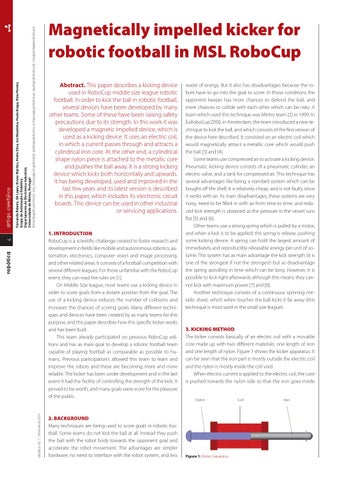
3. KICKING METHOD The kicker consists basically of an electric coil with a movable core made up with two different materials: one length of iron and one length of nylon. Figure 1 shows the kicker apparatus. It can be seen that the iron part is mostly outside the electric coil and the nylon is mostly inside the coil void. When electric current is applied to the electric coil, the core is pushed towards the nylon side so that the iron goes inside
Nylon
Figure 1. Kicker Apparatus.
Coil
Iron