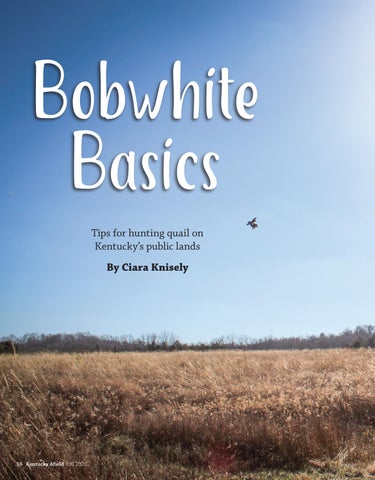
Bobwhite Basics
Tips for hunting quail on Kentucky’s public lands
By Ciara Knisely

NOT FAR FROM PARADISE,
the rolling open lands of Peabody Wildlife Management Area harbor Kentucky’s most robust bobwhite quail populations.
During the dreariest months of the year, hunters comb through tangled fields of briar and weeds at daybreak, chasing after their bird dogs and hoping to see them on point. In the field, locating these small birds requires noses to the ground. Though quail hunting has changed with time, few other game species in Kentucky are pursued in this tradition.
The bobwhite quail is a charming and plump bird with a small head, brown wings spotted with white and a short tail. Male birds take on a showier dark brown and white, while females are a light brown with more subdued markings. As wild game, their meat is served as a delicacy. Though the bobwhite’s niche grassland edge habitat is at a historic national all-time-low and rapidly disappearing, it hangs on as the country’s most widespread species of quail.
Cody Rhoden, small game program coordinator for the Kentucky Department of Fish and Wildlife Resources, monitors the state’s quail populations. He’s optimistic about the upcoming season.
“Our spring bird counts were on par with expectations and signs point to a good hatch this year,” he said.
Hunters can find public land quail hunting opportunities throughout the Green River and Bluegrass regions. Rhoden recommends Peabody Wildlife Management Area (WMA) and Clay WMA as top public land quail hunting sites in Kentucky.
GETTING BIRDY
Being a ground-foraging species that can only fly short distances, quail are connoisseurs of evasion and demand a hunting style that calls for teamwork. Certified Wildlife Biologist Reggie Thackston, a lifelong quail hunter from Georgia, described the sport as one of the best ways to introduce someone to hunting, especially for youth.
“During a quail hunt, you’re working with others. You don’t have to be silent or sit still the whole time. It’s a joy watching the dogs work, too,” Thackston said. Having raised 15 bird dogs over the years, clearly something has him hooked.
Like doves, quail are harvested by shooting on the wing. “As an evolutionary defense to surprise predators, quail hold tightly together until the predator is right up on them and then explode upward in all directions,” Rhoden explained.
Birds will stay localized year after year as long as their needs are met. In the fall, they gather and travel in groups called coveys.
“For me, it’s a very satisfying hunt, chasing and working alongside your dog,” said Rhoden, who has hunted with his sixyear-old English Setter, Fenton, since it was a puppy. “It’s as if you’re reaching back to a more primordial time. I will never forget the moment my dog went into his first point and I shot a bird over him.”
The minimal essentials for a quail hunt include a shotgun, a bird dog and a way to keep track of said dog. Equipment varies from simple collars outfitted with bells or noisemakers to GPS tracking devices,
depending on personal preference. The purpose is to listen for a dog’s bells to stop jingling or to see them stop moving on the GPS, ideally meaning they have located birds and have stopped on point.
The chase is just as fun for the dogs, too. Thackston, who most often hunts with friends to combine dogs and split into multiple groups, described the moment a dog realizes their job as a lightbulb flipping on.
“A dog has to learn he can’t catch the bird himself – that the only way he’ll get to hold one in his mouth is if he points and I shoot,” Thackston said.
Anyone who’s hunted alongside a welltrained bird dog can admire how impressive they are as hunting partners. Seeing a party of dogs shake with excitement before being turned loose, followed by later seeing them stand perfectly still on point, is unlike anything else. On the flip side, the task of training a bird dog can seem daunting, but Rhoden reassured that basic training doesn’t need to be extravagant and can be accomplished at home.
“It’s absolutely doable to self-train,” said Rhoden. “Do at least 15 minutes of practice a day. The breed and background of dog really influences their training and strengths. Speak with local quail hunting organizations and chapters across the state for tips – many members are dog owners who want to help and share the tradition.”
Initial training for bird dogs often involves releasing pen-reared birds when chasing wild birds isn’t an option. Captive-raised birds don’t develop “wild” instincts and won’t flush or fly, Thackston said, but utiliz-
ing them within training familiarizes dogs with their targets and scent.
For field practice with dogs before the season begins, Kentucky’s bobwhite quail shoot-to-train season with dogs opens annually August 15 and closes after May 15. When quail aren’t in season, Rhoden suggested hunters keep the sport fresh in a dog’s mind by hunting other species, such as woodcock.
LISTEN FOR THE WHISTLE
Quail need several essential components: nesting cover, protection from the elements and suitable food sources. Hunters should scout for coveys with these factors in mind. Kentucky Fish and Wildlife’s public land managers can also provide valuable insight.
Bobwhites make the stereotypical “ bobwhite ” breeding call in the spring. Covey calls heard in the fall are a three-noted “ kah-loi-hee.”
Kentucky Fish and Wildlife public lands biologist Eric Williams, who oversees Peabody WMA in Ohio, Hopkins and Muhlenberg counties, has some advice for hunters. “Go out before sunrise and listen for covey calls,” he suggested. “Covey calls mean that birds will be on the move. In the fall, we listen for calls to conduct covey counts.”
At Peabody WMA, staff intensely manage 8,000 acres and moderately manage
18,000 additional acres for quail habitat. The most typical land management practices are block disking to remove invasive species and disrupt the soil as well as strip planting grain and legumes, said Williams.
The aftermath of strip mining left the landscape barren, and Williams noted that quail now behave differently around the Green River region than quail in the Bluegrass region, even with both areas having good habitat. “Hunting linear spaces like fencerows is usually the strategy, but the quail at Peabody relate more to woody cover,” he said. Quail will feed on black locust seeds, which are common trees in the area.
Prescribed fire is typically a key habitat management practice for quail, though not at Peabody. “The most common mistake hunters make at Peabody is only hunting over open spaces. Quail here typically avoid regrowth areas after burns on reclaimed coal mines for at least a year,” Williams said.
Additionally, hills are more common at Peabody than not, and the brush is arduous to traverse. “Some hunters will come here planning to hunt all day, but their dogs end up too exhausted after a few hours,” Williams said.
Quail hunters might consider a pair of close-fitting chaps, as plants such as invasive multi-flora rose, autumn olive, bush
honeysuckle and sericea lespedeza do well on these areas and can easily slow down a hunting party or snag favorite gear.
Terrain at Clay WMA in Nicholas, Fleming and Bath counties is more typical of the Bluegrass habitat: woodlands interspersed with grassy meadows. Open fields, woodland edges overflowing with pollinator habitat and vegetation regrowth provide quail with their necessities. The area has benefitted from more than 1,000 acres of prescribed fire and hundreds of acres of forest stand management.
For hunters, focusing on edge habitat with nearby open weedy fields will provide the best chances of encountering birds. Kentucky Fish and Wildlife’s website, fw.ky.gov, includes an online habitat map of Clay WMA that identifies areas that have received habitat improvement.
Kentucky Fish and Wildlife public lands biologist James Woods, who manages Clay WMA, has helped initiate a new invasive species control method on site. “The mix of many microhabitats is very important to quail here,” said Woods.
Hunters should remember that even with perfect habitat, bad weather can bust a good quail hunt before it starts. The best

Reggie Thackston traverses Peabody’s tangled brush, which can easily tire hunters and dogs.


kind of day, said Rhoden, is around 40 degrees with high humidity levels. Days hotter than 70 degrees with low moisture make the worst kind of hunting weather for quail. For scenting conditions, slow winds are perfect.
FIGHTING FOR TRADITION
Without the cover and food provided by native plants, quail lose the resources they need and easily succumb to inclement weather and nest predators. “Habitat loss is without question the largest hinderance to
quail, but it’s also an issue we can proactively fight back against,” said Rhoden.
Thackston, who carries more than 40 years of professional quail management experience in his back pocket, has adapted a motto for this battle against invasive species. “Never take your foot off the throat of the beast,” he said. Ongoing management is critical.
Quail encounter similar struggles in Georgia, too, where Thackston grew up hunting and later worked with the state’s
quail management program. Having harvested his first bird as a child while hunting with his father in 1961, Thackston has seen things change. Dog training and hunting opportunities were more accessible in the past when quail were abundant, and he noted this shift as the biggest obstacle in engaging new hunters.
“Quail were almost accidental, byproducts of what I call crude farming – practices that used less insecticide and mowed less often,” Thackston explained. The crop fields that supported quail could rotate and rest, routinely left to overgrow with weeds.
Then, the twentieth century spurred quick developments in agriculture and engineering while other global progressions raised the quality of life. Kentucky became a primary supplier of coal when the industry peaked during the 1960s, and the Peabody region was one of many hotspots of mining activity. At the same time, commercialized agriculture began outcompeting local family farms.
Since 1960, more than 65% of Kentucky’s quail population has disappeared. It will take established long-term land management, though Thackston stressed that hope is not lost for this unique bird.
Along the Green River, where folk singer John Prine asked half of his ashes be strewn in his song “Paradise,” the landscape of Peabody WMA has made a significant recovery since heavy strip-mining days. Years of intense habitat recovery at Peabody WMA are slowly burying the world’s largest shovel among the evidence of its destruction.
The bobwhite quail needs advocates, and hunters are facing a call to action. Things are not too far away from a new hard-earned paradise – one where bird dogs and their hunters carry on a long-lasting tradition. n
Quail hunting in Kentucky operates under two zones. For the Western Zone, the 2023 hunting season opens Nov. 13 and runs through Feb. 10, 2024. For the Eastern Zone, the season runs during Nov. 1-10 and reopens Nov. 13 through Jan. 31, 2024. The daily harvest limit is eight birds while the possession limit is 16 birds.
Rachel Cummings photo
Cody Rhoden and his English Setter, Fenton, prepare to hunt an area previously burned for habitat management at Peabody WMA.
Members of the Bluegrass Ladies Sporting club enjoyed a mentored hunt from the Commonwealth Chapter of Quail Forever. Quail hunting is interactive and offers a great introduction to hunting.
Quail Forever Commonwealth Chapter photo