The House
Inside Villa Sofia
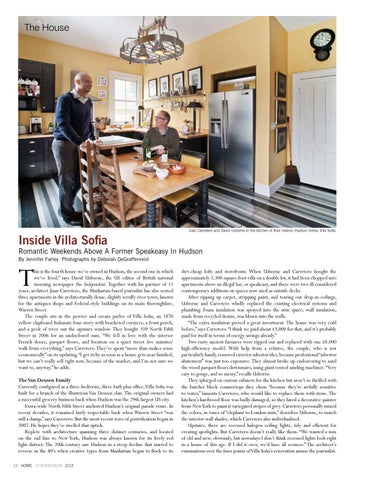
Juan Carretero and David Usborne in the kitchen of their historic Hudson home, Villa Sofia.
Romantic Weekends Above A Former Speakeasy In Hudson By Jennifer Farley Photographs by Deborah DeGraffenreid
T
his is the fourth house we’ve owned in Hudson, the second one in which we’ve lived,” says David Usborne, the US editor of British national morning newspaper the Independent. Together with his partner of 11 years, architect Juan Carretero, the Manhattan-based journalist has also rented three apartments in the architecturally dense, slightly scruffy river town, known for the antiques shops and Federal-style buildings on its main thoroughfare, Warren Street. The couple sits in the pewter and cream parlor of Villa Sofia, an 1870 yellow clapboard Italianate four-story with bracketed cornices, a front porch, and a peek of river out the upstairs window. They bought 109 North Fifth Street in 2006 for an undisclosed sum. “We fell in love with the interior French doors, parquet floors, and location on a quiet street five minutes’ walk from everything,” says Carretero. They’ve spent “more than makes sense economically” on its updating. “I get itchy as soon as a house gets near finished, but we can’t really sell right now, because of the market, and I’m not sure we want to, anyway,” he adds. The Van Deusen Family Currently configured as a three-bedroom, three-bath plus office, Villa Sofia was built for a branch of the illustrious Van Deusen clan. The original owners had a successful grocery business back when Hudson was the 29th-largest US city. Extra-wide North Fifth Street anchored Hudson’s original parade route. In recent decades, it remained fairly respectable back when Warren Street “was still a dump,” says Carretero. But the most recent wave of gentrification began in 2007. He hopes they’ve swelled that uptick. Replete with architecture spanning three distinct centuries, and located on the rail line to New York, Hudson was always known for its lively red light district. The 20th century saw Hudson in a steep decline that started to reverse in the 80’s when creative types from Manhattan began to flock to its 24 home ChronograM 2/13
dirt-cheap lofts and storefronts. When Usborne and Carretero bought the approximately 3,300-square-foot villa on a double lot, it had been chopped into apartments above an illegal bar, or speakeasy, and there were two ill-considered contemporary additions on spaces now used as outside decks. After ripping up carpet, stripping paint, and tearing out drop-in ceilings, Usborne and Carretero wholly replaced the existing electrical systems and plumbing. Foam insulation was sprayed into the attic space; wall insulation, made from recycled denim, was blown into the walls. “The extra insulation proved a great investment. The house was very cold before,” says Carretero. “I think we paid about $3,000 for that, and it’s probably paid for itself in terms of energy savings already.” Two rusty ancient furnaces were ripped out and replaced with one $8,000 high-efficiency model. With help from a relative, the couple, who is not particularly handy, removed exterior asbestos tiles, because professional “asbestos abatement” was just too expensive. They almost broke up endeavoring to sand the wood parquet floors downstairs, using giant rented sanding machines. “Very easy to gouge, and so messy,” recalls Usborne. They splurged on custom cabinets for the kitchen but aren’t so thrilled with the butcher block countertops they chose “because they’re awfully sensitive to water,” laments Carretero, who would like to replace them with stone. The kitchen’s hardwood floor was badly damaged, so they hired a decorative painter from NewYork to paint it variegated stripes of grey. Carretero personally mixed the colors, in tones of “elephant to London mist,” describes Usborne, to match the interior wall shades, which Carretero also individualized. Upstairs, there are recessed halogen ceiling lights, tidy and efficient for creating spotlights. But Carretero doesn’t really like them. “We wanted a mix of old and new, obviously, but nowadays I don’t think recessed lights look right in a house of this age. If I did it over, we’d have all sconces.” The architect’s ruminations over the finer points of Villa Sofia’s renovation amuse the journalist.