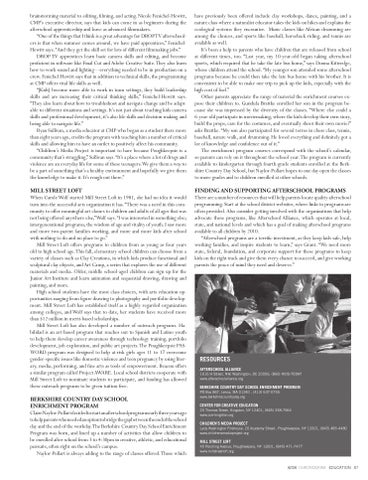
brainstorming material to editing, filming, and acting. Nicole Fenichel-Hewitt, CMP’s executive director, says that kids can come in as beginners during the afterschool apprenticeship and leave as advanced filmmakers. “One of the things that I think is a great advantage for DROP TV afterschoolers is that when summer comes around, we have paid apprentices,” FenichelHewitt says. “And they get the skill set for lots of different filmmaking jobs.” DROP TV apprentices learn basic camera skills and editing, and become proficient in software like Final Cut and Adobe Creative Suite. They also learn how to work sound and lighting—everything needed to be in production on a crew. Fenichel-Hewitt says that in addition to technical skills, the programming at CMP offers vital life skills as well. “[Kids] become more able to work in team settings, they build leadership skills and are increasing their critical thinking skills,” Fenichel-Hewitt says. “They also learn about how to troubleshoot and navigate change and be adaptable to different situations and settings. It’s not just about teaching kids camera skills and professional development, it’s also life skills and decision making and being able to navigate life.” Ryan Sullivan, a media educator at CMP who began as a student there more than eight years ago, credits the program with teaching him a number of critical skills and allowing him to have an outlet to positively affect his community. “Children’s Media Project is important to have because Poughkeepsie is a community that’s struggling,” Sullivan says. “It’s a place where a lot of drugs and violence are an everyday life for some of these teenagers.We give them a way to be a part of something that’s a healthy environment and hopefully we give them the knowledge to make it. It’s rough out there.”
have previously been offered include clay workshops, dance, painting, and a nature class where a naturalist educator takes the kids on hikes and explains the ecological systems they encounter. Music classes like African drumming are among the choices, and sports like baseball, horseback riding, and tennis are available as well. It’s been a help to parents who have children that are released from school at different times, too. “Last year, my 10-year-old began taking afterschool sports, which required that he take the late bus home,” says Donna Kittredge, whose children attend the school. “My younger son attended some afterschool programs because he could then take the late bus home with his brother. It is convenient to be able to make one trip to pick up the kids, especially with the high cost of fuel.” Other parents appreciate the range of material the enrichment courses expose their children to. Gundula Brattke enrolled her son in the program because she was impressed by the diversity of the classes. “Where else could a 6-year-old participate in moviemaking, where the kids develop their own story, build the props, care for the costumes, and eventually shoot their own movie?” asks Brattke. “My son also participated for several terms in chess class, tennis, baseball, nature walk, and drumming. He loved everything and definitely got a lot of knowledge and confidence out of it.” The enrichment program courses correspond with the school’s calendar, so parents can rely on it throughout the school year. The program is currently available to kindergarten through fourth-grade students enrolled at the Berkshire Country Day School, but Naylor-Pollart hopes to one day open the classes to more grades and to children enrolled at other schools.
MILL STREET LOFT When Carole Wolf started Mill Street Loft in 1981, she had no idea it would turn into the successful arts organization it has. “There was a need in this community to offer meaningful art classes to children and adults of all ages that was not being offered anywhere else,”Wolf says. “I was interested in something else; intergenerational programs, the wisdom of age and vitality of youth. I saw more and more two-parent families working, and more and more kids after school with nothing to do and no place to go.” Mill Street Loft offers programs to children from as young as four years old to high school age. This fall, elementary school children can choose from a variety of classes such as Clay Creations, in which kids produce functional and sculptural clay objects, and Art Camp, a series that explores the use of different materials and media. Older, middle school-aged children can sign up for the Junior Art Institute and learn animation and sequential drawing, drawing and painting, and more. High school students have the most class choices, with arts education opportunities ranging from figure drawing to photography and portfolio development. Mill Street Loft has established itself as a highly regarded organization among colleges, and Wolf says that to date, her students have received more than $12 million in merit-based scholarships. Mill Street Loft has also developed a number of outreach programs. Habilidad is an art-based program that reaches out to Spanish and Latino youth to help them develop career awareness through technology training, portfolio development, job exploration, and public art projects. The Poughkeepsie PASWORD program was designed to help at-risk girls ages 11 to 17 overcome gender-specific issues like domestic violence and teen pregnancy by using literary, media, performing, and fine arts as tools of empowerment. Beacon offers a similar program called Project AWARE. Local school districts cooperate with Mill Street Loft to nominate students to participate, and funding has allowed these outreach programs to be given tuition-free.
FINDING AND SUPPORTING AFTERSCHOOL PROGRAMS There are a number of resources that will help parents locate quality afterschool programming. Start at the school district websites, where links to programs are often provided. Also consider getting involved with the organizations that help advocate these programs, like Afterschool Alliance, which operates at local, state, and national levels and which has a goal of making afterschool programs available to all children by 2010. “Afterschool programs are a terrific investment, as they keep kids safe, help working families, and inspire students to learn,” says Grant. “We need more state, federal, foundation, and corporate support for these programs to keep kids on the right track and give them every chance to succeed, and give working parents the peace of mind they need and deserve.”
BERKSHIRE COUNTRY DAY SCHOOL ENRICHMENT PROGRAM Claire Naylor-Pollart decided to start an afterschool program nearly three years ago to help parents who needed an option to bridge the gap between the end of the school day and the end of the workday.The Berkshire Country Day School Enrichment Program was born, and lined up a number of activities that allow children to be enrolled after school from 3 to 4:30pm in creative, athletic, and educational pursuits, often right on the school’s campus. Naylor-Pollart is always adding to the range of classes offered. Those which
RESOURCES AFTERSCHOOL ALLIANCE 1616 H Street, NW, Washington, DC 20006, (866) KIDS-TODAY www.afterschoolalliance.org
BERKSHIRE COUNTRY DAY SCHOOL ENRICHMENT PROGRAM PO Box 867, Lenox, MA 01240 , (413) 637-0755 www.berkshirecountryday.org
CENTER FOR CREATIVE EDUCATION 20 Thomas Street, Kingston, NY 12401, (845) 338-7664 www.cce-kingston.org
CHILDREN’S MEDIA PROJECT Lady Washington Firehouse, 20 Academy Street , Poughkeepsie, NY 12601, (845) 485-4480 www.childrensmediaproject.org
MILL STREET LOFT 45 Pershing Avenue, Poughkeepsie, NY 12601, (845) 471-7477 www.millstreetloft.org
8/08 CHRONOGRAM EDUCATION 87