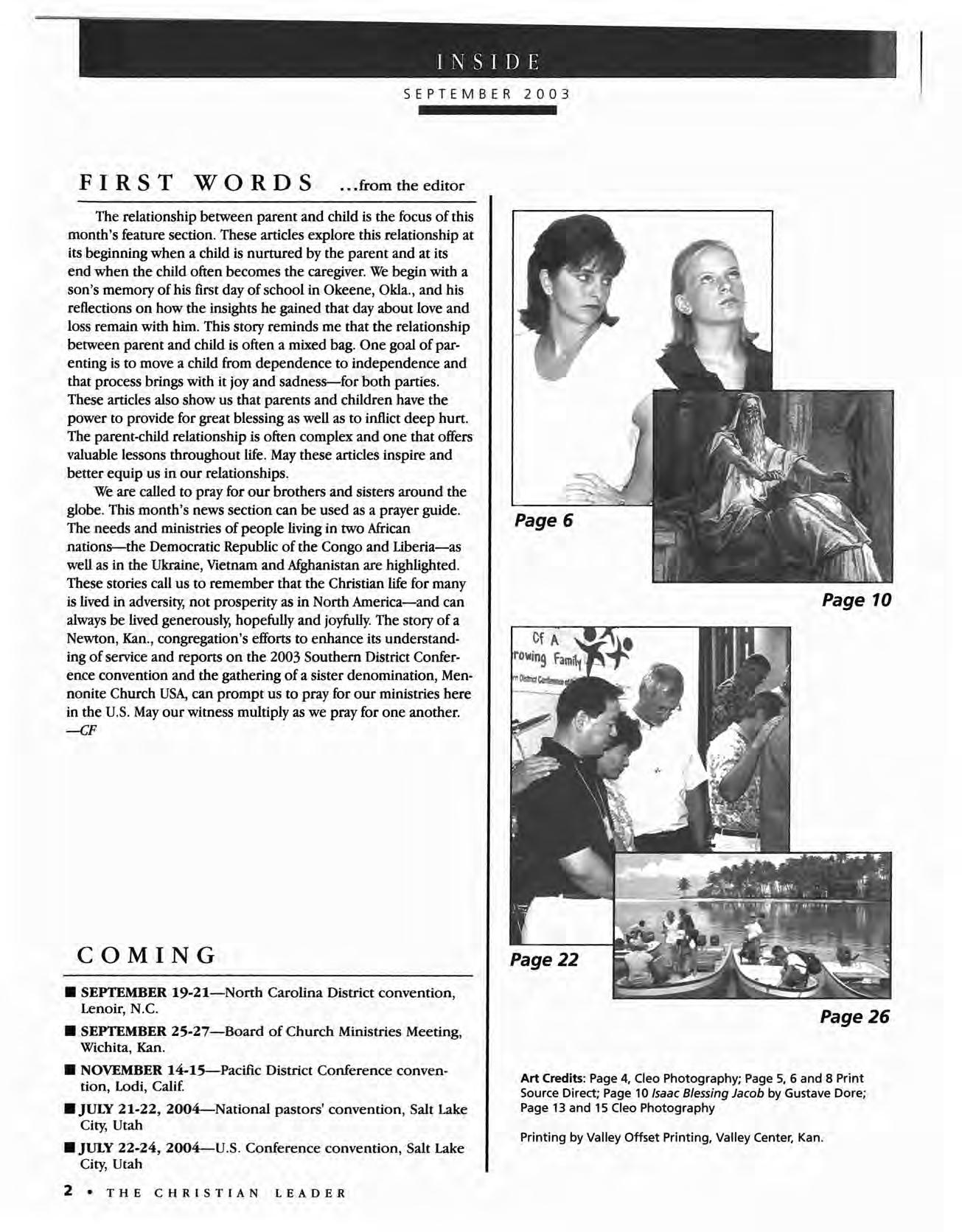
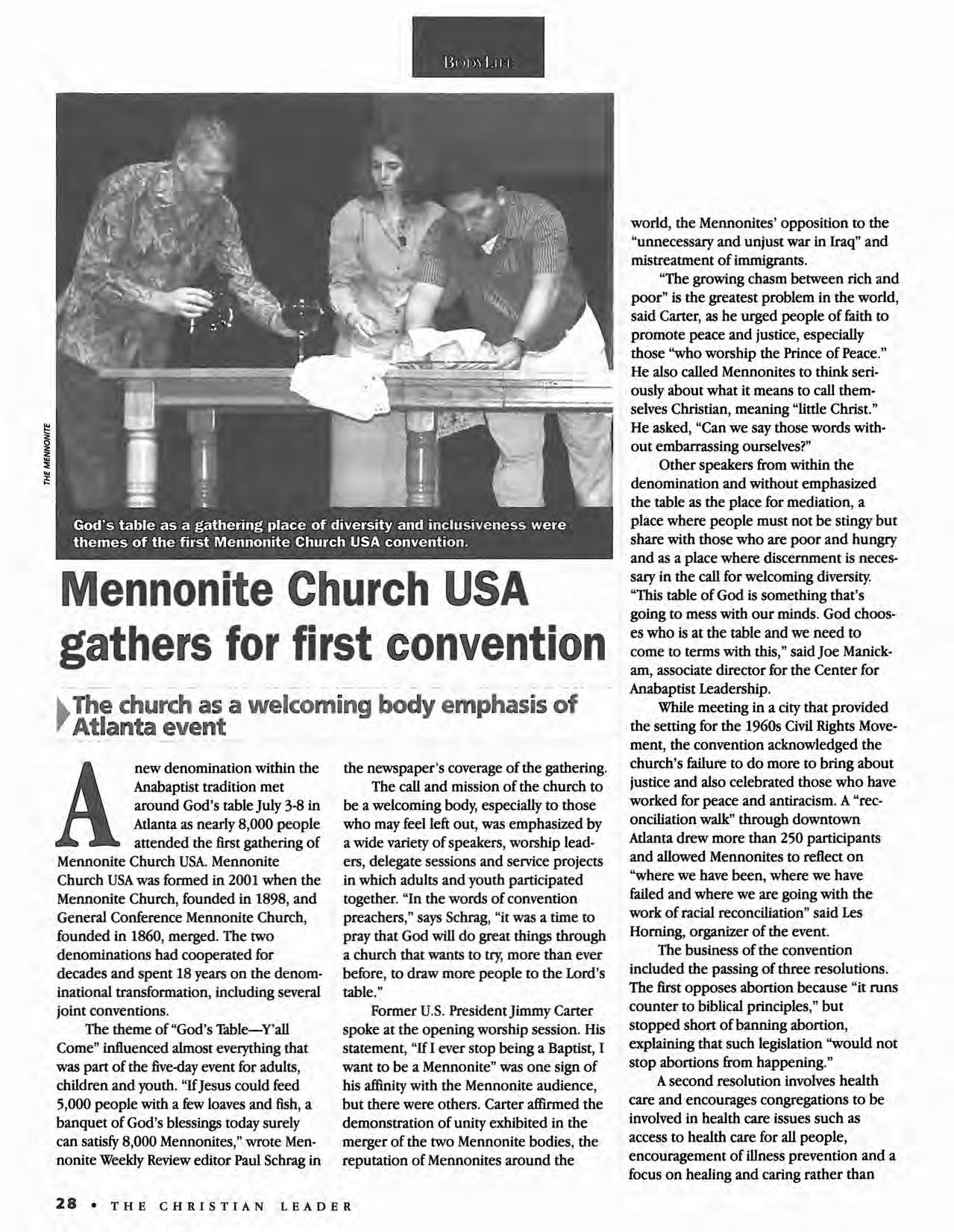
The relationship between parent and child is the focus of this month's feature section. These articles explore this relationship at its beginning when a child is nurtured by the parent and at its end when the child often becomes the caregiver. We begin with a son's memory of his first day of school in Okeene, Okla., and his reflections on how the insights he gained that day about love and loss remain with him. This story reminds me that the relationship between parent and child is often a mixed bag. One goal of parenting is to move a child from dependence to independence and that process brings with it joy and sadness-for both parties. These articles also show us that parents and children have the power to prOVide for great blessing as well as to inflict deep hurt. The parent-child relationship is often complex and one that offers valuable lessons throughout life. May these articles inspire and better equip us in our relationships.
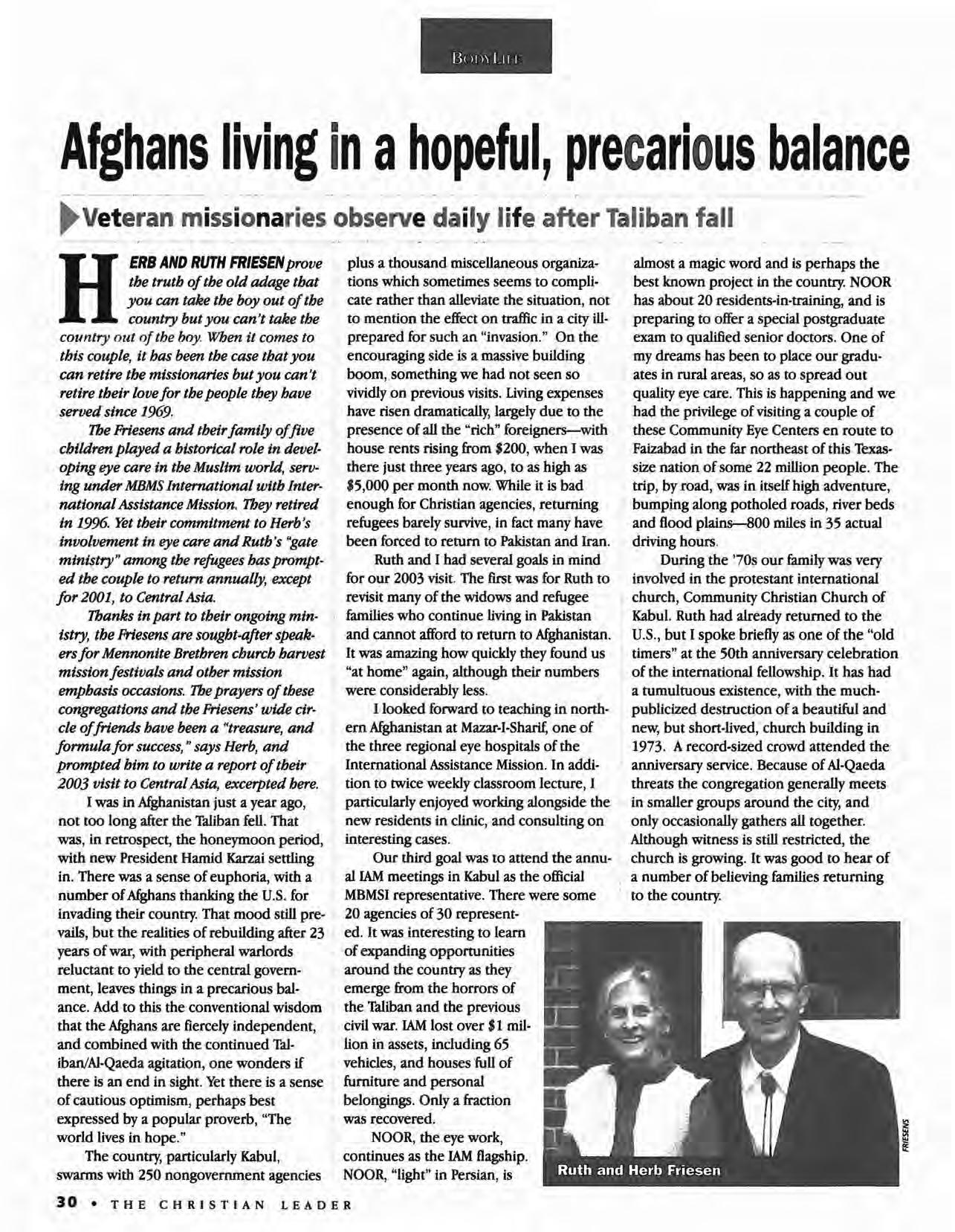
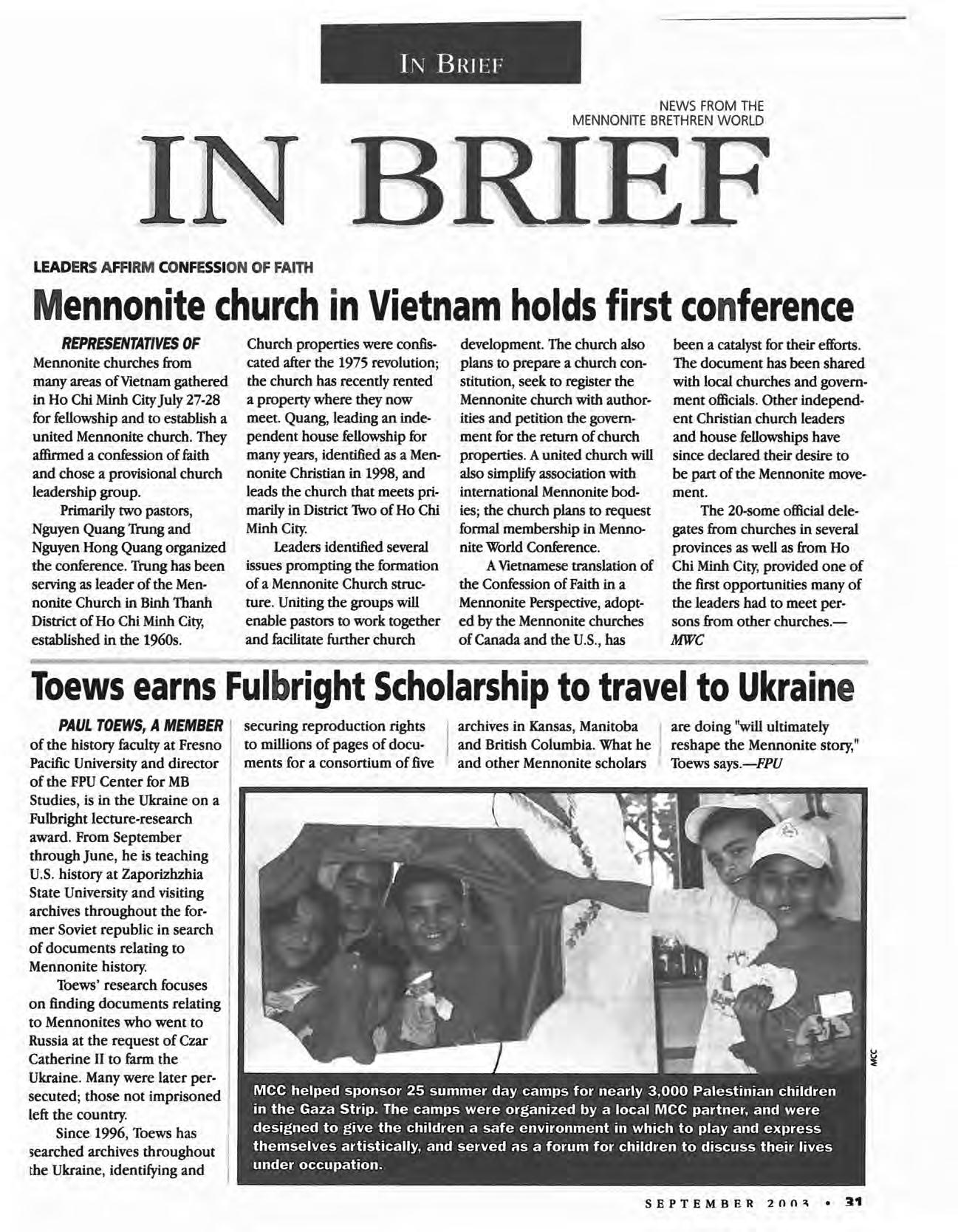
We are called to pray for our brothers and sisters around the globe. This month's news section can be used as a prayer guide. The needs and ministries of people living in two African .nations-the Democratic Republic of the Congo and Liberia-as well as in the Ukraine, Vietnam and Afghanistan are highlighted. These stories call us to remember that the Christian life for many is lived in adversity, not prosperity as in North America-and can always be lived generously, hopefully and joyfully. The story of a Newton, Kan., congregation's efforts to enhance its understanding of service and reports on the 2003 Southern District Conference convention and the gathering of a sister denomination, Mennonite Church USA, can prompt us to pray for our ministries here in the U.S. May our witness multiply as we pray for one another. -CF
COMING
• SEPTEMBER 19-21-North Carolina District convention, Lenoir, N.C.
• SEPTEMBER 25-27-Board of Church Ministries Meeting, Wichita, Kan.
• NOVEMBER 14-15-Pacific District Conference convention, Lodi, Calif.
• JULY 21-22, 2004-National pastors' convention, Salt Lake City, Utah
• JULY 22.24, 2004-U.S. Conference convention, Salt Lake City, Utah
Art Credits: Page 4, Cleo Photography; Page 5, 6 and 8 Print
Source Direct; Page 10 Isaac Blessing Jacob by Gustave Dore; Page 13 and 15 Cleo Photography
4 The First Day of School
A mother's promise calms the fears of her first grade son and leads to insight that "Bennie," as the author was known then, still ponders today. BY BEN C.
OLLENBERGER
6
Family Feud
Many family conflicts follow a similar and unhealthy pattern and seldom address the real issues. Our goal in a family disagreement should be to identify conflict early in the cycle and defeat it. When families make a habit of identifying the real issues and their importance and place a high value on preserving relationships, family feuds can be avoided. BY TIM NEUFELD
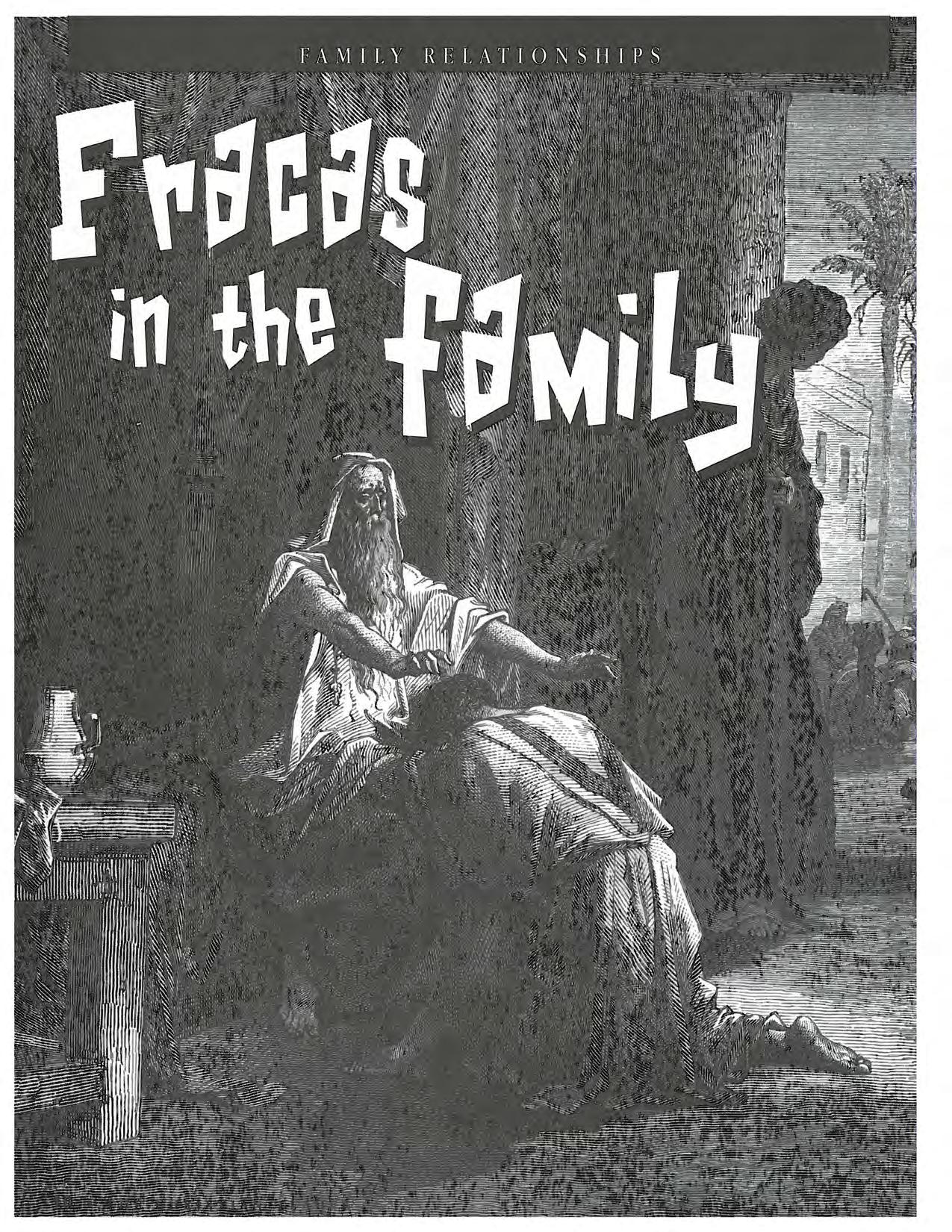
10 Fracus in the family
The Bible is not the place to look for examples of the "perfect" family. But it is the place to go for examples of God's redeeming grace in broken family relationships. The story of Jacob's family is one example. BY DAVID ESAU
13 What our aging parents really need
Giving care to an aging parent goes beyond the external needs. Professionals can take care of a parent's daily physical needs but only family members can give what an aging parent really needs-gifts of the spirit that include respect, understanding, loyalty and comfort. BY KAREN O'CONNOR
13
Caring for our parents: Learning from a mother's dementia
Dementia forces a parent and child into roles both would rather avoid. But this daughter is grateful for the lessons God has had for her as she and her mother have struggled with the ways in which dementia has affected their relationship. BY JEANNIE ALFORD HAGY
• Trim from living instead of giving Chuck's Corner by Chuck Buller 20
• Pleasant surprises everywhere
BOARD OF COMMUNICATIONS: Harold Loewen, chair; Peggy Goertzen, Reggie Hunt, Phil Neufeld, Moises Tagle, Dalton Reimer, Kathy Heinrichs Wiest
MANDATE: The Christian Leader (ISSN 0009-S149) is published monthly by the U.s. Conference of Mennonite Brethren Churches. The Christian Leader seeks to inform Mennonite Brethren members and churches of the events, activities, decisions and issues of their denomination, and to instruct, inspire and initiate dialogue so members will aspire to be faithful disciples of Christ as understood in the evangelical/Anabaptist theological tradition.
EDITORIAL POUCY: The views expressed in this publication do not necessarily represent the position of the Christian Leader, the Board of Communications or the Mennonite Brethren Church. Scripture references are from New International Version unless otherwise noted. The editors invite free-lance article submissions. A SASE must accompany articles.
READER PARTIOPATION: The editors invite readers to share their thoughts and opinions on topics relevant to the Mennonite Brethren Church using letters to the editor and Forum essays. Letters to the editor should be brief - 300 words or less - and on one subject. Letters must be signed and include the writer's city and state. Letters will be edited for clarity, appropriateness and length. Letters will be published, as space allows, unless marked "Not for publication." Forum is open to members or attendees of Mennonite Brethren churches. Essays should not exceed 800 words, and should include the writer's name, address, home church and occupation.
COMMUNICATION: All correspondence, including change of address, should be addressed to the Christian Leader, Box 220, Hillsboro, KS 67063. Phone: (620)947-5543. Fax: (620}947-3266. E-mail: christianleader@usmb.org.
SUBSCRIPTIONS: Rates: $16 for one year, $30 for two years and $42 for three years ($20, $38, $54 in Canada); $1.50 per copy.
MEMBERSHIP: The Christian Leader is a member of the Evangelical Press Association and Meetinghouse, an association of Mennonite and Brethren in Christ editors.
POSTMASTER: Send address changes to the Christian Leader, Box 220, Hillsboro, KS 67063. Periodicals postage paid at Hillsboro, Kansas.
• Blest be
INTERIM EDITOR Connie Faber
EDITORIAL ASSISTANT Nadine Friesen
t Flr$t Dav of
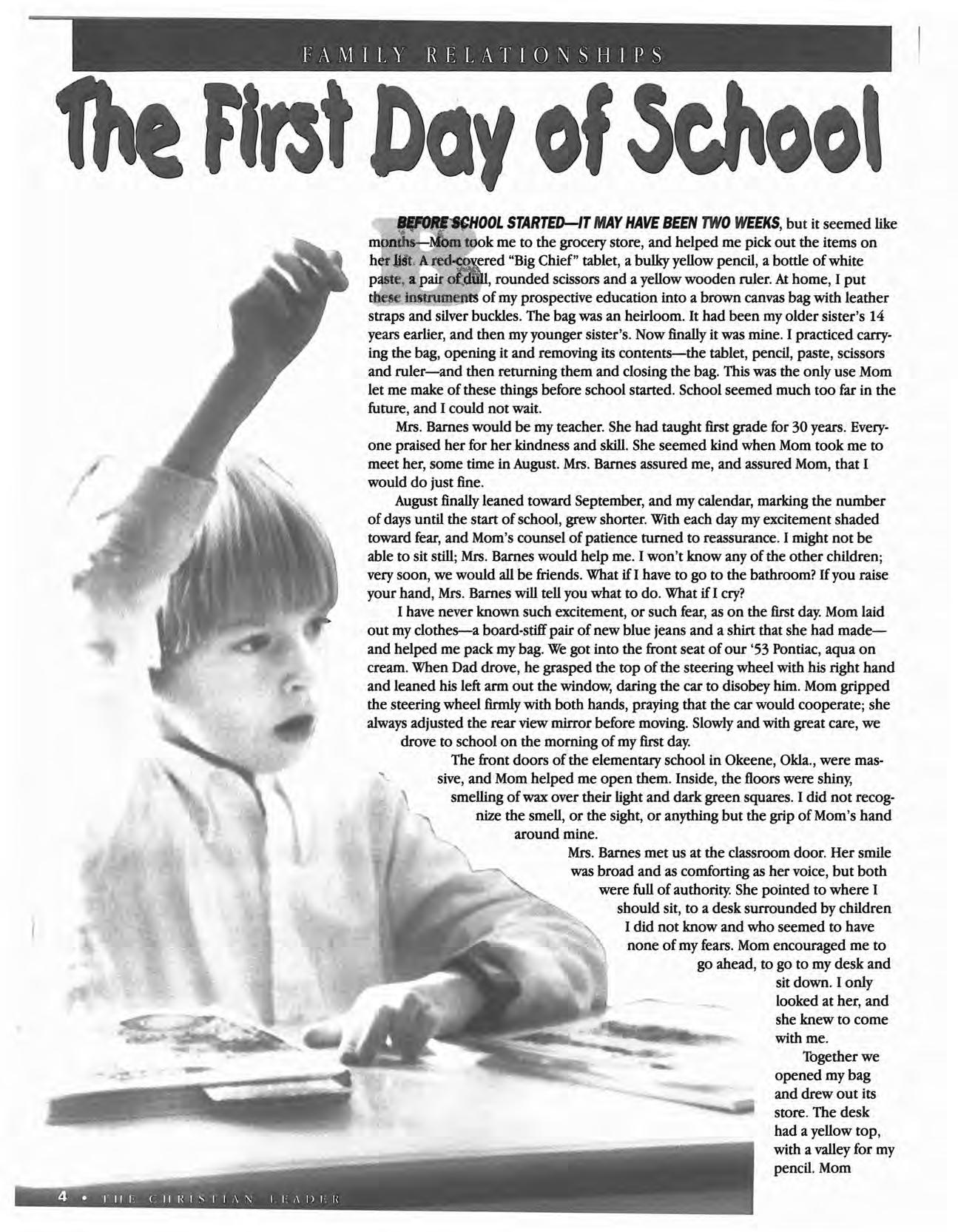
STARTED-IT MAY HAVE BEEN TWO WEEKS, but it seemed like m nth t ok me to the grocery store, and helped me pick out the items on h lilt. "Big Chief" tablet, a bulky yellow pencil, a bottle of white p e, a air rounded scissors and a yellow wooden ruler. At home, I put ese instrume of my prospective education into a brown canvas bag with leather straps and silver buckles. The bag was an heirloom. It had been my older sister's 14 years earlier, and then my younger sister's. Now finally it was mine. I practiced carrying the bag, opening it and removing its contents-the tablet, pencil, paste, scissors and ruler-and then returning them and closing the bag. This was the only use Mom let me make of these things before school started. School seemed much too far in the future, and I could not wait.
Mrs. Barnes would be my teacher. She had taught first grade for 30 years. Everyone praised her for her kindness and skill. She seemed kind when Mom took me to meet her, some time in August. Mrs. Barnes assured me, and assured Mom, that I would do just fine.
August finally leaned toward September, and my calendar, marking the number of days until the start of school, grew shorter. With each day my excitement shaded toward fear, and Mom's counsel of patience turned to reassurance. I might not be able to sit still; Mrs. Barnes would help me. I won't know any of the other children; very soon, we would all be friends. What if I have to go to the bathroom? If you raise your hand, Mrs. Barnes will tell you what to do. What if I cry?
I have never known such excitement, or such fear, as on the first day. Mom laid out my clothes-a board-stiff pair of new blue jeans and a shirt that she had madeand helped me pack my bag. We got into the front seat of our '53 Pontiac, aqua on cream. When Dad drove, he grasped the top of the steering wheel with his right hand and leaned his left arm out the window, daring the car to disobey him. Mom gripped the steering wheel firmly with both hands, praying that the car would cooperate; she always adjusted the rear view mirror before moving. Slowly and with great care, we drove to school on the morning of my first day.
The front doors of the elementary school in Okeene, Okla., were massive, and Mom helped me open them. Inside, the floors were shiny, smelling of wax over their light and dark green squares. I did not recognize the smell, or the sight, or anything but the grip of Mom's hand around mine.
Mrs. Barnes met us at the classroom door. Her smile was broad and as comforting as her voice, but both were full of authority. She pointed to where I should sit, to a desk surrounded by children I did not know and who seemed to have none of my fears. Mom encouraged me to go ahead, to go to my desk and sit down. I only looked at her, and she knew to come with me. Together we opened my bag and drew out its store. The desk had a yellow top, with a valley for my pencil. Mom
Ollenberger
showed me how to push up the desk top; we put my tablet, scissors, ruler and paste inside. I tested the chair, still clutching Mom's hand. She said it was time for school to start, and she would need to go. I cried without any shame.
Mom led me to a place near the door of the classroom, hugged me and dried my tears. She promised that if I would go to my desk by myself, she would find a chair and stay for awhile, just to make sure I was all right. Mrs. Barnes called the class to order and secure in Mom's promise I went to my desk.
Mrs. Barnes called all of our names and asked us to stand one by one. It was the first time I heard my name called among strangers. I stood and looked at Mom; across the room her smile told me I had done all right. Each word from Mrs. Barnes brought something new; and at each new thing I looked to Mom. Her smile told me that I was doing all right. And with each word and each smile, my fear moved toward courage. Mrs. Barnes told us to stand and get in a circle. From my place in the circle, I looked to Mom, and my smile told her that I was doing all right. In the circle, we played a game to learn each other's names. When I remembered a name, or when someone remembered mine, I smiled at Mom.
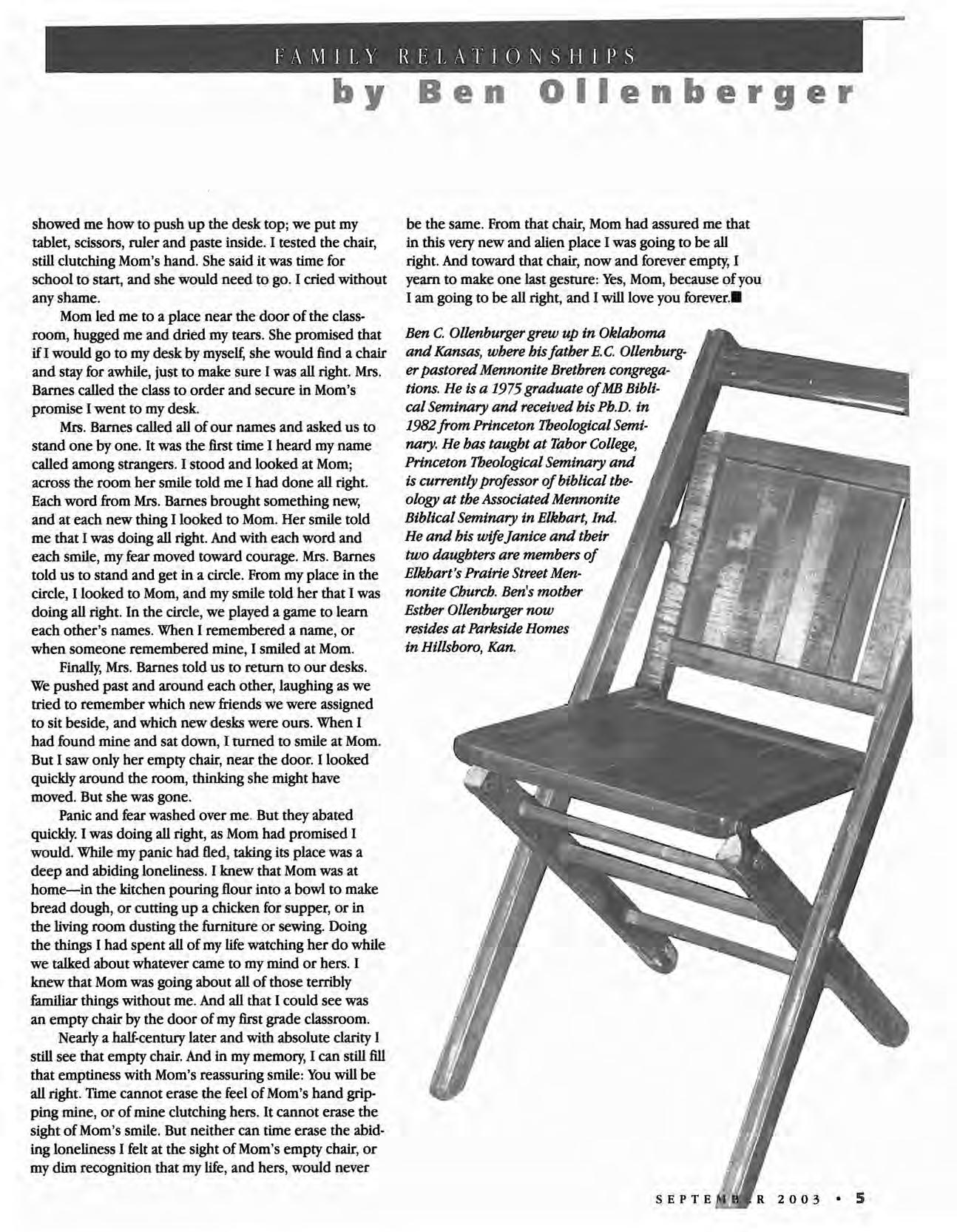
Finally, Mrs. Barnes told us to return to our desks. We pushed past and around each other, laughing as we tried to remember which new friends we were assigned to sit beside, and which new desks were ours. When I had found mine and sat down, I turned to smile at Mom. But I saw only her empty chair, near the door. I looked quickly around the room, thinking she might have moved. But she was gone.
Panic and fear washed over me. But they abated quickly. I was doing all right, as Mom had promised I would. While my panic had fled, taking its place was a deep and abiding loneliness. I knew that Mom was at home-in the kitchen pouring flour into a bowl to make bread dough, or cutting up a chicken for supper, or in the living room dusting the furniture or sewing. Doing the things I had spent all of my life watching her do while we talked about whatever came to my mind or hers. I knew that Mom was going about all of those terribly familiar things without me. And all that I could see was an empty chair by the door of my first grade classroom.
Nearly a half-century later and with absolute clarity I still see that empty chair. And in my memory, I can still fill that emptiness with Mom's reassuring smile: You will be all right. Time cannot erase the feel of Mom's hand gripping mine, or of mine clutching hers. It cannot erase the sight of Mom's smile. But neither can time erase the abiding loneliness I felt at the Sight of Mom's empty chair, or my dim recognition that my life, and hers, would never
be the same. From that chair, Mom had assured me that in this very new and alien place I was going to be all right. And toward that chair, now and forever empty, I yearn to make one last gesture: Yes, Mom, because of you I am going to be all right, and I will love you forever.•
Ben C. Ollenburger grew up in Oklahoma and Kansas, where his father E. C. Ollenburger pastored Mennonite Brethren congregations. He is a 1975 graduate ofME Biblical Seminary and received his Ph.D. in 1982 from Princeton Theological Seminary. He has taught at Tabor College, Princeton Theological Seminary and is currently professor of biblical theology at the Associated Mennonite Biblical Seminary in Elkhart, Ind. He and his wifejanice and their two daughters are members of Elkhart's Prairie Street Mennonite Church. Ben's mother Esther Ollenburger now resides at Parkside Homes in Hillsboro, Kan.
ami y eu
How to handle conflict in the family
Every night of very week in every city, families repeat the cycle ...
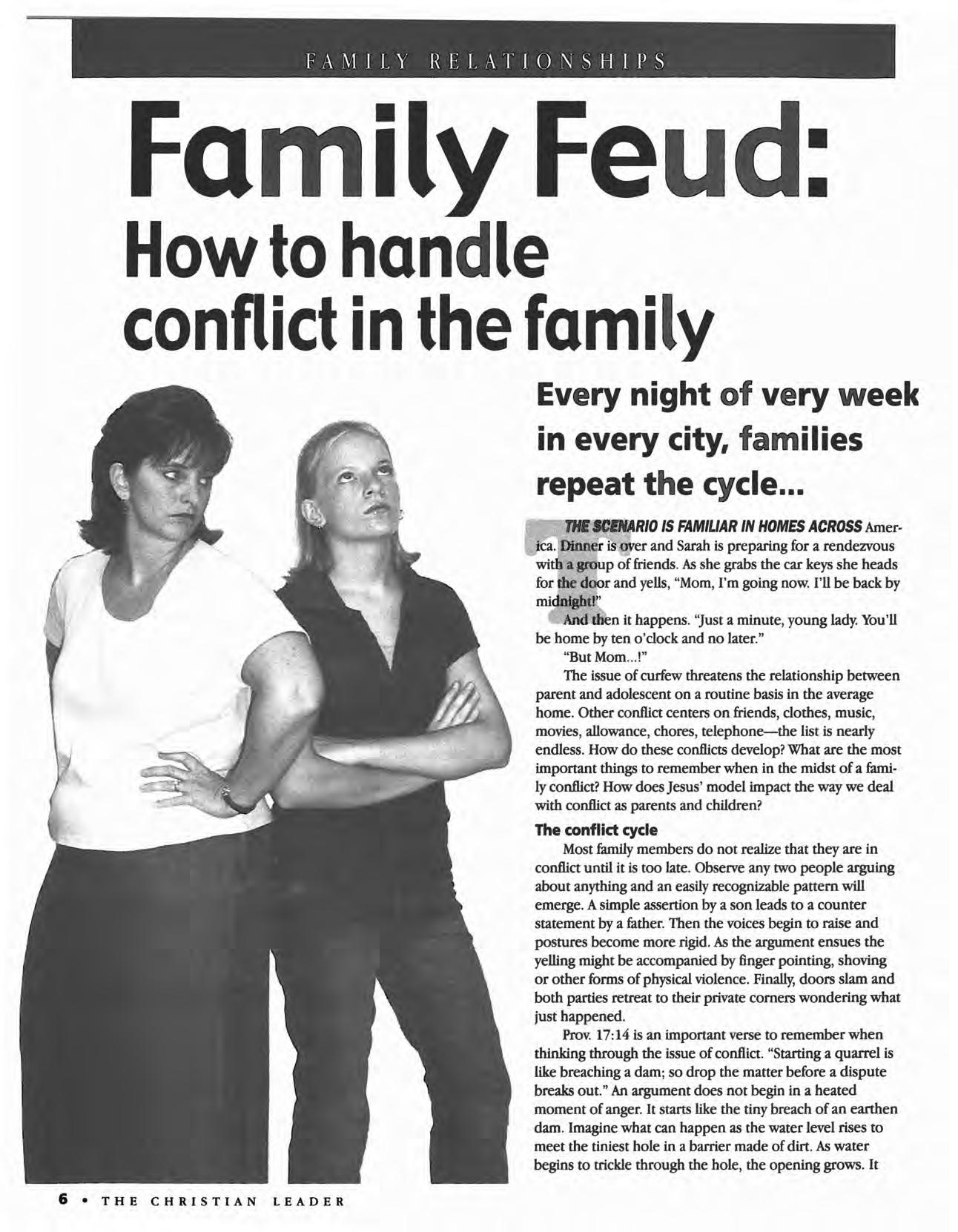
rnJfllmrARIO IS FAMILIAR IN HOMES ACROSS Amer· er and Sarah is preparing for a rendezvous wit a gr:qup of friends. As she grabs the car keys she heads for door and yells, "Mom, I'm going now. I'll be back by midmgbtl' then it happens. "Just a minute, young lady. You'll be home by ten o'clock and no later."
"But Mom '"
The issue of curfew threatens the relationship between parent and adolescent on a routine basis in the average home. Other conflict centers on friends, clothes, music, movies, allowance, chores, telephone-the list is nearly endless. How do these conflicts develop? What are the most important things to remember when in the midst of a fami· ly conflict? How does Jesus' model impact the way we deal with conflict as parents and children?
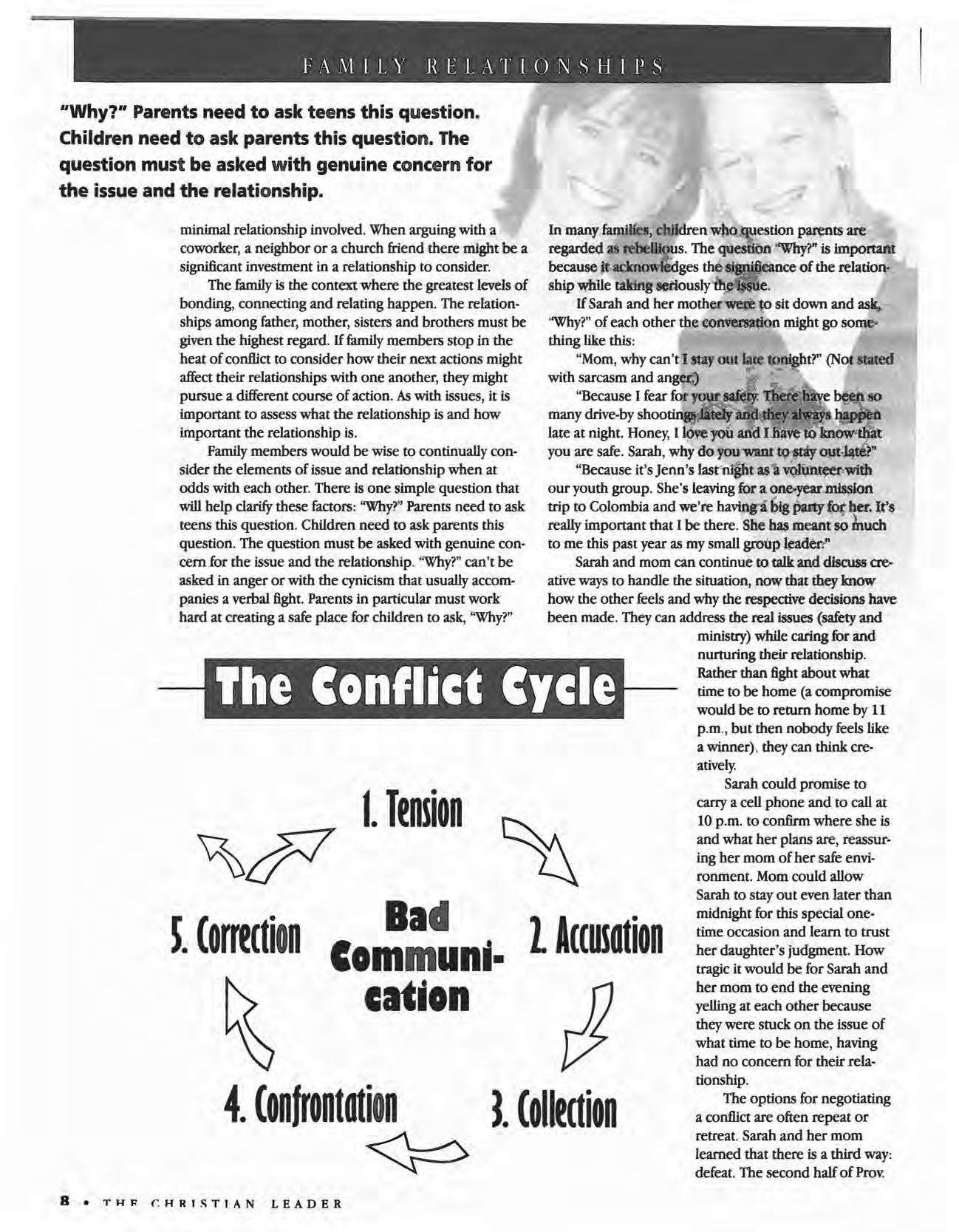
The conflict cycle
Most family members do not realize that they are in conflict until it is too late. Observe any two people arguing about anything and an easily recognizable pattern will emerge. A simple assertion by a son leads to a counter statement by a father. Then the voices begin to raise and postures become more rigid. As the argument ensues the yelling might be accompanied by finger pointing, shoving or other fonns of physical violence. Finally, doors slam and both parties retreat to their private comers wondering what just happened.
Prov. 17:14 is an important verse to remember when thinking through the issue of conflict. "Starting a quarrel is like breaching a dam; so drop the matter before a dispute breaks out." An argument does not begin in a heated moment of anger. It starts like the tiny breach of an earthen dam. Imagine what can happen as the water level rises to meet the tiniest hole in a barrier made of dirt. As water begins to trickle through the hole, the opening grows. It
gets bigger and bigger until the whole structure is overwhehned, resulting in a sudden rush of water as the dam bursts and washes away down the river. Arguments within the family follow a similar cycle.
Stage One: Tension. Tension comes from a change of plans. In Sarah's case, she planned on being out of the house until midnight. Her plans were changed when her mom demanded that she be home by 10:00 p.m. When expectations are altered, people tend to get annoyed. There is a subtle, almost unnoticeable sensation that something is wrong. The relationship between family members begins to be stressed because there is a change of plans.
Stage 1\vo: Accusation. Persons in conflict will begin to point the finger at one another making accusations that mayor may not be true. As Sarah heads to her friends' party she might become aware of the way she feels. There is an uncomfortable feeling, something is annoying her. 'lAb, ha," she says. "It's my mom's fault. She is the one who is making me feel this way." Parents and children begin to attack each other with statements like, ''You always say. ," and, ''You never let me " These kinds of absolute statements are meant to place blame on someone.
Stage Three: Collection. This is the stage that keeps people awake at night. Sarah might go to bed that evening still upset at her mother. Like a garbage truck making its weekly pickup at the curbside, she collects "garbage" to hold against her mother. "She not only wouldn't let me stay out late, but she did this and this and this." Parents do the same with their children. The ultimate tragedy at this point is that a person will create mental lists, harbor grudges and unfairly judge those that he or she is in con· flict with. An unhealthy preoccupation with the opposing party will develop. Sleep may be lost and the relationship is in jeopardy.
Stage Four: Confrontation. Eventually, every garbage truck has to head back to the dump and unload. The same is true of family members in conflict and the garbage is often dumped in the most heated of moments. Sarah might wake the next day to find herself at odds with her mom again, resulting in another argument. There comes a point when she has had enough and explodes, bringing her mother down with hurtful words and untrue accusations. Family members in this stage should wear signs that read, "Warning: Contents under pressure; do not expose to heat or store at high temperatures." Confrontation happens like the explosion of an aerosol can in a campfire. When conditions are just right the mother, father, son or daughter will blow up all over the nearest person. This is a desperate stage. People will say and do things in anger (momentary lapses of sanity) that they
by Tim Neufeld
would never do at Stage One. The relationship may be irreparably damaged.
Stage Five: Correction. This sounds like a positive stage, but most often it is not. Participants in family conflict usually take one of two paths after confrontation: repeat or retreat. To repeat contlict simply means that one remains in the cycle of conflict without ever reflecting on how to get out of that cycle. Sarah and her mother will probably try to "put the contlict behind them." The inten· tions are good (forgive and forget), but they haven't worked at learning how to reconcile a contlict the next time one arises. While they may not argue about curfew again, they certainly will repeat the cycle on other issues (phone, boyfriends, clothes, etc.).
Ultimately, one or both parties may retreat from con· flict.After family members have gone around the conflict cycle an almost countless number of times, they decide that breaking the relationship is the best way to avoid con· flict. Sarah, as so many adolescents do, might run to her room in desperation, pack her suitcase, and head for the front door. She shakes an angry fist in the air screaming at her parents, "I'm never coming back to this place again! I hate this house and I hate you!" Retreating from conflict results in the divorce of spouses, the separation of family members and the breaking of relationships.
The two most important things to remember Issue and relationship are the two most important elements to consider in resolving a family conflict. Issues are the things that family members fight about. Relationships are the interpersonal bonds between each of the members. Families are doomed to endlessly repeat an unmanaged cycle of conflict when they focus only on the issues.
Some contlicts are about very important issues, such as safety, use of drugs and alcohol, negative intluences of peers, etc. Some issues are much less important. Hair style, ear piercings, entertainment, a messy room and others may not be issues worth fighting about.
Many issues may be confused for being important when they are not. For instance, church attendance is an important issue for most members of this family must attend church." However, less important issues might be which church the kids want to attend, or missing church to spend the weekend with a friend. It is very important in every family conflict to identify what the issue is and how important the issue is.
The mistake that most parents and children make in handling contlict lies in underestimating the importance and power of relationships. In every contlict a relationship is at risk. When someone has an argument with a clerk at a grocery store there usually isn't more than a
"Why?" Parents need to ask teens this question. Children need to ask parents this question. The question must be asked with genuine concern for the issue and the relationship.
minimal relationship involved. When arguing with a coworker, a neighbor or a church friend there might be a significant investment in a relationship to consider.
The family is the context where the greatest levels of bonding, connecting and relating happen. The relationships among father, mother, sisters and brothers must be given the highest regard. If family members stop in the heat of conflict to consider how their next actions might affect their relationships with one another, they might pursue a different course of action. As with issues, it is important to assess what the relationship is and how important the relationship is.
Family members would be wise to continually consider the elements of issue and relationship when at odds with each other. There is one simple question that will help clarify these factors: "Why?" Parents need to ask teens this question. Children need to ask parents this question. The question must be asked with genuine concern for the issue and the relationship. ''Why?'' can't be asked in anger or with the cynicism that usually accompanies a verbal fight. Parents in particular must work hard at creating a safe place for children to ask, "Why?"
In many families, C en whoJl}1estion are regarded as rebellioUs. The questiOn "Why?" is importaftt because itaclmowitdges the ce of the relationship whlle taking settously
If Sarah and her to sit down and ''Why?'' of each other the might go some· thing like this:
. "Mom, why can'tl stay out t:.te (Not stated WIth sarcasm and ,.
"Because I fear for 80 many drive·by shootin late at night. Honey, I lOVe you '0 (l I you are safe. Sarah, why do you"\\!8l1t t9:'tiy
"Because it's lenn's last'ni§6t as'a our youth group. She's leaving foraone.yeauniS$ion trip to Colombia and we're having-a6ig her. really important that I be there. She meant so bluch to me this past year as my small group leader."
Sarah and mom can continue to talk and discuss cre· ative ways to handle the situation, now that they know how the other feels and why the respective decisions have been made. They can address the real issues (safety and ministry) while caring for and nurturing their relationship. Rather than fight about what time to be home (a compromise would be to return home by 11 p.m., but then nobody feels like a winner), they can think cre· atively.
Sarah could promise to carry a cell phone and to call at 10 p.m. to confirm where she is and what her plans are, reassur· ing her mom of her safe environment. Mom could allow Sarah to stay out even later than midnight for this special onetime occasion and learn to trust her daughter's judgment. How tragic it would be for Sarah and her mom to end the evening yelling at each other because they were stuck on the issue of what time to be home, having had no concern for their rela· tionship.
The options for negotiating a conflict are often repeat or retreat. Sarah and her mom learned that there is a third way: defeat. The second half of Provo
FAMILY RELATIONSHIPS
Resources:
Much of the material in this article is adapted from work pioneered by Dalton Reimer, Ron Claassen, and other faculty at the Center for Peacemaking and Conflict Studies at Fresno Pacific University. There is a wealth of information on the PACS website. Go to hnp://peace.fresno.edu/pacs/. I highly recommend the Basic Institute in Conflict Management and Mediation Seminar, a training seminar offered by PACS and MB Biblical Seminary. Contact PACS for a schedule of seminars.
17:14 states, "...drop the matter before a dispute breaks out." The goal in family conflict is to identify conflict early in the cycle and defeat it. Sarah and her mom were literally able to drop it before the dispute broke out while they were in the first stage of the cycle. To defeat conflict, fami· ly members must be sensitive to the tension that comes with the initial stage ofa conflict.
Jesus' model for handling conflid
Matthew 18 has served as a foundational text for managing conflict and broken relationships. In that one chapter Jesus tells stories of a lost child, a lost sheep, a lost brother and an unforgiving servant. The chapter must be read as a whole passage to understand the emphasis that Jesus is placing on restoring and reconciling relation· ships. Specifically, verses 15-20 challenge the believer to correct wayward brothers and sisters by personally talking to them. Application is easily made to handling family conflict. If family members understand that reconciliation of relationships is of utmost priority to God, it will be easier for families to identify the conflict and go to one another at an earlier stage.
One of the most shocking statements made in
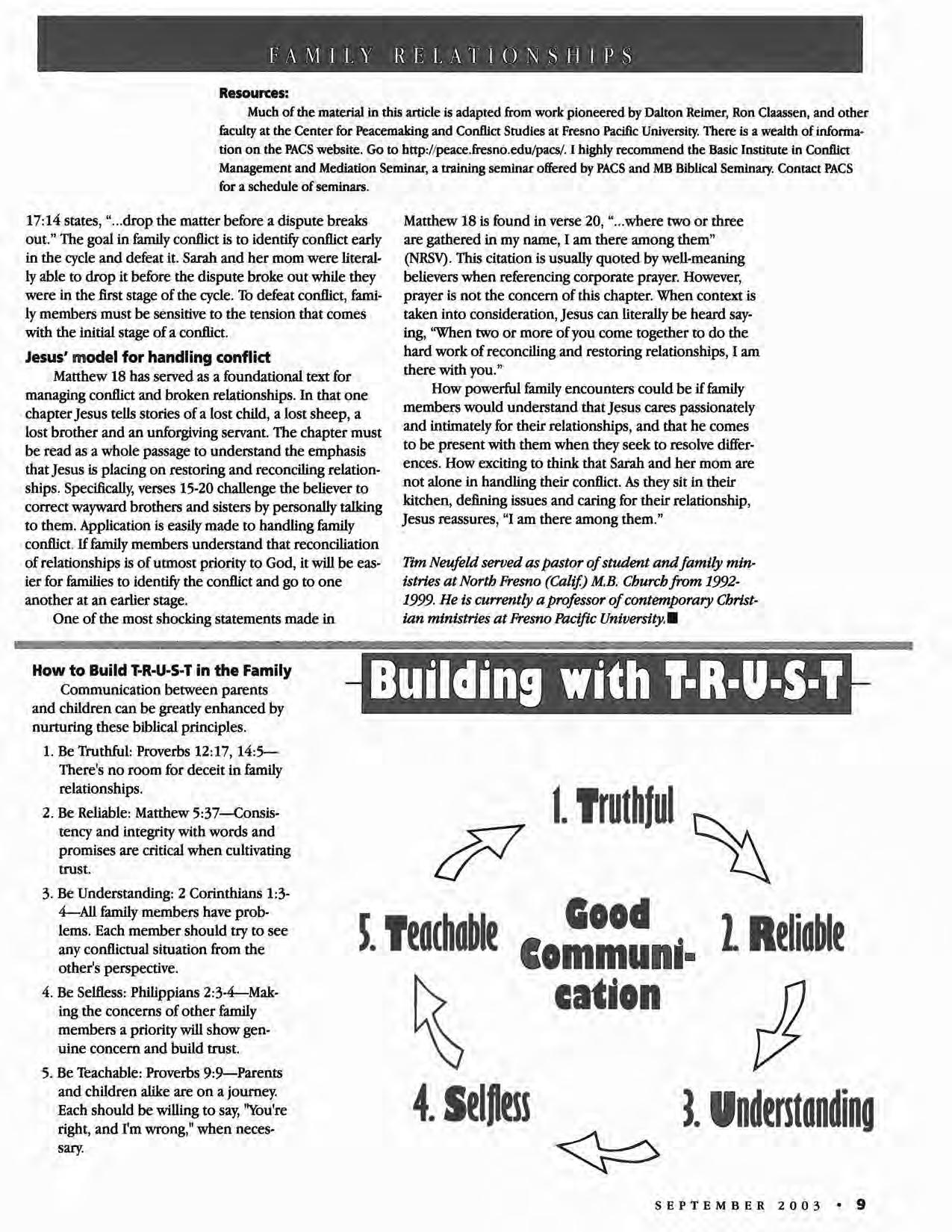
How to Build T·R·U·S·T in the Family Communication between parents and children can be gready enhanced by nurturing these biblical principles.
1. Be Truthful: Proverbs 12:17, 14:5There's no room for deceit in family relationships.
2. Be Reliable: Matthew 5:37-Consis· tency and integrity with words and promises are critical when cultivating trust.
3. Be Understanding: 2 Corinthians 1:34-All family members have problems. Each member should try to see any contlictual situation from the other's perspective.
4. Be Selfless: Philippians 2:3·4-Mak· ing the concerns of other family members a priority will show genuine concern and build trust.
5. Be Teachable: Proverbs 9:9-Parents and children alike are on a journey. Each should be willing to say, ''You're right, and I'm wrong," when neces· sary.
Matthew 18 is found in verse 20, " where two or three are gathered in my name, I am there among them" (NRSV). This citation is usually quoted by well-meaning believers when referencing corporate prayer. However, prayer is not the concern of this chapter. When context is taken into consideration, Jesus can literally be heard saying, "When two or more of you come together to do the hard work of reconciling and restoring relationships, I am there with you."
How powerful family encounters could be if family members would understand that Jesus cares passionately and intimately for their relationships, and that he comes to be present with them when they seek to resolve differ· ences. How exciting to think that Sarah and her mom are not alone in handling their conflict. As they sit in their kitchen, defining issues and caring for their relationship, Jesus reassures, "I am there among them."
Tim Neufeld served as pastor of student and family min· istries at North Fresno (Ca/if) M.B. Church from 1992· 1999. He is currently a professor of contemporary Christ· ian ministries at Fresno Pacific University.•
I lIIC
ost hadJ e kids vinced that I was perfect. Then my dau up and assured them that this was certaf.!lly not the e and she dug up an example from our home life to drive home her point. One simple snapshot of real life exposed the truth.
When we tum to the Scriptures looking for a model family we discover that there are no ideal families. Rather, as Eugene Peterson has noted, "The biblical material consistently portrays the family not as a Norman Rockwell group, beaming in gratitude around a Thanksgiving turkey, but as a series of broken relationships in need of redemption." More often than not, the families we come across in the Bible are not so much models of godly living but real life material for the transforming power God's redemptive grace.
The book of Genesis provides a unique opportunity to see a family system in operation over several generations. The story of Jacob's family covers Gen. 25: 1935:29, and is a story full of struggle and strife. Jacob and his brother Esau struggle in the womb (25:22), at birth (25:26) and in their youth (25:27-34). Jacob's flight into exile in Paddan Aram merely exchanges his conflict with Esau for conflict with the master of deceit himself: Uncle Laban (chapters 29-31) The struggle between Jacob's wives Rachel and Leah (30:8) becomes a horrifying battle, with each wife wanting what the other has. Rachel has Jacob's love and wants children; Leah has children and wants Jacob's love. HoW; we may wonder, could this family ever produce the offspring through whom all the peoples of the earth would be blessed (28:14)?
One way of understanding what happens in Jacob's family is to see it in terms of emotional triangles. The basic law of emotional triangles is that when two people become uncomfortable with one another, they may focus upon a third person or issue as a way of stabilizing their relationship. Each person in the triangled relationships plays a role. For example, if I am in a conflict with a coworker, I may label him a "persecutor" and see myself as a ''victim,'' especially when I complain to a third person (a "rescuer") about how pigheaded my coworker is acting.
Gen. 25:28 gives us insight into the beginning of emotional triangles in Jacob's family. Jacob's parents, Isaac and Rebekah, each have a favorite child through whom they relate-or fail to relate-to each other. Isaac in tum probably leamed this favoritism pattern from his father Abraham, although there are signs (21:11) that Abraham's favoritism was not as pronounced as Isaac's and Jacob's (37:3, 44:20).
The reasons for Isaac's preference of Esau is that he has "a taste for wild game" and Esau is a "skillful hunter" (25:27-28), not for any spiritual reasons. Esau, "Hairy"
(25:25) or "Red" as his brother nicknames him (25:30), is the opposite of his younger brother Jacob. What we encounter at the end of chapter 25 is sibling rivalry at its worst. Yet, although the strife between Jacob and Esau in Genesis 25:29-34 is based on Jacob's greed, there is a complicating factor we ought to take note of as well. Being caught in the triangle of their parents' relationship has greatly increased the natural sibling rivalry of the twin brothers.
A bad heir day
Several years pass (according to 26:34, the boys are over 40 years old), and the family has soured with age. The family conflict-between the parents, between the parents and children, and between the twins-nowescalates in pursuit of the patriarchal blessing.
The fact that Isaac is doing the blessing in secret (why not in public as in 49: 1,28 or 50:24-25?) should set off warning lights in our minds about the state of his family's relationships. Family secrets are a sign of emotional anxiety, and they also transmit the anxiety from generation to generation. Because of the emotional separation between Isaac and Rebekah, their disagreement over who should receive the birthright and blessing is fought out through their children rather than dealt with between themselves. Rebekah seems to have good intentions in trying to help God fulfil the prophecy in 25:23 (remember Abraham and Sarah in Genesis 16: 1-2), but the end does not justify the means.
From love at first sight (24:63-65), and children conceived in prayer (25:21) after a 20 year wait (25:26 minus 25:20), the family takes a dramatic tum for the worse. There is an emotional separation between Isaac and Rebekah. The tragedy is that if ever there was a marriage made in heaven, this was it (Genesis 24). Thus, it should silence forever the excuse of couples in conflict who lament that they must have married the wrong person. Even matches made in heaven take a covenant commitment and continuing communication to keep from growing cold.
Isaac is the common enemy ("persecutor") in the Rebekah,tJacob triangle, and Rebekah is the common enemy in the IsaaclEsau triangle, with each parent trying to rescue a victim son from a persecuting spouse. Just in case the reader hasn't picked up the dynamics at work, the narrator even refers to Esau as "his (Isaac's) son Esau" (27:5) and Jacob has "her (Rebekah's) sonJacob" (27:6).
The repetition of tasty food (27:4,7,9,14,17,31) proves that Rebekah knows what every woman supposedly knows: that the way to a man's heart is through his stomach. Actually, it shows how fickle the foundation of
Isaac's favoritism is. If the effects of such foolishness weren't so tragic, we might laugh; instead, we weep.
No one in this family behaves well. Isaac acts on his physical rather than his spiritual sense and, as has become the pattern of his life, is too passive, abdicating his leadership position. Rebekah acts out of domination (27:8,13: "Do what I say") and deception (27:14-17). Esau breaks the oath he made in 25:33 (the birthright and blessing went together), and later resolves to kill his brother (27:41). And Jacob blasphemously lies (27:19, 20,24).
The divine verdict on these actions is "guilty," and the family members will pay a heavy price for them. Rebekah's self-proclaimed prophecy (27:13:"Let the curse fall on me") will come true, as she loses both sons and will die without mention (note 35:8), never to see her son Jacob again. Esau will have no part in sacred history for having treated the birthright and the promises that went with it so lightly. Isaac lives on without significance (35:28), with a fractured family for most of his life. Jacob himself will transmit this pattern of favoritism into his own family, and reap its results. The most immediate result for Jacob is that he has to feel his brother's murderous wrath (27:41). He will also be deceived by his sons (37:31·33), in what seems to be poetic justice (Exodus 21:24).
The account of the birth ofJacob's 11 sons in Paddan Arant (29:31-30:24) provides insight into the transfer of problems from one generation to the next in a family. The rivalry of Rachel and Leah is greatly intensified by Laban using his daughters for selfish gain. Ironically, just as Jacob took advantage of his father's blindness (21: 1) to deceive him, so Laban uses the cover of night to trick Jacob into marrying the wrong woman.
Tragically, Leah is reduced to the status of a mere pawn, and her life will be spent longing and grasping for love and acceptance (29:32: "Surely my husband will love me now") that neither her father nor her husband ever gave her. (Notice Jacob's ongoing disregard for Leah and her sons reflected in Judah's words in 44:20.)
Rachel's struggle to overcome her older sister mirrors Jacob's earlier struggle to overcome his brother Esau. The two sisters will compete for their husband's affection by bearing him sons. The pattern of rivalry and favoritism continues.
Rabbi Edwin Friedman, in his book Generation to Generation, says that ''All human beings are programmed for far more pathology than could possibly become manifest in a lifetime." He's right, but this family takes a good run at achieving the maximum.
Jacob, passive, like his father, takes no leadership in trying to resolve the jealousy that has been building
between the two sisters. Finally, Rachel explodes (30:1). Whereas Isaac "prayed to the Lord on behalf of his wife, because she was barren" (25:21), Jacob only becomes outraged at his barren wife (30:2).
When conflicts reach this kind of emotional overload, something has got to give. In this case, each wife triangles in a maidservant (Bilhah-30:3; Zilpah-30:2).
The result is that Jacob is reduced to the status of a stud, and his marriage with Leah to a commercial contract (in 30: 16 he is "hired" by her for sex). Jacob's family gives a whole new meaning to the word "dysfunctional."
The amazing thing is that, because "where sin increased, grace increased all the more" (Romans 5:20), even this family is not beyond hope. After many difficult years, a wrestling match with God himself (32:22-30) brings Jacob into submission. Jacob's conversion at Peniel marks a dramatic turning point for this family. The evidence of his conversion is seen most dramatically in the shifts from his telling everyone "to go ahead of me" to meet Esau (32:16, 18:20) to "he himself went on ahead" (33:3).
Jacob now meets his brother face to face in humility rather than triangling in others. (Though notice the favoritism in his arranging the family, with the most loved in the back, 32:2). Bowing seven times (the common practice of a vassal to his lord in ancient court protocol) with his face in the dust, he seeks reconciliation with Esau, whom he has not seen or spoken to for over 20 years.
We do not know all the dynamics at work in this miracle, of why Esau is no longer bitter, but we have seen the grace of God at work changing Jacob and thus laying the foundation for reconciliation to occur. Jacob's repentance is accompanied by the returning of the blessing that he had formerly "stolen" from Esau. In doing this, he acknowledges that God is sovereign in his life and that everything he has is a gift (32:9-11). For the first time in his life, we see Jacob abandoning the old grasping pattern and trusting God for the results.
This family still has a long way to go, but in chapters 32-33 there are Significant signs of hope. By God's grace, the past can be changed. Sins need not be transmitted from generation to generation. The downward cycle can be broken if there is a willingness to forgive and to change. One of the most encouraging messages of this story is that if God can redeem this family, then there is hope for every family. •
David Esau is senior pastor at Cedar Park MB Church in Delta, B. C. Ibis article was first published in the MB Herald, the English-language publication of the Canadian MB Conference.
By K are n O'Connor
What our aging parents really need
Four gifts of the spirit that children can give their aging parents
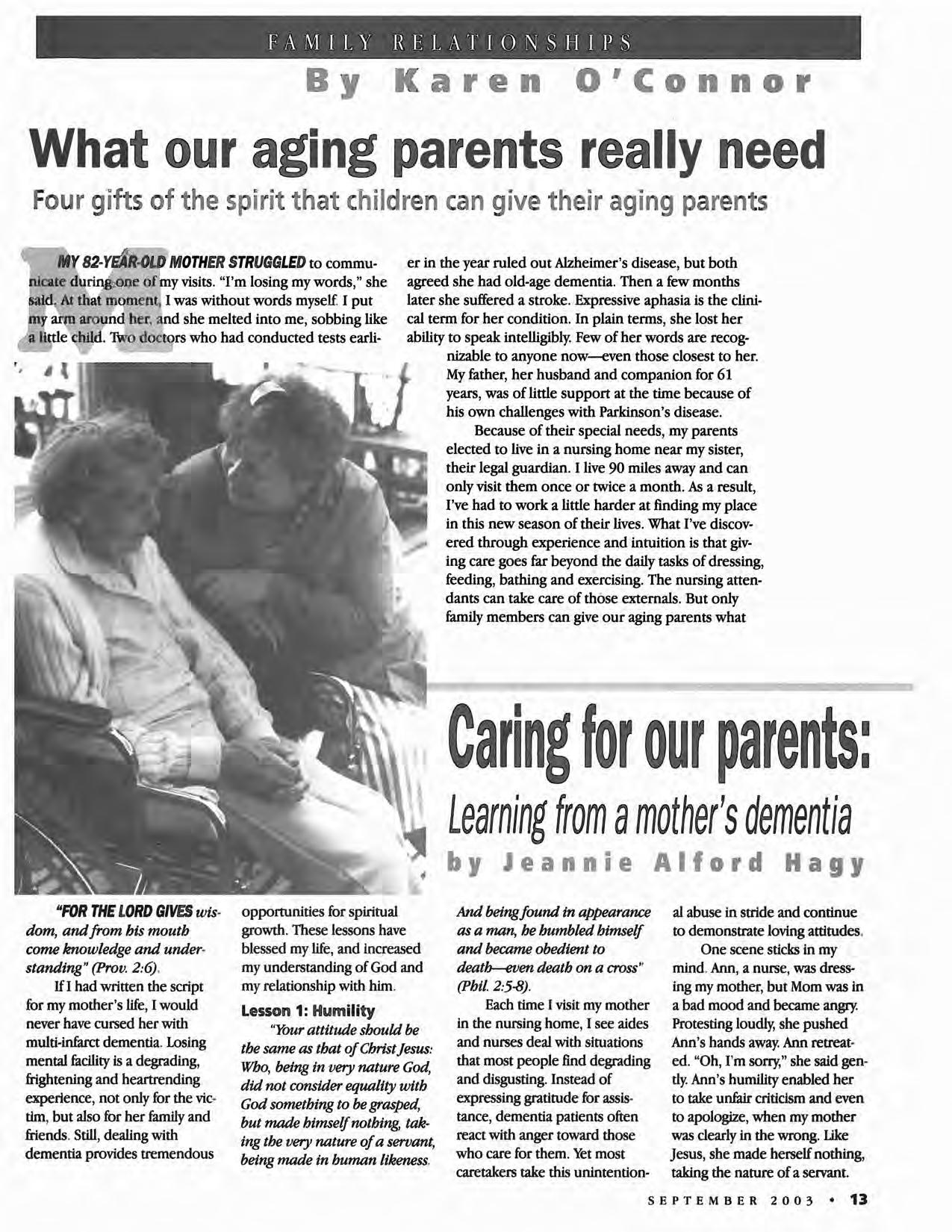
er in the year ruled out Alzheimer's disease, but both agreed she had old-age dementia. Then a few months later she suffered a stroke. Expressive aphasia is the clinical term for her condition. In plain terms, she lost her ability to speak intelligibly. Few of her words are recognizable to anyone now-even those closest to her. My father, her husband and companion for 61 years, was of little support at the time because of his own challenges with Parkinson's disease.
Because of their special needs, my parents elected to live in a nursing home near my sister, their legal guardian. I live 90 miles away and can only visit them once or twice a month. As a result, I've had to worka little harder at finding my place in this new season of their lives. What I've discovered through experience and intuition is that giving care goes far beyond the daily tasks of dressing, feeding, bathing and exercising. The nursing attendants can take care of those externals. But only family members can give our aging parents what
Caring for our parents: \\ Learning
I
"FOR THE LORD GIVES wisdom, and from his mouth come knowledge and understanding" (prov. 2:6).
If I had written the script for my mother's life, I would never have cursed her with multi-infarct dementia. Losing mental facility is a degrading, frightening and heartrending experience, not only for the victim, but also for her family and friends. Still, dealing with dementia provides tremendous
opportunities for spiritual growth. These lessons have blessed my life, and increased my understanding of God and my relationship with him.
Lesson 1: Humility
"Your attitude should be the same as that of Christ jesus: Who, being in very nature God, did not consider equality with God something to be grasped, but made himself nothing, taking the very nature of a servant, being made in human likeness.
from amother's dementia
by Jeannie Alford Hagy
And beingfound in appearance al abuse in stride and continue as a man, he humbled himself to demonstrate loving attitudes. and became obedient to One scene sticks in my deatb-even death on a cross" mind. Ann, a nurse, was dress(phil 2:5-8). ing my mother, but Mom was in
Each time I visit my mother a bad mood and became angry. in the nursing home, I see aides Protesting loudly, she pushed and nurses deal with situations Ann's hands away. Ann retreatthat most people find degrading ed. "Oh, I'm sorry," she said genand disgusting. Instead of dy. Ann's humility enabled her expressing gratitude for assis- to take unfair criticism and even tance, dementia patients often to apologize, when my mother react with anger toward those was clearly in the wrong. like who care for them. Yet most Jesus, she made herself nothing, caretakers take this unintention- taking the nature of a servant.
What they long for... is to be held in high esteem as people who still matter, regardless of their infirmities.
they really need-what I call gifts of the spirit. Perhaps you will find one that resonates within you as you relate to your mother or father. And you may want to add some of your own gifts to the list.
Respect: I remember as a child being reminded often to show respect, especially to eld· erly family members. I was not exactly sure what that meant, but it seemed to have something to do with being polite, listening when spo· ken to and helping when there was a need. My grandfather lived with us as I was growing up, so I had plenty of opportunities to practice respect.
Today the word respect has a new and deeper meaning for me than it did 50 years ago. Listening, helping and doing little favors are only a part of what our aging parents really need. What they long for, I believe, even if they cannot fully express it, is to be held in high esteem as people who still matter, regardless of their infirmities.
These experiences have helped me to understand and appreciate Jesus as a servant, the Jesus who touched lepers and washed feet. Jesus had a lot to say about humility. Now I'm more willing to listen.
Lesson 2: Resped for the value of individuals
"Therefore, as God's chosen people, holy and dearly loved, clothe yourselves with compassion, kindness, humility, gentleness and patience" (Col 3;12).
My mother was a very bright woman, well educated and com· petent. When she could no longer think clearly, however, she was often dismissed as a person. To many people, she became unimportant. Mom was more than her mental abilities. My mother loved people, especially children. She was a gende person, with a sweet spirit, unselfish
and nurturing. Often these strengths were ignored once she showed evidence of dementia. Unfortunately; I also focused on her limited thinking skills. Her deteriorating mind angered and frustrated me. Although I loved her intensely; I was shocked to realize how much value I'd placed on intelligence without regard to other character traits, not only in Mom but in other people as well. I had to remind myself that my mother and others with limited cognitive skills were still God's dear children and deserving of respect. Remembering that all of God's children have value is a continuousstrugWe, but I strive to no longer see people as onedimensional characters and to find in people around me qualities to admire and love.
For two years Mom lived in
We can communicate this respect in many little ways: asking their opinion or advice; remembering their preferences for food, music and reading; encouraging them to share stories from their earlier life and really listening to what they say; doing something together such as listening to music, even baking or gardening, if they are up to it.
Respect is also being willing to look at our parents in the light of today. Infirmities exist. Bodies are frail. Minds are fragile. Emotions are often at a breaking point. Despite all these conditions, however, our parents are still individuals. They will have their dreams and disappointments, hopes and longings. And they never outgrow their need for their children-of whatever age-to show respect. They have earned it.
Understanding: "How are you doing?" I often asked my father before he died four years ago.
"I hate that question," he said. Then he added softly, "I'm about the same."
I realized what a foolish question it was. My father had had Parkinson's disease for at least 10 years. Unless a miracle occurred, he was not going to get better.
Since that moment of awareness, I made a point of
a nursing home exclusively for dementia patients. One of the things I most appreciated about that nursing home was the atmosphere of acceptance. In the outside world, family memo bers had experienced awkwardness or embarrassment when confused loved ones were judged harshly. Within those walls, however, behavior on the part of a resident that would be considered rude, inappropriate or occasionally even obscene elsewhere, was accepted. I learned increased compassion and tolerance of differences there.
Lesson 3: Courage
"Be strong and courageous. Do not be afraid or terrified because of them, for the Lord your God goes with you; he will never leave you nor forsake you" (Deut. 31;6).
I used to think of courage as a quality needed in moments of crisis. That is definitely one form of courage. Placing Mom in a nursing home and dealing with various injuries, illnesses and hospitalizations certainly required courage. But often less dramatic moments call for even greater courage.
Many times as I drive to the nursing home to visit my mother, I pray all the way. I have asked God for courage to listen to Mom's sad, incoherent sentences or to appear positive and upbeat when I feel sorrowful and depleted. "Good" visits, in which light, sweet moments with Mom broke through darkness and despair, were far apart. When every interaction with her is heartbreaking, it takes courage to return for another visit.
connecting with him right where he was-as an old and frail man. I tried to bring some cheer to his day whenever I phoned or visited. But, I also wanted to acknowledge what he was going through in the moment: his discomfort with sitting, disruption when it was time for a bath, the inconvenience of getting dressed and the energy it took to bring his fork to his mouth in order to eat.
We may not be able to relieve our parents' fear and frustration, but we can walk down the tunnel with them and confirmwith understanding words what is obvious to our eyes.
"This is a difficult time, isn't it Dad?"
"Mom, I can only imagine how disappointing it is not to find the words you need."
LOyalty: My friend Cori says that despite her father's gradual
Courage was needed as I learned to lean on other people. It is hard to admit that I am not as emotionally strong or as patient and loving as I would like to appear. Often I have to confess wishing I could escape the duties of caring for my mother. I have to acknowledge feeling vulnerable, weak and overwhelmed. When I am low on resources and stuck in selfpity, I rely on family and friends to help me cope. I have struggled with depression that seemed unconquerable.
Living with dementia year after year is a marathon, an endurance test with no end in Sight. It takes courage.
Lesson 4: Trust
''1rust in the Lord with all your heart and lean not on your oum understanding" (Prov. 3:5).
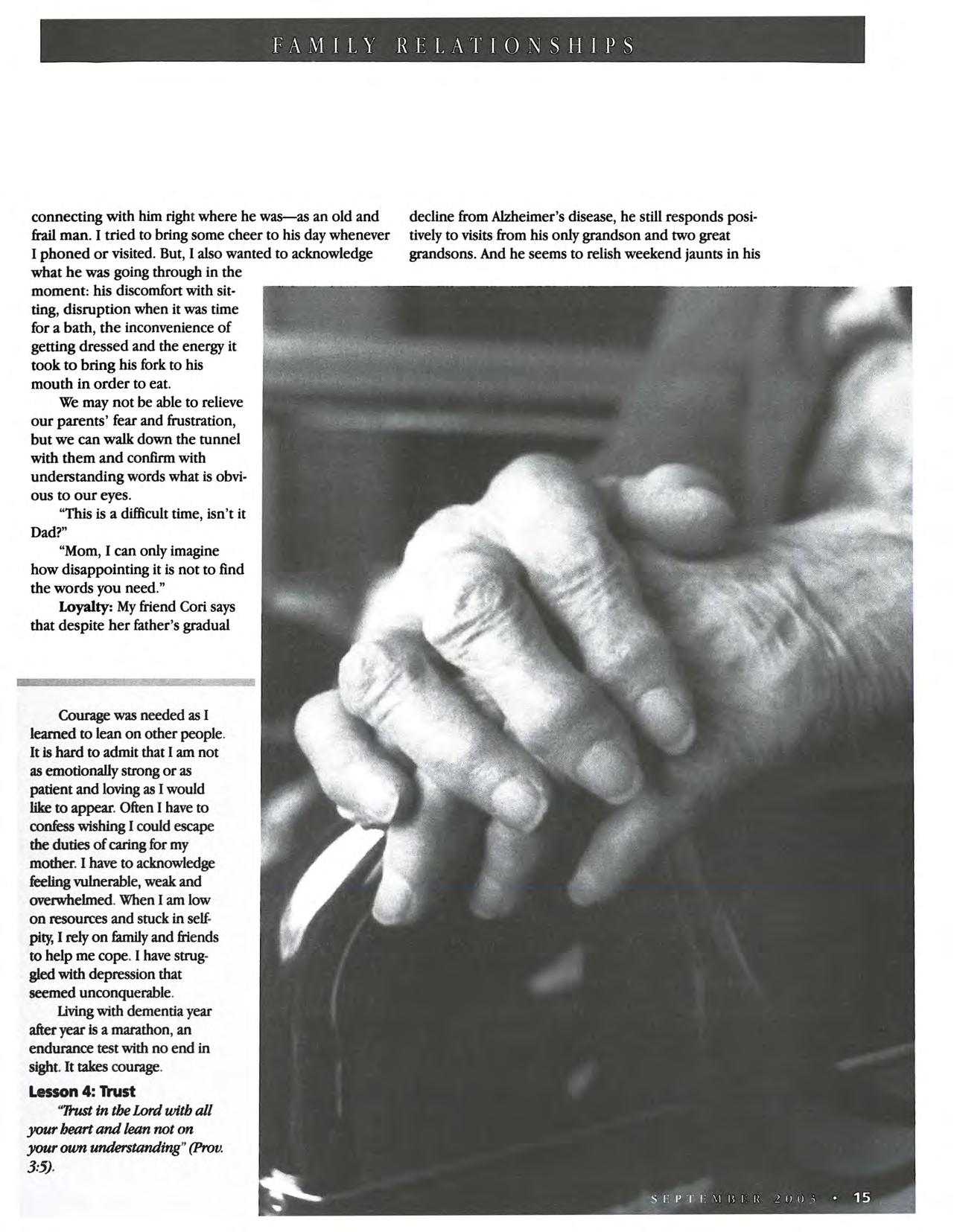
decline from Alzheimer's disease, he still responds positively to visits from his only grandson and two great grandsons. And he seems to relish weekend jaunts in his
wheelchair to a nearby yogurt shop.
Loyalty is the simple act of being faithful to a person, an ideal, a custom or cause. It can take many forms. We each find our own way. The important thing is that we give this gift. It is something our aging parents need.
Comfort: I remember my father comforting me when I was frightened by a bully in school and my mother standing by me as a good friend moved away. They were there for me through chicken pox and measles, dUring piano recitals and the school play, the night before a big test and the evening of senior prom.
Oneman comforts his aging mother by recreating a family tradition. Once a month he brings a brown bag supper of hamburgers and fries to the nursing home where his mother lives.
"It reminds me of when I was growing up," Walt said as we talked. "Whenever my dad was on the road for work-a couple of times a month-Mom and I would go to Prince Castle for hamburgers. 'Prince Castle nights,' as she called them, became part of my childhood. This is as close to a Prince Castle night as I can come now," he said, holding up the brown bag from a local fast-food restaurant.
Trust in a loving God has sustained me through the years of dealing with my mother's dementia. Over time, I can look back and recognize that God had led me and provided for me during difficult times with my mother. Gradually, my faith has grown, helping me to avoid worry and despair as I deal with decisions about her care. I have felt God telling me, "Relax. Trust. You are in my hands. Open yourself to my guidance and let go of fear. I will not let you faillf you will simply trust in me."
Once, during a time that I was wonying about her health and business matters, the message to trust God came directly from my mother. Reading through letters Mom had written a decade before, I came across these sentences: "Please do not worry about
We can also offer our parents spiritual comfort by praying for them, reading Scripture with them or to them and making a list of God's promises so they will have a reason to get up each morning. I made each of my parents a small Bible-promise booklet and placed it by their bedsides. Another woman attends a Scripture study for seniors with her mother once a week. A man I met includes his aging parents in Sunday worship services.
At times we may find ourselves feeling weary in doing good, especially when we have commitments to our own families and careers. At these times the wisdom of Proverbs can shore us up. "Listen to your father, who gave you life, and do not despise your mother when she is old May your father and mother be glad; may she who gave you birth rejoice" Provo 23:22,25) .•
Karen O'Connor is an award-winning author and retreat speaker from San Diego, California. Her latest book, In Step with Your Stepchildren: Building a Strong One-on-One Relationship, was published this summer by Beacon Hill Press. This article was first printed in The Mennonite, the publication of Mennonite Church USA
thinS" you cannot control Just trust that everything will work out somehow." When I ,""""'r.--.
begin to trust more, I can live in the moment instead of worrying about the future. There were times when Mom was delightful. She became and her silliness lightened the spirits of everyone around her. No, she was not the woman I had known in earlier years, but her life was still a gift, and I learned to enjoy and cherish the good times with her. Moments of tenderness, when she said I was beautiful or told
me how much she loved me, became more precious; I knew that
No, she was not the woman I had known in earlier years, but her life was still a gift
eventually she would loseverbal abilltyand fail to recognize me.
One of my favorite memories is of Mom dancing at a nursing home Valentine's Day party. She was thoroughly enjoying the music, a beautiful smile on her face. During that moment I was able to release concerns about her health and medical bills and simply enjoy watching my mother at peace.
"And we know that in all things God works for the good of those who love him, who have been called according to his purpose" (Rom. 8:28).
My mother has struggled with dementia for 17 years. Now in the final stage of illness, she is in a gerichair, recognizes no one and can no longer speak. I certainly have not liked having dementia in the script, forcing both my mother and me to play roles that we would rather have avoided. I continue to learn from this situation, however, and I continue to begrateful for the lessons that dementia can teach .•
Jeannie Alford Hagy is an Oklahoma City writer who hopes her three young adult children have witnessed loving care of an elderly parent.
BY PHILIP WIEBE
Not so opposite
is in more ways than one
SO, APPARENTLY opposites don't attract after all. After acting on that assumption for years, I learn from a recent study that it is really similars who attract. "Both sexes," the study concludes, "are most likely to attract individuals who look like them and have the same wealth, social status and share the same outlook towards family and fidelity."
That makes sense, I suppose. But it's a bit of a blow to a humorist. I've written a lot of material based on the "opposites attract" scenario, including a funny song I sing at parties and family gatherings about differences between my wife and me. ''You get up early, I stay up late; You eat your vegetables, I like chocolate cake; You talk through the movie, and I say 'No, no!' But that's what makes love go."
Thinking about it, though, I guess those kinds of differences are pretty much surface issues. My wife and I aren't really opposites. What I initially found attractive was her values and outlook. She struck me immediately as a genuine, straightforward person with an aversion to the prevailing veneers and superficialities of dating and romance. Just like me. She was someone who tried to figure out how to live her faith every day, and wasn't satisfied with merely being a child of the church or cultural Christian. Me too. She was not one to approach commitment and intimacy casually. Ditto. Of course, it didn't hurt that she was also quite a looker.
The point is, it was the similarities that drew us together. We discovered differences as we went along. But because we are one in matters of faith, family and fidelity, the differences have mostly been occasions for amusement and affection rather than serious conflict.
I've been mistaken, then, in my
vague assumption that my wife and I have been classic examples of the "opposites attract" paradigm. We've shared far more similarities than differences.
I wonder if there are other areas that would benefit from such a paradigm shift. It seems the entire cultural drift right now is toward differences between people, parties and groups.
Media and advertising bank on this. Products are made and sold with narrow demographics in mind. On one level I realize this is just the exercise of a free market. But on another level, it seems to promote divided values and loyalties. When you look at current media trends, for instance, you'll see a huge teen market for immoral, disrespectful, violent movies and video games. Though some argue this is harmless fun, you can't convince me of that. Yet media producers pander more and more to the desire for these products, because they sell.
When some worthwhile piece of media cuts across demographic lines to become praised and popular, it never seems to spark a mass migration to uplifting fare. It always seems more like a fluke. And so the demographic divisiveness continues, giving a grim picture of culture as a hopelessly divided, degraded, sin-seeking collection of castes. Yet I'm convinced there's a latent desire for more unity, integrity and morality in our society. Clearly popular media could be doing a lot more to help bring people together.
Another area where opposites rule the day is in politics. So many hopefuls base their entire campaigns on the slogan: "I'm nothing like the other candidate!" This troubles me, because the goals of political parties and desires of the public are much more similar than is
currently perceived. Almost everyone wants peace and prosperity for citizens, global safety and security, sustainable jobs and environment, provision for the hurting and needy, privacy and freedom for individuals, and so on.
The difference is in how the parties feel these can be achieved. That's a complicated question, but I know one thing. Feeding this great and growing political divide is far less effective toward achieving common good than working together and emphasizing our similarities.
The church also seems like a realm of opposites. Part of this is biblical, of course. We are a diverse group of people called to one faith and one purpose. But these days the "one" seems to be in jeopardy. So many issues in today's church revolve around differences: contemporary versus traditional, conservative ver· sus liberal, older versus younger, men versus women, and on it goes.
It is wonderful to realize there are various ministries and callings in the church, "so that the body of Christ may be built up" (Eph. 4:12). But sometimes I think we've gotten so hung up on individual abilities, tastes and preferences, we've deemphasized that "There is one body and one Spirit-just as you were called to one hope when you were called-one Lord, one faith, one baptism; one God and Father of all, who is over all and through all and in all" (Eph. 4:4-6).
Perhaps we can say "opposites attract" in the church because we are a global gathering of very different people. If we truly grasped the similarities, however-one Lord, one faith, one Spiritmaybe the divisions plaguing believers today wouldn't seem nearly so enormous .•
BY MARVIN HEIN
Questions about faith Be life
Teaching on the peace position and congregational governance
QHow come I rarely hear the
AAThe questioner brings up all the Mennonite Brethren peace I'm inclined to believe that o!d issues: vs. church counposition preached in our on this subjed leadership cil, congregatIOnal vs. rule, churches? What percentage of may be guilty of becoming consensus vs. democracy, etal. He IS conMennonite Brethren call them- once again the stillen im cerned about inefficiency in present selves nonviolent? (Washington) church governance structures and hamlanden, the quiet in the stringing ministry by waiting for approval land. from committees. I'm confident he voices .. the concerns of many, particularly the thing, we have not found a satisfactory younger segment of our churches. way of being both opposed to war and I'm persuaded there is no biblical still praying for the safety of troops model per se. The New Testament gives abroad. We should be able to do both, us different models. Was there ever a particularly if we also pray not only for stronger leader with more authority than our soldiers, but also for the people the Apostle Paul? But we don't have called our "enemies." many Pauls among us. Yet Paul also fos-
The inquiry comes from a missionary couple who was itinerating in MB churches most of the time during the build-up to and fighting of the Iraqi war. Their observation was that when queried, most MB pastors professed to hold to our doctrinal statement on love and nonresistance. But my missionary friend suspected that little was being taught by our leaders.
Not having been in more than three or four churches during the Iraqi war, I can not speak with authority on the extent to which our confession of faith article on nonviolence has been preached these last months. I do know that one congregation asked me to preach on our attitude to the Iraqi war, but on a Sunday evening when only the faithful few were present. I know of another church where a staff member was asked to share his conversion from a militarist position to that of an Anabaptist. In the congregation to which I belong, mention has been made about our position on war, but I'm not aware of any teaching. A Canadian MB bemoaned the fact that letters to the editor of the MB Herald affirming the MB peace position had become more frequent.
I'm inclined to believe that on this subject leadership may be guilty of becoming once again the stillen im landen, the quiet in the land. Why? For one
A second reason may be that in our tered congregational involvement and present culture to oppose war joins us, decisions when it is reported that "it in theory, with many people who advo- pleased the Holy Spirit and us" to take cate peace for far different reasons. We certain steps. suddenly have strange bed-partners in I caution pastors and chosen lay our nonviolent position, and we are not leaders to exercise great care in exerting comfortable "going to bed" with many of their authority over the congregation. As them. So we remain quiet. Closely relat- a former pastor, I'm aware that church ed is the fact that we have an avowed members see their leaders as far more evangelical president and he has told us heavy-handed than we pastors see ourwe are either with him or we are against selves. Sometimes they are right, somehim on the war issue. times wrong, but we need to deal with
How should a congregation
Qgovern itself? What strudure is biblical, healthy and wise? (California)
Have a question about a Bible passage, doctrine, conferencepolicy, or other spiritual issue? E-mail Marvin at mheinl@fresno.edu or send your question to "Inquiring Minds," c/o Marvin Hein, 3036 East Magill Avenue, Fresno, CA 93710.
A third reason, perhaps, is that the perceptions as well as realities. For examseeker-sensitive mood in doing church pie, the staff member who voiced concalls for not making loud noises that cern that a staff member was not placed alienate the newer, unfamiliar-to-our-doc- on the pastoral search committee no trine, seeking worshippers. We don't doubt meant well, but the resulting perwant to offend. Here I simply want to say ception was not healthy. that if we are true to our calling, we will Ultimately the determining factor be critics of culture, not simply adapters. will be the spirit in which the pastor leads. We must not forget that the New Testament model for leaders is the servant-leader model. This position does not run well with many of our culture's ideas about leadership. It does, however, run well with how Jesus taught his closest companions (leaders) to serve .•
BY ROSE BUSCHMAN
Trim from living instead of giving
Lifestyle choices limit our giving to missions and charity
MISSION ORGANIZATIONS AND charities all over the country are hurting these days for funds. Giving is down. Budgets have to be reduced and programs curtailed, or even canceled. Our own MBMS International ended its most recent fiscal year in May with a deficit of at least $500,000. An article in the July issue of the Christian Leader tells the story of Dale and Teresa Regier who together with 13 other prospective MBMSI missionaries are looking at new ways of supporting themselves as they are called to serve.
Common knowledge is that giving to charity is down. When asked why; the standard answer given is that the economy is down. People need their money to live and just don't have any extra money to give. For people who have lost their jobs that is probably true. For them it is the economy. Families suddenly have to scramble to pay for basic services and find creative ways to put food on the table. They have to find new strategies just to survive.
For those of us who have some regular income from jobs, investments or retirement benefits, however, I don't think it's really the economy. Rather, I'm convinced our reduced giving to the church and other charities is more the result of lifestyle choices we are making. If it were the economy, then we wouldn't continue to eat out as much as we dojust check your local restaurants on any given day. We wouldn't be able to afford all the motor homes we own and the SINs we drive. We wouldn't be able to travel the way we still do. We wouldn't be able to periodically redecorate our homes, or buy all the extras we think we need. In spite of a declining economy we still manage to afford our lifestyle. It
seems to me that many of us are trimming from our giving rather than our living.
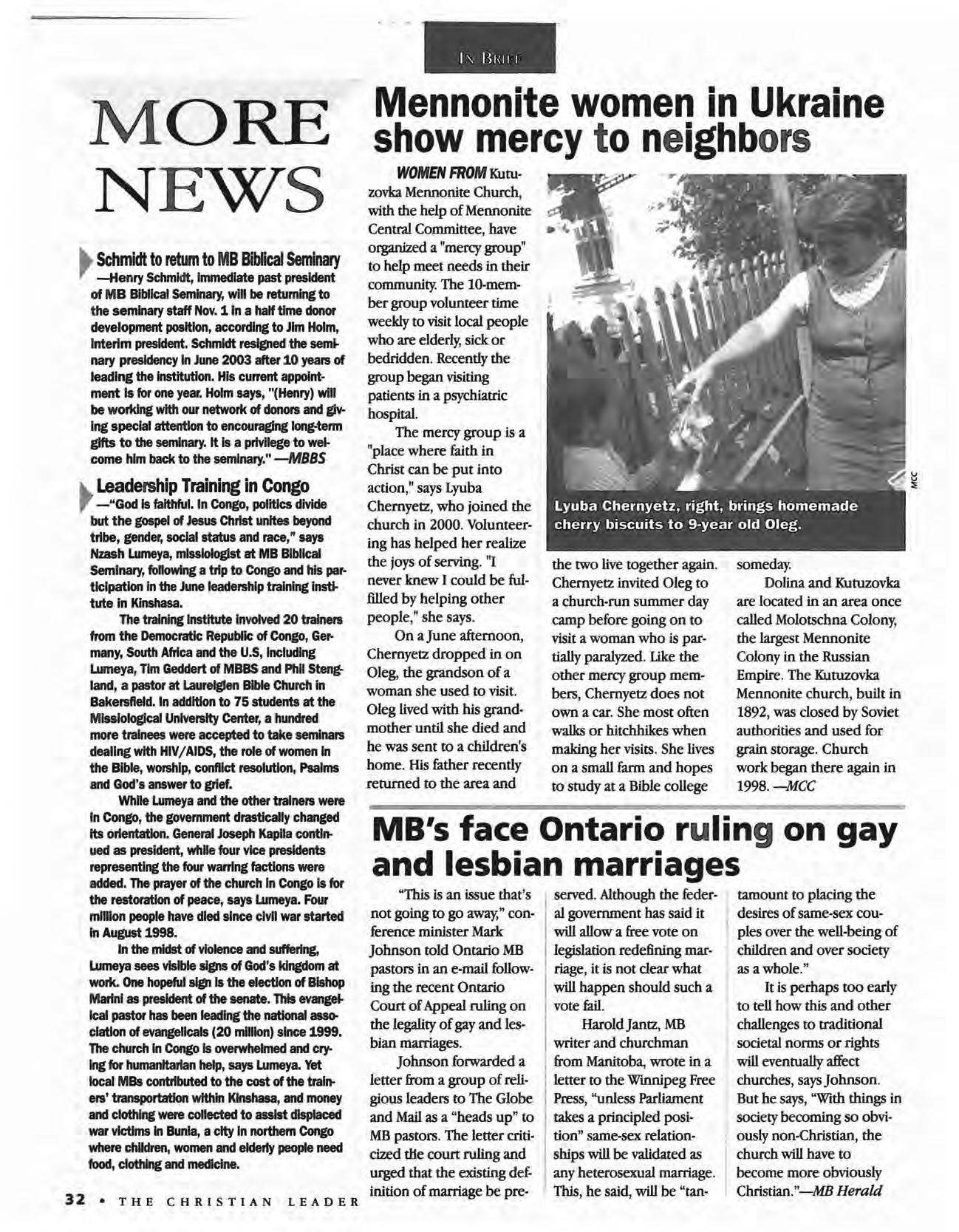
At a recent family reunion in Canada I met some cousins I had not seen in over 40 years. We had a great time renewing acquaintances, and getting to know each other again. One cousin and his wife shared with me their experience of going to the Philippines on a mission trip. While there they became aware of the need for a new school in one of the villages. However, the missionaries and the community lacked the funds for its construction. Ben and Julie decided they would sponsor the school. Now several years later the building program has been successfully completed and the school is in operation. Ben said to me, "We decided that it was more important for us to build this school than to buy a new diesel pickup truck."
"What has sponsoring this project meant to you?" I asked.
"It's the most rewarding and fulfilling thing we have done in years," Julie exclaimed. This couplecontinues to provide funds for the school's operation. They have experienced the joy of allowing God into their checkbook. Living more simply so they can afford to do this is not a sacrifice but a privilegefor them.
It's interesting to me that in the 1V programs I have seen this past year talking about ways families can save money, the major focus is on food costs. One professional couple found that by taking their lunches to work several times a week and not visiting the pop machine four or five times a day; they saved a whopping $500 a month. Another family; experiencing a job loss, told how they saved a "ton of money" by buying groceries and fIXing their food at home,
rather than eating out like they used to. Forced to economize, their cost of living went down dramatically.
Last summer I looked for an easy way to save some money for a special charity project I wanted to fund. I decided to cut back on drinking soda pop, especially when eating out or traveling. (Have you bothered to look and see how much you are paying for a soda these days?) When eating in a restaurant I ordered water with my meals. For traveling it made sense to pack a small cooler with ice and water or pop bought on sale at the grocery store. One of the unexpected advantages was that I soon found out that food tastes better when washed down with the neutral taste of water rather than the overwhelming strong flavor of most pop. Further benefits included a sizeable reduction in the calories consumed. And yes, I had enough extra money to fund my project.
When I shared this mini-project at a meeting recently; one of the committee members suggested that giving up pop might work for me but not for him. I have no quarrel with that. What bothered me was that he thought I was making some kind of a sacrifice by not drinking so much pop. For me it's not a sacrifice but an easy way to free up money for a special project.
Let's face it. As a rule, we find ways to pay for what is most important to us. If giving to the Lord is high on our list of priorities then we will find ways to continue doing it even when the economy is down. Then the 15 new MBMSI missionaries will receive their needed support, and those already serving will continue to receive funding. Jesus said, ''Where your heart is there will your treasure be also" (Matt. 6:21) .•
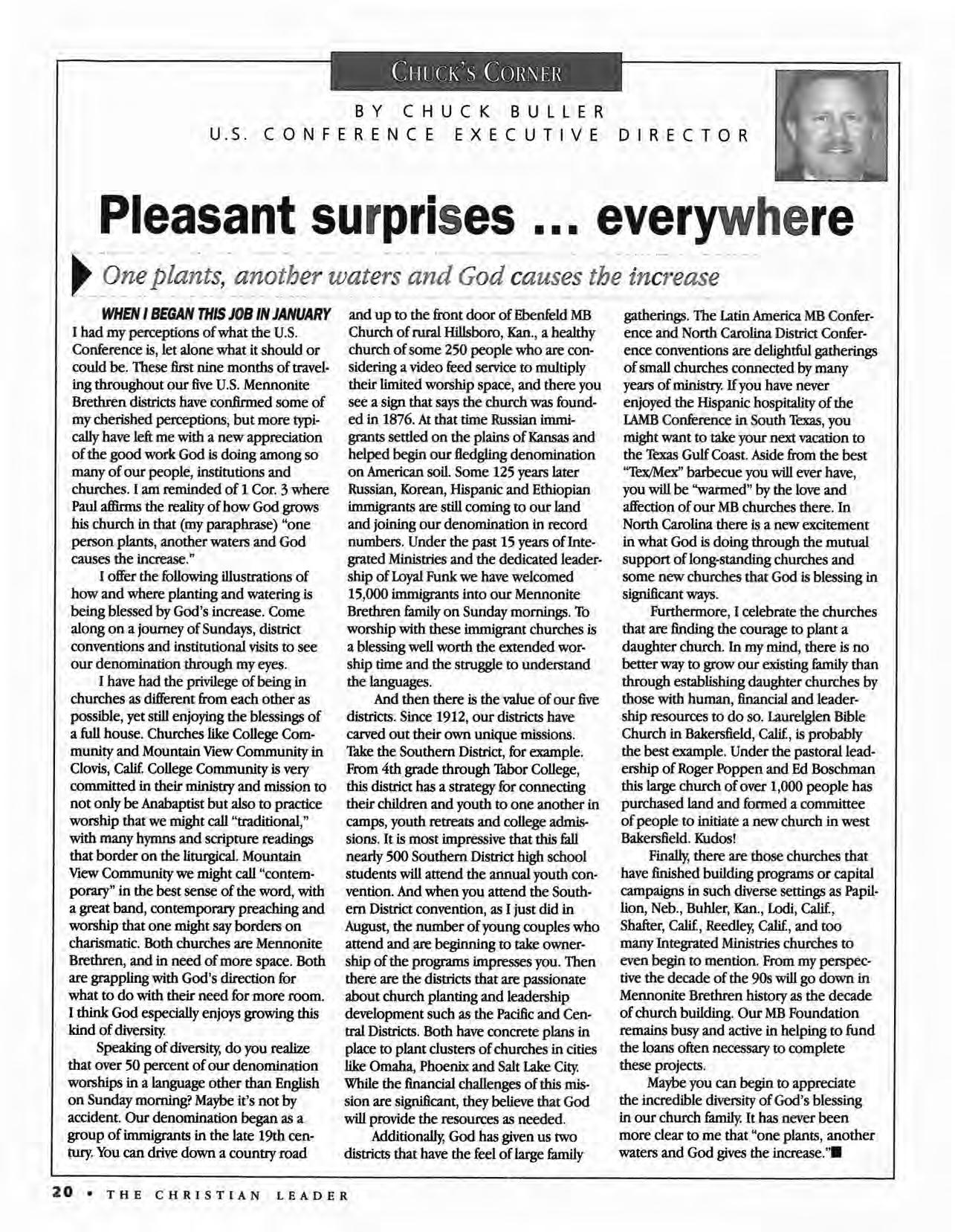
CHUCK's CORNER
BY CHUCK BULLER U.S. CONFERENCE EXECUTIVE DIRECTOR
Pleasant surprises ... everywhere
WHEN I BEGAN THIS JOB IN JANUARY
I had my perceptions of what the U.S. Conference is, let alone what it should or could be. These first nine months of traveling throughout our five U.S. Mennonite Brethren districts have confirmed some of my cherished perceptions, but more typically have left me with a new appreciation of the good work God is doing among so many of our people, institutions and churches. I am reminded of 1 Cor. 3 where Paul affirms the reality of how God grows his church in that (my paraphrase) "one person plants, another waters and God causes the increase."
I offer the following illustrations of how and where planting and watering is being blessed by God's increase. Come along on a journey of Sundays, district conventions and institutional visits to see our denomination through my eyes.
I have had the privilege of being in churches as different from each other as possible, yet still enjoying the blessings of a full house. Churches like College Community and Mountain View Community in Clovis, Calif College Community is very committed in their ministry and mission to not only be Anabaptist but also to practice worship that we might call "traditional," with many hymns and scripture readings that border on the liturgical. Mountain View Community we might call "contemporary" in the best sense of the word, with a great band, contemporarypreaching and worship that one might say borders on charismatic. Both churches are Mennonite Brethren, and in need of more space. Both are grappling with God's direction for what to do with their need for more room. I think God especially enjoys growing this kind of diversity.
Speaking of diversity, do you realize that over 50 percent of our denomination worships in a language other than English on Sunday morning? Maybe it's not by accident. Our denomination began as a group of immigrants in the late 19th century. You can drive down a country road
and up to the front door of Ebenfeld MB Church of rural Hillsboro, Kan., a healthy church of some 250 people who are considering a video feed service to multiply their limited worship space, and there you see a sign that says the church was founded in 1876. At that time Russian immigrants settled on the plains of Kansas and helped begin our fledgling denomination on American soil. Some 125 years later Russian, Korean, Hispanic and Ethiopian immigrants are still coming to our land and joining our denomination in record numbers. Under the past 15 years ofIntegrated Ministries and the dedicated leadership of Loyal Funk we have welcomed 15,000 immigrants into our Mennonite Brethren family on Sunday mornings. To worship with these immigrant churches is a blessing well worth the extended worship time and the struggle to understand the languages.
And then there is the value of our five districts. Since 1912, our districts have carved out their own unique missions. Take the Southern District, for example. From 4th grade through Tabor College, this district has a strategy for connecting their children and youth to one another in camps, youth retreats and college admissions. It is most impressive that this fall nearly 500 Southern District high school students will attend the annual youth convention. And when you attend the Southern District convention, as I just did in August, the number of young couples who attend and are beginning to take ownership of the programs impresses you. Then there are the districts that are passionate about churchplanting and leadership development such as the Pacific and Central Districts. Both have concrete plans in place to plant clusters of churches in cities like Omaha, Phoenix and Salt Lake City. While the financial challenges of this mission are significant, they believe that God will provide the resources as needed.
Additionally, God has given us two districts that have the feel of large family
gatherings. The Latin America MB Conference and North Carolina District Conference conventions are delightful gatherings of small churches connected by many years of ministry. If you have never enjoyed the Hispanic hospitality of the IAMB Conference in South Texas, you might want to take your next vacation to the Texas Gulf Coast. Aside from the best "Tex;'Mex" barbecue you will ever have, you will be "warmed" by the love and affection of our MB churches there. In North Carolina there is a new excitement in what God is doing through the mutual support of long-standing churches and some new churches that God is blessing in significant ways.
Furthermore, I celebrate the churches that are finding the courage to plant a daughter church. In my mind, there is no better way to grow our existing family than through establishing daughter churches by those with human, financial and leadership resources to do so. Laurelglen Bible Church in Bakersfield, Calif, is probably the best example. Under the pastoral leadership of Roger Poppen and Ed Boschman this large church of over 1,000 people has purchased land and formed a committee of people to initiate a new church in west Bakersfield. Kudos!
Finally, there are those churches that have finished building programs or capital campaigns in such diverse settings as Papillion, Neb., Buhler, Kan., Lodi, Calif, Shafter, Calif, Reedley, Calif, and too many Integrated Ministries churches to even begin to mention. From my perspective the decade of the 90s will go down in Mennonite Brethren history as the decade of church building. Our MB Foundation remains busy and active in helping to fund the loans often necessary to complete these projects.
Maybe you can begin to appreciate the incredible diversity of God's blessing in our church family. It has never been more clear to me that "one plants, another waters and God gives the increase.".
Retirement. Our grandparents may have spent their leisure years at the dining table or on the porch swing. Today we expect a more active, involved retirement. MMA can help make it happen - whether you've already put in your last day at the office, or you still have decades to go.
Your MMA counselor has solutions, from investment plans that fund your retirement, to annuities that help you make the most of it. And to protect these assets from the high cost of health care, MMA offers long-teno care and Medicare supplement Insurance, all delivered with the customer service MMA is known for.
If your life plans include a rewarding retirement full of possibilities, visit with your MMA counselor today, or phone (800) 348-7468.
SDC delegates debate, reach unity on financial matters
Four new congregations .into district
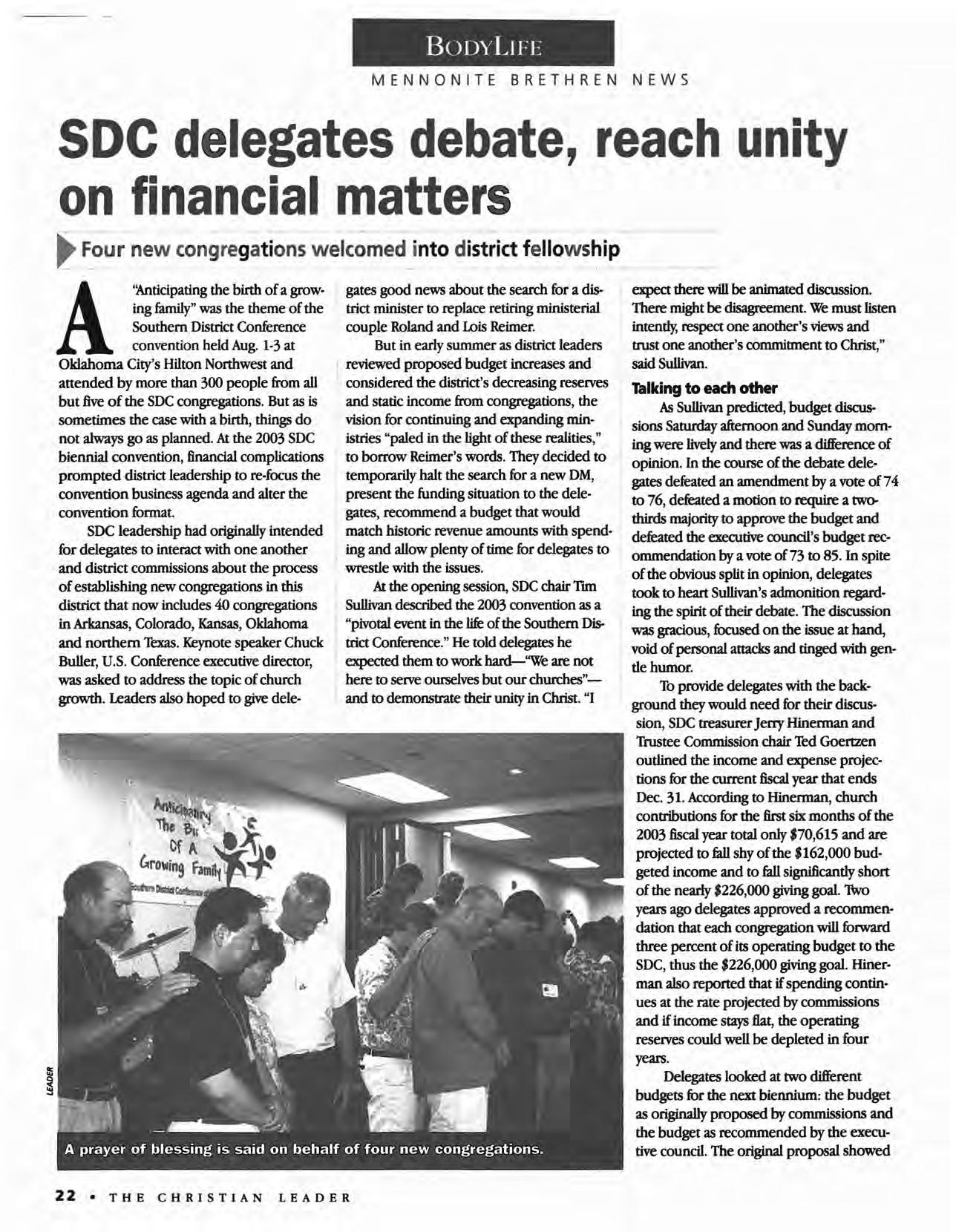
A'1.nticipating the birth of a growing family" was the theme of the Southern District Conference convention held Aug. 1-3 at Oklahoma City's Hilton Northwest and attended by more than 300 people from all but five of the SOC congregations. But as is sometimes the case with a birth, things do not always go as planned. At the 2003 SOC biennial convention, financial complications prompted district leadership to re-focus the convention business agenda and alter the convention format.
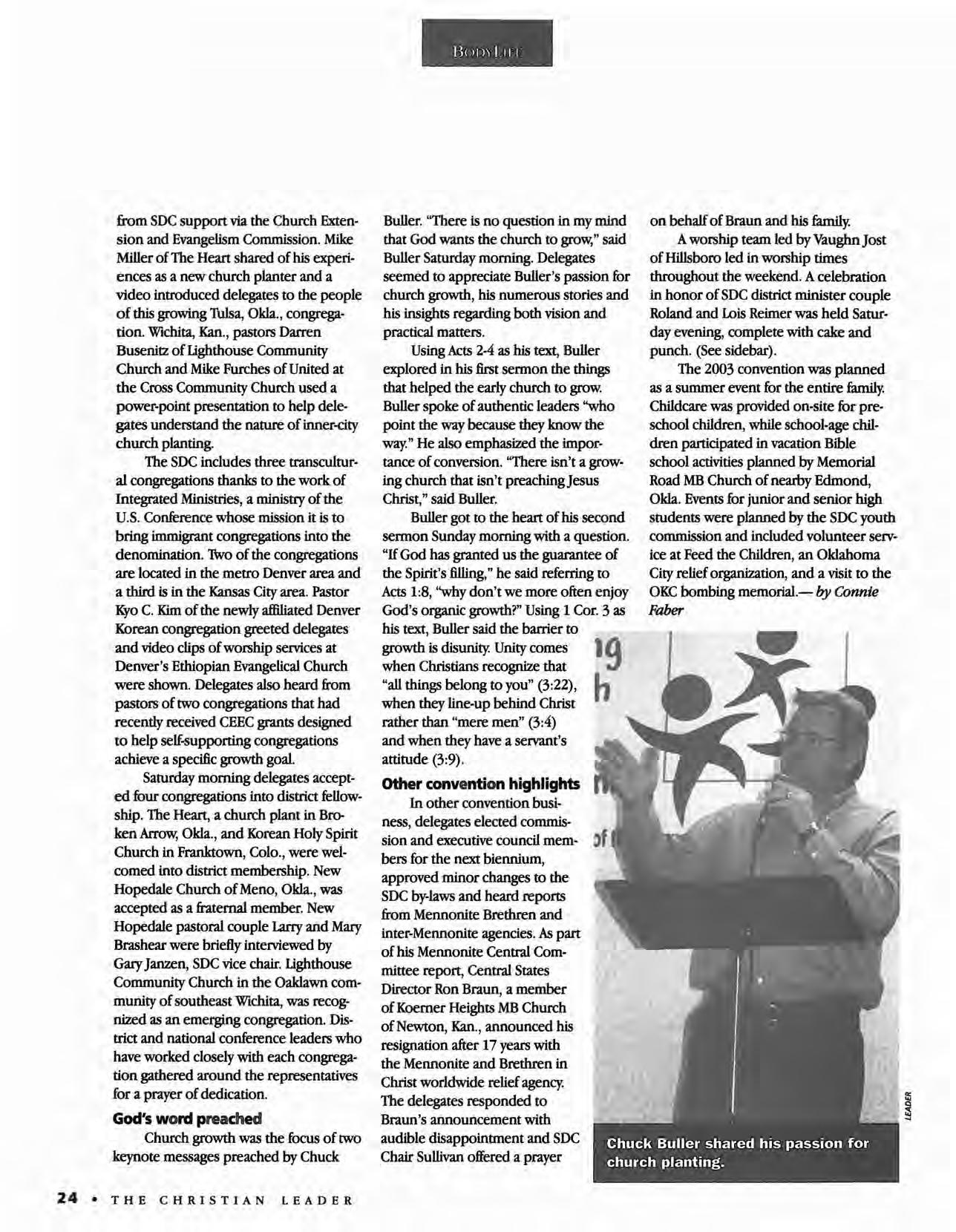
SOC leadership had originally intended for delegates to interact with one another and district commissions about the process of establishing new congregations in this district that now includes 40 congregations in Arkansas, Colorado, Kansas, Oklahoma and northern Texas. Keynote speaker Chuck Buller, U.S. Conference executive director, growth. Lewers also hoped to give dele-
gates good news about the seacm for a district minister to replace retiring ministerial couple Roland and Lois Reimer.
But in early summer as district lewers reviewed proposed budget increases and considered the district's decreasing reserves and static income from congregations, the vision for continuing and expanding ministries "paled in the light of these realities," to borrow Reimer's words. They decided to temporarily halt the search for a new DM, present the funding situation to the delegates, recommend a budget that would matm historic revenue amounts with spending and allow plenty of time for delegates to wresde with the issues.
At the opening session, SOC mair Tun Sullivan described the 2003 convention as a "pivotal event in the life of the Southern District Conference." He told delegates he expected them to work hard-"We are not here to serve ourselves but our murches"and to demonstrate their unity in Christ. "I
expect there will be animated discussion. There might be disagreement. We must listen intently, respect one another's views and trust one another's commitment 00 Christ," said Sullivan.
Talking to each other
As Sullivan predicted, budget discussions Saturday afternoon and Sunday morning were lively and there was a difference of opinion. In the course of the debate delegates defeated an amendment by a vote of 74 00 76, defeated a motion ro require a twothirds majority ro approve the budget and defeated the executive council's budget recommendation by a vote of 73 00 85. In spite of the obvious split in opinion, delegates took 00 heart Sullivan's admonition regarding the spirit of their debate. The discussion was gracious, focused on the issue at hand, void of personal attacks and tinged with gende humor.
To provide delegateswith the background they would need for their discussion, SOC treasurer Jerry Hinerman and Trustee Commission mair Ted Goertzen oudined the income and expense projections for the current fiscal year that ends Dec. 31. According to Hinerman, murch contributions for the first six months of the 2003 fiscal year total only '70,615 and are projected ro fall shy of the '162,000 budgeted income and to fall significantly short of the nearly $226,000 giving goal. 1\vo years ago delegates approved a recommendation that eam congregation will forward three percent of its operating budget to the SOC, thus the '226,000 giving goal. Hinerman also reported that if spending continues at the rate projected by commissions and if income stays flat, the operating reserves could well be depleted in four years.
Delegates at two different budgets for the next biennium: the budget as originally proposed by commissions and the budget as recommended by the executive council. The original proposal showed
expenditures of $260,950 in 2004 and $242,000 for 2005. The recommended budget totaled $195,950 for 2004 and $227,000 for 2005.
Discussion and debate focused on five issues: the projected shortfall for the current fiscal year, motivating congregations to increased giving, how best to use the district's operating fund reserves, whether or not to budget for a fulltime district minister in 2004 and the importance of funding youth activities at current levels. Delegates seemed to recognize that SOC leaders hold church planting as a high priority in spite of recommended budgets that include no new church planting projects for the next two years.
The discussion took place in four business sessions with almost 30 different individuals speaking and in four small groups
led by a Trustee Commission member. Church delegations were given time to caucus before voting on specific recommendations. The final discussion took place during a working lunch on Sunday. A motion to accept the original budget thatfunded all ministries as per the commissions' requests passed by an overwhelming majority. The recommendation also charged district lead· ers with developing a "strategic plan of action" related to funding needs and overall vision and called for the delegates to provide district leaders with their prayerful support.
Stories of God at work
Several times during the budget debate, delegates spoke to the importance of sharing with their home congregations the stories of how God is at work in the SDC. Reimer noted the momentum these
stories provided in a letter he wrote to pastors following the convention. "Through sharing stories of God at work, hearing God's Word preached and talking with each other and to the Lord together. a renewed enthusiasm and commitment for the mission of the SOC surfaced."
Stories were shared Friday evening and Saturday morning as SOC leaders painted a picture as to how congregations, through the SOC, are helping to grow God's kingdom. Sullivan commended congregations for impacting their home communities but cau· tioned that it is "hard for just one church to have a very big impact outside its community." The district, said Sullivan, provides con· gregations with an avenue for ministry beyond their city limits.
Reimers recognized for years of ministry to SDC
A RECEPTION, HOSTED by the Southern District Confer· ence executive committee, was held Saturday evening of the SOC convention to celebrate Roland and Lois Reimer's 14 years of ministry as district minister couple as well as their 50th wedding anniversary. Roland will be retiring from his role at the end of December. Lois worked for many years as her husband's secretary and often traveled with Roland to churches and visits with pastors in the district.
Those who attended the evening reception responded to open-ended questions about first memories of the Reimers, qualities of their leadership and Roland's best jokes and illustrations. In tum, Roland and Lois were questioned regarding the strengths they see in the district, their favorite church-to which Roland
replied, "The next one"-and some details related to their wedding 50 years ago.
Affirmation for the com· passion and commitment of their ministry to pastors and congregations was expressed by the giving of a clock. An album containing photographs of SOC churches was also presented to Reimer, who collects pictures of famous church buildings. A monetary gift was given in honor of the many miles the couple has traveled for the SOC with the encouragement to use it to travel to the destination of their choice.
Words and phrases used to describe the
Reimers' ministry included compassion, caring, organized, deeply committed to the wellbeing of pastors and the health of MB congregations, a good sense of humor, listeners and encouragers. It was evident by
Delegates heard from representatives of several congregations who have benefited the response of those at the celebration that many agreed with the assessment of the couple's ministry and have a deep sense of gratitude for the ways in which the Reimers have served. -Nadine Friesen
from SDC support via the Church Extension and Evangelism Commission. Mike Miller of The Heart shared of his experiences as a new church planter and a video introduced delegates to the people of this growing lWsa, Okla., congregation. Wichita, Kan., pastors Darren Busenitz of lighthouse Community Church and Mike Furches of United at the Cross Community Church used a power-point presentation to help delegatesunderstand the nature of inner-city church planting.
The SDC includes three transcultural congregations thanks to the work of Integrated Ministries, a ministry of the u.s. Conference whose mission it is to bring immigrant congregations into the denomination. lWo of the congregations are located in the metro Denver area and a third is in the Kansas City area. Pastor Kyo C. Kim of the newly affiliated Denver Korean congregation greeted delegates and video clips of worship services at Denver's Ethiopian Evangelical Church were shown. Delegates also heard from pastors of two congregations that had recently received CEEC grants designed to help self-supporting congregations achieve a specific growth goal.
Saturday morning delegates accepted four congregations into district fellowship. The Heart, a church plant in Broken Arrow, Okla., and Korean Holy Spirit Church in Franktown, Colo., were welcomed into district membership. New Hopedale Church of Meno, Okla., was accepted as a fraternal member. New Hopedale pastoral couple Larry and Mary Brashear were briefly interviewed by Gary Janzen, SDC vice chair. lighthouse Community Church in the Oaklawn community of southeast Wichita, was recognized as an emerging congregation. District and national conference leaders who have worked closely with each congregation gathered around the representatives for a prayer of dedication.
God's word preached
Church growth was the focus of two keynote messages preached by Chuck
Buller. ''There is no question in my mind that God wants the church to grow," said Buller Saturday morning. Delegates seemed to appreciate Buller's passion for church growth, his numerous stories and his insights regarding both vision and practical matters.
Using Acts 2-4 as his text, Buller explored in his first sermon the things that helped the early church to grow. Buller spoke of authentic leaders "who point the way because they know the way." He also emphasized the importance of conversion. "There isn't a growing church that isn't preaching Jesus Christ," said Buller.
Buller got to the heart of his second sermon Sunday morning with a question. "If God has granted us the guarantee of the Spirit's filling," he said referring to Acts 1:8, "why don't we more often enjoy God's organic growth?" Using 1 Cor. 3 as his text, Buller said the barrier to growth is disunity. Unity comes when Christians recognize that "all things belong to you" (3:22), when they line-up behind Christ rather than "mere men" (3:4) and when they have a servant's attitude (3:9).
Other convention highlights
In other convention business, delegates elected commission and executive council members for the next biennium, approved minor changes to the SOC by-laws and heard reports from Mennonite Brethren and inter-Mennonite agencies. As part of his Mennonite Central Committee report, Central States Director Ron Braun, a member of Koerner Heights MB Church of Newton, Kan., announced his resignation after 17 years with the Mennonite and Brethren in Christ worldwide relief agency. The delegates responded to Braun's announcement with audible disappointment and SDC Chair Sullivan offered a prayer
on behalf of Braun and his family.
A worship team led by Vaughn Jost of Hillsboro led in worship times throughout the weekend. A celebration in honor of SDC district minister couple Roland and Lois Reimer was held Saturday evening, complete with cake and punch. (See sidebar).
The 2003 convention was planned as a summer event for the entire family. Childcare was provided on-site for preschool children, while school-age children participated in vacation Bible school activities planned by Memorial Road MB Church of nearby Edmond, Okla. Events for junior and senior high students were planned by the SOC youth commission andincluded volunteer service at Feed the Children, an Oklahoma City relief organization, and a visit to the OKC bombing memorial.- by Connie Faber
HUNDREDS OF THOUSANDS OF people have fled their homes in civil war-tom Liberia, West Africa, leaving behind the fanns on which they depended for food. Through several partner organizations, Mennonite Central Committee is contributing both canned meat and funds to help feed displaced children, pregnant women and other Liberians at high risk of hunger.
MCC is contributing 3,000 cans of canned pork and 9,000 cans of canned beef to a Church World Service shipment of relief supplies. The shipment was scheduled to arrive in Monrovia, the Liberian capital, last month.
Some 4,300 cans of MCC canned beef were airlifted directly into Monrovia in April as part of a previous Church World Service shipment. Those supplies helped nearly 3,600 pregnant and nursing mothers, children and elderly people in six camps for displaced people near Monrovia.
Through the Canadian Foodgrains Bank, MCC is also contributing $35,800 toward a World Relief Canada project that will provide 505 metric tons of flour, lentils and oil. These emergency supplies will feed some 11,000 residents offour camps for intemally displaced people in Totota, central Liberia, for four months. Recipients are to include single mothers, pregnant women, the elderly and disabled people. Once home to some 75,000 inhabitants, the Totota area now hosts more than 165,500 people driven from their own regions by the war. The MCC West Africa office is based in neighboring Burkina Faso; no MCC personnel currendy serve in Liberia.
Civil war broke out in Liberia in 1989 and has continued off and on since then.
Government forces led by President Charles Taylor, who left the country last month, batded various rebel movements. Since early June, fighting between government and rebel forces, compounded by rampant looting, kept hundreds of thousands of Liberians confined to their homes. Markets have been closed, and food supplies have nearly disappeared. Most homes are without clean water, and medical care for the sick and injured is virtually unavailable.
''I am desperate to return," says Moses Gobah, 36, a Lutheran tninister waiting in Ghana to return to Liberia, told Ecumenical
PHILIPPINES
UKRAINE
UKRAINE
MEXICO
INDIA
NIGERIA
COSTA RICA
ECUADOR
AUG. 21-SEPT 8
SEPT. 3-22
OCT. 1-22
OCT. 03-19
Nov. 05-23
Nov. 05-23
Nov. 14-30
Nov. 28-DEC. 14
Congregation responds to challenge of service
Goal of challenge is to expand congregation's ,.. vision beyond Kansas
wheat fields
Some may say the price is too week of missions or service. high. Paying $4,000 to work for The aim of the challenge, Pastor Mark free, traveling 15 hours in an Isaac says, was to expand the congregaairplane on one's first-ever tion's view of the kingdom of God beyond flight, nursing a dog bite on a Koerner Heights Church. Isaac says it was remote island and soaking day after day in not necessary to travel to a distant location the incessant rain. But for Bryce Martens, for this to happen, though several planned Maria Reiss and Ron and Dena Braun, the mission trips abroad as part of the chalprice was just right. lenge. This summer eight youth and 13
These Newton, Kan., residents partici- adults or family units secured their plans pated this summer in a 15/15 Challenge at for ministry with more planned for the fall. Koerner Heights MB Church. The chal- Leaving on a jet plane lenge was for 15 youth and 15 adults or Maria Reiss, a high school junior, family units to participate in at least one
spent three weeks in Brazil. This was her first venture off the continent and on an airplane. She worked at a school in Brazil teaching English, organizing the library and helping care for a child with cerebral palsy. Leonard Reiss, Maria's father, formerly pastored a church in South Dakota where the family met the Stuckys, who were on furlough from mission work with Brazil Gospel Fellowship Mission. This couple founded the school where Maria worked. Maria says the Stuckys had told her she should come help them in a few years.
"And I was thinking 'Like that will ever happen,'" Maria says.
But Maria continued to correspond with the Stuckys, and when her parents said it was time for her to go on a service or mission trip, Maria chose Brazil.
Leonard Reiss says their family's philosophy is for each child to go on a mission trip after their junior year of high school, so they can get a feel for cross-cultural experiences.
"Our family has always been missionminded," Reiss says. "It's exciting to see our whole church getting on board and whole families joining in the effort."
Manual labor
Bryce Martens, who will be a high school sophomore, spent part of his summer in Papua New Guinea, an island country in the South Pacific. For two weeks, Martens trained in Florida at The Lord's Boot Camp with other members of his team, rising at 5:30 a.m. to run an obstacle course and working until 9:30 p.m. on everything from laying concrete to leaming puppetry.
Each member of the team was assigned a tool to bring. Some brought a 100-foot tape measure and others a hammer. Martens toted a post hole digger. He dismantled the digger for transport, carrying it in a traveling hard case for golf clubs. The rest of his belonging were sealed in plastic bags in a cardboard box, weighing less than 40 pounds.
Martens' task was to clear and repair an airstrip for airplanes flown by Mission
Aviation Fellowship pilots. Martens pulled out tree stumps and dug drainage ditches, as well as sang and did drama in churches.
Hard work was not foreign to this rural fellow, as he helps buck bales for the family's horse and chops up trees for firewood at home. He also did some yard work and other activities to raise the $4,000 for the trip.
In preparation for the trip, Martens received shots for typhoid and hepatitis and took malaria pills. Disease was one thing Martens' mother Joyce worried about. Safety was another.
"But Teen Mission guarantees the kids will not be in danger," she says.
The cost and risk involved do not compare to the rewards, Martens and his mother agree.
"This was an awesome way for him to get a new appreciation of life and grow in his walk with the Lord," Joyce Martens says. "It will truly be a growth experience for him, a maturing experience."
Five other Koerner Heights high school students, including three 2003 graduates, worked at camps this summer and another toured with a Christian college drama group.
Not just for kids
The 15/15 Challenge grew out of the mission vision of youth pastor Frank Huebert who has developed a four-year rotating plan for summer youth activities, including missions, camps and service projects. This was the year for at least 15 students to dive into mission projects individually or as small teams.
What was important for youth in the development of their global mission perspective was also good for their parents and families, Huebert says. So the challenge grew to include at least 15 families, couples or singles to take one week for missions or service this year, Isaac says.
The church encouraged the mission trips through fund-raisers and special offerings. The Sunday before a student or family left they were "sent" by the congregation through a time of prayer and blessing. Each participant was also encouraged
to prepare a report on his or her return so the congregation could share in the leaming of what God is doing in the world.
Ron and Dena Braun traveled to the other side of the globe to head a Mennonite Disaster Service unit rebuilding houses for people in the Chuuk Islands.
"Dena and I took the church's challenge of doing something to serve the Lord this summer seriously and thought we would find something for a week," Ron Braun says. "It was the Lord's leading that brought us in contact with Mennonite Disaster Service and their need for volunteers in Chuuk State of the Federated States of Micronesia. "
The Brauns served as project directors for six weeks in Chuuk, which is 650 miles southeast of Guam. The task was building 231 homes following a devastating typhoon July 2,2002. Braun says 50 homes have been completed on the island of Tonoas since February, and MDS plans to complete the remaining homes by the end of October.
There are six other MDS volunteers working in construction and training local Chuukese workers to become carpenters. One of the other volunteers is Jordan Miller, the son of Dan and Jo Miller of Newton.
MDS workers take boats to outlying islands each day to train workers and build 256-square-foot or 512-square-foot homes. The 50-minute boat rides offer ample
opportunity for the volunteers to get soaked by the morning rains. Braun reports it was common to then stay wet all day; either from more rain or the high humidity.
But the trip was not without its mishaps. Early in their visit, Dena was bitten by a dog while she was on a walk. The bite took a chunk out of her thigh but forI tunately there was a Federal Emergency Management Agency doctor on hand to clean and bandage the wound. "I thought I might get some color. I just didn't expect it to be blue," says Dena.
"Meeting the people is one of the highlights (as well as) enjoying their hospitality; and working together with them," Braun wrote in an e-mail from the island. ''When we have to leave it will be difficult. Other than the fact the temperatures are in the upper 80s each day and about 79 at night, the sunrises and sunsets are beautiful. The people we work and worship with are a blessing to us."
Other adult or family projects in the 15/15 Challenge included working with Habitat for Humanity in New Mexico, assisting in Mennonite Central Committee offices in Pennsylvania, installing an airplane engine for a missionary pilot in Ethiopia and mailing lessons to inmates through Child Evangelism Fellowship in Missouri.- This article, written by Amanda Balzer, was first printed by the Newton Kansan
Mennonite Church USA gathers for first convention
The church as a welcoming body emphasis of , Atlanta event
Anew denomination within the Anabaptist tradition met around God's table July 3-8 in Atlanta as nearly 8,000 people attended the first gathering of Mennonite Church USA. Mennonite Church USA was formed in 2001 when the Mennonite Church, founded in 1898, and General Conference Mennonite Church, founded in 1860, merged. The two denominations had cooperated for decades and spent 18 years on the denominational transformation, including several joint conventions.
The theme of "God's Table-Y'all Come" influenced almost everything that was part of the five-day event for adults, children and youth. "If Jesus could feed 5,000 people with a few loaves and fish, a banquet of God's blessings today surely can satisfy 8,000 Mennonites," wrote Mennonite Weekly Review editor Paul Schrag in
the newspaper's coverage of the gathering.
The call and mission of the church to be a welcoming body, especially to those who may feel left out, was emphasized by a wide variety of speakers, worship leaders, delegate sessions and service projects in which adults and youth participated together. "In the words of convention preachers," says Schrag, "it was a time to pray that God will do great things through a church that wants to try, more than ever before, to draw more people to the Lord's table."
Former U.S. President Jimmy Carter spoke at the opening worship session. His statement, "If I ever stop being a Baptist, I want to be a Mennonite" was one sign of his affinity with the Mennonite audience, but there were others. Carter affirmed the demonstration of unity exhibited in the merger of the two Mennonite bodies, the reputation of Mennonites around the
world, the Mennonites' opposition to the "unnecessary and unjust war in Iraq" and mistreatment of immigrants.
"The growing chasm between rich and poor" is the greatest problem in the world, said Carter, as he urged people of faith to promote peace and justice, especially those ''who worship the Prince of Peace." He also called Mennonites to think seriously about what it means to call them· selves Christian, meaning "little Christ." He asked, "Can we say those words without embarrassing ourselves?"
Other speakers from within the denomination and without emphasized the table as the place for mediation, a place where people must not be stingy but share with those who are poor and hungry and as a place where discernment is necessary in the call for welcoming diversity. "This table of God is something that's going to mess with our minds. God chooses who is at the table and we need to come to terms with thiS," said Joe Manickam, associate director for the Center for Anabaptist Leadership.
While meeting in a city that provided the setting for the 19608 Civil Rights Movement, the convention acknowledged the church's failure to do more to bring about justice and also celebrated those who have worked for peace and antiracism. A "reconciliation walk" through downtown Atlanta drew more than 250 participants and allowed Mennonites to reflect on "where we have been, where we have failed and where we are going with the work of racial reconciliation" said Les Horning, organizer of the event.
The business of the convention included the passing of three resolutions. The first opposes abortion because "it runs counter to biblical principles," but stopped short of banning abortion, explaining that such legislation ''would not stop abortions from happening."
A second resolution involves health care and encourages congregations to be involved in health care issues such as access to health care for all people, encouragement of illness prevention and a focus on healing and caring rather than
only curing.
Delegates also approved a resolution on immigration. "We reject our country's mistreatment of immigrants, repent of our silence and commit ourselves to act with and on behalf of our immigrant brothers and sisters, regardless of their legal status," says the resolution.
A Significant part of the Atlanta gathering was the Mennonite Youth Convention, attended by 6,000 teenagers. Youth focused on celebration and commitment dUring their times of worship and service. Hundreds responded to the call to make first-time commitments to Christ or a recommitment. Many of the youth participated in service projects throughout Atlanta.
While issues that had emerged as potential roadblocks to the merger continue to be processed, Mennonite Church USA leaders chose at this first convention to celebrate the vision and ministry opportunities found in the new denomination. It was God's inclusive invitation to come to the table that was emphasized. At the close of the convention musician Ken Medema, who created and led musical responses throughout the event, sang the reminder, "The whole world is waiting to come to the table."
-from reports in The Mennonite, the publication of Mennonite Church USA, and Mennonite Weekly Review, an inter-Mennonite newspaper.
Stewardship resources .ft-)/.
Other resources are available forpastors and Christkm educators
Your life is a gift from God. Resources from MMA help you fully appreciate that gift and live a life of holistic stewardship.
1\vo books on firstfruits stewardship from Lynn Miller, MMA's stewardship minister, will challenge and encourage you along your journey.
Firstfnlits Uving
God calls all people to firstfruits living. What does that mean? It means returning to God the best of what God's given. Cost: $7.99
Just in Time
Real life stories about opening up to others and giving back what God has given us. Cost: $8.99
Other stewardship resources
AChristian View of Money
How one lives is an accurate look at how one believes, particularly when looking at money. Cost: $8.99
Speaking About Money
Ways to reduce the tension when discussing money and stewardship. Cost: $14;99
AMother Held Hostage
A mother writes about life with her son and his battle with Tourette's Syndrome. It is a story about maintaining relationships during difficult times. Cost: $12.99
What Gives? Using God's Money
Bible study for junior high that explores money. Cost: $9.95
Money Talk
Bible study for senior high to help them understand faith and money. Cost: $12.95
Stewardship
for Ute!
MMA's Stewardship for Life eight-page lessons are packaged in sets for people in three life stages and are ideal for small groups. Also available: Leader's guides and individual lessons.
Cost: (any set below) $8.95
Set 1: Introduction to wellness Set 2: Wellness at mldllfe set 3: Wellness for the family
To order: (800) 348-7468, Ext. 269, stewardsbip@mma--online.org, or online at www.mma-online.0rw.resources.Shipping and handling charges are added to all orders.
Afghans living in ahopeful, precarious balance
Veteran missionaries observe daily life after Taliban fall
HERB AND RUTH FRIESEN prove the truth of the old adage that you can take the boy out of the country but you can't take the country out of the boy. When it comes to this couple, it has been the case that you can retire the missionaries but you can't retire their love for the people they have served since 1969.
The Friesens and their family offive children played a historical role in developing eye care in the Muslim world, serving under MBMS International with International Assistance Mission. They retired in 1996. their commitment to Herb's involvement in eye care and Ruth's "gate ministry" among the refugees has prompted the couple to return annually, except for 2001, to Central Asia.
Thanks in part to their ongoing ministry, the Friesens are sought-after speakers for Mennonite Brethren church harvest mission festivals and other mission emphasis occasions. The prayers of these congregations and the Frlesens' wide circle offriends have been a "treasure, and formula for success, " says Herb, and prompted him to write a report of their 2003 visit to Central Asia, excerpted here.
I was in Afghanistan just a year ago, not too long after the Taliban fell. That was, in retrospect, the honeymoon period, with new President Hamid Karzai settling in. There was a sense of euphoria, with a number of Afghans thanking the U.S. for invading their country. That mood still prevails, but the realities of rebuilding after 23 years of war, with peripheral warlords reluctant to yield to the central government, leaves things in a precarious balance. Add to this the conventional wisdom that the Afghans are fiercely independent, and combined with the continued Taliban/Al-Qaeda agitation, one wonders if there is an end in Sight. Yet there is a sense of cautious optimism, perhaps best expressed by a popular proverb, "The world lives in hope."
The country, particularly Kabul, swarms with 250 nongovernment agencies
plus a thousand miscellaneous organizations which sometimes seems to complicate rather than alleviate the situation, not to mention the effect on traffic in a city illprepared for such an "invasion." On the encouraging side is a massive building boom, something we had not seen so vividly on previous visits. Living expenses have risen dramatically, largely due to the presence of all the "rich" foreigners-with house rents rising from '200, when I was there just three years ago, to as high as '5,000 per month now. While it is bad enough for Christian agencies, returning refugees barely survive, in fact many have been forced to return to Pakistan and Iran.
Ruth and I had several goals in mind for our 2003 visit. The first was for Ruth to revisit many of the widows and refugee families who continue living in Pakistan and cannot afford to return to Afghanistan. It was amazing how quickly they found us "at horne" again, although their numbers were considerably less.
I looked forward to teaching in northern Afghanistan at Mazar-I-Sharif, one of the three regional eye hospitals of the International Assistance Mission. In addition to twice weekly classroom lecture, I particularly enjoyed working alongside the new residents in clinic, and consulting on interesting cases.
Our third goal was to attend the annual lAM meetings in Kabul as the official MBMSI representative. There were some 20 agencies of 30 represented. It was interesting to learn of expanding opportunities around the country as they emerge from the horrors of the Taliban and the previous civil war. lAM lost over $1 million in assets, including 65 vehicles, and houses 'full of furniture and personal belongings. Only a fraction was recovered.
NOOR, the eye work, continues as the lAM flagship. NOOR, "light" in Persian, is
almost a magic word and is perhaps the best known project in the country. NOOR has about 20 residents-in-training, and is preparing to offer a special postgraduate exam to qualified senior doctors. One of my dreams has been to place our graduates in rural areas, so as to spread out quality eye care. This is happening and we had the privilege of visiting a couple of these Community Eye Centers en route to Faizabad in the far northeast of this Texassize nation of some 22 million people. The trip, by road, was in itself high adventure, bumping along potholed roads, river beds and flood plains-800 miles in 35 actual driving hours.
During the 70s our family was very involved in the protestant international church, Community Christian Church of Kabul. Ruth had already returned to the U.S., but I spoke briefly as one of the "old timers" at the 50th anniversary celebration of the international fellowship. It has had a tumultuous existence, with the muchpublicized destruction of a beautiful and new, but short-lived, church building in 1973. A record-sized crowd attended the anniversary service. Because of Al-Qaeda threats the congregation generally meets in smaller groups around the city, and only occasionally gathers all together. Although witness is still restricted, the church is growing. It was good to hear of a number of believing families returning to the country.
LEADERS AFFIRM CONFESSION OF FAITH
Mennonite church in Vietnam holds first conference
REPRESENTATIVES OF
Mennornk churches from many areas of Vietnam gathered in Ho Chi Minh City July 27-28 for fellowship and to establish a united Mennornte church. They affirmed a confession of faith and chose a provisional church leadership group.
Primarily two pastors, Nguyen Quang Trung and Nguyen Hong Quang organized the conference. Trung has been serving as leader of the Mennornte Church in Binh Thanh District of Ho Chi Minh City, established in the 196Os.
Church properties were confiscated after the 1975 revolution; the church has recently rented a property where they now meet. Quang, leading an independent house fellowship for many years, identified as a Mennonite Christian in 1998, and leads the church thatmeets primarily in District 1\vo of Ho Chi Minh City.
Leaders identified several issues prompting the formation of a Mennornte Church structure. Urnting the groups will enable pastors to work together and facilitate further church
development. The church also plans to prepare a church constitution, seek to register the Mennornte church with authorities and petition the government for the return of church properties. A urnted church will also simplify association with international Mennornte bodies; the church plans to request formal membership in Mennonite World Conference.
A Vietnamese translation of the Confession of Faith in a Mennornte Perspective, adopted by the Mennornte churches of Canada and the U.S., has
been a catalyst for their efforts. The document has been shared with local churches and government officials. Other independent Christian church leaders and house fellowships have since declared their desire to be part of the Mennornte movement.
The 20-some official delegates from churches in several provinces as well as from Ho Chi Minh City, provided one of the first opportunities many of the leaders had to meet persons from other churches.-
MWC
Toews earns Fulbright Scholarship to travel to Ukraine
PAUL TOEWS, A MEMBER of the history faculty at Fresno Pacific Urnversity and director of the FPU Center for MB Studies, is in the Ukraine on a Fulbright lecture-research award. From September through June, he is teaching U.S. history at Zaporizhzhia State University and visiting archives throughout the former Soviet republic in search of documents relating to Mennonite history.
Toews' research focuses on finding documents relating to Mennonites who went to Russia at the request of Czar Catherine II to farm the Ukraine. Many were later persecuted; those not imprisoned left the country.
Since 1996, Toews has searched archives throughout the Ukraine, identifying and
securing reproduction rights I archives in Kansas, Manitoba I are doing "will ultimately to millions of pages of docu- and British Columbia. What he reshape the Mennonite story," ments for a consortium of five and other Mennornte scholars Toews says.-FPU
l\10RE NEWS
Schmidt to retum to MB Biblical Seminary r -Henry Schmidt, Immediate past president of MB Biblical Seminary, will be retumlng to the seminary staff Nov. 11n a half time donor development position, according to Jim Holm, Interim president. Schmidt resigned the seminary presidency In June 2003 after 10 years of leading the Institution. His current appointment Is for one year. Holm says, "(Henry) will be working with our network of donors and glvIng special attention to encouraging long-term gifts to the seminary. It Is a privilege to weicome him back to the seminary." -MBBS
Leadership Training in Congo
r -"God Is faithful. In Congo, politics dMde but the gospel of Jesus Christ unites beyond tribe, gender, social status and race," says Nzash Lumeya, mlsslologlst at MB Biblical seminary, following a trip to Congo and his participation In the June leadership training Institute In Kinshasa.
The training Institute Involved 20 trainers from the Democratic Republic of Congo, Germany, South Africa and the U.S, Including Lumeya, Tim Geddert of MBBS and Phil Steng. land, a pastor at Laurelglen Bible Church In Bakersfield. In addition to 75 students at the Missiological University Center, a hundred more trainees were accepted to take seminars dealing with HIV/ AIDS, the role of women In the Bible, worship, conflict resolution, Psalms and God's answer to grief.
While Lumeya and the other trainers were In Congo, the govemment drastically changed Its orientation. General Joseph Kaplla continued as president, while four vice presidents representing the four warring factions were added. The prayer of the church In Congo Is for the restoration of peace, says Lumeya. Four million people have died since civil war started In August 1998.
In the midst of violence and suffering, Lumeya sees visible signs of God's kingdom at work. One hopeful sign Is the election of Bishop Marini as president of the senate. This evangelIcal pastor has been leading the national ass0ciation of evangelicals (20 million) since 1999. The church In Congo Is overwhelmed and cryIng for humanitarian help, says Lumeya. Yet local MBs contributed to the cost of the trainers' transportation within Kinshasa, and money and clothing were collected to assist displaced war victims In Bunla, a city In northern Congo where chUdren, women and elderly people need food, clothing and medicine.
Mennonite women in Ukraine show mercy to neighbors
WOMEN FROM Kutuzovka Mennonite Church, with the help of Mennonite Central Committee, have organized a "mercy group" to help meet needs in their community. The 10-member group volunteer time weekly to visit local people who are elderly, sick or bedridden. Recently the group began visiting patients in a psychiatric hospital.
The mercy group is a "place where faith in Christ can be put into action," says Lyuba Chernyetz, who joined the church in 2000. Volunteering has helped her realize the joys of serving. "I never knew I could be fulfilled by helping other people," she says.
On a June afternoon, Chernyetz dropped in on Oleg, the grandson of a woman she used to visit. Oleg lived with his grandmother until she died and he was sent to a children's home. His father recently returned to the area and
the two live together again.
Chernyetz invited Oleg to a church-run summer day camp before going on to visit a woman who is partially paralyzed. Like the other mercy group members, Chernyetz does not own a car. She most often walks or hitchhikes when making her visits. She lives on a small farm and hopes to study at a Bible college
Dolina and Kutuzovka are located in an area once called Molotschna Colony, the largest Mennonite Colony in the Russian Empire. The Kutuzovka Mennonite church, built in 1892, was closed by Soviet authorities and used for grain storage. Church work began there again in 1998.-MCC
MB's face Ontario ruling on gay and lesbian marriages
"This is an issue that's not going to go away," conference minister Mark Johnson told Ontario MB pastors in an e-mail following the recent Ontario Court of Appeal ruling on the legality of gay and lesbian marriages.
Johnson forwarded a letter from a group of religious leaders to The Globe and Mail as a "heads up" to MB pastors. The letter criticized tlte court ruling and urged that the existing definition of marriage be pre-
served. Although the federal government has said it will allow a free vote on legislation redefining marriage, it is not clear what will happen should such a vote fail.
HaroldJantz, MB writer and churchman from Manitoba, wrote in a letter to the Wmnipeg Free Press, "unless Parliament takes a principled position" same-sex relationships will be validated as any heterosexual marriage. This, he said, will be "tan-
tamount to placing the desires of same-sex couples over the well-being of children and over society as a whole."
It is perhaps too early to tell how this and other challenges to traditional societal norms or rights will eventually affect churches, says Johnson. But he says, "With things in society becoming so obviously non-Christian, the church will have to become more obviously Christian."-MB Herald someday.
NEWS FROM OUR BROTHERS AND SISTERS ACROSS THE UNITED STATES
Baptism/membership
Blaine, Wash., (Birch Bay Bible Community)-Bill and Georgia Sherman, Phillip Davis and Melissa Lind were received into membership through baptism and confession of faith June 1.
Orland, Calif., (Country Bible)-Elisa Lower, Elise Royce, Carrie Snyder and Tarron Beauchamp were baptized at the church's annual July 4th family camp.
Weatherford, Okla., (Pine Acres)-Kevin Kelley was baptized and welcomed into membership July 20.
Bakersfield, Calif., (Laurelglen)-Christine Deeths and Will Penman were baptized the weekend of July 26-27.
Harvey, N.D.,-TIm Dockter and Scott Faul were baptized in the river July 27.
Celebration
Henderson, Neb.-The congregation held a rededication service July 13 celebrating the renovation of the church sanctuary. CrossWise, a drama/music group from Tabor College, had a part in the morning worship service.
Downey, Calif., (Living Hope)-Living Hope Church Ministry Center, formerly Immanuel Mennonite Church, celebrated its 50th anniversary Sept. 7 and the building of the present church campus. Former pastor Albert Epp spoke and previous attendees were welcomed to the service and catered lunch. The Ministry Center includes the joint churches of Living Hope and Abundant Life Assemblies, OMC Korean, the Vineyard and the Downey Christian Early Learning Center.
Edmond, Okla., (Memorial Road)-The congregation hosted "20 Years of Faithful Service" July 27 to celebrate the 20-year ministry of Pastor Paul and Gladys Klassen. A potluck meal and sharing time was part of the event.
Ministry
Bakersfield, calif., (Laurelglen)-"Prayers and Squares" is a national ministry of which Laurelglen is the newest chapter. A heavy thread is used to take stitches through the quilt layers and the ends are left free to be tied with a square knot by someone who offers a prayer for a person with a special need. The quilt is then given to that person. The uniqueness of the quilt is not in its pattern, color or workmanship, but in the prayers that are symbolically tied to each knot. The quilt is displayed in the church lobby where people stop to pray and tie a knot.
Clovis, Calif., (College Community)-Origami cranes in the baptistery area are part of a peace gift from the children of College Community and Memorial Road MB Church of Edmond, Okla., to the children of the MB church in
Hiroshima, Japan. Every August 6, Hiroshima remembers the devastating effects of the atomic bomb in a ceremony at Hiroshima Peace Park. Cranes sent from around the world are draped at the base of the Sadako statue. The cranes are sent in remembrance of those that suffered and died as a result of the bomb and as a plea for world peace Pastor Bill Braun along with 23 other members attended the Mennonite World Conference in Bulawayo, Zimbabwe.
Teaching/nurture
Wichita, Kan., (United at the Cross)-A one-day church vision workshop was held July 26 during which the congregation worked at discovering God's vision for its next chapter. A biblical study of the mission of the church, sharing personal passions and dreams and forming new ministry teams were part of the event.
Fairview, Okla.-"Total Money Makeover Live," a satellite one-day seminar by Dave Ramsey, will be presented Sept. 20. The goal of the seminar is to provide tools to help individuals and families manage their financial resources.
Belleview, Colo., (Belleview Community)-101 Discovery Class was offered Sunday afternoon, July 20, for those interested in the basics of the Christian faith, the church's mission, vision, strategies, structure and beliefs.
Blaine, Wash., (Birch Bay Community)-Craig and Bridget Hallman, MBMS International missionaries to Dubai, spoke to the congregation July 2B about their past work in Pakistan and future work in Dubai starting a recording studio to serve the south Asian Christian communities.
Workers
Wichita, Kan., (First MB)-Kim Bontrager has resigned as Director of Worship in order to give more time to her young family.
Bakersfield, Calif. (Laurelglen)-Nathan Carlson has joined the pastoral team as high school pastor. He and his wife Susan began their ministry August 1. Jeff Gowling has been called as lead pastor for the church emerging from the Laurelglen congregation. Jeff and his wife Traci and their children are relocating to Bakersfield in September.
Mountain Lake, Minn. (Community Bible)-Darren Rempel, formerly associate pastor at Bethesda MB Church in Huron, S.D., and his wife Sherry have accepted the call to serve as senior pastoral couple.
Dinuba, Calif.-Two part-time interim staff members are joining the ministry in Dinuba. Edmund Janzen, recent chair of the department of Christian ministries at Fresno Pacific University,
Church and university combine to serve in the Philippines
A partnership between Fresno Pacific University of Fresno, Calif., and Heritage Bible Church of Bakersfield, Calif, brought help to a village in the Philippines.
John Culaniban, pastor of the Filipino-American ministry of the Heritage Bible Church, organized a trip to Quezon on the island of Palawan in July. Palawan is the western most island of the Philippines, a Southwest Pacific nation of more than 76 million people and 7,000 islands.
Duane Ruth-Heffelbower, director of training and services for FPU's Center for Peacemaking and Conflict Studies, was among the participants. The group also included Culaniban, six doctors, two dentists and three nurses, two of whom are from the Bakersfield congregation, and a praise band from Manila.
The goals of the trip were to offer medical and dental services, provide resources for pastors and other leaders of area evangelical congregations and host a nightlycrusade. More than 2,000 people came for health services and many others attended the evening services.
Ruth-Heffelbower led a workshop on church leadership and conflict for about 80 pastors. He used cross-cultural material developed by CPACS on cycles of conflict and ways people commonly respond to help participants come up with solutions that work within their culture."-FPU news service
will serve as preaching pastor from September through December. H.H. Dick of Reedley, recent Pacific District Conference minister, will serve in pastoral care ministries. Barry Lloyd will continue serving as lead pastor.
Bakenfielcl. Calif., (Heritage Bible)-Perry Brian along with his wife Lynda have accepted the call to serve as worship pastor.
Olathe. Kan (Community Bible)-Rachel Williams is serving as director of children's ministries as of this summer.
Indiahoma. Okla. (Post Oak)-Charles Rempel has resigned as pastor. He and his wife Ellie plan to move to Hillsboro, Kan.
Correction: The July issue incorrectly stated that the Denver Ethiopian congregation participated in worship services at Buhler, Kan. It should have said the Olathe Ethiopian congregation has a sister relationship with Buhler.
DEATHS
ADRIAN. ELMER VlaOR, Buhler. Kan., a member of Buhler MB Church, was born October 18, 1923. southeast of Buhler to Jacob L. and Mary Neufeld Adrian and died July 16, 2003, at the age of 80. On October 3, 1947, he was married to Lovella Siemens who survives. He is also survived by one daughter, Jean Olsen; one son, Darrel and wife Holly; one brother, Norman and wife Myrtle; one sister, Ruth Friesen; one sisterin-law Helen Adrian, four grandchildren and one great grandchild.
BERG. ORRIN, Salem. Ore., was born January 1,
LE.
EVENTS
Pacific District Conference Invitation
Vinewood Community Church of Lodi, Calif., extends an invitation to Pacific District Churches for the annual conference Nov. 14-15. Registration fees will be $53, which includes Friday dinner, Saturday lunch and break-time snacks. Churches can expect to receive registration materials by the middle of September.
carson MB Churd! Reunion
The Carson MB Church of Delft, Minn., is planning a reunion for the 4th of July weekend 2004. We are inviting all persons who have ever attended Carson, or have roots in the church to return that weekend to meet past friends and to celebrate what God has done through his church. For further information write the church at CMB Church, 32329 496th Avenue, Windom, MN 56101 or contact Bob Ewert at 507-678-221 or rewert@swwnet.com. Also, we would appreciate help locating e-mail or postal addresses of any ex-Carson attendees.
Rocky Mountain Mennonite Relief Sale. Auction
Come have a good time supporting a great cause at the 28th Annual Rocky Mountain Mennonite Relief Sale and Auction, Saturday, Oct. 18,2003, at the Arkansas Valley Fairgrounds in Rocky Ford, Colo. The auction will include hundreds of quality items, many booths open at B a.m., scores of handmade heirloom quilts, lots of delicious food, a kids auction and activities, silent antique and collectibles auction. A sausage and pancake breakfast begins at 7 a.m., and the auction begins at 9:30 a.m. Navajo fry bread and sausage sandwiches as well as barbecued chicken will be served for lunch. A 1948 John Deere B tractor will be auctioned at 1 p.m. and the quilt auction begins at 1:30 p.m. On Friday, a variety of food booths will serve from 5-7 p.m. and a musical pro-
1930. in Hillsboro, Kan .• to Henry W. and Marie Harms Berg, and died July 19, 2003, at the age of 73. He was married to Ruby Sawatzky who survives. He is also survived by one son, Don and wife Jennifer Reimer-Berg; one daughter, Jeannie, and three grandchildren, all of Salem. HOFER, JOE E., Freeman, S.D., of Salem MB Church. Freeman, was born Sept. 7, 1917, near Bridgewater, S.D., to Paul A. and Anna Hofer and died July 15. 2003, at the age of 85. On March 2. 1947, he was married to Anna Glanzer who survives. He is also survived by three sons, Dan and wife Jane of Austin Tex., Orlando of Sioux Falls, S.D. and Earl and wife Suzanne of Wichita, Kan.; one brother, John W. and wife Bernadine of Bridgewater; one sister, Ruth Gross of Huron S.D., one sister-in-law, Rosella Haebersma of Sioux Falls, and four grandchildren.
STEFFEN. JAKE, Minot, N.D .• a member of Bible Fellowship Church, Minot, was born December 21, 1912, in rural Sawyer, N.D., to Jacob and Marie Sauter Steffen, and died July 20, 2003, at the age of 90. He was married to Violet Price who predeceased him in 1955. In 1956, he married Dorothy Hance, who survives. He is also survived by two sons, Robert and Charles. and one daughter, Joyce.
SCHMIDT. LEAH HELEN, Reedley, Calif., was born May 27, 1918 and died July 11, 2003, at the age of 85. She was married to John A. Schmidt who predeceased her. She is survived by three daughters. Carolynn Ediger of Chicago, III., Sharon and husband John Andrade of Rancho Palos Verdes, Calif .• and Glenda and husband Jim Goodwin of
H L E
gram ·On with the Show· will begin at 7:30 p.m. The program features a vocal quartet of musicians from Kansas colleges; a freewill offering will be taken for MCC. Proceeds of the sale go directly to meet human needs throughout the world through the work of Mennonite Central Committee, the relief, service, peace and development arm of the Mennonite and Brethren in Christ churches. For more information call 719-384-7914 or 719-481-2527 or visit www.emclj.org/sale.htm.
EMPLOYMENT
MilS Director of Public Relations
MB Biblical Seminary seeks a person to serve full time as Director of Public Relations. The position is located in Fresno, Calif. Join the team that sustains the Seminary's vision. Oversee implementation of constituency relations plan. Share the theological discoveries of the Seminary with the constituency through media. Manage alumni relations activities. Coordinate all media production. This includes developing print, electronic and video materials for recruitment, public relations and donor development. Please direct inquiries and resumes to Linda Bowman, MB Biblical Seminary, 4824 E. Butler Ave., Fresno, CA 93727; phone: 559-251-8628, e-mail: lindabow@mbseminary.com, fax: 559-251-7212.
FOR SALE
Ulysses Churd! History
Ulysses (Kan.l M.B. Church will celebrate our 75th anniversary Nov. 28-30, 2003. To commemorate this important milestone, a history book is being published. This special book is available for pre-sales for a limited time at $15.00 each. A limited supply will be available for sale at the celebration for $20.00. To secure your copy now, send $15.00 (payable to UMBCl, or call our office for more information at 1877-299-1471. Order deadline is Sept. 25, 2003.
Brentwood, Calif.; two sisters, Agnes Holleman and Eva Schmidt of Oklahoma, six grandchildren and seven great grandchildren.
SNELUNG, SUSAN S., Buhler, Kan .• was born March 12, 1952, and died August 6, 2003.
WHITES. ROBERT, Lenoir, N.C., pastor of Laytown MB Church, died June 21, 2003. He is survived by his wife Patti and two sons, Joey and Matthew.
CORREaION: The obituaries for William James Haag, Carol Jean Haag and Hulda Edna Ratzlaff Haag as published in the July issue incorrectly listed their churcb membership as Heritage Bible Church of Bakersfield. They were charter members of Laurelglen Bible Church of Bakersfield, where each of their memberships resided at the time of their deaths.
MISSION USA DIRECTOR
The Mission USA Board of the U.S. Conference of Mennonite Brethren Churches is seeking a full time director of its ministries. The MUSA Director shall lead a national vision for building Jesus' Kingdom through winning and disci piing people into the family of God. The director will:
• work with the appropriate district leadership teams at their request in the planting of new churches
• work at developing a strategy for church health and growth for local congregations that request these services
• oversee and facilitate the Integrated Ministries of the U.S. Conference
• help facilitate the Leadership Development of emerging leaders in partnership with a variety of Conference agencies.
The MUSA Director will report to and be accountable to the U.S. Conference Executive Director. Secondarily. the MUSA Director will relate to and help lead the MUSA board.
Qualifications include:
•A clear understanding of and commitment to the U.S. Conference of MB Churches and its confession of faith. demonstrated visionary leadership. excellent management skills and ministry experience.
HAS YOUR INTEREST INCOME BEEN DRAGGING ITS FEET?
Perhaps it's time you considered a Charitable Gift Annuity with MENNONITE BRETHREN FOUNDATION
Among the benefits you can expect:
• Guaranteed payments for life, partially tax-free
• Income tax charitable deduction Here are some sample rates:
Person
A GIFT ANNUITY IS A GREAT WAY TO HELP YOURSELF AND SUPPORT THE WORK OF OUR MENNONITE BRETHREN MINISTRIES!
FOR MORE INFORMATION, PLEASE MAIL THIS COUPON OR CALL OUR OFFICE:
MENNONITE BRETHREN FOUNDATION PO BOX 220 HILLSBORO KS 67063
TELEPHONE: 800-551-1547
Name
Address
City/State/Zip
Birthdates of beneficiaries
Phone
We will mail you without obligation a brochure and personalized illustration showing just what a Gift Annuity can do for you.
"This offer is void where prohibited by state law.
Blest be the ties that bind
We often describe our denomination as a family. Maybe it is because of our name-Mennonite Brethren. We are first and foremost God's family, brothers and sisters. Just as we aim for healthy relationships in our earthly families, we should strive for Christ-like relationships in our congregations. One thing that can hinder this is the way we respond to change.
If I were to draw my family picture today it would no longer include just my mom and dad, my younger sister and me as it did for more than 20 years. It would include my husband, our three children, two sets of parents, four siblings and four spouses, 11 nieces and nephews and three great-nieces and nephew. That is 26 people! And it will continue to be transformed thanks to marriage, birth and death. To be part of a family is to experience change.
To be part of a church family is also to encounter change. But sometimes it seems that while we expect change and deal with it in our fumilies, we do not expect changes in our congregational life and consequently we don't address change well. We recognize that adding new members to a fumily may mean buying a new house, changing the timing of holiday celebrations and developing new traditions. Adding newmembers to a church family also involves making changes-building a new facility, adding to weekly worship and discipleship activities and trying new activities and in the process creating new traditions-and we drag our feet. We know that as our children mature we need to give them more responsibility so that they will be prepared to manage their own affairs and live independently someday. Recognizing that we must do the same with one another as we mature spiritually, and as new attendees and members join our congregational families seems to be more of a challenge.
Why is it so hard for us as congregational families to change? I have no definitive answers, just some observations.
• When it comes to change, it is easier said than done. Sometimes I am not prepared for changes-I've missed the early signals that something needs to change. Then change catches me off guard, and I may find myself forced to make changes more quickly than I would like. That isn't always the most comfortable position in which to find ones self Or when my needs are being met it is easy to believe that the needs of everyone else are also being met. Why change when things seem to be working fine? It is not always easy to graciously adjust to a change that seems unnecessary. Change can be scary. We don't know what will happen if we make whatever shift our congregation is considering. It is not always easy
to honestly admit our real fears to others in the church family.
• Changes in our congregational life can be difficult when we are a community of multiple generations. When we worship, serve and are discipled in an intergenerational setting, we all benefit.
Church plants often envy those of us who worship in congregations with "old timers." Those of us who worship in multi-generation congregations do not always appreciate this facet of our church family. We need to remember that because of the season of life in which they find themselves, each generation has a unique contribution to make to church life. We don't always recognize that the needs and expectations each generation brings to worship and church life are affected by the culture in which that generation experienced its youth. Old timers forget that they were once young and eager to make changes so that faith would be relevant to their lives, and younger people fail to recognize that they will be the oldest generation someday. That they will have made the changes they felt necessary and will want to keep them in place.
• Often change prompts disagreements, and how we handle disagreement is critical. Tim Neufeld (see story page 6) suggests that families often fall into unhealthy cycles of conflict and he offers some alternatives. If earthly families don't always handle conflict the best, it seems likely that congregations will also make mistakes. Neufeld's challenge to identify the real issues behind the conflict and to place a high value on relationships seems to be excellent advice for churches. Part of giving value to relationships is to make sure we really listen to each other. I wonder then, how best do I show I have heard-not with my ears but with my heart-a viewpoint different than my own? Is adopting that viewpoint as my own-being convinced of that perspeetive-the only way to show I have heard? Delegates at the 2003 Southern District Conference convention demonstrated that we can have differing view points, debate those views, make a decision some disagree with and walk away from the process each convinced we were heard. How? I think when we show one another respect and love, we feel heard. Again, a concept easier talked about than successfully practiced.
At our house we talk about changing on the outside and on the inside. May our congregations grow on the outside-numerically, with regard to ministry and as we enhance facilities. More importantly, may we enjoy growth on the inside-as we encounter change, grapple with it honestly and keep relationships our first priority. -CF