Piper

![]()

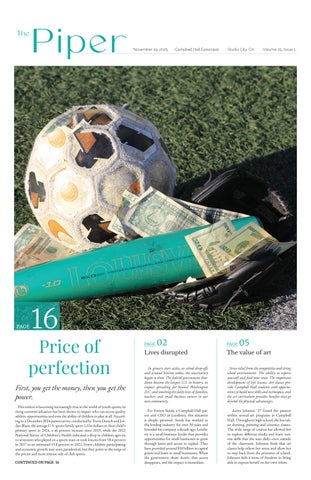
First, you get the money, then you get the power.
This notion is becoming increasingly true in the world of youth sports; its rising commercialization has been shown to impact who can access quality athletic opportunities and even the ability of children to play at all. According to a December 2024 parent survey conducted by Travis Dorsch and Jordan Blazo, the average U.S. sports family spent 1,016 dollars on their child’s primary sport in 2024, a 46 percent increase since 2019, while the 2022 National Survey of Children’s Health indicated a drop in children ages six to seventeen who played on a sports team or took lessons from 58.4 percent in 2017 to an estimated 53.8 percent in 2022. Fewer children participating and economic growth may seem paradoxical, but they point to the surge of the pricier and more intense side of club sports.
In grocery store aisles, at school drop-ofs and around kitchen tables, the uncertainty began to show. The federal government shutdown became the longest U.S. in history, its impact spreading far beyond Washington D.C. and touching the daily lives of families, teachers and small business owners in our own community.
For Everett Sands, a Campbell Hall parent and CEO of Lendistry, this situation is deeply personal. Sands has worked in the lending industry for over 20 years and founded his company a decade ago. Lendistry is a small-business lender that provides opportunities for small businesses to grow through loans and access to capital. They have provided around $10 billion in capital grants and loans to small businesses. When the government shuts down, that access disappears, and the impact is immediate.
Aniya Johnson ‘27 found her passion within several art programs at Campbell Hall. Throughout high school, she has taken drawing, painting and ceramics classes. The wide range of courses has allowed her to explore diferent media and learn various skills that she uses daily–even outside of the classroom. Johnson fnds that art classes help relieve her stress and allow her to step back from the pressures of school. Johnson feels a sense of freedom in being able to express herself on her own whim. The value of art
Stress relief from the competitive and tiring school environment. The ability to express yourself and fnd your voice. The important development of life lessons. Art classes provide Campbell Hall students with opportunities to build new skills and techniques, and the art curriculum provides benefts that go beyond the physical advantages.
The federal government shutdown has impacted millions of everyday people

The 2025 shutdown impacted small businesses across the country, freezing access to new Small Business Administration (SBA) loans, which are essential for a business’s growth. These loans often serve as a lifeline for the small businesses that rely on them. Without the ability to process these loans, small business owners are left in limbo, unable to grow or sustain their businesses.
“Let's just assume you had a contract with the government, and now the people who pay you aren't at work anymore,” Sands said. “So now you can't receive those funds, and then you can't pay your employees, or you can't help them. Imagine people not having access to food or their children not having access to food, well, that causes stress on an employee, and then they can't perform their job as well.”
For small businesses already navigating tight budgets, the consequences can be severe. With reduced access to capital and government contracts on hold, some owners were forced to make difcult choices just to stay afoat. The efects of lost federal support spread throughout the broader economy, reaching nearly every corner.
“The federal government is the world's largest employer,” Sands said. “Whether we like it or not, everyone is connected to it, whether it’s schools, resources or businesses. You don’t want that capital to stop fowing inside the economy. No matter what, everyone will feel that efect.”
The efects of the shutdown aren't just hitting business owners: they're rippling through the city, impacting its residents. Los Angeles Councilwoman Traci Park, who represents the city’s 11th district (CD11) on the westside, has seen frsthand how the federal government shutdown is impacting the Los Angeles community. In her district, vulnerable families, seniors and immigrant residents face growing food insecurity and fnancial hardship as federal assistance programs are disrupted.
“It's incumbent upon us as a city to keep a very close eye on where the vulnerable communities are being impacted and then ofer what we can to try to supplement,” Park said. “It is the people who need the help the most that will sufer the most as a result of this. Vulnerable families, people in the margins, folks that are
We have a lot of families that struggle with housing and food security. That compounds the issue for people who are already struggling to pay their rent and to buy food. The loss of that food support has been a major concern.
Traci Park
"already working two or three jobs just to pay rent, our seniors who depend on food support and other benefts.”
To help ease the burden on residents, Park’s ofce has been actively partnering with private organizations and city leadership. Currently, the CD11 has coordinated with Mayor Bass to distribute Angelinio cards to families in need and has created rental assistance programs. These eforts, along with collaborations with local non-profts and corporate partners, aim to provide immediate relief for those struggling with housing and necessities.
“As a local elected ofcial, the closest to the everyday people who live on the west side of Los Angeles, my role is to make sure that our essential services continue uninterrupted and that the needs of our residents continue to be met,” Park said. “When you have a supply chain shortage, which is what shutdowns lead to, the economic impact is higher prices. We have a lot of families that struggle with housing and food security. That compounds the issue for people who are already struggling to pay their rent and to buy food. The loss of that food support has been a major concern.”
In addition to fnancial relief, Park’s ofce has worked to strengthen community and safety support networks. They teamed up with philanthropic partners to create a rental assistance program and with corporate organizations like Amazon to support local food pantries, including organizations such as St. Mark Parish, which serves about 400 families a week. These eforts, along with collaborations with local nonprofts and city partners, aim to provide immediate support to families navigating the uncertainty of the shutdown.
“When the government shuts down and funding resources aren't available, the programs and services come to an actual halt,” Park said. “Making sure that at a city level we are able to ofer backstops to some of that and really lean in with our community partners to supplement those needs [is essential].”
STORY WES VAHRADIAN
If Congress fails to come to an agreement on funding bills for the fscal year, the U.S. government will enter what we know as a shutdown. Under the Antidefciency Act, federal agencies can’t spend money without authorization, leading to a pause in nonessential operations until Congress can fnally pass the new funding bill. According to David Wessel’s October 2025 Brookings Institution article, essential workers and systems like police, frefghters and Medicare will continue during a shutdown, but hundreds of thousands of nonessential federal employees cannot go to work, and would be without pay.
The process of passing a new funding bill is as follows: The House and Senate each pass their own funding bills, then convene to resolve their diferences and send the fnal draft to the president. According to Caitlin Yilek’s October 2025 CBS News article, if that process is not completed before Sept. 30, the government loses its power to spend. Shutdowns usually are the result of deeper political disputes rather than an actual lack of funding.
Shutdowns also interfere with programs that depend on federal grants shared with the states. According to a November 2025 National Conference of State Legislatures (NCSL) article, most mandatory programs with permanent funding lose the ability to secure additional funding during a shutdown, but some covered under the Full-Year Continuing Appropriations and Extensions Act can operate temporarily using funding from their frst quarter. States may rely on “carryover” funds to ensure essential services continue, but these funds are quickly used up. Programs like community health centers or assistance programs for low-income families have already lost the ability to get new funding, while others, like Medicaid, continue because of their permanent authorization and do not need to be renewed each year. These funding gaps lead states to make tough decisions about how to allocate the few funds they have left with until Congress eventually passes a new spending bill. The 2025 shutdown began when Congress failed to renew appropriations by Oct. 1. According to a Sept. 2025 House Appropriations Committee press release, the House passed a bill nearly identical to the previous year’s, with the only diference being its exclusion of the COVID-era health care subsidies, which had expired. The committee claimed that Senate Democrats rejected the bill on the merits that the subsidies must be renewed, and that, until they were, the bill would not pass. This standof between the House and Senate left federally funded agencies without a budget for employees and federal resources, halting many of their operations.
Shutdowns have become recurring features of partisan politics. They cost billions of dollars, disrupt essential operations, leave millions without work and pay and weaken public services. According to the Congressional Budget Ofce, this current shutdown has led to an estimated $3 billion in lost GDP. While the political fghts that create these shutdowns are centered on one specifc topic, in this case, healthcare funding, the real consequences are much larger. The bill passed by the House restored federal funding to agencies through Jan. 30 and provided full-year funding to a few vital government departments, such as the U.S. Department of Agriculture and the Food and Drug Administration (FDA).
According to Brookings analysts, the government doesn’t truly “save” any money in a shutdown. It just postpones spending while racking up extra costs like back pay to resume operations. Ultimately, a shutdown is much larger than a budgetary dispute. Some believe it marks the failure of congressional administrative decisions, and a clear divide between congressional bodies, afecting everyone, from federal employees to state offcials, to immigrants and everyday citizens who require public services. With the new funding bill now passed, the shutdown will end. Unless Congress can separate routine processes like funding from partisan politics, the risk of another shutdown is still imminent.
The number of days the shutdown lasted, the longest in our country's history
dollars of infationadjusted GDP were permanently lost
Supplemental Nutrition Assistance Program (SNAP) recipients lost their benefts during the shutdown
Democratic House members broke with other party and voted to reopen the government
monthly jobs reports missed, afecting government hiring data for September and October
STORY ANNIE LEONETTI & SOFIA WARD
ART GIANNA JOUDI
Stadium lights, huge audience, eye-opening performances. Every year, the Super Bowl brings artists from all over the world to perform on one of America’s biggest stages. This year, Puerto Rican artist Bad Bunny will perform his beloved songs–defying language barriers and breaking through stereotypes. For some students, this performance is not just entertainment but a crucial moment for representing Latino voices across the world.
According to NFL.com, Bad Bunny has used his music to stand for cultural pride, resilience and political expression. He’s a vocal advocate for Puerto Rico and uses his platform not only to celebrate his community’s heritage but to challenge injustice and amplify the voices that are being silenced. Since the announcement of his performance, the National Football League (NFL) and Bad Bunny have faced backlash for his vocal opposition to President Trump. He avoided shows in the U.S. because he was concerned with the U.S. Immigration and Customs Enforcement (ICE), as well as the mass deportation of Latinos. Through some of his songs like “NUEVAyol”, he lyrically critiques anti-immigrant rhetoric and openly voices his opinions online.
Victoria Hernandez ‘28 is an avid Bad Bunny listener and loves that the NFL chose him to perform at the halftime show. She sees how the messages in his music encourage her and others to embrace life's moments. She believes his presence on the big stage will represent something bigger than just a performance and possibly spark a positive change for the Latino community regarding the backlash they’ve been facing.
“He’s a role model, and really shows me how to live in the moment and focus on the little things,” Hernandez said. “He helps people come together in their families and really cherish the moment. It’s a super big thing, the halftime show, everyone's gonna see it. It’ll bring people to reality and see what’s really happening, and maybe something will change.”
While Becket Morritt '26 doesn't listen to Bad Bunny regularly, he views the Super Bowl as a major representation of America. He believes the halftime show has become a platform for artists to address world issues, and hopes Bad Bunny's show will hold signifcance for the Latino community.
event

"Last year, Lamar's performance was a little controversial, but having Bad Bunny perform, who is Latino, means a lot because we're at a time where we need more Latino movement," Morritt said. "Having him go up is showing how many Latinos we have in this country, and I guess people are mad because they don't want that right now. I don't think it's [the artists'] responsibility to perform for anything, but it's such a global stage to push for change. It's amazing that they fght for those kinds of things like representation with the power they hold as artists."
Like Morritt, Carys Johnson '27 recognizes how performers of color at the Super Bowl spotlight diverse voices. She believes Bad Bunny's decision to perform was justifed because he's representing Latinx culture on one of the world's biggest stages while standing his ground as an artist.
"The halftime performance is going to be really important this year, and I think Bad Bunny is going to make a great political statement at the Super Bowl," Johnson said. "Artists should use their platforms to show who they are and what they believe in during these performances because that's what performing is all about."
Gigi Johnson '27, a Bad Bunny fan, was excited to learn about his Super Bowl performance, given his advocacy for the Latino community. She believes that, given today's political climate, the NFL has made excellent selections. She acknowledges
Serving beyond his uniform

After serving as a combat engineer in the U.S. Army, calculating demolitions and leading convoys under pressure, high school geometry and AP Macroeconomics teacher Kevin Kelley now brings that same calm precision into his classrooms. In doing so, he creates an environment that allows his students to fourish and thrive both as students and as people.
Kelley joined the Army right after college and was commissioned as an ofcer in May 1989. He decided to join the Army because his father was a former soldier and because of his extreme passion for service. Kelley is a frm believer in giving back to his community, which he sees as central to his passion for teaching.
“I would argue that teaching is a service,” Kelley said. “Your efort is being multiplied into many more people than just yourself or one other person. Teaching does that because
STORY RUBY DUTTON
It is 7:30 AM on a Tuesday, and the Academic Honor Board (AHB) sits around the room listening intently as a teacher recounts a student's academic violation. Next to them is the dean, recounting their perspective as well. They dismiss the teacher, and the dean brings in the student to tell their side of the story of their infraction. After several conversations, the AHB decides on the student’s consequences.
that artists must leverage such massive platforms, especially Latino artists, given current hardships. Over the past two years, she's noticed the halftime show evolving beyond entertainment into performances that refect meaningful change.
“They've highlighted more diverse voices than they have previously, especially with Kendrick and Bad Bunny,” G. Johnson said. “They have a lot of underlying messages in their music, but are very vocal about their politics, beliefs and morals. That refects in their performances in the Super Bowl, so I feel like it represents something larger.”
G. Johnson anticipates the show because Bad Bunny can represent his community and those whose freedom of speech has been limited by ongoing mass deportations. She hopes critics will be confronted, while others fnd inspiration to stand against inequality. She views his performance as pivotal for Puerto Ricans, immigrants, and the Latino community.
"I really hope that the people who have something to say about what he stands for are angered by his performance and his ability to be on stage and sing for what he believes in," G. Johnson said. "I hope people get inspired by what he is performing about, and I think it's really important, especially for Puerto Ricans. A lot of immigrants in this country are being challenged by the administration, and this is a great artist to be performing who identifes with that grief."
Kelley's life lessons from the army have become the foundation of his universally loved teaching
as we teach, you guys spread out [that information] into the world, and multiply that message.”
Kelley served as a combat engineer, responsible for calculating demolitions and analyzing convoy routes. This work not only required technical precision but also the ability to stay calm under pressure. He believes that his combat experience has taught him to remain calm in stressful situations, as very few things make him anxious.
“[My experience in combat] allows me to take every day a little more relaxing, using a positive mood, because I've learned that I can handle any situation, and so I'm not ever concerned or stressed or worried,” Kelley said. “I think that creates a little bit of space for my classroom to be a stress-free environment.”
Eli Rebhun ‘26, one of Kelley’s AP Macroeconomics students, believes Kelley wants him to learn, as he always appears enthusiastic about what he is teaching. He also notices that, among his classes, Kelley’s classroom feels the calmest, which he considers essential in his ability to work efectively and without distraction. For Rebhun, the class has become something to look forward to everyday.
“Mr. Kelley’s classroom brings me a sense of calmness,” Rebhun said.
“It brings me a space on top of all my stressful classes, where I can just go to and relax, do something that I want and learn about something that I want to learn about because the teacher is motivated.”
For Rebhun, Kelley has become a mentor and support system. He admires Kelley’s willingness to go above and beyond for his students, ensuring they feel confdent in their work and supported if they are facing any challenges.
“He's almost like a father fgure to me,” Rebhun said. “I went to him [because] precalculus was killing me. But when we sat down, the thing about Mr. Kelley is that he wants to form a relationship with [his students]. Immediately, I was happy and excited to learn.”
That sense of connection refects Kelley’s philosophy that teaching, like the military, is truly about service and leadership. His time as an Army ofcer taught him the importance of putting others before himself, a lesson he applied in parenting or teaching.
“As an ofcer, you’re in charge of the lives of 30 people,” Kelley said. “You start to put yourself second. I think that’s benefcial when you’re a teacher and a parent. You have to hold high standards, but you mentor so that your students rise to those expectations.”
The AHB was started in 2003 by English teacher Louisa Levine, who retired last year. Now, U.S., History and CHAI Race teacher William Cullinan is the faculty head alongside faculty members Summerlyn Poon and Dr. Amanda Dye. The AHB is a team consisting of two voting faculty members, two freshmen, two sophomores, three juniors and three seniors. If a teacher suspects a student has been academically dishonest, they will refer them to the dean, who will often send the student to the AHB. The AHB then investigates whether the student is guilty or innocent and issues consequences. Cullinan understands the importance of making students feel heard instead of evaluated.
“[The purpose of the AHB is to] hear students, to make them feel like they were heard [and] to provide a place where they can speak to their peers about what happened,” Cullinan said. “Part of our intro script that we say to every student is that this is not an evaluation of character. This is an inquiry into what happened, why it happened and how a relationship with a teacher might be repaired. We want to give students the dignity of being able to make their case in front of their peers and to have a broader cross-section of the school represented in a decision-making process that afects the core of who we are, which is an institution committed to academic honor.”
Like Cullinan, Avery Thompson ‘28 wants students to feel heard and supported. Thompson joined the AHB in her freshman year after hearing about it on her freshman retreat. She acknowledges the AHB’s emphasis on a growth mindset and believes that's what sets the AHB apart from being punishment-oriented.
“We're trying to steer away from the super disciplinary and punishment approach,” Thompson said. “We don't want to use the AHB as a threat. We want it to [come across as we are] trying to help you. Punishment is part of the process, but the main issue we're trying to address is, how can [the student] learn from this? We have a big emphasis on a growth mindset. Even in hearings sometimes, if the student is upset and emotional, we try to help them calm down. We're not trying to call them out or judge their character. We're trying to evaluate their actual situation, and we're separating the student from the mistake that they made.”
Ellis Friday ‘26 has been on the AHB since 11th grade and joined to be more involved in the Campbell Hall community. He believes it is crucial that the AHB be student-led because students ofer perspectives and insights that teachers cannot.
“We can relate and see where students are coming from much better than teachers can,” Friday said. “We're going through what they're going through, so we understand things. We ofer insight into classes, how teachers operate and how they teach. We know the assignments because we've done them before or are doing them.”
Three students create an independent study of the Israel-Palestine confict, attempting to understand the confict through a historical lense
STORY BRONTE CLARKE & DENISSE ZELAYA
ART GIANNA JOUDI
Abrief unit in a tenth-grade history class on the Israel-Palestine confict sparked curiosity and engagement for students Eli Reyblat '26, Franny Leon '26 and Asher Avisar '26. Once they realized they all had diferent political opinions, they turned their diferences into an opportunity to deepen their knowledge of the confict.
Independent study projects allow participants to explore passions outside a classroom with no curriculum, expanding their understanding of chosen topics.
When Elena Malone, Campbell Hall Academic Inquiry (CHAI) Modern World History teacher, was initially approached to help start and advise this independent study, she was interested in learning about the confict in an academic setting. However, she wanted ground rules to help manage the course. Malone regulates class discussions by emphasizing source analysis and recognizing that sources can carry bias. The students must examine biases, context and evidence.
According to an October 2025 BBC article, the Israel-Palestine confict stems from more than a century of tension regarding land, identity and national rights. After World War I, Britain took control of Palestine, then inhabited by an Arab majority and Jewish minority. Following the Balfour Declaration's promise of a Jewish homeland, Jewish immigration increased, especially after the Holocaust. In 1947, the United Nations (UN) proposed partitioning Palestine into Jewish and Arab states, which the Arab nations rejected. Israel declared independence in 1948, sparking a war with neighboring Arab countries. Israel emerged

victorious, but Palestinians call this event the Nakba, which means "the catastrophe" in Arabic. After a series of wars throughout the 20th century, Israel gained control of the West Bank and the Gaza Strip. The West Bank remains under partial Palestinian governance but is fragmented by settlements that the UN has deemed illegal. In Gaza, Hamas took control in 2007, leading to repeated wars and what the UN has characterized as a humanitarian crisis.
Recent years have seen international pressure for peace, recognition of Palestine by several nations, and a cease-fre under the U.S.-brokered plan. Still, the core issues—statehood, refugee status and recognition—remain unresolved.
When advising this study, Malone knew it was important to acknowledge that each student brings a diferent perspective, which is rooted

E arlier this month, on Nov. 5, Campbell Hall Advanced Inquiry Art History (CHAI) students visited the Getty Villa museum in the Pacifc Palisades. Having just fnished in-class lessons on Ancient Roman, Etruscan and Greek civilizations, the group excursion was a ftting conclusion to the unit to both realize what they learned and deepen their understanding of such a complex history.
The museum's extensive collection allowed students to examine pottery, sculptures and mosaics that had previously existed only in their history textbooks and classroom presentations.
Having a strong interest in Ancient European History, art history student Danika Majer ‘26 was thrilled to visit the museum for the frst time and come face-to-face with the artworks she’d been learning about for the past few months. Additionally, Majer pointed out the signifcance of the architecture itself and how the accurate replica of the ancient structure presents an additional layer of immersion in the ancient world.
"I've always been really interested in art, so this class has been [really] amazing," Majer said. "It's so much diferent when you get to see everything up close; you can [pick out] all the details and illusions, and it's really amazing knowing that you're seeing it the [same] way these [Ancient peoples] would've seen it."
I want my students to leave here able to have these conversations outside of school—whether it's about Israel-Palestine, genocide, social media access, anything controversial—so they're practiced in having hard conversations.
Elena Malone
"mostly in familial or personal connections. She saw that independent study allowed students to engage in viewpoints that difer from their own.
She fnds it important for students to develop the skill of discussing controversial topics and form their arguments while maintaining respect for their peers and genuine curiosity for the subject. "Controversial topics need to be discussed,"

Malone said. "I want my students to leave here able to have these conversations outside of school— whether it's about Israel-Palestine, genocide, social media access, anything controversial—so they're practiced in having hard conversations."
Since the start of the independent study, Avisar has maintained a similar goal to Malone's: creating an independent study that focuses on the value of learning rather than avoiding a topic because of its controversy. He admires the group’s diverse opinions and how he and his peers are educating themselves about political afairs without disrespecting one another or damaging relationships. Avisar acknowledges how each student cares deeply about the topic, and he appreciates how they have created an opportunity to discuss the confict in an academic environment.
"It's for our own education, learning for the sake of learning is valuable," Avisar said. "However, it's also preparing us for college, where this topic is heavily debated, and being able to understand and empathize with others' perspectives will help us navigate those discussions better."
Like Avisar, Leon shares the sentiment of understanding diferent perspectives on the Israel-Palestinian confict. Leon's initial goal was to challenge her own bias so that she could reach accurate conclusions on the issue. She believes the biggest challenge with this independent study comes from the misinformation rampant on the internet about this topic, which motivates the group to understand the historical context of the issue.
"There's so many political, social and moral issues that are at play here," Leon said. "The whole conversation is oriented around bias and motivation, just as much as it is about what these people are actually saying and why they're saying it."
Reyblat understands the difculty his classmates have had in understanding the various perspectives of this issue. Rather than feeling overwhelmed by the challenges and vast topics the study covers, he hopes to gain a worldly perspective that prepares him for debate on this relevant topic. He believes his ability to argue for both sides would refect his knowledge of the subject, something he values more than the idea of being right.
"I hope to gain the ability to talk about the topic for 30 minutes without notes," Reyblat said. "To have this in-depth knowledge of it that we know comes from historical basis, to be able to defend both sides. That's one of the best ways to show a high degree of understanding is if you're able to defend both sides."

On Saturday, Nov. 15, Campbell Hall hosted “Centering Latinx Voices and Narratives”, an event open to members of the school community who are interested in amplifying the contributions of the Latinx community, both within K-12 education and beyond. Through various workshops and speakers, the event sought to discuss topics relevant to Campbell Hall families, spanning from identity and representation to immigration.
Alongside eight other high school students, Latinos Unidos Co-President Declan Carter ‘26 helped organize and promote the event, particularly by developing the icebreakers and workshops. Tasked with formulating topics that are politically and culturally relevant to the community, Carter initially wanted to blend his interests with science in a workshop on the growing racism in AI and how it is refected in societal biases.
“I was thinking about doing a workshop on the accidental racism of AI, because it’s such an interesting concept to me,” Carter said. “It’s much more difcult for a [person of color] to succeed in a very advanced medical or scientifc feld, so many of these [environments] are extremely [disproportionate] in that sense. And they’re all making this AI. So because they have that bias, it shows itself, unfortunately, in the programming.”
During this month’s open house on Nov. 8, Campbell Hall Advanced Inquiry (CHAI) students presented their work from last year’s CHAI symposium. The CHAI symposium was an event that involved student exhibits of exceptional work, student-led panels and a display of Campbell Hall’s academic rigor. Having been initially open to the Campbell Hall community, this year’s open house allowed these students to share their hard work with those unafliated with the school.
Sebastian Orlando ‘26 was one of these CHAI students and has been taking CHAI classes since his freshman year. For last year’s CHAI symposium and this year’s open house, he shared a lab from his CHAI biology class on the bicarbonate bufer system in the bloodstream. His decision to show this specifc work was rooted not only in his love for biology but also in the project’s connection to numerous other classes and topics.
“It was really great to be able to show [families] outside of school how Campbell Hall is innovating to help its students,” Orlando said. “I’ve made so many [connections] with both teachers and students through the CHAI program; it’s amazing to be surrounded by [other people] that are
5
Assessing art is more about a student's growth

As Lucy Tremaine ‘28 submits the painting she’s been working on to her teacher, she begins to wonder, how will my art be graded? Around her, classmates add the fnishing touches to their paintings; each one is unique in style, skill level and story. In art classes, where creativity has the stage, many students wonder whether teachers are grading their art on process, outcome or skill.
High school and middle school dance teacher Rachel Turner has developed a way to grade students’ performances that she believes is thorough and fair. Process is at the heart of her grading philosophy. Instead of grading the fnal product, Turner focuses on the choreography process itself. She’s found that her students care deeply about the dances they make, so she grades based on staying on schedule, time management and focus rather than judging solely on the outcome of the fnished piece itself.
“The way that I try to grade in all my classes is on the process rather than the product of it,” Turner said. “I usually fnd that my dancers care about making good dances, and so, in terms of the creative side of it, a grade is just something that adds stress rather than motivates them.”
For high school painting teacher Elizabeth Tremante, grading art is more about growth than critique. For Tremante, experience does not equate to a grade. She believes that teachers shouldn't grade on an artist’s skill, but on the technique and the growth they go through after being graded. Artists of all levels of experience have come into her classroom, and Tremante has found that it’s best to challenge everyone at their own skill-level. Her philosophy is that, if someone is a skilled artist, it doesn’t automatically mean they’ll get an A. One has to grow and work hard to become a better artist and get an A, no matter what level of experience they have.
“We have students come in with all levels of experience, so we challenge everyone at their level. I don't expect everyone's work to look the same,” Tremante said. “If you come into my class and you have a lot of experience, but you don't grow, you're not going to get an A. You need to grow from wherever you are. If you're a student who comes in with no experience, then you grow a lot. You may still not have the same level of sophistication of work as someone who's been taking our classes since they were in fourth grade, but you can still get an A.”
The idea of growth over perfection resonates with many students, including Tremaine. She has been painting, drawing and making ceramics for as long as she can remember, and for her, at times it’s difcult to have her art graded. Tremaine may have diferences from her teacher about what is good in the art she has made, but as she’s grown as an artist, she has learned that hearing diferent perspectives is benefcial. Tremaine believes that the whole point of art classes is to push people out of their comfort zones so that there’s room for them to grow creatively as artists.
“The whole point [of art] is to bring you out of what you’re comfortable with,” Tremaine said. “But it can be hard as an artist to receive grades on work that you've worked hard on, or even sometimes you don't think you work that hard, and then you have to hear teachers' comments about it.”
Alumi return to Campbell Hall to revisit their strong connections from high school

Noah Ehrlich '15, philanthropy chair and alumni board member, frst walked onto Campbell Hall's campus as a ninth-grader, following in his brothers' footsteps. One afternoon in his ninth-grade biology class, that all changed. What began as a lesson on ecosystems turned into a deep interest as Ehrlich became captivated by how life forms interact. That spark led him to pursue an independent study in epidemiology, advised by his biology teacher. Long hours in the lab and a degree in ecology and evolutionary biology from the University of Michigan followed. Now, as a member of Campbell Hall's alumni board, Ehrlich still credits his teachers' care and curiosity with shaping not just his studies but his sense of belonging. At Campbell Hall, he created a connection that keeps bringing him back.
The alumni board has 28 members who graduated between 1994 and 2011. The goals are to develop a sense of community among the 4,200 alumni from Campbell Hall.
AVERY KUKLIN
STORY
PHOTO PERMISSION KAITY-RAE
BLANK
Aniya Johnson ‘27 found her passion within several art programs at Campbell Hall. Throughout high school, she has taken drawing, painting and ceramics classes. The wide range of courses has allowed her to explore diferent media and learn various skills that she uses daily–even outside of the classroom. Johnson fnds that art classes help relieve her stress and allow her to step back from the pressures of school. Johnson feels a sense of freedom in being able to express herself on her own whim.
“[Art classes] are liberating,” Johnson said. “You go through a school day flled with so many hard classes, and then you see that one fun art class that you have, and you get excited because you get to express yourself in a diferent way. If you're in an [academic] class, you're there, head down, taking notes, processing and learning everything, but [in art class] you can free your mind of all of your stress.”
Kaity-Rae Blank ‘26 believes that art classes help break up her day and ease her anxieties. Blank has been making art since she was four years old and has taken art classes in and out of school for more than seven years. Now that Blank is a senior, she notices how art classes can be a good way to relieve life’s stress. As she discusses art with her peers, she feels that being around creative minds brings her small moments of happiness.
“Having a creative break in the day from school, [which is] academically such a com-
Ehrlich joined the Alumni Board because of his strong interest in fundraising and scholarships. He wanted to give back to the community through his work with the philanthropy committee. Ehrlich coordinates fundraising eforts among alumni. He launched initiatives to contact alumni through postcards and a recent "Text-a-thon" that reached more than 680 alumni, encouraging them to support the Campbell Hall Annual Fund. Ehrlich plans to continue his work as Philanthropy Chair because his colleagues share his passion for the community that his former teachers had for him.
"[Campbell Hall] was just a very formative place for me," Ehrlich said. "Without Campbell Hall, I might not have the career that I currently have, and I want to give back to the [community] that helped me get here. [The alumni board members] all have so much passion for Campbell Hall and the impact they have on the community. They all want to make a diference and it inspires me to work harder and give others the same experience we had."
Like Ehrlich, alumna Talar Papazian ‘95 believes that Campbell Hall made her who she is today. Papazian started at Campbell Hall in ninth grade and now sends her daughter Lilly Papazian '28 to the same school. Papazian remembers her experiences and the friendships she made on the experiential trips, which are some of her favorite memories. She believes

Releaving Stess: Kaity-Rae Blank '26 paints a watercolor painting to calm her
petitive environment, allows for students to have a break to stop thinking about grades, their test score on the last test or a science test,” Blank said. “It's a good break during the day."
Donna Chung, the middle school and high school painting, drawing and sculpture teacher, feels similarly. Chung believes that making art is a way for individuals to fgure out who they are and how they want to live. When Chung taught over Zoom during the pandemic from 2020 to 2021, she helped students develop ways to express themselves and make art through the screen. She believes that the value of art goes far beyond the classroom or a career: it’s a tool for self-expression and connection.
“Fundamentally, I think art is a way of fguring out who you are, what you have to say
that the community has impacted her life her continued involvement with the school.
"I think Campbell Hall is the place to be part of. It's just the longevity of the relationships here and there's a sense of comfort," Papazian said. "It creates continuity and then even more of it proves that Campbell Hall has a strong community."
Kristy Gabriel '89, Campbell Hall alumna and mother of Caroline Liebig '27, also experienced this strong sense of community during her time at Campbell Hall. As a 13-year student, Gabriel made lifelong friends. Gabriel's fondest memories with her class were on experiential-education trips to Joshua Tree and Yosemite. She always felt safe at school, as if her classmates were a second family to her. Gabriel kept her formative experience at Campbell Hall in mind when she toured elementary schools for her daughter. She saw how her daughter began to fall in love with the school as she had, and believes that her daughter has thrived since enrolling. Gabriel's familiarity with the school administration impacted her decision to send her daughter to Campbell Hall.
"The incredible knowledge of the teachers and staf, as well as the kindness that they exhibited and the vast array of opportunities at Campbell Hall made me want to enroll my daughter," Gabriel said. "There was a sense of automatic trust when I enrolled Caroline because the elementary school principal at the time was my high school principal, so I felt like giving my baby to a friend to take care of throughout the day."
Alumni believe they return to Campbell Hall to feel the familiarity of the community they had when they were students. Aubrey Rakoski, the associate director of alumni relations, has created ways for Campbell Hall alumni to stay connected to the school. Events are held throughout the year to ensure the community remains strong.
"It's been such a nice, beautiful thing to see alumni wanting to get involved," Rakoski said. "I think it builds tradition. The upperclassmen get to see that alumni stay involved. Having an opportunity to come back to their alma mater after they leave is really valuable."
and how to exist in the world,” Chung said. “Making art would be benefcial to everybody, not just people that want to study art, or be an artist.”
Printmaking and ceramics teacher Gabrielle Ferrer ‘01 has been involved with art since she was young. In college, she pursued her interest, and double-majored in English and art. Ferrer’s experience as an art student heavily infuenced her views and attitude as a teacher. She fnds that a key reason art classes are important is that they allow students to voice their opinions, and convey who they are.
“I think the value [of art classes] is what any teacher would say for their specifc discipline,” Ferrer said. “It's just as present in art, but there's also the added beneft of expression. [Art] can be such an important way for a student to synthesize what they're feeling along with going through the process, or what they're thinking about and working out through art.”
Ferrer believes that art classes are necessary because they teach students important lessons that they can apply to many aspects of their lives. She fnds that students need to build these skills in one way or another, and art classes present an opportunity for them to learn techniques and grow as individuals.
“Working through a problem and causing some sort of friction that you have to work through where there is no way to get around it is a formative experience,” Ferrer said. “It’s important to learn the value of a process rather than skipping through it to get to what you want. Then, at the end, everyone has at least one piece that they feel proud of and [feel] that emotion of, ‘Wow, that was really hard, but look at what I have.”
STORY CHARLOTTE WEINBERGER & CAYDEN DERMAN
PHOTO CHARLOTTE GORIN
Once seen as a pastime for grandparents gathered around kitchen tables, Mahjong is making an unexpected comeback amongst younger generations. Mahjong has resurfaced as more than just a game of tiles: it's a bridge between generations and cultures, ofering strategic fun and a unique way to bring family and friends together. Mahjong has always been a game enriched in culture and history, dating back to the mid-1800s during the Qing Dynasty. But over time, the tile game has spread far beyond its origins, evolving into a global hobby embraced by players worldwide.
The modern game of Mahjong still features uniquely designed tiles and is played by up to four players. Campbell Hall parent Jenny Sonbolian has been playing Mahjong since February 2025. When Sonbolian’s kids were little, her grandmother, who lived in L.A., played with her friends every week. Sonbolian would come over to her grandmother’s house with her children, and they would watch her play Mahjong for hours, fnding the movement of the tiles incredibly intriguing. Sadly, her grandmother passed away in 2016. It was then that Sonbolian inherited her Mahjong set. The game sat untouched in her garage for years, until all of a sudden people she knew started talking about it. That planted a seed, and when her sister-in-law suggested they learn how to play, she brought a set over to Thanksgiving. From then on, the family was hooked.
“I sat down and taught everyone—all my nieces, nephews, brothers—and it became this amazing cross-generational thing,” Sonbolian said. “My grandmother played, my sister-in-law’s mom plays, my kids play and now my little niece, who’s eight, is basically a master. It brought us all together around the table during the holidays. Now, when I play with friends, or rope my kids’ friends

and friends of all different races and religions together.
into playing, it’s another reason to connect—a reason to sit down, chat and engage while also keeping your mind active.”
Sonbolian, a third-generation player in her family, recognizes the cultural aspect that draws people to Mahjong. She acknowledges the shared ritual, the storytelling and the way the tiles have become a social language within families and friend groups.
“I think everyone who learns to play Mahjong should acknowledge its rich cultural roots,” Sonbolian said. “Mahjong is an ancient Chinese game flled with symbolism—the tiles and imagery have deep meaning. It also became a huge pastime in Jewish-American communities in the 1920s, which is why so many of our Jewish grandmothers
Student songwriters gain inspiration from their personal lives

From family to friends to musical artists, the new generation of songwriters at Campbell Hall have had a wide variety of diferent inspirations and infuences that have signifcantly changed their musical styles and motivated them to practice and strengthen their skills.
For Lily Rather ‘28, music isn’t just another hobby; it's a large part of what makes up who she is. Her musical journey started before she enrolled in Campbell Hall for middle school. Growing up in a family of musicians, Rather was surrounded by songs and instruments from a young age. Her dad and older brother share a passion for music. Between singing with her brother and her father leading family sing-alongs, rather better with her family through their mutual
love of music.
“I've always been a singer,” Rather said.
“Even when I was in my crib, I would always sing. My brother and I would sing together, and I could sing and dance before I could walk. My parents kind of always fgured that I'd be musical. We have a very musical family, so we'd always like to write and play together when I was younger. So it's always just been an extremely big part of my life.”
Once Rather joined Campbell Hall in seventh grade, she took choir and continued taking a variety of music classes in the following years. Through these classes, she not only strengthened her skills but also met people who shared a similar passion as hers, such as Sara Walter ‘28.
Much like Rather, Walter began her musical journey at home. She discovered her love for writing music and playing guitar at a young age, mostly due to her grandfather's example, who had been a guitarist in his youth. Through his encouragement, she has taken up music classes at Campbell Hall, where she has met a variety of upperclassmen who inspire her. In ninth grade, Walter decided to enroll in Music Theory, which not only included those at her level, but also other people whose skills and confdence were beyond her and greatly inspired her.
One of her greatest inspirations was alumna Sophie Glicklich ‘25, a pianist who graduated last year. Seeing Glicklich's artistry and passion in her performances showed Walter what was possible through dedication and hard work. As Walter continues to grow as a musician, she hopes to be a role model for younger students as Glicklich was for her.
“I always loved to watch [Glicklich],” Walter said. “She was amazing when she performed in Chapel. I just kept wondering, ‘how do you reach that level?’ Especially so early in your life, too. I always thought that's insane. She motivated me a lot when I would see her perform to just go and play more.”
played. That’s where the ‘American Mahjong card’ came from, which difers a bit from Chinese Mahjong. So, there’s this beautiful history—both Chinese and Jewish-American—that connects generations.”
Similarly, Poppy-Hall Smith ‘28 shares a deep love for Mahjong and an appreciation for its cultural roots. Born in China and having lived there for eight years, she frst discovered the game after attending a Mahjong course ofered at her school. Recently, Smith has noticed the same excitement she once felt spreading rapidly from international audiences to the Campbell Hall community.
“The fact that we have a Mahjong club at school shows that it’s growing,” Smith said. “Mahjong
I always loved to watch [Glicklich],” Walter said. “She was amazing when she performed in Chapel. I just kept wondering, ‘how do you reach that level?’ Especially so early in your life, too. always thought that's insane. She motivated me a lot when I would see her perform to just go and play more.
Sara Walter '28
"Archie Wegner ‘26 is an upperclassman, so he no longer has older students to look up to and be motivated by. Instead, Wegner fnds his inspiration from a variety of bands and musical artists.
Wegner found his musical style through blending diferent techniques and the infuence of his favorite musicians. His passion for music started early, thanks to his father encouraging him to take up guitar when he was fve years old. Wegner’s father introduced him to a popular band, Wilco, which became one of his larger inspirations. Wilco has put out many recent albums, and through this, Wegner has been able to listen to many songs written by them and picked up a similar style, Indie. Additionally, Wegner has also included many other types of sound within his music, such as the use of strings to represent classical music.
“[Wilco] has many ranging styles and it started with more of an Indie kind of country twang," Wegner said. "Then they developed their sound and there’s been a few really good albums from them, like Yankee Hotel Foxtrot. The infuence they’ve had on my style, I think a lot of Indie. I like to think of India more as the Indie sleaze, less of slow strumming and miserable kind of stuf. Defnitely a little bit of that, a lot of Baroque Pop is infuential to me because I like classical music, and so I incorporate strings and instrumentation in everything I do.”
defnitely can continue to gain popularity with social media and how fast trends can spread. It makes me happy to see more people playing.”
Sonbolian acknowledges the recent increase in interest. Mahjong has now become a signifcant part of her life. Not only does she play with her family but also plays with an expanded social circle that has formed because of Mahjong. Sonbolian started hosting Mahjong nights at her house, and formed new connections with friends through her weekly games, playing about three times a week.
“I think [Mahjong] is having a major explosion in popularity right now,” Sonbolian said. “It’s becoming a much younger game. It used to be such a ‘grandma game’— if someone played Mahjong, they were probably 85 or older. Now, brands and infuencers are modernizing it—with really cute tile sets, themed nights and even ‘Martini Mahjong’ events. 21+ Mahjong nights in downtown L.A. are trendy and social.”
Coach Kai-Yeung Shiu, another lifelong Mahjong enthusiast, sees the game as a perfect balance between skill and intuition. Having played for more than 38 years, Shiu views Mahjong as much more than just a tile-matching game.
“It keeps my mind sharp and my refexes quick,” Shiu said. “It’s similar to other games like Uno, Pictionary or Scrabble—a mix of strategy and fun all in one. You have to analyze situations, adjust your strategy based on the tiles you get and read other players’ tactics and styles.”
As Mahjong continues its climb in popularity, its timeless appeal lies within more than just the game itself. It's about the long nights spent with family, holiday celebrations and laughter woven together. Mahjong links heritage and communities together, creating memorable experiences that last for years to come.
“The game spreads as people travel and share their traditions, but what keeps it alive is the way it connects us,” Shiu said. “Every shufe of tiles is a link between generations and a reminder that the best traditions are the ones that bring people closer.”
OUR TOP 5 SONGS FROM NOVEMBER


LILY KERR PHOTO PERMISSION JAKOB BASH
This year’s High School production of Laurel Ollstein’s They Promised Her the Moon centers around the real story of Geraldyn “Jerrie” Cobb, follows the frst American woman to test for space-fight. The play tells the story of her life through her own unfolding memories as she steps into an isolation tank for a record-breaking nine hours, shedding light on a woman who, for much of history, was suppressed and forgotten.
Josh Adell, High School Performing Arts teacher and director of the high school production, refected on the process of bringing the show together, particularly the play’s heavy themes and how he approached them during the rehearsal process. For him, it was more than just a historical retelling, but an opportunity to explore questions of faith, resilience and ambition through the lens of a woman who has gone long overlooked.
“I’m not an extremely religious person, but I think the religious [aspects] of the play are really interesting [and unique],” Adell said. “I think it’s a really [ftting] production for our school because it's about fnding your own spirituality on your own terms, and Campbell Hall [really] supports that. That's what we encourage kids to do, whether it's spirituality through nature,

Campbell Hall’s photographer Danny Baker, found his passion for photography in his early twenties, inspired by his mothers artistic background. Years later, his lens has become a familiar presence on campus, capturing genuine moments that refect the school community. Baker began working with the school after he was asked to photograph the high school graduation in the early 2000s. Over time, he began doing more with Campbell Hall like photographing specifc events, eventually leading him to become the prominent photographer for the school. Each event he covered, deepened his connection to the campus culture, allowing him to capture perfect, genuine moments between students, faculty or staf.
After photographing the school for many years, Baker acknowledges how he looks for the perfect photo, one that captures the unique and diverse Campbell Hall community. He fnds that hiding behind a bush, or being sneaky with his photos,

or art, or like this play’s [main character], fying. It doesn't always have to be Christianity or Catholicism, it’s about what you decide.”
One of the leads in the production, Forrest Gilliland ‘26, portrays Dr. Randy Lovelace. Dr. Lovelace is an American physician who made signifcant contributions to aerospace medicine and high-altitude fight during the 1940s and 1950s. While Gilliland has been a part of Campbell Hall theater since the beginning of his freshman year, he acknowledges not just the difculty with playing such a sophisticated and layered character, but the growth that came from it.
“This character is so diferent from what I played last year,” Gilliland said. “I went from playing a [child in] a spelling bee to this [trailblazing and sophisticated] man in history, so it was really just the process of stepping into a diferent character and learning how to work with that and really [get] in his head. It's also a show that’s very diferent from anything I’ve ever done; it’s dramatic, and deals with a lot of [important themes]. As cliché as it sounds, it’s really helped me [expand my horizons] and grow as a performer.”
Alongside Gilliland, Shylah Olmstead ‘26 plays the lead role of the young Jerrie Cobb, the frst woman to undergo tests for space-fight in preparation for the eventually terminated Mercury 13. Olmstead touched on the historical signif-
A look into the life of Danny Baker, the photographer who captures campus life
leads to authentic, genuine shots, rather than staged, fake laughs.
“I try to look for real moments,” Baker said. “I look for people genuinely interacting, laughing and talking. That’s why I sometimes hide while shooting, so I can capture people naturally. If they notice me, some become reserved, while others really like the camera. But I prefer the authentic interactions between students and teachers.”
This philosophy has shaped his entire approach to school photography. Baker has learned how to anticipate key moments like the second before a burst of laughter, or the subtle gestures of friendship that highlight student life.
While Baker conveys the positive aspects that come with photographing the school, he also recognizes some of the more negative aspects as well. Having been a part of the community for so many years, he has seen frst-hand the impact social media and technology has had on students, and the way it changed his approach to photography.
“When cell phones became more common, it made it harder to capture real moments,” Baker said. “For many people, their frst reaction when they see a camera is to hold up their phone or cover their face. That’s probably the biggest change—years ago, it wasn’t as much of an issue.”
Despite these challenges, Baker remains committed to his photography and to the school. He has learned how to adapt his techniques, working even more discreetly and patiently waiting for the candid moments when students forget about the camera. His dedication to the school refects a deeper understanding, emphasizing how school photography goes beyond documenting events, but rather about preserving the history of the community.
Baker looks back on his time spent at Campbell Hall, noting the connection he feels with the students, especially the ones, like him, that have been part of the community since elementary school. He recognizes that what continues to draw him back each year is the close-knit and supportive environment that makes Campbell Hall so important to him. Baker fnds that the people and the shared sense of community is what makes his experience so special.
“I love the community,” Baker said. “It’s awesome being part of the school for so many years. Many of the current students—especially the 13-year ones—I’ve been photographing since kindergarten. I’ve watched a lot of people grow up, and that familiarity makes it such a beautiful place to be.”
cance of the play itself, and how – like countless other women – Jerrie’s story was simultaneously groundbreaking and overshadowed, pushed into the margins by limitations that still prevail today.
“Before learning about the play, I didn't know the story of [Jerrie Cobb] at all,” Olmstead said. “And when I read it, I was amazed [by this] piece of American history and I wanted people to know about it. I think telling her story is a way of teaching [people] that women have always been key parts of history, even when [the world] doesn’t want them to be.”
While this production’s set designer, Kai Gaona ‘27, highlighted how deeply rewarding the experience was, they also pointed out the many difculties that came with designing the space for such a complex and fckle production. After a lot of brainstorming, Gaona eventually decided on an aircraft hangar for the central design, which served both the story’s focus around fight and provided a setting with a lot of open space available for scene changes and setting shifts.
“When I frst got the news that I was doing the design, I was really scared,” Gaona said. “It took me two days to read and re-read the script until I felt confdent in what I was [doing]. That’s when I chose to make it a real [working] 1960s hangar; it’s supposed to look a little messy, like people are [constantly] building and fxing planes. [We worked hard] to make it feel lived-in.”

By Ruby Dutton


R.F. Kuang’s Yellowface follows June Hayward, a struggling white writer who steals the unpublished manuscript of her more successful Asian American friend, Athena Liu, after Athena suddenly dies. June convinces herself that fnishing and publishing the book is not only acceptable, but something she “deserves,”. She repeatedly claims she’s being “attacked” online and she becomes defensive, paranoid and obsessed with protecting the stolen book success that she believes is rightfully hers. Kuang never lets the reader forget that we are being told the book through June’s perspective, which is an unreliable narrator. This choice is what makes the book so fascinating to me. June constantly twists events to make herself look innocent, even when readers can see how obviously wrong she is. Because we can’t trust June, we’re constantly questioning what actually happened. Through June’s narration, Kuang shows how easily privilege can be hidden behind excuses and self pity. The book mirrors the larger theme of who gets to tell what stories, and why. Yellowface is compelling and thought-provoking.
STORY DENISSE ZELAYA, LAURA GAUTREY & FIORE CHUNG
ART IZZY TENG
Although he was born in the United States, Jeffery Liu's ‘26 family originated in China. After he was born, his family moved back to China but returned a year later due to his two brothers’ higher education. His family believed American schooling had creative freedom and a lenient teaching style. Despite living here for over 18 years, Liu’s parents never learned English because they lacked a connection to American culture.
However, Liu notices that his family fnds ways to connect with their Chinese roots in America. Liu’s parents have Chinese-speaking friends, which helps them build a community outside of English-speaking relationships. His parents do not attend most school events due to the language barrier. Yet Liu’s parents were never bothered by the language diference because they were disinterested in identifying as American.
“[My parents] don’t see themselves as patriots,” Liu said. “They feel that way for China, but they don’t feel that way for America. They don't feel like America truly welcomes them [as immigrants], so they won’t stay here after [Alvin] and I fnish school. There’s always hate towards so many people of color, so you'll never feel [completely] welcome or [truly] American because of [discrimination], unless you’re white.”
Liu understands that his parents do not identify as American, but instead view Liu and Alvin as American because of how they grew up. While Liu was born and grew up in America, his other family members were born in China. The idea of being American is diferent for everyone, even though Liu’s parents believe their children are American.
On another note, Dr. Carlos Castellanos, 11th-grade dean, is a first-generation American of Mexican descent. Like Liu, his family’s heritage has shaped how he defines being American. Both of his parents grew up in Mexico and immigrated to the U.S. when his dad was 9 in the early 70s. He believes that his Mexican heritage has contributed significantly to his dual identity as a Mexican-American.
“I always felt like there were two sides of me that I was always playing and that I had to constantly switch to go from entering my house and leaving my house,” Castellanos said. “Sometimes those things bled over. My parents are both bilingual, so that was always kind of mixed together. Traditions, both Mexican and American traditions, bled over. So there was a lot of crossover growing up. And for me, it was always just a matter of code switching essentially.”

Castellanos never felt that he was not American, nor was he ashamed of his Mexican heritage. He grew up in Los Angeles with other Latinos, got good grades, and his teachers loved him. However, his parents felt he needed to assimilate right away, ensuring he spoke perfect English to blend in. Castellanos tried to ft this mold of being American indirectly. “For them, it was a big [source of] pride that their son went to an English school, that I picked up English so quickly, and that I was helping them with their English at home at such a young age,” Castellanos said. “I was fascinated by this idea that the more English you can master, the more American you'll become. I think that kind of drive was instilled in [me] at a young age.”
According to an August 2025 New York Times article written by Ezra Klein, Vice President JD Vance said in an acceptance speech on Jul. 5, 2025, at the Claremont Institute, “We have broken our defnition of belonging, how we defne who is an American. And the way we have broken it is we’ve made it too broad, too capacious, too accepting, too


diverse.” Vance expresses further in his speech how the defnition of an American now includes others whom he doesn’t perceive as truly American. Liu’s family has been afected by this exact ideology, proving why they “do not truly feel welcome or American”.
Additionally, Liu believes being an America goes beyond having American citizenship. It depends on someone’s sense of belonging to the country. He’s recognized how immigrants and their children struggle the most with identifying as American because of the choice between identifying with their country of origin and the country in which they reside in.
“[My parents] only see my brother and I as American, and even then, my brother wouldn’t really defne himself as Amer-

be American has shifted and changed. Heres what our student body and faculty have to say

Even though we grew up here, it feels diferent. You shouldn't feel pressured by society to identify [as American]. If you want to be American, then you should, but if you want to go back to your culture, then do what makes you happy.”
Being American can go beyond citizenship, as Watson Eagles ‘27 also believes. Eagles was born and raised in Los Angeles, California, growing up in the Presbyterian Church with a father who is a pastor. His upbringing has infuenced the way he defnes being American.
“You're not American because of what you believe in or what you look like or what language you speak,” Eagles said. “That's what makes America so unique. That’s what makes someone uniquely American; everyone here is unique and bound by their uniqueness.”
In terms of uniqueness, Eagles also believes that cultural and ethnic backgrounds are what make America strong. He realizes that everyone in America, except Native Americans, is an immigrant. In his eyes, being an American is not just one defnition.
“I think that there is no ideal American,” Eagles said. “I think that the ideal American is someone who can see America for what it is, as an accumulation of diferent cultures and people who follow different religions, and that is what makes America.”
Similarly, Ella Heintz '26 believes that being American extends beyond political parties. She thinks that being ashamed of where someone is from, just because you don’t necessarily agree with the government’s current political stance, won't help the U.S. grow as a country. She feels that celebrating American culture while acknowledging and addressing wrongdoing is what we, as people, need to do.
“Being American and taking pride in being American has become something that has a political afliation in recent years because of what our government looks like, but I think it shouldn't be that way,” Heintz said. “You don't have to hate America to not agree with its current state, and I think the hatred of the country in general is never gonna be a positive for politics if we want to see it looking up. We shouldn't
just give up on the idea of even having a good government situation.”
The Heintz family has lived in America for generations. Her life has been centered around American culture and traditions. Heintz has always especially loved celebrating the Fourth of July, a celebration of independence and a refection of what America stands for. In recent years, Heintz has seen caution in celebrating American holidays such as the Fourth of July amid the current political climate. Last year, she and a friend decided to celebrate the Fourth of July by thrifting large American fag shirts. Still, people around her took it as support for the government rather than as her country's long-standing tradition of wearing red, white, and blue on the Fourth of July.
“I think the fourth of July is really fun and all of us probably grew up celebrating it with freworks, and that's really what you're thinking about, freworks and barbecues,” Heintz said. “But recently, as we've gotten older, it's been confusing whether or not we should celebrate a country that is in the state it's at.”
As someone who grew up in an immigrant household, Castellanos was concerned with ftting in with the kids at school, but his perspective shifted over time about what it truly meant to be American. He became less concerned with ftting in and more interested in creating his own amalgamation of Mexican and American roots. Castellanos grew up with American pop culture and media, watching Ninja Turtles, MTV, Ghostbusters and music. Consuming this type of media helped him to be “like the other kids”. He also believed that consuming trends would help him to be more American.
“Growing up, being American, in school, I wanted to eat the Lunchables,” Castellanos said. “I wanted to eat the lunch or whatever the popular kids were eating, like the popular white kids. I wanted to emulate that in order to ft in.”
Amid the diverse viewpoints, Castellanos notes that being American is also a choice. He refects on the diferent types of Americans and how it is ultimately one’s choice to decide who they want to be. From Liu to Heintz to Castellanos’s families, there is no single story that defnes being American. Castellanos realizes that choosing to be an inclusive American can make America stronger in the future.
“What kind of American do you want to be?” Castellanos said. “Do you want to be an American that excludes, shuts people out, or do you want to be the type of American that moves us forward in a direction where we can make room, we can tap into everybody's strengths.
SOUREC: Admin, P. (2017, March 6). The american identity: Points of pride, conficting views, and a distinct culture - ap-norc. https://apnorc.org/projects/the-american-identity-points-of-pride-conficting-views-and-a-distinct-culture/, https://apnorc.org/projects/the-americanidentity-points-of-pride-conficting-views-and-a-distinct-culture/Inc, G. (2025, June 30). American pride slips to new low. Gallup.Com. https://news.gallup.com/poll/692150/american-pride-slips-new-low.aspx ican.
71% of those polled say that the United States is losing its national identity based of of the beliefs and values the country represents
ONE of the public believe that the U.S. stands above every other country
17% third STATISTICS SAY THAT...
65% of Americans say diversity makes the United States stronger of people say they are proud to be American
AAs I glanced in the mirror, I found that the person looking back at me had become a stranger. I turned into an impression of borrowed smiles and rehearsed gestures, eager to please everyone but myself. I was swimming in a sea of sameness, and I could barely pull myself out. In a world overwhelmed with perfectly curated online personas and ferce cravings to be liked and accepted, authenticity is becoming increasingly elusive. Whether it is on social media, in a group of friends or even with our families, pressures of who we should be, what we should say and what we should think become hard to ignore. It is easy to lose oneself in the noise of others’ expectations, sacrifcing our genuine beliefs and values to ft in, but suppressing our true selves can only lead to a life without fulfllment or passion—a life where we become mere refections of others, rather than genuine expressions of ourselves. Authenticity is not about speaking what’s on your mind at any given moment. It’s not about intentionally separating yourself from the vast majority. Authenticity is about choosing your life and the way you live it. We are often subconsciously caught up in the performative nature of our actions; however, living authentically forces us to pause. In embracing who we are at our core, we learn to accept mistakes, grow with adversity and become the rawest versions of ourselves. The version of ourselves where

we can walk away from a space that doesn’t make room for who we are. The version of ourselves that can sit in the discomfort of being diferent. I vividly remember thinking of my friends’ approval before my own when buying a piece of clothing or making a comment in class. That confnement was sufocating: the understanding that my thoughts and opinions didn’t belong to me, that not being who they wanted me to be made me generally unwanted. Beginning to break that cycle has been complex, but
WHAT HAVE YOU HEARD ON CAMPUS THIS MONTH?
Junior year feels like the worst experience of my life.
e commons app is so complicated why do we even still have it.
Have you done physics? It's impossible.
Why are we getting so much homework on weekends? Am I not allowed to have a life?
Are we just going to stand [in Chapel] for everyone now?
College apps are way too much I'm not going to lie.
Did you hear he has COVID? I forgot that even existed

It's easy to lose oneself in the noise of others' expectations, sacrafcing our genuine beliefs and values to ft in, but supressing our true selves can only lead to a life without fulfllment or passion.
Izzy Teng ‘27
quirks or hobbies, and not everyone will align with my morals and values. But that’s okay: that’s the process. As undoubtedly scary as that is, it’s also so freeing.
it becomes clearer every day. I have started to listen to my own voice when making decisions, rather than letting someone else infltrate my mind. With each choice I make, I try to reclaim my freedom and break free from restraints that have kept me from being myself. Learning to listen to myself isn’t an overnight transition, but in some ways, that is what makes it most special. In fnding who I truly am, I’m growing to appreciate not only my wins, but also the moments when I feel the lowest. Those vulner-
able moments are when I get to know myself best: the person behind the expectations, the pressures, the noise, the persona. I’m not becoming someone new; I’m just uncovering what was previously buried in a longing for approval. Unfortunately, I’ve learned that being authentic to who I am can become lonely. The reality is that each person is diferent, so if I’m choosing to fully embrace my authentic self, I can’t expect everyone else to hop on board. Not everyone will understand my

Whether I like it or not, social media has played a big part in my college process. More so than I would have liked. It’s scary how easily a 15-second TikTok video can change everything for me. If I scroll through my For You page for even a second, I will fnd myself seriously considering applying to a new college I’d never even thought about just because a random person on the internet looked like they were having fun. While these TikToks or Instagram posts can be helpful to discover new schools and get a real glimpse of collegiate life, they can also oversimplify my massive decision. Every school I apply to should refect my goals and values, but these posts tempt me to forget that, and instead focus only on the immediate thrill of what looks fun or exciting.
I’ve grown into a version of myself that has previously felt so overshadowed. Now, I try to spend more time doing things that bring me quiet joys. Maybe that’s staying in, or maybe that’s going out to a party. Maybe that’s going out with friends, or maybe it’s just hanging out with my mom. I can’t expect myself to present as the picture-perfect person my head sometimes begs me to be, but I can promise to listen to my heart. I don’t need to know who I am just yet. I’m still learning and growing, but the more I begin to accept that, the easier it is to fnd peace in where I’m at.
Our world is crowded with trends and expectations to the point where it can make it hard to see ourselves clearly. But in the moments where we take a step back, we can begin to return to ourselves. So take a step back, not to stand out in the crowd but to stand frmly in who you are. In the end, nobody can live for us, so live for yourself.
However, social media isn’t completely negative when it comes to the college process. These posts introduce me to colleges and universities I might never have come across through traditional research. They ofer me a glimpse into real campus life that no website or tour could ever capture. Seeing real students walking through their dorms, getting food in the dining hall or cheering at a football game provides an authenticity that admissions emails can’t replicate.
As much as I appreciate this authenticity, I’ve come to realize how truly misleading it can be. These clips condense the complexities of college into quick clips of entertainment when, in reality, they're hiding the less glamorous side of their universities. Just because I’m drawn to the ‘vibe’ of a video doesn’t mean that the school aligns with my academic goals, my personality or the long-term future I want to build. However, the emotional pull of seeing someone your age having a blast on their school campus feels so immediate and convincing that it's hard not to be infuenced.
What bothers me most about social media's role in my college search is how it's changed the way I talk about school with other people. When I'm discussing colleges with friends or family, I catch myself referencing things I’ve only seen online, like “oh, I heard their dining hall is really good” or “everyone says the campus culture is amazing,” as if I have actual knowledge about these parts of the school. It feels bizarre that these strangers on social media have become unofcial ambassadors for entire universities in my mind, shaping not just my opinions but also the opinions I'm sharing with my friends. I notice that when I try to articulate why I’m interested in a school, sometimes the real reason is just that I've seen it all over my phone and it feels familiar, even though I’ve never stepped foot on their campus. There's something uncomfortable about realizing that my college list might be infuenced more by an algorithm designed to keep me scrolling than by my own independent research. Even though I recognize the negatives that social media brings, I hate the fact that I’m infuenced by people whose lives I’ll probably never intersect with, and whose values or priorities are probably nothing like mine. At the same time, I recognize that this infuence is inevitable. Even though I try to remind myself that these videos don’t tell me much about the actual school, it’s hard to completely separate their infuence from my thoughts and feelings about college. Social media taps into something instant and emotional, showing me people that I can relate to living a seemingly perfect college experience. I’ve come to realize that I cannot let these posts dictate my choices, reminding myself that these decisions have to stay grounded in what truly matters to me. Social media’s involvement in the college process is all about balance; I need to acknowledge its infuence without letting it control me and my choices.
STORY FIORE CHUNG
PHOTO FIORE CHUNG
hen I shadowed the attorneys at the Ofce of Diversion and Re-entry Court, I observed countless stories and mental health cases. Located in Downtown, the attorneys attempted to steer defendants dealing with mental illness and homelessness away from the criminal justice system and into treatment and housing. I witnessed how psychiatrists worked with attorneys, law enforcement and judges to help mentally ill people reintegrate into society while protecting public safety. However, I also realized the difer
ences in societal treatment for people with mental illness.
After listening to countless check-ins and court cases, I found a pattern. How are things going in your plan? The judge asks questions, asks how their treatments are going, primarily for drugs, and schedules future court dates. Some people were online, and some people came in person. There were observers in the audience: hopeful family members and spectators. Some were given tasks: Go to two AA meetings a week. Quickly, I became used to coming to the court every day. I made friends with the deputy, who gave me snacks and Oreos during break, I bonded with one of the Public Defenders, and I recognized other teenagers in the audience who were also there observing. Taking my seat in the jury area, the deputy told me to sit comfortably there, I found something new to learn every day. Every individual had a diferent story, and hearing about these people's circumstances did not make me scared of them as others told me I would be.
I shared stories, danced alongside patients during their therapies and I met the nicest people I had ever known. It was a bubble of a supportive and loving community.
Fiore Chung ‘26
In one day, the judge gave numerous lives another chance at life. Although some defendants had been struggling with their addiction and failed their treatment plan, the judge graciously gave many another chance, depending on their circumstances. I also admired how the judge remained composed and helpful to the defendants, even after a long day of similar cases. These chances left multiple people crying, families smiling and gave me a sense of relief. I knew that a second chance was what we all needed in our lives.
As one of the new additions to the court system, I had often wondered why a mental health court had not been implemented sooner. This led me to think there should be more equity for mental health support systems. But what could we do? First, the stigma surrounding the most vulnerable populations and minorities must be eradicated. There is a lot of misinformation and misconceptions around individuals who are just as similar to you and me. Even when I told my friends that I was interested in this feld, I was met with criticism and uncertainty. It starts with empathy, helping others who need it most and providing accessible support systems. These are changes that can not be done overnight and certainly not alone. To do my part, I interned at Somang and Hyundai Hospital in South Korea over the summer. Again, I received

Have you ever traveled by plane? Taken a candid photo of your friends? Opened Google Classroom to check your class agenda? If you understood all those words, then congratulations: you speak a little bit of Latin.
Two years ago, I started learning Latin outside of school. I was obsessed with Greco-Roman history, and while I watched and read many retellings and reimaginings of these ancient stories, I wanted to get to the root of it. The idea of being able to understand the Odyssey in its original form made me giddy, and all of the other amazing literature it would unlock. While I was lucky enough to have time and access to a teacher outside of Campbell Hall, it made me wonder: why has Latin become less and less accepted in wider school curricula?
Many argue that Latin is a “dead” language: that because no one speaks it conversationally, it has little place in the modern classroom. However, this misses the point of its importance. Latin is embedded in our own English language (according to Cogitorium, roughly 60 percent of all English words are directly

similar feedback: Why would you go to a mental hospital? Isn’t that dangerous? Aren’t you scared? It may seem scary, but it is mostly the unknown that scares us. Not understanding people leads to the worst, and I knew that I had to realize the misconceptions placed before me.
I shared stories, danced alongside patients during their therapies and I met the nicest people I had ever known. It was a bubble of a supportive and loving community. Even the social workers and psychiatrists all supported me with grateful words
borrowed or derived from Latin) and remains infuential across academic felds, scientifc naming and liturgical practices. Beyond that, Latin trains students to see connections and improve across disciplines. As author N.M. Gwynne said, “Latin will make you better at everything else.” Because Latin, like Ancient Greek, is such an intensely logical and uniquely ordered language, translation becomes a puzzle; it completely transforms your entire way of thinking, and this is hugely benefcial in mastering most everything else.
Furthermore, Latin is fun. There’s a special kind of satisfaction after translating an ancient text, then being able to step back and admire the little bit of code you’ve just pieced together. It becomes an environment to not only learn the grammar and vocabulary, but a place to engage in discussion: about how something should or shouldn’t be translated, and how a simple change in the conjugation can alter the meaning of a poem entirely. There are so many nuances and intricacies to the language and its stories, bringing an entirely diferent layer to the fore that is nonetheless important.
So, the question returns: why are we so quick to dismiss it? Part of the reason, I believe, is the way schools measure value; STEM programs attract more students, and global languages such as French or Mandarin can be seen as future career tools. Latin, on the other hand, is quiet. Its benefts–cultural reasoning, problem-solving skills, a connection with history–don’t produce fashy statistics, and become less and less easy to prioritize. At the same time, Latin has historically been associated with elite prep schools and universities (something that unfortunately still holds today), making universal accessibility more problematic.
To be clear, I’m not writing this to radicalize anyone or badger them into taking Latin. I don’t think it should replace more widely spoken languages or practical courses at all. But it should at least have a seat at the table. Students should have the opportunity to study it just as much as French or Spanish. By excluding Latin, you’re denying a connection to the words that have shaped civilization and infuenced democracy, science and the very world around us.
for my work. Since then, I knew that there was something bigger than the misunderstood to be afraid of; misunderstandings were the root of everything.
In the future, I will take these lessons and stories to advocate for accessibility to mental health support. The mind is a part of our body, so why should we take any less care of it? Just like how we do checkups for our bodies, we should be checking up on each other and being able to receive help when we need it.

At the start of the school year, Campbell Hall implemented The Commons– an app meant to block social media on students' phones. Although it has reduced phone usage, students fnd it unnecessary. The app has had numerous malfunctions, yet students still face disciplinary consequences for not having it installed.
BThough the line is often too long, the Monday pizza stand has become one of the favorite weekly traditions among the student body and faculty. While the student store has great pizza, this newly added stand has become popular within the community.


Looking for a mid-day snack? The high school ofce is your new pantry. This year, students are taking advantage of the lollipop jar, and it's become a fan favorite. With new favors every week, the jar brings a sweet joy to students' days.
Living in a world where AI has taken over countless jobs and opportunities, as seniors, we acknowledge the harmful efects of Artifcial Intelligence (AI) on students. Whether it’s looking up a summary of a reading or studying for a test, AI is used by around 86 percent of higher education students, according to a study conducted by the Digital Education Council at Campbell University. As the editorial board, we have witnessed the decline of reading comprehension and even the foundation of basic English skills. Students who get assigned a simple 10-page reading will ask AI to summarize and “dumb it down” for them. Using these shortcuts has led teenagers to get used to AI helping them. When the time comes to read something important, they not only fnd it hard to concentrate but also struggle to understand what they’re reading. AI is harming teenagers' attention spans not only in the classroom, but also at home when completing their work. We sometimes fnd ourselves struggling to understand the material of an assignment because, deep down, we know we can always ask our AI for help and have it fnd a way to help us better comprehend what we’re learning. Some teachers have even encouraged students to use AI for specifc research in their classes. While that can sometimes be helpful and used in a benefcial way, it can also lead many students to fall into a trap with inappropriate AI use. They rely on its help for the smallest assignments, also making it difcult to disassociate with the information that AI provides. This keeps students from thinking for themselves. AI has been taking a toll on the brains of younger generations, making them impulsively rely on the answers AI gives them, causing children to lack critical foundations in their early years where they’re supposed to be developing. Specifcally, it’s afected middle and high schoolers because they’re getting used to constantly having this resource at the tip of their fngers. An article by Scientifc American in August 2025, polled a group of teens and found that 19 percent of teens out of the 72 percent who use AI companions say that they spend equal or more time with them than they do with their real friends. A big concern is that kids will forget how to communicate with the people around

them and resort to their AI as a friend they can count on, even more than their close friends and family. These points in our childhood are critical in developing the foundational skills to take us through life, and having real-life communication skills. Not only does AI lower brain engagement, but kids also forget that AI does not know who they are as people. They convince themselves that AI is giving the truth, not the answers they want to hear. In allowing your brain to believe information that isn’t really true, you’re training it to believe what you want to hear, rather than what you need to hear.
AI is all or nothing. If a student simply asks a question, AI responds with an in-depth answer that goes beyond just helping a student understand and crosses into cheating. If a person even skims any information from AI, the brain subconsciously absorbs it. Even if you're writing without looking at the actual information it gives you, the reality is that what you end up writing is still a result of what AI came up with, and not a result of your own thinking. You could see faint words on the screen, but your brain still picks them up and automatically implements them into your writing. Whether or not you're fully copying, using AI is still a result of a computer’s thinking, and not your own. Many students are blinded to the fact that a computer is helping them think because they’ve become too used to it constantly being there. While we believe this is unhealthy, most students don’t recognize this
because to them, AI has become a part of their everyday lives and everyday assignments. However, AI cannot actually produce the high-quality work that skilled human beings can. AI is not the same as a human brain and will write in a robotic tone. Therefore, it is better for students to use their own knowledge and personal experiences to write more meaningful pieces. Just because AI exists, doesn’t mean students need to use it as their brains. We lived in this world before AI existed, so we know how to work without it. Although it can be tricky not to be tempted by its availability, it’s important to fnd the ways in which we can use it properly. So the big question is: How can we use AI appropriately? AI can be used as a tool for planning, outlining and research. When it’s used correctly, it can help generate creative ideas, proofread writing and simplify topics. While AI can be benefcial, it's important to fnd the applicable ways it can help students. AI is most helpful to our editorial board by explaining difcult concepts, breaking down math problems and formatting outlines. These tasks allow us to help us do our assignments in a more efcient manner without compromising. We believe that students should be taught the correct ways of utilizing AI instead of fully dismissing its use. Although we acknowledge that there are some positive ways to use AI, as the Editorial Board, we miss the world before AI was created and hope we don’t rely on it in the future.
Student newspaper of Campbell Hall School 4533 Laurel Canyon Blvd. Studio City, CA 91607 (818) 505-5325
Editor-in-Chief
Grace Urun
Managing Editor Wes Vahradian
News Editor Denisse Zelaya
Issues Editor
Isolina Cachan
Arts & Culture Editor
Charlotte Gorin
Opinions Editor
Sofa Ward
Sports Editors
Olympia Brown Charlotte Weinberger
In Focus Editor
Ruby Dutton
Copy Editor Izzy Teng
Social Media Manager Fiore Chung
Assistant Editors
Bronte Clarke, Audrey Park, Clio Spiegel, Izzy Teng
Staf Writers
Cayden Derman, Idris Flower, Laura Gautrey, Lily Kerr, Olive Kordansky, Avery Kuklin, Daniella Lechter, Annie Leonetti, Carter Ryan, Lily Schafer, Sophia Seymour, Richard Thune, Sadie Thurnauer, Brady Wang, Kate Williams
Graphic Designers
Archie Arnett, Gianna Joudi, Izzy Teng
Advisor Christine Gaul
ELI REBHUN
ARCHIE ARNETT
Iused to think that morality was an objectively clear manual that laid out simply what is right and what is wrong in this world. On one side, good things happen; on the other, bad things happen. Stealing a candy bar is immoral; people will look at you like you are morally defcient. And inversely, it's morally good to help someone carry groceries: simple. However, this manual has gotten blurry as I’ve gotten older. Diferent societies and cultures can have the most drastically diferent ideas about what is right and wrong. One hundred years ago, something may have been seen as a sin, but in the next hundred years, it was called a “blessing”. For example, 100 years ago in most Western Societies, divorce was commonly seen as something sinful or extremely immoral. In contrast, it is now perceived as a blessing for both people in that relationship. Morality is a social construct that is inevitably changing. We teach that lying is wrong, but if a lie protects a family in danger, is it still wrong? We teach that it’s wrong to break the law. But civil rights activists broke the law to

make things right, and history remembers them as heroes (rightfully so). People often call it irresponsible to skip school or quit a job. But isn’t it fair to prioritize someone’s mental health and general well being?
Eli Rebhun '26 critiques the diference between 'good' and 'bad' never not be something of value. This way of thinking about morality does not take away responsibility. It makes it bigger. If there isn't a universal checklist, you can make your own choices. Stop when you hear someone say, "That's wrong." Who is wrong? When is it wrong? Why is it wrong? Those questions allow you to tell the truth. You don't need to think twice when a choice puts someone's life in danger or stops them from living it to the fullest. That's not right. Morality may sometimes fail to be seen as ethical, but being ethical and being “right” can be diferent. It is a set of careful choices you make every day, based on where you live and how much you care about other people's lives in comparison to your own. I used to think that morality was like permanent ink. Now I see it as a drawing that changes with each generation. If you can take away one thing from this article, it’s this: Morality has no map. You draw the lines. I challenge you to make choices based on who you are, not just what society has created. Be an embodiment of your individual beliefs. We are all put on this Earth whether we like it or not. Go out and experience this world based on a path that is right for you and your conscience, not some magical universal truth that you will never end up fnding.
While this contrast may not make morality any clearer, it demonstrates that ethical principles are contingent upon context and culture. Friedrich Nietzsche was an ancient Greek philosopher who believed “Morality isn’t a universal truth but a system created by humans to serve social needs.” I deeply resonate with this quote for many reasons. In
some cultures, eating pork is seen as one of the most immoral acts one can commit. In another, it is seen as a luxury to be fawned over. In this sense, I agree that morality is a fexible spectrum that exists simply based on what we, as humans, fabricate and say is so. As long as societies have been around, they have created their own set of morals, which directly proves that there is no inherent set of moral truths that we have to follow. We make our own map, and it’s important to recognize and truly conceptualize that. The pursuit of understanding where we come from, who we are and what shapes our society will
The mission of ThePiper is to investigate and present the most relevant topics and issues pertaining to the lives of our school community. Truth, objectivity and accuracy are the primary goals of all staf members. Journalists uphold the right to express unpopular opinions or to agree with the majority and will never gather information in an inappropriate or unethical manner. Furthermore, ThePiper is intended to serve as a forum for student voices.
The unsigned editorials that appear in this publication represent the opinion of the editorial staf.
Letters to the editor are encouraged and should be submitted to Sofa Ward at wards22@campbellhall.org. Letters should be concise, and the writer may ask to be printed anonymously. Letters may not be printed if deemed inappropriate for print by ThePiper editorial board.
The Piper distributes 1,000 copies, free of charge to the Campbell Hall community. ThePiperis a member of the Columbia Scholastic Press Association and the National Scholastic Press Association. STORY

OLYMPIA BROWN
PHOTO GRACE URUN
Sports Medicine Club Co-President Jonah Edley ‘26 climbs into the truck, his heart racing as it rolls onto the soccer feld. He watches the trainers surround a student who has just taken a hard fall, moving quickly to assess the injury. Edley feels a surge of emotions, concern for the athlete's well-being, a spark of excitement at being part of the action and determination to do whatever he can to help get the player back on the feld safely. He watches each careful movement, from wrapping a sprained ankle to applying ice. Edley realizes the complexity and urgency of every decision, and he is motivated by the tangible impact that his support, no matter how small, can make in the athlete’s recovery and return to the game.
The Sports Medicine Club was founded in the 2023-24 school year and has been continuing to foster learning opportunities to eager students. This club has options for students to participate in clinics and workshops to fuel more hands-on learning. Each month, members of this club are required to obtain set observational hours, which could be spent shadowing the Athletic Trainers during practices or games.
With the responsibility of overseeing numerous sports in a single season, athletic trainer Catherine Ogulnick fnds the Sports Medicine Club students to be an integral part of supporting both the trainers and the athletes. She acknowledges how the students assist not only by observing, but also by learning how to set up hydration stations, support injured athletes and participate in rehab exercises. Ogulnick believes that their presence allows the athletic trainers to focus on


KATE WILLIAMS
Acasual summer camp with friends marked the beginning of a life-changing journey for young athlete Kapri Garnett ‘26. Now a senior and committed to playing Division 1 volleyball at the University of Michigan. What began as a casual interest has developed into a signifcant athletic career defned by dedication and achievement.
Garnett’s journey began with a simple decision to step out of her comfort zone. Having recently parted ways from horseback riding, a passion she had pursued for years, she was looking for a new outlet to stay active and meet new people. But once Garnett found her new love for volleyball, she soon recognized how difcult it was to balance school, sports and her personal life.
“It’s a lot to juggle, but I focus on the end goal,” Garnett said. “On tough days, I lean on my family and friends—they remind me why I’m doing this and help me push through.”
This dedication and focus paid of when Garnett received her college ofers, ultimately leading her to commit to playing Division 1 volleyball at the University of Michigan. Like many high school students, Garnett initially felt overwhelmed by the recruitment
critical tasks while giving the students hands-on experience in injury evaluation, treatment and prevention.
“For the Sports Medicine Club, we have observation hours that the students do,” Ogulnick said. “They essentially come in and they shadow us, and we encourage them to come in during busy times like lunch or after school, or during games. We basically explain everything we're doing to the injured athletes so that they can develop an understanding of what goes into the job and what knowledge is required.”
Athletic Trainer Joshua Rivera fnds that the sports medicine students' responsibilities extend beyond treating just student-athletes to encompass the care of anyone who gets injured on campus. He acknowledges the many tasks people might not realize the trainers handle, such as being on call for emergencies, managing ongoing rehab sessions, documenting injuries and ensuring that all students are cleared to safely participate in physical activity.
“We're responsible during the school year for any injuries that take place on campus,” Rivera said. “And it’s not just athletics, sometimes people think that we only treat athletes, but it's anybody, from elementary kids who get hurt during PE to maintenance workers or a teacher, any injury that happens, most of the time they come to us, so we're always on standby for that.”
While working under trainers Rivera and Ogulnick, Edley fnds that being part of the clubs means more than just assisting during practices and games, but it's more about directly helping athletes through every stage of their recovery process. Edley recognizes his appreciation of being able to experience frsthand how much efort goes into getting athletes safely back onto the feld.
“It's changed the way I view sports,” Edley said. “Seeing the amount of injuries that can happen in any sport and seeing how athletes feel when they can't play is a really hard thing for the athlete and for us. So helping the trainers get them back on the feld is a really amazing experience.”

and was unsure which school she
attending.
“But when I visited Michigan, I just fell in love with everything—the community, the vibe and how well it ft me personally,” Garnett said. “It felt right, and I knew it was the place for me."


Intensity, personality and the thrill of the race has helped F1 gain popularity

Henry Calvert ‘29 wakes up to the piercing sound of his alarm at 4 am on a school morning. Then, excitedly rushing to his TV, hoping to catch every minute of a two hour long race happening thousands of miles from his home. To many this may seem excessive, but to Calvert this seems like a perfect morning.
In 2023, Annie Gordon ‘27 was introduced to what would become one of her most prominent interests: Formula 1 (F1). Throughout her life, she has been surrounded by cars and racing because her brother was a car fanatic and her father has always been a fan of the sport. As soon as her father introduced her to the races, it instantly clicked. Gordon believes that she stays invested in the sport because she loves the thrill and excitement that surrounds each race. However, she feels that her interest in F1 goes beyond the racing itself. Gordon’s favorite driver, Nikki Lauda, has been an inspiration to her, especially as she learns to drive.
“Lauda said in [a] speech that you can't predict what happens in a race like you can't predict life,” Gordon said. “Like him, I have always learned more from losing than winning. I think that's a really valuable lesson that I try to carry with me. I fnd

all his stories so inspiring and even just seeing him have the confdence to drive helps me every day.”
Like Gordon, Mimi Ferreira, high school strength and conditioning teacher, has been a sports fan her entire life. She played softball, basketball, volleyball and track and feld when she was in high school and was voted the best athlete in her school. Ferreira’s love for sports also translates into being a sports fan. She follows almost every sport in the professional leagues and loves the competitive nature of sports in general. After being introduced to F1 last year, she has since fallen in love with its high-stakes races and intense culture. Aside from consistently watching the races and keeping up with her favorite drivers, she uses F1 to connect to new people.
“F1 has given me another outlet and interest and a way to get to know my students,” Ferreira said. “I genuinely love that. If it wasn't for me getting into this a year ago, I wouldn't know that so many kids in my classes are obsessed with F1 too. It's a really nice bonding moment between me and my students.”
Gordon's love for Formula 1 is driven by its unique and impressive nature. She believes the sport initially stood out to her because it consists of only 20 of the best drivers in the world, unlike many other sports in which thousands of people play professionally. She also fnds that the technicality and extensive training that F1 requires make the sport otherworldly. While
Gordon understands that some people are not entertained by watching F1 races, she feels that if they had a general knowledge of the extreme physical and mental concentration that is necessary, they would appreciate it more.
“People in America getting into watching the Drive to Survive show on Netfix is amazing,” Gordon said. “Even though the show is really controversial, it's great that it is becoming a big thing. I think that the more people who want to watch it, the better because it's a great sport and it deserves more recognition for the hard work that the drivers put into it.”
Calvert is also fascinated by the selectiveness and intense training the F1 requires. He was introduced to the sport during COVID and feels it was a great way to distract himself from the boredom of quarantine. He believes that its intense characteristics make F1 great entertainment. He also enjoys the aspects of the sport that don't take place on the track. Calvert feels that his connections to his favorite drivers come from their personalities and sportsmanship, which he hopes to emulate. Now that he is in high school, he believes he does not have as much time to engage every single race, but still looks forward to the ones he can make time for.
“Waking up early to watch the races gives me something to look forward to,” Calvert said. “For me, it's pretty hard to get excited about going to school and just doing homework all day. But F1 is something that I can use to distract myself and make me happy.”
The winter sports season kicked off in the Garver Gym on Nov. 14
As the gym lights dimmed and the music ramped up, the player introductions began. Each athlete was welcomed onto the court with cheers from the packed stands of parents and students, giving fans a frst look at this year’s roster. After the introductions, the night shifted into a series of interactive games and contests: this is Midnight Madness.
Campbell Hall celebrated Midnight Madness on Nov. 14 as a season opener for the girls' and boys' winter sports teams. The evening started with a ball-signing session, and was followed by performances, games and activities that bonded the K-12 Campbell Hall community.
In the foreground of the night’s activities was Addi Richards '27, an emcee for Midnight Madness, providing playful commentary and light-hearted fun to the events of the night. Richards believes that events such as Midnight Madness are excellent ways to bring the Campbell Hall community together, and she loved the opportunity to connect with the athletes and students
“I enjoyed giving the audience a good giggle and seeing the kids have fun," Richards said. "It was very heartwarming for me and I feel very lucky to

show at Midnight Madness.
be a part of making the exhilerating sports kickof special."
Though she appreciates the enthusiasm for Midnight Madness, Richards also acknowledges a lack of that excitement beyond the actual event. She hopes that moving forward, the Campbell Hall community can learn to channel that same energy into even the more low stakes sports games.
“Sometimes Campbell Hall lacks school spirit, and I wish we could do more," Richards said. "I wish all of our games, even the ones that aren’t a

big deal, were as high energy as Midnight Madness was, but I believe we can get to that point. I’m so excited to watch our community keep getting closer and closer.”
Similarly, Jaida Ward ‘27, one of the soccer players at Midnight Madness, was overwhelmed by support but recognizes a need for more of it in the regular season.
In her opinion, Midnight Madness allowed for the recognition of athletes, their time and their talent. Ward wants to see that recognition spread beyond this singular event, and hopes that energy can continue to carry the athletes’ spirits.
72%
of F1 fans under 25 became interested in Formula 1 after watching Drive to Survive on Netfix
F1 has over
60 dedicated fans in the United States alone, a number that has nearly doubled since 2018.
20 million BREAKDOWN
drivers compete in each F1 season, making it one of the most selective professional sports in the world. Only
Drivers can lose up to
6 of body weight in a single race due to heat and G-forces.
pounds
70 television viewers worldwide tune in for each Formula 1 race million
“At Midnight Madness I felt seen,” Ward said. “Being looked up to by little kids was especially encouraging, and I wish we could have more of that communal bonding throughout the sports seasons.”
To end the night, the athletes at Midnight Madness participated in a half-court shot competition that got the entire crowd on their feet. With only one opportunity to shoot, the gym was flled with a silent tension as the athletes lined up at a chance to make the half-court shot. Amongst these participants was Jake Bash ‘27. Though Bash was not participating as an athlete, he threw one out of the two half-court shots that were made. Bash feels that the energy received from Midnight Madness refects the importance of school spirit: uplifting the community and building connection through thrilling excitement.
“[Me shooting the ball] was not planned at all, and it was supposed to just be the players,” Bash said. “But of course, Addi asked me to shoot and I just couldn’t say no. Seeing the energy from the crowd when the ball went through the hoop, it just made me realize why these kinds of events are so important to show what real Viking spirit looks like.”
PHOTO ALEX CANTY
Tanning at the beach in Hawaii, Maya Harris ‘28 watches her volleyball team laughing and playing in the waves. She realizes how special this trip really is and how much bigger it is than the wins or losses from their games. The tournament brought her team together, and that is what mattered most.
Harris transferred from Crossroads School last year specifcally for volleyball. As a freshman on varsity, she had to acclimate to a new team and environment while also being the youngest player.
“I got hurt during the trip and I sprained my ankle, so I couldn't go on the beach, and so my favorite memory from Hawaii was when my coach had to carry me to the beach, and the whole team still made me feel super included even though I was hurt with my injury,” Harris said. “Even just doing things like talking in each other's rooms and ordering food is so fun because you learn random facts about each other, and everyone leaves much closer.”
Similar to Harris, freshman varsity basketball player Izzy Meigs ‘29 felt the team’s pre-season summer tournament in Arizona made the team much closer. Coming in as the only freshman on the team was hard when she frst arrived at the airport, as she felt everyone was already much closer; however, over time, the trip allowed her to get to know all the girls better. She believes any amount of time spent together on that trip made her closer to the team, whether that was stretching in between games or talking during warm-ups.
“We have so many practices as well as games in the summer, and then all that combined with when the actual season starts in the winter, is just a lot of time spent together,” Meigs said. “That builds a lot of team chemistry, which will make the team better on the actual court.”
Additionally, the varsity girls' basketball assistant coach, Freedom McCullough has seen the benefts of taking trips with the team, whether they are for tournaments or just

bonding. He emphasizes the beach trips he has taken with some of his teams, believing that they inspire the team to become closer.
“I’ve always loved the beach trip we take to a beach house every year,” McCullough said. “There’s so much value to hanging out together as a team, barbecuing, [going] to the beach, [hitting] the pool, [having] some fun together. It's all team bonding, even if the kids don't know it, whether it’s practice or not."
Varsity boys' basketball player Gus Phillips ‘28 feels that although players can connect efectively through fun events like trips and through activities, that is not the only way. He acknowledges a specifc time this fall when he had a really long drive to a game, but he made vital connections and actually enjoyed the ride. He, along with other underclassmen, were ofered a ride to and from the game by another player. This senior spent those hours of driving engaging with Phillips and his friend, providing valuable advice, making jokes and growing their connection.
“I thought it would be really boring to be crammed in that car, but it [ended up being] so fun,” Phillips said. “I really got to know my teammates and got much closer with them, which honestly really creates that connection we need in games.”
Nikita Kochnev 26’ joined the Campbell Hall community last year and has been a member of the varsity basketball team. He believes a team must be much more than just friends, but treat each other as if they are closer, similar to McCullough. Players must support each other, and only through this tight-knit bond can they truly play together in sync. He understands that for him and his teammates to achieve their individual goals, they must frst learn to work together efectively.
“At the end of the day, we're family, " Kochnev said. “I hope every team is like that. You want to care about each other, you want to be truly friends, not just teammates, because there's a diference. Everyone wants their own personal success, and we only get that if we have team success.”
What is your favorite pre-season tradition ?

"It is a very good bonding trick to see my teammates at school. We also have team sleepovers and hang out outside of school. I love driving with my teammates to the matches because we get to blast music and hang out. I have become friends with so many girls from different grades because of our team bonding activities and look forward to them each year."
- Mia Garfn '27

"I like going out to fun dinners. Its a great opportunity to bond together as a team which is important for the season. Being a senior, I feel that it is my responsibility to make sure our team is bonded before playoffs. Although our season is not until the spring we have already started hanging out a getting closer to prepare for when the season does begin."
- Kai Beeler '26

"We have a team bonfre at the start of the season. We get to talk about our hopes and goals for the season, and we write them all on a piece of paper and crumple them up, and then we throw them into the bonfre. It is my favorite tradition because it makes me feel a lot closer to my team."

STORY KATE WILLIAMS
On a cool fall morning, the sounds of sneakers hitting the ground signaled the start of a new season. This year, alumni Luke Patrick ‘17 and Noah Ballard ‘18 are ready to step into their new roles as cross country and track and feld coaches.
Patrick competed on the cross country and track and feld teams during his time at Campbell Hall. In 2021, after college, his friend, Daniel Kelly, one of Campbell Hall’s former cross country coaches, told him there was an opening for the middle school cross country team. He took the job and has now transitioned into his role as the new high school running coach. He noticed how easy it was to reconnect with the community.
“It's a really great environment and community to get back into,” Patrick said. “I found it to be a great work experience, and it felt very natural.”
Patrick feels that coaching at his alma mater is a way to carry on a tradition and a legacy. He recognizes that he gained a lot of respect for his previous coaches and for the small intricacies of coaching. In a way, he feels as if he is stepping back in time, but now in a leadership position.
“It's almost as though we're handing down the experiences we had and passing it on to the next generation,” Patrick said.

"I really look forward to our summer practices at school or Griffth Park. It's a really great way o reconnect with my teammates after summer and share all of our summer adventures with each other. I think the summer practices really contribute to the success of our team because we are able to bond before actually starting the season."
- Lilly Papazian '28
- Olive Collins '27
It is clear to Patrick that talented runners are emerging this year. Both Ballard and Patrick have two goals: to have a strong year and continue the team's upward trajectory.
“For our varsity boys, the main goal is to make it past the CIF fnals and go to state this year,” Patrick said. “And in our league, it would be great if we could win, but I think that's going to be really tough, but I think we can do it.”
Ballard came to Campbell Hall to coach when Jamie Moreland, the previous cross country coach, contacted him about returning to coach at the school. Ballard has equally as high hopes for the team as Patrick does. He is especially excited for the girls' team, as they have a full team this year, unlike when he competed.
“I don't think they have had [a full girls team] for a long time,” Ballard said. “I don't remember if we ever had all seven girls when I was here.”
Both Patrick and Ballard want the seniors to fnish of their high school athletic careers on a high note. They are aiming for success, and they agree that building a strong community beyond the sport will be key.
“I would say that social connection is one of my superpowers,” Patrick said. “I love connecting with the athletes that I have.”
Along with team building, Patrick believes prioritizing an athlete's mental health will lead to longterm success over the season. Preventing burnout in sport is key to success, so he strives to be as positive a role model as possible for all the athletes.
“Cross country can be tiring and it can be a lot on your body, both physically and mentally,” Patrick said. “So it's really nice to have a coach that is supportive in all of that so that they don't get too discouraged.”
How insurmountable fnancial costs in youth sports widen the gap between opportunity and access
The 2024-2025 Encino Little League president and father of a son in travel baseball, John Pollak ‘95, has seen this economic shift frsthand in recent years. He recalls knowing about one or two teams in 2020. Now he’s seen dozens.
“At frst, only the top-tier kids played travel, but when parents saw the skill gap, mid-tier and even lower-tier kids joined to keep up,” Pollak said. “[My wife and I] feel the pressure ourselves—to keep our son at the level we want, we have to stay in the program. We love it, but the price keeps rising. At some point, we’ll have to ask if it’s worth it.”
That pressure can be felt more acutely by parents with fewer resources. According to a 2021 survey by the Sports & Fitness Industry Association, 24 percent of kids ages six to twelve from families with household incomes of 25,000 dollars or less played sports regularly, compared to 40 percent of kids from homes with household incomes of 100,000 dollars or more. Parents with fnancial barriers often resort to the more afordable recreational leagues for their children, sacrifcing what Pollak describes as higher-quality time-intensive training in club sports. He believes parents pay for travel baseball, hoping their child will earn a scholarship to an elite high school baseball program.
“Travel programs help get kids into the right high schools, which is where they really start to get noticed [by colleges or the MLB],” Pollak said. “I’ve seen very good players miss out because they didn’t have the same visibility. In affuent areas like Sherman Oaks or Encino, many families can aford both rec and travel, and those kids often end up at top schools. But in less afuent districts, players don’t get the same exposure. If you’re only in rec ball there, schools like Harvard-Westlake or Sierra Canyon probably aren’t scouting you.”
Varsity tennis player Kai Beeler ‘26 echoes Pollack. He believes his access to private coaching and specialized training has given him an edge in development. Beeler fnds that athletes with greater fnancial resources experience greater exposure and a greater opportunity to play at the next level.
“The biggest diference is access,” Beeler said.

Breaking the bank: A basketball with money fowing from it emphasizes the hidden cost behind club or other competitive sports.
“Having access to good trainers and private coaches defnitely gives you an upper hand, but it’s not something everyone can aford. Those who can aford it can travel to more tournaments, which helps their rankings and increases their exposure.”
The fnancial barriers to exposure continue in high school. Nasir Akil ‘27, a recent Saint Mary’s College of California baseball commit, believes most of his exposure has come from college showcases with his travel team, Baseball Players’ Association (BPA) Wallbangers, and his coach’s connections. He acknowledges the inequity talented athletes from lower-income families face in athletic recruitment.
“One of my BPA teammates was invited to play in front of Arizona State, but the camp and travel were too expensive, so he couldn’t go,” Akil said.
The role of money should be reduced at all levels of sports. Now, money drives everything more than skill, talent or passion.
Jim Meade
"“A kid might have the talent, but can’t aford to travel to important events or camps. That means they miss opportunities to get noticed by colleges or pro scouts. That’s happened to a lot of players [I know].”
Akil believes that without private instruction or extraneous training, reaching a level acceptable by
college, semi-professional or professional league standards is nearly impossible. Jim Meade, middle school history, theater teacher and father of an eleven-year-old in travel baseball, agrees., Meade believes developmental resources are the factor that separates kids with opportunities in higher competition environments from those without.
“Kids like my son, who play year-round, improve much faster,” Meade said. “It’s not because they’re naturally better athletes, it’s because of access. There are defnitely talented athletes who don’t get into the travel baseball machine because their families can’t aford it. The role of money should be reduced at all levels of sports. Now, money drives everything more than skill, talent or passion.”
Similarly, varsity soccer player Delma Navarro ‘27 believes that without access to exclusive tournaments, it's harder to get noticed. Club soccer requires travel to places like Florida and Hawaii for tournaments. Although these tournaments are listed during registration for the club, travel, housing and transportation are not included in the fat fee, meaning families are spending large sums of money to play. After attending these tournaments, Navarro would get emails from coaches showing interest in her.
“I’ve seen other girls at camps or on my club team who can’t [aford to attend soccer tournaments],” Navarro said. “It makes it harder for them to get recognized [by colleges]. That part doesn't feel fair. But there’s not always something you can do about it.”
Jay Caspian Kang’s June 2025 New Yorker article, “Heir Ball: How the Cost of Youth Sports is Changing in the NBA,” reveals a similar pattern of inequality. Kang explains that as basketball youth becomes more expensive–with personal trainers and recruiting coaches–wealthy families dominate the talent pipeline. Kang argues that this shift has not only limited opportunity but changed the spirit of the game itself.
Navarro, whose brother receives assistance as an Occidental College soccer player, recognizes that access and exposure to colleges can be infuenced by one's fnancial situation. She believes it's possible to persevere through the hardships that arise with limited resources.
“There's not always something you can do about it.” Navarro said, “Just keep going. Don’t give up. Keep playing, keep showing up, and do what you can with what you have.”

STORY OLYMPIA BROWN
& CLIO SPIEGEL
PHOTO PERMISSION WATSON EAGLES
As she runs through the fnal stretch in a cross country meet at Brentwood, Olivia Sackler ‘27 begins to lose motivation, her legs burning and her pace slowing. Then, she sees her teammate cheering her on from the sidelines, jumping up and down, screaming, “You got this!” The familiar voice diminishes her exhaustion, giving her an extra boost of adrenaline to push through and complete her race.
Sackler has been competing in track since fourth grade, developing a passion for running very early on. She decided to join the cross country team her freshman year, eager to run with a team, rather than independently. Sackler fnds that even though most people run their own races, the way everyone cheers each other on makes it feel like any other team sport.
“Coming to a school that has a cross country team was really exciting,” Sackler said. “At my previous school, I didn’t have that opportunity, so I trained on my own. Being able to run with a team made joining cross country an incredible experience. Finding a community within the sport was also really rewarding, because it's difcult to fnd a community when you're competing in an individual sport.”
Like Sackler, Jake Singer ‘27 believes that cross country is a perfect blend of a team and
an individual sport. He joined in ninth grade after years of playing other sports like soccer, football and volleyball. However, he never felt the passion for those sports like he does now for running. He could tell almost immediately that the cross country team was an accepting, united environment that facilitated communal and individual growth. Singer feels that the cross country team has fulflled his love of team sports and helped him become a motivated and independent person.
“I just wasn't good enough to play other sports competitively in high school and I wanted to continue that sports team experience,” Singer said. “I don't look at cross country as something that's just for people who aren't good at other sports. I think it's an opportunity to work individually on improving yourself instead of having to be perfect at different skills that are required for other sports.”
Having run since middle school, Avery Taylor ‘27 decided to join the cross country team her junior year of high school. After trying diferent sports, including tennis, in search of a passion, Taylor was surprised to discover that the one she truly admired was cross country.
“I’ve always loved running,” Taylor said. “Because running was also something I involved myself with, I decided to join the cross country team in hopes of becoming more competitive through running. I’ve tried other sports, like tennis, but I’ve always kept coming back to running, so I fnally decided to
stick with it and join the team.”
Singer also chooses to return to the team year after year due to his dedication to running. However, he recognizes that a team without a stable coach is difcult to commit to. For the past two years, the team has had a diferent coach. He believes that each coach has had their own unique style, which creates some inconsistency in how the runners are expected to perform. However, this has not deterred him because he believes that variety helps him become a more well-rounded runner.
“Even though it's hard to adjust to a new coach's agenda every year after everyone gets so used to one, it's refreshing to be able to meet someone new and get diferent types of training expertise,” Singer said. “To me, just having a good time and enjoying running has really helped make the whole team feel like there hasn't been such a diference at all.”
Throughout her time on the team, Sackler has not only found a sense of community but also learned many skills she has applied to other aspects of her life. She fnds motivation essential to running, and she often notices herself internally motivating herself, whether that be for a test or a run.
“Being on the team has taught me how to motivate others and also take in motivation when I need it,” Sackler said. “I’ve also built a lot of stamina from that, and I try to apply that persistence to my schoolwork and other parts of my life.”