Piper

![]()

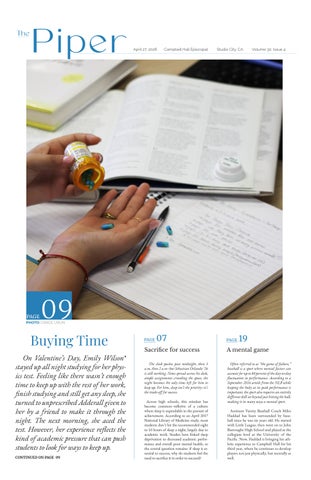
On Valentine’s Day, Emily Wilson* stayed up all night studying for her physics test. Feeling like there wasn’t enough time to keep up with the rest of her work, fnish studying and still get any sleep, she turned to unprescribed Adderall given to her by a friend to make it through the night. The next morning, she aced the test. However, her experience refects the kind of academic pressure that can push students to look for ways to keep up.
Sacrifce for success PAGE 19
The clock pushes past midnight, then 1 a.m, then 2 a.m–but Sebastian Orlando ‘26 is still working. Notes spread across his desk, ample assignments crowding the space, the night becomes the only time left for him to keep up. For him, sleep isn’t the priority–it’s the trade-of for success.
Across high schools, this mindset has become common–refetive of a culture where sleep is expendable in the pursuit of achievement. According to an April 2017 National Library of Medicine study, most students don’t hit the recommended eight to 10 hours of sleep a night, largely due to academic work. Studies have linked sleep deprivation to decreased academic performance and overall poor mental health, so the central question remains: if sleep is essential to success, why do students feel the need to sacrifce it in order to succeed?
Often referred to as “the game of failure,” baseball is a sport where mental factors can account for up to 80 percent of the day-to-day fuctuation in performance. According to a September 2016 article from the NLB while keeping the body at its peak performance is important, the sport also requires an entirely diferent skill set beyond just hitting the ball, making it in many ways a mental sport.
Assistant Varsity Baseball Coach Miles Haddad has been surrounded by baseball since he was six years old. He started with Little League, then went on to John Burroughs High School and played at the collegiate level at the University of the Pacifc. Now, Haddad is bringing his athletic experience to Campbell Hall for his third year, where he continues to develop players not just physically, but mentally as well.
Gen Z students are reading less as a result of the long-term impacts of screens and access to instantaneous information
STORY AUDREY PARK & SADIE THURNAUER GRAPHIC IZZY TENG
Every summer, the school library flls its shelves with returns. Students check out stacks of books for vacation, enough to last them weeks. But during the school year, those same students barely have enough time to open a single chapter. For many in Gen-Z, reading has become something squeezed into the margins of an already overwhelming life.
According to Dana Goldstein’s Sept, 2025, New York Times article, one-third of the high school seniors who took the National Assessment of Educational Progress exam lacked basic reading skills. Students were alarmed, but not surprised, many saying they witnessed the decline— frst-hand— in their own classrooms. The causes they cited were familiar: the lingering efects of COVID, “overwhelming” workloads, declining academic standards and an attention span increasingly fragmented by technology.
Goldstein argues that without deliberate intervention, these trends could have lasting consequences for civic participation, job readiness and the overall health of an informed generation.
To Dr. Kathleen Lawton-Trask, English Department Chair, the erosion of intellectual capacity is much more complex than a mere loss of interest in reading. One primary factor is the decrease in attention span due to increased use of technology during COVID. She acknowledges that during the pandemic, students became accustomed to reading excerpts on screens, which simultaneously infuenced their perception of entertainment; reading books became short-form videos online. This shift has made it increasingly difcult for students to transition back to long-form reading, even when they genuinely want to.
“I think that stamina is a place where, probably na tionally, maybe in ternationally, we're on a decline,” Law ton-Trask said. “The COVID generation became accustomed to reading shorter content and inter acting with books on screens more regular ly. There's actually a lot of research that shows that if you're looking at a screen to read, you're naturally skipping around, and you're sort of skim ming rather than reading deeply. And my theory, though I don't have anything to back this up, is that the more we're reading on a screen, the less we're reading deeply.”
The consequences of declining reading habits do not stop at shortened atten tion spans; they also
afect students’ confdence in their ability to write. With less exposure to intentional and deep reading, many students feel less prepared to complete tasks independently: organize ideas, develop arguments, structure essays and write clearly on their own. Consequently, artifcial intelligence (AI) has become an increasingly prevalent solution. Neverthe- less, the students who substitute practicing these skills themselves with AI, risk worsening the decline that their generation as a whole is actively trying to overcome.
“Not wanting to write on your own is an underlying reason,” Reyblat said. “However, another reason people might [rely on AI] is that they don't feel comfortable enough with their own writing, and they feel that they aren't good enough.”
This loss of attention extends far beyond classrooms, afecting people across several generations. From Jennifer Lutzky’s perspective as Library Director and middle-school librarian, students want to read but often struggle to fnd the focus to do so. For some, even picking up a book can already feel like a challenge. Nevertheless, students are not isolated; she acknowledges that reading has become more challenging for her as well.

“Everybody's attention spans are absolutely shredded, not just Gen-Z,” Lutsky said. “I think it's a combination of social media, short videos, where you're used to paying attention for 30 seconds, COVID, and even things like the fres in L.A. [That said,] we're not used to focusing on something for 30 minutes. I used to be able to curl up on the couch and read for an hour. Now honestly, if I'm reading for 15 or 20 minutes, that's great.”
According to Ahmed Mohamed Fahmy Yousef’s Mar. 7, 2025
35% of middle schoolers claim to dislike reading
43% of middle schoolers say they never or rarely read
SOURCE: FORBES
article, the primary factor attributed to the regression of literacy amongst Gen-Z— and even Gen Alpha— is called brain rot. Additionally, the widespread phenomenon “brain rot,” named the Oxford Word of the Year 2024, refers to the cognitive deterioration and mental exhaustion caused by excessive exposure to low-quality online materials, particularly experienced by adolescents. The study found that this affected core executive functioning skills: memory, decision-making and critical thinking; these efects were all found to be driven largely by the nature of social media: dopamine feedback loops. The compulsive reward-driven cycle of scrolling makes sustained, linear reading feel unrewarding by comparison, essentially rewiring expectations of what engaging with content should feel like.
Though the reduction in attention spans is often attributed to social media and shortform videos, Eli Reyblat ‘26, a member of the Academic Honor Board (AHB), believes that the stunted comprehension among all high school students is due to the increasing use of artifcial intelligence (AI). Without stronger guardrails, he fears the gap will only widen. However, to mitigate this, he
should attend workshops to learn about the ethical concerns surrounding AI.
“To use AI properly, [we need to implement] workshops, comparing an AI [completed] assignment to a [non-AI] assignment to show the diference,” Reyblat said. “AI writing took you 20 seconds while yours may have taken you an hour or two hours, [but] it is so easy to tell the diference. If we can get anywhere to bridge [the literacy] gap, it needs to come from a point of [acknowledging that] AI is genuinely bad.”

Lawton-Trask acknowledges that while high school students’ literacy skills are in sharp decline, they are not alone. As a child, Lawton-Trask vividly remembers losing track of time; now, after COVID, she fnds herself struggling to focus for long periods, like any high school student. Nevertheless, Lawton-Trask hopes that students— now— will also fnd pure enjoyment in reading, just like she did.
“I defnitely have had times in my life as a reader where I've read something, and I've just zoned out, so there's no judgment there whatsoever,” Lawton-Trask said. “However, it would also be wonderful if the English department, were able to give kids a really broad sense of what is out there in terms of books, because words, printed on a page, can be so many diferent things. Don’t assume that if you didn't enjoy Thoreau, that all books are lost to you.”
The annual trivia tournament fosters students' competitive spirits

Packed in a classroom flled with adrenaline and anxiety, Rocco Borrud ‘27 immediately buzzes in to answer a trivia question, even before the full question is stated. Although he instinctively realizes the answer was the Magic Castle, he confdently blurts out the haunted mansion! Everyone, audience members and competitors alike, stares at him as if he were crazy. He tried to make up for it by changing his answer, but it was too late. The other team tragically stole the correct answer.
Borrud remembers this as an unforgettable moment in his trivia career, yet this is only one of the many memories Campbell Hall’s annual trivia tournament creates for students, teachers and alumni. A decade ago, Kyle Klower, a former history teacher and former Student Activities Coordinator at Campbell Hall, started the Trivia Tournament to create a fun experience for students. Klower is a close friend of William Cullinan, a high school history teacher who continues the tournament's tradition every year.
At each tournament, Cullinan creates over 500 questions in traditional trivia categories for eight teams competing in a bracket. For Cullinan, this is mainly a solo operation that involves months of preparation, yet he enjoys hosting it for the students. Today, the tournament continues to rise in popularity.
“People want to see people be good at something academic—or at least academically adjacent—and it's fun to watch," Cullinan said. "Watching Jeopardy, it's impressive what people know and what they can conjure very quickly, and I think both the participants and the spectators enjoy that.”
Although new competitors rise, many familiar faces return, like Milo Miller ‘26. Miller is on a team with fve other seniors and has competed in the tournament since his freshman year. He enjoys the trivia and team aspect of the tournament the most.
“Getting to show that you know things is always fun, but also just getting to collaborate as a team and show our diferent strengths of our team,” Miller said. “It's not like we have a delegate, this person knows science, this person only knows history, but hearing us shine and show what we're good at is always fun.”
Alongside collaboration, the trivia tournament also brings a friendly rivalry. Borrud’s team competed for the second time this year, and after losing to Miller’s team last year, they thought they had a one-way rivalry with Miller’s team. While Miller’s team is undefeated, they have noticed Borrud’s ferce team and considered them their biggest rivals due to their recent high scores.
“Competition is as important to the community as cooperation,” Borrud said. “It's very clear that this fosters not only cooperation among teams, but competition between teams. Once you go against somebody in trivia, I'd say you're probably, if the trivia doesn't go terribly, terribly wrong, you're closer friends with them.”
The trivia tournament continues to impact lives and extends beyond just an event. Cullinan incorporates aspects of the trivia tournament to start his classes, beginning with a question of the day.
“[An] oddball fact can get people to perk up,” Cullinan said. “And then I think you cultivate an appreciation for that. Then it becomes part of how you see the world.”
The trivia tournament is not just a once-a-year event. Students discover their love of trivia or continue it outside of school. For Cullinan, trivia is a way of looking at the world and connection.
“To me, [trivia] is like a color,” Cullinan said. “It's the texture and the color of a fabric that makes something more interesting.”
STORY SOPHIA SEYMOUR & SOFIA WARD
PHOTO PERMISSION DANI BAKER
Family, a K-12 community, magic. These three words are used to describe the Campbell Hall Gospel Choir every year, where hundreds of students come together to sing religious songs. While some students resonate with the lyrics coming from a Christian background, others with diferent beliefs still fnd a community that transcends religion. In the months following the concert, many students refect on how their faith relates to their gospel experience.
After attending a Jewish school for her entire life until coming to Campbell Hall in seventh grade, Lucy Friedman ‘28 hesitated before joining the Gospel Choir. In eighth grade, she decided to join, but she wondered how her parents would feel about her participation in a Christian gospel music choir. Once Friedman joined the choir, she discussed with her mom the experience of singing Christian music while practicing Judaism.
“It's gone from [feeling like I am] praising the Christian community to [feeling] more like it is a community of people singing together,” Friedman said. “It has become more of a community of diferent people and less about singing gospel music. It goes above and beyond religion to a sense of community.”
Like Friedman, Ione Ross ‘28 joined the Gospel Choir in sixth grade when she joined the elementary school. Originally joining to meet people as a new student, she found the choir to be a place where the community around her extended beyond the religious aspect of the songs.
“When we're all able to sing together, we aren’t really thinking about religion, but more thinking about the friends you've made along the way,” Ross said. “It's such a fun experience, not only for people who are Christian, but just the community itself. You build such close relationships from it, and it's the best time ever. You feel such a bond with everyone in the Gospel Choir.”
Artistic Director of Gospel Choir and Ad-
STORY DENISSE ZELAYA
In a narrow bookstore in Lyme Regis, England, Declan Carter ‘26 lost himself in the rows of bookshelves. The corridors were dim, the shelves stacked so high that the ceiling disappeared behind spines. He eventually found his way, leaving with two books tucked under his arm, one on mycology and another on genetics, carrying home an unexpected memory.
That unplanned afternoon was exactly what the Campbell Hall Science and Literature London trip was designed to produce. Built collaboratively by English department chair and creative writing teacher Dr. Kathleen Lawton-Trask and high school science department chair Dr. Amanda Dye, the itinerary was shaped around one lesson: science and literature, though taught in opposition, have historically been in conversation with each other. Over the course of ten days, students visited Greenwich, Stonehenge, Bath, the Eden Project, Lyme Regis and London, tracing that overlap at every location and investigating the centuries of literary and scientifc history in London.
For Carter, who loves to study biology, the trip ofered something of an immersive experience, interacting with the material rather than learning in a classroom.

missions Associate Patrice Grace grew up with gospel music as a large part of her life, and introduced it to Campbell Hall in the nineties. Grace believes that the Campbell Hall Gospel choir is just as religiously diverse today as when it was founded in 1998. Grace believes it is important that children have a sense of belonging and feel seen, regardless of their religious beliefs.
“We all are searching for a purpose, and perhaps whatever the children are searching for, they fnd it momentarily in the choir,” Grace said. “Sometimes it's just camaraderie with other people, sometimes it's just that sense of belonging. With so much bad news and scary news in our world today, everyone is looking for something to be happy about and rejoiceful for.”
On stage: Stacy Dillon conducts more than 200 students for the gospel choir performance. immerse myself in that culture. Seeing that same sense of culture with a diferent religion at Campbell Hall is awesome, because it really brings me back to that.” Grace has worked with students from diverse backgrounds since founding the Gospel Choir. She fnds that the music connects students and speaks to them in some way, whether their motivation is spending time with friends, a love for singing, or a desire to worship. She has witnessed many instances of families of diferent religions discovering the joy of gospel music. Once, a Jewish student told Grace that she was practicing singing the lyric “I love Jesus” at home. The student’s grandmother heard her and asked what she was singing. The student explained that it was for a choir at school, but found that her grandmother was skeptical of the lyrics. However, when she went to the concert, the grandmother realized that the choir was about more than just Christianity.
Although the Campbell Hall Gospel Choir is made up of students of diferent religions, some students choose not to participate because they do not feel connected to gospel music. Jake Singer ‘27 is a Jewish student who chooses not to sing in the choir but still enjoys watching his friends sing and appreciates that many of them come from diferent religious backgrounds.
“I don't feel culturally connected to Gospel Choir,” Singer said. “I grew up at a Jewish school where I would sing Jewish songs and
“Spirituality transcends all religions,” Grace said. “My personal mantra and belief is that we all pray to the same guy, we just call Him by diferent names. I've had all religions and ethnicities in [the choir]. It touches the heart, it touches the soul and it touches the spirit of our beliefs. In that regard, we're all the same.”
Students attend a trip to London, where they got to combine their interests in science and literature.
son going,’ I wonder what would happen if blank’ and then bam, you discover.”
This expansion was refected in literary directions as well. Lawton-Trask gave students journals before the trip, inspiring them to fll them with daily prompts tied to the literature and location they would encounter. At the Sherlock Holmes Museum on Baker Street, those prompts inspired creativity, pushing students to refect on what they were seeing rather than simply passing through.
“Even though Sherlock Holmes is a fctional character, the street that he lived on did exist, and there's a museum at the address that they gave him,” Carter said. “Something in literature, kind of created in real life, and you can see the thought and care that went into it.”
For Iris Dean ‘27, the trip reshaped her understanding of what a city could hold. Before the trip, she expected London to feel corporate and serious as the fnancial capital of the world. What she found instead was a place layered with cultures, languages and centuries of shared life playing out on the same underground train.
“Just seeing everyone with so many diferent interests and lives, communally sharing one space was really interesting in a way I feel doesn't always happen in Los Angeles,” Dean said.
nia,” Carter and his classmates began noticing things that were of: plants that looked poorly tended, ecological details that did not add up, a tour guide explaining Native American culture in ways that felt incomplete.
Those kinds of conversations happening casually and organically with faculty often come when you're in a different place, in a different context,” Lawton-Trask said. “Science and literature are sometimes set up against one another. This trip was about showing students where they meet.
Kathleen Lawton-Trask
"
“That was my moment of, this feels weird to hear a British person explaining our culture and not even have it be entirely accurate,” Carter said. “Even though you know the intentions are good, and there is a lot of thought and knowledge involved, you still, because you're so familiar, see the discrepancies a lot.”
Lawton-Trask welcomed those observant conversations as part of what the trip was always meant to do. She believes the most valuable moments were rarely the ones planned in the itinerary.

“[The science] helped with envisioning where we could go and expanding my well of knowledge," Carter said. "I'm realizing as I get more and more into science that all the [discoveries made come from] one per-
That curiosity about place and culture was tested most sharply at the Eden Project, an environmental complex in Cornwall housing massive artifcial biomes. Walking through a section simply labeled “Califor-
“Those kinds of conversations happening casually and organically with faculty often come when you're in a diferent place, in a diferent context,” Lawton-Trask said. “Science and literature are sometimes set up against one another. This trip was about showing students where they meet.”

STORY SADIE THURNAUER & LILY SCHAFLER
GRAPHIC SABRINA NARAYAN
Before the classrooms are locked and the lights are turned of, tension can already fll the room. Across the United States, lockdown drills have become a routine part of school life. For many students, the sudden announcement over the loudspeaker brings a moment of uncertainty, forcing them to wonder whether what they are hearing is simply practice or something real.
Lockdown drills have become a fxture of American education, but as schools work to balance safety preparedness with student well-being, a growing body of research suggests that the drills may carry a hidden cost. Students and educators are increasingly divided over whether the drills do more good than harm. While administrators argue that preparation saves lives, a growing number of students say that the drills leave them more uncertain than ready.
The uncertainty around drills is something Charlotte Miller ‘28, knows well. She dreads the sound of the PA system. For her, the moment a lockdown begins can immediately trigger fear and confusion. Without warning, what started as a normal class block can shift into silence and heightened anxiety as she waits for instructions from her teacher.
“It scares me to not know what's coming, and at frst, I don't know if it's real or a drill,” Miller said. “It really gets me in fght or fight mode. My heart starts beating out of my chest, and I get scared. I also don't know anything because my teacher didn't warn me. I feel mentally unprepared, and then I start thinking, ‘if this were real, what would happen?”
The reality of active-shooter and lockdown drills
And there's no middle ground where people are actually practicing, and it feels like: is that even something you really need to practice? Does it really improve your effciency in a real situation?
Ezra McCullers '27
has become increasingly common. According to a 2025 study published in the journal NASN School Nurse and indexed by the National Library of Medicine, 73.4 percent of students surveyed reported experiencing at least one active shooter during their time in high school. While the drills are intended to prepare students and staf for emergencies, the study revealed that they can also come with emotional consequences. A 2020 report by Everytown Research found that, out of the 114 K-12 schools studied, active-shooter drills were associated with a 39 percent increase in depression, a 42 percent increase in stress and anxiety, along with a 22 percent increase in heightened concern about death in school communities.
Despite these concerns, many educators believe that drills are still necessary. Sabrina Pozzi, high school Spanish teacher, feels as though practice is necessary when dealing with lockdown drills. She believes that even if people panic during a real emergency, repeated drills help students remember the basic steps they need to follow. While some students describe drills as stress-inducing or unsettling, Pozzi believes the preparation is crucial in the event of a real crisis.
“The practice is there to put it in your head,” Pozzi said. “So you have some kind of idea what to do. When it happens, you don't know how you're going to react, and honestly, all of that practice could just go out the door, but then you remember, ‘I'm supposed to do this. I'm supposed to do
that’. It will slowly come.”
At Campbell Hall, drills are organized by Campbell Hall’s Emergency Response Program (CHERP). Director of operations, Michael Panman, explained that when planning drills, administrators focus on practicing every part of the emergency response plan. This included communication among staf, with students and faculty, and sometimes coordination between students or the broader community. While the school strives to achieve accuracy in the drills, it also aims to keep drills appropriate for all ages and not unnecessarily frightening.
Teachers are informed about the drills ahead of time so they can help guide students through the process, but the drills are not announced to students in advance to maintain realism. Scheduling drills is also carefully considered; however, Panman noted that real emergencies never happen at convenient times, so drills are meant to refect that unpredictability.
Panman acknowledges that it is unfortunate that schools have to conduct these drills, but he believes that failing to prepare students would be far more damaging. Some schools run intense simulations involving chaos or even hiring actors to play the roles of intruders, but Campbell Hall intentionally avoids creating panic. Instead, Panman noted that the goal is to practice procedures without emotional distress.
To illustrate the importance of the drills, Panman compared lockdown drills to airplane safety instructions. Even though hearing about worstcase scenarios can cause fear, airlines repeat safety procedures on every fight because preparation is essential in an emergency.
However, not everyone believes that lockdown drills are an efective way to prepare students. Ezra McCullers '27 believes that drills often take a mental toll on students without necessarily improving their readiness for a real emergency. In McCuller's experience, students tend to respond with extreme emotions rather than treating drills as serious practice.
“People are either joking or actually scared,” McCullers said. “And there's no middle ground where people are actually practicing, and it feels like: is that even something you really need to practice? Does it really improve your efciency in a real situation? Because you're going to be way more scared. So I don't think the environment is replicated by an announcement and all that you're practicing is one room of what you would do, but there are seven other classrooms where you'd have to do something else.”
According to research done by Everytown, drills can also have drastic long-term efects on younger students, specifcally in middle school. Early exposure to the concept of school shootings may make the threat feel more real and immediate. This constant awareness of danger can contribute to longer-term anxieties and emotional impacts that linger beyond the drills themselves.
“At such a young age where you're exposed to gun violence, which is the reality of our country,” McCullers said. “It’s not just this school. It's not always bad to have a plan for that. But you're imagining that from such a young age that it becomes a very real feeling of anxiety for a lot of people.”

As most students are still hitting snooze, some are already headed to their sunrise classes. While most are intimidated by the early start and worry about increased burnout, many beneft from the calm and productive start to their day. Campbell Hall ofers many sunrise classes, such as yoga or speech and debate, and is continuing to
add more in the years to come. The classes start at 7:50 every morning except on Wednesdays and end at 8:40. They have helped many students fulfll P.E. and visual arts credits, but the block also serves as a calming start to the day that many students enjoy.
Asa Hein-Martin '27 began participating in sunrise debate his sophomore year without actually being enrolled in the class. Due to his long commute to school and bus schedule, he has always arrived at school early and sat in a few classes last year. Hein-Martin ofcially joined the course this year and fnds it to be a less stressful and more relaxed environment. He sees the class as a good use of his extra time and as a meaningful way to be more productive before the school day begins.
"Just being at school early in the morning gives me backup time if I'm really stressed about work, and to get into school mode," Hein-Martin said. "Because I'm not taking an academic class in the morning, I don't see it afecting the fow of my day very much."
Although not a morning person, Helen McLean '26 has noticed that her sunrise classes improve not only her productivity but also her organization.
She has enjoyed taking multiple sunrise classes throughout high school and has participated in choir her freshman year and in sunrise yoga this semester. After adjusting to waking up an hour earlier, McLean has really enjoyed both of her experiences in sunrise classes and deeply appreciates the relaxing and grounding impact they have had on her overall day.
"[Before taking sunrise classes] I would get up immediately and go on my phone, and then I would kind of run out of time and be scrambling to get out of the house," McLean said. "I had very chaotic mornings, but now my yoga is a designated 45 minutes, so I'm not insanely frazzled before I get to school, which is nice because I go to class feeling a bit calmer."
Having a relaxing class for a sunrise has helped Tyler Bergman '28 ease into his day. He chose to take yoga this semester to provide a bufer between the morning and his frst block, and has seen the early start impact his day. Although he fnds that yoga puts him in a good headspace, he notices that the class's slow pace sometimes makes him feel more unmotivated and sluggish as the day progresses.
95%
of American public schools drill students on lockdown procedures
12
children die from gun violence in America every day
25% BREAKDOWN
of students feel anxious a er lockdown drills
ere has been a
715%
increase in the number of people wounded and killed in school shooting between 2004 and 2024 million
3
children in the U.S. are exposed to shootings per year — about 4 percent of the child population
SOURCE: NATIONAL INSTITUTE OF HEALTH
Sunrise classes As Campbell Hall continues to expand its sunrise class offerings, students discover that the early start can set a more productive tone for the rest of the school day
"I do notice burnout more in the beginning of the day," Bergman said. "Yoga is a nice way to start the day, but sometimes it gets me even more tired in a sense because of the way yoga works. We meditate at the end, and sometimes it kind of puts me back to sleep since that's the time I would be normally waking up. It kind of throws the rhythm of a little bit in the morning."
McLean has found that the schedule of sunrise classes has forced her to manage her time better and get more sleep. Her yoga sunrise is a helpful way to fulfll her requirements, compared to a longer class during the day. She enjoys seeing Campbell Hall expand its sunrise curriculum, and the new sunrise academic classes spark her interest.
"If you have friends who take it, it's super fun," McLean said. "I also hear that next year they're doing sunrise English classes, which I think could be super cool because the curriculum might be a little bit diferent in 45 minutes. I would recommend it, especially for a PE credit. I think that if you don't play a sport then sunrise yoga or Pilates is a fantastic option because it's only 45 minutes and it's a very calming way to start your day."
STORY SOPHIA SEYMOUR
PHOTO PERMISSION
KENNEDY WARE & THE CW NETWORK VIA WIKIMEDIA COMMONS
In response to the proceedings of the 2026 award season, The Concerned Women for America Legislative Action Committee writes that award shows should be about artistry, not pushing political messages, and that artists are paid to entertain, not to provide political commentary. However, the positivity that award-show activism is met with, from both members of the entertainment industry and fans, indicates that politics and art go hand in hand.
The activism taking place in this year’s award season is prevalent. From ICE OUT pins to acceptance speeches, artists are using award shows as a platform to send messages about issues important to them.
Brandy Curry is a former Campbell Hall elementary dance teacher, the mother of Parker Curry ‘28, and the Chief of Staf for the Emmy Awards. Curry has been working for the Television Academy for four years and witnessed activism while attending the 2026 Grammy Awards. Award shows do not discourage the inclusion of political topics in acceptance speeches. Curry fnds that as long as specifc people are not targeted by name and there is no vulgarity, political topics are accepted.
“I feel like performing artists for hundreds of years [have written about politics], starting with Shakespeare writing about immigration laws in the UK before they were called that,” Curry said. “Artistry has always been a platform for social justice work, and by default, social justice work will inform policy. So, of course, it's going to get political, and that's okay. It is coming from the place where it is their civic duty. It is how they can contribute to making sure that people belong and people feel safe.”
Mother of Maddie Potts ‘28 and Camp-


25% of Americans believe celebrities should never express their political opinions
The 2026 Oscars reached 17.9 million viewers
During the 2026 Oscars, 66% of infuencers demanded more celebrity activism
SOURCE: BILLBOARD
bell Hall board co-chair, Terra Potts, has a similar philosophy about the way art can refect society’s greatest issues. Potts ran the marketing and award campaign for Sinners, and this is her frst year working for a director rather than on the studio side. She has attended the Golden Globes, the Actor Awards, the BAFTA awards, the AARP Awards, the NBR awards and the Oscars this year. Potts has witnessed celebrities wear ICE OUT pins and mention ICE in their acceptance speeches. She appreciates the work of actors like Mark Rufalo, who advocate for human rights, and acknowledges the irony of celebrating while others in the nation are sufering.
“Art is a refection of the world that we're living in,” Potts said. “Most of the [nominated] movies this year are saying something about our current social, political situation. I think art has to refect whatever someone's truth is in society. [As an artist at an award show,] you have a lot of eyeballs [on you] who might not otherwise listen to an issue or care about an issue, but if they see their favorite celebrities, or someone who they admire, saying, ‘Hey, I don't like what ICE is doing,’ they might think twice about it or Google it. I think a bit of it is performative, but it is necessary that people who are not the people being afected speak out. "
When considering the lasting impact of political pop culture moments, Curry fnds herself refecting on John Leguizamo’s 2024 Emmy speech, delivered after writing about the importance of representation and migrant policies in the New York Times. Revisiting moments like these that remain relevant today reminds Curry how much traction and attention award show moments can gain. Similarly, Zoe Barr ‘29 was impacted when one of her favorite artists spoke out at the 2026 Grammys.
“One of my favorite singers, Billie Eilish, stood up against ICE and said that no one is illegal on stolen land, and so did Bad Bunny,” Barr said. “I thought that was an extremely brave and powerful thing to do. It makes me feel good that I support the artists who care about my rights and others' rights.”
After years of attending award shows and seeing artists stand up against various issues, Potts believes that award show activism can be impactful because someone who is only exposed to one message from their local media might tune in to an award show to see pretty dresses, only to be met with a diferent perspective. Potts thinks that if people see someone who is not directly afected by an issue speak out about it on behalf of others, it might break through to viewers.
“At the Sundance Film Festival, Alex
Peretti was being killed, so every interview coming out of Sundance was the artist saying things like, ‘I can't believe we're sitting here talking about this when our streets have turned, and we're losing all of our civil liberties as we speak.’ I think also in these moments when people stop and say that you can't ignore what's happening, [it is impactful.] Like, when Ryan [Coogler,] who I work with, got on stage at the NBR awards a few days after Renee Goode got murdered and spoke her name. We should be saying her name in big rooms.”
According to Gold Derby Magazine, 19.7 million viewers watched the Oscars, 7.4 million viewers watched the Emmys, and 9.3 million viewers watched the Golden Globes in 2025. American award shows reach wide audiences and even international communities when they air.
“Prior to social media, there just wasn't really an outlet to do the same unless you were interviewed on the red carpet or your TV show or movie premiere,” Curry said, “It tracks faster at an award show because you have a captive audience of 20 million people viewing. That goes beyond folks tuning in to watch; it hits all of the other social media platforms, and it becomes sound bites, and it trickles. I love that artists are using their platform in that way.”
Community members work towards providing support for students who experience the pressure of school

the only way to success. These common experiences are what challenge success aims to improve, creating a learning environment that allows students to fnd success beyond academics.
Challenge Success is an organization that aims to improve the overall student experience at school and recognizes that success is not only academic. It was created in partnership with Stanford University and has committees at schools across the country. Three years ago, Challenge Success was brought to Campbell Hall by former Middle School principal Dr. Marina Kheel to ensure that students both enjoy learning and feel confdent in school. Every year, the Challenge Success team at Campbell Hall attends a conference at Stanford where schools present on panels about what they’re doing to encourage Challenge Success at their schools.
High school mathematics teacher Daniel Lopez jumped at the ofer to be one of the teachers involved in the Challenge Success Program at Campbell Hall. He was intrigued by its goals and mission to make students’ overall learning experience enjoyable. Lopez has been part of this program for three years, and his role on the team is to listen to students and ofer input from the teacher’s perspective, including what might help teachers support students. Lopez’s main goal is to ensure he both voices and listens to students’ concerns so he can help improve their learning outcomes.
“I think every school should be refective of the students who go there,” Lopez said. “It’s import-
ant that students have diferent ways to have their voices heard and have a say in what happens at school. [Challenge Success] wants to come up with ideas that are helpful and make sure we communicate clearly about why we’re doing things.”
Throughout Lopez’s teaching career, he has noticed that students work diferently. He has made a consistent efort to ask students what could be improved in his classes so he can develop initiatives to help. Lopez strives to be a teacher who listens to students to get feedback, and create a positive environment not only in his classroom but schoolwide.
“I think it’s in the name—Challenge Success; everyone has diferent levels of success,” Lopez said. “[Challenge Success] has taught me that there are many diferent routes to success. It takes information, collaboration and many voices to fgure out how to make the school even more successful than it already is.”
From a student perspective, Addi Richards ‘27 believes in the importance of balance and mental health, which led her to join the Challenge Success team. Richards, along with four other student liaisons, is the voice of the school’s students, advocating for what they need from the school to feel successful. Richards prioritizes mental health and ensures that students fnd joy in attending school every week.
“A lot of people talk about how there’s not a good balance between extracurriculars and academics, and how they feel like they have to maintain a high GPA while dealing with difcult tests,” Richards
said. “This program is genuinely here to help with that. Even though Campbell Hall is a college-prep school and can’t do everything students want, there are many people in the community who want students to thrive, not feel tired, drained or overwhelmed every day. [Challenge Success] wants students to be excited about going to school.”
By being a part of this program, Richards has gained so much knowledge and skills she never knew she needed. She continues to speak up and create change at school for students who do not get the opportunity to.
“For me personally, I’m gaining the ability to talk to adults about what students actually need,” Richards said. “I’m able to communicate without feeling guilty or like I’m complaining because [Challenge Success] really gives me that platform. Challenge Success puts students before their résumés.”
Mateo Hernandez ‘26, a student representative on the Challenge Success team at Campbell Hall, values this program as a student-athlete managing a heavy workload. Hernandez is focused on its long-term vision, recognizing the goals that Challenge Success aims to achieve. He is aware of the many goals Challenge Success has and hopes in the future that he will work to make happen.
“Right now, it might not seem like there are a lot of benefts yet, but [Challenge Success] is a long process,” Hernandez said. “The goal [of Challenge Success] is to improve student life over time, not to force students into anything, but to support them in a way that works for them.”

CLIO SPIEGEL & DANI LECHTER
GRAPHIC SABRINA NARAYAN
The protest was loud and chaotic, the crowd growing as more people started to yell, and that's when he saw the can being raised over the crowd, spraying innocent people. Jonah Edley ‘26 wanted to go to a peace rally to show support for Israel, but was met with the hatred of his religion.
This racial discrimination is what some Jewish students go through when expressing their opinions about conficts involving Israel. Additionally, they may feel hesitant to share their opinions when they are uncertain about the beliefs and opinions of the people around them. The community at Campbell Hall has created a safe space
for Jewish students to express their opinions.
Edley, one of the co-presidents of the Jewish affnity group, feels the strength of the Jewish community is at Campbell Hall. Edley believes that the involvement of Jewish students has grown a lot over the last couple of years through the afnity group, chapels and other holiday events.
“The Jewish community is so strong,” Edley said. “It's incredible, how much it has developed over the years, now that we are an afnity group, from having parents support, and a student club that meets every other Wednesday, and multiple huge events put on through the year, and chapels, it's a really strong and close group of kids.”
Although the Jewish community at Campbell Hall is extremely welcoming and supportive, the school's warmth towards Jewish students has not

igh school photography teacher Cameron Cofman has found encouragement in the broader creative community through her work inside and outside the classroom. She recently earned an honorable mention from Innovate Grant, an organization dedicated to supporting artists through a streamlined application process. The grant runs four award cycles a year, awarding $1,800 to winners selected by a rotating jury, and accepts submissions of just fve images alongside a 200-word artist statement—keeping artists focused on creating rather than applying.
As an honorable mention, Cameron received a spotlight on Innovate Grant's website, where her work and artist statement are featured prominently. The grant's global reach and open calls — which sometimes highlight specifc disciplines like photography — have sparked ideas for her own students, who she hopes will recognize the importance of sharing their work.
"Being on the website is really nice because it's an easily accessible place to look at other people's work and see what they're up to," Cofman said. "It's very inspiring. I want to have my students look through it. It defnitely feels great to be selected from so many people."
My passion for [supporting Jewish people] can often lead to anger because I'm upset about the situation.That only makes me wanna speak about it more. I don't fear other people's beliefs. No one should be afraid to talk about something that's so important and so huge in Jewish people's lives, and I will stand by that. always
Sasha Mendelson '28
"shielded Sasha Mendelson ‘28 from anti-Semitism on social media. Mendelson feels that people’s posts, especially when their information is not properly supported, are very upsetting and discouraging. Usually, she would feel empowered to stand up to hate on social media or in person. However, as a result of the recent war involving Israel, the United States and Iran, it feels more daunting.
“I am usually very open about my beliefs,” Mendelson said. “Now I sometimes second-guess myself before posting about something or speaking up because I am afraid of what other people might say or how they might react. That is very alarming to me as a Jewish student.”
The fear of being ridiculed or insulted, however, is not strong enough to deter Mendelson from recognizing the importance of educating people about Jewish history. Despite being less eager to talk about her beliefs, she still hopes to teach those who may be getting false or tainted information. As someone who is very educated on Jewish History, she feels it is her responsibility to help others truly understand the depth and truth of the war. Unfortunately, she feels that the educational process can be extremely difcult, especially when faced with backlash. Mendelson often encounters people who refuse to learn or listen to a diferent perspective, but that never suppresses her desire to spread the truth.
“My passion for [supporting Jewish people] can often lead to anger because I'm upset about the

situation,” Mendelson said. "That only makes me wanna speak about it more. I don't fear other people's beliefs. No one should be afraid to talk about something that's so important and so huge in Jewish people's lives, and I will stand by that always.”
Although the anti-semitism Mendelson faced was digital, Edley encounters hatred closer to home. He often gets frustrated by the misinformation about Israel spread by his friends. Edley knows that not everyone is educated about the wars. Edley understands how confusing the news can be to follow and to fnd facts. Edley fnds it upsetting that many kids will go along with their friends' opinions since many people don’t know what is actually happening in these conficts.
“I'm not the perfect person, neither is anybody,” Edley said. “But defnitely times of people not understanding the facts and people just going with what their friends were saying would make me really upset. I remember in sophomore year there were defnitely some kids that were completely wrong and they wouldn’t listen to what was actually true, which made me really upset.”
Digitized information spreading as a result of the wars in the Middle East is also upsetting to Raf Schaefer '28. Online information, she feels, is the most difcult to speak out against. Schaefer fnds that anti-semitism online causes her to stay quiet out of fear of being discriminated against. After overhearing comments about the war involving Israel and Palestine, she feels worried about how people perceive her identity, prompting her to refrain from responding. Schafer understands that anti-semitism has been around for almost 2,000 years and likely will continue. Instead of trying to change the entire public perspective, she adjusts her personal life to make anti-semitic events rarer.
“You can't control what other people do,” Schaeffer said. “There are so many people out there that you can't trust as a Jewish person. It's important to form your own community with people you trust that you can speak to honestly. I wish that were everyone, but with the way the world is right now, a personal community is a great start.”

Organized by Aubrey Rakoski, the associate director of alumni relations, the Alumni Mentor Program draws on a network of more than 400 alumni mentors, who can be great resources for current Campbell Hall students during their college journey
Whether a student is just beginning their college search or narrowing down a fnal list, the program ofers guidance for wherever they are in the process. Mentors come from schools across the country—large public universities, small liberal arts colleges, and everything in between—giving students access to a wide spectrum of collegiate experiences.
Jenna Kriegler '27 found that speaking with a graduate gave her something a college tour alone could not—hearing frst-hand about things like dining hall culture and how students actually spend their time on campus gave her a deeper sense of the school's spirit.
"It's really important to reach out to people who actually attend the university because if you're going on a tour, you're seeing what [the school wants] to show you, not what the real experience is," Kriegler said. "Connecting with alumni has been crucial for my college research."
April 20 marked a Chapel presented by the Campbell Hall Armenian Afnity Group, honoring Armenian heritage and remembering the Armenian Genocide. Students shared their experiences, history, songs, and prayers with both the middle and high school communities. The event took place just one day before April 21, widely recognized as Armenian Genocide Remembrance Day, making the timing especially meaningful and deliberately chosen for participants and audience members alike.
Rachel Vardanyan '29 made a heartfelt speech about her great-great grandfather who perished in the Armenian Genocide, moving many students in the audience deeply. She also sang an Armenian song with two other members of the afnity group who played instruments. Vardanyan felt proud of the presentation they all put together as it brought awareness to a genocide many are not aware of. "I want them to be left with an impact, and I want them to refect on what really went on during the genocide," Vardanyan said. "I just [want to] leave [them] with that sense of learning something new and they can take that with them and choose to learn more about other cultures and other people."
High school students sacrifce their sleep for the extra study time even with the consequences of sleep deprivation
shapes the way he approaches his most demanding academic goals.
The clock pushes past midnight, then 1 a.m, then 2 a.m–but Sebastian Orlando ‘26 is still working. Notes spread across his desk, ample assignments crowding the space, the night becomes the only time left for him to keep up. For him, sleep isn’t the priority–it’s the trade-of for success.
Across high schools, this mindset has become common–refective of a broader culture where sleep is viewed as expendable in the pursuit of achievement. According to an April 2017 National Library of Medicine study, most students do not hit the recommended eight to 10 hours of sleep a night, largely attributed to academic work. Studies have consistently linked sleep deprivation to decreased academic performance, impaired memory, and overall poor mental health, so the central question remains: if sleep is essential to success, why do so many students feel the need to sacrifce it in order to achieve it?
That trade-of is one many students knowingly make. Orlando has lived within this mindset for all of high school, taking the hardest classes and working himself tirelessly to succeed in them. In the face of sports, clubs, and other extracurriculars, a typical school night consists of getting home at 7 p.m, showering, eating dinner, and talking to his family before launching into his work from around 8 p.m to 2 a.m. As someone who values science, Orlando recognizes that sleep is inherently necessary, but when meeting deadlines becomes crucial, he fnds that giving up sleep is a non-negotiable–allowing him to maximize his time for things he values higher.
“Sleep has become less of a sacrifce and more of something that just isn’t as important for me,” Orlando said. “I’ve learned that my performance isn’t about ‘am I tired or am
“I know multiple kids who can get eight or more hours [of sleep] a night, even while they're working hard. But for me, that's just not possible,” Orlando said. “For example, junior year, I wanted to have all A’s and A pluses, and I saw it as an absolute must to try and do that because I knew it was possible and therefore I knew it had to be achieved. So that's what I did, and in the end, it worked out, but it also meant I also was getting maybe only two to three hours of sleep a night in the process.”
This mindset, however, is not unique but reinforced by a culture that equates exhaustion with productivity. Guy Podell ‘27 sees that frst hand, acknowledging that minimal sleep and late nights are often interpreted as signs of dedication as opposed to signs of burnout. In his experience, that perception can make the behavior feel not only normal, but even admirable. Yet, Podell believes that what looks like productivity on the surface often masks a more harmful reality beneath it.
“I think there’s a narrative that getting your work done at night and giving up sleep means you're more productive or smart,” Podell said. “But I think that can be harmful to some people because if they try and reproduce that narrative without having the mental fortitude to actually work their body that hard, it can be detrimental for both the work and their health.”
Podell’s observation refects an academic environment where sleep becomes an afterthought in pursuit of rigorous classes and achievement. High School Human Development Teacher Julie Scurry builds on that, noticing the ways that pressure becomes even more pronounced when students begin making decisions about advanced classes and academic workload without fully accounting for the impact on their well-being. Still, Scurry understands the expectation schools put on students to be perfect, creating an ongoing tension between ambition
“When someone's taking on a harder class, they don't often think about, ‘hey, this class is going to be really rigorous. Am I going to be able to get enough sleep?’,” Scurry said. “No one is ever going to ask themselves that question, and I absolutely think they should, because sleep afects the way you function entirely. So if someone's going to take a really hard class to get into a certain school or to get a certain grade and show that they could do it, I think that's awesome, but I do think it doesn't go without sacrifce. And often that sacrifce is sleep.”
The tension Scurry refers to is something Addie Lowe ‘27 has experienced directly. As a student working within a competitive environment, Lowe fnds it unavoidable to compare herself to her classmates, especially when heavy workloads are deemed the standard for success. While Lowe has learned to develop habits that work more efciently for her, that pressure, she recognizes, can make it difcult to step back and prioritize rest without feeling like she’s falling behind.
“I’ve defnitely felt [the pressure to sacrifce sleep to succeed academically], especially because so many people in high school stay up late doing work,” Lowe said. “It can make you feel like you’re not doing enough, and I think it’s easy to want to succumb to that standard.
A July 2025 Sleep Foundation article written by Lucy Bryan acknowledges how essential sleep is for the human body, serving a variety of physical and physiological functions such as learning consolidation, emotional regulation, decision making and growth and healing. The scientifc fndings understand sleep not as a break from productivity, but as a necessary foundation for cognitive and emotional stability. Scurry echoes this sentiment, noticing how quickly those scientifc efects show up in a students’ life when sleep is consistently cut short. While it may not be immediate, the impact accumulates over time, often becoming most visible once performance and motivation start to decline.
“Sleep is like the nice friend that isn’t going to get mad at you if you cancel on her,” Scurry
At the end of the day, I trust my brain, but only when it’s fully rested and allowed to maximize its capabilities.
Guy Podell '27
surfaced in her academic and physical performance. As an athlete, Lowe knows how closely recovery and rest are tied to success, and she has come to recognize that her sleep is not separate from her performance but central to it. Over time, she’s learned to adjust her habits in order to prioritize rest and give her body the grace it needs to function properly.
“I was always tired and had trouble focusing in class, especially during tests,” Lowe said. “My performance in swimming also started to decline. After talking with coaches and doctors, we realized that I really needed to prioritize sleep and give back to my body after working it so hard. It’s something everyone should do, but for me, it became especially important.”
Similar to how Lowe reshaped her understanding of sleep, Podell has taken his own recognition of sleep deprivation consequences and shifted the way he approaches studying and rest. In practice, he’s found that prioritizing his sleep leads to stronger focus and retention, rather than what he fnds to be the false productivity of late-night cramming.
“I try to prioritize sleep over studying because chances are, if I’m well rested I will remember material from days past,” Podell said. “But if I try to just cram and memorize things, I won’t be able to recall information as efectively. At the end of the day, I trust my brain, but only when it’s fully rested and allowed to maximize its capabilities.”
Lowe has reframed sleep not as a loss of time, but as necessary preparation for success. She

6 in 10
70.6%
46%
students report that they are dragging, tired or sleepy at least three days a week of students report getting less than eight hours of sleep per night of high school students struggle to fall asleep most nights
61% of high school students think that their performance would improve with more sleep
Seniors spend their fnal months together at their favorite place on campus

CHARLOTTE WEINBERGER
ART EMILIA RYAN
As Maya Landa ‘26 walks through the hallway leading to the senior patio she can already hear the echoes of laughter, loud blabbering, and extremely loud commotion of the 2026 senior class. The senior patio is one of the many privileges that students look forward to their whole high school experience. A place specifcally designated for seniors only and where no other grade is allowed.
The senior patio is known for its never ending entertainment, something Ellis Friday ‘26 can agree with. He enjoys how lively and spirited the atmosphere on the patio is and spends any free time he has during school, on the patio.
“[On the senior patio] you see a bunch of people screaming about something—you don’t always know what,” Friday said. “You walk up, say hi to everybody, and then it’s just smiles and laughs all
around. It’s good energy. It can be a little rowdy—teachers probably get mad—but I like it. We’re all kind of carefree because we know it’s the last ride.”
That same sense of energy and connection is something other seniors have experienced as well. Ben Williams ‘26 joined Campbell Hall in seventh grade and feels as though senior year is diferent from all other years as it is full of many “lasts”. Williams has felt that the senior patio plays a major part in bringing the senior class closer together for their last year of high school.
“[The patio] is a community,” Williams said. “Everyone is nice to each other. I feel like we’ve gotten a lot closer because of the senior patio because we’re realizing it’s coming to an end, so we all want to spend time together.”
On the other hand, Landa feels as though the senior patio lacks connection and isn’t doing its job of bringing the grade together.
As much as she enjoys the patio, she notices as though the grade dynamic is the same as any other year.
“I don’t know if [the senior patio] has brought the senior class together as a whole,” Landa said. “But I think people have defnitely gotten closer in passing. Everyone is kind of isolated to their own groups on the patio, and that’s how it’s been since the beginning. It will probably continue that way.”
However, Landa does feel that having the patio as a space where only seniors can go makes senior year even more special than it already is. Even though she doesn’t believe it is bringing the seniors closer together she does very much appreciate having the shared space.
“It’s defnitely special to have something like the senior patio that’s just for my grade,” Landa said. “It’s another representation of how we’re growing and how high school is coming to an end, since we’re getting more privileges. I don’t think it makes a huge diference socially, but it is nice to have a shared space.” With having this shared space, there are little to no secrets among the senior class, especially when it comes to college decisions. Williams’ favorite memory while being on the patio is when he opened one of his college acceptance letters. A text was sent on the senior group chat alerting people that Williams was going to open his acceptance letter on the patio. Within minutes almost the whole senior class was crowded around Williams—arms around each other anxiously awaiting for the big reveal. When he opened it and received the congratulations, the whole patio was bursting with cheers and screams, classes from the quad could easily hear.
“Opening my decision letter [on the patio] was kind of in the moment,” Williams said. “I wasn’t going to wait because I had a baseball game and wouldn’t be home until around seven. I fgured I might as well open it in front of everyone. Once I did, everyone went crazy, and it was just insane. It was such an amazing moment.”
STORY CHARLOTTE WEINBERGER PHOTO LILY KER
This year’s High School production of Bob Martin and Chad Beguelin’s The Prom follows four estranged Broadway actors as they travel to the conservative town of Edgewater, Indiana, to help a lesbian student banned from bringing her girlfriend to high school prom. Boasting both comedic and heartfelt aspects, the musical explores many modern and relevant themes, all while celebrating the charm of prom itself.
Josh Adell, high school Performing Arts teacher and director of the production, refected on the process of bringing the show together, noting both the challenges and joys of the early stages. When choosing a musical for this year, Adell considered the relevance of many of the show’s themes, particularly its messaging about inclusivity and activism in the modern world; while the production aligned with the school’s broader commitment to these values, he felt that The Prom ofered a more complex view of what meaningful advocacy can look like.

said. “But on the other hand, there will always be [people] and [communities] there to support you. I’ve gotten to know a lot of people through the [theater program] who really care and make you feel seen, and being in this [musical] has really reminded me how important having that is.”
“Activism is sort of built into our curriculum in a way, and as you graduate and go on to college, you're going to be faced with it more and more,” Adell said. “You’ll most likely [have to] confront diferent styles and strategies of activism and support, and often among activists who want the same end goal, there are disagreements on how to get there. Navigating through that is a big life lesson. That’s what our Broadway characters really tried to learn ultimately. They made the mistake, and then they tried to correct it.”
One of the leads in the production, Forrest Gilliland ‘26, played famboyant Broadway star Barry Glickman, who transforms from a raging narcissist to a deeply empathetic and altruistic character over the course of the show. As he prepares to leave Campbell
Hall, Gilliland noted the bittersweet feeling of performing in his fnal production, acknowledging the sadness of having to part from the community and also the gratitude of having The Prom as his last show.
“Because my character, Barry, is so expressive, it really gave me an outlet to express that side of myself that I don’t normally show,” Gilliland said. “I had to tap into this more expressive, feminine energy and communicate that not [just through dialogue], but physically. Barry is very [animated]; I had to [learn] his facial expressions, his movement, even talk in a higher register than I was used to. It felt freeing in a [lot] of ways.”
Alongside Gilliland, Ava Borrud ‘26 played Emma Nolan, the lesbian high school student that spurs both the Broadway actors and her community to confront the prejudice of their town. Having participated in theater ever since she was a little girl, Borrud was grateful to combine her own love for performing with the many strong messages that The Prom conveys.
“The fact that this is a very new and modern show really shows that we have a long way to go in terms of accepting everybody,” Borrud
Despite it being their second time as set designer this school year, Kai Gaona ‘27 highlighted how much of a learning experience the role continues to be. The production’s eleven scenic locations made it difcult to account for ample space for both props and scene changes, but Gaona noted how the challenges were what made the fnal product most rewarding and ultimately helped them grow more confdent in their own skill as a designer.
“I had a lot of questions, especially during the building process; we had to change a lot to [accommodate] all of the really fast scene changes and things like that,” Gaona said. “I [looked back] a lot to my Freshman year musical, The Pirates of Penzance, and took a lot of inspiration from that design; it was really helpful.”
While The Prom also deals with more serious themes, another reason Adell gravitated towards it for this year’s musical was how it dealt with those themes in a more uplifting way.
“[This production] was such a source of hope in a time of political darkness,” Adell said. “I [remember] hearing three diferent teachers say, “wow, that was exactly what I needed to see right now.” Because it's such a positive play with such a joyful, hopeful message, and the music is so uplifting, [it was] comforting to see the audience walk out with just a bit more hope for where we are.”
VIKING VOICES
What are you going to miss most about the
patio?

"I'm going to miss talking to various friend groups that I wouldn't have talked to if it wasn't for senior year."

“I'm going to miss all the laughter and memories that we made here and just sitting with everyone at lunch.”

“I'm going to miss walking into the senior patio everyday and seeing all my boys. Seeing their smiles brings me joy.”


For Emily Wilson*, taking Adderall was not about recreation, but rather about feeling as if there weren’t enough hours in the day to meet the demands of her schoolwork.
A 2017 study conducted by researchers at NYU Rory Meyers College of Nursing shows that Wilson's experience refects a common trend among teenagers. Using data from the national Monitoring the Future survey, researchers analyzed responses from more than 24,000 high school seniors and found that while 6.9 percent of students reported using Adderall nonmedically, more than a quarter of those students did not report using amphetamines, despite Adderall being a form of amphetamine. This study highlights how many students are not fully aware of what the drug actually is, which can lead to the misuse of prescription stimulants.
Wilson began taking unprescribed Adderall Immediate-Release (IR) in her sophomore year because she had undiagnosed attention-defcit/hyperactivity disorder (ADHD) and was struggling to keep up in school. Her friend stopped taking her prescribed Adderall and gave it to her, and from there Wilson began using it to study for tests, complete homework on time, and gain more focus. However, over time, Wilson found that her experience with the drug refected the academic pressure that pushes many students to feel the need to use it in the frst place.
“In a perfect world, students with ADHD
Students often turn to stimulants like Adderall to maintain focus and gain an academic edge
shouldn’t even have to treat it in the way they do now,” Wilson said. “I don’t think we should be putting so much stress on our bodies and brains, we all have to meet the same academic standard and constantly work so hard that we need to make accommodations just to keep up. If we lived in a world where we weren’t so oversaturated with information all the time, I don’t think people would need to rely on Adderall as much. But I don’t think that’s something that’s going to change any time soon.”
While Wilson found the drug to help her academically, she recognizes how the drug's benefts often seem to outweigh the risks. She fnds that students who use Adderall often aren’t well-informed of the drug's side efects, both short-term and long-term. Wilson stopped using the drug because she realized it was doing more harm than good. However, she acknowledges how many students can be unaware of the risks, and continue with their use because of how it reduces academic pressure.
Wilson believes that the risks extend beyond health concerns to fnancial and behavioral consequences. She acknowledges that the drug’s high cost — around 300 dollars a month with a prescription — can push students toward unsafe alternatives, creating a rabbit hole. Along with these fnancial pressures, she warns that misuse can disrupt appetite and lead to serious negative efects if abused.
“It can be dangerous because it is an actual narcotic, and of course, it can be addictive,” Wilson said. “If you don’t have access to it in a controlled way, and if you don’t have full control over your impulses, it can be really dangerous. It’s easy to become dependent on something like that because it feels like it’s leveling the playing feld and helping you function in a productive way, like it seems everyone else can.”
After she was diagnosed with ADHD, Ella Heintz ‘26 began using extended-release medication in the Adderall family to help her complete homework on time and focus more in school. She understands the risks of IR Adder-
Ask the experts: understanding

Erica Rozmid, PhD, ABPP IS a Clinical Psychologist specializing in working with youth and young adults who struggle with anxiety, depression, and regulating emotions efectively. Many of her patients are neurodiverse and several of them have ADHD.
For teens who have ADHD, medications like Adderall can be life changing. Most often, children and teens go on medication for ADHD because their ability to focus has hindered their academic functioning or they are now depressed because their attempts to “focus more” and be “less impulsive” are no longer working. Their symptoms interfere in their relationships, grades are dropping, and regulating emotions become more challenging. ADHD is a brain-based condition where dopamine and norepinephrine (neurotransmitters responsible for focus and regulating impulses) are not being produced or released in the way they should be; Adderall corrects this imbalance. For these teens, Adderall makes them feel like they can fnally do what everyone else seems to do naturally.
Erica Rozmid
Our current culture places a high regard for productivity, optimization, and being efortlessly excellent. Adderall is placed on a pedestal for being a shortcut to achieve these outcomes yet the various consequences have a long term impact. Erica Rozmid
I feel like students are losing their humanity and are expected to operate only as students while they’re in school. There should be more time for students to actually live and not just constantly function as students. I think having to take Adderall every day, for example, is a sign that students are not getting enough opportunity to just be present and live in a way that is healthy and sustainable for their bodies.
Ella Heintz ‘26
all, especially due to how normalized the medication has become. While she fnds her ADHD medication to be extremely helpful in her day-to-day life, she believes that many people, particularly students, are not educated enough on what medication they are being prescribed, which can end up becoming harmful. She acknowledges how Immediate-Release Adderall often becomes the default option because it is widely recognized, which can lead students to overlook other medications that may be better suited to their needs.
“I don’t think enough people know that there are other options and that [Immediate-Release Adderall] is not necessarily the most practical or the safest option,” Heintz said. “Especially for students our age. I think it’s more popular than it should be because it’s not something that is practical for every student every day.”
Heintz believes that the educational environment plays a big role in why students feel compelled to use Adderall. She feels that students are often taught to prioritize academic success above all else, creating an unhealthy pressure to constantly perform. She fnds that unprescribed Adderall use refects a larger academic culture in which success and productivity are often placed at the center of students' lives.
“There is too much pressure in the current academic environment,” Heintz said. “I feel like students are losing their humanity and are expected to operate only as students while they’re in school. There should be more time for students to actually live and not just constantly function as students. I think having to take Adderall every day, for example, is a sign that students are not getting enough opportunity to just be present and live in a way that is healthy and sustainable for their bodies.” "

Ariel Krakowsky is a Licensed Clinical Social Worker, Sports Psychologist, and Registered Play Therapist who works within the K-12 public school setting. Most of the students she works with are youth of color who come from low income, immigrant families and who have experienced childhood trauma and struggle with anxiety, depression, ADHD, and other mood-related disorders.
Being neurodiverse is not something to fx and there is nothing wrong with them or how their brains work and process information. Needing to take medication is not something that should ever be viewed as a weakness or a negative. Sometimes, medication can be benefcial to provide relief and regulation to our bodies, and I want kids to know that they have agency and their voice matters in the process.
Ariel Krakowski
In general, I have noticed an increase in student use of multiple prescribed medications, including Adderall, but also anti-anxiety and anti-depressant medications. The rationale for this can be multi-faceted. In general, medical providers (especially those at community clinics) are quicker to prescribe medication, rather than allowing students to engage in mental health treatment, such as individual or family therapy or even schoolbased counseling. Additionally, within the communities that I work, there tends to be a stigma around mental health treatment. Families tend to be more comfortable with seeking treatment from medical providers, and therefore, medication is sometimes seen as more acceptable.
Ariel Krakowski
45 BREAKDOWN
of twelvth grade students have tried Adderall within the past year Stasta research department, 2026
million prescriptions for Addreall were written in 2023
Adviosry Board
saw a surge in Adderall use, at around 7.5 percent
42.9%
of reported stimulant misuse was with Addreall in 2025
National Library of Medicine
2024 20062011 2.3%
saw an increase of Adderall being sold. is is likely due to a shortage of the generic drug from 2022 to 2026
7
million children in the United States from ages 3-7 were diagnosed with ADHD, as reported by parents in 2022
CDC
12 %
of teens who reported to misuse stimulants like Adderall do so not to get high but to improve study focus
14%19%
Although misuse of Adderall is down oveall, there was a increase in prescriptions for teenage girls ages 15-19


Students appreciate the diverse people, opportunities and resources that set Los Angeles apart
LAURA GAUTREY & DANI LETCHER
STORY
PHOTO PERMISSION LILLI HAYSLIP
Walking down Ventura Boulevard alongside her friends, Alyssa Aguilar ‘28 notices all the diferent faces she sees along the way. Everyone is so diferent from one another, but nobody feels out of place; they all have smiles on their faces just like her. With a constant infux of new people and cultures moving to Los Angeles in search of new opportunities, Aguilar has learned what it’s like to build a community of people with diverse life experiences. As well as how this exposure can help others become better, more accepting versions of themselves.
Los Angeles is a city defned by contrast and diversity, where opportunity, inequality and everyday exploration coexist. For those who live there, these overlapping experiences shape how they see the city, whether through the lens of privilege and hardship, the discovery of new neighborhoods or the pursuit of ambitious careers.
Charlotte Miller ‘28 notices how diferent Los Angeles can be depending on where someone grew up. She notices the contrast between the city’s rich, glamorous parts and its growing unhoused population. Data collected in 2023 showed that families at the top of the income distribution, around the ninetieth percentile, earn almost eleven times as much as families at the tenth percentile. This large wage gap puts California among the top three states with this divide. In 2025, it is still estimated that around 72,000 people experienced homelessness on any given night within Los Angeles County.
Miller has seen how easy it is to get caught up in privilege, but also how those same circumstances can create opportunities to give back
through volunteering. These experiences have helped her grow into someone more empathetic and aware of others’ realities. Miller fnds that many people get caught up in one side of Los Angeles and forget about how much poverty exists in the city. The diversity of Los Angeles makes it unique, but also highlights the wide range of living conditions across neighborhoods.
“Being in such a diverse culture is really empowering, and there’s a lot of opportunity,” Miller said.
“You can have fun and be posh and do all these things, but you can also volunteer and see what life is like for people who don’t have as many opportunities. You can get caught up in the world of LA and super nice things, but you can also take a look at the fip side and see what’s actually happening, like poverty and homelessness, and you can make a change. There are so many successful people here to look up to and learn from. L.A. can really condition somebody to be their best self because of how many role models we have here.”
Miller and Lilli Hayslip ‘26 share an understanding of how diverse Los Angeles is, especially in how each neighborhood feels like its own world.
Hayslip enjoys exploring diferent parts of the city, often spending her weekends discovering new areas. For her, one of Los Angeles’ greatest strengths is how much there is to experience, from food to culture to geography. An article from early 2025 showed that Los Angeles’s population of nearly 4 million people is forty percent Latino, thirty percent non-Hispanic white, and sixteen percent Asian/Pacifc Islander. These percentages make up more than half of the population of Los Angeles, and, without including every ethnic group, show the range of diversity within the city.
The diversity of Los Angeles is something Hayslip loves about the city since it creates such a unique place where there is always
something new to try, from all diferent types of food to the ability to go up to the mountains and down to the beach within a weekend
“I live in Sherman Oaks, but I love East LA, especially Silver Lake,” Hayslip said. “I spend a lot of time there because it’s just a really good vibe. The people there are really cool. The food is good, and there’s always a new restaurant, a new cofee shop opening there and it’s really fun. Also, the shopping there is really good. They have a lot of second-hand stores, and it’s just afordable to shop, and it’s a really walkable area, which is nice.”
DeJean Dennis ‘26 loves exploring new parts of Los Angeles and gaining a better understanding of its scale. Since Dennis has only lived in the city for a couple of years, after moving here from Houston, Texas, he feels there is still much left to see. The variety of neighborhoods ensures that there is always something new to discover.
“I feel like I’ve only scratched the surface,” Dennis said. “I’ve barely seen downtown; I’ve only been to certain parts of the Valley. I really need to get out and see more. But I feel like that’s the best part about LA. You can essentially live here your whole life and still have more places to discover.”
For many, Los Angeles is also defned by the opportunities it provides. Dennis moved to Los Angeles from Houston two years ago. He sees a major diference between the two places in terms of openness to new ideas. In his experience, Los Angeles fosters a more opportunity-driven environment than the quieter suburban setting he was used to. This shift has infuenced both his daily life and his long-term goals, especially as he hopes to pursue a career in music and entertainment.
“L.A. defnitely shows people what’s possible in terms of non-traditional careers,” Dennis said. “In other cities, it’s not necessarily common to see someone who’s an actor or in the music in-
You never really know what you’re gonna fnd or who you’re gonna see or what you’re gonna experience. I feel like every single day in LA is truly something different and I just believe that’s something that you don’t really get out of other states. So I would say LA is just a place for unique experiences and there’s so much you’re able to do here.
Alyssa Aguilar ‘28
"dustry and super successful. But being in LA and growing up in this environment, when you see so many people successful in diferent felds, it lets you know that you can not only dream about being in those felds, but actually pursue them.”
Aguilar and Dennis both see the city as a place where ambition feels more attainable and where people are encouraged to pursue unconventional paths. Aguilar believes Los Angeles ofers constant variety, with new experiences always within reach. She also recognizes that her perspective is shaped by growing up in a nicer part of the city, which creates both a strong attachment and a curiosity to explore beyond it. She has noticed how media portrayals often focus on celebrities and infuencers, overlooking what she considers the city’s most meaningful qualities: its diversity, opportunities and sense of community.
“You never really know what you’re gonna fnd or who you’re gonna see or what you’re gonna experience,” Aguilar said. “I feel like every single day in LA is truly something diferent, and I just believe that’s something that you don’t really get out of other states. So I would say LA is just a place for unique experiences, and there’s so much you’re able to do here.”


Seeing Los Angeles as a city of contrasts, diversity and opportunity
Los Angeles, California, is a dream, a nightmare, a journey, a paradise, a rejection, an acceptance. Los Angeles is the organized and messy, tall ofce buildings with much room to spare, and homeless people living under the overpass on your drive to school. The most successful people are the ones you will fnd in Los Angeles, and, with them, the terror they went through to get there. The successful faced years of rejection, yet one acceptance separated them from millions of others. Los Angeles is not one, but all, a combination of the best. Los Angeles holds some of the best beaches, ones where you will fnd frantic children scampering like playful dogs everywhere you look. Year-round warmth paints your skin like the Mona Lisa, while a rare rainfall repairs and replenishes its parched lands. Los Angeles is a family, a family built on hard work
and pride. We are proud of the diversity in this city; we are proud of our cultures. Los Angeles is built on diversity, and will forever be.
The streets of Los Angeles are fooded with cars, supercars and the van of a family barely getting by. Trafc stops every car in its tracks like a deer in headlights. The tallest buildings, scraping the baby blue painted sky, and the stadiums of the best teams in the world are all home in Los Angeles. You’ll fnd hiking trails that will make you feel like a rattlesnake in the depths of the Amazon rainforest, and green screen backgrounds that make someone else feel like you are in a spaceship.
Infuencers crowding Rodeo Drive like it’s the stock exchange and single mothers working three jobs just to put food on the table for her two children. This tenacity, diversity, and beauty make Los Angeles what it is.

A classic bagel shop in Brentwood serves up a crispy on the outside, soft in the inside. Laylas bagels o!ers a variety of toppings depending on if you are craving sweet or savory. 1. Laylas Bagels

3. Dodger Stadium
Where do you go for the best baseball in the world??? Dodger Stadium of course. Make sure to get a dodger dog on the way out.

Recently popularized by Hailey Bieber, Sushi Fumi is all the hype (with the exception of the long line). The spicy tuna crispy rice is unbeatable!

PERMISSION


Nestled in between the hills and meadow lies the Silver Lake Resevoir. It’s surrounded by a trail that o!ers a clear view of the water and hills.
Olive Kordansky ‘28 discovers that LA’s contradictions are what makes it feel like home
STORY OLIVE KORDANSKY
Staring out past the hills into the heart of Los Angeles, I felt a rush of pride knowing how lucky I am to live in such a diverse city. I remember driving through Hollywood with my dad, past fashing lights and actors in character costumes, trash littering the foor, and appreciating the vastness of what it is to be from this city. He couldn’t wait till I went to college so he could take my brother and mom to live on the East Coast away from LA’s culture. It irked me that my home is pictured as a singular story of a city that, in reality, is nothing but stories. People can argue that LA is a place full of rich celebrities and nepo babies or that it’s a trashy dump full of unhoused and poor, overly glamorized through a social media lens, but each person who lives in LA is also a human, with feelings, hobbies, and passions. Sometimes when I am in trafc, I look into the windows of other cars and feel so fascinated with the fact that the person next to me, driving the same exact way as me, could be going somewhere so diferent. We each have hobbies, we each sit and talk, we each have friends and we have grievances.
I would argue that everything that makes this city ugly is what makes it so alive. It shows that people live here, that this city is lived in like old, creaky stairs of someone’s home. The way that pavement has little weeds peeking out or grafti-covered walls. It shows something has been there; it’s proof that we exist. That so many creative minds can live in one city known for its art and flm. It’s a small home in a poor neighborhood full of laughing families or a large home full of another laughing family. We are people who come together to live and to love life.
Here, you can "nd an array stands like fruit stands, fresh farm eggs, and owers!
Only an hour away from Los Angeles is Point Dume: the perfect escape from busy L.A. Whether you explore the hiking trails or the beaches, theres plenty for you to do and relax!
Our city is not New York; we have to drive. We can go on a hike to the observatory or eat lunch at a small taco stand. What makes this place so special is how we celebrate the life around us. Friendship is, and community is invited. No matter who was born and raised here or who immigrated. What makes Los Angeles so special is the beauty in what is ugly. I am so lucky to exist so impermanently in a place full of permanence. The home that sits near my mom’s art studio looks like it is falling down, and that’s sad to think about letting it crumble, but you can also remember what it was. That it homed so many. Our city is a mismatch of new and old buildings that tell the same story we each experience. Growing up connected to each other, learning to love the unconventional is important. It’s easy to feel the weight of political opinions or smaller things like friendship problems, and start to lose hope. But fnding it is what makes life better. I think LA is a place of people who pushed for better, and who still are pushing for better. We are the people who persevered and those who have failed. And that is sad and beautiful. We are people who left our homes to fnd like-minded people and a place to disagree safely. We are the people born here who are proof of what perseverance leads to, and we are people who never really had to try. We are also the people who failed so miserably and who have lost so extraneously that hope does not feel attainable. I think that if one place can tell that many stories and bring people from so many diferent walks of life to LA, then there must be something here. Something that makes people stay here forever and to feel love so deeply for a place to plant roots that may not last, but will have happened.
With the new generations facing unprecidented adversities, adolescents turn to teen support

BRONTE CLARKE & DANI LECHTER PHOTO PERMISSION SYDNEY SEFF
Countless phones continuously ring with the urgency of a young person in need. On the other side of the phone, a teen waits eagerly to talk to a peer about the pressing issues in their lives. A teen volunteer immediately picks up a call, and as they press the phone to their ear they become an anonymous listener, supporting and helping navigate fellow teens through their personal issues and emotional struggles. The crux of the Teen Line program is to ofer teen-to-teen support, ofering guidance to issues that can only pertain to the current generation of teenagers.
An April 2025 study by Kristin Weir at the American Psychological Association concludes that since 2021, teens have needed more emotional support than ever. Weir fnds that attention has been brought to the nationwide ‘loneliness epidemic’, therefore any sense of comfort through peers or family can ease these emotions. Today’s adolescents are wrestling with challenges that their parents’ and grandparents’ generations did not face, including frequent school shootings, the worsening threats of climate change and the aftermath of COVID-19 pandemic lockdowns. Furthermore, teens need social connections more than any other age group. The longing feeling of peer validation and social support is essential for teens, and during teen brain development, they need to feel a sense of belonging and social sup-
port.
Cheryl Eskin, the Senior Director at Teen Line, strongly believes that ensuring teens are heard and listened to is crucial when addressing adolescent mental health. Eskin recognizes that Teen Line volunteers don’t necessarily have to solve the caller's problems; they are listeners, making the caller feel like their issues are valid and their voice is heard. Eskin has realized over years of working with Teen Line, from a teen volunteer herself to the senior director of the organization, that it is important to recognize mental health, especially in the newer generations, where social media is more prevalent.
Teen Line’s unique approach to mental health is diferent from other hotlines because it's built on the connection of teens helping other teens. Eskin acknowledges that adult fgures can be seen as the ones with authority, and reaching out to an adult can make teens' less open to fully expressing their concerns. Teen Line gives opportunities to teens to talk to someone around the same age, providing comfort that they can talk freely without feeling judged or invalidated.
“[Teens are] growing up in a very diferent [generation], so being able to talk to someone who knows what it's like to be in high school and [knows] what it's like to have grown up with a phone and social media, it can make them realize that their problems are valid,” Eskin said. “[Our goal] would be to ensure that teens aren’t feeling judged but they feel heard and understood. [While] also recognizing that we can empower our teens as well.”
Teen Line volunteer Scout Hardie ‘27 has experienced the benefts of teens being able to reach out and talk with peers. Hardie frst joined Teen Line because she was interested in mental health,

KATE WILLIAMS
PERMISSION SEAN MCKAY
Sitting at his desk before school, Sean McKay ‘28 opens his journal and writes down three things he wants to accomplish for the day. It is not for a grade or for an audience, but rather for just himself. McKay frst began journaling because it is not only a way to step out of the realm of academic pressure, but it also helps him stay organized and manage stress. For many students, writing outside of the classroom looks very diferent from the essays and assignments turned in for school. McKay recently began journaling consistently and has found a new interest in writing during his free time. Even more, he appreciates not only the way journaling has aided him in structuring
his school schedules and goals, but also the creative freedom it has given him. Without the supervision of a teacher or expectation to turn in a gramatically accurate paper, he is able to write freely. After discovering recreational journalism, he believes schools should create more opportunities for creativity when assigning writing.
“[School writing assignments are] almost never personalized, and it's always the teacher who picks the topic, or the length, but when I'm writing for myself, it's all about me,” McKay said. “I don't have to worry about spelling, grammar or punctuation. I can just write, because I'm the only one who's seeing my journal.”
Mckay started journaling every morning and every night after being infuenced by his favorite NBA player Jared McCain. McKay started of by watching Jared McCains youtube channel and quickly became inspired by his work ethic. After seeing someone he looked up to journal, McKay became inclined to start journaling himself. Ever since he decided to begin this, he noticed that his focus and work ethic improving.
“[The journal] asks me, every morning, what are three goals you have for this day,” McKay said. “And I can envision the goals and then in the back of my head while I'm going through my school day or my weekend, work to achieve those goals.”
While his journaling passion stemmed from watching a sports idol, Stella Ivery ‘28 discovered her passion as a child. Ivery notices that journaling, every day, often helps solve problems in her life and, similar to.What initially began as keeping a log of her dreams every night. She picked it back up last summer, and now as a sophomore she incorporates journaling into her daily routine.
“It helps me process whatever I'm thinking, and in a healthy way,” Ivery said. “I am able to talk to myself in a way about what I'm feeling and what I'm struggling with. [By reading what I write] back to myself, I fgure out a solution. It is like
I think it makes a huge difference being able to talk with someone that's close to your age, that's going through similar things, or maybe you've been through similar things in their life
Andrew Shaw
"and she fnds that talking about mental concerns makes help-seekers feel acknowledged and seen, even from one phone call. Hardie sees Teen Line as a benefcial hotline because of its accessibility to teens across the country, it creates connections between teens that are diferent then an adult and teen. As a Teen Line volunteer, Hardie fnds it easier to talk to another teen about an issue than a therapist or adult because adults are usually seen as the people in authority, which might make their issues feel more real. She feels that relatability is what makes Teen Line so helpful.
“I hope I create a safe space for [the callers] and when they leave the call that they feel a weight lifted of [their shoulders], making their situation easier in some way,” Hardie said. “Sometimes people just need a person to talk to, they don't even need [their situation] fxed, all they really need is just someone there to listen.”
Andrew Shaw, Campbell Hall’s Director of Counseling, believes the teen help line is a good resource for teens who are struggling and need immediate help. Shaw frst became interested in school counseling when he was a student at Campbell Hall, taking AP Psychology, which then led him to his college major and career. Shaw noticed how teenagers feel more comfortable reaching out to someone their own age, who may be dealing with similar struggles. He emphasizes how important peer-to-peer connection is since the Teen Line volunteers are at a similar place in life and going through similar challenges as the caller.
“I think it makes a huge diference being able to talk with someone that's close to your age, that's going through similar things, or maybe you've been through similar things in their life,” Shaw said. “They've kind of understood the pressures of what kids are going through today, right here and now.”
a processing mechanism, and I feel like it helps my mental state, especially when I am trying to process an experience that I cannot otherwise.”
As a life coach and school psychologist Nicole Seymour, parent of Sophia Seymour ‘28, appreciates the many benefts that journaling has for her clients. Over the years, she has seen that her clients who have spent the time to write down their emotions and conficting life expiriences, have been able to process and navigate in an efective and meditative way. Moreover, Seymour herself has been journaling for 25 years and believes that journaling can be one of the most benefcial ways to process and internalize experiences and emotions — not just for teenagers, but for everyone, as its benefts remain the same, irrespective of age.
“I've seen it be helpful in a way where people can clear their minds, sometimes they come to solutions to problems while they're writing, sometimes they have some sort of discovery about themselves or their feelings,” Seymour said. “It's a safe place for you to explore your perspectives and feelings, and I think that we [adults] need that, not just adolescents.”
Seymour, when guiding her clients through the process of journaling, often recommends them to write at least three pages in order to be able to fully clear their minds and move past surface-level thoughts. Through this process, she has seen signifcant mental improvements from enforcing journaling in her daily routines and reccomends that others practice it as well. Not only does it provide a way for one to digest personal expirienes and conficts , but it also serves as a form of meditation and introspection.
“By the third page people often have a turnaround,” Seymour said. “Either they've solved the problem, or they just feel so much better that they're able to see the problem in a new way. I think it could really be eye-opening and change your feelings and your perspective.”

By Denisse Zelaya


Don Marquis's Archy and Mehitabel is a collection of philosophical freeverse poems narrated by a cockroach and a talking alley cat. Archy, a cockroach inhabited by a reincarnated poet, jumps on typewriter keys in a newsroom to chronicle their adventures. The poems use lowercase letters throughout, consistent with Marquis’ style in the Archy series, mimicking the output of a typewriter where the shift key requires pressure a cockroach like Archy cannot consistently apply. The most important lesson I learned from reading this book was from “The Flattered Lightning Bug," where the bug’s impressive luminescence entertains his friends at first, then transitions to sympathy for his need to perform, resulting in his merciless death from Mehitabel’s appetite. Reflecting early 20th-century anxieties about visibility and performance, these stories remain a timeless read well worth anyone's time.
STORY FIORE CHUNG
PHOTO BRONTE CLARKE
When you think of the word “boss” or “leader” what picture comes to mind? Most likely, an image of a man. According to Dr. Nicholas Salter on Ohio State’s Fisher College of Business Forum published on October 25, 2018, research fnds that gender stereotypes have afected beliefs on leadership for decades.
High school science teacher Dr. Amanda Dye graduated in 2009 from the University of Michigan with a degree in naval architecture. She was the only identifying female in her class of about 30 to 40 students. Dye has felt that the pressures of being a woman in STEM have afected how she thinks about herself, especially being the only one who looked like her in a learning environment.
“You were always trying to fgure out where you ft,” Dye said. “When you did excel, some people would say it was because you were the only girl. It's that constant pressure of questioning who you are in that space.”
Similarly, Sabrina Bell ‘27 was the only girl in her middle school coding class of about 15 people. She realizes that female representation is important because it directly afects how she views herself and how to navigate her future goals as a woman in STEM.
“Women in STEM, there's not a lot of us, and it sometimes feels less attainable than it would for a man,” Bell said. “It's important to have someone who gets it, who's teaching you, because you can relate to them and look up to them.”
Coming to Campbell Hall as a freshman, Delma Navarro ‘27 felt her transition was eased by her female role models. She sometimes felt out of place, not seeing people who looked like her. For Navarro, English teacher Jessica LeBlanc became her best friend, teacher-wise. Navarro appreciates that LeBlanc is always there to support her when she needs it.
“I wasn't comfortable at Campbell Hall and always thought about leaving, thinking I didn't have many friends,” Delma said. “But [Leblanc] always framed things positively — that I'd
make friends on the soccer team, that people would want to talk to me even if I didn't realize it.”
Role models have also shaped Ava Bragg ‘26’s life, such as her grandmother. Growing up, Bragg looked up to her grandmother. She was a teacher and always valued education, always emphasizing that reading and writing are skills people need in life. Bragg notes how she was supported in her identity as a woman and helped her to have a positive mindset.
“She gave me a role model as a woman — not in a limiting way, but in a free way,” Bragg said. “Like, you can do whatever you want, you have your own mind, you know yourself, you can have discernment over your own decisions. It shows the possibilities of life. If you see a successful woman, you know you can get there too. It's proof that it's real — that person was once in your position, and even as a woman, she pushed through and persevered.”

Women who are mentored are more likely to pay it forward than men.
Additionally, Dye notes that a role model representing similar aspects of yourself makes an immense impact compared to someone sympathizing with you. She tries to create a supportive and encouraging environment to help her students learn not just physics but also life lessons and confdence. Although she had a kind and supportive environment around her in her undergraduate education, hearing advice from someone who doesn’t empathize with you can feel diferent.
“When you have people you identify with, they can give you advice that no one else can,” Dye said. “Male profes-
Students bring characters to life
STORY DENISSE ZELAYA
PHOTO PERMISSION DANNY BAKER, EPIC IMAGERY
Theater tech members from every section of production, including lighting, sound and stage design, all gather around a table for their weekly Tuesday production meeting. Becca Stoll ‘27 and Luna Jacobellis ‘26 wait anxiously for their turn to share what is currently happening in their part of the production. Once it's their turn, they excitedly share with high school theatre teacher Josh Adell how the costume changes have gone, the creative direction they’ve taken with the makeup and rehearsal issues that come up. Adell provides feedback on their work done this week, highlighting areas of improvement in the days leading up to the opening night of the production.
As co-directors of hair, makeup and costume design for Campbell Hall’s student productions, Stoll and Jacobellis are responsible for how every character looks on stage. Through her sister’s experience, Lauren, on the hair and makeup crew, Stoll understands the responsibilities of being on the production team. Stoll joined the crew in her freshman year in hopes of following in her sisters’ footsteps. Jacobellis joined that same year, and as one of
Alumni cultivate interests beyond high school
STORY BRADY WANG
Some passions come and go while others stay for life. For Campbell Hall alumni, a passion for the arts started out at many diferent points in their childhood. A passion that at Campbell Hall, grew into what is a lifelong hobby or career today.
After sharpening her skills in the Campbell Hall dance program, Natalie Yu ‘23 is double-majoring in Applied Exercise Science and ballet dance at the University of Michigan. Her initial love was for dance, a passion that she's had her entire life. At Campbell Hall, she participated in the dance program that led her to signifcant growth as a ballet dancer.
“Throughout my life, I've been a competitive ballet dancer,” Yu said. “I wanted to continue dancing in college, so I auditioned for a lot of the colleges for their dance programs, and then I ended up choosing the University of Michigan because they are one of the top dance programs in the nation.”
Ella Burns ‘24 is majoring in oil painting at The School of the Art Institute of Chicago. Painting quickly grew from a hobby into a deep passion that has turned into her primary career.
SOURCE: NATIONAL ASSOCIATION OF MANUFACTURERS FACTS
sors tried to give me advice in a kind way, but there's always that level of 'you don't fully get it’. You can try to empathize, but you never totally understand. It's about giving advice on how to exist in that space and being a reminder that it's okay.”
Male Industries rely more on mentorship than women led industries.
Lastly, Dye gives some advice for any woman or girl that may feel discouraged due to her identity. Although her undergraduate education was male-dominated, she found other areas of her life, such as her graduate education, where she could be herself around people. Dye notes to not give up and persevere through the hard times because it will get better.
“The hardest part is loneliness, and when people say things that afect you relative to your identity, you're carrying that alone — no one else in the space is feeling what you're feeling,” Dye said. “That's where it gets hard, because the easy path is to just remove yourself from the environment. So: keep going, but also fnd other areas of your life where you can fnd balance. If you're in a feld where you feel alone, invest energy in other things to keep yourself grounded.”

the few people on the crew, she and Stoll were promoted to head of the makeup and hair crew. Earlier this year, they were given the additional responsibility of designing the costumes alongside performing arts costumer Brianne Gillen.
“Luna, [Gillen and I] have really expanded [the makeup crew which] used to not be much and has just become a community, especially those who come back to do it multiple times,” Stoll said. “It is an art form, but most of all, it's a community."
In addition to the weekly production meetings, the makeup crew meets separately on Wednesdays with Gillen, during which Stoll and Jacobellis create Pinterest boards. They create individual visions for each character in the shows, organizing their supply closet to begin practicing makeup looks and hairstyles on mannequins. During tech week, the
three stand backstage, taking notes on the actors whose costumes have to be reftted and the makeup looks that need fxing because of harsh lighting.
Stoll enjoys the creative freedom she has in her role, fnding value in transforming Campbell Hall students into real characters through the makeup crew. Yet, Stoll has faced challenges in the demanding responsibilities as a co-director, helping her develop adaptability and confdence in the value of her role within the production.
“[Before], I never thought hair and makeup was important because you're in these production meetings and people are literally doing the lights or sound, it feels like [our job is] less valued,” Stoll said.
“But [during the production of ‘The Prom!’], I've realized that what we do is equally important. A production doesn't create an actual character without costumes—that's how you take a person who's a student and transform them into a real-life character.”
Beyond building characters through her creative skills, Jacobellis has learned to integrate feedback from others to improve the characters on stage appearance. Putting her own makeup preferences aside, Jacobellis recognizes that her adaptability has allowed her to build relationships with the cast members.
“I’ve learned to adapt to styles that aren't my own and take creative liberty in a way where I can be open to having something look diferent than I wanted [them] to,” Jacobellis said. “Whoever's makeup you're doing, you instantly are forced to talk to whoever it is—you're able to make a connection with them through theater.”
“I've been interested in painting for a while, and during COVID, I decided that it was something that I could actually pursue as a formal education,” Burns said. “Painting is very meticulous. Once I'm done with the main kind of composition, I can go in and put in tiny details that I know are there, but people have to go up and look to fnd them.”
Burns is grateful for her time at Campbell Hall and believes it helped her grow as an artist. She believes that upon graduating, she had raised her artistic abilities and was ready for what was next.
“Campbell Hall is such a supportive place for creative industries, especially being in LA,” Burns said. “It was a very welcoming space to pursue creative opportunities. The teachers were so great about introducing me to everything, and structuring classes, so I had opportunities to build up skills and I felt well prepared for college.”
Like Burns, a love in their craft was found at Campbell Hall and for Molly Kirschenbaum ‘12, that was found through the theater program which set the foundation for their future career. They started theater in middle school and continued all throughout high school. After falling in love with Adells’ theater program, they developed interests for acting, writing and comedy, passions that make up their work today as a creator. For a while, they had been committed to doing what made sense fnancially. Recently, they realized that while it may not beneft them fnancially in the short term, the most important thing is to do what they truly love.
“A huge challenge of being an artist is fnding both work that pays well and is creatively fulflling,” Kirschenbaum said. “In the past, I've taken opportunities because it paid well or there was a clear logistical reason to take it. I realized I wish I'd spent this time focusing on my own work because while producing and creating your own work is very challenging, it's also given me the most success.”
After realizing their true passion, Kirschenbaum is planning to continue on the new path they started. They have recently written a play with a goal of getting it professionally produced in New York. They believe taking a chance has led them where they are now.
“Start putting your work into the world now in whatever way you can,” Kirschenbaum said. “It's important to show people what you make. It takes bravery to take a chance, but it's worth it.”
Page 14
Audrey Park '27 navigates her inner voice as it tells her to stop eating to lose weight

WHAT HAVE YOU HEARD ON CAMPUS THIS MONTH?
For senior prank can we all have a sleepover on Mr. Bull's lawn?
I set my intentions today, and I think I'm meant to be famous.
e right side of my body just gives le
What are some landmarks in LA, Century City?
Guys it's actually dangerous for a plane to be out right now, it's going to melt.
I forgot how to form a sentence.
Not to sound like a teenage girl but Germany was so the drama in the wars.
Your Adderal is blue? Mine's white.

Tell us what you overhear on our website here!
STORY
AUDREY PARK
ART AUDREY PARK
Every time I sit down to eat, a little voice appears in my head. Oftentimes, she is a thin lady, with her ribs jutting out of her stomach and collarbones protruding; her voice, glittered with a vocal fry; her words, sharp and snappy. Depending on the day, she is either from Los Angeles or from New York City. And her job: skinny. She walks 10,000 steps a day and partakes in a plethora of pilates, hot yoga and HIIT classes every week. Every time I sit down to consume food, I feel her watching me, like a hawk. “Are you really going to eat that?” she asks in a righteous tone. Thoughts begin to spiral. How much protein, how many carbs, fats, sugars… the list goes on. In the end, I decide not to eat. In my mind, that is better than the prospect of being fat or ugly.
With the rise of social media, skinny infuencers have come to defne beauty. They have constructed an entire aesthetic around thinness and called it a lifestyle. It is wrapped in green juices, matching linen sets and tastefully under-furnished New York penthouses. It is monetized through “what I eat in a day” clips where their answer is suspiciously not much: one egg white for breakfast, salad and a meager portion of steak for dinner. Bodies are displayed not as bodies, but as aspirations. Body checks, both covert and overt, turn visible abs and bones into proof of beauty. The message is never explicit. Nobody says to be thin. Instead, they say: be in control,
be clean, be intentional, be disciplined. But the translation is always the same. Be thin. Last summer, I was sucked into this frenzy of food and a lack thereof. June 4. 2025, I vividly remember waking up, excited for summer: endless nights at the beach, tank tops and bikinis, and a break for the body I had exerted through the school year. But when I opened my phone to TikTok, instead of fnding inspiration for what to wear, I found a blueprint for making myself smaller. As autumn neared, the only thoughts occupying my mind were: STAY SKINNY, STAY PRETTY. It became an addiction; having abs did not sufce. I counted the ribs that stuck out of my body, I incessantly wrapped my hands around my wrist — my pinky overlapping my thumb — I even tracked the amount of hair I lost, as these were all signs that it was working. Nevertheless, nothing was ever enough. What is more disturbing is how familiar this trend feels. The same hollowed cheekbones, the same protruding collarbones monetized, not through phone screens, but rather on the headlines of magazines. We saw this play out circa the 2000s. The supermodels of that era were not simply thin; they were thin by any means necessary. Cocaine was not a secret so much as it was an industry norm. Most notably, Kate Moss’s “nothing tastes as good as skinny feels” was not a controversial statement in 2009; for many, it was a mantra. The masses did not finch. They applauded. Of course, the movement self-corrected; that is, it pretended to. The body positivity movement of the 2010s arose as a response, but also as an argument in favor of self-love and embracing
one’s body, regardless of its imperfections. For a moment, it seemed as if the tide had turned. It hadn’t. If anything, it had disappeared only to come back even stronger. The diference between the 2000s and now is that, at least then, it was explicit in what they were selling. Today, the transaction is murkier: an infuencer is not an advertiser, but rather a friend, a confdant, a woman, just like the rest of us. In selling her weight loss plan and particular body image — skeletal, fatt-abbed, starved — you are invited, subtly and persistently, to emulate. Though the vehicle has morphed, the destination has remained the same.
And perhaps the most revolting development in this movement is the girl who receives this message. Social media did not merely revive the thin standard; it democratized it, ensuring that it could reach a wider audience with a speed far greater than a magazine ever could. A young girl, precociously accessing the media, does not need to go out of her way to fnd this content. The algorithm delivers it. This girl, who is just beginning to understand her own body, sees how the world perceives — women’s — bodies frst.
When I was younger, that thin lady was born. She took the narrative that skinny equaled beauty and ingrained it so deeply into how I perceived myself that I could no longer separate her voice from my own. As I scrolled through my for-you page, “wellness” and “ftness” infuencers dominated my feed. I thought that, if my stomach rumbled with hunger, I was doing something right. Fruit plates would become fruit meals. Three meals became one. Then none. I thought, fnally, I was doing something right. By then, I stopped suppressing her voice. I became it.
Grace Urun '26 reminisces on her years in ballet, struggling with body image

STORY GRACE URUN
PHOTO GRACE URUN
For 15 years of my life, I have been staring at myself in the mirror, wearing ballet tights and a leotard that felt stuck to my skin. I was in a room full of other girls, all wearing the same tight clothing, criticizing ourselves in the mirror. The reality of this environment is quite bizarre. I felt exposed, but something kept me there.
Nothing about ballet is natural. The structures in which our bodies have to conform, the mental challenges we face, the endless criticism. Yet, the beauty is undeniable, the reward is worthy of the pain. The truth is, art is powerful regardless of the struggles. Body image wasn't something I thought about when I was much younger. However, after I had surgery on my stomach in sixth grade, I started noticing changes to my body. As I was previously one of the smaller girls in class, being insecure didn’t occur to me. But once I was truly healthy, I saw how I wasn’t the skinniest anymore. Was I even remotely overweight? Not at all. But I was hyperaware of these unimportant fascinations that the ballet industry
looks for. There's “a look” to be a ballerina, and it wasn’t me anymore.
The diference between “health” and “weight” quickly changed for me once I realized being skinny didn’t mean being healthy. As I once associated these things to each other, I now don’t. And I despise the fact that I would speak to myself in a negative way in relation to my weight. In reality, before having surgery, I was the unhealthiest I had ever been at my lowest weight. Being a 5 '5 sixth grader at 70 pounds wasn’t a “goal” for health. It was a “goal” for the sick industry I was trying to please, or rather, the person I was because of the ballet industry.
Now, my weight thankfully wasn’t due to an eating disorder, which many of the dancers in this world face. I was diagnosed with a nerve disorder, making me unable to eat. There was a surgery for my condition, and I quickly started to get back to my healthy weight. I am grateful that I was always in a studio that felt safe, and nutrition was important for the wellness of our dancers. However, many dancers aren't in these types of spaces. Most of the time, an agenda is being pushed that ballerinas have to be stick-thin. These agendas aren’t realistic. And even if your direct environment as a dancer isn’t pushing these agendas, the internet is an open space that does push them. And it afects dancers like me, who might be in a stable environment but still experience bodyshaming.
So many of my experiences as a young dancer inspire me to create change. Nutrition is something I am passionate about because I wasn’t taught about it properly. Rehabilitation is something I am passionate about because I was taught to dance through injury. These things are important for a successful career in any sports industry, so we have to learn, practice and discuss.
I do think the dance industry is constantly evolving as a whole. These feelings I had were from when I was young. I didn’t really have anyone who looked “diferent” from the “ideal” standards of a ballerina. With social media, there are a lot of negatives, like where a lot of my insecurities stemmed from. But there are also positives, like showing young girls, including myself, that many body types exist in this industry and they have more than successful careers. It’s inspiring to me to see that there are women whom young girls can look up to and see real success as well. The outdated ballet standards are dying, and I am proud of that death.
STORY AVITAL DUMONTET
ART IZZY TENG
Avital Dumontet '27 hopes for a more personal learning atmosphere in each of her classes
eometry formulas, Shakespeare quotes and a poster that says ‘¿me da permiso ir al bano?’ decorate my all-purpose classroom by the Garver Gym. I’ve had both Algebra and Spanish in that room, English in 4111 twice, debate in two separate locations, and been forced to walk through seas of 13-year-olds to get to classes on the second foor of the middle school building.
Campbell Hall doesn’t have class-specifc rooms (other than chem labs and dance studios, we don’t have special English, math, Spanish or history rooms). Instead, our teachers shufe through nondescript, lightly decorated, matching carpet-and-panel rooms. Seldom will a teacher lay claim to any particular space — when I ask most teachers if they have scissors in their own desk, I get an “I don’t know, let’s fnd out together”.
At Campbell Hall, fnding a teacher during any given block is an expedition. First, you email, then you ask the librarian, then you check their usual room, before fnally, as a last resort, daring to step into the icy tundra that is the South Faculty Center. As a student, stepping into the South Faculty Center almost feels forbidden, a foreign region, a homeland to teachers but mysterious to us students. Heads snap from desks to stare at me, and it’s so quiet you could hear a pin drop. Immediately, I’m interrogated as to who I’m looking for; these teachers don’t want me there a second longer than necessary. I feel overwhelmingly out of place, like I’ve broken some unspoken, cosmic rule; like I’ve committed the highest ofense Campbell Hall has ever seen. Why are we afraid to approach our teachers for a quick question? Why is it so difcult to fnd space on campus to just spend time with them? I hadn’t noticed how much teachers not having their own classrooms afected our school until I started competing in debate tournaments hosted by other high schools. At most of the public schools we compete at, each teacher has their own classroom; no other class is taught in there but theirs. And while our two schools may be identical in our laminate desks and LED lighting, something about their classrooms emits a warmth

Campbell Hall has never achieved. Student portraits of the teacher are pinned to the wall, the desk is wrapped in photos from past proms, and all over are photos of the teacher’s family, the teacher hiking, the teacher on a cruise. Ceiling panels are painted by students with Hamlet, Newsies, the fag of Greece. A couch sat in the corner, poetry magnets littered the whiteboard. The edge of one teacher’s desk was covered en-
Sherman '29 reminisces on memories with her late grandmother

park she felt was special.
STORY MIMI SHERMAN
MIMI SHERMAN
Aplace I will always remember, but that will never be the same, is a park near my house. It faces the inlet where I would watch all of the tall sailboats pass by. I would watch rowing clubs exert themselves in the hot sun. I would ride my old scooter around the small path while my grandma watched me. My grandma, Baba, had watched me on the same brown wooden bench every time she had visited. My brother, grandma and I would go there frequently as little kids. So often, we called it Baba’s trees. She loved how lush the beautiful green trees were. The trunk was thick and held history. A slight breeze would carry the oceans sent straight to our noses. There would always be a bright fruit stand with watermelon and oranges and mango. The same man was selling the fruits every time. Birds would sing throughout the park and fy
through the big blue beyond.
Yet, over time, my grandma didn’t come around so often, and my brother and I didn’t ride our scooters as much. We grew out of them as our grandma grew old. We found out she had been diagnosed with skin cancer, and over many months, it beat her.
As she left, so did the park. Construction workers flled the path that I had used to scooter on. Stumps lay where trees once were. The fruit man has yet to come back. That same wooden bench that my Baba sat on was destroyed and replaced with a new one. The memories that happened can’t be reenacted. Even though I don’t visit often, and the park isn't as glamorous as I once saw it, it still holds countless memories that I will cherish forever.
The trees root back to when I was fve years old. I had learned how to climb their stable branches as I saw colonies of ants climbing in a line up to the leaves. My brother would join me up top where a nest with eggs would lie. We would giggle and stare at the glimmering water adjacent to us. Occasionally, a few seals would swim to the surface as their shiny heads would pop out. Seagulls would fy by as they squawked. The familiar formation of a V would fy in a fock. My grandma would yell at us to come down and to be careful of the small thorns lining the trunk. I remember I used to be afraid of bees as they buzzed by the dwarf sunfowers, landing on a petal. Every time I would pluck a dandelion, I would remember the girl who once stood in that park wishing I could stay there forever. But the park I remember only exists in my mind. What this park meant to me was a connection to my grandma and her daughter, my mother. A little after Baba died, my mother and I visited the park to speak to her, spiritually. We felt her presence through the trees and the breeze. We knew then that she was always shining down on us and looking after my family through that simple, yet diverse park.
My brother and I had grown. He is going to college as I am fnishing up my freshman year of high school. I am not a child anymore. Even though the park didn’t necessarily disappear, the version of myself who loved it did.
tirely by rubber ducks.
Every single classroom was like this. Competing over the weekend, I never actually saw the teachers these rooms belonged to, but I still felt like I knew them. I could tell from their classrooms not just what they taught, but how. The kind of teacher they were and how they felt about their students. It got me thinking …
How much do we really know about our teachers?
Most students have that teacher they feel safest around, that they’d go to frst if anything happened. I think we underestimate how vital it can be to not just have that person but that space. That place you can eat lunch with your favorite teacher, telling them all about your life— the trials and tribulations of teenhood —and sitting to hear all about theirs– past jobs, trips around the world, advice and words of encouragement. Campbell Hall’s best resource is our teachers. An 8-1 student-teacher ratio means we have a unique opportunity to connect with our teachers on a personal level, and we’re utterly missing out only because we can’t fnd a place to make that happen.
I don’t want the teacher's desks to be a laminated piece of wood that sits in the corner of the room taking up space. I don’t want classrooms that have a handful of random posters that are only permissible so long as they don’t impede another teacher's class. I want classrooms that are personal, overfowing with bits and bobs collected by that teacher over their years at the school. A room I can sit in and point to every little thing, knowing there’s a story. To hear about lives so different from mine, about hardship and overcoming failure and how we get back up, about what it means to grow up. Looking back, we won’t remember the level of math we got to, or the grade we got on a fnal. We’re going to remember the people we meet and the things they taught us.
For the frst time in Campbell Hall history, students took on a science and literature trip in London and the West Country. They got to see historical landmarks in places like Bath, Plymouth, Salisbury and of course, London. While it was cold and tiring, this amazing opportunity was heavily enjoyed.


As the seniors start to wrap up their fnal year in high school, they took a bittersweet weekend trip to Canyon Creek where they were able to spend time with their classmates, hike around the camp and even read their freshman letters. Ending with a huge bonfre, they refected on nostalgic memories they had as a class.
The Soldiers of Steel put on a legendary performance during which they received a standing ovation. Performing an extremely complex steel song, renowned for its difculty, they rehearsed for the entire semester to perfect it.


There are many diferent types of people that you come across in your lifetime: strangers, acquaintances, mutual friends and best friends. These people come into your lives for specifc purposes. Sometimes it's difcult to remember that those purposes can shift as you grow. Not everyone we cross paths with is meant to stay along with us for the long haul. Some people are not meant to be in your lives forever, but that doesn't change your appreciation for them. It’s normal to outgrow someone as your tastes, personalities and hobbies shift. While that’s completely normal, it can be hard to adapt to life without the friend you constantly saw.
It’s difcult to outgrow someone. You go from wanting to hang out with them every weekend to sending a casual “happy birthday” or “hope you’re doing well” text. At the beginning of the distance, you don’t realize how much your life is starting to change. You start with new beginnings and move away from the things you used to enjoy with certain friends.
In a way, by leaving your friend, you mature. Sometimes the absence of a person can help you grow even if you don’t see it at the moment. While this hurts the most with friends who have previously played a huge role in your life, it’s not until years later that you realize distancing yourself was for the best, and has benefted you in a way that you needed. You grow in a diferent way without the infuence of someone else, and it’s good to let yourself change without someone telling you how to change.
Growth is a natural process we all go through. Growing within yourself is challenging, let alone alongside others. In elementary school, it’s naturally engraved into your brain that the friendships you make are the only ones you’re going to have for the rest of your life. You have play dates together where you perform for your parents to let you have a sleepover, you talk about living with your best friends in this huge mansion by the beach, and about having kids at the same time, so they can grow up together as best friends, just like you guys.
However, as you enter middle school, you start becoming your own person. You and your

friends may begin to difer in preferences, and that’s okay. Friend groups fght and mix up as everyone starts to change. It’s an era where you make countless mistakes, but learn from them. Mistakes like going behind your friend's back, or liking the same person that your friend “claimed” months ago. These experiences shape your middle school friendships for the better and worse. Some friendships push through these hurdles, and others end there.
For many of us, COVID played a huge part in your development. It was a time when countless people would use Houseparty to play Among Us to stay connected to each other, while others couldn’t keep up with the online presence that the pandemic demanded, and as a result, lost many friendships. It was difcult to text but not be able to see each other in person. Even though staying at home wasn’t ideal, it was crucial to understanding more about yourself and what you are like. There are friendships that were lost because of it, but even more friendships that were lost after it. Because while it afected many in not being able to see each other, others fed of the online presence and sort of forgot what it was like to hangout in person. While this can be sad to accept, it’s also growth. Growth in a way that
helps teach us and understand who truly fts into your lives.
In high school, you are forced to grow alongside your peers as you see the same people everyday. You witness many diferent versions of yourself as you grow into adults. Lunch tables are constantly changing as friend groups fuctuate. And although it can feel unstable at times, this is part of growing up. There will be people who stay in your life who may not be the ones you expected, and still, the ones who leave may not always do so in dramatic ways. Sometimes your paths just difer, and that is totally okay.
Every friendship plays a role in your life and, therefore, is important. Outgrowing a person still leaves behind many memories and lessons. With the mentality that “everything happens for a reason” it's easy to not dwell on friendships ending. For seniors, moving on to college will be an interesting experience for your high school relationships. To the ninth and tenth graders, understand that growing apart from your close friends is natural, and a process that everyone goes through. Although not every friendship will be carried into the future with us, it's important to appreciate the people around us now as senior year comes to an end.
Each year on her birthday, Izzy Teng '27 looks back and refects on her growth
Admittedly, my birthday is my favorite holiday. As selfsh as it sounds, the reasoning truly isn’t so.
Birthdays have turned into a culture of extravagant parties and elaborate gifts. People spend weeks planning each intricate detail: their outfts, the table setting, the music, etc. It’s not to say that these things aren’t special, however, I believe that in focusing so much on the materialistic parts of birthdays, we lose sight of why we celebrate them in the frst place: to honor life.
Don’t get me wrong, I undeniably enjoy receiving gift cards and makeup, but I’ve also found that as I get older, those things hold less value.
Birthdays are a celebration of the day we took our frst breath on this earth, and are a reminder to be grateful for the millions of breaths we’ve taken since. Life is a precious commodity, so to be able to celebrate that each year is a quiet blessing. People often ask me how it feels to turn whatever age I’m turning, and to be transparent, half of the time my answer is “not that diferent”. To be fair, nothing about the day itself is actually diferent–but something about the refection it brings, is. Birthdays aren’t about what we’ve gained but how we’ve grown, and

to be able to look back on that is extremely sentimental. As a teenager, the amount of change I experience in just a year is appalling. However, within the nights of crying over someone leaving me out or getting mad at myself for messing up on a test is a version of me that’s constantly learning and evolving. On my birthday, I’m able to pause and look back at that. Not just to recognize where I’ve grown but to realize I’ve made it through another year of becoming. Becom-
ing someone stronger and bolder. Becoming someone I know would make my younger self proud. I’ve been through the pain of feeling diferent, of feeling rejected. I understand what it is like to dislike myself and feel mediocre. However, I’m learning to realize that those moments don’t defne me, they shape me. Every time I’ve felt a sense of self doubt isn’t a moment where I’m broken, rather a moment where I’m coming to understand myself better. In those times,
Student newspaper of Campbell Hall School
4533 Laurel Canyon Blvd. Studio City, CA 91607 (818) 505-5325
Editor-in-Chief
Grace Urun
Managing Editor Wes Vahradian
News Editor Denisse Zelaya
Features Editors
Charlotte Gorin
Isolina Cachan
Opinions Editor Sofa Ward
Sports Editors
Olympia Brown
Charlotte Weinberger
In Focus Editor
Ruby Dutton
Copy Editor Izzy Teng
Social Media Manager Fiore Chung
Assistant Editors Bronte Clarke, Audrey Park, Clio Spiegel, Izzy Teng
Staf Writers
Cayden Derman, Idris Flower, Laura Gautrey, Lily Kerr, Olive Kordansky, Avery Kuklin, Daniella Lechter, Annie Leonetti, Carter Ryan, Lily Schafer, Sophia Seymour, Richard Thune, Sadie Thurnauer, Brady Wang, Kate Williams
Graphic Designers
Archie Arnett, Gianna Joudi, Izzy Teng
Advisor
Christine Gaul
I’ve come to meet myself with patience rather than frustration, and a recognition that growth takes time. For me, there’s a resilience in giving myself grace. I am bound to make mistakes, and though being kind to myself can sometimes be the most challenging thing to do, it’s also the most rewarding. Sometimes, it’s the act of simply continuing on that feels the hardest, but that’s what my birthday has become to me. I’ve continued to grow in spite of the weight of my challenges, and that in itself is worth celebrating.
I don’t need the extravagance of a celebration because ultimately, I’ve realized that birthdays aren’t about how loudly we celebrate them but how deeply we feel them. For me, it is enough to be surrounded by the love of the people that remind me that I’m worth celebrating in the frst place. The true gifts are the people that make my life feel like one, and I am grateful to feel the abundance of the community I’ve built around me.
I am stronger because I get to grow, I am driven because I know there’s more to become, I am creative because I recognize the possibilities in everything. Each birthday, I’m reminded not only of the years I have lived, but of the privilege of growing. I can’t wait to meet the new version of myself next year.
The mission of ThePiper is to investigate and present the most relevant topics and issues pertaining to the lives of our school community. Truth, objectivity and accuracy are the primary goals of all staf members. Journalists uphold the right to express unpopular opinions or to agree with the majority and will never gather information in an inappropriate or unethical manner. Furthermore, ThePiper is intended to serve as a forum for student voices.
The unsigned editorials that appear in this publication represent the opinion of the editorial staf.
Letters to the editor are encouraged and should be submitted to Sofa Ward at wards22@campbellhall.org. Letters should be concise, and the writer may ask to be printed anonymously. Letters may not be printed if deemed inappropriate for print by ThePiper editorial board.
The Piperdistributes 1,000 copies, free of charge to the Campbell Hall community. ThePiperis a member of the Columbia Scholastic Press Association and the National Scholastic Press Association.
playofs: which month truly owns the sports calendar son ends in February and March, that's when I start getting into college basketball, especially with the tournaments starting and the games becoming more intense.”

March Madness. Fall football. MLB playofs. Sports fans often argue which time of year delivers the most excitement, whether it's football in the fall, March Madness in the spring or the playofs stretching across summer. Some students argue that the debate goes beyond seasons, since one month stands above all others. To solve this, the sports calendar must be judged using three key factors: championship stakes, cultural moments, and overlapping events to determine which month dominates the sports world.
Jake Bash ‘27, a very big sports fan, is among those who believe March is the best month. Bash, who follows multiple leagues simultaneously, suggests that March features an excessive number of important sporting events.
“March is just diferent,” Bash said. “You’ve got baseball starting, NBA and NHL heating up, and then March Madness on top of it. It’s just constant sports. There’s always something on, and that’s what makes it the best.”
Bash believes that sports fans fail to grasp the actual number of events that take place at the same time throughout various sports. He views watching sports as a period when fans from all leagues can discover valuable content to view at any time.
Romy D’Addario ‘26 points to college basketball as what truly sets March apart. The NCAA tournament creates immediate, season-ending stakes in every game, something she experiences as a varsity athlete. She argues that this makes March diferent from longer leagues, where teams have more time to recover.
“As someone who watches sports, I would say March for watching women's basketball,” D’Addario said. “Once our sea-


D’Addario highlights that March ofers fans the opportunity to observe future professional athletes. To D’Addario, the tournament is not just entertainment but a preview of the next generation of athletes, which adds another layer of meaning to the month.
“You’re watching where players come from and where they’re going,” D’Addario said. “I remember my freshman year and watching Angel Reese and Caitlin Clark go against each other during March Madness. They inspired me and gave me hope that I could be as good as them and achieve what they have.”
However, not everyone agrees that March is the clear winner. Marcus Everett, a 9thgrade history teacher, identifes late October through early November as the period when sports reach their greatest level of competition. He argues that this period is unmatched because all major leagues compete simultaneously, creating rare overlaps across almost all major sports.
“In late October and early November, you've got the NFL in full swing, NBA starting, NHL underway, MLB playofs, and college sports happening all at the same time,” Everett said. “When all of that is overlapping and going on together, that combination is hard to beat.”
Everett believes that football, in particular, is the strongest sport in the fall calendar, since every game carries high stakes and national attention. He also highlights that while March may have a signature event, the fall stands out because multiple major sports are taking place at the same time.
“I always look forward to the end of August, beginning of September, for the beginning of football season,” Everett said. “Football might be the most consistently meaningful sport during its season. Every week matters, and that keeps the whole fall really strong.”
While the fall calendar ofers consistent action, fans like Bash argue that March's sudden-death format creates more memorable moments. March feels more intense because its biggest games happen in a short time frame. Bash feels that people will remember March Madness for its extreme intensity.
“At the end of the day, people remember March Madness moments forever,” Bash said. “That doesn’t happen every month. You can have a whole season of games, but there are only certain moments where everything can come down to one shot or one game, and that is what makes it stand out.”
Everett argues that diferent months stand out for diferent reasons in sports, rather than one month being better in every way. He believes the strongest case comes from looking at how the importance of sports changes throughout the year.
“There’s always a good time of the year,” Everett said. “It just depends on what sport you’re following and what you enjoy watching, because diferent parts of the calendar ofer diferent types of competition and moments that stand out.”
ing, but his teammates were encouraging him and trying to lift his spirits.
This experience sparked a passion in Speaks. He originally did not enjoy running, but his brother started forcing him to attend practices, and over time, he gained an interest in track and feld. He started enjoying the community around him. Coaches began to believe in him as well, providing encouragement.
“To be honest, I hated running,” Speaks said. “I didn't really see the point of it, and I used to play basketball. People would say running, and I was like, nah, it's terrible. So I couldn't really get behind it. And then as I continued to go, I found a passion because I feel like sometimes when I run, it's like this nice quietness, and it's like a thrill that I chase in a way.”
As he continued running, he realized how important it was to take care of his body. Speaks spends much of his time after school and during his free blocks at the athletic training clinic, working hard to keep his body strong and prevent injuries.
“It's just as important as the practice, where I feel like people just see us practicing like it's all we do,” Speaks said. “I feel like people don't realize that in order to maintain doing something at an elite level, you have to take care of yourself. I have to take care of my body and understand that I'm only as good as I take care of myself. My body can't keep going if I don't do anything.”
Most recently, Speaks broke the school record for 100m with a time of 10.78 and set the Tara Davis Invitational 100m record. He started his track career from the ground and worked his way to the top. Speaks believes there's a lot more to track and feld than just running. He feels that people often overlook the challenges and difculties that come with the sport.
“Behind the scenes, it was a lot of work, and not only is it work, there's a lot of recovery,” Speaks said. “It's very time-consuming. I feel like people see someone run a certain time like maybe they're just born fast.


From unequal pay to limited media coverage, female athletes continue to fght for equal opportunities as men athletes

never got the same amount of crowd as the men's basketball team. We did have some support, but I think that there could be more support and push for women's sports in school.”
By the age of fourteen, twice as many girls drop out of their sports as boys. Female athletes continue to be underestimated, and women supporting women in sports can help change that. From classrooms to competitions, athletes are proving that encouragement, mentorship and community among women can not only improve performance but also challenge long-standing biases in the world of sports.
Due to factors such as social expectations and limited funding, girls often do not pursue sports seriously or continue into high school. Athletes report that the most notable times when women are diminished in athletics are when they receive less recognition than their male counterparts or when men receive new equipment that they don't. This double standard in the treatment of student-athletes makes girls feel unimportant and does not give them the support they need to continue their sport. Due to a lack of support from classmates and schools, female athletes have turned to other women for encouragement.
Lauren Fuller, alumna, middle school human development teacher and former student athlete, sees the ongoing lack of recognition for female athletes, both in professional sports and in school athletics. In high school, Fuller played softball, track and feld, basketball and volleyball. Recalling her own experiences competing, Fuller feels that even when women’s teams perform at a high level, they often receive less attention and smaller crowds compared to their male counterparts. While she acknowledges that schools provide encouragement for girls’ sports, Fuller believes the level of support still falls short and sees the need for greater visibility and opportunities for female athletes.
“Outside of school, women's sports don’t get the recognition that men's sports do,” Fuller said. “But I think that there's a lot of women athletes who play at a really high level who are really good, and I think that they're treated less than. When I was in school, I felt like my team was good. But we
were listed on the Forbes Magazine's 2024 list of highest paid athletes in the world
Fuller’s thoughts on the lack of recognition for women’s sports, especially within schools, is echoed by her mother, Toya Holiday. Holiday is a longtime coach, teacher, and current director of Diversity and Equity at Campbell Hall. Her positions over the years have allowed her to witness many inequalities in athletics. From resources and expectations to how athletes are evaluated, she recalled how female athletes were often required to do more while receiving less support in return. Thinking back to her own experience as an athlete, Holiday remembers frsthand the disparities between male and female athletes while playing college basketball.
“I played college ball at a D1 school, and just remembered what the guys would get versus the girls,” Holiday said. “We only got one pair of shoes, they got fve or ten. It was diferent. I had to take the SAT; the male athletes at the same school didn't have to do all of that. People have a preconceived narrative of what women should look like. Why do we have that standard for women but not for men? There were so many things the male athletes didn't have to do that women did.”
Despite the inequities Holiday has faced, she believes that the support of other women has been a constant throughout her life and that encouragement continues on through the communities women build on teams. Holiday believes that cheering each other on in buses before matches, supporting one another through wins and losses and reminding each other that their achievements matter are ways she has seen female athletes uplift one another. In environments where doubt or dismissal can creep in, Holiday believes the solidarity and sisterhood formed within women's teams are essential. It reinforces the idea that when others attempt to diminish women in athletics, it is often women themselves who step up to lift one another higher.
“Throughout my whole life, I've always had women supporting me,” Holiday said. “Number one, my mother, my grandmother, aunts, women at my church — they always gave support and re-
sources. I was taught that that's what women do. You're supposed to support each other. I saw that in my life, and I've always had women supporters. Even now, my girlfriends are just such advocates for anything I want to do.”
For Lailaa Williams ‘27, who has been playing volleyball since eighth grade, the importance of encouragement from her team has become clear, leading to her personal growth on and of the court. Williams believes that criticism and comparison often discourage girls from participating in sports. By fostering a sense of encouragement and community, female athletes can gain both personal growth and team success.
“Women should support women in everything,” Williams said. “Girls don’t play sports as much because they are often criticized by male athletes, being told ‘I’m not good enough’ or ‘I’m not as good as this person,’ but you’re as good as you want to be. There shouldn’t be jealousy if someone else is playing your position or in your sport. There should be a sense of competitiveness, but also a focus on uplifting each other and maintaining good communication and togetherness.”
Williams has taken notice of the importance of encouragement and community among female athletes, something Kailee Watts ‘28 believes is actively practiced on her basketball team. Watts began her basketball journey at just 7 years old, and for the 2025 to 2026 season, she played on the varsity girls’ basketball team. She believes that encouragement from her teammates has helped build confdence and create a sense of unity within the team before stepping out onto the court. Rather than focusing only on competition, her team prioritizes supporting one another and building energy before games, which helps them play better as a team. Watts has seen how these moments of connection help calm nerves and bring the team closer.
“Before games, there’s always a lot of nerves, so to hype ourselves up we usually group up and have a huddle together,” Watts said. “And then we give each other encouraging words and do an excited cheer, it really gets all of us going, our nerves start to ease a little bit, and we all get excited. It’s our way of showing each other our support and being there for each other.”
e dra pick in the WNBA, Azzi Fudd is guaranteed a $500,000 salary in her rst year. e no. 1 dra pick in the NBA gets $10 million
SOURCE: CBS sports
of women's sports fans only began watching within the last ve years
SOURCE: UN Women

ISAIAH JOHNSON
Before he learned to read, alum Isaiah Johnson ‘25 was already playing basketball. His early introduction to the game at just two years old, laid the foundation for his future success. Basketball continued to be a signifcant part of his life. Though Johnson was smaller than many of his teammates for years, he refused to let his size defne him. Instead, to prove he could compete professionally, he channeled his initial worries, using them as motivation to work harder and sharpen his skills.
“I would wake up before school, shoot about 750 shots, then do the same after school,” Johnson said. “Keeping the same routine prepared me for college and helped me academically, as I had to stay disciplined and couldn’t procrastinate. Having that structure made everything fall into place.”
After an extensive recruitment process, Johnson eventually received a Division I ofer from the University of Colorado. Moving into the college level required an adjustment in pace, strength and overall understanding of the game. While shifting, a teammate of his served as a mentor, helping make a smooth transition.
“Barrington, an older guard with three years of college experience, taught me how to be a college athlete. On the court, we’d watch flms together, and he’d give me pointers. Of the court, he checked in on me and made sure I was doing well.”
As the season progressed, Johnson became more comfortable within the team’s system, achieving a consistent role in the rotation. He started many games and, in his freshman year alone, averaged 16.9 points per game. His scoring ability and consistency increased, in addition to the number of minutes he played. By the end of the year, his performance stood out among all frst-year players in Colorado’s history, fnishing with the highest scoring output by a freshman.
“It was a big honor to have my name in the program’s history,” Johnson said. “I didn’t realize it until mid-season, but it just shows that having a strong work ethic and putting in time will always pay of.”
Johnson credits his father as a factor in his success. Johnson has re-entered the transfer portal for his upcoming sophomore season.
As Johnson prepares to play for the University of Texas, he continues to train and compete, with his eyes set on the future. Refecting, Johnson had one piece of advice that he kept with him every step of the way.
“Run your race,” Johnson said. “Don’t focus on what others have or what you don’t—just keep working, and your time will come. That mindset has helped me stay focused on my own path and not get caught up in comparisons. It’s something that applies to basketball, but also to life in general.”
STORY GRACE URUN & CAYDEN
DERMAN
PHOTO PERMISSION JENNA KRIEGLER
This is Miles Haddad's second year working as an assistant coach for the school. He tries to remove the goal of perfection, whether it’s the perfect pitch or the best at bat, from players' minds. Haddad has found that baseball is more about learning from losses and gaining confdence by developing toward goals.
“The more you play, the more you’re gonna fail,” Haddad said. “This game is built on failure, and that’s really what defnes good players versus great players: the ones who can bounce back from that failure a little bit quicker and have that short-term memory, keeping players confdent for the next pitch.”
The mental challenges of baseball are not limited to just younger players but extend to the most talented players worldwide. Even at the highest levels of the game, failure remains a constant part of their performance. Haddad explains how understanding his reality can only further shape the proper mindset needed to produce excellent players.
“At the highest level, guys like Mookie Betts, Mike Trout, Aaron Judge—they’re failing seven out of ten times, and they’re considered the elite of the elite,” Haddad said. “It’s really about not getting too caught up in the results and staying focused on what you can control—your attitude, your preparation, your process, and your competitive mindset.”
Failing in baseball is something Zach Chu ‘26 has gotten comfortable with over time. He has been playing baseball for fve years; however, Chu has been exposed to the sport for far longer. He and his dad used to go to the park to play catch or pitch together when he was young, and throughout middle school, he had friends who played baseball as well. When he joined baseball in his freshman year, he found it hard to accept failure, but over time, he learned how to change his mindset.

FERREIRA

“In the beginning, failing, and not getting a hit or catching a ball [was challenging],” Chu said. “That sucked freshman and sophomore year. But last year I really realized that it's okay. It's the game; one mistake in the game is not the reason you lose. There are multiple aspects to why a team loses. You're not gonna be remembered for just one mistake. It's a team thing. And I think last year, I defnitely realized that, especially being a catcher. You had to be the leader on the feld, like the quarterback. You had to be like the glue. You try to use your voice and just lead.”
diferent sports. Not long after coming to Campbell Hall, Ferreira became the softball coach until the program was discontinued in 2022 because there weren’t enough players. She decided to coach the middle school track team full-time until she eventually moved up to the high school track team for strength and conditioning in 2023.
This year, Ferreira continues to strengthen the track program as she has recently added an of-season. The ofseason consists of athletes running from October through January. While not mandatory, it had never been ofered at Campbell Hall before, and it’s a huge step toward strengthening the track program. Ferreira hopes this will prepare the athletes not only physically, but mentally, as the practices can be physically challenging and psychologically demanding.
“I genuinely am passionate about children that are passionate about what they do,” Ferreira said.
“I want to give the opportunity to the kids that wanna pursue this outside of school. If they're willing to put in the work, then I'm willing to put in the work.”
Furthermore, Ferreira believes that pushing her athletes outside their comfort zones is important for their mindset for the sport. While she knows many kids come into the sport wanting to try only one event, she tries to expose them to other events and to hear about what they want to do.
Each position in baseball carries unique mental and physical demands, but pitching is often seen as the most mentally challenging role in the game. One of the star pitchers at Campbell Hall, Jonah Smeit 27’ has experienced how daunting each moment can be when pitching in a high-pressure match.
“When you step on the mound, you need to maintain a clear mindset because of how isolated you are,” Smeit said. “In that moment, you control the game, so your mindset really plays a huge part in your performance.”
Mindset is something that varsity baseball head coach
Juan Velazquez has been prioritizing. Along with mindset, he has been working with the team to keep a positive attitude. Velázquez believes that players decide the type of attitude they exude. He feels these things manifest in body language and reactions to failure. By providing positive remarks to his students, he hopes he can help, even in a small way, to keep his players' heads held high.
“We break down every pitch to individual competitions,” Velázquez said. “Meaning if you come up to bat and the pitcher throws a strike, you think to yourself, ‘okay, you just won that competition, let me get the next pitch. And then I come up, and I hit the ball, and I get a base hit. I just won that competition.’ Breaking it down into individual pitches gives players a better chance of success. One of the things we talk about is instead of trying to win the game, we try to win every inning. If we win more innings than we lose, there's a pretty good chance we win the game.”
Chu has seen that the work his coaches are doing is starting to pay of. Along with his own experiences, he recognizes that it can be more difcult for underclassmen to accept the failures that come with baseball.
“I'd say last year we had a lot of lower classmen and they weren't aware yet,” Chu said. “It was like they didn't develop this mentality to the point where they couldn’t accept that failure was okay. But I think this year, our coach and upperclassmen have adapted to the situation we're in, and just everyone really stepped up and matured.”
Haddad has seen frsthand how the mental side of the game can make or break a player. After years of playing and coaching, his message to his players has stayed consistent: keep it simple. At its core, baseball is still just a game, and the ones who remember that tend to get the most out of it.
“The game isn’t that serious,” Mahhad said. “Sometimes we get caught up in results, but at the end of the day, you’re just playing a game. The more you trust your process and preparation, the more fun you’re gonna have, and the results will take care of themselves.”

for the track team. Reyblat found his love of track through with how healthy it makes him feel and the supportive community.
As the track team gets ready to compete at a meet, head coach Mimi Ferreira tells her players to give it their all, no matter the outcome. As everyone hears about the tremendous success they’re having this year, with players breaking multiple records and a few qualifying for diferent meets around Southern California, Ferreira is one of the main factors behind the team’s success. Ferreira originally ran track in high school but then stopped to focus on academics and sorority life in college. Her original passion was basketball, but as a naturally fast kid, she also enjoyed track. After college, she came to Campbell Hall in 2015, where she worked multiple jobs, including being an administrative assistant for Human Development. She quickly realized desk life wasn’t for her, so she consistently participated in athletics to fnd opportunities to get involved in
“I motivate them by pushing them even in the most uncomfortable of places,” Ferreira said. “I always do it with grace. I listen. My goal is always that every student gives me eye contact at some point if they feel defeated. I talk to every kid. Doesn't matter if I'm not a hurdle coach, doesn't matter if I'm not a distance coach. I make it a point that every kid knows that I'm interested in them.”
While she loves to help her students navigate the track world to fnd what they enjoy, she acknowledges that at the end of the day, it’s the student, not the coach, who has to be willing to work hard.
People think what makes someone successful at track is one of three things: fast muscle twitch, a large lung capacity and a thirst for physical pain. For many Campbell Hall athletes, track is more than just the physical act of running fast. Track also takes mental preparation and teammates who push each other to perform their best.
Watson Eagles ‘27 has been on the track team since freshman year and running cross country since middle school. He is mainly known for running the mile, but also runs the 800-meter and the 3200-meter races. Eagles is known around school for his times in each of these races.
“I originally started running track during COVID as a way to train for basketball,” Reyblat said. “I quickly realized that I liked track much more than basketball. The coaches and the team environment are what kept me going. Everyone supports each other, especially since in track you spend a lot of time cheering for teammates when you’re not racing.”
“Usually, the night before a meet, I start mentally preparing by imagining myself on the starting line and thinking about the anxiety and pressure that comes with racing,” Eagles said. I remind myself that I’m still in control and that I can push through it." STORY SOFIA WARD
“You have to show up because I will always be there and to support you and push you, but I can't do the work for you,” Ferreira said. “You have to get yourself into college. I always tell my students, ‘if you wanna be a D1 athlete, you need a D1 work ethic.’ You want it. Show up. Do it.”
“I ran cross country in middle school and discovered that I really loved running,” Eagles said. “During my freshman year cross country season, I had a lot of success, which inspired me to keep going and try track as well. I actually ended up excelling even more in track than in cross country, and since then I’ve just kept doing it.”
Eli Reyblat ‘26 found his love for track in a diferent way and didn't even enjoy track at frst. Reyblat also runs long-distance races, including the one-mile and two-mile races
Not only is support from the team helping you do your best, but the work behind the scenes also shows. Eagles believes that how he prepares his body and mind leading up to a track meet directly afects his performance. He treats his practices as if they are real races to prepare his pacing for the actual meets. The night before a meet, Eagles makes sure he goes to bed on time and visualizes how he wants the race to look. He feels this helps prepare him for the anxiety and stress before a race.
athletes navigate burnout, pressure and tough choices as they redefne their passions
STORY BRONTE CLARKE & ANNIE LEONETTI
PHOTO PERMISSION RILEY
POSTELLE
FFor athletes, passion doesn’t always stay constant. Whether it's the pressure of balancing academics, or the feeling of not being “good enough”, many students can fnd their love for a game begins to fade. Although losing a passion may be hard, many fnd it to beneft them in the long run and lead them to realize a diferent passion.
Girls’ Varsity Basketball Coach Alex Canty has been coaching basketball for fourteen years. He has not only observed the diferent ways players can lose their passion, but he has experienced it in the past during his own journey as a high school athlete. Going into his junior year of high school, Canty began struggling to stay motivated in basketball, but his coach encouraged him to continue. His own experiences inspire him to do the same with his players, helping them work through any issues they might face.


was able to prioritize that sport. But that's why this year, I made a difcult decision and picked a sport, and I picked tennis.”
tennis was an activity to stay active, she felt it wasn't going to be what she would pursue in the future.

According to senior players on the varsity tennis team, chemistry between players may be the last piece to the puzzle to winning CIFs. The team’s shared passion for the sport and trust between each other became a point of connection in which the team was brought much closer together, improving their bonding, and resulting in better performances. They feel that these factors will be key to their success this year.
“Sometimes the academic load can be too heavy, and players need to focus on their school work,” Canty said. “Others, I've seen, lose their passion because they don't feel they are good enough to play basketball. Those are the ones I really enjoy because I really want to work with them, because I don't want them to quit and wish later on in life that they wouldn't have quit basketball.”
One of Canty's former players Lulu Bidwell ‘28 has played tennis and basketball her whole life. She began to lose her passion for basketball after struggling with a club basketball coach, but still enjoyed playing the school season with her friends and Canty. She played both tennis and basketball her freshman year in the fall, and struggled with balancing the two.
“It was really hard for me to fgure out which practices I should go to, which matches or games to miss for the other sport,” Bidwell said. “And it caused me a lot of stress with the diferent coaches too, because I wanted them both to feel like I
Just as Bidwell was struggling to choose between two activities, Riley Postelle ‘27, had to choose between tennis and theater.
Postelle has played tennis ever since she was little. It had been the sport that Postelle had played her whole life, and when she joined the Campbell Hall tennis team she started to feel a shift in her passion for tennis.
Despite loving the coaching and the camaraderie of the team, she felt that she wasn’t enjoying the sport anymore. After leaving the school team she started to fnd her passion in theater. Postelle found that once she was no longer bound to the after school tennis practices and the hours of traveling to the matches, she was able to have the space and time to dive into her new interest.
“My passion for theater feels genuine,”
Postelle said. “With tennis, I felt like I was trying to please other people and be the best at something. With theater, I’m doing it because I love it and want to be there.”
Postelle fnds that while leaving tennis was very hard, she was able to fnd a passion where she could fully be herself. For Postelle,
“If I hadn’t quit tennis and joined theater, I wouldn’t have discovered my love for flm and media, and I wouldn’t be as connected to my emotions,” Postelle said. “Theater has opened so many doors for me, helping me understand myself and who I want to be.”
Choosing a sport was very difcult for Bidwell, but even after not participating in the school season her sophomore year, she still had so much love for the team. Instead of completely stopping the sport, she decided to approach her passion in a diferent way and became one of the managers for the girls varsity basketball team. This allowed her to stay connected to both sports.
“It was honestly a good decision for me to pick tennis over basketball because with tennis, I was able to actually focus on sport and be able to put as much efort into it as I could,” Bidwell said. “And with basketball, since I'd loved the coaches and the team, I was able to still be around the same environment, watch the games and still be around the same people without having to play.”
What made you lose your spark

"It was my junior year and after two years of playing high school basketball I realized it was taking up too much of my time. I was taking all honors classes and started theatre production so I knew I had to give one of those up. However, I now do PA announcing for the varsity basketball team so I was able to continue my passion for the sport without it taking up too much of my time."

"I used to play soccer in elementary school, and I started to do it in middle school but then I just realized that I didn't really have that much time for it, and I wasn't really passionate about it anymore. I wasn't really that passionate about it anymore because I had found my passion in theatre, and I realized that I wanted to spend more time there rather than on the feld."
-Carys Johnson '27

"I lost my spark in baseball even though I still love watching it. But I mainly lost my passion for the sport because I found a greater love for lighting and theatre and all of that kind of stuff. Also, being in high school it is really tough to both play a sport and do theatre and lighting because both of them are after school so it's impossible to do them both."
- Wyatt Kehoe'26
Led by the two seniors Eli Rebhun '26 and Kai Beeler '26, the boys' tennis team has found much success this season, now holding a winning record of 7 and 6. With a team made up mostly of underclassmen, the support and guidance of the upperclassmen is vital to their success this season. Their goal for the year is simple: push to make it in the playofs, play an undefeated postseason, and win a CIF championship. As one of the team’s Co-Captains, Rebhun, hopes to see a more unifed group this season, believing deeply in the importance of a tight-knit group of players to succeed. He feels this is an achievable goal and plans to schedule activities outside of school to help bring teammates closer. With team meetings or even casual dinners, Rebhun believes that building relationships away from the court directly translates to stronger communication and trust during matches. As his fnal year wraps up, Rebhun hopes to leave a lasting impact on the team’s future success and unity, especially through the younger players, guiding them for their time on the team after he has left.
“My personal goals for the season are to try and unite the team as the captain,” Rebhun said. “I want our team to be united more than ever to come together, support each other and to show support with of-court bonding as much as possible. During our matches, we need to be supporting each other, having each other's backs, [especially] if there's a tough call or something, we need to be] there to support the team.”
Working alongside Rebhun as Co-Captain is Beeler who fnds that a large part of that group unifcation Rebhun believes in is found in supporting the other players. He believes that when players show support for one another on and of the court, the team feels much more motivated and performs better. When they aren’t worried about judgment from teammates, Beeler believes they play looser and more freely, which at a high level can be the diference between winning and losing a close match.
“There's always a lot of energy on the courts,” Beeler said. “That's our goal to be loud, and show our spirit. And everyone is there for each other, we don't care just about ourselves, but we notice and look out for everyone else, if anyone's having a bad day or in a slump, everyone's there to cheer each other on and get them back going.”
Feeling guided by Rebhun and Beeler, Martin Han ‘29 believes the bonding the captains have created has helped him greatly in ftting in and fnding connection within the team. As a freshman stepping onto varsity Han faced a steep adjustment with faster competition, higher stakes, and an unfamiliar team dynamic. But the welcoming culture built by the upperclassmen made that jump far less daunting, giving him the confdence to compete at a higher level from early on. He feels that this is important for the entire team as when there is support shown between teammates, they feel much more confdent and build each other up as players. In times of stress or anger, he fnds it important to be supported by your teammates as it allows players to bounce back from difcult situations and losses. Additionally, he fnds that though the team has been a bit separated due to injuries, they’re hoping to become closer as players return.
“We can [always] rely on each other for tips or advice,” Han said. “A lot of the senior players are giving a lot of the younger players advice and setting a good model. They’re telling us to stay motivated and keep working hard, which is always good to hear when we’re feeling upset. We haven't had a full team yet [this season], and once we all get together, I can see us being a whole lot better.”