6/13/2019
Major reforms needed for the sugar industry - Chinimandi
“A timely arranged brain storming session held at DFPD which will help the sugar sector to successfully tackle the most challenging Sugar Season 2019-20 starting October” – Mr.Prakash Naiknavare By Shivani Rai - June 12, 2019
The Government has been intending to
nd an actual
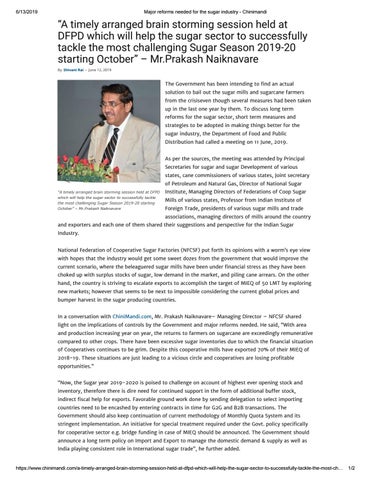
solution to bail out the sugar mills and sugarcane farmers from the crisiseven though several measures had been taken up in the last one year by them. To discuss long term reforms for the sugar sector, short term measures and strategies to be adopted in making things better for the sugar industry, the Department of Food and Public Distribution had called a meeting on 11 June, 2019. As per the sources, the meeting was attended by Principal Secretaries for sugar and sugar Development of various states, cane commissioners of various states, Joint secretary of Petroleum and Natural Gas, Director of National Sugar “A timely arranged brain storming session held at DFPD which will help the sugar sector to successfully tackle the most challenging Sugar Season 2019-20 starting October” – Mr.Prakash Naiknavare
Institute, Managing Directors of Federations of Coop Sugar Mills of various states, Professor from Indian Institute of Foreign Trade, presidents of various sugar mills and trade associations, managing directors of mills around the country
and exporters and each one of them shared their suggestions and perspective for the Indian Sugar Industry. National Federation of Cooperative Sugar Factories (NFCSF) put forth its opinions with a worm’s eye view with hopes that the industry would get some sweet dozes from the government that would improve the current scenario, where the beleaguered sugar mills have been under
nancial stress as they have been
choked up with surplus stocks of sugar, low demand in the market, and piling cane arrears. On the other hand, the country is striving to escalate exports to accomplish the target of MIEQ of 50 LMT by exploring new markets; however that seems to be next to impossible considering the current global prices and bumper harvest in the sugar producing countries. In a conversation with ChiniMandi.com, Mr. Prakash Naiknavare– Managing Director – NFCSF shared light on the implications of controls by the Government and major reforms needed. He said, “With area and production increasing year on year, the returns to farmers on sugarcane are exceedingly remunerative compared to other crops. There have been excessive sugar inventories due to which the financial situation of Cooperatives continues to be grim. Despite this cooperative mills have exported 70% of their MIEQ of 2018-19. These situations are just leading to a vicious circle and cooperatives are losing pro table opportunities.” “Now, the Sugar year 2019-2020 is poised to challenge on account of highest ever opening stock and inventory, therefore there is dire need for continued support in the form of additional bu er stock, indirect
scal help for exports. Favorable ground work done by sending delegation to select importing
countries need to be encashed by entering contracts in time for G2G and B2B transactions. The Government should also keep continuation of current methodology of Monthly Quota System and its stringent implementation. An initiative for special treatment required under the Govt. policy speci cally for cooperative sector e.g. bridge funding in case of MIEQ should be announced. The Government should announce a long term policy on Import and Export to manage the domestic demand & supply as well as India playing consistent role in International sugar trade”, he further added.
https://www.chinimandi.com/a-timely-arranged-brain-storming-session-held-at-dfpd-which-will-help-the-sugar-sector-to-successfully-tackle-the-most-ch…
1/2
6/13/2019
Major reforms needed for the sugar industry - Chinimandi
The Central Govt. has the vision to achieve 20 percent ethanol blending with petrol by the next decade. The
rst milestone of 10 percent of ethanol blending with petrol is on a verge to be achieved next year as
already hit 5% has been accomplished this year where 150 crore liters is currently available. Naiknavare said, “To accomplish the target for ethanol projects state/central guarantee is required Ethanol procurement, pricing and blending policy for a longer period like 5-10 years and be aimed at drawing away surplus sugar and sugarcane where partial juice usage for ethanol be made eligible for purchase price of Rs.59.13/litre.” “While many projects have progressed in private sector, not many projects in cooperatives could progress due to bank loans not being sanctioned. The banking fraternity’s current mindset to put sugar sector in “Caution list” needs to be changed. Excess land value surrounding mill may be taken for collateral security while sanctioning loans for
nancially weak mills. The Government should provide alternatives in
ways to stop hindrance of progress of the cooperative mills due to this. The subsidies should also be credited in farmers account. We have proposed for subsidization of railway freight for North East States for Cooperatives. Cooperatives are ready to supply more sugar for third party MIEQ also. Here, reduction in stock is required for timely start of the sugar mills, otherwise there may be issues eve for pre-seasonal expenses like advance payment of H&T etc. If the Rangrajan committee recommended model of revenue is implemented pan India for Sugarcane Pricing by amending sugarcane control order along with implementation of Escrow account and direct crediting of cane price, the cane growers would get relief from perpetual cane arrears causing frustration. Adding to this, the cane pricing policy should also be rationalized by linking cane price with revenue and there should be a creation of Cane Farmers Welfare Fund (CFWF) to bridge the gap between what the industry is able to pay and FRP
xed by the GOI. And apart from this if state Govt. wants to announce
their SAP over & above GOI’s FRP, then State Govt. should make budgetary provision for the same”, he continued. Currently the Minimum Selling Price of Sugar is Rs3100/Qntl needs to be revised upward by computing all the actual costs on
nance and depreciation so as to bring it close to, if not more than, the average cost
of production. Revising the MSP with a di erence of Rs.200/Qntl between M-30 and S-30 to enable parity in ex-mill sugar prices pan India will reduce the
nancial stress for fully paying FRP of sugarcane
by the mills.” Mr.Naiknavare also shared, “Industrial buyers consume 60 to 70% of the total domestic consumption and to bring
nancial stability; Dual pricing of sugar is need of the hour, Rs.60/kg for industrial consumers &
Rs.35/kg for household consumers. To maintain better quality standards, jute packaging compulsion should be completely diluted.” Where the sugar industry is divided into segments of stakeholders, the Cooperative sugar sector that attributes to a farmers organization contributes about 35% of total sugar production in India and also plays a vital role in direct and indirect employment generation of rural folks. The sector has approximately 55 lakh small and marginal cane growers are member shareholders and are directly connected with federal bodies. The National Federation of Cooperative Sugar Factories (NFCSF) has tried to be the voice of this fraternity and synergy to develop the Indian Sugar Industry.
Download ChiniMandi apps
https://www.chinimandi.com/a-timely-arranged-brain-storming-session-held-at-dfpd-which-will-help-the-sugar-sector-to-successfully-tackle-the-most-ch…
2/2