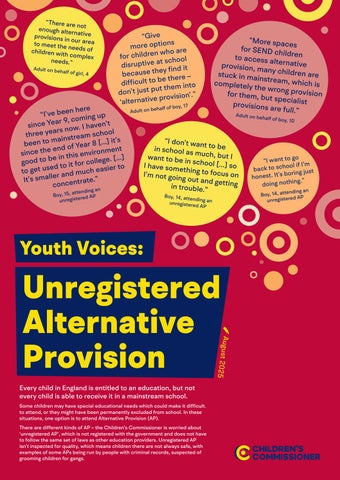
“There are not enough provisionsalternative in our area to meet the needs of children with needs.”complex
Adult on behalf of girl, 4
“Give more options for children who are disruptive at school because they find it difficult to be there –don’t just put them into ‘alternative provision’.”
“I’ve been here since Year 9, coming up three years now. I haven’t been to mainstream school since the end of Year 8 […] it’s good to be in this environment to get used to it for college. […] It’s smaller and much easier to concentrate.”
Boy, 15, attending an unregistered AP
Adult on behalf of boy, 17
“More spaces for SEND children to access alternative provision, many children are stuck in mainstream, which is completely the wrong provision for them, but specialist provisions are full.”
Adult on behalf of boy, 10
“I don’t want to be in school as much, but I want to be in school […] so I have something to focus on I’m not going out and getting in trouble.”
Boy, 14, attending an unregistered AP
Unregistered Alternative Provision Youth Voices: August 2025
Every child in England is entitled to an education, but not every child is able to receive it in a mainstream school. Some children may have special educational needs which could make it difficult. to attend, or they might have been permanently excluded from school. In these situations, one option is to attend Alternative Provision (AP).
There are different kinds of AP – the Children’s Commissioner is worried about ‘unregistered AP’, which is not registered with the government and does not have to follow the same set of laws as other education providers. Unregistered AP isn’t inspected for quality, which means children there are not always safe, with examples of some APs being run by people with criminal records, suspected of grooming children for gangs.
“I want to go back to school if I’m honest. It’s boring just doing nothing.”
Boy, 14, attending an unregistered AP
What has the Commissioner found out?
• In 2025, there were 29,244 children in unregistered AP – more than in registered AP.
• Since 2019, the number of placements in unregistered APs is estimated to have doubled.
• Much of this growth has come from children with the most severe special educational needs – children with Education, Health and Care Plans (EHCPs). In 2025, roughly 1 in 35 children with an EHCP were in unregistered AP.
• Vulnerable children from the most disadvantaged backgrounds were disproportionately more likely to be placed in unregistered AP.
What is the Commissioner going to do?
The freedom that unregistered APs have comes with advantages. It lets them change and adapt to the needs of individual children very quickly. But it also comes with risks: with quality, safety and accountability. The Commissioner wants a new registration system for unregistered APs to identify themselves to the government so it can make sure they are offering an excellent, safe and high-quality education, whilst allowing them to cater to children’s needs.
The Commissioner is asking for:
• Unregistered APs to identify themselves to the government and pass a national standards inspection before offering education.
• Government to introduce a Single Child Plan to coordinate the support a child needs, including education, health and social care needs. The document should reduce the need for children and families to retell their stories, help with information sharing, and enable services to work better together to provide support.
• Government to review the different types of unregistered AP and the evidence of what works. The current lack of high-quality data makes it very difficult to understand what unregistered APs are doing, and what they should be doing.
“ Children have told me about the barriers that prevent them from getting a good education. In these cases, unregistered alternative provision can offer a lifeline.
When done well, it can re-engage children who have fallen out of the system and help them find their spark again. But there is not enough oversight in the standard of education children get, or even a guarantee that staff are well trained – in the worst cases, these settings have been run by individuals with serious criminal histories, or placed children at risk of exploitation.
As Children’s Commissioner, I want to see a system that protects children and ensures they receive a high-quality education, wherever that happens.”
Dame Rachel de Souza Children’s Commissioner for England
Reach out for support
Speak to a trusted adult e.g. staff at school, a youth worker or a social worker
Get involved with your school council if it has one.
If you are living in care, are living away from home, have a social worker or are a care leaver you can contact the Children’s Commissioner’s Help at Hand team
Write to your MP or look into joining your local council’s Youth Council if it has one.