NINETY-FIFTH SEASON
Saturday, March 7, 2026, at 7:30
ZUKERMAN TRIO
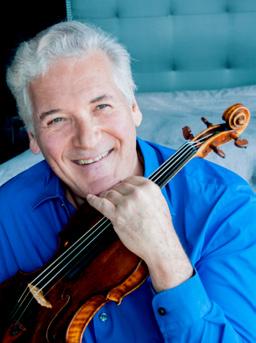
Pinchas Zukerman Violin
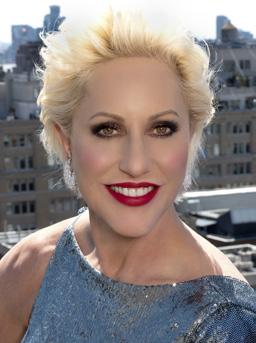
Amanda Forsyth Cello
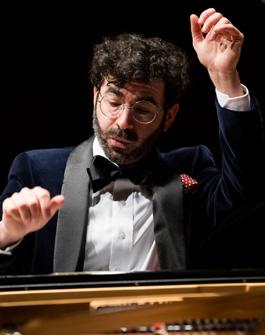
Michael Stephen Brown Piano
MENDELSSOHN
Piano Trio No. 1 in D Minor, Op. 49
Molto allegro ed agitato
Andante con moto tranquillo
Scherzo: Leggiero e vivace
Finale: Allegro assai appassionato
HIGDON Pale Yellow from Piano Trio
INTERMISSION
DVOŘÁK
Dumky for Piano, Violin, and Cello, Op. 90
Lento maestoso—Allegro vivace, quasi doppio movimento—
Poco adagio—Vivace non troppo—
Andante—Vivace non troppo
Andante moderato (quasi tempo di marcia)—
Allegretto scherzando
Allegro
Lento maestoso—Vivace, quasi doppio movimento
The Chicago Symphony Orchestra Association acknowledges support from the Illinois Arts Council.
COMMENTS
by Richard E. Rodda
FELIX MENDELSSOHN
Born February 3, 1809; Hamburg, Germany
Died November 4, 1847; Leipzig, Germany
Piano Trio No. 1 in D Minor, Op. 49
COMPOSED 1839
Mendelssohn was among the most successful musicians of the nineteenth century. His career showed none of the reverses, disappointments, and delays that were the norm for the other great romantic composers; indeed, it was in large part precisely the overwork and exhaustion to meet the demands for his presence, his performances, and his compositions that led to his untimely death at the age of thirty-eight. The most intense period of his life was ushered in by his appointment in 1835 as the administrator, music director, and conductor of the Leipzig Gewandhaus concerts. In very short order, he raised the quality of musical life in Leipzig to equal that of any city in Europe, and in 1842, he founded the local conservatory to maintain his standards of excellence. (The school was to be the most highly regarded institution of its kind in the world for the next half century.) In 1841 he was named director of the music section of the Academy of Arts in Berlin, a cultural venture newly instituted by King
Frederick William IV of Prussia, which required him not only to supervise and conduct a wide variety of programs but also to compose on royal demand—the incidental music that complements his dazzling 1826 Overture to A Midsummer Night’s Dream was sparked by one of Frederick’s requests. Mendelssohn toured, guest conducted, and composed incessantly, and on March 28, 1837, took on the additional responsibilities of family life when he married Cécile Jeanrenaud. “A conscientious chronicle of Mendelssohn’s next few years [after 1835] would merely weary the reader,” noted the late George Marek in his biography of the composer. “It would link work with more work, string success after success, place tribute next to tribute, and enumerate an ever larger register of acquaintances and friends.”
Mendelssohn’s duties kept him close to Leipzig for most of 1839, but he did manage to escape in May to conduct at the Lower Rhine Music Festival in Düsseldorf and in September to oversee the presentation of his oratorio Saint Paul in Brunswick. The D minor trio was completed in July, between those two engagements. Mendelssohn had displayed a special fondness for chamber combinations of piano and
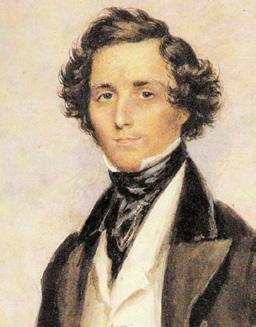
above: Felix Mendelssohn, watercolor by James Warren Childe (1780–1862), 1839
strings during his earlier years, producing three piano quartets and a sextet between 1822 and 1824. In January 1832 he wrote from Paris to his sister, Fanny, “I should like to compose a couple of good trios,” but he did not get around to broaching the genre for another seven years. When the D minor trio finally appeared in 1839, it was greeted with great and immediate enthusiasm. Robert Schumann hailed it in his review in the Neue Zeitschrift für Musik as “the master trio of the age, as were the B-flat [op. 97, Archduke] and D major [op. 70, no. 1, Ghost] trios of Beethoven and the E-flat trio [no. 2, op. 100] of Schubert in their times.” Schumann went on in his essay to claim that “Mendelssohn is the Mozart of the nineteenth century, the most brilliant musician, the one who sees most clearly through the contradictions of this period, and for the first time reconciles them.” Schumann closed by citing the music of both composers as embodying the ideals of “clarity, refinement, grace, and perfection.” The D minor trio has remained one of Mendelssohn’s most popular and beloved instrumental creations—Pablo Casals chose to play it with Mieczyslaw Horszowski and Alexander Schneider when he was invited by President John F. Kennedy to perform at the White House in 1961.
Though Mendelssohn was careful to involve all participants equally in the D minor trio in the presentation and development of the thematic
material, it is the piano that is granted the most brilliant of the three parts. In the original version of the piece, the piano writing was considerably more subdued, but Mendelssohn undertook a revision in later years at the urging of his friend composer and conductor Ferdinand Hiller, who encouraged him to incorporate some of the advanced technical devices of Liszt and Chopin into the work to better display the skill of the pianist (often Mendelssohn at the trio’s early performances). The opening D minor movement, heroic rather than mournful, is in a closely worked sonata form. The cello presents the main theme, a flowing melody of grace and eloquence, immediately at the outset. The complementary subject, also initiated by the cello, is a gently arched strain in the brighter tonality of A major. The extensive development section is an ingenious elaboration of these two lyrical inspirations. A full recapitulation of the principal themes rounds out the movement. The Andante, led by the piano, is reminiscent in its three-part structure and melodic style of the Songs Without Words. The scherzo is an elfin essay in the quicksilver, effervescent manner of which Mendelssohn was a master. The dactylic motif (long–short–short) given at the outset of the finale by the piano serves as the germ from which most of the movement grows.
A brief but energetic coda spawned by the same motif brings the trio to a triumphant close.
JENNIFER HIGDON
Born December 31, 1962; Brooklyn, New York
Pale Yellow from Piano Trio
COMPOSED 2003
Jennifer Higdon, born in Brooklyn, New York, and raised in Atlanta and Tennessee, is one of America’s foremost composers. She took her undergraduate training in flute performance at Bowling Green State University and received her master’s and doctoral degrees in composition from the University of Pennsylvania. Higdon was on the faculty of the Curtis Institute of Music in Philadelphia from 1994 until 2021. She also taught at the University of Pennsylvania, Bard College, and Ithaca College and served as composer-in-residence at the Mannes School of Music.
Jennifer Higdon’s works have been performed nationally and internationally, and she has received grants, awards, and commissions from many of the country’s leading orchestras, ensembles, and organizations. Her honors include the Pulitzer Prize in Music for her violin concerto, Eddie Medora King Award from the University of Texas at Austin, Nemmers Prize from Northwestern University, and
Governor’s Award for the Arts from the State of Pennsylvania. In 2002 she was inducted into the American Academy of Arts and Letters. Her opera, Cold Mountain, with a libretto by Gene Scheer based on Charles Frazier’s best-selling novel, was introduced at Santa Fe Opera in 2015 and received the International Opera Award for Best World Premiere and Grammy nominations as Best Opera Recording and Best Contemporary Classical Composition. Higdon’s works have been recorded on over sixty CDs, three of which have won Grammy awards for Best Contemporary Classical Composition. The recording of the percussion concerto was inducted into the Library of Congress National Recording Registry in 2019.
In 2003 Higdon became the first American female composer featured at the prestigious Festival of Contemporary Music at Tanglewood, and during the 2005–06 season, she was the Pittsburgh Symphony Orchestra’s Composer of the Year.
Higdon’s Piano Trio was commissioned by Bravo! Vail Valley Music Festival. The work premiered on July 15, 2003, by violinist Anne Akiko Meyers, cellist Alisa Weilerstein, and pianist Adam Neiman. The composer wrote,
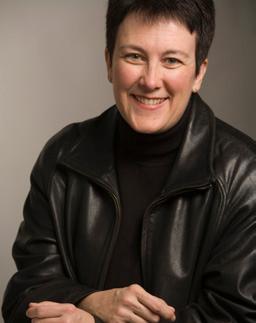
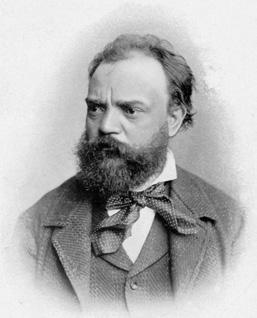
this page: Jennifer Higdon, photo by J.D. Scott | opposite page: Antonín Dvořák, ca. 1882
Can music reflect colors, and can colors be reflected in music? I have always been fascinated with the connection between painting and music. In my composing, I often picture colors as if I were spreading them on a canvas, except I do so with melodies, harmonies, and through the instruments themselves. The colors that I have chosen in both movement titles of the piano trio [Pale Yellow, Fiery Red] and in the music itself reflect
ANTONÍN DVOŘÁK
very different moods and energy levels, which I find fascinating, as it begs the question, can colors actually convey a mood?
For the first movement of the Piano Trio, Higdon created a pastoral character in Pale Yellow, which begins with meditative chord streams in the piano and grows more animated as it unfolds, perhaps reflecting the spreading light at sunrise, before recalling the opening mood to come to a peaceable close.
Born September 8, 1841; Nelahozeves (near Prague), Bohemia Died May 1, 1904; Prague, Bohemia
Dumky for Piano, Violin, and Cello, Op. 90
Success for Antonín
Dvořák was a twoedged sword. In 1874, when he was struggling to make a living as organist at St. Adalbert’s Church in Prague, he submitted some of his compositions to a committee in Vienna granting awards to promising musicians in the Habsburg provinces. These pieces came to the attention of Johannes Brahms, who encouraged Dvořák in his work and urged the panel to grant the young Bohemian composer the highest possible stipend. Three
years later, after Brahms had seen that Dvořák’s award was renewed, he instructed his publisher, Fritz Simrock in Berlin, that he was to accept Dvořák as a new client. Dvořák was thrilled with the career corridors that his Viennese connections opened for him, and he paid Brahms great homage in word and tone for the rest of his life. Brahms, however, was indissolubly linked with the spirit and letter of German music, and Dvořák soon found himself torn between the desire, on the one hand, to emulate his Viennese patron and, on the other, to support the political and social aspirations of his fellow Czechs. This dichotomy resulted in a crisis of philosophy for Dvořák by 1882, when Brahms
COMMENTS
was urging him to settle in Vienna, and opera houses in that city and Dresden were offering lucrative contracts for any work that he would write to a Germanlanguage libretto, a certain avenue to the international performance of his stage music.
Dvořák was still painfully undecided between Vienna and Prague, between his adopted German symphonism and his native Czech heritage, when his mother died on December 14, 1882. The grief he suffered over her loss and the emotional distress brought about by uncertainty over his future artistic path threw him into a difficult period of dark moods and troubled thoughts. Even the birth of a son (Antonín) on March 7, 1883, and news that his Stabat mater had been enthusiastically received at its English premiere in London a few days later did little to relieve his anxiety or ease his decision. After a brief hiatus in his creative work, he poured his feelings into some of his most powerful and deeply felt works during the following months (Piano Trio in F minor, Scherzo capriccioso, Hussite Overture, and the great D minor symphony). Dvořák was unable to resolve this philosophical and artistic crisis until 1885, when he chose unequivocally to remain in his Czech homeland to help nurture the country’s musical culture. He thereafter worked with great contentment at his summer home at Vysoká and his flat in Prague, and produced during the next seven years, before he left for his tenure as director of the National Conservatory in New York in 1892, some of his most characteristic nationalist compositions:
the second set of Slavonic Dances, Terzetto, Symphony no. 8 in G major, the opera The Jacobin, three overtures (Carnival, In Nature’s Realm, and Othello) and the Dumky Trio.
The dumka was a traditional Slavic (especially Ukrainian) folk ballad of meditative character that often described heroic deeds. Dvořák adapted the form for a number of his works: Dumka: Elegy for Piano (op. 35, 1876); three of the Slavonic Dances (op. 46, op. 2, 1878; op. 76, nos. 2 and 4, 1886); the slow movements of the A major string sextet (op. 48, 1878), piano quintet (op. 81, 1887), E-flat major string quartet (op. 51, 1879), and Furiant with Dumka for Piano (op. 12, 1884). The dumka acquired various musical characteristics in different cultures, so Dvořák felt justified in making his own formal interpretation of it for the six dumky (the plural of dumka) that comprise the op. 90 piano trio.
The form Dvořák created—alternating sections of slow, thoughtful music and fast, dancing music—not only honors the traditional folk genre but also reflects the emotional constitution of the composer. In his biography of Dvořák, Paul Stefan wrote, “If there is any ‘program’ to the Dumky Trio, it is this: melancholy and delirious joy of life combined in the same being.” Dvořák composed the work between November 1890 and January 1891, soon after his increasingly celebrated career was honored by his election to the Czech Academy of Arts and Sciences and by notification that the universities of both
Prague and Cambridge had proffered him honorary degrees. The trio was premiered on April 11, 1891, at the investiture ceremony in Prague. The participants in that performance—Dvořák (piano), Ferdinand Lachner (violin), Hanus Wihan (cello, the dedicatee of Dvořák’s 1895 Cello Concerto)—toured with the trio during the winter of the following year in a series of farewell recitals in forty-one towns in Bohemia and Moravia before the composer left for America.
The Dumky Trio eschews classical form in favor of a suitelike succession of
PROFILES
Zukerman Trio
With a celebrated career encompassing five decades, Pinchas Zukerman reigns as one of today’s most sought-after and versatile musicians. A prodigious talent recognized worldwide for his artistry, Zukerman has been an inspiration to young musicians throughout his adult life. In a continuing effort to motivate future generations through education and outreach, the renowned violin and viola soloist, conductor, and chamber musician teamed up in 2002 with four protégés to form a string quintet called the Zukerman Chamber Players. The quintet amassed an impressive international touring schedule with close to
six movements (each in a different key), which alternate slow and fast sections in the contrasting styles of sad song and lively dance. The music touches on a wide variety of moods—solemn, ethereal, tragic, boisterous—all set aglow through Dvořák’s superb handling of melody, harmonic color, and instrumental sonority.
Richard E. Rodda, a former faculty member at Case Western Reserve University and the Cleveland Institute of Music, provides program notes for many American orchestras, concert series, and festivals.
two hundred concerts and four discs on the CBC, Altara, and Sony labels. The Zukerman Trio emerged from the Zukerman Chamber Players with an official launch in 2013. Since then, the ensemble has performed globally in Japan, China, Australia, Spain, Italy, France, Hungary, Canada, South Africa, Istanbul, Russia, and Germany. The trio has appeared at major North American festivals, including Ravinia, Tanglewood, Aspen, Bravo! Vail,
and Banff, as well as European festivals in Edinburgh, Verbier, and Schleswig-Holstein.
Born in Tel Aviv, Pinchas Zukerman came to America in 1962, where he studied at the Juilliard School with Ivan Galamian. The renowned virtuoso has long been admired for the expressive lyricism of his playing, singular beauty of tone, and impeccable musicianship, heard throughout his discography of over a hundred albums for which he earned two Grammy awards and twenty-one nominations. Zukerman has been awarded a Medal of Arts and the Isaac Stern Award for Artistic Excellence and was appointed as the Rolex Mentor and Protégé Arts Initiative’s first instrumentalist mentor in the music discipline. A devoted and innovative pedagogue, Zukerman chairs the Pinchas Zukerman Performance Program at the Manhattan School of Music, where he has pioneered the use of distance-learning technology in the arts. Since 2021 he has served as artistic and principal education partner for the Dallas Symphony Orchestra. He holds the title of conductor emeritus with the National Arts Centre Orchestra of Canada.
Pinchas Zukerman has recorded for Decca, Analekta, CBS Masterworks, Philips, Angel, Deutsche Grammophon, CBC Records, Altara, and BMG Classics/RCA Victor Red Seal.
Exclusive representation: Kirshbaum Associates Inc.
307 Seventh Avenue, Suite 506 New York, NY 10001 kirshbaumassociates.com
Canadian Juno Award–winning cellist Amanda Forsyth is considered among her peers and critics one of the most dynamic cellists on the concert stage today. She has achieved an international reputation as a premier soloist and chamber musician and previously enthralled audiences as the principal cellist of both the Calgary Philharmonic and Canada’s National Arts Centre orchestras. Her intense richness of tone, exceptional musicality, and passion are reminiscent of cellists of a former age. She captivates audiences with every phrase.
Composer and pianist Michael Stephen Brown is a 2025 MacDowell Fellow, 2024 Yaddo Artist, and winner of Lincoln Center’s Emerging Artist Award and an Avery Fisher Career Grant. He performs internationally and receives commissions from orchestras, soloists, and festivals around the world. Recent highlights include a recital at Alice Tully Hall for the Chamber Music Society of Lincoln Center, as well as collaborations with Nicholas Canellakis, Pinchas Zukerman, and Amanda Forsyth. Currently, he is composing The Magical Carnival, a CMS-led project copresented by a consortium of U.S. presenters. His first album, Twelve Blocks, devoted entirely to his music, was released on February 13, 2026. He is the composer for Angeline Gragasin’s upcoming film Look but Don’t Touch
Michael Stephen Brown lives in New York City with his two nineteenthcentury Steinways, Octavia and Daria.