KLAUS MÄKELÄ Zell Music Director Designate | RICCARDO MUTI Music Director Emeritus for Life
Thursday, January 29, 2026, at 7:30
Friday, January 30, 2026, at 7:30
Saturday, January 31, 2026, at 7:30
Sunday, February 1, 2026, at 3:00
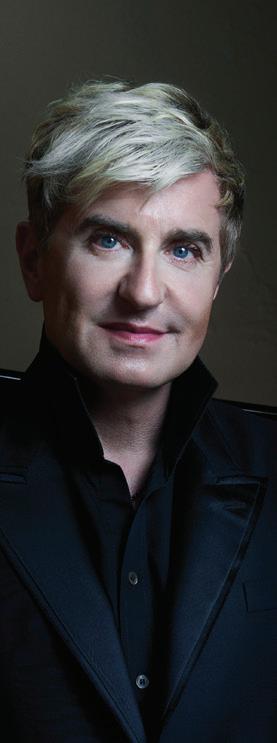
Esa-Pekka Salonen Conductor
Daniil Trifonov Piano
BEETHOVEN Piano Concerto No. 2 in B-flat Major, Op. 19
Allegro con brio
Adagio
Rondo: Molto allegro
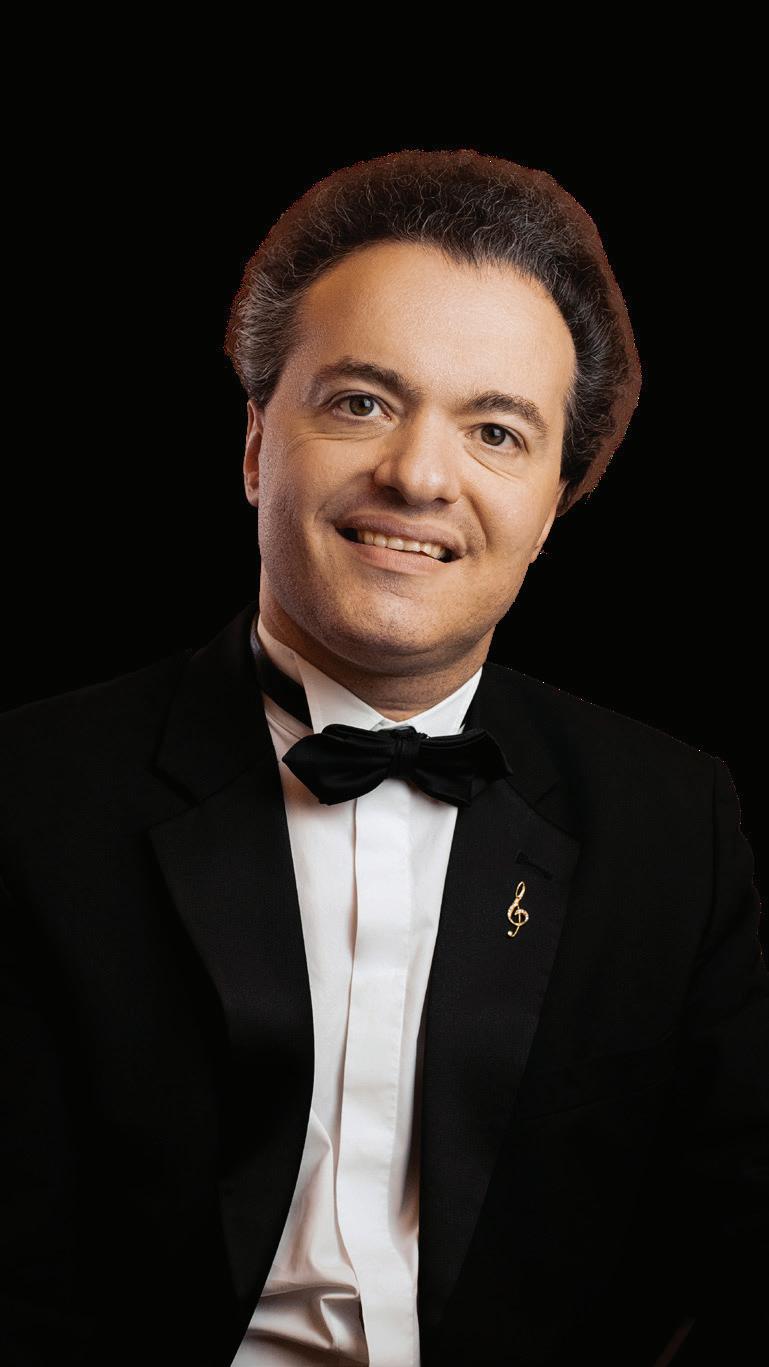
DANIIL TRIFONOV
INTERMISSION
BRUCKNER Symphony No. 4 in E-flat Major (Romantic)
Moving, not too fast
Andante quasi allegretto
Scherzo: Moving
Finale: Moving, but not too fast
These concerts are generously sponsored by The Negaunee Foundation. The appearance of Daniil Trifonov is made possible by an anonymous donor.
The Chicago Symphony Orchestra Association acknowledges support from the Illinois Arts Council.
These concerts are generously sponsored by The Negaunee Foundation.
COMMENTS by Phillip Huscher
LUDWIG
VAN BEETHOVEN
Born December 16 1770; Bonn, Germany
Died March 26, 1827; Vienna, Austria
Piano Concerto No. 2 in B-flat Major, Op. 19
Although it is known as no. 2, the B-flat major piano concerto is the earliest of Beethoven’s five works in the great classical form. In fact, it’s not even the composer’s first attempt at writing a concerto for himself. When he was only fourteen years old, Beethoven composed a piano concerto in E-flat major, and, although only the solo part has survived, it clearly reveals that the teenage Beethoven thought himself a great virtuoso. (The concerto was reconstructed and performed for the first time in 1943.) But, sometime over the next six years, Beethoven shelved that score and began a new piano concerto in B-flat, over which he struggled on and off for several more years until he felt it was ready for the public. The teenage show-off had become a perfectionist.
In 1792, the year Beethoven left Bonn and settled in Vienna, he wrote out a fresh copy of this concerto, perhaps to show his new teacher, Joseph Haydn, whom he would soon dismiss, leaving neither man with kind words for the other. At the first chance to play the work in public, Beethoven evidently dropped the original finale (discovered among his papers after his death and now known as the Rondo, WoO 6) and wrote a new one. He also revised the slow movement. This is probably the concerto he played at the charity concert on March 29, 1795—his first
COMPOSED
1790–95, revised 1801
FIRST PERFORMANCE
March 29, 1795, the composer as soloist
INSTRUMENTATION
solo piano, flute, 2 oboes, 2 bassoons, 2 horns, strings
CADENZA
Beethoven
APPROXIMATE PERFORMANCE TIME 28 minutes
FIRST CSO PERFORMANCES
March 12 and 13, 1926, Orchestra Hall. Harold Samuel as soloist, Frederick Stock conducting
July 11, 1946, Ravinia Festival. Leon Fleisher as soloist, William Steinberg conducting
MOST RECENT
CSO PERFORMANCES
July 15, 2010, Ravinia Festival. Jorge Federico Osorio as soloist, James Conlon conducting
December 1, 2, 3, and 6, 2022, Orchestra Hall. Francesco Piemontesi as soloist, Thomas Søndergård conducting
CSO RECORDINGS
1972. Vladimir Ashkenazy as soloist, Sir Georg Solti conducting. London
1983. Alfred Brendel as soloist, James Levine conducting. Philips
official public appearance in this great music capital—although by then he had written another one, in C major—the one we know as no. 1. (Beethoven’s old friend Franz Gerhard Wegeler recalls that the composer finished the finale at the very last moment, while suffering from a bad stomachache, but the evidence suggests that he was remembering a different performance and a different concerto.)
Beethoven continued to work on the B-flat score. He sketched, and then discarded, a new slow movement in D major. For a performance in Prague in 1798, he brushed up both the outer movements and added a coda to the Adagio. Still, he was dissatisfied. In fact, when he wrote to the publisher Breitkopf and Härtel in 1801, Beethoven hadn’t a good thing to say about either of his piano concertos:
I wish to add that one of my first concertos, and therefore not one of the best of my compositions, is to be published by Hofmeister, and that Mollo is to publish a concerto which, indeed, was written later, but which also does not rank among the best of my works in this form.
But the fact that in 1809 Beethoven chose to write out an expansive and highly challenging cadenza for the first movement—one that Daniil Trifonov plays at these performances—suggests that he still held this concerto in high esteem even after he had moved on to writing in a much more advanced style. Both these concertos reflect Mozart’s influence—in their design, in the balance of piano and orchestra, and in the piano writing itself—but, from the day he arrived
in Vienna, Beethoven was impatient to establish himself as a new force to be reckoned with, not as the next Mozart. Moreover, by 1801 he had already completed another concerto—the Third—that decisively broke away from the classical model and pointed in a completely new direction. That was the composer Beethoven wanted the power brokers at Breitkopf to notice. Nonetheless, he thought both of his first concertos fit to print, and they were published that year, in the “wrong” order—the C major concerto in March and the earlier one in B-flat major in December.
For all its classical decorum, there’s something explosive and rebellious about Beethoven’s earliest piano concerto. In the very opening orchestral tutti, for example, Beethoven swerves unexpectedly into D-flat major, at the same time pulling back from fortissimo to pianissimo to emphasize the jolt, in a way that is quite un-Mozartean. Once the piano enters, we are in the presence of a new personality. By all accounts, the young Beethoven was a thrilling performer of a very different sort than
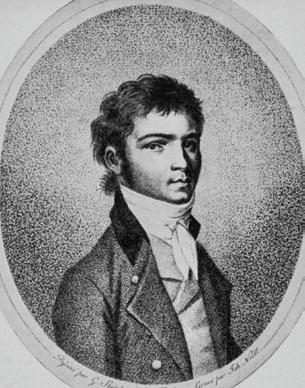
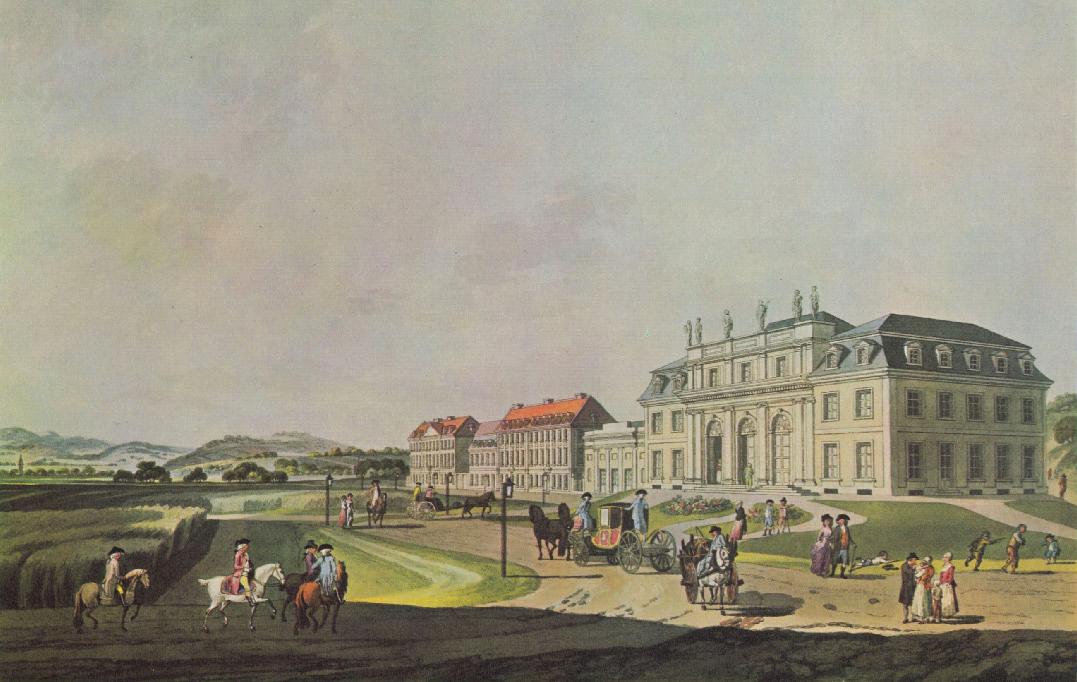
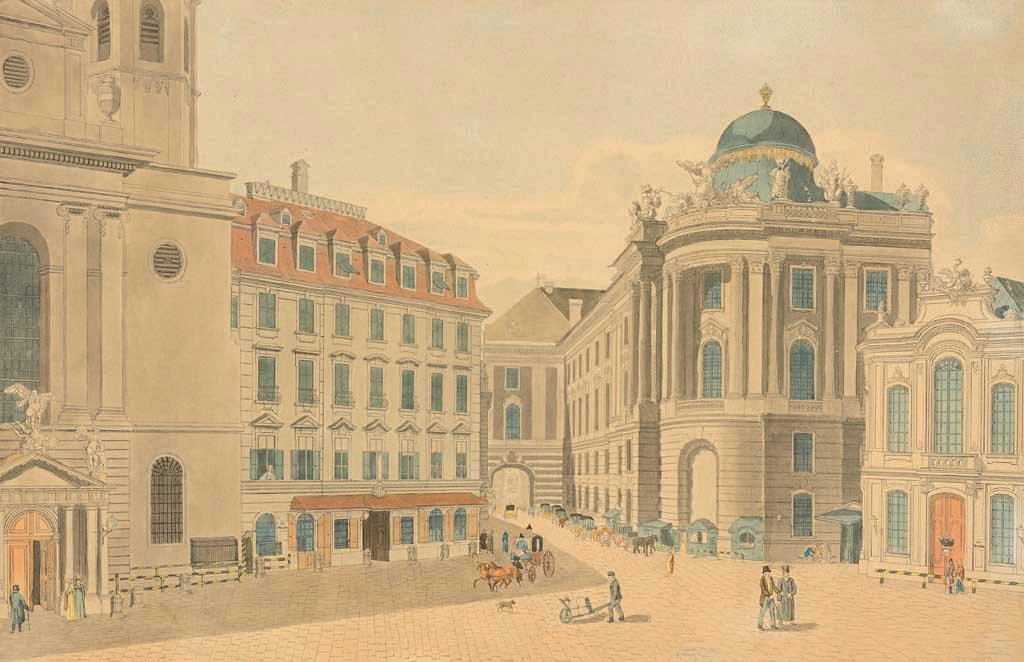
previous page, from top: Ludwig van Beethoven, copperplate engraving by Johann Joseph Neidl (1776–1832) after a lost portrait by Gandolph Ernst Stainhauser von Treuberg, (1766–1805), ca. 1800–01 | Redoute in Bonn–Bad Godesberg—opened in 1792 as a court ballroom and concert hall—where Beethoven performed as a member of the Bonn court orchestra and where he met Joseph Haydn in 1792 when Haydn was returning to Vienna after his first London trip. Copperplate engraving by Johann Ziegler (1749–1812) after a watercolor by Laurenz Janscha (1749–1812), 1792 | this page: A view of Vienna’s Michaelerplatz, ca. 1780s, including St. Michael’s Church, the Imperial Riding School, a domed wing of the Hofburg Palace, and the Imperial National Theatre (old Burgtheater) on the right, where Beethoven premiered his Piano Concerto no. 2 at a charity concert on March 29, 1795. Etching by Carl Schütz (1745–1800). Published by Artaria & Co., Vienna, Austria
Mozart—the newspaper reports praise his power, “unheard-of bravura and facility,” and sheer intensity of feeling—and his concertos reflect these musical sensibilities, as well as his new style of piano playing.
Mozart’s shadow still falls across the elegantly designed first movement, despite evidence of the subversive young Beethoven in the details. The bold and lovely slow movement (revised
for the 1795 premiere) is one of his earliest attempts to display both his true originality and the range of his emotional compass. The finale is light and witty, with a wonderful syncopated theme that the pianist finally “corrects,” putting the off-beat material on the beat shortly before the ending. The boisterous spirit of Vienna’s new self-appointed musical king is apparent in every measure.
ANTON BRUCKNER
Born September 4, 1824; Ansfelden, Upper Austria
Died October 11, 1896; Vienna, Austria
Symphony No. 4 in E-flat Major (Romantic)
Anton Bruckner was forty years old when he wrote his first significant large-scale work—a mass in D minor—and forty-two before he wrote the first symphony he was willing to claim. After years as a diligent student, Bruckner had finally found his own voice, but he wasn’t confident enough to trust it. The third and fourth symphonies were the toughest for him, and, in both cases, he needed several separate attempts—and a number of smaller touch-ups—before he was satisfied. He began the Fourth Symphony in 1874. Four years later, he wrote a new scherzo and finale. In 1880, he made further changes, reaching what was, for the time being, his final score. But even in the mid-1880s, he picked up his pencil and returned to the E-flat symphony. (It is the familiar 1878–80 version edited by Leopold Nowak that is performed at these concerts.)
Bruckner was responding not just to his own second thoughts, but also to the trivial—though deeply wounding—criticism of others. Well-meaning friends suggested pruning (Bruckner has always seemed long-winded to the unsympathetic listener) and recommended other changes, which Bruckner dutifully considered and often accepted. Franz Schalk and Ferdinand Löwe— two favorite, though unfaithful disciples—thought the scherzo of the Fourth Symphony ought to end pianissimo the first time around, rather than in a blaze of brass as Bruckner conceived it. And so it does, in the first printed edition that they prepared
COMPOSED 1874, revised 1878, 1880–81, 1886
FIRST PERFORMANCE
February 20, 1881; Vienna, Austria. Hans Richter conducting
January 22 and 23, 1897, Auditorium Theatre. Theodore Thomas conducting
July 25, 1961, Ravinia Festival. Paul Hindemith conducting
MOST RECENT
CSO PERFORMANCES
August 2, 1991, Ravinia Festival. Marek Janowski conducting
March 10, 11, and 12, 2022, Orchestra Hall. Herbert Blomstedt conducting
CSO RECORDINGS
1972. Daniel Barenboim conducting. Deutsche Grammophon
1981. Sir Georg Solti conducting. London
in 1890. (However, when it came time to authorize that edition, Bruckner refused to sign the printer’s copy; it was published anyway.)
Bruckner was certainly not the first composer to suffer at the hands of insensitive friends and colleagues. A short, awkward man with a severely cropped Prussian haircut and a wardrobe of misshapen suits, he seemed to invite scorn, if not ridicule, by his very appearance. (Beethoven, once arrested as a vagrant, had already proved that fashion plays no role in musical greatness.)
But Bruckner’s problem lay deeper. From his earliest days, he fought a devastating insecurity that frequently damaged his dealings with people, made his life one of perpetual misery, and almost denied him a career as a composer.
Yet, despite his doubts, the failure of several important performances, the hostility of musicians (the Vienna Philharmonic rejected his first three symphonies as unplayable), and the disloyalty of his students, Bruckner managed to get something down on paper that pleased himself, if no one else. In time, his unorthodox style, with its leisurely pace, slowly unfolding harmony, obsessive repetition of simple motives and chords, and apparent resistance to wrap things up, found many other receptive listeners.
Six of Bruckner’s symphonies start with a vague rumble that Bruckner picked up from the opening of Beethoven’s
Ninth and then focus on an important theme as it breaks through. Sometimes the effect is almost improvisational, as if Bruckner sat at the piano—or at the organ, for that was his instrument—one hand waiting to see what the other would do. In the Fourth Symphony, it takes us a surprisingly long time to figure out how quickly the music is moving. A calm, clear horn call beckons over string tremolos. But as the theme emerges, it brings with it faster countermelodies and increasing activity.
From Beethoven’s Ninth, Bruckner also found his model for a large-scale structure: a big first movement, a spacious adagio, a scherzo in sonata form, and a wide-ranging finale that gathers many threads together in a new light. The first movement of Bruckner’s Fourth is twice as long as any opening symphonic movement in Mozart or Haydn and comparable only to those of Beethoven’s Eroica and Ninth symphonies, among its predecessors. But Bruckner is not Haydn, Mozart, or Beethoven—not in the way he handles themes, plans his harmonic structure, or conceives form—even if he is working with many of the same tools.
It has taken music lovers some time to understand him. Robert Simpson, who wrote one of the first comprehensive studies of the symphonies in the 1960s, described Bruckner’s technique as a manifestation of patience. It is patience that many listeners do not bring to Bruckner, and he will not divulge his true greatness without it. Although Bruckner has
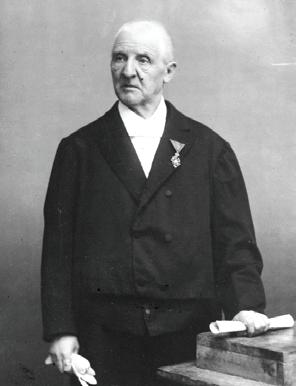
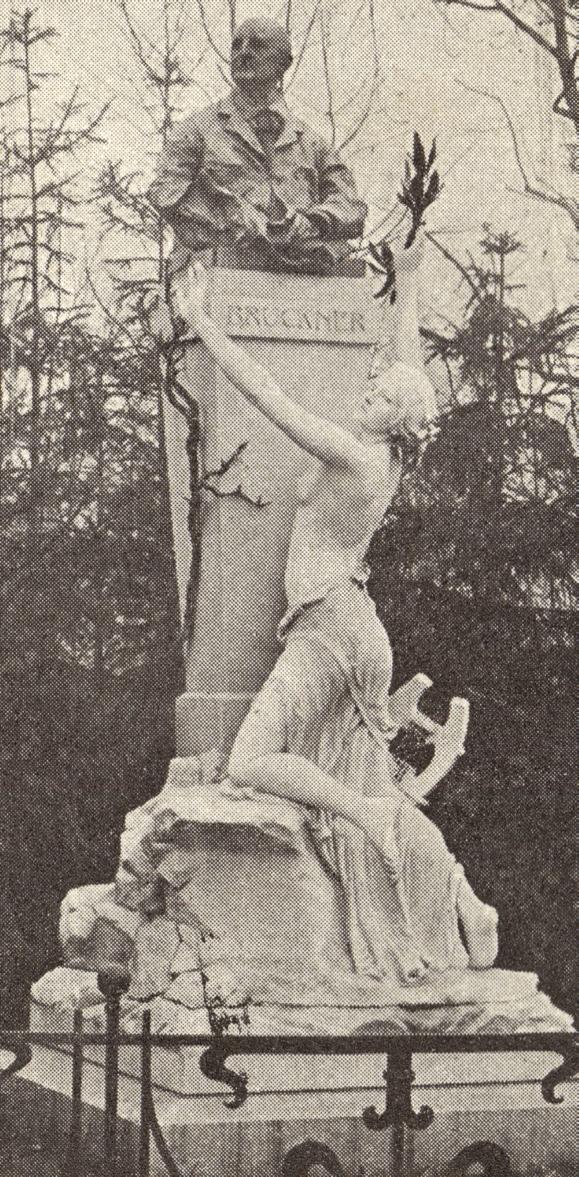
previous page: Anton Bruckner, in formal attire, with the Knight’s Cross of the Order of Franz Joseph and its accompanying diploma awarded by Emperor Franz Joseph I (1830–1916) in 1886. Photograph by Otto Schmidt (1849–1920), Vienna, Austria | this page: Monument to Bruckner in Vienna’s Stadtpark, unveiled in 1899 and later damaged and replaced with a simpler version. Bronze bust by Viktor Tilgner (1891–1899) and base by Fritz Zerritsch (1865–1938), including the likeness of Elisabeth Praherstorfer, a young woman admired by the composer
never been known to make a long story short, he is a masterful, compelling storyteller. The slow movement of this symphony moves at a deliberate, unchanging gait, but it’s shrewdly paced and lovingly told, and there are moments of almost unimaginable beauty. The grand climax is truly impressive only if one has made the slow ascent.
The scherzo, with its combination of hunting calls and brass fanfares, is lively, exciting stuff. But the pace is still leisurely, and the trio (marked “Not too quickly”) is delicately scored and more relaxed. When the scherzo music returns after the gentle respite of the trio, it’s apparent how Bruckner relies not on speed, but on sheer sonority—here the full brass band—to create excitement.
A Bruckner finale is always large and complicated, and this one gave him an especially hard time. It is really a slow movement, with all its customary attributes, despite what Bruckner chooses to call it. It opens, like the symphony, with a serene horn call over low stirrings that leads to increased commotion. Bruckner takes a number of detours to distant harmonic regions, enriching the itinerary immeasurably. There is a sense throughout of covering vast distances—an understanding of musical space that is new to the world of the symphony. The shadow of the scherzo hovers. Near the end, after a barrage from the full orchestra, there is a great, unexpected pause, and then the last full paragraph.
As Bruckner told the conductor Arthur Nikisch—in explanation of one of his most common idiosyncrasies—he liked to catch his breath before saying something significant. The ending is important, for it brings us back to the opening of the symphony, with its simple horn call. There is both a sense of wrapping things up and the satisfaction of reunion, as Bruckner gathers together familiar themes, like tourists who have gone their separate ways and meet at the day’s end.
A parting word about the subtitle, Romantic. This is the only symphony by Bruckner with a subtitle added by the composer himself. It was part of a scheme devised by his friends, after the symphony was completed, to give the music a programmatic storyline as well as a title to draw a more receptive audience. Bruckner reluctantly agreed but admitted that even he didn’t know what the finale was supposed to depict.
A postscript. Scarcely three months after Bruckner’s death in Vienna, Theodore Thomas and the Chicago Symphony Orchestra introduced his Fourth Symphony to Chicago on January 22, 1897, as a way of “keeping audiences in touch with musical progress,” the Tribune said. It was the first symphony by Bruckner the Orchestra ever played.
Phillip Huscher has been the program annotator for the Chicago Symphony Orchestra since 1987.
Lemminkäinen the Disruptor
Directly after the concert on February 21, join Professor Thomas Dubois for a presentation and audience Q&A about the story and artistic influences of the fabled folk hero Lemminkäinen on Sibelius’s composition. This event is open to all ticket holders and will take place in Grainger Ballroom with limited seating.
SCAN TO LEARN MORE
Discover the benefits of making a legacy gift to your Chicago Symphony Orchestra
“By planning a future gift for the Chicago Symphony Orchestra, we hope to contribute to the CSO’s legacy and honor the many wonderful memories we’ve enjoyed across the years.”
— Cathy and Kent Hoffmann
Join the Theodore Thomas Society
Named in honor of our founder and first music director, the Theodore Thomas Society recognizes individuals who have included the Chicago Symphony Orchestra in their will, trust or beneficiary designation. Contact Joe Bauer at 312-294-3192 or visit cso.org/plannedgiving for more information.
PROFILES
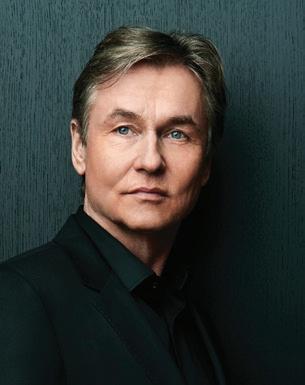
Esa-Pekka Salonen Conductor
FIRST CSO PERFORMANCES
January 14, 15, and 16, 1988, Orchestra Hall. Haydn’s Symphony no. 78, Bartók’s Piano Concerto no. 3 with Stephen Hough, and Nielsen’s Symphony no. 4
MOST RECENT CSO PERFORMANCES
February 6, 7, and 8, 2025, Orchestra Hall. Beethoven’s Symphony no. 2 and Bartók’s Bluebeard’s Castle with Ekaterina Gubanova and Christian Van Horn
Esa-Pekka Salonen is renowned as both a composer and conductor. He was recently named creative director of the Los Angeles Philharmonic, effective 2026–27, and creativity and innovation chair of the Philharmonie de Paris and principal conductor of the Orchestre de Paris, effective 2027–28. He is conductor laureate of the Philharmonia Orchestra in London, Los Angeles Philharmonic, and the Swedish Radio Symphony Orchestra in Stockholm, and he formerly served as music director of the San Francisco Symphony. He also is founder of the Colburn School’s Negaunee Conducting Program. Salonen cofounded and served as artistic director of the annual Baltic Sea Festival until 2018.
In recent seasons, Salonen cofounded the statewide California Festival with Gustavo Dudamel and Rafael Payare; led a synesthetic production of Scriabin’s Prometheus: The Poem of Fire in collaboration with pianist Jean-Yves Thibaudet and Cartier’s in-house perfumer Mathilde Laurent; and conducted the Finnish Radio Symphony Orchestra in a Salzburg Easter Festival residency featuring Simon McBurney’s production of Mussorgsky’s unfinished opera Khovanshchina, with never-before-heard music compiled by Gerard McBurney from a recently rediscovered manuscript.
Salonen began the 2025–26 season on tour with the Orchestre de Paris, centered on the premiere of his new Horn Concerto, composed
PHOTO BY ANDREW ECCLES
for Stefan Dohr. After a world premiere at the Lucerne Festival and performances in Berlin and Hamburg, he brings the piece to the Boston Symphony Orchestra, Filarmonica della Scala in Milan, and the Hong Kong Philharmonic Orchestra. Other conducting highlights include centennial programs of music by Pierre Boulez at the New York Philharmonic and dates with the LA Phil, Philadelphia Orchestra, and Orchestre de Paris. He concludes the season at the Ojai Music Festival, which he curates as 2026 music director.
He leads several of his works this season, including Tiu and Dona Nobis Pacem with the Swedish Radio Symphony and his Sinfonia concertante for organ and orchestra with Olivier Latry and the Gothenburg Symphony Orchestra.
Salonen has an extensive and varied recording career. Recent releases include the Grammy Award–winning (Best Opera Recording) world premiere of Saariaho’s Adriana Mater on Deutsche Grammophon, Bartók’s three piano concertos with Pierre-Laurent Aimard on Pentatone, and Ligeti’s Clocks and Clouds, Lux aeterna, and Ramifications on Apple Music Classical. His concertos for piano, violin, and cello all appear on recordings conducted by Salonen himself.
Esa-Pekka Salonen was educated at Helsinki’s Sibelius Academy, where he founded the new-music appreciation group Korvat Auki and ensemble Toimii with classmates Magnus Lindberg and Kaija Saariaho. He is the recipient of Sweden’s Litteris and Artibus Medal; the Pro Finlandia Medal of the Order of the Lion of Finland, Helsinki Medal, and Commander of the Order of the Lion of Finland; Poland’s Gloria Artis Medal for Merit to Culture; and Commander of France’s Order of Arts and Letters. He was elected an honorary member of the American Academy of Arts and Sciences in 2010 and appointed an Honorary Knight Commander of the Order of the British Empire (KBE) by Queen Elizabeth II in 2020. In 2023 he led the Nobel Prize Concert and in 2024 received the Polar Music Prize. Salonen holds seven honorary doctorates in four countries.
Explore, support and influence the future of music by becoming part of the Chicago Symphony Orchestra Association’s next generation. Join Chicago’s premier young professionals’ network, the Overture Council, today!
cso.org/overturecouncil
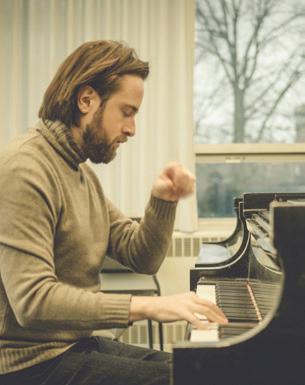
Daniil Trifonov Piano
FIRST CSO PERFORMANCES
November 14, 15, and 17, 2012, Orchestra Hall. Tchaikovsky’s Piano Concerto no. 1, Charles Dutoit conducting
MOST RECENT CSO PERFORMANCES
May 1, 2, 3, and 4, 2025, Orchestra Hall. Brahms’s Piano Concerto no. 2, Klaus Mäkelä conducting
Grammy Award–winning pianist Daniil Trifonov (Dan-eel Tree-fon-ov) is a solo artist, champion of the concerto repertoire, chamber and vocal collaborator, and composer. Combining consummate technique with rare sensitivity and depth, his performances are a perpetual source of wonder to audiences and critics alike. He won the Grammy Award for Best Instrumental Solo Album of 2018 with Transcendental, the collection of works by Liszt that marked his third title as an exclusive Deutsche Grammophon artist.
Trifonov’s 2025–26 season includes three performances at Carnegie Hall. He first reunited with German baritone Matthias Goerne for Schubert’s Die schöne Müllerin as the culmination of their North American tour of Schubert’s great song cycles that also saw them perform the collection Schwanengesang in Québec City and Boston and Winterreise in Toronto, Washington (D.C.), and Dallas, after which they tour the cycles to multiple German and Austrian cities, as well as to Paris in the spring. In November, Trifonov returned to Carnegie Hall in the company of the Orchestre National de France and Cristian Măcelaru for two French piano concertos: Saint-Saëns’s Second and Ravel’s jazz-inflected Concerto in G. In December, Trifonov’s third Carnegie Hall appearance of the season was a mainstage solo recital, with the same program performed throughout the season in the United States and Europe. Other season highlights include a tour in Sweden and
Austria with violinist Nikolaj Szeps-Znaider; a reprise of Brahms’s Second Piano Concerto with the Cleveland Orchestra and Franz Welser-Möst and three performances with the Orchestra dell’Accademia Nazionale di Santa Cecilia and Daniel Harding; and Beethoven’s Second Piano Concerto with the Cincinnati Symphony led by Măcelaru.
Trifonov’s existing Deutsche Grammophon discography includes his latest 2025 release, Tchaikovsky, exploring that composer’s more intimate side; 2024’s My American Story: North, which received the UK’s Presto Music Award; the Grammy-nominated live recording of his Carnegie recital debut; Chopin Evocations; Silver Age, for which he received Opus Klassik’s Instrumentalist of the Year/Piano Award; the best-selling, Grammy-nominated double album Bach: The Art of Life; and three volumes of Rachmaninov’s works with the Philadelphia Orchestra and Yannick Nézet-Séguin, of which two received Grammy nominations and the third won BBC Music’s 2019 Concerto Recording of the Year. Named Gramophone’s 2016 Artist of the Year and Musical America’s 2019 Artist of the Year, Trifonov was made a Knight of the Order of Arts and Letters by the French government in 2021.
Trifonov was the Chicago Symphony Orchestra Artist-in-Residence for the 2024–25 season.
During the 2010–11 season, Daniil Trifonov won medals at three of the music world’s most prestigious competitions: third prize in the International Frederic Chopin Piano Competition in Warsaw, first prize in the Arthur Rubinstein International Piano Master Competition in Tel Aviv, and both first prize and grand prize in the International Tchaikovsky Competition in Moscow.
He studied with Sergei Babayan at the Cleveland Institute of Music.
The Chicago Symphony Orchestra—consistently hailed as one of the world’s best—marks its 135th season in 2025–26. The ensemble’s history began in 1889, when Theodore Thomas, the leading conductor in America and a recognized music pioneer, was invited by Chicago businessman Charles Norman Fay to establish a symphony orchestra. Thomas’s aim to build a permanent orchestra of the highest quality was realized at the first concerts in October 1891 in the Auditorium Theatre. Thomas served as music director until his death in January 1905, just three weeks after the dedication of Orchestra Hall, the Orchestra’s permanent home designed by Daniel Burnham.
Frederick Stock, recruited by Thomas to the viola section in 1895, became assistant conductor in 1899 and succeeded the Orchestra’s founder. His tenure lasted thirty-seven years, from 1905 to 1942—the longest of the Orchestra’s music directors. Stock founded the Civic Orchestra of Chicago— the first training orchestra in the U.S. affiliated with a major orchestra—in 1919, established youth auditions, organized the first subscription concerts especially for children, and began a series of popular concerts.
Three conductors headed the Orchestra during the following decade: Désiré Defauw was music director from 1943 to 1947, Artur Rodzinski in 1947–48, and Rafael Kubelík from 1950 to 1953. The next ten years belonged to Fritz Reiner, whose recordings with the CSO are still considered hallmarks. Reiner invited Margaret Hillis to form the Chicago Symphony Chorus in 1957. For five seasons from 1963 to 1968, Jean Martinon held the position of music director.
Sir Georg Solti, the Orchestra’s eighth music director, served from 1969 until 1991. His arrival launched one of the most successful musical partnerships of our time. The CSO made its first overseas tour to Europe in 1971 under his direction and released numerous award-winning recordings. Beginning in 1991, Solti held the title of music director laureate and returned to conduct the Orchestra each season until his death in September 1997.
Daniel Barenboim became ninth music director in 1991, a position he held until 2006. His tenure was distinguished by the opening of Symphony Center in 1997, appearances with the Orchestra in the dual role of pianist and conductor, and twenty-one international tours. Appointed by Barenboim in 1994 as the Chorus’s second director, Duain Wolfe served until his retirement in 2022.
In 2010, Riccardo Muti became the Orchestra’s tenth music director. During his tenure, the Orchestra deepened its engagement with the Chicago community, nurtured its legacy while supporting a new generation of musicians and composers, and collaborated with visionary artists. In September 2023, Muti became music director emeritus for life.
In April 2024, Finnish conductor Klaus Mäkelä was announced as the Orchestra’s eleventh music director and will begin an initial five-year tenure as Zell Music Director in September 2027. In July 2025, Donald Palumbo became the third director of the Chicago Symphony Chorus.
Carlo Maria Giulini was named the Orchestra’s first principal guest conductor in 1969, serving until 1972; Claudio Abbado held the position from 1982 to 1985. Pierre Boulez was appointed as principal guest conductor in 1995 and was named Helen Regenstein Conductor Emeritus in 2006, a position he held until his death in January 2016. From 2006 to 2010, Bernard Haitink was the Orchestra’s first principal conductor.
Mezzo-soprano Joyce DiDonato is the CSO’s Artist-in-Residence for the 2025–26 season.
The Orchestra first performed at Ravinia Park in 1905 and appeared frequently through August 1931, after which the park was closed for most of the Great Depression. In August 1936, the Orchestra helped to inaugurate the first season of the Ravinia Festival, and it has been in residence nearly every summer since.
Since 1916, recording has been a significant part of the Orchestra’s activities. Recordings by the Chicago Symphony Orchestra and Chorus— including recent releases on CSO Resound, the Orchestra’s recording label launched in 2007— have earned sixty-five Grammy awards from the Recording Academy.
Chicago Symphony Orchestra
Klaus Mäkelä Zell Music Director Designate
Joyce DiDonato Artist-in-Residence
VIOLINS
Robert Chen Concertmaster
The Louis C. Sudler
Chair, endowed by an
anonymous benefactor
Stephanie Jeong
Associate Concertmaster
The Cathy and Bill Osborn Chair
David Taylor*
Assistant Concertmaster
The Ling Z. and Michael C.
Markovitz Chair
Yuan-Qing Yu*
Assistant Concertmaster
So Young Bae
Cornelius Chiu
Gina DiBello
Kozue Funakoshi
Russell Hershow
Qing Hou
Gabriela Lara
Matous Michal
Simon Michal
Sando Shia
Susan Synnestvedt
Rong-Yan Tang
Baird Dodge Principal
Danny Yehun Jin
Assistant Principal
Lei Hou
Ni Mei
Hermine Gagné
Rachel Goldstein
Mihaela Ionescu
Melanie Kupchynsky §
Wendy Koons Meir
Ronald Satkiewicz ‡
Florence Schwartz
VIOLAS
Teng Li Principal
The Paul Hindemith
Principal Viola Chair
Catherine Brubaker
Youming Chen
Sunghee Choi
Paolo Dara
Wei-Ting Kuo
Danny Lai
Weijing Michal
Diane Mues
Lawrence Neuman
Max Raimi
CELLOS
John Sharp Principal
The Eloise W. Martin Chair
Kenneth Olsen
Assistant Principal
The Adele Gidwitz Chair
Karen Basrak §
The Joseph A. and Cecile Renaud Gorno Chair
Richard Hirschl
Olivia Jakyoung Huh
Daniel Katz
Katinka Kleijn
Brant Taylor
The Ann Blickensderfer and Roger Blickensderfer Chair
BASSES
Alexander Hanna Principal
The David and Mary Winton
Green Principal Bass Chair
Alexander Horton
Assistant Principal
Daniel Carson
Ian Hallas
Robert Kassinger
Mark Kraemer
Stephen Lester
Bradley Opland
Andrew Sommer
FLUTES
Stefán Ragnar Höskuldsson § Principal
The Erika and Dietrich M.
Gross Principal Flute Chair
Emma Gerstein
Jennifer Gunn
PICCOLO
Jennifer Gunn
The Dora and John Aalbregtse Piccolo Chair
OBOES
William Welter Principal
Lora Schaefer
Assistant Principal
The Gilchrist Foundation, Jocelyn Gilchrist Chair
Scott Hostetler
ENGLISH HORN
Scott Hostetler
Riccardo Muti Music Director Emeritus for
CLARINETS
Stephen Williamson Principal
John Bruce Yeh
Assistant Principal
The Governing
Members Chair
Gregory Smith
E-FLAT CLARINET
John Bruce Yeh
BASSOONS
Keith Buncke Principal
William Buchman
Assistant Principal
Miles Maner
HORNS
Mark Almond Principal
James Smelser
David Griffin
Oto Carrillo
Susanna Gaunt
Daniel Gingrich ‡
TRUMPETS
Esteban Batallán Principal
The Adolph Herseth Principal Trumpet Chair, endowed by an anonymous benefactor
John Hagstrom
The Bleck Family Chair
Tage Larsen
TROMBONES
Timothy Higgins Principal
The Lisa and Paul Wiggin
Principal Trombone Chair
Michael Mulcahy
Charles Vernon
BASS TROMBONE
Charles Vernon
TUBA
Gene Pokorny Principal
The Arnold Jacobs Principal Tuba Chair, endowed by Christine Querfeld
* Assistant concertmasters are listed by seniority. ‡ On sabbatical § On leave
The CSO’s music director position is endowed in perpetuity by a generous gift from the Zell Family Foundation. The Louise H. Benton Wagner chair is currently unoccupied.
TIMPANI
David Herbert Principal
The Clinton Family Fund Chair
Vadim Karpinos
Assistant Principal
PERCUSSION
Cynthia Yeh Principal
Patricia Dash
Vadim Karpinos
LIBRARIANS
Justin Vibbard Principal
Carole Keller
Mark Swanson
CSO FELLOWS
Ariel Seunghyun Lee Violin
Jesús Linárez Violin
The Michael and Kathleen Elliott Fellow
ORCHESTRA PERSONNEL
John Deverman Director
Anne MacQuarrie Manager, CSO Auditions and Orchestra Personnel
STAGE TECHNICIANS
Christopher Lewis Stage Manager
Blair Carlson
Paul Christopher
Chris Grannen
Ryan Hartge
Peter Landry
Joshua Mondie
The Chicago Symphony Orchestra string sections utilize revolving seating. Players behind the first desk (first two desks in the violins) change seats systematically every two weeks and are listed alphabetically. Section percussionists also are listed alphabetically.
Discover more about the musicians, concerts, and generous supporters of the Chicago Symphony Orchestra Association online, at cso.org.
Find articles and program notes, listen to CSOradio, and watch CSOtv at Experience CSO.
cso.org/experience
Get involved with our many volunteer and affiliate groups.
cso.org/getinvolved
Connect with us on social @chicagosymphony
Enhance Your Concert Experience Program Notes
Access CSO program books and program notes online at cso.org/program. For most performances, notes are offered in written and video formats. Digital CSO program books are made possible with the generous support of The Walter and Karla Goldschmidt Foundation.
The Symphony Store
For complete listings of our generous supporters, please visit the Richard and Helen Thomas Donor Gallery.
cso.org/donorgallery
Commemorate your trip to Orchestra Hall with exclusive CSO souvenirs. The Store is open before all CSO and select Symphony Center Presents concerts. Regular store hours are Tuesday–Saturday, 11:30 a.m. to 5 p.m. Visit symphonystore.com to shop online.
Symphony Center Venue Policies
Children: Children 8 years of age and older are welcome to attend concerts at Symphony Center. CSO for Kids and select holiday and film concerts are open to children 3 years of age and older. All children, regardless of age, must have their own tickets for all performances. CSO Family Matinee concerts are recommended for ages 5 and up; Once Upon a Symphony concerts are recommended for ages 3–5.
Late seating: Late seating is at the discretion of house management and may not be available for certain programs and seating locations. For most concerts, late seating opportunities are between pieces or at intermission.
Box Level seating: Box Level seats are unnumbered, and the tradition is to rotate seating either between works or at intermission.
Electronic devices: Cell phones, pagers and all other mobile devices must be turned off or silenced before entering Orchestra Hall. The use of such devices during the performance is not permitted. Photography and video recording are prohibited during the performance.
CHICAGO SYMPHONY ORCHESTRA ASSOCIATION BOARD OF TRUSTEES
OFFICERS
Mary Louise Gorno Chair
Chester A. Gougis Vice Chair
Steven Shebik Vice Chair
Helen Zell Vice Chair
Renée Metcalf Treasurer
Jeff Alexander President
Kristine Stassen Secretary of the Board
Stacie M. Frank Assistant Treasurer
Dale Hedding Vice President for Development
TRUSTEES
R. John Aalbregtse
Peter J. Barack
H. Rigel Barber
Merrill Blau*
Roderick Branch
Robert J. Buford
Johannes Burlin
Leslie Henner Burns
Marion A. Cameron-Gray
George P. Colis
Keith S. Crow
Stephen V. D’Amore
Timothy A. Duffy
Brian W. Duwe
James B. Fadim
Robert B. Ford
Matthew Fry*
Jennifer Amler Goldstein
Sarah Good*
Mary Louise Gorno
Graham C. Grady
John Holmes
Janice L. Honigberg
Lori Julian
Neil T. Kawashima
Geraldine Keefe
Donna L. Kendall
Thomas Kilroy
Dr. Randall S. Kroszner
Patty C. Lane
Jason M. Laurie
Ling Z. Markovitz
Renée Metcalf
Britt M. Miller
Frank B. Modruson
Toni-Marie Montgomery
Mary Pivirotto Murley
Sylvia Neil
Christopher A. O’Herlihy
Santa J. Ono
Gerald L. Pauling II
Andrew Pritzker
LTC. Jennifer N. Pritzker, USA (Ret.)
Katherine Protextor Drehkoff
Dr. Don M. Randel
Alexander Ripley
Melissa M. Root
Burton X. Rosenberg
E. Scott Santi
Steven Shebik
Marlon R. Smith
Walter S. Snodell
Juan B. Solana*
Tracy A. Stanciel*
Dr. Eugene Stark
Daniel E. Sullivan, Jr.
Scott C. Swanson
Nasrin Thierer
Liisa M. Thomas
Christopher D. Tower
Laura Sumner Truax*
Frederick H. Waddell
Paul S. Watford
Craig R. Williams
Robert Wislow
Helen Zell
Gifford R. Zimmerman
LIFE TRUSTEES
William Adams IV
Mrs. Robert A. Beatty
Arnold M. Berlin
Randy Lamm Berlin
Laurence O. Booth
William G. Brown
Dean L. Buntrock
Bruce E. Clinton
Richard Colburn
Richard H. Cooper
Anthony T. Dean
John A. Edwardson
Thomas J. Eyerman
David W. Fox, Sr. †
* Ex Officio Trustee † Deceased List as of January 2026
Cyrus F. Freidheim, Jr.
Mrs. Robert W. Galvin
Paul C. Gignilliat †
Joseph B. Glossberg
Richard C. Godfrey
William A. Goldstein
Chester A. Gougis
Mary Winton Green
David P. Hackett
Joan W. Harris
John H. Hart
Thomas C. Heagy
Jay L. Henderson
Debora de Hoyos
William R. Jentes
Richard B. Kapnick
Donald G. Kempf, Jr.
Mrs. John C. Kern
Robert Kohl
Josef Lakonishok
Charles Ashby Lewis
Eva F. Lichtenberg
John F. Manley
R. Eden Martin
Arthur C. Martinez
Judith W. McCue
Lester H. McKeever Jr.
David E. McNeel
William A. Osborn
Mrs. Albert Pawlick
Jane DiRenzo Pigott
John M. Pratt
Dr. Irwin Press
John W. Rogers, Jr.
Jerry Rose
Frank A. Rossi
John R. Schmidt
Thomas C. Sheffield, Jr.
Robert C. Spoerri
Carl W. Stern
William H. Strong
Louis C. Sudler, Jr. †
Richard L. Thomas
Richard P. Toft
Penny Van Horn
Paul R. Wiggin
ADMINISTRATION
Jeff Alexander President
PRESIDENT’S OFFICE
Kristine Stassen Executive Assistant to the President & Secretary of the Board
Mónica Lugo Executive Assistant to the Music Director Emeritus for Life
Human Resources
Lynne Sorkin Director
Dijana Cirkic Manager
ARTISTIC ADMINISTRATION
Cristina Rocca Vice President
The Richard and Mary L. Gray Chair
James M. Fahey Senior Director, Programming, Symphony Center Presents
Randy Elliot Director, Artistic Administration
Lena Breitkreuz Artist Manager, Symphony Center Presents