NINETY-FIFTH SEASON
Sunday, February 22, 2026, at 3:00
Piano Series
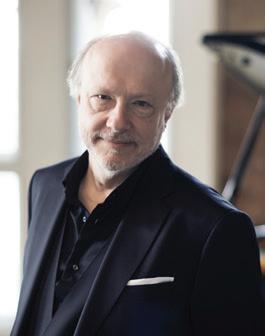
MARC-ANDRÉ HAMELIN
IVES Sonata No. 2 (Concord, Mass., 1840–60)
Emerson Hawthorne
The Alcotts
Thoreau
INTERMISSION
SCHUMANN Fantasy Pieces, Op. 12 In the Evening Soaring Why?
Whims In the Night Fable
Dream’s Confusions End of the Song
SCRIABIN Sonata in F-sharp Major, Op. 30, No. 4
Andante—
Prestissimo volando
The Chicago Symphony Orchestra Association acknowledges support from the Illinois Arts Council.
COMMENTS
by Richard E. Rodda
CHARLES IVES
Born October 20, 1874; Danbury, Connecticut
Died May 19, 1954; New York City
Sonata No. 2 (Concord, Mass., 1840–60)
Though Ives was one of the great musical modernists of the early twentieth century, the philosophical core of his work was unquestionably old-fashioned: that art could not only powerfully affect the heart, intellect, and spirit, but that it could also address mankind’s most profound concerns, beliefs that were formed and reinforced by his readings of Emerson, Browning, Hawthorne, Whitman, Whittier, Beecher, and the other American Transcendentalists.
Between 1907 and 1913, Ives planned a series of orchestral overtures inspired by those writers, titled Men of Literature, but only Browning reached its final form in that guise. The Matthew Arnold Overture was written in 1912, but was then lost. The overtures after Walt Whitman, John Greenleaf Whittier, and Henry Ward Beecher never went beyond the planning stage. By about 1911, Ives was trying to make piano concertos of Emerson and Hawthorne, but their stylistic and technical difficulties made performance in that form
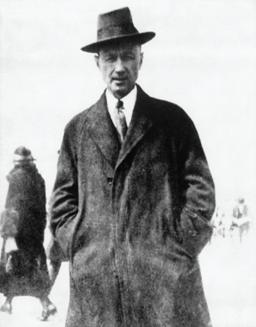
above: Charles Ives, ca. 1917
unlikely, so he reworked them again for solo piano as the first two movements of what he called a Concord Sonata, after the town outside Boston that was home and spiritual center to many of the Transcendentalists. He added to Emerson and Hawthorne a renovation of his Orchard House Overture from around 1904 to represent The Alcotts and composed, apparently anew, a finale on Thoreau. By 1912 he was able to try out the complete Concord Sonata for a former Yale classmate, music critic Max Smith. In 1919 Ives wrote four long Essays Before a Sonata to explain the work’s expressive and philosophical content and published them along with the score the following year.
Ives began his Essays,
It has seemed to the writer that though Emerson is a great poet and prophet, he is greater, possibly, as an invader of the unknown— America’s deepest explorer of the spiritual immensities. . . . We see him standing on a summit, at the door of the infinite where many men do not dare to climb, peering into the mysteries of life, contemplating the eternities, hurling back whatever he discovers there. . . . There is an “oracle” at the beginning of [Beethoven’s] Fifth
Symphony [whose opening motto is referred to repeatedly in the movement]—in those four notes lies one of Beethoven’s greatest messages. We would place its translation above the relentlessness of fate knocking at the door, above the greater human message of destiny, and strive to bring it towards the spiritual message of Emerson’s revelations—even to the “common heart” of Concord—the Soul of humanity knocking at the door of the Divine mysteries, radiant in the faith that it will be opened—and that the human will become the Divine!
Hawthorne is an extended fragment trying to suggest some of his wilder, fantastical adventures into the half-childlike, half-fairylike phantasmal realms. It may have something to do with the children’s excitement on that “frosty Berkshire morning and the frost imagery on the enchanted hall window” or something to do with the little demons dancing around his pipe bowl; or something to do with the old hymn tune that haunts the church and sings only to those in the churchyard to protect them from secular noises, as when the circus parade comes down Main Street.
Concord village itself reminds one of that common virtue lying at the height and root of all Concord divinities. As one
walks down the broad-arched street, passing the white house of Emerson—ascetic guard of a former prophetic beauty—he comes presently beneath the old elms overspreading the Alcott house. . . . There is a commonplace beauty about Orchard House—a kind of spiritual sturdiness underlying its quaint picturesqueness—a value that seems to stir a deeper feeling, a stronger sense of being nearer some perfect truth than a Gothic cathedral or an Etruscan villa. . . .
And so we won’t try to reconcile the music sketch of the Alcotts with much besides the memory of that home under the elms—the Scotch songs and the family hymns that were sung at the end of each day—a strength of hope that never gives way to despair—a conviction in the power of the common soul, which, when all is said and done, may be as typical as any theme of Concord and its Transcendentalists.
And if there be a program [in the fourth movement], let it follow Thoreau’s thought on an autumn day at Walden—a shadow of a thought at first, colored by the mist and haze over the pond: Low anchored cloud,/Fountain head and /Source of rivers. . . . /Dew cloth, dream drapery—/Drifting meadow of the air. . . . He knows now that he must let Nature flow through him and slowly; he releases his more personal desires to her broader rhythm, conscious that this blends
COMMENTS
more and more with the harmony of her solitude. . . . His meditations are interrupted only by the faint sound of the Concord bell. . . . Is it a transcendental tune of Concord?
’Tis an evening when the “whole body is one sense” . . . and before ending his day, he looks out over
ROBERT SCHUMANN
Born June 8, 1810; Zwickau, Germany
the clear, crystalline water of the pond and catches a glimpse of the shadow-thought he saw in the morning’s mist and haze. . . . He goes up the “pleasant hillside of pines, hickories, and moonlight to his cabin, with a strange liberty of Nature, a part of herself.”
Died July 29, 1856; Endenich, near Bonn, Germany
Fantasy Pieces, Op. 12
COMPOSED 1837
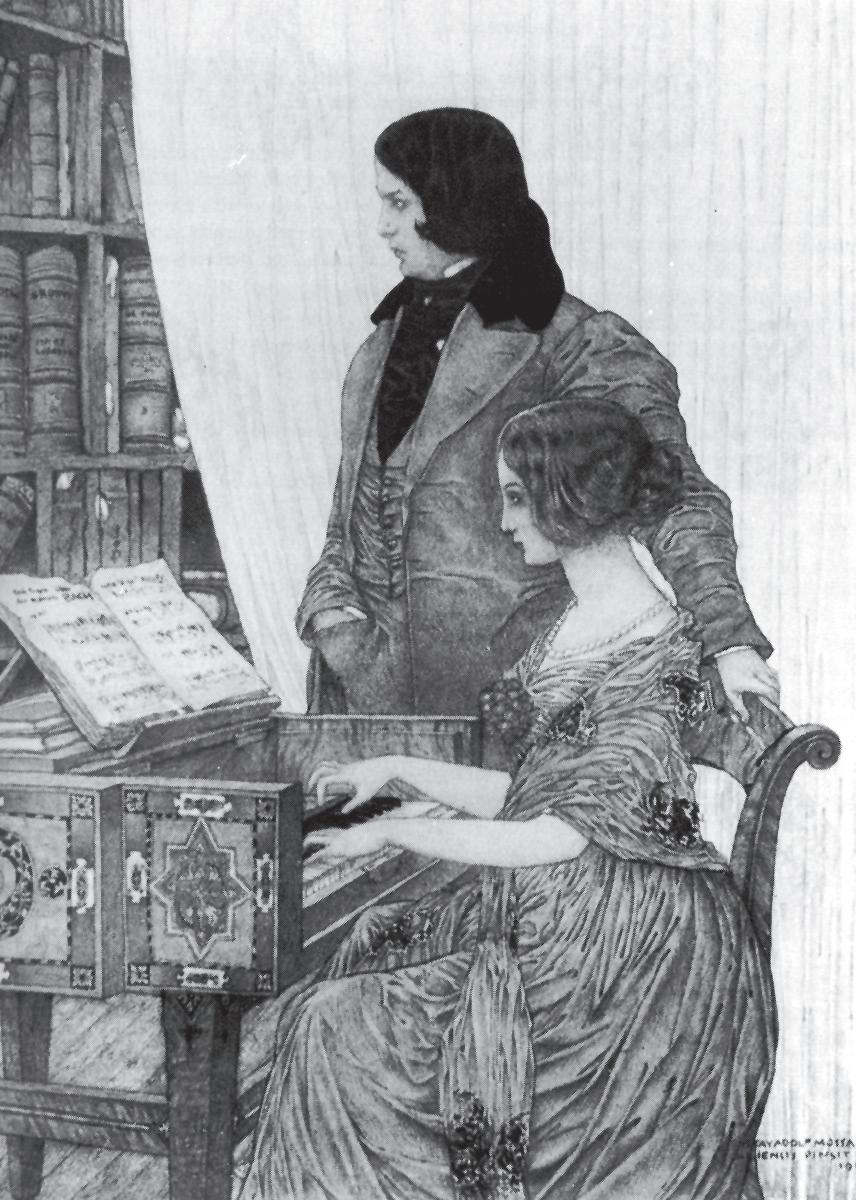
Schumann’s 1837 fantasy pieces were products of the turbulent time when his heated passion for Clara Wieck was being thwarted by the girl’s father, the renowned piano pedagogue Friedrich. Papa Wieck had shaped Clara, then eighteen, into a splendid pianist who was just gaining an international reputation for her talent, and he had no intention of allowing his still-underage daughter to be deflected from her career by the ardor of a twenty-seven-year-old musician of slim prospects and volatile personality. Early in 1836 Wieck shipped Clara off to Dresden to get her away from Schumann, but Robert followed his beloved there and won a
declaration of mutual love from her. When Wieck learned of this development, he retrieved Clara to Leipzig and forbade her further personal contact with Schumann. Letters and music would have to suffice for them. Despite the unsettled anxiety of those months, when Schumann often feared that he would lose not only Clara but also his reason, his creativity was fiercely fired by mingled pain and hope, and he produced the Dances of the Leage of David, op. 6, Fantasy, op. 17, Kreisleriana, op. 16, and Fantasy Pieces, op. 12. The fantasy pieces were composed during the spring and early summer of 1837; in August, Clara and Robert were engaged—by surreptitious letter. It was to be three more years, which were fraught with Friedrich Wieck’s ceaseless litigation to keep them apart, before they were finally married, on the eve of Clara’s twenty-first birthday.
Though the fantasy pieces were inspired by Schumann’s love for Clara, they were dedicated upon their publication to Anna Robena Laidlaw (1819–1901), an English pianist visiting Leipzig in June 1837 to perform at the Gewandhaus concerts under Mendelssohn’s direction. She had established a sufficient reputation in Britain to have been engaged to appear at Paganini’s farewell concert in London in 1834, and she was successful enough on her tours of Germany to receive an appointment as court pianist to the queen of Hanover. Schumann and Anna talked, strolled in the countryside, and made music together during her stay in Leipzig, and she was drawn to Robert strongly enough to leave him a locket of her hair. The dedication of op. 12 was a souvenir of their pleasant meetings, and, perhaps, an encouragement to her to perform his music in her homeland. “I felt very sorry for poor Miss Laidlaw,” Clara wrote coyly to Robert on January 7, 1838, “as she certainly carries you in her heart. If I were to tell you that I was jealous, I should be lying, and if I were to tell you that I wasn’t, you wouldn’t believe me anyway. . . .”
The eight fantasy pieces (a ninth piece was published posthumously in 1935) are suspended between the expressive poles of Schumann’s personal and creative nature—the impetuous and extroverted
Florestan and the dreamy and intimate Eusebius. To sharpen their imagery, Schumann added an evocative title to each movement after the set had been completed. The opening number, In the Evening, a tender nocturne buoyed upon a rippling triplet accompaniment, is the embodiment of Eusebian musing. Florestanian contrast is provided by the passionate energy of Soaring. Robert Haven Schauffler, in his flowery biography of Schumann, proposed a charming scenario for the sensitive Why: “Robert asks, ‘Why not get married?’ Clara wistfully replies, and Wieck dips his gruff oar into the bass.” Schumann instructed
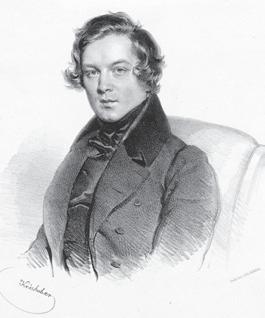
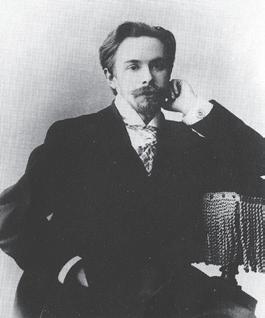
opposite page: Schumann, 1839, in a sketch by Josef Kriehuber (1800–1876) | this page: A portrait of Clara and Robert Schumann by Gustav-Adolf Mossa (1883–1971), 1913 | next page: Alexander Scriabin, ca. 1899
COMMENTS
that the quickly changing moods of Whims are to be played “with humor.” Regarding In the Night, Schumann confided to Clara,
After I had finished it, I found, to my delight, that it contained the story of Hero and Leander. Of course, you know it, how Leander swam every night through the sea to his love, who awaited him at the beacon, and showed him the way with a lighted torch. When I am playing In the Night, I can’t get rid of the idea. First, he throws himself into the sea; she calls him, he answers; he battles with the waves, and reaches land safely. Then the cantilena, when they are clasped in
ALEXANDER SCRIABIN
Born January 6, 1872; Moscow, Russia
Died April 27, 1915; Moscow, Russia
each other’s arms, until they have to part again, and he can’t tear himself away, until night wraps everything in darkness once more.
Fable suggests an agitated tale that is introduced and concluded by the storyteller’s slow phrases. Dream’s Confusions is a brilliant, virtuoso study that pauses only for the brief hymnlike passage that forms its central episode. In a letter that lays bare the opposing elements of his character, Schumann wrote to Clara concerning End of the Song: “Toward the end, everything gives place to a joyous wedding, but then the sorrow around you returns, and one hears the marriage bells and the death knell sounding together.”
Sonata in F-sharp Major, Op. 30, No. 4
COMPOSED 1903
“The Muscovite seer”; “the Russian musical mystic”; “the clearest case of artistic egomania in the chronicles of music”: Alexander Scriabin was one of the most unusual of all composers. Living in the generation between Tchaikovsky and Prokofiev,
he showed an early talent for music and trod the accepted path of lessons, conservatory training, and teaching. His visions, however, refused to be channeled into conventional forms of artistic expression, and he developed a unique style and philosophy.
Scriabin’s life was shaken by several significant changes around 1902, when he resigned from the faculty of the Moscow Conservatory to devote himself to composition and rumination.
From that time on, Scriabin bent his music ever more forcibly to expressing his dizzying world vision. He believed that mankind was approaching a final cataclysm from which a nobler race would emerge, with himself playing some exalted but ill-defined messianic role in the new order. (He welcomed the beginning of World War I as the fulfillment of his prophecy.) As the transition through this apocalypse, Scriabin posited an enormous ritual that would purge humanity and make it fit for the millennium. He felt that he was divinely called to create this ritual, this Mystery as he called it, and he spent the last twelve years of his life concocting ideas for its realization. Scriabin’s mammoth Mystery was to be performed in a specially built temple in India (a country in which he never set foot) and was to include music, mime, fragrance, light, sculpture, costume, etc., which were to represent the history of man from the dawn of time to the ultimate world convulsion. He even imagined a language of sighs and groans that would express feelings beyond mere words. He whipped all these fantasies together to create a vision of emotional ferment quite unlike anything else in the history of music or any other art. In describing the Poem of Ecstasy to his friend Ivan Lipaev, he said, “When you listen to it, look straight into the eye of the Sun!”
The Sonata no. 4 was composed in the crucial year of 1903, when Scriabin began to demonstrate the unique harmonic language built on daring, far-flung combinations of intervals that defined the conventional theory and came to be his characteristic musical speech. The two-movement Fourth Sonata opens with a dreamy meditation based on a gently upward-leaping theme and a brief answering motif built from scale steps; the leaping theme dominates. The sonata-form Prestissimo volando (as fast as possible, flying), which follows without pause, takes as its main theme a motif in quick, nervous, interrupted rhythms and as its second subject a broad idea ascending in chromatic half steps. The development section treats the main theme with increasing animation until the upward-leaping motif from the first movement is recalled as a bridge to the recapitulation, in which both themes return in heightened settings. The sonata reaches a grand climax in a coda based on the first movement’s leaping theme in a noble, aspiring transformation.
Richard E. Rodda, a former faculty member at Case Western Reserve University and the Cleveland Institute of Music, provides program notes for many American orchestras, concert series, and festivals.