COMMENTS
KEVIN PUTS
Born January 3, 1972; Saint Louis, Missouri
Kevin Puts on Emily — No Prisoner Be
Emily — No Prisoner Be emerged through my collaboration with great performers from two different realms.
The Hours—an opera based on the novel by Michael Cunningham with a libretto by Greg Pierce—was commissioned by the Metropolitan Opera and featured a trio of stars, including Joyce DiDonato, who created the role of Virginia Woolf to rapturous acclaim.
My creative work during the COVID-19 pandemic toggled between this mammoth project and another: a triple concerto called Contact for the dynamic string trio Time for Three. At some point during our work on Contact, the members of Time for Three (Nicolas Kendall, violin and vocals; Charles Yang, violin and vocals; Ranaan Meyer, bass and vocals) and I realized we were having too much fun and needed to look ahead to another project in the near future. When the idea of an album of songs arose, I had just the singer in mind! I had a strong feeling that the deep musical intuition, larger-than-life personalities, and fiercely creative minds of all four of these powerhouse
artists might gel in a very special way. I wasn’t wrong.
But an album of songs based on what text? I stumbled upon this poem by Emily Dickinson and had the answer:
They shut me up in Prose –As when a little Girl
They put me in the Closet –
Because they liked me “still” –
Still! Could themself have peeped –And seen my Brain – go round –They might as wise have lodged a Bird
For Treason – in the Pound –
Himself has but to will And easy as a Star Look down upon Captivity –And laugh – No more have I –
Though Juilliard- and Curtis Institutetrained musicians of the highest caliber, Time for Three exudes the energy of a rock/pop concert at its most exhilarating. I could imagine this energy right from the start, with “shredding” violin virtuosity ushering in Joyce’s first lines. The trio could even sing back her lines in counterpoint and provide harmonic support in the manner of Aretha Franklin’s backup singers. In short, I could see from the start this wasn’t going to be your grandmother’s Emily Dickinson song cycle.
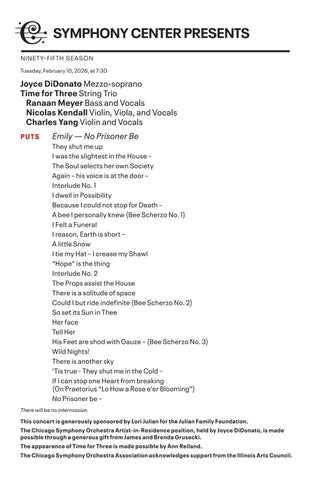
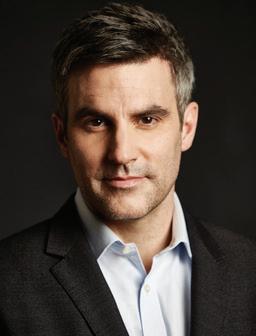
The breadth of the entire work became vaguely apparent in my mind, above: Kevin Puts, photo by David White
COMMENTS
a rather massive journey through Dickinson’s poetry framed by her refusal to be contained in “prose,” or—put less poetically—within the confines of conventional religious ideology, societal norms of the era, traditional social conventions, or even sexual identity. Though she famously cloistered herself in a room in her father’s house for much of her life, she would be a prisoner of nothing and no one.
To be sure, there is nothing groundbreaking in the choice to set Emily Dickinson’s poetry to music, and admittedly, my mention of it caused a few eyes to roll in the early stages. In fact, according to David Nirenberg, director of Princeton’s Institute for Advanced Studies, who graciously hosted the five of us for two immensely productive workshops, there have been over 3,000 musical settings of Emily Dickinson’s poetry. It positively cries out to be sung. There is music in every line, every word, and in the spaces between the words. It inspires rhythm, harmony, melody, musical atmosphere—it leaps off the page in a way composers have been unable to resist.
So I simply began to set poems— some well-known, some more obscure—as I discovered them, writing quickly and with little sense of where each song might eventually appear sequentially in the cycle. This approach to form represented a departure from the way I normally work, and frankly, it made me nervous. Not until I began workshopping the various songs with Joyce and Time for Three did I discover we could allow the music to dictate the
course of things. Historians have relied on Dickinson’s handwriting to make rough guesses as to when in her life a poem was written, but we do not know the precise order. It seems she wrote them as the spirit moved her.
So once I disavowed any obligation to preserve chronology or give the work a sequential thematic structure, isolated songs began to coalesce into small groups of songs.
Dickinson enjoyed a particular fascination with bees, judging from the number of poems written about them, so I found myself composing “bee scherzos,” which serve the dual function of showcasing Time for Three’s virtuosity and giving Joyce’s voice a much-needed rest during this rather colossal cycle. In fact, I was delighted to find that, in her indispensable book Dickinson, Helen Vendler fittingly describes the following as a “winsomely playful scherzo”:
Bee! I’m expecting you! Was saying Yesterday To Somebody you know That you were due –
The Frogs got Home last Week –Are settled, and at work –Birds, mostly back –The Clover warm and thick –
You’ll get my Letter by The seventeenth; Reply Or better, be with me –Yours, Fly.
These scherzos also serve as connective material between clusters of songs. Sometimes I even found myself flipping through Dickinson’s 1,800 poems to find one whose musical setting might close a “gap” in a similar way within the arc of the whole piece.
Though the intention of a poem like the wonderful “I dwell in Possibility” is clear enough, others are more resistant to interpretation, at least for this composer. Again, to quote Vendler, “like all capacious writers, she baffles complete understanding,” yet these more enigmatic offerings often create the most alluring space for musical setting. For example, the following:
So set its Sun in Thee What Day be dark to me –What Distance – far –So I the Ships may see That touch – how seldomly –Thy Shore?
There is the sense of longing for something just out of reach, and there is
the setting sun and the gentle rhythm of the tide. And for me, that is enough.
In my program note for The Hours, I described a rather metaphysical experience after spending so much time considering the predicaments and motivations of Virginia Woolf, albeit through a secondhand incarnation of the great writer formed in the mind of Michael Cunningham. It truly began to feel as if she were in the room with me as I grafted melodies and harmonies onto her story. I experienced something similar with the ghost of Georgia O’Keeffe as I mined hundreds of her letters to create The Brightness of Light for Renée Fleming. Emily Dickinson also stopped by my little third-floor office in Yonkers, New York (it’s getting crowded up here!). And when I visited Dickinson’s house in Amherst, Massachusetts, in summer 2024, I felt an odd familiarity and sense of recognition, though undoubtedly one formed by my own projecting and romanticizing. But this is, after all, what we do with our heroes.
REFRESHMENTS AT SYMPHONY CENTER
You can order drinks and snacks before the performance or during intermission at various bars located throughout Symphony Center, including the Bass Bar in the Rotunda and most of the lobby spaces in Orchestra Hall.
They shut me up
Poetry by Emily Dickinson
They shut me up in Prose –
As when a little Girl
They put me in the Closet –
Because they liked me “still” –
Still! Could themself have peeped –
And seen my Brain – go round –
They might as wise have lodged a Bird
For Treason – in the Pound –Himself has but to will
And easy as a Star
Look down upon Captivity –
And laugh – No more have I –
I was the slightest in the House –I was the slightest in the House –I took the smallest Room –
At night, my little Lamp, and Book –
And one Geranium –
So stationed I could catch the Mint
That never ceased to fall –
And just my Basket –
Let me think – I’m sure –
That this was all –
I never spoke – unless addressed –
And then, ‘twas brief and low –
I could not bear to live – aloud –
The Racket shamed me so –
And if it had not been so far –
And any one I knew
Were going – I had often thought How noteless – I could die –
The
Soul selects her own Society
The Soul selects her own Society –
Then – shuts the Door –
To her divine Majority –
Present no more –
Unmoved – she notes the Chariots –pausing –
At her low Gate –
Unmoved – an Emperor be kneeling
Upon her Mat –
I’ve known her – from an ample nation –
Choose One –
Then – close the Valves of her attention –
Like Stone –
Again – his voice is at the door –
Again – his voice is at the door –
I feel the old Degree –
I hear him ask the servant
For such an one – as me –
I take a flower – as I go –
My face to justify –
He never saw me – in this life –
I might surprise his eye!
I cross the Hall with mingled steps –
I – silent – pass the door –
I look on all this world contains –
Just his face – nothing more!
We talk in careless – and it toss –
A kind of plummet strain –
Each – sounding – shyly –
Just – how – deep –
The other’s one – had been –
We walk – I leave my Dog – at home –
A tender – thoughtful Moon –
Goes with us – just a little way –
And – then – we are alone –
Alone – if Angels are “alone” –
First time they try the sky!
Alone – if those “veiled faces” – be –
We cannot count – on High!
I’d give – to live that hour – again –
The purple – in my Vein –But He must count the drops – himself –My price for every stain!
Interlude
No. 1
I dwell in Possibility
I dwell in Possibility –A fairer House than Prose –More numerous of Windows –Superior – for Doors –Of Chambers as the Cedars –Impregnable of eye –
And for an everlasting Roof
The Gambrels of the Sky –Of Visitors – the fairest –For Occupation – This –
The spreading wide my narrow Hands
To gather Paradise –
Because I could not stop for Death –
Because I could not stop for Death –He kindly stopped for me –
The Carriage held but just Ourselves –And Immortality.
We slowly drove – He knew no haste And I had put away
My labor and my leisure too, For His Civility –We passed the School, where Children strove
At Recess – in the Ring –We passed the Fields of Gazing Grain –We passed the Setting Sun –Or rather – He passed Us –
The Dews drew quivering and Chill –For only Gossamer, my Gown –My Tippet – only Tulle –We paused before a House that seemed A Swelling of the Ground –The Roof was scarcely visible –The Cornice – in the Ground –Since then – ’tis Centuries – and yet Feels shorter than the Day I first surmised the Horses’ Heads Were toward Eternity –
A Bee I personally knew (Bee Scherzo No. 1)
A single Clover Plank Was all that saved a Bee
A Bee I personally knew From sinking in the sky –’Twixt Firmament above And Firmament below The Billows of Circumference Were sweeping him away –The idly swaying Plank Responsible to nought A sudden Freight of Wind assumed And Bumble Bee was not –This harrowing event Transpiring in the Grass Did not so much as wring from him A wandering “Alas” –
(Please turn the page quietly.)
I Felt a Funeral
I felt a Funeral, in my Brain, And Mourners to and fro
Kept treading – treading – till it seemed That Sense was breaking through –And when they all were seated, A Service, like a Drum –Kept beating – beating – till I thought My mind was going numb –And then I heard them lift a Box And creak across my Soul
With those same Boots of Lead, again, Then Space – began to toll, As all the Heavens were a Bell, And Being, but an Ear, And I, and Silence, some strange Race, Wrecked, solitary, here –
And then a Plank in Reason, broke, And I dropped down, and down –And hit a World, at every plunge, And Finished knowing – then –
I reason, Earth is short –I reason, Earth is short –And Anguish – absolute –And many hurt, But, what of that?
I reason, we could die –
The best Vitality
Cannot excel Decay, But, what of that?
I reason, that in Heaven –Somehow, it will be even –Some new Equation, given –But, what of that?
A little Snow
A little Snow was here and there Disseminated in her Hair –Since she and I had met and played Decade had gathered to Decade –But Time had added not obtained Impregnable the Rose For summer too indelible Too obdurate for Snows –
I tie my hat – I crease my Shawl I tie my Hat – I crease my Shawl –Life’s little duties do – precisely –
As the very least Were infinite –to me –I put new Blossoms in the Glass –And throw the old – away –I push a petal from my gown That anchored there – I weigh The time ’twill be till six o’clock I have so much to do –
And yet – Existence – some way back –Stopped – struck – my ticking –through –
We cannot put Ourself away As a completed Man Or Woman – When the Errand’s done We came to Flesh – upon –
There may be – Miles on Miles of Nought –Of Action – sicker far –
To simulate – is stinging work –To cover what we are From Science – and from Surgery –Too Telescopic Eyes
To bear on us unshaded –For their – sake – not for Ours –’Twould start them –
We – could tremble –But since we got a Bomb –And held it in our Bosom –Nay – Hold it – it is calm –
Therefore – we do life’s labor –Though life’s Reward – be done –With scrupulous exactness –To hold our Senses – on –
“Hope” is the thing
“Hope” is the thing with feathers –That perches in the soul –And sings the tune without the words –And never stops at – all –And sweetest – in the Gale is heard –And sore must be the storm –That could abash the little Bird
That kept so many warm –
.
I’ve heard it in the chillest land –And on the strangest Sea –Yet, never, in Extremity, It asked a crumb – of Me
Interlude No. 2
The Props assist the House
The Props assist the House
Until the House is built And then the Props withdraw And adequate, erect, The House support itself And cease to recollect
The Augur and the Carpenter –Just such a retrospect Hath the perfected Life –
A Past of Plank and Nail And slowness – then the scaffolds drop
Affirming it a Soul –
There is a solitude of space
There is a solitude of space
A solitude of sea
A solitude of death, but these Society shall be
Compared with that profounder site That polar privacy
A soul admitted to itself –Finite infinity
Could I but ride indefinite (Bee Scherzo
No. 2)
Could I but ride indefinite
As doth the Meadow Bee And visit only where I liked And No one visit me
And flirt all Day with Buttercups And marry whom I may And dwell a little everywhere Or better, run away With no Police to follow Or chase Him if He do Till He should jump Peninsulas To get away from me
I said But just to be a Bee Upon a Raft of Air And row in Nowhere all Day long And anchor off the Bar What Liberty! So Captives deem Who tight in Dungeons are.
So set its Sun in Thee
So set its Sun in Thee What Day be dark to me –What Distance – far –
So I the Ships may see That touch – how seldomly –Thy Shore?
(Please turn the page quietly.)
Her face
Her face was in a bed of hair,
Like flowers in a plot –
Her hand was whiter than the sperm
That feeds the sacred light.
Her tongue more tender than the tune That totters in the leaves –Who hears may be incredulous, Who witnesses, believes.
Tell Her
Going – to – Her!
Happy – Letter! Tell Her –
Tell Her – the page I never wrote!
Tell Her, I only said – the Syntax –
And left the Verb and the Pronoun – out!
Tell Her just how the fingers – hurried –Then – how they – stammered –slow – slow –
And then – you wished you had eyes –in your pages –
So you could see – what moved –them – so –
Tell Her – it wasn’t a practised writer –
You guessed –
From the way the sentence – toiled –
You could hear the Bodice – tug –behind you –
As if it held but the might of a child!
You almost pitied - it – you – it worked so –
Tell Her – No – you may quibble – there –For it would split Her Heart – to know it –
And then – you and I – were silenter!
Tell Her – Day – finished before we –finished –
And the old Clock kept neighing – “Day”!
And you – got sleepy – and begged to be ended –
What could – it hinder so – to say?
Tell Her – just how she sealed – you –Cautious!
But – if she ask “where you are hid” –until the evening –[Ah!] Be bashful!
Gesture Coquette –And shake your Head!
His Feet are shod with Gauze –(Bee Scherzo No. 3)
His Feet are shod with Gauze –His Helmet, is of Gold, His Breast, a Single Onyx With Chrysophrase, inlaid.
His Labor is a Chant –His Idleness – a Tune –Oh, for a Bee’s experience Of Clovers, and of Noon!
Wild Nights!
Wild Nights – Wild Nights! Were I with thee Wild Nights should be Our luxury!
Futile – the winds –To a heart in port –Done with the compass –Done with the chart!
Rowing in Eden –Ah, the sea!
Might I moor – Tonight –In thee!
There is another sky
There is another sky, Ever serene and fair, And there is another sunshine, Though it be darkness there; Never mind faded forests, [Austin,] Never mind silent fields –Here is a little forest, Whose leaf is ever green; Here is a brighter garden, Where not a frost has been; In its unfading flowers I hear the bright bee hum: Prithee, my brother, Into my garden come!
‘Tis true – They shut me in the Cold –’Tis true – They shut me in the Cold –But then – Themselves were warm And could not know the feeling ’twas –Forget it – Lord – of Them –Let not my Witness hinder Them In Heavenly esteem –No Paradise could be – Conferred Through Their beloved Blame –The Harm They did – was short –And since Myself – who bore it – do –Forgive Them – Even as Myself –Or else – forgive not me –
If I can stop one Heart from breaking (On Praetorius “Lo How a Rose e’er Blooming”)
If I can stop one heart from breaking, I shall not live in vain; If I can ease one life the aching, Or cool one pain, Or help one fainting robin Unto his nest again, I shall not live in vain.
No Prisoner be –No Prisoner be –Where Liberty –[Her]self – abide with Thee –
The Chicago Symphony Orchestra Artist-inResidence position, held by Joyce DiDonato, is made possible through a generous gift from James and Brenda Grusecki.
PROFILES
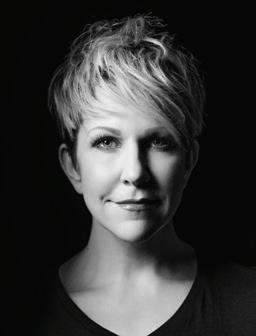
Joyce DiDonato Mezzo-soprano
Winner of multiple Grammy awards and a 2018 Olivier Award for Outstanding Achievement in Opera, Kansas-born Joyce DiDonato has soared to the top of the industry as a performer, producer, and fierce advocate for the arts.
Recent highlights include Handel’s Theodora for the Teatro Real in Madrid and an acclaimed European recital tour. She continued her celebrated musical partnership with the Philadelphia Orchestra and Yannick Nézet-Séguin, and her spring residency at the Konzerthaus Dortmund featured the world premiere of Rachel Portman’s song cycle Another Eve.
DiDonato’s distinctively varied 2025–26 season began with seasonopening concerts with both the Minnesota Orchestra and the Orchestre Métropolitain de Montréal, as well as the reopening of Powell Hall with the St. Louis Symphony Orchestra in the world premiere of Kevin Puts’s House of Tomorrow. She returned to Musikkollegium Winterthur for Another Eve and collaborated with Radio France for Mahler’s Rückert-Lieder in Paris and Dijon. She also reunites with pianist Craig Terry for recitals at Théâtre de Genève and Suntory Hall in Tokyo and embarks on her first major tour of Australia with the Melbourne, Tasmanian, and New Zealand symphony
orchestras. DiDonato made her Lincoln Center Theater stage debut as the mother in Menotti’s Amahl and the Night Visitors and her much-anticipated role debut at the Metropolitan Opera in Saariaho’s Innocence. Concert appearances include Mahler’s Symphony no. 2 with the Philadelphia Orchestra and Symphony no. 3 with the Berlin Philharmonic under the baton of NézetSéguin. The artist maintains her annual master class series at Carnegie Hall in New York and tours her album SongPlay throughout Asia. She also joins the Met Orchestra for her second European tour with Nézet-Séguin, following a performance of Mahler’s Symphony no. 4 at Carnegie Hall.
Her latest global touring project, EDEN, completed a groundbreaking three years with tours in Asia, South America, the United States, and Europe. A newly commissioned song cycle by Kevin Puts, Emily — No Prisoner Be, for her and the Grammy Award–winning string trio Time for Three, had its world premiere at the Bregenz Festival in August 2025.
On the operatic stage, DiDonato’s recent roles include Virginia Woolf (The Hours), Sister Helen Prejean (Dead Man Walking), Agrippina, Cendrillon, Sesto (La Clemenza di Tito), and Adalgisa (Norma), all for the Metropolitan Opera.
Much in demand on the concert and recital circuit, DiDonato has held residencies at Carnegie Hall and the Barbican Centre in London; toured extensively in the United States, South America, Europe, and Asia; and
PHOTO
appeared as guest soloist at the BBC’s Last Night of the Proms.
Her expansive discography includes Berlioz’s Les Troyens (Gramophone’s Recording of the Year) and Handel’s Agrippina (Gramophone’s Opera Recording of the Year). Other albums include the singular EDEN, spanning four centuries of music; Schubert’s Winterreise with Nézet-Séguin; and the Grammy-winning SongPlay, Diva Divo, and Drama Queens. Additional honors include being inducted into the Gramophone Hall of Fame, receiving the Fourteenth Concertgebouw Prize in September 2024, and being named an Officer of the Order of Arts and Letters by the French Republic.
Joyce DiDonato is the CSO Artistin-Residence for the 2025–26 season, made possible through a generous gift from James and Brenda Grusecki.
Time for Three String Trio
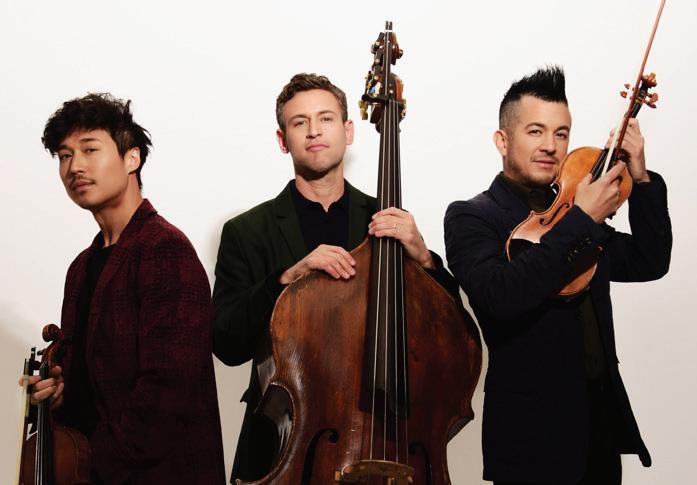
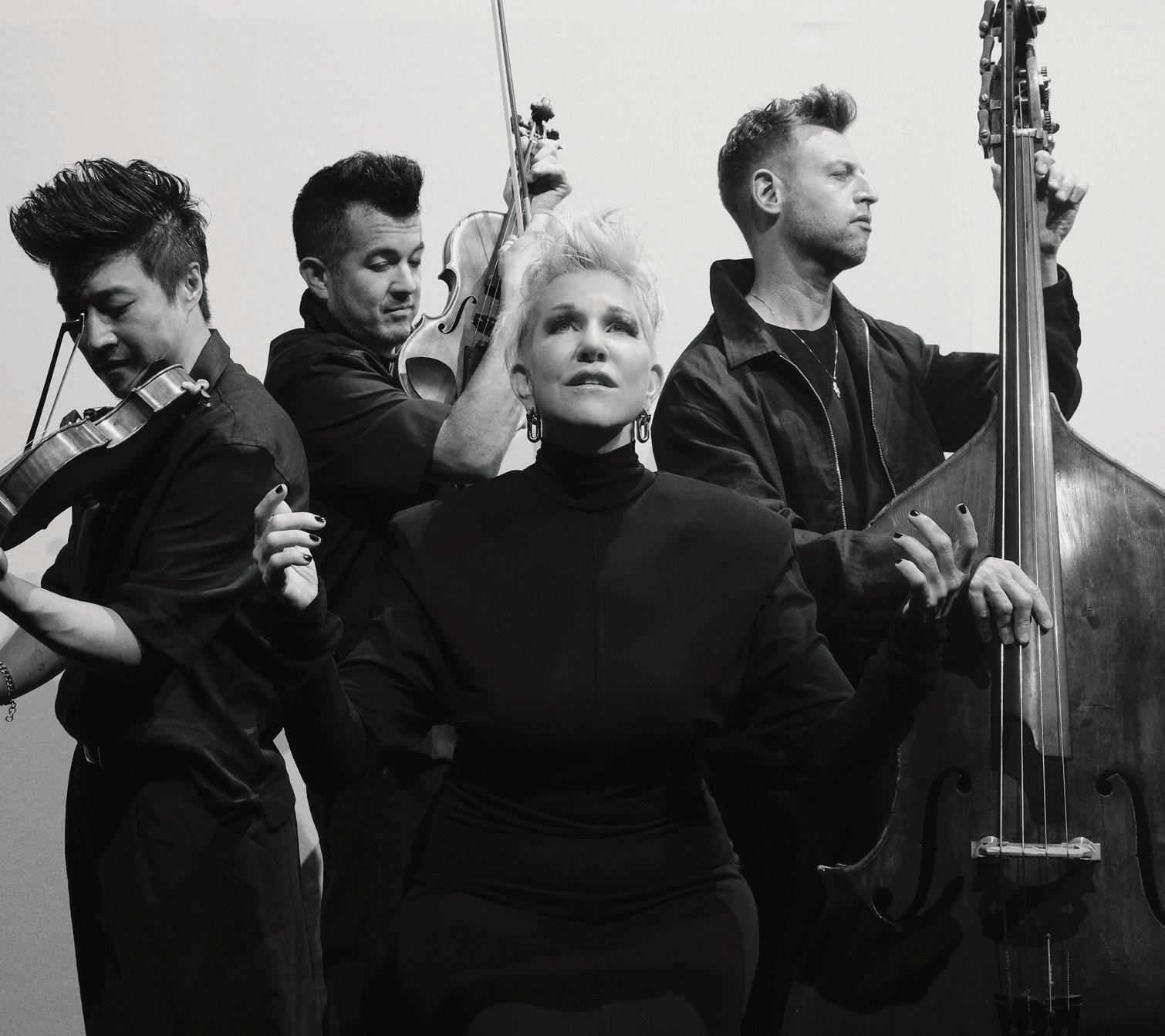
Grammy- and Emmy-winning ensemble Time for Three (TF3) defies convention and boundaries, merging classical, Americana, and singer-songwriter traditions into a singular, remarkable sound. Consisting of Ranaan Meyer (double bass and vocals), Nicolas “Nick” Kendall (violin and vocals), and Charles Yang (violin and vocals), TF3 captivates audiences worldwide with its virtuosic playing and insatiable appetite for creativity that expands typical perceptions of a string trio.
PRODUCTION CREDITS
Andrew Staples Director, Lighting, and Sound Designer
Lars Braun Stage Manager
William Reynolds Lighting Designer
Colin Egan Sound Engineer
Metamorphoza Dress Designer
Joyce DiDonato, Ranaan Meyer, Nicolas Kendall, Charles Yang Producers
Emily — No Prisoner Be has been generously supported by Mary Ellen Clark, Helen Berggruen for Five Arts Foundation, Gordon P. Getty, and Elaine Camarda and Morris Williams.
The creation of Emily — No Prisoner Be was made possible by the Lead Commissioner, Bregenzer Festspiele, and Co-Commissioners Cal Performances at the University of California, Berkeley, and University of California, Santa Barbara Arts and Lectures.
Special thanks to Gwydion Theatre Company and Anya Plotkin
This season, TF3 appears with the Philadelphia Orchestra and Marin Alsop, Louisville Orchestra and Teddy Abrams, and St. Louis Symphony and Stéphane Denève. The ensemble’s repertoire includes its newest commissioned concerto by composer Mason Bates, which premiered at Arizona Musicfest and was subsequently performed with the San Francisco Symphony and the Philadelphia Orchestra at the Saratoga Performing Arts Center. TF3 also embarks on a project titled Emily — No Prisoner Be with mezzo-soprano Joyce DiDonato. Written by Kevin Puts and inspired by the vivid and introspective poetry of Emily Dickinson, the project received its world premiere at the Bregenzer Festspiele and this season will visit Carnegie Hall and other top venues across the United States.
TF3 won a Grammy Award for the album Letters for the Future, released by Deutsche Grammophon, featuring works by Kevin Puts and Jennifer Higdon and recorded with the Philadelphia Orchestra. TF3 has enjoyed additional collaborations with Ben Folds, Natasha Bedingfield, Branford Marsalis, Joshua Bell, Jennifer Higdon, Chris Brubeck, William Bolcom, and Arlo Guthrie.
The ensemble’s concert special, Time for Three in Concert, was produced by PBS and earned the trio an Emmy Award.
TF3’s affinity for creative boundarypushing, commitment to encouraging the next generation of musicians, and relentless pursuit of musical excellence have solidified it as one of the most exceptional groups on the scene today.
SYMPHONY CENTER
PRESENTS
Jeff Alexander Chicago Symphony Orchestra Association President Cristina Rocca Vice President for Artistic Administration
The Richard and Mary L. Gray Chair
James M. Fahey Senior Director, Programming, Symphony Center Presents
Lena Breitkreuz Artist Manager, Symphony Center Presents Michael Lavin Director of Production
Joseph Sherman Associate Director of Production, SCP and Rental Events
MEET J oyce DiDonato & Time for Three
Please join us for a postconcert CD signing with tonight’s performers in the Rotunda.
Merchandise will be available in the outer lobby prior to the event.