Fanfare for the Uncommon Woman, No. 1
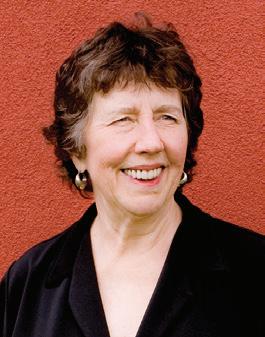
Aaron Copland wrote his famous Fanfare for the Common Man in 1942 to recognize everyday Americans whose work and tax dollars contributed so greatly to the ongoing war effort. It was one of a multitude of program-opening fanfares commissioned by Eugene Goossens, principal conductor of the Cincinnati Symphony at the time. In the 1980s, the composerin-residence at the Houston Symphony Tobias Picker embarked on a similar project to mark the 150th anniversary of the Declaration of Independence of Texas. Joan Tower was among those he asked to contribute a piece, and in 1986 she responded with a Fanfare for the Uncommon Woman, dedicated to the conductor Marin Alsop and, more broadly, “to women who take risks and who are adventurous.” The success of this first fanfare spurred Tower to compose many more over the ensuing years, all with inscriptions to women in the music industry whom she found inspiring. Alsop recorded an album of these fanfares with the Colorado Symphony in 1999, though Tower wrote
another in 2016 and has suggested she might write more should the occasion arise.
In the first Fanfare for the Uncommon Woman, she uses the same set of instruments that Copland did in his piece. In her program note, she points out a loose resemblance between the main theme of her work and the spacious call that opens Copland’s Fanfare. An ascending arpeggiated tuba entry that she adds partway through also contributes to the sense of homage. But otherwise, Tower’s is an entirely different sort of brassy showpiece. The proceedings open with the trumpets whipping off virtuosic, lightning-quick thirty-second-note licks that require extraordinary chops from the players. The weighty triplets that emerge in the trombones almost make the music sound like a stately march, but they have a raucous, danceable feeling to them. At the climax, triumphant, clarion triplet figures bounce around the group. When the brass players have expended all their energy, they sign off and let the three storming percussionists take it away in the final few measures.
—Nicky Swett
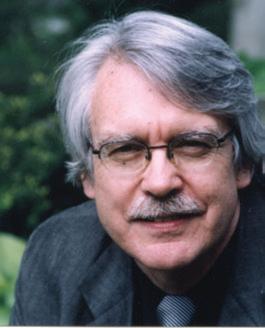
above: Joan Tower, photo by Bernard Mindich
IGOR STRAVINSKY
Born June 17, 1882; Oranienbaum, Russia
Died April 6, 1971; New York City
Symphonies of Wind Instruments (1947 revision)
On March 25, 1918, the day Claude Debussy died, Stravinsky finished writing a piano rag; the next month, he began The Soldier’s Tale. A page in music history had been turned.
Stravinsky and Debussy first met backstage after the premiere of The Firebird in June 1910. Debussy spoke kindly of the music, though he later told Stravinsky, “After all, you had to begin somewhere.” Stravinsky was in awe of his older colleague; he had admired Debussy’s music since the day he heard the Prelude to The Afternoon of a Faun as a boy in Russia.
Debussy had no reservations about Stravinsky’s next work, Petrushka, in which he noticed an “orchestral infallibility . . . found only in Parsifal.” Shortly after the Petrushka premiere, they met for lunch, drank champagne, and took photographs of each other. A close friendship developed, and Debussy later gave Stravinsky a walking stick inscribed with their initials.
Friendship between great composers is often complicated, and in the next few years, tensions arose. Debussy was irritated that The Rite of Spring was heralded everywhere as the watershed
score of the new century. (“It’s primitive music with all the modern conveniences,” he said.) Stravinsky admitted that he found Debussy’s acclaimed opera Pelleas and Melisande a “great bore.” In a letter to a friend dated 1916, Debussy dismissed Stravinsky as a spoiled child and an opportunist who wore flashy ties and “treads on women’s toes as he kisses their hands.”
The two composers continued to exchange affectionate letters, although during the war, when Debussy was suffering from cancer, they saw very little of each other. “His subtle, grave smile had disappeared,” Stravinsky later recalled, “and his skin was yellow and sunken; it was hard not to see the future cadaver in him. . . . I saw him last about nine months before his death. This was a triste visit, and Paris was grey, quiet, and without lights or movement.”
Nearly a year after Debussy died in the spring of 1918, Stravinsky learned that Debussy had dedicated the last of his three pieces, En blanc et noir, to him. “I was very moved by it,” Stravinsky wrote after receiving the score, “as well as delighted to see that it was such a good composition.” In the summer of 1920, Stravinsky accepted an invitation from Le revue musicale to contribute to a volume of piano pieces composed in memory of Debussy. He wrote fifty-one
measures of solemn chords, irregularly spaced, that he called a Tombeau de Claude Debussy. That music was quickly recycled as the final section of the Symphonies of Wind Instruments, which he completed in November 1920.
The first performance of the Symphonies of Wind Instruments under Serge Koussevitzky the following June made little impression—the piece was under-rehearsed (the scores arrived late), poorly positioned on the program (its spartan sonorities followed on the heels of Rimsky-Korsakov’s brilliant march from The Golden Cockerel), and badly played (the wind players remained in their chairs at the back of the stage, at an unfortunate distance from the conductor). Stravinsky later referred to Koussevitzky’s “execution” of the piece—“in the military sense.”
Stravinsky described the Symphonies of Wind Instruments as “an austere ritual which is unfolded in terms of short litanies between different groups of homogenous instruments.” He thought the title made better sense in French, although the use of the plural symphonies—alluding to the original meaning of the word, which implies instruments
sounding together—is unconventional in any language.
The Symphonies of Wind Instruments brilliantly shows Stravinsky’s ability to construct an entire score from small, dissimilar blocks of material. Stravinsky jumps from one to another like a film editor who constantly crosscuts between story lines. This restless, disjointed style is remarkably modern, and it influenced a whole new generation of composers long after Stravinsky had moved on to other things. The many shifts in tempo are, in fact, linked by a common pulse: Stravinsky uses only three metronome markings—72, 108, and 144—each a multiple of 36. Music that looks discontinuous on the page proves to be strangely hypnotic in performance, far greater than the sum of its parts. Finally, a sense of mood and line is sustained in the solemn chorale at the very end. There, in the procession of the grave, measured chords of the Tombeau, the music stretches toward infinity, as if Stravinsky were reluctant to take leave of the composer to whom, as he once admitted, he and the musicians of his generation owed the most.
—Phillip Huscher
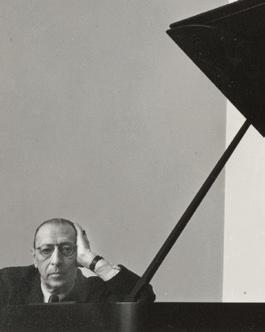
opposite page: Igor Stravinsky, photographed by Arnold Newman (1918–2006), 1946
JOHN HARBISON
Born December 20, 1938; Orange, New Jersey
Music for Eighteen Winds
Composers are rarely given a blank slate when they get a commission to write something new. Most invitations come with clear guidelines about instruments, scopes, or broader themes that must be incorporated into a work. John Harbison felt lucky when he got a completely open-ended request from the Arts Council of the Massachusetts Institute of Technology in 1985 to write something that could be played by any ensemble at the school. “I wrote a piece I had been contemplating for some time,” he explains in his program note on the resulting composition. “For winds, concise (about eleven minutes), and abstract (without extra musical associations).”
His chosen title for the work, Music for Eighteen Winds, could bring to mind Steve Reich’s Music for Eighteen Musicians, a landmark piece of American minimalism from the 1970s. In fact, Harbison said that he searched in vain for something splashier to call his wind work, but “the piece resisted.” It is a tightly constructed piece in two parts. In the first section, an up-tempo fanfare, the brass present martial
above: John Harbison, photo courtesy of the artist
syncopations in theatrical, antiphonal fashion. This brash dialogue becomes a backdrop for a helter-skelter solo shared by the bassoon and alto saxophone. Raucous, ascending scales in dissonant parallel fourths add to the hustle and bustle of the music. A short, thinly-scored interlude for flute and other supporting winds provides a momentary distraction from the chaotic urgings of the music, but soon enough the brass have resumed their shouting match, and assorted winds are buzzing with energy around them.
The second, slower part is introduced by a somber descent in the bassoons and clarinets, which sounds like some of the hyper-expressive, postromantic themes of Arnold Schonberg or Alban Berg. The wistful melodies that ensue seem like a complete departure from the music heard in the first part of the piece. Yet the musical ideas in this second section all have shapes that are borrowed from the initial, wild, up-tempo part. In his construction of the two halves of his piece, Harbison leverages an age-old principle of composition: that effective, meaningful contrast comes not from manipulating sheer amounts of difference, but from the complex interactions between varied elements
and elements that are carefully held constant. The mood shifts subtly close to the end of the piece. As Harbison explains it, “as the music becomes more and more cursive and
HENRY DORN
Born 1988; Little Rock, Arkansas
Never Forgetting
Henry Dorn is a nationally recognized composer and conductor whose music is celebrated for its rhythmic vitality, stylistic versatility, and deeply narrative voice. His works often reflect intimate stories, shaped by his perspective as both a musician and African American artist, and have been performed by distinguished ensembles across the country, including the Atlanta Symphony Orchestra, Detroit Symphony Orchestra, American Composers Orchestra, Minnesota Orchestra, United States Coast Guard Band, and the Dallas Winds.
Dorn currently serves as assistant professor of conducting and composition at St. Olaf College, where he leads the St. Olaf Band. Previously, he was assistant director of the Memphis Area Youth Wind Ensemble and director
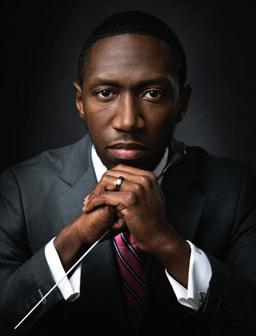
above: Henry Dorn, photo by Matthew Mitchell
self-contained, it also becomes warmer and more optimistic, a paradox that is close to this composer’s heart.”
—Nicky Swett
of the Nu Chamber Collective. He holds degrees from the University of Memphis, the Peabody Institute, and Michigan State University. His principal teachers in composition include David Biedenbender, Ricardo Lorenz, Alexis Bacon, Oscar Bettison, Kamran Ince, and Jack Cooper. He studied conducting with Kevin Sedatole, Harlan Parker, and Kraig Alan Williams.
Henry Dorn on Never Forgetting:
A message of hope. That is the intent behind this work. When Mallory Thompson approached me about writing for the Northshore Concert Band on the occasion of the ensemble’s seventieth season [in 2025], we spoke at length about giving voice to hope through music. A favorite quote of hers by Maya Angelou became the inspiration for the piece.
“I’ve learned that people will forget what you said, people will forget what you did, but people will never forget how you made them feel.”
Wrapped up in the simple quote are references to Angelou, the life she led, and the things she carried with her. Hope is an ever-constant underlying current in her writings, where she uses her voice to highlight elements of struggle juxtaposed with overcoming those hardships and being steadfastly resilient in the face of adversity. This work considers hope through that lens, considering the journey from the darkness of night toward a better and brighter day tomorrow.
Never Forgetting begins in quietude, a lone flute line shadowed by dark interjections in the low instruments—grief pressing in with growing weight. From this tension emerges a simple three-note idea that blossoms into a solemn theme, bearing the weight of memory and struggle. Gradually, light pierces the darkness. A solitary oboe lifts the harmony, while
a duet for alto saxophone and flute suggests the glimmer of hope that underpins the work. The music turns inward and outward at once, recalling earlier cries in the horns and reeds as clarinets introduce themes that lean toward resilience.
Midway, brightness asserts itself. The tempo quickens, rhythms drive forward, and swirling figures transform the opening gesture into sparks of optimism. The music surges toward a radiant climax—defiant and life-affirming, echoing Maya Angelou’s conviction that resilience is felt more deeply than words.
At its peak, the ground suddenly falls away. A clarinet line, altered by what has passed, remains as memory. Earlier themes return in softened form, tethered to their origins yet reshaped with humanity. In the closing bars, the flute recalls its opening song—fragile now, fading into unresolved quiet. The piece closes not with finality but as an open gesture, reminding us that hope is not a conclusion but an ongoing journey toward the next day’s light.
—Tyler Holstrom
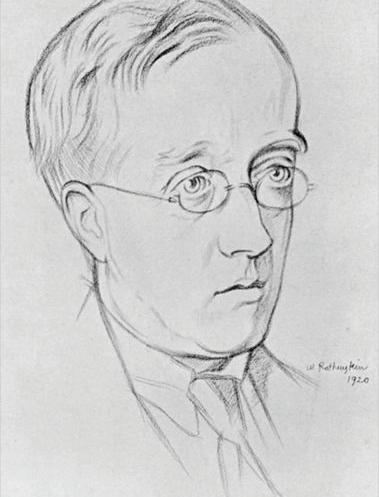
opposite page: Gustav Holst, sketch by William Rothenstein (1872–1945). Included in Music & Letters (Oxford University Press), vol. 1, no. 3 (July 1920)
GUSTAV HOLST
Born September 21, 1874; Cheltenham, England
Died May 25, 1934; London, England
First Suite in E-flat for Military Band, Op. 28, No. 1
Gustav Holst wrote his First Suite for Military Band in 1909, but the piece came to prominence in the early 1920s, when a slew of bands around Britain began to feature it on their programs. The suite received an uncharacteristically large number of positive newspaper reviews for band repertoire in that era. The Times noted that it was among the first works for military band “by a composer of standing” and praised it as a “healthy, cleanly written, diatonic, and generally outspoken and single-eyed composition.” The reviewer from The Observer went further, saying that “Holst has taken the military band seriously, as a beginning, and has mastered its technique, and his suite has the same value as would an orchestral piece from his pen.” The success of the piece helped to garner interest in writing for this instrumentation among English composers, paving the way for later band works by Ralph Vaughan Williams and Benjamin Britten.
Holst’s First Suite in E-flat opens with a chaconne. This baroque variation form involves continuously repeating a short melody or harmonic sequence, known as a “ground.” Holst’s refrain,
which is played plainly at the start by the clarinet, euphonium, and basses, is rather ingenious. It is a noble, touching tune on its own, but it also contains a multitude of wide leaps that imply a slew of different harmonies. This means it works well as a bassline and also as a primary, singing voice, and Holst continuously finds new characters by toggling between these identities. The large intervals that characterize the repeated melody are also relatively recognizable, which makes it quite exciting when, close to the end of the movement, the composer turns his ground upside down for a few cycles.
In the intermezzo, Holst writes a chirpy, syncopated ditty, alternating it with a broad melody that sounds like an English folk song. At the end, he layers these ideas in a show of wit and playfulness.
Holst gives the pickup to each phrase of the main theme of the closing march a righteous accent—a little kick that contributes to the pomp of the music. The lyrical theme that emerges over the course of the movement alludes to the repeated melody of the chaconne, making the rousing conclusion feel like the culmination of the complete work. In the march, the trombones get several sassy hits and melodic turns. Holst started playing the trombone when he
was twelve, and he continued to gig in orchestras and brass bands to support himself while studying composition at the Royal College of Music in the 1890s. The boisterous role of the instrument in the final movement of this suite may
WOLFGANG MOZART
Born January 27, 1756; Salzburg, Austria
Died December 5, 1791; Vienna, Austria
well have had a personal appeal to the composer—something he could imagine himself, or his friends, playing.
—Nicky Swett
Finale from Serenade No. 10 in B-flat Major, K. 370a (Gran Partita)
In the final year of his short life, Mozart loaned the clarinetist Anton Stadler 500 florins—a hefty sum in 1791, and one that put a serious dent in the composer’s finances. Mozart loved great musicians even more than money, and Stadler was his favorite clarinetist. In 1791 Mozart wrote two of his finest works for Stadler—a quintet for clarinet and strings (K. 581) and the clarinet concerto (K. 622), which is his last completed composition. They had worked together in Vienna for nearly ten years, and it was partly through Mozart’s intervention that Anton and his younger brother Johann became the first full-time
professional clarinetists in that important music capital. Mozart counted Anton among his close friends; they were fellow brothers in the Masonic order, and they obviously enjoyed each other’s company. They shared a fondness for games of all kinds and probably played billiards and bowled together; in 1787, when they took a coach to Prague to attend performances of The Marriage of Figaro, they invented names for themselves and the rest of their circle (Mozart was Punkitititi, and Stadler Nàtschibinitschibi).
It was Anton Stadler who first recognized this serenade for thirteen instruments as a masterpiece, and he decided to include four of its seven movements on his benefit concert at Vienna’s Burgtheater on March 23, 1784.
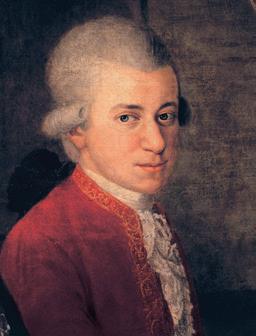
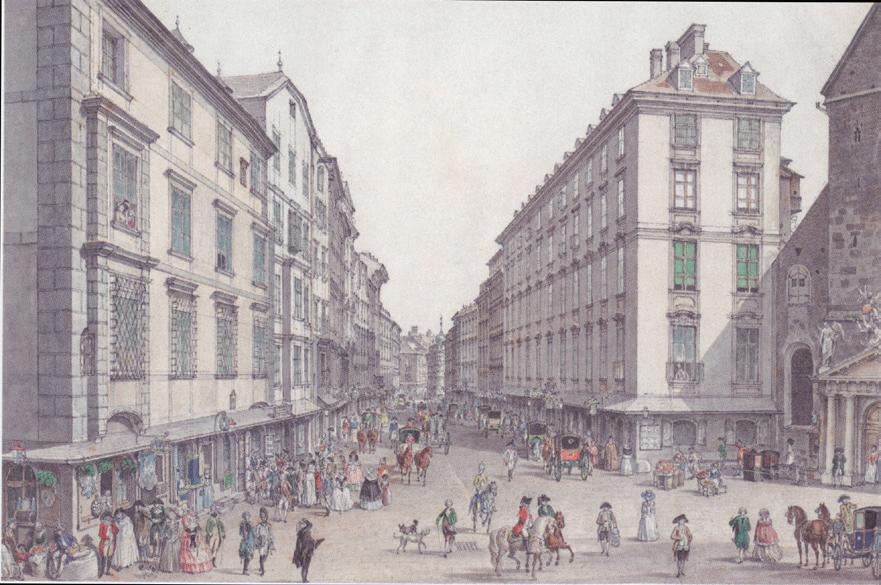
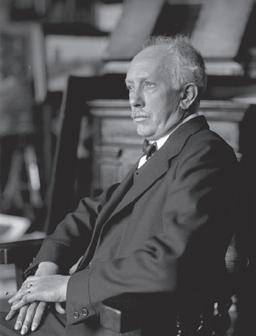
this page: Wolfgang Mozart, detail from the Mozart family portrait by Johann Nepomuk della Croce (1736–1819), 1780 | opposite page: The Kohlmarkt in Vienna, a drawing of a portion of the city center by Carl Schütz (1745–1800), 1786 | next spread: Richard Strauss, as photographed by Ferdinand Schmutzer (1870–1928), 1922. Austrian National Library, Image Archive, Austria
In the eighteenth century, serenades were occasional pieces, made to order for weddings, dinner parties, and all manner of society gatherings. Although Mozart accepted a number of these assignments in his career, he never learned to write music that did not call attention to itself. Mozart’s serenades tend to interfere with polite conversation, upstage the caterer, and distract the assembled crowd from the main event. This magnificent serenade, scored for an unusually large ensemble of musicians and written with a deep understanding of the heart’s emotions, is surely the most subversive background music ever written. Even in 1784, it was apparent, at least to Anton Stadler, that it belonged on the concert stage.
romance and a set of variations between the second minuet and the finale. Since each minuet features two trios, there are, in effect, eleven musical “numbers” of differing scale and mood.
It used to be assumed that Mozart composed this serenade in Munich in 1781, after the successful premiere of his opera Idomeneo, and a few weeks before he settled in Vienna. In recent years, however, as scholars have begun to pay attention to paper stock and watermarks, we have learned that Mozart did not use the type of manuscript paper on which the serenade is written until 1782, after his move to Vienna.
If Mozart wrote this music for his own wedding, that would help to explain its lavish scoring and unusually generous proportions. Eighteenth-century serenades were normally in five movements, with a minuet on either side of a central slow movement, but here Mozart adds a
Mozart calls for a dozen wind instruments, including two pairs of horns—one pair in F, the other in B-flat—to allow access to a wider range of keys. This is apparently the first of many works in which he used the basset horn, a lower-pitched relative of the clarinet. Mozart loved its plaintive sound—Bernard Shaw referred to its “watery melancholy”—and he wrote for it again in a number of occasional works, in Constanze’s tragic aria in The Abduction from the Seraglio, and, perhaps most memorably, in the final, unfinished requiem. (The Clarinet Concerto originally was conceived for basset horn.) Mozart also requests a “contrabasso,” a string bass, though today it is sometimes played by the contrabassoon instead, or in addition.
The B-flat serenade is Mozart’s supreme achievement in wind music. Every movement shows how much he
COMMENTS
loved the sound of winds cascading up and down scales, gently rocking an arpeggiated chord, or singing out like great operatic voices. Although virtually each page calls for all thirteen instruments, their relationships change from moment to moment, as different players engage each other in dialogue. Mozart was a master colorist, and he knew that an infinite number of hues could be made by just thirteen instruments. (Only in the first trio, scored for clarinets and basset horns alone, did he intentionally restrict his palette.)
The serenade is by turns grand, playful, somber, boisterous, witty, and heartbreaking—sometimes all within a single movement. On one page Mozart writes elaborate counterpoint, on the next a homespun melody over an ordinary accompaniment. Several passages suggest the brilliance and precision of military marching music; the finale, on the other hand, is so sublimely silly that one can imagine Punkitititi and Nàtschibinitschibi giggling over their delicious joke.
—Phillip Huscher
RICHARD STRAUSS
Born June 11, 1864; Munich, Germany
Died September 8, 1949; Garmisch-Partenkirchen, Germany
Introduction and Allegro from Symphony for Winds in E-flat Major (Happy Workshop)
Richard Strauss spent much of World War II in a state of despondency. He had reluctantly and self-interestedly collaborated with Hitler’s regime in the early 1930s, but he refused to cooperate with anti-Jewish policies, and in 1935, he decisively fell out of favor with the administration. He devoted much of his energy during the war to finding safety for his Jewish daughter-in-law and grandchildren,
and he had many periods in which he composed very little.
Strauss claimed in a bitter moment in October 1943 that he was done with writing major, public compositions, and that “the notes I scribble now have absolutely no meaning for music history.” Among his private experiments in 1943 was a sonatina for wind ensemble subtitled “From an Invalid’s Workshop,” an indication of his miserable state of mind and poor physical health while he was crafting the piece. He returned to writing for winds in 1944, drafting an altogether cheerier
“Sonatina no. 2,” which he described as a Symphony for Winds and subtitled Happy Workshop
The manuscript included an inscription “to the spirit of the eternal Mozart at the end of grateful life,” a most appropriate dedicatee for a wind work. In the 1780s, Mozart revitalized the genre of the wind serenade. His wind works from that time rivaled his symphonic creations and made brilliant, raucous, touching use of the diverse timbres found in wind ensembles. Strauss starts the final movement of his Happy Workshop in an utterly unhappy and un-Mozartian mode. The bassoons and contrabassoon lay down a thick, implication-rich set of dissonant harmonies, while higher voices in the group repeat a ruminating melodic figure that disintegrates into chromatic descents. As this heavy, slow introduction develops, we are introduced to a lighter figure—four sixteenth notes, two eighth notes, and a jolly ascending scale in triplets. Notably, the start of that gesture is a rhythmic motif that is important to the closing movement of Mozart’s Wind Serenade in B-flat, the so-called Gran Partita. This theme emerges cautiously in the bassoon and is eventually played by almost every instrument in the group
before Strauss uses the idea to move into an allegro. The gesture becomes the subject of a perky dialogue between upper wind voices, reminiscent of chirping, conversant birdsongs found in Beethoven’s Fourth and Sixth symphonies. Echoes of the severe opening return, but punctuated by bursts of these hooting, carefree calls, the music that seemed so dire initially comes to appear more benign. Strauss, like Mozart, writes difficult, virtuosic, yet fluent-sounding wind lines, resulting in an ultimately euphoric showcase for every instrument in the group.
—Nicky Swett
Phillip Huscher is the program annotator for the Chicago Symphony Orchestra.
Cellist, writer, and music researcher Nicky Swett holds a PhD in music from the University of Cambridge, where he was a Gates Scholar. From 2016 to 2018, he was a section member and community engagement fellow in the Civic Orchestra of Chicago.
Tyler Holstrom is a Chicago-based clarinetist and longtime member of the Northshore Concert Band. He has been a member of the Chicago Symphony Orchestra Association staff since 2012.
CIVIC ORCHESTRA OF CHICAGO SCHOLARSHIPS
Members of the Civic Orchestra receive an annual stipend to offset some of their living expenses during their training. The following donors have generously helped to support these stipends for the 2025–26 season.
Ten Civic members participate in the Civic Fellowship program, a rigorous artistic and professional development curriculum that supplements their membership in the full orchestra. Major funding for this program is generously provided by Lori Julian for the Julian Family Foundation
Nancy Abshire
Darren Carter, viola
Dr. & Mrs. Bernard H. Adelson Fund
Elena Galentas, viola
Robert & Isabelle Bass Foundation, Inc.
Timothy Warner, bass trombone
Rosalind Britton^ Ashley Ryoo, cello
Leslie and John Burns**
Matthew Nowlan, viola
Robert and Joanne Crown Fund
Alyssa Goh, violin
John Heo, violin
Pavlo Kyryliuk, violin
Buianto Lkhasaranov, cello
Matthew Musachio, violin
Mr.† & Mrs.† David Donovan
Chrisjovan Masso, tuba
Charles and Carol Emmons^
Will Stevens, oboe
Mr. & Mrs. David S. Fox^ Daniel Fletcher, flute
Paul † and Ellen Gignilliat
Naomi Powers, violin
Joseph and Madeleine Glossberg
Adam Davis, violin
Richard and Alice Godfrey
Ben Koenig, violin
Jennifer Amler Goldstein Fund, in memory of Thomas M. Goldstein
Alex Chao, percussion
Chester Gougis and Shelley Ochab
Tony Sanfilippo, Jr., bass
Mary Green
Walker Dean, bass
Jane Redmond Haliday Chair
Mona Mierxiati, violin
Lori Julian for the Julian Family Foundation
David Caplan, cello
Orlando Salazar,* oboe
Lester B. Knight Trust
Tricia Park, violin
Jonathon Piccolo, bass
Brandon Xu, cello
Shun-Ming Yang, cello
The League of the Chicago Symphony Orchestra
Kari Novilla,* harp
Leslie Fund, Inc.
Cameron Marquez,* percussion
Phil Lumpkin and William Tedford
Mason Spencer,* viola
Glenn Madeja and Janet Steidl
Erin Harrigan, horn
Maval Foundation
Arlo Hollander, trombone
Dustin Nguyen, trombone
Sean-David Whitworth, trumpet
Judy and Scott McCue and the Fry Foundation
Cierra Hall, flute
Leo and Catherine † Miserendino
Sava Velkoff,* viola
Ms. Susan Norvich
Yulia Watanabe-Price, violin
Margo and Mike Oberman
Hamed Barbarji,* trumpet
Julian Oettinger and Gail Waits, in memory of R. Lee Waits
Kyle Scully, timpani
Bruce Oltman and Bonnie McGrath†^
Alexander Wallack, bass
Earl† and Sandra Rusnak
Ebedit Fonseca, violin
Barbara and Barre Seid Foundation
Emmett Conway, horn
Micah Northam, horn
The George L. Shields Foundation, Inc.
Yat Chun Justin Pou, viola
Guillermo Ulloa, oboe
Abigail Yoon, violin
Dr. & Mrs. R. J. Solaro
Lara Madden Hughes, violin
David W. and Lucille G. Stotter Chair
Mia Smith, violin
Ruth Miner Swislow Charitable Fund
Rose Haselhorst, violin
Ms. Liisa Thomas and Mr. Stephen Pratt
Nick Reeves, cello
Peter and Ksenia Turula
Abner Wong, trumpet
Lois and James Vrhel
Endowment Fund
Albert Daschle, double bass
Paul and Lisa Wiggin
Layan Atieh, horn
Eden Stargardt,* horn
Marylou Witz
Justine Jing Xin Teo,* violin
Women’s Board of the Chicago Symphony Orchestra Association
Elizabeth Kapitaniuk, clarinet
Anonymous J Holzen,* cello
Anonymous^
Carlos Chacon, violin
Anonymous
Hojung Christina Lee, violin
Anonymous^
Judy Huang, viola
† Deceased * Civic Orchestra Fellow ^ Partial Sponsor ** Civic Administrative Fellowship Sponsor