CIVIC ORCHESTRA OF CHICAGO

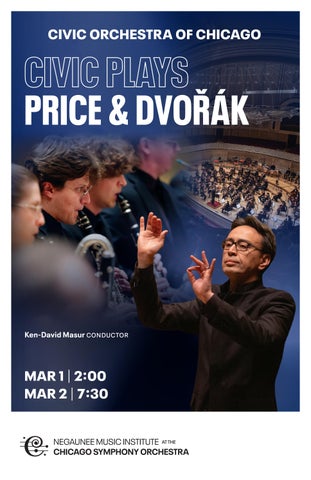
MAR 1 | 2:00 MAR 2 | 7:30


The 2025–26 Civic Orchestra season is generously sponsored by Lori Julian for the Julian Family Foundation, which also provides major funding for the Civic Fellowship program.
ONE HUNDRED SEVENTH SEASON
CIVIC ORCHESTRA OF CHICAGO
KEN-DAVID MASUR Principal Conductor
The Robert Kohl and Clark Pellett Principal Conductor Chair
Sunday, March 1, 2026, at 2:00
South Shore Cultural Center
Monday, March 2, 2026, at 7:30 Orchestra Hall
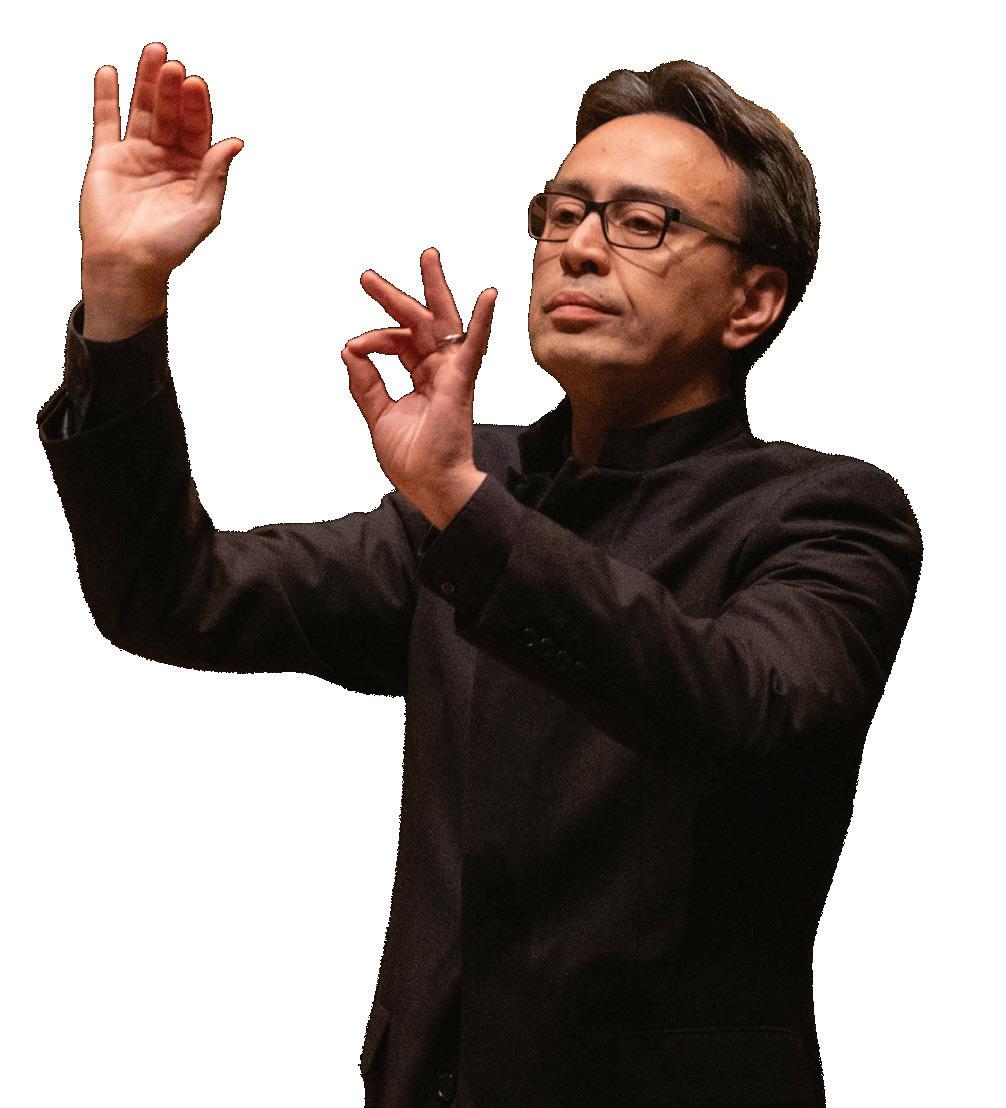
Ken-David Masur Conductor
KAY Overture to Theater Set
WALKER Lyric for Strings
PRICE Ethiopia’s Shadow in America
Introduction and Allegretto: The arrival of the Negro in America, when first brought here as a slave
Andante: His resignation and faith
Allegro: His adaptation. A fusion of his native and acquired impulses
INTERMISSION
DVOŘÁK Symphony No. 7 in D Minor, Op. 70
Allegro maestoso
Poco adagio
Scherzo: Vivace
Finale: Allegro
The 2025–26 Civic Orchestra season is generously sponsored by Lori Julian for the Julian Family Foundation, which also provides major funding for the Civic Fellowship program.
The Civic Orchestra of Chicago acknowledges support from the Illinois Arts Council.
COMMENTS
ULYSSES KAY
Born January 7, 1917; Tucson, Arizona
Died May 20, 1995; Englewood, New Jersey
Overture to Theater Set
COMPOSED
1968
FIRST PERFORMANCE
September 1968; Atlanta Symphony Orchestra. Robert Shaw conducting
INSTRUMENTATION
2 flutes and piccolo, 2 oboes and english horn, 2 clarinets and bass clarinet, 2 bassoons, 4 horns, 3 trumpets, 3 trombones, tuba, timpani, percussion, harp, strings
APPROXIMATE PERFORMANCE TIME
5 minutes
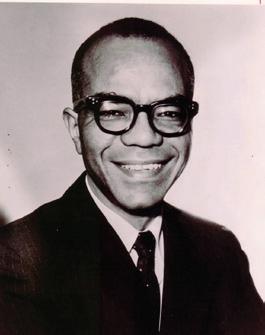
A native of Tucson, Arizona, and the nephew of Joe “King” Oliver, Ulysses Kay led a prolific fivedecade career as a composer and educator. Kay was considered one of the leading Black
composers of his generation, though he often found more enthusiasm with audiences abroad than at home. He described his musical approach as “enlightened modernism,” showing some of the dissonant and angular tonalities of his influential teacher Paul Hindemith, though with more hummable melodies.
Theater Set was commissioned by the Junior League of Atlanta for Robert Shaw, to whom it is dedicated, and the Atlanta Symphony Orchestra. The composer called it his tribute to “show music without quoting any popular theater tunes,” reflecting the burlesque shows he’d seen growing up at the Rialto Theatre in Tucson.
—Reprinted with permission by the Los Angeles Philharmonic
this page: Ulysses Kay | opposite page: An early publicity photograph, courtesy of George Walker
GEORGE WALKER
Born June 22, 1922; Washington, D.C.
Died August 23, 2018; Montclair, New Jersey
Lyric for Strings
COMPOSED 1941
FIRST PERFORMANCE
1941, Curtis Institute for Music; Philadelphia, Pennsylvania
INSTRUMENTATION
string orchestra
APPROXIMATE PERFORMANCE TIME
6 minutes
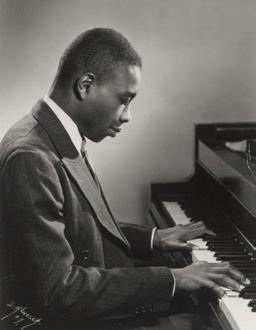
When George Walker graduated from high school at fourteen, he announced in the school yearbook that he planned to become a concert pianist. And he did, after graduating from the Oberlin Conservatory four years later. He made his recital debut at Town Hall in New York City in 1945 and, just two weeks later, played Rachmaninov’s Third Piano Concerto with the Philadelphia Orchestra under Eugene Ormandy. But he also became a composer—he began writing music while he was a graduate student at the Curtis Institute of Music, where he studied piano with Rudolf Serkin, fearing—and eventually confirming—that, as an African American performer, he would have a hard time getting engagements. It was Nadia
Boulanger, the celebrated teacher and famed discoverer of composing talent, who was the first to see his promise as a composer.
In the end, it is as a composer that Walker made his mark in a long and distinguished career. He was the recipient of fellowships from the Guggenheim, MacDowell Colony, Fulbright, and Rockefeller foundations and served on the faculties of Smith College, the University of Colorado, the Peabody Conservatory, University of Delaware, and Rutgers University. In 1996, more than half a century after he began composing and some seventy works later, Walker was awarded the Pulitzer Prize for Music for Lilacs, his setting for soprano and orchestra of Walt Whitman’s poem “When Lilacs Last in the Dooryard Bloom’d.” Even after Walker achieved great success as a composer, he continued his career as a pianist. His 2009 memoir is titled Reminiscences of an American Composer and Pianist. Playing the piano is something of a family tradition; his father, who immigrated from Jamaica and enjoyed a long career as a physician, taught himself to play piano as a pastime, and his sister, Frances Walker-Slocum, became a professor of piano at the Oberlin Conservatory (she was the
COMMENTS
first tenured African American woman at the college).
The Lyric for Strings dates from Walker’s earliest days as a composer—written while he was a graduate student at the Curtis Institute and still identified himself as a pianist. It was premiered there by the student orchestra. “I never played a string instrument,” Walker once said, “but somehow strings have always fascinated me.” The piece began as the second movement of a string quartet,
marked Molto adagio. Walker had just started to compose this music when he learned that his grandmother had died, and it became a memorial for her. A string orchestra version was premiered on the radio under the title Lament. The score, published as the Lyric for Strings, is simple and undeniably effective, with an eloquent theme that carries the piece to its climax and then ushers in a mood of welcome serenity.
—Phillip Huscher
FLORENCE PRICE
Born April 9, 1887; Little Rock, Arkansas Died June 3, 1953; Chicago, Illinois
Ethiopia’s Shadow in America
COMPOSED 1932
FIRST PERFORMANCE
January 2015; University of Arkansas Symphony Orchestra
INSTRUMENTATION
2 flutes and piccolo, 2 oboes, 2 clarinets, 2 bassoons, 4 horns, 2 trumpets, 2 trombones and bass trombone, tuba, timpani, percussion, celesta, strings
APPROXIMATE PERFORMANCE TIME 14 minutes
At the time she was born, Price’s parents— a dentist and a teacher—were central figures within a thriving Black middle-class community in Little Rock, Arkansas, that would rapidly erode from the enforcement of Jim Crow laws in the 1890s. Showing musical promise from an early age, Price nevertheless leaped over the narrow opportunities available to students of color in the South by entering Boston’s prestigious New England Conservatory in 1903. She graduated with honors in two fields—
organ performance and piano pedagogy—after only three years of study. Over the next twenty years, she pursued a career primarily as a teacher in Arkansas while raising two daughters and composing short piano works for her students as time permitted.
Escalating racial violence prompted Price and her family to move to Chicago in 1927. Though segregated along racial lines, the city’s well-developed musical infrastructure gave her more opportunities to pursue composition professionally. As musicologist Samantha Ege has shown, networks of Black women in the city offered mutual support for their musical pursuits, enabling Price to write substantial pieces in virtually every classical genre except opera. Several of the world’s greatest artists—Marian Anderson, Frederick Stock, Sir John Barbirolli, and Etta Moten, to name only a few—championed her music. Open discrimination against Black women impeded Price’s career, too, and even relatively unprejudiced White publishers and conductors feared professional backlash for promoting women of color. Most of her compositions remained unpublished during her lifetime and were thought lost until they were recovered from a dilapidated Illinois house in 2009.
Price first turned to orchestral composition in the late 1920s and continued to pursue it sporadically over the next twenty-five years, ultimately
completing just over a dozen largescale pieces. The inspiration for her earliest orchestral works was a contest for Black composers named in honor of the department store magnate Rodman Wanamaker. Her Symphony in E minor won first prize, and the Chicago Symphony Orchestra premiered the piece under Frederick Stock in June 1933. The flurry of interest surrounding the symphony prompted Price to finish a violin concerto and a piano concerto within the next twelve months.
The tone poem Ethiopia’s Shadow in America belongs to this early cluster of works, for it was completed in time for the competition won by her symphony. (This work garnered an honorable mention.) Curiously, it is one of only a few pieces for which she provided a descriptive narrative; much of her orchestral music might be called “absolute music.” In this piece, the first page of the manuscript score explains that she wanted the music to portray “1. The arrival of the Negro in America when first brought here as a slave. 2. His resignation and faith.
3. His adaptation, A fusion of his native and acquired impulses.” This three-part arc traces the historical experiences of enslaved Africans in America and aligns conceptually with certain works by figures associated with the Harlem Renaissance, such as Will Marion Cook, William Grant Still, and Duke Ellington. Listeners familiar with Price’s other
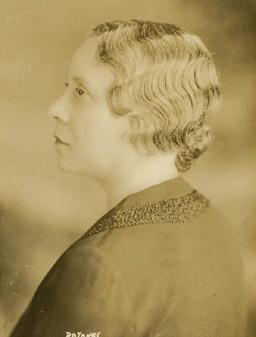
opposite page: Florence Price, portrait by R.D. Tones, 1933. Florence Beatrice Smith Price Papers Addendum, MC 988a, Box 2, Folder 1, Item 3. Special Collections, University of Arkansas Libraries, Fayetteville. For more on Florence Price, visit cso.org/experience/curation/florence-price.
orchestral music will be pleased to encounter her characteristically lush orchestration, harmonic richness, and, above all, keen melodic sense. New listeners will find music that blends the orchestral sonorities of the late nineteenth century with a distinctly American sensibility.
A brief introduction by a solo clarinet sets the scene before the orchestra launches into the two-part opening movement. The first part, an Adagio, moves seamlessly between simple melodic material reminiscent of folk music and the complex harmonic language often used to enhance dramatic situations in opera or film. A quiet close gives way to a buoyant Allegretto introduced by the woodblock and plucked strings. The first violins then take off with a sinewy syncopated melody that appears in various costumes across the rest of the movement
while percussion add a distinct sparkle. The profoundly religious second movement introduces the soft lament of a solo violinist accompanied by a string choir. A solo cellist later takes over the tune before it fades to an echo in the french horn, clarinet, and oboe. Now invoking vernacular dance, a catchy melody whips the third movement into a whirling array of orchestral color before a recollection of the opening Adagio offers a moment of reflection. But the dance resumes, propelling ever forward and closing the piece in grand fashion. Price observed that in music of the African diaspora, “Rhythm is of preeminent importance. In the dance, it is a compelling, onward-sweeping force that tolerates no interruption.”
—Reprinted with permission of the author, Douglas W. Shadle
ANTONÍN DVOŘÁK
Born September 8, 1841; Nelahozeves (near Prague), Bohemia Died May 1, 1904; Prague, Bohemia
Symphony No. 7 in D Minor, Op. 70
COMPOSED
1884–March 17, 1885
FIRST PERFORMANCE April 22, 1885; London, England. The composer conducting
INSTRUMENTATION
2 flutes (2nd doubling piccolo), 2 oboes, 2 clarinets, 2 bassoons, 4 horns, 2 trumpets, 3 trombones, timpani, strings
APPROXIMATE PERFORMANCE TIME
38 minutes
Until the late nineteenth century, Dvořák was the composer of five symphonies. His first four symphonies, never published during his lifetime, were unknown. This powerful D minor work was published in 1885 as Symphony no. 2, simply because it was the second symphony by Dvořák to come off the printer’s press, even though it was the seventh to come from the composer’s pen. Dvořák, who was perhaps the only one capable of setting the record straight, didn’t, when at the top of this manuscript, he wrote “Symphony no. 6”—discounting a first
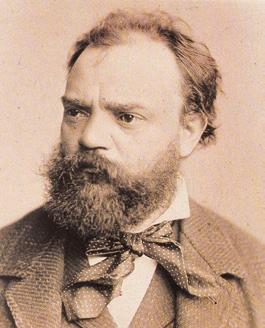
above: Antonín Dvořák, portrait, ca. 1882
symphony that was never returned from an orchestral competition and thus presumed lost.
Like his nineteenth-century colleagues Schubert and Bruckner, Dvořák has been good to musicologists, who sometimes make a living straightening up after the fact. His orchestral music has long been loved by the public. But only with the publication of Dvořák’s first four symphonies in the 1950s did we begin to use the current numbering. By now, even musicians who grew up calling this symphony no. 2 know it as no. 7.
In the spring of 1884, Dvořák went to London at the invitation of the Royal Philharmonic Society, whose members received him with enthusiasm and affection. After he returned home in June, the society elected him a member and commissioned a new symphony, but Dvořák waited six months before he began to work on it.
In a sense, this symphony was born the day Dvořák first heard Brahms’s new Third Symphony, and that was the music that still filled his head when he sat down that December to begin sketching. Johannes Brahms had already played a decisive role in Dvořák’s life, lending support and encouragement,
COMMENTS
and persuading his own publisher, Fritz Simrock, to take him on. Although Brahms insisted their admiration was reciprocal, history has tended to hear Brahms’s voice in Dvořák’s music, and not the other way around.
The work on the new symphony went quickly—three months from the first sketch to the finished product—but not smoothly. The sketches are a muddle; many pages are incomplete, as if Dvořák did not know how to continue. In February 1885 he wrote to Simrock, informing him of the new symphony and mentioning Brahms’s name in the same breath: “I don’t want to let Brahms down.” By March 17, the work was done, and Brahms could not possibly have been disappointed with the result.
This is arguably Dvořák’s finest symphony. The D minor symphony not only represents a mastery of form comparable to that of Schubert or Brahms—and new to Dvořák—but it searches for a deeper meaning than audiences had come to expect from the composer of popular Slavonic dances.
Dvořák said that the main theme of the first movement came to him while he stood on the platform waiting for the train from Pest to arrive at the State Station, an unlikely inspiration made more likely by the knowledge that Dvořák spent hours of his adult life monitoring the progress of trains in rail yards wherever he lived. (When he moved to New York, he loved watching the Boston trains come in.)
The second theme—in B-flat, and far too lovely to have been launched by a locomotive—leads to a magnificent and generous paragraph. The development of these materials is short and densely packed. The movement ends not with the tragic power that it had so brilliantly harnessed, but in a sudden demise.
The second movement is remarkable not only for the quality of its material but also for the way it unfolds, freely and unpredictably. This is very rich music, both intimate and openhearted; sweeping lyricism gives way to brief, emerging comments from the horn, the clarinet, or the oboe. The largo of the later New World Symphony may always be more famous and more easily remembered, for it is a big and gorgeous tune, but Dvořák never surpassed the achievement of this movement.
Many scherzos are dance music, but this one nearly lifts an audience to its feet—and sometimes prompts a bit of podium activity as well—with its lively and infectious rhythm. There is also the added excitement of an accompaniment that suggests two beats to the bar, while a melody wants three. With the finale, tragedy reappears, rules a number of themes, dictates a particularly stormy episode midway through, and admits a turn to D major only at the very end.
—Phillip Huscher
Phillip Huscher is the program annotator for the Chicago Symphony Orchestra.