CIVIC BACH MARATHON FINALE
DEC 15 | 7:00
Fourth Presbyterian Church 126 E. Chestnut St.
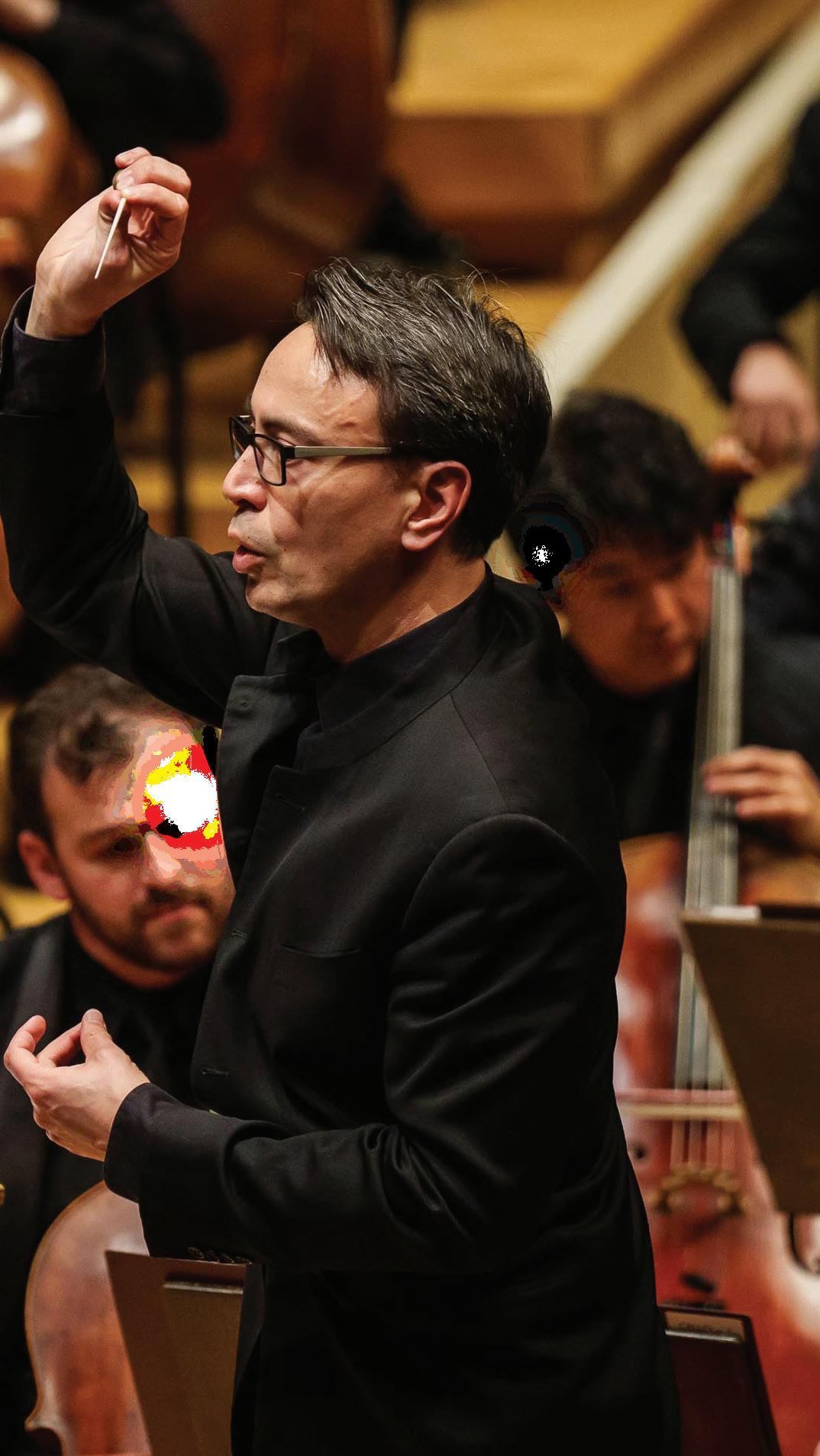
Ken-David Masur conductor
The 2025–26 Civic Orchestra season is generously sponsored by Lori Julian for the Julian Family Foundation, which also provides major funding for the Civic Fellowship program.
Tonight’s performance is dedicated to the memory of Katy Donovan, a beloved friend of the Civic Orchestra and Fourth Presbyterian Church.
ONE
HUNDRED SEVENTH SEASON
CIVIC ORCHESTRA OF CHICAGO
KEN-DAVID MASUR Principal Conductor
The Robert Kohl and Clark Pellett Principal Conductor Chair
Monday, December 15, 2025, at 7:00 Fourth Presbyterian Church
BACH MARATHON FINALE
Ken-David Masur Conductor
J.S. BACH
Brandenburg Concerto No. 5 in D Major, BWV 1050
Allegro Affettuoso
Allegro
Brandenburg Concerto No. 3 in G Major, BWV 1048 [Allegro]
Adagio Allegro
Brandenburg Concerto No. 4 in G Major, BWV 1049
Allegro Andante Presto
INTERMISSION
Brandenburg Concerto No. 6 in B-flat Major, BWV 1051 [Allegro]
Adagio ma non tanto— Allegro
O Mensch, bewein dein Sünde groß for String Orchestra (arr. Reger)
Selections from Dancing with J.S. Bach, Suites 1 and 2 (arr. Nathan)
The 2025–26 Civic Orchestra season is generously sponsored by Lori Julian for the Julian Family Foundation, which also provides major funding for the Civic Fellowship program. The Civic Orchestra of Chicago acknowledges support from the Illinois Arts Council.
Special thanks to Fourth Presbyterian Church, Emma Cox, and Kathy Kidder for hosting and helping to organize this concert.
COMMENTS by Phillip Huscher and Nicky Swett
JOHANN SEBASTIAN BACH
Born March 21, 1685; Eisenach, Thuringia, Germany
Died July 28, 1750; Leipzig, Germany
The Brandenburg Concertos Nos. 3–6, BWV 1048–1051
Berlin is now only a short afternoon’s drive from the half-dozen towns in east central Germany where Bach lived and worked his entire life. (In sixty-five years, he never set foot outside Germany.) But in his day, the trip was much more arduous, and Bach didn’t travel that far unless he was sent on official business. He went to Berlin in 1719 on an expense-account shopping trip to buy a new state-of-the-art harpsichord for his patron in Cöthen, a small, remote, rural town, sometimes dismissively called “Cow Cöthen.”
In Berlin, Bach found time to make several useful contacts, none more beneficial to the future of music than Margrave Christian Ludwig of Brandenburg, who asked Bach to send him some of his compositions. At the time, Bach was preoccupied with inspecting the harpsichord that had been made to order by Michael Mietke, who was famous for the quality of his high-end, elaborately painted
instruments, and with arranging to have it shipped back to Cöthen. But he didn’t forget the margrave’s request. It would be another two years before Bach handed Christian Ludwig the carefully written “presentation copy” of the six concertos we now call the Brandenburgs, after the margrave’s province just to the south and west of Berlin (its capital was Potsdam). Bach’s life, in the meantime, had been busy and unsettled. He had watched three family members (his ten-month-old son, his wife Maria Barbara, and his brother) die—a sudden spate of funerals, even in an age when life was short. He had gone to Halle to compete for the job of organist (he later declined the offer), which suggests that he was growing restless in Cöthen, despite working for an enlightened patron, the twenty-something Prince Leopold, who “both loved and understood music.” (The prince’s sympathies would suddenly change in 1721 when he married a woman who “seemed to be alien to the muses.”)
And, in addition to his daily workload at Cöthen, he was trying to finish some of
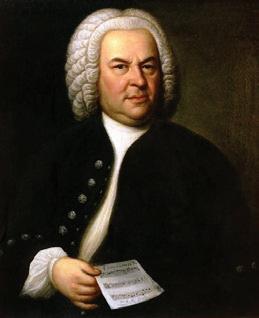
above: Johann Sebastian Bach, holding a copy of the six-part canon, BWV 1076. Portrait in oil by Elias Gottlob Haussmann (1695–1774), 1748. Bach-Archiv, Leipzig, Germany
his most important music, including the sonatas and suites for solo violin.
We don’t know when Bach wrote the six concertos he dedicated to the margrave of Brandenburg. Recent scholarship suggests that most of them were already finished when he met the margrave (two of them possibly dating from 1713) and that he simply took his time compiling a set of pieces, some old and some new, that he thought made a sufficiently varied and satisfying whole. The Fifth Concerto, for example, with its unprecedented star role for harpsichord, was surely written after Bach returned from Berlin, in order to inaugurate the new special-order instrument. The presentation score he gave the margrave is a “gift edition” of the set, almost entirely in Bach’s own meticulous handwriting, prefaced by an elaborate dedication page written in French and dated March 24, 1721. “As I had a couple of years ago the pleasure of appearing before Your Royal Highness,” Bach wrote, recounting how the margrave had praised his talent at the time and asked for “some pieces of my composition.” Bach simply but provocatively describes the contents as “concerts avec plusieurs instruments”—that is, concertos for many different combinations of instruments, a modest way of expressing one of the set’s most innovative features.
Since we have no record that the margrave ever arranged to have his concertos performed, he has often been unfairly portrayed as an unworthy
patron who put the unopened score on his bookshelf and never thanked or paid Bach for his efforts. We probably will never know when or where these works were first played, but they were obviously not widely known during Bach’s life. (The obituary prepared by his son Carl Philipp Emanuel doesn’t even mention them.) Only the Fifth, with its remarkable harpsichord solo, was performed with any regularity in the years after the composer’s death; eventually, the whole set was forgotten. The earliest documented public performance of a Brandenburg concerto dates from 1835, more than a century after they were written. Today, they are arguably Bach’s most popular works.
Like many of Bach’s sets, such as the Goldberg Variations or The WellTempered Clavier, the Brandenburg Concertos form a kind of master anthology—a demonstration, really, of all the imaginable possibilities inherent in a certain musical form. Each of these six concertos calls for a different combination of soloists—every one unprecedented in its choice of instruments and still without parallel today. Perhaps they represent Bach’s ideal, for their instrumentation corresponds neither to the Cöthen ensemble he conducted nor to the margrave’s own resident group of musicians. Bach gives solo roles to members of all three orchestral families, and often groups them in unexpected combinations, such as the trumpet, flute, oboe, and violin ensemble of the second concerto. All the concertos demand and celebrate the performers’ virtuosity as much as they demonstrate
COMMENTS
Bach’s amazing skill. The union of joyful music making and compositional brilliance puts the Brandenburgs among those rare works that delight connoisseurs and amateurs alike.
The Fifth Concerto stands out, even among the Brandenburgs, for Bach seems to be on the verge of inventing a new form—the keyboard concerto—that would soon be a favorite of virtually every composer from Mozart through the nineteenth century. In this piece, for the first time, Bach elevated the harpsichord from its rank-and-file role as a member of the continuo group (the back-up ensemble that provided the harmonic support in nearly all music written in Bach’s day) to a featured part. Joined by two other soloists, the flute and the violin, the keyboard here enjoys its first great starring role, not only sharing the spotlight but even dominating the action at times. It’s likely that the fancy two-manual harpsichord Bach picked up in Berlin gave him the idea of showing it off in an unusual way, but he cannot have known how the gesture would influence music after his death.
The opening Allegro is the longest of all the Brandenburg movements. In this complex music, Bach merges tradition (the alternation of a ritornello for all the musicians and episodes for the soloists) with a very modern concern for organic growth and continuity. Just before the last statement of the ritornello, Bach writes an extraordinary sixty-five-measure keyboard cadenza (he didn’t use the term, but that’s unmistakably what it is) that wouldn’t be
surpassed in length or imagination until Mozart and Beethoven began to write down the cadenzas they improvised for their own concertos. (Apparently Bach didn’t intend to get so carried away—in a first draft, the cadenza is just eighteen measures.) Despite its difficulty and showy brilliance, this isn’t a virtuoso indulgence, but an integral part of the piece—notice how the keyboard gradually begins to assert itself before the other instruments drop out—developing the main theme and then revving up, in a most extraordinary fashion, to lead into the final ritornello.
The slow middle movement—one of only a handful in Bach’s output marked affettuoso (affectionate, tender)—is a lovely air scored for just the three soloists. The way Bach ingeniously divides the material among the three, sometimes pairing flute and violin, sometimes the keyboard with one of the other instruments, gives this music such endless variety that we scarcely notice that the orchestra itself is silent. The finale, reuniting all the players, is a kind of da capo aria, with the entire beginning section repeated at the end. The keyboard quietly steals the spotlight again in the middle, and, even though the flute and the violin quickly regain their rightful places as fellow soloists, the concerto form itself would never be the same again.
The Third Concerto, thought to be among the earliest of the six, is scored for a nine-fold group of strings—three each of violin, viola, and cello. Its inherent homogeneity of sound
challenged Bach to create remarkably diverse sonorities and continuously changing textures. Bach spins the contents of each movement from just one or two simple themes, handed off from one group of players to another, eventually involving the instruments in what seems to be all possible permutations. There’s no clear-cut, consistent designation of soloists; the assignments change from page to page. The standard black-and-white contrast of the typical concerto grosso—the entire ensemble alternating with the solo group—is blurred here by the music’s ever-evolving nature and by Bach’s fascination with endlessly varied shades of gray. Both fast outer movements travel the wide spectrum from assertive unison passages to intricate polyphony, and from full orchestral splendor to the conversational intimacy of chamber music. One curiosity, still unsolved: in place of a conventional middle slow movement, Bach writes just two chords—those that would normally provide the movement’s final cadence—leaving musicians, possibly beginning with the margrave’s own, to wonder what the great master himself might have wanted.
The relationship between soloists is different in each of the Brandenburgs; in the Fourth Concerto, they switch roles as the work progresses. The violin dominates the opening Allegro (although at first it sounds as if the two flutes will have more to play). Then, in the slow middle movement, it’s the flutes who share the spotlight, while the violin, except for
one measure, is relegated to doubling the orchestral violins or simply playing the bass line. The violin takes the lead once again in the finale, although the real marvel of that movement is the way everyone, soloists and orchestra players alike, joins as equals in one contrapuntal web.
The Allegro is one of the longest movements in any of Bach’s concertos, partly because the opening paragraph— the traditional ritornello that introduces the main themes—is unusually spacious, with at least five different motifs to be developed. Bach then builds a very large structure, with six statements of the ritornello alternating with free and highly inventive episodes to create a monumental movement of surprising lightness. The Adagio is the only Brandenburg slow movement that doesn’t switch to a smaller cast of characters, instead calling for the entire ensemble (although, by reversing the solo roles, Bach subtly changes the complexion). The spirited finale isn’t dance music, as was the norm, but something more substantial and meaty. With its grand proportions and unusually serious fugal writing, this movement is one of the few finales in eighteenth-century music to carry as much weight as its opening movement counterpart—here, as in so many areas, Bach anticipates the accomplishments of Mozart and Beethoven.
Scored exclusively for low strings, the Sixth Brandenburg has the most unusual sonority of all these concertos. What is most remarkable,
however, is that Bach has managed to write music that is never somber, despite the unremittingly dark sound of his ensemble. Like the Third (the other all-string Brandenburg, which at least benefits from the brilliance of high violins), this concerto is a marvel of endless variety, in color and texture, within a monochromatic world. The first movement, especially, is very densely woven and insistently repetitive, but in Bach’s
hands it comes out lively and transparent. It is as if Bach had set himself the task of achieving the maximum contrast—both in the overall design of two full-ensemble movements surrounding an intimate viola duet, and within the shaping of the movements themselves— using a completely homogeneous cast of instruments.
—Phillip Huscher
O Mensch, bewein dein Sünde groß for String Orchestra (Arranged by Max Reger)
In the passionate opening line of the sixteenth-century Lutheran poet and theologian Seybald Heyden’s hymn “O Mensch, bewein dein Sünde groß,” the author implores mankind to “weep for your great sins” for which Jesus sacrificed himself. The text became a staple for inclusion in settings of the passion of Christ. J.S. Bach used the hymn as a basis for a lively choral fantasia that was featured in a 1725 version of the Saint John Passion and serves as the finale of the first part of the Saint Matthew Passion (1736). He also wrote a poignant setting of Heyden’s words in simple four-part harmony (BWV 402), which is included in some hymnals.
Many of Bach’s chorale preludes— organ pieces of varying length that are based on the tune of a hymn—were likely meant to set up the church choir singing that particular hymn. Others are quite substantial works that may have been intended to stand alone as part of
church services. Bach’s chorale prelude on “O Mensch” (BWV 622) is one of the most vivid and touching entries in his Orgelbüchlein (Little Organ Book), a collection of organ preludes that he wrote between 1708 and the late 1720s. The complete tune from the hymn is disguised in a sublimely ornamented, slowly developing melody in the top voice. The evolving dialogues among the active middle voices and bassline are far more emotional and expressive than what we find in Bach’s chorale setting or even what he writes in the fantasia from the Passions.
The German composer and organist Max Reger was intimately familiar with Bach’s writing for the organ. Reger wrote his own set of chorale preludes between 1900 and 1902, and many of his sacred organ works were composed in response to Bach’s music. His string orchestra version of the chorale prelude on “O Mensch,” which was
first published in 1915, is a relatively light-handed arrangement. Many early-twentieth-century transcribers of Bach’s music did a fair amount of “updating,” adjusting the pitches, rhythms, and harmonies in his pieces to reflect a postromantic idiom. But Bach’s O Mensch has enough winding, tense contrapuntal lines that Reger didn’t necessarily need to add notes to Bach’s original to make it sound close to his own churning, occasionally dense musical language.
Reger has very specific indications about the strings that the musicians should play on, and he asks two cellos, playing in a high range, to double the first violins on the melody. These orchestration details create a sensuous texture in which the instruments melt
into one another. He also adds many instructions for the players, including momentary speed reductions that accentuate Bach’s surprising tonal turns; swells and espressivo markings that bring out those active inner voices; and dynamics that range from intimate pianissimos to grand, orchestral fortissimos. But the most striking word in the score is the last—a new tempo of Adagissimo for the closing measures, in which Bach threatens us with a stark, lamenting line and then corrects this ominous gesture with a pleasing, major-key descent. Believe it or not, this marking is Bach’s own, scrawled on the manuscript, forever imbuing this music with a spacious, spiritual solemnity.
—Nicky Swett
Selections from Dancing with J.S. Bach, Suites 1 and 2
(Arranged by Eric Nathan)
J.S. Bach was a prolific self-swindler. If he needed to expand or modify a piece he was working on, he would gladly grab a movement from an old concerto here, a dance from a suite over there, and redeploy those excerpted structures in the project at hand. Sometimes he would adjust them for the present purposes, but often he essentially plugged them directly into the new context. Bach’s style is quite varied, and yet the results of his occasionally Frankensteinlike assembly processes are remarkably unified. They leverage the kind of coherence that can be found among
existing materials—the tangle of relations that lends majesty and clarity to artfully curated contemporary playlists and mixtapes or to concert programs made up of diverse works.
It is in honor of Bach, the constructor and transcriber, that Eric Nathan wrote his Dancing with J.S. Bach suites, orchestral arrangements of select numbers from Bach’s extensive solo keyboard repertoire. Nathan collaborated on the project with Dr. Michael B. Sporn, who commissioned the piece in memory of his wife, Kitte Sporn, and picked many of the assorted movements. “My two
COMMENTS
Dancing with J.S. Bach suites arose out of a love of Bach’s music and desire to engage more intimately with it,” Nathan explains in his program note. “I have tried to honor Bach’s music while also realizing my own interpretations of his works. You may hear my own compositional voice come through subtly at times. You might think of it as a tip of the hat to Bach, from whom I have learned so much as a composer.”
The saucy capriccio that opens the first Dancing with J.S. Bach suite is a rambunctious arrangement of the swinging, final movement of Bach’s Keyboard Partita no. 2 in C minor. In a few places, Nathan adds ornamentation to the melodic gesture in one section of the string orchestra while another section plays the same line in an unadorned manner. The hints of bubbly chaos that result would have been in keeping with the approach of some looser ensembles of the eighteenth century in which rogue members of a big group would do their own ornaments while the others dutifully played the notes on the page.
In his arrangement of the gavottes from Bach’s English Suite no. 6, Nathan sets the bassline as a stream of plucked notes, giving the music a mischievous energy that anachronistically brings to mind the naughty, nefarious atmosphere of Edvard Grieg’s famous orchestral number In the Hall of the Mountain
King from Peer Gynt. The contrasting second gavotte is a musette, a subtype of this dance genre in which the music unfolds above a bagpipelike drone. In Bach’s original, the drone is implied but not sustained by any voice. In Nathan’s version, he initially writes an explicit drone held by the bass instruments, and then he artfully fades the held note away until we are left with only two violins fiddling together.
In the fourth number of Dancing with J.S. Bach, Suite no. 2, a pair of bourrées drawn from Bach’s English Suite no. 1, Nathan adjusts some of the main lines in the original by splitting them between the strings and the oboe soloist. While writing these arrangements, he hoped “to find and imagine hidden dialogues that could exist between the orchestral instruments,” and in this setting, he puts the appealing results of this exploration on full display.
—Nicky Swett
Phillip Huscher is the program annotator for the Chicago Symphony Orchestra.
Cellist, writer, and music researcher Nicky Swett holds a PhD in music from the University of Cambridge, where he was a Gates Scholar. From 2016 to 2018, he was a section member and community engagement fellow in the Civic Orchestra of Chicago.
PROFILES
Ken-David Masur Conductor
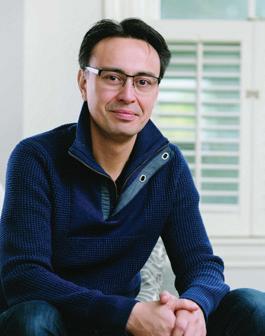
Ken-David Masur celebrates his seventh season as music director of the Milwaukee Symphony Orchestra and principal conductor of the Civic Orchestra of Chicago.
Masur’s tenure in Milwaukee has been notable for innovative thematic programming and bridge building, including a festival celebrating the music of the 1930s, when the Bradley Symphony Center was built; the Water Festival, which highlighted local community partners whose work centers on water conservation and education; and a new annual citywide Bach Festival, celebrating the abiding appeal of J.S. Bach’s music in an ever-changing world. He has also instituted a multi-season artist-in-residence program and led highly acclaimed performances of major choral works, including a semi-staged production of Peer Gynt.
In 2025–26 Masur will lead celebrations of the fiftieth anniversary of the Milwaukee Symphony Chorus. He and the MSO will reunite with longtime collaborators Augustin Hadelich, Orion Weiss, Stewart Goodyear, Nancy Zhou, and Bill Barclay and Concert Theatre Works to celebrate America’s 250th birthday with a program interweaving the music of Aaron Copland with the words of Mark Twain.
Passionate about contemporary music, Ken-David Masur has conducted and commissioned numerous new works, such as Wynton Marsalis’s Harold Haller and Hallelujah, Augusta Read Thomas’s Bebop Kaleidoscope— Homage to Duke Ellington, and Unsuk Chin’s Mannequin.
Masur has recorded with the English Chamber Orchestra and with the Stavanger Symphony, whose album was named WQXR’s Best New Classical Release. He also received a Grammy nomination from the Latin Recording Academy for Best Classical Album of the Year for his work as a producer of Salon Buenos Aires.
Masur and his wife, pianist Melinda Lee Masur, are founders and artistic directors of the Chelsea Music Festival, an annual summer festival in New York City, which celebrated its sixteenth anniversary in 2025. Its programs range from baroque and classical to contemporary and jazz, with an emphasis on intersecting with the culinary and visual arts.
Born and raised in Leipzig, Germany, Masur was trained at the Mendelssohn Academy in Leipzig, the Gewandhaus Children’s Choir, Detmold Academy, and the Hanns Eisler Conservatory in Berlin. While an undergraduate at Columbia University in New York, Masur became the first music director of the Bach Society Orchestra and Chorus.
Civic Orchestra of Chicago
The Civic Orchestra of Chicago is a training program of the Chicago Symphony Orchestra’s Negaunee Music Institute that prepares young professionals for careers in orchestral music. It was founded during the 1919–20 season by Frederick Stock, the CSO’s second music director, as the Civic Music Student Orchestra, and for over a century, its members have gone on to secure positions in orchestras across the world, including over 160 Civic players who have joined the CSO. Each season, Civic members are given numerous performance opportunities and participate in rigorous orchestral training with its principal conductor, Ken-David Masur, distinguished guest conductors, and a faculty of coaches consisting of CSO members. Civic Orchestra musicians develop as exceptional orchestral players and engaged artists, cultivating their ability to succeed in the rapidly evolving music world.
The Civic Orchestra serves the community through its commitment to present free or low-cost concerts of the highest quality at Symphony
Center and in venues across Greater Chicago, including annual concerts at the South Shore Cultural Center and Fourth Presbyterian Church. The Civic Orchestra also performs at the annual Crain-Maling Foundation CSO Young Artists Competition and Chicago Youth in Music Festival. Many Civic concerts can be heard locally on WFMT (98.7 FM), in addition to concert clips and smaller ensemble performances available on CSOtv and YouTube. Civic musicians expand their creative, professional, and artistic boundaries and reach diverse audiences through educational performances at Chicago public schools and a series of chamber concerts at various locations throughout the city.
To further expand its musician training, the Civic Orchestra launched the Civic Fellowship program in the 2013–14 season. Each year, up to twelve Civic members are designated as Civic Fellows and participate in intensive leadership training designed to build and diversify their creative and professional skills. The program’s curriculum has four modules: artistic planning, music education, social justice, and project management.
A gift to the Civic Orchestra of Chicago supports the rigorous training that members receive throughout the season, which includes coaching from musicians of the Chicago Symphony Orchestra and world-class conductors. Your gift today ensures that the Chicago Symphony Orchestra Association will continue to enrich, inspire, and transform lives through music.
Civic Orchestra of Chicago
Ken-David Masur Principal Conductor
The Robert Kohl and Clark Pellett Principal Conductor Chair
SOLOISTS
Cierra Hall flute
Naomi Powers violin
Keshav Srinivasan violin
Sava Velkoff* viola
Darren Carter viola
VIOLINS
Mona Mierxiati
Natalie Boberg
Ben Koenig
Mia Smith
Ebedit Fonseca
Lara Madden Hughes
Carlos Chacon
Tricia Park
Maria Paula Bernal
Yulia Watanabe-Price
Pavlo Kyryliuk
Hobart Shi
Rose Haselhorst
Hojung Christina Lee
June Lee
Jingjia Wang
Evan Chen
Jenny Choi*
Adam Davis
Lina Yamin
John Heo
Matthew Musachio
VIOLAS
Matthew Nowlan**
Yat Chun Justin Pou
Jacob Davis
Angela Rubin
August DuBeau
Judy Huang
Lucie Boyd
Elena Galentas
Roslyn Green+
Tzu-Yun Huang
CELLOS
David Caplan
Nick Reeves
Ashley Ryoo
Somyong Shin
Buianto Lkhasaranov
Henry Lin
* Civic Orchestra Fellow + Civic Orchestra Alumni ** NMI Arts Administration Fellow Artists listed by instrument in order of appearance
Brandon Xu
Krystian Chiu
J Holzen*
Shun-Ming Yang
BASSES
Albert Daschle
Bennett Norris
Walker Dean
Tony Sanfilippo Jr.
Gisel Dominguez
Jared Prokop
FLUTES
Daniel Fletcher
Isabel Evernham
OBOE
Guillermo Ulloa
HARPSICHORD
Daniel Szefer
LIBRARIAN
Andrew Wunrow
2025 Bach Marathon
The Civic Orchestra is grateful to partner with ten community organizations as part of the 2025 Bach Marathon. Led by Ken-David Masur, this finale concert is the culmination of a day rich in musical connections.
Thank you to the following partners who hosted Civic Orchestra performances today:
Sarah’s Circle
Erie House
Chicago Commons
UCAN
SPARC Center
Gateway to Learning RefugeeONE
Lincoln Park Community Services
City of Chicago Southwest Regional Senior Center
Deborah’s Place
NEGAUNEE MUSIC INSTITUTE AT THE CSO
The Negaunee Music Institute connects people to the extraordinary musical resources of the Chicago Symphony Orchestra. Institute programs educate audiences, train young musicians, and serve diverse communities across Chicago and around the world.
Current Negaunee Music Institute programs include an extensive series of CSO School and Family Concerts and open rehearsals; more than seventy-five in-depth school partnerships; online learning resources; the Civic Orchestra of Chicago, a prestigious ensemble for earlycareer musicians; intensive training and performance opportunities for youth, including the Percussion Scholarship Program, Chicago Youth in Music Festival, Crain-Maling Foundation CSO Young Artists Competition, and Young Composers Initiative; social impact initiatives, such as collaborations with Chicago Refugee Coalition and Notes for Peace for families who have lost loved ones to gun violence; and music education activities during CSO domestic and international tours.
the board of the negaunee music institute
Leslie Burns Chair
Steve Shebik Vice Chair
John Aalbregtse
David Arch
James Borkman
Jacqui Cheng
Ricardo Cifuentes
Richard Colburn
Charles Emmons
Judy Feldman
Toni-Marie Montgomery
Rumi Morales
Mimi Murley
Margo Oberman
Gerald Pauling
Kate Protextor Drehkoff
Harper Reed
Melissa Root
Amanda Sonneborn
Eugene Stark
Dan Sullivan
Paul Watford
Ex Officio Members
Jeff Alexander
Jonathan McCormick
Vanessa Moss
negaunee music institute administration
Jonathan McCormick Managing Director
Katy Clusen Associate Director, CSO for Kids
Katherine Eaton Coordinator, School Partnerships
Carol Kelleher Assistant, CSO for Kids
Anna Perkins Orchestra Manager, Civic Orchestra of Chicago
Zhiqian Wu Operations Coordinator, Civic Orchestra of Chicago
Rachael Cohen Program Manager
Charles Jones Program Assistant
Kevin Gupana Associate Director, Education & Community Engagement Giving
Frances Atkins Director of Publications and Institutional Content
Kristin Tobin Designer & Print Production Manager
Petya Kaltchev Editor
civic orchestra artistic leadership
Ken-David Masur Principal Conductor
The Robert Kohl and Clark Pellett Principal Conductor Chair
Coaches from the Chicago Symphony Orchestra
Robert Chen Concertmaster
The Louis C. Sudler Chair, endowed by an anonymous benefactor
Baird Dodge Principal Second Violin
Teng Li Principal Viola
The Paul Hindemith Principal Viola Chair
Brant Taylor Cello
The Ann Blickensderfer and Roger Blickensderfer Chair
Alexander Horton Assistant Principal Bass
William Welter Principal Oboe
Stephen Williamson Principal Clarinet
Keith Buncke Principal Bassoon
William Buchman Assistant Principal Bassoon
Mark Almond Principal Horn
Esteban Batallán Principal Trumpet
The Adolph Herseth Principal Trumpet Chair, endowed by an anonymous benefactor
Michael Mulcahy Trombone
Charles Vernon Bass Trombone
Gene Pokorny Principal Tuba
The Arnold Jacobs Principal Tuba Chair, endowed by Christine Querfeld
David Herbert Principal Timpani
The Clinton Family Fund Chair
Cynthia Yeh Principal Percussion
Justin Vibbard Principal Librarian
CIVIC ORCHESTRA OF CHICAGO SCHOLARSHIPS
Members of the Civic Orchestra receive an annual stipend to offset some of their living expenses during their training. The following donors have generously helped to support these stipends for the 2025–26 season.
Ten Civic members participate in the Civic Fellowship program, a rigorous artistic and professional development curriculum that supplements their membership in the full orchestra. Major funding for this program is generously provided by Lori Julian for the Julian Family Foundation
Nancy Abshire
Darren Carter, viola
Dr. & Mrs. Bernard H. Adelson Fund
Elena Galentas, viola
Robert & Isabelle Bass Foundation, Inc.
Timothy Warner, bass trombone
Rosalind Britton^
Ashley Ryoo, cello
Leslie and John Burns**
Matthew Nowlan, viola
Robert and Joanne Crown Fund
Alyssa Goh, violin
John Heo, violin
Pavlo Kyryliuk, violin
Buianto Lkhasaranov, cello
Matthew Musachio, violin
Mr.† & Mrs. David Donovan
Chrisjovan Masso, tuba
Charles and Carol Emmons^ Will Stevens, oboe
Mr. & Mrs. David S. Fox^
Daniel Fletcher, flute
Paul † and Ellen Gignilliat
Naomi Powers, violin
Joseph and Madeleine Glossberg
Adam Davis, violin
Richard and Alice Godfrey
Ben Koenig, violin
Jennifer Amler Goldstein Fund, in memory of Thomas M. Goldstein
Alex Chao, percussion
Mary Green
Walker Dean, bass
Jane Redmond Haliday Chair
Mona Mierxiati, violin
Lori Julian for the Julian Family Foundation
David Caplan, cello
Orlando Salazar,* oboe
Lester B. Knight Trust
Tricia Park, violin
Jonathon Piccolo, bass
Brandon Xu, cello
Shun-Ming Yang, cello
The League of the Chicago Symphony Orchestra
Kari Novilla,* harp
Phil Lumpkin and William Tedford
Mason Spencer,* viola
Glenn Madeja and Janet Steidl
Erin Harrigan, horn
Maval Foundation
Arlo Hollander, trombone
Dustin Nguyen, trombone
Sean-David Whitworth, trumpet
Judy and Scott McCue and the Fry Foundation
Cierra Hall, flute
Leslie Fund, Inc.
Cameron Marquez,* percussion
Leo and Catherine † Miserendino
Sava Velkoff,* viola
Ms. Susan Norvich
Yulia Watanabe-Price, violin
Margo and Mike Oberman
Hamed Barbarji,* trumpet
Julian Oettinger^
Kyle Scully, timpani
Bruce Oltman and Bonnie McGrath†^
Alexander Wallack, bass
Earl† and Sandra Rusnak
Ebedit Fonseca, violin
Barbara and Barre Seid Foundation
Emmett Conway, horn
Micah Northam, horn
The George L. Shields Foundation, Inc.
Abigail Yoon, violin
Yat Chun Justin Pou, viola
Guillermo Ulloa, oboe
Dr. & Mrs. R. J. Solaro ^ Sanford Whatley, viola
David W. and Lucille G. Stotter Chair
Mia Smith, violin
Ruth Miner Swislow Charitable Fund
Rose Haselhorst, violin
Ms. Liisa Thomas and Mr. Stephen Pratt
Nick Reeves, cello
Peter and Ksenia Turula
Abner Wong, trumpet
Lois and James Vrhel
Endowment Fund
Albert Daschle, double bass
Paul and Lisa Wiggin
Eden Stargardt,* horn
Layan Atieh, horn
Marylou Witz
Justine Jing Xin Teo,* violin
Women’s Board of the Chicago Symphony Orchestra Association
Elizabeth Kapitaniuk, clarinet
Anonymous J Holzen,* cello
Anonymous^
Carlos Chacon, violin
Anonymous
Hojung Christina Lee, violin