NEWS: Fundamentals Major Class Size Doubles to Largest in Program History
PAGE 6
NEWS: Fundamentals Major Class Size Doubles to Largest in Program History
PAGE 6
FEBRUARY 18, 2026
SEVENTH WEEK
VOL. 138, ISSUE 9
By BORIS ARCHIPOV | Senior News Reporter and NATHANIEL RODWELL-SIMON | News Editor
Content warning: This article contains references to sexual abuse.
Chair of the University of Chicago Board of Trustees David Rubenstein (J.D. ’73) met and directly corresponded with Jeffrey Epstein in 2012, according to emails released by the Department of Justice (DoJ).
NEWS: UChicago and Marine Biological Laboratory to End 12-Year Affiliation
PAGE 2
Emails referring to Rubenstein date back to at least 2010, after Epstein had pled guilty in 2008 to charges that he had solicited prostitution from a minor. Epstein and
GREY CITY: Up-and-Coming Technologies in Quantum Computing Have Deep Roots at UChicago
PAGE 8
Boris Nikolic, a former scientific advisor to Bill Gates, discussed plans for Epstein to meet with Rubenstein on several occasions. All but one were cancelled because of scheduling conflicts.
The documents reviewed by the Maroon do not indicate wrongdoing on Rubenstein’s part, and Rubenstein has not been named in any criminal or civil suits
ARTS AND CULTURE: The Imagined Lives of UChicago’s Fictional Alumni
PAGE 12
against Epstein and his associates.
The emails were among 3.5 million additional documents released by the DoJ in compliance with the Epstein Files Transparency Act on January 30. View the documents related to Rubenstein reviewed by the Maroon on our website.
Rubenstein was elected chair of UChi-
CONTINUED ON PG. 3
SPORTS: The Captain’s Homecoming: Jonathan Toews Returns to Chicago
PAGE 15
By ISAIAH GLICK | Deputy News Editor
The Marine Biological Laboratory (MBL) announced Wednesday that it will be ending its 12-year affiliation with the University, effective June 30.
The biology and environmental science research center—located in Woods Hole, Massachusetts—has been affiliated with the University since 2013. UChicago runs September-term programs, a pre-orientation program, a 15-week fall semester in environmental science, and a spring quarter in biological discovery at the MBL.
The laboratory will continue its academic programs and existing research collaborations with the University after
the partnership ends, according to an email from MBL Director Nipam Patel to MBL community ambassadors. The MBL will not make any significant changes to its staffing or budget, Patel wrote in the email, but University representatives on the organization’s board of trustees will be stepping down in June.
In his email, Patel praised the partnership between the University and the MBL, saying that it had “fueled significant research collaborations and publications, as well as joint programs established around common research themes. Examples of these include the MBL/University
of Chicago Graduate Research Fellowship Program and scientific collaborations that resulted in the development of innovative instruments, enabling high-resolution, three-dimensional visualization of cells and tissues.”
The MBL made the decision to become independent in part following a $25 million gift from Mark Terasaki last August and other investments that they say will help them become financially self-sufficient, according to the email.
When the two organizations announced the partnership in 2013, the University said it hoped to help the MBL from a fiscal standpoint. “Like all independent scientific labs, the MBL has faced financial pres-
sures in recent years even as its scientific programs have continued to thrive,” a University press release at the time read. “The affiliation will bring new resources with the University’s help, including efforts to expand access to federal and private grants, cooperation in philanthropic efforts, and expansion of educational programs.”
Since the affiliation began, the MBL has consistently run sizable budget deficits of $10–15 million, although the laboratory slashed its deficit in half in fiscal year 2025, now sitting at $5.8 million.
Critics of the University’s handling of its finances have noted that it has heavily subsidized the laboratory since the partnership began.
By NOLAN SHAFFER | News Reporter
In a unanimous vote, Maroon staff elected third-years Celeste Alcalay and Anika Krishnaswamy as co-editors-inchief of the Chicago Maroon for the 2026–27 term and fellow third-years Gabriel Kraemer and Nathaniel Rodwell-Simon as co-managing editors on February 7.
The four will lead the Maroon through its 134th year and will replace fourth-years Tiffany Li, Elena Eisenstadt, and Evgenia Anastasakos, who currently serve as editor-in-chief, deputy editor-in-chief, and managing editor, respectively.
The incoming slate, which will begin its tenure on March 14, ran on a platform of increasing collaboration and aligning internal standards among the Maroon’s editorial sections. Other plans include increasing the Maroon ’s social media presence, soliciting “Letters to the Editor,” and launching an annual campus climate survey.
They will be joined by second-year Eliot Aguera y Arcas as chief production officer, who said she hopes to bring the Maroon’s biweekly print edition back to its original broadsheet format. The paper switched to
the tabloid format in 2019.
Second-years Adam Zaidi and Arav Saksena will continue to lead business and strategy for the Maroon as co-chief financial officers. They plan to increase the business team’s integration internally and with other sections of the Maroon. They also plan to decrease reliance on advertisements for revenue.
Alcalay currently serves as a Grey City editor and senior News reporter. She has covered immigration on the South Side and University property expansion in Hyde Park. She also has contributed to the Maroon’s investigations team, writing about University disciplinary procedures for student protesters and the University grants terminated by the Trump administration, and she has published over a dozen podcasts.
During the election, Alcalay spoke about her passion for local journalism and her desire to support writers and editors, including in expanding coverage on the University’s relationship with the neighboring South Side communities.
“Here, on campus, students and faculty
deserve to know how national politics will affect their learning and teaching activities, how administrators make decisions about university operations, and who sits on the Board of Trustees,” she said.
Krishnaswamy is also an editor for Grey City as well as co-head editor of News. She has written long-form articles about student culture on campus, covering UChicago traditions like Scav and Kuvia, perceptions of the business economics major, emerging pre-professionalism on campus, and free speech at UChicago and Columbia University.
She highlighted the slate’s plan to create a more unified culture at the Maroon
“Whether that’s by increasing Maroon events or changing how we approach new reporter training, we want writers to feel like they can write a news piece one day and a concert review the next,” she said.
Rodwell-Simon is the head editor of Photo and Video as well as a News editor. He started at the Maroon as a photographer before finding his voice in reporting, covering the 2024 pro-Palestine encampment on campus, Immigration and Customs Enforcement activity in Hyde Park, plans to restructure the Division of
the Arts & Humanities, and relationships between University trustees and Jeffrey Epstein.
“Part of the reason I decided to run for slate is to ensure that those opportunities and this community get to continue so that future generations of students can fall in love with journalism as I did or just find a place on campus where they feel comfortable,” he said in his speech.
Kraemer, who is co-head editor of News, has covered the University’s responses to the Trump administration’s attacks on higher education, reductions in the University’s budget deficit, labor union contracts, and College Council elections.
Kraemer, Alcalay, and Rodwell-Simon all emphasized the importance of protecting and sustaining independent, community-based journalism amid the changing media landscape. “I’ve been thinking this week, in the wake of the layoffs at the [Washington] Post, that the least we can do is try to protect our little slice of journalism on campus,” Kraemer said.
“The Maroon can and will continue to be a hub for both community and for journalism,” Rodwell-Simon said. “That is my commitment to all of you.”
CONTINUED FROM PG. 1
cago’s Board of Trustees in 2022 and has served as a University trustee since 2007. He is a cofounder and co-chairman of the Carlyle Group, a private equity and financial services company.
In response to questions from the Maroon about Rubenstein’s relationship with Epstein, a Rubenstein spokesperson wrote that “Mr. Rubenstein had one meeting for 20 minutes in Carlyle’s office, at the request of people seeking Mr. Rubenstein’s participation in philanthropic endeavors, none of which were pursued by Mr. Rubenstein.”
“A brief email thanking Mr. Rubenstein for the meeting also suggested a meeting between Mr. Rubenstein and Ehud Barak, which never occurred. There is nothing more to Mr. Rubenstein’s involvement than that innocuous interaction,” the statement concluded.
Following his 2008 conviction, Epstein served 13 months in a work-release program. He was later arrested in 2019 on charges of sex trafficking of minors and died by apparent suicide while awaiting trial. Rubenstein’s spokesperson did not answer whether Rubenstein was aware of Epstein’s 2008 conviction prior to their meeting.
Nikolic, an associate of both Epstein and Rubenstein, repeatedly attempted to organize a meeting between the two. They successfully met in person in at least once in 2012.
Nikolic did not respond to a request for comment sent through his venture capital firm. He has not been charged with any crime related to his relationship with Epstein.
“[I] had a chat about you with david rubenstein with whom i had lunch yesterday. All good,” Nikolic wrote to Epstein on March 30, 2010. Original spelling, capitalization, and punctuation have been retained in all quotes unless otherwise indicated by brackets. In July, Nikolic told Epstein, “Thnking of connecting david rubenstein with peter mendelson,” and asked Epstein for his opinion on the pairing.
“[I] think that they would like eachother. The caryle has a track record of hrng polticians (although this changed),” Nikolic wrote.
Peter Mandelson served as the United Kingdom’s ambassador to the U.S. from February to September 2025, when he was dismissed after documents released by the
House Oversight Committee revealed the depth of his longtime connection to Epstein.
In an August 5, 2010 email, Epstein suggested that Mandelson meet Rubenstein—one day after Nikolic mentioned needing to discuss the pairing. Mandelson responded that he thought Epstein did not like Rubenstein. In response, Epstein asked for a phone number on which Mandelson could be reached. “[I] don;’t like a forever record,” Epstein wrote.
In April 2011, Epstein told Nikolic that Rubenstein was “going to see. Glenn Dubin, father of my [redacted], god daughter.” Nikolic asked Epstein if there was anything he should tell Rubenstein, “[o]ther [than] to screw that a…… ;),” to which Epstein responded that Rubenstein wanted Dubin to give money to the Harvard Kennedy School.
Dubin’s daughter, Celina Dubin, remained in contact with Epstein—her godfather—long after his 2008 conviction. Epstein once told an associate that he would marry her, although no evidence suggests they had a romantic relationship.
In October 2011, Nikolic wrote to Epstein that he was “thinking of us having a late breakfast (or lunch) with David [Rubenstein] on Monday morning in DC.” Epstein proposed inviting Rubenstein to see them in New York instead, depending on the availability of a person named Regina, whom the Maroon was unable to identify. In July 2012, Epstein forwarded an image to Nikolic with the message “for david rubenstein.” The content of the image is redacted in some versions of the conversation and was originally sent to Epstein by “Sarah K,” although it does not appear to be a photo of her.
One version of Epstein’s message reviewed by the Maroon includes a partially unredacted version of the image, which is of a female individual in a bathing suit on a beach. The person’s face remains redacted in this version.
Nikolic responded to the email, saying, “Thank you! HOT.”
It does not appear that Epstein and Rubenstein had corresponded directly at this point. The Rubenstein spokesperson denied that Rubenstein was aware of, or had ever received, the image.
The image’s original sender, “Sarah K,” is presumably Sarah Kellen, an unindicted co-conspirator in the original 2007 non-prosecution agreement against Ep-
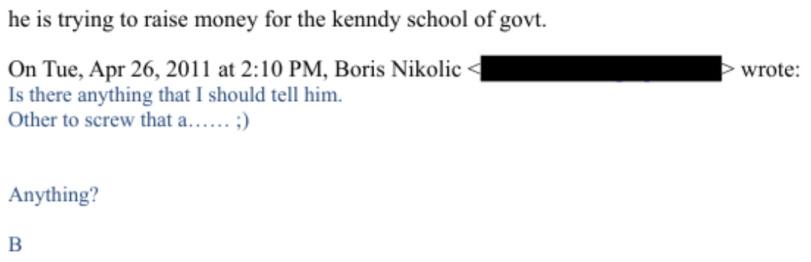
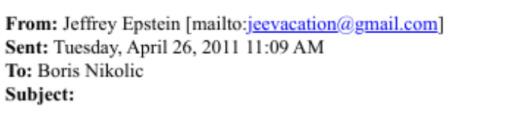
An April 2011 email exchange between Jeffrey Epstein and Boris Nikolic. courtesy of the u s department of justice
stein. The agreement required Epstein to plead guilty to state solicitation charges, register as a sex offender, and provide “victims with the means to obtain monetary damages.” In exchange, the U.S. Attorney’s Office would end its federal investigation of Epstein and his coconspirators.
Kellen has since been described by one of her lawyers “as a victim of Epstein” who
was “raped and abused weekly.” Kellen did not respond to a request for comment sent to the law firm that represents her. Some sections of the documents released may be redacted if they contain identifying information of victims, child sexual abuse material, information that would jeopardize an ongoing investigation or pros-
CONTINUED ON PG. 4
Tiffany Li, editor-in-chief
Elena Eisenstadt, deputy editor-in-chief
Evgenia Anastasakos, managing editor
Haebin Jung, chief production officer
Adam Zaidi and Arav Saksena, chief financial officers
The Maroon Editorial Board consists of the editors-in-chief and select staff of the Maroon
NEWS
Gabriel Kraemer, co-head editor
Anika Krishnaswamy, co-head editor
Nathaniel Rodwell-Simon, editor
GREY CITY
Celeste Alcalay, editor
Anika Krishnaswamy, editor
Vedika Baradwaj, editor
VIEWPOINTS
Sofia Cavallone, co-head editor
Camille Cypher, co-head editor
ARTS and CULTURE
Nolan Shaffer, co-head editor
Shawn Quek, co-head editor
Emily Sun, co-head editor
SPORTS
Shrivas Raghavan, editor Josh Grossman, editor
DATA and TECHNOLOGY
Nikhil Patel, editor
Jinny Kim, editor
Emily Sun, editor
CROSSWORDS
Eli Lowe, head editor
PHOTO and VIDEO
Nathaniel Rodwell-Simon, head editor
DESIGN
Eliot Aguera y Arcas, editor
COPY
Mazie Witter, chief
Megan Ha, chief Feifei Mei, chief
Vanessa Yelder, chief Olivia Rae Okun-Dubitsky, chief
SOCIAL MEDIA
Katherine Bolte, manager
NEWSLETTER
Evgenia Anastasakos editor
BUSINESS
Maria Lua, co-director of operations
Patrick Xia, co-director of operations
Executive Slate editor@chicagomaroon.com
For advertising inquiries, please contact ads@chicagomaroon.com
Circulation: 2,500
“... Epstein wrote in an email to Rubenstein, ‘[N]ice meeting you finally.’”
ecution, information deemed by executive order to be a threat to national defense or foreign policy, and content depicting death or abuse, according to the Epstein Files Transparency Act.
The Maroon did not attempt to identify the female individual in the partially unredacted image and flagged it to the Department of Justice as potentially having been published in error. On Tuesday night, the unredacted image was still available on the DoJ website.
Epstein, Nikolic, and Rubenstein attempted to coordinate meetings at least five times between August and November 2012, according to the emails reviewed by the Maroon
On August 21, Nikolic sent Rubenstein and Epstein an email introducing them to each other after previous attempts to schedule meetings were unsuccessful.
“David meet Jeffrey, Jeffrey meet David!” Nikolic wrote. “If meeting can work out, it is the best if you work it out directly! I
think you will both like meeting each other.”
It appears that they only met once shortly before November 12, 2012, when Epstein wrote in an email to Rubenstein, “[N]ice meeting you finally.”
“Thanks very much. Enjoyed the chance to meet you as well,” Rubenstein replied.
An email chain from November 26, 2012 indicates the two had planned to have dinner with former Israeli Prime Minister Ehud Barak that week. Epstein sent Rubenstein an article in the New York Times reporting that Barak planned to “leave political life” in Israel, to which Rubenstein responded, “So no dinner this week?”
Epstein replied, “[D]inner is a better idea now.. looking for interesting things to do,” presumably referring to Barak. The trio was ultimately unable to meet due to scheduling complications, the emails show.
The emails reviewed by the Maroon do not indicate that the two attempted to meet again after November 2012, although it appears they were both invited to the same Vanity Fair party in December 2013.
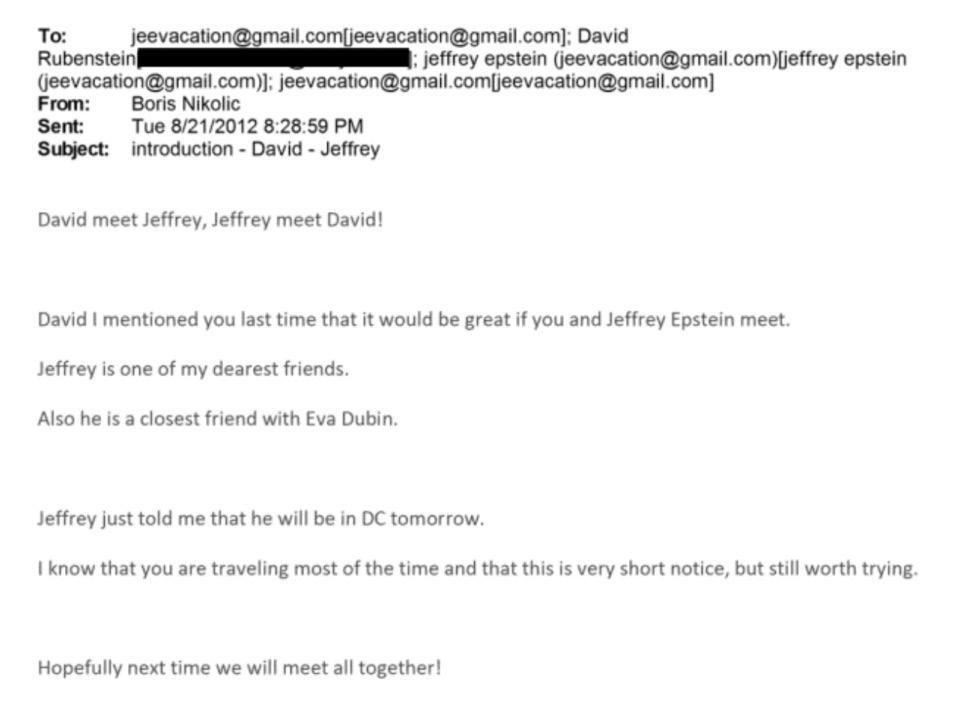
An August 2012 email thread including Epstein, Boris Nikolic, and Rubenstein. courtesy of the u s department of justice
By MATTHEW WEN | Senior News Reporter
The Public Safety Advisory Council (PSAC) held a public webinar on February 5 addressing recent public safety developments on and around campus, including a drop in robberies and new crosswalks to improve pedestrian safety.
The University of Chicago Police Department (UCPD) has not yet observed Immigration and Customs Enforcement (ICE) activity on campus, Chief of Police Kyle Bowman said at the meeting. “We haven’t had any of our officers come across any… ICE agents.”
The Maroon has tracked seven ICE detentions in Hyde Park since October 2025.
Facilitated by PSAC Chair Sharon Fairley, the council heard presentations from Bowman, Assistant Vice President for Campus Safety Michael Kwiatkowski, and Associate Director for Campus Environment Katie Martin Peck.
Bowman announced that there were 77 robberies recorded in Hyde Park and South Kenwood in 2025, a 33 percentage point decrease from 2024, marking the first time in at least 30 years the total number of robberies has been below 100.
The area, one of three community areas served by UCPD, spans from 47th to 61st Street and from Cottage Grove Avenue to Lake Michigan Avenue.
Yet Bowman is wary of viewing the sudden decrease without regard for the larger historical context.
“There’s definitely a pattern. As we bring numbers down over the years, numbers tend to turn back up,” Bowman said. Counts from the past decade are indicative of this trend. Area robberies fell to 109 in 2019 before steadily increasing to a post-pandemic peak of 208 in 2023.
Neighborhoods patrolled by UCPD, including Hyde Park, Kenwood, Oakland,
and Woodlawn all saw violent crime drop by more than 20 percent last year.
Bowman credited some of the recent successes to internal changes at UCPD.
“We really have taken a look at how we approach things, also with our patrol tactics, in terms of specifically where we’re assigning our patrol cars, in conjunction with the [University] Safety Ambassador Program,” he said. “A lot of the measures we put into place the past two years have contributed to success.”
Bowman also attributed the downturn to a citywide decrease in violent crime. According to him, Chicago saw a 36 percent decrease in robberies and a 21 percent drop in violent crime in 2025, compared to 41 percent and 25 percent drops, respectively, in UCPD areas.
The University’s Safety Ambassador Program, which posts ambassadors throughout campus and surrounding neighborhoods in high-visibility uniforms, implemented new accountability mea-
sures in 2025. “[Lytx], a driver tracking system that tracks the officer’s safe driving habits and logs unsafe driving, distracted driving, and overall driving habits, [sends] an alert if an officer [is] distracted driving or on the phone while driving. That’s immediately sent to the management team, and they take immediate action to remediate those practices,” Kwiatkowski said at the meeting.
The fleet of Safety Ambassador vehicles, which features large, neon-green light bars, is also due for refurbishment by the end of February. “Our vendor recently moved to a new equipment supplier, and the new light bars that they have been installing are brighter than the legacy light bars that were installed on our previous fleet of vehicles,” Kwiatkowski said. “We’ve identified the vehicles that have the light bars that are operating at a higher intensity, and we’re hoping to have that replacement completed by the end of
“What we came up with was an idea of improving the baseline level of safety for pedestrians throughout the entire zone... ”
CONTINUED FROM PG. 4
February.”
Peck also discussed recent pedestrian safety changes on campus. Following a Facilities Services study that identified areas to prioritize for safer pedestrian movement, Facilities focused on the western crossing connecting Woodlawn Residential Commons to Midway Plaisance. The study accounted for both pedestrian activity and the number of reported incidents at different intersections; the Midway experienced the most vehicle collisions on campus in 2024.
“At University and 60th [Streets], we
had many pedestrians crossing at a diagonal at an area that was not explicitly marked as a crosswalk, and so that quickly rose to the top as one of our priority intersections to do additional enhancements at,” Peck said.
In 2025, a concrete bump-out was installed to reduce pedestrian travel distance at the intersection. Now, the addition of a second formalized crosswalk and pedestrian crossing signage has standardized the crossing. The intersection of South University Avenue and East 55th Street was also enhanced similarly, with flashing pedestrian lights installed
where South Greenwood Avenue and South University Avenue meet East 55th Street. These lights, called rapid flashing beacons, were also added to many Midway crossings.
“What we came up with was an idea of improving the baseline level of safety for pedestrians throughout the entire zone, so making sure that we touched all of the crosswalks in that area and brought them up to a higher baseline level,” Peck said. “That was where we got into things like flexible bollard bump-outs, painted areas, and concrete curve bump-outs, along with some other strategies.”
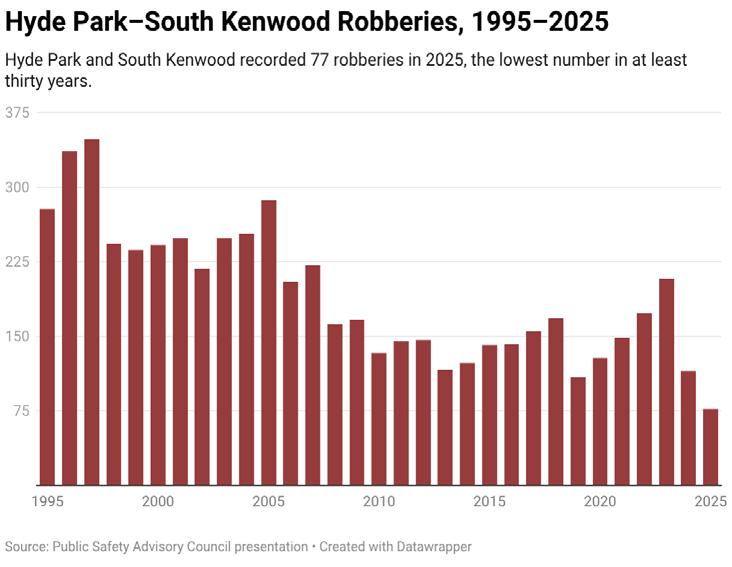
Annual Hyde Park and South Kenwood robberies fell in 2025, according to data presented in PSAC’s February meeting. gabriel kraemer
By NATHANIEL RODWELL-SIMON | News Editor
Undergraduate Student Government’s (USG) College Council (CC) met on February 9 to hear funding appeals from three RSOs—Occam’s Razor, the University of Chicago Space Program (UCSP), and the Ballroom and Latin Dance Association (BLDA).
CC representatives also raised concerns during the meeting about USG running out of funding for the remainder of the year but did not reach a conclusion on how to address the issue.
As of February 9, the Student Government Funding Committee (SGFC) had $69,000 remaining for the year, with $4,000 to cover the remainder of winter quarter funding requests, according to totals written down at the beginning of the meeting.
Much of the meeting revolved around a discussion of how and when to apply SGFC’s fundraising requirements and whether CC and SGFC should more strictly apply funding guidelines to limit expenditures for the remainder of the year.
Occam’s Razor asked CC to reconsider SGFC’s decision to deny its request for $3,495 in funding for its annual retreat,
arguing that the retreat is a core component of the RSO’s ability to successfully produce three shows each quarter. The request covered the full cost of Airbnb fees, transportation, and food for a weekend-long trip. According to Occam’s Razor’s appeal, they also did not receive funding for the trip during annual allocations.
SGFC had previously denied Occam’s Razor’s request because the retreat is not open to the general student population as required by SGFC’s funding principles. During its appeal, Occam’s Razor confirmed that the retreat was exclusively for members of the RSO.
Some CC representatives expressed concern that a strict application of the public event requirement would reward RSOs whose events are technically open to the public but, in practice, reserved for members. Other representatives argued that CC must take RSOs at their word, and that this is the reason SGFC conducts audits and imposes the same requirements on all RSOs that receive funding.
CC ultimately denied Occam’s Razor’s appeal and did not fund the trip.
UCSP appealed SGFC’s rejection of
a $300 request to cover the cost of food at an “engineering work session,” citing a misstatement made during the RSO’s initial request. SGFC had denied UCSP’s request for funding on the grounds that it does not fund food costs for RSOs’ general body meetings. UCSP said it had incorrectly described the work session a general body meeting in its initial request because of a recent change in leadership and noted that it has received funding for food in the past.
After deliberation, CC approved UCSP’s request in full.
BLDA appealed SGFC’s denial of $661 in funding to attend a dance competition, arguing that it was unable to find the lower-cost options for transportation and ticket prices that SGFC had cited and that SGFC was incorrect in stating that the RSO already had enough to cover the full cost of the event.
BLDA also noted that, as it was only requesting 36 percent coverage of travel costs from SGFC, the discrepancy should not prevent it from receiving funds. SGFC cost guidelines state that it generally will not cover more than 50 percent of competition-related travel costs.
During deliberation, a representative from SGFC maintained that BLDA would
not need additional funding if it used lower-cost travel options. SGFC and BLDA representatives continued to disagree over whether these options were available, with each providing different costs that they had identified.
CC representatives ultimately decided to recalculate the possible funding allocation based on BLDA’s request but disagreed on where to apply a 10 percentage point penalty for not engaging in external fundraising.
Per SGFC’s cost guide, RSOs are expected to raise at least 10 percent of funds themselves for requests exceeding $2,500 but less than $5,000. However, the guidelines do not specify whether the 10 percent requirement is imposed on the initial amount requested or the amount that SGFC agrees to cover.
After four rounds of voting, CC decided to allocate $369.90 to BLDA because, as Class of 2029 Representative Gavin Wynn put it, CC should “make a decision that allows [BLDA] to go on the trip instead of one that penalizes [the RSO] for [CC’s] uncertainty in our math.”
College Council holds weekly public meetings in Stuart Hall 104 on Mondays at 7 p.m.
By SILAS YATES | News Reporter
The Fundamentals: Issues and Texts major admitted 32 students this past fall for its second-year cohort, more than doubling its third-year cohort of 14. The fourth-year cohort has 19 students.
The major, which allows students to design their own curriculum guided by a research question of their choosing, requires students to apply in fall quarter of their second year. The application process entails participating in interviews and submitting a form that outlines the desired research question and any relevant texts.
The large cohort size is due to an increased number of applicants to the major, according to Fundamentals Program Director Ryan Coyne. “We at least doubled the number of applicants, and so we did accept double the number of students,” he said.
For Coyne, the increased interest in the major is a sign that the intellectual tradition is alive and well at UChicago. “What I see is a hunger for the kind of engagement with books that Fundamentals offers, and I think we’re seeing that in the numbers,” he said.
Fundamentals courses focus on the
close reading of a specific text or author, which “cultivates spaces where you can actually get to the bottom of your texts,” according to fourth-year Fundamentals major Gabriel Brumberg.
This uniquely deep investigation of texts has historically fostered a close relationship between students and professors. Initially, the program was meant to be an “apprenticeship program,” Coyne said, offering students “a chance to work with prestigious faculty in the humanities and the social sciences.”
Coyne emphasized the importance of this student–professor relationship as the program sees increased interest. “Advising is a very important part of the program. If we were to continue to grow, that would be wonderful, and it would also change the nature of the program. It really is meant to give students a chance to work with faculty,” he said.
He noted that Fundamentals appointed three additional faculty members this fall but said that decision was unrelated to the increased class size.
Brumberg suggested that the apprenticeship aspect of the program stems from a student’s drive to engage
with professors one-on-one, motivated by their specific research question, rather than something like class size or student-faculty ratio. “You feel you have this question that isn’t always covered in lecture…. If you stumble upon something where you think, ‘This is good for my research [question],’ it’s in your best interest to reach out to the professor,” he said. “I’m not sure that there being more Fundamentals students is going to change that.”
Even before the increase in interest, the Fundamentals program was planning to diversify and increase event programming, Coyne said. The program currently hosts the Issues and Texts Dinner series, where faculty are invited to talk about a text important to them and lead seminar conversations over a meal. In the future, Coyne plans to expand programming to include debates, reading groups, and student presentations, hoping to encourage more discussion and engagement among students.
“When you have a program with individualized curricula, it might seem like a solitary affair,” Coyne said. “But that’s not the case—in Fundamentals, you have a vibrant community of like-minded people, in the sense that they’re all commit-
ted to reading and thinking seriously and to doing that in dialogue with one another.”
Brumberg emphasized the importance of events for the social component of Fundamentals, since it has fewer required classes than other programs, which often give a major its structure. “The way you get some structure [in Fundamentals] is by feeling like you’re really part of a cohort—having events with them and meeting people in the cohort outside of class. I’ve spent a lot of time the last couple of years with people in Fundamentals,” he said.
When asked if he had seen any change in the events since the admission of the new cohort, Brumberg said, “Already I went to one dinner that was in a larger space than we’re usually in, because there were more people attending. But the vibe didn’t feel any different—you still sit down around a table, listen to a lecture, and then have an open seminar conversation.”
For Coyne, increasing the Fundamentals cohort size means “increasing the diversity of viewpoints,” though he added that whether the program will continue to grow in the future is uncertain.
By NOLAN SHAFFER | News Reporter
The Neubauer Collegium for Culture and Society received a $500,000 grant from the John D. and Catherine T. MacArthur Foundation last month to support a two-year research project on the current state and prospects of the humanities.
Launched in 2012, the Neubauer Collegium aims to “deepen knowledge about the world and our place in it” through collaborations with professors from nearly 50 departments across the University in almost 150 projects.
The grant will support the Future of the Humanities project, which is set to begin immediately. It will work to define core principles and qualities of work in the humanities and collaborate with NORC, a quantitative survey and data institute at UChicago. The project will culminate in a report with recommendations for administrators, instructors, and institutions involved in the humanities.
This research comes as the University’s Division of the Arts & Human-
ities faces a major restructuring amid significant budget cuts across the University. This past summer, the division announced it had tasked a faculty working group with considering the consolidation of its 15 departments into eight. No formal plans have been published yet, though the Maroon confirmed that the working groups are still meeting.
The grant is intended to “respond to mounting pressures facing the humanities, from assaults on academic freedom to the erasure of vital histories,” the MacArthur Foundation wrote in a press release on January 20. It is part of
a larger $10 million in funds distributed to various organizations across the country, such as the Feminist Press and the forthcoming National Juneteenth Museum. The Neubauer Collegium is the only higher education–affiliated institution among the grantees.
“I’m deeply gratified we will have an opportunity to convene such a critical conversation at the Neubauer Collegium, and I am hopeful about our ability to imagine forward-thinking ideas for the future of the humanities,” said Neubauer Collegium Roman Family Director Tara Zahra in a January 20 press release.
By IAN ROTHFELD | News Reporter
The U.S. Department of Health and Human Services (HHS) revised its schedule of recommended vaccines for American children last month, reducing the number of advised immunizations from 17 to 11. Because states enact their own policies and Illinois has not changed its guidelines, UChicago Medicine (UCMed) patients in Illinois will not experience changes to their care.
Uncertainty remains at UCMed locations in Indiana—a state following the new federal guidelines—and many doctors, including those at UCMed, worry that conflicting messaging will cause confusion that reduces vaccination rates and leaves states vulnerable to outbreaks that occur elsewhere.
HHS announced on January 5 that it will no longer recommend that all children get vaccinations for hepatitis A and B, rotavirus, RSV, meningococcal disease, and influenza, except for high-risk patients or patients who have consulted with a care provider through “shared clinical decision-making.” The changes follow an overhaul of the federal Advisory Committee on Immunization Practices (ACIP) overseen by Health Secretary Robert F. Kennedy Jr., who dismissed all ACIP members at the beginning of his tenure.
Though federal guidance often influences state practices, only states can mandate vaccines. Illinois’s guidance remains largely consistent with last year’s Centers for Disease Control and Prevention (CDC) recommendations and current professional health association guidance, allowing medical providers in Illinois to continue current vaccination practices.
When asked if its institutional vaccine guidelines would change, UCMed told the Maroon that “[t]he state of Illinois hasn’t changed its childhood immunization schedule.”
“This announcement has no bearing on Illinois’ childhood vaccine recommendations, which is based on up-to-date scientific evidence,” Sameer Vohra, director of the Illinois Department of Public Health, said in a statement last month. “As the federal government unilateral-
ly makes changes without transparent review or evidence to support changes, Illinois will continue to promote the well-being of Illinoisans by issuing recommendations based on the full weight of scientific evidence.”
Many of Kennedy’s replacements on the panel have histories of vaccine skepticism. The new panel chair, Kirk Milhoan, recently said that shots protecting against polio and measles—widely considered among the most successful steps taken to protect public health—should be optional.
All federally recommended vaccines must be covered by insurance, but the AHIP health insurer trade association said its members would continue covering the reclassified immunizations through the end of 2026. Illinois law requires insurance providers in the state to insure vaccines in line with state recommendations.
Vaccines no longer recommended in states that adopt federal guidelines are still considered recommended after a consultation with a physician. But “it’s really unclear” how providers in those states should proceed, according to Allison Bartlett, a professor of pediatrics and the interim chief of the Section of Pediatric Infectious Diseases at UCMed.
Indiana—where UCMed has six locations, one of which is fully operated by the University—is one of 23 states relying solely on the federal recommendations for childhood vaccines.
“Those logistics are not well understood.… [Medical providers] don’t want to get in trouble, but it’s not clear what they should or could be doing differently,” Bartlett said. “The providers’ expertise on the science-based evidence and safety for all the vaccines that we have feels diminished when it’s put in those contexts.”
“It makes it sound like, prior to this, we weren’t having conversations with our [patients’] families about vaccines—that’s completely wrong,” she said. “Everything that we do is in partnership with our patients and their families.”
Six major medical organizations—including the American Academy of Pe -
diatrics (AAP), the Infectious Diseases Society of America, and the American College of Physicians—sued on January 13 to block the new recommendations.
“The confusion and the needless creation of skepticism… is going to have significant impacts on the overall vaccination rates,” Bartlett said.
The Illinois committee responsible for setting statewide guidelines previously adhered to ACIP recommendations, but it broke with the current CDC guidance to mandate guidelines in line with recommendations from scientific bodies like the AAP, according to Bartlett.
Combatting communicable illnesses requires “a high level of community immunity to prevent transmission,” she said. “There are always populations that are going to be vulnerable to an infection… and the only way that they can stay safe is if everyone else who’s able to get vaccinated gets vaccinated.… There [aren’t] borders to
the spread of infectious diseases.”
Disease outbreaks in unvaccinated areas can “seed” infections across the country, even to vaccinated areas. The measles outbreak in an unvaccinated area of South Carolina—the largest in more than three decades—spread to North Carolina and Washington state, despite those states’ broader vaccine recommendations similar to Illinois.
For doctors in Illinois, Bartlett said, “we’re practicing the same way. We’ve always had families who have questions about vaccines, and we’re very good at having conversations with families about that.”
“I think the environment has caused us to double down and support our professional societies that are continuing to make these evidence-based recommendations…. It’s just causing us to have to think more about how we spread the message that we’ve always had.”


The University’s history is marked by breakthrough experiments in nuclear and particle physics.
By AMAN THAWANI | Grey City Reporter
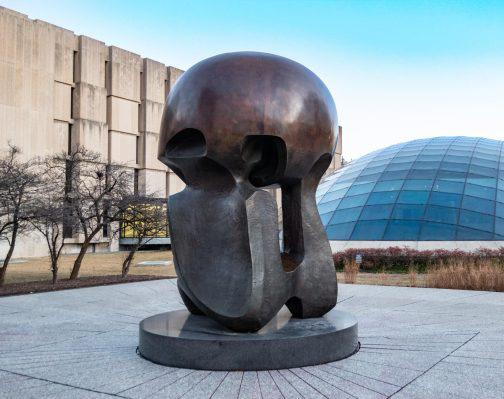
Looming behind Regenstein Library is a mushroom cloud–shaped bronze sculpture—Henry Moore’s Nuclear Energy. Installed in 1967, it now seems like an inconspicuous part of the campus landscape. In reality, it symbolizes the first step in UChicago’s deep and complex history as a pioneer in nuclear and quantum physics.
host a total of one million qubits, on Chicago’s South Side. Quantum computing is known as an up-and-coming technology with potential applications in scientific, financial, and industrial fields. But it is just the latest chapter in Chicago’s rich history in nuclear and particle physics, dotted with events like the first-ever synthetic nuclear chain reaction, the participation in the Chicago Quantum Exchange (CQE), and a student building a nuclear reactor for Scav. The city’s long-standing reputation as a pioneer in quantum science begins at the University of Chicago.
Fermi in Chicago: Turning Theory into Results
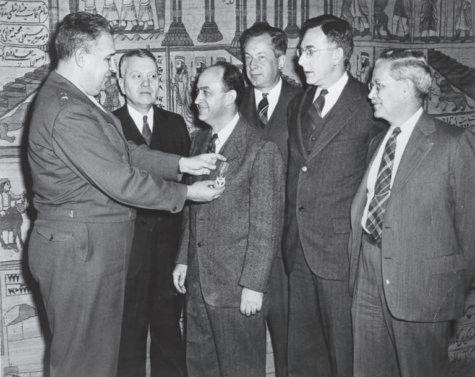
The Manhattan District director presents physicist Enrico Fermi and other University scientists with Medals for Merit for their role in developing the atomic bomb. courtesy of the hanna holborn gray special collections research center
chain reaction.
They set up a pile of graphite bricks embedded with layers of uranium and a series of cadmium rods methodically inserted into the pile.
Previously, Fermi and his colleague Anderson had reached an interesting conclusion. By applying quantum mechanics to the behavior of uranium, they had found that uranium atoms, when bombarded by neutrons, split and emit even more neutrons at high energies. This causes the uranium atoms hit by those neutrons to split as well, creating a chain reaction.
A framework for quantum physics originated in the early 1920s, when European physicists began to notice that particles behaved differently at small scales. The laws of classical physics were not holding; physicists, noticing those flaws, sought a remedy. Through the work of a few extraordinary individuals, the resulting forms of science found their way to UChicago, which then became the site of some of the most important experiments in the history of nuclear and quantum physics.
Just last year, the Palo Alto–based startup PsiQuantum announced its plan to construct the Quantum Computer Operations Center, a 300,000-square-foot quantum computing structure aiming to
In 1938, Enrico Fermi, often referred to as the architect of the nuclear age and one of the greatest physicists of all time, emigrated from Italy to escape Benito Mussolini’s rising fascist regime. After spending time at Columbia University, Fermi, trained in all forms of theoretical and experimental physics, moved to Chicago, ready to reshape the quantum landscape.
His work laid the foundation for more accurate, cohesive, and mathematically justified theories of particle motion.
In a biography of Fermi, Herbert Anderson—who had been his colleague first at Columbia and then at UChicago—described Fermi’s practical, realistic approach to science: “Fermi was in his 20s [in the 1920s] when physics was undergoing one of its major advances. The theory of quantum mechanics was developing rapidly.… Fermi was less interested in the more formal aspects of the theory than in its use in explaining what was going on.”
Like other physicists of his time, Fermi used the groundbreaking equations recently developed by theorists to conduct concrete experiments, uncovering many eye-opening truths about the physical world. In the 1920s and 1930s, he theorized about atomic collisions between charged particles and the existence of a new class of subatomic particles with special, useful properties (which were later discovered and named fermions in his honor).
In 1932, following the discovery of the neutron, experimental nuclear physics became an extremely fertile field. This would be crucial for Fermi’s later exploits in nuclear science at UChicago’s Metallurgical Laboratory (Met Lab).
On December 2, 1942, under the bleachers of UChicago’s Stagg Field, Fermi directed a research team in an experiment that achieved the first-ever man-made nuclear
His team removed the structure’s rods one by one, with “close watch being kept on the intensity [of neutrons in the system].” Fermi had calculated that for the chain reaction to occur, eight feet of the last rod needed to be removed.
“Actually when about seven feet were removed the intensity rose to a very high value but still stabilized after a few minutes at a finite level,” Fermi wrote. “It was with some trepidation that the order was given to remove one more foot and a half of the strip.”
Fermi wrote that the intensity began increasing slowly “until it was evident that it would actually diverge” to violent levels. Despite concerns about the outcome and safety of the reaction, when the cadmium strips were reinserted, the intensity dropped to a safe level. Fermi’s calculations had been correct, and it had been executed successfully.
Fermi would soon be moved to Los Alamos, New Mexico to join the main branch of the highly classified Manhattan Project, which sought to rapidly produce atomic weapons in the United States.
“The
CONTINUED FROM PG. 8
In 1945, the Manhattan Project culminated in the construction of the atomic bomb, whose deployment in Hiroshima and Nagasaki marked the end of World War II. Notably, the Nagasaki bomb used plutonium, researched by the Met Lab, instead of uranium.
Around the same time, the Met Lab officially became affiliated with the University and was converted into Argonne National Laboratory, a prominent physics research institution to this day.
UChicago funds about $50 million per year of Argonne’s research in both physical and life sciences, including nuclear reactor experiments.
Argonne has also become a center for scientific supercomputing; it currently owns and operates Aurora, one of the fastest supercomputers in the world. According to Argonne scientists, Aurora can perform more than one quintillion calculations every second. Argonne has said that its high-performance computers represent a significant streamlining of the research process relative to Fermi’s age, automating calculations that were once done manually.
In 1969, the Fermi National Accelerator Laboratory, commonly known as Fermilab, was founded. The UChicago-affiliated lab has been churning out advancements in atomic physics since its foundation. Fermilab scientists have directly discovered two kinds of subatomic particles, the top quark and bottom quark, and verified the existence of a third, the tau neutrino—all of which are essential for understanding the fundamentals of the universe.
Two central discoveries about the behavior of particulars on a small scale— quantum superposition, where things exist in multiple states at the same time, and entanglement, where things that should be completely independent actually affect each other—laid the groundwork for new derivative sciences.
One of these sciences was molecular engineering, the focus of the only engineering major offered at UChicago.
New Leaders: PME and the Chicago Quantum Exchange
The Pritzker School of Molecular Engineering (PME) was founded in 2011 and
works closely with companies such as IBM and partners with Argonne and Fermilab. It has grown into “the core of quantum, on campus and in the region,” PME’s dean, Nadya Mason, told the Maroon.
PME, like Argonne and Fermilab, champions a blend of theoretical training and experimental experience. It offers three tracks for its undergraduate students to pursue, one of which focuses on quantum engineering.
In molecular engineering, theory and practice feed into each other, says Doğa Kürkçüoğlu, a theoretical physicist at the Fermilab Quantum Institute. “Trying to determine whether theory leads to experiment or experiments allow us to advance theory is like trying to determine whether the chicken or the egg came first,” he told the Maroon. Indeed, researchers at PME have challenged the strict separation between a theoretical and empirical approach, opting to increase interactions between theorists and experimentalists.
Rohan Mehta (S.B. ’25), a recent quantum engineering graduate from PME, agreed, dubbing this phenomenon an “experimental-theoretical integration.”
One of the main disciplines making use of quantum mechanics is quantum computing. “In our classical computers, we use binary [bits]—0 or 1—because we’re very used to, in normal physics, either having something or not having it,” Mehta explained. “A switch can be on or off.” That binary structure does not hold in quantum physics.
“We don’t necessarily have a particle that’s here or there. But we have some particle that, in some very complicated way, is kind of both, and behaves in a completely different manner than what we’re used to.”
Quantum computers take advantage of fundamental units called quantum bits, or qubits. These derive their efficiency from the laws of quantum mechanics; as Mehta puts it, “when you have different physics, you can encode different kinds of information. And that allows you to do new kinds of computing.” The exploitation of quantum mechanics’ inherently probabilistic, uncertain nature is what makes quantum computing so powerful.
Many of the other quantum derivative sciences are also directly applicable to real-world scenarios. For example, en-
tangled particles can be used to generate quantum communication networks that can transmit information rapidly and securely.
“We have one of the world’s largest, longest quantum networks that has entangled particles going over long distances from here to [the University of Illinois Urbana-Champaign] and back again. And so we’ve been exploring what we can do with these networks,” Mason said. In this sense, PME has helped UChicago to enact its quantum discoveries in various contexts and to establish collaborations with other institutions in the Chicago area.
In 2017, UChicago, Argonne, Fermilab, and UIUC founded the Chicago Quantum Exchange, based at UChicago’s PME.
The CQE hosts regular symposiums at its partner institutions, builds physical quantum communication networks, and publishes reports on the progress of quantum research in the Chicago area.
Mason describes the CQE as “the basis for Chicago being the world’s center for quantum.” From chemists to mathematicians to computer scientists to engineers, Chicago-area researchers working in the quantum domain come together to advance quantum research, prepare the next generation of quantum leaders, and fuel the quantum economy.
In the wake of these academic developments, the baton has—at least partially—been passed to industrial players who seek to implement quantum discoveries in physical computers and hardware.
Companies like IBM and Google, along with quantum-specific corporations such as D-Wave Quantum, Quantinuum, and Infleqtion, form the backbone of the quantum economy, which encompasses the investments, jobs, infrastructure, and commercialization of everything quantum.
The Chicago area is a nexus of growth in quantum technology. In 2024, the Boston Consulting Group projected that quantum technology providers in Illinois, Indiana, and Wisconsin alone could generate $80 billion in economic value— roughly 30 percent of the global figure for the industry—by 2035. Additionally, Palo Alto startup PsiQuantum has selected a
site on the South Side, just five miles from UChicago, as the location for its industrial-sized quantum computing campus, to be named the Illinois Quantum and Microelectronics Park.
However, one central problem with modern quantum computing remains. Qubits, unlike bits, are prone to strange forms of perturbation including decoherence, where temperature fluctuations cause qubits to lose their functionality. They can also generate noise due to their sensitivity to interaction with random small particles.
The demand for improved quantum hardware, Mason said, is immediate. “We’re not always the most efficient at using the technologies that we have, and as technologies get better, sometimes we run into pretty strict hardware limits,” Mason said. Many major companies are developing next-generation quantum computers, cryogenic technologies to stabilize qubits, and more efficient qubits themselves.
“All the world’s current computers operating together can’t do what a one-million-qubit quantum computer will be able to do,” Microsoft wrote in an official statement. This is just one example of the incredible potential of the intersection between quantum computing and modern industrial technology.
UChicago continues to be involved in the development of quantum computing.
The CQE, in its annual report, characterized 2024 as “a year of unparalleled progress” for the Chicago quantum community: a UIUC-led experiment tested quantum communication technology in outer space; PME scientists leveraged properties of diamonds to attain more precise measurement technologies for quantum systems; and a Fermilab experiment succeeded in lengthening qubit lifetimes using a special class of qubits called superconducting qubits. UChicago is also collaborating with the State of Illinois to create a new quantum algorithm center, powered by IBM’s advanced quantum computers.
Researchers are still developing ways to tackle the biggest problems slowing progress in quantum computing, such as
“It benefits all of us to have quantum be successful in Chicago... ”
CONTINUED FROM PG. 9
decoherence and noise. Mehta is currently conducting theoretical research in this field, known as quantum error correction.
“Error correction is really one of those things that we need at scale,” Mehta said. Large portions of quantum computing’s usefulness, especially for industrial-level applications, depend on error correction.
With the International Year of Quantum having just passed, scientists and engineers are working relentlessly toward realizing the first fully functional quantum computer. Kürkçüoğlu predicts that this advance will “completely revolutionize the quantum and larger scientific landscape.”
Chicago is equipped with the world’s
Mehta says he is “quite optimistic” about the field’s potential, adding, “[T]he theory is very strong, and I think now it’s about integrating it into devices.”
premier experimental and computational resources, a constellation of dedicated scientists, and Governor J. B. Pritzker, who has secured billions of dollars in quantum computing investments. It is poised to expand its role as the forerunning intellectual and industrial center of quantum science.
As quantum science progresses and researchers improve the theoretical, industrial, and physical infrastructure supporting it, more major breakthroughs are set to arrive.
“Science is a combination of great ideas and tools that allow you to implement those great ideas,” Mason said, expressing excitement about the future. “It benefits all of us to have quantum be successful in Chicago, and with the significant support we’ve received [for] the partnerships across our universities and labs, I think we’re going to do it.”
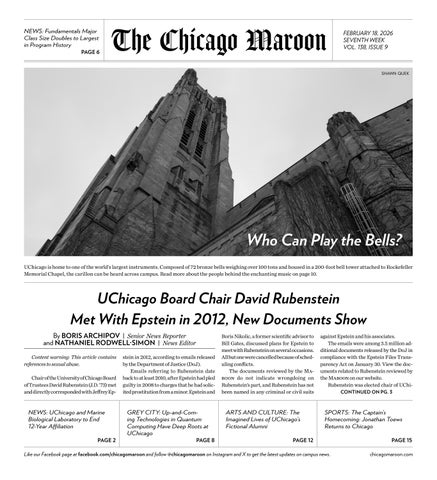
UChicago’s Guild of Carillonists play music from Errol Garner to Chappell Roan on the world’s “de facto biggest instrument.”
By SHAWN QUEK | Head Arts and Culture Editor
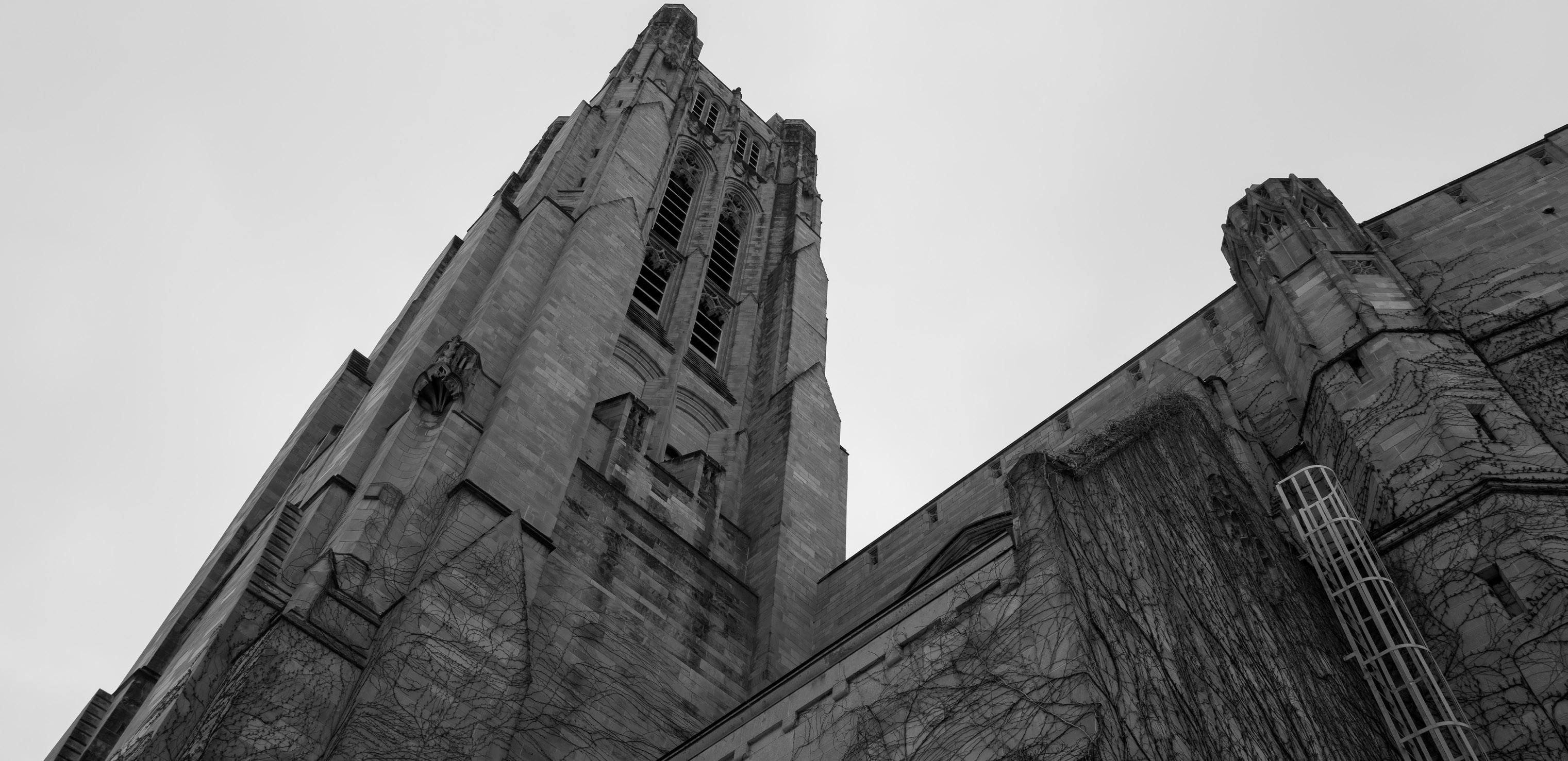
The carillon in Rockefeller Memorial Chapel is like a campus rumor you need to hear to believe. The Laura Spelman Rockefeller Memorial Carillon is composed of 72 bells, made of over 100 tons of bronze, housed in a 200 foot bell tower attached to the chapel, operated by a wooden keyboard and wire contraption that looks like it was designed to punish the hands. The atmospheric, hallowed, rich sound it makes is not music you merely stumble into. This is music that finds you, crossing the quad at 4 p.m. on a Tuesday, suddenly arrested by what sounds like a spiritual awakening, or perhaps an arrangement of Errol Garner’s “Misty.”
Will Vanman, a carillonist and second-year student studying public policy and Environment, Geography, and Urbanization (CEGU), first encountered the carillon on the internet. As a piano player admitted to the University, Vanman watched a YouTube video by Rob Scallon touring a massive instrument that turned out to be the Rockefeller Carillon. He watched excitedly with his family in Brisbane before coming to Chicago, filing it away as something really cool to do and hoping to have the fortune of swapping his
piano for a building-sized instrument.
Months later, at the Engagement Expo, there it was: the Guild of Carillonists table with a miniature carillon sitting on top, the physical manifestation of what he was waiting for. Five weeks of auditions followed, filled with lessons, practice, and nerves. At the end of the process, he was scored anonymously as he performed in front of the entire Guild using what Vanman calls “a very convoluted” system. “I did it this year and I didn’t really understand it,” he admits, laughing. Yet this didn’t stop him from learning to play the behemoth of an instrument.
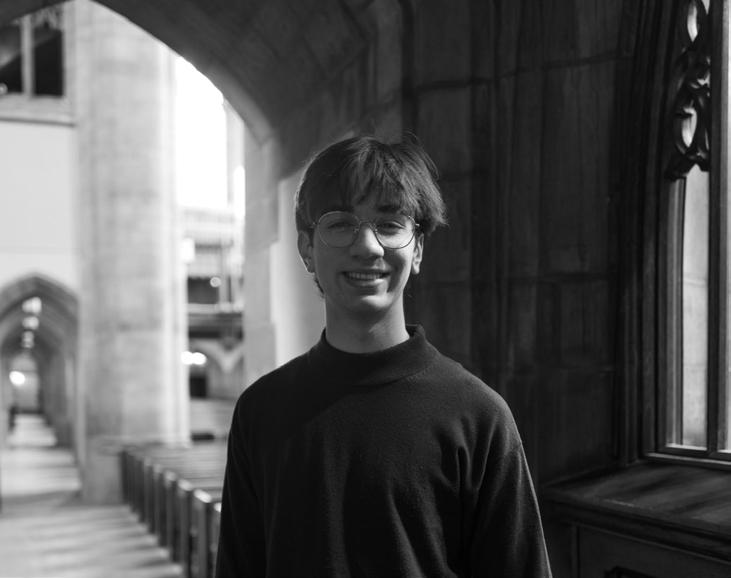
For the largest bells, you put your full weight into the foot pedal. The largest bell is affectionately named Big Laura, weighing 18.5 tons. This massive weight requires you to put your whole body weight into the foot pedal to engage the clapper, ringing the bell. The recital is part musical accomplishment, part feat of strength, and part interpretive dance. Vanman plays 100 tons of bronze suspended 200 feet in the air as nothing more than an extension of his body, a brooding rendition of Jef Denyn’s “Preludium in D minor” ringing across the campus below. In many ways, the Guild is carrying a legacy that’s inextricably linked to the instruments they play. Since the 1500s the Low Countries—Belgium, the Netherlands, and Luxembourg—have run these instruments as a musical reminder of civic pride. As such, the Guild makes a pilgrimage every other spring break, which member Emilio Del Angel, a third-year student studying neuroscience, was in charge of organizing this past year.
Del Angel spoke about the Guild’s trip to the Netherlands and Belgium, congregating in medieval bell towers and touring a carillon school tucked into the quaint Belgian town of Mechelen. Del Angel expressed with awe how he received a
masterclass from Eddy Mariën, city carillonneur of Mechelen, Leuven, and Halle on Mariën’s own arrangement, “Lux Aeterna.”
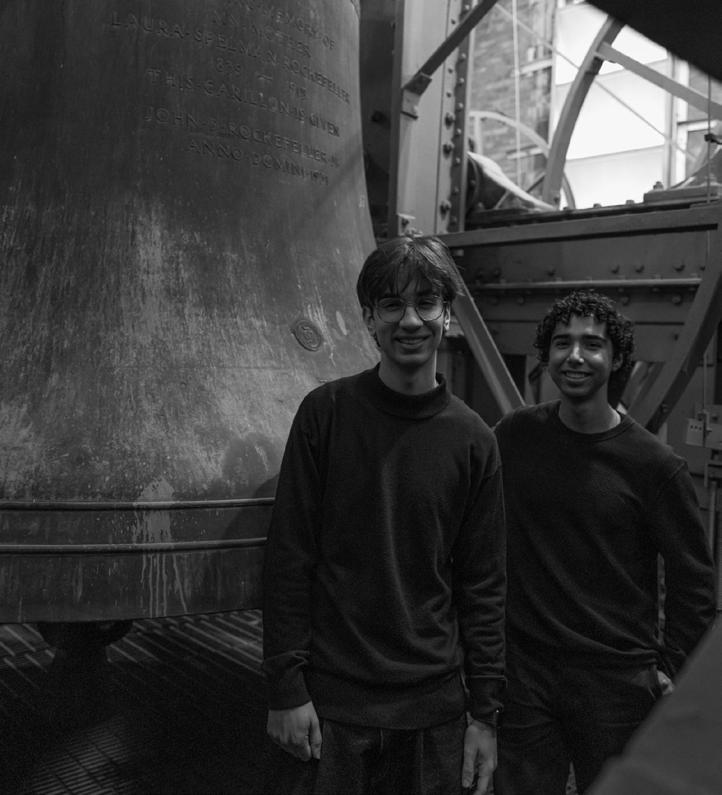
Will Vanman (left) and Emilio Del Angel (right) with the largest bell of the Laura Spelman Rockefeller Memorial Carillon. shawn quek
The Guild played historic carillons there, bells that survived both World Wars, spared the fate of being melted into bullets. “A lot of these places that we played at have such a deep history,” VanCONTINUED ON PG. 11
“Everybody can play the piano, but who can play the bells?”
man said, “it felt really amazing to just be part of that…” The sentence trails off because some things resist articulation. What can you say about touching an instrument from the 1500s, about placing your hands where generations of hands have been?
The University owns a carillon in part because of an American named William Gorham Rice. Rice witnessed carillons being destroyed in World War I as bell towers were bombed, bells themselves seized for their value as bullet metal. Rice then wrote “Carillon Music and Singing Towers of the Old World and the New,” in 1925. The book became popular, reaching John D. Rockefeller, who became invested in the instrument. Rockefeller financed two carillons, one at Riverside Church in Manhattan, the other at UChicago, both installed in the early 1930s. UChicago’s carillon cost about 200,000 dollars in 1924, converting to about 3.27 million dollars in 2026. According to the Rockefeller Memorial Chapel website, “Carillons of this size had never before been made, and have not been made again since that time.”
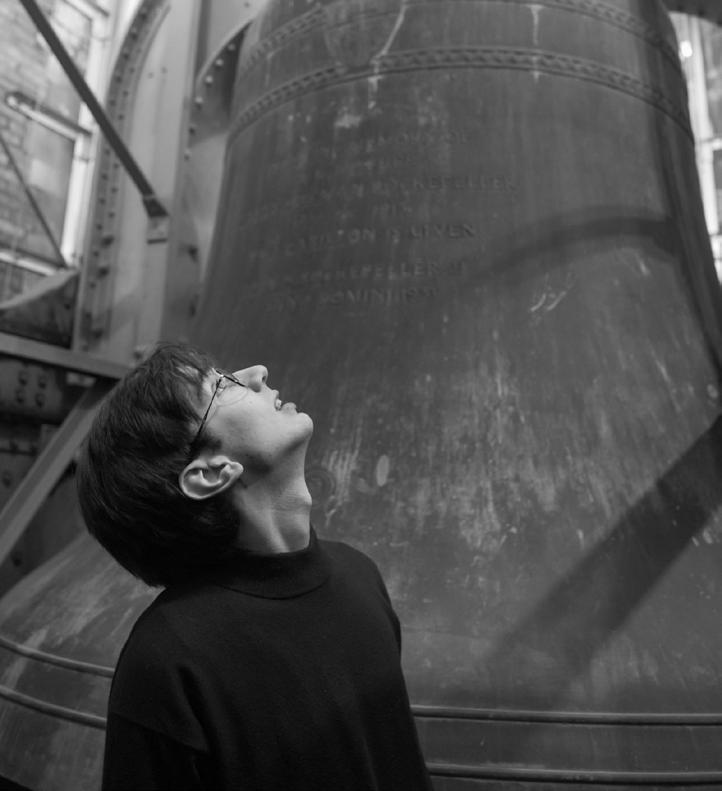
ficulties. “So, I guess Rockefeller is the de facto biggest in the world, which is pretty cool.” The understatement is very UChicago. The biggest playable instrument in the world is, indeed, “pretty cool.”
The awe-inspiring instrument can be examined up close by the public on tours offered by the Guild of Carillonists twice daily Tuesday through Friday. Vanman recounts how once, a little boy came with his family and got a close look inside one of the bells. The kid’s face lit up with pure wonder, and afterward his dad gave Vanman a high five. “I was like, yes!” The joy in this transmission of wonder from the Guild to a child to a grateful father, is what it’s all about.
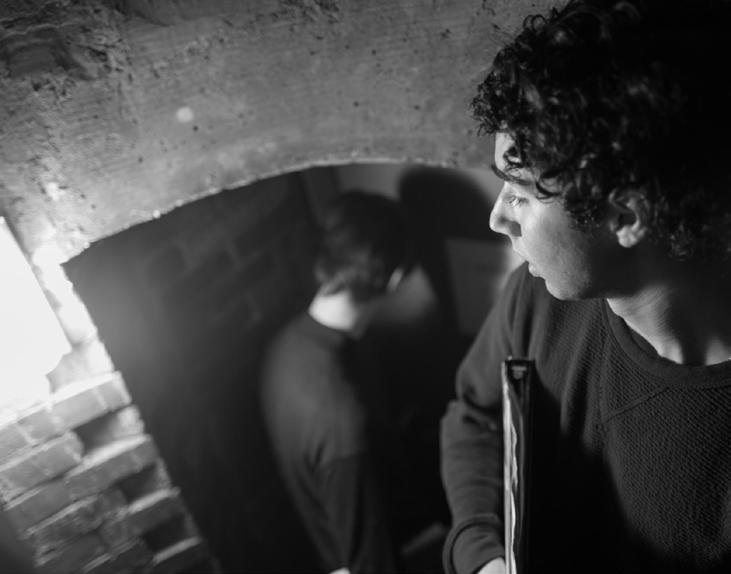
are the 11 preludes by Matthias Vanden Gheyn—essential, given that they’re the first notated carillon music on record. The music is rather quick, and the bells upstairs are rather heavy, so playing quickly while staying expressive and moving all those big batons is rather tricky. Vanman’s honesty about still learning, still adjusting, feels important, and reflects a reverence for the craft shared across the Guild.
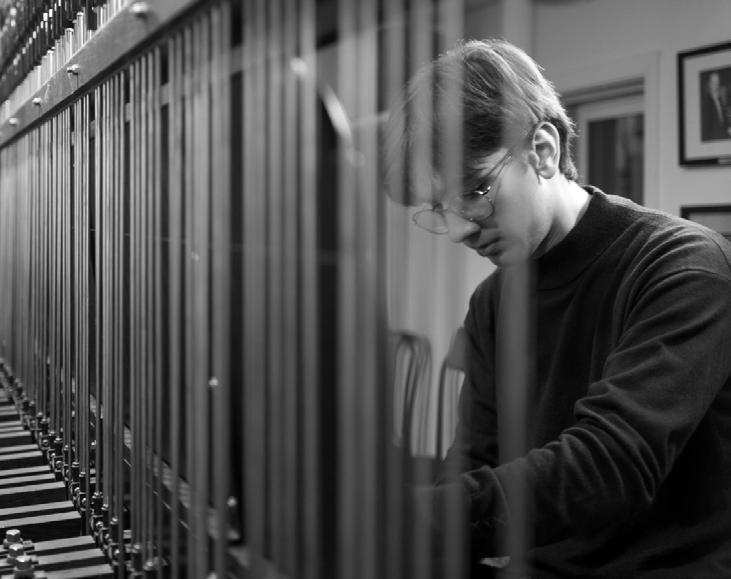
The Guild, composed of 23 students ranging from undergrads to sixth-year medical students, are all quite close. With this diversity comes the chance to meet all sorts of different people, people Del Angel would normally never encounter in his day-to-day life, creating a community where none would otherwise exist.
have that moment of recognition, walking across campus thinking, “Hang on, do I recognize that song? Oh, that’s ‘Pink Pony Club.’”
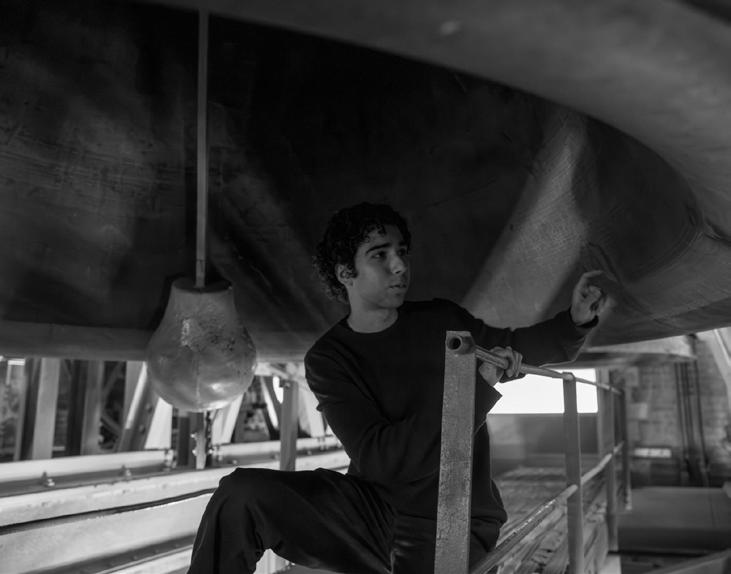
The bells that were commissioned after the devastation of two world wars now ring out pop songs and jazz standards across the Midway, played by a student from Australia who found them on YouTube and many others like him. Australia has exactly two carillons, both on the opposite end of the country from Vanman’s hometown of Brisbane. “There’s absolutely no chance I would have experienced this instrument if I did not just go, oh, I want to give it a go at college.” As Del Angel puts it, “Everybody can play the piano, but who can play the bells?”
So, each week, the Guild climbs the 240 steps, putting their fists to the batons and their feet to the pedals, playing “Misty” and “the Preludes” and “I’m Still Standing,” and below, the campus moves through its day, occasionally stopping to look up and wonder. CONTINUED FROM PG. 10
Another time, 30 Italian tourists from Bologna appeared with a translator who kept asking Vanman and Del Angel questions before answering them herself, gently correcting him in two languages. “Lowkey, she was kind of roasting me the whole time,” he said, chuckling at the memory. Even the gentle humiliation becomes part of the story, part of learning that knowledge moves in many directions.
Together they’re the two biggest carillons in the world by weight, though Vanman quickly corrects himself with the diligence of someone who cares about accuracy. There’s technically a heavier one at a zoo in St. Petersburg, “but apparently it’s so heavy that it’s unplayable.” And apparently, Riverside is having technical dif-
Before the carillon, Vanman played jazz piano, and he’s been testing what happens when you bring those pieces over to the carillon. “Misty” by Errol Garner “gets a very shimmering kind of quality to it, which I think is actually quite reflective of the original way it was played.” The instrument teaches him things about the music he thought he knew. This is the gift of constraints, the weight and resonance of bronze underscoring what was always there in the composition, waiting to be revealed.
For Vanman, the most difficult pieces
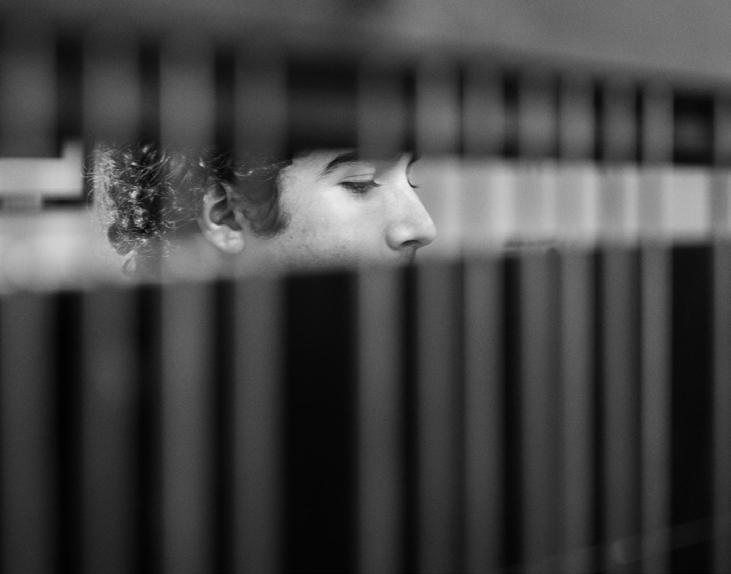
In addition to the standard fare for the Carillon, Del Angel enjoys making his own arrangements of popular songs. His favorite piece to play as of late is his take on “THE DINER” by Billie Eilish. Vanman personally puts on a diverse mix, including the classical canon’s challenging Baroque pieces, as well as lots of contemporary music. He wants people to
At UChicago’s Renaissance Society, Change, I Ching (64 Paintings) depicts a narrative between light, color, and a series of hexagrams.
By AINSLIE CHEN | Arts and Culture Reporter
Change is the only constant. Rendered in color, this mantra becomes a live exhibit of 64 hexagram paintings placed around the circumference of a jarringly empty room. Though the paintings vary in size and color, their consistent hexagram design creates the impression that they constitute different ways of looking at the same idea. This exhibit belongs to UChicago’s Renaissance Society, a contemporary art museum located on the fourth floor of Cobb Lecture Hall.
Leah Ke Yi Zheng’s Change, I Ching (64 Paintings) is based on I Ching, an ancient Chinese divination text loosely translated as “Book of Changes.” The I Ching dates to the Zhou dynasty and presents the future of the universe as a series of fluctuations between yin and yang. In practice, the text offers guidance on the timing and unfolding of potential outcomes. One divination method involves tossing three coins six times, where the result of each toss corresponds to one line in a hexagram. The ensuing hexagram corresponds to one of 64 in the book, which reveals a unique prediction.
All 64 hexagrams in the exhibit come directly from I Ching, and all share the same basic structure: six horizontal lines spanning a square canvas, some filled and others broken down the middle. Upon entering the room, the viewer is confronted with two seven-foot hexagrams on the opposite wall. One is painted in dusky shades of purple and the other in pastels, displaying patterns that are nearly identical but not quite: the purple
hexagram has a filled line at the top and a broken line at the bottom, an orientation that the pastel one flips. A cursory glance raises the assumption that these images encapsulate the duality of the human experience—light and darkness, yin and yang.
Yet, turning around reveals the remaining 62 multi-colored hexagrams spaced evenly along the faces of the room, calling attention to the fact that change itself is varied. The multiplicity of material enhances this idea: Zheng’s silk canvases are painted with either oil or acrylic paints, stretched across cherry or mahogany wood. While oil paint produces a deeper, more traditional chromatic experience, acrylic paint creates vivid colors characteristic of modern art. Zheng’s choice of material metaphorically bridges the gap between her devotion to ancient philosophy and her identity as a contemporary artist.
Of her pieces, my favorites were the three that decorate three of the four windows on the left wall of the room. The fourth is left empty, leaving an unobstructed view of real life unfolding across the street: bare trees shivering under the snow and people swarming in and out of the Franklin McLean Memorial Research Institute. Perhaps this aesthetic choice invites the viewer to consider change in action before turning back to the fixed exhibit.
An interesting effect is created when light enters the windows, which causes the exhibit itself to change in color and opacity:
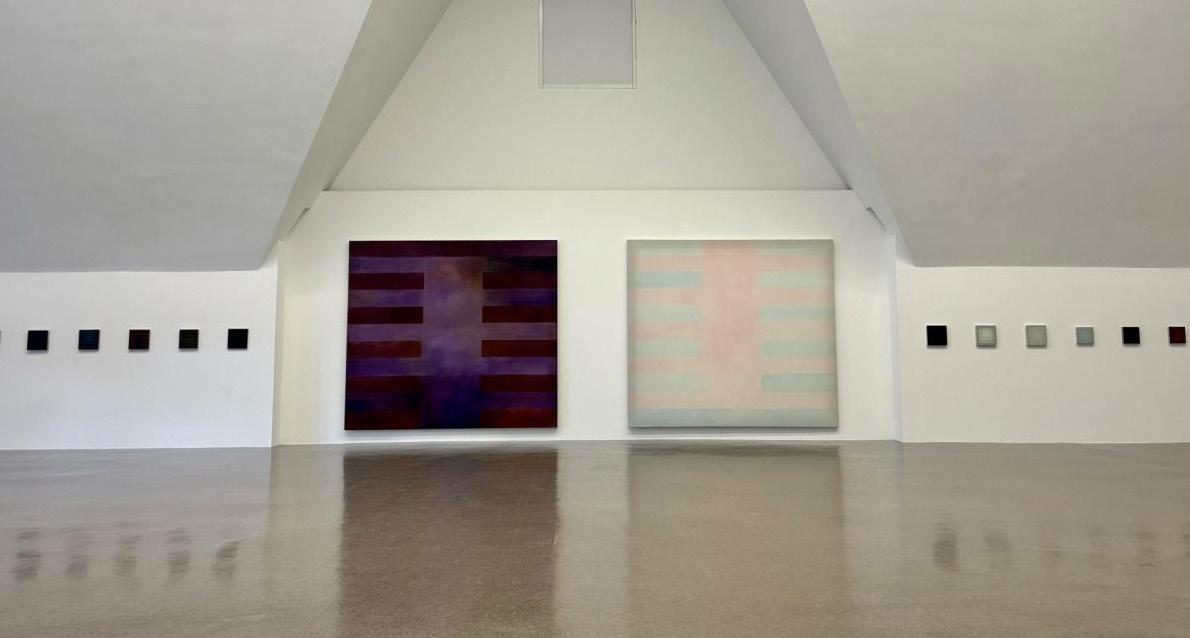
The largest paintings in Change, I Ching (64 Paintings), bearing similar hexagram patterns. ainslie chen
darker colors—like the dark purple captured in the image above—appear glossier, while lighter colors appear brighter and almost translucent. The interactions between light and color play into the study of change, as the eye’s perception of color is inextricably dependent on the presence of light. I watched in real time as the paintings changed from matte to glossy, evoking a sense of wonder at the transitory nature of perception.
Like the title of her work suggests, Zheng intended the exhibit to be perceived as a whole rather than the mere sum of its parts. The geometry of the room serves this concept well, as the tapered, triangular ceiling and the strategically incorporated windows lend nuance to an otherwise two-dimensional exhibit. Walking around, I was struck by how much the space seemed tailored to
Zheng’s pieces, with corner windows jutting out to shine light on canvases hanging right in front.
After taking one last look at the exhibit, I still harbored questions about the room itself. The gallery attendant—Tatiana Sky, a master’s student in the University’s Department of Visual Arts—happily fielded them, revealing that Zheng had, in fact, requested alterations to the Cobb room: the wall with the two largest canvases had been elongated by one foot, and certain windows had been covered so that only one wall allowed external light inside. In other words, Zheng had transformed the room into an active participant in her art.
Change, I Ching (64 Paintings) is on view at the Renaissance Society through April 12.
How would fictional UChicago alumni spend their four years on campus?
By EMMA BEAZLEY | Senior Arts and Culture Reporter
A university is a network of people— each with different skills, passions, and goals—tethered at the center by a single
institution to which they dedicate years of their lives. UChicago has created a community of Pulitzer Prize winners,
Hallowed Grounds pool fanatics, Nobel laureates, Mansueto regulars, MacArthur Fellows, Sidechat addicts, and everything in between. However, there is a special group of people tied to UChicago: the fic-
tional characters across various media forms who are credited with having attended this University. Below is an imagination of what each of
“It
CONTINUED FROM PG. 12
these characters’ undergraduate careers might have looked like if they went to the University in 2026, including their major, dorm, favorite Core class, and favorite spot on campus. Elements like majors, freshman dorms, and Core classes will hopefully connect current students to some of their favorite on screen peers.
Indiana Jones
Henry “Indiana” Jones is a professor of archaeology at Marshall College. Beloved by his students, his expertise is never questioned. His ability to command a classroom seems clearly shaped by an undergraduate curriculum based on the Socratic method. This confidence extends outside the classroom. Jones is best known for his moonlighting as a professional adventurer and artifact collector. He travels the world, relying on bravery and determination to recover aspects of ancient culture.
Majors: Archaeology, history
Dorm: Burton-Judson Courts
Favorite Core class: Introduction to African Civilization
Favorite spot on campus: Institute for the Study of Ancient Cultures (ISAC) Museum
Kitty Pryde
Katherine “Kitty” Pryde is the youngest member of the X-Men and can phase through solid matter by shifting her atoms through those of other objects. She is often the tech-savvy genius of the group, deploying creative problem-solving skills and incredible hacking abilities to gather information, infiltrate systems, and showcase her intellectual approach to fighting.
Majors: Astrophysics, computer science
Dorm: Campus North Residential Commons
Favorite Core class: Honors Mechanics; Honors Electricity and Magnetism
Favorite spot on campus: Crerar Library
Harry and Sally
When Harry Met Sally, a romantic comedy, famously opens on the Harper quad after its two protagonists have graduated, ready to embark on life after college. A shared ride to New York begins with con-
tempt but eventually sparks a friendship. Spanning more than 10 years, the movie culminates in their declaration of love. Sally Albright ultimately makes a career as a journalist writing for The News in New York City, while Harry Burns becomes a political analyst. Harry and Sally are beloved for their witty banter and philosophical debates about the bounds of love and friendship—intellects clearly shaped by a university which fosters passionate conversation. It is easy to imagine the two arguing over the Nicomachean Ethics in a sosc classroom.
Sally’s major: English language and literature
Harry’s majors: Political science, philosophy
Sally’s dorm: Burton-Judson Courts
Harry’s dorm: Snell-Hitchcock Hall
Sally’s favorite core class: Media Aesthetics: Image, Text, Sound
Harry’s favorite Core class: Classics of Social and Political Thought
Sally’s favorite spot on campus: Grounds of Being Harry’s favorite spot on campus: Hutchinson Commons
Mark Watney
The Martian, a sci-fi novel by Andy Weir, follows Mark Watney, an astronaut abandoned on Mars. When his crew is caught in a storm and forced into an emergency evacuation, Watney is caught in the winds and presumed dead. From the moment he awakes on Mars, Watney is tasked with survival. He relies on his brilliant ingenuity to communicate with NASA and his world-class botanical skills to grow food. He keeps himself entertained by listening to ’70s music, keeping video logs, and sustaining an amusing internal monologue that never fades despite his nightmare situation. Watney is a clear champion of a well-rounded education, where science, creativity, and resilience meet.
Majors: Molecular engineering, environmental science
Dorm: International House
Favorite Core class: Exploring the Organic Chemistry of Medicinal Plants: From Field to Laboratory Favorite spot on campus: Botany Pond
Daniel Jackson
Stargate SG-1 is a science fiction TV series that follows a secret U.S. Air Force team called SG-1 as they travel through an ancient alien portal called Stargate, which allows them to explore thousands of planets and encounter alien races. Daniel Jackson uses his vast knowledge of languages to act as the group translator and his understanding of mythologies and religions to interpret alien civilizations. He assumes the role of the pacifist, aiming to resolve conflict through mutual understanding rather than battle—a sharp contrast to the rest of the military.
Majors: Linguistics, archaeology, religious studies
Dorm: Renee Granville-Grossman Residential Commons
Favorite Core class: Language and the Human
Favorite spot on campus: UChicago Language Center
By combining live action and animation, Osmosis Jones tells the story of a white blood cell police officer and a pill for treating a cold who team up to protect their host from a deadly virus. Drix, the cold pill, was developed at UChicago, a fact that he uses to highlight his superior pharmaceutical abilities. He is the ultimate personification of a dutiful pill: focused, responsible, and anxious to get the job done. He is also the perfect representation of the care and detail demanded of UChicago students in everything they do.
Major: Biological sciences
Dorm: Woodlawn Residential Commons
Favorite Core class: Molecular Biology of the Cell
Favorite spot on campus: Regenstein Library
Richard Kimble
Richard Kimble is a surgeon who trained at UChicago Medicine. One day, his wife is murdered—and he is framed for the job. The doctor then assumes the role the film’s titular role, The Fugitive, and spends his days outrunning law enforcement. Motivated by his love for his wife, Kimble never gives up in his search for justice. He survives thanks to his problem-solving abilities and
his calm, strategic nature, never letting his emotions overtake him.
Majors: Biological chemistry, human rights
Dorm: Campus North Residential Commons
Favorite Core class: Forensic Biology: “Who done it?”
Favorite spot on campus: Panera in the Bernard A. Mitchell Hospital.
Sarah Harding
Sarah Harding is a young scientist specializing in animal behavior with a strong interest in field research. Because of her background, she is comfortable observing and learning from the dinosaurs in The Lost World: Jurassic Park. Her fascination with the creatures stretches beyond a mere hunger for innovation. She is compassionate and believes all animals should be observed and cared for rather than exploited for human gain. Harding’s brilliance and bravery make her quick on her feet, and her dedication to the protection of animals proves that strength and compassion are not mutually exclusive.
Majors: Geophysical sciences, biology
Dorm: Max Palevsky Residential Commons
Favorite Core class: Earth History
Favorite spot on campus: Culver Hall
Jack McCoy
Jack McCoy, a prosecutor on the show Law and Order, is ferociously driven and overpowering in the courtroom. His demand for justice is strong, though he often employs questionable tactics to produce the results he wants. His character embodies the distinction between the law’s outcome and the process required to get there, reflecting that there is often a disconnect between the two. Still, McCoy’s knowledge of the legal system is undeniable, and his ability to extract information makes him a fierce competitor.
Majors: Law, Letters, and Society; psychology
Dorm: Snell-Hitchcock Hall
Favorite Core class: Democracy: Equality, Liberty, and the Dilemmas of Self Government
Favorite spot on campus: ISAC Research Archives Library
By ISABELLA COLEMAN | Arts and Culture Reporter
It is common for artists to shed their skin, developing new personas and projects throughout their careers. María Zardoya is the latest to do so, with a surprising yet compelling break from her rising indie rock band The Marías. On her first ever tour with her solo project Not for Radio, she took the expression literally, reimagining herself as a swan in Swan Lake and taking the audience on a journey of the life and death of her character, representing the changes throughout her own career.
For context on this reinterpretation, Swan Lake is a 19th-century ballet that tells the tale of Prince Siegfried in a mythical European kingdom. Siegfried becomes enamored with Princess Odette, a woman who has been cursed to live as a swan during the daytime. This ballet is marked by deception and betrayal, while Not for Radio’s interpretation conveys the metamorphosis of Zardoya’s life.
Alongside her, Not for Radio’s band consists of Sam Evian (producer and multi-instrumentalist), Gianluca Buccellati (producer and multi-instrumentalist), Doron Zounes (bassist and guitarist), Oliver Hill (multi-instrumentalist and string arranger), and Sean Mullins (drummer). Soon after the release of their first album Melt, they announced their Winter in the Garden theater tour. In a post on Instagram, Zardoya wrote that she wanted concert viewers to “experience the music live in a beautiful theatre, seated and comfortable” where they could “see the stage and have an intimate night with the music.”
Upon entering the stunning venue, the Auditorium Theatre, I was met by an expansive line that stretched the length of six flights of stairs, with workers attempting to regulate the traffic. The prize at the end was the merchandise table, from which every fan seemed eager to buy an item. One worker, Sam, told me he had “never seen a line like this for
an artist before” at the venue.
After I waited in this vast line for about 45 minutes, an usher guided me to my seat and the opening act began. For this tour, the supporting acts are local string quartets from each show’s city. The quartet for this show was mesmerizing, playing recognizable classical pieces that swept the audience away and received thunderous applause.
Less than a half hour later, the curtain rose to reveal a garden-themed stage. Atop a mossy mound in front of a woodland backdrop, Zardoya emerged, dressed as a white swan, pure and delicate. With the ardent song “Puddles,” Act I: “Enchanted Fireflies” began.
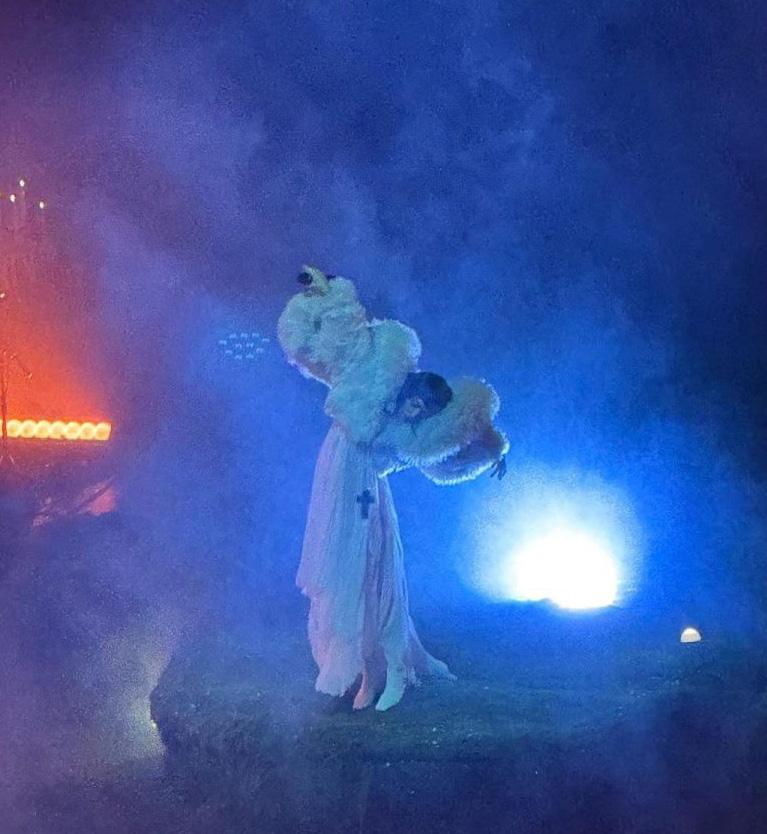
Not for Radio begins the first act with Zardoya in white regalia, representing the white swan. isabella coleman
Halfway through the act, Zardoya opened up about the writing of the Melt album. She described how she and her collaborators wrote it in a “cabin in the woods,” an atmosphere evidently recreated on the stage by the woodland background and set coated with elements of nature. This led into a performance of her first of three unreleased songs of the night, “Living Room.” This song is marked by a melancholic indie sound akin to the songs on Melt , including
pleading lyricism such as, “I don’t know how I can live on without you/ Don’t let me down/ I have you now/ Don’t let me down.”
At the end of the following song, “Water on Your Nose,” a sheer white curtain fell from above the stage, wrapping around Zardoya and the mossy set. With its descent came the transition into Act II: “A Swan in the Night.”
The second act consisted of a medley of works, including more songs from Melt , another unreleased song titled “Comet,” and a cover of “Nude” by Radiohead. The aesthetics of this section were similar to Act I, with Zardoya still clad in white, albeit without the fluffy, feathered coat that she shed in the middle of the first act.
During the performance of “Swan,” a drastic transformation began to occur. Throughout the song, white feathers floated down from above, coating the stage and performers. As the song neared its conclusion, a man dressed in black emerged, walking onto the center mound where Zardoya stood. The two took turns circling one another, like predator and prey, until the man picked up Zardoya bridal-style. When the song ended, the white curtain fell atop them and the mysterious man placed Zardoya, now “dead,” onto the mound, covering her body with the fallen fabric. I found this theatrical moment intriguing, as the “plot” of the show clearly shifted into a new, darker atmosphere, marked by the performative act of death.
The main curtain of the stage closed with a swan projected onto it. Then, mere moments later, the stage was revealed once more to begin the final part of the show, Act III: “The Underworld.”
The band continued performing without Zardoya’s vocals until a bed was revealed with Zardoya sitting upon it. Her white form was now fully shed, replaced with a black version of her first ensemble. As “Not the Only One” was performed, fake snow coated the stage, covering the once-vibrant green props.
This cold, haunting setting persisted as the performers played “Vueltas,” with fog rolling in.
The following song, an extended version of “No One Noticed,” was the sole piece from The Marías’ discography, and the crowd’s excitement was unmistakable. While most people in the audience did not record any of the concert, half of the listeners quickly whipped out their phones once this song began to take videos. This was also one of the few songs I could actually hear people singing along to, as most elected to remain hushed or silent throughout the show.
Following this and the final, unreleased song, “Ache,” the show ended with a performance of “Back To You,” the most popular song from Melt, which was met with roaring cheers. Black feathers fell onto the stage as the song closed, and the band soon appeared again for bows.
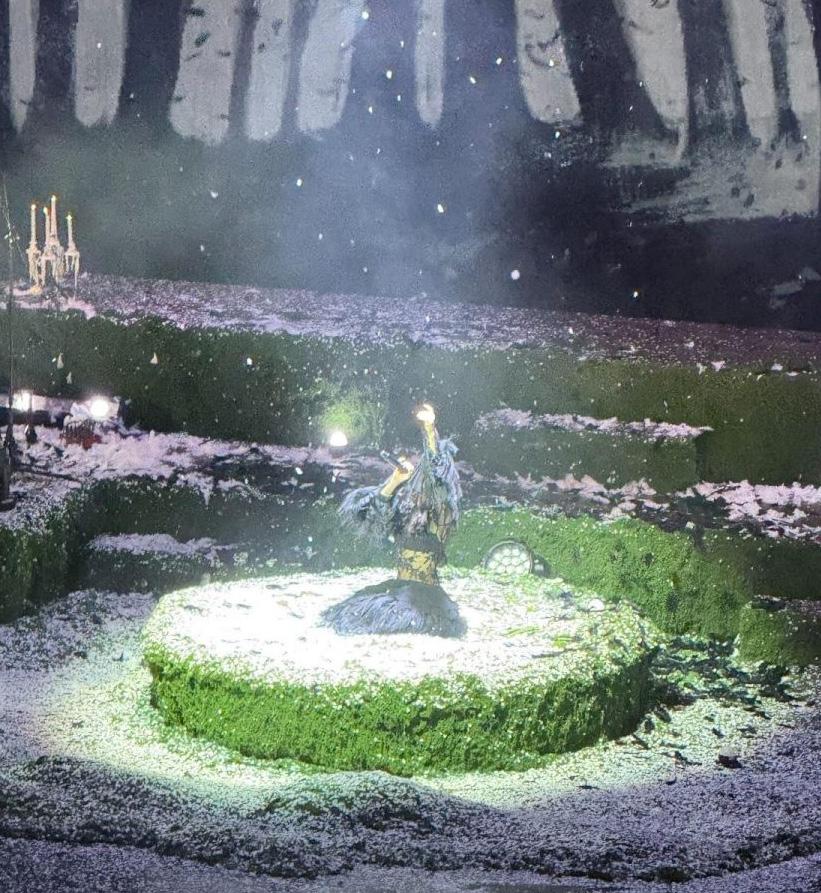
Not for Radio concludes the night with their final song as black feathers descend onto the stage. isabella coleman
The concert was mesmerizing, weaving the evocative songs into a unique interpretation of Swan Lake. It is evident why Not for Radio took inspiration from the ballet—their songs cannot be fully enjoyed, perhaps not even fully understood, without the visual theatricality that graced the Auditorium this January.
In the long-anticipated return game of Chicago’s longest-tenured NHL captain and three-time Stanley Cup champion, the Chicago Blackhawks took a 2–0 victory over the Winnipeg Jets.
By ALEXA WALSH | Sports Reporter
In 2023, the Chicago Blackhawks’ longest-tenured captain, Jonathan Toews, began a two-year hiatus due to health concerns related to long COVID. A key figure of 21st-century Chicago sports, helping guide the Blackhawks to three Stanley Cups in the 2010s, his departure left a hole in the Chicago sports community.
When the Winnipeg Jets announced the signing of the three-time Stanley Cup champion to a one-year contract, fans across Chicago started preparing for their captain’s return to the United Center. January 19, 2026—the date of his return— became a red (and black) circle on many Blackhawks fans’ calendars.
Fans followed through, occupying 19,894 seats at the United Center. The stadium was soon full of Jonathan Toews jerseys spanning from his University of North Dakota green to his Blackhawks red. Along with the typical hotdogs and deepdish pizza trays, supporters’ hands were waving “Welcome Back 19” signs supplied by the Chicago Blackhawks organization.
Despite the evident importance of a game that featured two division rivals, most of the energy in the stadium was dedicated to Toews and his return. Play stopped early in the first period for a tribute to Jonathan Toews, which included a video montage of his time in Chicago and time for him to skate a lap around the rink.
To no one’s surprise, after completing one lap around the rink, Toews was urged by the crowd and his own Winnipeg teammates to skate another lap. The former Chicago captain would wind up completing about four laps. He went to each side of the rink and pointed at different sections of adoring fans, who were holding various signs of encouragement and wearing his jerseys. The crowd was so unbelievably loud that Toews himself told the crowd “Alright, alright” so play could continue.
Upon resumption of play, Winnipeg forward Nino Niederreiter slashed Chicago’s Ryan Greene, ending in a scoreless power play for Chicago. Winnipeg and Chicago would then trade penalties for the rest of the period with Winnipeg’s Luke Schenn receiving a holding penalty against Chicago’s Oliver Moore at 12 minutes 50 seconds into the first period. Later, Chicago’s Louis Crevier received an interference penalty against Winnipeg’s Gabriel Vilardi at 15 minutes 21 seconds. In that sense, Toews’ celebratory laps were the highlight of an otherwise unremarkable first period.
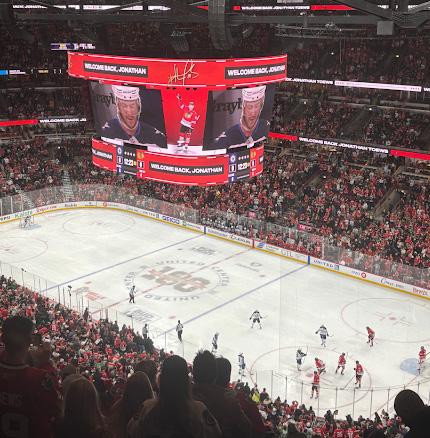
Winnipeg forward Jonathan Toews takes a seat on the bench at the conclusion of his video tribute. alexa walsh
Excitement didn’t return in the crowd until the jumbotron revealed Chicago Bears quarterback Caleb Williams and Cubs center fielder Pete Crow-Armstrong were in attendance. This came just one day after the Bears lost in overtime to the Los Angeles Rams in the NFC Divisional Round on January 18. Crow-Armstrong and Williams were featured several times on the Jumbotron, sparking a “Green Bay sucks” chant that reverberated through the whole crowd at the conclusion of a
scoreless period.
Other Chicago legends were in the audience for the long-awaited game, such as the Blackhawks’ own Andrew Shaw and Kris Versteeg. Versteeg was on the 2010 championship team with Toews that returned the Stanley Cup to Chicago after a 49-year drought but was not a part of the 2013 championship team that Andrew Shaw played on. However, both Versteeg and Shaw returned to be a part of the 2015 championship team which solidified the 2010s Blackhawks ensemble as a modern hockey dynasty.
Toews’ leadership and tenacity through the phenomenal seasons and not-so-phenomenal seasons were standouts for many Blackhawks fans, explaining the outpouring of love and respect for the current Winnipeg forward at the January 19 game.
Despite all the support for Toews, Blackhawks fans were still hungry for a win. Sitting at a 19–22–7 record and only 45 points in the Central Division, Chicago desperately needed the two points to begin the slow climb toward a .500 record. This win came quite slowly but easily for the Blackhawks as they dominated the second and third periods with a better faceoff percentage and goals scored.
Though Winnipeg ended the game with more shots on goal, the Blackhawks were better at converting their chances, producing two goals to take the win. The first goal came from Jason Dickinson at 13 minutes 21 seconds of the second period with assists from Ryan Donato and Alex Vlasic. Winnipeg tried to respond but could only come up with a Cole Perfetti tripping penalty against Chicago’s Oliver Moore near the end of the second period.
The third period remained similar to the first and second periods. There were frequent turnovers with both teams struggling to keep the puck in their possession for very long. Another penalty came when
Chicago’s Ryan Donato slashed Winnipeg’s Dylan DeMelo at 6 minutes 35 seconds of the third period. Despite all the penalties throughout the game, neither team was able to score on the power play, leaving the Winnipeg team especially unsatisfied.
With Winnipeg getting desperate, they pulled their Hart Memorial Trophy and three-time Vezina Trophy-winning goaltender Connor Hellebuyck for the last few minutes of play. Even with the extra man on the ice, Winnipeg was not able to respond to Chicago’s goal from the second period. Then, at 18 minutes 35 seconds, forward star Connor Bedard secured Chicago’s lead with an empty net goal with Ilya Mikheyev and Alex Vlasic getting the assists.
At the game’s conclusion, the three stars were announced: Blackhawks goaltender Spencer Knight for his third shutout of the season, Alex Vlasic for his two-point night, and Jason Dickinson for his opening goal. Chicago fans left with another win in an otherwise mediocre regular season and Winnipeg fans left with another loss for a team that has been making losses a habit.
While the game was not edge-of-yourseat material by any hockey fan’s standards, its emotional importance for Chicago fans and the NHL as a whole made it a game worth remembering. In an age when big trades for franchise players seem commonplace in the NHL, one-team players like Jonathan Toews seem like a dying breed. With fellow Blackhawks icon Patrick Kane playing out his final seasons in Detroit and the rest of the dynasty core now retired, Chicago’s 2010–2015 golden era is officially a thing of the past.
The Blackhawks have ushered in a new era on the backs of players like Connor Bedard and Frank Nazar. Nevertheless, it is clear that fans and the organization have not forgotten their longest-tenured captain.
By NOAH SODICKSON | Associate Crossword Editor