NEWS: One Dead, One in Critical Condition Following Two Off-Campus Shootings
3

NEWS: One Dead, One in Critical Condition Following Two Off-Campus Shootings
3

Eighty percent of the University’s properties are taxexempt. How much would it pay if that weren’t the case? Read more on page 4.
By OLIN NAFZIGER | News Reporter
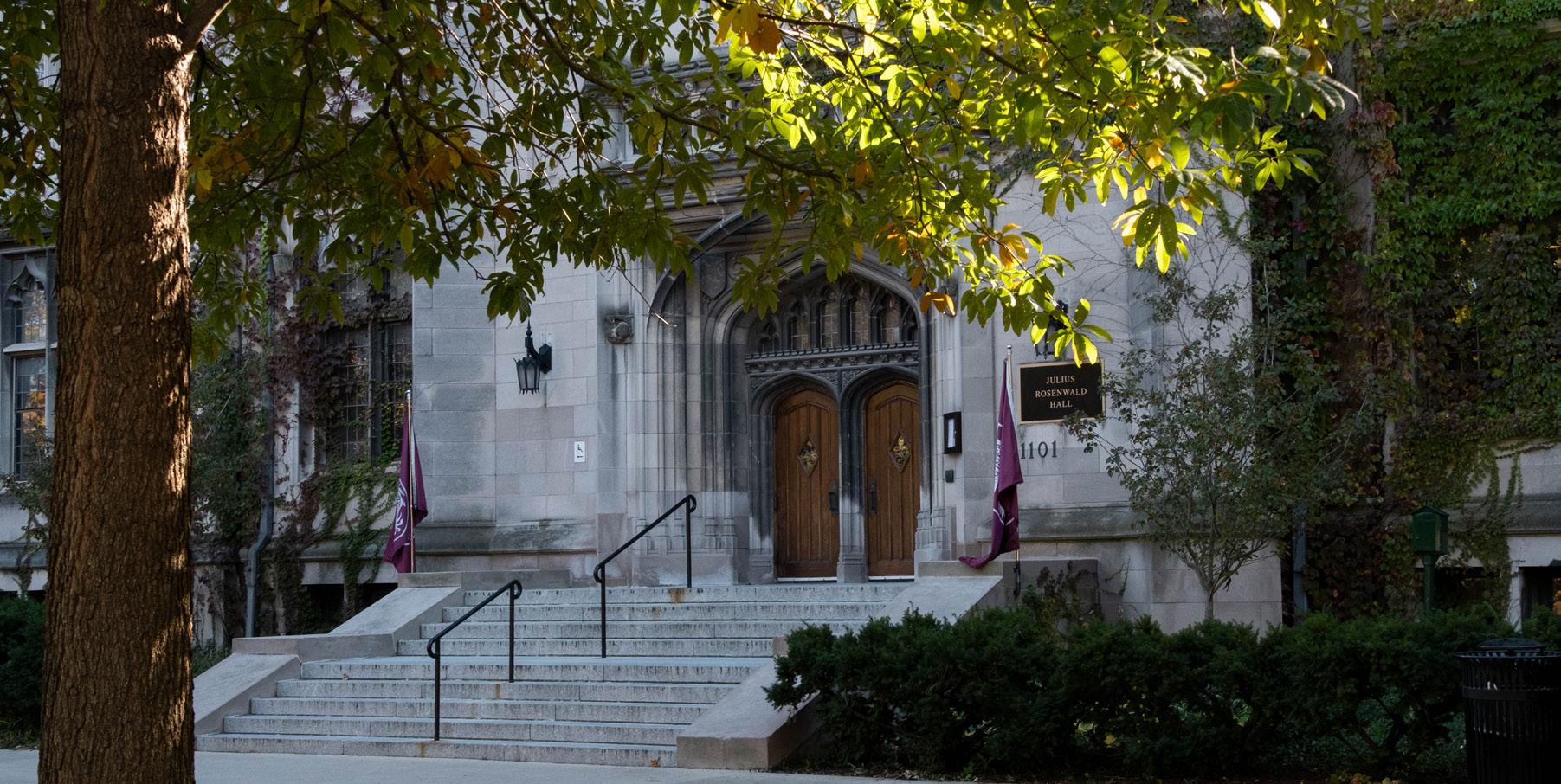
University President Paul Alivisatos announced in an email on March 23 that Ida Noyes Hall will undergo a modernization funded by a $50 million donation from Board of Trustees Chair David Rubenstein (J.D. ’73).
According to the announcement, the plans for Ida Noyes’s modernization entail preserving its historic aspects “while enhancing its infrastructure, accessibility and sustainability.” More information about the renovations, such as a project timeline or detailed plans for the modernization, has not been made public.
NEWS: TrueNorth Cafe to Reopen Early April Following Renovations PAGE 3
The renovation will inaugurate a rolling modernization initiative to “preserve the beauty and meaning of our historic buildings, while updating them to serve generations of faculty and students yet to come,” Alivisatos said. Dean of the College
GREY CITY: The UChicago Endowment, Explained PAGE 6
Melina Hale said the project will “create inviting spaces where students can gather, connect with one another or find a comfortable place to study.”
In a statement to the Maroon, a University spokesperson said that “[a]ll new architectural elements and the expanded set of activities and programs will be known as David M. Rubenstein Commons, while the existing building will continue to be named Ida Noyes Hall.” The spokesperson did not share specific information
ARTS AND CULTURE: Transcendentalism Takes Flight at Hamelin’s Ives Recital
PAGE 12
about the modifications to Ida Noyes or how student activities and organizations currently housed in the building would be impacted.
The spokesperson also stated that an architectural firm for the project has not yet been selected and that the “University will partner with the selected architectural firm to design a process to collect feedback from across the University community.”
CONTINUED ON PG. 2
SPORTS: Bye, Bye Bears: Chicago Bears One Step Closer to Relocation
PAGE 15
“The spokesperson did not specify whether
Films and the Pub will be able to continue operations in their current locations during the renovation process.”
CONTINUED FROM PG. 1
Ida Noyes Hall was built in 1916 following a gift from Chicago inventor LaVerne Noyes and named after his late wife, Ida. Originally built to provide women with facilities similar to those then offered exclusively for men at Hutchinson Commons, the Reynolds Club, and Bartlett Gymnasium, Ida Noyes Hall included a pool, a gymnasium, and social spaces at the time of construction.
The Ida Noyes gymnasium was converted into the Max Palevsky Cinema, which hosts Doc Films, in 1987, and the pool was converted into study spaces for Booth School of Business students in 2008. Today, Ida Noyes hosts academic and extracurricular events for the University.
It also provides office space for RSOs and University services including the Major Activities Board, Career Advancement, and the Center for Spiritual Life. The Maroon’s office is also located in Ida Noyes.
The Pub, a private bar serving University affiliates, has been located in the basement since 1974.
Doc Films was not made aware of the modernization plans before the public announcement, according to Joan Bahnfleth, its general chair.
According to the University spokesperson, “[t]here are no plans to move the Pub or the Max Palevsky Cinema. While some spaces will need to be relocated during the renovations, the University anticipates that the David M. Rubenstein Commons
will house both Career Advancement and Campus and Student Life spaces. More details will be shared once design plans are developed.”
The spokesperson did not specify whether Doc Films and the Pub will be able to continue operations in their current locations during the renovation process.
The new gift is the most recent of Rubenstein’s philanthropic contributions to the University. In 2010, he established the David M. Rubenstein Scholars Program, providing full-ride scholarships to approximately 10 percent of Law School students. As of 2025, Rubenstein has contributed over $61 million to the program, making it the largest scholarship program in Law School history.
In 2014, another gift by Rubenstein funded the construction of the David M. Rubenstein Forum, which opened in 2021 and hosts conferences, academic symposia, workshops, and other special events. Rubenstein has served as chair of the Board of Trustees since May 2022 and was awarded the Presidential Medal of Freedom by President Joe Biden in 2025 in recognition of his “patriotic philanthropy” and support for restoration of landmarks and cultural institutions in Washington, D.C.
The Maroon reported in February that Rubenstein met and directly corresponded with Jeffrey Epstein after the latter’s 2008 conviction for soliciting prostitution from a minor.
By BORIS ARCHIPOV | Senior News Reporter
Undergraduate Student Government’s (USG) College Council (CC) debated but did not pass a resolution introduced by Class of 2029 Representative Gavin Wynn proposing a pilot program that would allow student groups without official RSO status to coordinate with USG to reserve Student Center spaces.
Student Center spaces are currently only reservable by RSOs and recipients of money from the Student Engagement Fund, according to the resolution.
USG President Elijah Jenkins expressed concerns about the work needed from the CC chair and vice chair to reserve spaces for other student groups.
“There’s a lot behind the scenes in regards to booking these spaces and communication with Student Centers,” Jenkins said. “All this has to be directly responsive by the chair itself. And if they’re dealing with multiple requests, I don’t see how that’s feasible.”
Jenkins also said the resolution would make USG liable for the actions of other student groups. Because any student spaces booked under the resolution would be reserved by USG, USG would face repercussions if there were any problems during the event.
Wynn responded that a designee could handle coordination and offered to take on that responsibility himself. Although he agreed that there was a liability concern, he said that the resolution took appropriate measures to account for that.
The resolution would have required that a CC representative be in attendance at all events and that any student group that breaks a Student Center policy may lose deposits covering their reservations and the ability to reserve room access through USG.
“We are putting ourselves, our name out there,” Wynn said. “That comes with the great benefit of putting our name out
there as an organization that’s here to support the community, here to collaborate with students, to deliver on events that they want to have happen.”
CC deadlocked 7–7 in a vote on the resolution, with two abstentions, failing to pass it. The resolution can be voted on again only if a CC member who voted against it or abstained moves to reconsider.
Class of 2029 Representative Audrey Krajewski was initially a sponsor of the resolution but removed herself as a signatory during the meeting and voted against its passage.
“The conversation raised considerations I hadn’t fully accounted for when I first reviewed the proposal independently,” Krajewski told the Maroon. “I felt it was important to reflect that shift in perspective in both my sponsorship and vote.”
Wynn told the Maroon in an interview that he would like to see CC use its power to create concrete change “instead of advocating into the ether.”
The Communication, Ledger, and Elec-
tronic Accountability Reform (CLEAR) Act was also introduced by Class of 2026 Representative William Kimani during the meeting. The resolution would make USG’s RSO funding breakdown publicly available on the USG website and move all internal USG communications onto Slack.
“USG manages a budget of roughly $2.5 million, and I think it would be good for students to have some visibility into that,” Kimani said.
CC Vice Chair Kevin Guo added that transparency would be an important way for USG to ensure accountability and prevent corruption.
“If Student Government was ever corrupt, I think transparency is the best disinfectant in this case,” Guo said.
Because a resolution cannot be passed during the meeting in which it is introduced, the CLEAR Act cannot be approved until at least next week.
CC also amended its internal appeals procedures for RSO funding. Guo and Vice CONTINUED ON PG. 4
By NATHANIEL RODWELL-SIMON | Managing Editor
Two shootings took place near campus within an hour of each other on March 25, according to the University of Chicago Police Department (UCPD).
Individuals sustained gunshot wounds in both incidents. The first occurred at 6250 South Drexel Avenue, near the Harris Park Pool, at 11:30 a.m. The second occurred at 1363 East 53rd Street, in the alley adjacent to Taco Bell, at 12:20 p.m.
The victim in the Drexel Avenue shooting, a 29-year-old man, was pronounced dead after being transported to the University of Chicago Medical Center in critical condition, according to a preliminary report from the Chicago Police Department
(CPD) released at 12:54 p.m.
He was approached by two individuals in a white Mercedes, per the report. The model of the vehicle was not released. The shooting is being investigated as a homicide, and the shooters have not yet been identified.
The victim in the 53rd Street shooting, a 30-year-old man, was transported to the University of Chicago Medical Center in critical condition after being shot in the chest and the wrist, according to a preliminary report from CPD released at 2:22 p.m. He was approached by an individual in a Toyota Corolla while walking in an alley, per the report, which did not note the

Police vehicles near the scene of a shooting at East 53rd Street and South Kenwood Avenue on the afternoon of March 25. nathaniel rodwell-simon
vehicle’s color. CPD is aware of the alleged shooter’s identity.
Last week’s shootings were the second and third in the vicinity of UChicago since
the beginning of 2026, according to UCPD reports. Another off-campus shooting took place on March 16, during the University’s spring break.
By OLIN NAFZIGER | News Reporter
TrueNorth Cafe is set to reopen by the second week of April, according to the café’s owners. The café has been closed for renovations since November 3, but newfound structural issues forced the owners to postpone the original reopening date of February 1.
The 57th Street café has served the Hyde Park community since 2018, offering sandwiches, smoothies, and coffee drinks.
The café’s building, owned by Mac Properties, was constructed in 1911 and had not experienced prior structural problems, according to the café’s owner, Andy Peters (A.B. ’10). However, he said, “Closing down and doing a full renovation gave us the ability to stop putting bandages on smaller problems like we had in the past.”
The renovations included replacing beams that support both the floor and ceiling of the first floor of the building, where the café sits. Peters also planned to have the floor redone—replacing decades-old wood with new tile flooring—but ceiling issues delayed the installation and ultimately postponed the planned reopening date.
According to Peters, the extended closure also allowed the café to restructure its
floor plan, which had remained the same for decades, dating back to the building’s previous tenants. Due to food safety regulations, customers were previously unable to access the café’s back patio directly, as that would require putting a doorway in the middle of the back kitchen. With the new layout, Peters said, customers will be able to walk directly from the dining area to the patio.
Management used the time during renovations to “think not only about the physical space, but also about our customers and changing our menu,” Peters said. The previous layout of the café had separated the coffee-making area from the kitchen, where smoothies and sandwiches were made.
“Smoothies are a big part of our business, but they were previously made in the back,” he said. “That limited our ability to make blended coffee drinks like frappés or iced chais.” The expanded front service area will allow for a larger drink menu, Peters said, while the back kitchen will now mainly handle catering orders.
“I’m very excited,” he said. “The back patio is the best one I know, and now people will finally be able to use it.”
Celeste Alcalay and Anika Krishnaswamy, editors-in-chief
Gabriel Kraemer and Nathaniel Rodwell-Simon, managing editors
Eliot Aguera y Arcas, chief production officer
Adam Zaidi and Arav Saksena, chief financial officers
The Maroon Editorial Board consists of select editors and staff of the Maroon
NEWS
Kalyna Vickers, editor
Oliver Buntin, editor
GREY CITY
Vedika Baradwaj, editor Kaci Sziraki, editor
VIEWPOINTS
Sofia Cavallone, editor Adam Zaidi, editor
ARTS AND CULTURE
Shawn Quek, editor
Nolan Shaffer, editor
SPORTS
Josh Grossman, editor
Shrivas Raghavan, editor
DATA
Jinny Kim, editor
Nikhil Patel, editor
CROSSWORDS
Piyush Garodia, editor
Eli Lowe, editor
Noah Sodickson, editor
PHOTO AND VIDEO
Olin Nafziger, editor
DESIGN
Ankki Dong, editor
COPY
Megan Ha, chief Olivia Rae Okun-Dubitsky, chief Leah Tabakh, chief Mazie Witter, chief Vanessa Yelder, chief
NEWSLETTER
Nathaniel Rodwell-Simon, editor
SOCIAL MEDIA
Katherine Bolte, manager
PODCASTS
Audrey Barb, editor
FINANCIAL OPERATIONS
Maria Lua Barata de Boms, director
Patrick Xia, director
Executive Slate editor@chicagomaroon.com
For advertising inquiries, please contact ads@chicagomaroon.com
Circulation: 2,500
CONTINUED FROM PG. 2
President of Student Organizations Fred Lee introduced an amendment to move RSO appeal hearings outside of CC meeting time. The amendment was passed by a unanimous vote.
RSOs will now present appeals to a separate subcommittee of CC members, composed of at least one representative from each year, that will provide recommendations to CC regarding how much funding should be allocated to the RSO. The full council will still vote on allocation amounts for any appealing RSO.
The amendment was introduced by Lee in February with the intention of giving CC more time to discuss initiatives aside from RSO appeals, which take up a large portion of CC meeting time.
“[The amendment] will hopefully cut down on the amount of time that College Council spends hearing these appeals while also keeping college councils like the final decision process,” Guo said.

UChicago, like other universities, is exempt from most property taxes. Some say it shouldn’t be.
By JINNY KIM | Data
For more than a century, universities have been exempt from paying taxes on most of their properties. In Illinois, the Department of Revenue decides whether to grant exemptions to various types of nonprofit organizations for properties used for school, religious, or charitable purposes.
However, debates continue on whether public benefits from universities justify the significant tax exemptions they receive.
“These entities serve the public good. But times have changed, and many have become giant profit centers and some of the wealthiest and most powerful landowners in the state,” Andy Shaw, the former CEO of Better Government Association, a local government accountability advocacy group, wrote recently in an oped in the Chicago Tribune
“Northwestern University, the University of Chicago, Rush, Northwestern Medicine, and others sit on billions of dollars in tax-exempt real estate while surrounding neighborhoods and local governments strain to fund basic services and the rest of us face ever bigger tax bills.”
The Chicago Teachers Union has
Editor
demanded that the City collect voluntary payments from universities for years, arguing that wealthy institutions are not contributing their fair share to fund the city and its schools.
What does all of this mean for the University of Chicago? Which of its properties are tax-exempt, and how much would it pay if they weren’t? What are the discussions surrounding the University’s taxexempt status?
UChicago owns about 400 properties.
About 80 percent of them are taxexempt, according to a Maroon analysis of Cook County’s property tax and parcel data. Most of the University’s tax-exempt properties are academic buildings, but its hospitals are also exempt.
In Illinois, hospitals qualify for tax exemption if the value of certain services or activities, such as charity care or health services provided to low-income and underserved individuals, amounts to their estimated property tax liability.
For example, UChicago Medicine invested more than $715 million in community benefits in fiscal year 2024, including more than $567 million in uncompensated care, according to its Community
Benefit Report.
University properties, however, do not have such requirements. They are eligible for exemption if used exclusively for school purposes and without profitmaking motives. In Illinois, eligible uses include housing for students, their spouses and children, and staff.
Universities receive tax exemptions because they provide valuable services to the public, said Christopher Berry, a professor at UChicago’s Harris School of Public Policy.
“There’s a rationale to it, which is that the City thinks the thing that they’re doing is providing value unto itself,” Berry added. “I think in the case of certainly the University of Chicago, there’s a lot of benefits that it creates for the city.”
But understanding the extent of the University’s public benefits is a challenging task.
“What are the benefits of providing these exemptions to colleges and universities? I’m guessing that pretty often you end up in an abstract place. You start talking about their value as job creators, their value as supporting business activity in your communities,” said Paula Worthington, a lecturer at Harris.
“The reason those are sort of
harder-to-evaluate claims is that if the University of Chicago was not in Hyde Park, doing whatever it does, something else would be happening on those properties. There’d be other jobs, they just wouldn’t be jobs related to the University. So what the net impact is is not always easy to identify and articulate.”
Some academics and community members also point out that universities have significant, and often unchecked, influence on the economic and social landscape of their surrounding neighborhoods.
“Few understand higher education’s national role in the devastating history of demolition and displacement of stable communities during the Urban Renewal period,” author and urban historian Davarian Baldwin wrote in his book In the Shadow of the Ivory Tower. “When neighborhoods are targeted for campus expansion, the people who live there face the enduring trauma of losing their homes and the physical disruption of their cultural ties.”
Additionally, as university activities become more intricately linked to commercial interests, their tax-exempt status could become a sharper point of
“If
were a typical residential property owner, it would have paid about an additional $8 million in property taxes in fiscal year 2024.”
CONTINUED FROM PG. 4
contention.
“At some point, you are not just a university—you are also a hedge fund. You are also mobilizing billions of dollars that you are profiting off of,” said Wally Hilke, a professor at the Northwestern Pritzker School of Law. “When businesses or corporate interests are profiting, it is fair for the public to ask, ‘How much do we need to be subsidizing these private interests, and how much should we be making sure that, like any other project primarily for private benefit, the interests that are profiting should pay taxes back to the public?’”
“No one is suggesting taxing classrooms or charity wards like luxury condos,” Shaw wrote in his op-ed. “But research labs, administrative towers, medical office buildings, parking garages and revenue-generating facilities are fair game for a serious reassessment.”
UChicago’s properties include some mixed-use units. In Illinois, if exempt properties start being used for profit, the property owners are required to notify the Cook County Assessor’s Office. Then, businesses leasing space from nonprofits pay a type of property tax called a leasehold tax.
However, this situation doesn’t happen all the time. For instance, on East 55th Street, Campus North (Ellis) Garage is not only a four-level garage. It also houses Roux, a restaurant, as well as Seven Ten Social, a bar with a bowling alley. The property remains entirely tax-exempt.
In an emailed response to the Maroon ’s questions, a University spokesperson wrote that “this building is primarily used for parking and office space supporting the University’s educational mission.” The University is “assessing the background of this building’s exemption to maintain compliance,” the spokesperson wrote.
The Pret a Manger in the Reynolds Club, the Starbucks in Saieh Hall for Economics, and the Chicago French Press in the UChicago Bookstore are also examples of commercial activities in buildings that are tax-exempt.
The threshold for exemption is a question of state law and how the Department
Universities Own About $2 Billion Worth of Land in Cook County
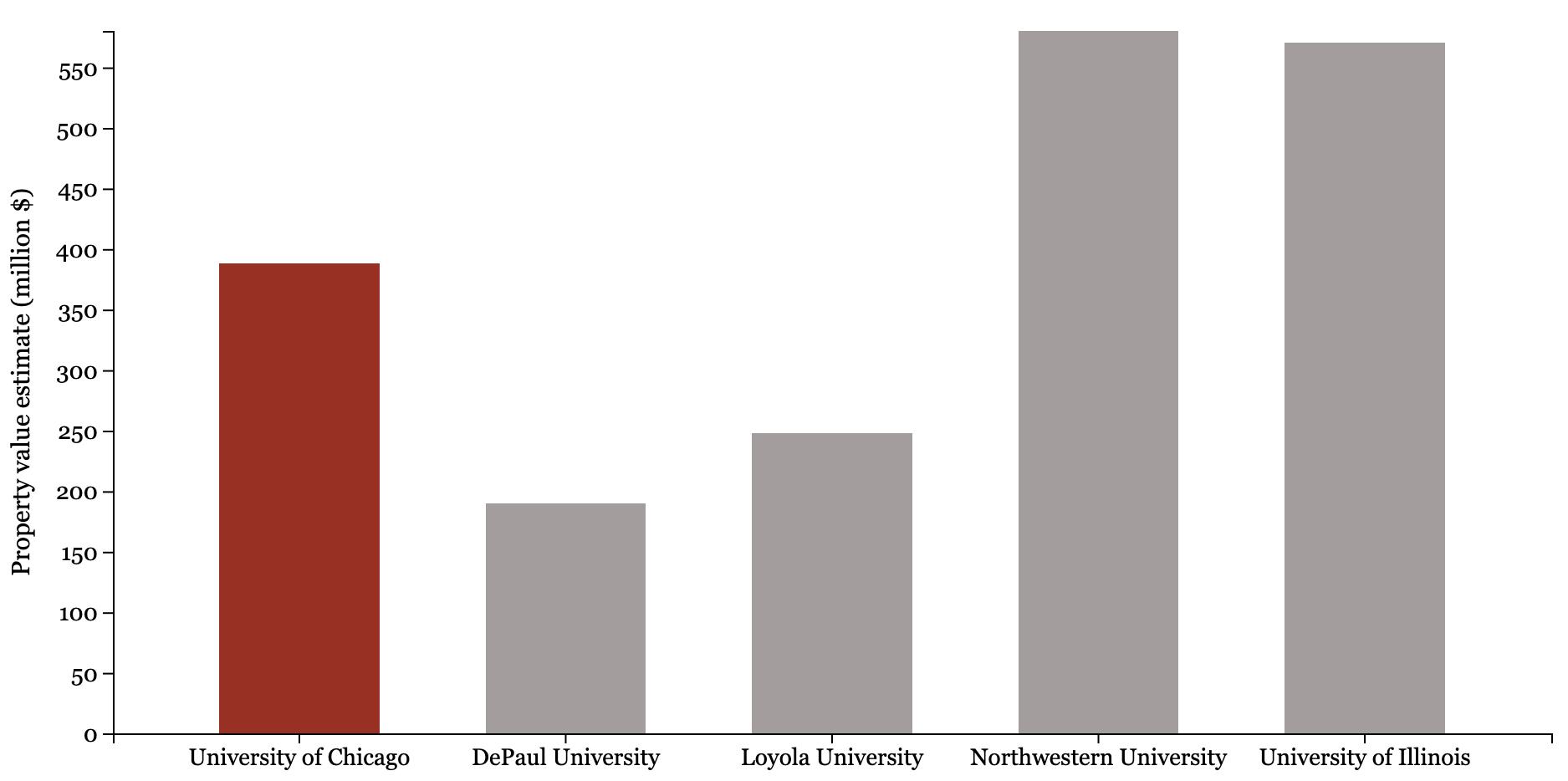
of Revenue assesses it when entities apply for tax exemption. The University has contested the decision in court before.
In tax year 2015, UChicago and Bright Horizons, a childcare company, sought a property-tax exemption for two oncampus daycares. This request was rejected by the Department of Revenue in 2016.
In 2020, the Illinois Appellate Court upheld the Department’s decision, finding that the properties were “used with a view to profit,” as Bright Horizons had earned about $940,000 in profits from using them.
There is also the question of unpaid property taxes. The property occupied by UChicago Medicine in Orland Park, a suburb about 30 miles away from Hyde Park, currently owes $1.1 million in unpaid tax bills including interest from tax years 2022 to 2024.
In response to the Maroon’s inquiry about the unpaid taxes, the University spokesperson said that the property is owned by the Village of Orland Park and leased by UChicago Medicine. According to the Cook County Assessor’s Office, this property is under a leasehold agreement, meaning that the lessee is the responsible taxpayer.
If UChicago were a typical residential property owner, it would have paid about an additional $8 million in property taxes in fiscal year 2024, according to land value estimates based on Cook County’s parcel data.
For the five universities in Chicago, this revenue for the City would add up
to about $30 million. Mayor Brandon Johnson’s Chicago Financial Future Task Force has proposed the City collect $20 million in annual voluntary payments from educational institutions as one way to address the City’s budget crisis.
The $30 million figure is likely a significant underestimate, however, as land value figures do not incorporate building value.
For example, the residential property at 5756 South Kimbark Avenue, next to the Booth School of Business, had a building value of $183,000 but a land value of about $28,000 in tax year 2024.
It also is not easy to identify all the properties that the University owns, because it can own properties as limited liability companies, known as LLCs, which do not have to disclose their owners.
In some cities, universities contribute through “payments in lieu of taxes” (PILOT) programs, which collect voluntary payments to partially compensate local governments.
In 2023, four colleges in Providence, including Brown University, struck an agreement with the city to pay more than $200 million over the next 20 years. Harvard University has paid the city of Cambridge $40 million in PILOTs in the last 10 years.
In Chicago, community organizations, such as ONE Northside, are advocating for universities in the city to also make such payments.
“Now, more than ever, we need to see progressive revenue options, and we see
the PILOT program as one of those ways of really achieving that,” said Jesse Hoyt, executive director of ONE Northside.
Developing a PILOT program as a reliable source of revenue for a city requires trust over periods of time and clear articulation about the value of the relationships with the participating institutions, Worthington said.
“Building trust and using that trust to have meaningful conversations is about acknowledging that it’s a two-way relationship, that the university provides things that are special to the city and its residents, but the City also provides things that are special and crucial to the university,” Worthington said.
“The University cannot erect a physical or virtual barrier boundary around itself and say, ‘We’re kind of a standalone thing. We don’t really have to care what’s happening for the city as a whole.’”
For now, the discussion remains open, and it is unclear how the City will move forward with voluntary payments from universities.
“A good place to start would be by asking people who are most impacted by these exemptions which enable universities to grow bigger than they would otherwise,” Hilke said.
“In the case of Chicago universities and colleges, that’s their neighbors. That’s whoever lives nearby and are impacted by the license of the college to grow the way it does without taxation.”
Scan the QR code below for the full interactive version and methodology of this article.

By KAREN YI | Data Reporter
In recent years, protests and funding cuts have roiled campuses nationwide and brought increased scrutiny to university endowments. News of campus organizers pressing administrations to divest from Israeli companies, arguments that endowment money should be used to offset federal funding cuts, and accusations of general mismanagement have prompted questions about how universities allocate the billions of dollars that support research and education.
Below, the Maroon’s data desk has compiled information about how the University’s $10.9 billion endowment is managed.
The Maroon drew from three publicly available sources in this analysis: Form 13F from the Securities and Exchange Commission (SEC), Form 990 from the Internal Revenue Service (IRS), and University reports. Form 13F is filed quarterly by institutions that manage over $100 million in assets, and Form 990 is filed annually by tax-exempt organizations. In addition to this data, the University commissions an annual financial report, which the Maroon supplemented with information from financial data sources available through the University library.
The endowment is just one of many sources that the University draws from to keep the lights on. The University’s income consists mainly of tuition, government grants, and the endowment. Tuition is collected from students and goes directly toward day-to-day operating expenses; the endowment, on the other hand, comes from private donations and is invested mainly as a rainy-day fund.
After tuition and other revenue are accounted for, universities withdraw an allowance from the endowment to cover remaining costs, amounting to about 4–5 percent of its total value per year. The remainder of the endowment is reinvested.
Usually, most of a university’s endowment is restricted, which means that donors have set rules determining what their donation can be used for and can punish the school for violating those agreements. For example, the Pearson family donated $100 million to the University in 2015 for the establishment of a global studies institute but later accused the University of contract breaches, including hiring underqualified faculty. In 2018, the Pearson family sued to recoup their funds.
According to the University’s 2025
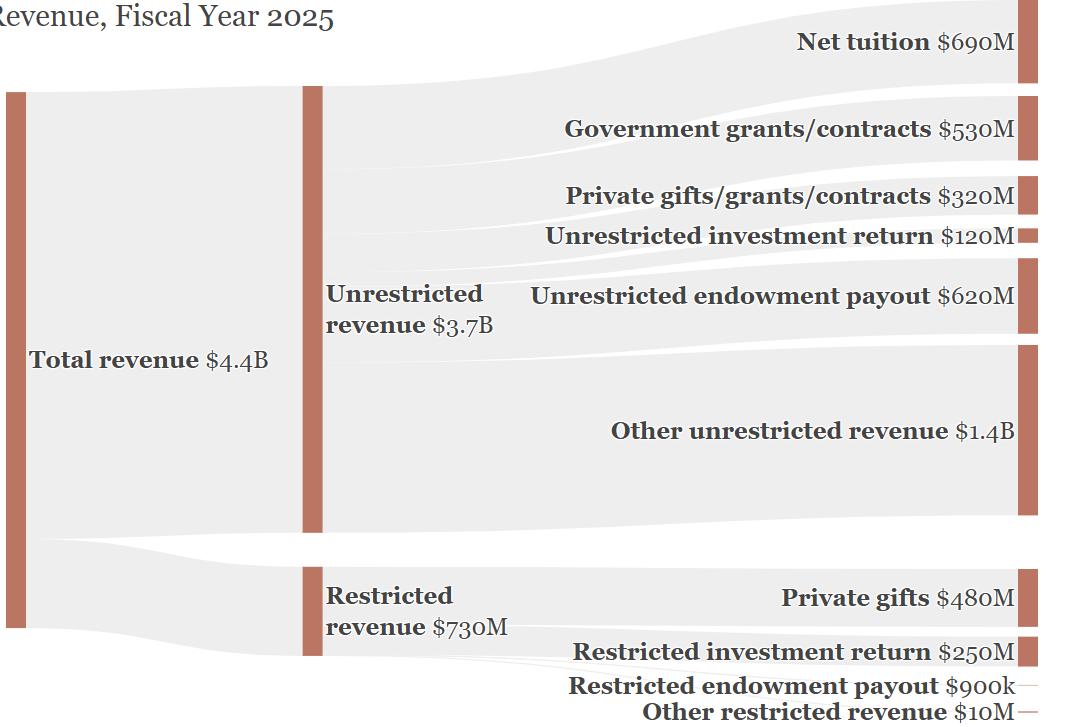
financial statement, about two-thirds of UChicago’s endowment consists of restricted funds. However, former President of Harvard University Larry Summers wrote last year that in emergencies, such as sudden loss of federal funding, even restricted funds can be used creatively.
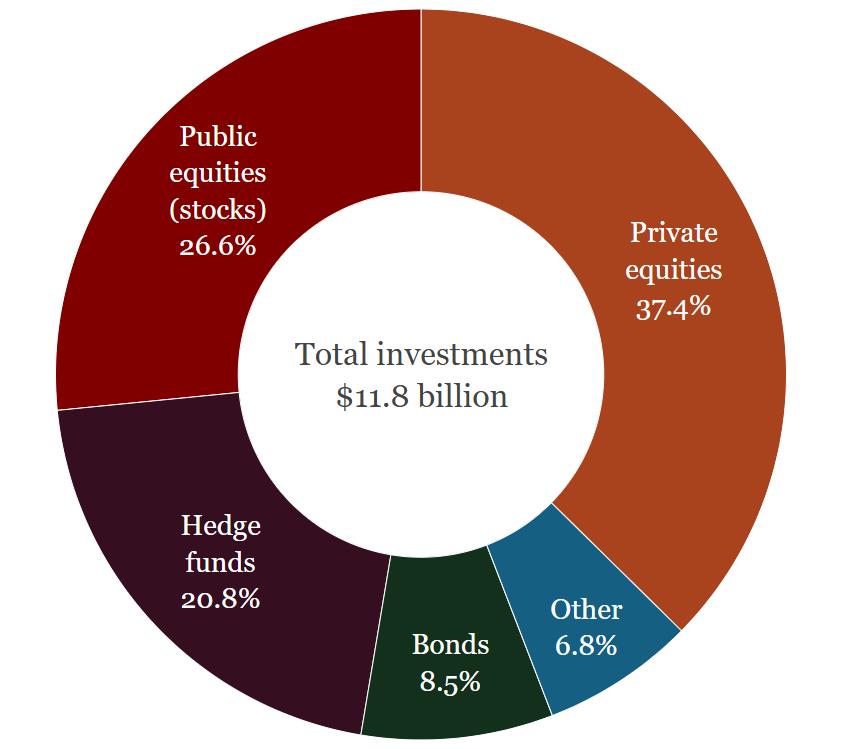
At the University of Chicago, almost the entire endowment is merged into one pot called the Total Return Investment Pool (TRIP). The TRIP is in turn invested into various equities and assets. The major distinction here is between public equities—commonly known as “stocks”—and private equities, which are less regulated and typically involve higher risk. Because stock exchanges are regulated by the federal government, more data is available on public stocks than on private equities.
Notably, the total amount of investments is slightly more than the amount in the endowment. The University did not respond to a request for comment regarding the difference between general investments and the endowment.
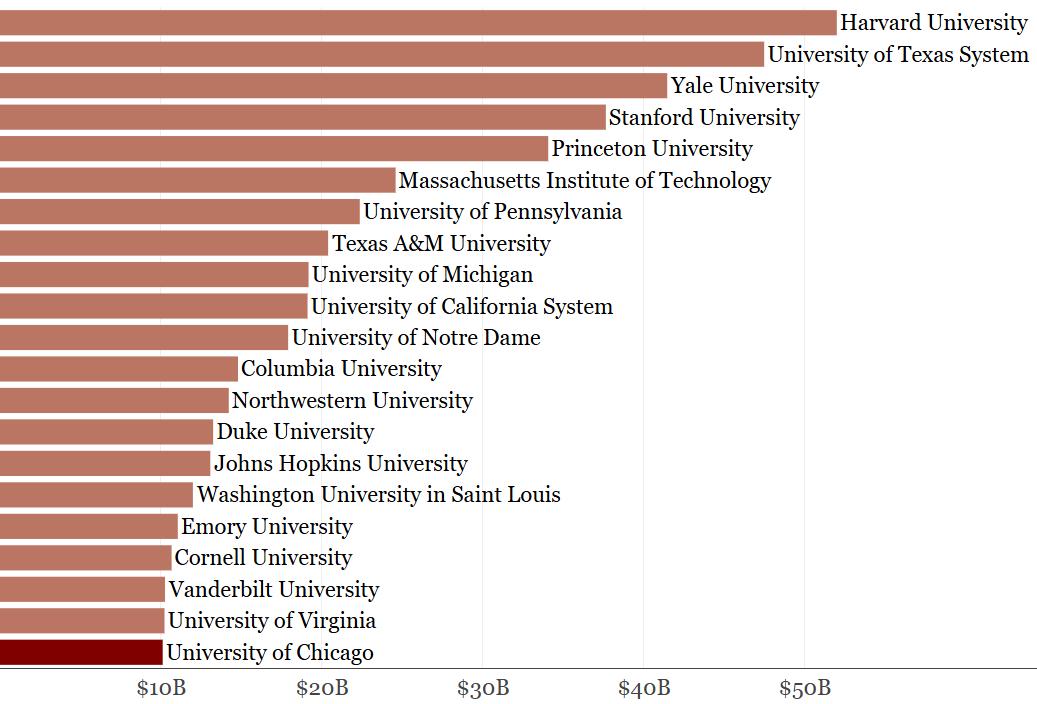
The University of Chicago possesses one of the 21 endowments in the United States with over $10 billion in funds. Still, although it was valued at $10.9 billion in
2025, it remains small among its peers. Little is known about how the University’s endowment is invested. UChicago is a private university, so while it must comply with general reporting requirements for nonprofits, it is not subject to the more stringent legal requirements placed on public universities. Many private universities have refused to comply with public demands for transparency, because providing information about their investment strategies could give peer institutions a competitive edge, though UChicago has fulfilled narrower requests on some occasions. But even for a private university, UChicago stands out: in 2023, Amnesty International rated the University as the least transparent among 10 peer institutions in
“[T]he president is ultimately ‘responsible, under the supervision of the Board, for the management of... investments.’”
CONTINUED FROM PG. 6
categories such as availability of information about the endowment and evidence of environmental-social governance investing.
Still, all universities do have some publicly available information, if one knows where to look.
The federal SEC requires all entities with significant investments to report on the amounts and names of stocks traded on public U.S. exchanges.
Data from the SEC reveals that UChicago has invested at minimum the following amounts across several industries as of September 2025:

However, SEC data represent less than 10 percent of UChicago’s public investments, and there is no way of knowing whether these proportions by sector are representative of the remainder of UChicago’s investments.
To provide information to donors and other interested parties, the University maintains some self-reporting on its finances.
Data compiled from the past 20 years of financial reports reveals that the University increased the proportion of the endowment invested in private equity from 20 percent
in 2005 to 37 percent in 2025, accompanied by a decrease in the proportion of bonds. This tactic is consistent with the “Yale Model” investment strategy, popularized by David Swensen in 1985. In a departure from prevailing strategies of the time, Swensen posited that riskier investments in areas like private equity and international stocks would yield higher returns. This new approach quickly became widespread among universities.
When asked why the University chose to increase the proportion of its investments in private equity, a University spokesperson wrote in an email to the Maroon that the administration has chosen to withdraw from the endowment at a rate of 5.5 percent in recent years: “UChicago has deployed the endowment more aggressively than some peers to support academic priorities, which has helped us to consistently compete well with universities that have endowments that are multiple times the size of ours.” This exceeds the 4–5 percent of annual endowment earnings that is typically considered normal for institutions to spend. Thus, a more profitable investment strategy may be needed to support a higher drawdown rate.
Notably, the University of Chicago has taken somewhat less risk compared to peer schools. “[T]he University took a relatively conservative investment position after the financial crisis of 2008–2009…. [which has meant] lower returns than some peers with less conservative portfolios during the strong markets of 2010–2021,” wrote Provost Katherine Baicker and Enterprise Chief Financial Officer Ivan Samstein in an email to faculty and staff last September.
The Board of Trustees acts as the steering committee for the Office of Investments, an entity within the Office of the President responsible for overseeing the endowment. The campus community has three avenues for providing input on investment strategy: the Council of the University Senate, a board comprising 51 elected faculty; the Graduate Council, which has five executive members and includes elected representatives from the 11 graduate divisions; and Advisory Councils, which are 14 councils with 10–95 members each, composed of “friends
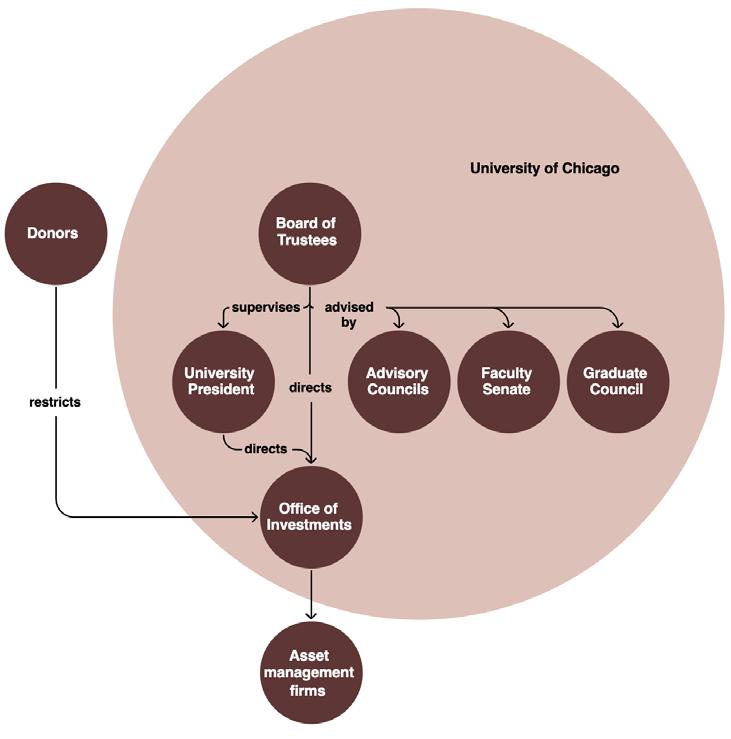
and alumni” of the University. Of these, only the Graduate Council appears to have regular meetings with the Board of Trustees, with a quarterly “Student Perspectives Series” running from 2016 onward.
A University representative stated in an email to the Maroon: “[The] Student Perspectives Series is one way for students to engage with trustees. Trustees also engage across the University with faculty, staff, and students in many ways including through various councils, speaking engagements, mentorship, and related interactions.”
The Office of Investments directly manages some of the endowment, but hires external asset-management firms to administer the rest. In an email to the Maroon, a University representative stated that the University currently works with 240 such external fund managers.
Because institutions outsource endowment management to third-party firms, some universities may not be aware of what their own endowments are invested in. When asked about this claim, a spokesperson wrote in an email: “The University’s investment team performs thorough due diligence to ensure that the funds in which it invests and their managers have no history of illegal behavior.”
Even if institutions are not aware of what their endowments are invested in, they have the power to find out. According to Brenden O’Connell, the chief investment officer at Leyland Cypress, a quantitative investment firm, any institution with a separately managed account (SMA) can request restrictions on their investments. “An SMA would be customized for you, usually. So you can impose constraints, [such
as] you don’t want exposure to XYZ industries, and then the manager will tailor the portfolio accordingly.”
For example, in 2021, Harvard requested that its endowment no longer be invested in fossil fuel companies after years of calls for divestment. While campus activists at UChicago have pushed for the same for years, the University has historically cited the Kalven Report, a 1967 declaration that the University must stay neutral in political contexts, as the main reason for its refusal to take action on the endowment. Activists counterargue that investment, as a means of financial support, is an inherently political act.
In a 2016 meeting with pro-divestment activists, former Trustee Thomas Cole appeared to suggest that the responsibility for setting investment goals and managing the endowment lies primarily with the Office of the President, while the Board of Trustees provides oversight.
However, according to University governing documents ratified in 2010 and renewed through at least 2024, the president is ultimately “responsible, under the supervision of the Board, for the management of… investments, investment properties, and special property holdings in the neighborhood of the University.” In a 2015 interview with the Maroon, then-President Robert Zimmer confirmed: “Investments are the responsibility of the Board of Trustees.”
The only player on the chart with greater or equal power to the Board is a donor who marks any funds as restricted.
The IRS requires all nonprofits to list financial conflicts of interest in their tax filings. The Maroon’s review of these documents revealed that the University of Chicago has been hiring trustee-led asset management firms to manage its endowment.
In 2015, when the University nominated Man Group’s CEO Emmanuel Roman to its Board of Trustees, Man Group was paid $992,000 for managing the endowment. While the University may have worked with Man Group prior to 2015, any such work would not have counted as a conflict of interest and therefore would not have CONTINUED ON PG. 8
“Overall, the University has paid at least one investment firm with a conflict of interest every year since 2014.”
Payments to Investment Managers with Conflicts of Interest

been reported. One year after Roman relocated to Pacific Investment Management Company LLC (PIMCO), the University stopped employing Man Group and began employing PIMCO. It is unknown whether Roman is a member of the Board’s Investment Committee, which would indicate whether he has direct influence over the endowment.
The University has employed three other companies associated with trustees in similar capacities, despite its policy of avoiding actual or potential conflicts of interest with current trustees. Overall, the University has paid at least one investment firm with a conflict of interest every year since 2014. In 2024, the University stopped reporting specific amounts paid to firms with conflicts of interest. In response to the Maroon’s request for comment, the University wrote: “The University benefits from having Trustees with a range of backgrounds, including many in finance. The number and size of investments managed by Trustee-owned firms is low and we adhere to industry-leading conflict of interest policies. Trustee-managed firms currently manage a small number of funds accounting for less than 0.2% of the university’s endowment. They have added value overall, but have never been sizable enough to drive endowment performance.” 0.2 percent of the University’s endowment in 2025 is equivalent to about $20 million.
Many members of campus have given statements on why they think greater transparency is needed. Below is a summary of some of their arguments.
When it comes to investment, one important distinction is between the primary and secondary markets. When a company goes public, it signals to the public that it needs to raise some amount of money, as indicated by its initial public offering. This is referred to as the primary market, which typically happens only once to kickstart a burgeoning company. What most people think of as the stock market is actually the secondary market, where players on the stock market buy and trade stocks with each other. Notably, the original company does not profit directly from the secondary market. For example, if the Maroon sold one share of Apple stock to Paul Alivisatos, Apple would not receive any proceeds from the transaction. Therefore, “investing in” a company does not necessarily financially benefit that company, at least when it comes to public equities.
Still, pro-divestment activists argue that investing in a company sends a message to the rest of the world, saying that the company’s products are valuable. The value of a company’s stock relates to its reputation
with customers and potential third-party investors. Withdrawing investments from a company, in turn, can pressure it to reconsider or change its practices.
Even before sweeping funding cuts took effect last year, professor Clifford Ando had dedicated 10 op-eds in the Maroon to criticizing what he sees as the University’s irresponsible management of funds, including a budget deficit that had been as high as $288 million in 2024. Following policy changes by the Trump administration, a controversial consolidation of the arts and humanities divisions, and the departure of several key managers in the Office of Investments signaled further financial troubles for the University.
While the University announced in November 2025 that the deficit had been successfully reduced by almost half, Ando called for greater transparency and communication: “The University of Chicago’s pathology for secrecy regarding the simple facts of its own operations does not suggest confidence on the part of its leadership, despite their power. They should announce their vision proudly and provide the data for it to be analyzed and discussed.”
The push for institutional transparency at universities is not limited to UChicago. Many have argued that it is the public’s right to understand the influence that elite institutions wield with their purses, especially if those institutions receive federal funding. In 2012, students at the University of California (UC), Berkeley expressed alarm after discovering that the UC system had invested in Bushmaster, a manufacturer of assault-style rifles. In 2024, Ohio State University students attempted to pressure their university to divest from holdings associated with the Israeli government, an effort that was stymied by an existing anti-divestment statute in Ohio state law. Even Congress has attempted to intervene, with both Democratic and Republican members unsuccessfully drafting legislation that would have held universities more accountable with their investments.
Some have also proposed alternative solutions for democratizing the endowment,
such as letting students elect trustees, have direct representation on the board, or manage small portions of the endowment.
If the goal of the endowment is to ensure financial stability for the University, it might not seem like a good idea to limit investment prospects, and, indeed, diversified portfolios are generally considered integral to investment strategy. In other words: don’t put all your eggs in one basket. Yet some firms argue that the financially responsible thing to do is to avoid including certain stocks, such as fossil fuel producers, in an investment portfolio, given the volatility of non-renewable resources. Such arguments propose that institutions should take proactive approaches to investments, rather than preserve the “institutional neutrality” outlined in the Kalven Report, which the University has previously used in defense of its investment strategy.
O’Connell, the Leyland Cypress investment manager, pointed out that the mere idea of “maximal return” is controversial in the world of higher education. He gave a theoretical example of a $1 billion endowment: If a university invests the full amount and receives $100 million in profit, it might use about half of the profit to cover operating expenses such as professors’ salaries or student programming. Another $10 million or so is lost to inflation, leaving $30 million in excess. When universities reinvest this excess rather than spending on students or communities in need, “some people say that $30 million in pure profit is unnecessary,” O’Connell explained. “It just makes the endowment bigger and bigger.”
As endowments continue growing amid federal cuts to university budgets, some question whether their original purpose as safety nets is being neglected. “When these universities are like, ‘No, we’re not going to step in here,’ then people are like, ‘What’s the point of the endowment?’ Isn’t this the exact scenario where the endowment should step in?” asked O’Connell should step in?” asked O’Connell.
The methodology of this article can be found online at chicagomaroon.com.
A program that grants prospective students a fast track to acceptance, as long as they can pay, makes an already competitive admissions process less fair.
By MAROON EDITORIAL BOARD
Imagine this: You are a high school senior who has been guaranteed a seat at a top university before Thanksgiving. Your peers are still stressing over their essays. The catch? You had to fork over a few thousand dollars to the University of Chicago the summer before.
First introduced for UChicago’s Class of 2029, Summer Session Early Notification (SSEN) gives College applicants who attend a Summer Session program the opportunity to receive a decision by November 1, the Early Action application deadline, or earlier, more than a month before traditional Early Decision 1 (ED1) decisions are released in midDecember.
The SSEN website states that the University began the program because “students have shared with us at the end of their program
how impactful their time on campus was for them both intellectually and as part of their college search process.”
The advantages SSEN can offer to certain applicants make UChicago’s admissions process less transparent and places students and families from underrepresented backgrounds at even more of a disadvantage. Spending several thousands of dollars in exchange for a slightly better chance of admission isn’t an option for many families who fall above the threshold for free tuition to UChicago’s summer programs. Wealthier families can afford to take this risk, whether or not it results in the student’s admission.
There are two possibilities: either SSEN gives applicants a better chance of getting into UChicago than they would have if they had applied through traditional ED1, or it doesn’t. We have no way of knowing for certain, which is a transparency problem in itself.
Unlike many of its peers, UChicago does not release information about the percentage of students admitted through Early Decision (ED) rounds. Brown University and the University of Pennsylvania admitted more than half of their 2029 classes through early admission rounds. Other schools in the Ivy Plus peer group, such as Northwestern University, Dartmouth College, and Cornell University, admitted between 20 and 30 percent of their 2029 classes through early admission rounds. Without transparency, we cannot understand the equity implications of UChicago’s early admission rounds.
If SSEN does improve applicants’ admissions prospects, it exacerbates inequity by benefiting students whose families can afford summer programs that cost up to $15,200, enabling them to access a parallel application pathway.
The SSEN website says that the University hopes the program
“will reduce the stress of waiting, provide earlier financial aid awards for assurance of affordability.” However, for families who qualify for financial aid, receiving earlier news about a financial aid package may not be worth the financial burden of the program.
Even if SSEN does not offer an admissions advantage, the perception that it does still has consequences. Many participants assume SSEN improves their chances in some way, though the University maintains that its only benefit is a condensed decision timeline. If its representations are accurate, UChicago is earning money, intentionally or not, off applicants’ false hope.
This is not to say that UChicago is the only flawed institution when it comes to equity in admissions. A class action lawsuit filed in 2025 accused UChicago and 31 other private institutions of higher education of binding applicants to ED offers without legal enforceability. According to the plaintiffs, ED applicants are compelled to accept offers without full awareness of the potential cost, meaning ED is only really a safe option for students whose families can afford to pay the full cost of attendance without a guarantee of significant assistance.
A spokesperson for the University said “a substantial number of students admitted through [SSEN] receive financial aid” in a statement to the Maroon, but the exact percentage is unknown.
In contrast to Rolling ED, a previous early admissions pathway not shared with students until their program ended, SSEN
is publicized on the University’s summer program website, creating an added incentive for students to sign up if they are vying for a spot in the College.
The lack of published data makes it impossible to assess the success rate of this approach.
We call upon the University to release SSEN admissions rates and compare the demographics of admitted students to other rounds. This is a crucial step for understanding its impacts, particularly on the financial backgrounds of students in the College, which the University does not publicize.
Until the University begins publishing data on its early admissions rounds, as many of its peers already do, SSEN will remain an opaque process, bringing in additional revenue for the University while worsening an already unequal admissions process.
Equitable admissions would require a standardized process accessible to all applicants, regardless of socioeconomic background. Furthermore, all applicants should be able to evaluate competing offers from colleges without risking a decreased likelihood of acceptance.
UChicago is a selective private institution and may not aspire to equitable admissions practices, but it should nonetheless understand the risks of the current process, which prioritizes those with substantial financial resources at the expense of those without.
Nathaniel Rodwell-Simon recused himself from this editorial because of a conflict of interest.
By CIARA BALANZÁ | Senior Arts
Reporter
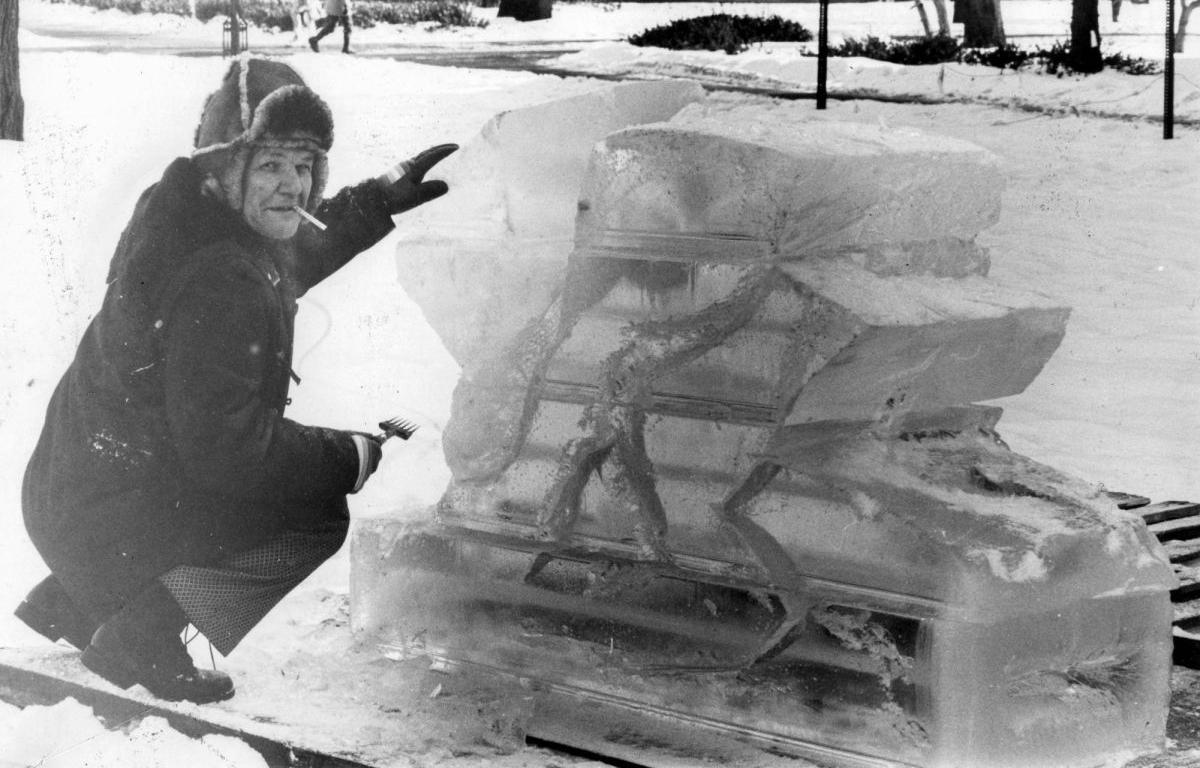
As sure as a wintry sunrise at Promontory Point, Kuvia is a staple of winter quarter at UChicago. Organized by the Council on University Programming (COUP), the weeklong festival has been a fixture of the coldest months for 43 years. Before our cold mornings recede into a cheerful spring, I dug into the Maroon’s photo archives to see the ritual in action.
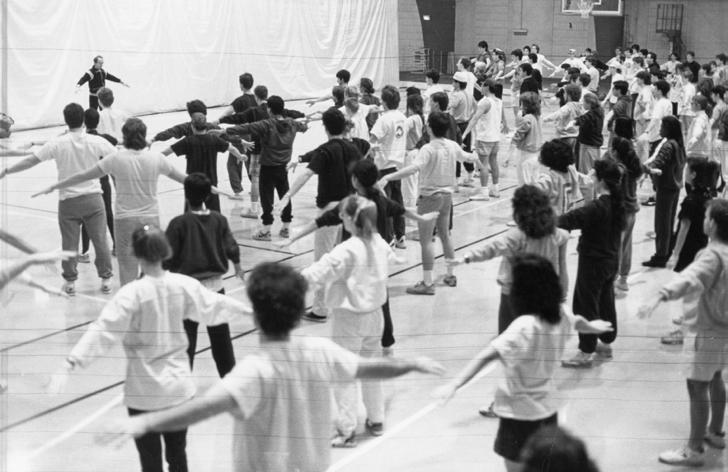
Kuvia began in 1983 and has since become a cherished tradition. The name comes from the Inuit word kuviasungnerk,
translated as the “pursuit of happiness.” It was later combined with the series of early morning exercises organized by former Dean of the College Donald Levine known as kangeiko—a nod to Japanese winter training traditions—held during the same week. Together, the terms capture the spirit of the event: a cold-weather regimen that somehow feels liberating.
In its earlier years, Kuvia functioned more like a loosely themed winter festival. Programming included lectures, movies, and outings like skiing. Run by the College Orientation Office, it functioned to
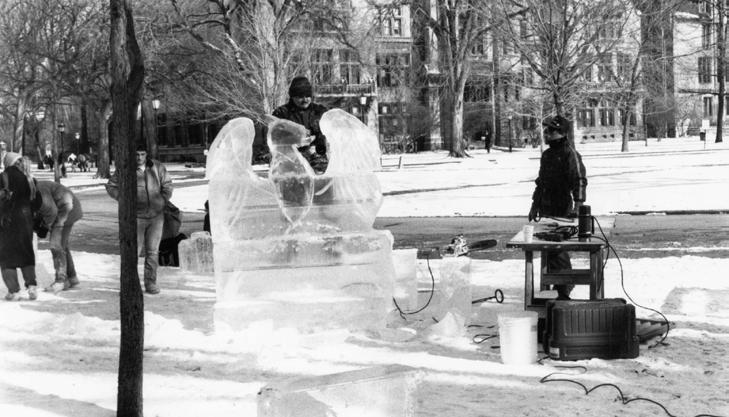
give students something to look forward to during the bleakest stretch of the quarter. Over time, it has formalized into a more disciplined routine.
When COUP arose in 1994, it reoriented the festival into a student-driven event. Each morning now centers on the same yoga sequence, followed by a rotating set of activities hosted by different RSOs. An additional introduced constant is the incentive. A coveted T-shirt is earned by those who attend the festival every morning. Since at least 2004, student designers have competed to adorn the annual shirt with winter iconography.
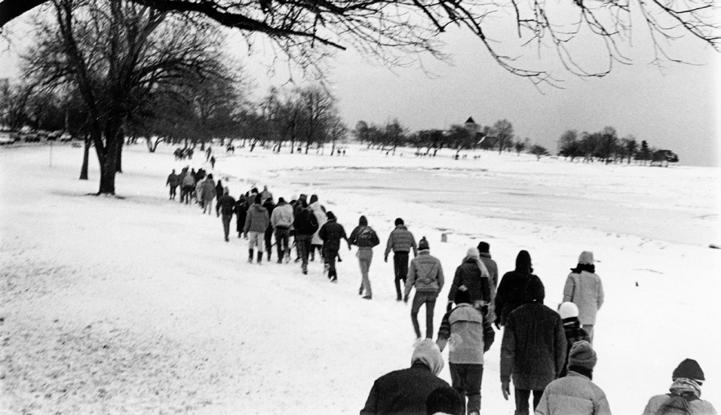
Students trudge to Promontory Point on the final day of Kuvia in 1985. chicago maroon photographic
There is an uneasy balance at the heart of Kuvia between wellness and tradition. Fourth-year Qian Fang Yeap, a repeat participant and COUP committee member, said the framing has shifted over time. In past years, “[we] would market Kuvia as a wellbeing initiative,” Yeap told me. Now, she argued, the health language seems inappropriate. “It makes no sense because it’s cold and you wake up so early,” she said. “It’s more of a tradition. You do it for the sake of doing it.”
The sun salutation is a rallying cry. Each day begins with the same set of movements, growing by an extra round as the week progresses. In unison, students clap their hands overhead in mountain poses. The sound ricochets across the track. This was not a room of people simply doing a yoga posture; it was a fully embodied performance. Downward dog was followed by a chorus of barking.
the 43-year tradition.
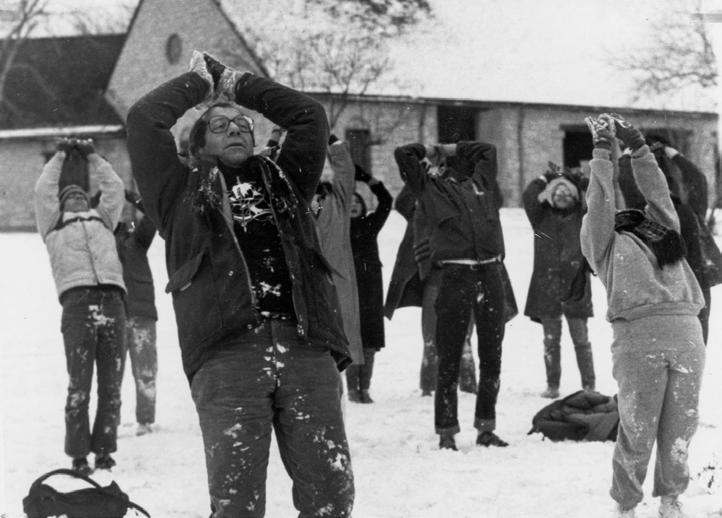
Participants salute the sun as it rises on Promontory Point in an undated photograph. chicago maroon photographic archive
Cobra was followed with hissing. On its last day, the event moves out of Henry Crown Field House and to the lakefront. This year, Dean of the College Melina Hale led the crowd through the sun salutation sequence on a carpet of fresh snow. The lakefront has long been the final landmark of Kuvia. Students have flocked to the Point, snow or shine, since at least 1985, as shown in photos dating back to then.
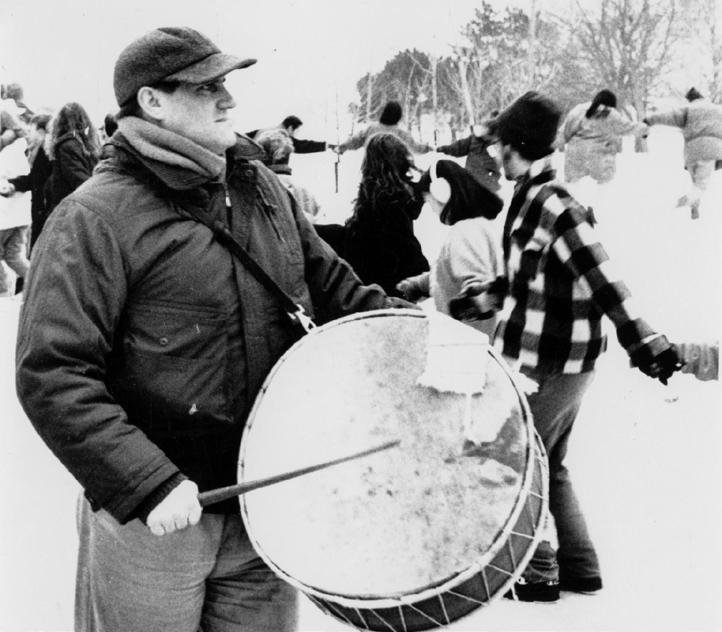
On the final day of Kuvia in 1992, a drummer plays the beat for the Snake Dance. chicago maroon photographic archive
And always, some students take it a step further, sprinting to the edge of the Point and taking a polar plunge. The lake dip captures the tradition’s logic. The long-standing ritual of Kuvia may be built on extremity, but all are free to decide how far they would like to jump in.
By JOSHUA FEDERMAN | Arts and Culture Reporter
University Theater’s quarterly short play showcase features one or two performances, roughly 45 minutes each, often written by students. This quarter, the Francis X. Kinahan Theater (FXK) was host to a pair of well-crafted shows: The Burden of Burial: Sophocles’ Antigone Reimagined, a musical adaptation of Antigone written and directed by third-year Courtney Pine, and El Cepillo de Dientes, a 1961 play by Jorge Díaz, directed by second-year Senna Schultz. The Saturday performances were darkened by the news that several costumes had been stolen from the FXK the previous night. Despite this, the show went on—as it must, so they say.
The Burden of Burial follows the plot of the original Antigone play, which is driven by the juxtaposition between the duty one has to their family and to the law. This theme is demonstrated first by Antigone (first-year Ash Kim) as she attempts to illegally bury her brother Polyneices. It later returns with the King Creon (first-year Patrick Gaghan) and Haemon (second-year Julian Iverson)— Creon’s son and Antigone’s fiancé—as they must choose between protecting her and upholding the royal decree.
Pine’s lyrics, arranged by Emilio Del Angel—also the musical director and pianist—effectively draw out this theme in a clear, catchy format. Pine uses direct, contemporary language to crystallize her ideas without oversimplifying the terms of the show. For example, Antigone’s and Ismene (second-year Millie Walsh) often reiterated “Three siblings … but now we have one” (and at the end, “…but now I have none”), keeping the focus on family and one’s duties to siblings. The variation Ismene sings alone at the end is especially effective, since it concisely invokes both her family and the sacrifice Antigone made in its defense.
The five-actor cast successfully used the particular tone set in each scene to give depth to the complicated motivations and
pressures affecting each character. Gaghan assumes Creon’s kingly stature, standing straight with his head held high to display the character’s pride. In many of his songs, he sings the same line about needing to appear strong as a king. As the consequences of his stubbornness worsen through the course of the play, his voice increasingly fills with more uncertainty at each repetition of this line. In the end, he sings it once more, only now with his voice heavy with regret for the foolishness which has left his son dead before him, completing his character’s development from unchecked pride to shameful humility. Iverson embodies the young Haemon’s inferior status to his father, making exceptionally clear the immense difficulty required to stand up to him. Standing next to or behind Creon, he appears slighter, needing to raise himself up fully and come forward to lock eyes with his father, representing his movement from subservience to resistance early on in the story.
Third-year Ariadne Merchant’s performances as Tiresias, Guard, and Messenger were especially compelling, as she was very successful in differentiating between each of these characters. When transitioning between the roles of the Guard and Tiresias, for example, she adjusted her stature from the young, nervous guard standing tall and quick on his feet to the older, resolute Tiresias in a more stooped and grounded position. Together, the actors drew out the thematic elements conveyed in their words, giving definition to each character and immersing the audience further into their world.
The set and costumes for this show were minimal, setting the action in a specific time and place without drawing attention to it. This allowed the audience to focus on the acting and writing, which were the strongest parts and central focus of this showcase, especially as a student-written pro-
duction. Additionally, the actors remained seated onstage for most of their “off” time, giving them the opportunity to act in the background and become a living part of the set.
The only ineffective design choice was to set the show in the seating and archway of a wedding venue (differing from the original play, set in the front of a palace), overemphasizing the idea of marriage. While Haemon and Antigone are engaged, they could just as well be lovers in some other capacity without significantly altering the story, which isn’t really about marriage. As such, this choice of set was more distracting than conducive to the presentation of the show.
The second play of the showcase, El Cepillo de Dientes, is one of the earlier and more popular plays of Jorge Díaz, an absurdist Latin American playwright. It follows a couple referred to only as He (Greg Bound) and She (Genevieve Robinson) as they navigate the challenges of contemporary married life, morphing into different characterizations of themselves throughout the show.
Shultz’s direction created visual distinctions throughout the play, a difficult feat with a mostly static set and only minor time jumps. These choices codify the themes around the relationship of the two characters. When the play begins, the marital discontentment is clear: the two sit close together at the small kitchen table, yet stare into their own reading materials and speak dismissively to each other, showing their emotional distance. By contrast, when they act out correspondence published in a newspaper’s personal ad section—a moment in which they are much closer emotionally— they stand much farther apart. Finally, the act ends with the two of them in the closest proximity but only because He is strangling She to death with a radio cord. Taken together, this blocking shows that the two are put off by their very closeness; sharing a toothbrush is what most repulses He. By contrast, in the second act, Robin-
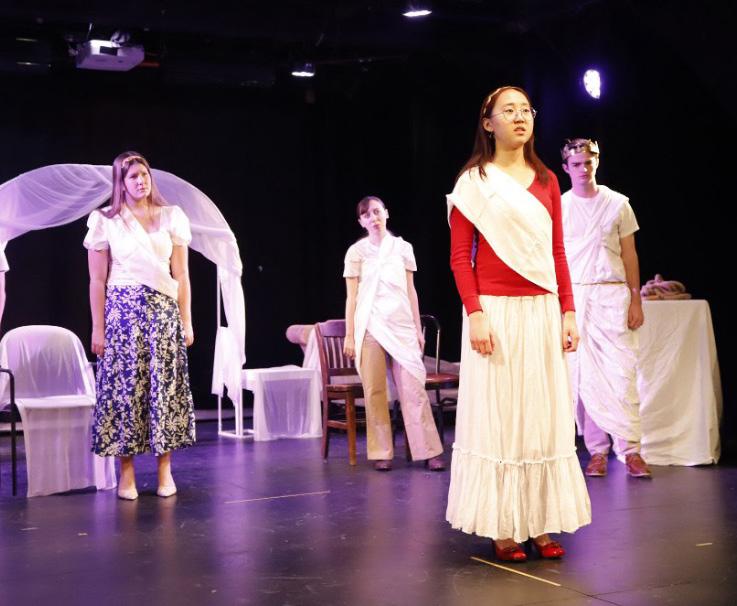
son is dressed as Antona, the housekeeper that He is in love with. She dances with him to the music his wife hates, and the two of them actually look at each other. To reflect this shift, Shultz’s direction is inverted. Now, the characters act as expected: close in space when close emotionally and distant when tensions rise. This new love is completely different from the deep connections of marriage—it is taboo and exciting. At the same time, the overt intimacy blocked between the actors in this scene creates an uneasy sensation to watch. He comes across as deeply unnatural, acting so unbothered by his recent murder to suggest sociopathy. We see the apparent closeness of lust but through these disquieting choices understand that the reluctant sharing of toothbrushes is the more morally correct alternative.
In the final sequence, the stage is emptied of all its furniture, and the two actors— no longer masquerading as a housekeeper or pen pal—scramble for each other in the dark, finally united. Their embrace brings closure to the blocking of the previous two acts, reuniting the original couple without the facade through which they have been living throughout the play. This final directorial decision concludes the play on a
“[T]hey
CONTINUED FROM PG. 11
positive note, leaving the audience with the sense that, despite all the turbulence of marriage, it is also the thing which lasts until the end.
While Shultz’s direction effectively used the positioning of He and She to visualize how their closeness changes throughout the show, it was flawed during She’s first entrance and He’s moment of passion with Antona, which were blocked such that the actors lay on the floor. In the FXK, a theater with minimal raking and a stage already near the audience’s eye level, this action was impossible to see sitting behind the first two rows when the house was as full as it was.
Bound’s performance was witty and charming, lending an invigorating boyishness to a character who is often rather unpleasant. He walked with a bounce in
his step and spoke in a manner which was both robotic and aware of its own monotony, highlighting the humor in that contrast. Robinson was vulnerable and intense, allowing the audience into the heart and mind of her character. She delivered her lines with urgency and directness, expressing every sentence zealously, as though she were just a bit aware of the audience, and sounding exactly the opposite of Bound’s deliveries. Together, they create a dynamic relationship between two very complex and hard-to-embody characters, executing the humorous notes exactly as needed while lending a compelling weight to the more sober and dramatic sequences. The serious observations of married life alongside the absurdist humor made the world of the show completely believable.
Jack Zirin-Hyman’s sound design was
another welcome element to the absurd landscape of this play. The lives of He and She are interspersed with cuts to old-fashioned TV advertisements, the audio played on top of the actors speaking those same ads. Such interjections give welcome pause to the rapidly changing scene of the couple’s life while reinforcing their dynamic and maintaining the absurd tone of the show. When He first brings up the toothbrush, the two jump into a Colgate ad, and their concluding argument begins with a disagreement over Dersa versus Ajax detergent. These moments, near the beginning and end of the show respectively, bookend the performance with sudden nods to idealized domestic realities portrayed on TV. Such nods create a stark contrast against the messy dynamic between He and She, serving as a reminder that their imperfections
are their authenticity.
Together, these two shows highlighted the strengths of many different roles in the production process. The Burden of Burial was a vibrant presentation of an entirely student-written production, with rich lyricism and skillful acting giving new life to a well-known story. It established the short play showcase as a venue where original student creativity can shine. El Cepillo de Dientes then contrasted a well-known plot with a novel storyline, shifting the focus from the writer’s interpretation of a classic story to the actors’ and director’s interpretation of modern characters. These differing foci of the productions allowed them, in unison, to showcase effective blocking, characterization, writing, and design work, illuminating the impressive creative efforts of the students who brought them to life.
By RYAN CLARK | Arts and Culture Reporter
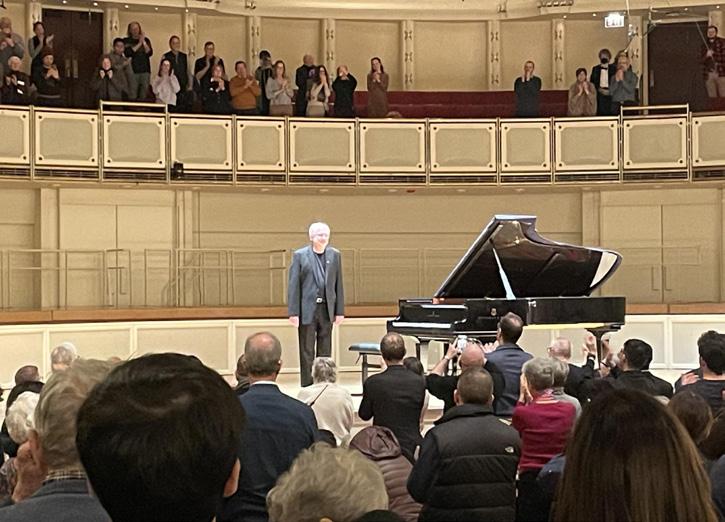
Legendary pianist Marc-André Hamelin’s February 22 recital at Symphony Center was a major event in the promotion of profound and challenging American music. With characteristic precision and clarity, Hamelin presented a worthy interpretation of Charles Ives’s titanic Piano Sonata No. 2 (Concord Mass., 1840–60) followed by Robert Schumann’s Fantasiestücke, Op. 12 and Alexander Scriabin’s Piano Sonata No. 4. In his performance of the Ives, Hamelin made the ethico-religious quest of American transcendentalism an audible phenomenon.
The Ives piece, commonly known as the Concord Sonata, is one of many masterpieces bequeathed by the composer to the treasury of American art music. The 50-minute sonata, first published in 1920, has the familiar four-movement structure of 19th-century symphonies and Ludwig van Beethoven’s longer piano sonatas, but any musical familiarity ends there. Individual movements lack traditional forms;
thematic material is shared throughout the movements; and Ives intersperses tonal melodicism with explosions of atonal and polytonal pyrotechnics. Complicating matters, Ives weaves ample quotations into his musical texture, including Beethoven’s “fate” motif from his Fifth Symphony and American hymns. This harmonic and formal radicalism does not produce a sense of austerity, like in the work of some later modernist composers, but rather serves Ives’s dense, shifting musical collage. Besides the aesthetic complexity, the prodigious technical difficulty of the piece also does not lend it to being frequently performed.
The stated subject matter of the work may explain some of the harshness and grandeur of its musical language. Ives titles each movement after American literary figures: in sequence, “Emerson,” “Hawthorne,” “The Alcotts” (for Bronson and Louisa May Alcott), and “Thoreau.” When writing about the piece in Essays Before a
Sonata, Ives identified mannerism as the great vice preventing talented composers from crafting great art. For Ives, the musical language of a piece must follow from the nonmusical content it expresses: images of nature, emotions, and, preferably, truths about life itself that it voices in sound. Thus, in “Emerson,” the almost overwrought sonority, violence, strangeness, and scope of the piece were all necessary to express the insight of the great American writer it tried to represent.
In the opening movement, “Emerson,” Hamelin shattered the anticipatory silence with the initial salvo of octaves moving contrariwise. Hamelin remained controlled through the movement’s many thorny and wonderful climaxes, which sounded like a fever dream of Beethoven. Then came the arabesque-like “Hawthorne” and tender “The Alcotts,” in which Hamelin’s knack for the soft and delicate side of Ives was manifest. The sonata finished with the meditative but icy “Thoreau.” Hamelin’s control in the lighter passages was matched by his skill in clarifying and weighting melodic
lines in the piece’s often knotty textures, though there was a certain restraint in the climaxes that blunted their force.
The nature of the sonata form as programmatic or philosophical music warrants comment. Sometimes Ives’s representational strategy is clear, as in the menacing second movement, which refers to Hawthorne’s concern with sin, or the warm third movement, which evokes the Alcott family home. But the first and fourth movements undermine those representations. With “Thoreau,” Ives seems to want
“Hamelin’s
to strip clichés and sentimentality from our view of nature, as if to emphasize the novelty and directness of Henry David Thoreau’s experience at Walden Pond. But how is the stormy first movement representative of the unwaveringly cheerful Ralph Waldo Emerson? Its thick dissonances seem unfitting for the sunny author who wrote in “Compensation” of every loss working for our benefit, or in “Circles” of every end heralding a new beginning. From Ives’s commentary on the piece, it seems that Ives’s Emerson is principally the prophetic Emerson of “The Over-Soul,” who declares the spiritual truth of oneness to be inside us. The first movement thus seems to be a constructive revision of Emerson, suggesting that the Emersonian inner self may not be placid but rather dark, aggressive, and irrational. (It is fitting, then, that Concord
Sonata was published in the same year as Sigmund Freud’s Beyond the Pleasure Principle, which featured the identification of the “death drive.”) The whole piece is a sort of crazy farewell to the nineteenth century: we get snatches of Beethoven and Richard Wagner, the transcendentalists, and even the magic of the salon as the work drags the spirit of that epoch into the grunge and chaos of the twentieth century. For Ives, old truths may need to be spoken in newer, stranger words.
some movements, as in “Des Abends.”
prised at the shock of the woman behind me by the end of the Concord Sonata. Hamelin’s performance of the Ives piece was an act of courage, both in the work’s technical demands and in its capacity to intimidate listeners. Piano recitals are often events of dusting off the same old Frédéric Chopin and Franz Liszt pieces that, charming and polished as they may be, have little to do with the feeling of contemporary life. Although Hamelin’s chosen sonatas of Ives and Scriabin are a century old, they felt modern in their abrasive intensity. The performance left me hoping that more pianists will present more challenging and vital music that stimulates and edifies audiences rather than merely gratifying their taste. Through his program, Hamelin effectively made the case for Ives as the last American transcendentalist, darker and more furious than his predecessors, but just as visionary. CONTINUED FROM PG.
Hamelin followed the rarely performed Ives with Schumann’s Fantasiestücke, a relative staple. Although not nearly as musically transgressive as Ives’s piece, Schumann’s suite has a similar emotional restlessness and range. Hamelin’s performance was clear and polished, and he displayed a gift for the playing of melody. However, Hamelin’s tempo skewed too slowly in
The concluding Scriabin sonata seemed to mark a return to the Ivesian soundworld, at least with respect to the texture, chromaticism, and cyclic form. I, who was previously a Scriabin skeptic, was won over. With the concluding “Prestissimo volando,” it seemed that Scriabin had blown up the concert hall and that we had been rendered intoxicated, amorous, and were now racing down highways of memory and imagination. Hamelin succeeded in providing a breathlessly fast and dazzling finale. As a treat for the audience, Hamelin’s encore performance of Maurice Ravel’s “Jeux d’eau” may have been the most perfectly played work in the recital.
It can now seem quaint to remember that concertgoers were once scandalized by Beethoven’s Eroica or Igor Stravinsky’s The Rite of Spring, so I was pleasantly sur-
Jim Jarmusch’s new film baffles in its mystification.
By ISAAC CRANE | Senior Arts and Culture Reporter
In John Berger’s highly influential work of art criticism, Ways of Seeing, he articulates an argument against mystification in which the viewer’s moment of interpretation of a piece of art is taken away by an explanation of that which occurs. Jim Jarmusch’s Father Mother Sister Brother struggles under the weight of its own themes of estrangement and decay and fails to avoid mystifying itself.
In Ways of Seeing, Berger defines mystification as “the process of explaining away what might otherwise be evident.” This, for Berger, eliminates the opportunity to create meaning from art from its appreciator (or detractor). The artist is still the artist and the admirers are still the admirers, but if art remains not mystified, meaning can be made collaboratively, even across time and space.
A lesser but still significant concern is the potential for what I will call
“demystification,” the process of obscuring what would already be obscure. When dealing with sufficiently complex subject matter, failures of artistic communication reflect demystification insofar as meaning-making is made unnecessarily difficult. Grappling with a difficult work has inherent value, but struggling through its arbitrary difficulty can only serve to diminish the meaning found through that grappling.
Through its own mystification and demystification, Father Mother Sister Brother tells three distinct, thematically resonant stories of aging, love, and loss in estranged families. The anthology film’s failings obscure its power.
In “Father,” the film depicts the visitation of a father (Tom Waits) by his children (Adam Driver and Mayim Bialik). In “Mother,” a writer (Charlotte Rampling) hosts her daughters (Cate Blanchett and Vicky Krieps) for the one time a year they all see
each other despite living in the same city.
In “Sister Brother,” siblings (Indya Moore and Luka Sabbat) reunite to mourn the loss of their parents by visiting the now-empty Parisian apartment they used to call home.
Connections are obvious and bountiful. Each story serves as a picturesque if meandering familial portrait. Collectively, however, they leave the viewer wanting. The triptych itself mystifies insofar as ideas that are explored with a semi-deft touch in individual stories serve to bludgeon the viewer with the weight of a sledgehammer when combined. Repetition explains that which was already evident.
Whatever meaning could be derived from the film is certainly obscured by the fact that the film functionally serves as an advertisement for Rolex and Yves Saint Laurent. In each story, characters show off Rolexes with varying levels of authenticity.
Yves Saint Laurent designed all the clothes for the film and was a financial backer. Though the label’s involvement serves to
provide some aesthetic clothes, the idea that Tom Waits’s or Cate Blanchett’s characters would be wearing such clothes stretches believability. The focus on non–thematically relevant aesthetics demystifies, it obscures themes that don’t need further obscuring. At points, the film’s craft leaves a lot to be desired. Moments of simple beauty in the relations between characters are paired with exceedingly wooden and hollow moments of dialogue. Moments of contemplation are interrupted by dialogue explaining which room of the house the characters are in. The evident is explained, obscuring both the obscure and the confronting. There is a thought-provoking film somewhere in here, but Jarmusch does enough to both mystify and demystify it that it is hard to become sufficiently invested to struggle with its ideas. It is difficult to wrap one’s hands around it due to its failures, not its successes.
Berger wrote that “when we ‘see’ a
“The evident is explained, obscuring both the obscure and the confronting.”
CONTINUED FROM PG. 13
landscape, we situate ourselves in it. If we ‘saw’ the art of the past, we would situate
ourselves in history. When we are prevented from seeing it, we are being deprived of the history which belongs to us.” Father
Mother Sister Brother reflects the promise of a shared artistic history that remains unrealized due to its mystification and
demystification of itself. The film’s friction aptly speaks to its themes: everyone gets older, even auteurs.
Broomball has been UChicago’s most beloved intramural sport for decades.
How did the little-known Midwestern activity become a cornerstone of UChicago culture?
By SHRIVAS RAGHAVAN | Sports Editor
“It’s like a game out of a dream.”
For many like fourth-year Grace Simmons, the idea of a game played on ice where skateless players use a broom-like plastic stick to caress a volleyball-sized ball into a goal seems like a vague, fever dream–induced rendition of ice hockey. It’s the type of scene that would result from asking the average five-year-old to draw a hockey game from memory. The sticks look a little too small, the puck looks a little too big, and the players look a little too disorganized.
But rest assured that “broomball” is very, very real and does in fact exist outside of dreams and the memory of a hypothetical five-year-old brain.
Forms of the sport can be traced back to the early 20th century. While some claim modern broomball was invented in Canada, others point to Duluth, Minnesota. Regardless, the game continued to gain popularity in Canada and the American Midwest throughout the 1900s, slowly manifesting itself as a winter staple for many in the region. In 1998, the International Federation of Broomball Associations (IFBA) was officially established. Fast forward another 28 years, and IFBA-recognized broomball programs can be found in 11 different countries, including Slovenia and Japan.
UChicago’s history of broomball is slightly murkier. According to Senior Associate Athletic Director for Recreation and Fitness Brian Bock, when the Gerald Ratner Athletics Center was built in 2003, many records were lost in the transition to the new building. But, when Bock began
working at UChicago that year, broomball had already established itself as an intramural (IM) cornerstone. “When alums come back, they all talk about broomball. I don’t know if it’s [from] the ’70s, ’80s, or ’90s, but it’s been around for at least 25 years,” Bock told the Maroon
Today, broomball is comfortably UChicago’s most popular IM sport. Its 412 registered participants—not including the additional 10-team waitlist—is by far the most of any IM offering. Notably, it is one of the few flagship IM leagues that is not only available to all genders but also graduates and undergraduates alike. “The great equalizer is ice,” Bock explained. “I don’t care if you’re a 23-year-old ex-college athlete or you’re an 18-year-old. You’re still going to fall.”
And fall they do. In fact, there’s not much “playing” being done in the average broomball game. The players with the required elegance to stay upright shuffle their way toward the ball in swarms and try their best to nudge (or whack) the ball forward, whereas most players are more focused on keeping their poorly sized helmets out of their eyes than generating any sort of attacking threat. The remaining players can be found either on the ground, trying to regain feeling in their hands, or crowded around the nearest goal, trying to keep two feet firmly on the ice.
The vast majority of games either end in a 1–0 Sean Dyche-ian affair or are too chaotic to crown a winner without a penalty shootout at the end to break the dead-
lock. Despite its eccentricity, hockey’s less elegant younger cousin has unequivocally stolen the hearts of UChicago students.
“I grew up playing all sorts of sports and I played every IM under the sun. Broomball is just this unique combination of things that you don’t get anywhere else,” fourthyear Nick Rinaldi explained. “Just random is the best way to describe it.”
“It’s one of those quirky UChicago sports. There’s no pressure to it; it’s just a lot of fun. It’s the type of thing that you do for the memories,” Simmons added. “I don’t think that there are a ton of opportunities [like broomball]; even with a lot of RSOs you have to apply to get into them, but this is just purely stupid fun.”
UChicago’s courses are rigorous, its nine-week quarters are demanding, and the lofty expectations set by the University’s professors are only surpassed by the expectations students place on themselves. In many ways, broomball is the antithesis of UChicago—lighthearted, relatively uncompetitive, and, for all intents and purposes, inconsequential. Yet, on nearly every Monday, Tuesday, and Thursday night of winter quarter, dozens of students leave the warmth of their favorite libraries to face Chicago’s bone-chilling winter, making the trek to the Midway Plaisance Ice Rink broom in hand.
“People are passionate. You might not be the best athlete, but you’re passionate about what you do and you step between the lines and you want to win and have fun. I think it translates well in a place like this,” Bock added.
After all, despite all its silliness, broom-
ball is still a sport, and the passion of UChicago’s broomballers is not confined to just whimsy. Where there is sport, there is a desire to win. And in the 2026 broomball season, no collection of broomballers mastered the art of winning quite like team Officially Washed.
In the six games leading up to the season’s semifinals, Officially Washed recorded six wins, scoring an astonishing 31 goals while conceding just once. With many former hockey and field hockey players on the roster, Officially Washed knew they had a leg up on the competition. More importantly, they knew how to exploit it. “Within hockey and field hockey, there’s terminology like ‘chip,’ ‘center,’ and ‘boards’ that each mean a specific thing,” first-year team member Kevin Liao explained. “Broomball is a similar sport to hockey, so we can carry it over.”
In a sport where goals are so hard to come by, Officially Washed had mastered the art of putting ball in net. But their success was not just a product of strategy and organization. For Rinaldi, Officially Washed’s team captain, it was a case of simply wanting it more. “We’re more fearless than the other teams. We don’t mind sprinting and falling sometimes,” Rinaldi told the Maroon
Fueled by their tactical prowess and unmatched determination, Officially Washed reached 2016 Golden State Warriors levels of sporting dominance. They were a true force to be reckoned with, and as the season’s semifinals loomed, broomball immortality was within an arm’s reach.
“We don’t mind sprinting and falling sometimes.”
CONTINUED FROM PG. 14
But when the Midway Plaisance Ice Rink was reduced from the mecca of UChicago broomball to nothing more than a kiddy pool following a historic stretch of warm weather, the team’s hopes of ending the season with silverware were in jeopardy.
With four teams still alive and no ice rink, crowning a champion would require a bit of creativity. Luckily, this wasn’t the first time something like this had happened. Since 2003, two such seasons produced unorthodox endings due to weather: the first season was decided with floor hockey matches in Ratner, while the second— which only had its championship game cancelled—was concluded through the declaration of co champions.
With the latter option unanimously disregarded by the remaining teams and the former option deemed impractical given Ratner’s tight end of quarter schedule, a compromise was struck. Both semifinals and the final would be decided by five-toseven-person penalty shootouts in the Ratner Auxiliary Gym. Officially Washed would have the chance to cap off their historic season with a championship.
But just like their NBA counterparts, fate had other plans for Officially Washed. The broomball powerhouse fell in excruciating fashion to the Dusters, a team that had made it to the semifinals in a very different fashion. “All our regular season games were either 1–0 or 0–0 then a shootout,” fourthyear Dusters team captain AJ DeRosa ex-
plained. “We were definitely pretty good at shootouts, so [the shootout format] didn’t hurt.”
Following the Dusters’s improbable semifinal victory, sights quickly shifted to Strongin House, their championship match opponents, who were no strangers to eking out close victories themselves. Both teams had entered the day with perfect records and identical goal differentials, but, in the end, the Dusters proved too clinical in front of the goal, beating Strongin 5–4 in the highest-scoring shootout of the day. Just like that, one hour and three gymnasium floor penalty shootouts later, the 2026 broomball season had come to an end.
The long-awaited broomball finale was underwhelming in a sense. Many of
the sport’s most endearing qualities were lost in the transition from ice to hardwood. There were no slips, falls, nor trademark moments of broomball magic. The shootouts brought suspense but lacked the disarray and camaraderie that have come to define broomball at UChicago.
But there was also something poetic about the season’s conclusion. Seeing David slay Goliath was a sight to behold for an impartial broomball enthusiast like myself. For a sport that is all about leveling the playing field, the final’s format did so beautifully. Talent was neutralized, chaos took center stage, and memories were made in the process.
At the end of the day, is there anything more broomball than that?
The Chicago Bears are antsy to shed themselves of an aging stadium. Where will they call home next?
By ALEXA WALSH | Senior Sports Reporter
For Chicago Bears fans, Soldier Field is a monument of grit and tenacity that could only belong to a fanbase that hasn’t seen a Super Bowl win in 40 years. The neoclassical stadium, which became the team’s home in September 1971, is a Lake Michigan landmark and has since hosted legendary teams like the 1985 Bears.
Despite its storied past, however, this iconic part of Chicago sports will most likely no longer be the Bears’ home. The Chicago Bears organization has been making a push for a new stadium since Team President and CEO Kevin Warren wrote an open letter to fans, stating that “in addition to Arlington Park, we need to expand our search and critically evaluate opportunities throughout the wider Chicagoland region, including Northwest Indiana.”
The open letter materialized following reports that the Bears were seeking $855 million in public funding to support the construction of a new stadium after Illinois lawmakers had previously refused this request from the Bears organization. At the time, the mention of expanding the search to Northwest Indiana was something Bears fans balked at. However, on February 19,
Indiana governor Mike Braun wrote on X, “Indiana is open for business, and our progrowth environment continues to attract major opportunities like this partnership with the Chicago Bears.”
The statement by Braun came after Indiana lawmakers unanimously passed Senate Bill 27, which sets up the framework for the Chicago Bears to build a stadium in Hammond, Indiana. The proposed site near the Wolf Lake area is roughly 27 miles from the Bears’ current home. While the physical distance is not overwhelming, the difference in region and cultural identity is stark, as the proposed site is far from even the southernmost parts of Chicago.
Despite this news, many Bears fans have still been clinging to the hope of staying in Chicago, as Soldier Field is a core part of the identity of the Bears fanbase. Yet, when Illinois governor J. B. Pritzker said in a press conference that he was “very disappointed” after the Bears released a statement endorsing the work done in the Indiana legislature, alarms began to sound that a Bears relocation was imminent. No Chicago sports fan wants to hear the Illinois governor acknowledging uncertainty
about where the team will end up. However, the Illinois legislature made a renewed effort to keep the Bears in the state. On February 26, the Illinois House Revenue and Finance Committee advanced a “megaprojects” bill. This bill outlines the ability for the National Football League (NFL) team to negotiate tax breaks in order to break ground on a new stadium in Arlington Heights. Chicago fans shouldn’t get too hopeful, however, as the Illinois House adjourned until April 7 without any further action on the bill.
So, what does this mean for Bears fans? Besides the relentless back-and-forth between two state governments and one stubborn NFL team, these relocation plans signal the end of an era for the Chicago Bears.
As the oldest stadium in the NFL, Soldier Field has seen many eras of a storied Chicago franchise, both good and bad. Though it opened in 1924, predating the high-flying “Monsters of the Midway” of the ’40s, Soldier Field got its first taste of the Chicago Bears in the ’70s, an era marked by rebuilding and general mediocrity. It did, however, accommodate the “Super Bowl Shuffle” team of 1985, with franchise legends like William “The Refrigerator” Perry, Mike Singletary, and “Sweetness” Walter
Payton.
Since then, the stadium has mainly seen decades similar to that of its inaugural seasons in the ’70s: constant “rebuilding” against the backdrop of poor performance. Only recently has life been injected into this struggling franchise, brought forward by a quarterback who chooses a pre-game drink of matcha, not a protein smoothie: Caleb Williams.
This reinvigoration has led to more excitement, but the newly invested fans have now been struck in the face by relocation plans. For newer Bears fans, of which there seems to be a notable increase due to the popularity of players like Williams and Colston Loveland, the move may seem like an unnecessary stadium goose chase. However, the reasons behind a possible stadium change are something that Chicago locals know all too well, as Soldier Field is often ranked as one of the worst stadiums in the NFL. With its age and limited seat capacity, the stadium change may be unwelcome in Bears fans’ hearts but not in their minds.
The Chicago Bears have not made commitments to Arlington Heights or Indiana, but it is abundantly clear that a new era of Bears football is coming.
By DAN CHEN | Crossword Constructor